Introduction
The Netherlands is a densely populated country in Northern Europe, with a heavy petrochemical industry centered at several different sites. The Netherlands has not only a nuclear power plant, but also smaller sites that produce radionuclear chemicals and isotopes for medical and research purposes. Moreover, another three nuclear power plants are located just across the border in Belgium and Germany. Thus, the possibility of an industrial incident with chemical, biological, or radionuclear (CBRN) substances is real. Even natural disasters can evolve into a serious CBRN incident, as proven by the 2011 Fukushima-Daiichi nuclear incident in Japan.
Transport of products used by these industries is also risky, as transportation-related accidents would result in the contamination of victims throughout the country, even far from risk zones. Controls from the Dutch transport authorities and customs in 2011 revealed that 30% of trucks carrying dangerous loads failed to comply with safety regulations and more than one-half of them had to be removed from the road because of high risks. 1
Last but not least, there are increasing threats of terrorist attacks that could involve CBRN substances. Europe became painfully aware of this possibility after the 2004 Madrid (Spain) and 2005 London (England) train bombings. Active threats from the Islamic State and the recent terrorist incidents in Paris (France), Nice (France), and Brussels (Belgium) prove that these risks are real, leading civil authorities to increasingly suggest that the use of chemical, biological, and even nuclear weapons cannot be excluded in populated areas. The French Prime Minister even expressed his concerns on this matter in the aftermath of the recent attacks. 2
The Netherlands faces several risks for this country, as it is active in military actions abroad. Moreover, the city of The Hague hosts the International Supreme Court, and the International Nuclear Summit convened there in 2014, likely making it a prime target for a CBRN incident. Thus, an important question arises: Are the Dutch acute hospitals prepared to deal with victims if these incidents should occur? The European literature on this subject is scarce, but previous studies revealed that CBRN-incident preparedness in hospitals in Poland,Reference Burda, Sein Anand, Chodorowski and Groszek 3 the United Kingdom,Reference Nathallee, Curphey, Beeching, Carley, Crawford and Mackway-Jones 4 - Reference Williams, Walter and Challen 6 and BelgiumReference Mortelmans, Van Boxstael, De Cauwer and Sabbe 7 is limited. Preparedness requires inclusion of CBRN scenarios in the hospital disaster plans, availability of appropriate decontamination facilities and personal protective equipment (PPE) with trained personnel, access to antidotes, radio-detection features, isolation facilities, as well as contacts with infectious and nuclear specialists.
The real threat of a possible CBRN incident in the Netherlands and limited previous information on this topic in Europe prompted researchers to address the following research question: Are Dutch hospitals prepared to deal with a large-scale CBRN incident? The study hypothesis is that Dutch hospitals are not adequately prepared for CBRN incidents.
Methods
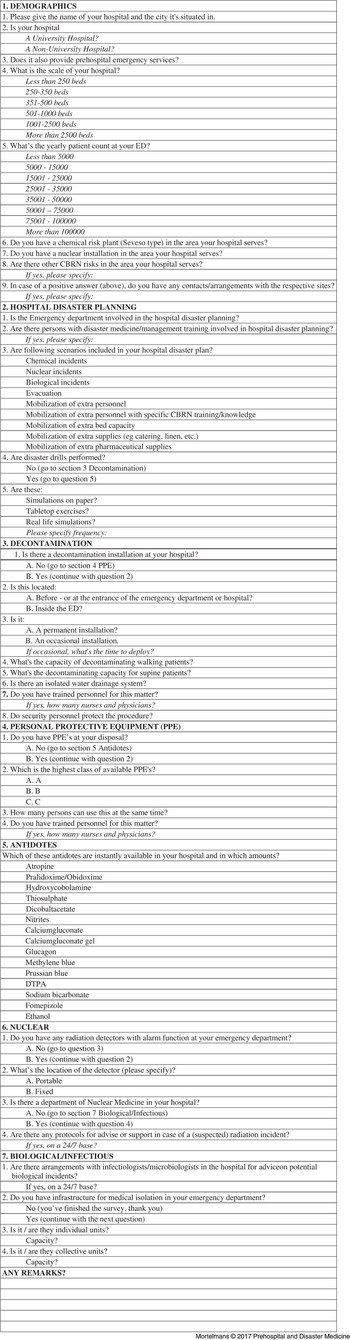
To evaluate the CBRN preparedness of Dutch acute hospitals, a descriptive, cross-sectional survey study was performed in 2013. The study was approved by the ethical committee of Ziekenhuis Netwerk Antwerpen (ZNA), Antwerp, Belgium (EC nr 3958). A link to an online questionnaire (Survey Monkey; Palo Alto, California USA; Figure 1) was sent to the medical directors of all 93 Dutch emergency departments (EDs) through the contact list of the Netherlands Society of Emergency Physicians (NSEP; Utrecht, the Netherlands). This online survey was designed to assess demographics, risk perception for CBRN incidents, hospital disaster planning, decontamination procedures and installations, availability of PPE, staff training and antidote use, availability of radio-detection equipment, isolation resources, nuclear medicine specialists, and infectiologists.
Questions Comprising Online Survey Sent to the Different Dutch Emergency Department Medical Directors.
Abbreviations: CBRN, chemical, biological, and radionuclear; DTPA, Diethylenetriaminepentaacetic acid; ED, emergency department; PPE, personal protective equipment.

The survey was developed at the Center for Research and Education in Emergency Care (CREEC) of the Leuven University (Leuven, Belgium) based upon a local pilot studyReference Mortelmans, Van Boxstael, De Cauwer and Sabbe 7 and was approved by an expert opinion panel of several disaster specialists from the network of the CREEC and the Leuven University Disaster Management Course (joint venture with the Belgian Military and the National Catholic Society for Nurses and Midwives). Non-responders of the initial invitation were sent a reminder email.
Stata SE version 10.1 (StataCorp LP; College Station, Texas USA) was used to evaluate the data statistically. To identify promoting factors in preparedness, comparisons of proportions/percentages were done using the Pearson chi square test. Ninety-five percent confidence intervals were given, where appropriate. A P value less than .05 was considered to be significant.
Results
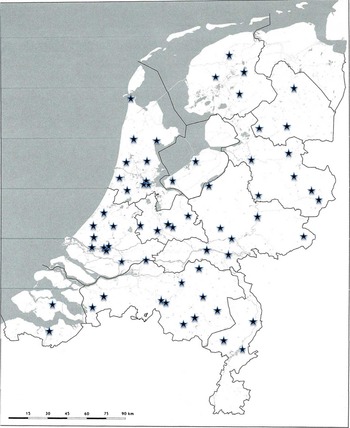
Response rate was 67.0% (geographical spread shown in Figure 2). The estimate of error due to the non-response rate was 16.3%. All results presented here were from this responder group of hospitals. Five percent of the participating hospitals were university hospitals (nine percent of all Dutch EDs are situated in university hospitals) and 15.0% were involved in prehospital emergency services.
Geographical Spread of Participating Hospitals. Note: Remark the concentration in the capital region in the west with also the Port of Rotterdam.

Hospital Disaster Planning
Sixty-two percent of hospitals stated they are at-risk for CBRN incidents (53% high-risk, Seveso type chemical plant in catchment area; 12% nuclear installation). Procedures for chemical incidents were included in hospital disaster plans for 73% of the hospitals, 42% of the hospitals included nuclear scenarios, and 48% included procedures for biological incidents. Almost all hospitals (98%) stated they could mobilize extra personnel in case of disasters, but only 60% of the hospitals had CBRN-trained personnel on call. Ninety-two percent had regular disaster drills as well, on paper, tabletop, or as real-life simulations. Eighty-eight percent stated that they could mobilize extra bed capacity in case of an influx of CBRN-related patients, and 93% of hospitals stated that extra supplies would be available.
Decontamination and PPE
Forty percent of the participating hospitals had a decontamination installation available, located either outside or at the entrance in 83% of them. These installations were permanent in 62% with 42% having an isolated water drainage system. Mean capacity was 3.11 (95% CI, 1.66-4.56; as the variables were not normally distributed; also, the median is added: 2 with 95% CI, 0.88-3.12) ambulatory patients per hour or 1.89 (95% CI, 1.28-2.50; as the variables were not normally distributed; also, the median is added: 1 with 95% CI, 0.26-1.74) supine patients per hour. Appropriately trained decontamination personnel were available in only 77% of the hospitals with decontamination installations, and in case of incident, 42% security personnel were available to protect this procedure.
Personal protective equipment was available in 56% of the hospitals, but only 32% of them were capable of using an appropriate level of protection for CBRN risks. Eighteen percent of the hospitals had access to a higher class of PPE, such as chemical-resistant suits and air purifying canister respirators. Only 14% had full-scale protective equipment, including a self-contained breathing apparatus respirator.
Antidotes
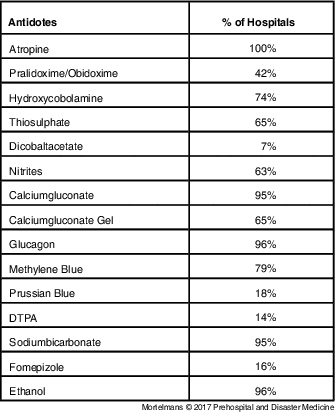
The availability of surveyed antidotes at the studied hospitals is summarized in Table 1.
Availability of Antidotes Expressed in Percentage of Hospitals

Abbreviation: DTPA, Diethylenetriaminepentaacetic acid.
Nuclear Threats
Six percent of the hospitals had a radiation-detection device with an alarm function; all of the devices were stated to be portable.
Although 50% of the hospitals had a department of nuclear medicine, protocols on assistance from nuclear medicine specialists were present in only 32% of them and only 22.5% had nuclear medicine specialists available on a 24/7 basis.
Biological Threats
Seventy-two percent of the hospitals had some arrangement in place for an infectious disease specialist to assist in case of biological threats. However, only 60% could implement this on a 24/7 basis. A dedicated structure for medical isolation was available in 56% of the hospitals; these were mainly individual units. Collective units were available in only 15%.
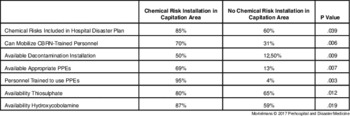
Hospitals with a high-risk chemical installation (Seveso type) in their capitation area significantly more frequently included chemical risks and plans for dealing with them in their hospital disaster plans; they had significantly more decontamination installations, appropriate PPEs, and appropriately trained personnel for these. These hospitals also had greater availability of thiosulphate and hydroxycobolamine. They also had a higher rate of specialized CBRN personnel that could be mobilized in case of incidents (Table 2 shows detailed statistical data).
Statistical Significant Differences in Preparation Between Hospitals with a High Chemical Risk Installation (Seveso type) in Their Capitation Area and Others

Note: Scores are expressed as percentage of hospitals that indeed have availability of the scored parameter. Statistical significance expressed by P value.
Abbreviation: PPE, personal protective equipment.
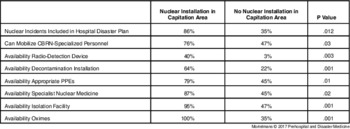
Hospitals with a radionuclear installation in their catchment area also more frequently included nuclear risks and plans for dealing with them in their hospital disaster plans. There was also a significantly greater availability of radio-detection equipment, oximes, nuclear medicine specialists, isolation and decontamination facilities, and appropriate PPEs. They also had a higher rate of specialized CBRN personnel that could be mobilized in case of incidents (Table 3 shows detailed statistical data). The size of a hospital and its university status did not significantly influence preparedness.
Statistical Significant Differences in Preparation Between Hospitals with a Nuclear Risk Installation in Their Capitation Area and Others

Note: Scores are expressed as percentage of hospitals that indeed have availability of the scored parameter. Statistical significance expressed by P value.
Abbreviation: CBRN, chemical, biological, and radionuclear.
Discussion
In the Netherlands, there are 87 (93 at the start of the survey) EDs that provide 24/7 hospital-based urgent care. These are organized in 11 acute care networks. There is coordination within each network on the organization of acute care, including preparedness for CBRN incidents. It is an almost entirely delegated responsibility. Although there are governmental hospital accreditation requirements, there is no national government entity that oversees the performance and preparedness of hospitals in this regard, nor is there any official standard or guideline concerning minimal requirements on CBRN preparedness.
The data support the hypothesis that Dutch hospitals are not adequately prepared for CBRN incidents and that there are some serious gaps in preparedness for treating victims of such incidents. This is not too surprising, given the results of previous literature on hospital preparedness of European hospitals. It is important to note that this is a worldwide problem, as studies done in Canada,Reference Kollek and Cwin 8 China,Reference Li, Huang and Zhang 9 and the USAReference Belsky, Klausner, Karson and Dunne 10 - Reference Becker and Middleton 15 report limited preparedness for treating victims of CBRN incidents in their hospitals. Only Israel, where preparedness is one of the criteria for hospital accreditation, seems to be well prepared for these threats.Reference Tur-Kaspa, Lev, Hendler, Siebner, Shapira and Shemer 16
Hospital Disaster Planning
Concerning hospital disaster planning and surge capacity to treat victims of CBRN incidents, results are more reassuring. In disaster planning, CBRN incidents are included in disaster response plans more often than the risks are perceived. However, to cover the risks of CBRN-related traffic incidents and terrorist threats, plans still need to be more comprehensive than that reported in the survey. The scores in this study were greater than scores reported in a similar study of Belgian hospital preparedness, where inclusion of the actual level of disaster planning did not even meet the needs for disaster planning.Reference Mortelmans, Van Boxstael, De Cauwer and Sabbe 7 By contrast, almost all the Dutch hospitals surveyed here reported that they could mobilize extra personnel in case of an incident. However, at the same time, the availability of CBRN-trained personnel is limited overall, with only 60% of hospitals having this capacity.
Decontamination and PPE
Another aspect of achieving adequate CBRN-incident preparedness is to have in place hospital decontamination structures, equipment, and trained personnel. To prevent secondary exposure of ED personnel or infrastructure to toxic materials, as negatively illustrated by the Tokyo sarin gas attack of 1995,Reference Okumura, Takasu and Ishimatsu 17 , Reference Wetter, Daniell and Treser 18 all contaminated patients should be decontaminated before entering the ED, or at least at the entrance of the ED. Besides protecting caregivers and the infrastructure, decontaminating people before they are admitted to the ED also has the therapeutic benefit of limiting exposure to toxic substances.Reference Stewart-Evans, Sharman and Isaac 19 - Reference Larson, Orr, Auf der Heide, Wu, Mukhopadhyay and Horton 21 Many hospital managers trust that victims have already undergone on-scene Emergency Medical Services (EMS) decontamination before being transported to designated hospitals. In real life, however, many arrive at hospitals by different means, often bypassing the EMS system altogether.Reference Wetter, Daniell and Treser 18 , Reference Chan, Yeung and Tang 22 - Reference Hildebrand and Bleetman 24
Only one out of three hospitals in this survey reported being able to decontaminate CBRN-incident victims before entering the ED, leaving the majority of hospitals at-risk for incidents of secondary contamination. The capacity of these installations is also insufficient to cope with mass-casualty incidents. This further raises the risk of secondary contamination. Fortunately, there is a same ratio of available appropriate PPEs to protect the triage and decontamination site personnel; PPE consisting of a splash protective, chemical-resistant suit with a full-face shield and filter purifier respirator mask is the minimum equipment recommended for these situations.Reference Horby, Murray, Cummins, Mackway-Jones and Euripidou 5 , Reference Chan, Yeung and Tang 22 , Reference Baker 25 , Reference Barelli, Biondi, Soave, Tafani and Bononi 26
Availability of Antidotes
Atropine is omnipresent as it is used in daily practice for purposes other than those related to CBRN incidents, be it in smaller doses. Standard used antidotes, such as sodium bicarbonate, glucagon, and ethanol, are also readily available, but more specific chemicals needed to treat CBRN victims as oximes, Diethylenetriaminepentaacetic acid (DTPA), and dicobaltacetate were clearly less frequently reported to be in stock at the surveyed hospitals. High costs to maintain stocks of these latter drugs and low-risk assessment for their use are probably the major reasons why most hospitals did not stock these drugs.
Nuclear and Biological Threats
Although 12% of the hospitals surveyed are located near nuclear installations, only six percent of them had access to a radiation detector with an alarm function to identify patients potentially contaminated by radiation. All other hospitals should keep in mind that a so-called “dirty bomb” could also confront them with this category of risk.
Assistance from the nuclear medicine department in these hospitals was also limited, especially with regard to 24/7 availability.
Infectiologists were more readily available to deal with biological incidents, but once again, 24/7 coverage was limited to 60% of the hospitals surveyed. Also, availability of isolation facilities would be insufficient in case of biological threats, especially in case of multiple-casualty incidents.
The higher preparedness scores of hospitals with a reported chemical or nuclear risk installation in their catchment area illustrates that there is a clear positive effect of risk perception.
Comparing the results with those reported in the available literature is difficult in this area, because studies of similar evaluations are rather scarce. For example, an evaluation of hospital preparedness in four important regions in ChinaReference Li, Huang and Zhang 9 revealed that these hospitals were mainly focused on infectious pathology following the 2002 SARS outbreak. Preparation for CBRN incidents was included in only 20.5% of these hospital disaster plans and only 13.3% of the hospitals felt prepared to admit and treat victims of a CBRN incident. A national survey of hospitals in CanadaReference Kollek and Cwin 8 revealed a similar risk profile: 42.0% of the hospitals with a high-risk chemical installation in the catchment area and 12.0% with a nuclear installation. But, by contrast, their preparedness scores were not as good as in the Dutch group: 30.0% had decontamination facilities (one-half of them inside the hospital) and only five percent could use appropriate PPEs. Also, specific antidotes as anticyanides (55.0%) and oximes (33.0%) were less available.
Studies of hospitals preparedness in the US are specifically tied to different locations and results vary widely. Availability of decontamination facilities at US hospitals vary from 52%Reference Keim, Pesik and Twum-Danso 13 to 81%,Reference Belsky, Klausner, Karson and Dunne 10 and readily available appropriate PPEs vary from none of the hospitalsReference Bennett 12 to 82%.Reference Belsky, Klausner, Karson and Dunne 10 One studyReference Treat, Williams, Furbee, Manley, Russel and Stamper 14 mentioned that 73% of the hospitals were not prepared at all to deal with CBRN incidents, and anotherReference Becker and Middleton 15 stated that neither the studied EDs, nor the hospital facilities, were prepared for an event involving radioactive materials.
The majority of the European literature on this subject comes from the UK. However, a study conducted in Poland showed that Dutch hospitals in the present study scored better than 12 important urban agglomeration hospitals in Poland, which lacked chemical plans, decontamination facilities, and PPEs.Reference Burda, Sein Anand, Chodorowski and Groszek 3
An evaluation of UK hospitals’ preparedness for biological incidents revealed that 24% were equipped with isolation facilities.Reference Nathallee, Curphey, Beeching, Carley, Crawford and Mackway-Jones 4 By contrast, 56% of the hospitals in The Netherlands sampled in the present study stated that they had isolation facilities. In 1999, the chemical preparedness of 308 EDs in six health regions of England was evaluated:Reference Horby, Murray, Cummins, Mackway-Jones and Euripidou 5 71% of the hospitals had a disaster plan for chemical incidents (vs 73% in the present study of Dutch hospitals); 10% had a safe and effective decontamination installation (vs 33% in the present study); and 12% had appropriate PPEs (vs 32% in the present study). After the London terrorist bombings of 2005, the British government passed legislation mandating that hospitals bear the statutory responsibility of preparing for chemical incidents. Hospital preparedness was subsequently assessed in 18 hospitals across North West England.Reference Williams, Walter and Challen 6 The hospitals’ preparedness has improved since the last century, but it is still not optimal. Eighty-eight percent of the hospitals had a chemical disaster plan, but only 38% of them could locate it in a reasonable amount of time. All had decontamination facilities, but only 61% were adequately equipped. Some of the cited studies might be outdated but, as previously mentioned, quantitative research in this field is rather scarce and under preparedness is the common feature over time.
It is clear that there are serious gaps in the preparedness of Dutch hospitals and EDs for treating victims of CBRN incidents, even in cases of a small-scale incident. Financial aspects of paying for adequate preparedness in growing financial pressures on hospital’s resources represent a major obstacle, as stated by many participants. Maintaining stocks of antidotes, installation of decontamination and isolation facilities, providing the personnel with appropriate PPEs, and training them to use everything represents a huge financial burden. In times of limited budgets, hospital administrators balk at investing in “low-risk” niches of preparedness, apparently believing that “it will never happen to us.” As long as there is no national directive with minimal requirements for hospital accreditation, there is little hope for improvement. European directives could be a move towards uniform preparedness, as budgets permit.
Limitations
A limitation of this study is that it was based on self-reported data. Some questions, especially those on antidotes availability, were difficult to answer, thus there is the possibility that the study may have a degree of reporting bias. However, there is a belief that these limitations do not discount the findings and they likely do not mislead one about the problem of unpreparedness of hospitals to treat victims of CBRN incidents. The fact that one out of three hospitals did not respond is another important limitation. Former preparedness studies revealed that responders are the most committed ones, so real national figures could even be worse than those reported here.
Conclusion
The observation was that despite a high-risk perception of threats, there are serious gaps in the preparedness of Dutch hospitals for treating patients involved in CBRN incidents.
Acknowledgements
The authors wish to thank the Belgian Society of Emergency and Disaster Medicine (Brussels, Belgium) for the use of its Survey Monkey account and the NSEP for its support in contacting and recruiting the participants.
Author Contributions
LM conceived the study, developed the survey, did the literature search, and wrote the manuscript. MG was the liaison with the NSEP and recruited the participants. GD and KA performed the statistical analysis, and MS helped in developing the survey and methodology. All authors read and approved the final version of the manuscript.