Introduction
The Mediterranean fruit fly, Ceratitis capitata (Wiedemann), is one of the most destructive pests found in fruit orchards (Liquido et al., Reference Liquido, Barr and Cunningham1997). The main method usually used to control this pest is the application of conventional insecticides such as organophosphates. In several Mediterranean countries, insecticide treatments are carried out by aerial spraying, which has the disadvantage of affecting non-target insects and vertebrates alike. Moreover, aerial application over high-density residential areas, such as the Mediterranean coast, provokes public concern. Traditional biological control is one of the possible ways to fight against C. capitata; indeed, for over 100 years, the search has been on to discover new parasitoids and predators to control this plague. Recently, new hymenopterous parasitoids (Copeland et al., Reference Copeland, Wharton, Luke and De Meyer2002; Lopez et al., Reference Lopez, Sivinski, Rendon, Holler, Bloem, Copeland, Trostle and Aluja2003), have been discovered, which could be potential biological control agents for C. capitata. Examples of these are Fopius ceratitivorous (Wharton), which originated in Africa, and Aganaspis daci (Weld) from the Mediterranean (Papadopoulos & Katsoyannos, Reference Papadopoulos and Katsoyannos2003).
Moreover, although the use of microbiological control agents has been widely studied in the laboratory (Castillo et al., Reference Castillo, Moya, Hernandez and Primo-Yufera2000; De La Rosa et al., Reference De La Rosa, Lopez and Liedo2002; Dimbi et al., Reference Dimbi, Maniania, Lux, Ekesi and Mueke2003), field trials using these micro-organisms are not widespread. Currently, our group is carrying out various field trials to analyse how Metarhizium anisopliae can be used as a new weapon to control this pest (our results are so far unpublished).
The possibility of insect control or eradication through the use of sexually sterile males was described in 1955 (Knipling, Reference Knipling1955); and this method, known as the sterile insect technique, is still currently in use. The sterile insect technique has demonstrated its ability to reduce fruit fly populations, and consequently reduce damage to fruit. For the sterile insect technique to be carried out successfully, C. capitata populations should have been previously reduced by either aerial chemical treatments (Batkin, Reference Batkin1995), mass trapping, lure and kill methods (Katsoyannos & Papadopoulos, Reference Katsoyannos and Papadopoulos2004) or biological control (Wong et al., Reference Wong, Ramadan, Herr and McInnis1992). Thus, a large number of released sterile males compete with a small number of wild males. However, in Mediterranean regions C. capitata populations are very high, which means that these pre-treatments are not sufficient to reduce the fruit fly population. It was for this reason that, at the end of 1990s, our group began the search for a method to efficiently reduce Mediterranean fruit fly populations. First, trials were conducted to look for an insect growth regulator that reduced fertility or fecundity in C. capitata. Lufenuron showed a high activity in reducing egg hatching. When females ingested a bait containing 0.1% (w:w) lufenuron, the hatching of the subsequently laid eggs was prevented. Moreover, in laboratory experiments, females that mated with lufenuron-treated males (0.5% (w:w) a.i. in diet) laid non-viable eggs (Casana-Giner et al., Reference Casana-Giner, Gandia-Balaguer, Mengod-Puerta, Primo-Millo and Primo-Yufera1999).
After this laboratory study, several field trials were carried out. The aims of these were three-fold: to test the minimum required surface area in order to obtain representative results, to discover the optimum bait composition and to ascertain the isolation grade of orchards, so as to optimize further field trials (Navarro-Llopis, Reference Navarro-Llopis2002). Lufenuron application studies and initial extended field trials were then conducted, with the application of lufenuron using the bait trap method. The result was a significant reduction in C. capitata population and significantly less stung fruit in lufenuron-treated orchards than in untreated orchards (Navarro-Llopis et al., Reference Navarro-Llopis, Sanchis-Cabanes, Ayala, Casana-Giner and Primo-Yufera2004). Additionally, this study also showed that barriers were needed to reduce Mediterranean fruit fly population intrusions into lufenuron-treated fields. Consequently, a new, four-year-long study over an extensive and isolated area was designed to verify the effectiveness of this new method and its possible cumulative effect on C. capitata populations.
In this paper, the use of chemosterilization as a method of reducing C. capitata populations is discussed, referring to the results from the four-year field trial, comparing chemosterilant treatment with malathion plus protein bait treatment in citrus orchards. The possibility of combining chemosterilization and the sterile insect technique in high population areas is also discussed.
Materials and methods
Trial fields description
Trials were carried out in a citrus orchard located in the Casella Valley, Alzira, Valencia, Spain using sweet oranges of the Navel group, Citrus sinensis Osbeck, and mandarins, Citrus reticulata Blanco (cv. ‘Marisol’ and cv. ‘Clementina Fina’), as the cultivated species. Figure 1 shows a site map of the trial fields. The east side of the trial field looked on to untreated fruit orchards and the west side looked on to another trial field where microbiological control of C. capitata was being carried out. The trial area was bordered on the north and south sides by hills, barren of fruit trees capable of hosting Mediterranean fruit flies. In the selected malathion-treated field, early mandarins, C. reticulata (cv. ’Marisol’), and sweet oranges, C. sinensis (cv. ’New Hall’), were being cultivated. In the lufenuron-treated fields, the main fruit trees cultivated were early mandarin, C. reticulata (cv. ’Marisol’ and cv. ‘Clementina Fina’), and sweet orange, C. sinensis (cv. New Hall).
Plan of field trial area in the Casella Valley, Alzira, Valencia, Spain.

In the trial fields, two types of treatment against Mediterranean fruit fly were compared: a chemosterilant treatment using traps with a lufenuron bait (lufenuron treatment) and a series of aerial applications of malathion with bait (malathion treatment). The lufenuron-treated fields covered some 80 ha and the malathion-treated fields 120 ha, some 0.5 km away from lufenuron-treated fields.
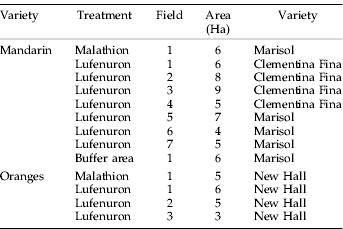
In the lufenuron-treated area, ten plots ranging in size from 3 to 9 ha were established (table 1) according to their characteristics, using criteria such as irrigation technique, variety of trees and cultural management. Separation between neighbouring plots was between 10 and 100 m, using roads or ravines as natural boundaries. In seven plots, there were mandarin varieties; and in three plots, there were orange varieties. A further plot, located to the west side of the lufenuron-treated field, along the barrier between the malathion-treated orchards and the lufenuron-treated area, was considered a buffer area.
Description of different plots in lufenuron- and malathion-treated areas in a field trial in the Casella Valley, Alzira, Spain.
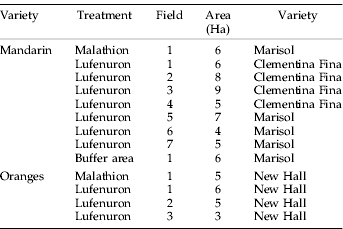
In the malathion-treated area, an 11 ha field was selected as a check field for C. capitata monitoring (fig. 1). This field contained two plots: one 6 ha plot of mandarins and one 5 ha plot of oranges. In 2004, the mandarin orchards lufenuron 3 and lufenuron 7 were removed from the trial because the trees were dug up.
Traps, attractants and baits
In the field trial, three types of traps were used: delta traps, Tephri traps and International Pheromone McPhail traps (IPMTs). The delta trap was yellow with a rectangular base measuring 15×10 cm, with two rectangular sides of similar dimensions that formed a triangular profile. Delta traps were provided by Econex (Murcia, Spain). Tephri traps from Utiplas S.L. (Madrid, Spain) (Katsoyannos, Reference Katsoyannos1994) consisted of a yellow invaginated base 5 cm deep, fitted with an opaque lid (3.5 cm high). The total height of the trap was 14 cm and its diameter at the junction of the lid with the base was 12 cm. Four fly entry holes, 2.1 cm in diameter, were placed at 90° to each other, 1 cm from the top of the trap base. The IPMT by Econex (Murcia, Spain) (Katsoyannos, Reference Katsoyannos1994) is a container made of a yellow base (7 cm tall) with a clear top (11 cm tall) and is 17 cm in diameter at its widest point.
Attractants used were: 1,1-dimethylethyl 4(or 5)-chloro-2-methylcyclohexanecarboxylate plug, commonly known as Trimedlure, a synthetic sexual attractant for males (Beroza et al., Reference Beroza, Gertler, Miyashita, Green and Steiner1961), manufactured by Econex (Murcia, Spain) and Biolure, a synthetic food-based attractant, attractive to both male and female Mediterranean fruit flies, consisting of separate chemical release packets for ammonium acetate, trimethylamine and putrescine, manufactured by Suterra (Oregon, USA).
The phagostimulant bait was a proteinaceus gel manufactured by Ecologia y Protección Agrícola (Valencia, Spain) that contained 30 g l−1 a.i. of lufenuron technical grade ((RS)-1-[2,5-dichloro-4-(1,1,2,3,3,3-hexafluoropropoxy)phenyl]-3-(2,6-difluorobenzoyl)urea) as manufactured by Syngenta (Basel, Switzerland).
Monitoring and barrier traps
The purpose of carrying out the monitoring was to follow C. capitata population dynamics all year round, paying special attention to the particular period of the year when fruit ripens. In order to monitor C. capitata populations, IPMTs baited with a Trimedlure plug and a 1.5 g tablet with 20% dichlorvos (as manufactured by Econex of Murcia, Spain) were used to kill C. capitata. The IPMTs with a Trimedlure plug and a dichlorvos tablet were hung in the lufenuron-treated area and in the check field at a density of one per hectare. (These traps are later referred to as monitoring traps.) Ceratitis capitata population monitoring was performed with 80 IPMTs in the 80 ha treated with lufenuron and 11 IPMTs in the check field (one trap per hectare). Inside each trap, one plug of Trimedlure and a dichlorvos tablet were placed. During 2001, traps were inspected weekly from the beginning of April to 15 August, twice per week from 16 August to 7 October, and then weekly again from 8 October to the end of the trial (in December). During 2002, 2003 and 2004, the traps were monitored weekly from February to December. Trimedlure emitters from the barrier and the monitoring traps were replaced every two months and tri-pack attractants and dichlorvos strips were replaced every 45 days.
In order to avoid C. capitata intrusion in to the test field, a 100 m wide mass trapping barrier of Tephri-traps and IPMTs was placed at the east and west side of the trial area. Tephri-traps contained a Biolure attractant and a dichlorvos tablet to kill fruit flies, as per the mass-trapping technique. IPMTs contained a Trimedlure plug and a dichlorvos tablet. One hundred and fifty traps (50 IPMTs and 100 Tephri-traps) were placed in each barrier (on the east and west sides of the trial field; fig. 1) at a density of 30 traps per hectare. (These traps are later referred to as barrier traps.)
Chemosterilant treatment
The gel with lufenuron was placed into a 9 cm internal diameter Petri dish at a quantity of 80 ml of gel per dish and placed in delta traps, which were then hung on the south-east side of the trees, 1.5 meters above ground, 24 traps ha−1. Each delta trap carried inside attractants (Trimedlure and/or Biolure). (These delta traps, including the chemosterilant bait and attractants, will later be referred to as chemosterilant traps.) Approximately one trap per 15 trees was hung in this way. The bait remained in the field inside the trap during the whole season.
The Biolure attractant increased the attraction of females. However, only one in each three traps carried a Trimedlure dispenser inside it, right in the centre of the Petri dish, to maintain the attraction of males. In this case, the distance between Trimedlure attractants was three times greater than the distance between Biolures, due to the superior efficacy of Trimedlure over large distances. In this way, males and females were attracted so as to obtain the greatest possible result on the C. capitata population. Direct visual observation in the field showed that males and females were attracted to the traps. Males were attracted mainly by Trimedlure because they landed directly on the Trimedlure plugs. Normally, after a short time, the males went down the plug, walked on and fed on the bait. However, females went directly to the bait at the edge of the Petri dish and fed on bait. Finally, both males and females would leave the trap and fly away.
Chemosterilant traps were placed before the first annual C. capitata population outbreak (between 15 May and 15 June). The treatment began on 10 May 2001 and traps remained in the field until 25 April 2002, when they were replaced with new traps. These new traps were in turn replaced on 20 April 2003 and remained in the field until May 2004, when they were again replaced with new ones, which lasted until the end of the trials in November 2004. Moreover, during 2001 and 2002, 50 chemosterilant traps were placed at the entry to the valley, about 2 km away from the lufenuron-treated area, for the purpose of aging trials.
Check field and insecticide treatments
The check field was aerially sprayed at a rate of 20 l ha−1 with 7.5 g malathion l−1 (Malafin 500 g l−1 manufactured by Agrodan, Valencia, Spain) and 12 g l−1 of protein bait (Buminal, 300 g of protein l−1, manufactured by Bayer Crop Science, Andernach, Germany) in order to reduce the fruit fly population. Aerial bait spraying of malathion was carried out once in 2001: on 28 August; five times in 2002: 27 June, 22 July, 8 August, 10 September and 14 October; seven times in 2003: 9 July, 20 August, 16 and 30 September, 11 and 22 October and 15 November; and 11 times in 2004: 3 and 16 of August, 1, 15 and 23 of September, 1, 9, 18 and 27 October and 4 and 16 November. Increasing aerial treatments are the result of the joint USA–pain protocol for mandarin exports to USA, which stipulates the need for this application if C. capitata populations are higher than 0.5 flies per trap per day.
The usual insecticide treatment in this Spanish region against Aonidiella auranti (Maskell) (Homoptera: Diaspididae), consisting of one treatment of chlorpyriphos in April–May, was carried out in the check field and lufenuron-treated area. Moreover, all Marisol mandarin areas (from both the check field and the lufenuron-treated area) were treated terrestrially with malathion against C. capitata three times per year during September and October in order to avoid fruit damage. These treatments corresponded to treatments that farmers perform in most Spanish citrus areas and were carried out by spraying single square metre spots on the south side of the trees with backpack sprayers. Applications were made with Buminal and Malafin and each treatment consumed 200 l ha−1 of the following composition: malathion 2.5 g l−1 and Buminal, 5 ml l−1.
Laboratory sterilant trials
Ceratitis capitata were reared in our insectarium in a 16:8 light:dark photoperiod, with 50–60% relative humidity and at a temperature of 27±1°C. Adult flies were fed with standard diet, a mixture of yeast autolysate from Sigma-Aldrich (Steinheim, Germany) and sucrose 1:4 (w:w). Larvae were reared on a mixture of wheat bran:sucrose:beer yeast:nipagin:nipasol:water and hydrochloric acid (20:5:1:0.5:0.5:10:0.1), determined by weight. Our C. capitata colony has been maintained since 1995. However, each year, wild pupae (50% of the total pupae colony population) are added to maintain the biological similarity of the colony with that of the wild population.
In order to test the loss of activity of the baits due to aging, laboratory tests were conducted as follows. For aging the baits, 50 delta traps, each one including a Petri dish with bait, 25 with lufenuron and 25 without lufenuron, were hung in 50 trees. Traps were placed 1 km away from the malathion-treated area and about 2 km away from the lufenuron-treated area at the beginning of May of 2001 and 2002. Petri dishes with aged bait gels were collected from the field every month (0, 30, 60, 90, 120, 150, 180, 210 and 240 days) and tested in laboratory assays. For each date, three bait dishes were collected from the field and these, together with three bait dishes without lufenuron, were individually placed into six separate Plexiglas cages (30×30×30 cm), each with 60 Mediterranean fruit flies (30 males and 30 females). The flies were five days old and had been starved for 24 h before the gels were introduced in to the cages. The gels remained inside the cages, available to the flies, for 3 h. During that time, flies were able to eat the lufenuron-bait gel. After 3 h, the three dishes with gels with lufenuron and the three gels without lufenuron were replaced with standard diet. Fifteen females were caught from each cage and introduced into three plexiglass cages (five flies per cage) in order to obtain three measurements of fertility per aged bait. In total, 18 cages were prepared, nine for the bait with lufenuron (three cages per bait) and nine for the control without lufenuron, five females per cage. In these cages, females lay eggs through the fabric of the plexiglass sides, and the eggs fall to a plastic container filled with water. One hundred and fifty eggs per cage, laid between 24 to 48 h after the bait ingestion were collected with a Pasteur pipette and placed onto three Petri dishes with agar gel (3 g l−1), 50 eggs per Petri dish. Three days after the eggs were placed in the dishes, egg hatching was evaluated, employing a stereoscopic microscope (Leica MZ75, 40×). This test was replicated during 2002.
Statistical analysis
Three pre-defined periods were established for statistical analysis. The first period was established up until one month before the maximum population level was achieved (15 May in the first year and 15 June in the second, third and fourth years), when the first C. capitata generation occurs. The second period started at the end of first period and lasted until 45 days after maximum population level was achieved. This period finishes with a natural breakdown of the C. capitata population. The third period runs from the end of second period to the end of the season, when fruit fly populations are low but fruit is ripening and fruit damage occurs. Two analyses were made in order to study the effect of lufenuron treatment versus malathion treatment: (i) a multiple regression model with Poisson error for the global efficacy of the treatments along the years; and (ii) a one-way ANOVA followed by the Tukey procedure. The advanced regressional poisson analysis uses as its dependent variable the sum of weekly trappings indexes for each of the predefined periods. This analysis was carried out separately for oranges and clementines. Age and type of treatment were then introduced as variables. Finally a one-way analysis of variance (ANOVA) and Tukey was applied to the aggregated catches. In order to perform the ANOVA, we used ‘Statgraphics plus 5.1’.
Assuming that each year the C. capitata population differs from that of the proceeding years (due to the unique biology of the flies), we needed to create an index to evaluate the annual efficacy of the chemosterilant, to measure the difference of population levels in a treated field against an untreated field, year on year. The index lists the reduction in fruit fly population in Lufenuron areas with respect to malathion-treated areas. The annual amount of fruit flies in each field is calculated by the sum of weekly averages of catches from 15th April to 30th November. Therefore, the annual efficacy index of the lufenuron treatment can be calculated as follows:
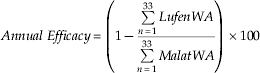
Where n=number of weeks from 15 April to 30 November; LufenWA=weekly average of Mediterranean fruit fly catches in flies per trap per day in the lufenuron-treated area; and MalatWA=weekly average of Mediterranean fruit fly catches in flies per trap per day in the malathion-treated area.
Results and discussion
Chemosterilant treatment efficacy
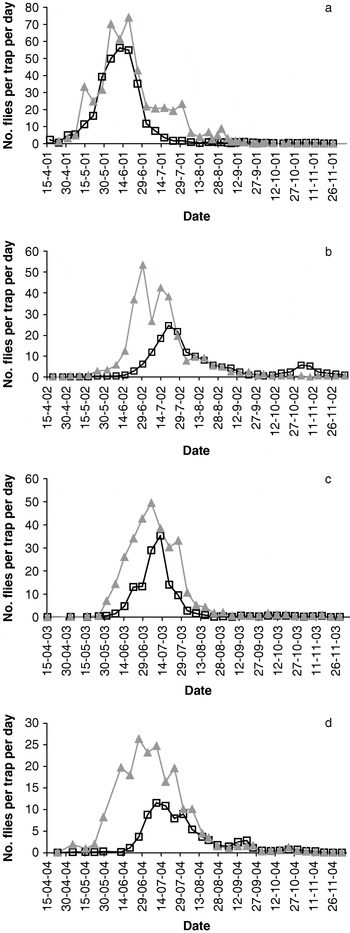
Figure 2 shows the population evolution of C. capitata in the lufenuron- and malathion-treated areas in 2001, 2002, 2003 and 2004. In 2001, as lufenuron traps were placed in the fields on 10 May, population reduction could not be expected until the following generation. In the normal temperature of this area in May–June, one generation lasts 45 days. In fact, between the first monitoring date and the end of June, no differences in Mediterranean fruit fly population were observed. However, from the end of June until the end of the year 2001, the population was significantly lower in the lufenuron-treated areas than in the malathion-treated area (fig. 2a).
Evolution of Mediterranean fruit fly populations in lufenuron (□) and malathion ( ) treated fields in the Casella Valley, Alzira, Spain in 2001 (a), 2002 (b), 2003 (c) and 2004 (d).

Between 2002 and 2004, a continuous population reduction was observed in the lufenuron-treated area. In 2002, the fruit fly population peak was delayed in lufenuron-treated areas by between 15 and 21 days compared to malathion-treated areas, and it was observed that the maximum population in the lufenuron-treated area was half that of the malathion-treated area (fig. 2b). During 2003 and 2004, the Lufenuron area population always remained below that of the malathion area (fig. 2c,d).
From fig. 2, it can be seen that between 2001 and 2004 a continuous population reduction was achieved in both the malathion- and the lufenuron-treated areas. In the first year of the study, in the malathion-treated fields the maximum population level reached 73 flies per trap per day, whilst in 2002 it was 52, in 2003 it was 49 and in 2004 it was 26. This reduction can be explained by the increasing number of malathion aerial treatments (from only one treatment in 2001 to 11 treatments in 2004). However, the C. capitata population in lufenuron-treated areas was always, with the exception of the end of the year of 2002 and three weeks in 2003, beneath the fruit fly population in malathion-treated areas. The maximum population reduction was achieved after four years of continuous lufenuron application, where a final maximum level of 13 Mediterranean fruit fly per trap per day was obtained.
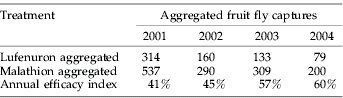
In order to evaluate the efficacy of lufenuron, we have established an ‘annual efficacy index’, which takes into account the fruit fly population of two differently treated areas during the year. In this case, we are comparing lufenuron treatment vs. malathion treatment. Table 2 shows the result gained in calculating this index, showing the increasing efficacy of this method year after year, which in the last year reaches an efficacy level of 60%. In this index we have not included the increasing number of aerial treatments in the malathion-treated area, which means that, when we study the cumulative efficacy of lufenuron treatments from year to year, we are looking at the real efficacy of lufenuron treatments. In fact, a linear correlation between efficacy and years of treatment can be observed, with a correlation ratio of r=0.97 with a P-value=0.0295, lower than 0.05. These results prove that the chemosterilization effect is cumulative and, therefore best results are obtained after successive seasons and applications.
Annual efficacy index during four years depending on treatment type in a field trial in the Casella Valley, Alzira, Spain.
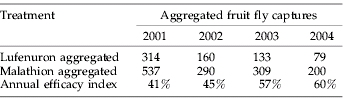
Lufenuron aggregated=sum of weekly averages of Mediterranean fruit fly catches in flies per trap per day in the lufenuron-treated area.
Malathion aggregated=sum of weekly averages of Mediterranean fruit fly catches in flies per trap per day in the malathion-treated area.
Annual efficacy index: one minus the quotient of lufenuron aggregated divided by malathion aggregated (in percentage).
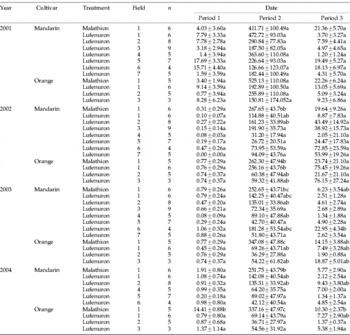
Table 3 shows Mediterranean fruit fly population in the seven mandarin lufenuron-treated areas compared to malathion, and the three orange lufenuron-treated areas also compared to the malathion one.
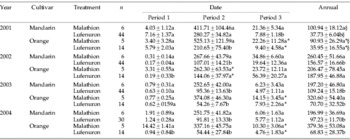
Aggregated catches of Ceratitis capitata per period (average±SEM) in malathion- and lufenuron-treated plots from 2001–2004 in a field trial in the Casella Valley, Alzira, Spain.

a, b, Values of the same period with the same letter within the same cultivar and year are not significantly different in the Tukey test (P=0.95).
n: number of monitoring traps.
Period 1, up until one month before the maximum population level; period 2, from the end of the first period to 45 days after the maximum population level; period 3, from the end of the second period to the end of the season.
Data were subjected to (log x) transformation for analysis; untransformed data are presented.
No significant differences were observed between C. capitata populations in lufenuron- and malathion-treated plots during the first year. In the second year significant differences were observed in the second period (F=4.09, df=11,61, P=0.0002). In this period five mandarin lufenuron-treated plots have significantly fewer catches than malathion-treated plots. In the third year these differences can be observed in three plots in the second period (F=4.30, df=11,61, P=0.0001), and in the fourth year these differences can be observed in all orange plots in the first and second period and in two orange fields in the third period.
Buffer areas were located in the first 100 m of lufenuron treatment, closer to malathion treatment areas. These buffer areas had intermediate results and only in 2002 did C. capitata populations differ significantly from those in the malathion-treated areas. It is normal that in surrounding fields, fruit fly populations were higher than in the central treated field (Navarro-Llopis et al., Reference Navarro-Llopis, Sanchis-Cabanes, Ayala, Casana-Giner and Primo-Yufera2004). In order to avoid this effect of fruit fly invasion, insecticide application (McQuate et al., Reference McQuate, Sylva and Jang2005) or perimeter mass trapping (Cohen & Yuval, Reference Cohen and Yuval2000) was used.
Collectively taking all the lufenuron fields on the one hand and all the check fields on the other (table 4), the following results are obtained. In the first year of trials, the fly population did not differ significantly from one area of treatment to another in the mandarin fields until they had been treated with lufenuron for 45 days, where we see figures of 272.93±98.52 for lufenuron as compared to 275.03±32.84 for malathion (F=0.00, df=58,1, P=0.97). However, as shown in table 4, in the first year, only after the initial 45 day period does the total sum of lufenuron treatment trappings become significant, and this fact is repeated in each of the four years of the study. By carefully analysing the data by time periods, we can conclude that these differences primarily take place in the central period when the highest population level exists. However, it is interesting to note that in the third period, population differences due to treatment type are not observed, which would indicate that the lufenuron treatment in the fourth year had the same effect as 11 malathion aerial treatments. Also worthy of note is that in the first period, except in the first year, the number of captured flies is always less in the lufenuron fields than in the malathion fields, despite the fact that only in orange fields in the fourth year can significant differences be observed between treatments.
Aggregated catches of Ceratitis capitata per period (average±SEM) in malathion- and lufenuron-treated fields from 2001 till 2004 in different cultivars in a field trial in the Casella Valley, Alzira, Spain.

Period 1, up until one month before the maximum population level; period 2, from the end of the first period to 45 days after maximum population; period 3, from the end 2 of the second period to end of the season.
§ Annual (without 10 first weeks when no efficacy is expected).
a, b, Values of the same period with the same letter within the same cultivar and year are not significantly different in the ANOVA test (Tukey) with P⩽0.05.
* Denotes significant difference in ANOVA test (Tukey) with P⩽0.1.
The regression model once again shows that the ‘type of treatment’ factor is significant when the data is analysed over the whole period (P<0.00) or in the second period (P<0.00). However, this factor is not significant when separately analysing the first and third periods.
Chemosterilant bait durability
In this field trial, the lufenuron bait stations were replaced only once per year. In order to ensure the activity of bait gels, they were tested in laboratory conditions after field aging. Results are shown in table 5. During the seven months that C. capitata activity occurs in Mediterranean conditions, the gels remain active, reducing fertility below 8%. The bait stations were replaced every year but attractants were replaced every two or three months. Currently, new dispensers based on zeolites and other micro- and mesoporous inorganic materials are being developed in order to reach a constant emission for at least seven months (Munoz-Pallares et al., Reference Munoz-Pallares, Corma, Primo and Primo-Yufera2001). With this development it will be possible to continuously reduce C. capitata populations with the same dispenser all year round.
Eggs hatching (%±SEM) from lufenuron bait-gel fed females and non-lufenuron bait gel fed females of Ceratitis capitata in the laboratory.

(+) Lufenuron, protein bait gel containing 30 g l−1 of lufenuron; (−) lufenuron, Protein bait gel containing without lufenuron.
a, b, Values within the same aging with the same letter are not significantly different in Student t-test (P⩽0.05).
Data were subjected to arcsine (sqrt(x)) transformation for analysis; untransformed data are presented.
Discussion
The present results show, at the very least, the same efficacy of the chemosterilant technique when compared to aerial malathion spraying. The tolerance of C. capitata to malathion has increased notably recently (Ortego et al., Reference Ortego, Magaña, Hernández-Crespo and Castañera2005) and the use of malathion in the EU has been limited by European Guideline 91/414. For these reasons, new products and methods are being developed and, in line with this, we have tested a new method that allows us to keep Mediterranean fruit fly populations low, using only 24 traps per hectare once per year.
Currently, chemosterilization traps are deployed in Spain over a 7000 ha area, and they cost, on average, €6.2, which includes attractants and gels. In additional to this, transport and handling costs add a further €0.9 per trap. The total cost, therefore, to set a field with chemosterilization traps, amounts to some €170 per hectare. This amount should be compared to the cost of aerial malathion treatment, which amounts to 4–5 € per fly-by, or pass. In a normal season of six passes, this treatment amounts to 25–30 € per hectare per season. As an orientative cost guide, in Spain at least, other existing alternative treatments (apart from malathion) cost, in the case of Spinosad aerial application, 8–10 € per pass per hectare, which corresponds to a rough amount of 50–60 € per six pass season per hectare. In the case of the sterile insect technique, releasing males during 47 weeks per year at 3000 males per hectare costs around 90–110 € per hectare.
These costs show that aerial malathion treatment is the cheapest option, but it does have two disadvantages. The first is its that it is not target-specific (Asquith & Messing, Reference Asquith and Messing1992; Hoelmer & Dahlsten, Reference Hoelmer and Dahlsten1993), which induces plagues and affects both mammals and birds alike, including, on occasion, humans (Marty et al., Reference Marty, Dawson, Bradman, Harnly and Dibartolomeis1994). The second is that it leaves insecticide residues on the fruit, a necessary condition, as these insecticides protect the fruit until it is about to be collected (Berrada et al., Reference Berrada, Fernandez, Ruiz, Molto and Manes2006). Spinosad treatments avoid the insecticide residues problem and no outbreaks of secondary pests occurred as a result of the spinosad bait sprays, as has been reported for malathion bait sprays in citrus (Thomas & Mangan, Reference Thomas and Mangan2005), although more studies on the effect of aerial application over large areas are necessary. Meanwhile, the sterile insect technique is specific and environmentally friendly, although its efficacy in Mediterranean countries, with high C. capitata population levels, has not been proved.
Moreover, the chemosterilization technique shows better results year on year, which indicates that, theoretically, continuous application over large areas should suppress fruit fly populations. The chemosterilization technique is very specific to C. capitata because specific attractants are used. Effectively, during the four years of field trials no pest resurgence has been detected in chemosterilization areas, which could mean that beneficial insects and non-target pests were not affected by this treatment, although more ecological studies are necessary to prove this. A research study is currently underway to trace what effects there may be on any auxiliary fauna in areas that are treated with lufenuron traps as compared to organic orchards. The preliminary findings after the first year suggest that there is no difference between organic plots and those that have been treated with lufenuron for four years (R. Laborda, personal communication).
The main advantage of this method over the sterile insect technique is that chemosterilization affects wild males and females, reducing the Mediterranean fruit fly population, independently of the overall C. capitata population. In Mediterranean countries this is a serious problem, as the fruit fly population level is very high and a large quantity of irradiated males is required for the sterile insect technique to succeed. With the combination of the two methods, it should be possible to reduce the wild Mediterranean fruit fly population with chemosterilization for two or three years and then apply the sterile insect technique in a more efficient and economic way. This combination of chemosterilization with the sterile insect technique is now being studied in a field trial, and the first results will be obtained in 2007.
Acknowledgements
The authors thank Stephen Skillman for helpful suggestions on the first version of the manuscript, Syngenta for supplying technical grade lufenuron, and the R&D+i Linguistic Assistance Office at the Universidad Politécnica de Valencia for their help in revising and correcting this paper. This research has been supported by ‘Fundación Jose y Ana Royo’, ‘Conselleria d'Agricultura Peixca i Alimentacio-GVA’ and INIA project number RTA03-103-C6.