A large body of research indicates that child victimization, physical, psychological and or sexual abuse, has long-term negative consequences. These effects are observed in multiple areas including neurocognitive functioning (Cowell, Cicchetti, Rogosch, & Toth, Reference Cowell, Cicchetti, Rogosch and Toth2015), social (Gilbert et al., Reference Gilbert, Widom, Browne, Fergusson, Webb and Janson2009), emotional (Masten et al., Reference Masten, Guyer, Hodgdon, McClure, Charney, Ernst and Monk2008), and mental health problems (Horwitz, Widom, McLaughlin, & White, Reference Horwitz, Widom, McLaughlin and White2001).
The impact of a history of victimization is not limited to neurological or psychological aspects. Child abuse survivors are more likely to engage in health risk activities, and these activities or behaviors are causes of morbidity and mortality (Hillis, Mercy, Amobi, & Kress, Reference Hillis, Mercy, Amobi and Kress2016; Kendall-Tackett, Reference Kendall-Tackett2013; Min, Minnes, Kim, & Singer, Reference Min, Minnes, Kim and Singer2013; Norman et al., Reference Norman, Byambaa, De, Butchart, Scott and Vos2012). Kendall-Tackett’s pathway model (2013), in particular, includes health-risk behaviors as a subset of the behavioral pathway that links victimization to physical health outcomes.
Felitti et al. (Reference Felitti, Anda, Nordenberg, Williamson, Spitz, Edwards and Marks1998) conducted the Adverse Childhood Experiences (ACE) study and published the first data showing a significant relationship between health-risk/disease in adulthood and childhood exposure to emotional, physical, or sexual abuse and household dysfunction. The impact of these findings linking childhood victimization and health-risk behaviors in adulthood extended the use of the ACE study questionnaire in this area of research. Those who experienced multiple adverse experiences in childhood were significantly more likely to be alcoholics, smokers or users of illegal drugs (Potthast, Neuner, & Catani, Reference Potthast, Neuner and Catani2014) and they were more likely to develop obesity or eating disorders (ACE Study: Anda & Felitti, Reference Anda and Felitti2003). Child sexual abuse has been related to sexual behaviors, such as precocity, promiscuity (Grimstad & Schei, Reference Grimstad and Schei1999), sexually transmitted disease, unwanted pregnancies and abortions (Felitti & Anda, Reference Felitti, Anda, Lanius and Vermetten2009). Finally, individuals who experienced four or more adverse experiences had a higher risk of suicide compared to those with a lower ACE score or non-victims (Thompson et al., Reference Thompson, Proctor, English, Dubowitz, Narasimhan and Everson2012).
However, the ACE study questionnaire provides a preliminary framework with home as the only context for abuse, and it does not consider other contexts or abusers, like school or peers. Moreover, it does not include questions about age of victimization which is an important piece of information, as timing can affect the level of trauma (Goodman, Quas, & Ogle, Reference Goodman, Quas and Ogle2009; Jaffee & Maikovich-Fong, Reference Jaffee and Maikovich-Fong2011). In this regard, there have been proposals made for a revised ACE version that could address these limitations (Anda, Butchart, Felitti, & Brown, Reference Anda, Butchart, Felitti and Brown2010; Finkelhor, Shattuck, Turner, & Hamby, Reference Finkelhor, Shattuck, Turner and Hamby2015). In fact, the ACE international questionnaire (ACE-IQ), currently in the process of validation, includes questions about peers. However, the findings related to health-risk behaviors using the ACE limit the range of victimization to maltreatment by an adult. This limitation arises from the fact that the focus on peer victimization did not emerge until some years later.
The importance of peer-victimization increased in the last decade because of the growing evidence supporting the negative outcomes associated with being bullied during childhood (Copeland, Wolke, Angold, & Costello, Reference Copeland, Wolke, Angold and Costello2013). Indeed, previous studies show the high incidence of peer victimization and its harmful influence on the social and psychological welfare of children (Turner, Finkelhor, Hamby, Shattuck, & Ormrod, Reference Turner, Finkelhor, Hamby, Shattuck and Ormrod2011) and on their physical health (van Dyk & Nelson, Reference van Dyk and Nelson2014). Moreover, an elevated risk for psychosis among bullied children, a type of peer victimization, has been found in prospective studies on trauma from population-based cohorts and samples of vulnerable youths (Schreier et al., Reference Schreier, Wolke, Thomas, Horwood, Hollis, Gunnell, Lewis and Harrison2009). The recent The United Nations Educational, Scientific and Cultural Organization (UNESCO) Global Education Monitoring Report (2017) concludes: “There is now ample evidence of the deep harm that school-related violence causes to children’s health and educational achievement, and to society at large” (p. 14).
Recent studies indicate that peer-victimization has a cumulative effect. Arseneault et al. (Reference Arseneault, Cannon, Fisher, Polanczyk, Moffitt and Caspi2011) studied the likelihood of reporting psychotic symptoms, at age of 12, in children who had been either maltreated by an adult or bullied by peers, or who had experienced both. They concluded that the “cumulative effect of abuse from adults and peers, rather than its timing, appears to confer the highest risk for developing psychotic symptoms” (p. 70).
The cumulative effect of different types of victimization is in line with the concept of “poly-victimization” introduced by Finkelhor, Ormrod, and Turner (Reference Finkelhor, Ormrod and Turner2007) i.e. suffering different types of victimization. Subsequently, the poly-victimization concept was expanded from assessing ‘past year’, to ‘lifetime’. (Finkelhor, Ormrod, & Turner, Reference Finkelhor, Ormrod and Turner2009). Poly-victimized children have been shown to be vulnerable to victimization across a number of contexts and a number of different relationships: Children who were maltreated by their parents were 20% more likely to experience peer or sibling victimizations and 30% more likely to be physically assaulted (Finkelhor et al., Reference Finkelhor, Ormrod and Turner2007). Children with different types of victimization show higher levels of distress than non poly-victims (Pereda, Guilera, & Abad, Reference Pereda, Guilera and Abad2014).
In the light of these findings, the studies in this area that used ACE present a limitation because they consider a subset of victimization: only by adults. Therefore, to obtain a more complete picture about the link between victimization and the development of health-risk behaviors in adulthood it is necessary to include contexts other than the home, and also peers as well as adults, as abusers, plus the possible connection between them considering poly-victimization findings.
In the field of child victimization, retrospective studies have been using a great variety of tools. A growth in survey activity in the last decades, using different tools, has led to reviews that showed a wide variation in prevalence and incidence estimates; even among otherwise comparable samples (Dunne et al., Reference Dunne, Zolotor, Runyan, Andreva-Miller, Choo, Dunne and Youssef2009). There is also a lack of consistency in findings regarding the impact of victimization on health and well-being (Pereda et al., Reference Pereda, Guilera and Abad2014). These discrepancies in estimates and consequences prevent comparisons that are needed to inform policies and actions (UNESCO, 2017). These facts point to the need for instruments that enable comparison of data from different cultures on the extent of the problem of child victimization, its correlates, and consequences (Meinck et al., Reference Meinck, Steinert, Sethi, Gilbert, Bellis, Mikton, Alink and Baban2016).
The International Society for the Prevention of Child Abuse and Neglect (ISPCAN) responded to the detected need for developing systematic data collection and research that was identified in the World Report on Violence against Children (Pinheiro, Reference Pinheiro2006). Thus, ISPCAN developed the ISPCAN Child Abuse Screening Tool (ICAST). The specific version for adults, called ICAST- retrospective (ICAST-R), has been based on a consensus among a broad cross-section of international experts who endorsed the individual items as being indicative of child maltreatment. The tool was translated and validated in six languages by Dunne et al., in 2009. In 2016, the tool was available in 20 languages (Meinck et al., Reference Meinck, Steinert, Sethi, Gilbert, Bellis, Mikton, Alink and Baban2016).
The ICAST-R presents certain advantages over the ACE study questionnaire. The participant begins answering questions about specific abusive acts and, after that, details about the context. In contrast, in the ACE questionnaire a context is given and then questions follow that context, this is considered to provide a ‘preliminary framework’. Thus, the ICAST-R format avoids the potential limitation on the range of memories available to the victims that using a preliminary framework may have (Dunne et al., Reference Dunne, Zolotor, Runyan, Andreva-Miller, Choo, Dunne and Youssef2009; Goodman et al., Reference Goodman, Quas and Ogle2009). Likewise, ICAST-R opens up the range of possible abusers to include peers. Finally, the tool includes a question about the timing of the abuse during childhood.
In spite of the fact that ICAST is one of the tools recommended to countries to use in carrying out national child maltreatment surveys (Meinck et al., Reference Meinck, Steinert, Sethi, Gilbert, Bellis, Mikton, Alink and Baban2016) it is not yet widely used, e.g. in schools (UNESCO, 2017). In Spain there are no studies using ICAST-R, and very few in other Spanish-speaking countries (Gantiva, Bello, Vanegas, & Sastoque, Reference Gantiva, Bello, Vanegas and Sastoque2009) and those studies focused on prevalence of child maltreatment.
The purpose of the present study was to make a contribution to the field of childhood victimization and health-risk behavior in adulthood in two ways. First, by adding peer victimization to being victimized by an adult and considering the timing of the reported victimization as well. This approach also allows analyzing the relation between these two types of victimization and health-risk behaviors in adulthood. Second, by introducing the use of the Spanish ICAST-R into the area of health-risk behaviors in adulthood, an area opened up by the ACE study in the 90s, years before evidence supporting negative outcomes of peer victimization started to circulate.
The health-risk behaviors relevant in this study included those in the ACE study: Substance abuse (alcohol, tobacco, and drugs), risky sexual behavior, physical activity, social isolation, and suicide attempts. Receiving psychological or psychiatric treatment was also included.
Three hypotheses guided the study. It was expected that: (1) Being victimized by adults would be associated with peer victimization; (2) The victimized group, either by adults or peers, would report more health-risk behaviors and a higher level of risk than the non-victimized group; (3) Considering the ICAST-R age response categories for the periods of childhood where abuse occurred, the group reporting maltreatment before and after the age of 10, would show more health-risk behaviors and more behaviors with higher levels of risk than the groups maltreated in one of those time periods.
Method
Participants
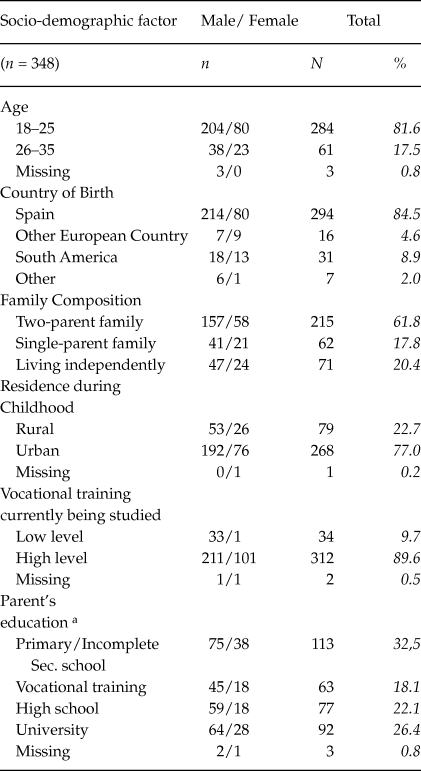
Study participants were a convenience sample of 348 adults, 245 men and 103 women, aged 18–35 (M = 22.18, SD = 4.23, Md = 21). All participants were recruited from four adult Vocational Training Colleges in the city of Valencia, Spain. Refer to Table 1.
Socio-Demographic Characteristics

a Parent with the highest educational level.
Procedure
The vocational training colleges were asked for their collaboration in this study. They agreed to facilitate the premises and the time with the students. All young adult participants gave informed, voluntary consent and all information remained anonymous. Data were collected through questionnaires, applied in small groups, up to 15. The rooms used for this purpose were big enough to guarantee that privacy was preserved during the completion of the questionnaires which took approximately 30 minutes. Participants were free to cease completely the questionnaires at any time if they did not feel comfortable with the questions asked. Two people refused to finish the questionnaires when they reached the section about victimization and left the room abruptly. The possibility to talk afterwards with the psychologist, who was present while the questionnaires were being completed, was offered to everybody. This study was approved by the Ethics Committee of the University of Valencia.
Variables and measures
Sociodemographic data. The self-reported data sheet included information on the participant’s social and family background: Age, sex, country of birth, family composition and parent’s educational level. The current level of the participant’s studies was also included.
Victimization: The Child Abuse Screening Tool- Retrospective Version (ICAST-R), International Society for the Prevention of Child Abuse and Neglect -ISPCAN (Dunne et al., Reference Dunne, Zolotor, Runyan, Andreva-Miller, Choo, Dunne and Youssef2009). The ICAST is a detection tool, developed from a Delphi procedure, with the participation of 122 experts and recognized organizations like Save the Children and World Vision, under the auspices of ISPCAN, in collaboration with UNICEF. It represents an international effort to increase comparability across studies and involved three instruments that ask parents about their use of different behaviors regarding discipline, older children about their own recent experiences of violence and young adults about their exposure to violent experiences before the age of 18: The ICAST-R. This questionnaire, after being subjected to the Delphi study, was initially translated (using translation and back-translation procedures) into six languages and field tested (Dunne et al., Reference Dunne, Zolotor, Runyan, Andreva-Miller, Choo, Dunne and Youssef2009).
The original ICAST-R version included 15 primary items: 5 each for physical, psychological, and sexual abuse. Questions are introduced as ‘events that may have happened to you from when you were a child to before you were 18 years old’. Specifically, for physical abuse events are described as ‘violent or upsetting things’. For psychological abuse it refers to ‘things that happen that make children feel very frightened or worried. They may also be made to feel embarrassed or ashamed, or unloved’. For sexual abuse the questions are introduced as ‘sexual experiences that sometimes happen to children or young people’ and it is emphasized that all of the questions are only about sexual acts that may have happened before you were 18 years old, when you did not want them to happen’.
The response options were: ‘Yes’, ‘No’, ‘Cannot Remember’. An affirmative response was followed by the secondary items asking about frequency (once-twice, 3–10 times and 10+), age and perpetrator characteristics. The item asking “at what times in your life did this happen to you?” has four non-exclusive choices: ‘Before 5 years of age’, ‘from 5 to 9”, “from 10–13” and “from 14–17”. There are three more items: One on the intention attributed to the abusive behaviors, another about subjective comparison to other children, and another about the secrecy of sexual abusive experiences.
The 18-item instrument shows acceptable construct validity and values of internal consistency, Cronbach’s alpha, between moderate and high: From .61 in the physical subscale and .63 in the psychological subscale, to .82 in the sexual subscale. The Spanish ICAST-R version was the one used in the present study (Dunne et al., Reference Dunne, Zolotor, Runyan, Andreva-Miller, Choo, Dunne and Youssef2009; Meinck et al., Reference Meinck, Steinert, Sethi, Gilbert, Bellis, Mikton, Alink and Baban2016)
Criteria used in this study to consider presence/absence of abuse were related to the type of abusive experience and the frequency reported. This was done by following the criteria established by Edwards et al. (Reference Edwards, Anda, Dube, Dong, Chapman, Felitti, Kendall-Tackett and Giacomoni2005) for the ACE questionnaire that were adjusted for the ICAST-R. These, physical and psychological abuse were considered present when the frequency reported included “3 or more times”, (“none” or “once /twice” was considered non-abuse). However, for sexual abuse any experience reported was considered sufficient. These restricted criteria for physical and psychological abuse were applied in examining the ICAST-R association with health-risk behaviors, using similar criteria to those used with the ACE questionnaire. Moreover, in defining abuse, while it is clear that a single incident of sexual abuse is considered to meet the criteria, regarding exposure to neglect, emotional abuse and moderate forms of physical abuse, this should be persistent and frequent to meet the definition of child maltreatment (Meinck et al., Reference Meinck, Steinert, Sethi, Gilbert, Bellis, Mikton, Alink and Baban2016). Obviously, this is independent of the fact that, regardless of its frequency, any form of abusive behavior violates children’s rights.
In sum, in relation to victimization the variables used in the analyses were: ‘presence/absence of child maltreatment’, according to the above specified criteria; the variables of ‘type of perpetrator’ (adult, peers), and age group in which the abuse occurred.
Health-risk behavior: Family Health History (Felitti et al., Reference Felitti, Anda, Nordenberg, Williamson, Spitz, Edwards and Marks1998). The original tool used in the ACE Study had two versions: One for women and another for men. Both were composed of questions about sociodemographics, child victimization, health-risk behaviors (e.g., substance abuse), and specific questions for each gender (e.g. pregnancies, in the case of women or violations by peers, in the case of men). In this research, the gender-specific questions were excluded, leaving only common questions. Altogether, 39 items were included addressing seven risk behaviors: Physical activity (3 items), consumption of alcohol (10 items), tobacco (6 items) and/or drugs (7 items), social and professional support (3 items), sexual intercourse (4 items) and suicidal behavior (5 items) plus one question (1 item) regarding having received psychological or psychiatric treatment.
The total number of health-risk behaviors reported was computed as the ‘Total reported’ variable. Additionally, health-risk behaviors are defined as any behavioral activity undertaken by individuals with a frequency or intensity that increases risk of disease or injury (Steptoe & Wardle, Reference Steptoe, Wardle, Kaptein and Weinman2004). Therefore, the reported information was examined so as to distinguish levels of risk as another variable. To do so, criteria were established based on the questions and the information provided by them:
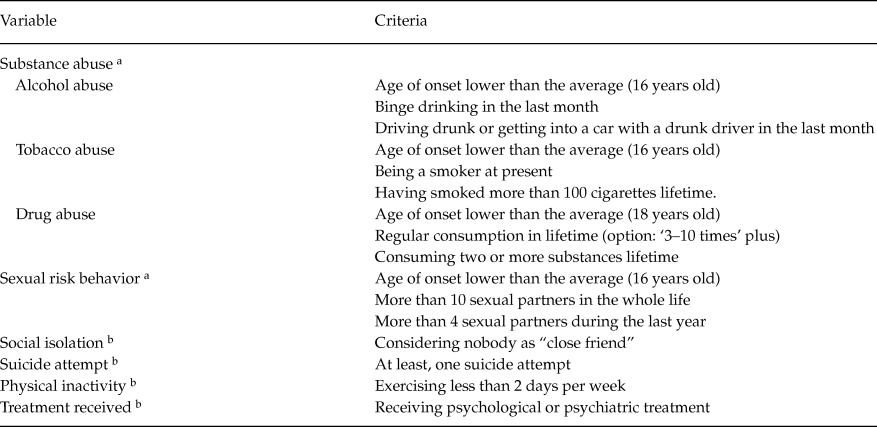
For substance abuse (alcohol, tobacco and drugs) and sexual behavior three aspects of health-risk behaviors were selected. Thus, regarding alcohol, the answers to the Items (4, 9 and 10 and/ or 11) related to onset age, pattern of drinking and driving or being with a drunk driver, were selected. Similarly, for tobacco (Items 14–16): The age at which smoking began, lifetime consumption of more than 100 cigarettes and currently being a smoker. For drugs (Items 20–22): Consumption before age 18, answering to consumption of drugs in lifetime from option ‘3–10’ times and upwards, and to have consumed more than one substance, obtained from the answer to what type of substances you have consumed. For sexual behavior (Items 29–31): Age for the first voluntary sexual relationship, 10+ sexual partners during lifetime and 4+ sexual partners last year. In all cases, ‘Non risk/Low risk’ was allocated to one criterion met and ‘Medium/High risk’ where two plus criteria were met.
For the rest of the health risk behaviors, answering one item was considered risk: Reporting zero in number of intimate friends (Item 28), affirmative answer to attempted suicide (Item 32), for physical activity (Item 1) less than 2 times per week and to having received psychological/psychiatric treatment (Item 26).
Substance abuse (alcohol, tobacco and drugs) and sexual behavior, where three criteria were used, were dichotomized into “no risk/low risk” vs. “medium/high risk” that matched “one criterion” vs. “two or more criteria met.” For the other variables, the levels were “presence” or “absence.” See extracted variables and details of criteria in Table 2.
Variables and Criteria for Health-Risk Behaviors

a “Non risk/Low risk” = one criterion met; “Medium/High risk” = 2 + criteria met.
b For variables with one criterion: Non Risk vs. Risk (criterion met).
Data analysis
The sociodemographic factors were planned to be examined using adjusted and unadjusted Risk Ratio to quantify its potential confounding effect on victimization and health-risk behaviors. Preliminary analyses were planned to explore the normality of the data. Non-parametric and parametric tests were conducted using, as the dependent variable, the total health-risk behaviors and, as factors, the groups created by: Presence/absence of child maltreatment, victimization perpetrator, and age group. Regarding age group, for the purpose of the analyses the four age categories were grouped into two non-exclusive broader categories: “Before the age of 10” and “after age 10”, due to the low number of participants reporting only victimization before 10, in either or both categories.
Additionally, to study the relationship between maltreatment and each health-risk indicator, contingency tables and Chi-squared tests were planned. Alpha level of .05, or lower, was used for all statistical tests. All data analyses were performed using SPSS version 17.0.
Results
The results are presented in three sections after the preliminary step of examining potential confounding factors on victimization and health-risk behaviors (HRBs). The subsequent sections are: First, victimization by adults and peers, followed by victimization and HRBs by adults and by peers and, finally, the timing of abuse and health-risk behaviors.
Preliminary examination of potential confounding effect of sociodemographic factors
The participants in our study were very homogeneous in age considering the standard deviation (4.23 years), the mean and the median values (aged: 22.18 and 21, respectively). In fact, 82% were between 18 and 25 years of age, and 17 % were between 26 and 35 (0.86% reports had no age reported). Therefore, the potential confounding effects for factor of age were minimized due to the age-range.
The other potential confounding factors were gender and parent’s educational level. The unadjusted relative risk of gender with HRBs was compared with the stratum specific relative risk (i.e. considering, female and male separately).
In the case of gender, the magnitude of confounding was quantified by computing percent differences for each gender between the adjusted Risk Ratio and the unadjusted Risk Ratio for both male and female together. Specifically, the difference between the unadjusted Risk Ratio and the adjusted value is divided by the unadjusted Risk Ratio. The association between victimization and HRBs for male participants differed from the unadjusted estimate (male and female) in 2.90% and 6.94% for women. In both cases, less than 10%, so it can be assumed that there is no confounding by factor of gender. Similar results were obtained using Cochran-Mantel-Haenszel estimate for Risk Ratio: The weighted average of the estimates of risk ratios across the strata provides a measure of association that is adjusted for confounding. The measure adjusted for confounding was: 1.0089 versus the 1.0086 for the unadjusted Risk Ratio (male and female together).
Regarding, parent’s education level, for computing the stratum specific relative risk, the four levels were grouped into two: ‘Primary/Incomplete Secondary School’ and ‘Vocational Training’ versus ‘High School’ and ‘University Studies’. The association between victimization and HRBs for low-medium studies groups differed from the unadjusted estimate (all groups of studies together) in 6.58%, and 8.27% for medium-high level studies. In both cases, less than 10%, so it can be assumed that there is no confounding by parental studies. Similar results were obtained using Cochran-Mantel-Haenszel estimate for Risk Ratio: The value of the measure of association that was adjusted for confounding was 1.014 versus 1.003 for the unadjusted Risk Ratio (no distinction of parent’ studies), 1.13% of difference.
Overall view: Victimization by adults and peers
There were 155 participants out of the 348 that met the criteria for being considered victimized because of frequency of acts reported regarding physical and psychological abuse or because of any sexual abuse experience reported. Therefore, 44.54% of participants reported being a victim of at least one type of abuse, either by adults or peers, at some point in their lives before the age of 18. Thus, twenty-five participants were victimized only by adults and sixty-six were victimized exclusively by peers. Additionally, sixty-four cases had overlapping victimization, reporting abuse by both adults and peers, which represented 41.29% of all the participants reporting childhood victimization and 18.39% of all the participants in this study. Specifically, eighty-nine participants (25.57% of the total 348 participants) suffered some kind of victimization by adults, and a total of 130 people (37.36%) suffered some kind of peer victimization, in both cases with or without a second type of victimization.
The distribution by types of maltreatment showed similar percentages of cases perpetrated by adults and by peers for physical (25.21% and 23.92%) and sexual abuse (11.60% for both), while psychological maltreatment was more frequently perpetrated by peers than by adults (71.00% vs. 39.35%)
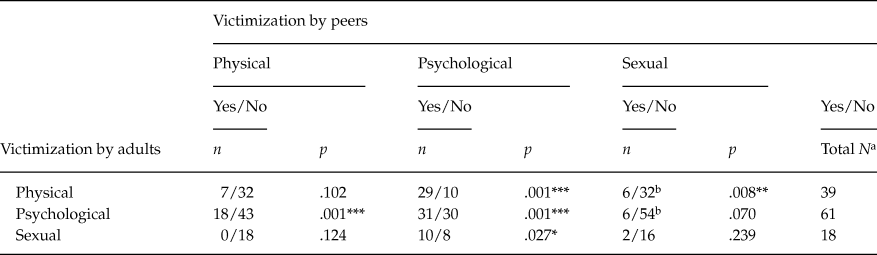
Moreover, child victimization perpetrated by adults was related to peer-victimization. Analysis showed that this relationship was statistically significant, χ2(1, N = 348) = 61.01, p < .001: those reporting being victimized by adults were more likely to report being victimized by peers than those not victimized by adults. Specifically, physical abuse by adults was related to psychological χ2(1, N = 348) = 37.13, p < .001, and sexual abuse, χ2(1, N = 348) = 9.75, p < .01, by peers. Psychological abuse by adults was also related to peer physical, χ2(1, N = 348) = 27.73, p < .001, and psychological abuse, χ2(1, N = 348) = 12.62, p < .001. Finally, sexual abuse by adults was related to psychological abuse by peers, χ2(1, N = 348) = 4.99, p < .05. See Table 3.
Distribution of Cases across Agent of Abuse by Type of Abuse, in the Total 155 Cases

a Total 118 is higher than 89 cases victimized by adults due to cases reporting more than one type of abuse by the same perpetrator.
b Data on one case missing.
Chi-squared Tests: *p < .05. **p < .01. ***p < .001.
Victimization and Health–risk Behavior
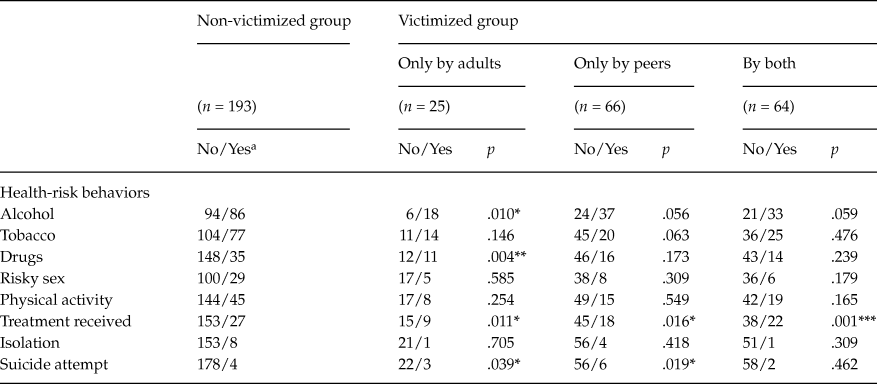
Victimization only by adults. These analyses included only those cases in which the maltreatment was perpetrated by adults, excluding those who also suffered peer victimization. The victimized group comprised twenty-five (11.46%) participants, and a non-victimized group of 193 (88.53%). For the total number of HRBs, as the dependent variable, there were seven missing data, one in the victimized group and six in the non-victimized one, using as criterion leaving two or more HRBs question blank. The assumption of normality was not met, therefore, non-parametric tests were applied. However, those tests showed similar results to parametric tests, so the results of the ANOVA are reported. As expected, results indicated that victims of maltreatment perpetrated by adults were involved, significantly, in higher numbers of HRBs than those who did not report abuse, F(1, 208) = 9.21, p < .01.
Additionally, participants who reported being victimized by adults showed a significant association with reporting medium/high risk in substance abuse: Alcohol, χ2(1, N = 204) = 6.28, p < .05; and drugs, χ2(1, N = 206) = 9.75, p < .01. Moreover, adult maltreatment was statistically significantly associated with suicide attempts, χ2(1, N = 207) = 6.46, p < .05, and receiving psychological or psychiatric treatment, χ2(1, N = 204) = 7.37, p < .05. See Table 4.
Health-Risk Behaviors, comparing Non-Victimized Group and Victimized Groups

a NO /YES = Non health-risk behavior/ Health-risk behavior.
Chi-squared Tests: * p < .05. ** p < .01. *** p < .001.
Victimization perpetrated only by peers. The analyses included only participants who exclusively reported peer victimization. This group comprised 66 participants, versus a non-victimized group of 193. Contrary to expectations, the results showed no significant differences between those groups with regard to the total amount of HRBs reported, F(1, 246) = 0.01, p = .980. However, as expected, the victimized group had a higher level of risk in suicidal behavior, χ2(1, N = 275) = 8.03, p < .05, and in receiving psychological or psychiatric treatment, χ2(1, N = 275) = 5.69, p < .05, than the non-victimized group.
Victimization perpetrated by adults and peers. The group victimized by both adults and by peers comprised sixty-four people (41.29% of all the participants). Contrary to expectations, results show that they did not engage in a higher number of HRBs than non-victimized group, F(1, 244) = 0.48, p = .487. However, as expected, a higher proportion of the group victimized by peers and adults reported receiving psychological or psychiatric treatment, compared to the non-victimized group, χ2(1, N = 240) = 13.01, p < .001. See Table 4.
Age groups and maltreatment
Three victim groups (n =155), were created to analyze the timing of victimization in terms of periods of childhood in which the maltreatment occurred: Those victimized only up to the age of 10 (pre-school and school age), victims where abuse started after 10 (secondary school age and older); and victims in both periods. There were five cases in which the information regarding age was missing. Therefore, in the whole group of participants with this information 56.67% only marked that they were victimized ‘after the age of 10’ (N = 85). Participants marking victimization in both periods ‘before- and after 10’ were 38.67% (N = 58). And there were only seven participants (4.65%) who only marked ‘before 10’.
All types of abuse were taken into account, including both adult and peer victimization. Results comparing the three groups with the non-victimized group showed no differences between the groups in terms of total number of HRBs, F(3, 305) = 0.34, p = .798.
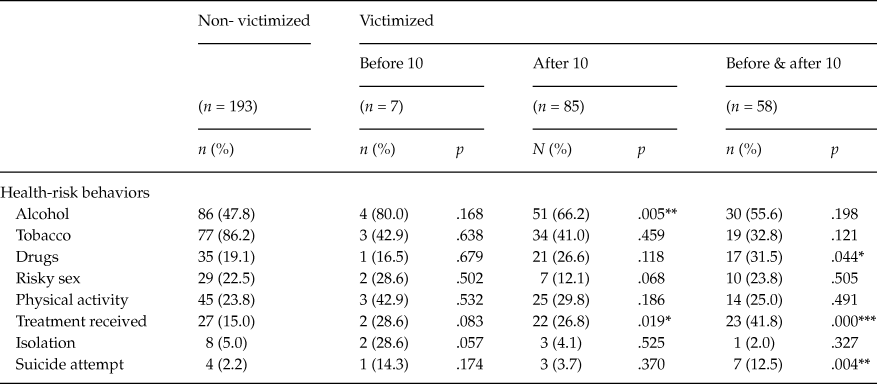
However, in terms of the level of risk some differences did emerge. Maltreatment after 10 was related in adulthood to a medium/high risk of alcohol abuse, χ2(1, N = 257) = 7.38, p < .01, and receiving psychological or psychiatric treatment, χ2(1, N = 262) = 5.18, p < .05. To report being maltreated in the two periods of time (before and after 10) was associated with having medium-high risk of drug consumption, χ2(1, N = 237) = 3.71, p < .05, and attempted suicide, χ 2(1, N = 238) = 10.31, p < .01. This victimized group was also more likely to receive psychological or psychiatric treatment, χ 2(1, N = 235) = 18.08, p < .05. See Table 5.
Participants Reporting Health-Risk Behaviors by Timing of Victimization

Note: Chi-squared tests: * p < .05. ** p < .01. *** p < .001.
Discussion
This study aimed to examine the relationship between childhood victimization, by adults and/or peers, and HRBs in adulthood using the ICAST-R in a Spanish population. Forty-four percent of the study participants reported being a victim of at least one type of abuse, either by adults or peers, at some point in their lives when they were less than 18 years of age and, of those, 41.29% reported abuse by both, which represented 18.39% of all participants. As expected, being victimized by adults was associated with peer victimization.
The findings of this study indicated that children maltreated by adults, regardless of the type suffered, were significantly more likely to report psychological abuse from their peers. In turn, psychological maltreatment by adults showed an association with two types of peer victimization: Physical and psychological. Additionally, participants reporting physical abuse by adults were more likely to report sexual abuse by peers. These findings showed the importance of psychological maltreatment, the impact of which has been found to be as serious as physical or sexual abuse (e.g, Potthast et al., Reference Potthast, Neuner and Catani2014). Psychological maltreatment was the most common type found in this study with more cases in peer-victimization (71.00%) than in adult-victimization (39.35%). This was consistent with previous research (Finkelhor et al., Reference Finkelhor, Ormrod and Turner2007).
These findings are consistent with poly-victimization studies showing that becoming a victim increases vulnerability in other contexts and situations (Finkelhor et al., Reference Finkelhor, Ormrod and Turner2007). Duncan (Reference Duncan1999) found that college students who were victims of bullying in childhood, a type of peer-victimization, experienced higher rates of emotional and physical maltreatment by parents and more sexual assaults, than those who were not bullied. Although not examined in the present study, emotional dysregulation has been found to mediate between being a victim of adult maltreatment and risk of being victimized by peers (Shields & Cichetti, Reference Shields and Cicchetti2001).
Regarding victimization and HRBs, the prediction that the victimized group would report a higher total number of health-risk behaviors than the non-victimized group, was only supported by the analyses with the group victimized solely by adults. However, the three groups: Those victimized only by adults, or by peers, and by both, as expected, showed significantly higher risk than the non-victimized group in several HRBs. These results indicated that more differences between victimized and non-victimized groups were found in the severity of their involvement in HRBs, and less with regard to how many different HRBs they reported; at least for those victimized by peers and by both. For these participants, there was a significantly higher proportion who reported having attempted suicide and having received psychological or psychiatric treatment. The participants who reported having being victimized only by adults, apart from suicide attempts and having received treatment, also reported a significantly higher risk of drug and alcohol abuse.
These results are congruent with those prospective and retrospective studies (Gilbert et al., Reference Gilbert, Widom, Browne, Fergusson, Webb and Janson2009) that have shown an association between child maltreatment, parental abuse and neglect and attempted suicide in adults. In our study this important HRB was also found in the participants reporting having been victimized only by peers. Additionally, the results regarding higher risk of substance abuse by victims of adults were consistent with other studies for drugs (Norman et al., Reference Norman, Byambaa, De, Butchart, Scott and Vos2012) and for alcohol and drugs in the ACE study (Felitti et al., Reference Felitti, Anda, Nordenberg, Williamson, Spitz, Edwards and Marks1998; Potthast et al., Reference Potthast, Neuner and Catani2014).
ICAST-R includes information about the timing of victimization. The results did not show differences in terms of the amount of health-risk behaviors among participants who reported that their victimization took place before the age of 10, after that age or in both periods of time and the non-victimized group. However, those participants who reported having been victimized by adults, peers or both, before and after the age of 10, compared with the non-victimized group, showed higher risk levels for drug abuse, and also attempted suicide; plus they received psychological or psychiatric treatment in higher proportions. The group victimized after the age of 10 showed a higher level of risk for alcohol abuse and receiving treatment. No differences in risk level were found for victimization that only occurred before the age of 10. These latter results could have been affected by the small number of participants who reported victimization only before the age of 10, while the majority of those participants who reported before the age of 10 also marked after 10 (11% vs. 89%). Future studies are required to shed light on this issue as there is evidence to suggest that age and timing of victimization are factors that can affect traumatization levels (Goodman et al., Reference Goodman, Quas and Ogle2009). Moreover, according to Kendall-Tackett’s pathway model (2013) which links victimization to physical health outcomes, the health-risk behaviors as a subset of the behavioral pathway, should reflect the impact of the length of victimization.
The findings of this study support the use of the ICAST-R tool in the study of HRBs in adulthood in a Spanish population. Although ICAST-R is not a comprehensive tool, as it does not contain any questions about neglect and other forms of victimization, it does, however, provide more information about child victimization by including perpetrators and contexts other than adults and the home, compared with other tools like the ACE questionnaire, which is widely used in the area of HRBs. The two tools use different ways of asking about adverse experiences. Future research should study if the way of asking those questions influences information recall, depending on the type of abuse experienced. Additionally, given that the ICAST-R is available in twenty languages, future studies conducted in different countries on HRBs and victimization that include it as an information-gathering tool, can broaden the knowledge of the relation between peer victimization and HRBs on an international level.
This study used retrospective research. There is research, in the context of the ACE Study that highlight the need for, and validity of, retrospective studies (Dube, Williamson, Thompson, Felitti, & Anda, Reference Dube, Williamson, Thompson, Felitti and Anda2004). Likewise, Kendall-Tackett & Becker-Blease (2004) value retrospective studies depending on the research question. The issue related to the type of memories required to be recalled and the severity of them seems to be a factor, in retrospective studies. Thus, adults may have difficulties recalling information due to the lapse of time between traumatic events and investigation (Norman et al., Reference Norman, Byambaa, De, Butchart, Scott and Vos2012). However, a comparison between prospective and retrospective methodologies has shown that more severe cases of multiple incidents of abuse were most likely to be identified by both methodologies, while less severe maltreatment incidents were more likely to be missed more frequently by self-report methods (Shaffer, Huston, & Egeland, Reference Shaffer, Huston and Egeland2008). This could underestimate the number of cases in retrospective studies on the less severe end of the spectrum. Therefore, a limitation of the present study could be the underestimation of child victimization.
Additionally, this study uses one source of information for victimization and HRBs, which could be affected by common method variance. However, due to the nature of the study, the completion of the questionnaires was anonymous, there was obviously no right or wrong answers and the two questionnaires differed in format and the topic areas covered. All these are actually procedures recommended by Podsakoff, MacKenzie, Lee, & Podsakoff, (2003) to reduce method bias. Finally, the sample was not selected randomly which could compromise the generalization of results. Likewise, the sample could be extended in future research to ensure generalization of results and allow consideration of a wide variety of sociodemographic factors that may shed light on the relationships under study.
In our study, child maltreatment perpetrated by adults and peers, have been shown to be interrelated and associated with significant HRBs in adulthood, thus presenting important risks to health. The implications of our findings, obtained using the ICAST-R, are twofold: Firstly, they suggest that child welfare and health professionals, taking histories from their clients, should routinely include the exploration of peer-victimization and, therefore, go beyond possible victimization at home. In particular, psychological victimization by peers in childhood deserves greater attention because of its association with suffering any other kind of victimization by an adult. Secondly, the link between peer victimization and attempted suicide underlines the importance of asking about peer victimization in comprehensive screening by child welfare and health professionals.