Introduction
The implications for labour markets of ageing populations is of concern among the industrialised nations. The nature of the shift in labour supply is dynamic and pressures brought about by changing demography will be felt in discrete occupations and industries at different times. Some occupations and industries are already beginning to feel their impact, in particular those that have traditionally relied on young entrants, those with ageing workforces, or those without optimum working arrangements or conditions (Rolland Reference Rolland2004). Public policy is increasingly aimed at promoting a prolongation of working lives, with the closing of early retirement pathways, increases in pension ages and the promotion of older workers as an under-used resource taking place among the industrialised nations (Keese Reference Keese2005). Questions have been raised, however, about employer interest in older labour, with surveys generally showing modest levels. Employer efforts to develop and maintain policies targeting the employment of older workers have in the past appeared to depend to a large extent on market conditions. Among the developed nations currently Australia may be viewed as an unusual case. Levels of unemployment are low with projections suggesting that employment growth will be solid and labour market activity strong (Reserve Bank of Australia 2010), indicating that vacancies for skilled workers may emerge as a frustration for business activity. With potentially conducive market conditions for employers to look to non-traditional sources of labour there is value in examining their use of strategies concerned with the recruitment and retention of older workers and how these compare with other available options for labour utilisation. What explains the utilisation of one strategy over another is of particular interest. In considering such issues, this article builds on previous studies that have explored workplace adjustments to demographic change, drawing on organisational change theory, human resource management theory and research that has examined the labour use strategies adopted by employers (Brooke and Taylor Reference Brooke and Taylor2005; Henkens, Remery and Schippers Reference Henkens, Remery and Schippers2008; Taylor and Walker Reference Taylor and Walker1994, Reference Taylor and Walker1998a, Reference Taylor and Walker1998b; Taylor et al. Reference Taylor, Brooke, McLoughlin and Di Biase2010). The present study was distinct from many that have considered the place of older workers in the labour market in that it aimed to locate them among the vast array of strategies that could potentially be adopted by an employer in response to demographic change and labour shortages. Understanding the circumstances under which one labour utilisation strategy is used over another may provide useful insights into the place of older workers in organisational policy making.
Employer policies towards older workers
A review of research into employer policies towards older workers and workforce ageing over the last two decades presents a mixed picture, although one where older workers can generally be viewed as occupying a relatively low and peripheral status in the minds of employers. Internationally, a range of studies have observed that early retirement policies have been preferred over ones based on the integration of older workers (e.g. re-organisation of working practices or promoting later retirement), that older workers are viewed as less important sources of labour as gauged by reference to other groups such as women and people with disabilities, as demonstrating a poor return on human capital investment and are often considered recruit of last resort (Guillemard, Taylor and Walker Reference Guillemard, Taylor and Walker1996; Loretto and White Reference Loretto and White2006, Remery et al. Reference Remery, Henkens, van Doorne-Huiskes, Ekamper and Schippers2000; Steinberg et al. Reference Steinberg, Donald, Najman and Skerman1996. Notably, organisation size (Le Minez Reference Le Minez1995) and sector (Taylor and Walker Reference Taylor and Walker1994) appear to be important factors determining employer orientations and practices, with smaller employers and those in the construction and manufacturing sectors demonstrating weaker interest in utilising older labour.
Importantly, research also indicates that employer behaviour towards older workers is strongly influenced by the point in the economic cycle. Recently, Henkens and Schippers (Reference Henkens, Schippers and Taylor2008), drawing on data collected from almost 3,500 Dutch employers with more than nine employees, observed that older workers came far behind people with disabilities and women in terms of preferred solutions to tackling labour shortages. Between the years 2000 and 2005 there was a dramatic decline in interest in all labour supply measures, including the recruitment and training of older workers. The authors attributed this to a weakening of the Dutch economy in the middle of the decade, resulting in a buyer's market for labour. There is strong evidence that interest in older workers, often formalised in policies aimed at their recruitment and retention, may quickly dissipate during economic downturns (Taylor Reference Taylor2006).
How should the results of these studies be evaluated? There appear to be broad commonalities across a number of studies. For the majority of employers, human resource management strategies have not tended to be as strongly focused on older workers as on other groups. Organisational policy making regarding older workers also seems rather ‘soft’ and not only in the direction of organisational stances that are conducive to their inclusion in the workforce, that is, it is clear that employers are willing to remove policies or end practices if they are perceived as redundant. Thus, an on-going overall weak orientation to older workers has been evidenced, although research is also indicative of differences according to organisational size and sector. Point in the economic cycle appears to be of particular significance.
Management of labour supply
Amid the range of options open to employers to manage labour during a period of dwindling supply, what explains an orientation or otherwise towards older workers is of considerable interest, particularly also when public policy is now so strongly focused on the prolongation of working lives. Of additional interest is whether among these various options any kind of meaningful pattern can be discerned, as is whether older workers are viewed by employers as a distinct group in labour market terms. For some observers, with population ageing will inevitably come an ageing of workforces. For instance, Walker has argued that ‘Future competitiveness in the private sector and efficiency in the public sector will rest increasingly on the performance and productivity of ageing workforces’ (2005: 691). However, importantly it is apparent that globalisation and the market competition this fosters provide a strong countervailing force for both government and employers. The shift to a global economy, where labour and capital flows, technology transfers and foreign direct investment dominate is forcing dynamic change for individuals, business and government. Resources, on the global scale, are being reshuffled in order to meet new demands and new approaches. While economic theory recognises that a reshuffling of resources in accordance with the principles of economic advantage may result in improved resource utilisation this can lead to older workers becoming ‘off-suit’ discards as their skills and attributes are no longer valued (Jorgensen and Taylor Reference Jorgensen and Taylor2008a, Reference Jorgensen and Taylor2008b). Further clues to understanding potential employer ambivalence towards older workers comes from consideration of management theory. While policy makers would, currently, prefer business to view them as an investment, according to Lyon, Hallier and Glover older employees are perceived as being less effective than younger workers and to represent a serious barrier to organisational change and flexible performance:
nothing better epitomises the contradiction between long-term employee investment and numerical flexibility than the treatment of older workers …[Human Resource Management's] philosophy can be seen to amplify older workers' problems by reinforcing ageism in management thinking through the provision of a commercially appropriate rationale which embellishes existing stereotypes and doubts about the commitment of older workers. (1998: 57)
Altogether, the available evidence points to the likelihood of strong resistance from business to ageing workforces. This raises questions about whether the predicted labour drought bought on by demographic change really will exert such pressure on business that this will, in turn, result in a strong market pull on older workers. Or conversely, whether early retirement will be preferred by Sennett's modern ‘flexible firm’ determined to maintain productivity and competitive advantage and unwilling to countenance an ageing of its workforce, treating older, long-service, workers with suspicion and leaving them facing the ‘specter of uselessness’ (2006: 83) as their skills and experience are devalued.
Classical economic theory states that faced with labour supply constraints employers have two choices: they can either reduce their dependence on it or they can attempt to increase its supply. The panoply of options for managing labour supply shortages is usefully described by Henkens, Remery and Schippers (Reference Henkens, Schippers and Taylor2008). Substituting capital for labour via an investment in new technology is one option while relocating production elsewhere either temporarily or permanently is another. An organisation perceiving a shortage of skilled labour in a given location might choose to look elsewhere, particularly in instances where technologically advanced workplaces place high demands on the competences of the worker. The more effective deployment of workers is another option, via investment in skills, increasing working hours, or increasing opportunities to prolong working lives. Idiosyncratic and specific skills requirements may encourage employers to seek to recruit young people whom they will invest in over the long term. Regarding increasing labour supply, wage rates may be raised by a particular firm, but with the potential for wage inflation as others follow suit, while firms may be unwilling to pay older workers at rates that exceed their marginal productivity. Employers may also be willing to reduce job entry requirements.
Henkens, Remery and Schippers (Reference Henkens, Schippers and Taylor2008) refer to constraints on organisational choices regarding labour supply. Industry sector, product or service, skill mix, more or less competitive markets, and social norms will inevitably influence responses to labour shortages. For instance, it might be posited that private-sector organisations facing severe international competition in ‘youthful’ markets would be reluctant to attempt a ‘risky’ strategy such as recruiting older workers for fear of losing market advantage. On the other hand, public-sector organisations may be pressured to have workforces reflective of society at large.
Henkens, Remery and Schippers (Reference Henkens, Schippers and Taylor2008) have explored these issues empirically, asking employers surveyed to consider a range of options for managing labour supply and to state whether they were being utilised already, might be used in future, or would not be used. Using exploratory factor analysis the researchers identified four overall strategies: tapping new target groups, including women and older workers; increasing the supply of labour from among existing workers, including encouraging overtime, encouraging the prolongation of working lives and calling back the already retired; outsourcing work and collaborating, including outsourcing work and offering higher wages; and structural adjustments, including relocating production elsewhere and substituting technology for labour. They report that staff shortages encouraged employers to focus on the recruitment of new categories of workers, including older ones. Such an approach was more often used by larger organisations and in the service and health and welfare sectors. They also report that increasing the supply of labour from among existing workers, by for instance encouraging employers to delay retirement, was a strategy adopted as staff shortages increased. Organisations in local government and the health and welfare sector were more likely to adopt this approach.
In Australia, attempts to elucidate employer attitudes and practices towards older workers have been relatively few and not on the scale of studies in other countries. There is a strong need to better understand the relative current position of Australian older workers against the backdrop of a sustained public policy push towards later retirement due to concerns about population ageing. Australia also provides a potentially useful case study of employer orientations to older workers at a time of a buoyant economy coupled with increasing competition for labour.
The present study aimed to assess current attitudes and practices towards older labour in the context of the potential to utilise other potential labour supply options amid a recent tightening of labour supply, to examine employer perceptions regarding the need to act concerning issues of workforce ageing and to explore the relationship between perceived competition for labour and workforce ageing as potential current determinants of organisational policy making regarding policies towards older workers. Drawing, in particular, on the spadework of Henkens and colleagues, this study also set out to explore the place of older workers in organisational policy making, as one of a range of potential approaches to tackling issues of labour supply.
Approach
The data on which this article is based come from an Australian project that considered the employment of older workers in a globalising economy. This project included a computer-assisted telephone interviewing (CATI) survey of 2 000 Queensland employers with more than 50 employees (29% response rate, i.e. 590), carried out in 2010. Employers with more than 50 employees were surveyed, accessed for a telephone interview through two rented business lists, one general and another focused on large organisations that are frequently updated and verified for accuracy by their owners. Responding organisations were selected at random from these lists and were contacted until the goal of 30 per cent response rate was achieved. The survey covered all employment sectors and asked a broad range of questions concerning the management of labour supply, including about the employment of older workers, and on average was completed in approximately 35 minutes. Queensland employers were surveyed due to the involvement of the Queensland State Government as a funding partner on the grant. Queensland, as with the rest of Australia, has been experiencing low levels of unemployment with concerns about labour shortages. In this article responding organisations are compared along characteristics such as number of employees, sector and gender balance, and as such it is useful to consider how these characteristics are distributed among this sample. Large organisations, with 200 or more employees, accounted for 53 per cent of responding organisations, with those with between 50 and 199 employees accounting for the remaining 47 per cent. Also, organisations were classified as either ‘for profit’, constituting 73 per cent of the sample, while the remaining 27 per cent were ‘government’ or ‘not-for-profit’ organisations (17 and 10%, respectively). Organisations' gender balance was slightly skewed towards males. On average, 57 per cent of employees were male although the spread of the percentage of genders in responding organisations was normally distributed across the sample. The distribution of age groups within organisations also showed that, on average, 20 per cent of employees were aged over 50 and 27 per cent were younger than 30, with the remaining 53 per cent aged between 30 and 50. Finally, the respondents representing participating organisations were characterised as predominantly male (64 per cent), with an average age of 45 years and a range of 22–69 years of age. Also, respondents indicated their occupation, with 41 per cent in human resources manager/human resource officer or recruitment functions, 17 per cent in directors/Chief Executive Officer/Chief Financial Officer or Managing Director roles, 14 per cent in regional or department manager roles, 12 per cent in general manager roles, while 10 per cent were heads/directors of a department. Finally, approximately 6 per cent of the sample was employed in administrator or ‘other’ roles. This sample was considered to be largely representative of medium and large organisations in Queensland and also Australia, an assertion based on the following considerations: participating organisations were selected at random within Queensland from the business lists and a response rate of approximately 30 per cent can be considered to be ‘substantially higher than the response rate generally found in corporate surveys’ (Henkens, Remery and Schippers Reference Henkens, Remery and Schippers2008).
The analysis to be reported here consists, firstly, of the presentation of descriptive statistics concerning the status of workforce ageing in these employing organisations, comparative data on the extent of adoption of different solutions to issues of labour supply, and organisational responses to issues of workforce ageing. This is followed by multivariate analysis where the characteristics of workplace labour supply strategies are explored and resulting composite variables are used as dependent variables in multivariate regression analysis with a range of organisational characteristics, respondent perceptions and attitudinal variables used as independent variables.
Results
Descriptive statistics
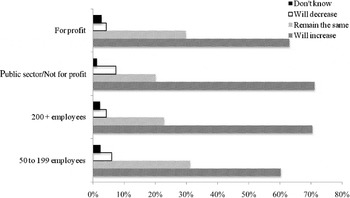
As noted above, the survey questionnaire asked about a range of issues concerning perceptions about labour supply, workforce ageing and organisational responses. As can be observed in Figure 1, larger and public-sector organisations were more likely to foresee an increase in the proportion of their workforces aged 50 and over in the coming five years, although overall, over 60 per cent of all organisations expected to experience workforce ageing over this period. Respondents were also asked over what time period a response would be required. Of note, over a third of smaller organisations foresaw no need to respond at any point. Also, private-sector organisations were rather more likely to perceive no need to respond than public or not-for-profit ones. The majority of all organisations felt that action was required within a five-year time horizon. However, approximately one-third of public or not-for-profit employers saw an immediate need to act.
Expected change in employees aged 50 and over in coming five years.

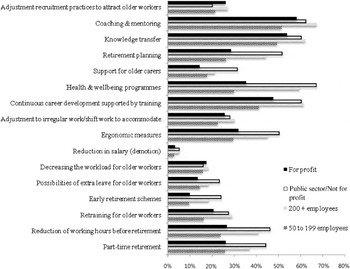
Figure 2 presents findings concerning how organisations were responding to workforce ageing. Notable was greater engagement from public-sector and not-for-profit employers and by larger employers and wide variations between kinds of employer on some responses. Echoing earlier studies, retraining for older workers was not a common response, although continuous career development supported by training was rated highly. Knowledge capture and transfer, including coaching and mentoring, were important responses overall, with health and wellbeing being an important response for public and not-for-profit organisations. Also of interest was the relatively low incidence of offering part-time retirement among private-sector employers compared to the picture overall.
Response to workforce ageing: already applied.

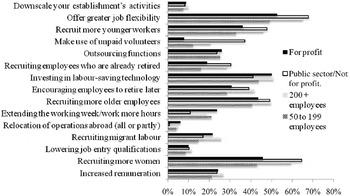
Figure 3 presents findings concerning responses to labour shortages that organisations had already applied. Echoing the findings of earlier studies, increasing job flexibility and promoting the employment of women were commonly reported, particularly among public and not-for-profit organisations. Of particular note was the unusually favourable response to older workers among both private-sector and public and not-for-profit organisations. Investing in labour-saving technology was also rated highly by employers in the public sector. Also of interest were efforts to recruit more younger workers among public and not-for-profit employers, perhaps in an attempt to re-balance the age profiles of their organisations.
Responses to labour shortages: already applied.

Competition for labour supply, workforce ageing and predicting employer responses: creating outcome variables
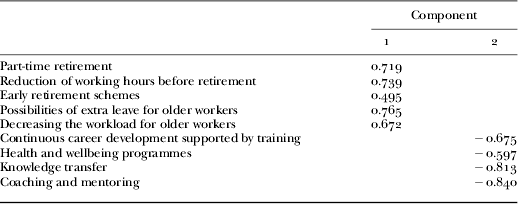
A principal components analysis was performed using the items listed in Figure 3 in order to create outcome variables. Items were removed based on low communalities and low factor loadings and a two-factor solution was consistently suggested by scree plots. Each item was removed individually in order of the lowest loading and seven items were removed. The responses to these items were transformed from three (already applied, will be considered and will not be considered) categories to two (already applied and have not yet applied) because the three categories are not on an appropriate continuum. The final (principal components with oblimin rotation) structure revealed two conceptually meaningful factors that were labelled ‘Flexible employment strategies targeting older workers’ and ‘General human resource strategies in response to workforce ageing’ (see Table 1 for the final model). The former consists of items which appear to have the common element of a gradual withdrawal in the lead up to retirement. The latter consists of more general approaches to human resource management, with items concerning knowledge sharing and acquisition having the largest loadings.
Principal components analysis structure – human resource strategies
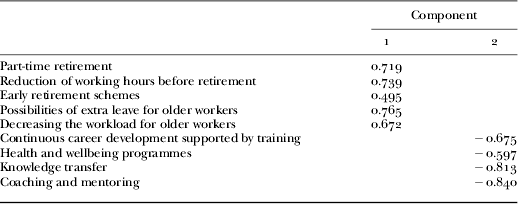
Note: Components: 1 = ‘Older worker flexible withdrawal strategies’ and 2 = ‘General human resource strategies’.
Regarding assumptions tests for sphericity, sampling adequacy and communalities were acceptable (Kaiser-Meyer-Olkin measure of sampling adequacy = 766, Bartlett's = 1296.320, p < 0.001). Altogether, 51.2 per cent of the variation was explained by the two-factor model. The residuals revealed 18 (50 per cent) non-redundant values greater than 0.05. While this is not a reason to reject the model, it does however reduce the confidence in this two-factor solution.
In the present analysis, dichotomisation of variables was applied for conceptual purposes and the analyses were conducted with awareness of the potential limitations in the use of such data with methods underpinned by correlation matrices.
Based on this analysis, subscales were created. To do this items were reversed so that the already applied category was worth more than the have not yet applied category. This meant that higher scores on the subscale indicated more already applied policies in the organisation. Subscales were created for each factor with each item of equal worth. There was no evidence to suggest that one policy should be weighted higher than another. Future studies could measure the importance of these policies, which may enable formulation of a weighted calculation. This was beyond the scope of the present study.
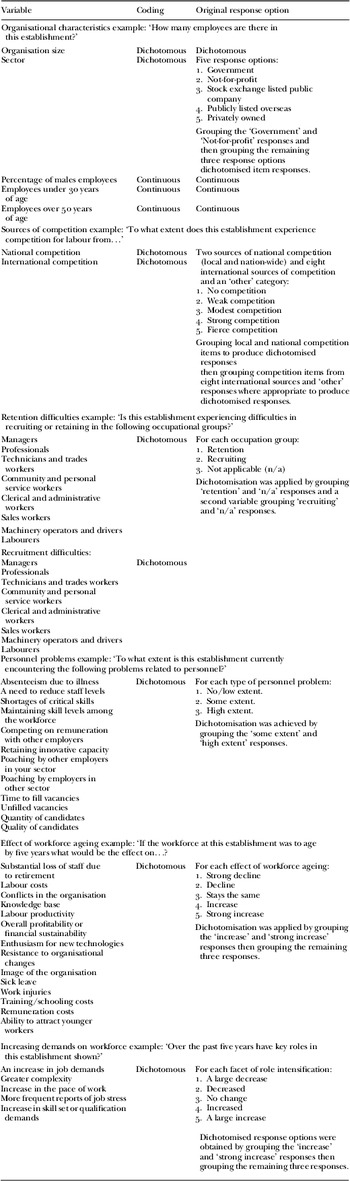
The next section of this article describes the results of binary logistic regression analysis, using a forward and backwards stepwise procedure, which was applied to assess the relative importance of factors identified from the literature as having potential to predict the application of older worker-specific and general human resource strategies: general organisational characteristics (e.g. workforce size, broad industry sector, gender and age composition), the extent of competition for labour organisations were experiencing, difficulties in filling vacancies, perceived demands on workforces and the perceived need to respond to workforce ageing. In order to explicate the exact nature of the items used to reflect the aforementioned predicting factors, Appendix 1 presents details of these items. Also included are examples of the items used.
Predicting flexible employment strategies targeting older workers
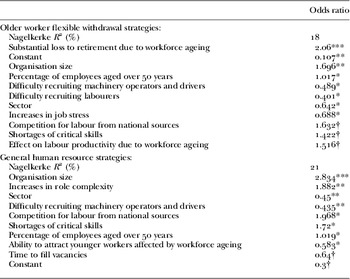
This analysis is presented in Table 2. The most important predictor was whether employers were expecting a substantial loss to retirement over the next five years (Wald = 13.5). Where this was the case employers were twice as likely to use flexible withdrawal strategies. Next was organisation size (Wald = 8.4), with large organisations 70 per cent more likely to use these responses. Following this was the percentage of employees aged over 50 (Wald = 6.2). For every unit increase in the percentage of employees over the age of 50, the probability of using these responses rose by 2 per cent. Whether organisations were having problems recruiting machinery operators and drivers (Wald = 5.2) and labourers (Wald = 5.2) were the next most important predictors. Organisations having problems recruiting machinery operators and drivers were half as likely to employ these responses. Similarly, employers experiencing difficulties recruiting labourers were 60 per cent less likely to apply these responses. After these came industrial sector (Wald = 4.5), with private-sector organisations 35 per cent less likely to apply these responses. Next was whether organisations were experiencing increases in job stress (Wald = 4.0). Where this was the case employers were 40 per cent less likely to apply these responses. Whether employers were experiencing competition for labour from within Australia (Wald = 3.7) was a further predictor. Employers experiencing such competition were 40 per cent more likely to use these responses. Whether organisations were experiencing a shortage of critical skills (Wald = 3.5) was also a predictor. Where this was the case employers were 40 per cent more likely to apply these responses. Finally, whether organisations were concerned about the productivity of their workforce due to ageing over the next five years was also a predictor, with such employers 50 per cent more likely to apply these responses.
Prediction of older worker flexible withdrawal strategies and general human resource strategies

Significance levels: † p < 0.1, * p < 0.05, ** p < 0.01, *** p < 0.001.
Predicting general human resource strategies
This analysis is presented in Table 2. The most important predictor was organisation size (Wald = 22.6), with large organisations almost three times more likely than medium ones to use general human resource strategies. This was followed by whether organisations were experiencing an increase in terms of job role complexity (Wald = 8.6). Those experiencing such an increase were 80 per cent more likely to use these responses. Next came industrial sector (Wald = 7.9), with private-sector organisations slightly under 50 per cent less likely to apply these responses. Whether organisations were having problems recruiting machinery operators and drivers (Wald = 6.8) followed in terms of importance. Where this was the case employers were almost 60 per cent less likely to apply these responses. Of lesser importance was whether employers were experiencing competition for labour from within Australia (Wald = 5.8). Employers experiencing such competition were almost twice as likely to apply these responses. Whether organisations were experiencing a shortage of critical skills (Wald = 5.3) followed in terms of importance. Organisations experiencing such a shortage were 70 per cent more likely to apply these responses. The percentage of employees aged over 50 (Wald = 4.6) was next most important. For every unit increase in the percentage of such employees, the probability of applying these responses increased by 2 per cent. Whether the organisation was concerned about the influence of workforce ageing on their ability to attract younger workers over the next five years (Wald = 4.5) was also a predictor. Organisations with such concerns were 40 per cent less likely to apply these responses. Finally, whether employers were experiencing problems with the time to fill vacancies (Wald = 3.5) was also found to be a predictor. Employers experiencing problems with the time to fill vacancies were 40 per cent less likely to apply these responses.
The results of these parallel linear binary logistic regression analyses indicate that it was larger, public-sector organisations that were most likely to be implementing both sets of human resource strategies. Also, concerns about the direct effects of workforce ageing, about managing labour supply and critical skills were shown to predict the adoption of strategies. Of interest was that a concern about the recruitment of machinery operators and drivers was a negative predictor of the take-up of these both specific older worker and general human resource strategies, while concern about the recruitment of labourers was a negative predictor of the specific older workers strategies. Such approaches, it appears, were not considered the solution to plugging these labour supply gaps.
The following set of analyses consider the kinds of responses to labour shortages adopted by those surveyed, patterns of these and the factors which predicted their take-up or otherwise. We initially consider the utility of the four strategies identified by Henkens, Remery and Schippers (Reference Henkens, Schippers and Taylor2008) in describing the present data before moving on to consideration of the factors predicting approaches to managing labour supply.
Organisational responses to labour shortages
Replication of the analysis carried out by Henkens, Remery and Schippers (Reference Henkens, Schippers and Taylor2008) was attempted using confirmatory factor analysis, although utilising a slightly different set of responses to labour shortages. Eleven common responses across the two datasets were analysed first. However, the items loaded in a pattern that was distinct from that observed by Henkens and colleagues so exploratory factor analysis was applied to determine if a pattern in the strategies to overcome labour shortages was present.
Exploratory factor analysis
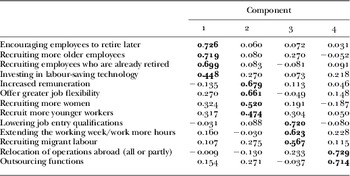
Following the approach taken by Henkens and colleagues, a principal components analysis was applied with a varimax rotation using the 15 responses to labour shortages. As shown in Table 3, some possible responses were removed due to the absence of significant loadings, these were: ‘Downscale the activities of your business’ and ‘Make use of unpaid volunteers’.
Principal components analysis of labour supply items

Note: Components: 1 = ‘Increase usage of older workers’, 2 = ‘Expansion of labour supply: incentives’, 3 = ‘Expansion of labour supply: reducing employment barriers’ and 4 = ‘Outsourcing and relocation’. Bold figures show loadings of greater than 0.4.
The four components that were extracted had a mix of responses to labour shortages that were distinct from the findings of Henkens and colleagues and with these data explained 50 per cent of the variance in responses to strategy usage. The four components that were extracted were labelled as follows.
1. Increase usage of older workers
This component had the largest loading for the response; ‘Encouraging employees to retire later’, followed by ‘Recruit more older workers’, ‘Recruiting employees who are already retired’ and finally, ‘Investing in labour-saving technology’. Unlike the dimensions uncovered by Henkens and colleagues this set of strategies have elements of reducing demand for labour, increasing labour supply from among the existing workforce and structural adjustments. This component focuses on the recruitment and usage of older workers and it is unclear why these strategies would align with a structural adjustment of investing in labour-saving technology.Footnote 1 Noteworthy is the difference between this approach and the one described earlier in this article that concerned flexible approaches to retirement.
2. Expansion of labour supply: incentives
This component had the largest loading on ‘Increased remuneration’ followed by ‘Offer greater job flexibility’, ‘Recruiting more women’ and finally ‘Recruit more younger workers’. This component again reflects a combination of the strategies proposed by Henkens and colleagues. While increased remuneration fell among the ‘outsourcing work and collaborating’ strategy in Henkens' work and recruiting more women fell with ‘tapping into new target groups’, these strategies have aligned into one component with these data. Concurrently, offering greater job flexibility is interpreted as an incentive strategy comparable to increased remuneration and increasing recruitment of younger workers reflects a similar approach to addressing labour shortages as recruiting more women.
3. Expansion of labour supply: reducing employment barriers
This component included two strategies identified by Henkens and colleagues; structural adjustments, in the recruiting of migrant labour and increasing use of the existing workforce in the response of extending the working week. Interestingly, the lowering of job entry qualifications was not found to load significantly in Henkens' analysis. The item ‘Lowering job entry qualifications’ had the largest loading on this component followed by ‘Extending the working week/work more hours’ and ‘Recruiting migrant labour’. These responses seem related to strategies identified in the previous component in that they concurrently describe targeting a new pool of labour and changes in the organisation of work and working time.
4. Outsourcing and relocation
The final component identified in this analysis included two responses: ‘Relocation of operations abroad (all or partly)’, which had the higher of the two loadings, and ‘Outsourcing functions’. From the perspective of the dimensions identified by Henkens and colleagues, these two responses cover two distinct dimensions; ‘outsourcing work and collaborating’ and ‘structural adjustments’.
Prediction of labour supply strategies
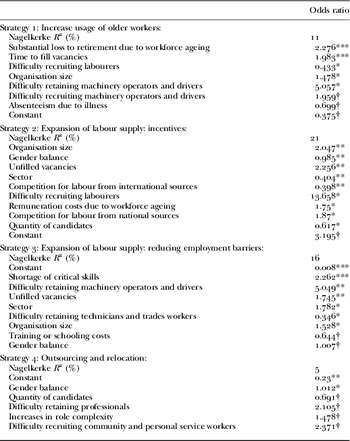
In an attempt to utilise organisational characteristics to predict use of the four strategies in response to labour shortages, the use of these strategies was dichotomised, moving from a continuous variable that reflected a count of the number of responses in each strategy that was applied to a variable indicating whether any of the responses in a given strategy had been applied. Using binary logistic regression, a series of predictor variables were chosen. These mirror those utilised in the analysis reported earlier in this article. This analysis is presented in Table 4.
Binary regression: prediction of strategies

Significance levels: †p <0.1, *p <0.05, **p <0.01, ***p <0.001.
Prediction of strategy 1: increase usage of older workers
The most important predictor was whether employers were anticipating a substantial loss of staff to retirement over the next five years (Wald = 15.6). Employers anticipating such a loss were more than twice as likely to apply such responses. This was followed by whether employers were experiencing problems with the time to fill vacancies (Wald = 12.4). Employers experiencing such problems were twice as likely to apply such responses. Next in terms of importance was whether employers were experiencing problems recruiting labourers (Wald = 4.7). Employers experiencing such difficulties were half as likely to use these responses. Organisation size (Wald = 4.4) came next, with large organisations approximately 50 per cent more likely to apply responses from strategy 1 than medium-sized organisations. Of lesser importance was whether employers were experiencing difficulty retaining and recruiting machinery operators and drivers (Wald = 4.3 and 3.4, respectively). Employers experiencing problems retaining machinery operators and drivers were five times as likely to apply these responses. Employers that were experiencing problems recruiting machinery operators and drivers were twice as likely to apply these responses. Of interest here is that such problems of labour supply appeared to be encouraging the usage of older labour whereas in the analysis reported earlier concerning organisational responses to workforce ageing, a negative relationship was observed with use of flexible employment strategies. This perhaps suggests that while in this instance there is interest in older labour, its usage is not associated with flexible approaches to retirement. The final predictor was whether employers were experiencing absenteeism due to illness (Wald = 3.4). Employers experiencing such problems were 40 per cent less likely to apply these responses.
Prediction of strategy 2: expansion of labour supply: incentives
The most important predictor was organisation size (Wald = 9.8), with larger employers twice as likely to apply the responses from strategy 2 than those of medium size. Gender balance in the organisation (Wald = 9.5) came next. For every unit increase in the proportion of males in the organisation, the probability of applying responses from strategy 2 fell by 1.5 per cent. This was followed by whether organisations were experiencing unfilled vacancies (Wald = 8.9). Employers experiencing such difficulties were more than twice as likely to apply these responses. Next came industrial sector (Wald = 8.3), with private-sector organisations 60 per cent less likely to apply responses from this strategy. Of somewhat lesser importance was whether organisations were experiencing competition for labour from international sources (Wald = 6.9). Organisations experiencing such competition were less than half as likely to apply these responses. This was followed by whether organisations were experiencing difficulties recruiting labourers (Wald = 6.4). Organisations experiencing such problems were 13 times as likely to apply responses from this strategy. Next came whether employers were expecting an increase in labour costs due to workforce ageing over the next five years (Wald = 5.0). Employers with such concerns were 75 per cent more likely to apply these responses. A further predictor was whether employers were experiencing competition for labour from within Australia (Wald = 4.8). Employers experiencing such competition were almost 90 per cent more likely to apply these responses. Finally, whether organisations were experiencing low quantities of candidates (Wald = 4.5) was also a predictor. Employers with such experiences were approximately 40 per cent less likely to apply these responses.
Prediction of strategy 3: expansion of labour supply: reducing employment barriers
The most important predictor was whether employers were experiencing a shortage of critical skills (Wald = 16.5). Employers experiencing such a shortage were more than twice as likely to apply responses from strategy 3. Next in terms of importance was whether employers were experiencing problems retaining machinery operators and drivers (Wald = 9.0). Employers experiencing such difficulties were five times more likely to apply responses from this strategy. This was followed by whether organisations were experiencing unfilled vacancies (Wald = 7.3). Employers with such experiences were 75 per cent more likely to apply these responses. Next in terms of importance was industrial sector (Wald = 6.4), with private-sector organisations 80 per cent more likely to apply responses from this strategy. After this was whether employers were experiencing difficulties retaining technicians and trades workers (Wald = 5.1). Where such difficulties were experienced employers were 65 per cent less likely to apply responses from this strategy. A further predictor was organisation size (Wald = 5.0), with large organisations 50 per cent more likely to apply these responses. Next came whether employers were expecting an increase in training costs due to workforce ageing (Wald = 3.6). Employers anticipating such an increase were 35 per cent less likely to apply responses from this strategy. Finally, gender balance in the organisation (Wald = 3.5) was also a predictor. For each unit increase in the proportion of males in the organisation, the probability of applying responses from strategy 3 increased by 1 per cent.
Prediction of strategy 4: outsourcing and relocation
The most important predictor was gender balance in the organisation (Wald = 9.3). For every unit increase in the proportion of male respondents, the probability of applying responses from strategy 4 increased by 1 per cent. Next was whether organisations were experiencing low quantities of candidates (Wald = 3.7). Employers experiencing this were 30 per cent less likely to apply responses from this strategy. This was followed by whether organisations were experiencing problems recruiting professional workers (Wald = 3.6). Employers experiencing such difficulties were twice as likely to apply responses from strategy 4. A further predictor was whether organisations were experiencing an increase in job role complexity (Wald = 3.5). Organisations experiencing this were 50 per cent more likely to apply responses from strategy 4. Finally, whether organisations were experiencing difficulties in recruiting community and personal service workers (Wald = 3.4) was also a predictor. Employers experiencing such difficulties were twice as likely to apply these responses.
To summarise this set of analyses, four approaches to managing labour supply were discerned using factor analysis and a range of predictors were determined. Regarding the first strategy, ‘Increase usage of older workers’, both workforce ageing and problems concerning labour supply were predictive of this approach. Public-sector employers were more likely than private ones to be targeting the employment of older workers, but employers concerned with absenteeism due to illness were less likely to have adopted this approach. Turning to the second labour supply strategy, ‘Expansion of labour supply: incentives’, workforce ageing and labour supply concerns were identified as predictors, as were organisation size and industry sector and gender. Regarding the third labour utilisation strategy, ‘Expansion of labour supply: reducing employment barriers’, whether employers were experiencing a shortage of critical skills and struggling to recruit certain types of workers, concerns about workforce ageing, industrial sector, organisation size, and gender balance acted as predictors. Turning to the final strategy identified, ‘Outsourcing and relocation’, gender was again of importance as were labour shortages. An increase in role complexity was also encouraging employers to cast their employment net as wide as possible. Of interest, workforce ageing was not a predictor of this latter approach to labour utilisation.
Discussion
This study has provided important new evidence concerning employer attitudes and practices towards older workers in Australia and added to the body of knowledge concerning the factors associated with the implementation of human resource strategies targeting older people. It has also placed older workers and workforce ageing in the context of labour utilisation strategies generally. Critically, and unusually in recent research on age and employment, this study has found evidence of employers generally appearing to demonstrate a comparatively strong orientation to this group. Our findings contrast favourably with studies in other countries and earlier Australian research. The authors can offer three explanations. First, it may be argued that the employers surveyed in this study could be somehow different to those surveyed elsewhere. This cannot be examined easily but earlier studies appear broadly consistent in their findings, whatever the methodology employed. Second, it may be that this finding represents a recent general shift in attitude towards older labour among Australian employers, perhaps as awareness of the likely impact of population ageing on the labour market has increased. Third, this finding may represent the effect of severe labour shortages in the Australian economy at this time that are forcing employers to cast their net wider than they otherwise would.
If the third explanation is correct, this would imply that employer interest in older labour might soften during any future economic downturn. However, our analysis suggests that concerns about both workforce ageing and its influences and about labour shortages are driving the adoption of specific measures concerning flexible approaches to retirement, the use of broader human resource strategies associated with workforce ageing and specific strategies aimed at increasing the supply of older labour. This may indicate that in Australia perceptions among employers regarding a longer-term trend towards workforce ageing could be supplanting more immediate labour supply concerns, perhaps suggesting that interest in older workers is likely to be sustained, rather than be a temporary situation as has been evidenced in earlier studies. If this is the case then it potentially bodes well for older workers in Australia. This situation may be exacerbated by the peculiarities of the Australian labour market where employers have a strong incentive to make do with the labour they have, unlike in the case of the relatively porous borders of Europe, in particular, which allow labour to flow freely, possibly encouraging a reliance on a continued ready supply from elsewhere.
On the other hand, our finding of modest interest among employers in retraining older workers, echoing previous studies, may indicate that they are, in another sense, nevertheless considered temporary stop-gaps. Managers may be recruiting older workers for roles for which training is considered unnecessary, or at least for ones that are not viewed as long term and for which investment in human capital is not considered worthwhile (Loretto and White Reference Loretto and White2006). This is rather more suggestive of a lack of a long-term commitment to older workers, with the potential for a precarious end to working life for some if a lack of human capital investment equates with a lack of quality employment opportunities (Kossen and Pedersen Reference Kossen and Pedersen2008), with inevitable difficulties in making a successful transition to retirement.
What appears to be a generally positive outlook for older workers in Australia also belies important differences among employers. Notable was the fact that overall, private-sector organisations were rather more oriented to strategies aimed at the expansion of labour supply, excluding those concerning older workers. It is possible to describe some characteristics of organisations targeting the increased usage of older workers. They tended to be larger, operating in the public sector, were anticipating a substantial loss of staff to retirement in the next five years, and had a problem with the time it took to fill vacancies. Employers experiencing problems with absenteeism due to illness were also less likely to be applying these solutions. This is possibly indicative of an association between age and declining health in the minds of employers and points to limits on the extent to which integrative strategies are applied to older workers. These findings also suggest that larger and public-sector organisations will be more receptive to older workers, perhaps making this an attractive employment option among this group. By contrast, this study points to the need to target policy measures on older workers in smaller and private-sector employers. Thus, in fact, this study points to the significant age segmentation of the Australian labour market. It is interesting to speculate on how this situation might evolve as the population continues to age. As noted earlier, significant numbers of smaller and private-sector organisations see no need to act in response to workforce ageing. Many employers will, it seems, be highly resistant to adjusting their approaches to managing labour.
In the context of this study, also of interest is the finding that age did not appear to be related to the propensity of an organisation to offshore or outsource its activities. This seems to run counter to the view that the flexible firm will be unwilling to accept an ageing of its workforce. Male-dominated organisations were more likely to countenance offshoring or outsourcing but not those with an over-representation of older workers. There is, however, a need for caution in interpreting this result. Ideally, more nuanced analysis would have considered sectoral and occupational differences and whether, for instance, employers were competing in international markets. However, the relatively small sample size in this study made such analysis problematical.
Given considerable interest in flexible retirement among policy makers internationally amid efforts to prolong working lives (Reday-Mulvey Reference Reday-Mulvey2000), the findings of this study are of importance. It appears that this approach was not generally applied to those in manual occupations. This is of concern, given the greater physical demands placed on such workers compared to other occupational groups. This approach is also less likely to be implemented by private-sector employers, here potentially placing older workers at a significant disadvantage compared to their public-sector counterparts.
Also noteworthy is that a lack of critical skills in organisations was found to be a determinant of the adoption of flexible retirement practices. This has long been considered a key benefit for organisations in adopting such an approach (Reday-Mulvey Reference Reday-Mulvey2000). Interestingly, as a driver of organisational policy making this is somewhat suggestive of an interest in nurturing and maintaining human capital that seems somewhat at odds with other evidence from this study of disinterest in investing in older human capital from a training perspective. However, the finding in this study that coaching and mentoring was an important response to workforce ageing may suggest that older workers are viewed as important stores of critical skills and knowledge that can be drawn on and transferred to others, but not it appears as potential recipients.
Caution is required in the interpretation of the findings of this study, indeed of most studies that have considered the attitudes and behaviour of employers towards older workers. Three broad and related methodological weaknesses place limitations on the conclusions that may be drawn. First, who was responding to the survey should be considered. In this and most other studies, there was an over-representation of those responsible for human resource matters. Given the considerable coverage of age issues in the specialist personnel press for more than a decade it might be expected that awareness of age and employment issues would have increased among human resource professionals. However, this is less likely to have been the case among other types of manager and supervisor. Were such people surveyed quite different findings might have been obtained. Second, there is the issue of whether the survey respondent was in a position to comment on company practices or was merely reporting policies. Studies have found that that actual practice does not always adhere to these policies and that both employees and line managers often had limited knowledge of policies (Goldstone and Jones Reference Goldstone and Jones2001), raising serious concerns about the relationship between organisational policy and practice (Loretto and White Reference Loretto and White2006). Also, while company policies may not overtly exclude older workers this does not mean that they will participate in large numbers in practice. For instance, there may be hidden institutional barriers limiting their participation. Studies have not considered the actual use made by older workers of flexible retirement arrangements or their actual participation in company training. But in the case of the latter it seems that older workers may face considerable organisational barriers (Taylor and Urwin Reference Taylor and Urwin2001). Third, a major deficiency is that most studies, including this one, of organisations have been reliant on one, or at best a limited number of data sources within organisations and have been carried out at one point in time. Not only does this lead to problems of unreliability of data, it also means that it is not possible to tell how workplace policies develop and change over time and how workers and managers influence, respond to and are affected by these changes. In particular, as already noted, there is evidence that attitudes and practices towards older workers vary depending on the point in the economic cycle.
Despite a recent proliferation of research studies in this area, understanding of the behaviour of organisations with regard to the management of workers of different ages remains limited. In particular, there is a need for more longitudinal studies and qualitative research within workplaces in order to properly discern trends and to better understand where deficiencies in organisational knowledge exist and how age barriers are manifested. Such knowledge will assist greatly in the development of intervention strategies that will effectively support employers as they respond to workforce ageing and problems in the management of labour supply.
Acknowledgements
This project was supported by a grant from the Australian Research Council (LP0 884 065), the Australian Population Institute, Success Factors and the Department of Employment, Economic Development and Innovation in Queensland.
Appendix 1
Variables used in the analysis