Optimizing antibiotic use is one component of a multifaceted strategy to tackle the antimicrobial resistance threat in health care. In 2015, the Regional Committee of the World Health Organization (WHO) for the Americas approved the Plan of Action on Antimicrobial Resistance.1 In this document, monitoring antibiotic use at the national level and strengthening the role of antibiotic use committees are noted as requirements to achieve the goal of optimizing antibiotic use in human health by 2020. To accomplish this milestone in Argentina, the National Program of Epidemiology and Control of Hospital-Acquired Infections (HAIs) conducted point-prevalence studies on hospital antibiotic use in Argentina to provide updated information on antibiotic use at national and regional levels. Herein, we report the results of these surveys in the year 2018.
Methods
The Argentina National Program of Epidemiology and Control of HAIs conducted 1-day prevalence surveys on hospital antibiotic use using a protocol and data collection forms developed by the program and based on the experience of Global Survey of Prevalence of Point of Consumption and Resistance of Antimicrobials (GLOBAL-PPS).2 The study was advertised at national conferences and through the Infectious Diseases Society of Argentina and Ministry of Health websites. In total, 109 hospitals from 21 of 24 provinces voluntarily participated in the survey. Data on antibiotic use were collected in all hospitalized patients (denominator) present in the wards at 8 a.m. on a predefined day in November 2018 following the instructions and inclusion criteria previously sent to the enrolled institutions. Those receiving an antimicrobial (numerator) were classified in 5 groups according to indication as documented in the chart: (1) HAI, (2) community-acquired infections (CAIs), (3) medical prophylaxis, (4) surgical prophylaxis, and (5) unknown (reason not documented in the chart). The following additional data were collected: patient gender and age, unit location, antimicrobial dose and route of administration, and site of primary infection. Hospitals were stratified into 4 groups according to services provided: (1) small hospitals with basic services, (2) community hospitals, (3) large public or private academic centers, and (4) specialty hospitals (eg, a dedicated obstetrics hospital).
The classification of Anatomical Therapeutic Chemicals (ATC) of the World Health Organization (WHO) was used for antimicrobial grouping.Reference Versporten, Zarb and Caniaux3 Staff at each site were trained in data collection prior to the survey, and data were recorded on a software developed for the survey, which had been validated before its implementation by the national team. Categorical variables were compared using the χ2 test in Stata version 13 software (StataCorp, College Station, TX). A 2-sided P < .05 was considered statistically significant.
Results
Overall, 10,006 patients from 71 public and 38 private hospitals in Argentina were evaluated; 44% were female, with a mean age of 35; the mean age of men was 56; and 6,976 patients (70%) were in public hospitals. There were 1,486 pediatric patients (15%) in the cohort.
Of the 10,006 patients surveyed, 4,031 (40%) were receiving at least 1 antimicrobial.
More patients in small hospitals were receiving an antibiotic, compared to larger size hospitals: 141 of 286 (49%) in small hospitals compared to 2,252 of 5,385 (42%) in medium-size hospitals (51–200 beds) (95% CI, 0.01–0.12; P = .02), as well as 1,461 of 3,779 (39%) in large hospitals (201–499 beds) (95% CI, 0.04–0.15; P < .01), and 177 of 556 (32%) in very large-size (>500 beds) hospitals (95% CI, 0.10–0.23; P < .01). Antibiotic use was more common in hospitals providing basic services (59 of 116, 51%) than in community hospitals (1,006 of 2,619, 38%; 95% CI, 0.03–0.22; P < .01) and large academic centers (2,530 of 6,190, 41%; 95% CI, 0.00–0.19; P = .03)
Antibiotic use was lower in the western region and in Buenos Aires city (255 of 700, 36%) and (1,673 of 4,500, 37%), respectively, compared to other regions in the country where the prevalence was ≥40%: 37% in Buenos Aires city compared to 1,008 of 2,280 (44%) in the northern belt of the country (95% CI, 0.09–0.04; P < .01), with 696 of 1,559 (44%) in the central region (95% CI, −0.09 to −0.04; P < .01) and 144 of 362 (40%) in Patagonia (95% CI, −0.08 to 0.02; P = .25). The distributions of antibiotic use by patient population, unit, and indication are summarized in Table 1.
Antibiotic Use in Hospitals in Argentina, 2018

Note. BL/BLI, narrow-spectrum β-lactam/β-lactamase inhibitor combinations; TMP/SMZ, trimethoprim and sulfamethoxazole.
a Antibiotics representing <3% of antibiotics used are not included.
b Narrow-spectrum β-lactamse/β-lactamse inhibitor: ampicillin/sulbactam, amoxicillin/sulbactam, amoxicillin/clavulanic.
More than half of all prescribed antibiotics were included in the following antibiotic groups: narrow-spectrum β-lactam/β-lactamase inhibitor combinations (BL/BLI, 749 of 6,073, 12.3%), first-generation cephalosporins (632 of 6,073, 10.4%), piperacillin/tazobactam (467 of 6,073, 7.7%), ciprofloxacin (462 of 6,073, 7.6%), vancomycin (431 of 6,073, 7.1%), ceftriaxone (335 of 6,073, 5.5%), and clindamycin (306 of 6,073, 5%).
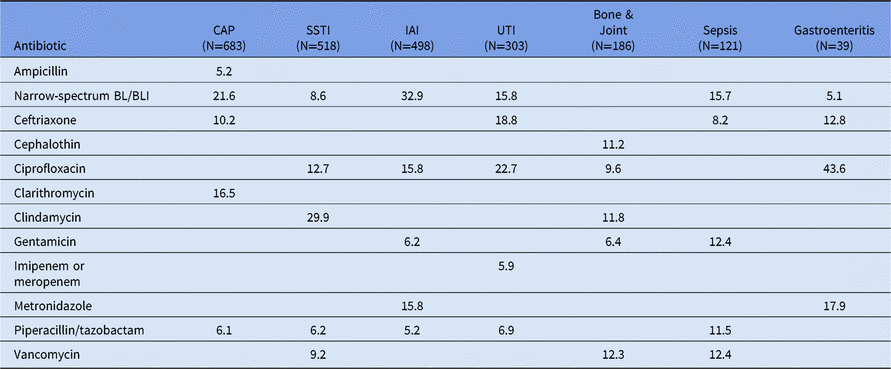
The most commonly prescribed empiric antibiotics for CAI included narrow-spectrum BL/BLI (487 of 2,329, 22.5%), ciprofloxacin (233 of 2,329, 10%), clindamycin (214 of 2,329, 9.2%), and ceftriaxone (213 of 2,329, 9.1%). However, the most common definitive antibiotics prescribed for CAIs were rifampin (48 of 650, 7.4%), vancomycin (45 of 650, 7%), piperacillin/tazobactam (37 of 650, 5.7%), ciprofloxacin (37 of 650, 5.7%), and ceftriaxone (35 of 650, 5.4%). The most common CAIs included pneumonia (683 of 2,672, 25%), skin and soft-tissue infections (SSTIs, 518 of 2,672, 19%), intra-abdominal infection (498 of 2,672, 19%) and urinary tract infections (UTIs, 303 of 2,672, 11%). The distributions of most commonly prescribed antibiotics by source of community-acquired infection are listed in Table 2. The most common antibiotic used for surgical prophylaxis was a first-generation cephalosporin (445 of 774, 57%), followed by ciprofloxacin (73 of 774, 9.4%).
The 5 Most Commonly Prescribed Antibiotics for Common Community-Acquired Infections

Note. CAP, community-acquired pneumonia; SSTI, skin and soft-tissue infection; IAI, intra-abdominal infection; UTI, urinary tract infection;BL/BLI, narrow-spectrum β-lactam/β-lactamase inhibitor combinations.
Discussion
In this prevalence survey conducted in acute-care hospitals in Argentina, 40% of patients were receiving an antimicrobial at the time of the survey, similar to that reported for Latin America by the Global-PPS for 2015. 4 Prevalence of antibiotic use was lower in certain regions; however, drug shortages or financial struggles that may have affected antibiotic availability were not assessed. Understanding contributing factors to regional differences is important in tailoring antibiotic stewardship efforts to regional needs.
The results of this survey indicate that small hospitals in Argentina might be using as much antibiotics as larger hospitals of higher complexity. According to a US national survey on antibiotic use, the size of the hospital was inversely correlated with the number of Centers for Disease Control antimicrobial stewardship core elements met,5 indicating that lack of resources (whether human or technical) may impact the quantity and quality of antibiotic use in the inpatient setting.
Most patients in this study were not in the intensive care unit (ICU), yet most patients in the ICU received antibiotics. Further evaluation of indications and appropriateness of antibiotics in this setting is needed. Better understanding of decision making around empiric and definitive treatment may help optimize antimicrobial use. For community-acquired infections, although narrow-spectrum BL/BLI and clindamycin were commonly prescribed for empiric treatment, rifampin, piperacillin/tazobactam, and vancomycin were commonly used for definitive therapy. Whether prescribers had local antibiograms, culture results, or treatment guidelines to guide their decisions was unknown.
Fluoroquinolones ranked second in overall use after BL/BLI antibiotics. Almost 1 in 10 antibiotics for surgical prophylaxis was ciprofloxacin, and it was among the most commonly prescribed antibiotics for UTI and SSTI. At least 30% of Escherichia coli isolated from CAI in Argentina are resistant to ciprofloxacin.5 Thus, the role of ciprofloxacin in empiric regimens and surgical prophylaxis merits further evaluation.
This study has several limitations. Duration of therapy was not collected; thus, the current report may overestimate or underrepresent broad-spectrum antibiotic use. Likewise, a cross-sectional study does not allow observation of trends or seasonality of antibiotic use. Last, voluntary participation may have selected hospitals with an interest in antibiotic stewardship, limiting generalizability of results. However, the survey does point to specific areas where antibiotic use in the hospital may warrant further attention.
In summary, these data enhance substantially the understanding of antibiotic use in Argentine hospitals and will be of great value to strategic plans aiming to address antibiotic prescribing problems and ensure safer antibiotic use in health care.
Acknowledgments
“Programa Nacional de Epidemiologia y Control de Infecciones Hospitalarias” would like to thank all participating hospitals that voluntarily collected and submitted data on antibiotic use and special thanks to Irene Pagano, MD, and Juliana Alvarez, MD, for their valuable contributions to this project. The results of this survey were shared via a written report in Spanish to participating hospitals earlier this year. The report is not available to the public.
Financial support
This survey was supported by “Programa Nacional de Epidemiología y Control de Infecciones Hospitalarias” and the Ministry of Health and Social Development of Argentina.
Conflicts of interest
All authors report no conflicts of interest relevant to this article.