Introduction
The last several decades have seen major advances in the mechanistic understanding of the onset and treatment of cardiovascular diseases. Increasing evidence supports the hypothesis that environmental stressors may increase the risk of acute cardiovascular events through triggering emotional stress.Reference Moller, Theorell and de Faire1, Reference Strike and Steptoe2 Both natural hazards (ie, earthquakesReference Leor and Kloner3 and hurricanesReference Swerdel, Janevic and Cosgrove4) and human causes (such as warsReference Meisel, Kutz and Dayan5 and terrorist attacksReference Allegra, Mostashari and Rothman6, Reference Feng, Lenihan and Johnson7) increase cardiac events. While emotional stress may play a critical role in those directly involved in a traumatic event, those who are not present and thus not directly involved may also experience stress reactions.Reference Schuster, Stein and Jaycox8, Reference Kiyohara, Kitamura and Iwami9
On the morning of April 16, 2014, one of the most tragic events in South Korean history occurred. The MV Sewol ferry, carrying 476 passengers and crew, including 325 high school students, capsized and sank off the western coast of South Korea, and left 304 people dead. Most of the dead were students from Danwon High School in Ansan.Reference Woo, Cho and Shim10 This disaster resulted in nation-wide grief and anger. Media coverage extensively disseminated live video footage of the ferry sinking with hundreds of victims, mostly teenagers, still trapped inside. Millions of Koreans were repeatedly exposed to these terrifying images over several weeks.
Catastrophic events may have pronounced health effects on individuals not physically present, particularly those who personalized the event and visualized themselves as potential victims.11 Limited data exist on the psychological effects from indirect exposure to national catastrophes, but have been described with the 9/11 terrorist attackReference Schuster, Stein and Jaycox8 (USA; 2001) and the Oklahoma City bombing (Oklahoma USA; 1995).Reference Pfefferbaum, Seale and McDonald12
Psychological stress from disasters results in both acute and long-term increases in cardiovascular disease risk among surviving victims.Reference Aoki, Fukumoto and Yasuda13 However, the immediate cardiovascular effects on a large sample of those indirectly exposed to a national catastrophe have not been examined. The objective of this study was to examine the association between the Sewol ferry disaster and nation-wide emergency department (ED) visits for cardiovascular events. It is hypothesized that a severe national disaster (eg, the Sewol ferry sinking) will cause an increase in the incidence of cardiac emergencies across the entire nation.
Materials and Methods
Study Setting and Acquisition of Data
Approximately 460 EDs exist in Korea, and they are designated by the Ministry of Health and Welfare (Sejong City, South Korea) as Levels I through III according to capacity and resources.Reference Ro, Shin and Lee14 Currently, 20 regional EDs (Level 1), 120 local EDs (Level 2), and approximately 300 emergency facilities (Level 3) provide care across the country. Level 1 EDs provide a high-level of emergency care by emergency physicians and contain emergency intensive care units.
The National Emergency Department Information System (NEDIS) is a government-run, nation-wide database containing data on all ED visits. The NEDIS has been in operation since 2003 and collects data from all ED patients and contains both demographic and clinical information. These data are certified and results are reported annually to the Ministry of Health and Welfare.15 Level I, II, and III EDs which collected the NEDIS data for the entire study periods were included. The exposure period included one-week periods from April 16 through June 17, 2014 (from the day of the Sewol ferry disaster to eight weeks after the disaster). The reference period was one month before the Sewol ferry disaster (March 15 to April 15, 2014). In order to evaluate the possibility of temporal increase in cardiovascular events, control periods prior to the Sewol ferry disaster (March 15 to June 17 in 2011, 2012, and 2013) were included in the study.
The final clinical diagnosis was based on the Korean Standard Classification of Disease 6th version (KCD-6), which is the Korean version of the International Classification of Disease (ICD) 10th revision. For the final analysis of the present study, patients greater than 18 years old who visited a participating ED and had one of the following final KCD-6 diagnoses: acute myocardial infarction (MI; I21.0-I21.9), angina (I20.0-I20.9), and/or cardiac arrhythmias (I49.0-I49.9) during the above mentioned exposure (April 16 to June 17, 2014), reference (March 15 to April 15, 2014), and control (March 15 to June 17 in 2011, 2012, and 2013) periods were extracted from the NEDIS database.
Environmental data for the study periods were also collected, as these findings may impact the rate of cardiovascular emergencies.Reference Cosselman, Navas-Acien and Kaufman16 Weather data, including daily mean temperature (°C) and air pressure (hPa), were obtained from the Korean Meteorological Administration (Seoul, South Korea). Ambient levels of air pollutions, including particulate matter ≤10μm (PM10) in aerodynamic diameter (μg/m3) and ozone (O3, ppb), were obtained from the Korea National Institute of Environmental Research (Incheon, South Korea).
This study was approved by institutional review board in Seoul National University Hospital (Seoul, South Korea; IRB No. 1807-026-955).
Statistical Analysis
The Poisson regression with a log link was used to model daily emergent cardiovascular event rates. A day was defined as a 24-hour period beginning at 9:00am, given that approximate time of sinking began at 8:50am and first media announcement at 9:20am. Incidence rate ratios (IRRs) comparing the weekly occurrence of cardiovascular events during the two-month period after the Sewol ferry incident with the reference period of one month prior to the disaster, adjusting for the same periods in previous three years, were calculated using the ESTIMATE statement in SAS (version 9.4; SAS Institute, Inc; Cary, North Carolina USA). Models were further adjusted by including the mean daily temperature, barometric pressure, and ambient air pollutants. The IRRs for sub-groups of patients, according to their gender, age group, and final diagnosis, were also calculated.
A two-tailed P value of less than .05 was considered to be statistically significant. All statistical analysis was performed using SAS software (version 9.4).
Results
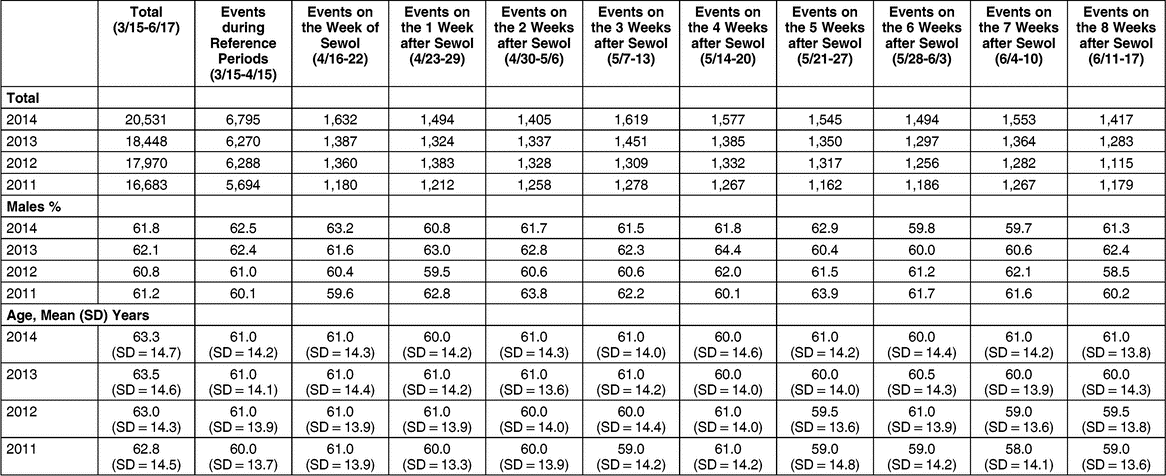
A total of 73,632 patients with acute cardiovascular emergencies were included in the study, including 45,280 (61.5%) males with a mean age of 63 (SD = 14.5) years old. Table 1 shows the weekly number of cardiovascular emergencies from the times after the Sewol disaster as well as the reference period (one month before the Sewol disaster) for each year from 2011 to 2014.
Characteristics of Patients with an Acute Cardiovascular Emergency during the Sewol Ferry Disaster Periods as Compared with the Reference Periods

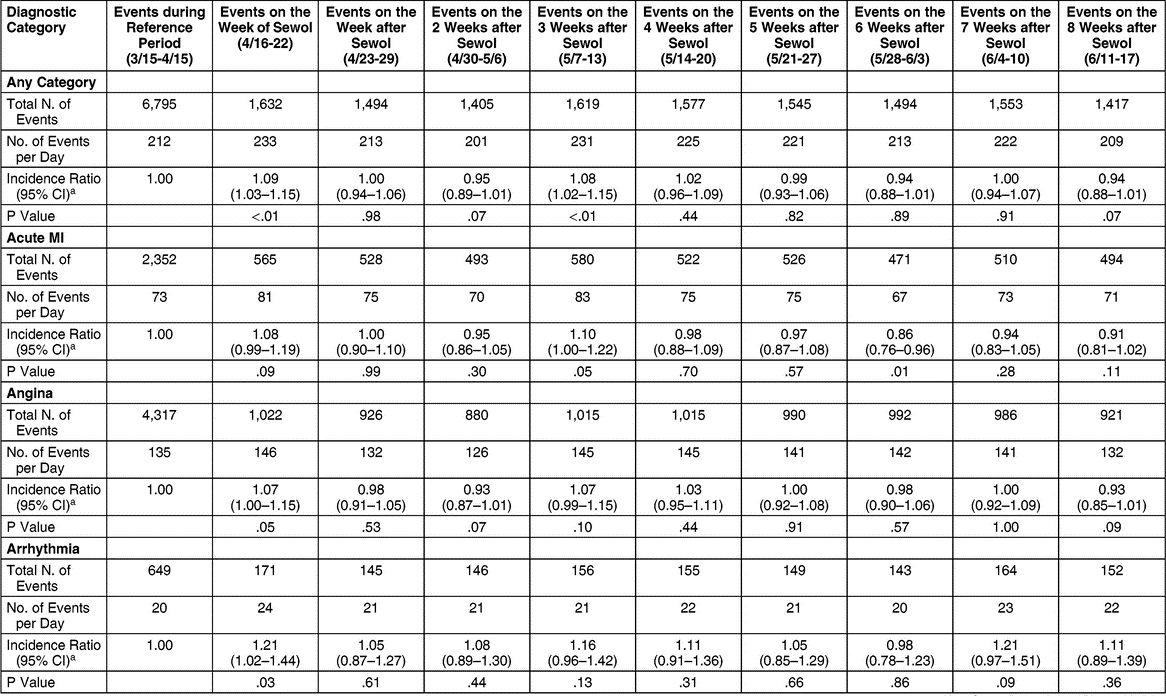
Table 2 shows the IRRs for cardiovascular events during the Sewol disaster, comparing weekly incidences of cardiovascular emergencies from the week of the event to eight weeks after the event with the reference period. After adjustment for temporal variation (same weekly periods in 2011-2013) and environmental factors, statistically significant increases in the incidence of cardiovascular emergencies were observed for the week of the Sewol disaster (4/16-22) and on the three weeks after the event (5/7-13) with adjusted IRRs of 1.09 (95% CI, 1.03-1.15; P <.01) and 1.08 (95% CI, 1.02-1.15; P <.01), respectively. When specific cardiac emergencies were analyzed, the most significant increase was observed in cardiac arrhythmias on the week of the Sewol disaster (IRR = 1.21; 95% CI, 1.02-1.44; P = .03). The incidence of emergency visits due to acute MI (IRR = 1.08; 95% CI, 0.99-1.19) and angina (IRR = 1.07; 95% CI, 1.00-1.15) also increased during the week of the disaster.
Multivariable Incidence Ratios for Cardiovascular Emergencies during the Weeks Following the Sewol Disaster, as Compared with the Control Period (One-Month before Sewol) According to Diagnostic Category

Abbreviation: MI, myocardial infarction.
a Adjusted for environmental (mean daily temperature, sea level pressure, ozone, and PM10) and temporal (2011-2013) factors.
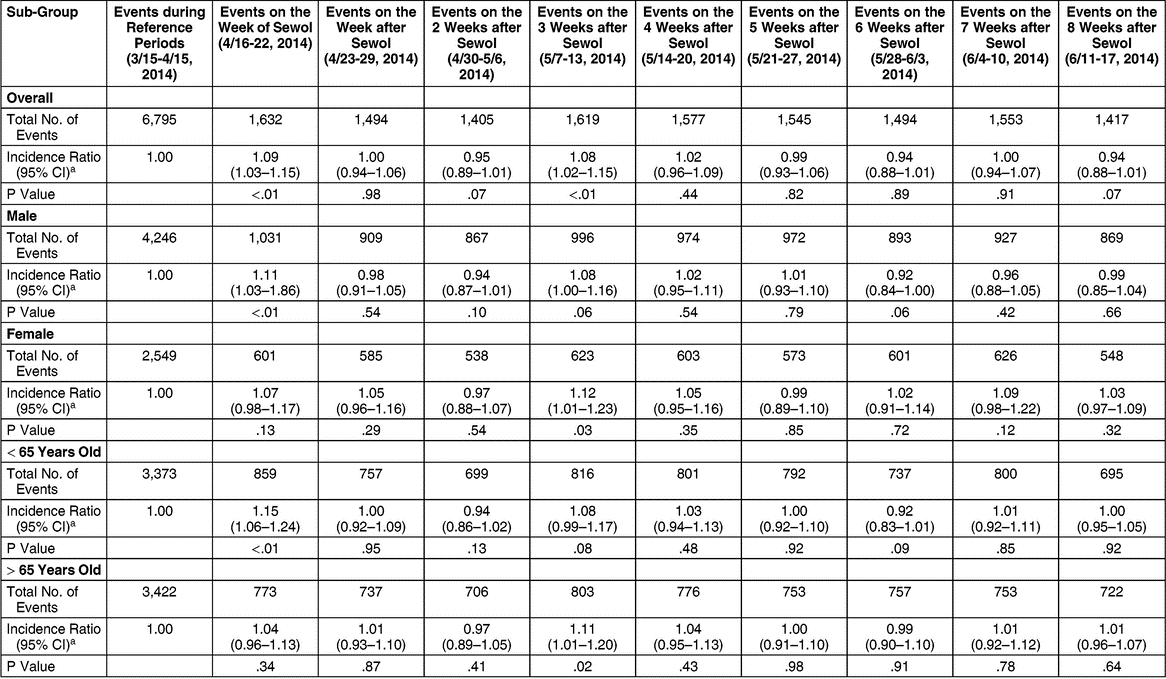
Sub-group analysis (for gender and age) indicated significant increases in the number of cardiovascular emergencies on the week of the Sewol for males (adjusted IRR = 1.11; 95% CI, 1.03-1.86; P <.01) and those less than 65 years of age (adjusted IRR = 1.15; 95% CI, 1.06-1.24; P <.01) when compared with the reference period (Table 3). There was also a significant increase in the number of cardiovascular emergencies on the third week after the event for female patients (adjusted IRR = 1.12; 95% CI, 1.01-1.23; P = .03).
Multivariable Incidence Ratios for Cardiovascular Emergencies during the Weeks Following the Sewol Disaster, as Compared with the Control Period (One Month before Sewol) by Gender and Age Sub-Groups

a Adjusted for environmental (mean daily temperature, sea level pressure, ozone, and PM10) and temporal (2011-2013) factors.
Discussion
In this study, the use of a large, representative, national dataset demonstrated increased risk of emergent cardiovascular emergencies during the first weeks of the Sewol ferry disaster. To the best of the authors’ knowledge, this is the first study to demonstrate the indirect exposure of a traumatic event to a significant increase in the incidence of acute cardiovascular emergencies.
Traditionally, those directly impacted with a specific disaster were considered at-risk, thus prior studies focused on the health consequences of the individuals who were directly exposed to the traumatic event.Reference Leor and Kloner3, Reference Tsai, Lung and Wang17 Following the Sewol disaster, several studies reported on the mental and physical health effects on those directly affected, including the survivors,Reference Lee, Nam and Kim18 the victim’s family members,Reference Lee, Han and Jang19 Danwon High School teachers,Reference Lee, Bhang and Lee20 and the community volunteers.Reference Lee, Kim and Bae21
Interest in the mental and physical health of the general population has increased since the 9/11 terrorist attacks. After the September 11 attacks, increased rates of ventricular tachyarrhythmia were observed among patients in Florida (USA) with implantable cardioverter-defibrillator.Reference Shedd, Sears and Harvill22 In another study, which was conducted after the March 11, 2011 Japanese earthquake, Kiyohara, et alReference Kiyohara, Kitamura and Iwami9 demonstrated that the incidence of out-of-hospital cardiac arrest in those living in non-disaster areas increased for the first week after the earthquake among both all adults (adjusted RR = 1.13; 95% CI, 1.05-1.22) and elderly women (adjusted RR = 1.23; 95% CI, 1.11-1.37).
Wide-spread media coverage potentially extends the disaster boundary by transmitting its impact far beyond the directly exposed population, which triggers detrimental health effects.Reference Holman, Garfin and Silver23, Reference Vasterman, Yzermans and Dirkzwager24 Catastrophic events are repeatedly broadcasted by mass media, which may contribute to stress-related symptomsReference Marshall, Bryant and Amsel25 and induce cardiovascular events, even among people indirectly exposed to the disaster.Reference Kiyohara, Kitamura and Iwami9 A study of the 2013 Boston (Massachusetts USA) Marathon bombing demonstrated that trauma-related media exposure is not only associated with acute psychological responses following the bombings, but had higher acute stress levels than those with direct exposure.Reference Holman, Garfin and Silver23
During the periods of the Sewol ferry disaster, millions of Koreans viewed repeated television coverage of the Sewol ferry sinking with hundreds of students still in the capsizing ferry. Furthermore, the captain’s and crewmembers’ irresponsibility, the government’s deficient response, and the slow response by rescue teams provoked further public anger and distress.Reference Lee, Nam and Kim18 In the current study, a significant increase in cardiac events was observed on the week of the Sewol disaster (April 16-22, 2014) and during the three weeks after the disaster (May 7-13, 2014). Previously, Woo, et al investigated changes in the public mood following the Sewol disaster using social media data (Twitter; Twitter Inc.; San Francisco, California USA), natural language processing, and text-mining technologies.Reference Woo, Cho and Shim10 Compared with a baseline of 46 days before the disaster, the number of social media posts mentioning anger, anxiety, and sadness all sharply increased during the five days after the disaster. In particular, expressions of anxiety had another peak during the third week after the disaster, when reports that the sunken Sewol ferry was beginning to collapse (reported on May 9, 2014). Thus, the spike in cardiac events during the three weeks after the disaster was likely related to the broadcasting of this event.
Strong evidence supports a significant impact of psychological factors on the pathogenesis of cardiovascular diseases.Reference Rozanski, Blumenthal and Kaplan26–Reference Vale28 Advances in the understanding of the mechanism of acute cardiovascular disease have coincided with increased acceptance in the role of psychological factors.Reference Buckley, Hoo and Fethney29 In addition to the previously mentioned catastrophes, national team soccer matches are known to trigger strong enough emotions to cause an increase in the incidence of cardiac emergencies. Compared to historical controls, a 25% increase in MI admissions in London was noted on the day England lost to Argentina in a penalty shootout during the 1998 World Cup.Reference Carroll, Ebrahim and Tilling30 Similarly, in Munich in 2006, the incidence of cardiovascular emergencies increased 2.7 times for men and 1.8 times for women on days the German team played.Reference Wilbert-Lampen, Leistner and Greven31
Several theories exist to explain how acute stress reactions to major events contribute to the development of acute cardiovascular emergencies. The mechanism for developing cardiovascular emergencies following stress includes increased sympathetic activation, which (1) mediates an increase in arterial pressure and heart rate, and vagal withdrawal coupled with transitory endothelial dysfunction and atherothrombotic activation; and (2) increases activity of blood clotting factors and platelets.Reference Vale28
Limitations
This study has several limitations. First, previous studies have indicated that triggering of acute cardiac events is more common in patients with known cardiovascular disease.Reference Strike, Perkins-Porras and Whitehead32, Reference Tofler and Muller33 The NEDIS, however, does not collect data on patients’ existing diseases, therefore it was uncertain whether the increase in acute cardiac emergencies was primarily in those with a history of cardiovascular disease. Second, the cardiac arrest events were not included in this study. Several studies demonstrated an increase in the out-of-hospital cardiac arrests within a few weeks of a traumatic catastrophe in individuals from non-disaster-stricken areas.Reference Kiyohara, Kitamura and Iwami9 However, it has been previously reported that diagnosis-based (such as ICD code-based) selection method is not a sensitive approach to identifying out-of-hospital cardiac arrests.Reference Coppler, Rittenberger and Wallace34 Therefore, due to the possibility of mis-classification and under-estimation of out-of-hospital cardiac arrest cases, cardiac arrest events were not included in the cardiac events in this study. Finally, although the patients were evaluated by emergency medicine physicians, mis-classification bias may have occurred. However, such bias is likely to be equally distributed across the study time period.
Conclusion
The present study demonstrates a significant increase in the incidence of cardiovascular emergencies during the week of, and three weeks after, the Sewol ferry disaster in 2014. These additional cardiac emergencies were likely triggered by emotional stress in relation to the tragic catastrophe. This study suggests an important public health impact from indirect exposure to tragic catastrophes. Further studies are warranted to assess mental and physical health of the general population in association with other traumatic disasters.