Grain upon grain, one by one, and one day, suddenly, there’s a heap, a little heap, the impossible heap.
Samuel Beckett, Endgame
Introduction
The ongoing legal and bioethics debates on consent requirements for collecting, storing, and utilizing human biological material for purposes of basic and applied research—that is, genomic research biobanking—have already managed to pass through three ostensibly dissimilar stages: during the last two decades or so, a mudslide of research papers, policies, and guidelines have been produced advocating anything from (1) presumed consent;Footnote 1 to (2) expressed, full-blown informed consent;Footnote 2 to the current mode of (3) broad consent.Footnote 3 Although it would be tempting to reconstruct these stages according to a historical dialectic, in which the latest consent model supersedes (aufhebt) the preceding ones, a critical analysis of the debate does not suggest that a qualitatively conceptual change has taken place. In fact, one of the most remarkable features of this debate is how little has been achieved conceptually, and how much effort has been laid down in balancing the purported interests of different stakeholders. With the arrival on the scene of (4) open consent models, we argue that the concept of consent may even become reduced to a hollow repetitive ritual, devoid of any relevant moral content.Footnote 4
Even though the different models (1–4) apply different outlooks on the distribution of interests as well as possible benefits and harms to different stakeholders involved in genomic research biobanking, in terms of the languages adopted, we are still firmly within the ethical frameworks of medical research and transplantation medicine. Consequently, the interests of research biobank donors tend to be debated as if they were identical to the interests of research subjects and patients in a medical context. This conflation of contexts arguably has some detrimental effects on our ability to ground the debate in the complex realities of genomic research biobanking, and the normative challenges it poses for individuals, institutions, and societies. Evidence suggests that the fundamental interests of so-called donors are too readily being defined for them in order to facilitate scientific and technological progress, often by bioethicists and legal experts kept on a leash by their own fantasies of biomedical utopia.
The Emergence of Genomic Research Biobanking
With the emergence of genomic research biobanking, the context of basic and applied biomedical and epidemiological research undergoes a qualitative change, not only as to its modes of organization but also, perhaps even more importantly, as to its different modes of interaction, by which we mean the specificity and diversity of relationships in which it is involved.
To be sure, it would seem only rational to use existing health registries, health surveys, and biobanks for different research purposes; however, the normative condition for this rationale has long rested on the premise that permanent health registries would remain unconnected, to be linked only temporarily within definite and closely monitored periods of time and only for precise, predefined purposes—at least ideally. Also, health registries have often been mandatory, conforming to a state’s obligation to monitor its population’s health, as for instance the Norwegian Cancer Registry and Birth Registry. Conversely, by employing both cohort and longitudinal research designs, comprehensive health surveys link a much wider range of person-sensitive data. The explicit or implicit premise of conducting health surveys has nonetheless been that they should not become permanent, and that data borrowed for research should be destroyed after its use. Data from health surveys also have been linked with data from biobanks, for example, pathological collections, the latter of which have traditionally been confined to the confidential spaces of hospital institutions, kept inconspicuous and shielded from the attention of outsiders. With the development of patients’ rights and data archive regulations, medical records stored by general practitioners or at hospital institutions became accessible to the patients themselves, which meant that patients had a right to know and control the information stored about them.
These checks and balances play the important democratic function of preserving citizens’ rights to privacy and fundamental freedoms: the construction of permanent databases containing individual-specific and sensitive information about citizens is a serious matter, a decision not to be left in the hands of either well-meaning scientists or self-styled ethical experts. As we shall see, the organizational mode of genomic research biobanking entails a rupture with the long-standing legal and moral tradition underpinning this “social contract.”
Take, for example, contemporary population research biobanks. Such biobanks contain vast amounts of biological samples and digitalized data stemming from a wide range of sources: blood samples, medical records, environmental data, health surveys, lifestyle data, genealogy data, and so on. What makes these research biobanks different from traditional biobanks is, among other things, their
• indefinite and readily expandable storing capacity;
• digitalization of a wide range of analogue data sources;
• enhanced resolution of data;
• efficiency of data sequencing, transfer, and accessibility;
• conversion of donations into natural resources with economic and techno-scientific value;
• indefinite linking capacities, which means that biobanks can be indefinitely expanded or linked into research infrastructures.
In the late twentieth century, rapid developments within high-throughput technologies and automation of laboratory procedures as well as increasingly powerful information and communication technologies meant that sufficiently large quantities of data now could be sequenced, enumerated, and stored at levels that, at the same time, were becoming increasingly cost efficient. If the molecular conceptualization of life as information had been important for biology in order to recast the macromolecules and functional structures of genetics in terms of a language of “codes,” “messages,” and “transcriptions,”Footnote 5 its importance became reaffirmed once more, as the analogue bioinformation of life could be sequenced and stored as digital bioinformation.
A striking illustration of the technical and bioinformatic upheavals, not least the creativity and vivacity of today’s genomic science, is the so-called 1000 Genomes Project, a mega-project launched in January 2008 and comprising some of the world’s leading research organizations in the field, such as the Beijing Genomics Institute, the Wellcome Trust Sanger Institute, and the National Human Genome Research Institute (NHGRI). As stated in an announcement of January 22, 2008, about the project:
During its two-year production phase, the 1000 Genomes Project will deliver sequence data at an average rate of about 8.2 billion bases per day, the equivalent of more than two human genomes every 24 hours. The volume of data—and the interpretation of those data—will pose a major challenge for leading experts in the fields of bioinformatics and statistical genetics.Footnote 6
To put the technological achievement in a historical perspective, it took genomic science 17 years to progress from the planning of the human genome project in 1984 to the completion of two drafts of a haploid sequence variation in 2001,Footnote 7 and then it took 6 more years to complete a diploid sequence of an individual human genome.Footnote 8 Today, genomic science is sequencing two human genomes every 24 hours, and notably at a much higher level of cost-efficiency and precision. Technologically, these efforts represent a quantitative leap in terms of data; whether they will facilitate an epistemic leap of equal size remains to be seen.
The 1000 Genomes Project is a highly globalized research infrastructure, comprising and connecting research institutions as remote from one another as Shenzhen in China; Hinxton in Cambridge, UK; and the National Institutes of Health (NIH) in the United States. As such, the 1000 Genomes Project follows an international trend in genomic research biobanking of harmonizing biobanks.Footnote 9 Similar to the Internet, these research infrastructures have a virtual location defined by transferability, capacity, efficiency, and accessibility, rather than checks and balances. When the data are first digitalized, that is, technically eternalized, the biobank becomes, theoretically as well as practically, independent from its geographical location.
The point at which the organizational mode of genomic research biobanking constitutes a rupture with the “social contract” of traditional biobanking is when it denies the premises of the contract, while tacitly admitting them into newly opened terrains. What we are dealing with is not the establishment of a permanent, comprehensive, and centralized database containing a dossier on each person, to be used and abused by political interests, but rather a distribution of interlinked and harmonized databases and biobanks.Footnote 10 One could easily imagine, however, that the technology developed today could actually be used for such dystopian ends. For all that, these are not the ends of genomic research biobanking; its ends are tied to the potential health benefits arising from biobank research and development (R&D), industrial development within biotechnology, and pharmacogenomics, which, for political reasons, have come to be seen as two sides of the same coin.
Hence, by linking an indefinite number of data sources into permanent research infrastructures (e.g., BBMRI), genomic research biobanking introduces a mode of interaction that can no longer be solely understood on the premises underpinning the often conflict-laden relationships between state and citizen, between the public and the private. By introducing a mode of interaction that conflates the private with public interests, these relationships are now being redistributed along a different axis of interests in which donors and the public are led to believe that health benefits and commercial benefits amount to the same thing.Footnote 11
The Regulatory Response
In the years surrounding the carefully orchestrated publications of the two aforementioned drafts of a haploid human genome sequence variation, a range of policies was enacted in order to regulate the collection, storage, and exploitation of human biological material and its concomitant bioinformation.Footnote 12 The primary purpose of these policies was to facilitate the construction of research infrastructures to be used for R&D. The secondary purpose was to install protective measures that would enable biobanks to be constructed, managed, and used “in an ethical sound manner.”Footnote 13
Because utilizing health registries, health surveys, and biobanks for research purposes by no means represents a new feature of, for example, epidemiological research, it seems appropriate to ask why biobanks suddenly came to the fore of policymaking in general, and why they came to be seen as an ethical issue in particular.
To understand why policies on genomic research biobanking suddenly became so important, we must first understand how existing biobanks and health registries, over a relatively short period of time, were turned into “gold mines” (in the words of the Norwegian Research Council),Footnote 14 sometimes even being equated with other natural resources such as oil, waterfalls, and gas.Footnote 15 The premise for this economic and technoscientific “transmutation” lay in part in the propensity of organizations to hardwire existing and new biobanks into national as well as transnational research infrastructures, thus enabling researchers to locate biological targets for complex pathological and physiological mechanisms. In part, these research infrastructures were to constitute a new economic anatomy, on which knowledge and innovation-based economies within biotechnology, pharmacology, and health sector systems were going to be built.Footnote 16
To facilitate genomic research biobanking along these lines, legal regulations were deemed necessary for creating stability and foresight for those enmeshed in building the new research facilities and infrastructures, whether they were researchers, investors, public funders, or venture capitalists. In an important sense, the immediate legacy of the human genome projects, therefore, had more to do with the restructuring, planning, and social organization of biology, and less to do with the production of actual biological knowledge. As such, the role of genomic research biobanking was first to consolidate this new mode of interaction emerging from the industrial upscaling of biology, and then to expand it. But why were biobanks seen as an ethical issue?
The first and immediate ethical challenge was that the newfound natural resource, viz., human biological material, is located within the human body, that is, living beings who are persons imbued with certain inalienable rights. Second, the merging of biotechnology with information and communication technology opened up a new outlook on the human body as data, thus raising concerns about issues of data protection, confidentiality, and privacy. Third, given the potential value, both economic and technoscientific, of human biological material and its concomitant bioinformation, policymakers were concerned about “gene robbery,” or unauthorized bioprospecting of unknowing individuals. Fourth, how should donors be informed or given control over the information stored about them, when donating a blood sample entails donating a data source whose richness is defined not only by the features of the blood sample itself, but even more so by available sequencing technology?
Unable to grapple with the daunting prospects of genomic research biobanking, the protective measures adopted by stumbling policymakers became irrevocably tied to the language of medical research ethics and the donation model of transplantation medicine, thus facilitating a merge on the regulatory level as well—between biomedical ethics and the permanent industrial broadening of knowledge-based economies.Footnote 17 It is at the moment when genomic research biobanking needs to remove the ethical and regulatory obstacles laid down by stumbling policymakers that ethics and health law experts are called on to calibrate existing models of consent.
Calibrating Consent
Confidentiality is often portrayed as the crux of ethical challenges arising from research biobanking. Although securing the confidentiality of data, information, and knowledge derived from donated biological material and other data sources is often thought of in purely technical terms,Footnote 18 it is important to remember that confidentiality is also a fundamental right, involving corresponding obligations held by researchers, affiliated institutions, and biobank employees. Unauthorized use and abuse of donations not only can have profound negative impacts on the personal lives of donors, but may also be problematic for the proper functioning of democratic societies. As such, research biobanks and their affiliated institutions have an obligation to ensure that data, information, and knowledge is handled in a manner that minimizes the risk to donors, while providing benefits to society. By conforming to strict data security measures and ethical standards, it is thought that donors to research biobanks will be well protected from potential harms arising from research biobanking. Such potential harms include psychosocial harms occurring from exposure to information regarding one’s own probable risk of developing diseases, divulged either from a biobank or from close relatives who have opted to receive such information, and discriminatory harms, including loss of job opportunities and exclusion from life insurance policies and healthcare benefits.
To ensure that such and similar unintended harms do not take place, it is crucial that donors, as well as their implicated biological relatives, be able to exercise their basic rights to self-determination and confidentiality. We find, however, that not only do contemporary research biobanks continually violate fundamental rights and freedoms, often expressed as the primacy of the human being, that is, that “[t]he interests and welfare of the human being should have priority over the sole interest of science or society,”Footnote 19 but, moreover, they are designed according to modes of organization and interaction in ways that obstruct fundamental rights from being exercised at all.
It is for these reasons that the introduction of broad consent as “the generally preferred solution for biobank studies” needs further scrutiny.Footnote 20 The problem with this conception is not only that it is at odds with the premises of information and understanding underlying the principle of informed consentFootnote 21 but that confidentiality as a right is turned into technically manageable forms of risk: “Consistency with current practice lends further support to the idea that sample donors should be entitled to give broad consent and consent to future research, provided that the risks of harm are well controlled by a secure coding system and by secrecy laws that protect the confidentiality of personal information.”Footnote 22 Hansson and colleaguesFootnote 23 are writing in a time when it is becoming increasingly clear that the problem of confidentiality cannot be reduced to technically manageable forms of risk.Footnote 24 Three years later, Hansson reiterates the same premise,Footnote 25 even though the problem of handling access to research biobanks has proved to be everything but solvable by way of “simple instructions”: “With broad consent emerging as the generally preferred solution for biobank studies and simple instructions available for coding that will protect the privacy of donors there is a good climate for international collaboration that may make progress in biobank research for the benefit of future patients through prevention and treatment.”Footnote 26
This problem becomes even clearer when turning attention to the open consent model proposed by Lunshof and colleagues.Footnote 27 Contrary to what Lunshof and colleagues want us to believe, the right to confidentiality does not pose a problem to research biobanking and genomic science; it is this research endeavor that poses a problem for confidentiality as well as for any form of consent of a non-illusionary nature. Lunshof and colleagues claim that “the empirical facts of genomic science change too fast for the reflection of ethics to keep pace with it,”Footnote 28 and that consequently biomedical research ethics is in need of a “revision” of some of its key concepts, such as confidentiality and consent.
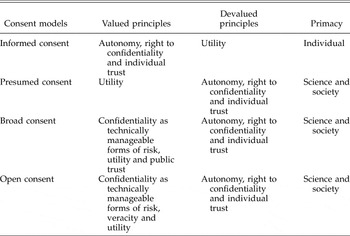
Their suggested way out of this conceptual quagmire does not, however, represent a revision of these concepts to make them comply with a scientific reality undergoing rapid change; rather, it is a depletion of these concepts of any moral bearing. Open consent, if not a contradiction in terms, is a moral illusion disguised as a “pragmatic” device to serve the narrow interests of closed researcher mindsets. It represents the inevitable end of a language game, which aims at overcoming the moral primacy of the human being in research by installing the priority of scientific and societal interests in its place (see Table 1).
A Diagrammatic Representation of the Relations between Different Consent Models, Their Concomitant Balance of Basic Principles and the Primacy of Involved Stakeholders

However, there is little use for balancing the purported interests of researchers against those of the individual donor when what are at stake are the basic rights and freedoms of donors, and the preconditions necessary for these rights to be exercised according to their intent.
The Underlying Argument
Until now we have concentrated our criticism on the ways in which broad consent and open consent models are currently being used in order to calibrate “ethical” research biobanking. However, we have not yet criticized the argument that seems to underpin these models.
Let us note in passing, that the idea that persons can waive their right to confidentiality through a consent procedure is not completely wrong. For example, I can tell you a specific secret and waive my right to confidentiality. But that is not what these new modes of “consent” are about at all. They are not about waiving confidentiality for specific items of information after proper reflection; they are about waiving confidentiality tout court as part of a consent process controlled by the researchers.
The underlying argument in Lunshof and colleagues,Footnote 29 an argument with which HanssonFootnote 30 does not seem completely unfamiliar, is that genomic research biobanking, inevitably if not imminently, will lead to a revolution in biomedical diagnostics, treatment, and prevention and, as such, will transform healthcare by providing a more rational basis for both medical intervention and organization of healthcare systems. Given that the risk to donors is miniscule, indeed that the discomforts involved in collecting biological samples are most often negligible, it is not only responsible to tip the scales in favor of scientific and societal interests, but entirely justifiable from an ethical point of view. All else being equal, the interests of science, industry, and society can in fact be equated with the interests and well-being of individual donors in the context of genomic research biobanking because we all want better medicine, improved health, and more cost-efficient healthcare. This seems to be the argument that science, industry, and society actively presuppose or tacitly take for granted.
The argument contains at least two highly problematic premises. One is empirically unsound and the other is ethically unjustifiable. Whereas the first premise concerns the burden of proof in accounting for these bewildering biomedical fantasies, at least by indicating their probability if not by taking recourse to some examples in the history of medicine, the second premise concerns the balancing of scientific and societal interests against the interests of donors, when the latter’s interests are defined as if the context is clinical, and the former’s interests are equated with the inevitability of these biomedical fantasies. Figuratively speaking, before one can begin to balance the different interests of stakeholders, it is necessary to first have a scale, a unit of measurement and something to put in the lattice.
We can also see that the argument is problematic when we consider that precisely the same argument could be used to justify an abolition of rules concerning the safe storage and transfer of data. It would undoubtedly be cheaper to run a research infrastructure with much looser rules for data security, so that more research could be performed with a given amount of resources. But any researcher who puts forward such an argument would, rightly, be deemed as unprofessional and unethical.
To the best of our knowledge, there is little evidence in the history of anatomy or physiology supporting the epistemological tenet that states that it is ever-deeper exploration into the basic units and functions of the human organism that has provided medicine with “the greatest benefits for mankind.”Footnote 31 The rare panaceas of medicine, such as antibiotics, do not entail a direct application of basic anatomical or physiological knowledge, although such knowledge helped to explain its beneficial effects after its serendipitous discovery.
At present, genomic research biobanking involves the proverbial search for a needle, or needles, in a haystack. Once the “needles” are found, one may start to discover how they can be applied, alone or in concert, and eventually how they interact with complex environments and individual behavior, from intracellular environments, to lifestyles, and to ecological niches. Hence, utilizing genomic biobanks in biomedical research will undoubtedly generate new basic knowledge about the molecular anatomy and physiology of living beings in general and the human organism in particular. Whether this knowledge will be important to cure or prevent disease is yet another question. In the advent of such scenarios, clinical tests will nonetheless be necessary within the context of the living being in order for researchers to prove the statistical validity of their findings in terms of biological reality. It is fairly easy to recognize that living organisms are complex; it is much harder to understand what it means that a living organism is complex, or what this form of complexity entails for the organism itself.Footnote 32
These epistemological reservations ought to be reflected not only in ethical discourse but also in science policies. Public as well as private funders rarely acknowledge that at present genomic research biobanking most often entails basic science and is far from being applied. As such, current funding policies operate with incentives for dishonesty, to the extent that it has become the norm. Researchers feel obligated to exaggerate the potential health benefits of their research applications to compete for limited economic resources. Moreover, the systemic dishonesty of these polices lead to a built-in incentive for similarly biased messages regarding the potential and nature of genomic research biobanking being transmitted to policymakers, media, and the taxpaying public. If regulation ought to reflect realities rather than hype, this precept holds true to an even greater extent for ethical discourse.Footnote 33 With this said, we now proceed to the next premise of the argument, the premise concerning the balance of purported interests.
One can readily understand why respect for the autonomy, dignity, and integrity of individual patients and research subjects is so important in the clinic, where interventions are often conducted with significant risk. The debilitating experience of being subjected to unnecessary and potentially harmful medical interventions without consent, reducing human dignity and replacing it with a mute, mechanical, and medically incompetent substitute, gradually came to be seen as morally unacceptable in medical practice.Footnote 34
In genomic research biobanking, this reduction requires neither a violent intervention into the integrity of individuals nor a waiver of individual consent. It comprises a form of reduction nonetheless, because the human body and its parts are “transmuted” into a natural resource—a resource over which donors cannot exercise their rights, that is, the right to proprietary privacy, and from which they cannot directly benefit. Indeed, it seems contradictory that the model of altruistic donations should be employed in the context of genomic research biobanking, especially when all but the donors are encouraged to exploit the newfound resources economically.Footnote 35 If economic interests can be the fundamental interests of researchers, investors, public or private research institutions, or venture capitalists, why can’t this be the case for donors as well?Footnote 36
The inevitable implications of these observations are that Lunshof and colleagues, along with Hansson and colleagues, are introducing a range of axiological biases at the heart of their argument to remove ethical and regulatory obstacles, thereby boosting the efficiency of genomic research biobanking with regard to their technoscientific power and economic value.Footnote 37
Ethical Endgames
Returning to the image of the scale: what we have is a discussion about not only which interests should be balanced, but also whether there exists a unit of measurement able to convert them, indeed, whether some interests can be put on a lattice at all. One may balance the degree of data security with other considerations, but can the right to confidentiality be balanced if this means revoking, for all practical purposes, the possibility of it being exercised? Is it possible to balance the societal benefits and harms resulting from genomic research biobanking with the value of privacy as such and the necessity of individual privacy for the functioning of our democratic institutions? By consolidating open consent and broad consent models, ethicists are unknowingly consolidating the economic exploitation of donors as well as giving moral precedence to organizational designs that hinder donors from exercising fundamental rights and freedoms. In doing so, they are putting donors, as well as democratic institutions, in harm’s way.
One strategy to end this difficult situation is to recognize donors as active partners in genomic research biobanking. At present, however, exclusion is both the norm and the reality. In order to do so, we may develop new institutions that are capable of responding to the specific stakes of genomic research biobanking, and not the stakes of clinical research and transplantation medicine. As of yet, there has been little or no push in this direction, especially in Europe. In a profound sense, this is also a problem of language. In Samuel Beckett’s play Endgame, from 1958, the protagonists are unable to articulate their calamity in any meaningful way, much less understand how it came about. They repeat the same language games in ever shorter and increasingly contrived statements, showing the audience a nightmarishly closed form of life. We believe the normative challenge of Beckett’s protagonists is not entirely different from that of the vast majority of research biobank ethicists and health law experts—namely knowing when to stop.
Unable to grasp either the normative challenges or the qualitative changes that brought about those challenges, they continue to play the same “ethical” endgames, being themselves played in turn. By adopting a particular consent model, one takes on more than a mere model. One also adopts a language and, as such, tacitly accepts a certain perspective: “And to imagine a language means to imagine a form of life,” writes Wittgenstein.Footnote 38 Indeed, at closer examination, none of the proposed consent models have been able to reconcile genomic research biobanking with the immanent perspective of medical research ethics, cordially articulated as the primacy of the human being. In a number of research papers, policies, and guidelines, donors’ interests are no sooner admitted in principle before they are denied in practice. Which forms of life are we able to imagine from such a spurious use of language? Must we not conclude that the conditions for biomedical research have changed in such a way that the ethical frameworks of medical research and transplantation medicine no longer enable us to imagine the ethical challenges of genomic science? Or, have these languages of biomedical ethics been altered in order to accommodate any kinds of change? We imagine it to be both. However, before we can imagine Beckett’s “impossible heap,” the ethical problems must also be acknowledged as a problem of reflexivity, that is, an ethical problem in which bioethicists or health law experts are playing an active part. Only then can we begin to put the qualitative changes brought about by genomic research biobanking into a perspective in which we can start not to facilitate but to understand in the truly integrated form of understanding as described by Pirsig:
Classical understanding is concerned with the piles and the basis for sorting and interrelating them. Romantic understanding is directed toward the handful of sand before the sorting begins. Both are valid ways of looking at the world although irreconcilable with each other. . . . What has become an urgent necessity is a way of looking at the world that does violence to neither of these two kinds of understanding and unites them into one. Such an understanding will not reject sand-sorting or contemplation of unsorted sand for its own sake. Such an understanding will instead seek to direct attention to the endless landscape from which the sand is taken. That was what Phaedrus, the poor surgeon, was trying to do. . . . To understand what he was trying to do it’s necessary to see that part of the landscape, inseparable from it, which must be understood, is a figure in the middle of it, sorting sand into piles. To see the landscape without seeing this figure is not to see the landscape at all.Footnote 39