In 2010 China's foreign minister visited Yoni, a small village in Sierra Leone, with a grand school-building plan. While Sierra Leone could certainly use more schools, the project location in “the middle of the bush” caused some surprise.Footnote 1 As it turns out, Yoni is the home village of Ernest Bai Koroma, Sierra Leone's president at the time. By a similar coincidence, of the three primary schools constructed with Chinese funds in rural Tanzania, one was built in the then president's hometown of Msoga.Footnote 2
While not necessarily reflecting intentional allocation decisions on the part of the Chinese, these are not isolated incidents. In a recent study, Axel Dreher and co-authors show that Chinese aid may be particularly easy to exploit for politicians who are engaged in patronage politics.Footnote 3 Introducing a new georeferenced data set on the subnational allocation of Chinese development projects across Africa, the authors find that Chinese development finance is disproportionately allocated to the birth regions of African leaders and, less robustly so, to areas populated by individuals who share their ethnicity. Replicating their analysis for World Bank aid, they find no evidence of any corresponding favoritism.
In the African context, where patronage politics is commonly suggested to have an ethnic dimension,Footnote 4 this raises questions regarding a potentially important externality of aid. In particular, if development finance ends up in the pockets of political elites and their ethno-regional networks, it seems reasonable to argue that this could exacerbate ethnic grievances and contribute to ethnic mobilization. In light of Dreher and colleagues’ findings,Footnote 5 my study investigates whether Chinese development projects make ethnic identities more salient in African partner countries.
The idea that aid could make ethnic identities more salient rests on a constructivist account of ethnicity, according to which ethnic identities are mobilized in the pursuit of state resources as opposed to being primordial and hardwired.Footnote 6 I consider two mechanisms through which Chinese development projects may make ethnic identities more salient.
First, competition for the inflow of resources that aid constitutes could mobilize ethnic identities across the board. The results of Eifert, Miguel, and Posner speak in favor of such a mechanism.Footnote 7 Drawing on survey data across ten African countries, their findings suggest that ethnic cleavages are more salient at election times and in cases where the winning party won by a small margin. They interpret this as supporting an instrumental understanding of ethnicity, where ethnic identities are mobilized in the struggle for political power and economic resources. By this reasoning, the inflow of resources could make ethnic identities more pronounced even in the absence of ethnic bias, simply by raising the stakes in the struggle for resources.
A second possible mechanism, however, is that perceived ethnic bias in the delivery of aid gives rise to ethnic grievances, and thereby more salient ethnic identities, in groups that perceive themselves as disadvantaged. The idea that unequal treatment of ethnic groups raises group members’ ethnic awareness is in line with a “reactive ethnicity” approach, according to which ethnic mobilization is prompted by an unequal division of resources along ethnic lines.Footnote 8
A number of commonly suggested features of Chinese development finance make it particularly relevant to study in this context. To begin with, the demand-driven nature of the Chinese aid-allocation processFootnote 9 and China's policy of non-interference in the domestic affairs of partner countriesFootnote 10 arguably make it prone to elite capture and possible ethnic bias. As Dreher and colleagues describe it, China's aid allocation tends to be based on requests from recipient-country governments.Footnote 11 Their aid packages are often negotiated in high-level meetings with political leaders rather than publicly outlined in country development-assistance strategies. Interpreted favorably, this could be seen as a sign of ensuring partner country ownership of development policy. At the same time, however, a request-based system of aid project delivery may provide opportunities for recipient-country governments to use funds strategically by promoting a subnational distribution of funds that favors their patronage network. Similarly, while recipient-country governments tend to view the non-interference principle as a sign of China respecting their countries’ sovereignty, critics suggest that it makes Chinese aid easy to exploit for politicians.Footnote 12
Critics often suggest that, rather than broad-based development projects, China tends to finance highly visible prestige projects benefiting a select few.Footnote 13 Citizens in the local area are thus likely to observe the concerned development project being implemented without necessarily getting a share of the rewards, which may lead to perceptions of unfair treatment.
Against this background, this study asks (1) whether the implementation of Chinese development projects makes ethnic identities more salient near project sites, (2) whether the potential effect varies depending on whether the respondents belong to an in-group—proxied by being a co-ethnic with the country president at the time of the survey—or an out-group, and (3) whether China stands out from other donors in this respect.
Questions 2 and 3 can help shed light on the theoretical mechanisms involved. If there is an effect, and it is uniform across groups, this would seem to imply that competition for the inflow of resources in and of itself, rather than perceptions of ethnic bias in the distribution of these resources, mobilizes ethnic identities. If the effect is significantly stronger in the out-group, on the other hand, this arguably signals that the effect is driven by ethnic grievances originating in perceived ethnic bias in disadvantaged groups.
Comparing results across donors (question 3) could also be revealing in this regard. Ethnically biased aid is unlikely to be a universal phenomenon. The fungibility of aid varies with donors’ strategic priorities,Footnote 14 and as noted, recent empirical evidence suggests that Chinese development finance may be particularly prone to elite capture.Footnote 15 If the hypothesized effect is nevertheless observed for all donors, this too would arguably add support to the idea that it is competition for the inflow of resources more generally, rather than perceived ethnic bias in the distribution of these resources, that mobilizes ethnic identities.
To address these questions, the new geo-referenced data set on the subnational allocation of Chinese development finance projects to Africa over the 2000–2014 period is geographically matched with 50,520 respondents from four Afrobarometer survey waves across eleven African countries. The estimation strategy to account for the endogenous placement of Chinese project sites compares the estimated effect of living near a site where a Chinese project was under implementation at the time of the interview, to that of living near a site where we know a Chinese project will appear subsequently.
The empirical results indeed suggest that living near an ongoing Chinese project makes ethnic identities more salient. This finding is robust over a wide range of specifications and subsamples, and thus calls attention to a potentially important externality of aid. The results provide no robust evidence that the Chinese presence has different effects on the ethnic identities of in-groups and out-groups in the local area, and thus offer no conclusive evidence in support for a grievance mechanism. On the other hand, the fact that Chinese development projects do in fact stand out from other influential donors in terms of their impact on ethnic identities seemingly speaks against a dominant role of the general ethnic competition mechanism.
Being the first effort to systemically investigate the effects of development projects on local ethnic identities in African partner countries, the study makes two principal contributions. First, it contributes directly to the literature on ethnic mobilization in Africa.Footnote 16 Eifert, Miguel, and Posner's results suggest that ethnic identities are more salient at election times, fueled by the struggle for political power and economic resources.Footnote 17 My study brings this thinking to the aid literature, where a similar argument can be made for ethnic identities reacting to the infusion of donor funds.Footnote 18
Second, it contributes to the emerging literature evaluating the subnational allocation and impacts of aid.Footnote 19 In particular, it adds to the recent strand of this literature focusing on the allocation and local externalities of Chinese aid. Despite the massive scale of Chinese development finance, there are relatively few quantitative studies assessing its effects and motivations. Unlike the Organisation for Economic Co-operation and Development (OECD) Development Assistance Committee (DAC) donors, the Chinese government does not routinely publish information on its foreign assistance. However, with the comprehensive data set on Chinese official finance to Africa recently made available by the AidData research laboratory, systematic quantitative analysis of Chinese aid flows is now possible.Footnote 20 In addition to the pioneering work of Dreher and co-authors, recent studies have, for instance, considered the impacts of Chinese development projects on local corruption,Footnote 21 trade union involvement,Footnote 22 and spatial inequality.Footnote 23 However, there is still no empirical evidence on whether the finding that Chinese development finance is particularly prone to end up in the pockets of political elites and their ethno-regional networks also implies that it makes local ethnic identities stronger.
Data and Empirical Strategy
To explore Chinese development projects’ local effects on ethnic identities in Africa, I geographically match spatial data on China's official financial flows to the continent over the period from 2000 to 2014 with 50,520 respondents from eleven African countriesFootnote 24 obtained from rounds three to six of the Afrobarometer survey.
The data on Chinese aid projects are obtained from geo-referenced project-level data of AidData's Geocoded Global Chinese Official Finance Version 1.1.1 data set.Footnote 25 Since the Chinese government does not release official, project-level financial information about its foreign aid activities, these data are based on an open-source media-based data collection technique, synthesizing and standardizing a large amount of information on Chinese development finance to African countries.Footnote 26
The aid data contain latitude and longitude project co-ordinates and provide information about the precision of the location identified.Footnote 27 Being interested in local effects of Chinese development projects, I focus on projects with recorded locations coded as corresponding to an exact location or as “near,” in the “area” of, or up to twenty-five kilometers away from an exact location.Footnote 28
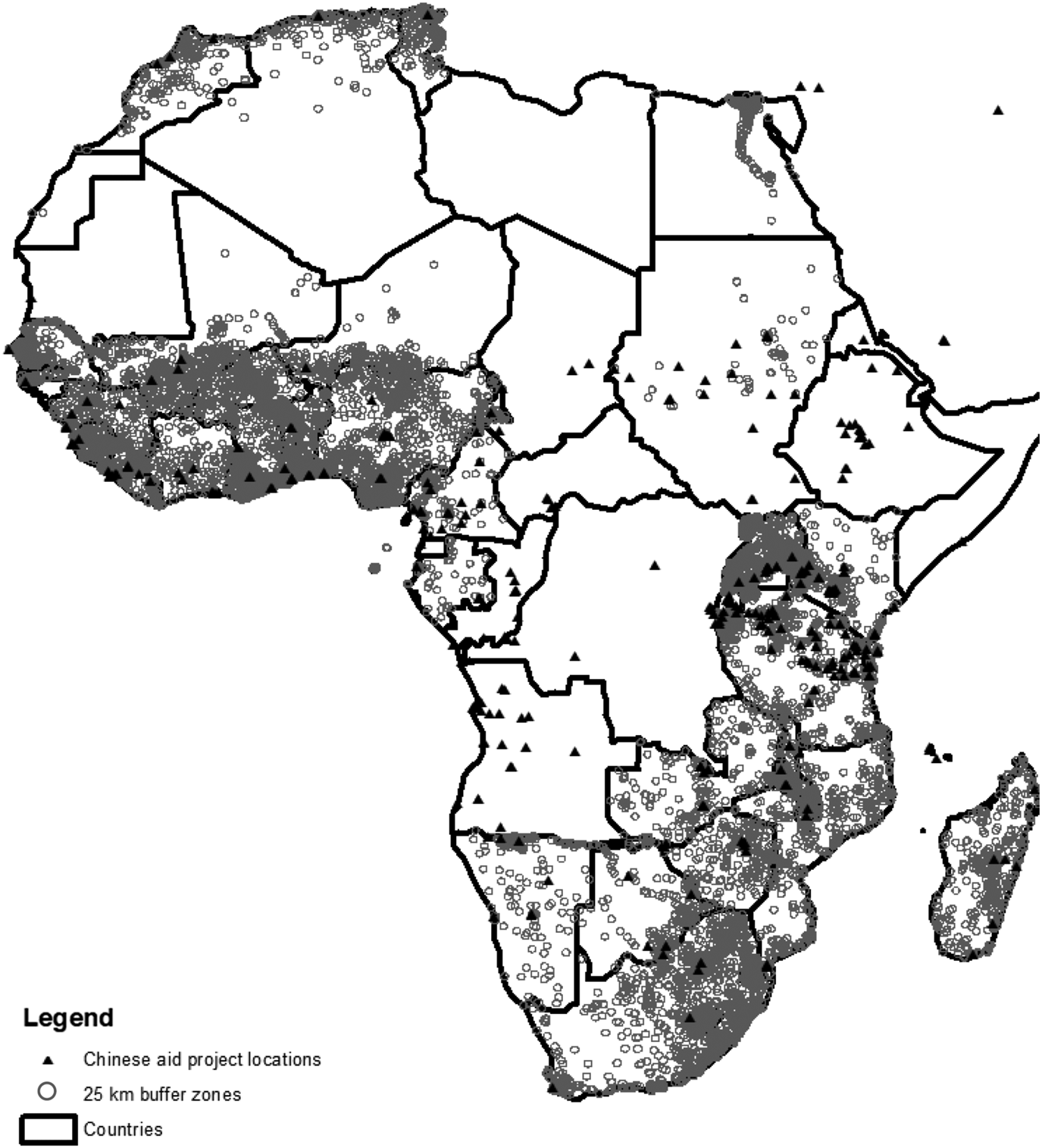
The point coordinates in the aid data are used to link aid projects to local survey respondents in the Afrobarometer. The coordinates of the surveyed Afrobarometer clusters, consisting of one or several geographically close villages or a neighborhood in an urban area, are used to match individuals to aid project sites with precise point coordinates. I measure the distance from the cluster center points to the aid project sites and identify the clusters located within a cut-off distance—here twenty-five kilometers—of at least one project site. Figure 1 maps the Chinese projects with precise geocodes and start dates across the African continent, along with the Afrobarometer survey clusters encircled by twenty-five-kilometer buffer zones. The eleven countries in the benchmark estimation sample contain 125 such project sites. The estimation strategy, described further later, relies on identifying survey respondents within twenty-five kilometers of project sites, that is, in clusters where an ongoing or future Chinese project lies within the twenty-five-kilometer buffer zone.
Chinese aid project sites and twenty-five-kilometer buffer zones around Afrobarometer survey clusters

The dependent variable focuses on ethnic identification. To capture the salience of ethnic identities, I use a question asking whether the respondent identifies primarily with his or her ethnic group or with his or her country, creating a dummy variable indicating whether the respondent reports to identify more in ethnic than in national terms. In the overall estimation sample, 15 percent of the respondents identify in ethnic terms (appendix Table A1), with the corresponding country shares ranging from around 4 percent ethnic identification in Cape Verde, to around 24 percent in Mali (Appendix A, Figure A1).
The main explanatory variables, which I describe in greater detail later, focus on living near a Chinese project site—either a site where a project is being implemented at the time of the survey (ongoing) or a site where a project will be opened but where implementation had not yet been initiated at the time of the survey (future).
To explore whether the potential effect of living close to a Chinese project site varies depending on the status of one's ethnic group, another key explanatory variable combines information on self-reported ethnic group affiliation with external data on the ethnic affiliations of heads of government in office. More specifically, I construct a dummy variable indicating whether the respondent belongs to the same ethnic group as the country's president at the time of the survey (in-group), and then interact this indicator with the variables for living close to Chinese project sites. Variable descriptions and summary statistics are presented in Tables A1 and A2 (Appendix A).
Estimation Strategy
The distribution of aid within countries is by no means random—some individuals and subnational areas, with certain characteristics, will be more likely than others to be targeted by aid. Members of the same ethnic group often live geographically clustered and a common argument is that African policymakers tend to favor their own homelands and ethnic groups in the allocation of funds. Hence, some areas and ethnic groups—and thus a nonrandom group of individuals with particular ethnic identities and living conditions—will presumably be more likely to be targeted by aid than others. For this reason, it is not plausible to assume that there is no relationship between project localization and the pre-existing characteristics of project sites and of the population residing in the surrounding areas.
To deal with these empirical challenges, I use a spatial-temporal estimation strategy.Footnote 29 In particular, I compare the estimated effect of living near sites where a Chinese development project is currently under implementation with the estimated effect of living near sites where a project will be opened but where implementation had not yet been initiated at the time the Afrobarometer covered that particular area. While the fact that the Afrobarometer is not a panel hinders me from following specific localities over time, before and after a project was initiated, with this estimation strategy I can still make use of the time variation in the data.
As such, I compare three groups of individuals, namely (1) those within twenty-five kilometers of at least one ongoing project site (ongoing, applying to 18 percent of respondents), (2) those within twenty-five kilometers of a site where a project will start, but where implementation was yet to begin at the survey date and not close to any ongoing projects (future, applying to 6 percent of respondents), and (3) those who are more than twenty-five kilometers from any project site (the omitted reference category in the regressions, applying to 76 percent of respondents).Footnote 30 The baseline regression takes the form:
 $$Y_{ivt} = \beta _1\cdot Ongoing_{it} + \beta _2\cdot Future_{it} + \alpha _s + \delta _t + \gamma \cdot {\bf X}_{it} + \varepsilon _{ivt}$$
where the ethnic identity Y for an individual i in cluster v at year t is regressed—in the benchmark set-up using linear probability models—on a dummy variable ongoing capturing whether the individual lives within the specified cut-off distance of an ongoing Chinese development project, and a dummy future for living close to a site where a Chinese project is planned but not yet implemented at the time of the survey. To control for variation in average levels of ethnic identities across time and space, the regressions include country (and in alternative estimations region) fixed effects (α s) and year fixed effects (δ t). To control for individual variation in ethnic identities, a vector (X i) of individual-level controls from the Afrobarometer are included. The baseline set of individual controls are age, age squared, gender, and urban/rural residence.Footnote 31 To account for correlated errors, the standard errors are clustered at the geographical clusters (i.e., at the enumeration area level). In another set of regressions, I add interaction terms between ongoing and future, on the one hand, and the variable indicating whether the respondent belongs to the same ethnic group as the country's president at the time of the survey (in-group), on the other.
The coefficient on ongoing (β 1) captures any causal effect of aid plus potential selection effects. The coefficient on future (β 2), on the other hand, captures only a selection effect. The idea is that by taking the difference between these two parameters we subtract the selection effect from the combined selection and causal effect, leaving behind the causal effect of aid on ethnic identities. The parameter difference between ongoing and future (β 1 − β 2) thus gives a difference-in-difference type of measure that controls for unobservable time-invariant characteristics that may influence selection into being a Chinese project site. The key assumption behind this approach is that the selection process relevant for ongoing and future projects sites is the same. A potential concern would be if ongoing/future project status picks up project timing and projects starting later differ systematically from projects starting earlier. Here it is important to note that there is no direct correspondence between when a project was implemented and whether it is coded as ongoing or future; ongoing/future status depends on project status at the time the Afrobarometer survey covered the particular area in question (see Figure A2). That said, however, there is an over-representation of respondents connected to ongoing projects in the later survey waves, which is why the possible effects of project timing will be carefully evaluated in the sensitivity analysis.
Using this approach to study whether Chinese development projects affect local ethnic identities, one has to make an assumption about the geographical reach of the potential effect. This, in turn, should reasonably depend on how far from project sites citizens are aware of the project's existence and its distribution of rewards. I use a twenty-five-kilometer cut-off in the benchmark estimation, but results using alternative cut-offs (ten, fifty, and seventy-five kilometers) are also presented.
Results
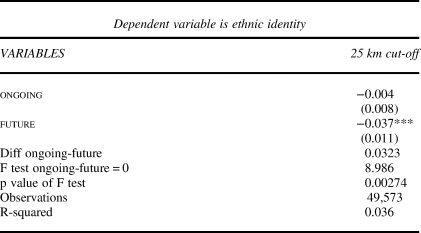
The benchmark results, presented in Table 1, indicate that respondents living near an ongoing rather than a future project are more likely to identify in ethnic terms. The estimation demonstrates the importance of taking the nonrandom selection of Chinese project sites into account. Looking at the parameter of ongoing in isolation, we see that the results at first sight seem to indicate that, if anything, people living close to an ongoing Chinese project are less likely to identify in ethnic terms. However, interpreting the parameter of the ongoing variable as capturing an effect of Chinese development projects on ethnic identities requires that the location of Chinese development projects is not correlated with pre-existing ethnic sentiments in these areas.
Chinese aid and ethnic identity

Notes: Robust standard errors (clustered by the survey clusters) in parentheses; * p < .10; ** p < .05; *** p < .01. The regression includes baseline controls and year and country fixed effects.
As it turns out, the negative and statistically significant coefficient on future suggests that Chinese projects tend to be located in areas with lower pre-existing ethnic identification. If not accounting for this tendency one would thus underestimate the effect of the Chinese presence. The bottom rows of Table 1 present the comparison of respondents living in areas with ongoing and future projects (βongoing − βfuture) and associated test results. The results indicate that those with an ongoing rather than a future project in their vicinity are 3.2 percentage points more likely to identify in ethnic terms, statistically significant at the 1 percent level. In relation to the overall sample mean of the dependent variable (Table A1), the difference is 22 percent and thus quite sizeable.
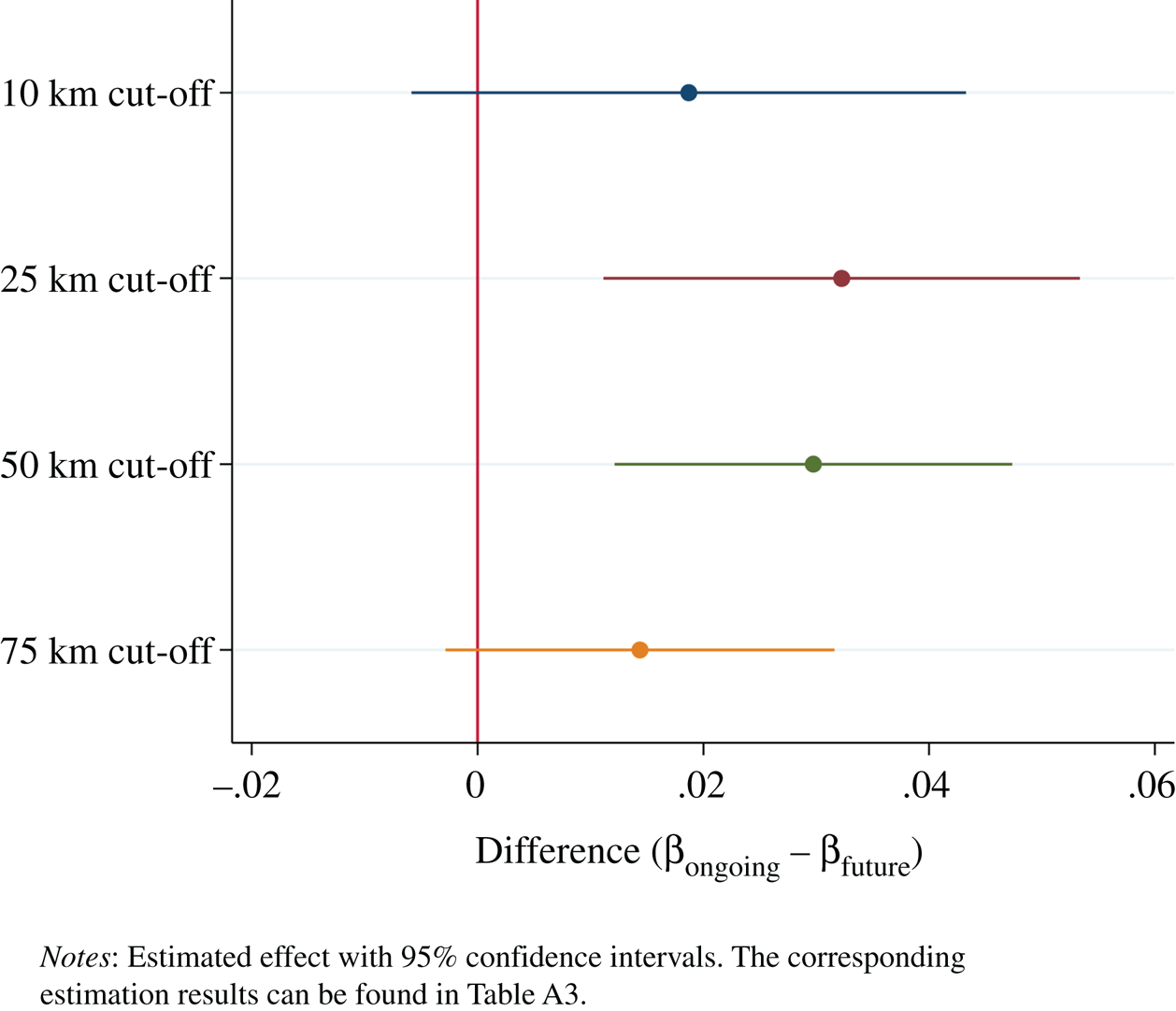
Figure 2 presents the results of estimations using different geographical cut-offs (ten, twenty-five, fifty, and seventy-five kilometers). The appropriate cut-off distance from a project—within which respondents are classified as treated—is an empirical question, and a trade-off between noise and size of the treatment group.Footnote 32 With a too small cut-off distance, we get a small sample of individuals linked to ongoing and future project sites.Footnote 33 On the other hand, a too large cut-off distance would include too many untreated individuals into the treatment group, leading to attenuation bias. This is reflected in Figure 2. The estimated effect is positive for all four cut-off distances, but less precisely estimated when using the smallest cut-off (giving a small pretreatment group) and smaller when using the largest cut-off (suggesting that the effect fades with distance).
Estimated effects when using different geographical cut-offs

Sensitivity Analysis
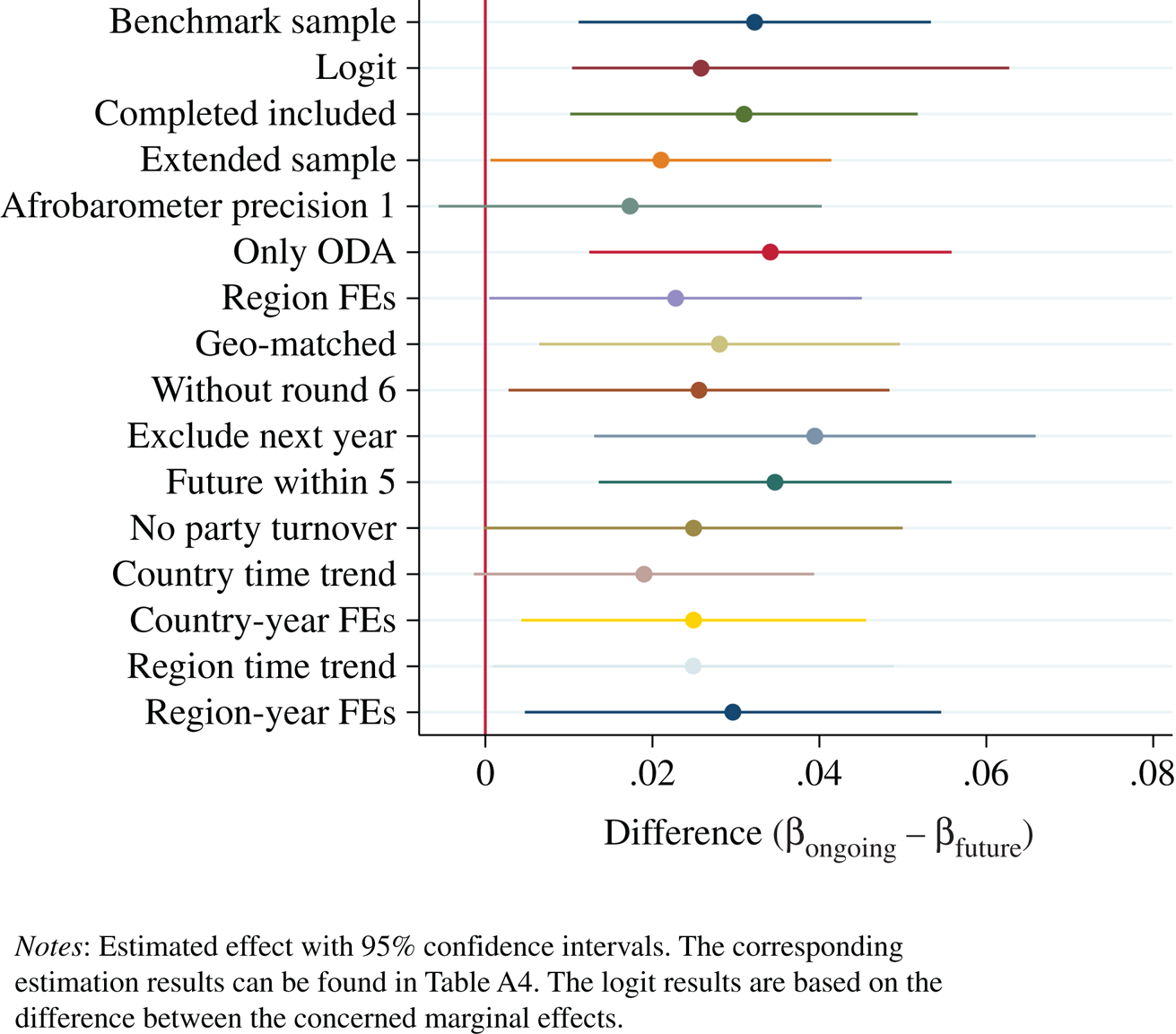
As Figure 3 indicates, the results are robust over a wide range of alternative specifications. They are similar when using Logit rather than linear probability models, when using an ordinal variable (ranging from 1 to 5, increasing in ethnic identification) rather than a dummy as dependent,Footnote 34 and when including (but controlling for) respondents having a completed Chinese project within the cut-off distance. Furthermore, the results remain qualitatively the same when relaxing the restriction that each sample country must have both a post- and a pretreatment group of respondents, implying a significantly larger sample (twenty-six countries and 108,290 respondents compared to eleven countries and 49,580 respondents). Restricting the sample to include only observations in Afrobarometer enumeration areas geocoded with precision code 1, which is arguably problematic in terms of representativeness, the estimated parameter difference is of a similar magnitude, but not quite statistically significant.
Sensitivity analysis

The benchmark estimation considers all Chinese development projects (remaining after relevant sample restrictions) listed by AidData. As noted, however, China tends to mix commercial interests with concessional flows. Restricting the sample of Chinese projects to include only those judged as “ODA-like” by AidData coders does not change the interpretation of results.Footnote 35
The benchmark estimation controls for variation in average levels of ethnic identification across countries. Reasonably, however, ethnic identification varies systematically within as well as across countries. While comparing with respondents living close to future project sites should help account for endogenous placement of projects, controlling for subnational variation would further improve the comparability of treatment and control groups. Given the limited size of the pretreatment group (people living close to future project sites) in some sample countries, specifications including a large number of fixed effects are quite demanding. Reassuringly, though, results using subnational region fixed effects are in line with the benchmark set-up.
The results are robust to dropping all respondents in enumeration areas further than one hundred kilometers away from Chinese projects sites. This form of geographical matching is useful since it controls for unobserved factors that are similar over space but may vary within countries or regions.Footnote 36 As such, it should make the pre- and post-treatment groups more comparable with the no-treatment group.
As I discussed earlier, a potential concern would be if ongoing/future project status picks up project timing and projects starting later differ systematically from projects starting earlier. As noted, there is no direct correspondence between time of project implementation and ongoing/future project status. A project implemented comparatively early may well be coded as a future project, all depending on at what point in time the Afrobarometer surveyed that particular area. That said, however, there is an over-representation of respondents connected to ongoing project sites in the later survey waves. And at the time of wave 6, which interviewed respondents in 2014 and 2015, all Chinese projects included in the data set had already been initiated, meaning that there are no respondents connected to future project sites in this round. Including wave 6 comes with the benefit of a significantly larger sample. Reassuringly, however, excluding observations from wave 6, the observed difference between ongoing and future remains.
In the benchmark set-up, the variable future captures respondents living close to a site where we know that a Chinese project will be implemented at a later stage. It places no restriction on how far ahead of the survey date project implementation starts. A potential concern is that circumstances in the area may change between survey date and project start, affecting the comparability of the treatment and pretreatment group. Looking at the data, we see that time until project start ranges from one to seven years. Reassuringly, restricting the pretreatment group to respondents living close to sites where projects will start within a maximum of five years of the interview date (which applies for 91 percent of the concerned group) does not change the results.
Five years is still a relatively long time span, however. And one can argue for similar time restrictions on the ongoing variable, which groups all respondents living within the cut-off distance of a Chinese project under implementation, regardless of time since project start. While the exact nature of such parameter variation is ambiguous a priori, it is likely that the effect of Chinese aid on local ethnic identities depends on project duration. Going back to the proposed mechanisms involved, if the general inflow of resources mobilizes ethnic identities across the board, it seems reasonable that the effect should be larger early in the implementation period. If, on the other hand, ethnic bias in the delivery of aid encourages ethnic identities in groups that perceive themselves as disadvantaged, the impact could presumably grow over the course of the project, once inequalities materialize.
Given the limited size of the pretreatment group, however, focusing on a narrow time bandwidth comes with difficulties in terms of statistical power.Footnote 37 It is also problematic considering the likelihood of pre-start effects. If the local population receives information about a Chinese project ahead of the project implementation period, this could presumably have an impact on ethnic identities prior to project start. If so, the difference between the ongoing and future parameters would underestimate the Chinese project's effect on ethnic identities. An estimation excluding observations connected to future projects starting within the next year (see Figure 3) suggests that this may indeed be the case. The estimated difference between the ongoing and future parameters becomes larger, seemingly indicating that the effect on ethnic identities is to some extent triggered in the immediate period ahead of project implementation.
Nevertheless, for the sake of comparability of the pre- and post-treatment groups, and to account for possible parameter heterogeneity depending on project duration, Figure A3 presents results of estimations with (1) five, four, three, and two-year time restrictions on the future category, (2) the same restrictions on the ongoing category, and (3) on both the ongoing and future categories simultaneously. For the smallest cut-offs, the limited size of the treatment and pretreatment groups as expected gives imprecise estimates. For the most part, however, the results remain unchanged.
However, even if we focus on a relatively narrow time bandwidth, we can still end up comparing respondents in areas with projects that start several years apart. Of particular concern here are situations where the party in power changes within the period. In this case, the selection process relevant to “future” sites may differ from the selection process pertaining to sites of ongoing projects. To make sure that this is not what drives the results, Figure 3 (and Table A4) also presents the results of an estimation where, for each country, the sample is restricting to include only survey rounds where the same party is in power (applying to 76 percent of the benchmark sample). The results do not change.
In the benchmark set-up, country and year fixed effects account for variation in average levels of ethnic identities across time and space. However, time trends in ethnic identification may well vary across countries, for example, as a result of where in their electoral cycles the respective countries are at the time of the different survey rounds, as well as across subnational regions due to local policies and developments. Reassuringly, however, the benchmark result withstands controls for (1) country-specific linear time trends, (2) country-year fixed effects, (3) subnational region-specific linear time trends, and (4) subnational region-year fixed effects.
Heterogeneity Across In-group and Out-group
I considered the local effect of Chinese development projects on the ethnic identities of citizens in general, making no distinction between people from different ethnic groups. As noted, though, this effect may differ across groups. If the allocation and implementation of Chinese development projects involve ethnic bias, one may suspect ethnic grievances, which arguably add to ethnic identities, among groups that perceive themselves as disadvantaged.
In an earlier version of their paper, Dreher and co-authors found some (not very robust) evidence of ethnic bias in Chinese aid at the regional level,Footnote 38 based on estimations focusing on ethnographic regions.Footnote 39 Table A5 considers project exposure at a more local level, presenting individual-level regressions relating proximity to Chinese development project sites to self-reported ethnic group affiliations.
The results provide some indication that in-groups and out-groups differ in terms of geographic proximity to Chinese project sites. In terms of the probability of having an ongoing Chinese project within twenty-five kilometers, co-ethnics of the president do not stand out from members of other groups. However, they are 2.3 percentage points more likely to live near a site where a Chinese project will be implemented in the future, tend to have a greater number of Chinese projects within twenty-five kilometers, and to live closer to Chinese projects on average. Based on the data at hand, we cannot judge whether this pattern is purposeful—it may well be driven by, say, better infrastructure or economic opportunities in areas where the in-group is overrepresented. Moreover, measures of geographic proximity to Chinese projects do not capture ethnic bias in implementation at the local level.
Table A6 considers whether the Chinese presence has different effects on the ethnic identities of in-groups and out-groups in the local area. To begin with, we can note that compared to people from other groups, co-ethnics of the president are around three percentage points less likely to identify in ethnic terms, conditional on baseline controls (column 1). If ethnic grievances make ethnic identities more salient, lower ethnic identification in a potentially privileged in-group is arguably not surprising. Another interpretation is that people are more likely to identify with the broader nation-state when a co-ethnic controls the state.Footnote 40
On the other hand, the estimations provide no robust evidence that the Chinese presence has different effects on the ethnic identities of in-groups and out-groups in the local area. Introducing interaction terms between the dummy for belonging to the same group as the country president and the dummies for living close to ongoing and future Chinese development projects, living near an ongoing compared to a future Chinese project site comes with a greater tendency to identify in ethnic terms for both the in-group and the out-group (column 2). However, neither subgroup effect survives the inclusion of subnational regional controls (for the out-group the effect remains statistically significant at the 10 percent level).
Comparing Donors
Chinese development projects seemingly stand out from other influential donors in terms of making ethnic identities more salient. Replicating the key regressions for World Bank projects (Table A7), for which there are also geo-referenced data available for a large multi-country African sample, the results do not suggest an equivalent pattern. In fact, they indicate the reverse—that living near an ongoing as opposed to a future project comes with weaker ethnic identification. The results indicate that those with an ongoing rather than a future project in their vicinity are approximately five percentage points less likely to identify in ethnic terms, statistically significant at the 1 percent level. Just as the results for Chinese projects, this finding is seemingly robust over a wide range of specifications and subsamples (see Figures A4 and A5). Furthermore, there is some indication that the effect is driven primarily by the out-group (Table A7, columns 3 and 4).
A generous interpretation of the weaker ethnic identification observed near ongoing World Bank project sites is that ethnically neutral project implementation may act to attenuate ethnic identities in these areas, in particular in groups that may otherwise perceive themselves as disadvantaged. However, a more thorough analysis of World Bank projects would clearly be necessary to uncover the potential mechanisms involved. For the purpose of this study, it suffices to note that Chinese development projects stand out from World Bank projects in terms of making ethnic identities more salient close to project sites.Footnote 41
Conclusion
In a recent study, Axel Dreher and co-authors show that Chinese aid may be particularly easy to exploit for politicians who are engaged in patronage politics.Footnote 42 This raises important questions regarding potential externalities of aid. In particular, if development finance ends up in the pockets of political elites and their ethno-regional networks, does this exacerbate ethnic grievances and contribute to ethnic mobilization? In this research note I examined whether Chinese development projects make local ethnic identities more salient in African partner countries.
I proposed two mechanisms through which this may occur. First, competition for the inflow of resources that aid constitutes could mobilize ethnic identities across the board. Second, perceptions of ethnically biased aid could make ethnic identities more salient in disadvantaged groups. Against this background, the study asked whether the implementation of Chinese development projects makes ethnic identities more salient near project sites, whether the potential effect is uniform across groups, and whether it varies across donors.
The empirical analysis drew on a new geo-referenced data set on the subnational allocation of Chinese development finance projects to Africa from 2000 to 2014, geographically matched with 50,520 survey respondents across eleven African countries. To account for the endogenous placement of Chinese project sites, I focused on comparing the estimated effect of living near a site where a Chinese project was under implementation at the time of the interview, to that of living near a site where a Chinese project will appear after the interview date.
The empirical results indeed suggest that, on average, living near an ongoing Chinese project makes ethnic identities more salient. This finding is robust over a wide range of specifications and subsamples, and thus calls attention to a potentially important externality of aid.
The results provide some indication that co-ethnics of the president more often have Chinese project sites in their vicinity. However, there is no robust evidence to suggest that the Chinese presence has different effects on the ethnic identities of in-groups and out-groups in the local area. Hence, with respect to mechanisms, we cannot draw the conclusion that the stronger ethnic identities observed near Chinese project sites are driven by ethnic grievances originating in perceived ethnic bias.
On the other hand, donor heterogeneity in results seemingly speaks against a dominant role of the general ethnic competition mechanism. If ethnic identities were mobilized merely by competition for the inflow of resources, one would arguably expect to observe a similar effect across all donors. As it turns out, though, Chinese development projects stand out from other influential donors in terms of their impact on ethnic identities.
Replicating the key analysis for World Bank projects, the results in fact indicate the reverse—that living near an ongoing as opposed to a future project comes with weaker ethnic identification. There is also some indication that this effect is driven primarily by the out-group. A favorable interpretation of this finding is that ethnically neutral project implementation may act to attenuate ethnic identities near World Bank project sites, in particular for groups that may otherwise perceive themselves as disadvantaged. However, a more thorough analysis would clearly be necessary to uncover the potential mechanisms involved and to verify these encouraging results across a wide range of donors. Nonetheless, the suggestive evidence here opens for interesting future research: can aid projects, if implemented in an ethnically neutral fashion, in effect act to bring people together, across ethnic group lines?
The results call attention to the importance of considering the distributional consequences of aid. On a more general level, the study highlights the need to consider not only to what extent aid achieves its explicit objectives, but also its potential unintended effects, or externalities. These could be positive or negative and are likely to influence the long-term sustainability of a project.
Data Availability Statement
Replication files for this research note may be found at <https://doi.org/10.7910/DVN/1IHXRB>.
Supplementary Material
Supplementary material for this research note is available at <https://doi.org/10.1017/S0020818320000260>.
Acknowledgments
I thank two anonymous referees for valuable suggestions. I also thank Pelle Ahlerup, Arne Bigsten, Dick Durevall, Andreas Kotsadam, Brad Parks, Sven Tengstam, Joseph Vecci, and seminar participants at the ASWEDE, SITE, DEU GU, and Dev Res conferences for helpful comments and suggestions.
Funding
I acknowledge financial support from the Swedish Research Council.