Introduction
Soil-transmitted helminths (STH) are included in the list of the world's neglected tropical diseases (Molyneux et al., Reference Molyneux, Hotez and Fenwick2005). The STHs include the roundworm Ascaris lumbricoides, the whipworm Trichuris trichiura, the hookworms, Ancylostoma duodenale and Necator americanus, and Strongyloides stercoralis. Ascaris lumbricoides infects in the order of 1.2 billion people, T. trichiura 795 million and hookworm 740 million (de Silva et al., Reference de Silva, Brooker, Hotez, Montresor, Engels and Savioli2003). The manifestations of severe disease include fatal intestinal obstruction or pulmonary allergic reactions in the case of ascariasis, severe anaemia in hookworm infections and chronic dysentery and rectal prolapse in trichuriasis (Crompton & Nesheim, Reference Crompton and Nesheim2002). The public health importance of STHs has been well recognized and their disease burden has been acknowledged to be as great as those of tuberculosis (34.7 million disability adjusted life years (DALYs)) or malaria (46.5 million DALYs) (Hotez et al., Reference Hotez, Molyneux, Fenwick, Ottesen, Ehrlich Sachs and Sachs2006). The global burden of disease caused by these intestinal nematodes is an estimated 22.1 million DALYs lost to hookworm, 10.5 million to A. lumbricoides and 6.4 million to T. trichiura, giving a combined total of 39 million life years (Chan, Reference Chan1997).
The morbidity due to STH infections is greatest in school-age children, who typically have the highest intensity of helminth infections (Haswell-Elkins et al., Reference Haswell-Elkins, Elkins and Anderson1987; Bundy et al., Reference Bundy, Kan and Rose1988), and children of this age group have been the focus of intervention studies and age-targeted strategies for chemotherapy (Asaolu et al., Reference Asaolu, Holland and Crompton1991, Reference Asaolu, Holland, Jegede, Fraser, Stoddard and Crompton1992; Holland et al., Reference Holland, Asaolu, Crompton, Whitehead and Coombs1996). In 2001, the World Health Assembly passed a resolution urging member states to control the morbidity of STH infections through large-scale use of anthelminthic drugs for school-aged children in less-developed countries (WHO, 2002). In recent years the deleterious impact of STH infections in preschool children has also been demonstrated; a review by Albonico and colleagues (Albonico et al., Reference Albonico, Allen, Chitsulo, Engels, Gabrielli and Savioli2008) revealed that periodic deworming has been shown to improve growth, micronutrient status (iron and vitamin A), and motor and language development in preschool children, and justifies the inclusion of this age group in deworming programmes.
In 2002, WHO organized an informal consultation to assess the previous recommendation discouraging the use of anthelminthic drugs in children less than 2 years of age (WHO, 2003). The consultation concluded that although there is little published information about the use of anthelminthic drugs in this age group, the data that exist offer no obvious reason for excluding children of this age group from treatment (WHO, 2003). Children aged 24 months and less make up between 5 and 10% of the 3.5 billion people either infected with, or at risk of, infection from STHs (WHO, 2003). Evidence suggests that soil-transmitted helminthiasis has a potential effect on growth and development of children under 24 months of age (Abdel-Wahab et al., Reference Abdel-Wahab, Powers, Mahmoud and Good1974; Awasthi et al., Reference Awasthi, Pande and Fletcher2000; Awasthi & Pande, Reference Awasthi and Pande2001). Despite this, children of this age group continue to receive little or no attention, even though the WHO consultation identified a lack of specific studies on these children and highlighted a paucity of epidemiological data, particularly parasite intensity. Therefore, the present study aimed to determine the prevalence and intensity of geohelminths in children aged 0–25 months and also to identify the associated risk factors for A. lumbricoides which, to our knowledge, have not been previously assessed.
Materials and methods
Six hundred and fifty-five children, boys and girls, aged from 0 to 25 months, attended field assessments in May and June 2005. Three semi-urban villages, Moro, Edun-abon and Ipetumodu, were selected for the study. These villages are within 2 km of each other and 15 km from Ile-Ife, Osun state, Nigeria. The inhabitants of these communities are a mixture of people from different ethnic groups, although the majority are Yoruba-speaking (Asaolu et al., Reference Asaolu, Holland and Crompton1991).
Introductory meetings were held in each village. The purpose of the study was explained to as many inhabitants as possible. A call was made for children aged from 0 to 2 years to attend temporary clinics for assessments on arranged dates. Local government health officers helped mobilize the mothers for field assessments. Participation in the study was voluntary. The study was explained to each mother and they were asked to sign or fingerprint the consent form to enrol their child. Each child was given an identification card with an ID number. Mothers were interviewed using a questionnaire which collected data on age and sex of the child, socio-economic status (SES), access to drinkable water, latrine availability, animal ownership, parental education and occupation, access to health care, and feeding behaviour for children aged < 6 months and ≥ 6 months.
Mothers were supplied with a flexible weigh boat, a 50 ml centrifuge tube and an applicator stick to help them collect their child's stool and bring the sample back to the field station the same or following days. One gram of stool was weighed and stored in a 2 ml Eppendorf tube and fixed in 10% formalin (1 volume of 40% formaldehyde diluted with 9 volumes distilled water). Faecal samples (369) were examined for STHs in the laboratory by means of a modified formol-ether concentration method (Allen & Ridley, Reference Allen and Ridley1970) using a 425 μm aperture sieve, di-ethyl ether and centrifuging at 2400 rpm for 2 min. In addition to qualitative diagnosis for STHs an indirect measure of helminth intensity was obtained by counting eggs per gram of faeces (epg).
Anthropometric measurements (weight, height, and mid-upper arm circumference (MUAC)) and clinical indicators (spleen enlargement) were measured. The anthropometric measurements of the children were compared with standard values from CDC/WHO (1978) and were expressed as Z scores. Stunting was defined as height-for-age (HAZ) Z scores below − 2, underweight was defined as weight-for-age (WAH) Z scores below − 2, and wasting was defined weight-for-height (WHZ) Z scores below − 2 (Stoltzfus et al., Reference Stoltzfus, Chway, Montresor, Tielsch, Jape, Albonico and Savioli2004). Anthropometric scores were computed using Epi-Info software (2002, Centre for Disease Control and Prevention, USA).
Ethical clearance was granted by the Ethics and Research Committee, Obafemi Awolowo University Teaching Hospitals' Complex, Ile-Ife, Nigeria.
Statistical analysis
Statistical analysis was performed using SPSS 14.0 (SPSS Inc., Chicago, Illinois, USA) and R (Team, Reference Team2007). Children who did and did not submit a stool sample were compared on the basis of their characteristics: age, sex, village and SES. Chi-square analysis was used to test proportions and a two-sample t-test was used to test SES. The SES index was created by adding up the number of key possessions in each subject's household. As the parents knew the purpose of the study, and provision of treatment, compliance could be related to the suspected or known presence of helminths. Therefore, chi-square analysis was used to test the difference in the proportion of children who had or had not previously excreted or vomited a worm and the children who did and did not submit a stool sample.
Chi-squared analysis was used to determine whether the prevalence of A. lumbricoides varied significantly among villages, and between age and sex. The epg data for A. lumbricoides was not normally distributed and log-transforming this data could not correct the distribution asymmetry. A Mann–Whitney U test was used to test the difference in epg between sexes while Kruskal–Wallis tests were used to test the difference in epg among age groups and villages.
The number of potential risk factors (39) associated with A. lumbricoides infections was too large to consider in a single analysis. Chi-squared tests (performed in SPSS) were used to determine which of these factors were non-randomly associated with the prevalence of infection and hence may be suitable explanatory factors for subsequent binary logistic regressions predicting prevalence. We were conservative in our selection of potential risk factors, choosing only those whose associated P values were less than 0.20: this set formed the maximal model. Multiple logistic regression analysis was run in R using the GLM function with a binomial family and logit link function. Model selection was performed using bidirectional stepwise selection using the AIC criterion, starting with the maximal model. All risk factors were entered as fixed-factors using reference category formulation. Parameter effects in the binary logistic regression models are presented as loge(odds). In order to determine the proportional change in odds referred to in the text, we calculated exp(loge(odds)). Comparisons of models by AIC requires that exactly the same dataset is used throughout the selection process. Observations with missing values for any of the variables included in the maximal model were therefore excluded. See the Results section for ultimate sample sizes and the number of excluded observations.
As the feeding behaviour of children aged < 6 months and ≥ 6 months was recorded in a questionnaire, our intention was to undertake the multiple logistic regression model analysis on two subsets of data: a subset for children aged < 6 months and a subset of data for children aged ≥ 6 months. However, owing to the low prevalence of A. lumbricoides in the children aged < 6 months, the multiple logistic regression model was based only on a subset of children aged ≥ 6 months.
Results
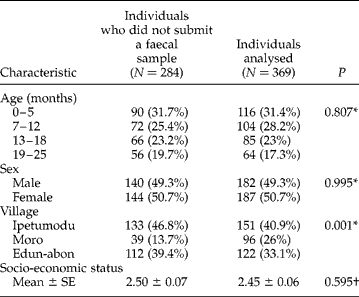
Six hundred and fifty-three children visited the clinics during the epidemiological survey. Compliance to return stool specimens was moderate; 369 children (56.5%) provided stool samples for screening of STHs. The characteristics were similar for children who did and did not submit a stool sample (table 1). There was a higher proportion of children in Moro in the group that submitted a stool sample (26%) when compared to the group that did not submit a faecal sample (13.7%) (χ2 = 14.822, df = 2, P = 0.001). There was no significant difference between children who had or had not previously excreted or vomited a worm and children who did or did not submit a stool sample for analysis. The sample population examined consisted of 182 males and 187 females, with an age (mean ± SD) of 11 ± 6.93 months. Forty-eight children harboured helminth species, the majority (45) of whom had single helminth species infections. Ascaris lumbricoides (12.5%) was the dominant infection. Forty-three (93.5%) of Ascaris infections were of light intensity while three (6.5%) were of moderate intensity. Five children (1.4%) were infected with T. trichiura and these infections were of light intensity (mean epg ± SE: 0.3 ± 4).
Baseline characteristics for children who did and did not submit a faecal sample.
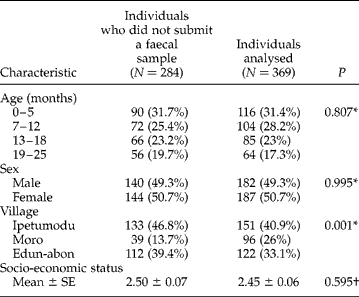
* χ2 test; † t-test.
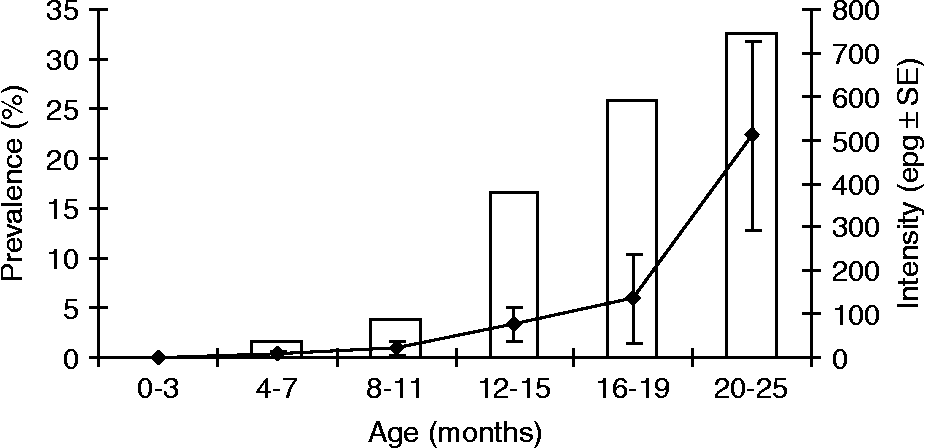
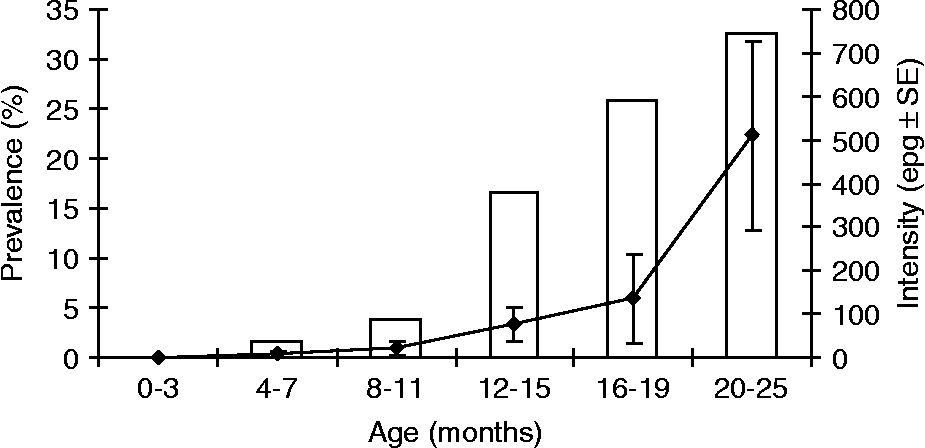
Prevalence of A. lumbricoides increased significantly with age (fig. 1; χ2 = 50.52, df = 5, P < 0.001). Ascaris was more common in older children, with a sharp increase at 12 months. The youngest child to be infected with A. lumbricoides was five months old. There was a steep increase in the mean intensity of A. lumbricoides after the 16–19 month age category (fig. 1; Z = − 6.234, P < 0.001). The prevalence and intensity of A. lumbricoides did not differ significantly between sexes or among the villages.
The relationship between the prevalence (open bars) and mean intensity (continuous line) of A. lumbricoides among children aged 0–25 months.
Twenty-three per cent of the children had low HAZ, 12.5% had low WAZ, and 12.9% had low WHZ. There were no statistically significant associations between the prevalence of A. lumbricoides and low WAZ, HAZ and WHZ.
Ascaris lumbricoides in children aged ≥6 months
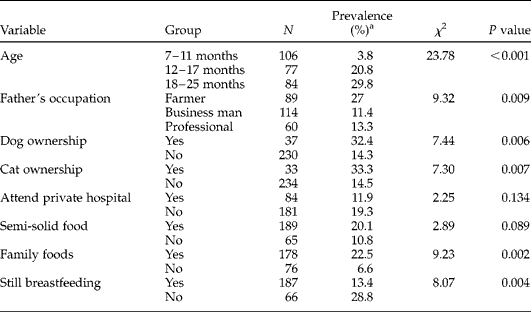
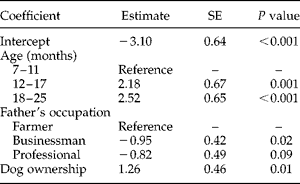
Based on the results from the chi-squared analysis identifying potential risk factors, and a cut-off P value of 0.2, we specified a maximal logistic regression model comprising the following explanatory factors: father's occupation, dog ownership, cat ownership, attending private hospital, eating semi-solid food, eating family foods, and still breastfeeding (table 2). Additionally, age category, using age 7–11 months as the reference category, was included as a fixed factor and with an interaction between all aforementioned factors to allow for non-linear interactions with children of different ages and their environment. The maximal model comprised 248 observations following exclusion of missing values (19 observations were removed). Stepwise linear regression selected a minimal adequate model (table 3) with an overall improvement of AIC from 224.83 to 202.15. The odds of being infected with A. lumbricoides increased as the children got older. Children aged 12–17 months and 18–25 months were 8.8 and 12.4 times, respectively, more likely to harbour Ascaris than those aged 7–11 months. The odds of harbouring Ascaris for children whose families owned a dog were 3.5 times that of children whose families did not own a dog. Children whose fathers were businessmen were 0.4 times less likely to be infected with Ascaris than those whose fathers were farmers.
Chi-squared (χ2) analysis for factors significantly associated (P<0.2) with Ascaris lumbricoides infections among children aged ≥6 months.
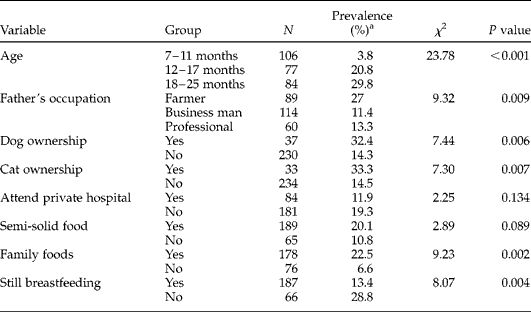
a The prevalence of A. lumbricoides positive cases, to show the direction of association.
Resultant minimal adequate model for the prevalence of Ascaris lumbricoides in children aged ≥6 months, with parameter estimates (expressed as log-odds) and associated standard error of the estimate and P values (N=248).
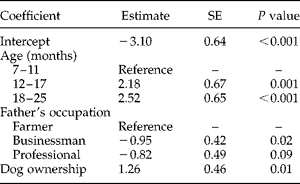
SE, standard error.
Discussion
Before the WHO consultation in 2002, children aged less than 24 months were excluded from large-scale intervention programmes for STHs in endemic countries. The high prevalence of A. lumbricoides (24.7%) in children aged 12–25 months found in our epidemiological survey supports the recommendation of WHO to enrol children aged from 1–2 years in control programmes for STHs. Ascaris lumbricoides was the dominant STH infection in this population. Few children harboured T. trichiura. Ascaris lumbricoides and T. trichiura infections are more important in younger children, as opposed to hookworm which is found in older age groups (Asaolu et al., Reference Asaolu, Ofoezie, Odumuyiwa, Sowemimo and Ogunniyi2002). This may explain why no hookworm infections were present in these children. Age was the most significant risk factor for A. lumbricoides in the logistic regression model. Weaning from breast milk to solid foods and better mobility of children aged >10 months may explain the increase in the prevalence of A. lumbricoides in older children (Montresor et al., Reference Montresor, Awasthi and Crompton2003). Other studies on children aged less than 24 months demonstrate that the prevalence of A. lumbricoides ranged from 6.2% in Nicaragua (Oberhelman et al., Reference Oberhelman, Guerrero, Fernandez, Silio, Mercado, Comiskey, Ihenacho and Mera1998) to 66% in Zaire (Mbendi et al., Reference Mbendi, Mashako, Lukuni and Ndongala1988). The low prevalence of A. lumbricoides (2.9%) in children aged less than 1 year compares well with studies undertaken in Sierra Leone (2%) (Wilson et al., Reference Wilson, Lindsay, Crompton and Hodges1991), Rio de Janeiro (4.3%) (Costa-Macedo & Rey, Reference Costa-Macedo and Rey2000), and Nigeria (7.6%) (Asaolu et al., Reference Asaolu, Ofoezie, Odumuyiwa, Sowemimo and Ogunniyi2002).
Dog ownership was significantly associated with the prevalence of A. lumbricoides and was retained as a significant risk factor in the logistic regression model. Traub and colleagues have demonstrated that dogs were significant disseminators and environmental contaminators of A. lumbricoides in communities where promiscuous defecation by humans occurs (Traub et al., Reference Traub, Robertson, Irwin, Mencke and Thompson2002). This association suggests that there may be a significant health risk for young children in similar communities where dogs are present.
In the present study, the father's occupation was also significantly associated with A. lumbricoides and still remained significant in the logistic regression model. Ascaris lumbricoides was more common in children whose fathers were farmers than in those whose fathers were businessmen or professionals. Farmers who use nightsoil (human faeces and urine) as fertilizer for crops may be at more risk of STH infection, as nightsoil has previously been demonstrated as a risk factor for hookworm infection in Vietnam (van der Hoek et al., Reference van der Hoek, De, Konradsen, Cam, Hoa and Toan2003). In the present study, the use of human faeces as fertilizer is not well practised in the study villages: only 2.5% of the mothers interviewed stated that they used human faeces as a fertilizer. Hence the high prevalence of A. lumbricoides in children whose fathers are farmers may be attributed to other socio-economic or behavioural factors. Naish and colleagues revealed that children whose parents' occupation was fishing had a higher prevalence and greater intensity of A. lumbricoides infection (Naish et al., Reference Naish, McCarthy and Williams2004). The authors suggested that this finding could be attributed to lack of nearby latrines, which may also be a contributing factor to our finding.
The analysis of risk factors in this study was based on the presence or absence of parasitism, rather than the intensity of infection. This analysis does not control for potential differences in health outcomes based on intensity of infection. However, the majority of infections in these young children were light and therefore may be expected to have similar health outcomes. Although children of these age groups are less likely to harbour heavy infections, their worm burdens are housed in smaller bodies, and therefore they are at a higher risk of anaemia and wasting malnutrition (Awasthi & Pande, Reference Awasthi and Pande2001). While we cannot interpret a cause-and-effect relationship between risk factors and Ascaris infection, the risk factors identified in this study are biologically plausible and important for planning parasite prevention in Ile-Ife, Nigeria. The role of dogs in the transmission of A. lumbricoides and other intestinal parasites requires further investigation. The findings from this study suggest that many of these young children, who are at a critical stage of development, are infected with Ascaris, and that the rate of infection with these parasites increases with age. This study has demonstrated the need to incorporate preschool children into deworming programmes in endemic regions and to explore innovative ways of delivering cost-effective deworming treatment to this high-risk age group.
Acknowledgements
We extend sincere thanks to the children and mothers who participated in the study, and the community leaders and the fieldworkers for their significant contribution. The authors would like to acknowledge the expert technical assistance of Mr David Lawrie and Mr Grant Spence (Scottish Parasite Diagnostic Laboratory, Glasgow), Dr Kolapo Oyeniyi (Ife North Local Government), Dr Mark Brown (Trinity College, Dublin) and Miss Aisling Proctor (Trinity College, Dublin). Fieldwork received financial support from the Irish National Children's Hospital. Patrick Kirwan was a recipient of a postgraduate scholarship from Irish Research Council of Science Engineering and Technology.