In the centuries that spanned the beginning of the Christian Era, the genre of apocalyptic literature flourished throughout the Near East. An ongoing question for scholars is whether there is any link between Persian apocalyptic texts and Jewish or Christian ones; it is difficult to arrive at a definitive answer because of the ninth–tenth century redaction of Persian apocalyptic manuscripts. We need to turn to the core of the mythical complexes involved in order to shed some light on the question, and in this sense Hesiodic material (namely Works and Days) is invaluable, since the “ages of the world” myth is one of the best links available for such a study. I argue here that Lactantius' witness to the Oracle of Hystaspes (OH) follows Hesiod very closely in its description of the end of times, and I propose some hypotheses regarding how this occurred over the course of intellectual history.
1. The OH is one of the most difficult texts of the late Hellenistic period. It has not survived in its entirety; we know of its existence from quotations by five different non-Zoroastrian authors, although scholars have suggested that a “stand-alone” text of that name never existed.Footnote 1
Three different hypotheses have been put forward: the first that the OH is a mere fabrication of the different authors who quote it; the second that we are dealing with very diverse and generic material simply grouped under the same pseudonym; the third, that what the five authors quote constitutes the remains of what was once a complete text (or at least a complete oral tradition put into written form).Footnote 2
The first hypothesis seems very unlikely; how could five distinct authors (Justin, Clement, Lactantius, Lydos and Aristokritos), who span the second to the sixth centuries ce, end up with different parts of a whole, all of them invented separately and yet forming a coherent whole?Footnote 3
The second appears more reasonable, especially if we take into account the fact that Sibylline material is also grouped in some fragments of the OH under the simple name of “the Sibyl”. There is nothing in principle to prevent the same happening to Hystaspes.Footnote 4
It is the third hypothesis that shall be examined here in the light of comparison to Hesiod and to Persian apocalypses, namely that the OH, as it appears in Lactantius, retains much of what was once a complete text at least in so far as it concerns the parts comprising the evils before the end of times. It is important to bear in mind that, although it is a late witness to Hesiodic myth, the OH sheds much light on the paths developed over centuries by distinct “types” of apocalypses.
2. The principal argument of this paper is, in a sense, a continuation of Hinnells' work in his ground-breaking article on the Oracle of Hystaspes (1973). However, I shall depart from Hinnells' ideas, and move forward to comparisons with Hesiodic material, which was not included in Hinnells' work: his focus was not on Hesiod, but on Iranian apocalyptic.
There are three main hypotheses concerning the possible link (it is tempting to talk about “influence” here but it is unwise to use the term) between Hesiod and Iranian apocalyptic:
1. Both stem from a common (i.e. generic) Indo-European background.
2. One of the sources used later Zoroastrian–Hellenistic material similar to Hesiodic myth (such as that found in the OH).
3. Hesiod and Indo-European eschatology parted ways at a point in time which is now impossible to define, but they stem from a common source – a “proto-form” of the myth, so to speak.
There is nothing in principle which falsifies the first hypothesis. However, it is now impossible to reconstruct with complete precision the supposedly Indo-European myths that may have been at its origin.
First, a number of Hesiodic concepts are missing from later sources, no matter whether we are talking about Persian apocalypses or the sequence of metals related to world empires as they would appear in the book of Daniel. Hesiod's Works' mythical ages complex does not, as a whole, appear in toto unchanged from Indo-European times to those of Zoroastrian–Hellenistic apocalyptic. Only part of the mythical complex appears – namely, the idea of good or bad periods (associated with mythical or historical kingdoms) linked to metals, ranging from gold (the best age) to iron (the worst).Footnote 5
Hesiod's Works' mythical ages complex cannot have been appropriated in its entirety and unchanged in Zoroastrian–Hellenistic apocalyptic.
The OH, especially in Lactantius' testimony, provides us with an interesting panorama on how a common mythical complex can be shared and developed over time.
Owing to space limitations, it is not possible to reproduce Hesiod's text (Works) in full here. I refer the reader to check any uncertainties in West's edition.
A number of themes also known from early texts in other IE languages are evoked in this long passage from Hesiod. Two of the most important topics shared between Hesiod and other Indo-European traditions are concerns about cattle and lack of hospitality: but the most significant is the relationship between micro- and macrocosm, and thus, of human life as a mirror of that of the universe. This also appears in Zoroastrian texts and their Vedic counterparts.Footnote 6
3. Let us turn now to Persian material. The relationship between metals and ages is best exemplified in two passages from the ZWY, one featuring a four-age and the second a seven-age periodization; it should be noted that the ZWY is, in comparison to the JN and the Dk, more relevant to this article, and will thus be the focus of our analysis. I will begin with ZWY 1.1–11:Footnote 7
/11/ And the one on which iron had been mixed is the evil rule of the parted hair of dēws of the seed of Xēšm, when it will be the end of your tenth century, o Spitāmān Zarduxšt.
And then, in the second passage, ZWY 3.19–29:
/29/ The one on which iron had been mixed is the evil dominion of the parted hair dēws of the seed of Xēšm, when it will be the end of the tenth century of your millennium, o Spitāmān Zarduxšt.
A brief survey of the discussion surrounding the dating of these texts is required here; due to the topic of this article an exhaustive discussion of the issues is not required.
For some time, apparently as part of the heritage of the Religionsgeschichtliche Schule, the “influence” of Iranian ideas on Jewish apocalyptic was taken for granted.Footnote 8 Few voices arose against an assumption which lacked documentary evidence – Persian apocalyptic manuscript redaction can be dated, as stated above, from the ninth–tenth centuries ce; there is no direct quotation of Persian apocalypses in Jewish or Christian manuscripts.Footnote 9
Likewise, arguments for the antiquity of Zoroastrian apocalypse rely on the following: the possibility of preservation, for long periods, of sacred literature in oral form; the unlikeliness of Persians of any period drawing on Jewish sources and incorporating them to their theological weaponry; and classical sources stating that much which is in accordance to the sceptics' views (e.g. Gignoux, Duchesne-Guillemin among the most popular authors) is, in fact, material from the ninth–tenth centuries ce.Footnote 10
By contrast, the sceptics draw mainly on external evidence: a great deal of their argument is based on manuscripts of the texts as they came down to us in their current form.Footnote 11 But in my opinion this argument is flawed: no one would use the same reasoning to date, say, Hesiod, whose earliest extant manuscript is from the tenth century ce – that is, almost 1,600 years after the dating generally accepted for the life and works of Hesiod himself.Footnote 12 No scholar in his or her senses would use the same argument to date the content of any text: it betrays a confusion of sorts, between internal and external evidence.
One may argue that there are many other witnesses to Hesiod in Antiquity – more than to the Persian sources quoted here; for these, we can find some internal evidence in the form of references, but no direct quotations of Persian texts (i.e. although Plutarch, for example, tells us much that is correct about Zoroastrian beliefs, he does not quote Persian texts verbatim). But this can easily be explained: while most of the peoples who did well under the dominion of Greek, then Roman, rule, had to speak Greek in order to make themselves heard, Greeks remained solidly monolingual.Footnote 13 In this sense, the “Eastern knowledge”, invented by Greeks from Plato to Plutarch and beyond, presents no essential difference vis-à-vis Persian material than it poses to Babylonian, Egyptian or Jewish sources. It is remarkable that even in Herodotus we find an astonishing array of information concerning Egypt (and even his written sources are mentioned) but Herodotus did not bother to learn the language of the natives, even just to check for himself the precision of the information given. In this procedure he was a pioneer of Greek usage for centuries to come.Footnote 14
4. A comparison between the content (and eventually, language) of Persian sources and Hesiodic reminiscences found in the fragmentary OH should prove most useful here.
If we are to consider seriously the internal evidence, the picture that emerges in this triple-text crossing is that we are dealing, in Hesiod, with remnants of the Archaic Period in Greece, after the last invasions (Hesiod is thought to have lived in the eighth century bce) but before the emergence of the polis as an independent institution, based upon the written and public nature of its legislation. This, in turn, finds another Indo-European parallel in the Indian yugas myth, to which we should briefly turn since the last of the yugas, or ages, yields significant information for our subject.
A somewhat lengthy digression is necessary here, given the nature of the “iron” or “black” ages in a mythical complex genetically related to the Hesiodic one and even more, one that appears, unexpectedly, at least twice in the work of fifth-century Greek writers.
5. A very early mythical complex – one that nonetheless comes to life in later sources, sometimes where one would not expect it – in Indo-European lore relates to the pair “cosmic tree” or “cosmic pillar” and “primordial man”. In fact, both come together and, most importantly, are linked to Indian material in the testimony of the gnostic Bardesanes (second century ce), according to Stobaeus 2.2. We shall work backwards from Bardesanes in our analysis. The knowledge imparted by Bardesanes, however, goes back much further: as we shall see it can be traced to very early Vedic material.
During the reign of the Roman emperor Elegabalus (218–222 ce), Bardesanes, a Syrian gnosticFootnote 15 (c. 154–222 ce), met Hindu priests sent to Rome. This is mentioned by Porphyry (On Abstinence 4.17) and also in a fragment of his now lost work De Styge 5.2. Stobaeus preserved this fragment in his Anthology 1.3.56.Footnote 16 Here we have the description given by the brahmins to Bardesanes of an enormous human statue to be found at the centre of the Earth, in a cave. It had its arms outstretched as if crucified, and under its armpits several earthly and celestial beings were represented. It should be noted that Stobeaus claims to follow Bardesanes' report “word for word” (κατὰ λέξιν), and this makes the passage quite trustworthy – Bardesanes does not claim to be speaking “in the spirit of what was said” or anything of the sort. He assures the reader that this is not a paraphrase.
This celestial figure is none other than the man with outstretched arms: “And [the Indians] told him about a great natural cave in a very high mountain, approximately in the centre of the Earth”.Footnote 17
We have next a number of common themes in Indo-European myths here that already appear in Hesiod – microcosm/macrocosm and the consequent analogy of the ages of the world and the ages of man, as well as the original androgyny of God (not explicit in Hesiod but something which can be deduced from his appreciation of the nature of men in general). There is also a very interesting Greek fragment stating that Zeus is both man and woman.Footnote 18 Passages dealing with the same issue can be found in Indian material,Footnote 19 but this is beyond the scope of this article.
The other important myth that should be mentioned is the ageing of the world as related to the ageing of Višnu – i.e. again between macrocosm and microcosm. This is to be found in the Ṛg Veda 10.10,Footnote 20 where Yama refuses to be united with his twin sister Yami, which shows the existence of an ancient Indo-European myth (since it does not appear in either Semitic tradition or pre-Vedic India) where the primordial twins give birth to the first human beings, which in turn implies that the latter were twins. In another passage this blessed period, the colour of Višnu-Narayana, whose body is the cosmos, is white.Footnote 21 In the second period, men are no longer twins but, as in the Aristophanic story, male and female; there are already crafts, houses and private property.Footnote 22Dharma has been weakened by one-quarter, and so has the length of human life; the colour of Višnu is now red. In the third period, dharma has been reduced a further quarter, men are exposed to disease, mortality and lust for riches appear, and Višnu is now yellow.
Most important to us is the fourth period of the yugas, because of its many similarities to the last age of Hesiodic myth. Višnu is now black, the colour of iron; in this age, kali yuga, every type of disgrace falls upon men and the normal course of things has been inverted in all aspects of life. The world is now full of heresies, and only one-quarter of the dharma remains.Footnote 23
Yet another variation can be found in the Ṛg Veda 10.90, the Puruṣa Hymn.Footnote 24Puruṣa in Sanskrit means a person of the masculine gender, but this hymn suggests the gigantic primordial being that, due to its sacrifice, begets all creation. Among the things coming out of its body are the four castes.
Far from being remote from our theme, the passages from the Ṛg Veda show a striking similarity to what Hesiod proposes, and even more, to shamanistic drum-art-motifs.Footnote 25
6. Returning to Hesiod, and to our three initial hypotheses, it seems clear that one cannot speak of simple “borrowings” here.
A comparison between the righteousness of the good, early times in both Hesiod and in Persian sources seems unnecessary (except for the comparison between the metals, as we shall see below in the case of the ZWY); in the OH the blessings of the early times are implied, but not described in detail.
Let us start with a plain comparison between the woes of the “Iron Age” and those of the end times in the OH. In terms of wickedness, it appears that “Bronze Age” men were the equals of their “Iron Age” counterparts, but lacked the time necessary to do more harm to themselves.
[140] But when earth had covered this generation also – they are called blessed spirits of the underworld by men, and, though they are of second order, yet honor attends them also – Zeus the Father made a third generation of mortal men, a brazen race, sprung from ash-trees; and it was in no way equal to the silver age, [145] but was terrible and strong. They loved the lamentable works of Ares and deeds of violence; they ate no bread, but were hard of heart like adamant, fearful men. Great was their strength and unconquerable the arms which grew from their shoulders on their strong limbs. [150] Their armor was of bronze, and their houses of bronze, and of bronze were their implements: there was no black iron [μέλας […] σίδηρος]. These were destroyed by their own hands and passed to the dark house of chill Hades, and left no name: terrible though they were, [155] black death [θάνατος […] μέλας] seized them, and they left the bright light of the sun.
One of the important traits to observe here is that the sequence of the ages in Hesiod follows that of the introduction of technology: it explicitly recognized that bronze weaponry precedes iron utensils and that the latter are far more destructive.Footnote 26
One may also observe that “iron” shares one attribute with death – both are named twice in this passage as “black”. The same colour is to be observed in the last age, kali yuga. It seems that beside the obvious resemblance between the dark hue of iron as a mineral, there is an association to death to which not enough attention has been paid.Footnote 27
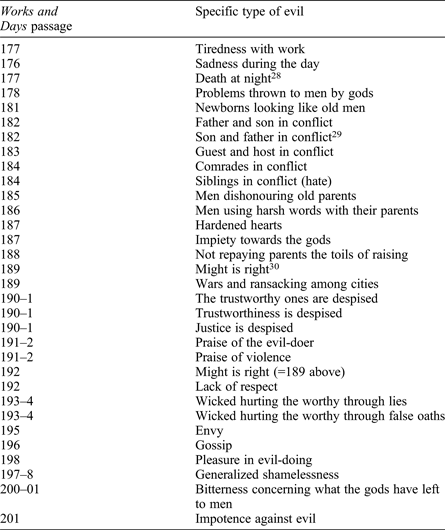
As regards the “Iron Age” itself, Table 1 shows how Hesiod can be summarized, following the sections of Works previously quoted and the concerns of the article. Table 1 lists Hesiod's evils of the last age categorized first by text order, then by type on item 8.
Hesiod's evils of the last age, Works and Days
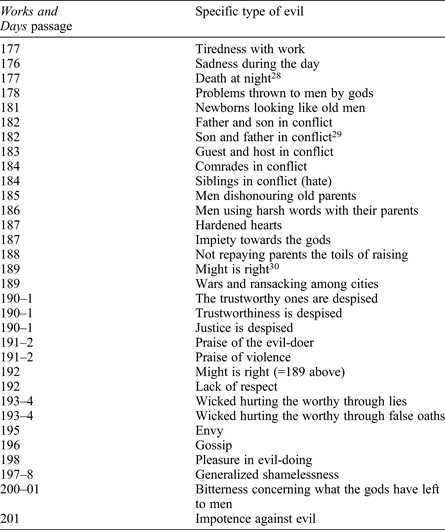
7. So the woes of the last age, in Hesiod, have the following remarkable traits in terms of our analysis of the thirty-two evils mentioned:
7.1. No mention of “black” as an attribute is made;Footnote 31 interestingly, Hades and Nemesis wear “white” clothes – but Works, 177, links the “darkness” of the night to death.
7.2. Death or perishing are mentioned three times in the “Bronze Age”, but four in the verses regarding the “Iron Age” (the reference to the gods as “deathless” in Works, 200–201, should be dismissed since it is not really a way of speaking about human immortality).
7.3. Violence is a common trait in the last three ages: however, in the last one terms related to strife appear no fewer than twenty times, and are praised thirteen times, as seen in Table 1.
7.4. It is often overlooked (as in Daniel and the ZWY) that there will be some good mixed with evil in the “Iron Age”, in a very similar way to how we can speak of unknown things mixed with iron in Dn 2.33 and in the ZWY 1.1.
7.5. The details given concerning the last stages of the eschatological drama are crucial.
7.6. Of particular importance among the woes of the “Iron Age” are those related to:
7.6.1. Ingratitude (six times);
7.6.2. unfriendliness (7)
7.6.3. lack of respect for old age (5);
7.6.4. hostility among relatives (4);
7.6.5. woes related to the body and health (4);
7.6.6. men as lacking trust (10);
7.6.7. praise of violence (9);
7.6.8. problems caused by the gods (3);
7.6.9. impiety (1);
7.6.10. gossiping (3).Footnote 32
One can see that injustice and violence together answer for nineteen instances of the “Iron Age” evils – they almost merit a separate section among the many “Iron Age” woes.
7.7. Finally, it is noteworthy that the only woes related to nature come at the beginning of Hesiod's description and deal not with the natural world, but rather with the lives of men: unrest and sorrow (176–7); and newborns looking like old men (181). And contrary to the other ages, which were destroyed by the gods, it appears that the last race finds the gods tired, so that men are left to their own fate (201).
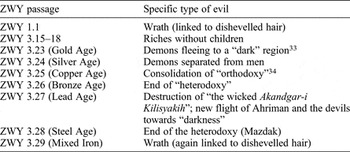
8. Checking Hesiod against the ZWY results in the outcomes shown in Table 2. The ZWY offers more modest results as the text is much smaller and more fragmentary compared to the Works (comparing passages dealing with the ages of the world): it should be noted that here evils seem to be more concentrated in the last Hesiodic myth, but are more evenly spread in the ZWY.
Hesiod's evils of the last age, ZWY

Understanding Table 2 typologically, we would then have the following quantification of woes:
1. heterodoxy (four times);
2. wrath (twice);
3. appearance/fleeing of demons (three times);
4. lack of descendants (once).
The reference to themes somehow related to iron appears twice.
In fact, only the last age can be considered strictly evil; the others, either in the four ages version (ch. 1) or the seven ages one (ch. 3) are a mixture of good and evil. This recalls the “time of mixture” in the fight between Ahuramazda and Ahriman, but also echoes Hesiod – after all, the poet tells us of the heroes: “[…] these last equally have honor and glory” (Works, 169b).
We can conclude that in the ZWY the main evils to be fought are heterodoxy and demons (both total seven evils out of ten).
How does this picture compare to the woes promised to men in the last days according to Lactantius? One must note that in the ZWY the discussion about the metal ages takes place in ch. 4.
9. As noted at the beginning of this article, we are concerned mostly with Lactantius' testimony – it is the fullest and lengthiest in all respects; Clement, Justin the Martyr, Aristokritos and Lydos are little more than references (although important ones) in the sum of fragments that compose the OH. However, the following passage from Justin has some relevance for my argument: “The Sibyl and Hystaspes have given out that this whole system of corruptibles shall be destroyed by fire”.Footnote 35 It also states that, in respect to two Eastern testimonies, the world is both declining (for it is corruptible) and finite.
In addition to the promise made by the Sibyl and Hystaspes regarding the end of times by ekpyrosis or the destruction of the world by fire as stated by Justin, we should turn to Lactantius.
The first passage is DI 7.16:
Cities shall be utterly overthrown, and shall perish; not only by fire and the sword, but also by continual earthquakes and overflowings of waters, and by frequent diseases and repeated famines.
Next,
But the voices also of prophets of the world, agreeing with the heavenly, announce the end and overthrow of all things after a short time, describing, as it were, the last old age of the wearied and wasting world. But the things which are said by prophets and seers to be about to happen before that last ending comes upon the world I will subjoin, being collected and accumulated from all quarters.Footnote 36
A lengthier passage, although not strictly related to Hystaspes, has much the same flavour and would help add comparisons to Hesiodic woes:
For righteousness will so decrease, and impiety, avarice, lust will so greatly increase, that if there shall then happen to be any good men, they will be a prey to the wicked, and will be harassed on all sides by the unrighteous; while the wicked alone will be in opulence, but the good will be afflicted in all calumnies and in want. All justice will be confounded, and the laws will be destroyed. No one will then have anything except that which has been gained or defended by violence: boldness and violence will possess all things. There will be no faith among men, nor peace, nor kindness, nor shame, nor truth; and thus also there will be neither security, nor government, nor any rest from evils. For all the earth will be in a state of tumult; wars will everywhere rage; all nations will be in arms, and will oppose one another; neighbouring states will carry on conflicts with each other; and first of all Egypt will pay the penalties of her foolish superstitions, and will be covered with blood as if with a river. Then the sword will traverse the world, mowing down everything, and laying low all things as a crop. And the cause of this desolation and confusion will be this, because the Roman name, by which the world is now ruled (my mind dreads to relate it, but I will relate it, because it is about to happen), will be taken away from the earth, and the government return to Asia; and the East will again bear rule, and the West be reduced to servitude.Footnote 37
The reference to a decline of the West and the rise of Asia looks decidedly like late material, since none of this is to be found – for very apparent reasons – in Hesiod: during his lifetime Rome was small, powerless and unknown to cultured Greeks. So with the exception of the woes denounced by Hystaspes, which are strictly related to the downfall of the Roman governability, we have a strikingly similar pattern to that of Hesiodic evils of the “Iron Age” – it is important to remember that the metals are never referred to in Lactantius, but then this may be due to his relative ignorance of Christian scriptures and, by consequence, it is reasonable to presume that Daniel did not come to his mind immediately with the sequence of ages/empires/metals of Dn 2.
Another of Lactantius' passages, in the same spirit, is DI 7.16:
Then, in truth, a detestable and abominable time shall come, in which life shall be pleasant to none of men. […] For the atmosphere will be tainted, and become corrupt and pestilential – at one time by unseasonable rains, at another by barren drought, now by cold, and now by excessive heat. Nor will the earth give its fruit to man: no field, or tree, or vine, will produce anything; but after they have given the greatest hope in the blossom, they will fail in the fruit. Fountains also shall be dried up, together with the rivers; so that there shall not be sufficient supply for drinking; and waters shall be changed into blood or bitterness. On account of these things, beasts shall fail on the land, and birds in the air, and fishes in the sea. Wonderful prodigies also in heaven shall confound the minds of men with the greatest terrors, and the trains of comets, and the darkness of the sun, and the colour of the moon, and the gliding of the falling stars. Nor, however, will these things take place in the accustomed manner; but there will suddenly appear stars unknown and unseen by the eyes; the sun will be perpetually darkened, so that there will be scarcely any distinction between the night and the day; the moon will now fail, not for three hours only, but, overspread with perpetual blood, will go through extraordinary movements, so that it will not be easy for man to ascertain the courses of the heavenly bodies or the system of the times; for there will either be summer in the winter, or winter in the summer. Then the year will be shortened, and the month diminished, and the day contracted into a short space; and stars shall fall in great numbers, so that all the heavens will appear dark without any lights. The loftiest mountains also will fall, and be levelled with the plains; the sea will be rendered unnavigable.
And finally, at DI 7.17:
That will be the time in which righteousness shall be cast out, and innocence be hated; in which the wicked shall prey upon the good as enemies; neither law, nor order, nor military discipline shall be preserved; no one shall reverence hoary locks, nor recognise the duty of piety, nor pity sex or infancy; all things shall be confounded and mixed together against right, and against the laws of nature. Thus the whole earth shall be laid waste, as though by one universal robbery. When these things shall so happen, then the righteous and the followers of truth shall separate themselves from the wicked, and flee into solitude. And when he hears of this, the impious king, inflamed with anger, will come with a great army, and, bringing up all his forces, will surround all the mountain in which the righteous shall be situated, that he may seize them. But they, when they shall see themselves to be shut in on all sides and besieged, will call upon God with a loud voice, and implore the aid of heaven; and God shall hear them, and send from heaven a great king to rescue and free them, and destroy all the wicked with fire, and sword.Footnote 38
Looking now from a perspective of the nature of the evils described in Lactantius, we would then have:
9.1. The wearing of the world and its destruction (DI 7.14); this is implied in the Hesiodic double assertion that he (Hesiod) would rather be born afterwards (which means there should be a new beginning) and that the gods have forsaken men (Works, 200). In contrast to that abandon, these last wicked men will be destroyed in the final sentences of DI 7.17 – and, in another striking parallel to Iranian ordeals or ekpyrosis, the same theme appears here:
[…] when He shall have judged the righteous, He will also try them with fire. Then they whose sins shall exceed either in weight or in number shall be scorched by the fire and burnt; but they whom full justice and maturity of virtue have imbued will not perceive that fire.Footnote 39
In this last passage, terrifying as it may appear, the emphasis is placed more on righteousness than on wickedness – the righteous appear four times, the wicked only once.
9.2. As in Hesiod, a great many of Lactantius' worries concern the loss of justice: it appears no fewer than eleven times in DI 7.15, none in 7.16 (which is more concerned with natural catastrophism as we shall see) and fifteen in DI 7.17.
9.3. Violence appears quite frequently, but here an important distinction should be made: violence as a sign of the wearying of the world on one hand and as the mark of decay among the Roman Empire on the other. This last feature is of less interest here, and resembles very much the theme of Eastern revenge on the West – typical of sibylline material.Footnote 40 So violence as an intrinsic feature of the last age, regardless of the political turmoil described in the last phrases of DI 7.15 and 17, is mentioned six times in DI 7.15 and twice in 7.17.
9.4. Turmoil in nature appears interestingly interwoven with the sins of men in a single passage in DI 7.17 where evils contrary to nature (presumably of a sexual nature) are mentioned.
9.5. The usual turmoil concerning nature at large appears several times, resembling Hesiod DI 7.16 is almost exclusively concerned with that kind of evil.
This summarizes the catalogue of misfortunes described in the fragments of the OH in Lactantius. The Persian material is more diversified, but has many common themes with both Hesiod and the OH.
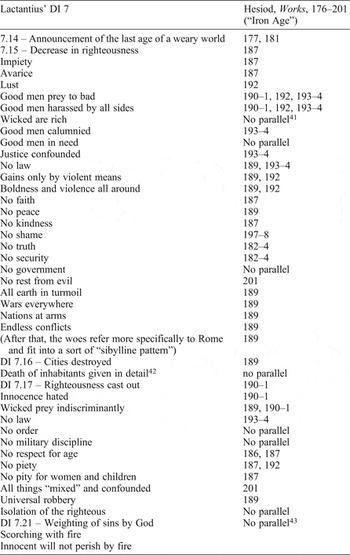
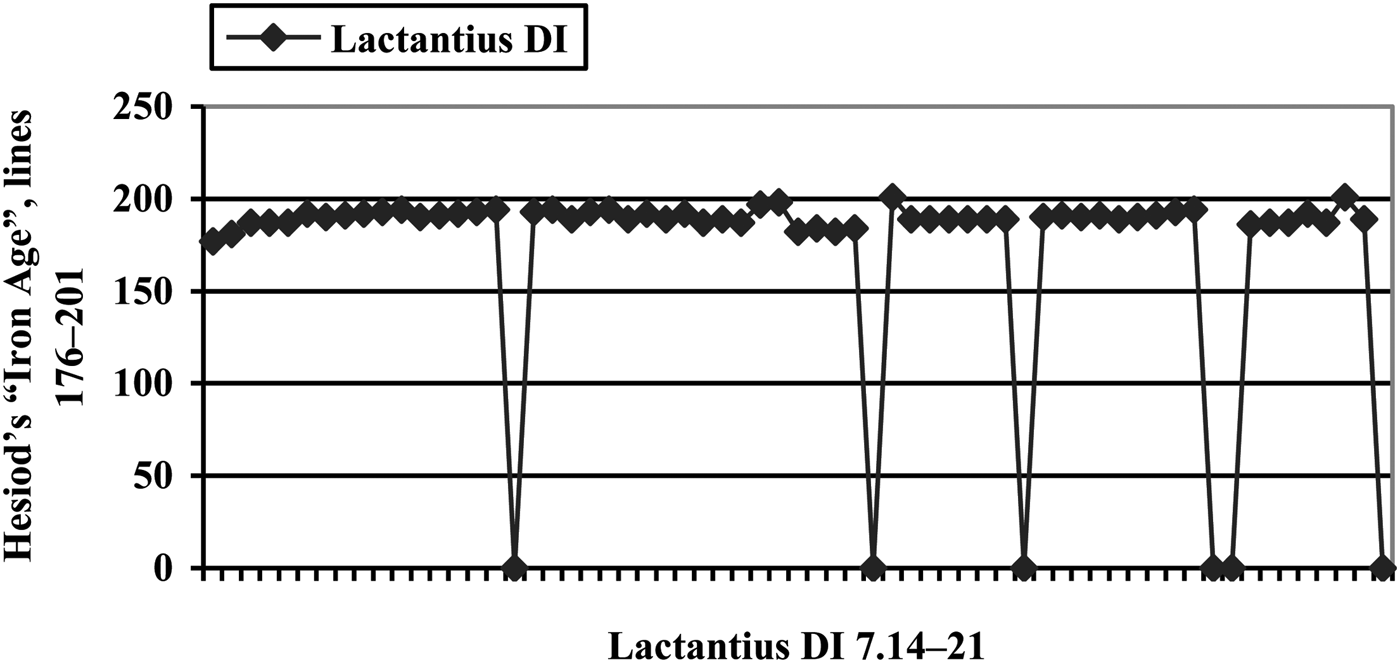
10. The most important issue is found in a straight comparison of the order of evils as they appear respectively in the “Iron Age” and in the OH passages of Lactantius, as Table 3 shows.
Lactantius' evils of the last age

More surprisingly the evidence in Table 3 demonstrates that, grosso modo, Lactantius either follows Hesiod's order of evils in the last age, or deals in a very few passages with issues which are irrelevant, or non-existent, at the time of the composition of Works and Days.
More remarkable are any similarities between the Hesiodic “Iron Age” and Lactantius' fragments of the OH stop when it comes to eschatological issues. What conclusion can be drawn from all this?
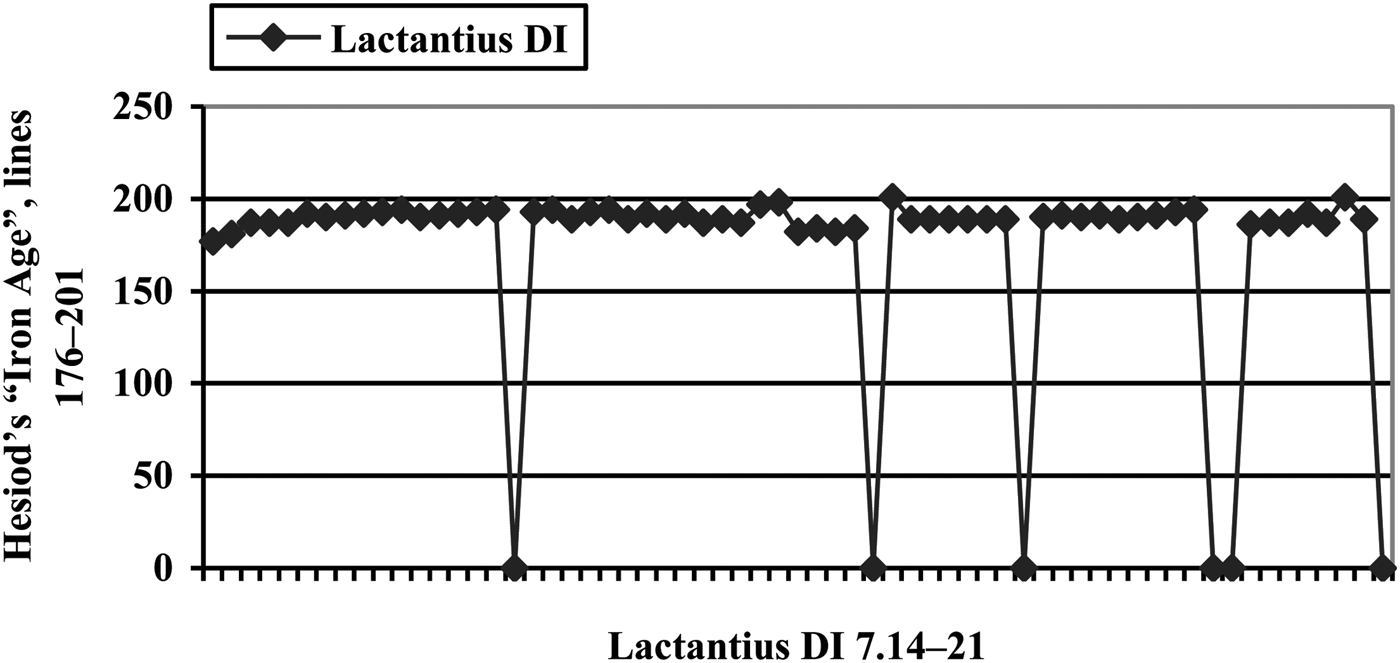
From the graph in Figure 1 we learn that throughout the passages of the DI that deal with the last age, Lactantius follows Hesiod's woes very closely, with slight ups and downs, and only six real downs – the parts of Table 3 where there are no parallels to the Works.
Proposed development scheme of world evils from a *PIE proto-form to Lactantius
11. As Hinnells rightly observed, one of the main issues of the OH that does not agree with Middle Persian apocalyptic texts – namely the GrBd, the ZWY, the JN and the Dk – are those related to final judgement. This is somehow related to the idea of retribution (a Zoroastrian concept) versus that of salvation by Grace (Christian).Footnote 44 But men have undergone ordeals, according to Jewish belief, before – and this seems to be the “second layer” on the OH: the destruction of men by water during the Flood and the promise of a second “selection of the pure” by fire is found not only in Jewish pseudepigrapha but even in the NT itself.Footnote 45
Our conclusions can be summarized thus:
11.1. The purpose of the kind of natural catastrophe described in the OH is unclear; we do not know if they are meant as chastisement or purification. However, while Hinnells and Cumont are quite right in ascertaining that such a compact amount of evils put together suggests an Iranian origin (since no evils can arise gratuitously as the result of a moody God, but in Zoroastrianism they may arise as the outcome of the will of an evil spiritFootnote 46), we should take into account the reverse – the apocalyptic passages concerning the blessings of nature in the godly age to come.
A complete table of cosmic evils compared to those announced in the OH and in Persian sources is given by Hinnells in Table II.2,Footnote 47 which need not be reproduced here.
11.2. Regarding the coming good, no apocalypse seems more useful for our comparison than the Syriac Apocalypse of Baruch (2Br): the promises contained therein are masterfully interwoven with the evils related to the birthpangs of the perfect world to come. So, in 2Br 29.5 it is said that vines will produce many times more wine from a single grape than previously. Now, the OH (DI 7.16) offers the opposite picture:
Nor will the earth give its fruit to man: no field, or tree, or vine, will produce anything; but after they have given the greatest hope in the blossom, they will fail in the fruit. Fountains also shall be dried up, together with the rivers; so that there shall not be sufficient supply for drinking; and waters shall be changed into blood or bitterness.
Here, however, the events described are part of God's plan, whereas in the OH they appear to be related in an unclear way to the general decay of an ageing world. In this respect, again we should turn to Hesiod, on his praise of Justice soon after the digression on the “ages of the world”: given that the woes of the unjust “Iron Age” resemble so much the following ones, it is quite likely that they form part of a whole exhortation to Justice as not only right, but also expedient (Works, 225–35):
[225] But they who give straight judgements to strangers and to the men of the land, and go not aside from what is just, their city flourishes, and the people prosper in it: Peace, the nurse of children, is abroad in their land, and all-seeing Zeus never decrees cruel war against them. [230] Neither famine nor disaster ever haunt men who do true justice; but light-heartedly they tend the fields which are all their care. The earth bears them victual in plenty, and on the mountains the oak bears acorns upon the top and bees in the midst. Their woolly sheep are laden with fleeces; [235] their women bear children like their parents. They flourish continually with good things, and do not travel on ships, for the grain-giving earth bears them fruit.
So a land governed according to just laws is not only something to be pursued in its own right – as is implied by the blessings of the first two ages of men, the golden and silver ones – but is also rewarded. Parallels in Biblical passages look very close indeed,Footnote 48 but again, as Hinnells pointed out, the fact that all the woes are put together – those of clear Jewish–Christian origin and the strictly Zoroastrian ones – suggests an origin that is either syncretistic or which leans more towards Iranian reward-eschatological thinking. But this concerns the outcome of times, not the woes of the last age.
11.3. As regards the injustice of the last times, OH (especially DI 7.15) is more similar to Hesiod's Works than to anything else, including Persian material (the question of origin or appropriation, to which I referred at the beginning of this article, will be dealt with in the Conclusion: the wording of Hesiod for “evil”, “evil-doers” or unjust men in general (κακῶν, κακός, κακόχαρτος) parallels the OH in DI.7 and Persian sources (e.g. ZWY 1.11: ud ān ī āhan abar gumēxt *ēstād duš-pādixšāyīh […]; ZWY 4.60: awēsān ēdōn *duš-pādixšā be bawēnd, kū ka mard-ēw […]); for impiety (ούδè θεῶν ὄπιν εὶδότες); for unsafety and lack of respect for law (including material gains by sheer violence, οὐδὲ δικαίου οὔτʼ ἀγαθού […] κακῶν […] καὶ ὕβριν); regarding avarice, (τοκεῦσιν); and lack of respect for old age, γηράσκοντας ἀτιμήσουσι.
11.4. The most intriguing features in the OH described in this article are no doubt the evils awaiting men who commit bad deeds in this life. Again, this can be due either to Lactantius' own relative ignorance of Scripture or, since he is quoting material that is related to Pagan seers and visionaries like the Sibyl or unspecified “Hellenistic books”,Footnote 49 these relate more closely to the woes of the last age as they appear in these works.
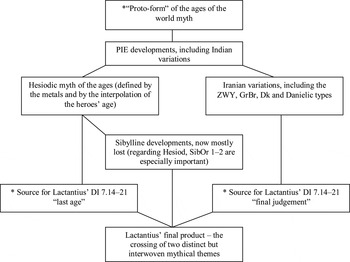
11.5. So Lactantius, for all his deficiencies regarding Scripture, may be a very important link in understanding how the “ages of the world” mythical complex spread and was consumed in Late Antiquity. His text is not fragmentary; his sequence of woes, according to our examination in Table 3 (and taking into account the previous discussion on the PIE origin of the myth of the primeval man and related matters), could suggest something like the scheme in Figure 2 for the development of the myth.
Proposed development scheme of world evils from a *PIE proto-form to Lactantius

Conclusion
In conclusion we can summarize the main arguments as follows:
1. The parallel woes of the last age in the fragments of the OH, especially those present in Lactantius' DI 7.15–21 are very much reminiscent of the ones to be found in Hesiod.
2. The eschatological themes in the OH refer more closely to Persian material than to Dn or Rev material (and here the analysis of Indian sources and Bardesanes proves to be of paramount importance), but the dating of the Persian manuscripts provides a barrier that, while not insurmountable (if one does not mix internal with external evidence), is to be taken seriously into account;
3. The parallels present in Lactantius, referring to the woes of the last age, could be traced to Biblical material (e.g. Dn or Rev) but here two things must be borne in mind: Lactantius does not refer to traditional themes in these two texts (e.g. the other ages, or kingdoms or metals) and this could be attributed to his own ignorance of Scripture; on the other hand, they sometimes resemble the very wording and order of evils present in Hesiod.
4. The idea that we are dealing with a theme that stretches back to PIE times is not impossible – the surprising presence of the myth of the primordial androgynes in Plato's Symposium allows that – given Lactantius' knowledge of classical scholarship, but it is more likely that, in his case, we are dealing with direct reminiscences of Hesiod.Footnote 50
5. We should conclude that the third hypothesis put forward at the beginning of this article has the greatest degree of possibility: the woes in the fragments grouped under the name of Hystaspes display knowledge of Hesiodic lore without Danielic or Persian mediation.
Finally, a parting of ways seems clear in that Hesiod proposes no clear eschatological solution, while the OH, Jewish, Christian and Persian sources do. It is no coincidence that here lies the main fracture between Lactantius and Hesiod.