Implications
Accurate determination of stress in farm animals is critical, since a quantitative measure of stress-related parameters is difficult. Besides ethical-related issues, the impact of animal welfare has a direct repercussion on meat quality and quantity, therefore it is of major economic relevance for food industry. Currently solid and standard protocols to assess turkey welfare lack. The present study highlights the possible use of molecular biomarkers to quantitatively assess stress in turkey. Three candidate biomarkers have been identified in serum of stressed turkey and they may be useful to discriminate between stressed and unstressed animals.
Introduction
Welfare is a multidimensional concept that embraces absence of suffering, high levels of biological functioning and the potential for animals to have positive experience. Beside ethical-related issues, the current importance of animal welfare has a direct impact on meat quality and quantity (Terlouw et al., Reference Terlouw, Arnould, Auperin, Berri, Le Bihan-Duval, Deiss, Lefèvre, Lensink and Mounier2008), therefore is also of major economic concern for the turkey industry. Although solid and standard welfare protocols exist for poultry, the Welfare Quality® (2009), Assessment Protocol for Poultry, reports that these protocols cannot be applied successfully to turkey species (http://www.welfarequality.net/everyone/45630/9/0/22). Traditional methods include behavioral observation and few quantifiable parameters, such as cortisol among the others, although their use is still debated (Marchewka et al., Reference Marchewka, Watanabe, Ferrante and Estevez2013).
The knowledge of how welfare management tools, previously applied to other species, can be applied also to turkeys is unclear, and this prevents a correct quantification of the effects of management practices on turkey productivity and welfare. The standard protocols to assess animal welfare are often incomplete or unsuitable, since they differ in the thresholds set to differentiate high v. poor welfare, and/or in the way the information is integrated to form an overall evaluation judgment (Botreau et al., Reference Botreau, Bonde, Butterworth, Perny, Bracke, Capdeville and Veissier2007).
MicroRNA (miRNA) are small non-coding RNA that regulate post-transcriptionally gene expression, playing key roles in regulating immune response. The modulation of miRNA expression is an early response to stressful conditions. Extracellular miRNA can be easily extracted from body fluids. Therefore, circulating miRNA are among the most promising clinical biomarkers for the diagnosis of a variety of diseases and stress disorders in humans (Andersen et al., Reference Andersen, Duroux and Gazerani2014).
The aim of the present study was to (a) ascertain whether transport-related stress modulates the expression of circulating miRNA and (b) investigate the potential use of differentially expressed miRNA as biomarkers to measure transport-related stress. The study was carried out by measuring by quantitative polymerase chain reaction (qPCR) those miRNA that were previously demonstrated to be related to stress events and immune defenses in chicken, namely miR-22, miR-155, miR-181a, miR-204 and miR-365 (Ahanda et al., Reference Ahanda, Zerjal, Dhorne-Pollet, Rau, Cooksey and Giuffra2014). Road transportation was selected as stress model. The practices related to road transport, which is regarded as one of the most stressful events in the turkeys’ lifetime (Marchewka et al., Reference Marchewka, Watanabe, Ferrante and Estevez2013), included catching, loading, transport, unloading and final feed deprivation until slaughtering.
Material and methods
Sample collection
Blood was collected from 16 clinically healthy 105-day-old turkeys by branchial vein venipuncture using serum collection tubes during routine disease testing. After a 2-h road-transportation, further blood samples were collected during routine slaughtering process from the neck vessels cut by the automatic processing killer. Road-transport was carried out according to EU procedures for animal transport (Council Regulation (EC) No 1/2005 of 22 December 2004 on the protection of animals during transport and related operations and amending Directives 64/432/EEC and 93/119/EC and Regulation (EC) No 1255/97). Serum was stored at −80°C until RNA extraction.
miRNA extraction and real-time qPCR
Total RNA was extracted using miRNeasy Serum/Plasma Kit (catalog number 217184, Qiagen, Milano, Italy). Serum was thawed on ice and centrifuged at 3000×g for 5 min at 4°C. An aliquot of 150 μl per sample was transferred to a new tube and 1 ml of Qiazol was added. The Caenorhabditis elegans miRNA cel-miR-39 (catalog number 219610, Qiagen) was used as synthetic spike-in control due to lack of sequence homology to avian miRNA. After an incubation at room temperature for 5 min, 3.75 μl (25 fmol final concentration) of spike-in control was added and the samples vortexed to ensure complete mixing. The RNA extraction was then carried out according to manufacturer’s instruction. Total RNA concentration and quality were validated as ratio A260/A280 by NanoDrop ND-1000 UV–vis spectrophotometer (NanoDrop Technologies Inc., Wilmington, DE, USA). The reverse transcription was performed using the TaqMan MicroRNA Reverse Transcription Kit (catalog number 4366596, Applied Biosystems, Monza, Italy) using miRNA-specific stem-loop RT primers as according to manufacturer’s instructions. Reverse transcription reactions were performed in 15 μl volume reactions containing 1.5 μl 10× miRNA RT buffer, 1 μl MultiScribe reverse transcriptase (50 U/µl), 0.30 μl 100 mM dNTP mix, 0.19 μl RNase Inhibitor (20 U/μl), 6 μl of custom RT primer pool and 3.01 μl of nuclease-free water. The custom RT primer pool was prepared combining 10 μl of each individual 5× RT primer in a final volume of 1000 μl; the final concentration of each primer in the RT primer pool was 0.05× each. Serum RNA of 3 μl were added to each RT reaction. RT reaction mixture were incubated on ice for 5 min, 16°C for 30 min, 42°C for 30 min and then 85°C for 5 min.
The qPCR experiments were designed following MIQE guidelines. Small RNA TaqMan assays were performed according to manufacturer’s instruction. The selected primer/probe assays (Life Technologies, Monza, Italy) included cel-miR-39-3p (assay ID000200), hsa-miR-22 (assay ID398), hsa-miR-181a-3p (assay ID516), hsa-miR-155-5p (assay ID479), hsa-miR-204 (assay ID508), hsa-miR-365-3p (assay ID1020). Quantitative reactions were performed in duplicate in scaled-down (12 μl) reaction volumes using 6 μl TaqMAN 2X Universal Master Mix II (catalog number 4440044, Applied Biosystems), 0.6 μl miRNA specific TaqMan Assay 20× and 1 μl of the RT product per reaction on Eco Real Time PCR detection System (Illumina, San Diego, CA, USA). The standard cycling program was 50°C for 2 min, 95°C for 10 min and 40 cycles of 95°C for 15 s and 60°C for 60 s. Data were normalized relative to the expression of cel-miR-39. miRNA expression levels are presented in terms of fold change normalized to cel-miR-39 expression using the formula
 $$2^{{{\minus}\Delta \Delta _{{C_{q} }} }} $$
.
Statistical analysis
Normality of the distribution of each of the miRNA variables was assessed using Shapiro–Wilk test. Since data were not normally distributed a non-parametric method, the Wilcoxon test, was used in the analysis of differences in miRNA expression. A receiver operating characteristic (ROC) curve was used to determine the sensitivity and specificity of the assay in discriminating between pre- and post-transported animals. The area under the curve (AUC) for the ROC curves was calculated. Statistical analysis was performed using XLSTAT for Windows (Addinsoft, New York, NY, USA) and MedCalc 14.0 (MedCalc Software bvba, Ostend, Belgium).
Results
miR-22, miR-155 and miR-365 levels are elevated in the blood serum of stressed turkeys
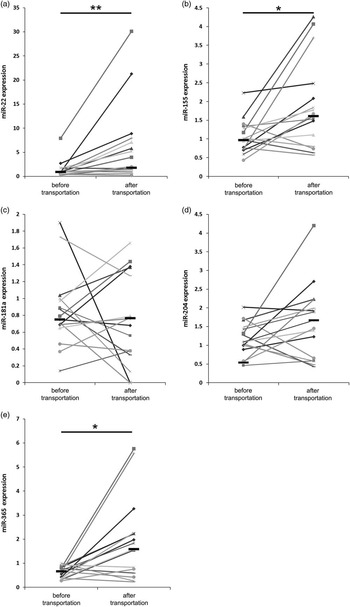
The comparative analysis demonstrated that three circulating miRNA, namely miR-22, miR-155 and miR-365, were differentially expressed in serum samples collected after road transportation if compared with those collected before transportation from the same animal. In detail, the levels of miR-22, miR-155 and miR-365 were significantly higher after road transportation (all P⩽0.05) (Figure 1).
Circulating stress-related miRNA levels of individual turkeys. Serum samples were collected from sixteen turkeys before and after road-transportation and were analyzed for the presence of stress-related miRNA. Levels of (a) miR-22, (b) miR-155, (c) miR-181a, (d) miR-204 and (e) miR-365. The black lines mark the medians. *P<0.05; **P<0.01.

The median expression levels of miR-22, miR-155 and miR-365 were 0.90 (range: 0.22 to 7.90), 0.97 (range: 0.43 to 2.23) and 0.66 (range: 0.27 to 1) before transportation, and 1.81 (range: 0.19 to 30.13), 1.61 (range: 0.57 to 4.07) and 1.59 (range: 0.23 to 5.76) after transportation, respectively.
Diagnostic performance of miR-22, miR-155 and miR-365
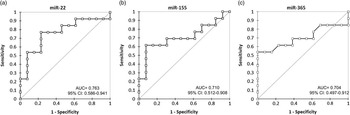
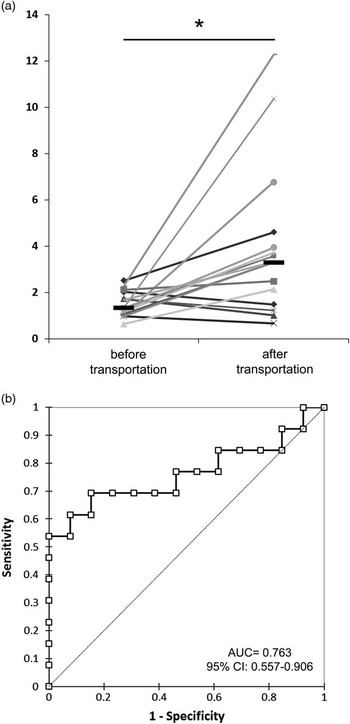
In the second part of the study we explored the potential use of the three miRNA that were found to be differentially regulated as biomarker predictors of transport-related stress. ROC analysis was used to estimate the diagnostic value of miR-22, miR-155 and miR-365 alone, or in combination. The ROC analysis was carried out by plotting the true positive (sensitivity) v. false positive (1-specificity). Cut-off points were set in order to maximize the sum of sensitivity and specificity; the cut off points for miR-22, miR-155 and miR-365 were 1.31, 1.48 and 1.59, respectively. The diagnostic accuracy of miR-22, miR-155 and miR-365, as measured by the AUC, was 0.763 (95% CI 0.586 to 0.941), 0.710 (95% CI 0.512 to 0.908) and 0.704 (95% CI 0.497 to 0.912), respectively (Figure 2). Further statistical analysis was performed considering the weighted average relative quantification values of the three stressed-related miRNA (Figure 3a). The median expression levels were 1.02 (range: 0.62 to 1.38) and 1.97 (range: 1.73 to 6.26) before and after transportation, respectively. The predicted probability of being discriminated as stressed-animals from the logit model based on the three miRNA [logit=(0.065×expression level of miR-22)+(0.562×expression level of miR-155)+(1.395×expression level of miR-365)] was used to construct a ROC curve (Figure 3b). The AUC for the combined miRNA was 0.763 (95% CI 0.557 to 0.906).
Receiver-operator characteristics (ROC) curve analysis of candidate stress-related miRNA. ROC plots for (a) miR-22, (b) miR-155 and (c) miR-365 were used to differentiate stressed from not-stressed animals. AUC=area under the curve; CI=confidence interval.

The average expression of the three candidate stress-related miRNA. (a) The weighted average relative quantification (RQ) values of the three candidate stress-related miRNA of individual turkeys. (b) Receiver operating characteris (ROC) curve analysis was constructed using the logit model. The black lines mark the medians. *P<0.05. AUC=area under the curve; CI=confidence interval.

Discussion
Accurate determination of stress in poultry, and farm animals in general, is critical, since it is often difficult to measure quantitatively stress-related parameters. Beside the use of behavioral scoring system, biochemical parameters have been proposed to provide a broad assessment of animal welfare including corticosteroids and acute phase proteins (Pineiro et al., Reference Pineiro, Pineiro, Carpintero, Morales, Campbell, Eckersall, Toussaint and Lampreave2007; Marchewka et al., Reference Marchewka, Watanabe, Ferrante and Estevez2013). miRNA act as regulators of gene expression during many different pathophysiological pathways, including those involved in neuropsychiatric disorders and stress (Kocerha et al., Reference Kocerha, Dwivedi and Brennand2015), moreover a recent study reported that miRNome is capable of quickly reacting to feed deprivation stress in chicken (Ahanda et al., Reference Ahanda, Zerjal, Dhorne-Pollet, Rau, Cooksey and Giuffra2014).
The hypothesis of this study was that circulating miRNA could provide a useful source of biomarkers for objective measurements of animal welfare. This hypothesis was validated by demonstrating that three miRNA were significantly upregulated during road transport in turkeys. Given their involvement in the modulation of immune response, the present results suggest that transport-related procedures may interfere with the immune status of the turkey by modifying the gene expression level of immune-related miRNA.
In particular, miR-155 is physiologically expressed at low levels in B and T cells, macrophages, dendritic cells, and progenitor/stem cell populations, and is upregulated after their activation by immune stimuli, eading to modulation of humoral and innate cell-mediated immune responses (Elton et al., Reference Elton, Selemon, Elton and Parinandi2013). MiR-22 is one of the very few ubiquitously expressed miRNAs, and is likely to be involved in buffering cellular activities that are common to the vast majority cells. Among others activities, it is involved in the hematopoiesis process, in the down regulation of IL6 and in the differentiation of Th17 cells (Liang et al., Reference Liang, Liu, Mei, Zhang, Xin, Zhang and Yang2015).
The role of miR-365 is still not well understood. MiR-365 expression has been so far associated to cancer development and its progression (Zhou et al., Reference Zhou, Liu, Ma, Cao, Peng, Guo, Zhou, Zheng, Guo, Wan, Shi, He, Lu, Jiang, Ou, Guo and Ding2013). The finding that miR-365 may be related to transport-stress confirms what has been recently reported by Ahanda et al. (Reference Ahanda, Zerjal, Dhorne-Pollet, Rau, Cooksey and Giuffra2014), who demonstrated that miR-365 family members are present in plasma and red blood, but not white blood cells, and their expression is modulated by food deprivation stress.
In conclusion, this preliminary study highlighted that transport-related procedures are capable of modifying expression of immune-related miRNA, providing for the first time a molecular link between stress and immune defenses in turkey species. In the second part of this investigation, we demonstrated by ROC analysis that the combined panel of three miRNA may be useful to discriminate between transport stressed and unstressed animals. In order to confirm the diagnostic value of these candidate miRNA, and develop a minimally invasive screening tool for assessing turkey welfare, further studies on a higher number of samples and different transport conditions are required.
Acknowledgments
This work was partially supported by grant from the Italian Ministry of Health (grant number: RC IZS VE 7/2012).