On Tuesday evening, 22 March 1904, Rabbi Isaac S. Moses of New York's congregation Ahawath Chesed-Shaar HaShomayim, joined a recently revived Society of American Cantors to honor the centennial of celebrated Viennese cantor/composer Salomon Sulzer (1804–1890). As president of the cosponsoring Central Conference of American Rabbis (CCAR), a sizeable rabbinic organization dedicated to principles of religious reform, Moses used the evening to extol Sulzer's refined bel canto voice and sophisticated choral compositions as the model of the modern cantorate. Declaring each American cantor who followed in Sulzer's footsteps a skilled “religious functionary,” Moses rhetorically promoted the cantor that evening from a paraclerical figure to a full-fledged member of the pulpit team. Then he went further, outlining a plan to give the cantor an organic home in America. The liberal rabbinic seminaries that had taken root in the United States since 1875, Moses claimed, had produced an overabundance of rabbis, risking a surfeit of intellectualism for American congregations.Footnote 1 In response, and mirroring an earlier call from Society for American Cantors president Solomon Rappaport, Moses announced support for a “school for cantors where young men of musical ability shall be trained in every branch that is requisite for a modern cantor.”Footnote 2 The co-officiation of a liberal-minded rabbi and a Sulzerian cantor, Moses believed, would provide American pulpits with a complete religious complement, establish a high standard for the country's Jewish future, and most importantly, “rekindle the slumbering spark of devotion in the soul of the modern Jew.”Footnote 3
Moses's address tapped into a zeitgeist of institutionalization among liberal American Jewish groups, who sought a normative process for producing and maintaining the country's spiritual leaders during a time of great demographic and cultural change. The Union of American Hebrew Congregations (UAHC, founded 1873), a confederation of liberal–leaning, predominantly German–Jewish synagogues that allied with the CCAR and its Cincinnati-based seminary, Hebrew Union College (HUC, founded 1875), had developed its own liturgy (the 1892/1894/1895 Union Prayer Book and 1897 Union Hymnal). Ongoing, large-scale immigration of Jews from Eastern Europe had led more conservative Jewish alternatives to emerge in New York, including the Jewish Theological Seminary (1886; representing what was later known as Conservative Judaism) and the Orthodox Union (1897/8; representing Modern Orthodox Judaism). The Sulzer gathering attempted to assert some control over these developments by establishing the cantorate as a viable career choice and giving liberal Jewish leaders license to engineer the figure to their own specifications. Sulzer thus became a symbol for distinguishing desirable forms of cantorial art from perceived threats of cheap imitation in order to find a meaningful balance for the spiritual and intellectual needs of American liberal Jews.
The Sulzer event provided insight into the range of options available for cantorial training among liberal Jews of the time. At the center of the discussion lay the question of the cantor's role and symbolic mission in Jewish life: Did the cantor hold his greatest obligations to the musical legacy of the Jewish people or to the contemporary communities he served? How should the cantor sound? What did the cantor need to know to do his job well? And what title should the figure take? No single answer dominated. A similar meeting of cantors in Berlin the following year treated prominent figures such as Sulzer, Samuel Naumbourg (Paris, 1817–1880), Louis Lewandowski (Berlin, 1821–1894), and their ilk mainly as big-city exceptions to the cantor's more common role as a service reader, teacher, and slaughterer, often educated through a mandated series of state-supported teacher training schools.Footnote 4 By contrast, in the expanding American Jewish marketplace, congregations gained prominence based on the size and refinement of their membership, their public visibility in the nation's spiritual marketplace, and their civic engagement. For these American congregations, Sulzer and company represented a paradigm of high culture—an important musical counterpart to a cultivated rabbinic leader—supported by devoting a new stream of resources to the infrastructure of public worship.
These discussions have largely been lost to history, buried by the later predominance of Eastern Europe as a primary source of Jewish aesthetics, coupled with a 1940s paradigm of American cantorial training promoted by émigré scholar Eric Werner. Werner, who led the drive to open the Hebrew Union College School of Sacred Music in 1948, saw the cantorial school as a means to preserve “traditional” Eastern European cantorial culture after the Holocaust's decimation of European Jewry, and consequently described institutionalized versions of cantorial training as both modern and unprecedented.Footnote 5 Newly available digital resources, however, now allow us to place these postwar efforts and their concomitant rhetoric into a deeper and more complex historical context. American-centered motivations to organize and train a class of people who could call themselves Jewish cantors in fact date to at least the mid-nineteenth century, with organizers regularly attempting to imbue the figure of the cantor with a consistent character and professional lifecycle. Training during these decades became a goal on both sides of the Atlantic. Salomon Sulzer's call for a cantorial school at the 1869 international rabbinical synod in Leipzig resonated in the United States for decades afterward, even as the intellectual landscape of the cantorate became more crowded and complicated.Footnote 6 Yet why, how, and even what kind of figure to train proved somewhat less clear. Students and admirers of Sulzer in the United States offered one vision by the start of the twentieth century, but that vision shifted as new waves of Eastern European Jewish immigrants brought their own contributions to musical instruction, religious depth, and intellectual rigor in the early twentieth century. Each attempt at establishing a school for cantors, then, ultimately aimed to inscribe in the figure of the cantor an inheritor of a valued musical tradition that deserved, as a profession, its own respect.
I focus in this essay on the first third of the twentieth century, a period of dramatic change in American Jewish culture and demographics that transformed the American Jewish population from a central European–dominated group of ca. 250,000 in 1880 to an eastern European–dominated population of ca. 4.8 million by 1940. During these decades, cantors of all backgrounds embarked on near constant efforts to set up American schools for Jewish cantorial training, spurred by international conversations about the cantor's role as an increasingly music-centered and autonomous “modern” figure.
In many ways this conversation, which paralleled similar conversations taking place throughout Europe, laid the groundwork for the emergence of American cantorial schools after World War II. Yet the later minimization of these efforts speaks to broader issues about music's role in the context of immigrant history. Philip Bohlman describes such history as distinct from grander narratives of the United States, representing “musics of Americans without larger histories of their own . . . bounded by the components of the ‘immigrant experience,’ whose pastness music preserves as long as it can.”Footnote 7 Indeed, the emerging study of Judaism as its own scientific entity at the time (Wissenschaft des Judenthums) gave additional scholarly heft to longstanding cultural portrayals of cantors as an embodiment of Jewish history.Footnote 8 Thus cantors could symbolize the internal “pull” of tradition against forces of assimilation while evincing a kind of orientalism that inspired American music scholars such as Daniel Gregory Mason to decry Jews’ undesirable influence in American art music.Footnote 9 Efforts to establish cantorial schools aimed to ameliorate this precarious balance by entraining the cantor to embody claims of “traditional” (i.e., orally transmitted) European–Jewish derivation while appealing to systematic, conservatory-style modes of artistic legitimacy. Yet that same focus often intentionally underplayed a more complicated and multilayered story of Jewish immigrant adaptation in America.
The most prominent of these efforts included the aforementioned 1904 service and the announcements by Isaac Moses and Solomon Rappaport; the short-lived Cantorial Seminary of America led by Abraham Minkowsky from 1911 to ca. 1913; a promising yet failed effort to create a cantorial school in 1923–24, led by Abraham's brother, celebrated Odessa cantor/scholar Pinchas Minkowsky; and smaller cantorial schools established by Jacob Schwartz between ca. 1915 and 1940 and Asher Chassin in the 1930s (see Table 1). The first three of these initiatives had institutional backing, emerging from the Society of American Cantors (a group that changed its name several times, as I will describe) in an effort to give the cantorial career path greater security overall. With the backing of its membership, the Society featured gala concerts to garner publicity and raise funds. The other two schools offered different models: Schwartz's, representing an individual instructor, respected among his cantor peers, with loose organizational ties to a liberal Jewish seminary; and Chassin's, established as part of an envisioned autonomous cantorial ecosystem with significant media outreach. Seen in their time, these efforts at systematizing cantorial education point to more fundamental questions about redefining the cantor—who had been assigned many roles up until that point—with arguments that promoted music as a mode of philosophical discourse complementing Jewish exegetical traditions.
Cantorial schools in the United States, 1904–1940.

Although details about these schools remain relatively sparse, the fragmentary information available offers clues to the ways that this process took place amid the changing norms and demographics of American Jewish life. Viewed as a continuous chronicle rather than isolated incidents, these largely overlooked efforts at weaving a fundamental musical narrative into the synagogue pulpit suggest a more robust musical relationship between Europe and the United States than previously characterized, with the cantorial figure developing as a product of this interaction. In concert with recent scholarly efforts to characterize transatlantic musical interactions as “crosscurrents” rather than as one-sided developments based on assumptions of (often European) cultural hierarchy, this case study extends such ideas to the distinctive topographies of religio-ethnic microhistories.Footnote 10 The Jewish cantor figure, which often relies on similar narratives of European musical authenticity, provides a case in point: while built upon a Middle East-to-Europe-to-America historical trajectory needed to affirm communal perceptions of longevity and authority, evidence suggests that the position only became ensconced in Jewish culture during the transatlantic professionalization movements of the twentieth century.
The narrative I present here benefits in large part from recent projects to digitize American and European Jewish newspapers, combined with hand-made indices of Die Deborah (Cincinnati, 1855–1902) and The American Hebrew (New York, founded 1879) available in the reading room of the American Jewish Archives in Cincinnati. These searchable resources have given the previously underexposed Jewish musical scene of nineteenth and early twentieth century America a much greater level of detail, now discernable through skilled delving and synthesis. While some resources, such as ProQuest's American Jewish Periodicals database, remain rare and prohibitively expensive at this writing, other newspaper databases such as Fulton History and the Pittsburgh Jewish Newspaper Project have been made freely available as local community/university projects, and more continue to come online. Compiling and triangulating these sources serves as a core of the research for this essay, and the basis for corroborative research in more conventional sources such as books, archives, and microforms.
Jews, Music, and the United States before 1904
The emergence of the music-focused cantorial figure in the United States dates to the mid-nineteenth century, when a sizeable migration of central European Jews effectively quintupled the American Jewish population (from ca. 50,000 in 1848 to ca. 250,000 in 1880). They established a new wave of synagogues, many of which aimed to reform prayer aesthetics to include enforced orderly worship, mixed choirs, organs, and group recitation. Synagogues founded during this time developed a new, more formal role for the prayer leader, hiring people who could lead services under the interchangeable title of Chazan/Chasan or Cantor. (Practitioners themselves began to assert political distinctions between the terms starting in the 1860s, with the term “Cantor” increasingly denoting a liberal mindset.)Footnote 11 This figure, usually reelected from year to year, also often ran a school for children and occasionally served as a synagogue's bill collector.Footnote 12
As American congregations grew in size and prominence, they attracted European-trained rabbis more effectively, installing them as theological leaders alongside the chasanim (pl.)—often at a much greater salary. By the 1860s, several models had emerged: some congregations invested in a choir, hiring a choir director to lead the music in collaboration with the rabbi and the chasan. Some turned the chasan position into a kind of musical assistant rabbi, who used his office to emphasize congregational participation as a form of theological progress. (G. M. Cohen's 1864 publication The Sacred Harp of Judah, for example, promoted group singing in both home and sanctuary.)Footnote 13 The model that eventually came to define the public image of the cantor, however, emerged through students of Salomon Sulzer in the United States—especially Alois Kaiser in Baltimore (active 1866–1908), Samuel Welsch in New York (1865–1880), and Morris Goldstein in New York (1868–1880) and Cincinnati (1881–1906). These figures’ vocal skill, long pulpit tenures, prominent rabbinic partners, and public personae as musical authorities distinguished them among religious leaders as desirable figures in the drive to introduce liturgical rituals that addressed the perceived needs of American–Jewish populations.
Even in the 1860s, attempts at establishing training courses for cantors in the United States took different approaches depending on motivation, creating new models in a land that lacked Europe's somewhat stricter regulations. For Sulzer-trained cantor Samuel Welsch, who assumed the pulpit of Manhattan's Ahawath Chesed congregation in 1865, musical competence became the gateway for cantorial instruction. Shortly after his arrival from Prague, Welsch teamed up with his congregation's (non-Jewish) organist, Charles Korzeles, to start a “Music Institute” modeled on European conservatories but tailored to busy schedules and low incomes. They distinguished their institute by offering to train cantors as well (on full scholarship), under the justification that Welsch “himself is a proficient, trained cantor.”Footnote 14 When placed within a rabbinical seminary environment, however, the cantor held a more workman-like role. An 1867 prospectus for Maimonides College, a Philadelphia rabbinical seminary whose planned faculty included prominent Philadelphia rabbis Isaac Leeser, Sabato Morais, and Marcus Jastrow, added after a detailed description of ministerial training: “Competent instructors in Chazanuth [liturgical singing] and Shechitah [kosher slaughter] will be provided for those desiring to become Chazanim.”Footnote 15 The brief reference acknowledged the cantor's importance in Jewish communal life, albeit with a rather lesser intellectual role. Although at least one cantor/slaughterer enrolled during the College's brief existence, that individual appears to have done so to gain rabbinic or ministerial credentials; and in subsequent reports (often tied to financial difficulties) the cantorial goals of the College disappeared.Footnote 16
With the subsequent establishment of the Union of American Hebrew Congregations (1873) and its intellectual center Hebrew Union College in Cincinnati (1875), a devoted core of music-focused cantors sought to redefine the cantor as a musical equal alongside the rabbi. Rabbinic leaders such as Isaac Mayer Wise thought highly of music's ability to inspire congregations to aesthetic and spiritual heights and looked to cantors as vessels of liberal Jewish identity.Footnote 17 Especially those rabbis looking to promote new liturgies through the second third of the nineteenth century, such as Wise (Cincinnati), Adolph Huebsch (New York), David Einhorn (Baltimore/Philadelphia/New York), and Benjamin Szold (Baltimore), realized the power of cantors to project the depth, coherence, and prestige of their prayer books in front of a congregation.Footnote 18 After founding the Central Conference of American Rabbis in 1889, Wise encouraged Kaiser and others to help the group create a new American liturgy.Footnote 19 Kaiser and his colleagues responded by creating the Society of American Cantors, a body that seemed to parallel the CCAR and initially saw its charge as providing music for the group's new Union Prayer Book.
The early optimism of this relationship, however, soon began to fray. The CCAR's fraught rollout of its prayer book—published in 1892, recalled, and then republished in a significantly revised edition in 1894–95—forced the Society to scramble to compile a stopgap, mimeographed musical resource for congregations to use during the October 1894 High Holidays (see Example 1).Footnote 20 And although the CCAR lauded the Society's work and renewed its request for a full musical complement to its new texts, the episode nonetheless confirmed to some cantors music's secondary role in the liturgical hierarchy.Footnote 21 Once the completed Union Hymnal saw publication in 1897, moreover, new problems began to emerge. The Hymnal’s emphasis on orderly group singing had already started to give way to a new sound of Jewish synagogue singers arriving from Eastern Europe. Broad interest in these new immigrant singers’ heroic-style voices, wider ranges, broader timbral usage (including shifts into upper range falsetto), improvisatory bravura passages, exotic-sounding modes, exotic appearance, and stories of innate talent, thrilled congregants and concert audiences alike, while appearing to lower the value of veteran American cantors and their musical education (see Example 2).Footnote 22 Predictably, the hymnal failed to catch on as had been hoped. Given the other ambitions of the UAHC, it appeared that many rabbis came to view music as subsidiary to their own theological goals despite a continued, well-intentioned rhetoric of clerical partnership with the cantorate.
German-style liturgical music. Theodore Guinsburg, “The Lord Reigneth” [opening measures] for choir and organ. In Anthems, Hymns, and Responses for the Union Prayer Book (New York: n.p., 1894).

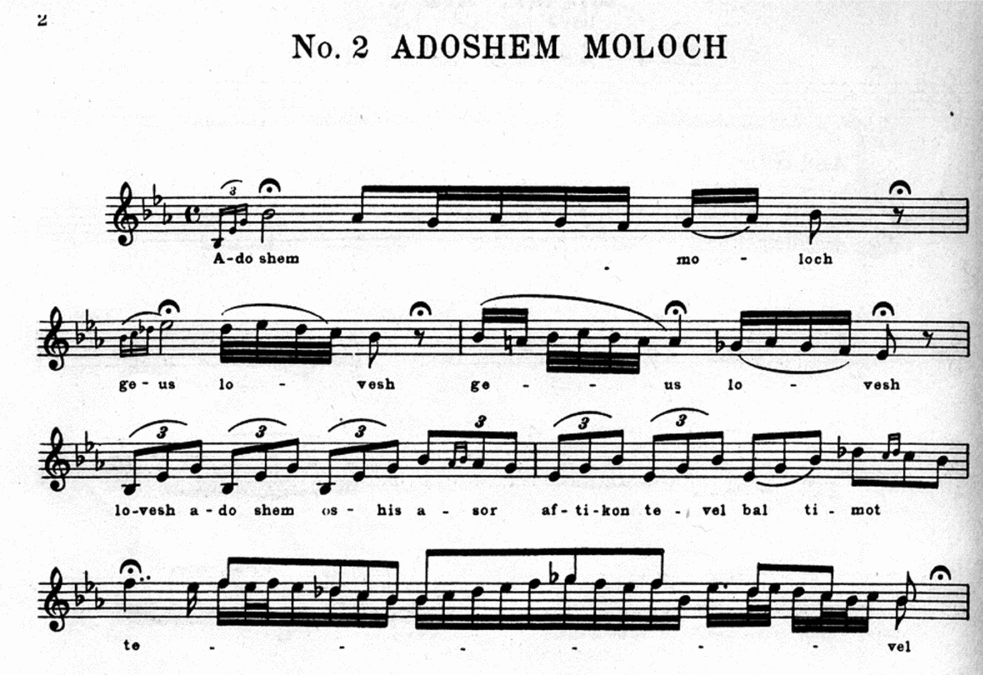
Eastern European–style cantorial music. Yossele Rosenblatt, “Adoshem Moloch” (Hebrew equivalent of “The Lord Reigneth”). Recitative transcription (beginning). In Josef Rosenblatt, Tefiloth Yosef: Selected Recitatives (New York: Metro Music, 1927), 2.

In Sulzer's Image: The Cantors Seminary of America
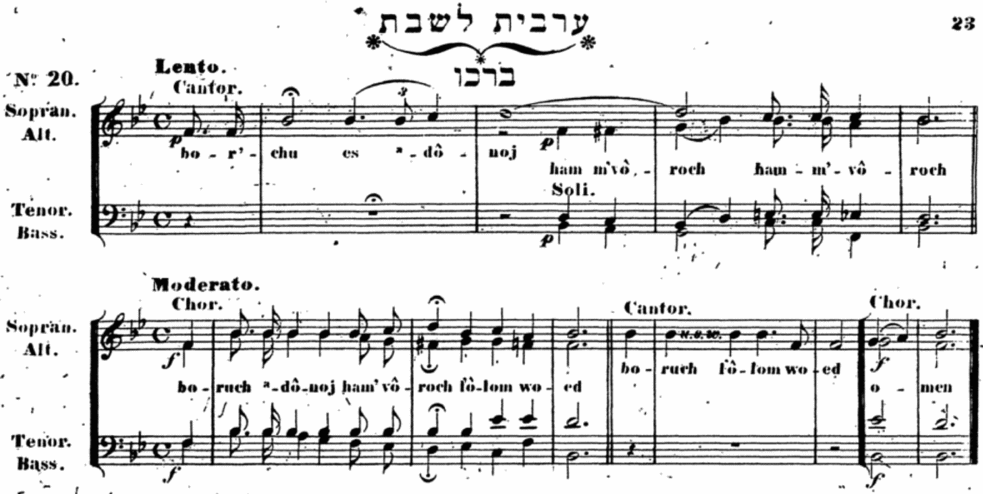
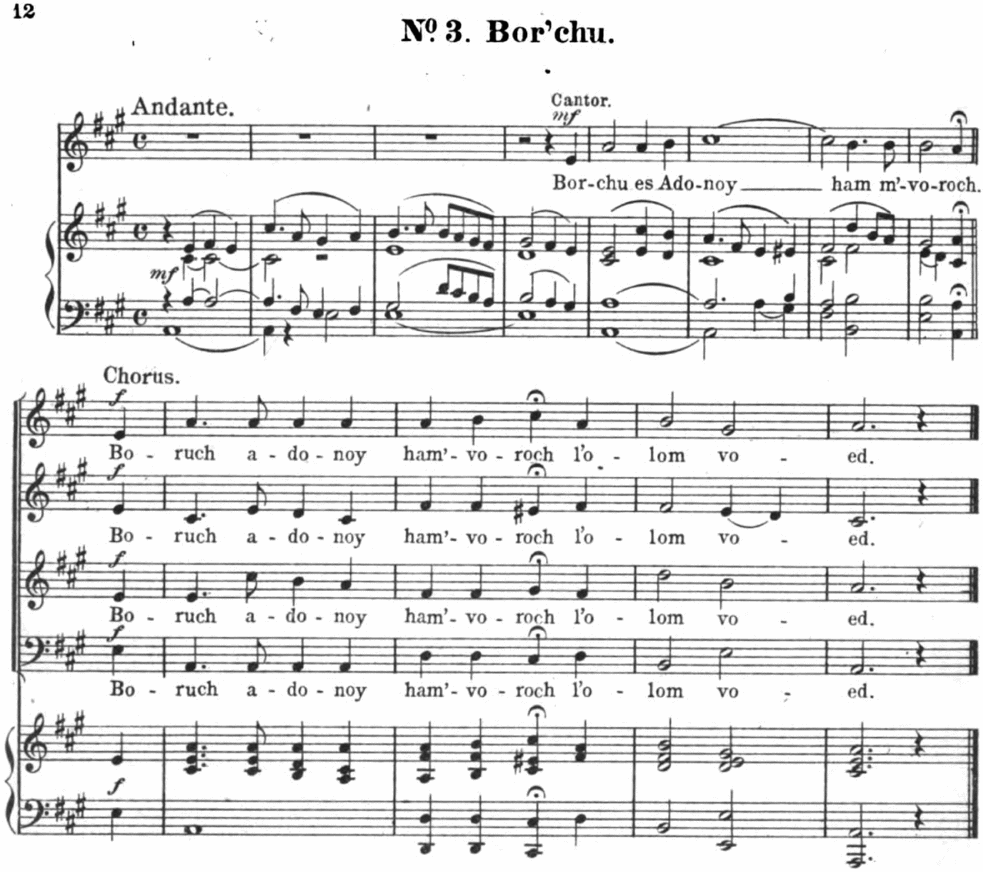
Cantors sought to defend against their own devaluation. In May 1903, the Society of American Cantors repurposed itself by creating a New York branch and then made plans to mark the centennial of Salomon Sulzer's birth the next year as a rallying point. Working with the Central Conference of American Rabbis, they arranged for a gala concert and national campaign to honor Sulzer, in the process canonizing his music for a new generation.Footnote 23 CCAR leadership asked its members across the country to deliver sermons on “the life and influence of Sulzer” on the final Sabbath in March 1904 (March 25–26) and provided Society president Solomon [sic] Rappaport's published pamphlet on Sulzer's life as assistance.Footnote 24 The gala concert on 22 March 1904, the Society's eleventh gathering, was recast as the “First Annual Meeting” to emphasize the organization's reinvigorated purpose.Footnote 25 Published arrangements of the evening's music, adapted from the original settings for unaccompanied male choir into a mixed choir-and-organ format, offered an additional avenue for liberal American Jewish congregations to incorporate Sulzer's work into their active Friday night repertoires (see Examples 3a–b).Footnote 26
Salomon Sulzer, “Barechu” (call to prayer) for the Friday night service.

Salomon Sulzer, “Barechu” (call to prayer) for the Friday night service.

Cantors attempted to redefine their role on the scholarly front as well, as seen in The Jewish Encyclopedia (published in New York between 1901 and 1906), the premier compendium of German–Jewish scholarship.Footnote 27 The Encyclopedia’s editors directed readers seeking the term “Cantor” (and “Chazan”) in Volume III (1902, pp. 550, 684) to a two-part “Hazzan” article in Volume VI (1904, pp. 284–87). The first half of that article, written by staff writer Rabbi/Doctor Max Schloessinger, presented an intricate linguistic history of the term “Hazzan” in Jewish rabbinic texts, ending in the early modern period with section headings entitled “Complaints Against Hazzanim” and “Their Vanity” that placed the Hazzan in a negative light. The second section, written by Society for American Cantors founder Alois Kaiser, sought to reverse this trajectory. Beginning with the heading “In Modern Times” and explicitly changing both tone and vocabulary to conform to the Society's new image, Kaiser averred that “the hazzan gave way to the cantor, and the ‘meshorerim’ [boy singers] were supplanted by a male, or mixed, choir.” He carefully maintained the use of the term “cantor” throughout his account of Sulzer and his cohort, while describing them as “practical hazzanim” in the final sentence, in a carefully filtered rejoinder to Schloessinger's narrative. This distinction between the archaic “hazzan” and the modern “cantor,” with the mid-nineteenth century serving as a point of demarcation, held similarly in Kaiser's eight other articles for the Encyclopedia, emphasizing both the cantor's new role in the contemporary synagogue and the logical leap from German philology to American practicality that such a transformation required in Kaiser's eyes.Footnote 28
Six weeks before the Sulzer centennial concert, current Society President Rappaport published an article in the American Hebrew entitled “Establishment of a School for Cantors.” This article rehearsed a standard harangue against “impostor” cantors as pleasant singers who “could perhaps find a more congenial and a better remunerative position on the concert stage, or in opera.”Footnote 29 Citing them as minimally knowledgeable in both music and Hebrew, he also identified three categories of differentiation for which a school could be helpful: “Jewish knowledge, religious inspiration, and the required training in Chazanuth [the art/skill of cantorial chanting].”Footnote 30 Sulzer's ministry served as a model here—“the path upon which we are to walk”—in order to “put an end to this regrettable state of affairs.” Rappaport placed the most significant benefit of cantorial education squarely on the laity, which “will come to a full realization that the profession of cantor is not a handicraft; a sort of phonographic machine, or a Kunstueck [Kunststück] (a work of art) himself, but that he is a means toward serving an ideal art; they will learn to understand that the Chasan is the interpreter of their hearts’ highest and noblest emotions, vitalizing the religious sentiment, inspiring and intensifying the call of conscience and arousing a genuine desire for a better life.”Footnote 31 Creating cantors in Sulzer's image, argued Rappaport, could resuscitate the very act of prayer as a divine communal striving: facilitated by the cantor, linking to the “submissive” quality of the ancient Orient (Rappaport cited Jewish Theological Seminary president Solomon Schechter here), and justified to the modern world through a common language of music scholarship.
Although these rhetorically significant efforts left a clear written record, they failed to facilitate the desired school. Some kind of training program in Jewish music remained a goal for American Jewish religious leaders, however, likely those who believed in the cantor's ability to create a unique musical bond between Jews and prayer that could reinforce a unified narrative among America's disparate Jewish populations, thereby ameliorating divisions. The following year, Mathilde Schechter (wife of Solomon Schechter), attempted a different approach when she founded the “Choral Society for Ancient Hebrew Melodies.”Footnote 32 In the spirit of amateur German singing societies (Singvereine), this one—populated by faculty from the Jewish Theological Seminary, with rehearsals held up the street at the 92nd Street Y—aimed to educate Jews to recognize and respond to the music of their heritage as determined by the society's leadership. In 1906, with a grant from the Betty Loeb Musical Foundation, Legends of the Jews author Louis Ginzburg joined the group under the premise of researching, discovering, and publishing ancient Jewish melodies for choral performance.Footnote 33
This short-lived group also involved Henry Street Synagogue (Chaarai Zedeck) cantor Abraham Minkowsky, who had studied at the Moscow Conservatory under conductor Vasilly Safonov and officiated at Kherson's Great Choral Synagogue (in Ukraine) before a 1905 pogrom likely led him to emigrate to the United States.Footnote 34 Minkowsky worked with a choir of men and boys in his synagogue's practice, which, combined with his musical training, probably affected his ideas about the elements of a cantorial school. In December 1910, Minkowsky headed a new effort by the Society of American Cantors to establish what he called a “Cantors Seminary of America”—perhaps anticipating affiliation with the Jewish Theological Seminary of America—and announced a grand concert of the Society at Carnegie Hall on 1 March 1911 to publicize the effort. Publicity about the concert described the anticipated school's training program as three years long, during which “everything necessary for a modern cantor will be taught.” While no other information about the curriculum is known, the faculty included a position in “voice culture” (essentially vocal training) occupied by Bernhard Steinberg.Footnote 35
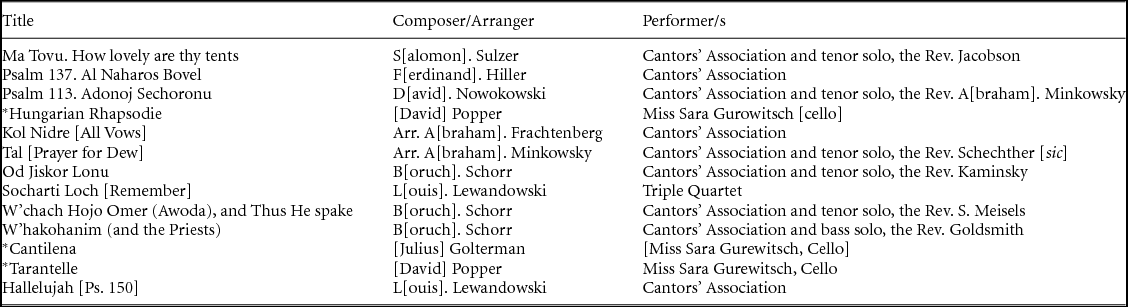
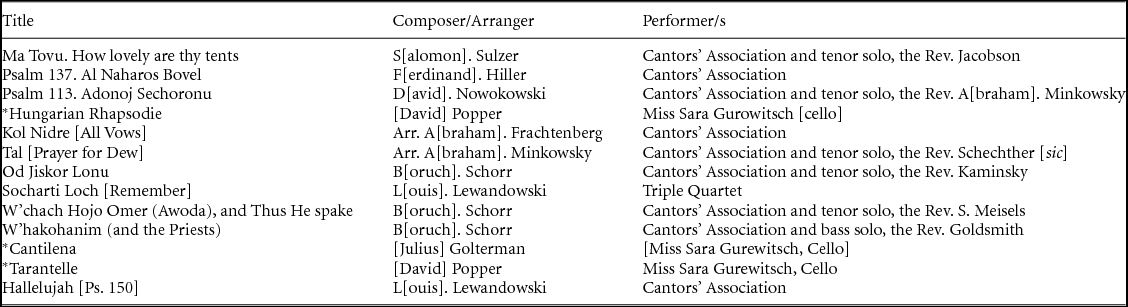
Nonetheless, the surviving program of the concert offers a self-portrait of the cantorate that may have translated to the training program (since some of the organization's leaders and soloists were also the intended instructors) (see Table 2). A well-known music director, Leon M. Kramer, who at the time led the choir at New York's Spanish-Portuguese Shearith Israel congregation, conducted the proceedings and likely accompanied the performers on piano where appropriate.Footnote 36 Beginning with Sulzer's “Mah Tovu,” the concert included Lewandowski's “Sochorti Loch” and ended with his popular Psalm 150 (“Hallelujah”). More interesting was the inclusion of selections by eastern European–centered composers. Boruch Schorr (1823–1904), who had three selections performed in the concert, officiated at the Great Synagogue of Lemberg, interrupted only by five years in New York; his son Israel Schorr, cantor at Brooklyn's Beth Israel congregation, published his father's music in 1906 as Neginoth Baruch Schorr (Baruch Schorr's Religious Music).Footnote 37 David Nowakowsky's (1848–1921) setting of Psalm 115, “Adonoj Sechoronu,” presented another example: the composer likely came to the Society's attention through Abraham Minkowsky's brother, Pinchas, who championed Nowakowsky's music at the Brody Shul in the thriving intellectual center of Odessa; and Abraham, notably, sang the solo at the concert.Footnote 38 A setting of Psalm 137 by German composer Ferdinand Hiller (1811–1885)Footnote 39 complemented choral arrangements of Kol Nidre (All Vows) and Tal (prayer for dew) by Society members Abraham Frachtenberg (1861–1927), and Abraham Minkowsky, respectively.Footnote 40 Popular interludes by composer/cellists David Popper and Julius Golterman, performed by Russian–born cellist Sara Gurowitsch, rounded out the concert.Footnote 41 This collection of works indicated a continued association with the Sulzer/Lewandowski trajectory and (through the cello pieces) an appeal to contemporary art music, but the lineup also emphasized the ethnic sounds of more recent composers and cantors, who had by this time become markers of both exoticism and authenticity in Jewish religious music.
Program for a concert by the Society for American Cantors to publicize the effort to create a “Cantors Seminary of America,” 1 March 1911. New York Tribune, 26 February 1911, C3. *=Non-liturgical selection.
Eight months after the concert, the Cantors Seminary of America received a five-year charter from the New York Board of Education and opened officially on 11 November, devoting itself to “the training and education of young men to qualify them to assume [the] position of cantor in Orthodox and Reformed American congregations.”Footnote 42 Contemporary references to the school suggest an unstable existence. The 1912 American Jewish Year Book placed it at 123 Second Avenue (between Seventh and Eighth Streets), while the 1912 Jewish Communal Directory listed the school in conjunction with the Cantors Association of America at 40 W. 115th Street (near Lenox Avenue).Footnote 43 Ultimately, the school could not sustain itself and it disappeared with little notice. In 1917, the Society's president, Cantor Nathan Abramson, looked back on the Seminary's brief existence and noted, “The aim was to supply the needs of American Jews by training young men for the profession, instead of relying, exclusively, on the ‘finished product’ coming hither from the old world . . . But the curse that has blighted many a worthy undertaking in this community, soon overtook this one also. The seminary was closed for a lack of funds.” Abramson once again placed responsibility squarely on the Jewish community: “A cantors’ seminary is in reality the business of the community, surely much more so than the business of the cantors themselves.”Footnote 44 By including this failure in a list of current antagonisms to the cantorial profession (including the presence of “congregational politicians,” a lack of job security, and the refusal of many synagogues to pay cantors for trial visits), he framed the issue as a moral reckoning for so-called enlightened communities, rather than restating standard arguments about musical training and quality.
In the following decade, several scholars, including Jacob Singer and A. W. Binder in the United States, Abraham Z. Idelsohn in Palestine, and Pinchas Minkowsky in Odessa, all vied to give Jewish music a meaningful intellectual foundation. Singer, addressing the CCAR in 1913, again recalled Sulzer's 1869 recommendation for a cantorial school as part of a history of Jewish Music, and updated it for current needs: “The resolution of Sulzer . . . is not devoid of suggestiveness for us. We would do well to encourage the cantors in developing the theoretical as well as the practical side of their calling. Since most of our communities are not favored by the services of a cantor, our needs will have to be supplied in some other way, but the progress of our cantors will be of benefit to us all.”Footnote 45 Jewish music scholar and Yiddish folk song advocate Rabbi Morris Clark (1889–1954?), writing in the prominent journal Musical America in April 1916, viewed the traditions and progression of cantorial repertoire differently. He acknowledged Sulzer, Lewandowski, and Weintraub as preservers of “traditional airs,” but he also praised Ukrainian-born Cantor Zaidel Rovner (Jacob Samuel Maragovsky, 1856–1943) for going one step beyond by creating “new melodies,” presumably out of respect for the improvisations on traditional chant he heard at Rovner's only American concert (in Carnegie Hall) the previous week.Footnote 46 The following year, Clark continued this line of concern by attributing what he saw as the cantor's decreased relevance and inability to innovate to the shrinking resources available: consequently lamenting that Jewish music as a whole was “not regarded as an art, but merely as an auxiliary to ecclesiasticism.”Footnote 47 A renewed effort in 1918 by a consortium called the United Hebrew Choral Societies aimed to link cantors with an “academic center” at New York's Hebrew Teachers College.Footnote 48 Soon thereafter, cantors themselves, recognizing the difficulties of the profession, began to prioritize a relief fund and retirement home for their struggling and aging members.Footnote 49
In Minkowsky's Image: The Paradigm Shifts Eastward
At the end of 1922, the cantors’ Society again renewed its efforts, rebranding itself “The Jewish Ministers and Cantors’ Association of America,” reframing “the art of cantorship” as the process of preserving traditional/ancient “Hebrew” melody, and reasserting the importance of traditional musical style in worship.Footnote 50 Abraham Z. Idelsohn, recently arrived in New York and serving as cantor of the Society for the Advancement of Judaism, continued to advocate for a documentary approach to “Oriental” (i.e., non-European) Jewish communities as the basis for a reinvigorated repertoire.Footnote 51 American cantors, however, found a more agreeable figure to serve their cause and their profession in Odessa's Pinchas Minkowsky (1859–1924).Footnote 52
Considered one of the era's great practitioners of hazanut, Minkowsky positioned himself alongside other intellectuals of the day as a champion of Jewish “ethnic” song that had emerged from an idealized Eastern Europe and the Middle East but became compromised and corrupted in the reforming developments of mid-nineteenth century central Europe. His erudite writings—mostly in Hebrew and Yiddish—solidified his authority as a practitioner and scholar on both sides of the Atlantic. Through them, he brought “Jewish song” into dialogue with prevailing perspectives in mainstream musicology, and his fluency with contemporary modal theory allowed him to present a detailed history (and, in his view, future) of the cantor's art.Footnote 53 The United States provided an important stage in this development: from 1887 to 1892 he lived in Manhattan, serving as cantor of prominent congregation Adath Jeshurun (which had just moved into to a new building on Eldridge Street) and teaching for at least part of this time as a “Preceptor in hazzanut” at the Jewish Theological Seminary.Footnote 54 He subsequently left for Odessa's prominent Brody Shul, where for the next three decades he grew to considerable fame as a central musical figure in the city's thriving Jewish intellectual scene. A key promoter of Brody Shul's composer and choir director David Nowakowsky, Minkowsky also ran Odessa's HaZamir choral society, where he counted among his singers the major Zionist figures Hayyim Nachman Bialik, Saul Tchernikovsky, and Joshua Rawitsky.Footnote 55 Many of his writings from this time period consequently found publication in journals that reflected his colleagues’ Zionist beliefs, in particular describing displeasure with the perceived decadence of contemporary cosmopolitan Jewish life and the desire to build a new culture that rang truer to his vision of history. Amid his calls to return to older melodies, Minkowsky denigrated “modern” hazanut as pale imitation of the original Jewish melody. His 1907 entry on Hazzanut in the American Hebrew-language encyclopedia Ozar Yisrael encapsulated his position: after highlighting historical periods of hazanut based on Greek and Arab melodic influences (illustrated with scalar diagrams), Minkowsky criticized the modern period as having broken from tradition in the pursuit of Christian beauty, leading to a bastardized “imitation of Ashkenazi song.”Footnote 56 He reinforced this position in a 1911 article celebrating the (re)opening of a School for Cantors (“Kantorenschule”) in Vienna, describing the school as a place where the oral tradition of the Jews could receive meaningful cultivation, and regain its organic notation, instruments, and musical terms, allowing it to sit once again alongside Chinese, Arab, Christian, and other musical cultures. Critical of Hasidism and the Haskalah/Jewish enlightenment (the “[Moses] Mendelssohn school”), he focused his criticism on America, where “we need only to visit a few synagogues in New York, Chicago, etc., during the service, in order to convince ourselves of the anarchy of liturgical poetry and the frivolity of the melodies, of the concert style of the orthodox synagogues and the church style of the Reform synagogues.”Footnote 57 Such a harsh critique asserted an alternative lineage of Jewish song that rejected Central European reform in favor of a more pastoral “restoration” narrative couched further to the East.
When Minkowsky returned to the United States in August 1923, amid famine and “Bolshevist persecution” in Odessa, his arrival in Boston generated great fanfare. A number of New England–based Jewish institutions and choral societies supported him as he announced ambitious plans to create a “Jewish National Conservatory” that would include its own building, free instruction, and a department “devoted entirely to the training of cantors.”Footnote 58 Shortly thereafter the Jewish Ministers Cantors Association came on board, offering to hold a benefit concert for the institution, and the curriculum took a concrete shape.Footnote 59
Translated to American terms, Minkowsky's critique of the state of hazanut was built on the premise that American Jews relied too much on superficial and commercial urges, causing them to treat their cantors poorly and prefer flash over substance. Drawing from his own experiences in Odessa, which to him characterized European integrity, he reasserted the value of Jewish learning over vocal ability, publicly promoted the cantor as Judaism's original clergyman, and expressed the hope that an attitudinal change in this direction would at least start to improve the American cantor's lot. Minkowsky and the cantors’ association consequently envisioned a course of training that included “traditional Jewish music, theory and harmony, Jewish history, Hebrew grammar, Bible, Talmud, and English grammar and literature.”Footnote 60 The latter categories, it appears, could offer some semblance of American higher education, allowing the cantor to bring his specialized knowledge fluently to American congregations.
The gala concert, at Madison Square Garden on 3 February 1924, took shape as a complete public reenvisioning of the cantorial role. Framed as a 30th anniversary of the renewed Jewish Ministers Cantors Association, the event even attracted the attention of President Calvin Coolidge, who had to decline the Association president's invitation but praised “the excellent work the association is carrying on” nonetheless.Footnote 61 In preparation, the Association compiled a large souvenir book, ambitiously called The History of Chazanuth/Di Geschichte fun Hazanut. Along with a history of the society, biographies of most of the society's members past and present, and poems of praise modeled on Jewish liturgy, the volume included a long, scholarly article by Minkowsky that traced the cantor's presence within Jewish liturgy and history, and included a musical analysis section to substantiate the cantor's legacy. Two articles in the volume explored the cantorate in America, both of them expressing optimism that the future would lead to enlightenment among the population and improvement in the cantor's fortunes. Other articles addressed the cantor's role in Odessa and Poland, and, perhaps most telling as a sign of changing demographic influence, highlighted the success of the Jewish Conservatory in Riga established four years earlier by the St. Petersburg-based Society for Jewish Folk Music.Footnote 62 The elaborate concert program, which began with “The Star Spangled Banner” and ended with the Zionist anthem “Hatikvah,” played to a capacity house; the press reported that 3000 people had to be turned away.Footnote 63 Yet one key part of the evening was missing: Pinchas Minkowsky, the intellectual center of the school, had died suddenly two weeks earlier. His colleagues attempted to proceed with the school anyway, publicizing the call for a seminary as “Minkowsky's Final Words.”Footnote 64 But the institution that would recreate the cantor and represent a “monument” to Minkowsky's memory failed to materialize.
Toward a Professional Role in American Jewish Life
Attempts to create cantorial training schools continued apace. At the same time that the gala concert was in preparation, Jewish choral conductor Meyer Posner announced his intention to open a “Hebrew sacred music” department at New York's nonsectarian Master Institute of United Arts to combine training of “cantors, choirmasters, organists, and composers” with academic research on Jewish music.Footnote 65 In 1925 and again in 1927, a Reform-affiliated group, the Modern Cantors Association, opened a school to “teach both orthodox and reformed rituals[,] and ban professional singing.” Their model attempted to bring into dialogue two recognized musical domains for the cantor—the improvisational, modal verve of orthodoxy and the refined harmonic beauty of reform—in the hope of creating a figure who could serve the increasing number of American synagogues.Footnote 66 New York Jewish Theological Seminary chancellor Cyrus Adler reiterated his institution's intentions to expand cantorial instruction into a “Cantors School” in 1926, needing only a generous donor.Footnote 67 And the Jewish Ministers Cantors Association continued to keep a school high on its agenda, announcing a $100,000 drive to build a seminary building at its 1928 convention—and continuing to issue regular appeals for a Cantorial Seminary for at least the next decade.Footnote 68
In addition to redefining the cantorate, these initiatives helped cantors retain a public presence in an ever more complicated and competitive Jewish spiritual marketplace, where even the term “cantor/chasan” remained so fraught that many had preferred to use the more broadly accepted title of “rabbi” in newspapers and official documents.Footnote 69 In late 1927, for example, a group of orthodox rabbis calling themselves the Rabbinical Council (“Vaad HaRabanim”), publicly “urged upon Orthodox Jews that at wedding ceremonies and in the granting of divorces not cantors or ‘reverends’ but duly authorized rabbis should officiate” in order to preserve a main source of their members’ shrinking income.Footnote 70 The pronouncement led to a nationally publicized legal dispute in Boston that temporarily barred cantors from officiating at weddings.Footnote 71 While cantors’ educational standards clearly held a secondary status in the case itself, the final resolution to accept the cantor's position as a bona fide member of the clergy would continue to bolster cantors’ authority when faced with such challenges.
At least two other cantorial schools operated in New York during the 1930s. Cantor Jacob Schwartz's “Institute for [or ‘of’] Hazanuth” dated its founding to 1915, and may have appeared in part to temper the Cantors Seminary of America's closure. Schwartz assumed the position of cantor at New York's Congregation B'nai Jeshurun in 1914 (the congregation was a founding member of the Conservative Judaism-affiliated United Synagogue of America in 1913), which likely allowed his Institute to remain in regular dialogue with both the major cantorial organizations and the Jewish Theological Seminary. Focusing on a seven-part curriculum that included “Voice Culture,” “Nusah Ha-Tefillah” (“traditional chants”), “Traditional Melodies,” “Neginoth ([Scriptural] Cantillation),” “[Modern] Temple Music” (including working with an organ), “Hebrew and English Reading,” and “History of Hazanuth,” Schwartz placed most of the Institute's fourteen graduates through 1926 at recently founded Conservative synagogues.Footnote 72 A steady succession of manuscript music and occasional announcements from the Institute points to its punctuated development in the mid-1920s, including expansion to a “beautiful studio” at 216 West 100th Street in 1926.Footnote 73 In December 1930, the Institute advertised the availability of its graduates for synagogue employment; and in 1936 Schwartz published two volumes of his compositions and arrangements, with choir and organ accompaniment, as Shire Ya'akov (“The Songs of Jacob”). In October 1937, Schwartz promoted his school in the Musical Courier by “stating that there is a shortage of trained cantors in the United States, since the last convention of the Reformed [sic] Rabbis of America passed a resolution re-instating the cantorate in the synagogue”; he added ominously that “the racial ban in [Germany, Austria, and Poland, where cantorial training institutes existed] has cut off most of that supply [of cantors].” Another article, in the August 1938 issue of the Musical Courier, listed the school's thirty-one graduates (presumably since its founding) and claimed that twenty-two had secured synagogue work right after completing their studies.Footnote 74 The 1938–39 volume of Who's Who in American Jewry listed Schwartz as chairman of a “Committee to establish a Cantors Seminary”; and in 1941, still identified as the Institute director, he began his second term as President of the Jewish Ministers Cantors Association.Footnote 75 Eventually Schwartz became an instructor at the Jewish Theological Seminary's Cantors Institute after its founding in 1952.
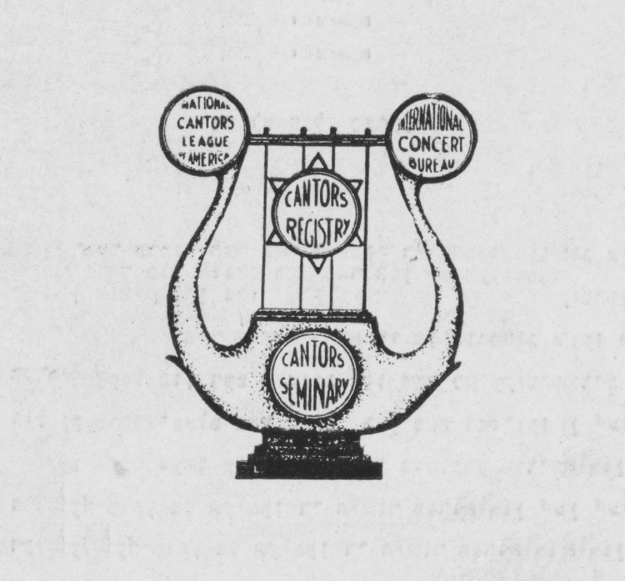
The other school, run by Asher Chassin (ca. 1879–1937), attempted to construct a wide-ranging, independent vision of the cantorial profession. A conductor, writer, producer, and self-appointed scholar of Jewish music, Chassin built on a series of cantorial concerts broadcast over the radio in 1927 and appears to have opened his school shortly thereafter, in affiliation with the National Cantors and Ministers League (a different organization).Footnote 76 A brief pamphlet published under the school's imprint in 1930, which promoted a youth-based musical curriculum (the “New Educational Music Idea”) as an antidote for a stated communal concern with American Jewish attenuation, mapped out Chassin's cantorial plans in a graphic form (Figure 1).Footnote 77 A small lyre-shaped insignia on the last page placed the “Cantors Seminary” at the base of the instrument; above, a “Cantors Registry” badge on the strings was flanked on either side by badges reading “National Cantors League of America” and a “Concert Bureau.”Footnote 78 These elements situated cantorial training as a crucial part of a thriving Jewish musical culture, in which cantors were to play a primary role.
Lyre figure representing Asher Chassin's organizational ambitions for the cantorial ecosystem. “The N[ew]. E[ducational]. M[usic]. Idea.” New York: Cantors Seminary, 1930.

The Crosscurrents of the Cantorate
Despite the best of intentions and punctuated advances, none of these institutions had the traction necessary to establish the cantorate fully as a lifecycle-based profession. Only after the obliteration of European Jewish life in the Holocaust did the right configuration of intellectual grounding, practical training, institutional buy-in, and moral obligation come about to create a durable cantorial institution that could balance the cantor-as-teacher with the cantor's more philosophically desirable calling as a longstanding vessel of Jewish song. Establishing that new narrative in American history, however, required another figure to emerge as a historical authority: the musicologist, who could appropriately bridge the intellectual divide between musical sophistication and the “disinterested” scholarship necessary for seminaries to bring the cantor officially into their portfolios.Footnote 79 Austrian émigré Eric Werner in particular used this opening to transplant an Eastern European narrative of Jewish musical development onto American soil as a spiritual basis for all cantorial singing. Stating the time-sensitive need to adopt and cultivate precious Jewish musical traditions obliterated by the Nazis, Werner recast America as a new vessel for these traditions to take root and grow, while promoting a historical narrative of cantorial training that largely omitted any previous history of cantorial schools, European or American.Footnote 80 Werner's strategy succeeded, ushering in a new era of cantorial education that included the creation of two additional movement–based cantorial schools—the Jewish Theological Seminary's Cantors Institute (Conservative; founded 1952) and Yeshiva University's Cantorial Training Institute (Modern Orthodox; founded 1954). These institutions set standards for cantorial education that conformed to their own movement-based missions, while empowering two major cantors’ organizations (the American Conference of Cantors [founded 1951, Reform-affiliated] and the Cantors Assembly [founded 1947, Conservative-affiliated]), in many ways achieving the professional lifecycle aspirations sought previously.Footnote 81 Their success, however, has long relegated the previous history of cantorial schools in America to footnotes, at best a series of scattered and disorganized events.
When placed back into their historical context, these efforts to create new cantorial schools in the first half of the twentieth century show the cantorate emerging through active dialogue in a shifting international landscape of ideas and norms. As new populations of Jews joined existing ones on American soil, the history, the aesthetics, and even the nature of synagogue music shifted to reflect the new arrivals’ practices and intellectual structures. Subsequently, so did the idea of the cantor: a vessel chosen collectively to embody a viable musical profession among Jewish clergy, curating Jewish musical heritage as part of a moral calling to the community, and ideally controlling its own cycles of renewal to ensure that music practitioners retained their value and self-respect on the American pulpit. That dialogue is instructive for understanding subsequent developments as well. The founding of additional American cantorial programs at the Academy for Jewish Religion (Yonkers, 1992; Los Angeles, 2000), Philadelphia's Gratz College (c. 1983–2010), and Hebrew College (Newton Centre, MA, 2004, revamped 2014), along with the 1984 creation of the Tel Aviv Cantorial Institute, the 1990s founding of what has been known most recently as the Institute de Jazanim Morim de Shira “Bet Asaf” at Buenos Aires’ Seminario Rabínico Latinoamericano Marshall T. Meyer, the 2007 founding of the cantorial program at Germany's Abraham Geiger College, and even the 2011 renaming of the Hebrew Union College School of Sacred Music in memory of Jewish singer/songwriter/liturgist Debbie Friedman all continued these conversations rather than starting them. With each cycle of reinvention they also remade the cantor, reshaping the figure's history and meaning while navigating a new path through Jewish heritage.
This account also offers insight into the shifting sands of American immigrant history, where the search for points of transition into America tends to map onto discourses of modernity, overlooking richer, more prolonged, and more complex explanations that characterize American “ethnic” music as a process of constant re-peopling, revision and restatement in order eventually to enter the American narrative. Looking through the extended lens of this American case study, in other words, it might be best to see the cantor as a flexible symbol of historical continuity, assembled to make sense of a fragmented past in order to maintain music's place in the emerging Judaism of a modern age.