


In 1909, Philadelphia-based advertising agency N.W. Ayer & Son crafted a campaign for Parksdale brand butter that simultaneously highlighted and denigrated the “old methods” of making butter. Although folksy images of farmwomen toiling away with butter churns capture the eye initially, a closer look at the copy on these print advertisements reveals something markedly different. With the tagline, “Old Methods Not Up to New Ways,” one ad declared that the company had transformed butter-making from an “uncertain, haphazard branch of farm industry into a scientific business” that could be characterized by a uniform product manufactured in a modern, state-of-the-art facility (fig. 1).Footnote 1 Another boasted of the product's germ-free and dust-free qualities and overall healthfulness and delicious taste. “The old-time farmstead, with its picturesque dairy maid, couldn't compete with the ‘Parksdale’ process of today,” the ad declared.Footnote 2
In juxtaposing the traditional with the modern, this 1909 advertisement for Parksdale brand butter exemplifies the seemingly paradoxical nature of food advertising during this period: new technologies and processes were venerated directly alongside pastoral imagery. Parksdale brand butter advertisement, 1909, folder 2, collection no. 59, box 27, N.W. Ayer & Son Advertising Agency Records. Courtesy Archives Center, National Museum of American History, Washington, DC.
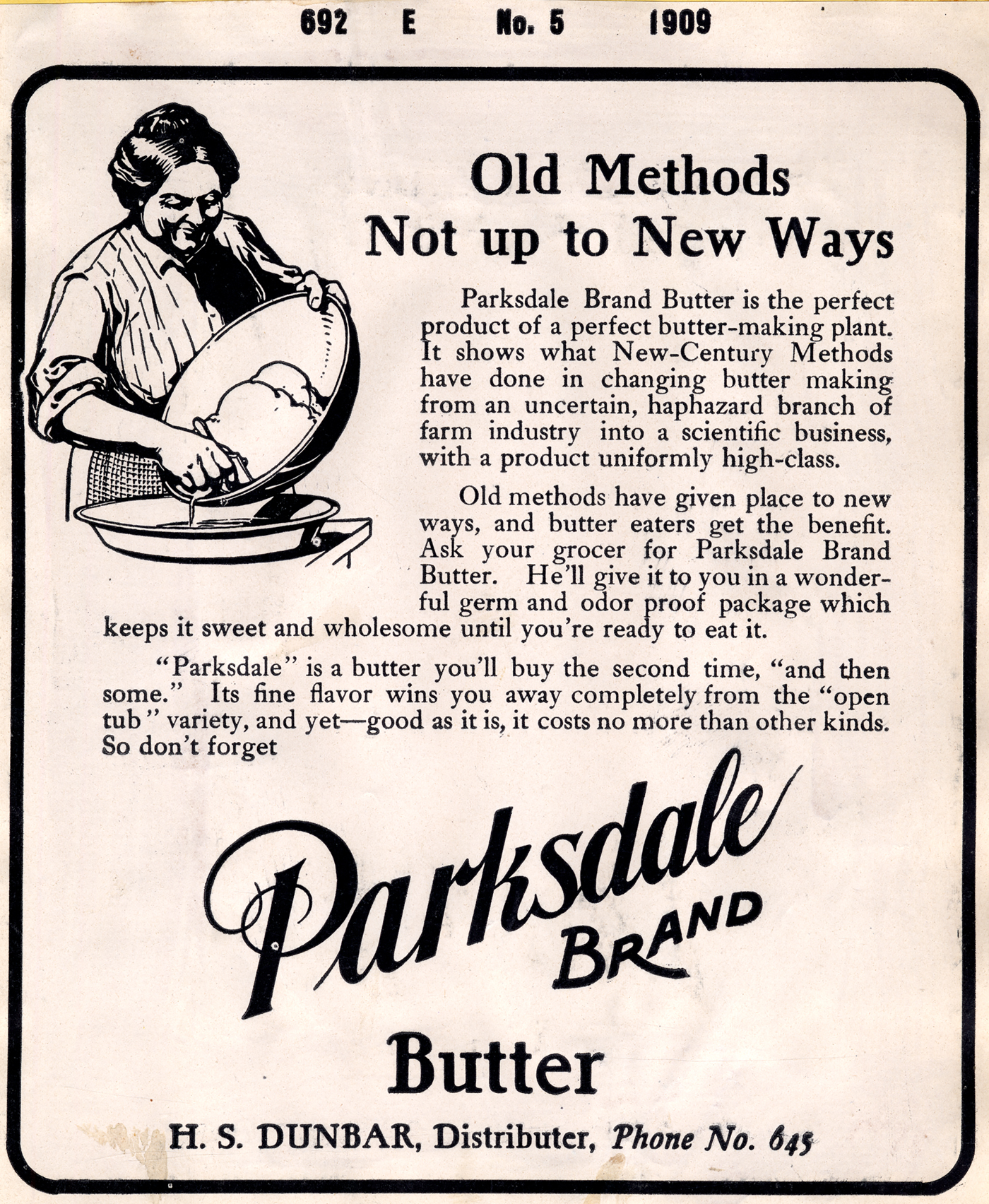
In a seemingly paradoxical manner, this ad and others like it celebrated what was new and modern—in this instance, mass-produced butter wrapped in a “patented package” to protect it from germs and odor—while remaining firmly tied to pastoral imagery and ideology. Though coupling the rural with the modern might at first seem like an odd marketing strategy, a deeper look at ads such as these reveals that this dualism made much more sense at a time when food production and consumption in the United States were particularly anxiety-ridden. By exemplifying what historian Laura Lovett has labeled “nostalgic modernism,” a phenomenon in which the era's reformers “embraced the possibility of social change” while working to build a society “in the image of an idealized past,” food advertising can help us understand how corporate interests were able to redirect conversations about food adulteration and safety in ways that connected them to reformers wary about mass-produced food products.Footnote 3 In other words, this advertisement and others like it reveal how food companies repackaged themselves not as the problem in the fight to introduce and enforce federal pure food legislation, but as part of the solution, alongside reformers whose own work depended in turn on the cooperation of business interests.
A wide-ranging grassroots campaign for federal legislation to safeguard the nation's food products had led to the 1906 passage of the Pure Food and Drug Act, but by 1909, when the Parksdale butter ad appeared, it was still unclear how this new federal legislation would be enforced, by whom, and to what degree. Although it has long been heralded by academics and cultural commentators and in the collective imagination as a landmark victory for consumer protection, food production and consumption in the United States remained deeply fraught in the immediate years after the passage of the Pure Food and Drug Act. In the absence of a clearly defined apparatus to enforce the new law and much contestation among policy-makers, business interests, and reformers, the food industry's co-option of reform ideals and rhetoric exemplifies the increasing power of big business over both public policy and mainstream cultural discourse in the United States during the early twentieth century and beyond. Though scholars have often framed the push to introduce federal food policy as a fairly linear institutional or political narrative, a cultural historical approach gives new insight into the ways that unresolved questions about purity in food production and consumption have vexed Americans and stymied business interests and policy-makers—quandaries that have continued to reverberate into the present moment.Footnote 4 In other words, looking at how food manufacturers used advertising and outreach to sway public opinion reveals a more complex story about the 1906 passage of the Pure Food and Drug Act and its aftermath. Though the new law and the reform efforts that led to its creation have been widely considered a triumph of the Progressive Era, this article argues that the new legislation was not in fact a watershed moment in which reformers were able to control big business; rather, it is remarkable how quickly business was able to pervert the work of reformers, particularly in a landscape where enforcement of this new federal legislation proved difficult. While the campaign for pure food at a more grassroots level may have legitimized the power of the consumer via the state over corporations, these efforts ultimately served to concentrate more power in the hands of the commercial enterprises that were most able to bear the costs—particularly those that were able to fund large-scale advertising and marketing campaigns.
By 1909, the style of advertising that brands like Parksdale butter used was not novel: as a large body of historical scholarship has demonstrated, business interests had played a role in the battle for pure food practically from its outset in the 1870s. Most famously, the H.J. Heinz Company worked with advertising agencies like N.W. Ayer & Son on national print advertising campaigns that would implicitly tie the brand to the pure food cause by linking its products with intangible qualities like “goodness” and “wholesomeness.”Footnote 5 With Heinz's entire product line described in one 1906 example as “pure in the strictest sense of the word,” the company's marketing was consistently paradoxical, embracing new equipment and processes that seemed to remove human involvement from the production process while concurrently romanticizing things done in “the old-fashioned way.”Footnote 6 One advertisement for Heinz tomato soup prominently featured an illustration of the fruit ripening on the vine, with the accompanying copy boasting of “red-ripe tomatoes, grown on our own farms, from seed of our own cultivation.” Once picked, the tomatoes were cooked with “cream fresh from the dairies.” Descriptions of mechanical technology and antiseptic surroundings accompany this emphasis on the natural: “After cooking … the perfect product, steaming hot, is conducted through silver-lined tubes to sterilized tins of special Heinz make.… Consider, moreover, the cleanliness of surroundings, the purity of materials, the painstaking care given to the smallest details.”Footnote 7 By using the same language as their critics and reformers in their advertising campaigns, companies like these believed that they could assuage consumer anxieties in a way that would bolster their bottom lines. After all, as sociologist Donna Wood has pointed out, businesses wanted to use regulation to gain advantages over their competitors: accurate labeling and a ban on fraudulent substitution and adulteration in food products benefited consumers who wanted safe and honest goods, and it benefited manufacturers who sought to profit from selling these goods.Footnote 8 However, marketing and advertising played an increasingly prominent—though underexplored—role in the immediate years after the 1906 passage of the Pure Food and Drug Act amidst widespread confusion and heated debate about how this legislation would actually be implemented and enforced. Although we know something about how businesses may have benefited from regulatory legislation, and even pushed for it behind the scenes, much less has been said about how they communicated to the public that they were the guardians of purity and safety. By centering on the methods businesses used to convey this notion, this article builds upon Wood's work, and in doing so aligns with New Left historian Gabriel Kolko's seminal critique of progressivism, which argues that big business was the chief beneficiary of regulatory legislation meant to curtail it.Footnote 9
Business and grassroots reform efforts became intertwined almost from the outset of the fight for federal pure food legislation. Acutely aware of consumer fears and criticisms—as well as the growing significance of pure food reform efforts—manufacturers knew that many Americans had become extraordinarily concerned with the food they ate, particularly when they could not see how or where it was produced.Footnote 10 Taking over the processing duties once done at home or by neighbors, large companies now made and transported food products nationwide by steamship and rail. New ways of producing and consuming meant that although manufactured and branded food products had become a common sight in middle-class American cupboards, consumers were anxious about their food in an unprecedented way. This was, as anyone who has read Upton Sinclair's 1906 political novel The Jungle can attest, an era marred by a number of scandals and scares about the quality of American food, particularly meat and milk. The “germ theory” of disease developed by French scientist Louis Pasteur had also become prominent beginning in the 1860s, and the concept that serious diseases were caused by microscopic bacteria was especially appealing to middle-class Americans, many of whom had been concerned with hygiene and personal cleanliness since the early nineteenth century.Footnote 11 Food and beverages became particular objects of scrutiny because they were thought of as “the main vehicles for germs entering the body.”Footnote 12 As “dirt” became a synonym for “disease,” domestic scientists and health officials increasingly warned Americans about the perils of purchasing food from dusty grocery stores and street vendors and preparing food with unwashed hands, and the propensity of the housefly to contaminate food and spread illness-causing germs.Footnote 13 By the turn of the twentieth century, progressive reformers’ calls for strong federal regulatory legislation on food had reached fever pitch.
Prior to 1906, a patchwork system of pure food laws existed at the state level with varying degrees of strength and capacities for enforcement.Footnote 14 In Arizona, for example, it was illegal to sell adulterated products, but there was no agency in charge of actually enforcing the regulations or establishing penalties for those who broke them. In contrast, enforcement was more vigilant in Massachusetts, where the State Board of Health and the State Dairy Commissioner jointly oversaw state pure food laws.Footnote 15 As food production began to incorporate, interstate commerce flourished, meaning that this hodgepodge of state laws became increasingly inefficient. For Alice Lakey of the National Consumers League (NCL), this “chaotic” system of regulation “[could] not be anything else” without federal legislation, and in a 1905 letter to delegates at the NCL's annual meeting, Lakey called upon “every consumer in this country to work for the passage of the Pure Food Bill.”Footnote 16 In the lead-up to its passage, it became increasingly apparent that business and reform both needed the other to succeed. The pure food crusaders’ sensibilities were undergirded by the Progressive Era compulsion to curtail corporate power through state intervention, but they had to tread carefully. To get regulatory legislation passed and enforced as smoothly and quickly as possible, reformers needed to quell potential opposition from the business community.Footnote 17 Manufacturers, on the other hand, were compelled to draw from the language of reform to foster consumer trust at a moment when it was ebbing. Moreover, both parties depended on and benefited from their abilities to reach wide audiences. The universality of food and its necessity for human survival made the pure food fight compelling to a wide swath of people, echoing Michael McGerr's observation that by “invoking disparate Americans’ shared identity as consumers,” women's clubs, temperance organizations, religious organizations, state and federal chemists, public health officials, physicians, journalists, and politicians all mobilized behind this singular cause.Footnote 18
The tenuous unity that these seemingly improbable allies forged in the years leading up to 1906 was centered on the issue of adulteration, which concerned reformers and manufacturers alike. Adulteration could happen in two ways. Firstly, injurious adulteration involved the addition of poisonous substances and culminated in a series of scandals, such as the one involving “embalmed beef,” wherein a commanding officer's 1898 testimony to a commission investigating the Spanish-American War alleged that the canned beef supplied to troops was “responsible for the great sickness in the American army” and smelled “like an embalmed dead body.”Footnote 19 Secondly, economic adulteration involved the use of additives that altered a product's integrity. Less sensational than poisoning but much more widespread, food manufacturers adulterated their products to save money (for example, cheeses that contained skim milk in place of cream, or cocoa and chocolate containing flour and starch) in ways that were not a direct public health concern.Footnote 20 Rather, it was a business issue: some manufacturers feared that their prices would be undercut by competitors who used low-cost substitutions. Economic adulteration also affected consumer trust because many considered it fraudulent. Though product adulteration might be successful in the short term, revenues could ultimately suffer if consumers believed that they were being cheated or lied to.Footnote 21 Consequently, the push for accurate labeling became a cornerstone of the pure food cause, as it appealed to the divergent interests of producers and consumer advocates working in both official and extralegal capacities.
Social class also played a crucial role in creating interdependencies between business and reform. On both sides of the battlefield, the pure food war was waged largely by what historian T.J. Jackson Lears has described as the “old-stock Protestant … leaders of the American WASP bourgeoisie” who exerted a great deal of influence on the nation's commerce and culture.Footnote 22 By the turn of the twentieth century, the increasingly powerful advertising industry and its practitioners—dominated by this class—functioned as “apostles of modernity,” who, like town criers, “brought good news about progress.”Footnote 23 However, advertisements for branded food products from this period reveal that this was a self-serving type of progress. The advertising industry was at this time dominated by “an extraordinarily privileged [and majority male] elite” which saw itself as having a responsibility to disseminate its apparently intellectually and culturally superior viewpoints to a mass audience.Footnote 24 Predominately female reform organizations and food experts came from similar backgrounds and shared this self-perception and intentionality.Footnote 25 For instance, Florence Kelley of the NCL was the Cornell-educated daughter of a founder of the Republican Party and member of the House of Representatives, and Ellen Richards of the American Home Economics Association was a pioneering research chemist and the first woman to be admitted to (and later teach at) the Massachusetts Institute of Technology. Driven by the same notion that education would create informed consumers and that their authoritative voices would help do away with “impure” foods at a time when production was markedly disconnected from consumption, male and female expertise overlapped and intersected with one another, resulting in a powerful commercial food culture based on its creators’ own self-images and desires that were disseminated from the top down.
With “the food question” vexing American consumers, the lines between activism and commerce became increasingly blurry.Footnote 26 Doubts, inconsistencies, and uncertainties about which foods and cooking techniques were healthful and which should be avoided gave rise to the food expert, who was regarded—and often promoted by the media and business—as an authority on nutrition, health, and the quest for pure food.Footnote 27 Articles on these topics appeared regularly in the popular press at the turn of the twentieth century. In a similar fashion to today's celebrity chefs and diet gurus who provide consumers with best practices for their kitchens, prominent cookbook authors and food writers like Fannie Farmer, Mary J. Lincoln, and Sarah Tyson Rorer covered all areas of culinary and dietary practices in the turn-of-the-century United States, from meal preparation and menu planning to grocery shopping effectively and maintaining hygienic habits in one's kitchen.Footnote 28 Like their present-day counterparts, these experts also functioned as intermediaries between producers and consumers. By endorsing products, editing periodicals and other publications like advertising recipe booklets, and giving cooking demonstrations at food expositions, these advocates targeted middle-class women in particular.Footnote 29 For example, Sarah Tyson Rorer founded a cooking school in Philadelphia in 1884 where she taught the principles of domestic science, and she also worked as a spokeswoman for Cottolene brand shortening, writing in a 1900 product cookbook that she found it to be a “pure and unadulterated article, and a much more healthful product than lard.” Likewise, Mary J. Lincoln authored a number of advertising pamphlets for food and cooking equipment manufacturers, including Jell-O, which she described as a “boon” for “the beginner in the culinary art and for the perplexed housekeeper in emergencies.”Footnote 30
It is not at all surprising that this new commercial food culture was molded to appeal to a female audience.Footnote 31 According to the J. Walter Thompson Company advertising agency in 1918, women were responsible for “85% of retail purchases,” including food.Footnote 32 Trade magazine Ad Sense reported in 1906 that women should be targeted accordingly since they were apparently “never too tired” to learn about products that could “add comfort and happiness” to their households.Footnote 33 In an age when many mass-produced food items were new to American consumers—such as cereal, canned milk, and canned meat—advertising created and enlarged demand for these products while minimizing fears about them, which meant that manufacturers quickly recognized its importance. Transcending its mid-nineteenth-century roots as a local and regional industry associated with “circuses and P.T. Barnum hokum,” advertising had by 1920 become powerful, respectable, and wide-reaching.Footnote 34 By 1910, corporations (including prominent food manufacturers like Borden, Campbell's, and Armour) were spending more than $600 million on large-scale national advertising campaigns, compared to just $30 million in 1880.Footnote 35 For one advertising agency—Philadelphia's N.W. Ayer & Son—food advertising revenues rose from just 1 percent of the company's income in 1877 to 15 percent by 1901. By 1920, the food industry as a whole was spending more than $14 million annually on marketing.Footnote 36
The onus long placed on women to prepare food for their families was as useful to reformers as it was to advertisers and the food experts who worked with them. This specific gender role meant that it was socially acceptable for middle-class women to become interested in the politics of food, as it fell comfortably within the bounds of separate spheres of ideology that cast women as maternal caregivers.Footnote 37 Although membership in groups like the NCL—arguably the most prominent advocacy group behind the campaign for pure food—was not always single-gendered, their work on pure food made their organizations a seemingly natural fit for women.Footnote 38 In 1906, NCL co-founder Lakey observed that the turn-of-the-century woman was forced to reconsider her food purchasing and preparation habits after the industrialization of food processing made her aware that “what she was feeding her family did not meet the standards of human decency.”Footnote 39 As culinary historian Laura Shapiro has observed, domestic scientists and reform organizations like the NCL believed that since food adulteration was “an education problem rather than an industrial one,” women should be taught how to “shop carefully.”Footnote 40 The NCL declared that it was “the duty of consumers to find out under what conditions the articles they purchase are produced and distributed,” and warned consumers in urban areas against purchasing food manufactured and sold in tenement houses (described as “basement bakeries”) as well as items like ice cream sold by street vendors.Footnote 41
In addition to initiating efforts to teach female consumers about the dangers of adulteration in foods, by 1905, the NCL had expanded the scope of the pure food cause by creating a national network of activists.Footnote 42 In addition to uniting various groups at the national level, the NCL's work was supported by sixty-three state-level leagues located in twenty-two states by 1907, and they set out a series of objectives on pure food to work toward.Footnote 43 At this time, one year after the passage of the Pure Food and Drug Act, its members became particularly concerned with how these new federal laws would be enforced. The NCL's Committee on Food Investigation detailed its plans to help ensure that the new legislation would be adequately enforced, which included public addresses by NCL members, more education and outreach efforts, and an alliance with the People's Lobby, a powerful national political reform organization that aimed to influence legislation favoring the “public interest.”Footnote 44 This alliance, described by Lakey as the NCL's “most important work in February 1907,” was formed to protest an amendment that the group feared would hamper the new law's efficiency and prevent its enforcement.
After the Pure Food and Drug Act was passed, the Agricultural Appropriation bill set aside $650,000 to enforce it. According to the New York Times, this was done with the understanding that “so small an appropriation could only be effective in obtaining the cooperation of State officers and experts.”Footnote 45 Subsequently—and with the pretext that it would prevent the federal government from diverting funds to state-level enforcement—Minnesota representative James Tawney tried to add an amendment that both the Times and the NCL said would “cripple the pure-food law.”Footnote 46 As Lakey pointed out at a 1907 NCL meeting in New York City, by forbidding the federal government from employing state officials to work with them to enforce it, the Tawney amendment would significantly drive up costs. Because the proposed amendment would require the creation of a new federal bureau to enforce the Pure Food and Drug Act, the government would have to budget for annual costs of $5 million instead of the $650,000 initially earmarked.Footnote 47
Although the Tawney amendment was not ultimately enacted, it was just “the first of numerous attempts” to weaken or even reverse the federal pure food law.Footnote 48 After the law was introduced in 1906, the laws that Congress eventually passed did favor the food industry's interests over those of reformers like the NCL and U.S. Department of Agriculture (USDA) chief chemist Dr. Harvey Washington Wiley, who vociferously pushed back against them. Citing cases like one in which manufacturers of glucose were given the legal right to label their product as “corn syrup,” Lakey remarked in 1911 that the act had been “hobbled” by “special interests” and vowed to combat its mandates through “publicity and education.”Footnote 49 Her efforts seemed futile, however: Congress did not authorize funds to enforce the Pure Food and Drug Act, and rather than have federal authorities determine violations of it, the USDA's Bureau of Chemistry (which in 1927 became the modern-day Food and Drug Administration) was made responsible for taking individual offenders to court. Penalties for manufacturers that violated the new law were minor; political scientist Courtney I.P. Thomas has described the legislation that ultimately came into being as “a vague statute replete with weak language, loopholes, and imprecise provisions.”Footnote 50 Furthermore, these attempts to challenge the law reveal a crucial chink in the armor of the United States’ food safety regime that continues to resonate: the question of what the term “purity” actually means when it relates to the food we eat is only vaguely—and to many, unsatisfactorily—answered. Though purity was given a legislative meaning at this historical moment, it was and is fraught with a myriad of complex cultural underpinnings. As anthropologist Sidney Mintz persuasively explained in a 1996 essay, the term “purity” has two related (yet contradictory) meanings. Mintz asks an important question about how best to define purity as a concept: “Do we mean something that is natural, unaltered, unprocessed—an unspoiled product of nature's agents: the unfettered action of sun, water, air, soil, and organic growth, unaltered by the action of humankind? Or do we mean something else—something that may be equally comforting though quite different: aseptic, scientifically clean, hygienic, chemically quantifiable, free of germs and microbes, guaranteed not to make us sick?” Both explanations are correct—many of us hold these dissimilar views simultaneously. Depending on the context, purity can be cast as something unprocessed or something that is heavily manipulated.Footnote 51
This sense of uncertainty about food purity has been woven into federal policy since the Progressive Era, meaning that contrary to the pervasive cultural myth, the Pure Food and Drug Act was not a monumental turning point for food safety in the United States. As Thomas pointed out in her 2014 study on American food regulation, the federal government's power to regulate microbiological food safety has been “extremely limited historically.”Footnote 52 The regulatory framework that was enacted beginning in 1906 was broad, imprecise, and ultimately primarily intended to prevent commercial fraud rather than to safeguard public health against microbial, chemical, or physical contamination. In the words of Theodore Roosevelt's Attorney General Charles Joseph Bonaparte, consumer protection from dishonest labeling was paramount: “[The Pure Food and Drug Act's] first aim is to insure [sic], so far as possible, that […] an article of food or of a drug shall contain nothing different from what [the purchaser] wishes and intends to buy.”Footnote 53 Even Dr. Wiley—the most significant single actor in the struggle for pure food and the author of a 1929 book about the ways the new law was “perverted” to protect manufacturers over “the health of the people”—thought that economic fraud took precedence.Footnote 54 As he remarked, “the injury to public health is the least important question.… The real evil of food adulteration is deception of the consumer.”Footnote 55 Indeed, the Pure Food and Drug Act itself reflected this belief. Poisonous substances added to food were not made illegal, but rather only had to be listed on the product's ingredient label.Footnote 56 By focusing on deceit rather than on food safety, the law left open a powerful empty space that business would try doggedly to fill.
The H.J. Heinz Company's marketing efforts in and after 1906 best reflect this sense of ambiguity about adulteration in prepared food. A staunch supporter of the push for federal pure food legislation, the company appointed a staff of three to assist the president and Congress in securing these laws.Footnote 57 Less motivated by public health than by gaining a competitive edge in the marketplace, the company's founder believed that partnering with a federal regulatory agency was the best way to earn buyers’ trust, underscoring sociologist Wood's argument about business's economically strategic use of public policy.Footnote 58 To ensure that consumers were aware of his company's collaboration with the federal government, company founder Henry Heinz again turned to advertising to communicate a message shaped by reform organizations like the NCL. With the help of N.W. Ayer & Son, these advertisements emphasized above all else Heinz products’ apparent purity. As one proclaimed, Heinz goods were “made not only to conform to, but actually exceed the requirements of all State and National Food Laws” (fig. 2).Footnote 59 One ad titled “An Impartial Statement of Grave Importance to The Public Health” focused on the perceived dangers of benzoate of soda, and described the company's decision to publicly disavow the preservative substance and exclude it from their products.Footnote 60 More egregiously, another even tried to disassociate the company from its commercial interests altogether by describing the controversy surrounding benzoate of soda as “nothing more or less than an alignment of profit-seeking food manufacturers’ interests against the health and physical welfare of the people.”Footnote 61 Overtly excluding itself from the category of “profit-seeking food manufacturer,” this was a laughably deliberate attempt by Heinz to distance itself from the Progressive Era view of the modern American corporation as avaricious and dangerous.
This 1906 Heinz advertisement is an example of how the company explicitly aligned itself with the pure food cause. Heinz, “Wide-Open Kitchens” advertisement, collection no. 59, box 248, book 447, N.W. Ayer & Son Advertising Agency Records. Courtesy Archives Center, National Museum of American History, Washington, DC.
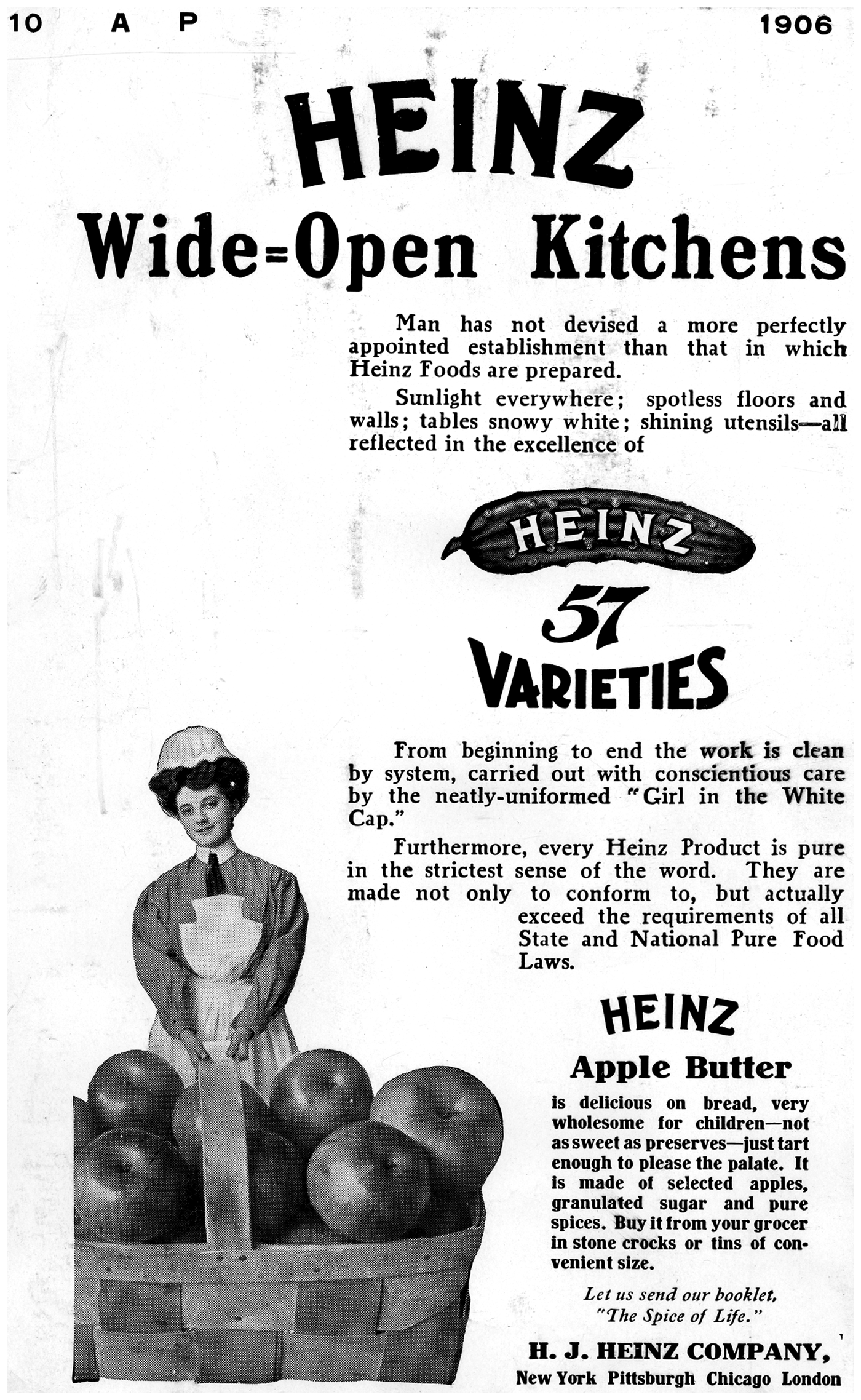
The controversy surrounding the use of benzoate of soda as a preservative—and Heinz's savvy harnessing of it—was a pivotal moment amidst the confusion and pushback regarding how federal pure food legislation would be enforced. Though not prohibited under federal law, benzoate of soda was a preservative considered dangerous to human health by some (including USDA chief chemist Wiley) if present in large amounts. It was also associated with economic adulteration. For example, one Heinz advertisement claimed that benzoate of soda “permit[ted] the cheapest and most unsanitary methods of manufacture” by allowing food manufacturers to use low-quality components (like produce peelings and cores) that “would otherwise be thrown away.”Footnote 62 Although the issue united Wiley and the Heinz company, it created a bitter rift between the USDA chemist and Secretary of Agriculture James Wilson. After the second ruling on the preservative in 1907 declared its use in prepared foods illegal, other manufacturers pushed back and asked for a special hearing before Secretary Wilson. With their hackles raised by this request, Heinz and Wiley went on the defensive: the Heinz company hired press agents to report favorably on Wiley and his work, and Wiley used his relationship with Heinz as a way of bypassing Wilson to go directly to the Oval Office, first during Roosevelt's presidency and then Taft's.Footnote 63 Tensions were further heightened in 1908 when Roosevelt, after consulting with Wilson, decided to appoint a board of scientific experts to examine benzoate of soda's use as a food preservative. Headed by prominent chemist and Johns Hopkins University president Ira Remsen, Wiley considered the Remsen Board a threat to his authority, and its creation permanently soured his relationship with Roosevelt.Footnote 64 Moreover, a number of Wiley's supporters, including Heinz and some members of the National Association of Food and Dairy Departments, were “willing to cooperate in attacking the Remsen Board and Secretary Wilson,” most notably at the Association's 1908 convention at Mackinac Island, Michigan, where a resolution that condemned Wilson was passed.Footnote 65 Afterward, the press continued to depict the Remsen Board in a negative light, painting them as dishonest “agents of food dopers,” and an interest group called the Century Syndicate (which was financed by the Royal Baking Powder Company) hired former political operative Orville LaDow to craft a public relations campaign to boost Wiley's profile while smearing Wilson and the Remsen Board.Footnote 66
These clashes went on for several years after the Pure Food and Drug Act was signed into law as concerns about the new law's efficiency continued to solidify. National Food Magazine reported in 1909 that “foods drugged with chemicals and otherwise adulterated [were] still being sold in large quantities,” and would be until the “food adulterators’” power could be curtailed.Footnote 67 A year later, Philadelphia-based newspaper The North American observed that the “health and food departments of many states have utterly cast aside the federal laws as virtually worthless” in favor of enforcing “their far better state laws.”Footnote 68 Prominent investigative journalist Samuel Hopkins Adams pointedly asked Hampton's Magazine readers in 1910 “what [had] become of our pure food law?” It took seventeen years to pass, he pointed out, but just three years after it did, it had become “practically an inert machine … destroyed by the old allies of fraud and poison.”Footnote 69 Other media outlets similarly reported that business's more nefarious interests had “emasculated” the national laws, “vilified” the work of bureaucrats and reformers, and “fettered” the authority of officials like Wiley, Wilson, and Remsen.Footnote 70 Indeed, a 1909 article in National Food Magazine even claimed that in spite of the hard work of physicians, women's organizations, and retail grocers, “the fight looked more like a losing one”—that is, apparently until the “makers of legitimate food” joined in.Footnote 71
With other pressing political concerns pushing food issues off of the front pages and out of Americans’ minds, an increasing number of food manufacturers began to position themselves as the last best hope to win the fading fight.Footnote 72 For example, the Domestic Science and Pure Food Exposition at Madison Square Garden in the fall of 1910 was framed as a collaboration between national manufacturers and powerful domestic science and reform organizations. With each product's eligibility in the show dependent “upon absolute purity,” the event showcased the increasingly cozy relationship that had developed between business and reform, with each side benefiting from the ostensible integrity of one another.Footnote 73 Characterizing the two interests as “allied forces,” The North American remarked that “best of all for the public,” the food manufacturers who attended the exposition would now have the support of an “army of men and women whose influence radiates throughout the entire country.”Footnote 74
In the same year, a group of approximately twenty large manufacturers—including Heinz, the Shredded Wheat Company, and the Franco-American Food Company—formally incorporated under New York State Law as the American Association for the Promotion of Purity in Food Products (AAPPFP).Footnote 75 They used product advertising as a way to boast of their membership in this self-established group, condemned the use of preservatives, supported national regulatory legislation, and worked toward improving sanitary conditions in their factories. It is not entirely clear if this organization was legitimately concerned with the creation and enforcement of regulatory legislation, or if it was formed primarily for marketing purposes, but its platform pledged that member companies would “severally and jointly give their moral and financial support and undivided influence toward upholding … the administration of all laws looking to the elevation of the standards of the food producing interests of this country.”Footnote 76 The press seemed to embrace the AAPPFP's work with less skepticism than it might have in the years before the federal legislation passed.Footnote 77 While observing that it was “not so well known” in terms of its “personality” and “identities” within the cause as groups like the American Medical Association were, The North American described the AAPPFP as “thoroughly in sympathy with state and federal pure food legislation,” and noted that the group was working as hard as more grassroots organizations were to “procure pure food supplies.”Footnote 78 National Food Magazine was even more enthusiastic in its coverage: “Nothing could be of greater advantage to consumers,” it declared. “[The AAPPFP] will make the food issue one of clearly defined lines, showing the people who are the makers of pure food and who are not, teaching [consumers] to distinguish between the brands of purity and impurity. It will cause all the wolves to remove their sheep's clothing.”Footnote 79
Whether or not this was entirely true—and it seems unlikely that it was—it underscores the degree to which a symbiotic relationship had developed between business and reform in the years after the passage of the Pure Food and Drug Act. Following Heinz's lead, advertisements for mass-produced food products after 1906 often blurred the lines between marketing and public service. For example, a 1912 advertisement that appeared in the Evening World newspaper in New York City at first glance appears to have been a public health notice: “Dr. Wiley Please Note,” the tagline blared before referencing “[his] fight against benzoate of soda and other chemical preservatives and colors in foods.” A closer inspection reveals that the document is an advertisement for Premier Food Products (fig. 3). Mentions of the product line's “delicious flavor” and “beautiful appearance” are contrasted against descriptions of the company's hygienic and technologically advanced manufacturing processes. The advertisement does not contain any product photographs or illustrations; the only image depicted is an official-looking star-shaped logo (denoted as “the Sign of the Star”) intended to act as “the connecting link between the Premier ideals of perfection and a discriminating public.”Footnote 80
Following Heinz's lead, advertisements for food products often blurred the lines between marketing and public service. This 1912 Premier Food Products advertisement directly addressed Dr. Harvey Washington Wiley, the USDA chief chemist who played an instrumental role in the passage of the Pure Food and Drug Act. Premier Food Products advertisement, October 11, 1912, Evening World, box 207, Harvey Washington Wiley Papers, 1854–1954. Courtesy Manuscript Division, Library of Congress, Washington, DC.
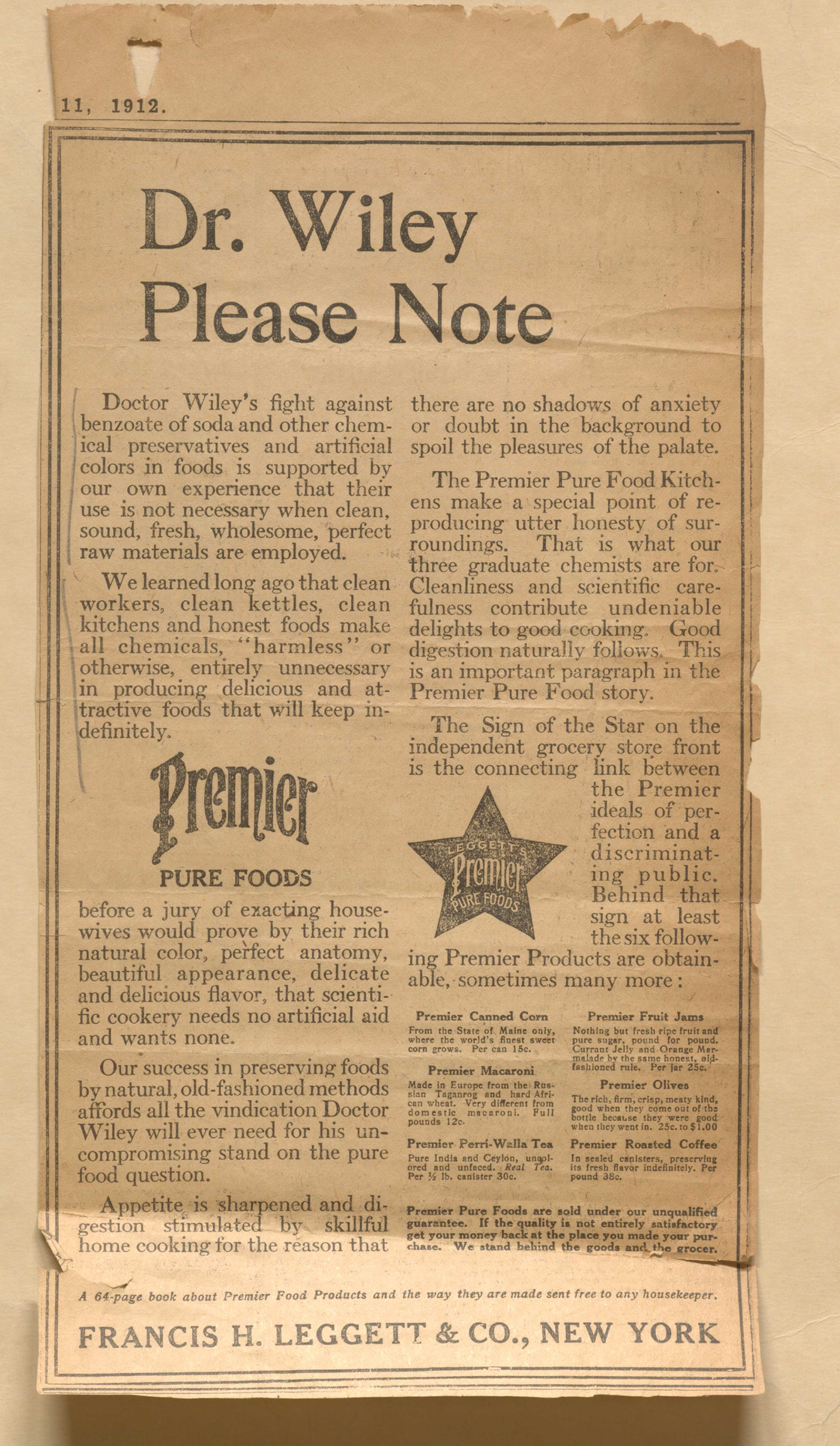
This advertisement and others like it should be understood as a microcosm for a larger cultural phenomenon. A direct byproduct of an urge to recapture the fading “realness” of American life amidst the emergence of industrial capitalism, mass production, and urbanization, the nostalgic modernist discourses present in these advertising campaigns reflect the beginnings of a fixation with concepts like “honesty” and “authenticity” that began during a time when fears about fraud (whether commercial, social, political, or aesthetic) “routinely [occurred], especially when [a] society becomes so large that one usually deals with strangers, not neighbors.”Footnote 81 Particularly in the absence of a clear apparatus to enforce the Pure Food and Drug Act, it is understandable that manufacturers seized upon these uncertainties and started to work with advertising agencies, reform organizations, and public relations firms to create a symbolic association in consumers’ minds between branded food products and nostalgic modernist ideals.
Embracing the age's industrial methods of production while also venerating aspects of “authentic” American culture perceived to be in crisis, the way that “pure food” products were marketed reflects a paradox that cuts to the very core of the American experience—namely that progress is celebrated, but also feared. By co-opting discussions about food production and consumption and taking advantage of consumers’ anxieties and ambivalence, many of the era's advertisements for prepared food reveal that purity—and its attendant links to hygiene, public health, and consumer safety—swiftly became a commodity that could be purchased. With consumer trust at a low ebb because of ambiguous regulatory policy, repackaging nostalgic modernist ideals about food and disseminating them to a mass audience allowed American business leaders to seize a quintessential Progressive Era cause and manipulate it in a way that ultimately served their own economic interests. And as evidenced by today's seemingly unending barrage of ads touting food products that are apparently “organic,” “natural,” and “artisanal” alongside alarmingly regular product recalls, outbreaks of foodborne illnesses, and news stories about how powerful lobbyists have repeatedly weakened the Food and Drug Administration, it is clear that their work haunts us still.Footnote 82



