Among the central questions in the study of developmental psychopathology is how risk conditions, stemming from child, parent, context, or culture, coalesce into a significant enough risk that alters the child's development to a maladaptive trajectory. The specific parameters that add up to a substantial risk, the way contexts exacerbate or attenuate the effects of risk on child outcomes, and the level at which independent risk factors cross a critical cutoff are issues of theoretical and clinical importance (Belsky, 1998; Cicchetti & Lynch, 1993; Rutter & Sroufe, 2000). Although research has addressed the cumulative effects of parent, child, and contextual risk, the role of culture in shaping child adaptation has received surprisingly little attention. Culture, as a set of beliefs, attitudes, practices, and behaviors pertaining to child rearing and the family, exerts the most significant impact on the infant's rearing environment (Kagan, 2001; Keller, 2003). Yet, the contribution of culture to the child's propensity for psychopathology remains largely unknown.
This study examines the role of culture in moderating the relations between eight indices of risk in the infant's ecology and two types of developmental outcomes in young children: symbolic competence and behavior adaptation. Specifically, we examined two sets of culture-related hypotheses with regard to the relations of risk and development. The first set considered culture-specific links between infant, parent, and contextual determinants and child outcomes. Theoretical perspectives on development within cultural ecologies suggest distinct pathways to the emergence of competence and adaptation in cultures guided by different orientations (Greenfield, Keller, Fuligni, & Maynard, 2003; Kagitçişi, 1996; Rogoff, 2003; Shweder, 2003). The second set of hypotheses was informed by the concept of “cumulative risk.” Models on risk and resilience theorize that the cumulative number of risk conditions in the infant's ecology is the determining factor in shaping child maladaptation (Cicchetti & Toth, 1998; Rutter, 1987; Sameroff & Fiese, 2000). This “cumulative risk” effect is suggested to be universal and has been observed in studies of Western and non-Western cultures (Sameroff, Seifer, Barocas, Zax, & Greenspan, 1987; Werner & Smith, 1979). We thus made an attempt to address both the culture-specific and universal contributions of risk factors in infancy to domains of young children's competence and adaptation in a community sample of Israeli and Palestinian couples and their first-born child.
Ecological and transactional perspectives suggest that infant development occurs within a growing matrix of proximal and distal influences (Belsky, 1984; Bronfenbrenner, 1977). These include the child's biological dispositions; the parent's personality, experiences, and the parent–infant relationships; the larger circle of social networks; and the more distal effects of cultural attitudes and philosophies, which in turn, define parental attitudes, living conditions, and interpersonal patterns. Each ecological factor influences and is influenced by other factors at both the same (e.g., mothering on fathering) and different (e.g., infant dispositions on parenting) levels of the ecological ring. In combination, this network of bidirectional influences forms a mutually regulating dynamic system that continuously shapes developmental outcomes (Lynch & Cicchetti, 1998; Sameroff, 1997). Each ecological determinant at the level of child, parent, or context may, at some point or in certain combinations, turn into a risk condition. Consistent with the formulations of dynamic systems' theory, when a risk condition occurs at critical nodes or within specific contexts its effect may be magnified, and even small differences in levels of risk can make a substantial impact with repeated iterations (Fogel, 1993; Fogel & Thelen, 1987).
Culture is perhaps the most neglected topic in the study of risk and resilience. To date, few studies examined the differential effects of risk conditions on developmental outcomes as they emerge within cultural contexts (Shweder et al., 1998). A recent survey of the literature on infant mental health indicates that 94% of the studies come from North America or Europe (Tomlinson & Swartz, 2003), a situation that not only prevents the implementation of culturally sensitive interventions but also seriously skews our understanding of human development. Because culture provides the organizing framework for the child's ecology, the meaning, saliency, and impact of specific risk conditions are likely to vary across cultural communities (Celia, 2004).
The effects of culture on the architecture of risk and protective factors may stem from several sources. First, if one considers the central dichotomy between cultures, phrased in terms of individualism versus collectivism (Triandis, 1989) or independence versus interdependence (Markus & Kitayama, 1991), it is clear that these dichotomous worldviews and lifestyles determine the centrality of the social context to the growing child. Social support has been shown to exert a greater impact on maternal functioning and child adaptation in cultures guided by a more collectivistic orientation (Cutrona, Russell, Hessling, Brown, & Murry, 2000). The effects of social support on child adaptation may thus vary according the culture's collectivistic philosophies and living conditions. Second, cultures define the parameters of health and pathology, delineate accepted from nonaccepted behavior, and offer living conditions that may intensify or mitigate the effects of parental psychopathology on the growing child (Shweder, 2003). For instance, maternal depression, which is closely related to social support, particularly among Arab women (Stuchbery, Matthey, & Barnett, 1998), may have a different effect on child adaptation in the context of nuclear versus extended living arrangements. In extended family dwelling, where several women raise children together (Sharma & Fischer, 1998), the effects of maternal depressive symptoms may be attenuated by the infant's daily interactions with other women of a kin relationship. Third, collectivistic societies, which view deference to authority and the reduction of aggression as central parenting goals (Briggs, 1972; Hofstede, 2001), may consider the infant's temperamental disposition to negative emotionality as more disruptive. Fourth, cultural beliefs and attitudes shape the parents' interactive behavior in ways that are consistent with the culture's overarching goals and meaning systems (LeVine, 2002; Super & Harkness, 1986; Whiting & Whiting, 1975). In individualistic societies, parent–infant interactions are built on a face-to-face position and involve patterns of covocalization, mutual gazing, and object presentation, behaviors that mark the dialogue between separate individuals who coordinate their interpersonal exchange. In collectivistic societies, interactions are framed by continuous contact (Tronick, 1995), which reflects the inseparateness of mother and child (LeVine, 2002). Patterns of visual and vocal coordination have been shown to promote self-regulation and competence in children growing in individualistic societies, not among those reared in collectivistic contexts (Keller et al., 2004). As such, the study of risk and resilience may benefit from including culture as a research parameter and from assessing Risk × Culture interactions. Interaction effects that may be important to the continuity from infancy to the preschool years are the interaction of culture and social support, culture and maternal depression, culture and the infant's negative emotionality, and culture and the parent–infant behavioral repertoire.
Ecological Risk at the Transition to Parenthood
Risk conditions in infancy are generally thought to stem from three sources: child, parent, and context (Belsky, 1984). Of the infant-related risks, the infant's dysregulated temperament is among the most frequently studied biological risk. In relation to the developmental outcomes studied here, infant dysregulation plays a role in the consolidation of behavior problems from toddlerhood to adult life (Belsky, Hsieh, & Crnic, 1998; Caspi, 2000; Rubin, Burgess, Dwyer, & Hastings, 2003) and predicts lower cognitive and symbolic skills (Feldman, Eidelman, & Rotenberg, 2004; van Bakel & Riksen-Walraven, 2002). As to the controversy of whether maternal report is a valid measure of infant temperament (Seifer, Sameroff, Barrett, & Krafchuk, 1994), observed and self-reported difficult temperament are likely to exert separate and cumulative effects on infant development. Inborn dysregulation limits the infant's capacity to extract formative experiences from the environment during critical periods for the development of self-regulation (Tucker, 1992) whereas maternal perceptions create the emotional context in which infants form internalized models of self, other, and relationships (Stern, 1995).
Maternal postpartum depression is a prevalent mother-related risk, affecting 10–12% of women of childbearing age (Burt & Stein, 2002), and its negative effects on children's cognitive skills and behavior adaptation are well known (Goodman & Gotlieb, 1999; Weinberg & Tronick, 1998). Maternal depression decreases the quality of child play (Easterbrooks, Biesecker, & Lyons-Ruth, 2000; Murray et al., 1999) and predicts more behavior problems (Burt et al., 2005; Carter, Garrity-Rokous, Chazan-Cohen, Little, & Briggs-Gowan, 2001; Feldman & Eidelman, 2004). In the present study, we included two additional mother-related risks that shape the mother's world in the postpartum period and are related to depressive symptoms: work–family interference and the experience of childbirth. Because of the large rise in rates of maternal employment in recent years, most mothers of young infants are currently employed (Han & Waldfogel, 2003), and maternal work–family interference is an important feature of the infant's ecology (Voydanoff, 1989). Mother work–family interference is associated with higher depression, lower adaptation, and less marital support, particularly at the transition to parenthood (Feldman, Sussman, & Zigler, 2004; Hyde, Klein, Essex, & Clark, 1995; Schwartzberg & Dytell, 1996). An additional mother-related risk is the experience of childbirth and the rate of recovery, especially among first-time mothers. A negative childbirth experience correlates with lower maternal adaptation, slower entrance into the maternal role, and less optimal mother–infant relationship (Feldman, Sussman, et al., 2004; Goldstein-Ferber & Feldman, 2005).
Contextual risk and support are typically examined in relation two sources: the marital relationship and the larger social context. The quality of the marital relationship and the degree of social support are important contextual assets, associated with higher maternal sensitivity, lower maternal depression, and lower child negative emotionality (Cowan & Cowan, 1992; Cutrona & Troutman, 1986; Pauli-Pott, Mertesacker, & Beckmann, 2004). In terms of the link to symbolic competence and behavior adaptation, marital satisfaction was found to predict the complexity of symbolic play in preschoolers (Keren, Feldman, Namdari-Weinbaum, Spitzer, & Tyano, 2005), and is associated with less behavior problems in the childhood years (Seiffge-Krenke & Kollmar, 1998). Similarly, social support buffers against the development of child behavior problems (Franz, Lensche, & Schmitz, 2003; Kroes et al., 2002), and the role of contextual support is especially strong for mothers in collectivistic societies, where child care by a kin is a common practice (Sharma & Fischer, 1998). The effects of risk on family adaptation increases during the transition to parenthood, a period when bidirectional links between risk factors are tighter and their impact on family functioning is more salient (Belsky & Pensky, 1988; Heinicke, 1984; Levy-Shiff, 1994). Furthermore, because the transition to parenthood is a significant period from a cultural perspective, marking the transmission of the cultural heritage to a new generation, the effects of cultural practices, support networks, and relational patterns on the family ecology may be more pronounced.
Developmental Outcomes in Young Children
Between the age of 2 and 3 years, the infant's world expands as language develops, mastery of symbol use grows, and the self emerges as the locus of internal thoughts and feelings (Cicchetti & Beeghley, 1990; Kagan, 1981; Piaget, 1962), abilities that indicate that cognitive competencies develop along the line of increasing symbolic distance. Symbolic play has been studied as a developmental function related to, but distinct from, both general cognitive skills and language competence (Bates, O'Connell, & Shore, 1987; Tamis-LeMonda & Bornstein, 1994) and its maturation follows a similar line from concrete to decontextualized expression (Fenson & Ramsay, 1980; McCune, 1995). During the third year, symbolic play becomes more complex, play sequences grow more elaborate, and individual variability in symbolic complexity reflects both cognitive growth and emotional well-being (Noll & Harding, 2003; Slade & Wolf, 1994).
In addition to its links to maternal depression, infant dysregulation, and social support, children's symbolic expression is shaped by the cultural context. It has been suggested that every society must prepare its children to comprehend and use symbols, but cultures employ different methods to reach that goal (Rogoff, 2003; Vygotsky, 1978). In more traditional societies, children learn tool use through guided participation and copractice with more proficient adults, whereas parents in individualistic societies facilitate symbolic growth through play that focuses on verbal and affective exchange (Rogoff, Mistry, Goncu, & Mosier, 1993). Thus, with regard to the culture-specific pathways to symbolization, parents in individualistic societies may support symbolic skills through behavioral coordination with the infant communicative signals (Feldman & Greenbaum, 1997; Slade, 1987). Symbolic and linguistic capacities in traditional societies, particularly in Arab societies, are more closely linked to the mother's social support networks (Eapen, Zoubeidi, & Yunis, 2004). Still, the correlations found between maternal verbal responsiveness and child play for Egyptian toddlers (Wachs et al., 1993) suggest both main and moderating effects in the relations of parent sensitivity and symbolic complexity. As to the universal hypothesis, because symbol use is among the defining features of the Homo sapiens, it is likely that under normative rearing conditions all children would develop adequate symbolic skills and play would be organized by a similar process (Bornstein, Haynes, Pascual, Painter, & Galperin, 1999). Similarly, lower levels of symbolic play are likely to be associated with higher levels of cumulative risk.
In parallel to the maturation of symbolic capacities, children begin at this age to display behavior problems that clearly deviate from the culturally accepted norms and predict lower adaptation in later childhood and adolescence (Caspi, 2000). Toddlers' behavior problems are related to risk conditions stemming from each level of the ecology, including difficult infant temperament, maternal depression, low social support, and less optimal parent–child relations (Dawson et al., 2003; Holden & Ritchie, 1991; Mahoney, Jouriles, & Scavone, 1997). Studies of children's behavior problems in cultures guided by individualistic and collectivistic philosophies indicate that the underlying structure of externalizing and internalizing symptoms, their associations with ecological risk factors, and the validity of the instrument are retained across a wide range of cultures (Bengi-Arslan, Verhulst, van der Ende, & Erol, 1997; Chang, Morrissey, & Koplewicz, 1995; Heubeck, 2000; Javo, Heyerdahl, & Ronning, 2000; Tramontina, Schmitz, Polanczyk, & Rohde, 2003), including the Israeli and the Palestinian societies (Auerbach, Yirmiya, & Kamel, 1996). Among Arab toddlers, the family's social support is an important determinant in the consolidation of behavior problems (Eapen, Yunis, Zoubeidi, & Sabri, 2004). Thus, with regard to the culture-specific pathway, it is possible that social support may have a stronger buffering effect on child adaptation in cultures organized by multigenerational living conditions where support availability is high. In addition, infant dysregulated temperament may have a more negative effect on the emergence of behavior problems in societies that stress deference to authority (Hofstede, 2001). In terms of the universal hypothesis, it is likely that higher levels of behavior problems would correlate with more cumulative risk across cultures.
The Present Study
In light of the above, the present study examined the moderating role of culture on the relations of risk conditions in infancy and the development of symbolic play and behavior adaptation. Participants were dual-earner Israeli and Palestinian couples and their first-born child observed at 5 and 34 months. The age of 5 months was selected because infants at this age are already familiar with the culture-specific patterns of parent–infant interaction and the family has typically recovered from the experience of childbirth. The age of 34 months, the last quarter of the third year, is a point when the child's symbolic play reaches a certain complexity and behavior problems are beginning to emerge in the externalizing and internalizing domains. Eight ecological determinants were examined as potential risk conditions and independent, cumulative, and interactive effects were tested. Consistent with the ecological perspective (Belsky, 1984; Bronfenbrenner, 1977), we hypothesized that risk originating in the infant, parent, and context would predict less optimal outcomes in the toddler stage, that culture would moderate the effects of risk on development, and that risk factors would exert a cumulative impact on maladjustment.
Eight determinants of the infant's ecology were examined as predictors of toddlers' symbolic skills and behavior adaptation. These included infant observed and parent-reported difficult temperament as the child's factors; maternal depression, work–family interference, and the experience of childbirth as the mother's factors; mother–infant and father–infant interactions as the observed indices of the microsystem; and the parents' marital satisfaction and social support as the contextual variables. Children's symbolic capacities and behavior problems were selected as the age-appropriate cognitive and social–emotional outcomes because of their close dependence on environmental conditions. It was expected that difficult temperament, maternal depression, work overload, and negative childbirth experience, low parent sensitivity, and less marital and social support would predict low symbolic competence and more behavior problems.
The “cultural pathways” perspective (Greenfield et al., 2003) was adapted to the study of developmental risk and guided the culture-specific hypotheses. According to this perspective, the parenting experiences offered by the culture differentially support child competence and adaptation and parents use the resources available in their ecology to achieve developmental milestones. Marked differences in parental attitudes, believes, and child rearing practices exist between the Israeli and Palestinian societies, which are primarily related to the individualistic and collectivistic orientations of the two cultures, as we have found for this sample at 5 months (Feldman, Masalha, & Nadam, 2001). The Israeli society is primarily urban, and its orientation is clearly individualistic. Young couples live in nuclear family arrangements, gender-role philosophies are more egalitarian, and parenting goals are framed in terms of autonomy and self-actualization (Feldman, 2000; Israel Central Bureau of Statistics, 2002). Patterns of parent–infant interactions revolve around mutual gazing, covocalization, and active involvement with toys, behaviors that support the development of competence in individualistic societies (Keller et al., 2004).
The Arab–Palestinian society is collectivistic in its orientation, and several aspects characterize its specific version of collectivism. According to the Abudabbeh's (1998) model, Arab family life is defined by three main features; adherence to traditional gender-role philosophies even among modern couples (Abdalla, 1995; Mar'i & Mar'i, 1985), patriarchal hierarchies of power that stress deference to authority, and the superiority of the family goals to those of the self. Extended family living, which stresses the inseparateness of the young family from the family of origin, the deemphasis on motivations of self-fulfillment, particularly among women, and the emphasis on child compliance as a central parenting goal are expressions of these aspects (Al-Haj, 1989; Dwairy & van Sickle, 1996; El-Islam, 1983). Similar to other traditional societies, early interactions are based on physical contact between parent and child rather than on patterns of visual and affective coordination (LeVine, 2002; Tronick, Morelli, & Ivey, 1992).
The aforementioned differences in parenting practices and living conditions were expected to chart different pathways to the emergence of symbolic competence and behavior adaptation. The parents' visual and vocal coordination with the infant's signals were expected to have a stronger impact on the emergence of symbolic play in the Israeli group. As to behavior problems, several culture-moderated effects were hypothesized. Social support was expected to have a more positive impact in the context of extended-family settings and to have a stronger buffering effect on the development of behavior problems among Arab children; maternal depression was expected to have a stronger effect in the context of nuclear-family living and thus to have a more negative effect on Israeli children; and infant negative emotionality was expected to have a more negative impact on the development of behavior problems in Arab children.
Method
Participants
The initial cohort of participants included 100 Israeli–Jewish couples (parents of 52 boys and 48 girls) and 62 Arab–Palestinian couples (parents of 33 boys and 29 girls) and their first-born child. All parents in the study graduated high school, with the vast majority holding a vocational or academic degree (83%). Only dual-earner families were recruited in the two societies, and all participating mothers and fathers were employed in skilled or semiskilled professions. Israeli mothers were on average 27.7 years old (SD = 3.93), and Arab mothers were on average 25.65 years (SD = 3.19); the age difference was significant, F (1, 161) = 11.81, p < .01. Israeli mothers completed an average of 15.25 years of education (SD = 1.69) and Arab mothers 14.68 years (SD = 1.35), but the difference was not significant. Israeli fathers' age averaged 30.37 years (SD = 4.99), and their education averaged 14.54 years (SD = 1.64). Arab fathers' age averaged 30.35 years with an average education of 14.19 (SD = 1.85) years, and no significant age or education differences were found for fathers.
Mothers in the two societies had all worked prior to childbirth, were on maternity leave, and returned to work when the infant was between 12 and 16 weeks, with no cultural differences in the length of leave. None of the fathers reported taking a paid parental leave. Thirty-eight percent of Israeli mothers and 42% of the Arab mothers were employed in semiskilled professions (secretaries, teachers' assistants), 15% of Israeli mothers and 13% of Arab mothers were self-employed, and the rest worked as skilled professionals (teachers, computer technicians, physicians). Among fathers, 18% of Israeli fathers and 21% of Arab fathers were employed in semiskilled professions, 22% of Israeli fathers and 26% of Arab fathers were self-employed, and the rest were employed in skilled professions. No cultural differences were found in the professional status of men and women or in the family's economic status, and all couples considered themselves middle class according to their society's standards.
Israeli families were living in the greater Jerusalem and Tel Aviv areas and were recruited by nurses in well-baby stations in their immediate neighborhoods. Nurses introduced the study to those who fit the study criteria after screening the clinic's records for parental and infant physical and mental health complications. Of a pool of 110 considered as potential candidates and approached, 100 agreed to participate. Ten mothers declined, citing father refusal or scheduling difficulties as reasons. The well-baby clinic records of these women did not show differences in demographic or health variables compared to the participating families.
Arab families were recruited in the greater area of Nazareth in the northern part of Israel (n = 28) and of Ramallah in the West Bank (n = 34). Recruitment and data collection were conducted by professionals who were members of each cultural community. Seven families approached declined participation, and these were of similar background as the participating families. Of the Arabs, 90% were Muslims and 10% were Christians, with no differences between religions for any demographic or study variables. However, it is possible that the small number of Christians precluded the detection of significant differences between Christians and Muslims, and this should be noted as a study limitation. No differences were found between the two Arab groups for any variable, and data were collapsed into a single group. The study was conducted between 1996 and 2000 during a relatively peaceful period in the region.
Home visits were made by members of each cultural community who were trained to conduct the study in Israel and Ramallah, and periodic meetings between groups were held. In the first visit Israeli infants were an average of 20.51 weeks (SD = 3.14), and Arab infants were an average of 21.32 weeks (SD = 3.98) with no age difference. All infants were born at full term, had birthweights of 2700 g and above, and were in good health since birth.
Of the original 100 Israeli families, 86 families were seen again when the child was 34 months (44 boys, 42 girls). Among Arabs, 55 families were seen again (29 boys, 26 girls). Israeli toddlers were on average 33.74 months (SD = 4.43) and Arab toddlers were 34.32 months (SD = 4.18), and there was no group difference. No differences were found between families who were revisited and those who were not on any of the measures collected at 5 months. Attrition was mainly related to inability to locate the families or to the family moving to a far away location. All couples in the study were still married by the time their child reached 34 months. In 60% of the Israeli families and 62% of the Arab families a second child was born by the time the first child was 34 months old, with no cultural differences in family composition. Change in maternal employment status between 5 and 34 months were as follows: among the Israeli mothers 27% mothers reported a decrease and 19% reported an increase in the amount of out of home hours. In the Arab group 25% reported an increase and 20% reported a decrease in work hours, and no cultural differences were found in the proportion of change. Overall, Israeli mothers were employed 33.4 hr/week (SD = 6.55) and Arab mothers were employed 32.17 hr/week (SD = 8.26) with no cultural differences in maternal employment.
Procedure
5 months
Parents were contacted by a culturally matched interviewer, and a time was set when both parents were home and the infant was expected to be fed and awake. Home visits lasted about 2 hr and began with the interviewer's introducing the study's goals and procedures. Parents then moved to different rooms to be interviewed and to complete a set of self-report measures. Questionnaires were completed in Hebrew or Arabic. Questionnaires were adapted to Arabic using a back and forth translation by a team of professionals and validated for use in the Palestinian culture in two ways. First, a group of mental health and child development professionals examined the suitability of each instrument for parents of young children in their society by going over each question, assuring its relevance for parents, and making minor changes in wording for clarity. Second, questionnaires were tested on a pilot sample of 20 parents prior to their use in the current study. Parents were asked to indicate whether there are questions not applicable to children at that age or to their experience as parents and to change unclear words. Parents indicated that all questions were on target, and slight changes in wording were made following the parents' suggestions. After completion of the questionnaires, parents and infants were videotaped in three interactions: mother–infant, father–infant (counterbalanced), and a triadic family session. In this report, we use data from the two parent–infant interactions.
34 months
At 34 months, families and children were observed again by a culturally matched team of observers. Home visits included several dyadic and triadic interactions, interviews, and self-report measures. In this report, we use data from the two parent–infant interactions.
Parent–child symbolic play
Fifteen minutes of free play between the child and each parent (counterbalanced) were videotaped. Parents and children were given a set of toys that have shown to elicit symbolic play in children of that age (Keren et al., 2005; Tamis-LeMonda & Bornstein, 1994), including two dolls, a bottle, a blanket, a tea set including two cups, two plates, sugar and milk pots, a boiler pan, a wallet, a colored necklace, a pair of plastic sunglasses, a sponge, three work tools, two small cars, a telephone, two pet animals and two wild animals, and a small tool set.
Measures
Infancy–5 months
Of the eight infancy risk factors studied here, six factors were extracted from the parents' self-report measures and the other two were based on coded observations. Depressive symptoms, marital satisfaction, and social support were reported at both 5 and 34 months. However, because this study assessed the effects of early ecological risk, only the 5-month measures were used and the 34-month measures were used to validate the early measures. Apart from measures related to mother risk (maternal depression, work–family interference, and experience of childbirth) all self-reported and observed ecological determinants and outcome measures were based on an average of the mothers' and fathers' self-reports and behaviors.
Risk factor 1: Mother depressive symptoms.
The Beck Depression Inventory (BDI; Beck, 1978) includes 21 items that measure the level of depressive symptoms on a 3-point scale. The BDI is a widely used self-report instrument for the assessment of depressive symptoms, with well-established reliability and validity (Bumberry, Oliver, & McClure, 1978). Internal consistency (Cronbach α) for this sample was .85. Parents also completed the BDI at 34 months, and BDI scores showed medium-level stability over time (r = .54, p < .001).
Risk factor 2: Parent perception of infant temperament.
The Infant Characteristics Questionnaire (Bates, Freeland, & Lounsbury, 1979) consists of 24 items measured on a 9-point scale and yields four factors. The Fussy-Difficult factor was used in this study, as it is the most stable dimension in self-report instruments of temperament (Goldsmith & Alansky, 1987). Internal consistency (Cronbach α) was .77. The mothers' and fathers' fussy-difficult scores were related (r = .73, p < .001) and were averaged into a single score.
Risk factor 3: Marital satisfaction.
The Marital Adjustment Test (MAT; Locke & Wallace, 1959) consists of 15 items, summed to create a global marital satisfaction score. The MAT is a widely used instrument in the study of marital relationships, with well-demonstrated reliability and validity (Gottman, Markman, & Notarius, 1977). Internal consistency (Cronbach α) was .76. Mothers' and fathers' scores were correlated (r = .61, p < .001), and were averaged into a single score. Marital satisfaction showed individual stability from 5 to 34 months (r = .51, p < .001), validating the use of the MAT in assessing a stable component in the couple's relationship.
Risk factor 4: Social support.
Two measures were used to assess social support networks. The Social Support Scale (Cutrona, 1984) is a 12-item scale that provides information on the parent's subjective perception of support availability in different domains (e.g., attachment, guidance, reassurance of worth), with good reliability and validity. Internal consistency (Cronbach's α) was .80. Mothers' and fathers' scores (r = .65, p < .001) were averaged into a single score. In the second measure, adapted from Crockenberg and Litman (1990), parents list names of people with whom they have contact within nested circles according to the frequency of contact. The final score is the sum of the number of contacts weighed by the frequency of contact, averaged across mother and father (α = .87). The two social support scales were correlated (r = .59, p < .001) and their standardized scores were averaged into a Social Support composite (α = .70). Social support was similarly measured at 33 months and was highly stable (r = .72, p < .001).
Risk factor 5: Work–family interference.
Parents were interviewed with the Parental Leave Inventory (PLI), a validated instrument including 108 items (Feldman et al., 2001, Feldman, Sussman, et al., 2004). Mother work–family interference was the average of six questions rated from 1 (low) to 5 (high) that considered the balance between the work and family roles following childbirth (e.g., how well mother is performing at work, how postbirth job performance compares with prebirth performance, the degree to which thoughts of the infant interfere with work; α = .74).
Risk factor 6: Experience of childbirth.
This was the average of three PLI items reported by the mother on a scale from 1 to 5: effects of childbirth on self-esteem, effects of childbirth on marriage, and the degree of recovery from childbirth (α = .70).
Several additional items were extracted from the PLI that address the parents' attitudes, beliefs, child-rearing goals, child-care practices, and living arrangements. These were used to validate the individualistic versus collectivistic orientations of the two societies.
Traditional gender-role attitudes.
These attitudes entail the parent's endorsement of the following: mothers should stay home when infants are young, a mother's early return to work is harmful for infants, raising children is the purpose of a woman's life, men and women should receive equal job opportunities (negative), and parents should share child-care responsibilities (negative; α = .71).
Child-care arrangements.
Parents rated whether their infant was in the care of a family member, in-home babysitting, out of home care (dual employment was an inclusion criteria for the present study), and the number of infants being cared for by the caregiver.
Father involvement.
Parents rated on a scale from 1 (low) to 5 (high) the degree of father involvement in household chores and in child-care responsibilities and the mothers' and fathers' scores (r = .57, p < .01) were averaged into a Father Involvement composite (α = .84).
Reasons for returning to work.
Mothers rated yes/no whether the following influenced their decision to return to work: financial need, career advancement, and self-fulfillment.
Experience with infant care.
Two items considered the level of involvement the mother had with infant siblings and her general experience with infants.
Role model.
Mothers rated whether their mothers worked outside the home when they were growing up. For those whose mothers did work, mothers rated the degree to which (1 to 5) their own mother's career was important for her self-concept.
Child-rearing goals.
Parents rated (1–5) the degree to which they considered each of the following a child-rearing goal: self-expression, respect for elders, creativity, compliance to rules, and positive relations with others. Parents also rated the degree to which they consider each of the following as an important attribute in a child: kind, assertive, polite, quiet, and smart.
34 months.
Child behavior problems.
Mother and father each completed the Child Behavior Checklist/2–3 Years (CBCL/2–3; Achenbach, 1992). Items in the CBCL are rated on a 3-point scale from never applies to almost always applies. Three summary scores are extracted, a total behavior score, an externalizing symptoms scores, and an externalizing symptoms score. Mothers' and fathers' scores were highly correlated (r = .79–.83) and were averaged into a single score. The CBCL/2–3 has been previously validated in samples of Israeli and Palestinian toddlers (Auerbach et al., 1996). Internal consistency for this sample was (Cronbach's α) .81.
Coding: Infancy–5 months
Risk factor 7: Parent sensitivity.
Mother–infant and father–infant interactions were coded using the Coding Interactive Behavior Manual (CIB; Feldman, 1998). The CIB is a global rating system that includes 42 codes, each rated on a 5-point scale (1 = low, 5 = high). The CIB has been validated on samples from several cultures and has shown sensitivity to infant age, cultural setting, and biological and emotional risk conditions (Feldman, 2000; Feldman, Eidelman, & Rotenberg, 2004; Feldman, Eidelman, Sirota, & Weller, 2002; Feldman, Keren, Gross-Rozval, & Tyano, 2004; Feldman & Klein, 2003; Feldman, Weller, Eidelman, & Sirota, 2003). The parent sensitivity factor was used (mother α = .93, father α = .91), which includes parent acknowledgement of infant signals, visual contact, warm and positive affect, appropriate vocal quality, resourcefulness in handling infant distress or expanding the interaction, consistency of style, and adaptation to infant states.
Two coders, one from each culture who spoke Hebrew and Arabic, coded the interactions and each coded sessions from the two cultures. Coders were trained to 90% reliability. Interrater reliability, conducted for 25 sessions, had an averaged intraclass r value of .90 (range = .80–.95). Mothers' and fathers' scores were interrelated (r = .54, p < .001) and were averaged into a single score.
Risk factor 8: Infant negative emotionality.
Infant negative emotionality was coded from the mother–infant and father–infant interaction using the CIB codes (mother α = .73, father α = .75). Codes included were: infant shows fatigue and tiredness, emits fuss-cry vocalization, withdraws, shows discontentment. Infant negative emotionality during infant–mother and infant–father interactions were correlated (r = .55, p < .001) and were averaged into an infant negative emotionality factor. The observed and self-reported measures showed significant but low correlations (r = .20, p < .05), which precluded their integration into a single score.
Coding: 34 months.
Child symbolic play.
Symbolic play was coded separately for child and parent along eight hierarchical levels of symbolization and a default. For each 10-s epoch one out of the following nine mutually exclusive codes was applied in line with previous research (Feldman, Eidelman, et al., 2004; Feldman & Greenbaum, 1997; Melstein-Damast, Tamis-LeMonda, & Bornstein, 1996). Child play levels included three presymbolic levels: (a) no play; (b) object manipulation (e.g., touching, throwing); and (c) functional play: use of a toy in its intended way, for example, moving a car on the floor. Two simple symbolic levels were coded (d) self-pretend: unitary symbolic acts around the self, for example, sleeping or combing hair; and (e) other pretend: unitary symbolic acts that include others in the pretend play, for example, feeding a doll. Three complex symbolic levels were coded: (f) combinatorial pretend: combining several play schemes into a single act, in one of the following three types: a single scheme is played with several objects (e.g., feeding doll and then feeding dog), several schemes are played with the same object (e.g., feeding doll then putting it to bed), or different schemes are organized in order (e.g., dressing doll, putting it inside a car, driving car); (g) hierarchical pretend: a single act that expresses a hierarchical scheme (e.g., a child plans ahead and fits objects to predetermined roles); and (h) substitutional pretend: a child substitutes one object for another in a deliberate fashion, for example, a stick is used instead of a car.
Coding of children's symbolic play was conducted by Israeli and Arab coders who did not participate in the 5-month coding, and each coded interactions from the two cultures. Reliability was computed on 25 interactions and reliability κ values averaged .88 (range = .79–.94). The proportion of time the infant spent in each play level was computed and three composites were created: functional play (manipulation + functional play), simple symbolic play (self-pretend + other pretend), and complex symbolic play (combinatorial, hierarchical, and substitutional pretend). The complex symbolic play composites in the mother–child and father–child interactions were related (r = .57, p < .001) and were averaged into a single score. This score, which indexes the age-appropriate level of symbolic play, was used as a criterion variable.
Results
As a first step, we examined parental attitudes, beliefs, and practices to validate the individualistic versus collectivistic orientation of the two societies. Only data from couples participating in the two assessment points are reported here.
Cultural differences in parental attitudes and child-rearing practices: Individualistic versus collectivistic orientation
Living arrangements
All young Arab families, but only 6% of the Israeli families lived within a walking distance to at least one set of grandparents, confirming to the nuclear versus extended living arrangements of the two societies.
Data pertaining to traditional gender-role attitudes, child-care arrangements, the mothers' role model, reasons for returning to work, and experience with infants for this sample at 5 months are reported elsewhere (Feldman et al., 2001). In short, the data indicate that Arab mothers and fathers adhered to more traditional gender-role philosophies, F (1, 281) = 78.46, p < .001. Arab mothers returned to work birth for financial reasons and not for reasons of self-fulfillment or career advancement, χ2 (1, 141) = 24.22, p < .001. Most of the grandmothers in the Arab but not the Israeli group did not work outside the home, χ2 (1, 141) = 10.77, p < .001, and among those whose mothers did work, Israeli mothers perceived their mothers' career as more central to their self concept, F (1, 80) = 11.68, p < .001. Arab mothers had more experience in caring for infants in their youth, F (1, 140) = 9.21, p < .001, and 65% of Arab infants, compared to only 12% of Israeli infants were cared for by a kin, χ2 (1, 141) = 16.97, p < .001.
Father involvement
Arab parents reported lower father involvement in household and child-care responsibilities, F (140) = 54.13, p < .001, keeping with the traditional gender roles.
Child-rearing goals
As expected, Israeli parents placed higher emphasis on the child's “self-expression” and “creativity,” F (1, 281) = 43.54 and 21.24, respectively, p < .001, whereas Arab parents had higher endorsement for “respect for elders” and “compliance to rules,” F (1, 281) = 54.11 and 17.24, respectively, p < .001. Parents in the two societies also endorsed different qualities in a child. Israeli parents placed a higher value on an “assertive” and “smart” child, F (1, 323) = 43.11 and 10.33, respectively, p < .001, whereas Arab parents had higher endorsement for a “quiet” and “polite” child, F (1, 323) = 35.97 and 19.25, respectively, p < .001.
In sum, the cultural comparisons reveal significant differences between the two societies on dimensions related to collectivism versus individualism and to their specific expressions in Arab cultures (Abudabbeh, 1998), including traditional gender-role philosophies, extended living arrangement, child care by a kin, less focus on career as means for women's self-expression, and child-rearing goals phrased in terms of honor, respect for elders, and compliance.
Descriptive statistics for study variables
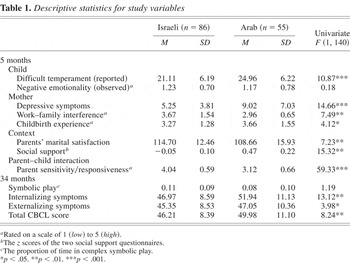
Descriptive statistics for all study variables are presented according to culture (Table 1). No gender differences or Gender × Culture interactions were found for any of the ecological determinants or the outcome measures and the data were therefore collapsed across gender. The data at 5 months are presented only for the 141 families who completed the two assessment points.
Descriptive statistics for study variables

As seen, cultural differences were found for most factors. Israeli parents scored higher on parental sensitivity and reported more marital satisfaction, less depressive symptoms, and lower perceived infant difficulty. Arab mothers experienced less work–family interference, recovered better from childbirth, and Arab parents reported higher levels of social support. Symbolic play levels were comparable across societies and higher CBCL scores were reported for Arab toddlers. In considering mean-level differences, the differences in sample size between the two cultures should be noted as a study limitation.
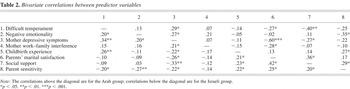
Prior to assessing the cumulative and interactive effects of the ecological determinants on children's symbolic skills and social–emotional adaptation, bivariate correlations were computed between the predictor variables. To examine cultural differences in the magnitude of the correlations, correlations were computed separately for each group (Table 2).
Bivariate correlations between predictor variables

The data seen in Table 2 indicate that, for the most part, a similar pattern of correlations emerged in the two cultures. In both societies, maternal depression was related to infant observed and reported difficult temperament, infant negative emotionality correlated with lower parental sensitivity, marital satisfaction was associated with higher social support, social support was related to higher sensitivity, and maternal depression correlated with lower marital satisfaction. These data suggest that the co-occurrence of risk conditions may be universal. Several associations were found only in the Israeli group, such as between maternal depression with higher work–family interference, more negative experience of childbirth, and lower sensitivity, or between perceived infant difficulty and negative birth experience. In general, maternal depression correlated with most other risk conditions in the Israeli group. Other correlations were significant only in the Arab group, such as the relations between perceived infant difficulty and lower marital satisfaction and less social support. Overall, however, the magnitudes of the correlations were not significantly different between the two groups.
Predicting child symbolic competence and social–emotional adaptation
Tables 3 and 4 present two hierarchical regression models predicting child symbolic play and behavior problems from culture, ecological determinants, and their interaction.
Predicting child symbolic competence

Predicting child behavior problems

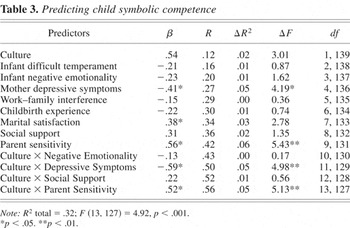
Prior to computing these regressions we examined whether the parental attitudes, beliefs, and child-rearing practices related to the individualistic/collectivistic distinction contribute to the prediction of symbolic competence and behavior problems above and beyond cultural membership. None of these factors explained unique variance in symbolic play or behavior problems above and beyond culture, and these variables were not entered in the next set of regressions. Similarly, maternal employment and child gender were unrelated to the outcome variables. In the regressions reported here, variables were entered one by one in a theoretically determined order. Culture was entered first as a binary variable to partial out variance related to cultural differences. In the following, the ecological determinants were entered according to Belsky's (1984) determinants of parenting model, which suggests that infant dispositions, maternal personality, and contextual conditions affect children and decreasing order. Infant perceived and observed difficulty were thus entered as the child factors; maternal depression, work–family interference, and childbirth experience as the maternal factors; marital satisfaction and social support as the contextual factors; and parental sensitivity as an observed index of the environmental attunement to the child. In the next four blocks, the four interaction terms were entered in the same order as the determinants: culture and infant negative emotionality, culture and maternal depressive symptoms, culture and social support, and culture and parent sensitivity. The criterion variable was the child's complex symbolic play score: the age-appropriate level of symbolic complexity. Results for symbolic competence are presented in Table 3.
As seen in Table 3, culture did not make a unique contribution to the prediction of symbolic play and children of both cultures displayed similar levels of symbolic complexity. Two determinants had a unique contribution to the prediction of symbolic competence: maternal depression and parent sensitivity. Two interactions were predictive of symbolic play: culture and maternal depression and culture and parent sensitivity. Examination of the first interaction indicated that for the Israeli group, parent sensitivity was significantly related to toddler's symbolic competence (r = .33, p < .01), but the associations between sensitivity and symbolic skills for the Arab group were not significant (r = .03, p > .10). The difference between the magnitudes of these two correlations was significant (Fisher's Z = 2.07, p < .05). The opposite pattern emerged for the interaction of maternal depression and symbolic play. Correlations were significant for the Arab group (r = −.39, p < .01), but not for the Israeli group (r = −.08, p > .10), and the difference between the magnitudes of the correlations was significant (Fisher's Z = 2.01, p < .05). A note of caution is warranted here, as a full moderator model was not implied because culture was not independently predictive of symbolic play.
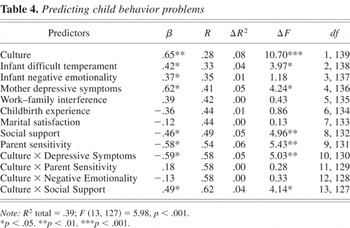
A similar hierarchical regression model was used to predict children's behavior problems and is presented in Table 4. As seen in this table, four ecological determinants were uniquely predictive of infants' behavior problems; infant difficult temperament, maternal depressive symptoms, low social support, and low parent sensitivity. Two significant interactions were found: culture and maternal depressive symptoms and culture and social support. As to the first interaction, the behavior problems of Israeli toddlers whose mothers scored high (M = 48.23, SD = 7.91, N = 39) or low (M = 44.98, SD = 8.63, N = 47) on maternal depression (using the median split), was significant, F (1, 85) = 4.62, p < .05. Among Arabs, on the other hand, the difference between children of mothers scoring low (M = 49.36, SD = 10.87, N = 39) or high (M = 50.51, SD = 12.32, N = 25) was not significant, F (1, 54) = .47, p > .10. The opposite pattern was found for social support. The difference in the CBCL scores of Arab children whose parents reported high (M = 47.44, SD = 11.21, N = 31) or low (M = 51.71, SD = 10.88, N = 24) social support (using the median split) was significant, F (1, 54) = 4.02, p < .05, and no difference was found between the high (M = 46.03, SD = 8.28, N = 40) and low (M = 46.47, SD = 8.76, N = 46) social support group among Israeli toddlers, F (1, 85) = .54, p > .10. Contrary to our expectation, the interaction of culture and infant negative emotionality was not significant. A full moderator model is implied here, with culture moderating the relations of early maternal depression and family social support and later behavior problems (Baron & Kenny, 1986). We also examined regression models in which parental sensitivity was entered before the mother's depressive symptoms, as a more proximal variable, and the results remained essentially the same.
Discussion
The results of this study suggest that culture moderates the effects of risk conditions on developmental outcomes at the transition from infancy to early childhood. Risk and protective factors measured at 5 months differentially affected the development of symbolic skills and behavior adaptation at 34 months in the two cultures. Specifically, the parents' sensitive responsiveness, in terms of visual, vocal, and affective coordination with the infant's signals, had a greater impact on the symbolic complexity of Israeli toddlers. The family's social support networks buffered against the emergence of behavior problems in the Arab group, whereas maternal postpartum depressive symptoms had a more negative effect on the expression of externalizing and internalizing symptoms in the Israeli group. According to culture-specific models of human development (Greenfield et al., 2003; Rogoff, 2003; Shweder, 2003), the saliency of risk and protective factors may vary according to the cultural context. The present findings are consistent with these models and suggest that the resources, living conditions, child-rearing attitudes, and parenting practices available within the infant's ecology are likely to shape the effects of risk conditions on the development of competence and adaptation.
Israeli and Palestinian parents differed on a range of child-rearing attitudes and family conditions, and these cultural differences may have determined the centrality of specific risk factors to child outcomes. Findings from the Palestinian sample were consistent with Abudabbeh's (1998) model on the special type of collectivism observed in Arab families. Parents in this group adhered to more traditional gender-role philosophies, fathers were less involved in child rearing, mothers perceived their work as motivated by the family's financial needs rather than the need for self-fulfillment, parents considered deference to authority and compliance as central parenting goals, mothers reported caring for infants siblings as girls, approximately two thirds of Palestinian infants were cared for by a kin, and all young couples lived within close quarters to their family of origin. Within this multigenerational, extended-family context, specific effects of social support and maternal depression on child adaptation were described. According to the “cultural pathways” perspective, the resources available within the infant's ecology serve as vehicles for growth and adaptation, particularly at the transition from infancy to early childhood (Keller et al., 2004). Consistent with this perspective, social support, an important feature of the collectivistic context, had a more beneficial impact on child adaptation in the Palestinian society, where young working mothers rely on help from the larger family to balance work and parenting (Mar'i & Mar'i, 1985). A recent report from the United Arab Emirates (Eapen et al., 2004) similarly shows that a central predictor of children's behavior problems at 3 years was the mother's lack of social support, particularly among immigrant mothers. These findings are also consistent with those of Cutrona and colleagues (2000), who showed that social support had a more positive impact on mother and child's functioning in cultural settings guided by a more communal approach. A somewhat related explanation may be that the parents' social support networks in collectivistic societies reflect the family's status in the community, and this factor may serve as a proxy for a range of growth-promoting conditions in the child's environment.
The negative effects of maternal postpartum depression on the emergence of behavior problems have been demonstrated in numerous studies (Carter et al., 2001; Feldman & Eidelman, 2004; Murray et al., 1999). The present findings highlight these effects in relation to the rearing context of individualistic societies. Several possible explanations may account for the culture-specific effects of maternal depression on behavior problems. For children growing in nuclear family settings, the mother is often the infant's primary caregiver, the nature of the mother–infant relationship is critical for optimal growth, and the infant's exposure to caregiving females of a kin relationship is usually limited. Within an extended family ecology, where several young mothers raise their children together and infants are exposed to multiple caregivers on a daily basis (LeVine, 2002; Sharma & Fischer, 1998), the impact of the mother's depressed mood may be somewhat attenuated. Another possibility is that in societies that stress self-expression, creativity, and initiative, as seen here in the child-rearing goals of Israeli parents, child adaptation may be more susceptible to the mother's depressed mood. Depressed mothers are less competent in supporting the infant's intentionality, initiation, autonomy, and self-sufficiency (Feldman & Reznick, 1996; Kochanska & Kuczynski, 1991) or in providing sufficient external regulation for the development of self-regulatory capacities (Field, 1992). As a result, the mother's depressive symptoms may be more crucial to child adaptation in such societies than in cultures that emphasize compliance and respect for elders. This may be especially salient during the early preschool years, a period when autonomy and initiative are viewed as central developmental milestones for Western children. This hypothesis, however, is preliminary, and requires replication in larger samples and various cultures to further specify the links between culture, maternal depressive symptomatology, and child adaptation.
Longitudinal associations between the parent's sensitive responsiveness to infant signals and the level of symbolic complexity in early childhood were stronger for the Israeli group. In general, parents in individualistic societies foster the child's symbolization and tool use through special moments of play that are organized around face-to-face interactions. Parents in more traditional societies are less inclined to set a special time for play and periods of play are less distinguished from the stream of daily life (Klein, 1996; Rogoff et al., 1993). In cultures that engage in face-to-face play, the parent's moment by moment coordination with the child's affective expression supports the development of symbolic skills (Melstein-Damast et al., 1996; Slade, 1987). Still, the fact that no cultural differences were found in levels of symbolic complexity indicates that parents in collectivistic societies find effective ways to facilitate child symbolization and future research is required to chart these pathways more fully. The greater effect of maternal depressive symptoms on child symbolic play in the Israeli group may relate to the use of affect synchrony as a typical mode of early interactions. Possibly, in cultures that rely on affect matching, maternal depression, which compromises the development of mother–infant synchrony (Feldman, 2003; Field, 1992), has a more negative impact than in societies that rely on other modes of parent–infant relatedness.
Limitations of the findings should be noted. The two groups were not of equal size, and the smaller number of Arab families should be remembered in the interpretation of the interaction effects. It is also possible that although groups were matched on a range of demographic variables, some unknown or unmeasured factor may have contributed to the reported outcomes. This study presents the first effort to follow the development of infants and families in the Palestinian society, and much further research is required to chart the growth trajectories of children in that society across childhood and beyond.
Finally, the findings have implications for the study of resilience, defined as positive adaptation in the face of adverse conditions (Luthar & Cicchetti, 2000). Resilience has generally been studied in relation to interpersonal and social factors, and recently its biological underpinnings have been addressed (Curtis & Cicchetti, 2003). The present findings underscore the need to include culture in the study of resilience, in addition to its biological roots and social correlates. Specific cultural provisions, relational patterns, living arrangements, and child-rearing philosophies may serve as protective factors in the face of adversity in certain cultural or subcultural contexts but not in others. Resilience, therefore, need to be studied in relation to the core features of the culture and its availability for a specific child or family at important nodes. Further research is require to elucidate the theoretical, empirical, and clinical aspects of cumulative risk, protective factors, and resilience in healthy and at risk populations of different ages, etiologies, and cultures. Better understanding of early ecological risk and its accumulation may enable the construction of more efficient interventions that are suited to the child's social context and can help promote competence and adaptation in the early years in ways that are consistent with the cultural goals and meaning systems.