


1. Introduction
The allocation of capital and the functioning of financial markets are positively related. Incentives, selection and contract enforcement are at the heart of efficient resource allocation. In approaching the relationship between private and public finance, scholars have taken interest rates as a valuable tool to investigate the provision of funds, as resources tend to be invested in activities with high and safe returns. Therefore, the price of credit is positively related to the «credible commitment» of debtors and, accordingly, the safeguard of lenders' property rights (North and Weingast Reference North and Weingast1989; North Reference North1990, p. 69; La Porta et al. Reference La Porta, Lopes-De-Silanes, Shleifer and Vishny1998). This article seeks to uncover the drivers in the distribution of savings in different capital markets in Portugal between 1550 and 1800. It provides new empirical evidence on credit operations, interest rates for short- and long-term credit and debt servicing. Since there is little systematic information on the investments made by individuals, the article focuses on associational organisations, for which evidence of participation in early modern financial markets is far more abundant and easier to gauge.
Early modern investors' decision-making has caught the attention of historians and economic historians, who have sought to understand how investors, whether individuals or organisations, decided how, when and where to apply their funds. Associational organisations were critical players in early modern financial markets, and their credibility as economic agents has been widely recognised in the literature (McCants Reference McCants1997; Gelderblom and Jonker Reference Gelderblom, Jonker, Atack and Neal2009; Ammannati Reference Ammannati2012; Grafe Reference Grafe2012; Milhaud Reference Milhaud2018; Costa et al. Reference Costa, Rocha and Brito2018a). In a recent article, van Bavel (Reference van Bavel2022) notes that although associational organisations had not rooted out wealth inequalities in early modern societies, they often allowed their members to shield their property and awarded them political leverage against states. Among these organisations, religious and charitable institutions stood out not only for the social and political power they enjoyed within local communities but also for their role in financial markets. In the early modern period, organisations such as the Italian Monte di Pietà (Carboni Reference Carboni2013; Avallone and Salvemini Reference Avallone, Salvemini, Costabile and Neal2018), Spanish convents (Toboso Sánchez Reference Toboso Sánchez1987; Álvarez Nogal Reference Álvarez Nogal2009; Milhaud Reference Milhaud2018; Grafe Reference Grafe2022) and Ottoman waqfs (Karagedikli and Tunçer Reference Karagedikli, Tunçer, Lorenzini, Lorandini and Coffman2018) became indisputable economic agents who continuously managed large volumes of wealth, which they assembled through alms, donations and inheritances. Their engagement in financial markets, mainly in—but not limited to—moneylending, is beyond doubt, for they operated as leading credit suppliers to the private and public sectors.
Despite the flurry of studies on credit and debt relations, the literature has largely disregarded the driving forces behind the allocation of savings in different capital markets. Smith (Reference Smith2021) and Baguet (Reference Baguet2016) focused on the investment choices made by individuals, stressing the importance of family, social and civic networks in the investment processes either in the East Indian Company or in Ghent's municipal debt. Except for Shammas (Reference Shammas2020), Gelderblom and Jonker (Reference Gelderblom, Jonker, Atack and Neal2009, Reference Gelderblom and Jonker2011) and De Vijlder and Limberger (Reference De Vijlder and Limberger2014), studies have failed to understand institutional investors' investment behaviour during the Old Regime. Examining the donors and trustees enrolled in the Charity Commission Report for England and Wales, Shammas (Reference Shammas2020) observed a long-term shift from real estate investments into perpetual government annuities in the mid-18th century, mainly driven by legal changes. Gelderblom and Jonker's study (Reference Gelderblom, Jonker, Atack and Neal2009) also pointed out a shift in the investment choices of Amsterdam's public welfare institutions. By the mid-17th century, real estate had lost importance in terms of investment, and then onwards, institutional investors channelled their funds towards financial assets, either private loans or securities; the latter corresponded to the most valuable asset held by such charities, with bonds preferably bought in the secondary market.
This article follows and complements the studies that have drawn attention to the investors' side and looks at the mechanisms underlying the distribution of resources into different capital markets. To delve deeper into this question, the article thoroughly examines the credit activity of the two largest Portuguese charitable institutions over 250 years: the Misericórdia of Lisbon and the Misericórdia of Porto. Founded in the late 15th century to support the poor, the Misericórdias were the leading charitable institutions in Portugal (Sá Reference Sá1997). These charities are worth examining for several reasons. First, in addition to their charitable activity, they were important economic agents. Their sound finances, on the one hand, and the social and political powers they enjoyed, on the other hand, turned them into relevant investors who moved relatively well in labour, land, capital and credit markets. As for credit markets, the role of these charities was far from insignificant. In the first half of the 18th century, loans granted by the Misericórdia of Lisbon accounted for 24 per cent of the total volume of loans signed in one of Lisbon's notary bureaux (Rodrigues Reference Rodrigues, Lopes and Jesus2019a). The relevance of the Misericórdias as public credit suppliers is also mirrored in the 1681 royal budget, for 16 per cent of the juros (interest) were paid to the Misericórdias (8.5 per cent to the Misericórdia of Lisbon, and 2.5 per cent to that of Porto).
Studies have confirmed that the Misericórdias, mainly the wealthiest among them, found in moneylending the preferential means to monetise the funds they acquired through testamentary legacies and alms (Abreu Reference Abreu1990; Sá Reference Sá1997, Reference Sá, dos Guimarães Sá and Amorim2018b; Amorim Reference Amorim2006; Ribeiro Reference Ribeiro2009). However, much of this literature has been limited to the loans made to individuals, underplaying—and sometimes even ignoring—the role these charities played in the market for government bonds. Moreover, most studies concerned with this topic tend to analyse the investment of charities in private loans and sovereign debt separately, failing to consider the institutional framework of these operations. To date, no research has examined both credit market segments in a dynamic relationship, nor the motivations and the extent of the lending practices of these organisations. This article pays special attention to the investment of the Misericórdias in private loans and sovereign debt, questioning the rationality behind the allocation of funds.
This article relies on a new dataset of credit transactions, interest rates and debt service. For both Misericórdias, account books, notarial records, deliberations of ruling boards and royal chancery books were thoroughly examined to find information about overall revenues and loans to the private and public sectors. This study covers the period from 1550 to 1800, corresponding to the first evidence of the participation of the Misericórdias in the public debt and 1800 to a change in the issuance of government debt and the advent of paper money a few years earlier (1796).
The main finding is that the investment behaviour of these institutional lenders had undergone a shift by the early 18th century when they stopped allocating funds into the market for public debt. We argue that the demise of government bonds (padrões de juro) in the Misericórdias' investments was not related to (1) poor debt servicing since monarchs honoured their financial obligations (save in the 1790s) nor to (2) interest rates because government bonds and private loans ran a 5 per cent interest until the early 18th century. We further claim that the disappearance of government bonds from these charities' investments depended on the Portuguese crown's uses for these instruments. By the 1720s, the monarchy preferred to issue debt to consolidate short-term debt rather than raise funds. In these circumstances, the Misericórdias started to channel their financial resources into the private credit market (particularly short-term loans).
This study contributes to several strands of the literature. First, it contributes to the literature on charities and their economic role. It shows that the Misericórdias were important players in the credit market and that their investments were guided by a certain economic rationality, highlighting that these organisations, despite their religious commitments, were not atavistic but rather made various risky decisions and investments. The second contribution relates to the literature on capital markets and offers new insights into both the supply and demand sides. It provides a completely new series on debt service and interest rates of private and public perpetuities.
The article proceeds as follows. Section 2 elaborates on the case studies. Section 3 describes the institutional framework of the Portuguese credit market and examines the credit structure of the Misericórdias, revealing a shift in their investment behaviour. Section 4 explores the determinants of capital allocation, focusing on interest rates and debt service. Section 5 considers the supply and demand of government bonds as a possible explanation for the disinvestment of the Misericórdias in the public credit market. Section 5 concludes.
2. The Misericórdias as a case study
The Misericórdias were lay charities founded in the late 15th century. The Misericórdia of Lisbon was the first to be established in August 1498, but many others sprang up across the kingdom and in the Portuguese overseas territories shortly afterwards. By the mid-16th century, there were 300 Misericórdias in Portugal and 378 by the beginning of the 18th century (Paiva Reference Paiva2013). These charities provided a wide range of charitable services, which comprised treating the sick and poor, caring for foundlings, visiting poor prisoners, ransoming captives, awarding dowries to poor young girls, delivering daily alms to the shamefaced poor and praying in thousands of yearly masses devoted to the deceased. Overall, these confraternities enjoyed the monopoly of charity and were deemed the most critical charitable institutions in Portugal and its overseas empire (Sá Reference Sá1997). Their close connection with both the Portuguese monarchy, which acted as their immediate and main protector, and the local elites that formed their ruling boards turned the Misericórdias into unique organisations with major and indisputable economic, social and political powers.
This article takes the two most prominent Portuguese Misericórdias as case studies: the Misericórdia of Lisbon and that of Porto. Both cities had essential features in common, as they were critical seaports with active business communities during the early modern period. The main difference between them was that Lisbon was a capital city, where the court's presence and the high nobility had a substantial impact on the Misericórdia (Monteiro Reference Monteiro2003). In contrast, Porto had a smaller population, and its elites included a mixture of lesser nobility and merchants. While Lisbon's seaport held the monopoly for the Carreira da Índia, Porto developed a close connection with Brazil, which would be responsible for its prosperity from the 17th century onwards. The comparison between these two Misericórdias is hampered because Lisbon's archives were lost during the 1755 earthquake; hence, reliable data for this confraternity are only available from the second half of the 18th century. In contrast, the historical archives of the Misericórdia of Porto are some of the best-preserved, offering an almost complete series of account books and several other sources, such as letters and the deliberations of the confraternity's ruling board since at least the mid-16th century.
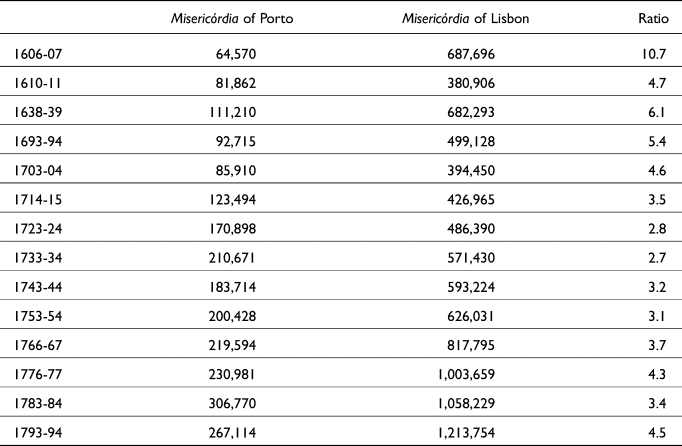
In addition to their charitable programme, the Misericórdias also stood out for their sound finances. Table 1 shows the total revenues of the Misericórdias of Lisbon and Porto between 1606 and 1794. It is important to note that the data come from different sources, ultimately explaining the high volatility of the revenues. Data for Porto come from account books, while the data for Lisbon are from different sources due to the destruction of its historical archives in 1755: secondary (1639), printed (1606-11, 1693-1754) and archival sources (1766-94). The revenues of these confraternities included those from the gift-giving economy, such as alms and royal contributions, and those from their market activities, such as interest on loans, sales and rents from land (Figure 1).Footnote 1
Total revenues of the Misericórdias of Porto and Lisbon, 1606-1794 (Réis of 1700)

Sources: For the Misericórdia of Porto: Arquivo Histórico da Santa Casa da Misericórdia do Porto (hereafter AHSCMP), Série E, Banco 1, Books 12, 14, 24; Banco 2, Books 2, 5, 9, 12, 15, 19, 22, 28; Banco 3, Books 3, 11, 21. For the Misericórdia of Lisbon: for 1606-07 and 1610-11, Oliveira (Reference Oliveira1991, pp. 591-593); for 1639, Amorim (Reference Amorim and Paiva2017, p. 197); for 1703-94, Biblioteca Nacional de Portugal (hereafter BNP), Relação de gastos que a Santa Casa da Misericórdia de Lisboa fez este ano…; Arquivo Histórico da Santa Casa da Misericórdia de Lisboa (hereafter AHSCMLSB), Gestão Financeira, Instrução da Casa, Balanço da receita e despesa da tesouraria geral da Santa Casa da Misericórdia… (1781-1801), Books 1-3. Deflator: CPI, see Palma and Reis (Reference Palma and Reis2019).
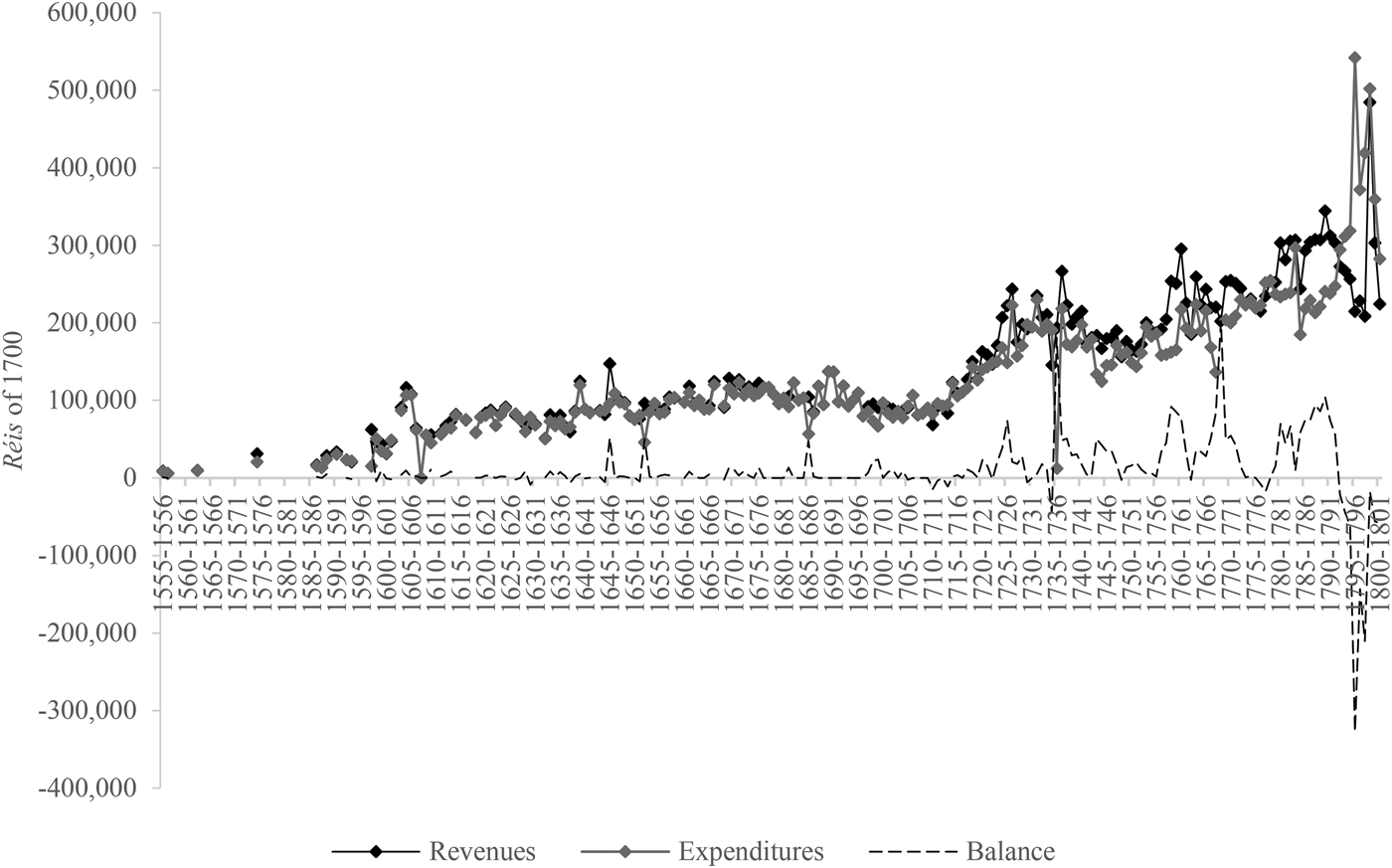
The Misericórdia of Porto's finances, 1555-1800.
Notes: The account books of 1557-61, 1563-64, 1576-85, 1589-90, 1594-96, 1602-03, 1607-08, 1625-26, 1631-32 are missing, and those of 1659-60, 1667-68, 1735-36 and 1771-72 are incomplete.
Sources: For 1571-1668, see Sá (Reference Sá, dos Guimarães Sá and Amorim2018b, pp. 200-207 and extra text III). For 1669-1800, AHSCMP, Série E, Banco 1, Books 36-41, Banco 2, Books 1-32; Banco 3, Books 1-28. Deflator as in Table 1.

In financial terms, no other Misericórdia could compare with that of Lisbon. In 1607, its revenue accounted for 2.6 per cent of the crown's revenue and 1.2 per cent in 1766. These numbers reveal its financial wealth and suggest that few competed with it.Footnote 2 Despite being the second-largest charity in the kingdom, the Misericórdia of Porto had an annual revenue of about three to six times less than that of its counterpart in Lisbon (Table 1).Footnote 3 Notwithstanding, its revenues were far from negligible, as they were similar to that of other major organisations, such as the Portuguese Inquisition in 1770 (Lopes Reference Lopes2021, p. 513). To date, not a single case of bankruptcy of these institutions is known, despite the difficult years that some of them had to deal with. Figure 1 shows the evolution of the finances of the Misericórdia of Porto and its solvency throughout the early modern period.
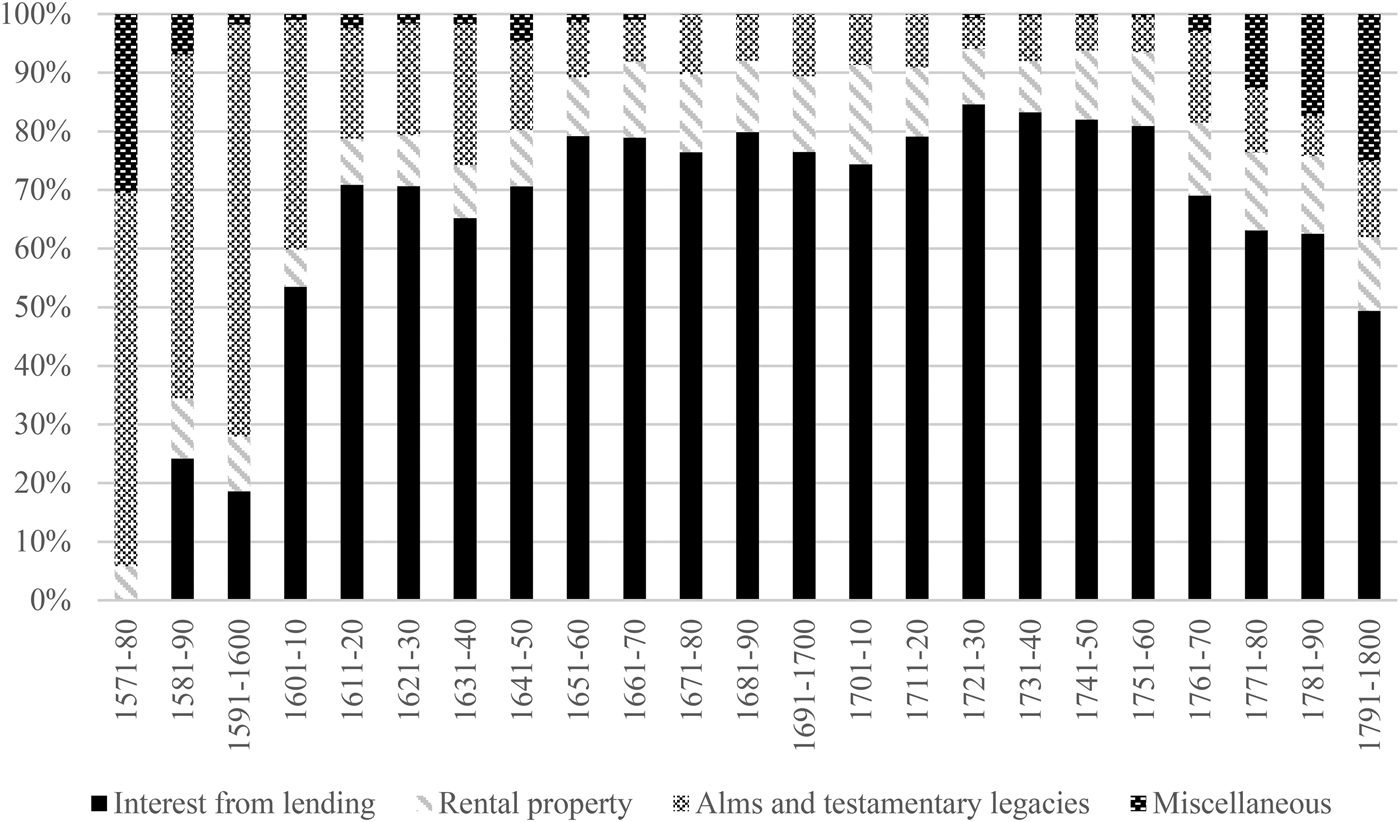
It is no wonder that institutions with such sound finances became important active economic agents engaging in different markets, such as the real estate, labour and financial markets. Figure 2 breaks down the sources of revenue of the Misericórdia of Porto between 1571 and 1800.
Sources of revenue of the Misericórdia of Porto, 1571-1800 (percentage).
Sources: As in Figure 1.

As with other European and colonial charitable institutions (Teeuwen Reference Teeuwen2014; Grafe Reference Grafe2022), early revenues for the Misericórdias came mainly from pious bequests. Despite receiving small alms and other voluntary endowments, in the case of Porto, overseas donations explain the predominance of this source of income from 1571 until the early 17th century (Figure 2). In 1584, the confraternity received its first significant inheritance from Dom Lopo de Almeida (c.1525-84), chaplain of King Filipe I of Portugal (reign 1580-98) and founder of the largest hospital in the city (Basto Reference Basto1964). This inheritance set the stage for the consolidation of the Misericórdia's finances, asserting it as the city's primary charitable institution from then onwards. In addition to this inheritance, the late 16th century brought other exceptionally fruitful testamentary legacies, mainly from overseas benefactors (Sá Reference Sá2018a, pp. 121-143; Reference Sá, dos Guimarães Sá and Amorim2018b, pp. 184-195). The ‘first golden age’ of post-mortem donations lasted approximately until the 1620s, when this source of revenue accounted for, on average, more than half of the Misericórdia's income, followed by a decline in their relative importance. From the 1750s onwards, testamentary legacies and donations were again accountable for the confraternity's prosperity. The revival of endowments was in line with other Portuguese Misericórdias, which started to receive substantial inheritances from Brazilian donors in the second half of the 18th century (Sá Reference Sá1997, p. 83; Reference Sá, dos Guimarães Sá and Amorim2018b, p. 166; Abreu Reference Abreu and Paiva2002, pp. 247-258).
Rental property, in turn, played a relatively small part in the annual revenue, which, at its peak, represented 23 per cent (1705) of the total budget. On average, it corresponded to a slim 11 per cent of all income. Other Misericórdias, such as that of Lisbon, shared this figure, where revenues from real estate were also marginal, at least in the 18th century (Rodrigues Reference Rodrigues2019b). The statutory prohibition of the acquisition of real estate can explain how unimportant rental property was in the annual income of these confraternities.Footnote 4 According to the bylaws (Compromisso), whenever the Misericórdias received land or buildings through donations or wills, they had to sell them in a public auction to the highest bidder, who could not be a member of the current ruling board (Araújo and Paiva Reference Araújo and Paiva2007, pp. 228, 246). This rule could only be broken in two situations: when the king explicitly authorised the confraternities to acquire and hold real estate and when the confraternities received entailed property, which, due to its nature, had to be used to finance the benefactors' determinations.
Had the Misericórdias incorporated real estate into their patrimony because of a judicial sentence (through rent arrears or non-performing credits), they would also have been forced to sell it within 1 year and 1 day. Monies from such sales were usually placed in the credit market, deemed a safe (low risk) and less expensive investment. The bylaws openly acknowledged that purchasing and managing real estate was a less attractive investment compared with the acquisition of financial assets (Araújo and Paiva Reference Araújo and Paiva2007, p. 241). While the statutory prohibition of keeping and acquiring real estate left the Misericórdias with few options for investment, they enjoyed far more autonomy to engage in financial markets. Testators often spelt out in their last wills the procedures to monetise their inheritances, which often relied upon the acquisition of free-standing income and moneylending (although they seldom specified whether the loans were to private individuals or the public sector). Interest from loans assured a regular stream of income that the Misericórdias needed to meet their charitable purposes, mainly to fund chantries and other charitable practices.Footnote 5 It is important to note that the loans granted by these organisations were not works of charity, for they were not directed to the poor strata of society, as was the case with the Italian Monte di Pietà (Carboni Reference Carboni2013). The Misericórdias extended loans to debtors of different social backgrounds, from farmers and artisans to members of the high nobility, for various purposes, including consumption, rollover of debts or investment. As Grafe (Reference Grafe2022, p. 8) pointed out for Spanish America, these organisations considered the investment of the accumulated capital as «a duty». Investment rationality ran through most of the ruling board's decisions, often deliberating on where to invest the assets, to whom to loan money and how profitable the investments could be.
Figure 2 shows that from the early 17th century onwards, revenues from lending activities never represented less than 40 per cent of the annual budget (except for 1760-63 and 1792-99). Figures in Porto did not diverge substantially from other Misericórdias, as they repeatedly displayed the same predominance of moneylending income in their annual budget (Costa Reference Costa1999, pp. 106-128, 142-143; Amorim Reference Amorim2006; Rodrigues Reference Rodrigues2019b). Not only did these charities allow access to credit for a large segment of the population, whether in urban or rural settings, but they also became essential creditors of the Portuguese monarchy during the early modern period (Abreu Reference Abreu2003; Araújo Reference Araújo and Fernandes2009; Sá Reference Sá2018a). Although the importance of the Misericórdias as creditors of the monarchy and of individuals is indisputable, questions about the reasons underlying their investment behaviour and the functioning of the credit market remain unanswered. The following section briefly examines the functioning of the credit market and analyses the Misericórdias' credit structure.
3. The credit market and the Misericórdias
In the early modern period, creditors, whether private or institutional, had a wide range of investment options and could apply their savings to short-, medium- or long-term loans. The well-functioning of the credit markets depends largely on the institutional framework that supports the agreements that imply intemporal decision-making. In the first part of this section, we briefly discuss the main institutional features of the early modern Portuguese credit market and the credit instruments available to borrowers and lenders. We then assess the credit structure of the Misericórdias from 1550 to 1800.
3.1 The credit market in early modern Portugal
Moneylending was widespread in early modern Europe, and Portugal was no exception (Rocha Reference Rocha1996; Muldrew Reference Muldrew1998). The well-functioning of credit markets depends on the institutional framework that allows the reduction of transaction costs, arising mainly—but not only—from information asymmetries, such as adverse selection (ex ante), moral hazard (ex post) and agency problems (North Reference North1990). Early modern notaries played a crucial role in match-making parties to a contract and thus mitigated information asymmetries and reduced transaction costs (Hoffman et al. Reference Hoffman, Postel-Vinay and Rosenthal2019). Although credit agreements could be made informally, lenders and borrowers preferred to make them formally before a notary, knowing that their rights would be legally protected and the contract would be swiftly enforced before the law. Formal institutions—such as the law courts—also played a role in the functioning of credit markets, for they enforced contracts and, thus, protected creditors' property rights. The institutional framework is, then, crucial for the allocation of resources, the design of efficient contracts and their enforcement and, ultimately, for the correct functioning of the market (North Reference North1990).
Borrowers and lenders had several credit instruments at their disposal depending on their needs, all of which were recognised before Portuguese law and signed before notaries: long-term instruments, such as annuities/perpetuities (either private or public), or short–medium instruments, such as obligations, bills of exchange or simple notes. Annuities were the most widely used financial instruments throughout medieval and early modern Europe. Little is known about the extent to which they were used in Portugal, but their structure was quite similar to French and Flemish rentes (Munro Reference Munro2003). Known as censos, private perpetuities corresponded to contracts in which the seller/debtor ‘sold’ a fraction of the future revenues of a given property. In return for a capital sum given to the seller/debtor, the buyer/creditor held the right to an annual payment (censo) in kind or cash. These contracts seldom declared the interest rate, although it can be assessed through the ‘annual pension’ paid by the seller/debtor to the buyer/creditor and the principal advanced by the latter. The contracts could include a buy-back clause (pacto de retro), giving the borrower the right to dissolve the agreement, and the censo could be ‘sold’ perpetually or in lifetimes (Costa Reference Costa1961). Unlike short-term private loans (obligations), the censo was typically associated with the rural world, mainly with agrarian credit (Costa Reference Costa1961; Munro Reference Munro2003). Due to their perpetual nature, in Iberia, these instruments were much used by religious institutions to acquire revenues to meet the cost of perpetual religious services (Ena Sanjuán Reference Ena Sanjuán2021) or to ensure grain supply in times of inflation (Rodrigues Reference Rodrigues2013). Evidence from Portugal shows that, as early as the 13th century, censos had comparatively low interest rates and creditors' property rights were relatively well protected by formal institutions (Henriques Reference Henriques2020).
In addition to private perpetuities, lenders could channel their liquidity to other long-term credit operations, such as the acquisition of sovereign debt (padrões de juro). In the early 16th century, the Portuguese crown started to issue debt to raise funds to meet its needs. Like the Castilian juros al quitar (Toboso Sánchez Reference Toboso Sánchez1987; Álvarez Nogal Reference Álvarez Nogal2009) or the Flemish and Dutch losrent (Tracy Reference Tracy1985), the Portuguese padrões de juro consisted of perpetual and redeemable credit titles issued by the crown against fiscal revenues (Gomes Reference Gomes1883). The payment of the annual interest (juros) relied on fiscal revenue streams (almoxarifados or alfândegas), making these investments a safe option. The contract came about when the creditor delivered a capital sum to the debtor—the king—in Lisbon after the public announcement of the sale of annuities through edicts (Gomes Reference Gomes1883). In exchange, the creditor held the right to receive an annual amount corresponding to the loan's interest (juro). Despite their perpetual nature, these contracts could be amortised or redeemed at the debtor's discretion (Costa and Miranda Reference Costa and Miranda2023). Like censos, padrões de juro included a buy-back clause, whereby the debtor could dissolve the contract by paying back the creditor's capital at any time. Issuing debt was not exclusive to monarchs, as noble households and municipal councils could also resort to this expedient to meet their financial needs. Municipal and noble long-term debt shared the same features as government debt; differences relied upon the revenue streams that backed the annual interest payment and the interest rate could vary from the sovereign debt instruments.
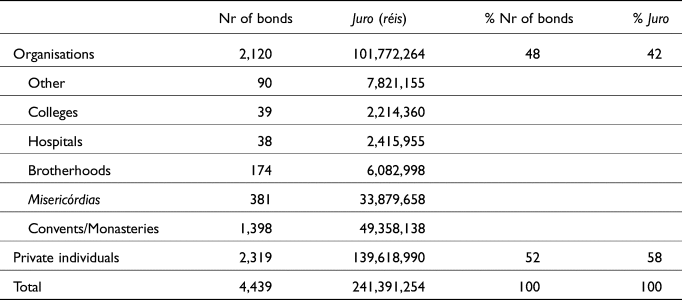
Whether first issuances, dealings in the secondary market or debt management situations, padrões de juro were repeatedly recorded in the royal chancery books. The participation of institutional investors in Portuguese sovereign debt was not insignificant. Table 2 shows the type of investors of the monarchy, based on a list of all juros paid by the crown in 1694.
Type of creditors of the Portuguese crown, 1694

Source: BNP [Juro das alfândegas e almoxarifados do reino], PBA. 125.
Private individuals and institutional investors played a similar role in sovereign debt in the late 17th century, either in the number of titles or juros paid.Footnote 6 Although the Misericórdias ranked second among the organisations that acquired public bonds, their predominance in the credit market should not be underestimated, as there were far fewer Misericórdias than convents and monasteries.Footnote 7
Bondholders acquired these titles directly (through the primary or secondary markets) or indirectly (through inheritances or the settlement of private debts). The purchase of government bonds in the secondary market had several advantages. First, individuals/organisations could buy a fraction rather than the whole bond. Then, they could purchase older bonds, meaning they were paid before bondholders who held titles issued more recently. Furthermore, the selling price could be negotiated between the parties, as long as the bond was not sold «at less than half of the fair price» (Ordenações Filipinas [1985] 1603, Book 4, Title 13). Although bonds were generally sold at par, there is evidence that buyers occasionally paid extra (referred to as pitanças) to guarantee the business.Footnote 8
For short- or medium-term investments, creditors could rely on obligations, generally used for consumption needs and rollover of debts (Costa et al. Reference Costa, Rocha and Brito2018b). Unlike in France, obligations in Portugal often stated the date of repayment and the interest rate (Hoffman et al. Reference Hoffman, Postel-Vinay and Rosenthal2019). These loans were usually made against a wide range of assets, such as real estate, pawns and rights over revenues (debts, rents, salaries). Contracts often determined 1 year of duration but allowed for an extension if the parties agreed. Once the maturity had expired, the creditor was legally entitled to ask for the repayment of the principal and the due interest. In 18th-century Lisbon, evidence from notarial records and probate inventories demonstrates that all social strata participated in the private credit market, either as borrowers or lenders (Rocha Reference Rocha1996; Costa et al. Reference Costa, Rocha and Brito2018a). The former were mainly nobles, and the latter were businessmen and professionals, but individuals from all occupations engaged in the market. It often happened that loans were not repaid in whole or in part, and creditors could seek redress through formal or informal institutions. Debt restructuring was one of the ways to avoid default, but creditors also had other formal mechanisms at their disposal. Portuguese law protected creditors' property rights, and law courts often enforced contracts expeditiously (Rodrigues Reference Rodrigues2019c), although idiosyncratic characteristics of the parties could affect the enforcement mechanisms (Reis Reference Reis, Ma and van Zanden2011).
3.2 The Misericórdias in the credit market
The Misericórdias found the preferential means to monetise the funds they acquired through testamentary legacies and alms in the credit market. They engaged in the private credit market via long-term (interchangeably censos or pensões) and short- and medium-term contracts (obrigações), and also in the market for government bonds, through the acquisition of padrões de juro. Table 3 provides the Misericórdia of Porto's investments in the credit market from the late 16th century to the end of the 18th century.Footnote 9
Size of the Misericórdia of Porto's investment in the credit market (in Réis), 1550-1800

Sources: For loans to the crown, ANTT, Chancelarias régias; for private loans, AHSCMP, Série H, Banco 8, Books 1-31.
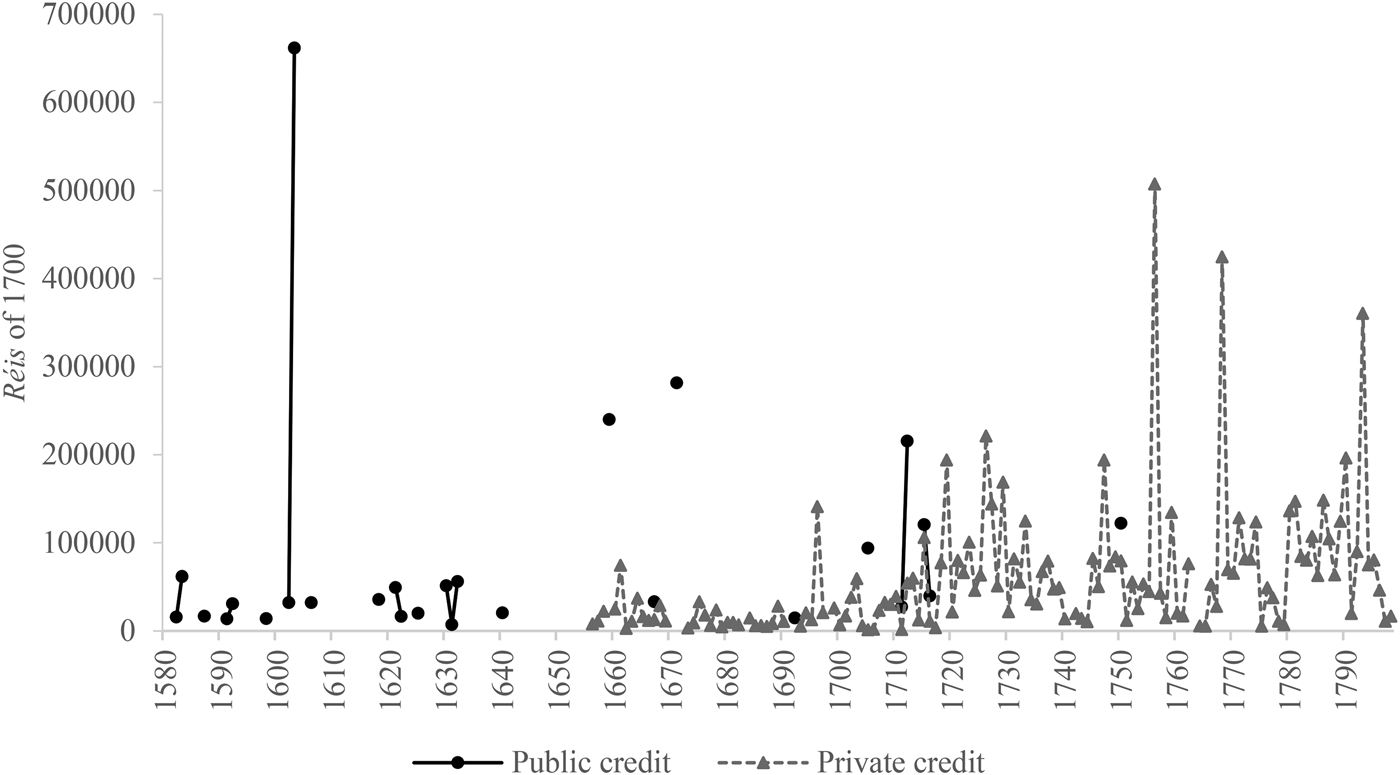
Between 1550 and 1800, the Misericórdia of Porto invested approximately 918 million réis in the credit market, 85 per cent in private lending and 15 per cent in public debt. Table 3 shows a significant change in the Misericórdia's investment pattern. While in the 16th and 17th centuries, it mainly invested in public credit, in the 18th century, it operated in reverse, channelling 95 per cent of its investments to private lending. This shift is more telling when considering the annual distribution of investments (Figure 3).
Yearly investments of the Misericórdia of Porto in the credit market, 1580-1800.
Note: Absolute number of transactions in public credit (29: 26 purchased from the Portuguese crown, two from the Casa de Bragança and one from the city council) and private credit (660).

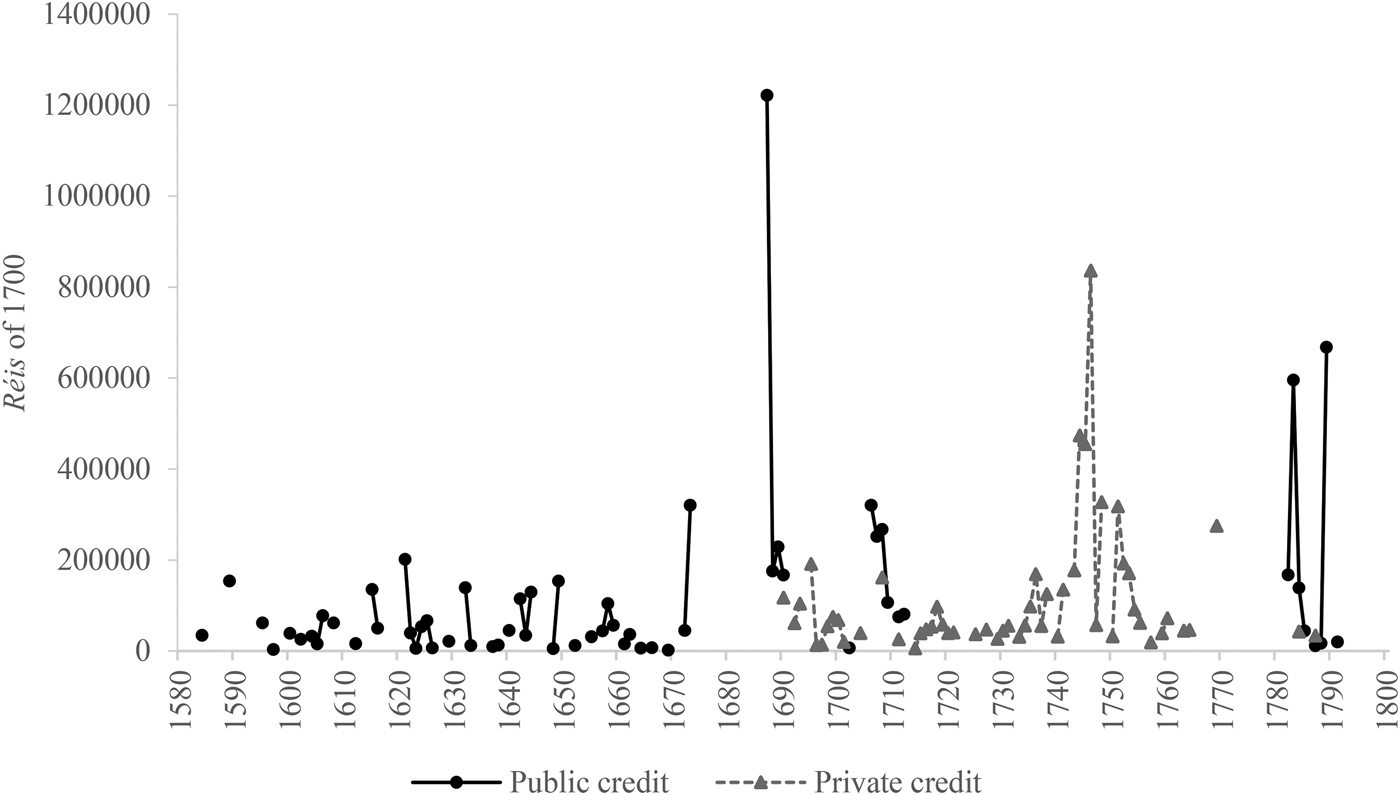
Figure 3 shows that the Misericórdia of Porto ceased to invest in government bonds in the early 18th century. The last juro purchased from the crown dates from 1712. From this point onwards, the Misericórdia invested only three times in the public sector: in 1715 and 1716, it acquired two debt titles issued by the Casa de Bragança (duchy household), and in 1750 it acquired a municipal bond. After 1712, the confraternity began to allocate its savings heavily to the private credit market. Such a significant shift in the investment pattern was not exclusive to the Misericórdia of Porto, as that of Lisbon shows similar trends (Figure 4).
Yearly investments of the Misericórdia of Lisbon in the credit market, 1580-1800.
Note: The private loans series displayed in the figure above is underestimated, as the archives of the Misericórdia of Lisbon were lost in the 1755 earthquake. The series includes loan amounts that were reconstructed from other sources, mainly lawsuits, private correspondence and deliberations of the ruling boards. Absolute number of transactions in public credit (130) and in private credit (106).
Sources: For government bonds, ANTT, Chancelarias régias and Rodrigues (Reference Rodrigues2019b); for private loans, Rodrigues (Reference Rodrigues, Lopes and Jesus2019a). Deflator as in Table 1.

Except for the late 18th century, the chronology of investments made by these two confraternities is similar (Figure 4). Like the Misericórdia of Porto, that of Lisbon stopped investing in government bonds in 1712. After that date, it only participated in the public credit market between 1784 and 1791, after the crown's regulation of its credit activity (Lopes Reference Lopes2008; Rodrigues Reference Rodrigues2019b). Figure 4 also shows that from the 1730s onwards, the Misericórdia of Lisbon strengthened its participation in private lending. The peak in loans to individuals in the 1740s was due to the exceptional liquidity that the Misericórdia enjoyed at the time (Monteiro Reference Monteiro2003). In 1743, King João V (reign 1707-50) not only ordered that all government bonds that carried an interest rate above 5 per cent be reduced, but also that they be transferred to the Patriarchal See. This operation lasted until the late 18th century, and it is estimated that approximately 5,000 million réis were redeemed (Azevedo Reference Azevedo1988, pp. 374-375). At the time, the Misericórdia of Lisbon still held government bonds at 6.25 per cent. Our estimates indicate that the confraternity lost at least forty-eight bonds to the Patriarchal See, of which forty were redeemed in the 1740s. This operation allowed the Misericórdia to cash in approximately 85 million réis, which it channelled directly to private lending.
The Misericórdia of Lisbon stopped granting loans to individuals in 1775 due to a chronic situation of non-performing loans. Creditors and debtors formed the same group of individuals; both were members of the high court nobility, who also had a seat on the Misericórdia's ruling boards (Serrão Reference Serrão1998; Monteiro Reference Monteiro2003). Debtors often had difficulty in paying the annual interest, and the Misericórdia failed to set up an effective charging system, enabling the accumulation of an extraordinary volume of due interest and capital, with severe repercussions for the organisation's financial health. Even resorting to law courts or private order institutions did not solve loan non-compliance issues (Rodrigues Reference Rodrigues, Lopes and Jesus2019a, Reference Rodrigues2019c). In this context, the crown started to meddle in the confraternity's credit activity (Lopes Reference Lopes2008). Although a collection of decrees was issued to regulate the volume of credit and the collaterals that backed up the contracts, these texts proved unsuccessful and in 1775 the ban on participation in the private credit market was enacted.
Figures 3 and 4 raise several questions: why did significant creditors such as the Misericórdias cease to lend to the monarch at the same time? What explains this turning point and, particularly, the timing of their growing interest in the private credit market to the detriment of the public sector? In what follows, we consider the determinants of fund allocation and put forward two hypotheses. First, private interest rates may have been more attractive than the interest paid on public loans; institutional investors therefore channelled their resources to a more profitable business. Second, potential problems in servicing public debt might have pushed institutional creditors to allocate their funds to private lending.
4. Determinants of fund allocation towards private loans and sovereign debt
4.1 Interest rates
Interest rates are deemed a valuable tool to assess the quality of financial markets (North Reference North1990). One can hypothesise that private interest rates might have been more attractive to the Misericórdias, diverting investments from the public sector. To test this hypothesis, we collected the nominal interest rates stated in both short- and long-term public and private lending contracts signed by the Misericórdia of Porto.
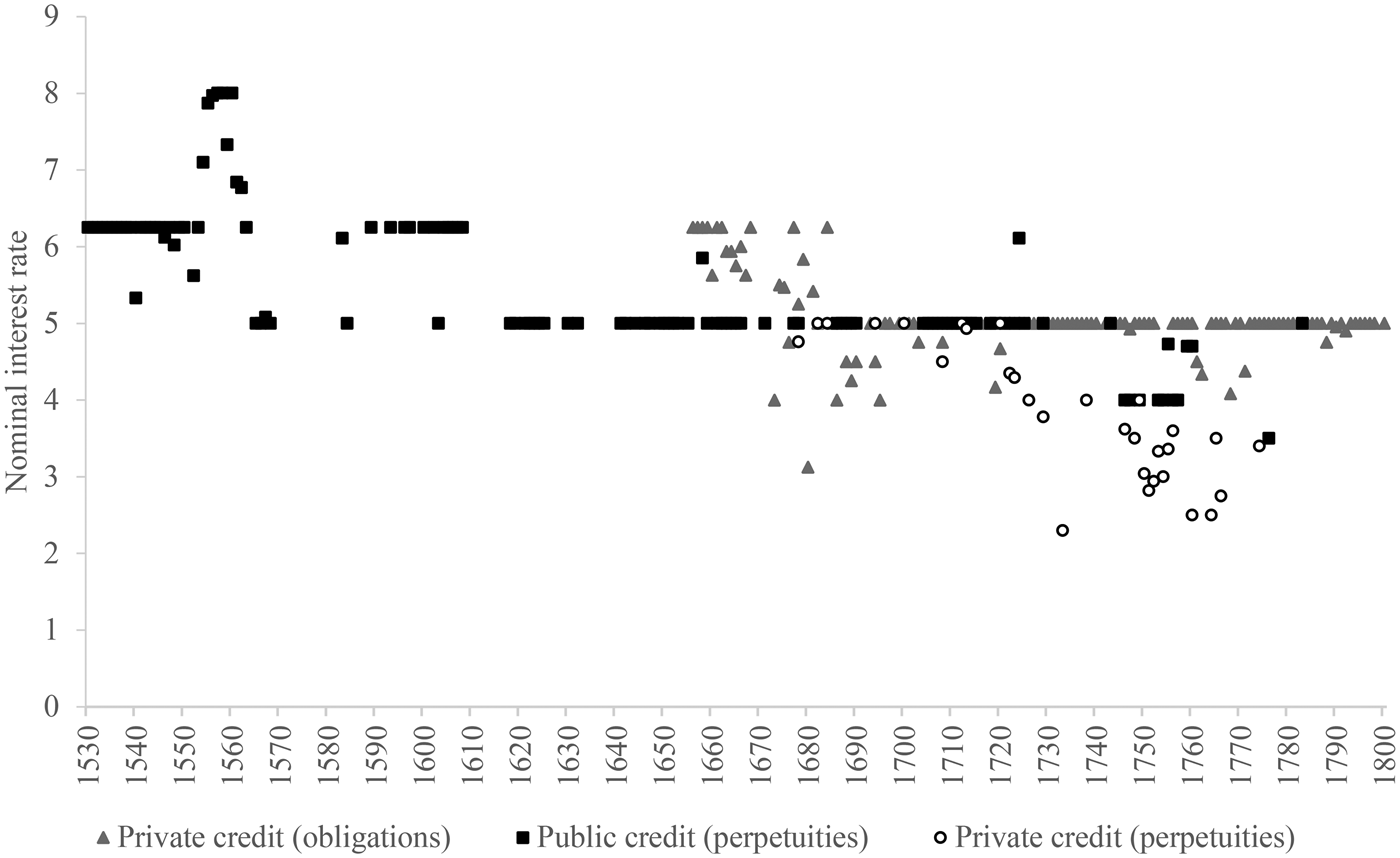
Figure 5 charts nominal interest rates for short- and long-term private and public loans from the early 16th century to the end of the 18th century. The data corroborate what was already known about the declining trend in interest rates for private and public credit before 1800 (Clark Reference Clark2005; Grafe Reference Grafe2012, p. 15; Costa et al. Reference Costa, Rocha and Brito2018b; Sussman Reference Sussman2022).Footnote 10 Portuguese government bonds were sold at 8 per cent in the mid-16th century, 6.25-5 until the mid-18th century, and 4 per cent in 1770 (Costa et al. Reference Costa, Miranda and Nogues-Marco2021). The same steadily declining trend held for obligations (Costa et al. Reference Costa, Rocha and Brito2018b), and it was only in 1757 that a 5 per cent cap was fixed for all private credit contracts.Footnote 11 Until then, rates for private loans ranged between 6.25 and 0 per cent.
Nominal interest rates for private loans and government bonds, 1530-1800.
Note: Private perpetuities depicted in the figure above refer to censos paid only in cash.
Sources: For public perpetuities, see the database in the research project Sovereign Debt and Private Credit in Portugal (1668-1797) (PTDC/HAR-HIS/28809/2017) (www.debt.pt); for private perpetuities and obligations, see Table 3.

Unlike that for Castile, evidence for Portugal's private perpetuities (censos) is scarce. In 1614, a royal decree fixed at 5 per cent (20,000 réis o milhar) the rate for censos paid in cash or goods and 10 and 8.3 per cent for life annuities, whether over one or two lives (Collecção 1747, pp. 115-116).Footnote 12 However, the royal decree was waived in 1643. It was only in 1698 that the monarch decided that all censos should not be sold with an interest rate higher than 5 per cent. The document noted that:
«Wealthy men with little money buy censos and juros over the estates of the neediest and thus bring them excessive debts. They can pocket the principal in a few years and continue to receive the interest, and often acquire property through foreclosures, leaving the seller in a miserable state» (Silva Reference Silva1854, pp. 410-411).
Figure 5 shows that the Misericórdias did not stop investing in government bonds due to the higher profitability of the private sector, as private and public credit displayed similar interest rates, approximately 5 per cent, by the mid-1710s. From 1580 to 1800, the Misericórdia of Porto acquired twenty-six padrões the juro from the Royal Treasury: nineteen were at a 5 per cent interest rate, six at 6.25 per cent and one at 4 per cent. For those purchased at 6.25 per cent, the interest was lowered to 5 per cent in 1624 as part of an operation of interest reduction started by King Filipe II in 1614. In such operations, creditors had three options: (1) accept the interest rate reduction, (2) keep the same interest rate by topping up the principal, or (3) refuse the reduction and be repaid. In 1624, the Misericórdia chose the former and, at the beginning of the 18th century, all juros held by the Misericórdia of Porto ran at 5 per cent, except for a padrão de juro purchased in 1711 that was at 4 per cent. When lending to individuals, the confraternity usually granted short-term loans at 6.25 per cent. However, the interest rate was seemingly fixed at 5 per cent in the 1690s and persisted until the end of the 18th century.Footnote 13 Lower interest rates (3 per cent) were usually charged to specific borrowers, such as religious institutions. Regardless of the debtor, contracts could stipulate a fine in case the borrower defaulted on the payment of the annual interest, being bound to a new rate of «6.25 per cent until the liquidation of the loan, rather than the 5 per cent rate».Footnote 14 Although it is unclear whether the Misericórdia implemented the contracts' wording, such clauses reveal its leeway in charging a default risk premium.
Only the interest rate on private perpetuities paid in cash started to decline around 1708 (4.5 per cent), reaching 2.5 per cent in the 1760s.Footnote 15 Notwithstanding, the Misericórdias and other organisations did not seem interested in this type of contract, which, in contrast, was the preferred credit instrument in Castile and Aragon (Milhaud Reference Milhaud2019). The Misericórdia of Porto only began to invest in censos sporadically in the late 17th century, an activity that had ceased by the late 1760s. In 1770, the ruling board of the Misericórdia acknowledged that:
«All [censos] are purchased at the rate of 3 or 3.5 per cent, which was derived from persuasion and importunate pleas by the parties and the piety of the councillors of this ruling board, without a thorough examination of the resulting damage to this Misericórdia.»Footnote 16
Whereby, councillors determined:
«not to allow the purchase of rents, pensions or censos charged on houses or lands already owned by this Misericórdia to avoid the severe damage that can result from the loss of part or the whole of the said pension as it often happens when, due to fires only the floor of the buildings remains, and to rebuild them it is necessary to use a large part of the rent, sometimes spending many years getting someone willing to invest in it.»Footnote 17
As the Misericórdia was not interested in private perpetuities, it allocated its funds to obligations and sovereign debt. However, both contracts ran a similar interest rate in the mid-1710s when government bonds disappeared from the Misericórdias' investments, which suggests that the participation of these confraternities in the sovereign debt market was not related to the price of credit.
4.2 Debt service
Another possible explanation for the turning point in the Misericórdia's investment behaviour is debt service. Property rights are critical in explaining capital allocation, as investors tend to abandon specific forms of investment whenever their rights are not guaranteed (North and Weingast Reference North and Weingast1989). Therefore, investments in the public and private sectors are deemed reliable if the debtor conveniently pays the annual interest. Otherwise, creditors will likely channel their funds to other investments.
In Portugal, government bonds were considered low-risk investments, mainly because fiscal revenues backed the payment of interest. These contracts were silent about the likelihood and consequences of the king's defaulting on his financial obligations. Occasionally, monarchs assigned a secondary fiscal stream to back the payment of the yearly interest should the primary stream dry up. In any case, creditors had no right to claim the repayment of the principal in case of default, which was up to the debtor. In 1659, the crown halted the payment of one juro consigned in the Porto Customs House to the Misericórdia of Porto. The confraternity's ruling board decided to judicially write to the Treasury Council demanding the payment of the arrears on the grounds that its charitable activities had been compromised since the suspension of the payment. It seems that the Treasury Council was extending the case and the Misericórdia was quick to address the king directly, reporting on the situation after hearing its councillors about the legitimacy of the claim. The councillors stated that:
«According to the law of preference and the special mortgage and any other consignation, Your Majesty has no privilege for considering himself as any other private person with respect to the said obligation [the payment of the juro].»Footnote 18
Although the arrears were only paid in 1683, this telling example demonstrates that whenever needed, creditors, at least institutional ones, could—and did—pressure the monarch to fulfil his financial obligations.Footnote 19 Despite the apparent impunity of the debtor, there was a general perception among creditors that sovereign debt was the safest of investments. Another telling example corroborates this idea. In 1687, the Misericórdia of Porto intended to redeem a bond it had purchased from the Duchy of Braganza (which by then was poorly paid), and with the proceeds of this operation, it intended to buy a sovereign bond consigned in the Tobacco Customs House, one of the most desirable fiscal streams. The members of the ruling board acknowledged that «in a few years, the Misericórdia will want to do it [redeem the Braganza's bond] at a time when there will be no government bonds [consigned in the Tobacco Customs House] in which to invest as there is now».Footnote 20
In contrast, loans advanced to individuals were considered less secure because debtors often missed the payments of annual interest, and it was very expensive to execute each one of them (Rodrigues Reference Rodrigues2019c). The enforcement of these contracts was complex, lengthy and, therefore, costly. The Misericórdia's ruling boards recognised that «despite having granted the loans with the necessary collateral, some debtors and their guarantors went bankrupt».Footnote 21 Creditors understood that the wording of the contracts did not protect them entirely because the execution of collaterals was far more painful than stated in the agreements. Additionally, there was the perception that should cases go to court, judicial rulings were uncertain, which aggravated the risk of lending to the private sector even more.Footnote 22 Missed annual interest payments, default on credit and debtors' bankruptcies were common scenarios in the Misericórdias' lending activities (Lopes Reference Lopes2008). For some Misericórdias, such as that of Lisbon, the non-compliance of private credit contracts took significant proportions, hovering around 70 per cent of all loans (Rodrigues Reference Rodrigues, Lopes and Jesus2019a, Reference Rodrigues2019c). The high proportion of default on debts in the case of Lisbon had to do with the inbreeding nature of the loans, which were addressed mainly to the members of the high nobility, who were, at the same time, members of the confraternity and had a seat on its governing bodies. The case of Porto, however, seems to have been quite different, as only 6.7 per cent of the loans were in litigation or went bankrupt (Amorim and Costa Reference Amorim, Costa, de Araújo and Osswald2018, p. 181).
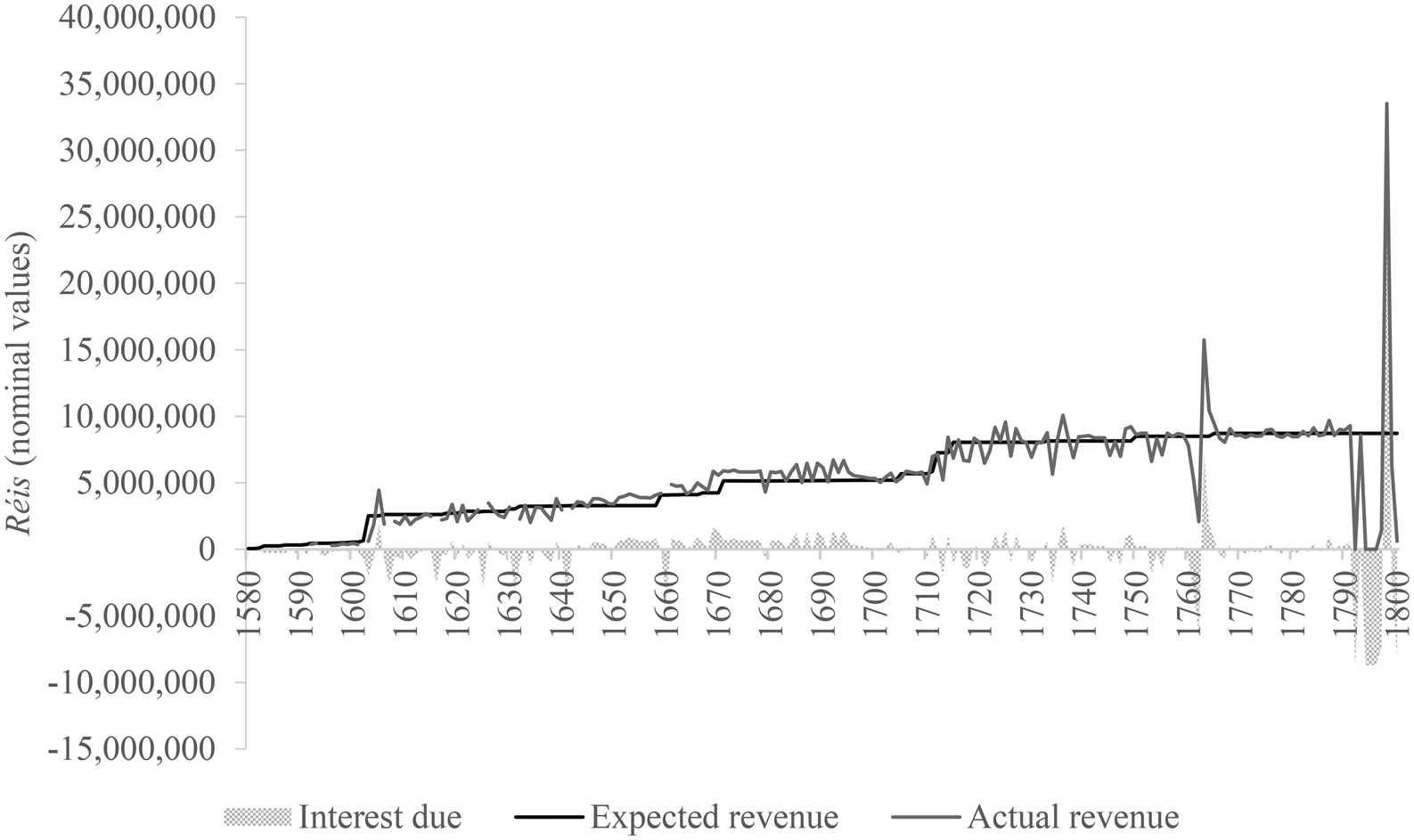
Despite evidence on this general perception of the risk of lending, there is little empirical evidence about the regularity of the payment of annual juros and its impact on creditors' investments. One might wonder whether the instability of interest payments by the crown led the Misericórdia of Porto to try to overcome the situation by investing in the private segment of the credit market. If this assumption is confirmed, it demonstrates the ability of the confraternity to circumvent complex financial problems. To explore this hypothesis, Figure 6 presents for the first time the payment of juros to the Misericórdia of Porto between 1580 and 1800. The series is the most complete regarding Portuguese debt servicing ever assembled and novel in its chronological breadth.

Figure 6 shows that, despite the yearly instability of the series, interest from government bonds was correctly paid. The volatility of payments seems to have been more significant from the beginning of the 18th century onwards, although the period of the Iberian Union (1580-1640) also displayed yearly fluctuations, emphasising the erosion of the credibility of padrões de juro (Costa and Miranda Reference Costa and Miranda2023, p. 10). The 1630s were significant in this regard and a royal document stated that:
«It is worth of great consideration the discredit in which are the juros because, by not paying them fully, it is difficult to find someone willing to purchase them; and this is to Your Majesty's great detriment, having the juros been the means with which Your Majesty and the past kings had answered to precise needs» [1634-05-10] (Silva Reference Silva1854, pp. 43-46).
Additionally, between 1659 and 1665, not all juros were paid; mainly those consigned to the Porto Customs House, because their income had by then dried up due to «the lack of trade and fleets from Brazil that all go now to the city of Lisbon and due to the half dues it pays to the English nation for the capitulation of peace».Footnote 23 The irregularity of debt service from 1720 onwards was mainly caused by one juro consigned in salt from Setúbal. Shortly after its acquisition in 1711, the Misericórdia concluded that it was a ruinous investment because the annual interest was poorly paid, with frequent delays in part or total.Footnote 24 The 1790s were undoubtedly difficult years for the Portuguese monarchy and Figure 6 highlights the dire straits the crown was in on this matter. The non-payment of juros in the 1790s was not exclusive to the Misericórdia of Porto; other charities, such as Viana do Castelo (Ribeiro Reference Ribeiro2009, p. 397), Guimarães (Costa Reference Costa1999, p. 121) and Lisbon faced the same trend. In 1792 and 1794-96, payments halted completely, and in the following years (except for 1798-99), the crown paid very little.Footnote 25 The reason for which payments stopped lies in the participation of Portugal, along with Spain, in the Roussillon Campaign (1793-95) against France, which required all available funds to finance the army (Costa Reference Costa1992).
Contrary to what has been argued in the literature (North and Weingast Reference North and Weingast1989; Reinhart and Rogoff Reference Reinhart and Rogoff2009), Portuguese monarchs, although absolutists, did not default on their financial commitments during the early modern period.Footnote 26 While delays in the payment of interest were common, and partial suspensions did occur, especially during the Iberian Union, there is no evidence that the Portuguese monarchs did not honour their financial obligations. Moreover, Figure 6 does not show any sharp suspension in the debt service that could justify the disinvestment of the Misericórdias in government bonds. In fact, defaults occurred long after the Misericórdias had stopped investing in sovereign debt in the mid-1710s. Hence, the investment behaviour of these confraternities was related neither to interest rates nor to the poor performance of the Portuguese crown in servicing public debt. The following section assesses the supply and demand of government bonds and their potential effects on the investments of the Misericórdias.
5. The supply and demand of government bonds and their effects
In this section, we look at the supply and demand of government bonds as a possible explanation for the demise of the Misericórdias' investments in sovereign debt by the mid-1710s. Towards the end of the 18th century, the Misericórdia of Porto owned thirty-three government bonds, corresponding to an annual revenue of approximately 7.3 million réis (Table 4). These figures are tiny when compared with those relating to the Misericórdia of Lisbon, which in the same period held 358 bonds, yielding c. 51.2 million réis per year (Rodrigues Reference Rodrigues2019b).Footnote 27 These two Misericórdias also differed in the way they made their acquisitions, in that most government bonds held by the Lisbon Misericórdia were the result of inheritances.
Forms of acquisition of government bonds by the Misericórdia of Porto, 1574-1800

Sources: ANTT, Chancelarias régias.
Table 4 demonstrates that the Misericórdia of Porto acquired most of its government bonds (26 = 79 per cent) in the market with the money from testators, as this was a standard way to increase its revenues. The first bonds owned by the confraternity were purchased on the secondary market. Between 1582 and 1600, six padrões were acquired, yielding 455,000 réis. After this date, the Misericórdia only obtained three juros in the secondary market, one in 1602 and two in 1692.
Investments in the market for government bonds did not always derive from the Misericórdia's ruling boards, nor did they follow the donors' testamentary clauses. Lenders also engaged in the market following the monarchs' suggestion. Of the twenty-six public bonds purchased by the Misericórdia, eleven (42 per cent) were obtained after the king had proposed their acquisition. This is even more meaningful if we consider the scale of the investment: 79 per cent (5.8 million réis) of the revenues from government bonds derived from these «suggested» loans.
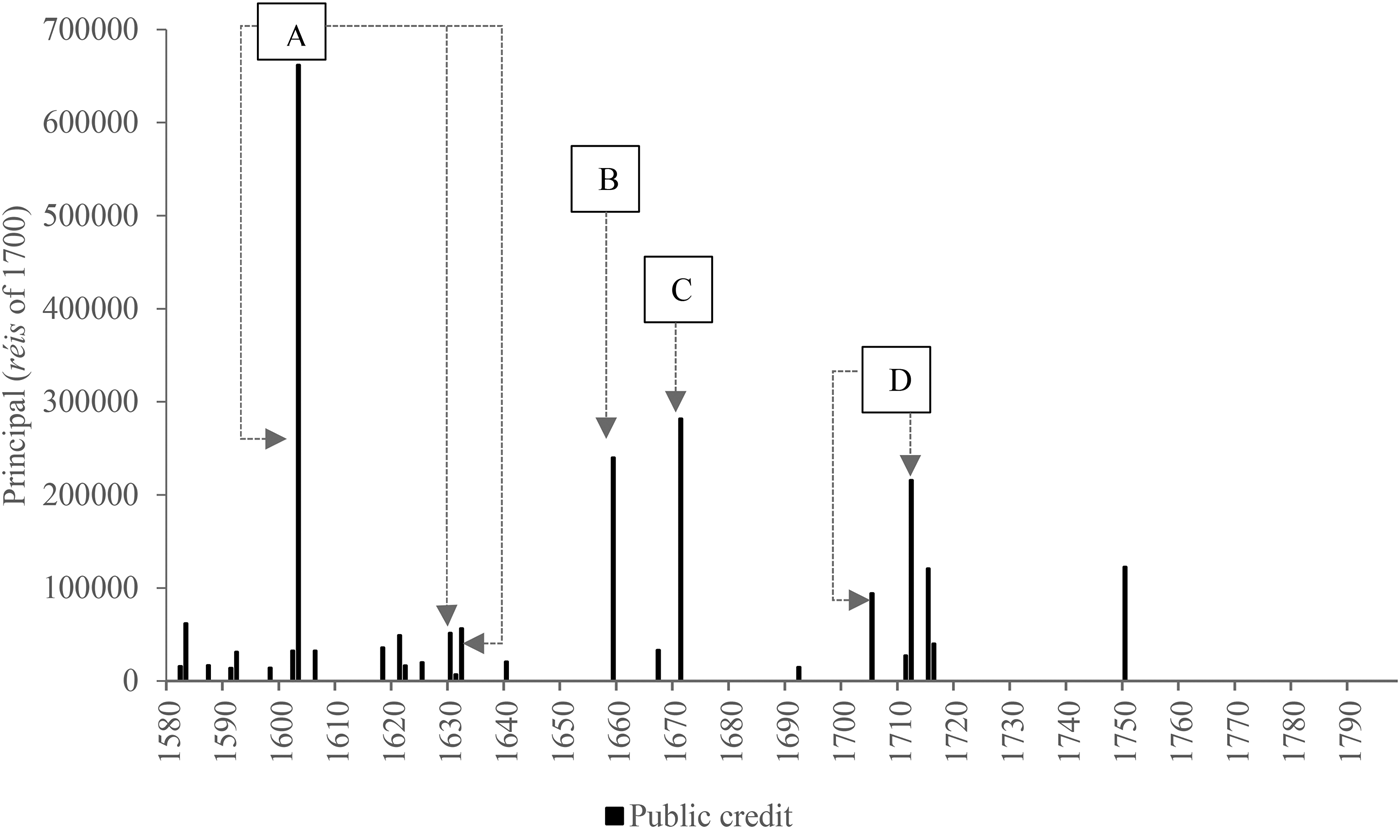
The crown started to propose the acquisition of bonds to the Misericórdia in the late 16th century as a means to transfer inheritances from Estado da Índia because the former needed money on location either to face war expenses or buy pepper to be shipped by the Carreira da Índia fleet (Figure 7). In 1598 and 1600, King Filipe II took 94,000 cruzados from the Misericórdia of Goa and Cochin to buy pepper. In 1603, the king recognised that the royal treasury «was unable to pay in cash», so a bond was delivered to the Misericórdia to pay the debt (a principal of 36 million réis).Footnote 28 In these cases, a bond was issued as a means of payment, but not without the consent of the confraternity, which first deliberated on it and assessed the benefits of the king's proposal.Footnote 29

During the Restoration War against Habsburg Spain and up to 1670, the crown's financial concerns moved back to Europe. In 1658, Queen Regent Luísa de Gusmão (1656-62), mother of future King Afonso VI (reign 1656-83), sent a letter to the Misericórdia, stating the «need for money and people» to halt the Castilian onslaught in the province of Entre Douro e Minho. The following year, the Misericórdia purchased two government bonds, an investment of 16 million réis (Araújo Reference Araújo and Fernandes2009). This operation represented a significant venture, all the more so because it corresponded to approximately twice the confraternity's annual budget (around 6.5 million réis). The financial contribution of the Misericórdia of Porto did not end with the ceasefire of the War of Restoration in 1668. Recognising Portugal's sovereignty and independence required sending an embassy to Rome. On this occasion, the confraternity delivered 16.4 million réis to the Royal Treasury after an intense exchange of messages with King Afonso VI. In a letter written in 1670, the king asked for the funds the Misericórdia had on deposit. He additionally suggested the confraternity to call in the principal of all loans it had advanced to individuals, an operation already conducted in 1659 (Araújo Reference Araújo and Fernandes2009). In other words, the Misericórdia summoned its private debtors to repay their debts.Footnote 30 The proceeds were gathered and loaned to the crown to help finance the embassy to Rome. This operation transferred 11.5 million réis from the private credit market to the market for sovereign debt.
At the beginning of the 18th century, the confraternity purchased its last two government bonds in 1705 and 1712, respectively. On both occasions, it financed the War of Spanish Succession that was being waged (1701-14). In 1712, the Misericórdia delivered the outstanding sum of 28 million réis, more than half of its annual income. The ruling board authorised the loan because:
«there is no one [individual] who wants to take loans with the necessary securities, and those [loans] already advanced to private debtors experience delayed payments that it should be more convenient to invest all the money possible (…) in the acquisition of government bonds».Footnote 31
After 1712, the Misericórdia did not purchase padrões de juro from the monarchy, as would happen with the Misericórdia of Lisbon in the 1780s (Figure 4). It remains, however, to be explained why monarchs stopped drawing on the coffers of the Misericórdias and other organisations, such as the Portuguese Inquisition (Lopes Reference Lopes2021, p. 304) from the early 18th century onwards. First, the crown's recourse to organisations it protected, promoted and founded should not be surprising. It is worth noting, however, that these organisations could—and did—refuse some of the crown's requests (Lopes Reference Lopes2021, p. 288), on the grounds that they had no savings or—most importantly—that their foundational objectives would be compromised if they agreed to the loans. Nevertheless, if they had the means, they often decided to invest as part of their long and personal relationship with the monarchy, not invalidating the existence of a secondary market for these bonds. Although it lacks confirmation, one can hypothesise that colonial revenues, mainly those from tobacco and Brazilian gold, positively affected royal finances. Consequently, monarchs might not have needed to resort, at least to the same extent, to surpluses from these institutional investors.
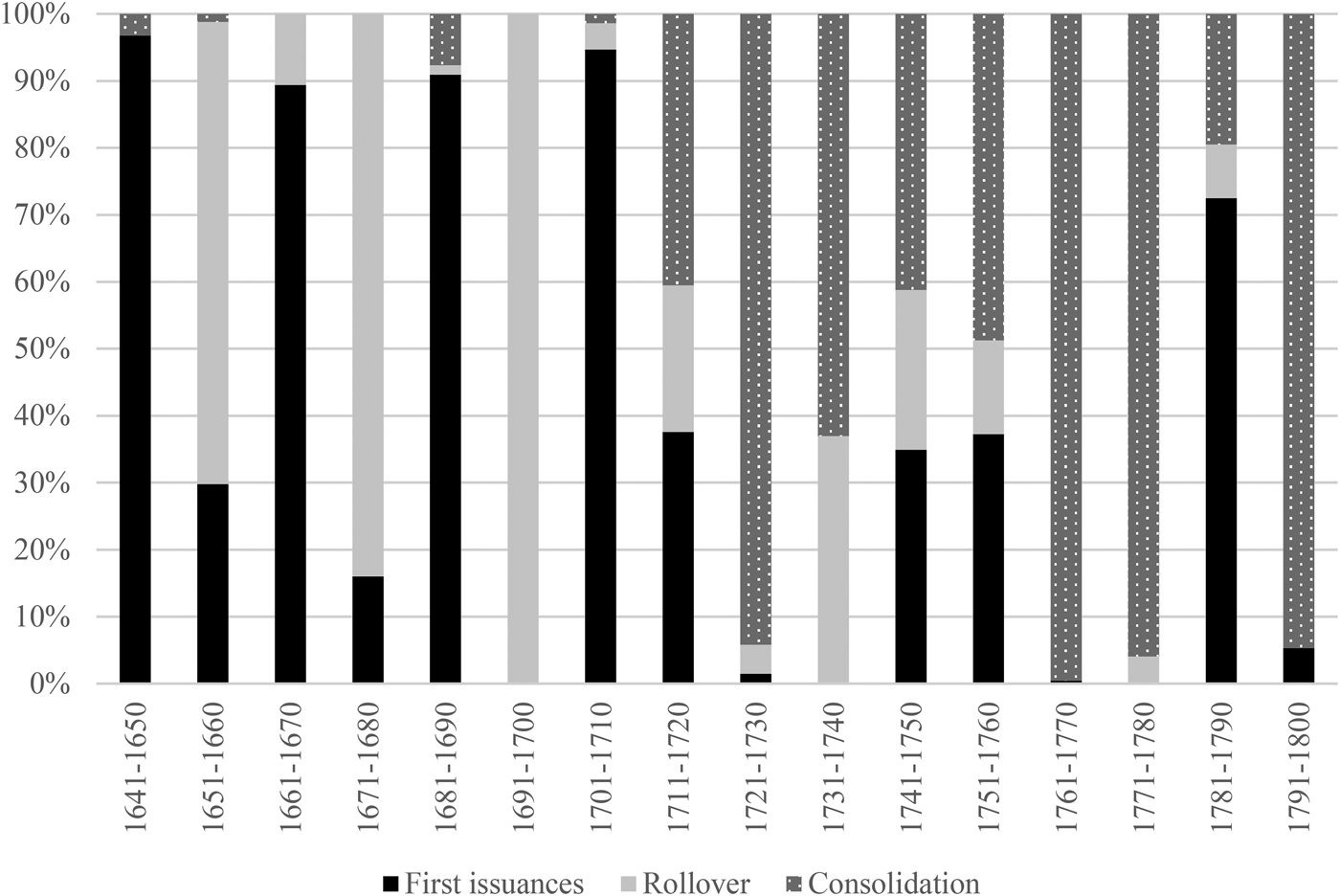
New data on the sovereign debt reveal that the Portuguese monarchy issued government bonds to raise funds to surrender the right to revenues until the early 18th century (Figure 8). However, from the 1720s onwards, debt was issued to meet other needs, mainly to consolidate short-term debt. It appears that the mid-1710s marked a new beginning for royal finances. On the one hand, the end of the Portuguese participation in the War of the Spanish Succession and the neutral position of the monarchs regarding other European conflicts must have alleviated royal expenditure and, consequently, the need to raise money through the issuance of public debt. On the other hand, Brazilian gold, discovered at the end of the 17th century, allowed an extraordinary revenue inflow. These two trends surely influenced the rationales for issuing debt and hence directly affected the social profile of bondholders.

The shift in the uses the Portuguese crown made of sovereign debt impacted how and who participated in the market for this financial instrument. The new bondholders were either assentistas, their relatives or individuals who somehow acquired debenture notes. As so, unless institutional creditors purchased debenture notes from assentistas, their participation in sovereign debt was limited to the secondary market, which, according to the currently available evidence did not appear to be very buoyant. Therefore, the demise of government bonds in the Misericórdia's investment portfolio was not related to the lack of interest in this financial instrument but rather to the waning issuance of these titles for fundraising. Figure 8 also shows that, despite this shift in the use of government bonds, the crown issued debt in the 1740s and 1750s, but no Misericórdia participated in these fundraising campaigns. It seems that these charities had already begun to invest heavily in private loans (Figures 3 and 4), with no savings to channel into public debt. Moreover, the bonds issued in the 1740s and ‘50s only benefited from the participation of twenty-seven institutional creditors (especially monasteries) since most of the new bondholders were private individuals close to the private circle of the king, mainly the high nobility and judges.
After the 1710s, the Misericórdias preferred to allocate their financial resources to short–medium (obligations) to the detriment of long-term private credit (censos). Lower interest rates charged in private perpetuities may explain this preference, as censos ran a 4.5–2.5 interest rate, while obligations were at 5 per cent (Figure 5). Moreover, one cannot rule out the hypothesis that the Misericórdia chose to keep its prerogative to claim the principal at its discretion after the maturity period elapsed. Between 1656 and 1800, the Misericórdia of Porto signed 660 obligations, amounting to 779 million réis.Footnote 32
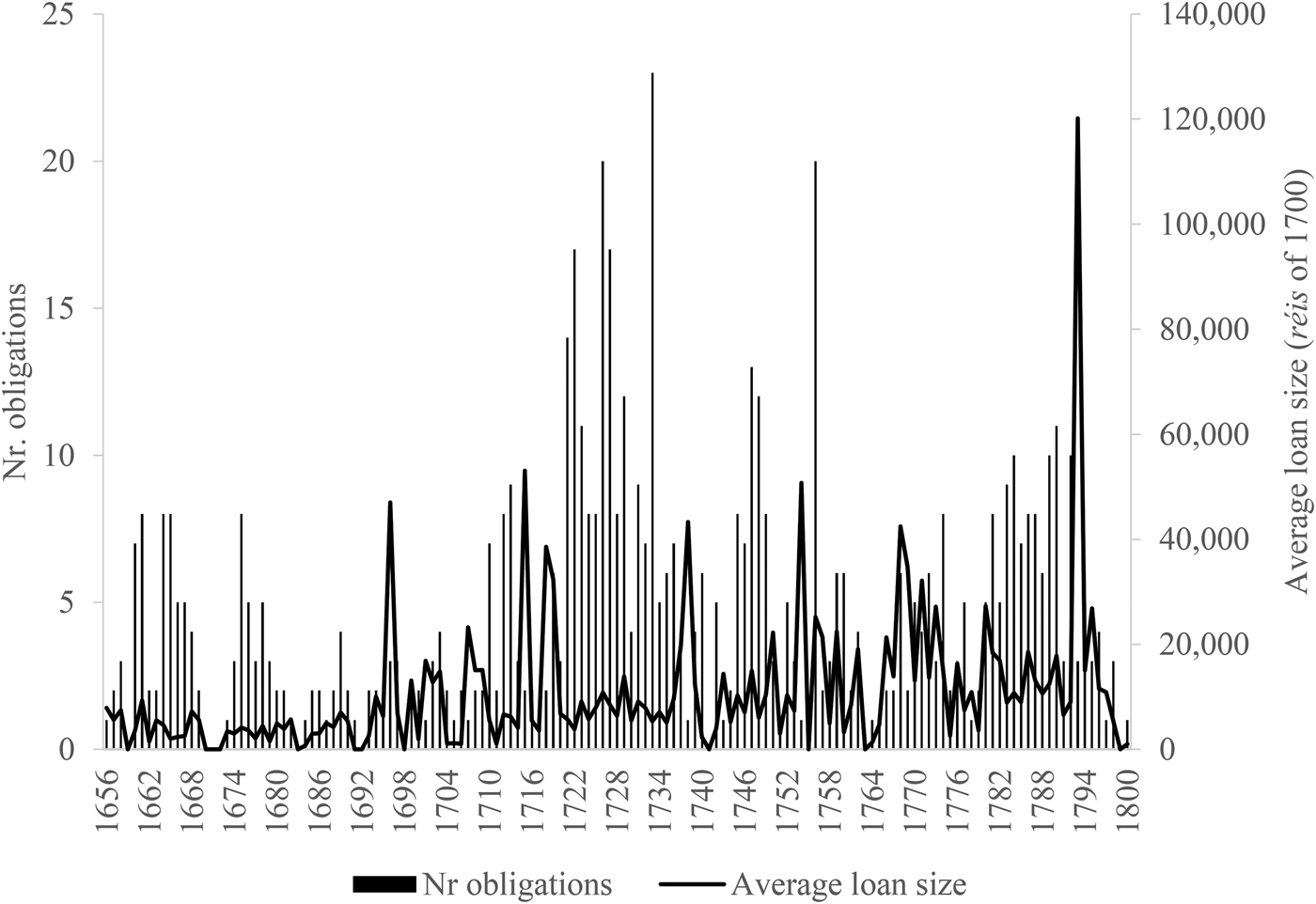
Figure 9 shows that except for the 1660s, when the Misericórdia signed fifty-one loans, the number of contracts was not significant until the early 18th century (119 contracts = 18 per cent). The charity would strengthen its participation in private lending during the first half of the century, signing 58 per cent (315) of all its obligations from 1700 to 1800. Portuguese scholarship has stressed the inbreeding nature of the private loans of the Misericórdias, where creditor and debtor were members of the confraternity and the impact of the high levels of social capital in the enforcement of these contracts.
Annual distribution of the loans granted by the Misericórdia of Porto to private individuals, 1656-1800.
Sources: see Table 3.

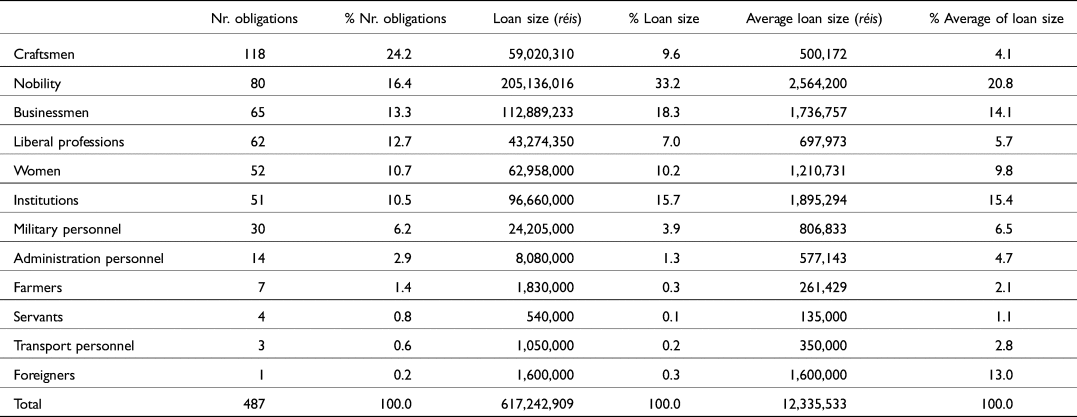
The Misericórdia of Porto lent money at interest to all social strata (Table 5). Although almost a quarter of all debtors were craftsmen, followed by nobles and businessmen, the largest amounts were unsurprisingly lent to the latter two and to institutions that benefited from lower interest rates (3 per cent). The contracts' wording stated the maturity as 1 year, and prorated the length if the parties agreed, but the analysis of the redemption dates shows that these loans quickly became long-term agreements. As in other parts of Europe, loans were longer than the initial duration specified in the original contract, extensions being a response to increased uncertainty (Hoffman et al. Reference Hoffman, Postel-Vinay and Rosenthal2019, p. 219). Maturities are known for 43 per cent of the 660 contracts, 33 per cent of which were paid back within 5 years of the contract being signed, 23 per cent between 6 and 10 years and 45 per cent were reimbursed after 10 years (10 obligations lasted half a century and one was paid back 107 years after the contract had been signed). It is important to highlight two main features of these investments. First, the juros collected annually aimed to fulfil the Misericórdia's charitable programme; however, as soon as the debtor repaid the principal, the brotherhood immediately lent the sum received again to a new debtor thus guaranteeing the circulation of the money (andar a giro) and the permanent fulfilment of its pious obligations. The second characteristic is that debtors occasionally asked the Misericórdia to reschedule the loan, to which the Misericórdia agreed, but not without asking for a reinforcement of the collateral. In other words, these investments were closely monitored by the confraternity and were sometimes redesigned if the parties agreed.
Social profile of the debtors of the Misericórdia of Porto, 1656-1800

Note: 173 (26 per cent; 21 per cent of the total volume of credit) out of 660 contracts do not mention the occupation or the social status of the debtor.
Source: as in Table 3.
Although actual breaches of contract occurred, as happened in the case of the Misericórdia of Lisbon, it seems plausible that the Misericórdia would prefer to invest its funds in private contracts where it had the final word to call in the principal once the maturity date had been reached. Furthermore, obligations that turned into longer contracts remained an interesting investment if the borrower paid the annual interest in a fair and timely fashion (Grafe Reference Grafe2022). In the case of the Misericórdia of Porto, private loans seem to have fared quite well, as only a tiny fraction were in litigation (Amorim and Costa Reference Amorim, Costa, de Araújo and Osswald2018). The social profile of the borrowers may partially justify this figure because, unlike Lisbon, the wealth of this charity did not seem to have been captured by the elite nor insiders.
6. Conclusions
Knowing the allocation of funds in different markets is critical for understanding how early modern markets operated. This study focused on the investments of the leading charitable institutions in Portugal—the Misericórdias of Lisbon and Porto—which were also major credit suppliers; it aimed to uncover the mechanisms underlying the distribution of savings of these institutional lenders in different segments of the credit market between 1550 and 1800. We began by exploring the credit instruments used in Portugal and framing the case study, offering an account of the Misericórdias' investment behaviour. Data show that in the early 18th century, a shift in these investors' preferences occurred. Whereas in the 16th and 17th centuries, the Misericórdias of Porto and Lisbon participated strongly in the market for government bonds, their investment behaviour changed in the 18th century. The Misericórdias suddenly stopped lending to the king in the 1710s and started channelling their financial resources to the private credit market.
Evidence shows that neither interest rates nor debt service justified this shift towards private lending. At the beginning of the 18th century, private and public interest rates were similar (approximately 5 per cent). Contrary to what the literature has indicated, Portuguese monarchs did not default on their financial obligations. A new series on debt service shows that interest from government bonds was fairly paid during the period under analysis. Except in the 1790s, when the king suspended payments due to the war, interest from government bonds was paid on schedule on most occasions.
The article also explored the debtors' side, looking at the supply and demand of government bonds. Investments in sovereign debt were of interest to the Misericórdias and considered a safe investment. Data suggest that changes in the purposes for which the debt was issued ultimately determined the disinvestment of these charities in the public credit market. While more research is needed to uncover the motivation for this shift, the neutral position of Portugal in the European conflicts and the new inflow of colonial revenues, particularly those from Brazilian gold and tobacco, must have positively impacted the royal finances. Within this context, monarchs might not have needed to resort to these institutional investors' surpluses, at least not to the same extent. Additionally, as the crown did not need funds to wage warfare or for other expenses, government debt was issued mainly to consolidate short-term debt. In these circumstances, institutional lenders such as the Misericórdias of Lisbon and Porto started to channel their financial resources into the private credit market. These charities preferred short–medium loans rather than private perpetuities not only because the price of credit was much more attractive, but also because obligations quickly became relatively long contracts that could be managed closely, suiting the Misericórdias' needs to finance their perpetual charitable obligations.
Supplementary material
The supplementary material for this article can be found at https://doi.org/10.1017/S0212610923000137.
Acknowledgements
We thank Leonor Freire Costa, Jaime Reis, Isabel dos Guimarães Sá, Susana Münch Miranda, Bruno Lopes, Graça Almeida Borges, Regina Grafe, Íñigo Ena Sanjuán, Pedro Neves, Nuno Palma, António Castro Henriques and the anonymous referees for their helpful comments and suggestions. This article benefitted from the comments received at the «Financial Institutions in Early Modern Iberian Monarchies» Workshop at the EUI (2021), «The Shadow of the Sovereign—Public and Private Credit Markets in Early Modern Europe» Seminar at ISEG (2021), and the 2019 Portuguese Association of Economic and Social History Conference in Faro, where preliminary versions were presented. The author gratefully acknowledges financial support from the Fundação para a Ciência e a Tecnologia under the research project PTDC/HAR-HIS/28809/2017 and UIDB/04521/2020.