INTRODUCTION
Exposure to recreational water may have adverse health effects due to the presence of human pathogenic micro-organisms in the water. In the Netherlands, the most frequently reported disorders related to exposure to surface water are skin conditions. A substantial part of the patients that report these skin conditions have (presumptive) cercarial dermatitis (Schets and de Roda Husman, Reference Schets and de Roda Husman2007, Reference Schets and de Roda Husman2008a). Cercarial dermatitis has been recognized as an increasing problem with respect to recreation in surface water not only in the Netherlands and Europe (De Gentile et al. Reference De Gentile, Picot, Bourdeau, Bardet, Kerjan, Piriou, Le Guennic, Bayssade-Dufour, Chabasse and Mott1996; Kolářová et al. Reference Kolářová, Skírnisson and Horák1999; Loy and Haas, Reference Loy and Haas2001; Zbikowska, Reference Zbikowska2004; Jouet et al. Reference Jouet, Ferté, Depaquit, Rudolfová, Latour, Zanella, Kaltenbach and Léger2008; Fraser et al. Reference Fraser, Allan, Roworth, Smith and Holme2009), but also in other parts of the world (Rao et al. Reference Rao, Dash, Agrawal, Yadav, Anvikar, Vohra, Bhondeley, Ukey, Das, Minocha and Tiwari2007; Valdovinos and Balboa, Reference Valdovinos and Balboa2008).
Cercarial dermatitis or swimmers' itch is primarily caused by the larvae (cercariae) of the schistosome Trichobilharzia. This parasite of water fowl has a two-host life cycle with fresh water snails as the intermediate host in which asexual multiplication takes place. Mature cercariae are released from the snail tissue into the water and penetrate the skin of a new final host. Physical and chemical factors stimulate attachment to and penetration of the host skin. The similarity of lipid concentrations in the skin of water birds and humans explains why cercariae also penetrate the skin of swimmers. In humans, cercariae generally penetrate the dermis and epidermis and are subsequently captured and destroyed by the human immune system. Cercarial dermatitis is an allergic response to this penetration represented by maculopapular skin eruptions and (intense) itching of the skin (Horák and Kolářová, Reference Horák and Kolářová2001). Upon first exposure symptoms are mild or absent, but repeated contact with cercariae may lead to more severe symptoms and may also include fever, limb swelling, nausea and diarrhoea (Horák et al. Reference Horák, Kolářová and Adema2002).
In case bathers report symptoms of cercarial dermatitis after exposure to recreational lakes, managers responsible for water quality and safe bathing wish to confirm whether Trichobilharzia is present in the bathing water or not. If the presence of the parasite can be confirmed, Trichobilharzia is considered as the most likely cause of the reported symptoms, although it should be borne in mind that the symptoms may also be caused by other micro-organisms, insects or algae. Upon confirmation of the presence of Trichobilharzia, measures to protect bathers from further exposure may be taken, which mainly comprise of putting up warning signs or installing a swimming ban and attempting to remove snails from the lake or at least from the bathing zone.
In the Netherlands, the standard procedure to demonstrate the presence of Trichobilharzia in recreational lakes consists of snail collection, stimulating the shedding of cercariae from the collected snails in the laboratory and confirmation of the presence of Trichobilharzia cercariae by microscopy. This procedure is, however, labour intensive and prone to errors, particularly when done in routine laboratories that do not have specific parasitological expertise. Erroneous identification of cercariae may result in ongoing exposure of bathers (if the conclusion is that they are not Trichobilharzia, while in fact they are), or in putting up warning signs or installation of swimming bans whilst this in unnecessary (if the conclusion is that they are Trichobilharzia, while in fact they are not). Moreover, in the Netherlands (presumptive) cercarial dermatitis is often reported whilst snails cannot be found in the implicated water (Schets et al. Reference Schets, Lodder, van Duynhoven and de Roda Husman2008b) and also, collected snails do not always shed cercariae (Loy and Haas, Reference Loy and Haas2001; Zbikowska, Reference Zbikowska2004). Therefore, a novel approach for the confirmation of Trichobilharzia in bathing water including concentration of water samples by filtration and PCR detection of the parasite in these samples is proposed. Previously, Hertel et al. (Reference Hertel, Hamburger, Haberl and Haas2002) aimed at developing a method for PCR detection of Trichobilharzia in lakes. This method successfully detected Trichobilharzia cercariae that were added to snail and plankton samples, but it was, however, not tested on water samples.
The proposed novel approach was applied to 3 different bathing sites with ongoing reports of cercarial dermatitis sampled from 2005 until 2008. Detection of Trichobilharzia in surface waters used for bathing was optimized and compared to the standard procedure of snail collection and examination in order to guide interventions to prevent (further) cases of cercarial dermatitis among bathers.
MATERIALS AND METHODS
Sampling sites and sampling
Water samples were taken from official bathing sites with a history of cercarial dermatitis problems; all samples were taken between 8 and 11 a.m. Het Wed is a dune lake along the North-Holland coast (52°23′ N, 4°35′ E) both Prinsenmeer (51°25′ N, 5°44′ E) and Westpolderplas (51°35′ N, 4°39′ E) are recreational lakes located in the south of the Netherlands, in the province North-Brabant close to Eindhoven and Breda, respectively. Samples were taken during the bathing seasons of 2005–2008. In 2005 and 2006 sampling was done after the reporting of symptoms of cercarial dermatitis by bathers. In 2007 and 2008 samples were taken according to a previously set sampling plan. Since Trichobilharzia cercariae are merely found in the upper layers of the water body and, although they are capable of active swimming towards their hosts, are transported over longer distances by wind and water flow (Horák et al. Reference Horák, Kolářová and Adema2002), samples were taken at beaches with onshore winds. A wind meter (Skywatch Explorer 3) was used to determine wind direction. On each sampling day, within a time frame of 1–2 h, samples from Het Wed and Westpolderplas were taken at 3 different beaches, whereas sampling of the larger Prinsenmeer was done at 5 different spots. Regardless of wind direction, a sample from the official bathing zone was always included. Water samples (approximately 15–20 L) were collected in polypropylene vessels that were not submerged but filled at the water surface. Samples were transported to the laboratory at ambient temperatures. On every sampling day, snail collection was attempted and, whenever found, snails were stored in a container filled with water from the lake from which they were collected and transported to the laboratory at ambient temperatures.
Concentration of water samples
Approximately 10 L of each water sample was filtered through an Envirochek filtration capsule (Pall Gelman Laboratory, Ann Arbor MI, USA) at a flow rate of 2 L/min following the manufacturer's instructions and the procedure described in ISO 15553 (Anonymous, 2006). Additionally, another approximately 2 L of the 2007 and 2008 samples was filtered through a 142 mm diameter 0·45 μm pore size cellulose nitrate membrane filter (type 113; Sartorius Mechatronics Netherlands BV, Nieuwegein, The Netherlands) using standard membrane filtration equipment. Filtered samples were eluted from the Envirochek capsules with approximately 130 ml of elution buffer (Anonymous, 2006) by agitation in a wrist action laboratory shaker (5 min, 600 rpm). After decanting of the eluate, the elution procedure was repeated. A fraction of the eluate was examined for the presence of ocellate furcocercariae by microscopy (magnification X50–100). The cellulose nitrate membrane filters were rinsed with 5–10 ml of phosphate buffered saline (PBS). A fraction of the obtained suspension was examined for the presence of ocellate furcocercariae by microscopy. Subsequently, the membrane filters were washed with 25 ml of lysis buffer. PBS and lysis buffer were pooled and further treated as one. Envirochek eluates and membrane filter washes were concentrated by centrifugation (10 min, 1080 g, without centrifuge brake), the obtained pellets were suspended in 30–35 ml of lysis buffer and the suspensions were stored at 4°C overnight to allow sedimentation of large particles. DNA was extracted from the supernatants by using a magnetic extraction kit (bioMerieux Benelux BV, Boxtel, the Netherlands) according to the manufacturers' instructions.
Snail processing
Shell height of each snail was measured and the snails were identified by using an identification key (Glöer and Meier-Brook, Reference Glöer and Meier-Brook2003). Release of cercariae was stimulated by putting snails in a beaker with fresh tap water and placing this under a desk lamp for approximately 3 h at room temperature (Sluiters et al. Reference Sluiters, Brussaard-Wüst and Meuleman1980). In the Netherlands, tap water is not chlorinated. The tap water was subsequently examined for the presence of ocellate furcocercariae by microscopy (magnification X50–100). Volumes of 30–50 ml of the tap water were filtered through a 0·4 μm pore size polycarbonate membrane filter (Isopore; Millipore Corporate, Billerica, USA) which was washed with approximately 10 ml of lysis buffer. DNA was extracted as described above.
Molecular detection of Trichobilharzia DNA
The presence of Trichobilharzia in the water samples was demonstrated by using different PCR methods that targeted different parts of the Trichobilharzia genome. Detection of the Trichobilharzia ToSau3A tandem repeated sequence was done as described by Hertel et al. (Reference Hertel, Hamburger, Haberl and Haas2002), whereas detection of the ITS1 and ITS2 regions was performed as described by Dvořák et al. (Reference Dvořák, Vaňáčová, Hampl, Flegr and Horák2002). PCR of the D2 domain was performed as described by Jouet et al. (Reference Jouet, Ferté, Depaquit, Rudolfová, Latour, Zanella, Kaltenbach and Léger2008). Direct sequence analysis of the obtained PCR-products allowed either detection of the genus Trichobilharzia (ToSau3A) or identification of the Trichobilharzia species present (ITS and D2).
RESULTS
Water
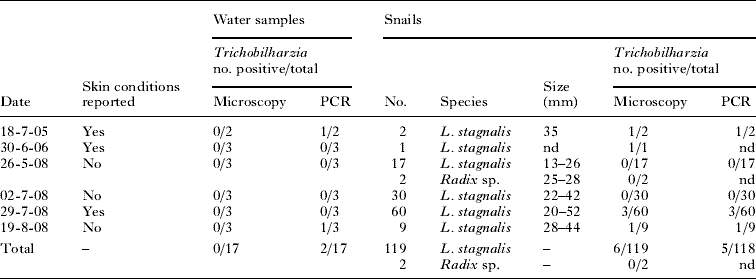
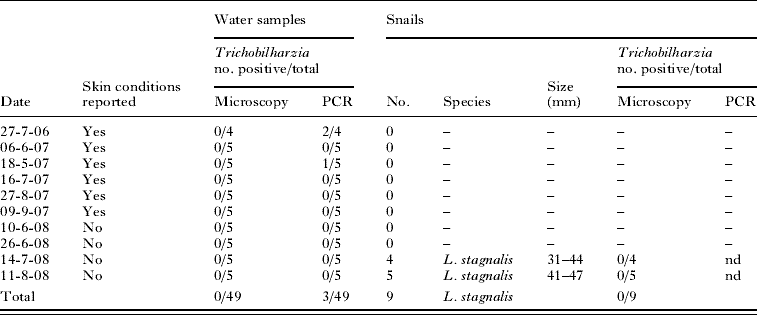
From 2005 until 2008 a total of 79 water samples were taken from the 3 recreational lakes on 21 different days; snails were found on 10 of these days. On 4 other sampling days snails were found and tested, but water samples were not taken. Trichobilharzia was detected in water samples by ToSau3A PCR and in snails by microscopy on 2 of these 10 days (Table 1). PCR also demonstrated the presence of the parasite in water samples taken on 2 other days on which snails were not found (Table 2). In total, Trichobilharzia was detected by PCR in 5 of 79 water samples (6%). Microscopic examination of all concentrated water samples did not result in any positive finding and may therefore be omitted from the procedure.
The presence of Trichobilharzia in snails and water samples from dune lake Het Wed and the reporting of skin conditions by bathers, 2005–2008
nd, Analysis not done.
The presence of Trichobilharzia in snails and water samples from recreational lake Prinsenmeer and the reporting of skin conditions by bathers, 2006–2008
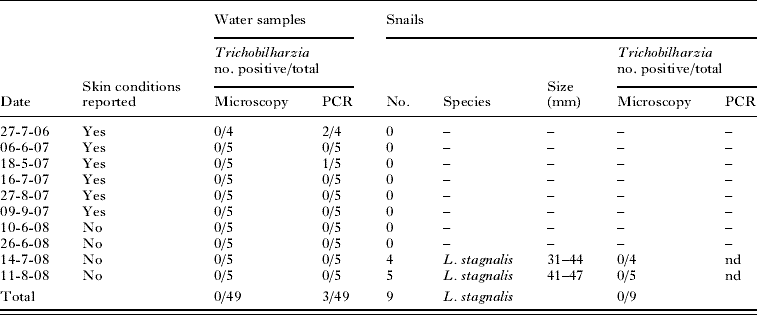
nd, Analysis not done.
Positive PCR results were obtained with ToSau3A PCR only. The ITS1 and ITS2 and D2 primers did not yield DNA fragments that could be identified as Trichobilharzia DNA. Sequence analysis of the obtained ITS and D2 PCR products neither provided information on the presence of Trichobilharzia, nor on which Trichobilharzia species was present in the water. Attempts to optimize ITS PCR by using other primer combinations (ITS3 and ITS4, ITS2 and ITS5, ITS4 and ITS5) did not result in the intended enhanced specificity.
In 2007 and 2008, water samples were concentrated by use of Envirochek capsules and membrane filters in parallel, yielding 1 sample positive with both membrane filter and Envirochek and another sample positive with membrane filter only.
Snails
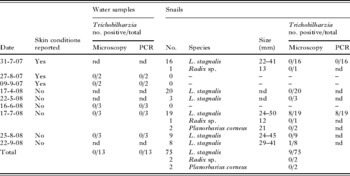
At each of the 6 sampling days snails were found in Het Wed, whereas they were regularly found (6 of 9 days) in Lake Westpolderplas but were recovered from Lake Prinsenmeer on 2 of 10 sampling days only (Tables 1–3). The majority of snails were identified as Lymnaea stagnalis, but some were Radix sp. and Planorbarius corneus. When combining the results of the entire study period, microscopic examination demonstrated that 5% of the L. stagnalis from Het Wed (n=6), 0% of the L. stagnalis from Prinsenmeer (n=0) and 12% of L. stagnalis from Westpolderplas (n=9) were infected by Trichobilharzia (Tables 1–3). In total, Trichobilharzia was detected in 15 of 203 L. stagnalis (7%). The parasite was not detected in the Radix sp. and Planorbarius corneus.
The presence of Trichobilharzia in snails and water samples from recreational lake Westpolderplas and the reporting of skin conditions by bathers, 2007–2008

nd, Analysis not done.
Shell height was measured for 179 of the 203 L. stagnalis examined. The average shell height of Trichobilharzia negative snails (n=165) was 30 mm (range 13–52 mm), whereas the average shell height of positive snails (n=14) was 40 mm (range 26–50 mm). Infected snails were significantly (P<0·0001) larger than non-infected snails.
Skin conditions and parasite detection
Symptoms of cercarial dermatitis were reported on 12 of the 25 sampling days (Tables 1–3). Examination of collected snails confirmed the presence of Trichobilharzia in Het Wed on 3 days with reported health complaints, whereas simultaneous analysis of water samples gave positive results on 1 of these days. Water samples from Prinsenmeer were positive on 2 of 8 days with reporting of skin complaints on which no snails were found. On the other hand, 1 water sample from Het Wed was found positive and snails that shed Trichobilharzia cercariae were collected from both Het Wed and the Westpolderplas in the absence of reported (presumptive) cercarial dermatitis on 3 different sampling days. Analysis of water samples and examination of snails were compared by calculating the method sensitivity and specificity (Noordhuizen et al. Reference Noordhuizen, Frankena, van der Hoofd and Graat1997). Analysis of water samples combined a high sensitivity (75%) with a moderate specificity (53%) and examination of snails was moderately sensitive (50%) and highly specific (88%), indicating that both methods produced false-positive and false-negative results.
DISCUSSION
Analysis of water samples and examination of collected snails from bathing sites with cercarial dermatitis problems appear to be complementary procedures in terms of sensitivity and specificity that, when performed simultaneously, increase the probability of Trichobilharzia detection and thus provide substantiation of measures to be taken to protect bathers from further exposure and prevent additional cases of swimmers' itch.
The standard procedure of snail collection and examination does not always provide the required information on parasite presence. Snails cannot always be found (Schets et al. Reference Schets, Lodder, van Duynhoven and de Roda Husman2008b) and, due to the low prevalence of Trichobilharzia in snails, collected snails do not always shed cercariae (Loy and Haas, Reference Loy and Haas2001; Zbikowska, Reference Zbikowska2004). In these situations analysis of water samples could give a decisive answer on parasite presence, which was the case on 25% of the sampling days with reported skin conditions on which snails could not be found. Although positive water samples confirm the presence of the parasite, negative water samples do not necessarily indicate its absence. False negative water samples most likely result from non-coinciding sampling and release of cercariae from snails into the water or spatial heterogeneity, but also from parasite concentrations that are below the detection limit of the PCR methods used. However, true negative water samples and snails may occur when reported symptoms are not caused by Trichobilharzia, but by other (micro-) organisms in the water or through other exposure routes than recreational water.
Due to the low number of positive samples obtained during the parallel use of Envirochek capsules and membrane filters for concentration of water samples, it is impossible to draw conclusions on superior suitability of one of the filters. Membrane filters are cheaper, easier to handle and require simpler equipment, but further comparison should confirm whether they are the best choice.
Direct confirmation of the presence of Trichobilharzia in concentrated water samples and snails appeared to be possible with the ToSau3A PCR only. Due to lack of specificity, both the ITS and D2 PCR did not only amplify DNA fragments of Trichobilharzia, but also of Echinostoma and Diplostomum. Sequence analysis of the obtained fragments did not provide information on the presence of Trichobilharzia, nor on the Trichobilharzia species present. However, confirmation of the presence of Trichobilharzia, without species identification, as done by ToSau3A PCR, is sufficient for water quality managers who should take action in response to the reports of cercarial dermatitis.
Positive snails confirmed the presence of Trichobilharzia on several sampling days with reported symptoms of cercarial dermatitis, but were also found in the absence of reported skin conditions. A limited number of exposed bathers most likely caused the absence of reports of cercarial dermatitis despite the presence of Trichobilharzia, because sampling according to the sampling plan coincided with periods of cool, cloudy and rainy weather or was done after the official bathing season. However, under-reporting of cases of cercarial dermatitis may also play a role since people may be inclined to refrain from reporting mild symptoms. Moreover, delayed development of more serious symptoms and a time gap between exposure, seeking health care and reporting to health authorities may blur the relation between recreational water contact and reported health complaints.
The prevalence of Trichobilharzia-positive L. stagnalis was variable: none of the collected snails from Lake Prinsenmeer was infected with the parasite, whereas 5–12% of the snails from the other 2 lakes were positive. This variable prevalence is in concurrence with the results obtained by Loy and Haas (Reference Loy and Haas2001) in their 20-year study of a pond system in Germany. They observed a high variation in prevalence of bird schistosomes in L. stagnalis between different ponds and also for individual ponds over different years, which they, however, could not attribute to ecological characteristics. The overall prevalence of Trichobilharzia in 43 441 L. stagnalis examined in the German study was 0·17%. Ferté et al. (Reference Ferté, Depaquit, Carré, Villena and Léger2005) found the parasite in 0·4% of 2304 examined L. stagnalis from a French lake with cases of cercarial dermatitis. The overall prevalence in L. stagnalis from the 3 Dutch lakes was 7%, which may be truly higher due to the inclusion of recreational lakes with known cercarial dermatitis problems only, but may also be distorted by the low number of 203 snails examined. The lack of detection of Trichobilharzia in other snail species is most likely the result of the very low number of specimens of these species examined. The reported prevalence of Trichobilharzia in Radix species is generally low, ranging from 0·05% to 0·07% in France (Ferté et al. Reference Ferté, Depaquit, Carré, Villena and Léger2005; Jouet et al. Reference Jouet, Ferté, Depaquit, Rudolfová, Latour, Zanella, Kaltenbach and Léger2008) and 0·24% in Germany (Loy and Haas, Reference Loy and Haas2001) to 4·8% in Iceland (Skírnisson and Kolářová, Reference Skírnisson and Kolářová2008). In their review, Horák et al. (Reference Horák, Kolářová and Adema2002) mentioned reports of Trichobilharzia cercariae in snails of the family Planorbidae, to which Planorbarius corneus belongs, but they caution that these cercariae may be of Trichobilharzia species with unknown life cycles, or belong to another genus.
Besides Trichobilharzia cercariae, the examined L. stagnalis also contained cercariae of Diplostomum and Echinostoma and Xiphidiocercariae. Some snails had mixed infections of Diplostomum and Trichobilharizia, but the exact number of snails with these mixed infections was not recorded. Mixed infections of bird schistosomes in L. stagnalis were previously reported by Loy and Haas (Reference Loy and Haas2001) who found Diplostomum cercariae combined with each of the other cercariae they detected. Mixed infections may hamper correct identification of cercariae.
Trichobilharzia-positive L. stagnalis snails were significantly larger than negative snails. This may be due to parasite-induced gigantism (Horák et al. Reference Horák, Kolářová and Adema2002), but likewise it may be the effect of snail age (Graham, Reference Graham2003). Older and thus larger snails are more likely to have a patent infection than juvenile snails smaller than 10 mm (Sluiters et al. Reference Sluiters, Brussaard-Wüst and Meuleman1980). Loy and Haas (Reference Loy and Haas2001) only collected snails with shell height of at least 35 mm and thus did not generate data on smaller snails. Of the 14 Trichobilharzia-positive snails we collected, 3 (21·4%) were smaller than 35 mm (26, 32 and 33 mm). It is therefore suggested that snails of at least 20 mm are collected for examination.
Both examination of snails and analysis of water samples have their limitations and thus it is suggested that the search for snails and water sampling is done simultaneously, both in case of reports of (presumptive) cercarial dermatitis or when lakes with a history of cercarial dermatitis are examined prior to the bathing season. Since examination of snails more often demonstrated the presence of Trichobilharzia than did analysis of water samples, the analysis of environmental samples preferably starts with examination of collected snails, followed by analysis of water samples in case of negative results. In the absence of snails, analysis of water samples would be a useful alternative.
ACKNOWLEDGEMENTS
The authors thank Harold van den Berg (RIVM-LZO), Ronald Italiaander (RIVM-LZO), Saskia Rutjes (RIVM-LZO), Ina Roels (PWN), Lucia van Geldorp (province North-Holland), Bart Jansen (province North-Brabant), Martin Stamhuis (Waterschap Brabantse Delta), Francien Lambregts (Delta waterlab) and Jörn Pilon (Aqualab) for their contribution to this study and thank Arie Havelaar (RIVM-LZO) for critically reading the manuscript.
FINANCIAL SUPPORT
This research was performed by the order and for the account of the Ministry of Housing, Spatial Planning and the Environment, the General Directorate of Environmental Protection in the Netherlands.