


1 Introduction
Red drum (Sciaenops ocellatus) is an estuarine-dependent fish species found in oceanic and coastal waters and ranges from Florida to Massachusetts along the US Atlantic coast and from southwestern Florida to Mexico in the Gulf of Mexico (Mercer, Reference Mercer1984). The red drum is an important marine recreational species in the United States. Red drum fisheries in the Atlantic states were designated as overfished in 1984 by the Atlantic States Marine Fisheries Commission (ASMFC, 2002). In addition, South Carolina declared red drum a “gamefish” during 1987 (ASMFC, 2002) and established a no-sale provision except for aquaculture-grown red drum. South Carolina implemented substantive changes to their fishery regulations to further restrict the harvest of red drum and increase the adult population (Smith, Jenkins, Denson & Collins, Reference Smith, Jenkins, Denson and Collins2004).
Despite rising regulatory constraints on red drum recreational fishing in South Carolina since 1987, it still remains one of the most sought after marine fish species by South Carolina recreational anglers. For example, at the time of data collection for this study, a 2005 telephone survey by Responsive Management (RM, 2006) of South Carolina recreational fishing license holders revealed that the red drum was the most commonly targeted species by resident and nonresident anglers. Moreover, South Carolina angler trips targeting red drum, an estimated 336,500 trips (Atlantic Coastal Cooperative Statistics Program, 2008) in 2005, comprised about 24% of all South Carolina marine recreational fishing trips, the highest percentage for a single species.
Given the importance of red drum overfishing concerns, fishery management agencies, nongovernment organizations and other groups have investigated, and in some states implemented, aquaculture programs. Since red drum is one of the primary target species by South Carolina anglers, the South Carolina Department of Natural Resources (SCDNR) initiated applied research in 1988 to evaluate the use of hatchery-produced red drum juveniles to increase the red drum population (Smith, Jenkins & Denson, Reference Smith, Jenkins and Denson1997; Smith et al., Reference Smith, Jenkins, Denson and Collins2004; Jenkins, Smith & Denson, Reference Jenkins, Smith and Denson2004a ). Based upon favorable research results, a statewide “demonstration scale” program involving three South Carolina estuarine systems was implemented in 2002 and predicated on the possibility of annually releasing hatchery cultivated red drum juveniles over a 5–10-year period (Smith et al., Reference Smith, Jenkins, Denson and Collins2004).
Amendment 2 to the Interstate Fishery Management Plan for Red Drum (ASMFC, 2002) identified the need to: “Fully evaluate the efficacy of using cultured red drum to restore native stocks along the Atlantic Coast including risk adjusted benefit-cost analyses.” Therefore, an economic study was implemented in 2004 to begin addressing the benefit-cost analysis research need identified by the ASMFC as well as generating a benefit-cost analysis desired by SCDNR to assist with the initial economic evaluation of red drum stocking. This paper describes the techniques used to estimate angler benefits and red drum stocking costs.
This paper has three contributions. The first is that we present a unique test of the convergent validity of the contingent valuation method (CVM). We conduct internal validity tests on the bid and income variables, as is typical in CVM studies. We also test for validity of the own-price and cross-price effects. We use these results to test the convergent validity of willingness to pay by combining recreation demand and willingness to pay data. Convergent validity is a test of the consistency between valuation methods. We implement the willingness to pay model described by Whitehead (Reference Whitehead1995) and predict the expected number of trips that would be observed as a result of the stocking program from the willingness to pay model. We combine this estimate with an estimate of the consumer surplus per day of red drum fishing and estimate the value of additional fishing trips. We compare the CVM and travel cost method estimates and find that they are consistent with each other, lending validity to our benefit-cost analysis.
The second contribution is an illustration of how so-called hypothetical bias corrections can be used to conduct the necessary sensitivity analysis of benefit estimates. Hypothetical bias exists when stated willingness to pay is greater than actual willingness to pay in the same situation (Loomis, Reference Loomis2011). Hypothetical bias is expected to be present when voluntary donations, such as a tax checkoff as in this study, is the payment vehicle (Carson & Groves, Reference Carson and Groves2007). One approach to mitigating hypothetical bias is to recode the yes responses according to the self-reported certainty of respondents (Blumenschein, Blomquist, Johannesson, Horn & Freeman, Reference Blumenschein, Blomquist, Johannesson, Horn and Freeman2008). We estimate our model at three levels of certainty. The change in consumer surplus and willingness to pay suggests that the CVM data recoded at a certainty level of 7 is convergent valid while the uncorrected and very certain responses are not convergent valid. We use the convergent valid benefit estimates as our base case and these two other estimates in our sensitivity analysis as upper and lower values.
The third contribution is to add an example of a real-world benefit-cost analysis of fish stocking programs to the literature. While there is a vast literature on the economic value of recreational fisheries (e.g., Johnston, Ranson, Besedin & Helm, Reference Johnston, Ranson, Besedin and Helm2006), only a few studies use monetized benefit estimates in benefit-cost analysis for a recreational fish stocking program (Johnson, Behnke, Harpman & Walsh, Reference Johnson, Behnke, Harpman and Walsh1995; Patrick, Bin, Schwabe & Schuhmann, Reference Patrick, Bin, Schwabe and Schuhmann2006; Palmer & Snowball, Reference Palmer and Snowball2009; Hunt, Scarborough, Giri, Douglas & Jones, Reference Hunt, Scarborough, Giri, Douglas and Jones2017). For example, Patrick et al. (Reference Patrick, Bin, Schwabe and Schuhmann2006) examined the costs and benefits of a striped bass (Morone saxatilis) stocking program in North Carolina. Monetarized recreational benefit estimates were obtained from a previously estimated recreation demand model of striped bass fishing. Minimum nonuse values that would make the net benefits of the stocking program positive were calculated. Our study would be the only one that we are aware of to compare benefits to costs of a recreational fish stocking program where hypothetical bias was addressed. Further, our survey design decisions were constrained by agency decisions favoring realism over contingent valuation standard practice. Readers can use our results as a case study concerning this type of limitations.
In Section 2 of the paper, we present the model that guides our survey design, data analysis and convergent validity test. This is followed by Sections 3 and 4, that describe the survey methods and data, respectively. Sections 5 and 6 describe estimation of benefits and costs, respectively. Section 7 compares benefits and costs and conducts sensitivity analysis. Discussion (Section 8) and conclusions (Section 9) follow.
2 Model
The theoretical model closely follows Whitehead (Reference Whitehead1995). Suppose anglers have the utility function,
 $u(x_{j},q_{j})$
, where
 $x_{j}$
is the number of fishing trips at site
 $j$
and
 $q_{j}$
is fishing quality (e.g., catch rates) at site
 $j$
. The expenditure function is
 $e(p_{j},q_{j},u)$
, where
 $p_{j}$
is the price, measured by the travel cost, of fishing trips at site
 $j$
. Willingness to pay is the maximum amount of money anglers would give up for the improvement in fishing quality resulting from the stocking program at site
 $j=1$
,
 $q_{1}^{\ast }$
. Substitution of the indirect utility function,
 $v(p_{j},q_{j},y)$
where
 $y$
is income, yields
 $\text{WTP}=e[p_{1},p_{2},q_{1},q_{2},v(p_{1},p_{2},q_{1}^{\ast },q_{2},y)]-y$
, for
 $j=1,2$
. When the quality change at site
 $j=1$
is omitted and quality at site
 $j=2$
is constant, the linear willingness to pay function is
 $\text{WTP}=\unicode[STIX]{x1D6FC}_{0}+\unicode[STIX]{x1D6FC}_{1}p_{1}+\unicode[STIX]{x1D6FC}_{2}p_{2}+\unicode[STIX]{x1D6FC}_{3}y+e$
, where
 $e$
is the error term,
 $\unicode[STIX]{x1D6FC}_{1}<0$
if recreation trips to site
 $j=1$
increase with the quality improvement,
 $\unicode[STIX]{x1D6FC}_{2}>0$
if recreation trips to site
 $j=2$
decrease and
 $\unicode[STIX]{x1D6FC}_{3}>0$
if the quality change is a normal good.
We use the Cameron (Reference Cameron1988) censored logistic regression model to estimate
 $\text{WTP}$
and its determinants associated with the red drum stocking program. The dependent variable in the model is the dichotomous choice “yes” response. The logistic regression model estimates the probability that willingness to pay is greater than or equal to the bid amount,
 $\Pr [\mathit{yes}]=\Pr [(\boldsymbol{\unicode[STIX]{x1D6FE}}^{\prime }X-B)/\unicode[STIX]{x1D705}\geqslant e/\unicode[STIX]{x1D705}]$
, where
 $\boldsymbol{\unicode[STIX]{x1D6FE}}$
is a logit coefficient vector,
 $B$
is the bid and
 $-1/\unicode[STIX]{x1D705}$
is the logit coefficient on the bid amount. The means of the independent variables are used to estimate willingness to pay,
 $\widehat{\text{WTP}}=-(\hat{\boldsymbol{\unicode[STIX]{x1D6FE}}}/\hat{\unicode[STIX]{x1D705}})^{\prime }\bar{X}$
. Standard errors of
 $\text{WTP}$
and marginal effects are constructed using the Delta Method (Cameron, Reference Cameron1991; Greene, Reference Greene2003).
We investigate the convergent validity of the
 $\text{WTP}$
estimate by testing for the consistency of the value of the estimate of additional fishing trips as a result of the program from both CVM and travel cost method. The estimate is constructed using the consumer surplus estimate from the travel cost method and the own-price coefficient in the
 $\text{WTP}$
model. From the travel cost method, the demand for fishing trips is
 $x_{1}(p_{1},p_{2},q_{1},q_{2},y)$
. If this demand is estimated with the semilog functional form as is common with count data models such as the negative binomial (Parsons, Reference Parsons, Champ, Boyle and Brown2017), then the consumer surplus per fishing trip is
 $\text{CS}/x=-1/\unicode[STIX]{x1D6FD}_{1}$
, where
 $\unicode[STIX]{x1D6FD}_{1}<0$
is the coefficient on
 $p_{1}$
. The negative of the coefficient on the own-price variable in the
 $\text{WTP}$
model is an estimate of the change in the number of fishing trips that would result from the stocking program,
 $\unicode[STIX]{x1D6E5}x=-\hat{\unicode[STIX]{x1D6FC}}_{1}=x_{1}(q_{1}^{\ast })-x_{1}(q_{1})$
, assuming the marginal cost of utility across quality levels approaches one (Whitehead, Reference Whitehead1995). An estimate of the value of the change in trips that would result from the stocking program is
 $\unicode[STIX]{x1D6E5}\text{CS}=\unicode[STIX]{x1D6E5}x/\unicode[STIX]{x1D6FD}_{1}$
. The null hypothesis for the convergent validity of the contingent valuation and travel cost demand methods is
 $\widehat{\text{WTP}}=\hat{\unicode[STIX]{x1D6FC}}_{1}/\unicode[STIX]{x1D6FD}_{1}.$
The alternative hypothesis is the inequality.
3 Methods
The CVM was used to estimate the benefits of the red drum stocking program (Mitchell & Carson, Reference Mitchell and Carson1989; Whitehead & Haab, Reference Whitehead, Haab and Shogren2013). After pretests in 2004, a 2005 mail survey using a self-administered mail questionnaire was used to collect angler data for estimating economic benefits of red drum stock enhancement in South Carolina.Footnote 1 The survey employed a random sample of all holders of South Carolina saltwater recreational fishing licensees.
Respondents were told that the SCDNR’s Marine Resources Division (MRD) is experimenting with a red drum stocking program. If the MRD finds that the experimental stocking program is successful in enhancing the stock, a statewide program could be implemented. This scenario was written under the realism constraints imposed by the SCDNR and is similar to Rosenberger, Collins and Svetlik (Reference Rosenberger, Collins and Svetlik2005) who described a West Virginia trout stocking program that would reap uncertain benefits. In this context, survey respondents must determine their willingness to pay under uncertainty.
The CVM scenario stated that the red drum stocking program would be funded by a state tax return voluntary checkoff donation. Respondents were asked if they would personally be willing to make an annual and voluntary contribution of $
 $B$
to a special fund to support a South Carolina Red Drum stocking program. Respondents who do not file a South Carolina tax return were told that they could make a contribution directly to the fund. One of four contribution amounts chosen, based on a pretest results, $5, $20, $35, or $50, was randomly assigned to questionnaires mailed to sampled licensees. The policy decision rule is that a full-scale stocking program would be implemented if donations exceed the costs. The payment vehicle and policy decision rule have been shown to generate lower estimates of the maximum willingness to pay relative to the dichotomous choice referendum vote scenario (Hoehn & Randall, Reference Hoehn and Randall1987; Champ, Bishop, Brown & McCollum, Reference Champ, Bishop, Brown and McCollum1997; Newsome, Blomquist & Romain, Reference Newsome, Blomquist and Romain2001; Carson & Groves, Reference Carson and Groves2007).
One concern with the CVM is the tendency for hypothetical willingness to pay to be overestimated relative to real willingness to pay in laboratory and field settings (List & Gallet, Reference List and Gallet2001; Little & Berrens, Reference Little and Berrens2004). Respondents tend to state that they will pay for a good when in fact they will not, or they will actually pay less, when placed in a similar purchase decision. Hypothetical bias might arise in these data if expected future income is greater than current income (i.e., the hypothetical scenario makes the budget constraint seem less binding), among other reasons (Whitehead & Blomquist, Reference Whitehead, Blomquist, Anna and Kahn2006).
In order to mitigate hypothetical bias, respondents who answered, “yes” to a donation of the bid amount were then asked about how certain they are that they would actually pay. Champ and Bishop (Reference Champ and Bishop2001), Poe, Clark, Rondeau and Schulze (Reference Poe, Clark, Rondeau and Schulze2002), Vossler, Ethier, Poe and Welsh (Reference Vossler, Ethier, Poe and Welsh2003) and Blumenschein et al. (Reference Blumenschein, Blomquist, Johannesson, Horn and Freeman2008) found that those respondents who are relatively certain of their willingness to pay on a 10-point certainty scale have similar hypothetical willingness to pay compared to a real willingness to pay sample. Certainty was elicited using a 10-point scale where “10” was “very certain” and “1” was “very uncertain.” Following the review by Loomis (Reference Loomis2011), the hypothetical willingness to pay responses were coded so that only those respondents who were certain about their voluntary contribution (Certain
 ${\geqslant}$
7) were included as a “yes” response. We provide sensitivity analysis using unrecoded yes responses and yes responses recoded at a certainty level of 10.Footnote
2
In addition to the CVM questions, respondents were asked other questions, including if they owned or co-owned a power boat used for saltwater recreational fishing, how many times they went saltwater fishing in SC during the past 12 months, and if during these trips they attempted to catch (“target”) red drum. Sampled licensees were also asked to provide information on socio-demographic characteristics such as age, education, ethnic background, household income, gender and if they received a SC income tax refund for the 2003 tax year.
Our sample frame is Fiscal Year 2003–04 (i.e., FY04) South Carolina saltwater recreational licensees. Any recreational angler saltwater fishing from a private boat in South Carolina waters was required to purchase a Saltwater Recreational Fishing License from the SCDNR. Before 2009, saltwater anglers fishing from South Carolina shore-based sites including coastal beaches, unlicensed piers or private docks were not required to purchase a license. SCDNR reported selling a total of 112,473 Saltwater Recreational Fishing Licenses during FY04. The highest estimated percentage of licenses, 56%, was by purchasers with addresses in the coastal region, followed by purchasers with out of state license addresses, 24%, and the South Carolina noncoastal region, about 20%. South Carolina coastal license holders resided in one of the 17 counties in eastern South Carolina; the noncoastal SC licensees resided in a 29-county strata generally in western South Carolina. North Carolina and Georgia addresses comprised much of the out of state region licenses.Footnote 3
Each regional sampling stratum included about 1,680 licensees. Thus, a total of 5,040 SC FY04 saltwater licensees, 4.5% of the total licenses sold, were randomly selected and mailed a questionnaire.Footnote 4 Questionnaires with a cover letter were mailed in January and February 2005 with the first mailing in January going to all sampled licensees. In February, questionnaires were mailed to those not responding to the first mailing wave. A reminder postcard was also sent one week after the first mailing in January, 2005. A total of 2,084 questionnaires were received from sampled licensees. Considering undeliverable mail (e.g., questionnaires returned due to no current forwarding address, etc.), the response rate was 46%.
4 Data
Respondents were excluded from the CVM analysis if their returned questionnaire had missing data for key response variables (e.g., income, fishing trips). The total respondents used in this analysis were 1,772. The willingness to pay yes responses are presented in Table 1. As the bid amount rises from $5 to $50 the probability of a yes response falls from 61% to 23%. When the yes responses are recoded so that only those who are certain at the level 7 and above are considered, then the probability falls from 50% to 17%. Most conservatively, when the yes responses are recoded so that only those who are certain at the level 10 are considered true yes responses then the probability falls from 31% to 15%.
The variables used in the logistic regression analysis are fishing trips, travel costs and income (Table 2). The average number of fishing trips for red drum was 6.Footnote
5
The average before taxes household income in 2003 was $81 thousand (Table 2) with 52% reported receiving a state tax refund for 2004. Travel costs,
 $tc$
, are measured including transportation and time costs,
 $tc=c\times d+\unicode[STIX]{x1D6FF}(w\times d/mph)$
, where
 $d$
is the round trip distance for each individual to each site. Transportation costs,
 $c$
, are calculated at $0.30 per mile traveled. Time costs are calculated using estimated travel times (assuming an average speed of 40 miles per hour) and the wage rate. The wage,
 $w$
, is measured as household income divided by 2080 hours worked. The average travel cost to the nearest South Carolina fishing site is $166. The average travel cost to the nearest Georgia site, a substitute, is $281.Footnote
6
Willingness to pay responses.

Data summary.

For variables used in analysis, average education was 15 years and average age was 47 years. The sample is 86% male and 96% Caucasian. Forty-seven percent own a boat. Eighty-two percent purchased an annual license, 33% are from the South Carolina coastal region and 39% are from the South Carolina noncoastal region.Footnote 7
5 Benefits
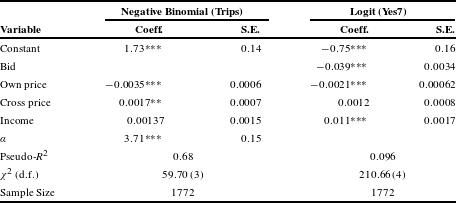
We separately estimate the recreation demand and the willingness to pay models (Table 3). All models are weighted by license type and the population of the three zones. The recreation demand model is a negative binomial regression that accounts for the count nature and overdispersion of the data (Parsons, Reference Parsons, Champ, Boyle and Brown2017). The number of days fished for red drum decreases with the own price and increases with the cross-price variables. Income has no statistically significant effect on days fished. In the willingness to pay model, we present estimates using the yes variable recoded for respondents who are certain at the level 7 or higher. As the bid increases the probability of a yes response decreases. As the own-price variable increases the probability of a yes response decreases. According to the theory described above, this indicates that fishing trips would increase with the stocking program. As income increases the probability of a yes response increases, indicating that the stocking program is a normal good. The cross-price variable has no statistically significant effect on the probability of a yes response, indicating that fishing trips in Georgia would not change. Similar qualitative results are found in the logit models for the unrecoded (Yes1) and recoded at 10 yes variables (Yes10).Footnote 8
Recreation demand and contingent valuation regression models. a
a Regression models are weighted.
*** Significant at
 $p=0.01$
.
** Significant at
 $p=0.05$
.
* Significant at
 $p=0.10$
.
In Table 4, we present
 $\text{WTP}$
and
 $\unicode[STIX]{x1D6E5}\text{CS}$
estimates. Since the probability of a yes response approaches 1 in the negative range of the bid values, we estimate willingness to pay over the nonnegative portion of the logistic distribution,
 $\text{WTP}=-ln(1+e^{\boldsymbol{\unicode[STIX]{x1D6FE}}^{\prime }\bar{X}})/\unicode[STIX]{x1D705}$
(Hanemann, Reference Hanemann1989). The mean willingness to pay from the unrecoded yes responses (Yes1) is $25. Mean willingness to pay with yes responses recoded at 7 (Yes7) and 10 (Yes10) are $19 and $8. The consumer surplus per fishing trip from the recreation demand model is $285 (standard error, s.e.
 $=$
48). The change in fishing trip estimates from the Yes1, Yes7 and Yes10 willingness to pay models are 0.052 (s.e.
 $=$
0.015), 0.053 (s.e.
 $=$
0.016) and 0.0072 (s.e.
 $=$
0.015), respectively. The consumer surplus for the change in fishing trips is $15, $15 and $2, respectively, in the Yes1, Yes7 and Yes10 models (Table 4). The difference in the change in consumer surplus (
 $\unicode[STIX]{x1D6E5}\text{CS}$
) and willingness to pay (
 $\text{WTP}$
) is not statistically significant in the Yes7 model since the 95% confidence intervals are overlapping. In the Yes1 model, the willingness to pay estimate is significantly greater than the change in consumer surplus estimate. In the Yes10 model the change in consumer surplus estimate is not statistically different from zero. We use these results to justify use of the Yes7 willingness to pay estimate, which is convergent valid with the travel cost demand model estimate, as our base case in the benefit-cost analysis. We conduct sensitivity analysis with the Yes1 and Yes10 willingness to pay estimates.
Individual benefit estimates.

a Difference in
 $\unicode[STIX]{x1D6E5}\text{CS}$
and
 $\text{WTP}$
is not statistically different from zero
 $(p=0.05)$
.
6 Costs
Costs are the explicit government costs incurred by the SCDNR for the seasonal stocking (August through October) of red drum juveniles (20–50 mm TL) during 2005 (Table 5) and based upon the assumption that the maximum annual capacity output of juvenile red drum by SCDNR was needed for the seasonal stocking (Jenkins, Denson, Bridgham, Collins & Smith, Reference Jenkins, Denson, Bridgham, Collins and Smith2004b ). This assumption was based on existing SCDNR Marine Resources Division aquaculture facilities, mainly the Waddell Mariculture Center (WMC). Operating costs were estimated from actual facility activities specific to red drum juvenile cultivation and stocking research, such as electricity cost for juvenile pond aeration and broodstock tanks as well as personnel costs, including direct supervision and administration. Estimated annual administrative costs, an indirect cost category associated with personnel management, purchasing, accounting, etc., were calculated as 20% of direct personnel costs.
Estimated costs of a South Carolina red drum stocking program in 2005 US $.

Initial investment costs were based on actual repair and construction costs associated with 2004–05 improvements in the WMC as well as the cost of equipment purchased for the red drum stocking program. Allocating major WMC improvement costs to the program was considered a conservative treatment of initial investment costs directly related to red drum stocking because WMC improvements also benefited other SCDNR programs. After the initial investment, replacement costs for durable items such as equipment needed in the harvest and transport of juveniles were also periodically added to the projected annual stocking program costs.
Based upon the use of existing MRD facilities used for mariculture programs, it was estimated that about 2.9 million red drum juveniles
 $({\sim}30.0~\text{mm}~\text{TL})$
(Personal communication, August 6, 2007, M. Denson, SCDNR, Marine Resources Division, Charleston, SC) could be produced and released at a total annualized operating cost including indirect administrative costs of approximately $372,000 or $0.13 per red drum juvenile stocked by SCDNR (Table 5).Footnote
9
Initial incremental investment, mainly total fixed costs of equipment and improvements in the WMC needed for the red drum stocking program, was approximately $558,000 (Table 5). Projected annual replacement costs for durable items after 2005, e.g., equipment (e.g., tractors) needed in the harvest and transport of juveniles, were also included in the projected annual stocking program costs (Table 5).
7 Net benefits
A standard BCA decision rule about whether a government program can be justified on economic principles is NPV, i.e., the discounted value of projected net economic benefits
 $$\begin{eqnarray}\text{NPV}=\mathop{\sum }_{t=0}^{T}\frac{(B_{t}-C_{t})}{(1+d)^{t}}\end{eqnarray}$$
where
 $B_{t}$
is the estimated willingness to pay values (the benefits of the project in year
 $t$
,
 $t=0$
to
 $T$
and year
 $2005=1$
),
 $C_{t}$
are the government costs of the red drum stocking program in year
 $t$
and
 $d$
is the real social discount rate. As a simple rule, a positive
 $\text{NPV}$
in the context of a “stand-alone” program (i.e., a simple comparison to the status quo) would lead to the acceptance of a program, while a negative
 $\text{NPV}$
would signal a rejection of the program. All benefits and costs are standardized to constant 2005 dollars with the CPI. The social discount rate used in this study was 3.5% (Moore, Boardman, Vining, Weimer & Greenberg, Reference Moore, Boardman, Vining, Weimer and Greenberg2004). The time period of 10 years was based on the plan that the statewide hatchery release of red drum would be limited to a 5–10-year period (Smith et al., Reference Smith, Jenkins, Denson and Collins2004).
Individual benefit estimates were aggregated over the 110,579 (FY04) South Carolina license holders 20 years and older. Annual net benefits were extrapolated over a 10-year period starting in 2005 using the base case and upper and lower benefit levels (Table 6). For each benefit level, projected net benefits were positive for all years. The NPVs for the baseline benefit level is $14.6 million. The NPV using the low and high benefit levels is $4.5 million and $20 million.
Estimated constant annual benefits and operating costs generated by the SC red drum stocking program (2005 US $ in thousands).

a Low, base and high are WTP estimates from Table 4 multiplied by 110,579 anglers.
The NPVs are considered conservative for several reasons. First, the extrapolation of licensee benefits was based on the applicable number of licenses sold remaining fixed at the FY04 level even though the number had increased an average of 4.9% per fiscal year during the FY04–FY08 period with 135,902 licenses sold in FY08. Second, saltwater shore-based anglers were not included in the projected aggregate benefit estimates because anglers fishing from shore-based sites were not required to purchase a saltwater recreational fishing license in FY04. In addition, the donation payment vehicle used in this study is also likely to elicit lower estimates of willingness to pay relative to a referendum vote (Champ et al., Reference Champ, Bishop, Brown and McCollum1997; Carson & Groves, Reference Carson and Groves2007). Lastly, benefits that might potentially stem from the utility of equipment and/or other improvements (i.e., horizon values) funded through the red drum stocking after 10 years, especially infrastructure improvements at the Waddell Mariculture Center, were not considered.
8 Discussion
The positive NPV of the baseline scenario is consistent with the economically efficient use of stocking resources relative to the status quo. However, the opportunity costs of the red drum program compared to other possible marine fishery management program alternatives were not considered in this study. Stated another way, projected net benefits that might have been generated by other fishery management programs using the resources available to the red drum stocking program were not compared with net benefits estimated in this study. Consequently, if additional BCA studies of the red drum stocking program are needed in the future, it is recommended that the opportunity costs of the South Carolina red drum program be incorporated into future BCA studies, especially relative to other current and/or possible future marine fisheries management program alternatives.
Given the actual uncertainty of the stocking program, our survey did not specify an objective change in fishing quality to survey respondents. Therefore, the change in fishing quality is an omitted variable that is captured in the error term. If the change in site quality is uncorrelated with travel costs and income, the coefficients on these variables are unbiased. This is likely if respondents used the objective change in site quality in their donation decisions. But if respondents make their donation decisions based on a subjective change in site quality and this change is informed by the number of fishing trips, then the
 $\text{WTP}$
regression coefficients may be biased. The sign of the bias on the own-price coefficient is equal to the product of the sign of the coefficient on the change in quality,
 $\unicode[STIX]{x1D6FD}_{\unicode[STIX]{x1D6E5}q}>0$
, and the sign of the correlation between the own-price and change in quality variables. If respondents who fish more (fewer) trips expect the quality change to be higher (lower), then the correlation is negative (positive) since the own-price variable is negatively correlated with fishing trips. Any bias in the own-price coefficient will not affect our
 $\text{WTP}$
estimates but may affect our convergent validity tests. We have no a priori expectations of the sign of the potential bias.
As noted previously, our survey design decisions were constrained by agency decision favoring realism over contingent valuation standard practice. In this context, we are not “…paralyzed by the impossibility of preparing an ideal analysis …” (Farrow & Viscusi, Reference Farrow and Viscusi2011). We present our results as a pragmatic contribution to understanding of the strengths and limitations of BCA in what we believe to be a “real-world” setting. The CVM scenario reflects SCDNR concerns as a risk averse fishery resource management agency wishing to minimize the risk of unintentionally signaling surveyed anglers that increased catch rates were expected to stem from the red drum stocking program. We concluded that the agency’s precautionary approach to the scenario was reasonable and pragmatic for three reasons.
First, attempting to accurately forecast effects related to fishery and other natural resources policies can be problematic. Moreover, even providing ranges of possible catch rates of marine fishery stocking projects can be problematic for several reasons including the challenges of monitoring the status of wild red drum stocks and accounting for factors such as the interactions in red drum angler behavior and recreational fishing technology over time (e.g., ASMFC, 2017). Consequently, for practical policy purposes, accurately forecasting possible stocking effects when superimposed on the variability and uncertainties characteristic of marine fish species and their environment while considering angler behavior can be technically difficult and costly.
Second, a specific funding concern influencing the CVM scenario design was the agency’s need to exercise caution about unintentionally signaling anglers that the agency expected to continue red drum experimental stocking at the 2000’s levels, thus perhaps complicating options for reallocating limited funding for other possible applied fishery research projects. In the 2000s, this was a significant consideration for SCDNR because among other concerns it wanted to maintain research funding options for future research on other species especially if there was a policy decision to fund a multiyear, full-scale red drum stocking program with dedicated funds. In hindsight, this was a prudent consideration because by the mid-2000s the need for applied fishery research on cobia (Rachycentron canadum), another marine species targeted by South Carolina anglers, had become apparent because of escalating fishing pressure and the related need to better understand stock dynamics (e.g., Darden, Walker, Brenkert, Yost & Denson, Reference Darden, Walker, Brenkert, Yost and Denson2014; Kalinowsky, Curran & Smith, Reference Kalinowsky, Curran and Smith2016).
Third, as an experimental stocking research program, the agency mainly sought the BCA results as initial advisory information, but not as the primary factor that might be used for expanding or phasing out the program. The agency’s expectations about using our BCA results mainly for advisory purposes indicates that the agency was less concerned about possible technical limitations of our BCA study than we, the practitioners, were. Moreover, this expectation would be consistent with an agency seeking BCA information to assist with the preliminary evaluation of a public policy that would be based on selected stakeholders (i.e., license anglers) paying for a program via a voluntary payment vehicle, not an evaluation of proposed policy such as requiring anglers to purchase a special license so they can legally catch fish species that are supported by a stock enhancement program.
9 Conclusions
This paper makes three contributions to the benefit-cost analysis literature. We conduct a unique test of convergent validity, illustrate the use of certainty ratings to adjust to hypothetical bias as a sensitivity analysis and conduct a benefit-cost analysis for a recreational fishing stocking program. We test the convergent validity of the CVM by comparing the willingness to pay values with an estimate of the consumer surplus that would arise from the increase in recreation trips due to the improved quality of trips. We find that the values are convergent valid for the willingness to pay estimate derived from the certainty recode level from a consensus of the literature. Benefits were compared to estimated, explicit stocking costs. We illustrate how the certainty recode approach to hypothetical bias can be used for sensitivity analysis. We find that the benefits of the program exceed the cost in the worst case scenario indicating that the program would be economically efficient relative to no program.
There are two limitations to our results that could be addressed in future research. First, considering survey design, our contingent valuation scenario did not describe the expected level of fishing quality improvement that might arise with the stocking program. Description of various objective quality improvements would allow for another internal validity test of the data and allow more accurate development of willingness to pay estimates. Second, we relied upon an indirect estimate of the increase in recreation trips that might arise from the stocking program. Future research should elicit stated preference measures of trip changes resulting from the stocking program to more directly compare the CVM and travel cost method estimates of benefits.
Acknowledgments
We thank the Marine Resources Research Institute in the South Carolina Department of Natural Resources who provided data and other information, especially Jen Fountain, Wally Jenkins and Al Stokes. We thank the editors and referees whose comments have greatly improved this paper. We also thank all of the recreational anglers who participated in the survey. Support for this research was provided by the South Carolina Department of Natural Resources (SCDNR) and the U.S. Fish and Wildlife Service (USFWS). The views expressed herein are those of the authors and do not necessarily reflect the views of the USFWS or SCDNR.
Supplementary material
To view supplementary material for this article, please visit https://doi.org/10.1017/bca.2018.1.



