I. INTRODUCTION
In recent decades, there is increasing interest in the new generation of luminescence and display devices and techniques, such as white light-emitting diodes (LEDs)Reference Höppe1,Reference Blasse and Grabmaier2 and plasma display panels (PDPs).Reference Lee, Hyun, Paik, Yoon, Lee and Choi3,Reference Imai, Sato and Abe4 Compared to traditional luminescence and display techniques, the new techniques are environmentally friendly and bring important advantages, such as low energy consumption, high quantum efficiency, long lifetime, and a high display rendering index. Phosphors are inevitably constituent parts in these applications, making a significant contribution to the color index and purity. The novel rare-earth doped (oxo)nitridosilicate phosphors have attracted much attention due to their high quantum efficiency in the long wave length range and excellent thermal and chemical stability.
There are many types of (oxo)nitridosilicate phosphors that have already been successfully synthesized; some typical examples are red-emitting Sr2Si5N8:Eu2+ (Refs. Reference Li, Van Steen, Van Krevel, Botty, Delsing, DiSalvo, de With and Hintzen5 and Reference Xie, Hirosaki, Suehiro, Xu and Mitomo6) and CaAlSiN3:Eu2+,Reference Uheda, Hirosaki, Yamamoto, Naito, Nakajima and Yamamoto7,Reference Lee and Sohn8 yellow-emitting Ca-α-SiAlON:Eu2+,Reference Xie, Hirosaki, Sakuma, Yamamoto and Mitomo9–Reference Xu, Tang, Nishimura and Hao11 green-emitting (Sr, Ca)Si2O2N2:Eu2+ (Refs. Reference Li, Delsing, de With and Hintzen12–Reference Yang, Xu, Hao, Yang, Tang and Xie14) and Ba3Si6O12N2:Eu2+,Reference Tang, Chen, Hao, Xu, Xie and Li15 and blue-emitting AlON:Eu2+,Reference Yin, Xu, Hao, Xie, Wang, Yang and Yang16 α-Si3N4:Eu2+,Reference Xu, Nishimura, Huang, Xie, Hirosaki and Tanaka17 and BaSi3Al3O4N5:Eu2+.Reference Tang, Xie, Huang, Hao, Xu and Xie18
The blue-emitting phosphors are important in red–green–blue systems to realize white light with a high color rendering index. BaMgAl10O17:Eu2+ (BAM) is a well known commercial blue phosphor.Reference Jung, Cho, Lee, Sohn, Kim, Lee and Kweon19,Reference Bizarri and Moine20 However, the emission intensity of the BAM phosphors undergoes a significant degradation during PDP manufacturing as well as in the period of application because of the intrinsic low thermal stability. Thus, new blue-emission phosphors with higher performance are highly demanded materials. Our group has recently successfully developed a novel BaSi3Al3O4N5:Eu2+ phosphor,Reference Tang, Xie, Huang, Hao, Xu and Xie18 which has a strong absorption band in the range of the vacuum ultraviolet (VUV) to near-ultraviolet (UV) region and exhibits an intense blue emission that peaks at 470 nm.
Besides the aforementioned requirements, the properties of the powders are equally important in white LEDs and PDPs. In particular, the powders of the phosphors need to be dispersed in the resin and then dropped on the luminescence and display dices. To achieve high resolution and quantum efficiency, a uniform phosphor layer must be produced in the coating. High quality powders with homogeneous spherical particles with a narrow size distribution and elimination of agglomerations will favor high packing density and result in low light scattering. However, it is not easy to meet these requirements, especially with the novel (oxo)nitridosilicate phosphors.Reference Gu, Zhang, Wang and Li21,Reference Tang, Yang, Zhan, Hao and Xu22 In particular, the fabrication of these phosphors requires high firing temperatures, a long soaking time, and a reductive atmosphere, which lead to hard agglomerations and irregular morphology in the final powders. Thus, it is essential to seek a convenient and effective method to control the morphology and size distribution of the particles of (oxo)nitridosilicate powders under the harsh synthesis conditions. A flux is usually added to modulate the size distribution because in the liquid-phase-sintering-like mechanism, it often makes a positive contribution to the formation of homogeneous particles.Reference Ravichandran, Roy, White and Erdei23,Reference Yin, Yu, Xu, Hao and Simeon24
This work presents the production of homogeneous powders of BaSi3Al3O4N5:Eu2+ phosphors, which feature high stability and no decay of the luminescence properties and comprise particles with an equiaxed morphology and a narrow size distribution, by adding a barium fluoride (BaF2) additive as a flux to modulate the morphology and the size distribution of the particles of the produced powder. The influence of the amount of BaF2 in the raw materials on adjusting the homogeneity, the particle size distribution, and the photoluminescence (PL) properties of the produced powders was experimentally investigated. According to our previous work,Reference Tang, Xie, Huang, Hao, Xu and Xie18 in this paper, the content of Eu2+ in the phosphor was set at the optimum concentration, i.e., 15 mol% with respect to Ba atoms, and the sintering temperature at 1550 °C.
II. MATERIALS AND EXPERIMENTAL PROCEDURE
Powders of BaSi3Al3O4N5:Eu2+ phosphors with different amounts of BaF2 flux in the raw materials were prepared by the conventional solid-state reaction method. The stoichiometric amounts of BaCO3, BaF2, Al2O3, SiO2, and Eu2O3 (all from Sinopharm Chemical Reagent Co. Ltd, Shanghai, China, 99.99%), Si3N4 (UBE Industries, Ltd, Japan, 96.0%), and AlN (UBE Industries, Ltd, Japan, 99.9%) powders were well mixed in a Si3N4 mortar by hand. Then, the powder mixtures were put in BN crucibles with unsealed lids in a horizontal tube furnace. The powders were fired at 1550 °C for 6 h under NH3 flow (the heating rate was 3 K/min). Then, the powders were slowly cooled down to 800 °C at a cooling rate of 5 K/min. Finally, the samples were naturally cooled down to room temperature.
The produced powders were ground well and the crystalline phases formed were identified by x-ray powder diffraction analysis (XRD, Rigaku TTR-III) using Cu Kα1 radiation (λ = 1.54056 Å) at 40 kV and 100 mA with a graphite monochromator. The samples of powder were placed in a silica chip positioned vertically in the machine toward the 2θ/θ scan axis. The scan speed was 2°/min.
The morphology and the particle size distribution of the powders were investigated using a scanning electron microscope (SEM), which was equipped with a backscattering electron image (BSEI) apparatus (JEOL-6390LA, JEOL, Japan). The F content was determined using an energy dispersive x-ray spectrometer (EDS) attached to the SEM. The particle size distribution of the as-received phosphors was also determined by the dynamic laser scattering method of powder suspensions.
The PL spectra were measured at room temperature by a fluorescent spectrophotometer (F-4600, Hitachi Ltd, Japan) with a 200 W Xe lamp as an excitation source. The emission spectrum was corrected for the spectral response of a monochromator and Hamamatsu R928P photomultiplier tube (Hamamatsu Photonics K.K., Hamamatsu, Japan) by a light diffuser and a tungsten lamp (Noma Electric Corp., New York; 10 V, 4 A). The excitation spectrum was corrected for the spectral distribution of the xenon lamp intensity by measuring Rhodamine-B as a reference.
The VUV spectra and XANES spectra at the Eu-L3 edge of the BaSi3Al3O4N5:Eu2+ phosphors were measured on a U14C VUV station and a U7C XAFS station at NSRL (National Synchrotron Radiation Laboratory, Hefei, China) at room temperature, respectively. The relative VUV excitation intensity of the samples was corrected by comparing the measured excitation intensity of salicylate at the same excitation conditions. For the XANES measurements, the storage ring of NSRL was run at 0.8 GeV with the maximum current of 200 mA. Because of the samples' low concentration of Eu, they were measured in the fluorescence detector using the transmission mode.
III. RESULTS AND DISCUSSION
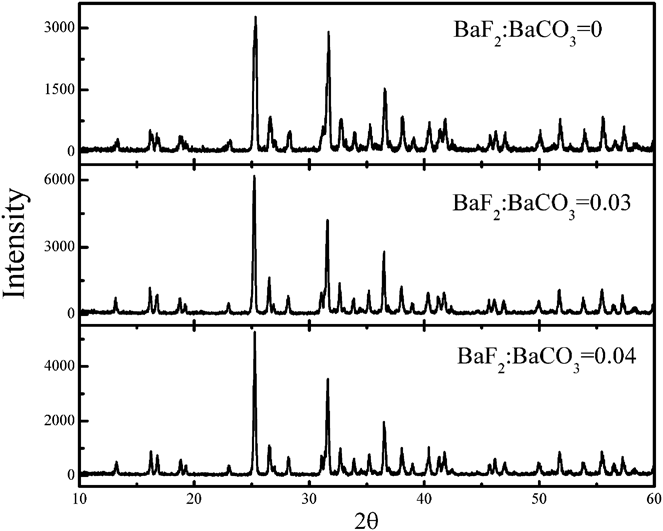
Figure 1 shows the influence of the amount of BaF2 flux added in the raw powders on the x-ray diffractograms of the BaSi3Al3O4N5:Eu2+ phosphors synthesized by the solid-state reaction method. In all cases, BaSi3Al3O4N5 was exclusively identified. There is no evidence of the formation of other phases. This finding indicates that pure phosphor phases are easily obtained using BaF2 flux. However, the increase in the amount of BaF2 flux results in increasing sharpness of the peaks. This suggests that BaF2 flux enhances the crystallinity of the BaSi3Al3O4N5:Eu2+ phase.
Influence of BaF2 addition in the raw powder mixture on the x-ray diffractograms of the produced BaSi3Al3O4N5:Eu2+ phosphors.

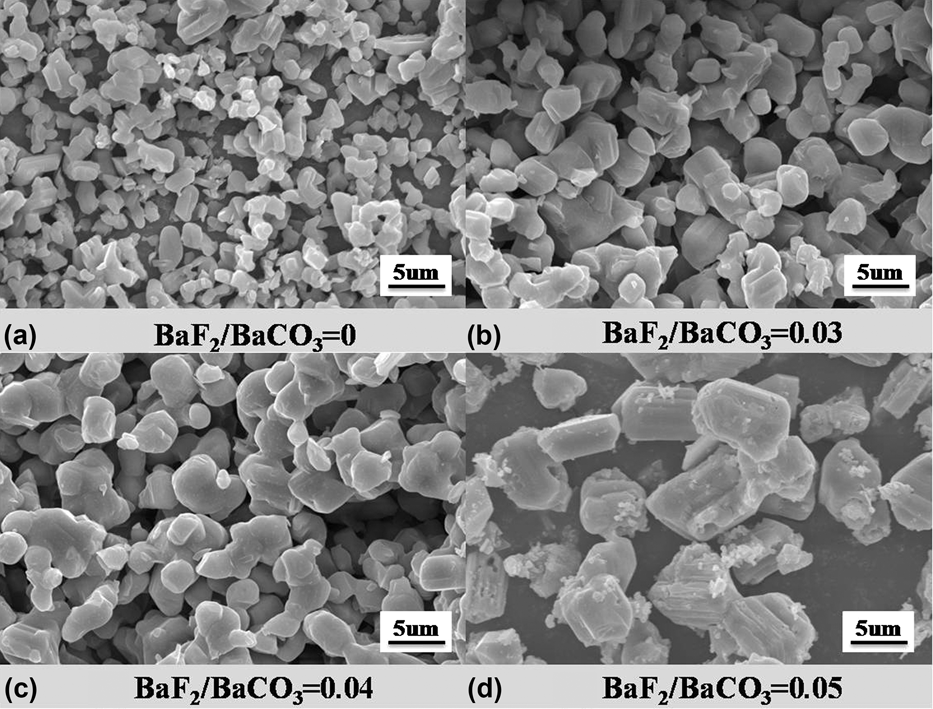
The SEM images in Fig. 2 show that the amount of BaF2 flux (reflected in the BaF2/BaCO3 ratio) pronouncedly influences the morphology of the produced powders. In particular, the particles in the powders produced with no addition of BaF2 flux are small with an apparent broad size distribution. The addition of BaF2 in the raw materials favored the growth of the particles, which apparently have a narrower size distribution and smooth surfaces. Moreover, agglomerations were not observed.
Influence of BaF2 addition in the raw powder mixture on the microstructure of the as-prepared BaSi3Al3O4N5:Eu2+ powders.
The growth mechanism of the particles in these phosphors is still unclear. However, it has been postulated that the phosphors' particles form through a liquid-phase-sintering-like reaction mechanism.Reference Yu, Yang, Delsing and Hintzen25,Reference Hu, Yan, Ma, Wan and Hu26 Thus, it might be suggested that the introduction of BaF2 flux (which has a lower melting point than these phosphors) can reduce the temperature of the formation of liquid phase and modify the nucleation and growth processes of the BaSi3Al3O4N5:Eu2+ crystals.
The particle size distribution of the BaSi3Al3O4N5:Eu2+ powders for the case of BaF2/BaCO3 = 0.04 [which corresponds to the powder in Fig. 2(c)] was measured by the dynamic laser scattering method, and the results are presented in the plot of Fig. 3. This powder obviously has a narrow size distribution with D 50 = 19.11 μm and span = (D 90–D 10)/D 50 = 0.78. However, the most important finding from these measurements is that the average size of the particles (D 50) can be controlled by the amount of BaF2 flux added in the raw materials, as shown in the inset of Fig. 3. It should be also noted that the grain size measured by the laser scattering method is larger than that observed by SEM, probably due to the poor dispersion of the phosphor particles in water.
Particle size distribution of the BaSi3Al3O4N5:Eu2+ powder shown in Fig. 2(c) (BaF2/BaCO3 = 0.04). The inset shows the influence of BaF2 content on D 50.
Figure 4 shows the influence of the amount of BaF2 addition on the PL spectra of the produced BaSi3Al3O4N5:Eu2+ phosphors. The excitation spectrum consists of a broad band between 200 and 460 nm, due to the 4f 7 → 4f 65d transitions of Eu2+ ions. The intensive blue emission spectrum, which peaks at 470 nm, is attributed to the 4f 6 5d → 4f 7 transitions of Eu2+ ions.Reference Song, Fu, Agathopoulos, He, Zhao and Li27,Reference Li, Chen, Shen, Zhong, Cheng, Sun, Zhang, Zhong, Tian and Du28 The picture in the inset of Fig. 4 shows the body color of the BaSi3Al3O4N5:Eu2+ phosphor (for BaF2:BaCO3 = 0.04) under 365 nm excitation and confirms the strong blue emission of this phosphor. The PL intensity increases with increases in the amount of BaF2 flux up to BaF2:BaCO3 = 0.04 and then decreases. Moreover, it should be mentioned that the internal and external quantum efficiencies of the phosphor produced with no-BaF2 flux at the excitation wave length of 305 nm reach 85% and 79%, respectively.Reference Tang, Xie, Huang, Hao, Xu and Xie18 Thus, it is concluded that the addition of BaF2 flux does not jeopardize the good PL of the phosphor.
Influence of BaF2 addition in the raw powder mixture on the PL spectra of the produced BaSi3Al3O4N5:Eu2+ phosphors. The inset shows the body color of the BaSi3Al3O4N5:Eu2+ phosphor (BaF2:BaCO3 = 0.04) under 365 nm excitation.
With regard to the potential use of the BaSi3Al3O4N5:Eu2+ phosphors as blue phosphors in PDP display techniques, the excitation and emission spectra under VUV conditions are shown in Fig. 5. The emission spectra, attributed to the characteristic emission of Eu2+ ions, show characteristics similar to those seen under UV excitation. The excitation spectra show strong absorption between 160 and 220 nm, which precisely matches the emission spectra of Xe/He excitation sources (173 nm) in the PDP techniques. The excitation at wave lengths below 220 nm is attributed to the absorption of the host lattice, which corresponds to the localized transitions of Ba–O bonds in the host lattice.Reference Wang, Xu, Yin and Hao29,Reference Birks and Friedman30 With regard to the influence of BaF2, the PL intensity is maximized for 3 mol%; however, the intensity remains at a high level within the investigated range of BaF2 contents. Consideration of the PL spectra under both UV and VUV conditions suggests that the slight improvement of the PL is likely due to the high crystallinity of the phosphor, which is favored by the addition of BaF2 flux.
Influence of BaF2 addition in the raw powder mixture on the VUV spectra of the BaSi3Al3O4N5:Eu2+ phosphors.
The thermal stability of the produced phosphors is an important property because the halogen ions often impair the thermal stability. The plots in Fig. 6 show the influence of annealing at different temperatures in air on the PL spectra of the BaSi3Al3O4N5:Eu2+ phosphor produced with 4 mol% BaF2 flux. Compared to the nonannealed sample, the luminescence intensity increases slightly after annealing at 600 °C for 2 h. It is suggested that annealing may remove the impurities and molecular H2O from the surface of the particles. Annealing at 800 °C causes a small decrease (<5%) in the luminescence intensity. These findings suggest that BaF2 flux does not jeopardize the excellent thermal stability of BaSi3Al3O4N5:Eu2+ phosphors.Reference Nedelec, Avignant and Mahiou31,Reference Jüstel and Nikol32 Note that no structural transformations or alterations were detected by XRD analysis (data not shown) in the crystalline regime of the produced powders which were annealed at temperatures up to 800 °C. As reported for BAM phosphors, it is generally accepted that the thermal stability is linked to structural transformations and the oxidation of the Eu2+ ions.
PL spectra of BaSi3Al3O4N5:Eu2+ phosphors for a ratio BaF2/BaCO3 = 0.04 annealed at different temperatures in air.
The influence of annealing temperature on the normalized Eu L3-edge XANES spectra of the BaSi3Al3O4N5:Eu2+ phosphor produced with 4 mol% BaF2 flux is shown in Fig. 7. The RE-L2 and RE-L3 edges in pure Eu2+ ions and pure Eu3+ ions are located in different peak positions in the XANES investigations, and the energy discrepancy is about 7.5 eV.Reference Hu, Kaind and Meyer33,Reference Yin, Hu, Xu and Hao34 From these spectra, it is clearly seen that only one intense peak appeared in the XANES spectra in all cases, which is the characteristic Eu-L2 edge of Eu2+ ions.Reference Wang, Xu, Yin and Hao29,Reference Yin, Hu, Xu and Hao34 There is no signal of Eu3+ ions in the spectrum after annealing at 600 °C. A small shoulder appears at the right-hand side of the Eu2+ ion peak after annealing at 800 °C, which suggests that a small amount of Eu2+ ions were oxidized to Eu3+ ions under these conditions.
XANES spectra of BaSi3Al3O4N5:Eu2+ phosphors with 4 mol% BaF2 flux, annealed at different temperatures in air.
It was stated above that the thermal stability of the phosphors is related to the structural transformations as well as the oxidation of the Eu2+ ions. The experimental results showed that both the crystalline regime of the produced phosphors and the regime of Eu2+ ions have an outstanding thermal stability. This may be ascribed to the intrinsic structural characteristics of the BaSi3Al3O4N5 crystal, which consists of a rigid three-dimensional (Si,Al)(O,N)4 tetrahedron skeleton. The strong covalent network leads to chemical inertness of the phosphor because it prevents the incorporation of F ions into the crystal, isolates the Eu2+ ions from oxygen attack, and prevents the motion of Eu2+ ions in the crystal, even at high temperatures. Indeed, fluorine was not detected (by EDS) in the produced phosphors. The details of the reactions that involve F ions and their influence on the products yielded are not clear. We might suggest that the F ions are released in the form of HF after a reaction with NH3 under the reductive atmosphere. However, this needs further investigation.
Figure 8 presents the decay curves of the emission at 470 nm in the case of pure phosphor and the phosphor produced with 4 mol% BaF2 flux. Both decay curves are well fitted to an exponential function
 $$I = I_{\rm{0}} \exp ( - t/{\rm{\tau }})\quad ,$$
where I is the luminescence intensity at the time t after switching off the excitation illumination, I 0 is the initial luminescence intensity, and τ is the decay time of the exponential component. The results agree fairly well with one Eu2+ crystal site in the BaSi3Al3O4N5:Eu2+ structure. The decay times are approximately 950 ns, which fit well with the demands of PDP and LED techniques. Decay times are slightly longer in the phosphors produced with BaF2 flux.
Decay curves of the BaSi3Al3O4N5:Eu2+ phosphors, pure and with 3 mol% BaF2 flux.
As discussed above, the addition of BaF2 flux enhances the crystallinity and thus decreases the concentration of defects. The defect traps act as energy captors; thus, their presence leads to a nonradiative transfer of energy.Reference Liu, Wang, Wen, Zhang, Zhu and Zhang35 Therefore, the slightly longer decay time should be ascribed to the decrease in the concentration of the defects' impurities. Consequently, the experimental results of this study suggest that the BaF2 flux favors the decrease of the number of defect traps and enhances the crystallinity of the BaSi3Al3O4N5:Eu2+ crystal.
IV. CONCLUSIONS
BaF2 was successfully introduced in the raw materials, acting as an efficient flux to produce fine powder of BaSi3Al3O4N5:Eu2+ blue phosphor. The particle size of the powder can be easily controlled by the amount of the BaF2 flux added. The addition of BaF2 does not jeopardize the excellent PL and high stability of the phosphors.
ACKNOWLEDGMENTS
This research was supported by the National Science Foundation of China (Grant Nos. 51072191, 11179037, and J1030412), National Basic Research Program of China (973 Program, 2012CB922004), USTC-NSRL association funding (Grant No. KY2060140005), Anhui Provincial Natural Science Foundation (Grant No. 11040606M11), and Anhui Provincial Education Department (Grant No. KJ2012A289).