1. Introduction
The root of a word is one of the central elements of morphological inquiry. In most approaches to the study of words, roots are taken to be the core element – the part that remains after all affixes (dependent elements) have been stripped away. Roots are the most basic meaning-bearing elements, and more complex words are formed based on them. In cognitive linguistics, Langacker defines roots in the following way: “(1) morphemes are minimal symbolic units; (2) within this class, the defining property of roots is their phonological autonomy—affixes and other nonroot morphemes are phonologically dependent; (3) a stem is an autonomous phonological structure at any level within a word: a root is a stem, and so is each successive composite obtained by combining a stem with a dependent morpheme” (Langacker, Reference Langacker1987, p. 345). Most languages have clearly identifiable roots (see, e.g., Stekauer, Valera, & Körtvélyessy, Reference Stekauer, Valera and Körtvélyessy2012), and several languages are widely regarded as having an especially transparent root system. Examples of such languages include Hebrew, Arabic, Hungarian, the Slavic languages, and so on. (This transparency should, of course, be regarded as a gradient phenomenon.)
I will approach roots with the help of the conceptual machinery of cognitive linguistics – and especially the tools that cognitive linguistics offers to handle the conceptualization of abstract meaning (see, e.g., Kövecses, Reference Kövecses2006, for a summary and introduction). As will be seen, the study of roots and their role in creating meaning necessarily implies dealing with the historical dimension of language, as worked out by a variety of authors along cognitive linguistic lines, such as Geeraerts (Reference Geeraerts1997), Koch (Reference Koch2001), Sweetser (Reference Sweetser1990), Traugott and Dasher (Reference Traugott and Dasher2002). I focus on a single Hungarian root: the root es- (meaning ‘fall(ing)’) that occurs in over one hundred Hungarian words.
My goal in the paper is to examine, through the study of a single root, the potential cognitive significance of roots in language and cognition in three interconnected areas: in the creation of words, in meaning making, and in conceptual structure. I will proceed as follows: First, I raise the issue of how it is possible for a particular root to appear in so many words as does es- with a great variety of different meanings (Section 2). Second, I ask if roots as morphemes have any additional cognitive status that may be relevant to meaning making (Section 3). Third, in order to see the potential organizing role of roots in the conceptual system, I compare the emergence of the equivalent English words with that of the Hungarian words (Section 4). Fourth, I compare the relevant parts of the organization of the Hungarian and English systems, and raise the possibility that roots may provide an important further basis for structuring the conceptual system related to languages, such as Hungarian (Section 5).
2. The root es- in Hungarian
If we examine some of the alphabetically arranged dictionaries of the Hungarian language that were used in the research for this paper (such as The (explanatory) dictionary of the Hungarian language, by Bárczi and Országh (Reference Bárczi and Országh1962), The historical-etymological dictionary of the Hungarian language by Benkő (Reference Benkő1984), The dictionary of the Hungarian language by Czuczor and Fogarasi (Reference Czuczor and Fogarasi1862), and A Hungarian etymological dictionary by Tótfalusi (Reference Tótfalusi2004)), we find that more than one hundred headwords begin with the morphological element es-, including the verb esik ‘fall’ and the noun esés ‘fall(ing)’. The etymological dictionaries suggest that, with some exceptions, the overwhelming majority of such words are built out of the root es- and several affixes. Given this, I suggest that the root es- provides a major part (though not the whole) of the meaning of over one hundred words in Hungarian.
Two nineteenth-century Hungarian lexicographers, Gergely Czuczor and János Fogarasi (1862), were instrumental in directing our attention to the importance of word roots in the organization of the lexicon of the Hungarian language. As they showed in their work, roots, such as es-, provide the semantic basis for the majority of Hungarian words. They suggested that roughly 2,300 roots supply the core semantic element of over 100,000 Hungarian words. This is a fascinating and potentially powerful idea, but the only way to really establish it would involve systematically identifying all the root morphemes in the language, and then conducting detailed and in-depth analyses of each and every morpheme. Clearly, I will not be able to perform the former task; instead, I take a relatively uncontroversial root (es-) as identified by the mainstream contemporary Hungarian etymological dictionary (see Benkő, Reference Benkő1984) and analyze it from a variety of cognitive perspectives by means of the conceptual machinery of cognitive linguistics.
In essence, my suggestion will be that we can only explain the heavy presence of the root es- in over one hundred Hungarian words if we rely on the cognitive mechanisms that are involved in the ‘spread’ of the root from one word to another, as the root is conjoined with the various affixes. The cognitive mechanisms that appear most relevant in the productive utilization of the root include metonymy, metaphor, fictive motion, and mental spaces.
The literature on each of these cognitive operations is huge in cognitive linguistics. Their general, introductory-level discussion can be found in various introductions to cognitive linguistics (e.g., Kövecses, Reference Kövecses2006, Reference Kövecses2010), but the major sources for and elaborations of the cognitive operations will be referred to in the sections where they are discussed in the paper. The present section is structured according to the cognitive mechanisms that apply to the shift from the meaning of the root morpheme es- to that of the words in which it occurs. Out of the more than one hundred words that involve this root morpheme, ten have been selected for analysis: eső, eskü, esedezik, est(e), esemény, esik, esés, eset, esély, esedékes. The ten words were selected for illustrative purposes to demonstrate the various cognitive processes that are utilized in the creation of new meanings involving the root es-.
2.1. the root es- and metonymy
We can define metonymy as follows: metonymy is a cognitive process in the course of which an element that belongs to a particular conceptual frame, or idealized cognitive model, provides mental access to another element within the same frame or to the whole frame (see Kövecses, Reference Kövecses2010; Kövecses & Radden, Reference Kövecses and Radden1998; Radden & Kövecses, Reference Radden, Kövecses, Panther and Raddden1999). Geeraerts (Reference Geeraerts1997) and Koch (Reference Koch, Panther and Raddden1999) discuss the general cognitive role of metonymy in historical semantic change. I will discuss four of the ten words mentioned above in light of my definition and along the cognitive linguistic lines offered by Geeraerts and Koch. The four words include: eső, eskü, esedezik, and est(e).
2.1.1. eső ‘rain’
How could the word eső have possibly emerged? It consists of the root es- and the suffix –ó (which comes in two variants, –ó and –ő, the choice of which being governed by vowel harmony). –Ó is a suffix that can be used in Hungarian in a variety of different ways: among others, to indicate (1) an actually occurring action, (2) a trait-like or typical action or event, (3) a property, (4) an agent, instrument, or location, and (5) complex events (Reference Tóth-CzifraTóth-Czifra, unpublished observations). Given this, on one interpretation we can suggest that the word eső is the result of a metonymy in which an actually occurring action or event stands for a complex physical event (eső as present participle Ò eső as noun). The metonymy can be spelled out as follows: AN ACTUALLY OCCURRING ACTION OR EVENT FOR THE COMPLEX EVENT INVOLVING IT.
What brings into existence the ‘actually occurring action or event’ sense of eső is the joining of the root es- with the suffix –Ó. It yields the present participial form eső. This is actually the development of the senses of eső as proposed by The historical-etymological dictionary of the Hungarian language (Benkő, Reference Benkő1984): first the ‘actually occurring’ sense is produced, which in turn metonymically yields the nominal sense of eső (i.e., ‘rain’).
One can ask whether the first step in the process of emergence is also metonymic. Probably it is not. However, there is a deeper sense in which we can think of the entire process of derivation (plus conversion) and its output as metonymic. In an encyclopedic view of meaning (see, e.g., Langacker, Reference Langacker1987), rain is a complex physical event that consists of a complex of processes, properties, and things: There are the clouds from which the raindrops fall. We can regard the raindrops as the things that are involved in the process of falling, and the raindrops and the falling as having such properties as being wet (consisting of water) and moving downward, respectively. The raindrops hit the ground and produce certain (beneficial and non-beneficial) effects, and many others. It is this entire complex of experiences that we take to be rain. Now, out of all these experiences it is the ‘falling’ (of the raindrops) that is relied on when Hungarians conceptualize rain, and, consequently, they linguistically code their complex experiences of it in terms of this single feature. This is metonymic thinking in which a single property of a complex of things, events, and properties is used to metonymically stand for the whole complex. In other words, we deal with the highly general PART FOR WHOLE metonymy here, where the part is RAINDROPS FALLING and the whole is the COMPLEX EVENT OF RAIN. I suggest that this is a metonymy that underlies the way Hungarians conceptualize and linguistically code the experience of rain.
2.1.2. eskü ‘oath’
The noun eskü ‘oath’ can be semantically motivated by another metonymy:
FALLING TO THE GROUND FOR THE OATH
More generally, the metonymic principle is:
THE GESTURE/ POSTURE FOR THE ACTION INVOLVING IT
However, etymologically, the word eskü ‘oath’ did not emerge directly from the root es-. As The historical-etymological dictionary of the Hungarian language (Benkő, Reference Benkő1984) points out, it derives from the verb esküszik ‘take an oath’, which is morphologically composed of the root es-, the archaic verb-forming suffix –sz, and the punctual (semelfactive) verbal suffix –k. The noun eskü ‘oath’ acquired its final shape through reduction during the Hungarian language reform period toward the end of the eighteenth century. As etymological dictionaries agree, the verb lost its verb-forming suffix –sz and the –ik verb ending.
The conceptual frame of oath-taking includes the person taking the oath, the action of taking the oath, the gesture or posture performed in taking it, the person or thing on which the oath is taken, and so on. Of these elements of the frame, it is the gesture or posture that is required to account for the meaning of eskü ‘oath’. In the European cultural sphere, in the past oaths were conventionally taken by kneeling down. It is this change in relative height that explains the use of the word root es- ‘fall(ing)’. A more detailed explanation would of course also require taking into account a further metonymy according to which FALLING (DOWN BEFORE SOMEONE) stands for KNEELING (DOWN BEFORE SOMEONE). For the present purposes, it will suffice to assume the presence of the metonymy FALLING DOWN TO THE GROUND FOR OATH TAKING in the semantic motivation of the word eskü ‘oath’ in Hungarian. Importantly, Czuczor and Fogarasi (Reference Czuczor and Fogarasi1862) note that the word eskü ‘oath’ also existed in the form of es as a noun – a form that coincides with the root es-. In addition, they observe the presence of es- in the sense of eskü ‘oath’ in several contemporary dialects. Such observations, if valid, further reinforce the idea of the metonymic development of eskü ‘oath’ from the root es-.
2.1.3. esedezik ‘beg’, ‘supplicate’, ‘implore’
The most commonly accepted conventional meaning of the verb esedezik in the Hungarian dictionaries consulted is ‘könyörög’ (‘beg’, ‘supplicate’, ‘implore’). The frame for esedezik involves the person who performs the action indicated by the verb, another person at whom the action is directed, the cause or reason of the action, and the manner in which the action is performed. Significantly, and similar to eskü above, the manner of performing the action consists, historically, of the gesture or posture of falling to the ground before the person from whom something is requested. This yields the general metonymy:
THE GESTURE/ POSTURE ASSOCIATED WITH AN ACTION FOR THE ACTION INVOLVING IT
In this case, the gesture or posture is falling to the ground, while the action involving it is imploring someone. The corresponding more specific metonymy is: FALLING (TO THE GROUND BEFORE A PERSON) FOR BEGGING/ IMPLORING THAT PERSON. It is the application of this specific metonymy that may have given rise to the word esedezik ‘beg’, ‘supplicate’, ‘implore’.
Esedezik is composed of the root es-, the complex iterative suffix –dez (consisting of –d and –z as simple iterative suffixes), and the verbal ending –ik. The iterative suffix indicates that the act of imploring involves several repeated (speech) acts. This is combined with the essentially durative meaning of the root, specifying that the durative action is made up of several repeated (speech) acts.
We could further ask why the gesture/posture of falling (down before someone) is part of the conceptual frame of esedezik ‘beg’, ‘supplicate’, ‘implore’ to begin with. The reason might be that the person who performs this action has less power than the person from whom something is requested. The unequal distribution of power between the two persons can thus be captured by the conceptual metaphor POWER IS UP and LACK OF POWER IS DOWN (see Kövecses, Reference Kövecses2010; Lakoff & Johnson, Reference Lakoff and Johnson1980): the person with less power (conceptualized metaphorically as DOWN) implores the person with more power (conceptualized as UP). It is this metaphor-based idea that accounts for the presence of the element FALLING DOWN BEFORE SOMEONE in the frame. In other words, the frame contains a metaphor-based element that constitutes the manner component of imploring someone in the Hungarian word. The same holds, of course, for the word eskü ‘oath’ discussed above. In general, this kind of interplay between metaphors and metonymies occurs frequently in the way we conceptualize aspects of the world.
2.1.4. est(e) ‘evening’
As noted by The historical-etymological dictionary of the Hungarian language (Benkő, Reference Benkő1984), the word emerged from the root es- and the nominalizing suffix –t (with este being the result of a complex process of derivation from est, not relevant to the present discussion). Conceptually, the nominalizing suffix gives ‘thing’ status to the process of falling. The emergence of the word est and the more colloquial este ‘evening’ can be motivated by a metonymic principle that obtains between events and the time of the occurrence of events. The specific metonymy that applies to this case can be given as:
THE FALLING OF THE SUN FOR THE TIME OF THE DAY WHEN THIS OCCURS
That is to say, est(e) ‘evening’ in Hungarian is conceptualized as the falling of the sun. This conceptualization is based on the perceptual experience of the sun ‘going down’. Given the perceptual experience, we may need an additional step in our account according to which ‘going down’ is seen as ‘falling’. It is not clear whether this is a metonymic or a metaphoric step (or, as a matter of fact, simply a shift based on literal similarity). However, the additional step and the uncertainty concerning the interpretation GOING DOWN as FALLING does not affect the argument that in Hungarian the word est(e) ‘evening’ seems to derive from the root es- (and the nominalizing suffix –t) through a metonymic process (i.e., THE FALLING OF THE SUN FOR THE TIME OF THE DAY WHEN THIS OCCURS).
The metonymy above is a specific-level case of a more general metonymic principle. The times when events occur can be conceptualized through the events themselves, provided that the events typically or characteristically occur at a regular time (of the day, season, etc.). Thus, the general metonymy can be stated as AN EVENT FOR THE TIME WHEN THE EVENT OCCURS.
While this does not seem to be a productive general metonymy, its reversal is. For example, the general metonymic principle THE TIME WHEN AN EVENT OCCURS FOR THE EVENT serves as the semantic basis of words like nyaral ‘be on (summer) vacation’, which derives in turn from nyár ‘summer’ in Hungarian. Clearly, the metonymy also works for English, as in the verb summer (e.g., summer in Paris). The idea in both cases is that the time when certain actions are typically or characteristically done can metonymically stand for the actions themselves.
More interestingly for Hungarian, it is the latter general metonymy that provides the semantic motivation for the word estély ‘(evening) reception (and dance)’. In this case, the word est ‘evening’, meaning a particular time or period of the day, can be used to indicate the activities performed during that time or period, given the general metonymy THE TIME WHEN AN EVENT OCCURS FOR THE EVENT. This is an example of how the root es- can produce new words by undergoing a series of metonymic processes.
2.2. the root es- and metaphor
By metaphor I mean the following: metaphor is a cognitive process in the course of which a more abstract concept (or frame) is conceived, or conceptualized, in terms of another, more physical concept (or frame) by means of finding or creating a set of conceptual correspondences between the elements of the two concepts. This definition of metaphor takes its point of departure in Lakoff and Johnson’s (Reference Lakoff and Johnson1980) influential book Metaphors we live by. (For further details of conceptual metaphor theory, see also Kövecses, Reference Kövecses2010). In this section, I discuss how the Hungarian words esemény ‘event’, ‘occurrence’, ‘happening’, esik ‘fall’, esés ‘fall(ing)’, and eset ‘case’ may have come into existence through the application of a metaphorization process.
2.2.1. esemény ‘event, occurrence, happening’
The word esemény consists of the root es- and the nominalizing suffix –mény/–mány (the use of which depending on rules of vowel harmony). The general meaning of the suffix is ‘thing’, while its more specific meaning is ‘the result or consequence of an action or process’ (i.e., in this case, the ‘result of falling’). However, the ‘falling’ part is to be understood metaphorically, and, as in all other cases in this section, the nominalizing suffix lends the conceptual status of ‘things’ to the process indicated by the verbal root. To put this in the terminology of conceptual metaphor theory, we suggest that the generic-level concept of ESEMÉNY (‘event’, ‘occurrence’, ‘happening’) is conceptualized in Hungarian as ESÉS ‘fall(ing)’. In other words, EVENT is the target domain and FALL(ING) is the source domain, which yields the conceptual metaphor EVENTS ARE FALLING. This conceptual metaphor is made manifest linguistically in a number of metaphorical expressions as evidenced by the dictionaries consulted. Here are some Hungarian examples (with the actual metaphorical expressions in italics) with a word-for-word translation followed by an approximate English equivalent:
EVENTS ARE FALLING
-
(1) Már az régen esett.
already that long-ago fell
‘It already happened a long time ago.’
-
(2) Az utolsó háborúkor esett.
the last war-at fell
‘It happened during the last war.’
The examples above are taken from the dictionaries that were consulted. They sound somewhat archaic to our contemporary ears, but they are still perfectly understandable to native speakers of Hungarian. However, other, more current examples can also be found in one of the more recent dictionaries employed in collecting the data (The (explanatory) dictionary of the Hungarian language), as in examples (3)–(6):
-
(3) Ahogy esik, úgy puffan.
as fall-3rd pers-sing-pres, so thud-3rd pers-sing-pres
‘As it happens, so it thuds.’ / ‘It happens as it happens.’ / ‘Let the chips fall where they may.’
-
(4) Baja esik.
trouble-pos-3rd pers fall-3rd pers-sing-pres
‘He/she/it is hurt.’
-
(5) Csoda esik.
Miracle fall-3rd pers-sing-pres
‘Miracle happens.’
-
(6) Hogy esett a dolog?
how fall-3rd pers-sing-past the thing
‘How did it happen?’
All of the examples above indicate the clear presence of the conceptualization of events in terms of falling in Hungarian.
But, as the dictionaries testify, in addition to FALLING, the concept of EVENTS can also be conceptualized metaphorically as (HORIZONTAL) MOVEMENT. We find the following examples, (7)–(10), for this conceptual metaphor in The (explanatory/interpretative) dictionary of the Hungarian language:
EVENTS ARE (HORIZONTAL) MOVEMENT
-
(7) Az események menete
the event-pl going-pos
‘The going of events / The way events go/happen’
-
(8) Az események sodra
the event-pl current-pos
‘The current of events’
-
(9) Rohannak az események.
rush-3rd pers-pl-pres the event-pl
‘Events rush. / Events move fast. / Events occur fast.’
-
(10) Minden figyelmével a bekövetkező események felé fordult.
all attention-3rd pers-pos-inst the in-following events toward turn-3rd pers-sing-past
‘With all his/her attention he/she turned to the events to follow / to the upcoming events.’
As can be seen, in the latter set of examples above it is not falling but horizontal movement that serves as the source domain of the metaphor for the conceptualization of events. The resulting conceptual metaphor can be stated as: EVENTS ARE HORIZONTAL MOVEMENT. (The metaphor EVENTS ARE MOVEMENTS was pointed out by Lakoff, Reference Lakoff and Ortony1993, as an essential part of the ‘Event Structure’ metaphor.)
The last example deserves special comment. As the word bekövetkező ‘upcoming’, ‘to follow’ indicates, on top of the metaphor EVENTS ARE MOVEMENT, future events are more specifically conceptualized as things that follow each other and that approach the observer. This metaphorical conceptualization relies on the metaphor for time according to which TIME IS MOTION, more specifically, motion toward the observer. (Another version of this metaphor is the case where the observer moves toward stationary time-objects. On time metaphors in general, see Evans, Reference Evans2013; Lakoff and Johnson, Reference Lakoff and Johnson1999.)
The basic (minimal or skeletal) structure of the EVENTS ARE FALLING and EVENTS ARE HORIZONTAL MOVEMENT metaphors can be given as follows:
EVENTS ARE FALLING
the entity falling Ò the person/object to whom/which something happens
the process of falling Ò the process of happening
EVENTS ARE HORIZONTAL MOTION
the entity moving Ò the person/object to whom/which something happens
the process of moving Ò the process of happening
The arrows connect corresponding elements in the source and target domains, going from the source to the target. Such conceptual structures are called ‘correspondences’, or ‘mappings’ in conceptual metaphor theory. Jointly, they define a particular conceptual metaphor.
Both source domains above, that is, vertical movement (i.e., falling) and horizontal movement, belong to the broader category of MOVEMENT. In both metaphors, it is MOVEMENT that corresponds to EVENTS (HAPPENINGS, OCCURRENCES). What distinguishes the metaphors is the quality of movement. In light of the examples, the definitions, and the descriptions of usage provided by the dictionaries we get a sense of the qualitative differences between the two types of movement (vertical and horizontal).
Falling (vertical movement) is characterized by the property of having a downward orientation, the property of being generally non-volitional or unintentional or accidental, the property of being sudden or unexpected in many cases, the property of being typically fast, the property of often being short-lived, and the property of being a negative or unpleasant experience in a set of representative cases (such as humans falling down to the ground). Two observations need to be made in connection with this characterization of falling. One is that these features are not present in each and every form of falling, but they are representative of several different paradigmatic forms of it. Second, the features of falling are not intended as objective and inherent features of falling but merely as pragmatically implied ones (like unpleasant and unintentional). As will be seen later in this section, the properties of falling above are taken advantage of in the course of the metaphorical conceptualization of various events.
By contrast, given the examples and the various definitions and descriptions in the dictionaries, horizontal movement is primarily characterized by a different set of properties, including the following: the property of being typically extended in space and time (as opposed to the short-lived nature of many cases of falling), the property of often involving multiple entities at the same time, the property of the multiple entities moving in one direction and hence in an organized fashion, and the property of the unified movement displaying force (or simply, being forceful). The features that characterize horizontal movement as a metaphorical source domain often involve multiple entities, as revealed, for example, by the frequent use of the word esemény ‘event’ in the plural (események ‘events’); the feature of the organized nature of the horizontal movement is demonstrated by the word menet ‘going’, ‘march’ that reflects the orderly movement of multiple entities, such as army columns (unlike the ‘disorderliness’ of falling); and the feature of the continued or persistent forcefulness of horizontal motion is shown by the word sodrás ‘current’, as used in the metaphor (unlike the lack of the persistence of the force in falling). Again, such features are not necessary and sufficient conditions of horizontal movement in general, but they characterize many cases of horizontal movement, as the linguistic data show.
In light of these characterizations, a more complete and detailed structure of the two conceptual metaphors can be offered with the help of the mappings, or correspondences, below:
EVENTS ARE HORIZONTAL MOTION
the entity moving Ò the person/object to whom/which something happens
the process of moving Ò the process of happening/occurrence
the spatial extent of the movement Ò the temporal length of the happening/event
multiple entities in the movement Ò multiple entities in the happening/event
the orderly nature of the movement Ò the orderly nature of the happening/event
the forcefulness of the movement Ò the forcefulness of happening/event
By contrast, in light of the characterization of the source domain of falling above, the following correspondences, or mappings, of the EVENTS ARE FALLING conceptual metaphor suggest themselves:
EVENTS ARE FALLING
the entity falling Ò the person/object to whom/which something happens
the process of falling Ò the process of happening
the bad experience (of certain types of falling) Ò the unpleasantness of the event
the short-lived nature of falling Ò the short-lived character of the event
the involuntariness/unintenionality of falling Ò the involuntariness/unintentionality of the event
the suddenness of falling Ò the suddenness/unexpectedness of the event
the fastness of the motion Ò the fastness of the event
As will be seen below, these properties of falling as a source domain are commonly utilized in the metaphors where falling serves as a source domain for events.
2.2.2. esés ‘fall(ing)’ and esik ‘fall’
The noun esés ‘fall(ing)’ and the verb esik ‘fall’ are naturally listed as headwords in the dictionaries. They appear both in a literal sense and as metaphorical source concepts. We saw above that the concept of falling is one of the metaphorical source domains of events. Here we examine two specific subcases where falling is employed as a source concept in metaphorical conceptualization within the larger category of events.
‘Change of state’ as an event.
In one subcase, an entity undergoes a change of state; and it goes from one state into another. States are commonly conceptualized metaphorically as CONTAINERS or BOUNDED REGIONS and the change is conceived of as MOTION (cf. Lakoff, Reference Lakoff and Ortony1993). Thus, changes of states, in a large number of cases, are viewed and talked about in terms of the metaphors STATES ARE CONTAINERS / BOUNDED REGIONS and CHANGE IS MOTION. Again, the motion can be either horizontal or vertical. When vertical motion is applied, we get the complex metaphor A CHANGE OF STATE IS FALLING INTO A CONTAINER / BOUNDED REGION.
Let us look at some examples first for the CHANGE IS FALLING metaphor in Hungarian, as illustrated by metaphorical expressions culled from the dictionaries (examples (11) through (21):
CHANGE IS FALLING
-
(11) Ágynak esik
bed-to fall-3rd pers-sing-pres
‘get sick / come down sick’
-
(12) Áldozatául esik
victim-3rd pers-pos-as fall-3rd pers-sing-pres
‘fall victim of sthg’
-
(13) Bajba esik
trouble-into fall-3rd pers-sing-pres
‘get into trouble’
-
(14) Bűnbe esik
sin-into fall-3rd pers-sing-pres
‘fall into a sin’
-
(15) Csapdába esik
trap-into fall-3rd pers-sing-pres
‘fall into a trap’
-
(16) Foglyul esik
captive-as fall-3rd pers-sing-pres
‘fall captive’
-
(17) Fogságba esik
captivity-into fall-3rd pers-sing-pres
‘fall into captivity’
-
(18) Gondolkodóba esik
thinking-into fall-3rd pers-sing-pres
‘start thinking/wondering’
-
(19) Hajának esik
hair-to fall-3rd pers-sing-pres
‘fall out / begin to fight’
-
(20) Szerelembe esik
love-into fall-3rd pers-sing-pres
‘fall in love’
-
(21) Teherbe esik
pregnancy-into fall-3rd pers-sing-pres
‘become/get pregnant’
As the metaphorical expressions above show, the notion of change is captured by the concept of falling in all of the examples. Another feature of many examples is that the change involved is involuntary, unintentional, or accidental. Moreover, the changes appear to involve a very short duration. That is to say, the latter two features fit and demonstrate the characterization of falling as an event given above.
The majority of the examples also indicate that states are viewed as containers also in Hungarian. The STATES ARE CONTAINERS / BOUNDED REGIONS metaphor is illustrated by the examples where the noun has the suffix –ba, –be ‘-into’, as in bajba esik ‘get into trouble’, betegségbe esik ‘get sick’, szomorúságba esik ‘become sad’, kétségbe esik ‘despair, lose heart’, teherbe esik ‘become pregnant’, szerelembe esik ‘fall in love’, etc. As pointed out and demonstrated by many of the examples above, the metaphor for states and the metaphor for change often merge into the complex metaphor A CHANGE OF STATE IS FALLING INTO A CONTAINER.
As can be seen in many of the examples, the changes of state expressed by falling are negative, undesirable ones. This feature of the FALLING metaphor was also mentioned as one of the mappings that characterizes the CHANGE IS FALLING metaphor. The concept of falling is especially well suited for the expression of such negative content, since it is congruent with the major metaphor for negative, bad, unpleasant states: BAD IS DOWN (and GOOD IS UP, as shown by Lakoff and Johnson, Reference Lakoff and Johnson1980). The downward orientation of movement in falling and the lack of control it often implies readily lend falling the quality of negativity or unpleasantness.
‘Reduction’ as an event.
Reduction (in the sense of ‘becoming less’) is another type of change of state that is commonly conveyed through the concept of falling. This results in the metaphor REDUCTION IS FALLING, or BECOMING LESS IS FALLING. The metaphor is fully compatible or congruent with the well-known metaphor pair: MORE IS UP and LESS IS DOWN (Lakoff and Johnson, Reference Lakoff and Johnson1980). The following are linguistic examples from The (explanatory) dictionary of the Hungarian language (examples (22) through (24)):
REDUCTION IS FALLING
-
(22) Az árak esése
The price-pl falling-pos
‘The falling of prices’
-
(23) A részvények esése
The share-pl falling-pos
‘The falling of shares’
-
(24) A láz esése
The fever falling-pos
‘The falling of fever / The drop of fever’
The REDUCTION IS FALLING metaphor displays two interesting tendencies. One is that its application tends to involve the ‘fastness’ component of falling, as pointed out in the set of mappings above. The (explanatory) dictionary of the Hungarian language states that it is used of “usually fast cases of reduction”. The other feature is that in some of its uses it allows for the conceptualization of falling as ‘slow’ or ‘even’. The contradiction is only apparent here because the characteristic or prototypical feature of falling is that it is ‘fast’, but this can be canceled, or overridden, in special cases where the speed of falling is ‘slow’. In other words, the prototypical concept of falling as used in the metaphor is not a hard-and-fast rule but allows for variation.
2.2.5. eset ‘case, occasion, situation’ or ‘event, happening, occurrence’
The word eset is composed of the root es- and the deverbal nominalizing suffix –at/–et. As in other cases, the suffix gives ‘entity, thing’ status to the process of falling. The word has two clearly identifiable senses in Hungarian as testified by the dictionaries consulted. The first is defined by the dictionaries as ‘that which happened’, that is, as ‘event, happening, occurrence’, similar to esemény. Since, as we saw, events are metaphorically conceived as falling, this sense of the word can be straightforwardly motivated by the metaphor EVENTS ARE FALLING in Hungarian.
The word eset meaning ‘event, happening, occurrence’ can be found in a large number of compounds, such as baleset ‘accident’, bűneset ‘a case of crime’, gyászeset ‘a case of mourning/death’, haláleset ‘a case of death’, káreset ‘a case of damage’, kóreset ‘disease case’, ‘pathology’, tűzeset ‘a case of fire’, and so on. These compounds build on some of the features of falling identified above. On the one hand, they involve the element of involuntariness or unintentionality, and, on the other, they have strong negative connotations. Both of these are in line with some of the prototypical characteristics of falling as an event.
But it seems that the most common or productive use of the word involves the case where it denotes the occasion or situation in which an event or occurrence takes place or can take place. The (explanatory) dictionary of the Hungarian language supplies the examples in (25) below:
-
(25) abban az esetben is … ‘even in the case when …’, vmilyen esetben ‘in some/a case’, adott esetben ‘in the given case’, ellenkező esetben ‘otherwise, or else’, a jelen esetben ‘in the present case’, a legjobb/legrosszabb esetben ‘in the best/worst case’, végső esetben ‘if the worst comes to the worst’ or ‘as a last resort’, vmi(nek) esetén ‘in case of something’, betegség esetén ‘in case of illness’, háború esetén ‘in case of war’, szükség esetén ‘if necessary/required’, tűz esetén ‘in case of fire’, esetenként ‘in some cases’, esetről esetre ‘from case to case’
The meaning of the examples seems to be based on, or motivated by, a metonymy that can be stated as follows:
THE EVENT/ HAPPENING FOR THE OCCASION/ SITUATION IN WHICH IT OCCURS OR CAN OCCUR
The metonymy assumes a set of metaphors according to which EVENTS/HAPPENINGS ARE OBJECTS and OCCASIONS/SITUATIONS ARE CONTAINERS, which, together, constitute the complex metaphor EVENTS/HAPPENINGS ARE OBJECTS IN A CONTAINER. The meaning of the word eset as ‘case, occasion, situation’ in the latter list of examples can only be conceptualized as such on the basis of this set of metaphors.
2.3. the root es- and fictive motion
Fictive motion involves cases of conceptualization where a static situation is construed dynamically (see Talmy, Reference Talmy2000). For example, this is what happens when we construe and linguistically present a road that is inherently static as if it were moving (as in the road runs along the coast, the road is winding through the valley). This dynamic construal also applies to some uses of the words esik ‘fall’ and esés ‘fall(ing)’, as shown by the dictionaries.
2.3.1. esik ‘fall’
Esik derives from the root es- and the third person verbal ending, –ik, of a category of Hungarian verbs. (The form with –ik is used as the dictionary form for this set of verbs.) Let us take one of the relevant definitions offered by The (explanatory) dictionary of the Hungarian language regarding the word esik ‘fall’: “<Of a thing in space> to continue abruptly or gradually at a lower level; slope.” The example provided by the dictionary for this sense of the word is in (26):
-
(26) Itt esik a hegy oldala.
Here fall-3rd pers-sing-pres the mountain side-pos
‘The side of the mountain falls/drops here.’
In this case, it is clear that there is no movement of any kind involved and that the side of the mountain cannot fall, and yet it can be construed and presented as if it did – that is, dynamically, with the help of a motion verb, such as esik ‘fall’.
2.3.2. esés ‘fall(ing)’
Esés is the nominal form of esik, composed of the root es- and the deverbal noun-forming suffix –és. In a similar fashion to esik, the static position of objects can be dynamically represented via the noun esés ‘fall(ing)’, when, for example, talking about the ‘falling’ of a curtain or skirt (a függöny ‘the curtain’, szoknya ‘the skirt’ esése ’). There is no real, dynamic motion here; the static ‘position’ or ‘positioning’ of the curtain or skirt is portrayed by means of fictive motion, as in example (27):
-
(27) Szép esése van a függönynek.
pretty falling-pos is the curtain-pos
‘The curtain hangs nicely.’
Fictive motion is a way of dynamically (re)conceptualizing and (re)presenting aspects of the world that are static. By this cognitive mechanism, we can develop new senses for motion words, such as esik ‘fall’ and esés ‘fall(ing)’.
2.4. the root es- and mental spaces
The theory of mental spaces was proposed by Gilles Fauconnier (Reference Fauconnier1994). Mental spaces are conceptual ‘packets’ we build online. There are many different kinds of mental spaces: possibility, necessity, hypotheticality, wish, knowledge, past, future, yesterday, tomorrow, last year, remembering, opinion, dream, and many others. Many of these exist universally. Mental spaces are built with the help of ‘space builders’ in the course of communication. For example, the most common space builder for hypotheticality in English is the word if (e.g., if she comes, …), hope as a mental space is created by the verb or noun hope (e.g., I hope she will …), the future space is expressed in English by means of several different space builders, including will (e.g., she will come …), imaginary situations are built, among others, with the word imaginary (e.g., an imaginary woman), and so on. The mental spaces that are created can be structured by frame-based knowledge or a combination of knowledge from various frames. The various frame roles are given specific values in real situations of discourse.
In this subsection, I discuss three words from our list: eset ‘case’, esély ‘chance’, and esedékes ‘due’.
2.4.1. eset ‘case, opportunity, situation’
The word eset in the sense of ‘case, opportunity, situation’ analyzed above can be thought of as describing a mental space, in which an event can occur. The when and where at and in which something occurs or can occur is an ‘opportunity’ mental space (cf. the opportunity to do something). Often, this mental space is of a hypothetical character, as indicated by many of the examples provided by the dictionary. In such cases, many of the expressions (such as abban az esetben ‘in that case’, tűz esetén ‘in case of fire’) can take the space builder ha ‘if’ for hypotheticality in Hungarian (abban az esetben, ha … , ha tűz van …). It may also be possible that the theory of mental spaces can or should be combined with the metonymy suggested above in: THE EVENT/HAPPENING FOR THE OCCASION/SITUATION IN WHICH IT OCCURS OR CAN OCCUR. It seems reasonable to assume that the creation of the hypothetical occasion-space is accomplished by means of this metonymy.
2.4.2. esély ‘chance’
The word esély is formed by the root es- and the archaic noun-forming suffix –ly. As in the previous cases, the nominalizing suffix turns the process into a noun, giving it a ‘thing-like’ character. The (explanatory/interpretative) dictionary of the Hungarian language distinguishes two closely related senses of the word esély ‘chance’. The first involves (sports) competitions in which a person has the possibility to achieve something. Examples for this sense include the cases in (28):
-
(28) győzelmi esély ‘chance to win’; kevés esély van ‘slim chance for something’; minden esélye megvan a győzelemre ‘has every chance to win’; nincs sok esélye arra, hogy elnyerje az állást ‘has not a lot of chance to get the job’; mérlegeli a mérkőzés esélyeit ‘weigh the chances of the game’; milyen eséllyel indul? ‘what are his/her chances?’
The second meaning is given as “a critical situation, condition in which something may happen, come to pass, in which something may occur in several ways; the possibility of something taking place, happening.” Examples include the cases in (29):
-
(29) a háború esélye ‘the chance of war’; megjátssza vminek az esélyét ‘take one’s chances’; kevés esély van a gyógyulására ‘have a slim chance for recovery’
What is shared by the two senses is that there is a possibility that something will happen. Following the same reasoning as for the word eset ‘case, opportunity, situation’ above (namely, that it can be thought of as a hypothetical mental space brought into existence by a metonymy), it is also conceivable to think of the meaning of esély ‘chance’ as a ‘possibility’ mental space brought into existence by another metonymy: THE EVENT/HAPPENING FOR THE SITUATION IN WHICH IT IS POSSIBLE THAT IT WILL HAPPEN. The meaning of esély can then be expressed as: ‘possibility that an event will happen.’ However, it should be noticed that for this meaning to develop, the metaphor EVENTS ARE FALLING is also required. This is the metaphor that serves as the basis for the metonymy above.
2.4.3. esedékes ‘due’
The adjective esedékes derives from the root es-, the verb-forming suffix –ed, the noun-forming suffix –ék, and the adjectivizing suffix –es. It is the final suffix –es that turns the word into an adjective, lending it the conceptual character of a property. The (explanatory) dictionary of the Hungarian language distinguishes two senses of the word esedékes ‘due’. The first is described as some kind of service with an approaching deadline or that needs to be acted on or paid in the near future. One of the examples offered for this sense is (30):
-
(30) A hátralék kifizetése esedékessé válik.
the remainder payment-pos due-as becoming
‘The payment of the remainder (of the sum owed) is becoming due.’
This sense of the word involves an obligation (to pay).
The second sense is described by the dictionary as an event that is to occur in the near future or that can be expected to occur in the near future, as in (31):
-
(31) Már nagyon esedékes a látogatása.
Already very due the visit-his/her
‘His/her visit is due / very likely / very much expected to happen.’
The description of this sense implies either that something will necessarily be the case or that it is very much expected to be the case, as in the example above. In other words, we may have to do with the mental spaces of ‘necessity’ and ‘expectation’.
In both of the senses (‘obligation’ and ‘necessity’ or ‘strong expectation’), the same cognitive mechanisms seem to be at work. That is, in the first we have the metonymy FALLING FOR THE EVENT THAT HAS TO HAPPEN, while in the second FALLING FOR THE EVENT THAT IS STRONGLY EXPECTED TO HAPPEN. In addition, the metaphor EVENTS ARE FALLING is also involved, and it makes the application of the metonymy possible, which in turn creates the respective mental spaces.
2.5. summary
In this section I have shown, through the analysis of the root es- and the suffixes employed in the words in Hungarian, how different words with related senses develop, that is, how the mental lexicon of the Hungarian language is built by its speakers. We saw that the root es- is a crucial component of a number of Hungarian words and that the different meanings that characterize the words arise in part from the various cognitive mechanisms that apply to the root. Other parts and aspects of the words arise from the constituent suffixes involved in the words in question. All in all, we have seen how the various conceptual metaphors and metonymies, the meaning of es-, and meanings of the suffixes combine to form the various lexical senses of the ten words.
3. Roots and image schemas
I suggest that roots are closely tied to image schemas in the conceptual system. Image schemas provide meaningful structure to much of our experience, and are thus part of our most fundamental meaning-making apparatus. The study of image schemas has a long history in psychology, but the notion gained renewed interest in cognitive science and linguistics through the work of philosopher Mark Johnson (Reference Johnson1987). Johnson proposed that much of our basic meaning making (linguistic or otherwise) relies on image schemas. He defined image schemas as recurrent abstract patterns of experience that arise from basic bodily and social experience. He postulated the existence of several dozens of basic image schemas, such as CONTAINER, WHOLE–PART, SOURCE–PATH–GOAL, LINK, and so on. His work had important impact on theories of meaning making (see, e.g., Lakoff, Reference Lakoff1987; Lakoff & Johnson, Reference Lakoff and Johnson1999; Langacker, Reference Langacker1987) and also on the experimental study of how people make sense of their experience (see, e.g., Gibbs, Reference Gibbs1994, Reference Gibbs2006).
Two features of image schemas are especially relevant to roots. One is that, though image schemas are abstract patterns that arise in the course of our physical and social interactions in the world, they are also embodied in human experience. They are analog structures that we constantly rely on when we engage in meaning making (see, e.g., Barsalou, Reference Barsalou1999; Gibbs, Reference Gibbs2006). Their other feature is that they play a crucial role in metaphorical meaning making. They bring embodied experience to bear on the conceptualization of abstract ideas (Gibbs, Reference Gibbs1994; Lakoff & Johnson, Reference Lakoff and Johnson1980, Reference Lakoff and Johnson1999).
In a series of experiments, Gibbs, Beitel, Harrington, and Sanders (Reference Gibbs, Beitel, Harrington and Sanders1995) studied the image schemas that people associate with physical standing and how people rely on these image schemas in the interpretation of various sentences that involve the many uses of the verb and noun stand (such as He stands six foot five, He wouldn’t stand for such treatment, etc.). Gibbs and his colleagues identified a number of image schemas that people apparently used in understanding the physical experience of standing and the interpretation of various uses of the word stand in the sentences employed in the experiement. Of these the most important ones were identified as: BALANCE, VERTICALITY, CENTER–PERIPHERY, RESISTANCE, and LINKAGE. These and other image schemas appear to characterize the various senses of the word stand. The individual senses are characterized by particular combinations of such image schemas (that Gibbs et al. called ‘image schema profiles’), with some overlap of image schema profiles between the senses.
Though no experimental work was done for the present study on es-, it is reasonable to assume that the root exhibits several of the properties opposite to those of standing. After all, falling is in many ways the opposite of standing. Thus, it makes sense to assume that associated with es- are such image schemas as LOSS OF BALANCE and DOWNWARD MOVEMENT, and additional notions that these imply, such as LOSS OF CONTROL and BADNESS. As a matter of fact, many of the metaphorical extensions of es- discussed above in the paper seem to be based on such image schemas and the implications of these schemas. Thus, while ‘balance’ in standing is voluntary (though not conscious), the ‘loss of balance’ in falling is involuntary, and is often used to express the accidental, non-deliberate aspects of events, as we saw above. Further, while ‘balance’ in standing is a required and desirable property of standing, ‘loss of balance’ is an undesirable property of falling (e.g., when people trip and fall). And while (maintaining) ‘balance’ is a property of standing that reflects control, ‘loss of balance’ is one that reflects loss of control. These and other features of the root es- can be explained with reference to the image schemas that characterize people’s understanding of the event of falling.
This is most obvious in the case of the metaphorical extensions of the root in Hungarian. As we saw, es- was used for nonvoluntary, accidental events (such as falling sick), undesirable events (haláleset ‘a case of death’, káreset ‘a case of damage’, etc.), and uncontrollable events (such as szomorúságba esik ‘lose heart, become sad’, teherbe esik ‘become pregnant’). Several additional features were noted in connection with the metaphorical extensions of es- that all seem to rely on the image schemas that are associated with this root.
Overall, it may be suggested that the root es- functions as a specific-level morpheme (i.e., not a generic-level one) that recruits a number of abstract, generic-level image schemas and their implications. In a way, it seems as if es- metonymically represents a number of image schemas, precisely because it is in a specific-to-generic relationship with them (cf. the metonymy SPECIFIC FOR GENERIC).
4. How did the English equivalents of the ten words emerge in English?
In this section, I examine the English equivalents of the ten Hungarian words discussed. In particular, I am interested in the question of how the words corresponding to the Hungarian ones arose in English. This allows us to see if the emergence of the English words is in any way based on the meaning expressed by the Hungarian root es- ‘fall’ and to find any similarities or differences in the cognitive mechanisms employed in the two languages.
4.1. metonymy
The metonymy-based words with es- in Hungarian include eső ‘rain’, eskü ‘oath’, esedezik ‘beg, implore, beseech’, and est or este ‘evening’.
4.1.1. eső ‘rain’
The English word rain seems to come from Germanic cognates meaning ‘rain’, as either noun or verb. There is no indication that the word was created metonymically. This means that its emergence is literal, as shown, for example, by the Online Etymology Dictionary :
rain (n.)

Old English regn ‘rain’, from Proto-Germanic *regna- (cf. Old Saxon regan, Old Frisian rein, Middle Dutch reghen, Dutch regen, German regen, Old Norse regn, Gothic rign ‘rain’), with no certain cognates outside Germanic, unless it is from a presumed PIE *reg- ‘moist, wet’, which may be the source of Latin rigare ‘to wet, moisten’ (cf. irrigate).
If, however, rain does indeed derive from the PIE root meaning ‘moist, wet’, it could be considered a metonymic development: A PROPERTY OF A THING (i.e., moist, wet) FOR THE PROCESS (i.e., rain) INVOLVING THE THING.
4.1.2. eskü ‘oath’
The emergence of oath is also literal. This is indicated by the same dictionary:
oath (n.)

Old English að ‘oath, judicial swearing, solemn appeal to deity in witness of truth or a promise’, from Proto-Germanic *aithaz (cf. Old Norse eiðr, Swedish ed, Old Saxon, Old Frisian eth, Middle Dutch eet, Dutch eed, German eid, Gothic aiþs ‘oath’), from PIE *oi-to- ‘an oath’ (cf. Old Irish oeth ‘oath’). In reference to careless invocations of divinity, from late 12c.
4.1.3. esedezik ‘beg, supplicate, implore’
A number of words in English have roughly similar meanings to esedezik. The word beg has uncertain etymology according to the dictionary. It may either come from Old English bedecian (meaning ‘beg’) or from Anglo-French begart (originally a member of the Beghards).
supplicate (v.)

early 15c., ‘beg for, beseech’, back-formation from supplication or else from Latin supplicatus, past participle of supplicare ‘plead humbly, beseech, kneel down’. Related: supplicated; supplicating.
As can be seen, the Latin word supplicare means, among other things, ‘kneel down’. This displays some similarity to the origin of the Hungarian word, in that both involve ‘kneeling down’, a component also present in esedezik. Thus, supplicare and, indirectly, supplicate may emerge metonymically: THE GESTURE/POSTURE FOR THE ACTION INVOLVING IT.
implore (v.)

c.1500, from Middle French implorer and directly from Latin implorare ‘call for help, beseech’, originally ‘invoke with weeping’, from assimilated form of in- ‘on, upon’ (see in- (2)) + plorare ‘to weep, cry out’. Related: implored; imploring; imploringly.
According to this etymology, the word implore may be based on metonymy: weeping and crying out are actions that can accompany imploring. Thus, the metonymy would be: THE ACTION OF WEEPING/CRYING OUT THAT ACCOMPANY IMPLORING FOR IMPLORING.
pray (v.)

early 13c., ‘ask earnestly, beg’, also (c.1300) ‘pray to a god or saint’, from Old French preier ‘to pray’ (c.900, Modern French prier), from Vulgar Latin *precare (also source of Italian pregare), from Latin precari ‘ask earnestly, beg, entreat’, from *prex (plural preces, genitive precis) ‘prayer, request, entreaty’, from PIE root *prek- ‘to ask, request, entreat’ (cf. Sanskrit prasna-, Avestan frashna- ‘question’; Old Church Slavonic prositi, Lithuanian prasyti ‘to ask, beg’; Old High German frahen, German fragen, Old English fricgan ‘to ask’ a question).
Pray is also a close counterpart of esedezik, in that they both involve the idea of an earnest request. However, the Hungarian word does not have the meaning component ‘to a God’. If the earliest meaning of the form from which pray derived was ‘to ask, request, entreat’, then pray simply evolved by way of meaning specification. This can be conceived of as a very general type of metonymy of the form: A MORE GENERAL CONCEPT FOR A MORE SPECIFIC CONCEPT THAT CONTAINS THE MORE GENERAL ONE.
4.1.4. este ‘evening’
The Online Etymology Dictionary explains the emergence of evening as follows:
evening (n.)

from Old English æfnung ‘evening, sunset’, verbal noun from æfnian ‘become evening, grow toward evening’, from æfen ‘evening’ (see eve). As a synonym of even (n.), it dates from mid-15c. and now entirely replaces the older word in this sense. Another Old English noun for ‘evening’ was cwildtid.
This is not very helpful because evening is derived from ‘become evening, grow toward evening’ that comes from Old English aefen ‘evening.’ Eve is in turn given as:
eve (n.)

‘evening’, Old English æfen, with pre-1200 loss of terminal -n (which was mistaken for an inflection), from Proto-Germanic *æbando- (cf. Old Saxon aband, Old Frisian ewnd, Dutch avond, Old High German aband, German Abend, Old Norse aptann, Danish aften), of uncertain origin.
In other words, the origin of the word evening is lost in history. However, we find interesting information about it in the etymologies of two other words: vesper and west.
vesper (n.)

late 14c., ‘the evening star’, from Old French vespre, from Latin vesper (masc.), vespera (fem.) ‘evening star, evening, west’, related to Greek hesperos, and ultimately from PIE *wespero- (cf. Old Church Slavonic večeru, Lithuanian vakaras, Welsh ucher, Old Irish fescor ‘evening’), from root *we- ‘down’ (cf. Sanskrit avah ‘down, downward’). Meaning ‘evening’ is attested from c.1600.
west

Old English west ‘in or toward the west’, from Proto-Germanic *wes-t- (cf. Old Norse vestr, Old Frisian, Middle Dutch, Dutch west, Old High German -west, only in compounds, German west), from PIE *wes- (source of Greek hesperos, Latin vesper ‘evening, west’), perhaps an enlarged form of root *we- ‘to go down’ (cf. Sanskrit avah ‘downward’), and thus literally ‘direction in which the sun sets’. Cf. also High German dialectal abend ‘west’, literally ‘evening’.
Given these two etymologies, it may be that the word evening is also based on a metonymic comprehension of the world, in which THE GOING DOWN OF THE SUN FOR THE TIME OF THE DAY WHEN IT OCCURS and, more generally, AN EVENT FOR THE TIME WHEN THE EVENT OCCURS, as we saw for Hungarian above.
In sum, the etymologies of the English counterparts of the four Hungarian words seem to indicate that none of the English words involve the counterpart of the es- root. This is not surprising. However, just like Hungarian, English also uses metonymies to create the words. At the same time, none of the metonymies were found to be equivalent to the Hungarian ones. There was only one case, evening, where the content of the metonymies in Hungarian and English came very close to each other. But even here the Hungarian metonymy involved the notion of falling and the English one that of going down.
4.2. metaphor
The metaphor-based Hungarian words I examined above include: esemény, esik, esés, and eset.
4.2.1. esemény ‘event, occurrence, happening’
The most general word in English that serves as a counterpart of Hungarian esemény is event. This is what the Online Etymology Dictionary writes about it:
event (n.)

1570s, from Middle French event, from Latin eventus ‘occurrence, accident, event, fortune, fate, lot, issue’, from past participle stem of evenire ‘to come out, happen, result’, from ex- ‘out’ (see ex-) + venire ‘to come’ (see venue).
On this etymology, events in general are metaphorically conceptualized as substances (objects?) in a container that become manifest when they come out of the container. Thus, POTENTIAL EVENTS ARE SUBSTANCES IN A CONTAINER and ACTUAL EVENTS ARE SUBSTANCES COMING OUT OF THE CONTAINER. The actual occurrence of the event is the (horizontal) motion of the substance (cf. EVENTS ARE (HORIZONTAL) MOTION).
Occurrence and happening are given in the etymology dictionary as follows:
occurrence (n.)

1530s, from Middle French occurrence ‘unexpected happening’ or directly from Medieval Latin occurrentia, from Latin occurentem (nominative occurens), present participle of occurrere (see occur).
occur (v.)

1520s, ‘meet, meet in argument’, from Middle French occurrer ‘happen unexpectedly’ or directly from Latin occurrere ‘run to meet, run against, befall, present itself’, from ob ‘against, toward’ (see ob-) + currere ‘to run’ (see current (adj.)). Sense development is from ‘meet’ to ‘present itself’ to ‘appear’ to ‘happen’ (‘present itself in the course of events’). Meaning ‘to come into one’s mind’ is from 1620s. Related: occurred; occurring.
happening (n.)

mid-15c., ‘chance, luck’, from present participle of happen; meaning ‘occurrence’ is 1550s. Sense of ‘spontaneous event or display’ is from 1959 in the argot of artists. Happenings ‘events’ was noted by Fowler as a vogue word from c.1905.
happen (v.)

c.1300, ‘to come to pass, occur’, originally ‘occur by hap, to have the (good or bad) fortune (to do, be, etc.)’; see hap (n.). Replaced Old English gelimpan, gesceon, and Middle English befall. In Middle English fel it hap meant ‘it happened’. Related: happened; happening.
As can be seen, all of these words have to do with some chance occurrence. This is especially visible in the etymology of hap:
hap (n.)

c.1200, ‘chance, a person’s luck, fortune, fate’; also ‘unforeseen occurrence’, from Old Norse happ ‘chance, good luck’, from Proto-Germanic *khapan (source of Old English gehæp ‘convenient, fit’), from PIE *kob- ‘to suit, fit, succeed’ (cf. Old Church Slavonic kobu ‘fate, foreboding, omen’, Old Irish cob ‘victory’). Meaning ‘good fortune’ is from early 13c.
hap (v.)

‘to happen’, mid-14c., from hap (n.) ‘chance’.
The only indication of the presence of the notion of falling as a metaphorical source domain is given in the word befall, where it is stated that “[i]n Middle English fel it hap meant ‘it happened’.” Thus, the English words that are equivalent or comparable to esemény do not or only minimally contain this semantic component.
4.2.2. esik ‘fall’ and esés ‘fall(ing)’
This does not mean, however, that in English the notion of falling is unutilized or entirely marginal in the conceptualization of events. While it is true that the word fall in English does not specifically and directly denote ‘happen’, as is the case in Hungarian and as was the case in Middle English (see previous paragraph), the conceptual metaphor EVENTS ARE FALLING also exists in English. Below are some examples to illustrate it (from the Merriam-Webster Learner’s Dictionary ) in (32):
-
(32) Christmas falls on a Wednesday this year.
The stress falls on the first syllable.
He fell among a band of thieves.
It was just a thought that fell into her mind.
I will do my best, then let the chips fall where they may.
As predicted by the properties of ‘falling’ pointed out in a previous section (Section 2.2.1), these are all unintentional, involuntary, or chance events. Interestingly, the metaphor was ignored or simply not found worth discussing by Lakoff in his extensive study of the Event Structure metaphor in English (Lakoff, Reference Lakoff and Ortony1993), where he focused his attention on the notion of (horizontal) motion as a source domain.
The conceptual metaphor A CHANGE OF STATE IS FALLING is also present in English. Below are some examples from the Merriam-Webster Learner’s Dictionary in (33):
-
(33) She fell ill/sick.
He fell asleep.
The crowd fell silent.
This word has fallen [= ‘gone’] out of use.
This word has fallen into disuse. [= ‘this word is no longer used’]
His theories have now fallen into disrepute/disfavor.
The machinery has fallen into disrepair.
The examples are all manifestations of the CHANGE OF STATE IS FALLING metaphor. Just as in Hungarian, the changes of state are unfavorable, negative changes.
The ‘reduction’ sense of ‘falling’, which is based on the BECOMING LESS IS FALLING metaphor, is also well known in English. Some examples follow from the same dictionary as above in (34):
-
(34) The temperature fell after dark.
His heart rate fell (off) dramatically.
The value of the stock has fallen drastically.
Participation in the group has fallen. [= ‘declined’]
Factory production has fallen off.
Stocks fell several points in early trading today.
The market is continuing to fall.
His voice fell (to a whisper).
The music rose and fell.
In this case, too, the reduction is often sharp, sudden, or forceful – in line with the predictable features of falling as a source domain.
4.2.3. eset ‘case’
The English word case, unlike its Hungarian counterpart, does not reveal anything to present-day speakers of English about where it might come from. However, the Online Etymology Dictionary has this to say about it:
case (n.1)

early 13c., ‘what befalls one; state of affairs’, from Old French cas ‘an event, happening, situation, quarrel, trial’, from Latin casus ‘a chance, occasion, opportunity; accident, mishap’, literally ‘a falling’, from cas-, past participle stem of cadere ‘to fall, sink, settle down, decline, perish’ (used widely: of the setting of heavenly bodies, the fall of Troy, suicides), from PIE root *kad- ‘to lay out, fall or make fall, yield, break up’ (cf. Sanskrit sad- ‘to fall down’, Armenian chacnum ‘to fall, become low’, perhaps also Middle Irish casar ‘hail, lightning’). The notion being ‘that which falls’ as ‘that which happens’ (cf. befall).
As can be readily seen, the etymology identifies in a straightforward manner the EVENTS ARE FALLING conceptual metaphor.
4.3. fictive motion
As we saw previously, in fictive motion, a static situation is conceptualized in a dynamic way. The cognitive mechanism is shared by speakers of Hungarian and English (and those of other languages).
4.3.1. esik ‘fall’ and esés ‘fall(ing)’
We saw how the verb esik ‘fall’ and the deverbal noun esés ‘fall(ing)’ can be used in Hungarian to conceptualize a static scene dynamically, that is, as if there was motion involved. The verb fall in English can be used in the same way. Consider the sentences (taken from the Merriam-Webster Learner’s Dictionary online and the Free Online Dictionary ) in (35) and (36):
In the sense of ‘slope’:
-
(35) The ground falls away to the east.
The sides of the ridge fall away steeply.
The rolling hills fall gently toward the coast.
In the sense of ’hang down’:
-
(36) Her hair fell loosely over her shoulders.
Fictive motion in these examples seems to work in the same way in English and Hungarian.
4.4. mental spaces
The cognitive mechanism of building mental spaces was utilized in connection with three Hungarian words: eset, esély, and esedékes. Of these, we have already seen the probable metaphor-based etymology of eset ‘case’ above.
4.4.1. esély ‘chance’
The development of the word’s counterpart in English, chance, is given as follows in the Online Etymology Dictionary :
chance (n.)

c.1300, ‘something that takes place, what happens, an occurrence’ (good or bad, but more often bad), from Old French cheance ‘accident, chance, fortune, luck, situation, the falling of dice’ (12c., Modern French chance), from Vulgar Latin *cadentia ‘that which falls out’, a term used in dice, from neuter plural of Latin cadens, present participle of cadere ‘to fall’ (see case (n.1)).
In English frequently in plural, chances. The word’s notions of ‘opportunity’ and ‘randomness’ are as old as the record of it in English and now all but crowd out the word’s original notion of ‘mere occurrence’. Main chance ‘thing of most importance’ is from 1570s, bearing the older sense. The mathematical (and hence odds-making) sense is attested from 1778. To stand a chance (or not) is from 1796.
Here again, while the etymology is hidden to most native speakers of English, it clearly shows that the emergence of the word is based on the metaphor (INVOLUNTARY/ACCIDENTAL) EVENTS ARE FALLING.
In examining the Hungarian word esély in a previous section, in addition to chance I also made reference to some further notions: opportunity and situation in English. While the etymology of situation (‘place, position, or location’ from Middle French or Medieval Latin) appears to be irrelevant to the argument here, that of opportunity and the closely related term occasion is highly interesting:
opportunity (n.)

late 14c., from Old French opportunite (13c.) and directly from Latin opportunitatem (nominative opportunitas) ‘fitness, convenience, suitableness, favorable time’, from opportunus (see opportune). Opportunity cost attested from 1911. Expression opportunity knocks but once (at any man’s door) attested from 1898.
According to the dictionary, the meaning of opportunity is closely connected to that of occasion, which again involves the notion of falling:
occasion (n.)

late 14c., ‘opportunity; grounds for action, state of affairs that makes something else possible; a happening, occurrence’, from Old French ochaison, ocasion ‘cause, reason, excuse, pretext; opportunity’ (13c.) or directly from Latin occasionem (nominative occasio) ‘opportunity, appropriate time’, in Late Latin ‘cause’, from occasum, occasus, past participle of occidere ‘fall down, go down’, from ob ‘down, away’ (see ob-) + cadere ‘to fall’ (see case (n.1)). The notion is of a ‘falling together’, or juncture, of circumstances.
In other words, the metaphor EVENTS ARE FALLING must have played some role in the emergence of the meanings associated with these words.
4.4.2. esedékes ‘due’
The etymology of due is given by the dictionary as follows:
due (adj.)

early 14c., ‘customary, regular’; mid-14c., ‘owing, payable’, from Old French deu, past participle of devoir ‘to owe’, from Latin debere ‘to owe’ (see debt).
It is clear here that the English word does not derive from the notion of falling. At the same time, the current sense of ‘payable’ can be conceptualized by means of the EVENTS ARE FALLING metaphor, as in The bills fell due. As we will see in the section below, the case of due is symptomatic for the difference (and similarity) between Hungarian and English as regards language and conceptualization (cognition).
4.5. summary
In contrast to Hungarian, the English counterparts of the Hungarian words do not reveal much as far as their semantic motivation and etymology is concerned (unless one knows Latin, of course). Though the same cognitive mechanisms (metaphor, metonymy, etc.) are at work most of the time, the English words rain, oath, beg, supplicate, implore, evening, event, occurrence, happening, case, chance, opportunity, occasion, and others, do not indicate in their ‘surface’ forms where they come from to contemporary speakers of English.
But we also saw that this observation is not true concerning the ‘deeper’ conceptual processes, as revealed by the etymological development of most of these words. We found in many cases that the same conceptual metaphor, EVENTS ARE FALLING, that provides the semantic motivation for the presence of the root es- in Hungarian also forms the semantic basis of the English words. This means that Hungarian appears to be more semantically transparent than English as regards the words involving the root es- and its English counterparts for various historical reasons (such as the Norman influence on English). At the same time, this higher level of transparency cannot be explained by the lack or under-utilization of the relevant cognitive mechanisms on the part of speakers of English. The probably near-universal conceptual metaphor EVENTS ARE FALLING is just as much present (unconsciously) in the mind of speakers of English as it is in the mind of speakers of Hungarian.
5. Roots structuring the conceptual system
Many cognitive psychologists and linguists see the conceptual system as being structured along two axes: a ‘horizontal’ one and a ‘vertical’ one (see, e.g., Barsalou, Reference Barsalou1999; Lakoff, Reference Lakoff1987; Rosch, Reference Rosch, Rosch and Lloyd1978). Briefly, the horizontal organization of concepts essentially consists of prototypical representations of conceptual categories that are on the same level of conceptual organization and that belong to the same topic area (e.g., CHAIR and BED under FURNITURE). The vertical organization consists of hierarchies of concepts (at the superordinate, middle or basic, and subordinate levels). A number of properties of the middle level indicate that this level of conceptual organization can be taken to be the psychologically most important one (see, e.g., Lakoff, Reference Lakoff1987; Rosch, Reference Rosch, Rosch and Lloyd1978).
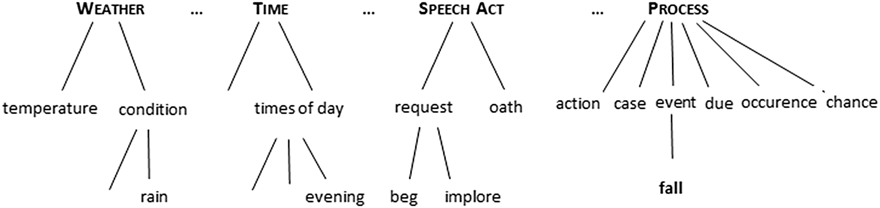
Given this organization of the system, we could suggest that the English words (and the corresponding concepts) we saw above that can be considered counterpart lexical items of the Hungarian words participate in various horizontal and vertical structures that can be partially represented diagrammatically as in Figure 1.
The conceptual organization of the English equivalents for the Hungarian words–concepts derived from the root es-.

As can be seen, the words rain, evening, beg, implore, oath, fall, case, chance, due, event, and occurrence participate in four large conceptual hieararchies: weather, time, speech act, and process. These hierarchies represent different topic areas (or thematic groups of concepts); they are not ‘neighboring’ ones. To indicate this, three dots are used at the uppermost level. The concepts at this level are clearly superordinate-level ones. The concepts at the lowest level are basic-level ones in Figure 1. Anything above the basic level is more or less superordinate with respect to this level.
But what is really relevant to the argument here are two observations. The first is that the concepts that involve the root es- cross-cut both the horizontal and vertical hierarchies, somewhat like conceptual frames that are constituted by a diverse set of concepts from a variety of different hierarchies (topic areas) and from various levels of the hierarchies (superordinate, basic-level, subordinate). But the system of concepts based on es- does not make up a frame, as this is understood in cognitive science and linguistics. Frames are mental representations of coherent specific areas of human experience (see, e.g., Fillmore, Reference Fillmore1982), but the concepts involving es- do not constitute coherent specific areas of experience. They are simply a set of meanings that are systematically related to each other by means of a variety of different cognitive mechanisms (such as metaphor and metonymy). Taken in this sense, roots like es- seem to provide a new dimension in the organization of conceptual structure by virtue of their power to organize conceptual structure in a way that is neither a hierarchical structure nor a conceptual frame.
The second observation is that the English word forms themselves do not reveal any kind of connectedness that would indicate that they are the products of and are based on a unified conceptual framework that underlies most of them: the metaphor EVENTS ARE FALLING and the various metonymies involving the notion of FALLING. As we have noted, this conceptual apparatus can be found in the history of many of the words in English as well, but the words themselves do not make this explicitly observable to speakers.
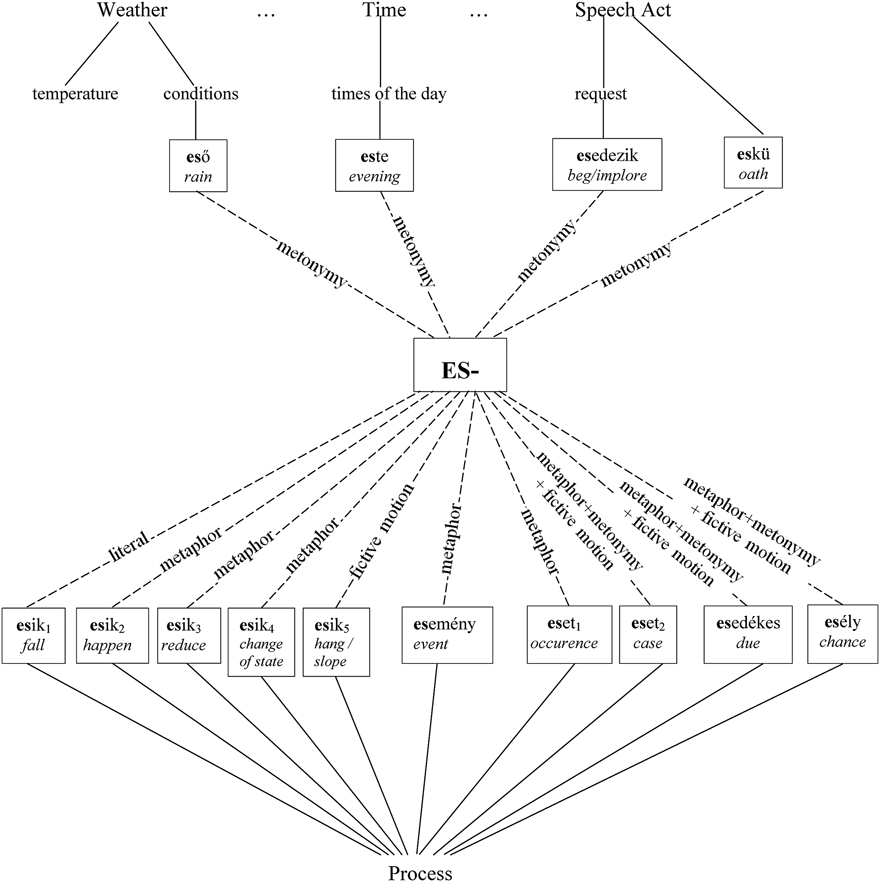
By contrast, Hungarian very clearly indicates through the word forms that there is a conceptual connectedness in all of these cases: the root es- ‘fall’ serves as the central conceptual element from which a number of words are derived by means of a conceptual metaphor with FALLING as its source domain and a variety of metonymies of which FALLING is the ‘vehicle’ element. Thus the situation in Hungarian is radically different from that in English, and it can be diagrammed as shown in Figure 2 (in Figure 2, to save space, I ignore all the additional suffixes that contribute to the meanings of the Hungarian words).
The conceptual organization of the Hungarian words–concepts derived from the root es-.

Given this considerable difference between Hungarian and English, it could perhaps be suggested that such large-scale conceptual application of roots and their linguistic transparency as revealed by es- provides an unrecognized or not sufficiently recognized dimension of conceptual and linguistic organization. In a way, languages that rely on manifest roots make conceptual organization explicit in their linguistic forms; they wear their ‘conceptual hearts’ on their ‘linguistic sleeves’, so to speak. They reflect a dimension of conceptual organization that is not, or is much less, reflected by languages that reveal roots in a much less obvious or explicit way in their word forms.
6. Conclusions
My major goal in this paper was to provide a new perspective for the study of roots. In particular, a cognitivist perspective allows us to respond to the issues in the ‘Introduction’ as follows:
As regards the issue of the relationship between the the root es- and the many words in which it participates, I suggested that there are well-established cognitive mechanisms that provide systematic connections between es- and the various meanings that it can create jointly with the suffixes in the respective lexical items. Four cognitive operations were found important in my account: metonymy, metaphor, fictive motion, and mental spaces. In several cases the operations are at work jointly in systematically relating the meanings, with the conceptual metaphor EVENTS ARE FALLING playing an especially important role.
Concerning their ontological status, roots are of course minimal conceptual units with a form and a meaning. But I also argued, based on work by Gibbs et al. (Reference Gibbs, Beitel, Harrington and Sanders1995), that roots like es- may also be strongly associated with a variety of different image schemas. In a way, the specific roots, such as es-, can be seen as metonymcally evoking several generic-level image schemas with which they are associated. The image schemas contribute a considerable amount of meaning to the roots that conceptualizers make use of in the course of conceptualizing their experiences of the world.
The contrastive analysis between Hungarian and English revealed that English does not explicitly display any linguistic element in its morphology indicating the meaning esik ‘fall’. This does not mean, however, that English does not conceptualize many of the same events and things as Hungarian does by means of the notion of falling. There seems to be a great deal of overlap between English and Hungarian as regards the conceptual level: both languages rely heavily on the conceptual metaphor EVENTS ARE FALLING, even though this conceptualization is not made manifest in the corresponding words (except, of course, in the case of the words esik and fall).
What can roots possibly contribute to the global organization of conceptual structure? Cognitive psychologists proposed two major ways for the organization of concepts: prototypes and basic-level categories. The organization of concepts provided by roots seems to cross-cut these ‘horizontal’ and ‘vertical’ axes, and it may reveal a unique dimension for conceptual organization in languages that rely heavily on transparent roots in their morphologies, such as Hungarian.