INTRODUCTION
Non-native species are capable of causing adverse effects in the environments they colonize (Vitousek et al., Reference Vitousek, D'Antonio, Loope and Westbrooks1996). If the introduction of a non-native species results in well-established populations and a negative impact on other organisms or the economy, then the species is deemed invasive (Rilov & Crooks, Reference Rilov and Crooks2009). Invaders compete with indigenous species for food resources and living space (Davis, Reference Davis2003), and the prevalence of an invasive species can cause indigenous species to become scarce or locally extinct (Gurevitch & Padilla, Reference Gurevitch and Padilla2004). Roughly 40% of threatened or endangered species in the United States are affected by competition or predation of an invasive species (Wilcove et al., Reference Wilcove, Rothstein, Bubow, Phillips and Losos1998). Eradication of these invaders can cost billions of dollars (Pimentel et al., Reference Pimentel, Lach, Zuniga and Morrison2000; Rilov & Crooks, Reference Rilov and Crooks2009). A study published in 2005 estimated that the United States spends $120 billion a year on economic damage and control of invasive species (Pimentel et al., Reference Pimentel, Zuniga and Morrison2005). Considering the potential impact of an invasive species, there is a necessity to prevent introductions from occurring and to better understand successful invasions. Many methods have been proposed to prevent introductions by screening species for their invasive properties (i.e. Weber & Gut, Reference Weber and Gut2004). However, few strategies have been suggested to determine invasive properties of a species once it is introduced to a new region.
There are numerous examples of aquatic introductions in which the species became widely distributed after introductions and experienced exponential population growth (Carlton, Reference Carlton1992; Whitfield et al., Reference Whitfield, Gardner, Vives, Gilligan, Courtenay, Ray and Hare2002; Bubb et al., Reference Bubb, Thom and Lucas2004; Robinson et al., Reference Robinson, Griffiths, McQuad and Ruis2005). To date, roughly 2300 aquatic introductions have been recorded in the United States (Roman & Darling, Reference Roman and Darling2007; USGS, 2009a). These introductions are known to spread via multiple vectors, including shipping (i.e. ship fouling or ballast water), aquaculture, or aquarium release (Carlton & Geller, Reference Carlton and Geller1993; Branch & Steffani, Reference Branch and Steffani2004; Walters et al., Reference Walters, Odom and Zaleski2011).
Mussels and barnacles provide some of the most well documented cases of aquatic invasions. For example, the zebra mussel, Driessena polymorpha, was first found in North American waters of Lake St Clair in 1988. Today, zebra mussels can be found in freshwater bodies in the United States from New England to Texas to California (USGS, 2012). Moreover, the marine mussel Mytilus galloprovincialis dispersed world-wide from its native range in the Mediterranean, Black, and Adriatic Seas to locations including Japan (1932), South Africa (1979), China (1981), United States (1985), Canada (1980s), Korea (1980s), Australia (1990s) and Mexico (1990s) (Lee & Morton, Reference Lee and Morton1985; McDonald et al., Reference McDonald, Seed and Koehn1991; Anderson et al., Reference Anderson, Bilodeau, Gilg and Hilbish2002; Branch & Steffani, Reference Branch and Steffani2004). Furthermore, the barnacle species Austrominius (Elminius) modestus has become widespread and well-established along the European coastline since its introduction in 1943 (Bishop, Reference Bishop1947; Allen et al., Reference Allen, Power, O'Riordan, Myers and McGrath2006). The first record of A. modestus in Ireland was in 1956 near Lough Hyne Marine Nature Reserve (Beard, Reference Beard1957). A 2001 follow-up survey revealed A. modestus was the most abundant and widely distributed barnacle species in the reserve (Lawson et al., Reference Lawson, Davenport and Whitaker2004).
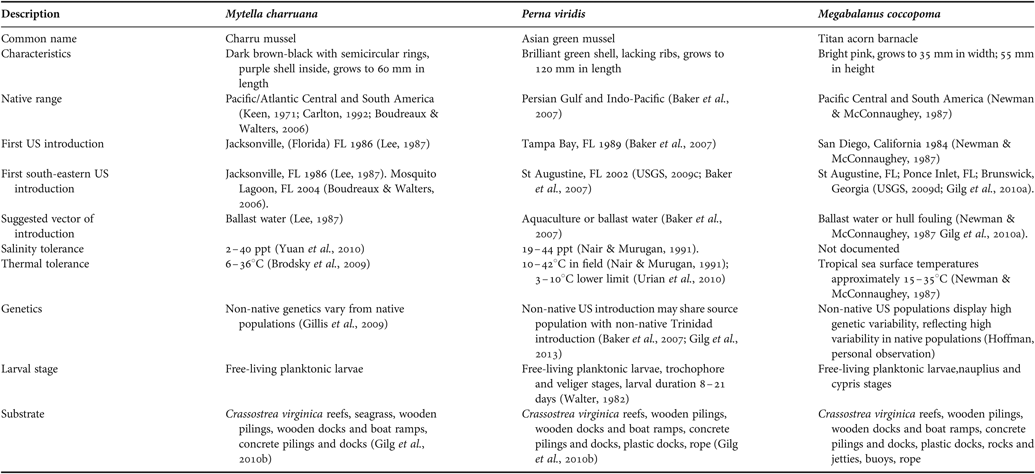
In the south-eastern United States, three non-native, marine, sessile invertebrates with invasive potential were introduced within the past decade. These included two mussel species, Mytella charruana (d'Orbigny, 1846) and Perna viridis (Linnaeus, 1758), and the barnacle Megabalanus coccopoma (Darwin, 1854). Native range, introduction history, putative introduction vectors, biotic conditions, genetic diversity and common substrates for each species are listed in Table 1.
Summary of the introduction history, physical description and physiological characteristics of Mytella charruana, Perna viridis and Megabalanus coccopoma.

The three invertebrates all possess the characteristics of successful invaders including the ability to aggregate and grow in high densities, wide salinity and temperature tolerances, and the propensity to colonize artificial substrates (Table 1). Our study sought to monitor the distribution of M. charruana, P. viridis and M. coccopoma along the south-eastern US coast including coastal inlets and estuaries for a period of five years to determine locations of recruitment and retention. Observational data collected during the surveys provides insight into rates of expansion and range fluctuations, sustaining habitat and potential invasive impact for each species.
MATERIALS AND METHODS
A biannual survey was conducted in order to document the range and abundance of Mytella charruana, Perna viridis and Megabalanus coccopoma along the south-eastern coast of the United States between June 2006 and June 2011. Ranging a total of 894 km from Charleston, South Carolina (SC) to Jupiter, Florida (FL) (Table 2), 82 sites along the south-eastern coastline were searched each June and December with some exceptions (see below).
Survey sites listed north to south from the biannual coastal survey running from June 2006 to June 2011. Site ID is the abbreviated site name, salinity is the range measured in parts per thousand at a site throughout the entire survey, X signifies species presence on at least one occasion at the site, added to survey represents the date when the site was incorporated into the survey.

After reviewing the data set, any count per unit effort (cpue) <1.0 was considered low, ≥1.0 and <5.0 was considered moderate, ≥5.0 was considered high. Salinity was measured at each site using a portable refractometer from two replicate water samples taken near the most abundant substrate type. Water and air temperatures were taken once at each site in a similar location to the salinity sampling with a digital thermometer. Sites displayed a range of salinities (Table 2), while water temperature ranged from 26.4–35.5°C in the summers and 8–26°C in the winters.
The initial survey for M. charruana occurred in June 2006 and included 48 sites ranging from Jupiter, FL to New Smyrna Beach, FL in an effort to record new introductions in the Indian River Lagoon (IRL; Table 2). In December 2007, 28 new sites were added to the survey, ranging from Jacksonville, FL to Savannah, Georgia (GA) (Table 2; Figure. 1). The northern sites were chosen after reports regarding the discovery of M. charruana in Georgia and Jacksonville were released in 2006 (USGS, 2008, 2009b).
Count per unit effort for Mytella charruana at survey sites from June 2006–June 2011; December 2006 and June 2007 were omitted due to lack of data. Sites are ordered north to south from left to right. See Table 2 for list of abbreviations.

Perna viridis and Megabalanus coccopoma were added to the survey, which consisted of 76 sites at the time, in June 2008 in light of the spread of P. viridis (Baker et al., Reference Baker, Fajans, Arnold, Ingrao, Marelli and Baker2007) and limited knowledge on the dispersal of M. coccopoma in Florida (Gilg et al., Reference Gilg, Lukaj, Abdulnour, Middlebrook, Gonzalez, Turner and Howard2010a). In December 2008, three new sites in South Carolina were added based on US Geological Survey reports of P. viridis and M. coccopoma in this state (USGS, 2009c, d), and in June 2009, two sites were added in St Augustine, FL based on observations of P. viridis made by University of central Florida (UCF) researchers (Yuan & Nash, personal observations; Table 2). A final site in SC was incorporated in June 2010 at Hunting Island State Park, SC based on a reported discovery of M. charruana.
RESULTS
Mytella charruana
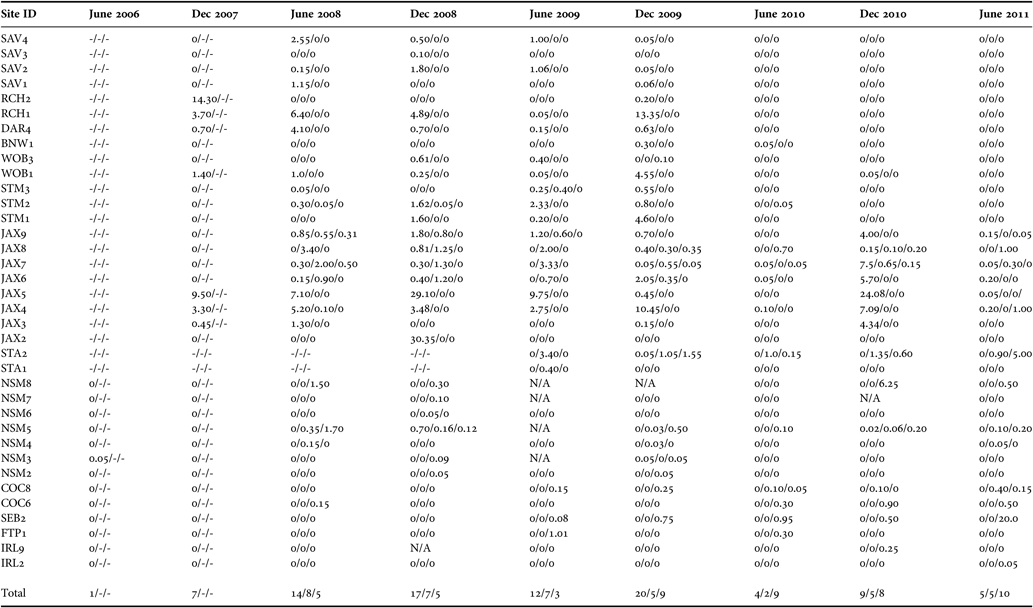
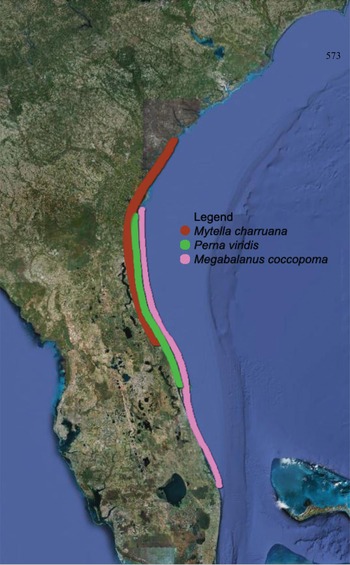
Prior to 2007, we only found Mytella charruana in New Smyrna Beach, FL (Tables 2 & 3). However, we did not examine sites north of Ponce de Leon Inlet, FL until December 2007. During the December 2007 survey, M. charruana populations were found between Jacksonville and northern GA (Table 3; Figure 1). Surveys conducted during subsequent years revealed that M. charruana occurred in the region among years; however, specific locations varied from year to year (Table 3; Figure 1). The northernmost site for M. charruana occurred in Savannah, GA (Tables 2 & 3). The December 2009 survey showed the widest distribution of M. charruana throughout the south-east (Table 3). During this survey, M. charruana occupied 18 of 28 sites (64%) between Jacksonville, FL and Savannah, GA, as well as sites in St Augustine and New Smyrna Beach, FL, covering a distance of approximately 400 km along the coastline.
Count per unit effort (individuals counted/minutes searched) for Mytella charruana, Perna viridis and Megabalanus coccopoma. Count per unit effort data are ordered from left to right: M. charruana/P. viridis/M. coccopoma. Site ID specifies the abbreviated site name (Table 2), and the dates specify when each survey was conducted. Dashes (-) indicate that the site was not part of the survey for a particular species at the given time; zeros (0) indicate that the species was not found at a site during the survey; and sites that were not searched during a particular survey are indicated by N/A. Total indicates the total number of sites where the species was found for all surveys combined.

Densities of M. charruana varied between locations. The sites in New Smyrna Beach sustained low abundances of M. charruana, with populations remaining <1.0 cpu throughout the study (Table 3; Figure 1). In St Augustine, M. charruana was found only once, in December 2009, with a cpu of 0.05 (Table 3; Figure 1). High abundances of M. charruana, with ≥5.0 cpue, were recorded 13 times during our 5-year survey. Ten of these high abundance collections occurred in Jacksonville waters (Table 3; Figure 1). The highest cpue recorded for M. charruana was 29.10 in Jacksonville in December 2009 (Table 3; Figure 1). Sites in Georgia displayed a high cpue for M. charruana on three of the 13 surveys, and each of these three sites was located in northern Georgia (Table 3). In June 2010, M. charruana experienced a vast reduction in distribution and abundance. The species was present at only three sites in Jacksonville and one in central Georgia, and all populations were <1.0 cpue. After the population reductions were recorded in June 2010, M. charruana did not recover its previous range. Our final survey, conducted in June 2011, revealed that M. charruana was not present at any survey sites north of Jacksonville (Table 3; Figure 1).
Perna viridis
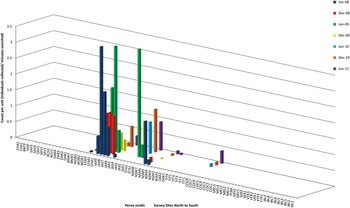
During June 2008, Perna viridis was found in three locations: New Smyrna Beach, Jacksonville, and southern Georgia (Table 3). This was the first survey that included this species. Subsequent surveys revealed that northward and southward spread of P. viridis was minor. The most northerly site inhabited by P. viridis was St Marys, GA in June 2008–June 2009 (Table 3; Figure 2). The most southern location populated by P. viridis was in Cocoa, FL, where it was observed in June 2010 (Table 3). The presence of P. viridis was most consistent in St Augustine and Jacksonville (Table 3).
Count per unit effort for Perna viridis at survey sites from June 2008 to June 2011. Sites are ordered north to south from left to right. See Table 2 for list of abbreviations.

Throughout our survey, high abundances (≥5.0 cpue) were never recorded for P. viridis. Southern sites in Cocoa, FL only showed low abundances of P. viridis at ≤0.4 cpue. Further north, in New Smyrna Beach, the highest cpu we observed was 0.35 in June 2008, and in St Augustine the cpue ranged from 1.0 to 5.0 (Table 3; Figure 2). We found P. viridis in moderate abundances at sites in Jacksonville (Table 3; Figure 2). However, we only observed low abundances of P. viridis north of Jacksonville. Total populated sites did not vary much between winter and summer surveys with a few exceptions; June 2008 had the highest number of populated sites of any survey (eight sites) and June 2010 had the fewest (two sites). Overall, the total collective range covered by P. viridis during the study was 307 km from St Marys, GA to Cocoa, FL (Figure 2).
Megabalanus coccopoma
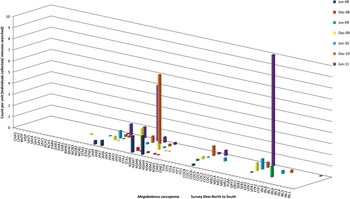
We began documenting the presence of Megabalanus coccopoma in June 2008. During that survey, M. coccopoma was found at five sites in Florida between Cocoa and Jacksonville, covering a distance of 272 km (Table 3; Figure 3). During subsequent years, the range of M. coccopoma was variable. In June 2009, the species was only found between Ft Pierce and Cocoa, FL (Table 3). The farthest north the species was found was Jekyll Island, GA, during the December 2009 survey (Table 3; Figure 3). In June 2011, the southernmost population was observed in Jupiter, FL. Therefore, the cumulative range of M. coccopoma covered a distance of 550 km from Jupiter, FL to Jekyll Island, GA (Table 3; Figure 3).
Count per unit effort for Megabalanus coccopoma at survey sites from June 2008 to June 2011. Sites are ordered north to south from left to right. See Table 2 for list of abbreviations.

For M. coccopoma, we tended to observe greater numbers during summer surveys (Table 3). The presence of M. coccopoma was most consistent at New Smyrna Beach, FL where occurrences were observed between June 2008 and June 2011, with the exception of June 2009 (Table 3). Variance in abundance was typically low between site locations and survey dates (Table 3; Figure 3). One noticeable exception occurred at Sebastian, FL where abundances were low (Figure 3) except for the June 2011 survey, where a cpue of 20.00 was recorded. Moreover, this was the single highest recorded cpue for M. coccopoma during our study (Table 3; Figure 3).
DISCUSSION
This study sought to characterize the distribution and persistence of three recent marine invaders to the south-eastern USA Atlantic coast. Each of the three focal species (Mytella charruana, Perna viridis and Megabalanus coccopoma) shared overlapping ranges at sites in central Florida and southern Georgia. Moreover, Mytella charruana and Megabalanus coccopoma both inhabited overlapping sites in central Georgia, and P. viridis and M. coccopoma were both distributed along the central Florida coastline. Although the three invertebrates have been found on natural oyster reefs (Boudreaux & Walters, Reference Boudreaux and Walters2006; Baker et al., Reference Baker, Fajans, Arnold, Ingrao, Marelli and Baker2007; Gilg et al., Reference Gilg, Lukaj, Abdulnour, Middlebrook, Gonzalez, Turner and Howard2010a), they were most commonly found on artificial structures (e.g. floating docks and pier pilings; Table 2). In general, these data suggest that M. charruana, P. viridis and M. coccopoma are capable of settling on the same substrates and tolerate overlapping ranges of salinity and temperature (Newman & McConnaughey, Reference Newman and McConnaughey1987; Baker et al., Reference Baker, Fajans, Arnold, Ingrao, Marelli and Baker2007; Yuan et al., Reference Yuan, Walters, Schneider and Hoffman2010; Table 2; Figures 1–4). Our study highlights how all three species were persistent within the geographical range observed, although the specific locations and abundances varied from year-to-year over the five-year period investigated here (Figure 4). Below, we discuss which biotic and abiotic factors likely contribute to annual range fluctuations as well as overarching distribution patterns.
Map showing the cumulative ranges recorded for Mytella charruana, Perna viridis and Megabalanus coccopoma over the duration of the study.

Fluctuations in specific population locations and densities within those locations occurred throughout the study, most notably for M. charruana (Table 3; Figure 1). Distributions of M. charruana contracted markedly in June 2010 following the occurrence of an unusually cold winter (NOAA, 2010). Similarly, P. viridis showed a noticeable decline in abundance in the June 2010 survey. Simultaneous reductions in abundance for M. charruana and P. viridis could be explained by lower than average water temperatures which occurred during the month of January 2010. Both M. charruana and P. viridis are considered tropical species, and thus may be sensitive to cold temperatures. In January 2010, the air temperature in Jacksonville, FL fell to 0°C or below for 12 of 13 days (2 January–14 January; NOAA, 2010). During that time, ocean surface temperatures were recorded at 5.6°C below the average, reaching temperatures as low as 4.7°C (NOAA, 2012). Furthermore, air temperatures at St Simons Island, GA, approximately 35 km north of St Marys, GA, remained ≤0°C for 12 consecutive days (3–14 January 2010). According to recent studies, the minimal thermal tolerance of M. charruana to produce byssal threads is between 6 and 9°C, and complete mortality occurred at or below 6°C (Brodsky et al., Reference Brodsky, Walters, Hoffman and Schneider2009, Reference Brodsky, Walters, Schneider and Hoffman2011). However, juvenile M. charruana (≤12 mm) have greater survivorship at 6–9°C than adults (Yuan et al., unpublished data), likely enabling numbers to return in subsequent years. In laboratory trials, mortality of P. viridis occurred after an average of 5.7 days' exposure to water temperatures of 10°C, and 100% mortality was recorded after 13 days (Urian et al., Reference Urian, Hatle and Gilg2010). Exposure to air temperatures of 7°C or less showed decreased survivorship for P. viridis, especially for small mussels. Given the NOAA data on sea surface temperatures around the area of invasion (NOAA, 2010, 2012), it is likely that temperature was a key limiting factor for the survival and dispersal of M. charruana and P. viridis along the south-eastern coast and explains fluctuations of range and densities for these species.
Unlike the two mussel species, the abundance and distribution of M. coccopoma did not notably decline after the cold temperatures in January 2010. Counts per unit effort actually increased for M. coccopoma at sites in Fort Pierce, Sebastian, Jacksonville, FL, and St Marys, GA, while reductions in abundance were seen ubiquitously for M. charruana and P. viridis. This was an unexpected observation because M. coccopoma is also considered a tropical species and reportedly cannot survive or reproduce without warm tropical sea surface temperatures of 15–35°C (Newman & McConnaughey, Reference Newman and McConnaughey1987). It is possible that if populations of M. coccopoma that arrived on the Atlantic coast were transported from other invaded areas (e.g. California and Japan; Newman & McConnaughey, Reference Newman and McConnaughey1987; Yamaguchi et al., Reference Yamaguchi, Prabowo, Yuu Ohshiro, Shimono, Jones, Kawai, Otani, Oshino, Inagawa, Akaya and Tamura2009) then the introduced population of M. coccopoma could be pre-adapted to colder temperatures, allowing it to tolerate cold winter conditions. While temperature may prevent the survival of M. charruana and P. viridis in northern climates (e.g. north of Georgia; Urian et al., Reference Urian, Hatle and Gilg2010; Firth et al., Reference Firth, Knights and Bell2011), our data suggest that M. coccopoma may be more cold-tolerant, allowing for further dispersal north along the eastern US coast. Further research on the specific temperature tolerances of M. coccopoma may shed light on this hypothesis.
Salinity, although important, was less likely to limit range expansion in either mussel species. Mytella charruana and P. viridis have demonstrated wide salinity tolerances in laboratory trials ranging from 2 to 40 ppt for M. charruana and 19–44 ppt for P. viridis (Nair & Murugan, Reference Nair and Murugan1991; Yuan et al., Reference Yuan, Walters, Schneider and Hoffman2010). Our field observations have shown that M. charruana occupied sites with salinities ranging from 0 to 35 ppt and P. viridis from 2 to 38 ppt. This indicates that each species can tolerate wide ranges of salinities for at least short periods of time in their introduced range. A recent study examined the salinity–temperature interactions for M. charruana and P. viridis in controlled laboratory settings and revealed a unique optimal salinity–temperature range with variations depending on mussel size (Yuan et al., unpublished data). The results showed significant survival for P. viridis at a wide range of temperatures from 9 to 35°C when the salinity was 35–37 ppt; as salinity decreased, the survival range became narrower. With M. charruana, the data suggested that small and large individuals can survive at a wide range of salinities (5–40 ppt) at 20°C, but the salinity range is restricted with increased or decreased temperatures (Yuan et al., unpublished data). Because P. viridis maintains optimal survivorship at high salinities, it is unlikely that the species will grow to high densities in low salinity estuaries (but see Firth et al., Reference Firth, Knights and Bell2011). Such laboratory experiments have yet to be conducted for M. coccopoma. However, our field observations suggest that M. coccopoma can also tolerate a wide salinity range. For example, M. coccopoma occupied sites with salinities ranging from 2 to 42 ppt (Table 2). However, sites that typically have the highest abundances of M. coccopoma exhibited salinities ranging from 22 to 40 ppt (Table 2). Of all the sites on the survey where we observed M. coccopoma, Jacksonville sites had the most variable salinities, ranging from 8 to 30 ppt. These field data indicate that M. coccopoma can tolerate salinity fluctuations for short periods of time, even if survival is more successful in higher salinities. Overall, salinity appears less significant in determining dispersal potential than temperature.
Our data suggest that all three species are capable of reproducing along the south-eastern coastline. Mytella charruana adults collected in the field contained gametes (Stenyakina et al., Reference Stenyakina, Walters, Hoffman and Calestani2010). Additionally, juvenile mussels as small as 1.5 mm were collected in high numbers during winter surveys, most likely the offspring of spawning from the previous summer or autumn. In St Augustine and Jacksonville, P. viridis maintained well-established populations and also showed evidence of reproduction and juvenile survival. Subsequent reproduction in US waters is also likely based on gamete releases documented under laboratory conditions (L.J. Walters, personal observation). The smallest specimen of P. viridis collected in the study measured 4 mm in length. Continual re-introductions are also a possible explanation for well-maintained populations of P. viridis in St Augustine and Jacksonville, but no specific genetic data have been presented on this hypothesis.
Sites in Jacksonville, FL and on the Georgian coastline supported the highest abundances of M. charruana. One explanation points to multiple introductions from South America to Jacksonville or Georgia, which is supported by the genetic composition of non-native M. charruana populations in the region (Gillis et al., Reference Gillis, Walters, Fernandes and Hoffman2009). The success of M. coccopoma populations varied somewhat from that of the two mussels. St Augustine and Ponce de Leon Inlet, near New Smyrna Beach, were the first locations recorded to have M. coccopoma on the south-eastern Atlantic coast (USGS, 2009d), and both areas have maintained high-density, well-established populations for 3–4 years. However, site SEB2 in Sebastian was not documented as a point of introduction by USGS, yet established populations of M. coccopoma were observed there from June 2009 through to June 2011. Larval dispersal may be a possible explanation for the apparently recent introduction of M. coccopoma to Sebastian. All three species exhibit a planktonic larval stage, which likely plays a large role in patterns of dispersal. Larval dispersal is reliant on a number of factors including ocean and surface currents. It is interesting that although M. charruana is a tropical species, it showed a northward progression in distribution, but did not advance southwards. This was likely caused by the Gulf Stream, the major oceanic current of the western Atlantic, which generally moves north along the eastern United States coastline. Additionally, offshore surface currents tend to move north in summer, offshore in winter, south in autumn (Weber & Blanton, Reference Weber and Blanton1980; Atkinson et al., Reference Atkinson, Lee, Blanton and Chandler1983). Considering the locations of M. charruana (New Smyrna Beach, Jacksonville, Georgia) and the spawning season (summer/autumn), the transport of larvae via currents would be predominantly northward. This larval dispersal pattern likely applies to P. viridis as well, which would account for the minimal distribution of P. viridis south of New Smyrna Beach. However, P. viridis was found in Cocoa, FL, which could be attributed to commercial or recreational boating. We have observed P. viridis attached to hulls of boats, which could easily traffic this sessile invertebrate around local waterways (L.J. Walters, personal observation).
Dispersal patterns of M. coccopoma vary from those of the other two species. While M. coccopoma was distributed northward from our first observations in New Smyrna Beach, it was also found south in subsequent surveys. Prior work supports evidence that M. coccopoma spawning occurs in spring and summer (Gilg et al., Reference Gilg, Lukaj, Abdulnour, Middlebrook, Gonzalez, Turner and Howard2010a), and a previous study conducted in Brazil observed M. coccopoma larval abundance peaking in September–November (Severino & Resgalla, Reference Severino and Resgalla2005). If similar patterns of reproduction are occurring in the south-eastern United States, then larval release would peak March–May, when offshore surface currents are travelling northward (Weber & Blanton, Reference Weber and Blanton1980; Atkinson et al., Reference Atkinson, Lee, Blanton and Chandler1983). Thus, M. coccopoma may have other means of dispersal, such as independent introductions via ballast water or recreational boating at the southern locations, which may explain both the northward and southward distribution of M. coccopoma as opposed to M. charruana and P. viridis. Further investigations should be conducted to better understand the mechanisms of dispersal.
The initial finding of M. charruana in Canaveral National Seashore in the Indian River Lagoon (IRL) in 2004 was a great concern. The exotic mussel was found living attached to live oysters on intertidal reefs of the native eastern oyster, Crassostrea virginica (Boudreaux & Walters, Reference Boudreaux and Walters2006). The potential impact of M. charruana on the oyster reef habitats of the IRL prompted the need for this non-native species survey. Incidences with over 40 individuals of M. charruana attached to a single living oyster were recorded in the northern IRL (L.J. Walters, personal observation). Although live M. charruana have only rarely been documented on the C. virginica reefs of Mosquito Lagoon since 2006 (L.J. Walters, personal observation), persistent populations of M. charruana, P. viridis and M. coccopoma can be found approximately 10 km north of Canaveral National Seashore (Tables 2 & 3). Both M. charruana and P. viridis have been found living in the IRL south of Canaveral National Seashore. Although the initial concern has not yet manifested as an outbreak of these species, it is typical for invaders to persist at low numbers for a number of years, in a lag-phase of invasion, before abundances increase to detrimental levels (Kolbe et al., Reference Kolbe, Glor, Rodriguez-Schettino, Chamizo-Lara, Larson and Losos2004).
This study was designed to investigate our understanding of current distributions of the three non-indigenous invertebrates and which environmental and man-made factors have contributed to their current distribution. However, it is difficult to determine whether M. charruana, P. viridis and M. coccopoma are causing negative impacts on the colonized environments based on this study. The propensity of M. charruana to aggregate in densities as high as 11,000 m2 could pose a threat by displacing other native species (Pereira et al., Reference Pereira, Hilberath, Ansarah and Galvao2003). The large size of P. viridis may increase the species' competitive edge for food and space and has already proved to be economically costly. Gregarious clusters of M. coccopoma may assume a similar threat, and the large size of this barnacle could contribute to the displacement of native sessile species. Predator–prey relationships between native predators and the introduced species or vice versa could shift the species dynamics within the affected ecosystems. Future research should continue to determine genetic make-up of introduced species, larval distributions, competitive interaction with native species, as well as physiological studies in non-native ranges.
ACKNOWLEDGEMENTS
Funding was provided by USDA NIFA Award No.: 2008-32320-04574, the Indian River Lagoon National Estuary Programme, Workforce Central Florida and the National Science Foundation. Thanks go to the Office of Undergraduate Research at the University of Central Florida, the UCF Research and Mentoring Programme, the UCF Young Entrepreneur Scholars, the UCF Biology Department, and all who assisted with the project: E. Nash, M. Boudreaux, N. Gillis, J. Ledgard, P. Sacks, L. Stroud, S. Hamadeh, S. Brodsky, J. Solomon, M. Kemper, S. Garvis, P. Biscardi, A. Way and A. Godwin.