On October 15, 2017, American actress Alyssa Milano sent a tweet with the hashtag #MeToo in response to growing sexual assault and harassment accusations against Hollywood producer Harvey Weinstein. The tweet was simple: “If you've been sexually harassed or assaulted write ‘me too’ as a reply to this tweet.”Footnote 1 Within 24 hours, the phrase had been shared on Twitter half a million times (Santiago and Criss Reference Santiago and Criss2017). Internationally, in the weeks that followed Milano's tweet, individuals from more than 85 countries sent #MeToo-related tweets (Strum Reference Strum2017). Although the “Me Too” movement had started with the work of Tarana Burke and other feminists offline and on the social media website Myspace more than a decade before, the tremendous diffusion of activism in 2017 was both surprising and humbling for feminists and women's rights activists (Boyle Reference Boyle2019, 4).Footnote 2
“Hashtag activism” and “digital feminist activism” are growing forms of political engagement (Mendes, Ringrose, and Keller Reference Mendes, Ringrose and Keller2018; Xiong, Cho, and Boatwright Reference Xiong, Cho and Boatwright2019). As Vassallo (Reference Vassallo2018, 68) pointed out, “protest has become an online activity.” To note, although most #MeToo activism can be assumed to involve women, we acknowledge that all individuals in a country could and do use the hashtag as a form of digital activism. This type of engagement seems different from the traditional protest march; at first glance, digital activism does not seem as individually costly as a hunger strike or sit-in. Hashtag activism is often seen as synonymous with “slacktivism,” as simply forwarding a tweet or liking a comment does not appear to involve much personal effort (Breuer and Farooq Reference Breuer and Farooq2012; Vie Reference Vie2014). However, in the case of #MeToo, digital feminist activism can still be personally costly: “although it may be technologically easy for many groups to engage in digital feminist activism, there remain emotional, mental or practical barriers which create different experiences, and legitimate some feminist voices, perspectives and experiences over others” (Mendes, Ringrose, and Keller Reference Mendes, Ringrose and Keller2018, 237).
When protest evolves, so, too, must our understanding of the factors that drive advocacy participation. Although much work has been done on the determinants of participation in social movement organizations or street protests, there is limited cross-national work that examines participation in digital advocacy. What factors encourage participation in #MeToo? Are these factors distinct from the drivers of more traditional, nondigital participation in protests or social movements? Given the transnational nature of #MeToo and other digital feminist activism in recent years, it is easy to assume that globalization and the internet drive digital advocacy, perhaps lessening or even eliminating the need for domestic political structures and opportunities. With digital activism like #MeToo, does domestic politics even matter?
In this article, we argue that digital feminist activism still requires domestic political conditions that heighten people's willingness to participate and provide an opportunity for engagement. Much of the popular discussion of digital activism overestimates the importance of foreign influences and global ties. Australian journalist Tracey Spicer, for example, told the Telegraph that “globalization, connectivity and the women's rights movement have created the perfect storm” for #MeToo participation, with women realizing that they are not “alone” (Burke Reference Burke2018). Some scholars agree, contending that the internet and other communication technologies have changed collective action, making the international more important (Earl and Kimport Reference Earl and Kimport2011; Hands Reference Hands2011; Van Laer and Van Aelst Reference Van Laer and Aelst2010).Footnote 3 Other scholars have joined us in arguing for the continued importance of domestic forces and the synergy between traditional protest and digital activism (Breindl Reference Breindl2010; Della Porta and Mosca Reference Della Porta and Mosca2005; Greitens Reference Greitens2013; Kahn and Kellner Reference Kahn and Kellner2004). Even for a global digital movement like #MeToo, we argue that overall levels of engagement still critically depend on domestic political opportunity structures. In this regard, digital feminist activism may be more similar to traditional political protest than is commonly assumed.
To test the implications of our argument, we examine a snapshot of data on the #MeToo movement from 17,289 global tweets from July 20 to July 25, 2019, and 17,922 global tweets from September 15 to September 21, 2019. The choice of these time periods was arbitrary, coming almost two years after the exposition of hashtag.Footnote 4 These periods provide a glimpse of involvement with an established advocacy movement at a time somewhat distinct from the immediate dispersion of the issue and hashtag. By not focusing on the original viral tweets from 2017, we are better able to describe individual involvement with a recognized movement, similar to studies on involvement with traditional women's street protest or social movements in the post–Cold War period (Hughes, Krook, and Paxton Reference Hughes, Krook and Paxton2015; Murdie and Peksen Reference Murdie and Peksen2015; Stienstra Reference Stienstra2016). Using Bayesian statistical modeling at the country level, we show that #MeToo advocacy involvement is still driven by domestic political opportunity structures, even when we account for globalization and internet access. Our findings help connect digital activism to traditional theories of contentious politics. Although protest may be evolving, new forms of activism still depend on political structures that provide opportunity and heighten individual willingness.
The article proceeds as follows: In the next section, we review the literature on mobilization and the diffusion of movements. Next, we outline our argument concerning the necessity of domestic political opportunity for all advocacy, even hashtag advocacy. We then present our data and discuss our modeling choices. We review the results and, finally, offer some suggestions for policy and academic work that builds on our empirical findings.
WHERE ARE ALL THE (FEMALE) ACTIVISTS?
To build our argument about cross-national levels of participation in #MeToo, we draw on three related literatures: (1) general mass mobilization, (2) digital activism, and (3) movement diffusion. First, what leads to higher levels of mass mobilization within a country? Cross-national work on the determinants of involvement in the women's movement or in women's offline protest is still relatively rare (Fallon and Rademacher Reference Fallon, Rademacher, Alexander, Bolzendahl and Jalalzai2018; Murdie and Peksen Reference Murdie and Peksen2015). Most studies focus on women's participation in North America and Western Europe only (Costain Reference Costain1992; Soule et al. Reference Soule, McAdam, McCarthy and Su1999). The studies that do exist, however, often find very similar patterns of women's participation in protest to that of protest that does not center on women's issues, especially when compared with other historically disadvantaged groups (Murdie and Peksen Reference Murdie and Peksen2015; Bell et al. Reference Bell, Murdie and Peksen2019).
The larger literature on protest offers many important arguments on the drivers of mobilization. First, early scholarship highlighted the role of grievances and feelings of relative deprivation, often connecting these ideas to the overall use of violence by the government (Chenoweth and Ulfelder Reference Chenoweth and Ulfelder2017; Gurr Reference Gurr1968). Repression and injustice can mobilize individuals to take to the streets. Research on women's protest has similarly found that a lack of respect for women's rights often accompanies mobilization (Bell, Murdie, and Peksen Reference Bell, Murdie and Peksen2019; Costain Reference Costain1992; Murdie and Peksen Reference Murdie and Peksen2015).
Second, staging or joining a protest is costly, requiring both human capital and material resources (McCarthy and Zald Reference McCarthy and Zald1977). Much research has found that the presence of established civil society groups, greater individual wealth, and an educated population make mobilization easier by reducing individual barriers to participation and increasing the resources through which groups can mobilize for protest events (Chenoweth and Lewis Reference Chenoweth and Lewis2013; Dalton, Van Sickle, and Weldon Reference Dalton, Van Sickle and Weldon2010; Murdie and Peksen Reference Murdie and Peksen2015). This is especially true for nonviolent protest mobilization.
Many studies on the role of globalization in protest focus on how the informational resources provided by globalization may aid in mobilization. For example, the spread of information and interpersonal connections can help with coordination and reduce duplication of effort, allowing country-level movements to learn from each other and share resources (Bell, Murdie, and Peksen Reference Bell, Murdie and Peksen2019). Globalization can also make it easier for transnational nongovernmental organizations to be involved within a country, increasing the ability of local actors to coordinate and plan protests (Keck and Sikkink Reference Keck and Sikkink1998; Murdie and Peksen Reference Murdie and Peksen2015; Olzak and Tsutsui Reference Olzak and Tsutsui1998).
Much research also stresses the importance of political opportunity structures. Protest is more likely when individuals believe the political structure will allow mobilization and that mobilization has some chance of being successful (Costain Reference Costain1992; Lichbach Reference Lichbach1998; Murdie and Peksen Reference Murdie and Peksen2015). The opportunity structure also colors the tactics used; more violent tactics are more likely in closed political systems (Meyer Reference Meyer2004; Schock Reference Schock2004). Some researchers have suggested a curvilinear relationship between protest mobilization and political opportunity structures; after a certain level of openness, citizens may move to more insider political tactics, such as directly engaging with legislators, as opposed to taking to the streets to demand political change (Dalton, Van Sickle and Weldon Reference Dalton, Van Sickle and Weldon2010; Meyer Reference Meyer2004). Nonetheless, protest is less likely in closed political systems.
DIGITAL ACTIVISM
The literature discussed here is useful in understanding the cross-national factors that make protest more likely in some countries. However, much of this literature predates the internet and is centered on both nonviolent and violent forms of street protest. Are the drivers of digital activism similar? To start, many scholars stress that digital activism is somewhat less costly than traditional mobilization. For example, Earl and Kimport (Reference Earl and Kimport2011, 90) contend that “when participation can occur online, participation will generally be less costly and thus should spur flash-style mobilizations in which large numbers of people participate.” Compared with organizing or participating in a march, retweeting a hashtag or adding your name to an online petition takes less time and energy. Some digital activism is anonymous, limiting the potential costs of reprisal. In line with these arguments, digital activism could revolutionize contentious politics (Hands Reference Hands2011; Van Laer and Van Aelst Reference Van Laer and Aelst2010). Internet access becomes a key driver of revolution.
When it comes to #MeToo activism, however, and other digital feminist activism, there are some heightened costs of participation. Mendes, Ringrose, and Keller's (Reference Mendes, Ringrose and Keller2018, 242) online survey of digital feminist activists found that 72% had faced hostile trolling on Twitter after posting feminist views; this trolling ranged from taunts or slurs to “violent and graphic rape and death threats.” The human rights organization Amnesty International (2018) released a report on “Toxic Twitter,” noting that violence toward and abuse of women online may include the sharing of private information such as pictures and home addresses. These threats may be more than what one would receive for attending a feminist rally, and, even though the threats happen online, the fear of physical violence is often justified.
In addition, participation in digital feminist activism is likely influenced by political opportunity structures: if individuals are going to be involved in a movement, there has to be some general belief that the movement will be successful and that the government will not repress their mobilization. In addition, online resources are often coupled with offline mobilization. In this regard, digital activism is synergistic with traditional protest (Della Porta and Mosca Reference Della Porta and Mosca2005). This is in line with Hill's (Reference Hill2013, 6) discussion of the role of domestic political structures in the digital age:
Digital revolutions do not make social revolutions in and of themselves. It is not the technology itself that brings down repressive regimes, exposes unjust laws, frees political prisoners or secures human rights. Social change comes from the people—the people on the ground who are using digital technology as well as more traditional methods, to help organize and expand their demand for change.
Given the widespread prevalence of sexual harassment and assault around the world, it is likely that digital feminist activism has motivations similar to the relative deprivation or grievance arguments from traditional scholarship. However, with digital feminist activism especially, the political opportunity structure may make it more or less likely for individuals to speak out about their grievances. In many regards, this is similar to the reporting of sexual assaults to police forces. Countries with supportive political and legal systems often have a higher level of reported rapes, not because of a higher overall level of offenses but because of the “improved legal and social position of women” (Van Hofer Reference Von Hofer2000, 85). We expect this logic to inform involvement with the #MeToo movement as well.
DIFFUSION OF MOVEMENTS
When focusing on #MeToo, we are interested not only in what drives activism or protests but also in what drives involvement in an international movement, specifically a movement originating in the United States. How does a movement spread across borders? Studies on the diffusion of movements suggest several diffusion mechanisms (Strang and Soule Reference Strang and Soule1998). From contagion to social learning processes, these mechanisms stress international influences and how domestic actors are affected by foreign influences. The notion of contagion effects views the diffusion process as unpredictable and spontaneous. Protestors in a country observe protests in other countries and mimic the collective action without careful planning.
Social learning provides a more nuanced explanation of diffusion processes. Rather than simply copying other countries’ protests, collective actors vigilantly learn strategies and tactics from other countries. Either way, protests in other countries create demonstration effects. Potential protestors and activists will observe a successful movement in a country and try to organize the movement in their country (Kuran Reference Kuran1991; Tarrow Reference Tarrow1994; Weyland Reference Weyland2012). Weyland (Reference Weyland2012) argues that since discontented people face tremendous uncertainty, they rely on cognitive heuristics before organizing protests, and other countries’ protests provide them with these heuristics. Because of these heuristics, potential collective actors are more observant of striking, vivid protest events in other countries, and they often overestimate their chances of winning in contentious movements and underestimate important differences in domestic conditions between them and other countries. Weyland (Reference Weyland2009) explains the anti-regime movement in Europe in 1848 as driven by demonstration effects. Many scholars use demonstration effects to explain the series of protests in Eastern Europe in the early 2000s (Beissinger Reference Beissinger2007; Gunitsky Reference Gunitsky2018) and the Arab Spring in the early 2010s (Bamert, Gilardi, and Wasserfallen Reference Bamert, Gilardi and Wasserfallen2015; Gunitsky Reference Gunitsky2018; Weyland Reference Weyland2012).
Studies of protest diffusion, accordingly, pay attention to the routes that transmit protest information to other countries. Transnational activists and international nongovernmental organizations (INGOs), economic and social ties, and the internet are discussed in the literature (Brancati and Lucardi Reference Brancati and Lucardi2019; Lotan et al. Reference Lotan, Graeff, Ananny, Gaffney, Pearce and Boyd2011; Strang and Soule Reference Strang and Soule1998; Weyland Reference Weyland2019). Transnational activists and INGOs not only spread news but also hand down new methods and tactics to potential protestors (Beissinger Reference Beissinger2007; Bunce and Wolchik Reference Bunce and Wolchik2006; Tarrow Reference Tarrow2005).
Economic relations between countries also play a significant role in disseminating information since close economic relations will increase the communications and interactions of economic actors between countries. For the same reason, social ties are considered important in spreading information. Because close countries are more likely to be connected by economic and social ties, the diffusion literature often considers geographic contiguity an important factor that makes diffusion more likely (Gunitsky Reference Gunitsky2014; Houle, Kayser, and Xiang Reference Houle, Kayser and Xiang2016; Teorell Reference Teorell2010).
Finally, the diffusion literature stresses the role of the internet in diffusion processes (Bamert, Gilardi, and Wasserfallen Reference Bamert, Gilardi and Wasserfallen2015; Lotan et al. Reference Lotan, Graeff, Ananny, Gaffney, Pearce and Boyd2011; Weyland Reference Weyland2019). During the Arab Spring, social media outlets such as Facebook and Twitter were frequently used to diffuse protest news and mobilize protestors (Bamert, Gilardi, and Wasserfallen Reference Bamert, Gilardi and Wasserfallen2015; Larson et al. Reference Larson, Nagler, Ronen and Tucker2019; Weyland Reference Weyland2019). Social media disseminates news very quickly—sometimes almost in real time. Weyland (Reference Weyland2019, 4) notes that after the Tunisian dictator had been removed by street protests, “within five minutes,” Egyptian activists called for action by Egyptian people on Twitter.
Demonstration effects, however, often overestimate the importance of international influence in the diffusion process. Potential protestors also take domestic political conditions into account (Brancati and Lucardi Reference Brancati and Lucardi2019; Hale Reference Hale2019; Kim Reference Kim2019; Skorge Reference Skorge2018). International influences will prompt people to take action only when these people have both the willingness and opportunity for mobilization. Countries differ in their political opportunity structures, and these differences will lead to different mobilization environments, under which people have different levels of willingness and opportunities for mobilization. In a more open society, potential collective actors will be endowed with more political and social resources. This means that mobilization is easier for them compared with actors in a less open society. However, discontented people in an open society will be endowed with a wider set of options to express their discontent, meaning they may not take the same action that people in the other country took. Therefore, without taking these domestic influences into account, diffusion studies cannot adequately explain why a movement diffuses into some countries but not in others.
Moreover, in terms of women's political engagement, domestic political conditions play significant roles (Kim Reference Kim2019; Skorge Reference Skorge2018). Kim (Reference Kim2019, 594), for example, finds that women under the presence of direct democracy more actively engage in politics since direct democracy “signals the system's openness to women's voice” and thus encourages women to participate in political activities. Participation in #MeToo is costly for women since it involves a certain level of sharing of their personal narratives and stories. In a more open political system, women will feel encouraged to share their stories and thus are more likely to engage in #MeToo. On the contrary, in a closed political system, even though women receive international signals to participate in #MeToo, they are less encouraged by their political system to openly speak out against authority figures, and thus less likely to participate in the movement. Similarly, in a closed political system, those outside the winning coalition may not see their voice as being effective in garnering political concessions. Therefore, speaking out against those with historically more power may be viewed as ineffective. Further, a closed political system is less likely to garner offline mobilization, limiting any synergistic multiplicative effect that the digital activism could bring (Hill Reference Hill2013). Given that all #MeToo participants could face hostile trolling, threats, and invasions of privacy as a result of their activism, the costs may be seen as greater than the expected benefits of activism in a closed system.
Taking these arguments together, we contend that domestic political opportunity is an important driver of #MeToo mobilization; countries with more open political structures should have more #MeToo involvement within their borders than countries with closed political structures. Our understanding of traditional protest has long supported the role of domestic political opportunity structures in increasing individual willingness to join a movement (Kim Reference Kim2019; Skorge Reference Skorge2018). Further, for digital activism, political opportunity structures will color whether individuals think that the movement will be successful and that their concerns will be taken seriously. Finally, although #MeToo is an international movement, domestic political opportunity still matters for protest diffusion. We contend that the importance of domestic political opportunity structures should hold, even accounting for the host of international factors that make digital activism more likely.
HYPOTHESES AND CONCEPTUALIZATION OF OPEN POLITICAL SYSTEMS
As discussed earlier, we contend that political opportunity structures drive #MeToo mobilization. Drawing on this discussion, we use five Varieties of Democracy (V-Dem) high-level democracy indices to capture slightly different conceptualizations of the level of openness in a political system (Coppedge et al. Reference Coppedge, Gerring, Knutsen, Lindberg, Teorell, Altman and Bernhard2019). Each of these conceptualizations becomes one of our testable hypotheses. First, the V-Dem electoral democracy index not only captures free and fair processes of elections but also includes freedom of expression and the existence of independent media outlets that allow citizens to get access to alternative information. We expect that as a country protects citizens’ political rights with free and fair elections and higher degrees of freedom of expression, individuals in the country will be more likely to engage in the #MeToo movement (H1). This is because this system will reassure activists that their voices will be heard through independent media outlets and will be taken seriously by their political system. If individuals do not think their tweets will reverberate through the local political system, they will be less likely to participate.
Second, V-Dem's liberal democracy index captures whether a country protects minority rights and prevents the tyranny of the government and the majority (Coppedge et al. Reference Coppedge, Gerring, Knutsen, Lindberg, Teorell, Altman and Bernhard2019). We expect that as a country protects minority rights better and has a strong rule of law and independent judiciary, citizens will be more likely to participate in #MeToo (H2). That is, the system will signal to individuals that their rights will be protected as they reveal their grievances in public. Further, a liberal democracy will provide the judicial mechanisms that could make #MeToo participation lead to local change.
Third, the participatory democracy index entails citizens’ active participation in political processes (Coppedge et al. Reference Coppedge, Gerring, Knutsen, Lindberg, Teorell, Altman and Bernhard2019). It not only emphasizes electoral participation but also stresses nonelectoral participation, such as participation in civil society organizations, direct democracy, and subnational political bodies (Coppedge et al. Reference Coppedge, Gerring, Knutsen, Lindberg, Teorell, Altman and Bernhard2019, 40). We expect that as a political system encourages citizens to be more active in political processes, women in the system will be more likely to engage in #MeToo (H3). Civil society groups and past experiences with direct democracy may make individuals both more likely to know about the movement and more likely to participate in advocacy through digital media.
Fourth, V-Dem's deliberative democracy index captures whether there are meaningful dialogues before making decisions in a polity (Coppedge et al. Reference Coppedge, Gerring, Knutsen, Lindberg, Teorell, Altman and Bernhard2019, 41). This democracy index emphasizes the processes in which preferences are formed and final decisions are made. These processes should rely on public reasoning for the common good and should not rely on “emotional appeals, solidary attachments, parochial interests, or coercion” (Coppedge et al. Reference Coppedge, Gerring, Knutsen, Lindberg, Teorell, Altman and Bernhard2019, 41). We expect that as a country performs better in a deliberative process, people in the country will be more likely to engage in #MeToo tweets (H4). A strong culture of deliberative democracy is likely to be associated with both in-person and online political discourse. Therefore, #MeToo tweets may be part of a regularized political dialogue.
Finally, we take the egalitarian principle of democracy into account. V-Dem's egalitarian democracy index captures whether social groups have equal rights and equal access to power and whether resources are distributed so that “no individual is so impoverished as to preclude their participation” (Coppedge et al. Reference Coppedge, Gerring, Knutsen, Lindberg, Teorell, Altman and Bernhard2019, 41; Sigman and Lindberg Reference Sigman and Lindberg2019, 600). We expect that if a country is more egalitarian, citizens in the country will be more likely to engage in #MeToo tweets (H5). When power is shared across groups, individuals will be more likely to see #MeToo advocacy as a worthwhile way to express their rights, irrespective of any historical inequality to their social group.
DEPENDENT VARIABLE
We test our hypotheses using data collected from Twitter. The dependent variable is the number of #MeToo tweets in a country.Footnote 5 We extracted global tweets for two time periods. These time periods were chosen arbitrarily, in no way related to the strength of the activism or political events at the time. In the first round, we collected 17,289 global tweets from July 20 to July 25, 2019. In the second round, we collected another 17,922 global tweets from September 15 to September 21, 2019.Footnote 6 These tweets contain locations that the account owners specified. With these locations, we coded the countries where the account owners were located.Footnote 7 Then, we counted the tweets by country for each time period. We took the square root of our dependent variable because of overdispersion. Although our data only allow us to examine digital feminist activism for a short time, the time scope still enables us to explore why the movement has diffused into some countries but not in others.
The period examined is less than two years after the movement started in the United States in October 2017. During those years, the movement did not fade away online. In fact, a simple search on Twitter finds many recent #MeToo tweets. On the New York Times's website, the search term “#MeToo” found six news articles published in August 2019. Moreover, the intervening period, almost two years from the original movement in July 2017, provided enough time for people around the world to get the information on the movement and process the information. In the United States, where the movement started, the online movement has triggered much offline feminist actions. Offline accusations, lawsuits, and street marches have occurred. Although it is premature to assess whether the online activism and subsequent offline actions have been successful, one can still argue that these actions are making positive changes in the United States. As people around the world were able to observe the process and the outcome of those activities for two years, they had time to process the information and calculate their expected utility of engaging in the #MeToo movement. Therefore, the intervening time window is not long enough for the movement to fade away, but it is still long enough to spread information outside the United States. A similar argument can be made for studies that investigate women's rights street protest in the post–Cold War period (Hughes, Krook, and Paxton Reference Hughes, Krook and Paxton2015; Murdie and Peksen Reference Murdie and Peksen2015; Stienstra Reference Stienstra2016). Some time has passed since the early waves of feminism and the women's rights movement, allowing us to examine participation in an existing movement.
It is worth noting that we only examine tweets that include the English version of #MeToo. Many of the tweets we examine were in other languages but included the English hashtag. We hope future work will examine variations of #MeToo advocacy in other languages. Our key results hold with the addition of a control for whether a country has English as an official language.Footnote 8
ALTERNATIVE EXPLANATIONS
We also test alternative explanations and examine whether they account for the diffusion of digital feminist activism. All models include variables that account for the most common explanations of #MeToo activism. First, because the #MeToo movement is an internet-based movement, we control for the country's internet penetration rates, using 2018 data from the World Bank; this was the most recent year for which data existed when we ran our analyses Additionally, we include a dichotomous indicator for the United States because the movement started there. Naturally, the number of #MeToo tweets is the largest for the United States. We also include dichotomous indicators for three countries that are known to block Twitter: China, Iran, and North Korea.
We also examine aspects of globalization and look at how globalization correlates with #MeToo activism. First, political globalization can make diffusion more likely. INGOs and transnational activists are regarded as important actors who can diffuse movements into foreign countries. These actors can not only engage in the spread of information but also actively train domestic activists and mobilize people. Also, even though their role may not be as direct as that of INGOs and transnational activists, intergovernmental organizations (IGOs) can play a role in the diffusion process. As a country engages in international political cooperation through IGOs, that country is more likely to be open to foreign impact. We examine the role of INGOs, transnational activists, and IGOs and whether their existence or influence in a country increases the likelihood of the diffusion of #MeToo.Footnote 9 We use the KOF political globalization index data from 2016, the most recent available year, to do so (Gygli et al. Reference Gygli, Haelg, Potrafke and Sturm2019). Since the numbers of IGO memberships, INGOs, and foreign embassies are considered to calculate the levels of political globalization, this index enables us to test the effect of these organizations on the diffusion of #MeToo.
We also examine whether economic globalization can lead to the transnational diffusion of a movement. That is, as economic actors interact with each other more frequently, countries are more vulnerable to foreign influences, making digital feminist activism more likely. We use the KOF economic globalization index from 2016 to test whether economic globalization increases the probability of #MeToo diffusion. The index measures the level of economic globalization with trade and capital flows (Gygli et al. Reference Gygli, Haelg, Potrafke and Sturm2019).
Finally, social globalization can be claimed to increase the likelihood of #MeToo diffusion. The KOF social globalization index defines social globalization as “direct interactions among citizens” in different countries; “the actual inflow of ideas, knowledge, and images”; and the extent to which U.S. cultural products dominate (Gygli et al. Reference Gygli, Haelg, Potrafke and Sturm2019). These interactions and inflows of foreign ideas and U.S. culture can lead citizens in a country to be more vulnerable to the impact of #MeToo movement that was started in the United States.
We include other control variables as well. We add the natural log of population from the World Bank's 2018 data. The literature finds that a larger population provides a greater opportunity for collective action (Inclán Reference Inclán2008). We control for the proportion of seats held by women in national parliaments from the World Bank's 2018 data. We control for this because the proportion of women in formal institutions can affect the women's movement. It could be argued that as more women hold offices in formal institutions, women's rights are more likely to be protected through those formal institutions. Therefore, women are less likely to engage in digital activism and more likely to find formal routes to accuse their sexual harassers.
MODEL SPECIFICATION
We estimate Bayesian linear models. We argue that the Bayesian approach is advantageous for two reasons. First, we have two tweet samples collected in different time periods: one in July 2019 and the other in September 2019. A Bayesian approach enables us to be flexible in dealing with these two samples. One simple approach is to aggregate the two samples and estimate one set of models. However, the limitation of this approach is that simply aggregating the two samples fails to take the different time frames into account. We collected tweets with a two-month interval because we think that an idiosyncratic event in a country may cause a sudden increase of #MeToo tweets in the country. But by aggregating the two data sets, we cannot examine this time frame effect. Therefore, it is important to examine the two data sets separately, and the Bayesian approach helps us to do that in a more sophisticated way.
Intuitively, people update their prior beliefs after obtaining a new observation. From the data collected in July 2019, we learned information about the diffusion of #MeToo. Then, we obtained a new data set in September 2019. Therefore, we needed to update our knowledge on the diffusion of #MeToo based on the newly collected data. With the concept of Bayesian updating, we can analyze the September data and utilize our prior information obtained from the July data.
Theoretically, we are able to move from the prior probability to the posterior probability and update our prior beliefs with Bayes's theorem:

where P(θ) is the prior probability mass function of θ before observing the data, P(θ|D) is the posterior probability mass function of θ given the data, and P(D|θ) is the likelihood function (Gill Reference Gill2014). Because Bayes's theorem enables us to incorporate prior information into our models, we are able to examine the two samples in the context of Bayesian updating.
Second, we only examine a one-year time frame (2019), and thus our sample contains 141 countries as observations. This is a relatively small sample in size. Bayesian models allow us to estimate parameters with our relatively small sample without biases. The Bayesian approach does not rely on asymptotic approximation. Rather, based on Bayes's theorem, we can make inferences that are conditional on the data we have. Therefore, small sample inferences are not different from larger sample inferences (Gelman and Hill Reference Gelman and Hill2007; Gill Reference Gill2014).
Taking advantage of the Bayesian approach, we estimate three sets of Bayesian linear models. First, we estimate Bayesian linear models with the July data using noninformative independent normal priors for the regression coefficients with a mean of zero and variance of 100. Then, we estimate another set of Bayesian linear models with the September data. In this estimation, we incorporate prior information learned from the July data. We use informative priors that are posterior distributions of coefficients in our July data models.Footnote 10 Finally, we aggregate the July and September samples and estimate Bayesian linear models using noninformative normal priors for the regression coefficients with a mean of zero and variance of 100 to compare our results from the nonaggregated samples with the aggregated samples. We use Markov chain Monte Carlo (MCMC) methods to calculate joint posterior distributions for model parameters. MCMC estimation is conducted using JAGS and the R package rjags (Plummer Reference Plummer2003, Reference Plummer2013). We conduct convergence diagnostics and do not find the absence of convergence.
We rescale our variables by standardizing them. We do this for a better visualization of posterior distributions in the figures.
RESULTS
Table 1 summarizes our electoral democracy models using the aggregate sample. Model 1 controls for the overall globalization level. Models 2, 3, and 4 control for economic, social, and political globalization, respectively. Posterior medians for electoral democracy in all four models are positive, and the 95% credible intervals, presented in brackets in the tables, do not contain zeros in Models 1, 2, and 4. Although the 95% credible interval contains zero in Model 3, more than 50% of the distributions fall within the positive range in these models. This confirms our hypothesis (H1) that women are more likely to engage in #MeToo in a country where political rights are better protected.
Electoral democracy models (aggregate sample)

The posterior medians for globalization are positive in Models 1, 2, and 3. However, the credible intervals include zeros in Models 1 and 2, and the size of the effects is marginal. Social globalization, however, appears to be meaningful since the credible intervals do not contain zeros. This means that as citizens in different countries interact more frequently, the #MeToo diffusion is more likely. The posterior median for political globalization is negative, but its credible interval contains zero in Model 4. This means that political globalization does not meaningfully drive #MeToo diffusion once domestic political opportunity structures are taken into account.
The results for liberal democracy models with the aggregate sample appear in Table 2. The results do not significantly differ from the electoral democracy models. The effects of liberal democracy are positive, and the 95% credible intervals do not contain zeros in Models 5, 6, and 8. However, when the social globalization is controlled for, the credible interval for the posterior distribution of liberal democracy contains zero in Model 7. Still, a larger proportion of the distribution falls within a positive range. As the posterior distribution for liberal democracy shows, people are more likely to engage in the #MeToo movement when their country protects minority rights better in line with our hypothesis (H2).
Liberal democracy models (aggregate sample)

Table 3 summarizes the effects of participatory, deliberative, and egalitarian democracy when the overall globalization scores are controlled for. The posterior median for each key variable is positive, in line with our remaining hypotheses (H3, H4, and H5). Moreover, as the 95% credible intervals do not contain zeros, these results confirm our theory that the #MeToo movement is more likely to diffuse to a country where people's political rights, civil rights, and civil liberties are better protected, in line with our hypotheses.
Other democracy models (aggregate sample)

Table 4 displays the posterior distributions of electoral and liberal democracy models with the July sample and the September sample. The July sample models use noninformative priors, while the September sample models use informative priors incorporating the information learned from the July sample models. The posterior medians for electoral and liberal democracy in the July sample models are positive (Models 11 and 12). Although the 95% credible intervals include zeros, a larger proportion of the posterior distributions fall into the positive range. The posterior medians for electoral and liberal democracy in the September sample models are also positive, and the effects are significant as the 95% credible intervals do not include zeros. Overall, these models still confirm our hypotheses that diffusion of the #MeToo movement is more likely when political and minority rights are better protected (H1 and H2).
Electoral and liberal democracy models (July and September samples)

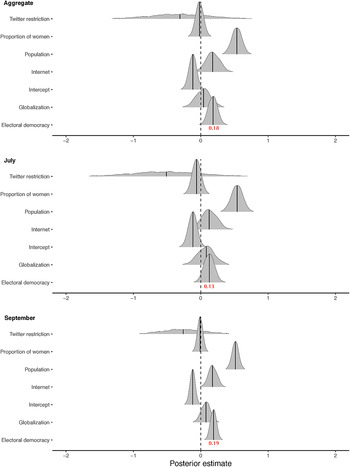
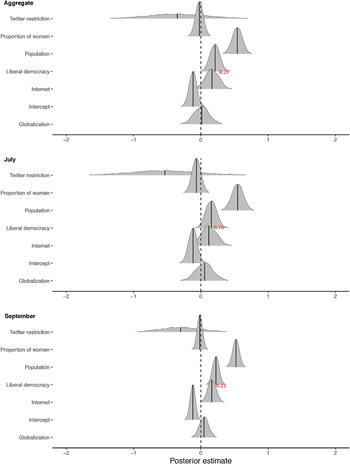
To visually compare the aggregate sample models to July and September sample models, we plot posterior distributions of each model. Figure 1 demonstrates the electoral democracy models of the three different samples.Footnote 11 The posterior medians for electoral democracy in the aggregate sample model and the September sample model are nearly the same. Because the September sample model employs informative priors, the variances of posterior distributions in the September model are much smaller than the variances in the aggregate sample model. Figure 2 shows liberal democracy models of the three samples. Again, the medians of posterior distributions for liberal democracy appear to be positive in all three models. Also, the posterior medians for liberal democracy in the aggregate sample model and the September sample model are about the same. In summary, with the advantages of Bayesian statistics, we flexibly analyze our two samples. The aggregate sample models, as well as the September sample models with informative priors, perform the same and confirm our hypotheses.
Electoral democracy.

Liberal democracy.

CONCLUSION
In this study, we have examined why the #MeToo movement has diffused to some countries but not others. Even after accounting for internet penetration and other external international influences, we find that domestic political opportunity structures play a significant role in motivating individual digital feminist activism. To our knowledge, our study is one of the first to quantitatively examine the drivers of #MeToo activism in a cross-national framework.
Our findings center on three main points. First, domestic politics still matter, even with the diffusion of transnational advocacy such as #MeToo. As Brancati and Lucardi (Reference Brancati and Lucardi2019) argue, actors face different domestic social and political environments, and these differences will affect their decisions to follow foreign countries’ protestors. Therefore, diffusion is not just a transnational process. Rather, it is also a domestic political process in which potential collective actors consider their domestic political opportunities into account before taking action. We find that this logic applies to digital feminist activism.
Second, open political systems provide better opportunities to women and marginalized groups and encourage them to engage in political and social movements as an open political system signals that it will value and better protect minority rights. Therefore, women will feel encouraged to express their grievances in an open political system.
Finally, our results highlight the synergy between traditional offline or street protest and digital feminist activism. In both tactics, domestic political opportunity matters. For those interested in spreading feminist activism, the internet can be a tool but not a substitute for domestic political structures and engagement.
As a whole, we take these points to imply that feminist and women's rights activism cannot be separated from democratization and human rights activism more generally. Without domestic political structures that provide protections for political and minority rights, it is unlikely that digital feminist activism like #MeToo will flourish. Similar to the common phrase “women's rights are human rights,” we find that human rights—specifically, civil and political rights—are important for women's rights. This implies the need for synergistic activism, perhaps bringing together both local and international civil society groups with human rights and feminist agendas. The importance of political and civil rights promotion for women's rights activism may need to be better examined by practitioners and written in to future policy.
We see many avenues for future scholarship in this area that draws upon our work. First, we see the need for more detailed sentiment analysis of #MeToo tweets and other digital feminist activism. Does the tone of the tweets change as time goes on? Are tweets from certain countries more likely to be positive in tone? We predict that we will see more positive #MeToo tweets in countries with better protections for political and minority rights, even if we account for the average tone of all tweets from a particular country.
Second, because of data constraints, our work focused on a limited time span well after the start of the movement. We expect that models using a longer time period would produce similar results concerning the importance of domestic political structures. However, the relative importance of certain aspects of the domestic political environment could change as the movement matures. We hope future studies will look at the ways in which both domestic and international factors could be influenced by the relative age of the advocacy movement in general or advocacy hashtag more specifically.
Finally, we hope that future scholars will extend this framework to other digital feminist activism hashtags and other activism hashtags. It would be interesting to see whether involvement in #EverydaySexism, #TimesUp, or even #ClimateStrike is also affected by domestic political structures in the same way as #MeToo. We think this is an especially fruitful time to examine the interplay between different digital activist movements and between digital and offline activism.
SUPPLEMENTARY MATERIAL
To view supplementary material for this article, please visit https://doi.org/10.1017/S1743923X20000148.