



Introduction
Metasurfaces (MS) are planar metamaterials with a subwavelength thickness created via nano-printing and lithography. Controlling spatially changing electromagnetic (EM) or optical responses, including scattering phase, amplitude, and polarization, is possible. The ultra-thin construction of MSs can significantly reduce deleterious and unwanted wave propagation losses through careful material and design selection. Regarding polarization response, all metasurfaces are classified as high-impedance surfaces (HIS), frequency selective surfaces (FSS), ideal absorbers, and reflecting surfaces are fundamental periodic structures made of aperture elements or conductive patches meant to reflect, transmit, or absorb EM waves that are known as finite-state systems [Reference Munk1].
An FSS is proficient in transmitting or preventing waves of specific wavelengths; as a result, the FSS structure is referred to as physical filtration in EMs. The present-era telecommunication system advancements necessitate the development of unique designs of FSS to comply with rigorous EM criteria [Reference Yan, Qu, Wang, Zhang, Zhou, Chen and Zheng2, Reference Yan, Qu, Wang, Zhang, Zhang, Xia and Wang3], absorption of microwaves [Reference Jha, Jibran and Sharma4, Reference Jha, Mishra and Sharma5], lowering of radar cross-sections (RCSs), elimination of electromagnetic interference (EMI), millimeter and terahertz pulse activities, and other FSS applications are few such examples [Reference Munk1]. Moreover, regarding the unprecedented attention generated by extraordinary broadcasting, meta-surfaces, and associated challenges, in the last few years, considerable studies have been performed on various kinds of traditional EM structures related to FSS. These developments have a long history in electronics, nanotechnology, electrical engineering, and physics. Although traditional FSSs have restricted use due to low-frequency bands and poor filtration sensitivity that fall short of the operational demands for the contemporary EM applications, a wide range of solutions for improving the properties of classic FSSs are available in the open literature and on the internet. Activated fractal 3D FSS, FSSs, and FSSs-based EM structures are only a limited number of the most recent techniques that academics have advanced.
Additionally, metamaterials are the subject of study now [Reference Campbell and Ziolkowski6, Reference Song and Mazumder7], miniaturized FSSs [Reference Yu, Jiang and Gong8, Reference Shi, Tang, Zhuang and Wang9], and embedded sandwiched FSSs [Reference Liang, Cao, Wang and Wan10–Reference Li, Yu and Behdad20]. It can represent a significant advancement in radiofrequency technology. However, some applications necessitate that the passband/stopband frequency of the FSS is changeable under certain situations, and as a result, the active FSS study has been warmly embraced [Reference Zhang, Yang, Wu and Hua21–Reference Valderrama-Zurián, Aguilar-Moya, Melero-Fuentes and Aleixandre-Benavent28].
Methodology
The technique described in the systematic review (SR) is based on “Preferred Reporting Items for Systematic Reviews and Meta-Analyses” (PRISMA) declarations. PRISMA is the minimal collection of SRs and meta-analyses related to evidence. It intends to report studies that assess the impacts of interventions. However, it can also be utilized to record SRs with objectives other than evaluating interventions for prevalence, diagnosis, or prognosis.
Search strategy
As a part of this work, a systematic literature review focusing on FSSs and active frequency selective surfaces (AFSSs) structures is studied to better understand the development of AFSSs. The search strategy involved a blind focus to-FSS database search, a citation AFSS, and a citation sub-6 GHz. The initial information sources consist of four primary Academic Literature Collections: Science Direct, IEEE, Springer, and Scopus databases [Reference Ford, Roberts, Zhou, Fong and Rigelsford29–Reference Rashid, Li and Shen36], which assist in finding the objective of this review as well as the research questions.
The AFSS is an emerging field of research. This work systematically focuses on a detailed study of the Challenges, Classification, Application, and Design Issues of AFSS for the sub-6 GHz frequency bandwidth (BW). Scientists need to pay more attention to a comprehensive analysis of the numerous varieties of FSSs that have emerged, differentiated by their structural design, uses, and the behavior of the array of elements used. Instead, they have taken this omission for allowed.
Because of this, this review paper presents an overview of the rapidly increasing study field of AFSSs by evaluating advancements over the last few years, with a primary focus on categorizing the FSSs.
A further goal of this SR is the development of an open-source knowledge platform to support future research on this topic by collecting and analyzing critical findings from the previous study, summarizing and comparing them, and by identifying the issues and limitations that have arisen from the research. In the context of the extensive research on FSS, the following study topics are addressed:
RQ 1: Why is there a worldwide need for FSSs and AFSSs?
RQ 2: What are the types of FSS, and in what way does AFSS relate to FSS and its classification?
RQ 3: What are the challenges in implementing AFSS in the concern area of sub-GHz?
RQ 4: What are the design issues in developing AFSS for sub-6 GHz for future perspective?
RQ 5: How does the future of AFSSs reflect their durability and efficiency?
Classification of AFSS
The AFSS is a good option for overcoming the constraints of FSS as a superstrate. Incorporation of the lumped-element devices in FSS provides various advantages, including increased radiation BW, control of resonance frequency and directivity, and many more. The working capabilities of AFSS depend upon the construction of the frequency-selective surface. Based on the surface’s construction, design, structure, etc., the AFSS is classified into different categories, as discussed in Fig. 1 [Reference Thakur, Yadava and Das37].
AFSS classification.

Based on AFSS element type
The grade of an element depends on the fundamental application of the selective surface. However, certain features stand out as being desirable for most applications. First, a quality element should have a stable, resonant frequency with an angle of incidence. Leading candidates with this feature are all the members of group 2, namely the loop categories like the 3 and 4 leg-loaded elements, the simple square and circular loops, and the hexagon element for broadband applications. It has been further observed that the “shaping” of these loops can give the designer a broad variety of BW from the narrow (the 4- and 3-legged loaded element) to a super-wide (hexagon). Although all selective surfaces can change BW by variation of the inter-element spacings, the four-legged and three-legged components can vary by changing the elements themselves. Typical for most of these elements is the onset of the second resonance for parallel polarization and oblique incidence. That leads to nulls as low as only half the octave over a fundamental frequency [Reference Al-Atrakchii, Sayidmarie and Abd-Alhameed38].
However, by packing the elements very close together, it is possible to experience huge BW and obtain modal interaction nulls so narrowly that they are relatively inconsequential for many applications. The square spiral element is exciting because it can reflect, but it can also be transparent. It has a very large BW approaching that of the hexagon element. It is the best center-connected element for many applications. However, the BW varies more with the change in polarization than in the hexagon case. That may or may not be advantageous for some applications [Reference Aguilar, Boccato, Junqueira and Weber39]. However, it is possible to place several layers of FSS precisely positioned to each other, leading to the so-called super-dense surfaces. It can lead to a considerable rise in the −3 dB BW, but the modal interaction null is moved slightly upward in the frequency.
The great advantage of super-dense surfaces lies in their potential for extremely low cross-polarization. Decreasing end-loading moves the null downward while increasing the length of an end-loading moves the null upward. However, end bars themselves will eventually start to scatter. The solid internal or the plate type element is seldom applied alone but mainly with “complementary” FSS adjacent to it. Finally, the sequence of elements list is endless and expands longer every day [Reference Bayatpur and Sarabandi31]. The lumped element, when embodied, improves the response of the FSS. The AFSS enhances the sensitivity of the frequency response. However, fabrication errors and insertion loss arise due to localized electric fields.
Equivalent filter banks
Wu et al. [Reference Wu, Hu, Zhao, Lu and Zhang40] pioneered intrinsic mode functions (IMFs) empirical mode decomposition (EMD) statistics analysis on only White-Gaussian Noise. Fractional Gaussian noise (FGN) has been applied to show how EMD behaves as flexibilities for Gaussian broadband noise with no frequent prevailing band in stochastic situations. Similarly, a numerical simulation based on FGN is used to analyze whether the local mean decomposition technique has a wavelet-like filtering characteristic. As a result, a study has been done in previous works, and variational mode decomposition statistics are helpful. The increment method of fractional Brownian motion in time series was described as the FGN [Reference Chiu and Chang41]. The Hurst exponent (0 < H < 1) is used to compose an FGN time-series autocorrelation sequence. The specific property of FSSs is that it only achieves resonance at a required frequency when the slot size or patch in the unit cell is at least half wavelength. Its constraint is solved by decreasing an electrical dimension of the forming inclusions to the sub-wavelength levels, ensuring insensitivity to changes in incidence angle and polarization [Reference Nauman, Saleem, Rashid and Shafique33–Reference Panwar, Puthucheri, Agarwala and Singh35].
Based on the AFSS array
The array is termed a collection of a fixed number of elements in a particular sequence, wherein all elements have the same data type. Each element is selected by one or more indices that can be computed at run time during task execution. Elements based on arrays are classified as solid patch array elements, slot array elements, patched looped array elements, and slot looped array elements, as shown in Fig. 2 [Reference Thirumal Murugan, Suresh Kumar, Salil and Venkatesh42, Reference Liang, Sanz-Izquierdo, Parker and Batchelor43].
Type of loops.

Based on the AFSS applications
The use of AFSS for RF interference mitigation [Reference Mohri and Rostamizadeh44] and EM shielding applications is becoming more prevalent. To address forthcoming difficulties, the applications require frequency agility. The frequency-tuning characteristics of AFSS make it appropriate for use in the adaptive environment [Reference Mohri and Rostamizadeh44–Reference Najafy and Abbasi Arand57].
Slot active frequency selective surface (SAFSS) is suggested as a low-cost twin spectrum monitoring transceiver, with every unit cell on the board having two different slots working at frequencies of 1.5 and 2.45 GHz. In every channel, certain capacitors were used to provide an appropriate single mode [Reference Vallecchi, Langley and Schuchinsky58]. A 2.5D miniaturized multifunction AFSSs are designed to get polarization symmetry where four subcells of similar type are combined. Studies at harmonic wavelength may be used to understand better the fundamental surface flow and EM cluster allocation [Reference Li, Costa, Fang, Liu, Wang, Cao and Monorchio13]. The bi-state interweaving spiral that can be reconfigured with PIN diodes in both dual-polarized and single-polarized unit cell architectures allows the EM intervention to be switched either transparent or reflective as needed at various wavelengths, allowing FSSs to transition between transparent and reflecting modes [Reference Chang and Yoon59]. The AFSS having a squared aperture, using PIN diodes, has been analyzed by using dc bias to it. The EM properties of the AFSS structure are changed [Reference Mavridou, Feresidis, Gardner and Hall60]. Two cascaded FSS modeled with intervening dielectrics are modeled, and the results demonstrate that switching between robust transmission and reflection of incoming EM waves is feasible [Reference Doken and Kartal61].
AFSS with rectangular loops and AFSS with sparse active devices are investigated. The surface’s frequency response may be electrically switched per waveguide simulation [Reference Zhang, Lin, Wu, Ding, Bian and Liu23]. A configurable band stops FSS design for unlicensed 2.4 and 5.8 GHz industrial, medical, and scientific bands. A novel hypothesis utilizing PIN diodes in a high current density position is observed to achieve the desired frequency switch performance [Reference Vallecchi, Langley and Schuchinsky58]. A new intelligent wall approach with the AFSS and the sensors is suggested, and intelligent walls positively impacted system performance is shown [Reference Kasar and Belen62]. The single PIN-based diode with a bare microstrip transmission patch as a unitary component is designed as an AFSS based high-quality programmable filtering transmitter [Reference Yang, Li, Cao and Wang63]. The Wi-Fi AFSS and long-term evolution-AFSS built of half-blocking transmissions at 2.45 and 2.1 GHz using cyclical looping patching and single loop patch is proposed. To be aware of the alterations between reflection characteristics and transmission characteristics, AFSSs use PIN diodes [Reference Boccia, Russo, Amendola and Di Massa64, Reference Kiani, Olsson, Karlsson, Esselle and Nilsson65].
Experimental demonstrations show a cord active second-order bandpass wavelength selecting surface-fed transmitter and a programmable optical transmitter and receiver beam. With the use of microwave varactors in FSS unitary cells, a DC voltage can be used to change the wavelength of the wave signal FSS between 4.0 and 5.8 GHz [Reference Li, Costa, Fang, Liu, Wang, Cao and Monorchio13]. Researchers demonstrated an AFSS with a single-layer bandpass built on four PIN diodes and a circular loop aperture per unitary cell. This structure has an excellent transverse electric incidence angle consistency at 2.45 GHz working BW [Reference Fang, Cao, Zhou and Wang66]. A technique for AFSS slot arrays is described. A thin, flexible substrate separates the biasing layer from the slot layer, and PIN and varactor diode (VD) type diodes are used for switching and tuning. One use is changing the environment management design of buildings to provide access to desired frequency bands [Reference Sanz-Izquierdo, Parker, Robertson and Batchelor52]. Based on a transverse wave formulation and acquisition of data on the interface, the wave concept iterative process (WCIP) is developed. As a result, no matrix inversion is needed, and convergence is guaranteed regardless of the structure’s interfaces. The existing intensity and electric field on the interface are solved using the technique provided.
Studies based on different designs of AFSS
AFSS has a wide range of functions that randomly include many element geometries, multiband reflectors, and frequency windows. Based on these factors, AFSS has evolved in various designs. A short discussion based on these designs of AFSS is discussed in Fig. 3.
AFSS-based different studies.

2.5D miniaturized multifunctional AFSS (2.5D MMAFSSs)
It is constructed via connected metal strips and parallel metallic plates on an FR4 substrate. The unitary element, as reported, may be shrunk to 0.063 λ 0, where λ 0 is the free-space wavelength, using additional lumped components. The compact design makes creating polarization-insensitive EM modes simple yet has remarkable angle reliability. To verify the idea of a compact design for miniaturization, a “2.5 D MMAFSS” working at 1.9 GHz is designed for evaluation. The experimental findings are excellent and consistent with simulated ones, enabling its use as a multifunctional device for telecommunication [Reference Li, Costa, Fang, Liu, Wang, Cao and Monorchio13].
A dual-band electrically beam scanning antenna with a slot AFSS
The construction and testing of a transmitter model for 1.5 and 2.45 GHz wavelength range for beam scanning using SAFSS. Each SAFSS screen unit cell has high tuning ranges and dual modes. For constructing a reliable beam scanning for wireless communication with enhanced network security, certain capacitors are utilized in every layer to overlap the resonance. A dual-band antenna is cheap, simple to build, and efficient in concurrently sweeping beams over an entire 360° angular range in two bands [Reference Najafy and Abbasi Arand57].
Reconfigurable bi-state interwoven spiral FSSs
Bi-state switching FSSs often utilize semiconductor switches like PIN diodes. Using a control signal, typically dc bias, at a particular wavelength, the surfaces of a strip component may be rendered reflecting or translucent. PIN diodes join neighboring dipoles to create columns connected by biasing wires. The layer can be radiation-transparent if the high-pass spectrum is narrow and adequate [Reference Vallecchi, Langley and Schuchinsky58]. The structure proves to be highly responsive for isolation and large fractional BWs as compared to the passive FSS.
AFSS of squared aperture with a metal plate loading
Figure 4 depicts the setup of a functional AFSS unit cell. The outer metal is envisioned as vertical rods describing inductors over a similar transmission line for a vertically polarized incident wave for an equivalent circuit. Whereas, when used in parallel with the inductor as capacitors, horizontal bars do not produce horizontal inductances on the equi-voltage bars because of their capacitive nature [Reference Chang and Yoon59]. The metal loading enables the structure to be modeled with better Q, with diodes with better transmission properties at 2.3 GHz. The unit cell is transmissive for OFF state and high isolation for ON state. The miniaturized immersed FSS comprises a series of unit structures, each comprising a lower frequency selection surface and an upper square resistor ring. From 1 to 2 GHz, the design has strong wave transmission performance, with an absorption rate of more than 90% over the whole Ku band. This can also produce a mono station RCS decrease of more than 10 dB over the entire Ku band. When radiated by oblique incident waves, this model has the feature of removing grating lobes in an absorption band due to its tiny construction. It can achieve wide-angle and broadband antenna RCS reduction by assuring excellent transmission [Reference Edalati and McCollough67].
AFSS unitary cell configuration: (a) front side and (b) backside.

Dual-functional AFSS with parallel feeding configuration
A structure comprising two orthogonally fixed metallic layers divided by the slim dielectric layer. Various active devices involving PIN diodes and VDs were employed individually at upper and lower metallic layers. Thus, the frequency tuning function for EM and transverse magnetic (TM) waves is accomplished by providing the working states of these active elements, as shown in Figs. 4 and 5 [Reference Vallecchi, Langley and Schuchinsky58–Reference Mavridou, Feresidis, Gardner and Hall60, Reference Farooq, Iftikhar, Shafique, Babar Abbasi, Clendinning, Fida, Mughal and Khan68–Reference Ma, Li, Zhang, Ye, Huangfu, Sun, Zhu, Li and Ran73]. The AFSS design possesses dual function with a better tuning range. The structure is capable of tuning and switching.
Model of the suggested AFSS unit cell: (a) top view, (b) side view, and (c) cross-sectional view.

Magnetically tuned AFSS
The stability of tunable AFSS includes the incidence of EM waves at various angles and studied switching of the frequency bands. Zhang et al. have proposed a technique for determining the tuning and angular stability of reconfigurable FSS. The simulation findings reveal that by altering the external magnetic field to spin the top layer, AFSS is controlled over the broad frequency range of 6.36–8.81 GHz. The developed AFSS maintains strong tuning stability among frequency bands and is stable from 0° to 80° oblique incidence of EM radiation [Reference Zhang, Yang and He24, Reference Ma, Li, Zhang, Ye, Huangfu, Sun, Zhu, Li and Ran73]. The incident wave effects on resonance, insertion loss, passband, and stop band have shown better for magnetically tuned AFSS than diodes, atmospheric light, and 3-D mechanically. A system with two metallic layers separated by a thin dielectric layer is created. Three independently controlled frequency tuning, polarization selection, and EM switching are incorporated into the developed structure using varactor and PIN diodes [Reference Li, Ma, Zhou, Wang, Ye, Sun, Zhu, Denidni and Ran12]. A unique biasing setup is intended to need parallel bias voltages for two distinct active device types. The structure exhibits multifunctional features due to a selective injection of a liquid metal alloy into fluidic channels. The proposed model operates effectively under different polarization and oblique incidence situations [Reference Mahmood and Denidni74–Reference Hou, Chen, Wang, Huang and Denidni77]. It is suggested to design a periodic array of the microchannels engraved on an opposing side of the elastomeric substrate [Reference Ghosh, Phon, Tentzeris and Lim49, Reference Suryadinata and Pranjoto50]. The geometry has the novelty of having independent control in reconfigurability among multiple working states. The prototype shows measured results in close resemblance with simulated responses.
Beam-sweeping reconfigurable response AFSS
A design was proposed in which a monopole antenna and six reflecting AFSS screens are used, and semiconductor switches are used to achieve reconfigurable behavior. The working state of the AFSS screens may be configured by applying various biasing voltages to the diode switches; hence, the monopole antenna’s beamwidth and radiation direction can be changed. The omnidirectional scanning outcome can be accomplished at the x–y plane with a step of 60° between 1.8 and 2 GHz, with a maximum radiant efficiency of 96%. Furthermore, with recorded gains of 4.58–6.53 dB, the 3 dB beamwidth may be varied from 176° to 120° [Reference Houssein, Elzwawi and Denidni78, Reference Esparza-Aguilar, Rodriguez-Cuevas, Martynyuk and Martinez-Lopez79]. FSS unit elements consisting of a “split ring slot resonator” with a VD were researched [Reference Fabian-Gongora, Martynyuk, Rodriguez-Cuevas and Martinez-Lopez80–Reference Bai, Yan, Li, Wang, Zheng, Wang and Qu82]. The proposed AFSS has a single controllable device in every unit element, capable of reflecting and transmitting in two operating bands. The resonance frequency is also tuned in one of the bands through a transmission window. To enable the waveguide simulator to differentiate the AFSS, the unit element “active diaphragm” operating at the X-band is devised and constructed. The measured findings reveal transmitting or reflecting tunable response in a lower band with RF between 9 and 9.35 GHz. The tunable FSS is executed by no resonant subwavelength unit cells loaded with VDs, as [Reference Bay83, Reference Yang, Chen, Quan, Zhao, Shi and Liu84] suggested. The redshifts created by VDs were utilized to offset the deviation under an oblique incident angle. The suggested tunable AFSS was based on a 2-layer structure comprised of the array of wire grids and the array of split square rings loaded with two DVDs. The practical measurement is conducted in a C-band frequency range, demonstrating the method’s viability. The experimental findings match the predictions well, showing angular stability at 4.25 GHz.
Beam steering using AFSS
Wu et al. [Reference Wu, Hu, Zhao, Lu and Zhang40] presented a THz antenna having 360° beam steering. The recommended antenna is a THz multidirectional single pole antenna having the hexagonal screen of AFSS. In terahertz, the AFSS unit cell may be switched ON and OFF by altering the “chemical potential” of graphene from 0 to 0.5 eV. As a result, the antenna can perform 360° beam scanning. Furthermore, unlike traditional AFSS with just two states, the suggested AFSS’s transmission and reflection coefficients continually change because of the tunable chemical potential and increasing the antenna’s radiation gain. Authors in [Reference Yang, Luyen, Xu and Behdad85–Reference Elzwawi and Denidni87] presented the dual-band, independent “beam steering THz antenna” made from a broadband multidirectional single-pole source antenna, surrounded by the six hexagonal screens of AFSS with the switchable filtering response in the two bands. AFSS screen can convert among high transmission and total reflection at two frequency ranges separately by changing “chemical potential” from 0 to 0.5 eV. As a result, the THz antenna’s radiation beams in two bands can be directed with variable combinations from 360° large-angle scanning to multidirectional radiation. Wang et al. [Reference Wang, Li, Xiong and Zhai88] utilized AFSS to design a “beam-steering antenna” of flower type. The proposed concept includes an antenna of a dual-band patch having unipolar radiation properties, two tunable AFSS layers, and six metallic sheets clustered around EM waves. The AFSS layers determine the broadcast parameters of the indicated antenna. The source’s omnidirectional radiation pattern is converted to a multi-beam-directed radiation pattern that operates at 2.45 and 5.8 GHz using different combinations of PIN diodes.
Beam switching using AFSS
Houssein et al. [Reference Houssein, Elzwawi and Denidni78] suggested that the ASFSS are utilized to produce a dual-band beam-switching antenna. The dual-band monopole antenna as the source of EM waves and ASFSS is used in the suggested design. The ASFSS was utilized to transform the source’s omnidirectional radiation pattern into a directional one, resulting in a reversible antenna. At 2.45 and 5.8 GHz, beam steering with a 90° angular beamwidth was attained using various PIN-diode combinations. References [Reference Zhang, Ding and Shao26, Reference Ding, Zhang, Zhang and Liu89–Reference Gu, Izquierdo, Gao, Batchelor, Parker, Qin, Wei, Li and Xu92] used the phase compensation procedure to analyze it and validated using cylindrical FSS and the beam-switching antenna. An omnidirectional dipole and a phase-adjustable AFSS structure were embedded with varactors and an ordered bias voltage under the supervision of a phased compensation technique to steer and gather the dipole pattern. At 2.45 GHz, the suggested antenna achieves the high gain of 13.3 dBi, while fulfilling beam switching with the 20° step. The constructed prototype’s measured findings are in good agreement with a simulated one [Reference Gu, Gao, Sanz-Izquierdo, Parker, Qin, Xu, Batchelor, Yang and Cheng93–Reference Shoaib and Raza95]. Bouslama et al. [Reference Bouslama, Traii, Denidni and Gharsallah96] proposed the shifting-beam developing superstrate antenna concept. The antenna is made up of two parts: the source patch antenna and the AFSS. The antenna’s beam switching was accomplished via PIN diodes. At the 5G frequency, the ON and OFF states of the AFSS show transmission and reflection properties, respectively. When all the diodes are ON, AFSS becomes transparent, and when all the diodes are OFF, AFSS becomes opaque. This unusual occurrence causes the patch’s primary beam to shift from broadside to end, firing in an elevation plane. The design can be used in 5G applications [Reference Abdollahvand, Forooraghi, Atlasbaf, Martinez-de-rioja, Encinar, Ebrahimi and Ghosh97].
Beam forming using AFSS
References [Reference Zhang, Wu and Denidni22, Reference Bai, Yan, Li, Wang, Zheng, Wang and Qu82, Reference Abdollahvand, Forooraghi, Atlasbaf, Martinez-de-rioja, Encinar, Ebrahimi and Ghosh97–Reference Zhao, Zhang, Xu, Yu and Liu99] suggested AFSS was used to create a unique switched-beamforming antenna. The antenna is made up of two components: an omnidirectional source and a new active triangular frequency selective surface (ATFSS) that surrounds the source. In the ATFSS construction, each unit cell has two diamond-shaped patches linked by the high-frequency PIN diode. The ON and OFF states of ATFSS display transmission and reflection properties in an operational WLAN band by altering the applied biasing voltage. Beam switching at numerous azimuthal directions is done by assembling AFSS unit cells in the triangle configuration with three panels and selecting different combinations of diode states. The suggested antenna is manufactured and measured to validate the concept. At 5.8 GHz, the model and experiment had a high agreement regarding beam directions, reflection coefficient, and gain. Using a Genetic Algorithm software and a 32-element high gain beamforming antenna, authors in [Reference Zhong, Xu, Chen, Li, Wang and Shi100–Reference Wang, He and Yang103] developed a real-time voltage control framework. The antenna’s gain had increased to 8.95 dBi, while the antenna’s beamwidth had shrunk to 30°. Sanz-Izquierdo et al. [Reference Sanz-Izquierdo and Parker104] viewed a dual-functional radar-communication (DFRC) method as the favorable component in a developing platform. When integrating the required transmit beam pattern, the degree of freedom of the waveform design is restricted, creating high multi-user interference (MUI) and reducing communication performance. The author also investigated joint waveform passive and designed beamforming in the RIS-assisted DFRC system. Minimizing the MUI under strict beam pattern constraints by mutually optimizing the RIS phase shift matrix and DFRC waveform is studied.
Principle working of AFSS
Active devices are mounted onto passive frequency selective surfaces (PFSS) to affect an AFSS. In contrast to passive FSS, active FSS compensates for its flaws and has a promising future in radar radomes and multifrequency system domains. The electrically operated AFSS is the commonly seen active FSS because of its straightforward design and low cost. In addition to an orthogonal structure of the bottom and top metal layers, which ensures polarization stability, compact unit cells also provide angular stability to the AFSS. According to the simulation outcome, the AFSSs can be used in radar random and unmanned aerial vehicle (UAV) systems [Reference Sazegar, Zheng, Kohler, Maune, Nikfalazar, Binder and Jakoby105, Reference Cure, Weller and Miranda106]. To have a better overall frequency response, the traditional FSSs must be tuned and modified in terms of their frequency response. It is possible to allow or stop a specific frequency by building active FSSs [Reference Cure, Weller, Miranda and Price107–Reference Edalati and Denidni109]. The advantages of such structures are their ease of design and production, but the downside is that they need to be reconfigurable. Active FSSs’ EM properties are determined during the design phase, and the only method to modify them is to redesign and rebuild the structure [Reference Bouslama, Traii, Denidni and Gharsallah96, Reference Sanz-Izquierdo and Parker104].
ElMahgoub et al. [Reference ElMahgoub, Yang and Elsherbeni98] defined active FSSs as FSSs having adaptive EM properties. Adaptive approaches introduce dynamic qualities and allow them to be controlled in near-real-time. Furthermore, compared to a passive FSS, an active FSS is substantially smaller. Therefore, incorporating active components within conducting aperture/patch geometries may boost the design’s usefulness and reconfigurability, which is crucial for many practical applications [Reference Taylor, Parker and Batchelor110, Reference Anusha, Mohana Geetha, Amsaveni, Das, Anveshkumar, Dutta and Biswas111]. For example, an active FSS would prevent mobile phone signals from entering security areas, such as airport lounges, but other radio, TV, and wireless signals would undoubtedly get through without an issue. However, the complexity of such structure design and production is simply a side of concern [Reference Anand, Mittal and Raheja112–Reference Ahmed, Nasrazadani and Ju114].
To have larger BW, EM structures have been extensively documented based on AFSS for microwave absorption, radomes, and antenna applications [Reference Alexandropoulos, Lerosey, Debbah and Fink115–Reference Lazaro, Ramos, Girbau and Villarino122]. Metal-backed microwave absorption models comprised of magnetic materials and dielectric materials generally have a restricted BW. It is also widely known that raising the thickness of coated layers for signal absorbers can enhance absorption BW [Reference Koohestani, Perdriau, Ramdani and Carlsson123–Reference Xu and Sonkusale127]. However, a significant thickness-BW tradeoff restricts the application of such EM structures. Compared to standard FSSs, AFSS’s complex structures result in a broader BW and reduced coating thickness [Reference Edalati and Denidni109, Reference Xi, Ma, Li, Zhang, Li and Ran128–Reference Mishra and Panwar131]. A better design component of innovative EM structures is a continuous or discrete tuning of the reflection null in real-time across the large frequency spectrum. Any EM structure’s frequency response can be switched from transmitting to reflecting using active FSSs [Reference Zhang, Chan, Xue and Hu27, Reference Anwar, Mao and Ning30, Reference Kapoor, Kumar and Mishra132, Reference Huang, Song, Ji, Yang and Luo133]. To create innovative, intelligent EM constructions, such modifying capabilities of a structure are necessary. Previously, such control was achieved using a composite structure with several dielectrics magnetic and conductive elements. Active components can be used to flip among reflection modes and transmission at specific frequencies [Reference Ji, Zhang and Liu134–Reference He, Feng, Guo, Wei, Zhang, Huang, Li, Miao and Jiang137]. Table 1 lists EM structures based on AFSS and associated active switching components in the microwave frequency range; Schottky, PIN, MEMS switches, and varactor are frequently utilized switching components for active FSS-based EM devices. Many reconfigurable FSSs are developed and extensively researched for several applications for telecommunications, medical devices, and radars. According to the University of Sheffield researchers, the adaptive properties of active FSSs may be acquired by altering a reflection null generated utilizing a flexible impedance structure.
An overview of reconfigurable FSS based on switching elements and frequency

Simulation and optimization approaches
Inductance and capacitance have been shown to impact the absorber’s thickness significantly. Purely inductive screens can enhance absorber thickness, whereas purely capacitive screens can decrease absorber thickness. Table 2 shows a variety of distinct approaches, along with their transmission coefficients, reflection coefficients, and beam scanning angles. The Active FSS proposed for the sub-6 GHz, where different switching approaches are designed based on the antenna. The bean scanning is achieved in the range of 10° to 90° which is governed by the topology used in designing the AFSS. The transmission and reflection coefficients, as tabulated in Table 2, emphasize the structure’s reliability for the sub-6 GHz BW. These structures, as proposed, illustrate that the operating frequency and FSS architecture significantly impact active FSS-based EM structures’ beam scanning angle, transmission coefficient, and reflection coefficient. The complexity of the structure and active element used in AFSS-based structures are critical factors for determining the conformal beam scanning angle achieved. The monopole antenna can be switched to a dual-band with various beam scanning as detailed.
Transmission and reflection coefficient overview of different approaches
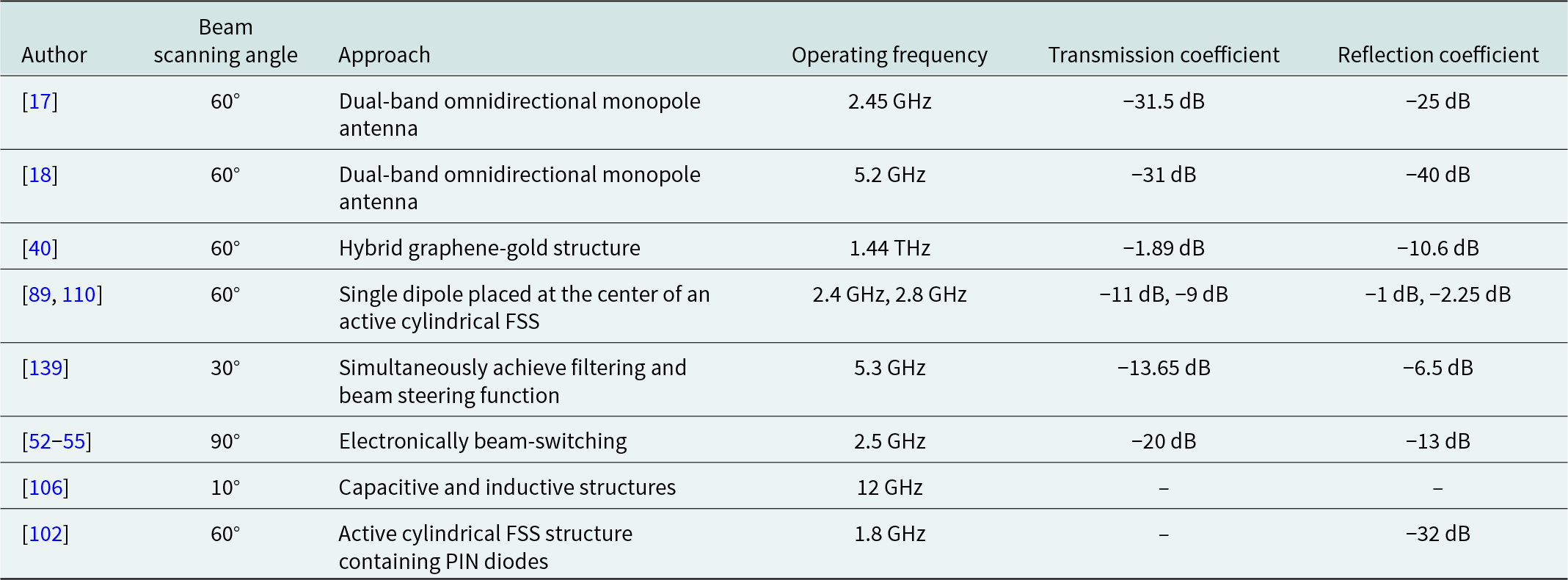
Table 3 shows a schematic analysis of several antennas built and integrated into various FSS, the materials used for multiple operating frequencies, their gain, and beam steering coverage. In context with present-day warfare and communication systems, the need for conformal FSS is being experienced. These types of structures are adaptive to the shape of the platform on which they are mounted. The curvature of the conformal or conical FSS affects the frequency response. The AFSS with the operating frequency and structure complexity having the bean steering capabilities along with switching is tabulated in Table 3. Table 3 lists the designed AFSS structures based on different approaches and components to meet the requirement of beam steering and beam switching. Authors have used ST, ADS, and HFSS methods for examining a wide range of antennas based on operating frequency, gain, and FSS structure.
Various AFSS designs in different frequency bands for antenna integration

AFSSs’ possible limitations and possible uses in the future
For a very long time, antenna randoms, polarizers, radar absorption materials, reflectors, and composite metamaterials have all been employed with AFSSs. Even though this field of study is relatively new, it has a long history of application and theoretical development due to the abundance of well-developed design and analytic tools. However, significant theoretical and practical issues remain, such as creating non-periodic AFSS and doubly curved AFSS. An AFSS must have a wider BW, crisp band edges, stability, and quicker roll-off with the modification of entering EM wave polarizations and angles. The nature of the array element, its shape, inter-element spacing, dielectric, and structural profiles are characteristics that defined the structure of an AFSS from prior work and this review study. Many essential issues must be addressed in the design of AFSS structures. The selection of a suitable AFSS element, the unit cell’s size, the substrate’s profile, and the iterations of the layer are all critical. This is to meet the demands of compact and demanding applications. These characteristics have proven challenging to control and need critical and excellent EM behavior analysis of an AFSS to achieve. Trans-receiver and transgender radar absorption materials, polarizers, composite metamaterials, and reflectors are all examples where AFSSs have been utilized. To build effective FSS structures. Many essential issues must be overcome. Several difficult areas in substantial FSS investigation and practical application where they may have a significant effect on future trends are as follows:
• Vast numbers of unit cells are typically required for a collection to communicate with an incident beam efficiently.
• The difficulty in controlling surface conductivity is also one of the significant problems.
• The capability to protect 5G cellular devices operating at 28 GHz with geometric and polarization consistency is essential.
• The FSS designers need help achieving all the features mentioned above in an optimal design.
• To enhance resonant lengths to meet the issue of reducing the unit cell.
• When creating curved surfaces, increasing the distance between elements and the size of individual components may be troublesome.
• Because of its operational BW limitations, single-layer FSS BW performance is incredibly challenging to enhance.
• When developing new AFSS designs and theories, improving the BW of single-layer AFSS structures is essential.
• AFSS apertures must be as small as feasible to provide better thermal insulation, a significant problem.
• The creation of a doubly curved AFSS, a non-periodic AFSS, is one example of a significant theoretical and practical issue yet to be addressed.
As an alternative to traditional FSS, AFSSs may dynamically tune their EM response by external excitations, which solves the issue of persistent component characteristics in the performance of the former. Many AFSS-related difficulties need the attention of designers in this field. FSS reliability may be degraded from time to time due to interference of the signals caused by a sizeable biasing network. Adding to the complexity and expense of such structures are the manufacturing difficulties. Active FSS’s large number of active devices has been a critical source of power consumption issues. A HIS may significantly decrease the number of active components, resulting in a more complicated system. Several more areas of AFSS research and practical applications that might have a significant influence on future trends are discussed in this study.
Designing a realistic AFSS
It is necessary to use thin outer layers with subwavelength thicknesses and low dielectric constant substrates to maintain a continuous BW despite changes in incidence. Even if such materials with low dielectric constants exist, they are not readily accessible now, and they may not be mechanically compatible. An option would be to design such complex elements or develop another solution to this problem [Reference Deng, Xi, Li and Ding140].
Optimization dilemma
So far, there have been many ways to improve shown or proposed. These, on the other hand, must be used at the proper time and in the right location [Reference Pan, Huang, Chen, Pu, Ma and Luo141]. Although numerous test cases are required to solve the different incidence polarization and angles, specific designs become problematic or impossible to enhance by calculations. Thus, computer speed and a well-written application would be crucial. Unfortunately, this results in the worst experience for new designers in the real world. For example, the BW and resonance frequency of specific AFSS designs vary widely, and even minor modifications in incidence angles and polarizations may not be effective [Reference Lazaro, Ramos, Girbau and Villarino122]. Without a viable answer, the computer program may continue to simulate indefinitely. Moreover, many designers are unaware of the need to examine the “dielectric profile” and instead concentrate on adjusting other geometric factors without recognizing the influence on the resonating frequency’s instability, cross-polarization, and grating lobes. Designing parameters that consider both the desired and undesirable outcomes is thus a time-consuming and challenging task for anybody involved in its implementation [Reference Wang, He and Yang103].
Design tools
Another problem has to do with the available design tools. “Full-wave analysis” approaches for AFSS geometries are increasingly prevalent, and keeping track of all the developed methods has become challenging. Several commercial software packages provide precise analysis with more excellent dependability. On the other hand, irregular surfaces can be investigated most effectively using such analytical tools since the structure symbolizes the unit element having “subwavelength dimensions.” Due to these limitations, additional forms are complicated or uneven. The analysis excludes AFSS geometries such as curved surfaces, closely bound multiple AFSS, and non-periodicity structures. Furthermore, applying “approximation rules” to geometries generally used for a unit element is not feasible because the approximation rules are not applicable [Reference Farooq, Iftikhar, Shafique, Khan, Fida, Mughal and Anagnostou69].
Accurate analysis
Much of the time, a well-estimated AFSS analysis produces a highly accurate, dependable result; as promised to some people’s surprise, this only sometimes works in specific designs. Due to the assumption that the current distribution on “array elements” stays constant and that only the phase and amplitude of current fluctuate having incidence angle, the rationale for this is that in certain situations, “odd-modes” may cause the current oblique incidence angle distribution to shift, resulting in the BW no longer being constant, and so failing the analytical test. The difficulty is addressed using compact array components that only retain the principal current distribution inside this resonant zone. However, there is a limit to how small the elements can be and how far they are separated from one another, which may affect how flat the transmission curve’s top is. It is thus necessary to choose between continuous BW and a flat top of the frequency response at specific frequencies [Reference Kitagawa, Suga, Araki and Hashimoto125].
Miniaturized design
Because of the need for flexibility in specific applications, miniaturized AFSS, particularly in antenna randoms, are sometimes necessary. Furthermore, substantial element diameters and inter-element spacing were inappropriate for creating curved surfaces. A smaller unit cell size is an attractive option with relatively lower “electrical dimensions” and improved “angular stability” of the AFSSs. The notion of a tiny “array element” has become popular because they distinguish between the operational bands and the grating lobes. Multiple element forms have applied various AFSS downsizing strategies in recent years; nonetheless, this difficulty still needs to be resolved for “much low space” and “stiff” applications, as well as for many other applications [Reference Yang, Luyen, Xu and Behdad85, Reference Singh and Yadav142].
The problem of transmission losses
AFSS, such as radomes, are planned to have minimum transmission losses; nevertheless, they reveal significant losses when tested in real-world circumstances. Even though basic theoretical research implies that these losses account for just a portion of the total, such deficits have significance at a “low-loss substrate.” There are several causes of such losses, including dielectric heating, radiation, and Ohmic losses, and it is not easy to distinguish between them all [Reference Kapoor, Kumar and Mishra132, Reference Shuai, Yang, Liu, Yang and Liu139].
Fabrication challenges in 3D structures
Compared with traditional AFSS, which are made up of 2D “periodic array elements” that exhibit slow roll-offs, instability, and poor frequency selectivity under various “incident angles,” recently reported 3D-AFSS are alleviated, and innovative problems associated with 2D AFSS, as previously reported 3D-AFSS. Although these 3D structures have shown acceptable frequency range response, the complexity is the fundamental problem associated with this sophisticated technology of their development and production. An exhaustive investigation has been conducted to overcome this obstacle. As a result, higher performance and innovative implementations in 3D AFSS as projected to be available just around the corner with a bigger BW, a more comprehensive out-of-band rejection range than currently provided, and in-band steady response [Reference Huang, Song, Ji, Yang and Luo133, Reference Naqvi and Lim143].
Transmission through energy-saving glass
Energy-saving window glass in today’s structures requires a passband AFSS to fulfill several crucial features, the most significant of which are steady frequency response and a good rise in BW. However, FSS apertures must be as tiny as feasible to increase thermal insulation, which presents a significant difficulty [Reference Gong, Lu, Hoang, Niyato, Shu, Kim and Liang121]. Therefore, a precise etching of the FSS coating is required to prevent the loss of thermal insulation while maintaining the window glass’s elegant appearance. Since oxide is present in the coated layer, it is not easy to achieve high resonating FSS and flawless transmission response; nevertheless, recent studies have demonstrated enhanced performance due to meticulous design [Reference Lin, Zheng, Alexandropoulos, Wen, Chen and Mumtaz70].
Higher operating bandwidth
While designing AFSSs, restricted operational BW is one of the most difficult challenges. As a result, increasing the BW for single-layer AFSS structures is critical. However, although fractal and loop components have been employed to reduce the size of the unit element of the AFSS, it needs to be clarified if this has improved BW. Even though multilayer construction aids in achieving an optimum design, performing more excellent BW, particularly at low operational frequencies, is the most challenging problem for designers [Reference Wang, He and Yang103].
AFSS for intelligent cities applications
Most wireless mobile communication occurs in 6 GHz and lower frequency bands. The Wi-Fi spectrum has significant problems in densely populated areas like conference centers and condominium complexes. Access to more than 24 GHz millimeter-wave frequencies is also required for innovative city applications. EM wave propagation through objects and construction materials is weak in this higher frequency region, causing practical difficulties. To improve RF signals’ absorption and conveyance in interior and exterior contexts, FSS systems are placed, as well as inside the buildings. However, to successfully work in these low and higher frequency bands, intelligent city apps must be able to manage the propagation and interference concerns that may arise [Reference Xu and Sonkusale127].
AFSS’s future developments
Much advancement has been made in the field of AFSS. Table 4 summarizes some of the possible use of AFSS designed for diverse application area, although they are not the only ones, and researchers are also developing new application scenarios [Reference Azemi, Ghorbani and Rowe116].
Various application areas and utility of AFSS

Discussions and conclusion
Active FSS elements using semiconductor devices are used to regulate EM properties. The frequency response of AFSS relies on their periodicity size and makes them easy to manipulate by carefully determining all design factors, such as FSS form, periodicity, and size. This simple design enables the operation of an external control signal to change the characteristics of the semiconductor devices. Semiconductor loading is one of the most effective approaches for introducing dynamic frequency response. It is through proper bias voltage across a series of bias lines. The element’s shape usually determines the number of bias lines. Compared to ferrite-controlled devices, another essential attribute of semiconductors is their compact size, cost-effectiveness, and quick speed. The diode’s greater capacitance dominates an AFSS comprised of an array of dipoles loaded with semiconductor diodes. It can result in a virtual rise in dipole length that can downward the resonance frequency.
This overview offers a valuable viewpoint on one of the fastest-growing areas of current EM and inquiry of an essential “periodic structure” known as AFSS and its kinds and functions. Various studies on AFSS structures have been given till now, considering contemporary emerging trends in communication. From the most basic AFSS to the most complex, from the convoluted/meandered to the most sophisticated and, numerous categories are grouped in this category. Basic 2D AFSS with low mass weight and volume has been employed in several applications, and advanced 3D active FSS with better efficiency can compensate for the manufacturing complexity. When comparing various design techniques, array element topologies, frequency and BW ranges, and polarizability, much data are provided in tables.
The AFSS development fraternity and a broad spectrum of microwave investigators might benefit from this work by comparing and developing new methods. An AFSS architecture may be helpful for many prospective and realistic applications in diverse frequency ranges comprising microwave, millimeter-wave (MW), terahertz (THz), and optical. To give a brief idea of the breadth and depth of AFSS’s technical expertise, see Table 5. Since AFSS design, existing or innovative implementation, and manufacturing processes are studied further. It means that novel AFSSs will be a viable option for traditional, underperforming FSSs in the future. This analysis will assist in connecting the theoretical basis with structural dimensions and performance characteristics in cutting-edge AFSS designs.
Practical applications of AFSS

Our research includes several things that could be improved, including missing data, possible biases, and misclassification. Further, despite conducting thorough research across many domains, relevant publications may have included all the publications addressing the design of AFSS. This circumstance may have the unintended effect of injecting bias into the data we attempted to gather. In this review paper, the element used in AFSS, structural profile, beam switching, beam scanning/steering capabilities, and approaches have been discussed in detail. From the structural perspective, researchers have used various topologies to achieve the intended goal. Since it is imperative to add the active elements and the biasing line to the AFSS-based structures, the topology must be as simple as possible, like a simple ring, loop, or their derivatives. The biasing lines should be designed with a minimum metallic footprint on the substrate to avoid its intervention in the functioning of the structure. Otherwise, the biasing arrangement should be made a part of the AFSS structure.
Further, with the advancement of technology, many attractive fabrication solutions are also available, and among them, additive manufacturing is gaining momentum for the passive structure and should also be explored for the AFSS design to improve the modal accuracy. The paper also discusses the possible limitations and future applications of AFSS and presents a detailed study of AFSS used for various applications. Certain new areas of applications, like smart homes, wireless power transmission, health monitoring systems, etc., have been identified in Tables 4 and 5, which may serve as the future direction of the research in the field of AFSS design, analysis, and integration.
Data availability statement
Not applicable
Acknowledgements
The authors are sincerely thankful to the anonymous reviewers for their critical comments and suggestions to improve the quality of the manuscript.
Author contributions
Ashish Suri conceptualized, interpreted the findings of the various papers and has written the draft of the manuscript. Kumud R. Jha supervised, reviewed, and helped in arriving at the conclusion of the manuscript.
Funding statement
This research received no specific grant from any funding agency, commercial or not-for-profit sectors.
Competing interests
The authors report no conflict of interest.

Ashish Suri received a Bachelor’s Degree in Electronics Engineering from the University of Pune, India, in 2001, a Master’s Degree in Electronics and Communication Engineering from the Beant College of Engineering & Technology, Gurdaspur, India, in 2011, and is currently pursuing Ph.D. Degree in Electronics and Communication Engineering from the Shri Mata Vaishno Devi University, Katra, UT of JK, India.

Kumud Ranjan Jha (IEEE M’17–SM’18, FIE’23) received the Bachelor’s degree in Electronics and Communication Engineering from The Institution of Engineers (India), Kolkata, India, in 1999, the Master’s Degree in Electronics and Communication Engineering from the Birla Institute of Technology, Ranchi, India, in 2007, and the Ph.D. Degree in Electronics and Communication Engineering from the Jaypee University of Information Technology, Waknaghat, India, in 2012. From September 2013 to September 2014, he was a Postdoctoral Fellow in the Department of Electrical and Computer Engineering at San Diego State University, San Diego, CA, USA, and currently an Associate Professor at Shri Mata Vaishno Devi University, Katra, UT of JK, India. He has authored/co-authored more than 90 research articles in journals and conferences. Dr. Jha is the recipient of the 2012 Raman Fellowship award from the University Grant Commission, Government of India, for the Postdoctoral Study in the USA. His current research interests include microwave/RF passive/active component design and terahertz electronics for future wireless applications.



