Introduction
Digital technologies, which include artificial intelligence, block chain, cloud computing, and big data, are entering human life at an amazing speed, changing the basis for economic development and triggering the Fourth Industrial Revolution (Volberda, Khanagha, Baden-Fuller, Mihalache, & Birkinshaw, Reference Volberda, Khanagha, Baden-Fuller, Mihalache and Birkinshaw2021). Consequently, innovation generated by digital transformation has become an important means for firms to survive, develop, and obtain sustainable competitive advantage (Denicolai, Magnani, & Vidal, Reference Denicolai, Magnani and Vidal2020). Digital transformation not only provides firms with technical means and tools to carry out innovation (e.g., Brynjolfsson & Collis, Reference Brynjolfsson and Collis2019; Garud, Kumaraswamy, Roberts, & Xu, Reference Garud, Kumaraswamy, Roberts and Xu2022), but also creates new ways for realizing innovative value (Ferreira, Fernandes, & Ferreira, Reference Ferreira, Fernandes and Ferreira2019). Embracing digital technology and carrying out digital transformation helps firms such as TikTok to open up ‘new tracks’ in international markets and to establish new core competences (e.g., Huang, Rust, & Maksimovic, Reference Huang, Rust and Maksimovic2019).
Despite the clear importance of promoting firm innovation through digital transformation (Levinthal, Reference Levinthal2019), two theoretical gaps are evident. First, does digital transformation promote or hinder innovation? Lanzolla, Pesce, and Tucci (Reference Lanzolla, Pesce and Tucci2021) noted that digital transformation helps firms discover, recognize, and integrate existing knowledge within an organization, which promotes firm innovation. On the contrary, Hilbolling, Berends, Deken, and Tuertscher (Reference Hilbolling, Berends, Deken and Tuertscher2020) case study on e-commerce platforms found that the deepening of firm digitalization means that more and more stakeholders will join the firm’s innovation process. Although the participation of stakeholders provides the basis for the diversification of firm innovation, in the long run, repeated optimization destroys the platform’s integrity and damages consumers’ experience, which is not conducive to firm innovation. Consequently, the relationship between digital transformation and innovation remains uncertain.
Second, applying digital transformation to promote innovation is not a single behavior; it must be consistent with firms’ strategy (Sturgeon, Reference Sturgeon2021). Studying the relationship between digital transformation and innovation without considering competitive strategy leads to biased results (Mithas, Tafti, & Mitchell, Reference Mithas, Tafti and Mitchell2013). Unfortunately, existing studies do not fully integrate ‘digitization, innovation and strategy’, either in theory or in practice (Björkdahl, Reference Björkdahl2020; Denicolai, Magnani, & Vidal, Reference Denicolai, Magnani and Vidal2020).
The present paper has sought to fill the above two research gaps. By combining the search and recombination perspective and attention-based view (ABV), we developed a theoretical framework that explains the nonlinear relationship between firm digital transformation (FDT) and innovation. At the same time, we incorporated Porter’s competitive strategy theory into our framework through examining the moderating role of differentiation strategy and cost leadership strategy. We tested our framework by studying 21,509 observations from 2,565 Chinese listed companies between 2009 and 2019 and found that digital transformation and innovation appear in an inverted U-shaped relationship. The differentiation strategy and the cost leadership strategy play different moderating roles. We ran endogenous tests through employing both the instrumental variable method and time-varying difference-in-differences method. The results are valid and robust.
This study makes three main contributions. First, it provides nonlinear micro evidence for firms to carry out digital transformation. The digital transformation is a complex process (Hanelt, Bohnsack, Marz, & Marante, Reference Hanelt, Bohnsack, Marz and Marante2021). The present paper reveals a specific mechanism of digital transformation affecting innovation. Second, we did not take digital transformation and innovation as independent activities of firms, but instead integrated them into firms’ competitive strategy. Accordingly, we have expanded the boundary of traditional strategy research (Sturgeon, Reference Sturgeon2021), especially Porter’s competitive strategy theory. Third, due to the rapid development of digital technology and the advance of the digital economy, we provide insights for entrepreneurs who are interested in carrying out digital transformation and improving their innovation ability.
Relevant concepts and theories
Digital transformation
Digital transformation (also known as digitization) refers to ‘organizational change that is triggered and shaped by the wide-spread diffusion of digital technologies’ (Hanelt et al., Reference Hanelt, Bohnsack, Marz and Marante2021, p. 1160). The two key parts of this definition are digital technology and organizational change. Digital technology refers to the science and technology related to data processing capability (Hanelt et al., Reference Hanelt, Bohnsack, Marz and Marante2021). Digital technology has higher productivity, better malleability, and stronger compatibility than information and communication technology. The objective of digital transformation is organization. Digital transformation focuses on organizational change, including, for example, the change of internal behavior, internal and external environment interaction, and final performance output caused by the introduction of digital technology (Parker, Alstyne, & Jiang, Reference Parker, Alstyne and Jiang2017).
Although the previous literature has studied digital transformation from different perspectives, the ‘background–mechanism–performance’ framework proposed by Hanelt et al. (Reference Hanelt, Bohnsack, Marz and Marante2021) makes a good summary. First, digital transformation requires certain background conditions: firms must examine whether they have mastered or have the potential to master digital technology, and whether they have access to big data and algorithms for big data analysis. The availability of technology and big data constitutes the material conditions for firms to promote digital transformation (e.g., Weichert, Reference Weichert2017). Second, there are two specific mechanisms by which firms to carry out digital transformation: innovation and integration. Innovation refers to bringing new resources, capabilities, and operation processes into the firm’s incumbent operation system. Integration refers to integrating existing resources, processes, and capabilities, such as the use of coordination mechanisms to assimilate digital technologies (Chatterjee, Grewal, & Sambamurthy, Reference Chatterjee, Grewal and Sambamurthy2002). Finally, digital transformation can affect firm performance in various aspects, such as business performance (e.g., Agarwal, Gao, DesRoches, & Jha, Reference Agarwal, Gao, DesRoches and Jha2010), and reacting to market turbulence (e.g., Daniel & Wilson, Reference Daniel and Wilson2003).
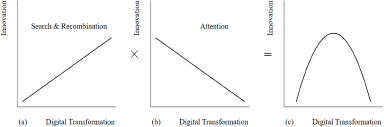
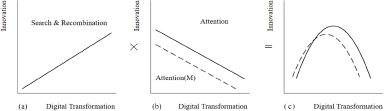
Because prior studies have shown that digital transformation has both positive and negative effects on firms’ performance (Trittin-Ulbrich, Scherer, Munro, & Whelan, Reference Trittin-Ulbrich, Scherer, Munro and Whelan2021), we hypothesize that the relationship between digital transformation and innovation is not linear, but has an inverted U-shape. Referring to Haans, Pieters, and He (Reference Haans, Pieters and He2016), the mathematical essence of an inverted U-shape is that, with the increase of independent variable, the dependent variable first increases and then decreases. Accordingly, Haans et al. proposed that any (inverted) U-shape is composed of two forces (for instance, see Fig. 1). Although there may be many cohorts of ‘two forces’ that can explain the same (inverted) U-shape, the best cohort must be that both two forces are closely related to independent variable (Haans et al., Reference Haans, Pieters and He2016). In our case, an obvious feature of digital transformation is that it helps people find, obtain, and utilize information easily and it would greatly enhance firms’ search and recombination activities for innovation (Savino, Petruzzelli, & Albino, Reference Savino, Petruzzelli and Albino2017). Meanwhile, digital transformation often leads to information overload, which distracts firms’ attention to innovation (Lanzolla et al., Reference Lanzolla, Pesce and Tucci2021) and information becomes valuable only when people pay attention to it. Search and recombination perspective and ABV then become the most appropriate two forces in our study for generating hypothesis. Therefore, the search and recombination perspective, along with the ABV, serves as the theoretical foundation for this paper.
The inverted U-shaped relationship between digital transformation and innovation.

In the contemporary academic research landscape, a significant gap is evident in the comprehensive integration of digitization, innovation, and strategic competition. Appio, Frattini, Petrzzelli, and Neirotti (Reference Appio, Frattini, Petrzzelli and Neirotti2021) research pinpointed four principal factors that contribute to this fragmentation: conceptual ambiguity, paradigmatic diversity, a theoretical–empirical divide, and indeterminate organizational choices. The complexity and multidimensionality of digital transformation lead to varied interpretations, highlighting the need for a unified conceptual framework to reconcile diverse research perspectives (Broekhuizen, Broekhuis, Gijsenberg, & Wieringa, Reference Broekhuizen, Broekhuis, Gijsenberg and Wieringa2021; Hanelt et al., Reference Hanelt, Bohnsack, Marz and Marante2021). Additionally, the interdisciplinary nature of digital transformation research, spanning management, information systems, and innovation studies, introduces a rich and diverse array of paradigms and methodologies, complicating the synthesis of findings (Cennamo, Dagnino, Minin, & Lanzolla, Reference Cennamo, Dagnino, Minin and Lanzolla2020; Nambisan, Wright, & Feldman, Reference Nambisan, Wright and Feldman2019). The gap between theoretical propositions and empirical evidence, exacerbated by the intricate array of technologies, results in an incomplete understanding of how digital transformation impacts innovation (Berger, Briel, Davidsson, & Kuckertz, Reference Berger, Briel, Davidsson and Kuckertz2021). Furthermore, the unclear selection of effective organizational forms and innovation strategies in the context of digital transformation pertains to the assimilation of novel digital competencies into established firms and navigating innovation within the digital environment (Nambisan, Lyytinen, Majchrzak, & Song, Reference Nambisan, Lyytinen, Majchrzak and Song2017). It is essential to address these factors in order to foster a more cohesive and coherent body of knowledge at the nexus of digitization, innovation, and strategy.
Search and recombination in innovation perspective
Along with being the driving force for economic development, innovation is also an important means by which firms can enhance sustainable competitiveness (e.g., Firk, Gehrke, Hanelt, & Wolff, Reference Firk, Gehrke, Hanelt and Wolff2022; Franco & Landini, Reference Franco and Landini2022; Hilbolling et al., Reference Hilbolling, Berends, Deken and Tuertscher2020; Nambisan et al., Reference Nambisan, Wright and Feldman2019). Schumpeter (Reference Schumpeter1934) noted that innovation introduces new combinations of new production factors and production conditions into the production system. Based on Schumpeter’s definition, generating innovation comprises two activities: search and recombination. Search is defined as the process by which firms find new and valuable ideas in a large and diverse internal and external innovation resources (Cyert & March, Reference Cyert and March1963; Laursen & Salter, Reference Laursen and Salter2014). Recombination is defined as the process by which a firm obtains innovation by recombining existing elements or introducing new features for existing elements (Lanzolla et al., Reference Lanzolla, Pesce and Tucci2021).
When carrying out innovation, firms can search internally, which includes investigating the existing elements and structures and looking for the possibility to recombine elements (structures) in the organization (Lanzolla et al., Reference Lanzolla, Pesce and Tucci2021). Firms can also search externally, which involves looking for the possibility of innovation outside their boundaries. The object of a firm’s external search consists of four parts (Martini, Neirotti, & Appio, Reference Martini, Neirotti and Appio2017): search consumption trend from customers, obtain cost knowledge from suppliers, observe and track competitors’ changes, and cooperate with universities and scientific and research institutions. In the digital economy, a more popular way of conducting external search is by firms inviting people from the outside to participate in the project development process; this is so-called open innovation (e.g., Audretsch & Belitski, Reference Audretsch and Belitski2023; Chesbrough, Reference Chesbrough2003).
After searching for resources and information, firms need to recombine them with existing internal conditions. Lanzolla et al. (Reference Lanzolla, Pesce and Tucci2021) raised four approaches to doing recombination in digital transformation: no recombination, recombination by integration of digital and legacy, recombination by layering of digital over legacy, and recombination by grafting of digital and legacy. Tsouri, Hansen, Hanson, and Steen (Reference Tsouri, Hansen, Hanson and Steen2020) studied knowledge recombination for green shipping, noting that recombination was heavily influenced by firms’ embeddedness, proximity, and status.
ABV and firm attention
In the process of realizing innovation, digital transformation not only changes firms’ search and recombination but also affects firm attention.
The ABV originates from Herbert Simon’s organizational behavior theory (1947). Simon’s basic premise was that people’s attention is limited and that their cognition on their own behavior and performance constitutes their own rational boundary (March & Simon, Reference March and Simon1958). Contemporary brain neuroscience supports Simon’s view, noting that our brain’s neural mechanisms and working principle determine that human attention must be a limited and scarce resource (Posner & Rothbart, Reference Posner and Rothbart2007). Because firms are constituted by people, the scarcity of human attention constitutes the first logic for us to understand the impact of digital transformation on firm innovation.
The ABV regards the firm as an attention distribution system, in which decision-makers’ cognition and behavior are determined not by their own knowledge and experience, but by the decision-makers’ cognition of the specific environment they are in (Ocasio, Reference Ocasio1997, p. 189). Firms’ attention mainly includes two aspects: issue and answer. The former refers to understanding of the environment, including problems, opportunities, and threats; the latter is optional actions (Ocasio, Reference Ocasio1997). Firm attention emphasizes how the firm environment constitutes and controls the attention range of employees, as well as the employees’ decision-making in a specific situation. Because there are so many specific situations, firms cannot pay attention to each situation (Ocasio, Reference Ocasio1997) and the coordination of attention at the firm level and individual level is time-consuming. Thus, scarcity of firm attention constitutes the second logic for us to understand the impact of digital transformation on firm innovation.
Utilizing the ABV provides a multifaceted approach to understanding the complex relationship between digital transformation and innovation. First, the ABV emphasizes the scarcity of managerial attention, a critical resource that must be strategically allocated to effectively prioritize and support innovation initiatives that align with the organization’s digital transformation goals (Ocasio, Reference Ocasio1997). This is exemplified by studies showing that attentional intensity and breadth directly influence innovation outcomes (Yadav, Prabhu, & Chandy, Reference Yadav, Prabhu and Chandy2007). Second, the ABV makes it possible to examine how organizational structures distribute and regulate attention, influencing which digital technologies and innovations gain traction within the firm (Ocasio, Reference Ocasio1997). The role of organizational architecture in directing attention is highlighted by how CEOs of General Electric have shaped governance channels for strategic planning (Ocasio & Joseph, Reference Ocasio and Joseph2008). Third, the concept of situated attention within the ABV highlights the importance of contextual factors in shaping attentional focus, which is crucial for adapting to rapid digital trends and seizing innovation opportunities (Ocasio, Reference Ocasio1997). The impact of environmental embeddedness on attention allocation is demonstrated by how competitive and regulatory contexts can affect new product development (McCann & Bahl, Reference McCann and Bahl2017). Fourth, the ABV’s consideration of strategic framing helps organizations interpret and respond to changes in their environment, ensuring that attention is directed toward actions that foster innovation in the context of digital transformation (Brielmaier & Friesl, Reference Brielmaier and Friesl2023). Finally, by integrating a practice perspective, ABV offers a holistic view that encompasses the material and social practices of digital transformation, enhancing the understanding of how attention management can drive innovative outcomes (Brielmaier & Friesl, Reference Brielmaier and Friesl2023).
In summary, because the biggest impact of digital transformation on a firm is to bring digital resources and digital processing technology, digital transformation directly changes firms’ search and recombination, and their attention, which naturally become critical mechanisms for us to understand the relationship between digital transformation and innovation.
Competitive strategy
Firm strategy guides a firm’s purpose, behavior, and development direction (Porter, Reference Porter1998). To Porter, the survival of firm is based on competition, which means that the way in which competitive advantage is established is one of the most important issues in management research (Porter, Reference Porter2008). Porteradvanced three competitive strategies: differentiation, cost leadership, and focus. We have ignored focus strategy, because Porter noted that it can be achieved either via differentiation or cost leadership (Datta, Reference Datta2010).
Differentiation strategy can be understood as firms providing unique products or services in their industries (Porter, 1980, p. 37). Differentiation is reflected in brand, technology, service, trading network, and other aspects. The advantage of adopting differentiation strategy is that a firm can alleviate pressure from the supplier, cultivate consumer loyalty, and have more resources and action choices in the face of competitors.
The cost leadership strategy requires the production and operation to be efficient, takes reducing costs as the first priority, and controls the increase in costs from various environments. In the face of fierce market competition, allowing a firm to obtain income higher than the industry average rate of return reflects the key to the cost leadership strategy. More importantly, it gives firms an advantage in their supply chain ecosystem.
Finally, cost leadership strategy and differentiation strategy generally show the relationship of ‘you cannot have your cake and eat it too’ (Porter, Reference Porter1985, pp. 127–28). Firms need to make a trade-off between the two strategies.
Hypothesis development
There is an inverted U-shaped relationship between digital transformation and innovation of firms
We regard search and recombination as the first force. Following Schumpeter’s viewpoint, the realization of innovation is based on firms’ search and recombination process. Digital technology, which is an important part of digital transformation, allows people to expand their search and recombination capabilities. Taking Python as an example, when people need to find and classify data in an innovation process, Python helps people easily download massive amounts of data and analyze them, which has changed the traditional data collection method and greatly expanded the search boundary of people (Durante & Elsaid, Reference Durante and Elsaid2018). Furthermore, a large number of computer-aided design software programs can be applied, the function of which is to help people fully control the innovation process. For example, the current 3D sketch design technology allows people to comprehensively analyze the details of new products/services they develop (Marion & Fixson, Reference Marion and Fixson2021). Machine learning and data mining technology expand firms’ innovation boundaries through the digital portrait of consumers, and members can implement different innovations for different consumers to accurately meet the needs of consumers (Sampson & Chase, Reference Sampson and Chase2020). In short, digital technology increases people’s search and recombination ability.
Digital transformation can expand and optimize the combination of production factors, and can quickly introduce new factors into the production system for realizing innovations. On one hand, digital technology expands firms’ channels and boundaries for obtaining resources (Lyu, Peng, Yang, Li, & Gu, Reference Lyu, Peng, Yang, Li and Gu2022; Zhang, Gao, & Zhang, Reference Zhang, Gao and Zhang2022). After applying Internet of things, blockchain, big data, and other technologies, firms can have in-depth interaction and cooperation with multiple peers (Pagani, Reference Pagani2013). Furthermore, digital technology not only improves the ability of firms in data generation, collection, storage, transmission, processing, analysis, and protection, but also makes data a factor in a firm’s R&D process (Nambisan et al., Reference Nambisan, Lyytinen, Majchrzak and Song2017). On the other hand, digital transformation helps search and recombine new ways of performing innovations efficiently. For example, collaborative information technologies, such as Asana, Basecamp, and teamwork.com, are designed for firms to find obstacles of tasks, restructure relationships among tasks, and promote communication among members in tasks (Marion & Fixson, Reference Marion and Fixson2021). The impact of digital technology on firm innovation is also reflected in the fact that digital technology is a tool that can innovate by itself. This is frequently seen for firms that employ AI technology: based on big data, the neural network algorithm performs self-iteration and self-optimization (Silver et al., Reference Silver, Huang, Maddison, Guez, Sifre, Driessche and Hassabis2016).
Finally, it is important to highlight that digital transformation brings digital strategies to firms that compete in digital contexts whose speed, scope, and scale changes are greater than in traditional settings (Volberda et al., Reference Volberda, Khanagha, Baden-Fuller, Mihalache and Birkinshaw2021). According to Sebastian et al. (Reference Sebastian, Ross, Beath, Mocker, Moloney and Fonstad2017), firms can either set a customer-engaged strategy or set a digitized solution strategy. A customer-engaged strategy requires firms to search new possibilities to increase interactions among firm-customers as well as among customers themselves, and to recombine resources and activities to identify customers’ demands. A digitized solution strategy involves searching and recombining products, services, and data through internal R&D to anticipate/manipulate customer needs. In both strategies, the digital transformation and innovation appear to have a positive relationship.
Proposition 1: From the perspective of search and recombination, the digital transformation in firms is positively related to firm innovation.
Figure 1(a) visualizes Proposition 1.
Firms’ attention is the second force we employ to understand the digital transformation and innovation relationship. Our inspiration comes from Ocasio’s ABV (Reference Ocasio1997), which divides firms’ attention into three aspects: structural distribution of attention, situated attention, and focus of attention.
Structural distribution of attention implies ‘the particular context decision-makers find themselves in, and how they attend to it, depends on how the organization distributes and controls the allocation of issues, answers, and decision-makers within specific firm activities, communications, and procedures’ (Ocasio, Reference Ocasio1997, p. 191). With the deepening of digital transformation, firms carrying out digital transformation must devote a large part of their attention from innovations to other issues. First, because digital transformation does not necessarily bring success to firms (Trittin-Ulbrich et al., Reference Trittin-Ulbrich, Scherer, Munro and Whelan2021), and because digital technology itself cannot tell firms how transformation will succeed (Mikalef & Pateli, Reference Mikalef and Pateli2017), firms must pay significant attention to identifying and selecting ‘appropriate’ transformation modes and paths (Ferreira, Fernandes, & Ferreira, Reference Ferreira, Fernandes and Ferreira2019). Second, because the essence of promoting digital transformation is to replace the old operation model of the firm with new models, firms must also allocate their attention to firm structure organizations for marching new models (e.g., Lotz, Lobato, & Thomas, Reference Lotz, Lobato and Thomas2018). Third, talent is an important resource for firm development (Dlugos & Keller, Reference Dlugos and Keller2021). With the deepening of digital transformation, the training of employees will attract the attention of firms (Jones, Hutcheson, & Camba, Reference Jones, Hutcheson and Camba2021). On one hand, firms will find that they need to spend a lot of time and energy to recruit digital talent, but that the demand for such talent will always be greater than the supply. On the other hand, when a firm is deeply digitized, it can cultivate and train employees by itself, and even ‘lease’ excellent digital talent through outsourcing, part-time, and other means. At this stage, the requirements for the quality of employees are further improved. Firms not only need employees who understand technology and rules but also employees who have deep insights into digital transformation. However, such employees are scarce, so firms must pay a lot of attention to the construction of an employee team rather than innovation.
Situated attention emphasizes that when entrepreneurs make decisions, their attention will be affected by procedures and communication channels (Ocasio, Reference Ocasio1997). When innovators pay the same attention to the same situation, innovators have common attention and have a unified understanding of the environment, which is conducive to innovation. However, with the deepening of digital transformation, innovators encounter the practical problem that digitization brings a vast number of new situations, which makes it too difficult for innovators to reach unified understandings (Trittin-Ulbrich et al., Reference Trittin-Ulbrich, Scherer, Munro and Whelan2021). The situated attention is distracted, which then leads to less innovation.
The focus of attention refers to what problems entrepreneurs focus on and what answers they try to find (Ocasio, Reference Ocasio1997). With the deepening of digital transformation, entrepreneurs encounter the attention dilemma when innovating. Because entrepreneurs’ attention is limited, if they distribute their attention evenly to all the information and innovation possibilities brought by digitization, they will face information overload (Lanzolla et al., Reference Lanzolla, Pesce and Tucci2021), which can cause them to lose innovation focus (Blohm, Riedl, Fuller, & Leimeister, Reference Blohm, Riedl, Fuller and Leimeister2016). If entrepreneurs focus solely on the narrow innovation field, they may miss areas that could be more important than the area they did focus on. Both information overload and ‘focus narrow’ are not good for innovations. Therefore, with the deepening of digital transformation, the focus of attention is easily dispersed, which is not conducive to innovation.
Proposition 2: Building on the ABV, digital transformation is negatively correlated with innovation.
Figure 1(b) visualizes Proposition 2.
The impact of digital transformation on innovation can be divided into two parts: (1) The extent to which digitization can push innovation up through expanding the search and recombination capability; and (2) how much attention on innovation is diluted by digitization. Therefore, we propose the following hypotheses:
H1: The relationship between digital transformation and innovation performance is jointly determined by firms’ search and recombination and firms’ attention to innovation, showing an inverted U-shaped relationship.
Figure 1 visualizes H1.
In next two sections, we will discuss how two competitive strategies moderate the relationship shown in Figure 1. We mainly concentrate on attention force, simply because digital transformation is built on digital technology, which is an objective fact that determines a firm’s search and recombination. Therefore, when digital transformation is given, the boundary of a firm’s search and recombination is set down. Different competitive strategies require firms to focus on different things. Accordingly, attention would change.
Digital transformation and innovation relationship in differentiation strategy
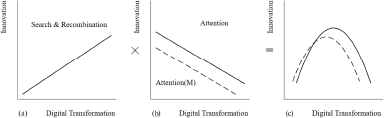
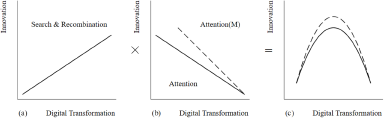
The core of a differentiation strategy is to require firms to provide customers with unique products or services that are different from those of other firms (Porter, 1980). First of all, we need to review Fig. 1(b): When firms do not carry out digital transformation, the attention invested in innovation is the intercept. However, when firms take differentiation as their competitive strategy, this intercept will be shortened. This is mainly because although the differentiation strategy emphasizes the uniqueness of products and services, it is not equivalent to only carrying out innovation activities (Nachum & Wymbs, Reference Nachum and Wymbs2005). More specifically, according to Porter’s (1980) argument, a differentiation strategy includes four categories: product differentiation, service differentiation, employee differentiation, and brand differentiation. Some differentiations are highly related to innovation, such as products that can bring unique value to consumers (Fischer & Reuber, Reference Fischer and Reuber2014), but some differentiations, such as the attitude of the staff and brand, are not greatly related to innovation (e.g., Dzyabura & Peres, Reference Dzyabura and Peres2021). In addition, many service-oriented firms (such as consulting firms, law offices, and entertainment firms) often rely on their own unique social network rather than innovation when implementing differentiation strategies (e.g., McNamara, Peck, & Sasson, Reference McNamara, Peck and Sasson2013). Therefore, when firms adopt a differentiation strategy, innovation is not their only option. Many things have nothing to do with innovation, but can make firms different. Graphically, the attention line shifts downward, the intercept is shortened (dotted line in Fig. 2(b)), and the inverted U-shaped relationship between digital transformation and innovation shifts downward and to the left (Fig. 2(c)).
Employing the differentiation strategy leads to the inverted U-shape go to down left.

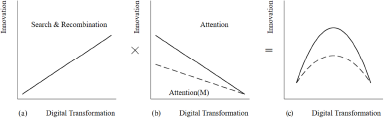
The differentiation strategy’s pursuit of uniqueness will inevitably reduce the impact of digital transformation on innovation. Specifically, digital transformation can affect firm innovation in many aspects (e.g., Appio et al., Reference Appio, Frattini, Petrzzelli and Neirotti2021; Giudice et al., Reference Giudice, Scuotto, Papa, Tarba, Breschani and Warkentin2021). However, following the principle of pursuing uniqueness, firms do not need to focus on all impacts of digital transformation on innovation, but only on certain areas that can make them unique. We provide two examples. As a platform that provides a taxi-like service, Uber employs a differentiation strategy (Rosenblat, Reference Rosenblat2018). Uber noticed that, in the taxi industry, customers have a weak relationship with drivers. Uber’s strategy is to provide strong web-based connectivity between the customers and the drivers. As a result, Uber mainly pays attention to artificial intelligence, particularly in terms of continuously optimizing algorithms so that both drivers and customers have stable prediction and trust. Another example is Waze, which provides a navigation app. Considering that most navigation apps can provide turn-by-turn service, Waze’s differentiation strategy is to employ the user-centric design. Waze continues to provide new crowdsourced feedback data and iterate its algorithm, which helps its users obtain faster and more accurate rerouting according to the changing traffic flows (Gregory, Henfridsson, Kaganer, & Kyriakou, Reference Gregory, Henfridsson, Kaganer and Kyriakou2021). An important lesson we can learn from the Uber case and the Waze case is that firms employing a differentiation strategy do not need to explore all innovation possibilities brought by digital transformation. Graphically, the slope of the attention line slows down (dotted line in Fig. 3(b)), resulting in the slowing down of the inverted U-shaped line (Fig. 3(c)).
Flattening of the slope of attention leads to flattening of the inverted U-shape.

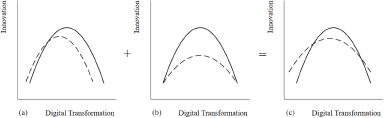
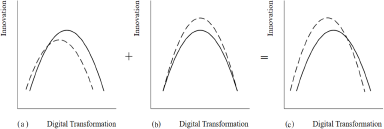
Combining Figs. 2(c) and 3(d), we offer the following hypothesis (Fig. 4):
H2: Differentiation strategy positively moderates the inverted U-shaped relationship between firm digital transformation and firm innovation. The inverted U-shaped relationship moves to the bottom left but becomes flatter as the degree of differentiation strategy increases.
The moderating effect of differentiation strategy.

Digital transformation and innovation relationship in cost leadership strategy
According to Porter’s competition theory, the adoption of cost leadership strategy often means that the competitive market in which the firms participates is dominated by homogeneous products or standardized products, and the differentiation between products is small (Porter, 1980). In other words, this is a consumer-dominant market, in which consumers have low conversion costs and high bargaining power, which leads to price competition as the main means for firms to survive. Following the logic mentioned in Hypothesis 2, we first take intercept of attention into account.
When a firm decides to employ cost leadership strategy, all it should to do is minimize cost (Banker, Mashruwala, & Tripathy, Reference Banker, Mashruwala and Tripathy2014). However, reducing costs through innovation is neither sufficient nor necessary to realize the cost leadership strategy (ibid). In other words, firms adopting cost leadership strategy can reduce costs in many ways besides innovation. For example, the most important way to control costs is to achieve mass production and scale effect (Parkin, Reference Parkin2016); Walmart is a typical example (Ghemawat, Reference Ghemawat2006). Another way of achieving cost control is by managing the supply chain (Ceccagnoli & Jiang, Reference Ceccagnoli and Jiang2013). Consider the example of Boeing (Florida & Kenney, Reference Florida and Kenney1990), which is one of the largest aircraft manufacturers in the world. In Seattle, Boeing’s supply chain is composed of thousands of related firms. Boeing takes advantage of its scale to make its suppliers compete against one other to reduce costs, which reduces Boeing’s costs (ibid).
Lessons provided by the Walmart and Boeing cases are that when firms adopt the cost leadership strategy, considerable attention will be shifted to achieve economies of scale. Since innovation is no longer the only goal for firms, the attention on innovation per se would decline. Graphically, the attention line of the firm shifts downward, the intercept is shortened (the dotted line in Fig. 5(b)), and the inverted U-shaped relationship between digital transformation and innovation shifts downward and to the left (as shown in Fig. 5(c)).
Employing the cost leadership strategy leads to the inverted U-shape go to down left.

Digital transformation is expensive. Cappa, Oriani, Peruffo, and McCarthy (Reference Cappa, Oriani, Peruffo and McCarthy2021) pointed out that if a firm’s digital transformation is built on big data, then the expenditure for generating, managing, and analyzing data could include storage cost, insurance cost, and dysfunctional cost. For example, three terabytes of storage costs US$1 million per month (ibid). After adopting the cost leadership strategy, the cost expenditure of the firm is limited, so it is inevitable that the firm must focus on a business for which it can control costs (Banker et al., Reference Banker, Mashruwala and Tripathy2014). Under the cost leadership strategy, the relationship between firm digitization and innovation can be strengthened from two aspects (Sotnyk & Goncharenko, Reference Sotnyk and Goncharenko2015). First, firms can focus on dematerialization of product form. Due to cost constraints, firms’ attention must focus solely on specific digital technologies for obtaining advantages in such technical fields through product specialization. Second, firms can also focus on dematerialization of the production process. The limited cost requires firms to make more accurate and full use of digital technology to establish advantages in human-to-human interaction mode, digital manufacturing, digital marketing, digital operation, and so on.
To sum up, when firms employ a cost leadership strategy because of cost control, they must attempt to make full use of digitization to expand their attention ability, which strengthens innovations. Graphically, the slope of the attention line becomes steeper (as shown by dotted line in Fig. 6(b)), resulting in a steepening of the inverted U-line (as shown in Fig. 6(c)).
Steepening of the attention slope leads to a steeper inverted U-shape.

Combining Fig. 5(c) and Fig. 6(c), we offer the following hypothesis (shown in Fig. 7(c)):
H3: Cost leadership strategy negatively moderates the inverted U-shaped relationship between firm digital transformation and firm innovation: The inverted U-shaped relationship moves downward and to left and becomes steeper as the level of cost leadership strategy increases.
The moderating effect of cost leadership strategy.

Research methodology
Sample selection and data source
We selected Chinese listed companies from 2009 to 2019 as our research sample to study the effect of digital transformation on firm innovation. This time period was selected to avoid the impact of macroeconomic environment turbulence (the financial crisis in 2008 and COVID-19 in December 2019). We collected firm-level financial and patent data from the China Stock Market and Accounting Research Database (https://www.gtarsc.com/). We obtained data about firms’ competitive strategies from the WinGo Financial Text Data Platform (WinGoData, http://www.wingodata.cn/) and collected firms’ annual report data from Cnchao.com (http://www.cninfo.com.cn/). At the city level, data were collected from the China City Statistical Yearbook, which provided us with detailed demographic, economic, and fiscal indicators at the city level. All data were public, transparent, and replicable.
The initial sample contained firm-level and city-level data. Following previous studies (Peng & Tao, Reference Peng and Tao2022; Wen, Zhong, & Lee, Reference Wen, Zhong and Lee2022; Zhai, Yang, & Chan, Reference Zhai, Yang and Chan2022), we removed firms based on the following criteria: (1) special treatment and particular treatment listed firms (because their financial data did not have reference value); (2) firms in the financial industry; (3) firms with missing patent and financial information; and (4) firms with observation data of fewer than 3 years. The resulting sample consists of 21,509 observations, which includes 2,565 listed companies in China from 2009 to 2019. We winsorized the continuous variables at the 1% and 99% levels to avoid the impact of outliers.
Variable descriptions
Dependent variable
There are two main methods to measure firm innovation when studying firm-level innovation: innovation input and innovation output. Innovation input is often regarded as financial investments that firms make to explore and exploit new opportunities (Duran, Kammerlander, Van Essen, & Zellweger, Reference Duran, Kammerlander, Van Essen and Zellweger2016), such as R&D expenditure, the proportion of R&D personnel (R&D personnel/total employees), and R&D intensity (R&D expenditure/sales). Innovation inputs often need to go through a long and complex innovation process before they are converted into innovation outputs, such as patents and new products (Frishammar, Richtnér, Brattström, Magnusson, & Björk, Reference Frishammar, Richtnér, Brattström, Magnusson and Björk2019). Thus, we measure innovation by total patent applications (denoted by Innov), which is summed by the patent applications of invention patents and utility patents. On one hand, patents are often considered an objective measure of firm innovation (Lee, Lee, & Garrett, Reference Lee, Lee and Garrett2019). On the other hand, the application and authorization processes of patents are reviewed by professionals for their innovation and applicability. Therefore, patent data is more reliable than data such as the output value of new products and R&D investment.
Independent variable
FDT is a relatively abstract concept and it is difficult to find an indicator that can accurately reflect this concept in reality (Hanelt et al., Reference Hanelt, Bohnsack, Marz and Marante2021). Previous studies have mainly applied two different methods to measure the degree of FDT. On the one hand, researchers often use specific digital technologies applied in firms to construct FDT indicators, such as information and communication technology and the Internet of things (Branstetter, Drev, & Kwon, Reference Branstetter, Drev and Kwon2019; Ceipek, Hautz, De Massis, Matzler, & Ardito, Reference Ceipek, Hautz, De Massis, Matzler and Ardito2021). However, these indicators cannot effectively reflect the overall picture of firm digitization. On the other hand, some researchers have attempted to measure firms’ digital transformation using case studies or questionnaires (e.g., Singh, Sharma, & Dhir, Reference Singh, Sharma and Dhir2021; Smith & Beretta, Reference Smith and Beretta2021). Although these methods can reflect the digital process of specific firms from a multidimensional perspective, the sample is often limited in size or representativeness. In order to describe the degree of FDT as accurately as possible, the existing research introduces a new measurement method. Based on the text information of the annual report disclosed by listed companies, Python and Java programs are used to extract and count the word frequency involved in ‘digital transformation’ in the firms’ annual report, and those keywords are used to describe the degree of FDT (Wen et al., Reference Wen, Zhong and Lee2022; Zhai et al., Reference Zhai, Yang and Chan2022). The reason for using this measurement method is that the digital transformation is closely related to the firm’s strategy. As a major way of promoting high-quality development, a firm’s digital transformation actions in the digital era will usually be reflected in the annual report with the forms of summary and guidance.
Based on the text information of the annual report of listed companies, we first extracted and counted keywords about ‘digital transformation’ in the firm’s annual report using a textual analysis method. We then used these keywords to construct the FDT indicators. The detailed steps are as follows:
1. Obtain the annual report data. We sorted out the annual report data of all Chinese listed companies in Shanghai Stock Exchange and Shenzhen Stock Exchange from 2009 to 2019.
2. FDT keyword selection. Drawing on existing studies (Wen et al., Reference Wen, Zhong and Lee2022; Zhai et al., Reference Zhai, Yang and Chan2022), we selected the keyword of FDT from five dimensions: Artificial intelligence (including keywords: artificial intelligence, automation, intelligence, intelligent business, intelligent construction, intelligent era, machine learning, robot, 3D printing, 3D technology, 3D tools, 5G); Blockchain (including keywords: digital currency, blockchain), Cloud computing (including keywords: cloud, cloud computing, cloud services, edge computing, Internet of things); Big Data (including keywords: big data and data assets, computer technology, data integration, data fusion, data information, data management, digitization, digital marketing, digital technology, digital technology, digital operation, digital terminal, digital economy, digital trade, digital supply chain, digital system, informatization, information age, information communication, information integration, information technology); and E-business models (including keywords: cross-border e-commerce, e-commerce, e-commerce platform, electronic technology, online, Internet, network, offline, B2B, B2C, C2B, C2C, O2O, P2P). Figure 8 reflects these five dimensions.
Figure 8.Examples of keywords for digital transformation.

3. Extract keywords and word count frequency. Based on the above keywords, Java PDFbox is used to match and extract the characteristic words of the annual report, the frequency of each ‘FDT’ keyword in the annual report of the current year is counted, and then the word frequency of a single keyword is summarized to its corresponding dimension to obtain the total word frequency of each dimension.
4. Build FDT indicators. We used the coefficient of variation method to give corresponding weights to the above dimensions, calculated the scores of each dimension, and then use the summarized scores as the proxy variables of FDT. The larger the FDT indicator value, the higher the degree of FDT.

A significant challenge in the application of textual analysis to quantify a firm’s digital transformation lies in the limitation that textual data primarily reflects the firm’s intentions rather than its behavioral manifestations. Notably, there is a disparity whereby a listed company might articulate certain commitments within its annual report, while actions may deviate from such pronouncements. Similarly, the company might comment superficially on digital phenomena without active involvement. The former scenario carries potential legal implications, as it has the potential to mislead investors. In the latter scenario, due to the gravity associated with the company’s annual report, it is generally improbable for the company to engage in discussions unrelated to its core business. In contrast, the adoption of digital technology for analyzing and delineating customer profiles has become a well-established and mature practice within the realm of business. In this context, textual analysis itself is not a novel concept in terms of its business applications. Consequently, in the absence of an impeccable approach for quantifying digital transformations, textual analysis emerges as a justifiably acceptable methodological avenue (e.g., Hoberg & Maksimovic, Reference Hoberg and Maksimovic2015; Li, Reference Li2008; Loughran & McDonald, Reference Loughran and McDonald2011). Although it may not attain an ideal level of precision, employing textual analysis is inherently superior to the complete absence of a quantification framework, which makes it a pragmatic choice for addressing the challenges at hand. Finally, in order to verify the validity of FDT indicator, we used the proportion of the digital technology-related portion of the year-end intangible asset to measure the digital investment of listed companies. Such data were disclosed in the listed companies’ financial statements. We regressed the digital investment on FDT and found that there is a significant positive relation between digital transformation and digital investment (p-value < .01). This finding implies that the higher the frequency of words referring to digital transformation, the more the firm invested on FDT. In summary, in our case FDT is a good indicator to reflect the listed company’s efforts in digital transformation.
Moderators
Our moderators were differentiation strategy (Diff) and cost leadership (Cost) and collected data on these two moderators from WinGoData. Based on the methods of ‘seed word’ and ‘word2vec’ (Zha & Li, Reference Zha and Li2019), WinGoData constructs the textual indicators of firm competitive strategy using the annual report of listed companies. The greater the value of the Diff (or Cost) strategy indicator, the higher the degree of adopting the corresponding Diff strategy. See Appendix 1 for the keywords for the textual indicators of Diff and Cost strategies.
Control variables
To improve the research accuracy, we controlled variables at the firm level, industry level, and city level, drawing on previous studies (Jafari-Sadeghi, Garcia-Perez, Candelo, & Couturier, Reference Jafari-Sadeghi, Garcia-Perez, Candelo and Couturier2021; Wen et al., Reference Wen, Zhong and Lee2022; Zhai et al., Reference Zhai, Yang and Chan2022). The control variables at the firm level include firm size (lnemp), which is measured by the natural logarithm of the number of the employees; financial leverage (Lev), measured by dividing total liabilities by total assets; firm age (lnage); cash holding (Cash), measured by dividing net cash flow from operating activities by total assets; return on total assets; the dummy variable of state-owned firms; firm value (TobinQ); the proportion of independent directors (Dbdbratio); and the percentage ownership of the largest shareholder (Top1). Considering that the industry competition at the industry level will affect the business decision-making of firms, the degree of industry concentration (CR5) is controlled, which is measured by the operating income of the five largest companies in the industry as a percentage of the industry’s total operating income. At the city level, the digital transformation of the firm indirectly is influenced by the city where the firm is located. Thus, we controlled the economic development level (lnPGDP), measured by natural logarithm of GDP per capita; the natural logarithm of education expenditure (lnEdu) and science and technology expenditure (lnTech) in government expenditures, and the natural logarithm of internet broadband access (lnNet) of the city.
Regression models
We built the following empirical model to explore relationship between FDT and innovation:
 \begin{equation}Inno{v_{ij,t}} = {\beta _0} + {\beta _1}FD{T_{ij,t}} + {\beta _2}FDT_{ij,t}^2 + {\beta _3}Control{s_{ij,t}} + {\mu _{ij}} + {\delta _t} + {\varepsilon _{ij,t}}\,\,\end{equation}
where subscripts i, j, and t denote firms, cities, and years, respectively.  $Inno{v_{ij,t}}$ refers to the proxy variable of firm innovation.
 $FD{T_{ij,t}}$ is the indicator of FDT, and
 $FDT_{ij,t}^2$ is the square term of
 $FD{T_{ij,t}}$.
 $Control{s_{ij,t}}$ represents the control variables mentioned above.
 ${\mu _{ijt}}$ and
 ${\delta _t}$ refer to industry-fixed effect and time-fixed effect, respectively.
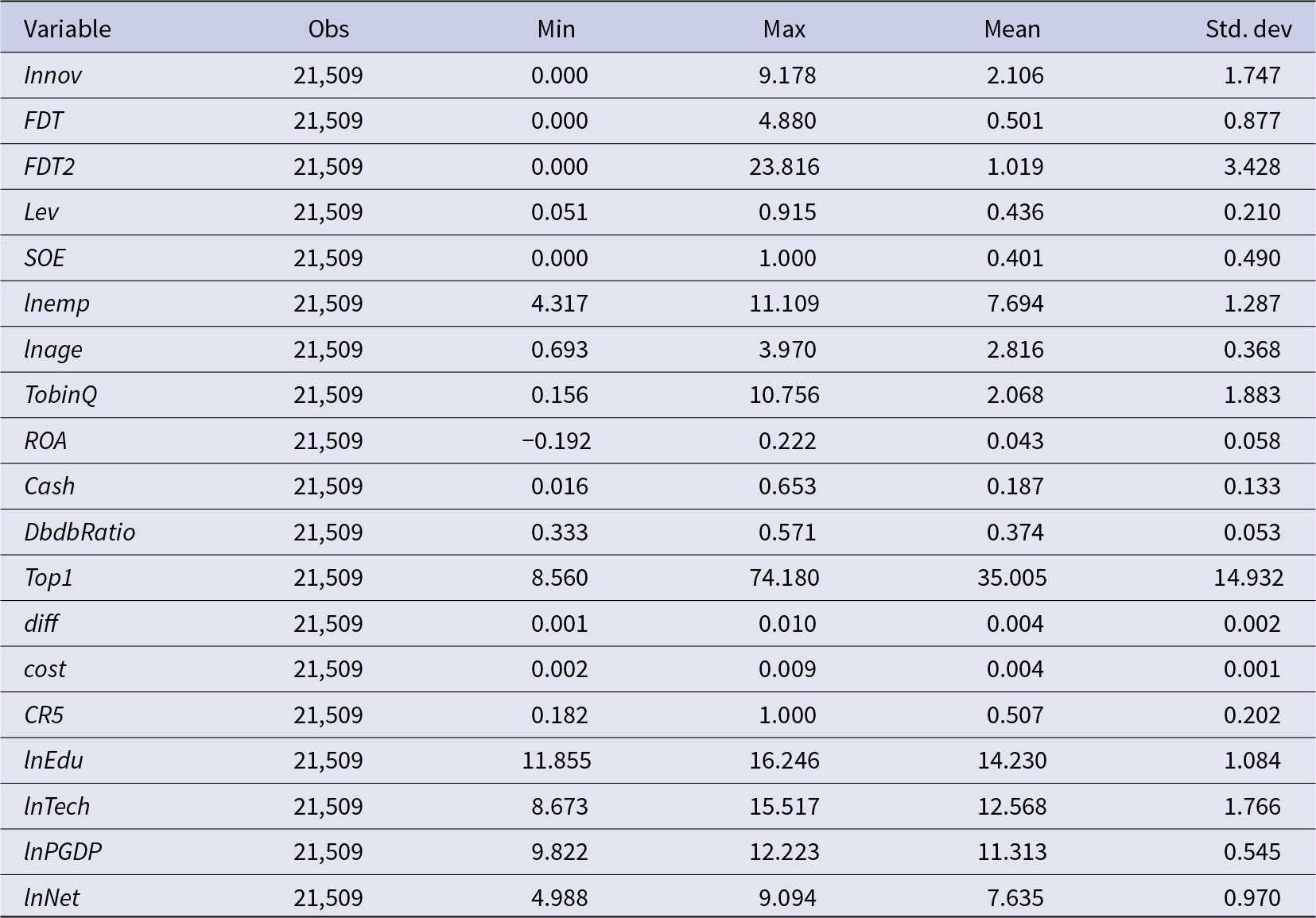
 ${\varepsilon _{ij,t}}$ is errors term. The descriptive statistics of all these variables are listed in Table 1.
Descriptive information on variables

Note: FDT2 is FDT × FDT.
Regression results
Benchmark regression results
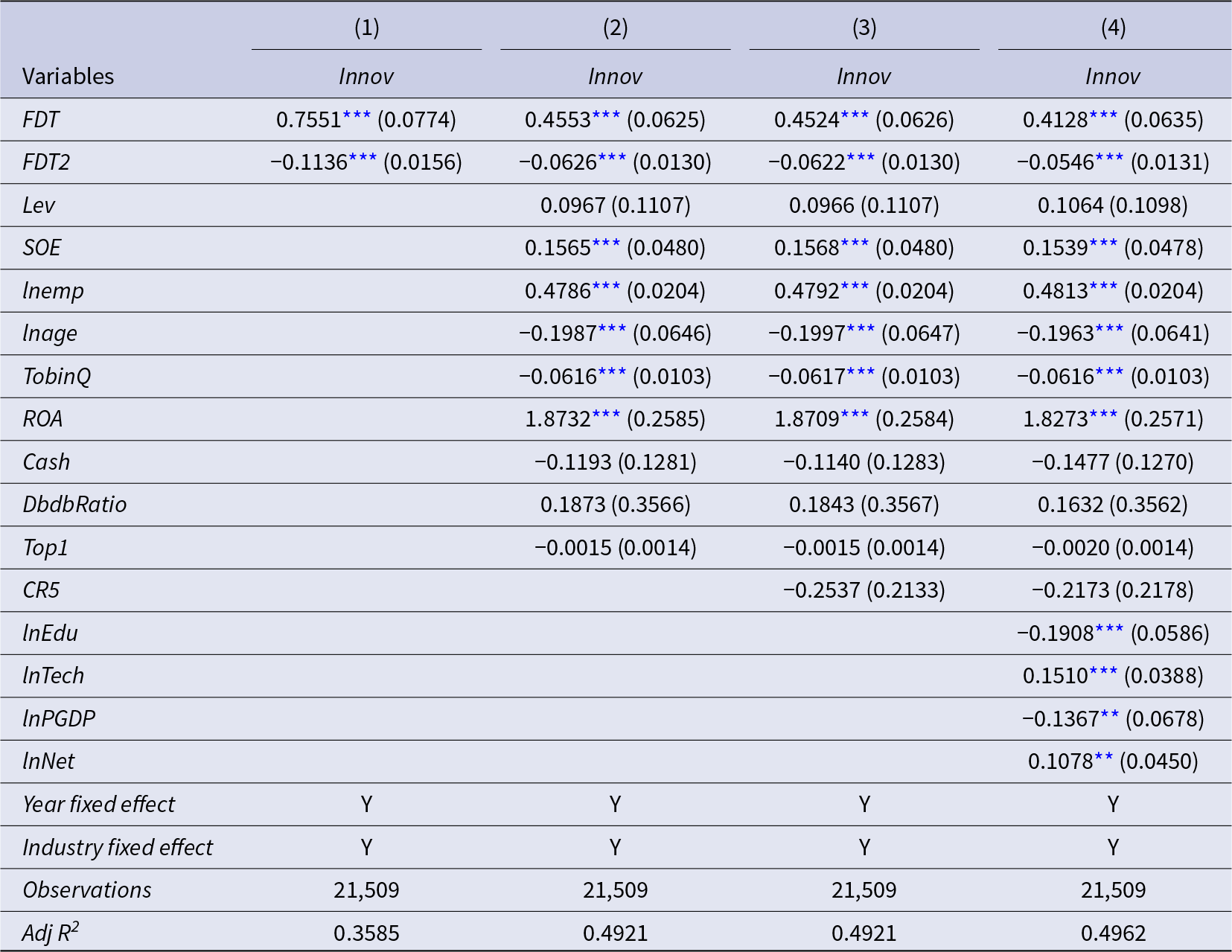
Table 2 reports the benchmark estimation results of Eq. (1). Columns (1)–(4) successively report the regression results, gradually incorporating firm, industry, and city control variables on the basis of column (1). Consistently across all four columns, the regression results show that FDT2 is significantly negative at the level of 1%, indicating that FDT has an inverted U-effect on firm innovation. That is, before the FDT reaches a certain critical value, it plays a role in promoting firm innovation, and when the firm digital degree exceeds a certain critical value, it inhibits firm innovation. Using Column (4) as an example, the coefficient of FDT2 is −0.0546 and significantly negative at the level of 1%, which means that the digital transformation of firms has an inverted U-impact on firm innovation, which is consistent with the theoretical analysis results. Thus, Hypothesis 1 receives support.
Impacts of digital transformation on innovation

Notes: Hereafter, heteroscedasticity-adjusted standard errors reported in parentheses are clustered at firm level;
*** , **, and * represent 1%, 5% , and 10% statistical significance.
Robustness tests and endogenous tests
U-shaped relation test
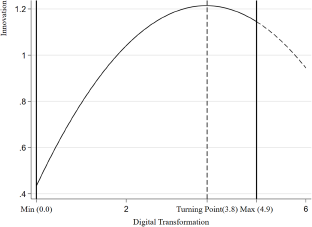
Haans et al. (Reference Haans, Pieters and He2016) noted that it is not sufficient to only observe the significance of the square item (in our paper, it is FDT2) in order to assert the existence of a U-shaped relationship. Therefore, drawing on Lind and Mehlum (Reference Lind and Mehlum2010), we first calculated the inverted U turning point, and then checked whether a significant difference existed between the slopes on the left and right sides of the turning point. As shown in Table 3, the range of FDT is (0, 4.8802) and the turning point is 3.8. The slope on both sides of the turning point is different: the slope of the left section (0, 3.8) is 0.4128 and significant at the level of 1%, and the slope of the right interval (3.8, 4.8802) is −0.1203 and significant at the level of 10%. This test confirmed the inverted U effect of FDT on firm innovation, which is consistent with the previous conclusion. Thus, Hypothesis 1 again receives support. Figure 9 visualizes the U-shaped test.
U-shaped relationship testing for digital transformation and innovation.

U-test for digital transformation and innovation

Notes: The turning point is 3.8. Controls are the same as Table 2 has.

Other robustness tests
Because the benchmark regression results may be affected by the measurement of key variables, we changed the measurement of key variables for the sake of robustness.
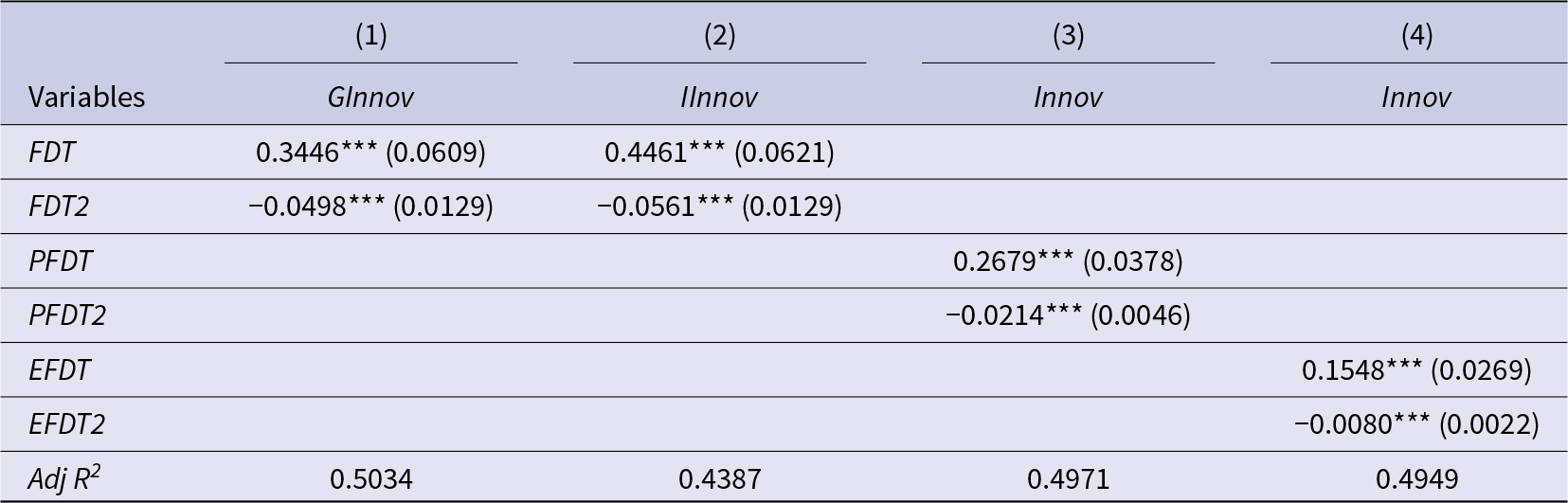
1. Change the measurement of the dependent variable because a time lag exists between patent applications and formal authorization. In addition, compared with other types of patents, the number of firm invention patents can better reflect the quality of firm innovation. Accordingly, we used the number of patents granted by the firm (GInnov, total number of invention patents and utility model patents) and the number of invention patents applied (IInnov) as the new independent variables. As shown in Table 4, Columns (1) and (2) estimate GInnov and IInnov, respectively. The regression results show that the coefficient of FDT and FDT2 is significant and the direction is consistent with the benchmark regression, which means that the previous conclusion is robust.
2. Change the measurement of independent variables. We reconstructed the indicator of FDT using principal component analysis and the entropy method. Both methods can objectively give weight to each index in order to avoid overly strong subjectivity in measuring the indicator of FDT. Columns (3) and (4) report the regression results of using principal component analysis (PFDT, PFDT2) and the entropy method (EFDT, EFDT2), respectively, to measure FDT. The coefficients of FDT and FDT2 are significant and the directions are consistent with the benchmark regression. In sum, even if the measurement of key variables is changed, the firm’s digital transformation still has an inverted U-effect on firm innovation. Therefore, Hypothesis 1 can be supported again.
Endogenous tests
In the present paper, the unobserved heterogeneity or omitted variable bias may lead to endogenous problems. On one hand, the improvement of the degree of FDT will improve the innovation environment of firms and further promote the improvement of the efficiency and quality of innovation. On the other hand, firms with a higher willingness and capability to innovate may also be more motivated to promote their digital transformation. In order to alleviate the potential endogenous impact of this reverse causality on the research conclusions as much as possible, we applied both the instrumental variable method and the time-varying difference-in-differences method to deal with this endogenous problem.
Instrumental variable method
Weselected the proportion of directors, supervisors, and senior managers with internet experience (top management team members with internet experience [TMTIV]) as the instrumental variable. Following Angrist and Pischke (Reference Angrist and Pischke2014) suggestion, a good instrumental variable, in our paper, should satisfy the following two conditions (Clarke & Matta, Reference Clarke and Matta2018):
1. There is a significant correlation between TMTIV and FDT; namely, correlation. Mathematically,
${\text{cov}}\left( {FDT,TMTIV} \right) \ne 0$.2. TMTIV should be uncorrelated with the error term; namely, exogeneity. Mathematically,
${\text{cov}}\left( {TMTIV,\varepsilon } \right) = 0$.


Condition (1) is easy to demonstrate, but condition (2) is hard to verify. In order to make the instrumental variables satisfy the exogeneity assumption, we excluded directors, supervisors, and senior managers who had a background in R&D, teaching in colleges and universities, and scientific research institutions before constructing TMTIV, partly because those members may have a high likelihood of applying for patents directly. In order to further alleviate the potential impact of reverse causality, this paper lags FDT for one period and then carries out the instrumental variable method (Two-stage least squares [2SLS])test again.
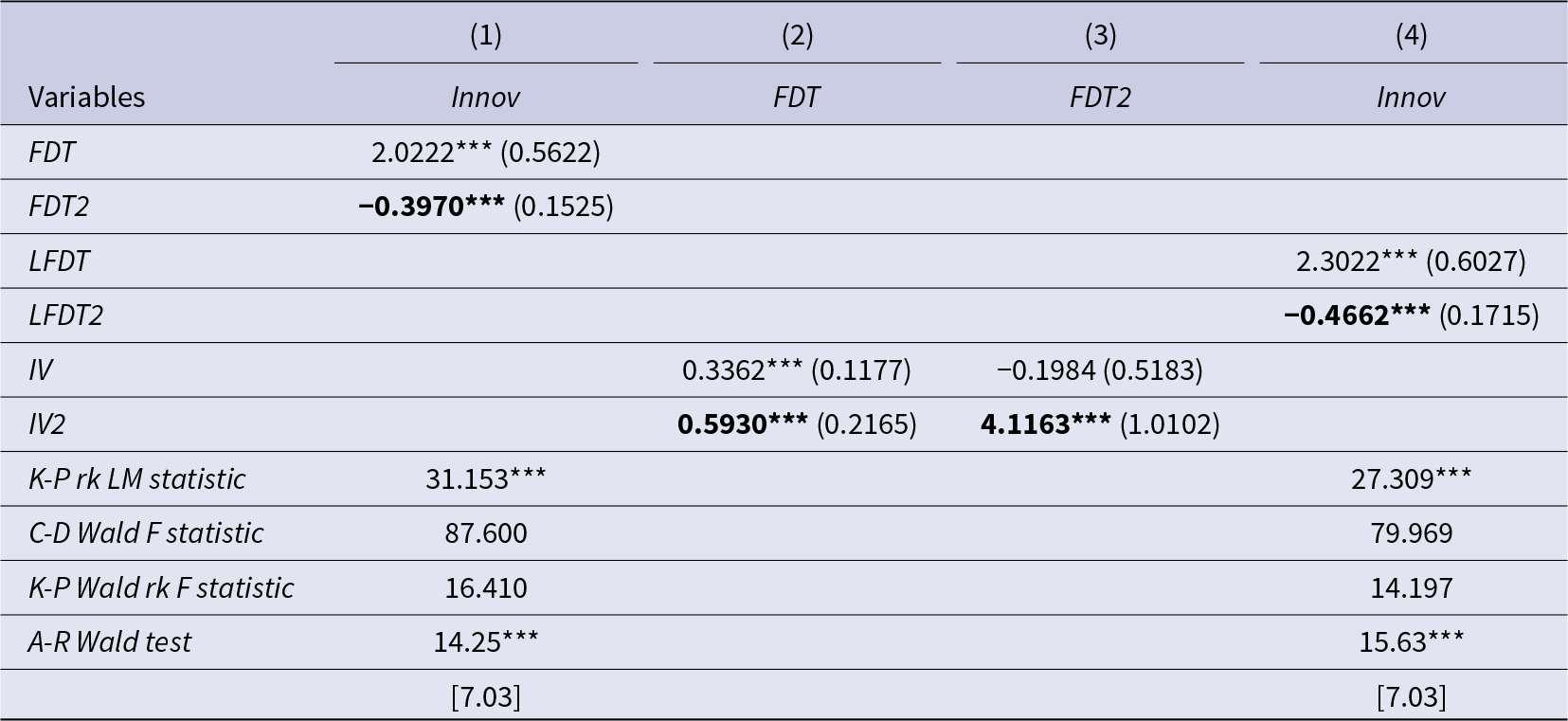
Table 5 reports the estimated results of the instrumental variable method. As shown in Column (1), the coefficient of FDT2 was significantly negative (β = −0.3970, p < .01). Columns (2) and (3) report the estimation results of the first and second stages of the instrumental variable method (2SLS), respectively. Column (4) reports the estimation results after considering reverse causality; the estimation results are highly consistent with that in Column (1). Table 5 also reports the basic information of instrumental variables. The Kleibergen PAAP rk LM statistic is significant at the 1% level, and the Kleibergen PAAP Wald F statistic is larger than the critical value of Stock-Yogo weak instrumental variable identification F-test at the 10% significance level. Both tests suggest that TMTIV is a qualified instrumental variable. In general, the estimation results of instrumental variable methods again verify that there is an inverted U-shaped relationship between FDT and innovation; this is consistent with the previous conclusion.
Endogenous treatment: instrumental variable method

Notes: The F-test value for Stock-Yogo weak instrumental variable identification is given in square brackets (the last row) at the significance level of 10%. Controls are the same as Table 2 has.
Time-varying difference-in-differences method
It is still difficult to thoroughly verify the exogeneity of instrumental variables (that is, whether instrumental variables affect firm innovation through other ways besides digital transformation). Therefore, we need to apply the other method to further deal with the endogeneity.
Considering the differences in the specific years when firms implement digital transformation, it is an excellent quasi-natural experiment for different firms to adopt digital transformation in different years. Following previous studies (Wen et al., Reference Wen, Zhong and Lee2022), we adopted the time-varying difference-in-differences method to overcome possible endogeneity. Specifically, a typical difference-in-differences model is:
 \begin{align}
Inno{v_{ij,t}}\; & = {\alpha _0} + {\alpha _1}Treate{d_{ij,t}} + {\alpha _2}Pos{t_{ij,t}} + {\alpha _3}{\left( {Treated*Post} \right)_{ij,t}} + {\alpha _4}Control{s_{ij,t}}\nonumber \\ & \qquad\quad + {\mu _{ij}} + {\delta _t} + {\varepsilon _{ij,t}} \end{align}
where ‘Treated’ and ‘Post’ are dummy variables that refer to ‘treatment and control’ group and ‘before-after’ the digital transformation, respectively. However, in the time-varying difference-in-differences, due to collinearity with the time dummies and the dummy for the post-treatment period, the normal expression mentioned above could be simplified as in Eq. (2). For further mathematical details, please read Beck et al.’s (Reference Beck, Levine and Levkov2010, p. 1644) classic paper entitled ‘Big Bad Banks’, published in Journal of Finance.
 \begin{equation}Inno{v_{ij,t}} = {\alpha _0} + {\alpha _1}Refor{m_{ij,t}} + {\alpha _2}Control{s_{ij,t}} + {\mu _{ij}} + {\delta _t} + {\varepsilon _{ij,t}}{ }\end{equation}
where  $Refor{m_{ij,t}}$ is a dummy variable: when and after a firm undergoes a digital transformation, such variable is 1 (otherwise it is 0). If the coefficient
 ${\alpha _1}$ is significant and positive, this suggests that FDT positively influences innovation. On the contrary, if the coefficient
 ${\alpha _1}$ is significant and negative, this suggests that FDT negatively influences innovation. However, the focus of the present study is not the ‘Reform’ per se; instead, we are interested in how the degree of FDT influences firm innovation after the firm carried out digital transformation. Thus, we need to take independent variables into regression. We then constructed the following two models:
 \begin{align}
Inno{v_{ij,t}} = {\gamma _0} + {\gamma _1}Refor{m_{ij,t}} + {\gamma _2}Refor{m_{ij,t}} \times FD{T_{ij,t}} + {\gamma _3}Control{s_{ij,t}} + {\mu _{ij}} + {\delta _t} + {\varepsilon _{ij,t}} \end{align}
 \begin{align}
Inno{v_{ij,t}} & = \gamma _0^{\prime} + \gamma _1^{\prime}Refor{m_{ij,t}} + \gamma _2^{\prime}Refor{m_{ij,t}} \times FD{T_{ij,t}} + \gamma _3^{\prime}Refor{m_{ij,t}} \times FDT_{ij,t}^2 + \gamma _3^{\prime}Control{s_{ij,t}}\nonumber \\ & \qquad\quad + {\mu _{ij}} + {\delta _t} + {\varepsilon _{ij,t}}
\end{align}
Compared with Eqs. (2–4) introduce the interactive terms  $Refor{m_{ij,t}} \times FD{T_{ij,t}}$ and
 $Refor{m_{ij,t}} \times FDT_{ij,t}^2$, respectively.
 $\gamma _1^{\prime}$ and
 $\gamma _2^{{\prime}}$ measure the moderating effect of the degree of FDT on firm innovation when the firm carries out digital transformation.
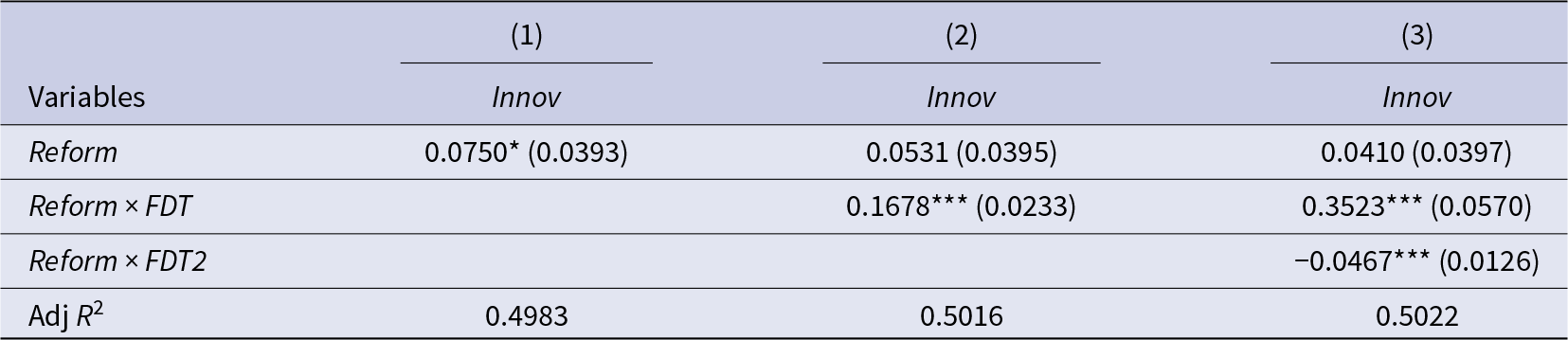
Table 6 reports the estimation results of the time-varying difference-in-differences method. Column (1) reports the regression results of Formula (2), and the coefficient of  $Refor{m_{ij,t}}$ is significantly positive (
 ${\alpha _1}$ = 0.0750, p < .1), which shows that the firm’s innovation has been significantly improved after the digital transformation. Columns (2) and (3) report the estimation results of Eqs. (3) and (4), respectively. As shown in Column (3), the coefficient of
 $Refor{m_{ij,t}} \times FD{T_{ij,t}}$ is significantly positive (
 $\gamma _1^{{\prime}}$ = 0.3523, p < .01), but the coefficient of
 $Refor{m_{ij,t}} \times FDT_{ij,t}^2$ is significantly negative (
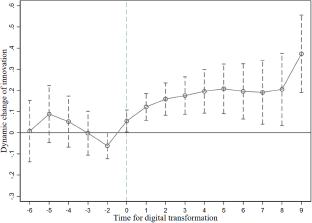
 $\gamma _1^{{\prime}}$ = −0.0467, p < .01). That is, digital transformation positively affects firm innovation when the degree of FDT is relatively low, but this impact turns negative with the increase of FDT. Thus, the degree of FDT has an inverted U-shaped moderating effect on firm innovation. In addition, the parallel trend test is carried out in this paper. As shown in Fig. 10, the confidence interval of all firms before digital transformation does not exist (that is, there is no significant change in all firms). After the implementation of digital transformation, there are significant positive changes in firm innovation, which shows that the parallel trend test of the time-varying difference-in-differences method is satisfied. Overall, after multiple robustness and endogenous treatment, Hypothesis 1 is still valid.
The parallel trend test of the time-varying difference-in-differences method.

Endogenous tests: time-varying difference-in-differences

Note: Controls are the same as Table 2 has.
Moderating effect of two competitive strategies
The firm’s digital transformation is neither a simple event nor the final form of firm strategy. The realization of digital strategy requires continuous adjustment and change, and this process is affected by a series of emerging and iterative firm decision-making activities. Therefore, analyzing the impact of a firm’s competitive strategy on the relationship between digital transformation and innovation from a strategic perspective is helpful to open the mechanism black box. Thus, we constructed the following model to investigate the moderating effect of competitive strategy on the relationship between FDT and innovation:
 \begin{align}Inno{v_{ij,t}} & = {\beta _0} + {\beta _1}FD{T_{ij,t}} + {\beta _2}FDT_{ij,t}^2 + {\beta _3}Control{s_{ij,t}} + {\beta _4}Dif{f_{ij,t}} + {\beta _5}FD{T_{ij,t}}Dif{f_{ij,t}}\nonumber\\ & \qquad\quad + {\beta _6}FDT_{ij,t}^2Dif{f_{ij,t}} + {\mu _{ij}} + {\delta _t} + {\varepsilon _{ij,t}} \end{align}
 \begin{align}Inno{v_{ij,t}} & = {\beta _0} + {\beta _1}FD{T_{ij,t}} + {\beta _2}FDT_{ij,t}^2 + {\beta _3}Control{s_{ij,t}} + {\beta _7}Cos{t_{ij,t}} + {\beta _8}FD{T_{ij,t}}Cos{t_{ij,t}}\nonumber\\ & \qquad\quad + {\beta _9}FDT_{ij,t}^2Cos{t_{ij,t}} + {\mu _{ij}} + {\delta _t} + {\varepsilon _{ij,t}} \end{align}
where  $Dif{f_{ij,t}}$ and
 $Cos{t_{ij,t}}$ are moderators that refer to differentiation strategy and cost leadership strategy, respectively. We centralized FDT, FDT2, and moderators in interactive items to avoid multicollinearity (Frazier, Tix, & Barron, Reference Frazier, Tix and Barron2004).
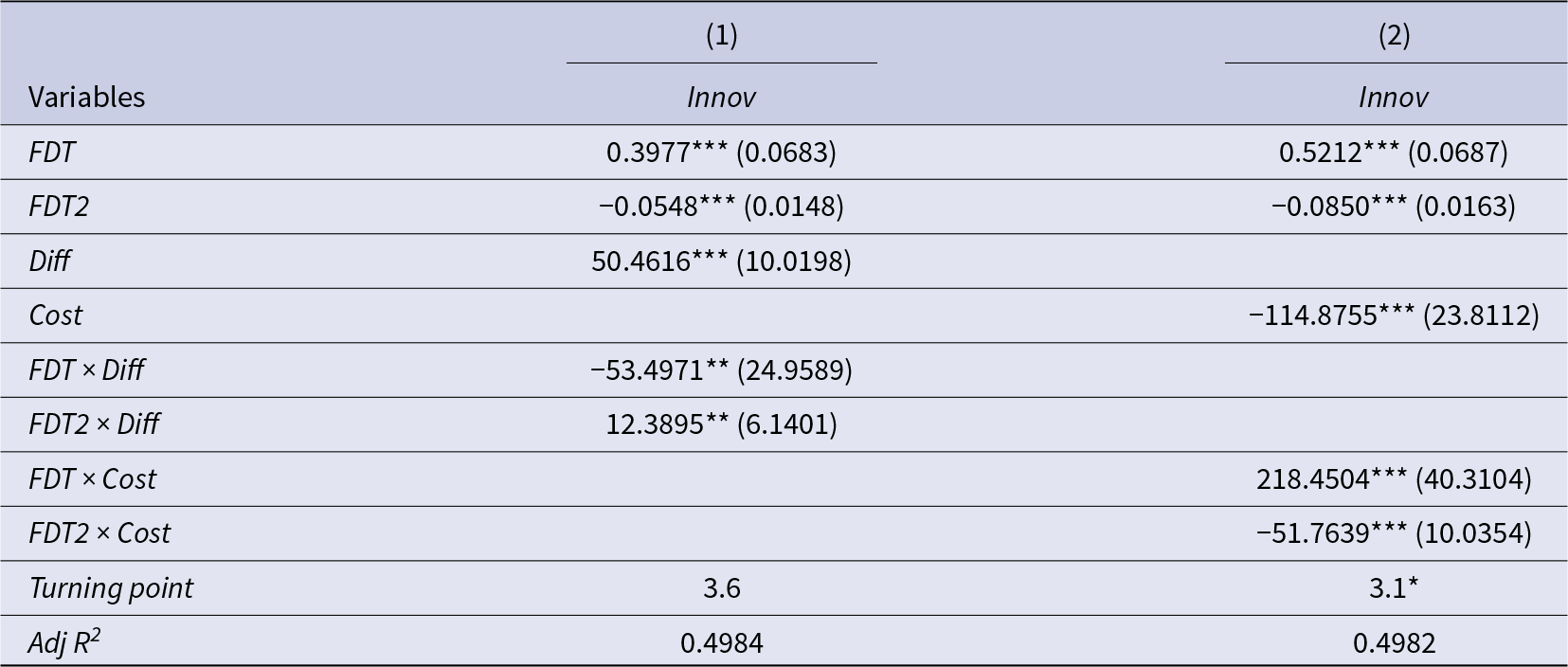
Table 7 reports the estimation results of the moderating effect of competitive strategy. As shown in Column (1), the coefficient of  $FDT_{ij,t}^2Dif{f_{ij,t}}$ is statistically significant (
 ${\beta _6}$ = 12.3895, p < .05), which means that the differentiation strategy flattens the inverted U-shaped relationship between FDT and innovation; that is, the differentiation strategy weakens the impact of FDT on firm innovation. Although the turning points moved to the left, this movement is not statistically significant (Taking Eq. (5) as an example, we need to determine whether
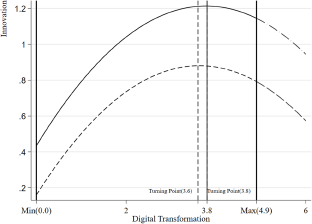
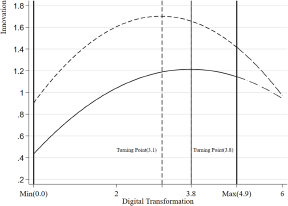
 $FD{T^*} = \frac{{{\beta _1}{\beta _6} - {\beta _2}{\beta _5}}}{{2{{\left( {{\beta _2} + 2{\beta _6}Dif{f_{ij,t}}} \right)}^2}}}$ is significantly different from zero in order to further determine whether the turning point has moved significantly according to the suggestion from Haans et al. (Reference Haans, Pieters and He2016)), which means that the differentiation strategy does not significantly reduce the best degree of digitization conducive to innovation. Therefore, Hypothesis 2 is partially verified. The dotted line in Fig. 11 depicts how differentiation strategy moderates the inverted U-shaped relationship between FDT and firm innovation.

Moderating effect of differentiation strategy.

The results in Column (2) show that the coefficient of  $FDT_{ij,t}^2Cos{t_{ij,t}}$ is significantly negative at the 1% level (
 ${\beta _9}$ = −16.1727, p < .01), which means that the cost leadership strategy makes the inverted U-shaped relationship between FDT and innovation steeper. In other words, it shows that the cost leadership strategy strengthens the impact of FDT on firm innovation. Moderated by cost leadership strategy, the turning points moved significantly to the left (p < .1). Thus, Hypothesis 3 is fully supported. The dotted line in Fig. 12 depicts how the cost leadership strategy moderates the inverted U-shaped relationship between FDT and firm innovation.
Moderating effect of cost leadership strategy.

Concluding remarks
Based on 21,509 observation data of 2,565 listed companies from 2009 to 2019, we investigated the relationship between digital transformation and innovation. We found that digital transformation and innovation were neither positively nor negatively correlated, but showed an inverted U-shaped relationship. As far as the present study is concerned, before the digital transformation degree of firms reached 3.8, the digital transformation of firms continued to promote the increase of firm innovation. However, after the digital transformation exceeded 3.8, the innovation of firms began to decrease. In addition, the relationship between digital transformation and innovation of firms is affected by their own competitive strategy. A differentiated competitive strategy weakens this inverted U-shaped relationship, while the cost leadership strategy strengthens the relationship.
We have put forward three hypotheses, of which Hypotheses 1 and 3 are fully supported. The differentiation mentioned in Hypothesis 2 weakens the inverted U-shaped relationship but, statistically speaking, the differentiation does not move the inverted U-shaped relationship to the lower left. This could be because our sample comes from 2009 to 2019, the period when Chinese firms gradually moved from high-speed development to high-quality development and more and more listed companies realized the importance of innovation. Accordingly, the differentiation strategy will be embodied in how to more fully tap and make use of all resources and conditions, and let firms innovate in products, services, and processes from aspects such as demand prediction, product design, and after-sales service. In this context, although differentiation strategy distracts the attention of firms, the distracted attention is redistributed to some details of digital technology, so it did not significantly change firms’ attention from innovation to others.
Because we have already stated the theoretical contribution in the introduction section, here we only illustrate the practical implications of this paper: a firm employing differentiation strategies can tailor its digital transformation efforts to further enhance innovation. By focusing on unique digital capabilities and leveraging them to create innovative products and services, these firms can strengthen their market position and competitive advantage. Firms pursuing a cost leadership strategy must be aware that their approach to digital transformation may have different moderating effects on innovation compared to differentiation strategies. They should optimize digital investments to improve operational efficiency and cost management without sacrificing innovative potential.
The primary limitations of this study encompass two main aspects. First, methodological constraints are present as the hypotheses are exclusively evaluated using quantitative methods. To corroborate the findings, employing qualitative methodologies, such as case studies, could provide a more nuanced understanding of the phenomena under investigation. Second, the contextual scope is confined to the Chinese market, a large economy with an advanced digital business ecosystem. Future research could extend the analysis to encompass a comparative study across multiple nations, thereby enhancing the generalizability of the conclusions.
In the digital era, carrying out digital transformation to push innovations is an issue that every firm should consider (Hanelt et al., Reference Hanelt, Bohnsack, Marz and Marante2021). The present paper provides insights into how digital transformation impact innovation, as moderated by firm strategy. This may provide more managerial substance to the call for innovation strategy in competitive industries. Further studies are needed to unwrap the digital transformation–innovation relationship across various industries and in the US and EU economies where digital technology is at the competitive frontier.
Data availability statement
Our firm-level financial and patent data comes from the China Stock Market and Accounting Research Database (CSMAR, https://www.gtarsc.com/). We obtained data about firms’ competitive strategies from WinGo Financial Text Data Platform (WinGoData, http://www.wingodata.cn/). We collected firms’ annual report data from Cnchao.com (http://www.cninfo.com.cn/). The city-level data were collected from the China City Statistical Yearbook. All data were public, transparent, and replicable.
Acknowledgements
This paper is financed by the Humanity and Social Science Foundation of Ministry of Education of China, Grant No: 22YJCZH117. Ren Lu is grateful to Professor Gabriel Benito at BI Norwegian Business School for his valuable comments on the manuscript.
Appendix 1. Word set of competitive strategy