The Experiences in Close Relationships — Revised (ECR-R) Questionnaire is one of the most widely used self-report measures to capture romantic attachment anxiety and avoidance (Fraley, Waller, & Brennan, Reference Fraley, Waller and Brennan2000). It has been used in different age groups (e.g., Brenning, Soenens, Braet, & Bosmans, Reference Brenning, Soenens, Braet and Bosmans2011) and translated to different languages (e.g., Jin & Tang, Reference Jin and Tang2007). Different short forms in languages other than English have been proposed to improve its factorial structure and psychometric abilities (e.g., Brenk-Franz et al., Reference Brenk-Franz, Ehrenthal, Freund, Schneider, Strauû, Tiesler and Gensichen2018). Attempts have also been made to expand its use to measure general (how one feels and behaves in close interpersonal relationships overall) as opposed to romantic attachment (Wilkinson, Reference Wilkinson2011). The Experiences in Close Relationships — Revised — General Short Form (ECR-R-GSF) was developed by Wilkinson as a modified version of the ECR-R to assess general attachment in Australian adolescents and young adults. It would be valuable to examine the degree to which researchers can use this form to assess general attachment in other language groups. For example, there has not been a short form of the ECR-R developed for use in Chinese-speaking communities. The aim of this study is to cross-examine the psychometric properties and the factorial structure of the ECR-R-GSF in two samples of emerging adults, one from Australia and another from China. We seek to establish measurement invariance between these two samples by conducting multigroup confirmatory factor analysis (CFA) so as to examine the validity of this measure in Chinese-speaking populations.
Attachment Theory
According to Bowlby (Reference Bowlby1988), the attachment system protects infants from danger by keeping them close to their caregivers (or attachment figures) to cope with stress and to manage fear. In adulthood, the attachment system is activated when the individual is in distress and is deactivated when the desired emotional support or protection has been attained to devote time to explore the environment (Bowlby, Reference Bowlby1969; Mikulincer & Shaver, Reference Mikulincer and Shaver2007). As a result of individuals’ manifold early attachment-related interactions, they develop expectations and beliefs about their caregivers’ responsiveness and availability (Bowlby, Reference Bowlby1973; Hazan & Shaver, Reference Hazan and Shaver1987). Over time, these relationship expectancies result in a stable attachment style or orientation, characterised by an individual's typical emotion-regulation strategies involving significant others, especially when in distress (Shaver & Mikulincer, Reference Shaver and Mikulincer2002). Differences in attachment figure availability and proximity-seeking viability in childhood introduce individual differences in attachment styles (Ainsworth, Blehar, Waters, & Wall, Reference Ainsworth, Blehar, Waters and Wall1978; Mikulincer & Shaver, Reference Mikulincer and Shaver2007).
Partly based on the early psychometric work by Brennan, Clark, and Shaver (Reference Brennan, Clark, Shaver, Simpson and Rholes1998), Mikulincer and Shaver (Reference Mikulincer and Shaver2007) proposed a model of attachment styles in adulthood employing two orthogonal attachment dimensions: attachment anxiety and avoidance. They suggested that those exposed to a history of inconsistent and/or negative close relationship interactions, or the ‘insecurely’ attached individuals, typically have fewer adaptive emotion-regulation strategies. Individuals high on the attachment anxiety dimension have high self-doubt and are worried that their attachment figures may abandon them; thus they seek excessive reassurance (Brennan et al., Reference Brennan, Clark, Shaver, Simpson and Rholes1998; Mikulincer & Shaver, Reference Mikulincer and Shaver2007). Persons higher on avoidance have learnt to avoid rejection from attachment figures, thus experiencing a discomfort with closeness and dependence on others, as well as a desire to keep emotional distance (Bartholomew & Horowitz, Reference Bartholomew and Horowitz1991; Cameron, Finnegan & Morry, Reference Cameron, Finnegan and Morry2012; Mikulincer & Shaver, Reference Mikulincer and Shaver2007). In contrast, positive relationship experiences will be internalised for the ‘securely’ attached individuals, so that when confronted with stress they are able to adaptively attend to and regulate their emotions (Shaver & Mikulincer, Reference Shaver and Mikulincer2002). These individuals are said to be lower on both dimensions of attachment insecurities (Shaver & Mikulincer, Reference Shaver and Mikulincer2002).
The ECR-R and the ECR-R-GSF
Self-report questionnaires of the anxiety and avoidance dimensions, such as the Experiences in Close Relationships (ECR; Brennan et al., Reference Brennan, Clark, Shaver, Simpson and Rholes1998) and its revised version the ECR-R (Fraley et al., Reference Fraley, Waller and Brennan2000), have dominated social and personality psychology research on adult attachment in recent years. The ECR is a 36-item measure used to assess the two dimensions of adult romantic attachment. It was developed from a sample of over 1,000 participants; the items were derived from a pool of 323 items from 60 subscales that measure attachment-related constructs. Also based on these 323 items, Fraley et al. (Reference Fraley, Waller and Brennan2000) developed the ECR-R using both factor analysis and an item response theory analysis. Similar to the ECR, the ECR-R includes 36 items that assess attachment anxiety and avoidance (Fraley et al., Reference Fraley, Waller and Brennan2000). Compared to the ECR, the ECR-R is argued to capture the entire continuum of attachment (in)security better, although it is more prone to higher correlations between the two dimensions (Cameron et al., Reference Cameron, Finnegan and Morry2012). Recent years have witnessed an increase in its adaptation to different populations and different cultural contexts, making it one of the most widely used self-report measures (Cameron et al., Reference Cameron, Finnegan and Morry2012; Wilkinson, Reference Wilkinson2011). Studies conducted with both English-speaking and non-English-speaking samples have demonstrated good internal reliabilities, with Cronbach's alphas around or above .90, and good external validities (see Cameron et al., Reference Cameron, Finnegan and Morry2012; Mikulincer & Shaver, Reference Mikulincer and Shaver2007; Ravitz, Maunder, Hunter, Sthankiya, & Lancee, Reference Ravitz, Maunder, Hunter, Sthankiya and Lancee2010, for reviews).
However, the proposed two-factor, non-orthogonal structure of the ECR-R (Sibley & Liu, Reference Sibley and Liu2004) has received inconsistent evidence. Sibley and Liu (Reference Sibley and Liu2004) and Wongpakaran, Wongpakaran, and Wannarit (Reference Wongpakaran, Wongpakaran and Wannarit2011) confirmed this structure in English-speaking (n = 199) and Thai-speaking (n = 400) samples respectively. However, Gray and Dunlop (Reference Gray and Dunlop2017) conducted a CFA and an exploratory structural equation modelling (ESEM), which allows item cross-loadings (e.g., items from the Anxiety scale load on the Avoidance scale) to test this structure in an English-speaking sample (n = 1,291). They found that a model with cross-loadings from the ESEM produced a better fit than the original structure. Gray and Dunlop argued that having cross-loadings is an important and inherent feature of the ECR-R, like many other personality inventories (Hopwood & Donnellan, Reference Hopwood and Donnellan2010), despite the oft-cited moderate correlation between the anxiety and avoidance dimensions (see Cameron et al., Reference Cameron, Finnegan and Morry2012, for a meta-analysis). Some individuals make a general negative evaluation about their relationships, and both dimensions were found to share some similarities such as negative mood (Gray & Dunlop, Reference Gray and Dunlop2017; Wei, Vogel, Ku, & Zakalik, Reference Wei, Vogel, Ku and Zakalik2005). Interestingly, these empirical observations are in contrast to Mikulincer and Shaver's (Reference Mikulincer and Shaver2007) original orthogonal conceptualisation, which warrants further investigation.
Furthermore, Fraley, Heffernan, Vicary, and Brumbaugh (Reference Fraley, Heffernan, Vicary and Brumbaugh2011) contended that the ECR and the ECR-R are too long, with some redundant items. Researchers should build on well-established measures for methodological continuity and the accumulation of knowledge on the nature of adult attachment to develop better and shorter measures (Fraley et al., Reference Fraley, Heffernan, Vicary and Brumbaugh2011). There have been a few short forms of the ECR-R developed in Thai (Wongpakaran & Wongpakaran, Reference Wongpakaran and Wongpakaran2012), Czech (Kaščáková et al., Reference Kaščáková, Husárová, Hašto, Kolarčik, Šolcová, Gecková and Tavel2016), and German (Brenk-Franz et al., Reference Brenk-Franz, Ehrenthal, Freund, Schneider, Strauû, Tiesler and Gensichen2018) to measure romantic attachment experiences. As with the ECR-R, this line of research yielded mixed evidence about the two-factor structure, with the CFIs (the robust comparative fit index; Bentler, Reference Bentler1990) ranging from .92 to .99 and the RMSEAs (the robust root mean squared error of approximation; Browne & Cudeck, Reference Browne, Cudeck, Bollen and Long1993) from .014 to .076. However, the Cronbach's alphas were generally acceptable, ranging from .84 to .89 for the Anxiety scale and from .73 to .90 for the Avoidance scale.
Both the ECR and the ECR-R were originally developed to assess romantic attachment and include items referring to romantic partners. However, researchers have been attempting to use them to measure general rather than romantic attachment (e.g., Fraley et al., Reference Fraley, Heffernan, Vicary and Brumbaugh2011). Wilkinson (Reference Wilkinson2011) developed the 20-item ECR-R-GSF to measure general attachment in an Australian, English-speaking sample. On a sample of high school and college students (n = 698), the ECR-R-GSF was found to have good internal reliability (Cronbach's α = .88 for both dimensions). It also demonstrated good construct validity according to the correlations with other well-established attachment measures such as the Relationships Questionnaire and the Inventory of Parent and Peer Attachment (Wilkinson, Reference Wilkinson2011). Furthermore, the proposed two-factor model was supported by the CFA, although five pairs of correlated errors were added to achieve an acceptable fit. All items produced satisfactory loadings on their expected factors, except for item 11 (.33 on Avoidance; Wilkinson, Reference Wilkinson2011). To our best knowledge, the ECR-R-GSF is the only English short form of the ECR-R, which provides a good reference point for short forms in other languages for cross-validation to retain the original meaning in English. It is also the only one that measures general attachment as opposed to romantic attachment, and thus would provide further insight into general attachment experiences (Wilkinson, Reference Wilkinson2011).
The ECR-R in China
Bowlby's (Reference Bowlby1969) original theory emphasised the universality of the biological basis of the attachment system. Recent research suggests that attachment exists in all cultures, and so do the differentiations between attachment orientations and dimensions in children and adults (see Mesman, van IJzendoorn, & Sagi-Schwarz, 1999; Schmitt et al., Reference Schmitt, Alcalay, Allensworth, Allik, Ault, Austers and Zupanèiè2004, for reviews). However, adult attachment dimensions stem from early interactions with primary caregivers and are affected by societal factors such as economic burden, the harshness of the physical environment, and parenting styles, all varying across different regions (Schmitt et al., Reference Schmitt, Alcalay, Allensworth, Allik, Ault, Austers and Zupanèiè2004). Schmitt et al. (Reference Schmitt, Alcalay, Allensworth, Allik, Ault, Austers and Zupanèiè2004) compared data from 62 different cultures and reported that the secure type was more common in Western cultures, whereas anxious attachment represented a larger proportion in East Asian cultures (i.e., Hong Kong and Taiwan), with this argued to be a result of their heavier reliance on other people's opinions. The original conceptualisation and operationalisation of (romantic) attachment avoidance may fail to address core avoidant behaviour in East Asian cultures, although this remains under-studied in mainland China (Schmitt et al., Reference Schmitt, Alcalay, Allensworth, Allik, Ault, Austers and Zupanèiè2004). While individuals from these cultures value well-controlled composure and emotional restraint, which may lead to emotionally dismissive and withdrawal behaviour (Zhu, Wang, & Chong, Reference Zhu, Wang and Chong2016), they also value closeness and harmony (Friedman, Rholes, Simpson, Bond, Diaz-Loving, & Chan, Reference Friedman, Rholes, Simpson, Bond, Diaz-Loving and Chan2010), which may decrease their interpersonal distance. However, this contradiction has not been addressed in the literature.
Although the ECR-R has been translated and used to understand attachment-related processes in Chinese populations (e.g., Xue et al., Reference Xue, Xu, Zaroff, Chi, Du, Ungvari and Xiang2018) and to compare these processes between such populations and Western populations (e.g., Zhu et al., Reference Zhu, Wang and Chong2016), measurement invariance between these groups has not been demonstrated to ensure that the same process or construct is being captured in different language groups. Its utility in the Chinese culture has not been appropriately evaluated. The ECR-R was only introduced to China about a decade ago (Jin & Tang, Reference Jin and Tang2007; Lu, Huo, Gao, & Cong, Reference Lu, Huo, Gao and Cong2006). The two Chinese versions were shown to have good internal reliabilities, with Jin and Tang reporting a Cronbach's alpha of .94 for the Anxiety scale and .89 for the Avoidance scale, whereas Lu et al. (Reference Lu, Huo, Gao and Cong2006) reported .86 for Anxiety and .81 for Avoidance. Jin and Tang's (Reference Jin and Tang2007) version produced five factors in exploratory factor analysis (EFA). Only after removing six items (unspecified in the study) was the two-factor structure reproduced in EFA, suggesting that some items were problematic. Jin and Tang's CFA results of the two-factor structure also did not reach the cut-off value for a good model fit by traditional criteria.
To date, only one study on the cross-cultural validity of the ECR-R involving a Chinese sample could be located. Mastrotheodoros, Chen, and Motti-Stefanidi (Reference Mastrotheodoros, Chen and Motti-Stefanidi2015) compared the ECR-R between a Greek sample and a Chinese sample. By conducting CFA using parcelling (clusters of items instead of individual items as indicators), they found the two-factor structure to have a marginal fit in their Chinese sample: CFI = .94, RMSEA = .080. They were only able to establish partial metric and scalar invariance across the two groups, suggesting that the items in their adapted ECR-R were understood and/or answered differently across their Greek and Chinese samples. Mastrotheodoros et al. concluded that the ECR-R could be used on the Chinese sample, but cross-cultural comparison should proceed with caution.
The Present Study
To our knowledge, no study has been conducted to examine the factorial structure of the ECR-R-GSF across an English-speaking sample and a Chinese sample. This would be important to further the application of the ECR family measures in Chinese-speaking populations, extending previous, limited research on their use in East-Asian cultures. This study sets out to examine the psychometric properties of the ECR-R-GSF in an Australian university student sample, in order to compare its factorial structure to a Chinese student sample from China. This will be achieved by the CFA, utilising individual items and not parcels, by investigating the measurement invariance between the two cultural groups. By investigating at an item not a parcel level, we hope to shed light on how each item may or may not work the same way across cultures.
Method
Procedure
Two convenience samples were recruited as part of a larger study on university adjustment in Australia and China through an online system for research participation, Facebook, emails, short talks in lectures, and flyers. The Australian psychology students received course credit for their participation. Other students were given the option of being entered in a lottery for a $100 gift voucher (Australian participants), or a gift voucher worth 500 Chinese yuan (Chinese participants). The study received approval from the University of Newcastle Human Research Ethics Committee and the Chinese Academy of Sciences. The questionnaires were administered via the Qualtrics platform. After giving informed consent, participants answered questions from five scales, along with demographic and background information. The completion time was 20–30 minutes.
Participants
The Chinese sample (n = 626) was recruited from two universities in China (mainland), while the Australian sample (n = 426) was recruited from one university in Australia. Participation was restricted to domestic students aged 18 years or older. The majority of the Australian sample identified as ethnically Australian (n = 209, 49%), were females (n = 301, 71%), in a relationship (n = 211, 50%), and first-year students (n = 264, 62%). Their mean age was 20.10 (SD = 2.50) years. Among those who were in a relationship, more than half (n = 137, 65%) had been in the relationship for longer than one year. For the Chinese sample, the majority were females (n = 438, 70%), second-year students (n = 428, 68%), and with a mean age of 19.10 (SD = 1.00) years. The Chinese sample was approximately one year younger than the Australian sample: t(1050) = 9.01, p < .05. Most were not in a relationship (n = 455, 73%), and for those in a relationship, only 73 (43%) had been in the relationship for more than one year.
Measure
The ECR-R-GSF (Wilkinson, Reference Wilkinson2011) contains 20 items (see Appendix A) with 10 from each of the scales of Anxiety and Avoidance. The items are worded to address relationships in general. For example, the original item from the ECR-R, “I find it easy to depend on romantic partners” was adapted to “I find it easy to depend on other people”. The questions were answered on a 5-point scale from 1 (strongly disagree) to 5 (strongly agree). The Chinese measures were translated by the first author and back-translated by a professional interpreter who is bilingual and not familiar with psychology or attachment theory (Brislin, Reference Brislin1970). Any differences were resolved by referring to dictionaries and professional translating material to ensure the original English meaning was retained. The translated version was piloted on a convenience sample before distribution (Brislin, Reference Brislin1970).
Data Analysis
The data were screened for univariate and multivariate outliers using the procedures outlined by Byrne (Reference Byrne2012). SPSS version 24 was used to prepare the data. An EFA using maximum likelihood method with oblimin rotation was conducted (see Appendix B for results), followed by single group CFA using Mplus 8 (Muthén & Muthén, Reference Muthén and Muthén2012). MLM estimation (maximum likelihood estimation with robust standard errors) was implemented as it adjusts for univariate and multivariate non-normality (Li, Reference Li2016). The tested models were evaluated using several fit indices, which included the CFI (Bentler, Reference Bentler1990), the RMSEA and its 90% confidence interval (Browne & Cudeck, Reference Browne, Cudeck, Bollen and Long1993), and the Tucker-Lewis Index (TLI; Tucker & Lewis, Reference Tucker and Lewis1973) along with factor weights and structural covariances. Hu and Bentler (Reference Hu and Bentler1999) recommended cut-off values of .95 for the CFI and the TLI, and .06 for the RMSEA as indicating good fit. Browne and Cudeck recommended a less stringent standard of a CFI greater than .09 and a RMSEA lower than .08 as indicating acceptable fit. We applied the common employed guide that differences in fit indices of >.009 for the CFI and TLI indicate meaningful differences in model fit (Byrne, Reference Byrne2012; Schermelleh-Engel, Moosbrugger, & Müller, Reference Schermelleh-Engel, Moosbrugger and Müller2003). We planned to test two models: a univariate model where all items load on one attachment insecurity factor as a baseline model for comparison; and a two-factor model, in line with the original theoretical proposition, where the items load on their proposed factors and covariance is allowed between the factors. The best-fitting model was chosen based on its substantive meaning and the principle of parsimony, that is, it is a model that provides the best fit to the data with minimal parameters (Byrne, Reference Byrne2010).
Multigroup CFA (Byrne, Reference Byrne2012) was conducted to compare samples using Mplus 8 (Muthén & Muthén, Reference Muthén and Muthén2012). The comparison of competing models was carried out through a series of analyses by evaluating increasingly restrictive levels of measurement invariance (Byrne, Reference Byrne2008; Cheung & Rensvold, Reference Cheung and Rensvold2002). The first step evaluated evidence for configural invariance, the requirement of which is that the number of factors and the particular items that load on to each factor are similar across groups. The second step involved the evaluation of metric invariance, which involves comparing the fit of the configural invariance model to the fit of a nested model in which the factor loadings are constrained equally across groups. The absence of a meaningful decrement in fit between the configural invariance model and the more constrained metric invariance model would suggest metric invariance. In the third step, scalar invariance was evaluated by adding constraints on item intercepts and comparing model fit to the metric invariance model. Finding that the metric and scalar invariance models do not differ meaningfully in fit was taken as evidence in favour of scalar invariance. Finally, as the two-factor model of the ECR-R-GSF involves a factor covariance between Anxiety and Avoidance, its invariance was tested by constraining it across groups and comparing model fit to the scalar invariance model. If researchers fail to find full metric or scalar invariance across groups, further analyses to identify whether a subset of items demonstrates invariance across groups is recommended (i.e., partial invariance; Byrne, Reference Byrne2010; Byrne, Shavelson, & Muthén, Reference Byrne, Shavelson and Muthén1989; Steenkamp & Baumgartner, Reference Steenkamp and Baumgartner1998).
Results
The means, standard deviations, skewness and kurtosis of the unrecoded 20 items are shown in Appendix A. There was no serious departure from normality for the items. Table 1 shows the descriptive statistics for the two scales. The Cronbach's alphas showed acceptable reliability, though appeared lower for the Chinese version. Neither scales showed a serious departure from normality. The correlation between the two scales was not significant in the Chinese sample (r = .03) and was significantly lower than that of the Australian sample (r = .34, p < .05): z = 5.14, p < .05.
Descriptive Statistics for the Two Scales for the Two Samples

Note: Aus = the Australian sample, Chi = the Chinese sample; *Independent sample t test suggests that the means on Anxiety are different across the two groups: t(1050) = 2.35, p < .05, but not different for avoidance: t(1050) = .52, p > .05.
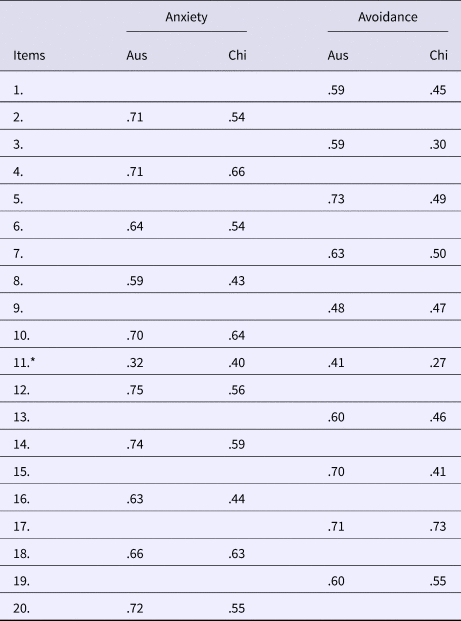
For the Australian sample, the one-factor model did not fit the data: RMSEA = .137 [.131, .143], CFI = .587, TLI = .538; nor did the two-factor model: RMSEA = .088 [.081, .094], CFI = .831, TLI = .810. Five modifications (one cross-loading: item 11 on Anxiety; four correlated error terms between items 13 and 19, 2 and 4, 7 and 17, and 8 and 20) were added step-wise based on both the modification indexes (MI) and their theoretical acceptability to achieve an acceptable fit: RMSEA = .068 [.061, .075], CFI = .901, TLI = .885. We termed this the best-fitting model for the Australian sample. The potential cross-loading of item 11 on Anxiety produced the biggest MI and also improved the model fit substantially (ΔCFI > .01). Items 13 and 19 both referred to depending on other people. Items 2 and 4 both involved worrying that other people do not care/love enough. Items 7 and 17 both involved discussing issues with others. Items 8 and 20 both referred to being close to others. Adding any further modifications did not bear significant theoretical meaning, nor did they improve the model fit by a significant amount. The factor loadings of this final model, all above .40, are presented in Table 2. The correlation between the two factors was .35. We concluded that the two-factor model with the added modifications was an acceptable fit.
Factor Loadings of the Final Two-Factor Model in Both Samples

Note: *Item 11 showed cross-loadings in both samples. Aus = the Australian sample, Chi = the Chinese sample. The modifications in the Australian sample: item 11 cross-loads on Anxiety; the correlated error terms between item 13 and 19: .57, between item 2 and 4: .30, between item 7 and 17: .27, and between item 8 and 20: .24. The modifications in the Chinese sample: item 11 cross-loads on Anxiety; the correlated error terms between item 13 and 19: .45, between item 2 and 4: .26, between item 13 and 3: .36, and between 3 and 19: .27.
For the Chinese sample, the one-factor model did not fit the data: RMSEA = .107 [.101, .112], CFI = .527, TLI = .472; nor did the two-factor model: RMSEA = .072 [.067, .078], CFI = .785, TLI = .759. Five modifications (one cross-loading: item 11 on Anxiety; four correlated error terms between items 13 and 19, 2 and 4, 13 and 3, and 3 and 19) were added step-wise based on both the MI and their theoretical meanings to achieve a marginal fit: RMSEA = .056 [.050, .061], CFI = .876, TLI = .857. This is the best-fitting model for the Chinese sample. Three of these modifications were the same as the Australian sample, while the remaining two, the correlated error terms between items 3 and 13 and between 3 and 19, referred to depending on other people. Adding further modifications did not bear theoretical meaning, nor did they improve the model fit significantly. In this final model, the correlation between the two factors was non-significant (r = .01). The factor loadings are presented in Table 2. As shown, items 3, 8, 11, 15, and 16 had low loadings on their expected factors. Another CFA was conducted with these five items removed, which we termed the 15-item reduced model. The model fit was unsatisfactory (RMSEA = .064 [.056, .072], CFI = .876, TLI = .854), before one pair of correlated errors for items 13 and 19 was added and the model fit was acceptable: RMSEA = .048 [.040, .056], CFI = .931, TLI = .918. The factor loadings in this model ranged from .44 (item 1) to .76 (item 17), with the correlation between the two factors being non-significant again: .06. We concluded that for the Chinese sample, the two-factor model with the five added modifications was a marginal fit, and the factor loadings suggested the existence of problematic items. The removal of these items produced an acceptable-fitting model.
For the multigroup analysis, the best-fitting models of the two samples were examined due to their better fit and simplicity (Table 3). The two unique error covariances in each sample (between items 7 and 17 and items 8 and 20 in the Australian sample, and between items 13 and 3, and 3 and 19 in the Chinese sample) were set as zero in the other sample. Shown in Table 3, the configural model was a marginal fit. Metric invariance was achieved, as the fit of the metric invariance model, model 1, did not drop significantly from the configural model (ΔCFI < .01; Cheung & Rensvold, Reference Cheung and Rensvold2002). However, scalar invariance was not achieved until six intercepts (items 20, 8, 11, 13, 2, and 1) were released to achieve partial scalar invariance. Finally, the covariance between the two factors was not significantly different, indicated by the non-significant drop of CFI of model 3 from model 2.
Multi-Group CFA Results of the Final Two-Factor Model

The best-fitting model from the Australian sample, as well as the 15-item reduced model from the Chinese sample, were also tested between the two groups. The outcome remained the same: metric but not scalar invariance was achieved, with the covariance between the two factors not significantly different across groups. Therefore, we concluded that there was only metric but no scalar invariance between the two samples on the ECR-R-GSF and that removing problematic items did not improve this outcome.
Discussion
To our best knowledge, the ECR-R-GSF was the first short form of the ECR-R developed on an English-speaking sample to measure general, instead of romantic, attachment. This study sought to examine its factor structure with an alternative Australian sample and to test its cross-cultural validity in a Chinese sample for the first time. Both scales of the ECR-R-GSF, Anxiety and Avoidance, demonstrated good internal reliability in the Australian sample, similar to previous findings on Australian samples (Pepping & Duvenage, Reference Pepping and Duvenage2015; Wilkinson, Reference Wilkinson2011) and also to the two other short forms of the ECR-R developed on non-English-speaking European samples (Brenk-Franz et al., Reference Brenk-Franz, Ehrenthal, Freund, Schneider, Strauû, Tiesler and Gensichen2018; Kaščáková et al., Reference Kaščáková, Husárová, Hašto, Kolarčik, Šolcová, Gecková and Tavel2016). As the first study to examine the ECR-R-GSF in a Chinese sample, our Cronbach's alphas indicated that it was a reliable measure. These are slightly less than Jin and Tang's (Reference Jin and Tang2007) 30-item Chinese ECR-R, but comparable to Wongpakaran and Wongpakaran's (Reference Wongpakaran and Wongpakaran2012) 18-item Thai ECR-R. Our lower Cronbach's alphas could partially be explained by the shorter length of the ECR-R-GSF (similar to Wongpakaran and Wongpakaran's) compared to the ECR-R; there were also some problematic items revealed by the CFAs.
The proposed two-factor model, including two modifications that were the same as Wilkinson's (Reference Wilkinson2011; the error covariances between items 8 and 20 and between 7 and 17), was replicated in the current Australian sample. In line with previous findings on the ECR-R (Gray & Dunlop, Reference Gray and Dunlop2017; Wongpakaran et al., Reference Wongpakaran, Wongpakaran and Wannarit2011), cross-loadings and correlated errors were also found. This addition of the correlated error terms on the basis of the simplified, multifactor model to fit real-life data has been widely reported on other well-established personality/attribute instruments such as Gignac, Bates, and Jang's (Reference Gignac, Bates and Jang2007) and Aluja, Rolland, García, and Rossier's (Reference Aluja, Rolland, García and Rossier2007) reports with the Revised NEO-Personality Inventory and the Rosenberg Self-Esteem Scale respectively (cf. Hopwood & Donnellan, Reference Hopwood and Donnellan2010). These correlated items are similar in their wording; thus, we do not believe that this indicates serious violations to the hypothesised model. Rather, we concur with Gray and Dunlop and Hopwood and Donnellan in recognising that these items share some additional correlations above and beyond the underlying avoidance (anxiety) dimension. This could be an important feature of the ECR-R-GSF.
For example, the error covariance between items 13 and 19 was similar to Wilkinson's (Reference Wilkinson2011) error covariance between items 3, 13, and 19 reported on a different sample. Accordingly, the EFA (Appendix B) also suggested the possible existence of a third factor that included these three items and was highly correlated with the avoidance factor. Wilkinson proposed that the perception of a dependency on other people in relationships, measured by these three items, is perhaps qualitatively distinct from attachment avoidance. This pattern was not observed in previous studies using the ECR-R to measure romantic relationships (Gray & Dunlop, Reference Gray and Dunlop2017; Sibley & Liu, Reference Sibley and Liu2004). It is possible that when referring to general relationships (e.g., item 13, “I find it easy to depend on other people”), these three items further tap into a sense of independence and individuality beyond an avoidance of attachment-related information. This is consistent with the theoretical and empirical overlap between attachment avoidance and individualism — a stronger tendency to rely on oneself (Frías, Shaver, & Díaz-Loving, Reference Frías, Shaver and Díaz-Loving2014; Lin, Chew, & Wilkinson, Reference Lin, Chew and Wilkinson2017). This also merits further investigation by linking the different aspects of attachment avoidance to individualism, before one can use the full score of this scale (cf. Hopwood & Donnellan, Reference Hopwood and Donnellan2010).
The correlation between the two factors in the Australian sample (.35) was slightly lower than Wilkinson's (Reference Wilkinson2011) report on the ECR-R-GSF (.48) and Sibley and Liu's (Reference Sibley and Liu2004) report on the ECR-R (.42), both based on English-speaking samples. In the current study only, a cross-loading of item 11 on Anxiety was included in the final model, which could account for the lower correlation between the two factors. This moderate correlation was reported in previous studies addressing romantic relationships (e.g., Wei et al., Reference Wei, Vogel, Ku and Zakalik2005). Although the ECR-R was argued to be more prone to higher correlations between the two dimensions (Cameron et al., Reference Cameron, Finnegan and Morry2012), these empirical findings depart from the original theoretical proposal that the two attachment dimensions are orthogonal (Fraley & Shaver, Reference Fraley and Shaver1997). In fact, both attachment insecurities are similar with regard to their relations with interpersonal problems (Wei et al., Reference Wei, Vogel, Ku and Zakalik2005), perceived social support (Vogel & Wei, Reference Vogel and Wei2005), and self-esteem (Hao & Wilkinson, Reference Hao and Wilkinson2014), among others. Yet they are characterised by different patterns of emotion-regulation strategies: attachment anxiety with hyperactivating strategies and attachment avoidance with deactivating strategies (Mikulincer & Shaver, Reference Mikulincer and Shaver2007). These inconsistences raise the important question of what the nature of the relationship between these two ‘dimensions’ of attachment insecurity really is and how this can be reconciled with the orthogonal theoretical propositions (Mikulincer & Shaver, Reference Mikulincer and Shaver2007). Whether the differences in the correlation are due to the current sample or the ECR-R-GSF also warrants future replication.
With the Chinese data, the hypothesised two-factor model with five modifications only provided a marginal fit, with five items having low factor loadings. This is in concordance with Jin and Tang (Reference Jin and Tang2007), who removed six items only to achieve an acceptable fit for their Chinese ECR-R. The problematic items were reported in other non-English-speaking samples. For example, Conradi, Gerlsma, van Duijin, and de Jonge (Reference Conradi, Gerlsma, van Duijn and de Jonge2006) found in a Dutch sample that item 3 (their item 21), “I find it difficult to allow myself to depend on other people”, loaded on both factors. Item 11, “I am nervous when others get too close to me”, showed cross-loading in our samples and Wongpakaran and Wongpakaran's (Reference Wongpakaran and Wongpakaran2012) Thai sample. The word “nervous” may be tapping into attachment anxiety. Echoing our previous argument, these frequently observed cross-loadings across the different language versions may be an inherent feature of the measure and may reflect the heightened interpersonal difficulties experienced by both anxiously attached and avoidantly attached individuals (Wei et al., Reference Wei, Vogel, Ku and Zakalik2005). However, avoidant individuals may have more troubles with relationships because of a reluctance to communicate, whereas anxious individuals have difficult relationships because it may be very demanding for others to meet their excessive need for attention. Future research should consider revising or even removing these items from the ECR-R-GSF or the ECR-R to differentiate this aspect of attachment insecurities to improve their validity, especially for adaptations into other languages.
Multigroup CFA indicated the existence of substantial cultural differences at the scalar level, although at the level of the factor structure, factor loadings and factor covariance, the measure was partially invariant across groups. A shared factor structure on the ECR-R-GSF meant that the construct of general attachment could be represented by the same two underlying factors in the two cultural groups. The invariance on the factor loadings suggested that the individual items were related to their underlying factors in a similar way across groups. The invariance on the factorial covariance indicated that the relationship between the two factors was also similar across groups. These findings are all in agreement with the universality of the attachment system (Mesman et al., Reference Mesman, van IJzendoorn, Sagi-Schwarz, Cassidy and Shaver2002; Schmitt et al., Reference Schmitt, Alcalay, Allensworth, Allik, Ault, Austers and Zupanèiè2004). However, it should be noted that when judging the significance of the decrease in model fit, we adopted a more liberal approach by focusing on the change in CFI instead of the more conservative and restrictive criteria employing the change in chi-square (Byrne, Reference Byrne2010). Besides, different pairs of error covariance were included in the two groups. Therefore, our results need future replication in alternative samples; researchers are encouraged to be cautious when comparing the ECR-R-GSF across different cultural groups as scale scores may not be directly comparable.
Our failure to find scalar invariance is not wholly unexpected. The independent sample t test showed that the Chinese sample scored higher on attachment anxiety but not avoidance. Previously, Mastrotheodoros et al. (Reference Mastrotheodoros, Chen and Motti-Stefanidi2015) failed to find either metric or scalar invariance on the ECR-R between their Greek and Chinese samples. Schmitt et al. (Reference Schmitt, Alcalay, Allensworth, Allik, Ault, Austers and Zupanèiè2004) reported samples from Hong Kong and Taiwan to score higher on (romantic) attachment anxiety than their Australian counterparts. More importantly, Australia and China differ on a range of broader cultural dimensions, including individualism versus collectivism (Hofstede Insights, 2018) and parenting style at the individual level (Robinson et al., Reference Robinson, Hart, Mandleco, Olsen, Russell, Aloa and Bazarskaya1996). It is possible that participants from the collectivism- and Confucianism-based cultures are more concerned with others’ opinions compared to Australian students. Naturally, their greater tendency towards self-monitoring (Hamid, Reference Hamid1994; Oyserman, Coon, & Kemmelmeier, Reference Oyserman, Coon and Kemmelmeier2002) could lead to higher scores on items such as “I find that other people don't want to be as close as I would like” (item 20). The Chinese sample was also younger than the Australian sample, making them more subject to others’ influences. However, whether this is equal to an exaggerated emotional need to be loved and accepted (attachment anxiety) remains to be examined.
Further, a majority of the millennials in China are the only child in their family due to the one-child policy (e.g., 77%; Shi, Wang, Yao, Su, Zhao, & Chen, Reference Shi, Wang, Yao, Su, Zhao and Chen2017). The only children have parents who were reported to demonstrate excessive affection and overprotection towards them (Fan, Reference Fan2016). This could subject them to an over-reliance on others for both practical and emotional help in adulthood, hence higher attachment anxiety. The traditional Chinese culture also puts less stress on the expression of negative emotions, out of the concern that it will disrupt group harmony, compared to Western cultures such as North America and Australia (Bond, Reference Bond1993; Wang et al., Reference Wang, Shi, Geng, Zou, Tan, Wang and Chan2016). This highly valued composure and emotional restraint (Zhu et al., Reference Zhu, Wang and Chong2016) could be one driving force for their higher scores on items such as “I prefer not to show others how I feel deep down” (item 1). The Chinese sample, who reported fewer experiences with romantic relationships, could also be less willing to and less skilful at communicating with others in close relationships (Stanton, Campbell, & Pink, Reference Stanton, Campbell and Pink2017).
During the measure translating process, it was challenging for us to find a direct, one-to-one translation in Chinese for words pertaining to some emotional experiences, such as “affectionate” (item 15). Similarly, Mallinckrodt and Wang (Reference Mallinckrodt and Wang2004), who translated the ECR into Chinese, also reported difficulties in finding a single Chinese referent for affect descriptions such as “feel bad”. It is unclear whether Chinese genuinely experience fewer emotions or they are just not used to overtly expressing them. These gaps between the original version and the Chinese translations could reflect differences in the languages, an understanding about the attachment concept, the cultures, and/or all of these. More studies that compare the attachment construct between samples from China and Western samples are needed.
We caution future researchers against comparing scores of the ECR-R-GSF, or even the ECR-R, across different language versions when metric and scalar invariance are not demonstrated. The current multigroup CFA results, combined with previous results from non-English-speaking samples, suggest that in order to develop a Chinese, or any language other than English, version of the ECR-R-GSF with demonstrated measurement invariance, future researchers need to select better performing items from the ECR-R or even the ECR. In fact, an emic approach, to define the functional equivalence of ‘attachment anxiety and avoidance’ in a Chinese culture — the pre-existing, naturally occurring attachment insecurities in a Chinese culture, as opposed to a translation of the Western measure — could be more appropriate (Berry, Reference Berry1969). The mere translation of an existing measure, even a well-established one like the ECR-R, does not guarantee the same meaning of a construct in a different culture.
Limitations and Future Directions
The present study is not without limitations. First, the nature of the two convenience samples indicated that the readers should be cautious with generalising the results outside the current context; for example, to the two cultures in general. On a similar note, the Australian sample had more experiences with romantic relationships and were older compared to the Chinese sample. These warrant future replications with two samples from Australia and China that are more similar with regard to their relationship status and age. Second, whether the students were the only child in their family was not assessed because it was not the focus of the current study. Considering that the only-child status may affect relationship-specific attachment, it could be promising for future researchers to study attachment to mother/father in only-children across different cultural groups. It may also be worthwhile to compare attachment to siblings in non-only-child families across Australia and China; or to investigate siblings’ attachment to each other across cultures using the actor-partner interdependence model (Whiteman, McHale, & Soli, Reference Whiteman, McHale and Soli2011). Second, we established the initial psychometric and measurement (non)invariance evidence of the ECR-R-GSF in emerging adult population across two selected cultures. Its utility could be extended by future studies to other age groups such as middle-aged and older adults and to other Asian (e.g., Korea) and Western (e.g., the UK) cultures. Given the implication attachment has for psychopathology (Mikulincer & Shaver, Reference Mikulincer and Shaver2012), it will also be useful to follow up whether there are cultural differences on the ECR-R-GSF in clinical groups, such as those with an Axis I or II diagnosis, to examine its clinical utility. These efforts will extend previous literature as most of the existing attachment measures capture romantic as opposed to general attachment.
Third, the ECR family of measures may not address attachment security adequately given their focus on insecurity. Interested researchers could translate the Attachment Style Questionnaire (Feeney, Noller, & Hanrahan, Reference Feeney, Noller, Hanrahan, Sperling and Berman1994) and the revised version of the Relationship Scales Questionnaire (Scharfe, Reference Scharfe2016), for instance, to Chinese and assess general (as opposed to romantic) attachment security as well as attachment insecurities in Australia and China, since cross-cultural evidence on attachment security has mainly been collected from infants and children (Mesman et al., Reference Mesman, van IJzendoorn, Sagi-Schwarz, Cassidy and Shaver2002). Finally, one further step could be taken to adapt and administer the alternatives to self-report attachment measures such as the Adult Attachment Interview (George, Kaplan, & Main, Reference George, Kaplan and Main1985) to measure general attachment in both cultural groups. Considering the long-standing critiques of using self-report measures to assess attachment because they fall short of detecting unconscious defensive responses (Ravitz et al., Reference Ravitz, Maunder, Hunter, Sthankiya and Lancee2010), another venue for future research is to combine both self-report and interviews (Shaver, Belsky, & Brennan, Reference Shaver, Belsky and Brennan2000) to capture general adult attachment.
Conclusion
In conclusion, this study broadens the application of the ECR-R-GSF, but also highlights the pitfalls that may occur when applying measures cross-culturally. The replication of the factor structure and scale characteristics results in a young adult Australian sample was generally successful, with some caveats, such as the cross-loading of some items and some correlated error terms, consistent with previous findings. As the first study to examine a Chinese short form of the ECR-R, we found the ECR-R-GSF to have good internal reliability in our Chinese university student sample. The use of the ECR-R-GSF in China and/or Chinese-speaking populations is promising. However, as full scalar invariance across the two cultural groups was not supported, the comparisons of the scores of the ECR-R-GSF across the cultures is not encouraged at this stage. The use of translated measures can be problematic when there is no attempt to verify that they are in fact measuring the same construct or that the underlying constructs have similar meanings across language/cultural groups. The widespread use of the ECR-based measures may, to some extent, be another example of the influence of WEIRD (i.e., Western, educated, industrialised, rich, and democratic) science (Henrich, Heine, & Norenzayan, Reference Henrich, Heine and Norenzayan2010), given the predominance of Western samples in attachment research. While the universality of broad attachment concepts is not being questioned here, their manifestation and impact across cultural groups may not be as universal as we think and will be hard to estimate if more appropriate measures are not developed.
Author ORCIDs
Jichun Hao, 0000-0003-1424-7234
Acknowledgments
The authors would like to thank Associate Professor Binsheng Tian for his assistance with participant recruitment in China. The authors would also like to thank Ms Qing Yao for the back-translation of the measures. The first author is a PhD candidate under the supervision of the other two authors.
Conflict of interest
None.
Ethical requirements
The authors assert that all procedures contributing to this work comply with the ethical standards of the relevant national and institutional committees on human experimentations and with the Helsinki Declaration of 1975, as revised in 2008.
Appendix A Descriptive Statistics of the ECR-R-GSF Items in Both Samples

Appendix B Exploratory Factor Analyses Results
For the Australian sample, the initial EFA extracted three factors based on Eigen values, with 56.55% of the total variance explained. The unexpected third factor consisted of items 3, 13 and 19, all from the avoidance scale and referred to a dependency on others. This third factor also correlated highly with the avoidance factor (.53). Item 11 loaded on both anxiety and avoidance. After restricting the number of extracted factors to 2, 50.55% of the variance was explained, with all the items loading on their expected factors except for item 11, which showed a cross-loading again. For the Chinese sample, the initial EFA extracted five factors based on Eigen values, with 53.92% of the variance explained. Two factors were from the anxiety scale, while the remaining three were from the avoidance scale, with the correlations between factors ranged from .01 to .55. Five items (items 1, 12, 18, 19 and 20) showed cross-loadings. After restricting the number of factors to two which correlated weakly (.02), only 37.56% of the variance was explained, with four items showing cross-loadings on both factors: items 16, 11, 1 and 15.