INTRODUCTION
Neglect indicates a failure in reporting, responding, or orienting to contralesional stimuli that cannot be explained by primary sensory or motor deficits (Heilman, Watson, & Valenstein, Reference Heilman, Watson and Valenstein1993; Robertson & Halligan, Reference Robertson and Halligan1999). Visual neglect commonly occurs in consequence of right hemisphere (RH) lesions. Two major symptoms are a tendency to initially orient attention to the ipsilesional side (Butler, Lawrence, Eskes, & Klein, Reference Butler, Lawrence, Eskes and Klein2009; Gainotti, De Luca, Figliozzi, & Doricchi, Reference Gainotti, De Luca, Figliozzi and Doricchi2009; Gainotti, D’Erme, & Bartolomeo, Reference Gainotti, D’Erme and Bartolomeo1991; Karnath & Rorden, Reference Karnath and Rorden2012; Nurmi et al., Reference Nurmi, Kettunen, Laihosalo, Ruuskanen, Koivisto and Jehkonen2010) and a deficit in orienting attention toward the contralesional side (e.g., Corbetta & Shulmann, Reference Corbetta and Shulman2011; Danckert & Ferber, Reference Danckert and Ferber2006; Karnath & Rorden, Reference Karnath and Rorden2012). Patients with left visual neglect tend to orient first to the right hemispace, and then fail to reorient toward the left (Robertson & Eglin, Reference Robertson and Eglin1993). In addition to lateralized symptoms, neglect is known to involve non-lateralized attentional deficits, which are also recognized as essential to neglect (Husain & Rorden, Reference Husain and Rorden2003; van Kessel, van Nes, Brouwer, Geurts, & Fasotti, Reference van Kessel, van Nes, Brouwer, Alexander, Geurts and Fasotti2010; Manly, Reference Manly2002; Robertson, Reference Robertson1993).
According to Karnath’s (Reference Karnath1988) model, there are three components that contribute to neglect: (a) a tendency to initially orient attention to the ipsilesional side, (b) a deficit in shifting attention from the ipsilesional side toward the contralesional side, and (c) a generalized (non-lateralized) decline in information processing and attention capacity. It has been suggested that the lateralized and the non-lateralized components interact with each other to intensify neglect symptoms (van Kessel et al., Reference van Kessel, van Nes, Brouwer, Alexander, Geurts and Fasotti2010; Manly, Reference Manly2002; Ting et al., Reference Ting, Pollock, Dutton, Doubal, Ting, Thompson and Dhillon2011) and to impair recovery from neglect (Husain & Rorden, Reference Husain and Rorden2003; Robertson, Reference Robertson1993, Reference Robertson2001; Samuelsson, Hjelmquist, Jensen, Ekholm, & Blomstrand, Reference Samuelsson, Hjelmquist, Jensen, Ekholm and Blomstrand1998).
Adequate processing speed is essential in many cognitive functions, and slowed processing speed is often thought to underlie attentional deficits (Lezak, Howieson, Bigler, & Tranel, Reference Lezak, Howieson, Bigler and Tranel2012). Slow processing speed has been associated with RH lesions (Farne et al., Reference Farne, Buxbaum, Ferraro, Frassinetti, Whyte, Veramonti and Làdavas2004; Heilman et al., Reference Heilman, Watson and Valenstein1993) and to an even greater extent with neglect (Erez, Katz, Ring, & Soroker, Reference Erez, Katz, Ring and Soroker2009; Bonato, Reference Bonato2012; Gerritsen, Berg, Deelman, Visser-Keizer, & Meyboom-de Jong, Reference Gerritsen, Berg, Deelman, Visser-Keizer and Meyboom-de Jong2003). Several studies have demonstrated neglect-related slowness of perceptual processing using measures of reaction time (Bartolomeo, Reference Bartolomeo1997; Bartolomeo & Chokron, Reference Bartolomeo and Chokron1999, Reference Bartolomeo and Chokron2002; Behrmann & Meegan, Reference Behrmann and Meegan1998; Erez et al., Reference Erez, Katz, Ring and Soroker2009; van Kessel et al., Reference van Kessel, van Nes, Brouwer, Alexander, Geurts and Fasotti2010; Samuelsson et al., Reference Samuelsson, Hjelmquist, Jensen, Ekholm and Blomstrand1998; Smania et al., Reference Smania, Martini, Gambina, Tomelleri, Palamara, Natale and Marzi1998), attentional blink (Danckert & Ferber, Reference Danckert and Ferber2006; Husain & Rorden, Reference Husain and Rorden2003), and cancellation rate (Manly et al., Reference Manly, Dove, Blows, George, Noonan, Dodds and Warburton2009; Robertson, Reference Robertson1993; Robertson & Eglin, Reference Robertson and Eglin1993). Some studies have reported evidence of slow contralateral visual processing, which has been thought to reflect lateralized deficits, that is, ipsilateral orienting and resultant slow attending to the left (e.g., Behrmann & Meegan, Reference Behrmann and Meegan1998; Smania et al., Reference Smania, Martini, Gambina, Tomelleri, Palamara, Natale and Marzi1998). Other studies have described this slowness as ipsilateral or bilateral, and interpreted it as a limitation of non-lateralized attentional processing capacity (Bartolomeo & Chokron, Reference Bartolomeo and Chokron2002; van Kessel et al., Reference van Kessel, van Nes, Brouwer, Alexander, Geurts and Fasotti2010; Robertson, Reference Robertson1993).
Conventional neglect tests typically measure the deficit in orienting attention to the contralesional side, which may manifest as left-sided omissions in cancellation tasks (Heilman et al., Reference Heilman, Watson and Valenstein1993; Husain & Rorden, Reference Husain and Rorden2003; Karnath & Rorden, Reference Karnath and Rorden2012; van Kessel et al., Reference van Kessel, van Nes, Brouwer, Alexander, Geurts and Fasotti2010). The Behavioural Inattention Test (BIT) that includes six conventional paper-pencil subtests (BITC) and nine behavioral subtests (Jehkonen, Reference Jehkonen2002a; Wilson, Cockburn, & Halligan, Reference Wilson, Cockburn and Halligan1987) has been shown to be a valid and reliable method for examining visual neglect (Wilson et al., Reference Wilson, Cockburn and Halligan1987). In determining the laterality of attentional deficits the BITC can be further enhanced by measuring the Center of Cancellation (CoC) to define the mean horizontal location of the cancelled targets (Binder, Marshall, Lazar, Benjamin, & Mohr, Reference Binder, Marshall, Lazar, Benjamin and Mohr1992; Rorden & Karnath, Reference Rorden and Karnath2010).
However, neither the BIT nor other traditional methods usually acknowledge the other components of neglect described above, that is, a tendency to initially orient attention to the ipsilesional side (here referred to as initial ipsilateral orienting bias) and slowed processing speed. The only exception that we are aware of is the Bell’s test in a standardized French battery (Batterie d’Evaluation de la Négligence) that measures ipsilateral orienting bias (Azouvi et al., Reference Azouvi, Bartolomeo, Beis, Perennou, Pradat-Diehl and Rousseaux2006). Therefore, most conventional methods may be insensitive in assessing less severe forms of neglect.
Indeed, several studies have shown that at the acute phase of stroke, some RH patients who do not exhibit neglect in conventional measures do nonetheless demonstrate initial ipsilateral orienting bias (Erez et al., Reference Erez, Katz, Ring and Soroker2009; Gainotti et al., Reference Gainotti, D’Erme and Bartolomeo1991; Jalas, Lindell, Brunila, Tenovuo, & Hämäläinen, Reference Jalas, Lindell, Brunila, Tenovuo and Hämäläinen2002; Nurmi et al., Reference Nurmi, Kettunen, Laihosalo, Ruuskanen, Koivisto and Jehkonen2010) and/or slowed processing speed (van Kessel et al., Reference van Kessel, van Nes, Brouwer, Alexander, Geurts and Fasotti2010). Similarly, many patients who according to traditional tests have recovered from neglect still show initial ipsilateral orienting bias (Bartolomeo, Reference Bartolomeo1997; Bartolomeo & Chockron, Reference Bartolomeo and Chokron2002; Bonato, Reference Bonato2012; Kettunen, Nurmi, Dastidar, & Jehkonen, Reference Kettunen, Nurmi, Dastidar and Jehkonen2012; Mattingley, Bradshaw, Bradshaw, & Nettleton, Reference Mattingley, Bradshaw, Bradshaw and Nettleton1994) and/or slowed processing speed (Bonato, Reference Bonato2012; Friedrich & Margolin, Reference Friedrich and Margolin1993; Robertson & Eglin, Reference Robertson and Eglin1993; Samuelsson et al., Reference Samuelsson, Hjelmquist, Jensen, Ekholm and Blomstrand1998; Taylor, Reference Taylor2003; Viken, Reference Viken2013) as residual neglect symptoms long after stroke.
It appears then that more sensitive methods are needed to assess mild or residual neglect. To this end, it has been suggested that the starting point (SP) in cancellation tasks is highly sensitive in detecting initial ipsilateral orienting bias (Bonato, Reference Bonato2012; Nurmi et al. Reference Nurmi, Kettunen, Laihosalo, Ruuskanen, Koivisto and Jehkonen2010; Samuelsson, Hjelmquist, Naver, & Blomstrand, Reference Samuelsson, Hjelmquist, Naver and Blomstrand1996; Ting et al., Reference Ting, Pollock, Dutton, Doubal, Ting, Thompson and Dhillon2011). According to Azouvi et al. (Reference Azouvi, Samuel, Louis-Dreyfus, Bernati, Bartolomeo, Beis and Rousseaux2002, Reference Azouvi, Bartolomeo, Beis, Perennou, Pradat-Diehl and Rousseaux2006), it is in fact the most sensitive paper-and-pencil measure of neglect. In contrast to healthy controls, who typically start cancellation from left side (Nurmi et al., Reference Nurmi, Kettunen, Laihosalo, Ruuskanen, Koivisto and Jehkonen2010; Robertson & Eglin, Reference Robertson and Eglin1993; Warren, Moore, & Vogtle, Reference Warren, Moore and Vogtle2008), neglect patients mainly start it from the right (Adair & Barrett, Reference Adair and Barrett2008; Heilmann et al., Reference Heilman, Watson and Valenstein1993). Furthermore, it has been suggested that the inclusion of processing speed measurement might increase the diagnostic sensitivity of the assessment for mild neglect symptoms at the acute phase (Erez et al., Reference Erez, Katz, Ring and Soroker2009; van Kessel et al., Reference van Kessel, van Nes, Brouwer, Alexander, Geurts and Fasotti2010; Ting et al., Reference Ting, Pollock, Dutton, Doubal, Ting, Thompson and Dhillon2011) as well as for residual neglect symptoms during the recovery (Bartolomeo, Reference Bartolomeo1997; Bonato, Reference Bonato2012; Friedrich & Margolin, Reference Friedrich and Margolin1993; Taylor, Reference Taylor2003).
As mentioned above, it appears that different neglect-related symptoms do not recover at the same rate. Karnath (Reference Karnath1988) has proposed that out of the three components of visual neglect, inability to orient attention toward the contralesional side recovers faster than ipsilateral orienting bias or general attentional deficits. Indeed, when assessed with conventional methods that mainly focus on measuring the ability to orient attention contralaterally, it seems that in most patients neglect recovers within the first few months after RH stroke (e.g., Bonato, Reference Bonato2012; Cassidy, Lewis, & Grey, Reference Cassidy, Lewis and Grey1998; Harvey & Gilchrist, Reference Harvey and Gilchrist2002), although recovery may fluctuate during the first year (Jehkonen, Laihosalo, Koivisto, Dastidar, & Ahonen, Reference Jehkonen, Laihosalo, Koivisto, Dastidar and Ahonen2007).
Initial ipsilateral orienting bias, on the other hand, is often present for 6 to 7 (Bonato, Reference Bonato2012; Kettunen et al., Reference Kettunen, Nurmi, Dastidar and Jehkonen2012; Samuelsson et al., Reference Samuelsson, Hjelmquist, Naver and Blomstrand1996), even 12 months (Mattingley et al., Reference Mattingley, Bradshaw, Bradshaw and Nettleton1994) after stroke, despite the recovered ability to reorient attention toward the contralesional side. Similarly, slow processing speed has been seen as a residual symptom in clinically recovered neglect patients for 3 to 7 months post-stroke (Harvey & Gilchrist, Reference Harvey and Gilchrist2002; Samuelsson et al., Reference Samuelsson, Hjelmquist, Jensen, Ekholm and Blomstrand1998; Viken, Reference Viken2013). It has also been shown that even if patients no longer show neglect symptoms in simpler tasks, attentionally more demanding situations, as often encountered in daily activities, may still provoke residual symptoms, such as ipsilateral orienting bias (Friedrich & Margolin, Reference Friedrich and Margolin1993; Taylor, Reference Taylor2003).
The presence of neglect following stroke is known to predict poor functional recovery and rehabilitation outcomes as well as difficulties in activities of daily living (ADL; Buxbaum et al., Reference Buxbaum, Ferraro, Veramonti, Farne, Whyte, Lavadas, Frassinetti and Coslett2004; Chen, Hreha, Kong, & Barrett, Reference Chen, Hreha, Kong and Barrett2015; Cherney, Halper, Kwasnica, Harvey, & Zhang, Reference Cherney, Halper, Kwasnica, Harvey and Zhang2001; Di Monaco et al., Reference Di Monaco, Schintu, Dotta, Barba, Tappero and Gindri2011; Gillen, Tennen, & McKee, Reference Gillen, Tennen and McKee2005; Jehkonen, Reference Jehkonen2002b; Katz, Hartman-Maeir, Ring, & Soroker, Reference Katz, Hartman-Maeir, Ring and Soroker1999). Viken, Jood, Jern, Blomstrand, and Samuelsson (Reference Viken, Jood, Jern, Blomstrand and Samuelsson2014) found that in RH patients, among all the neglect-related symptoms present at the acute phase of stroke, ipsilateral orienting bias was the most important predictor of functional dependency at 3 months and slow visual processing speed at 2 years post-stroke. Additionally, even when full-blown neglect symptoms are absent, milder deficits such as ipsilateral orienting bias and slow processing speed per se cause difficulties in more complex ADL such as wheelchair maneuvering and participating in traffic (e.g., driving, crossing roads), thus increasing the risk of accidents and impairing and endangering functioning in real-life situations (Bonato, Reference Bonato2012; Suzuki, Chen, & Kondo, Reference Suzuki, Chen and Kondo1997; Webster et al., Reference Webster, Roades, Morril, Rapport, Abadee, Sowa and Godlewski1995).
This study set out to explore the occurrence and recovery of different neglect-related symptoms, focusing particularly on neglect laterality, initial ipsilateral orienting bias, and slowed processing speed in visual search. These symptoms were examined during a 1-year follow-up in RH infarct patients, divided into three groups based on the acute phase symptoms: a neglect (N+) group, a mild left inattention (MLI+) group, and a non-neglect (N−) group. These patient groups were also compared with healthy controls.
The following hypotheses were set: (1) in the N+ group, originally left-sided manifestation of neglect shifts toward milder non-lateralized attentional deficit during the 1-year follow-up; (2) both the N+ and MLI+ groups show initial ipsilateral orienting bias throughout the follow-up period; and (3) all RH patient groups show slowed processing speed in visual search at the acute phase, and the N+ and MLI+ groups continue to show this during the follow-up period.
Our particular focus was to examine the occurrence of symptoms and their recovery in patients with MLI+, who cannot be detected with conventional neglect tests in clinical work and who have received minor attention in neglect research. Neglect assessment was based on the BIT with additional analyses of CoC and SP. In addition, we aimed to further enhance this conventional method by creating guidelines for assessing slowed processing speed using the BIT cancellation tasks.
METHODS
Subjects
The patient group included 65 first-ever RH infarct patients consecutively admitted to Tampere University Hospital during two different periods, from January 2007 to January 2008 and from March 2010 to December 2012. The infarct diagnosis was based on the neurological and neuroradiological examinations. Patients who met the criteria for thrombolysis received the treatment within 4.5 hr of infarct onset, others were treated according to a conservative treatment protocol. Patients with a neurological diagnosis other than RH infarct, previous neurological or psychiatric diagnosis, significant cerebral atrophy, significant loss of consciousness, significant loss of primary vision or hearing, age<30 or>85 years, substance abuse, native language other than Finnish, and inability to live independently before infarct were excluded from the study. Informed consent was obtained before inclusion in the study.
The patients underwent three neurological examinations: on arrival at hospital (baseline), at the acute phase (within a few days from onset) and at 6 months. Two neuroradiological examinations were carried out: a CT on arrival at hospital and a MRI at the acute phase or at 6 months. In addition, three neuropsychological examinations were conducted: at the acute phase, at 6 and at 12 months. No recurrent strokes emerged during the follow-up period. Rehabilitation status (received/not received during the 1-year follow-up) regarding neuropsychological rehabilitation and occupational therapy was obtained from all patients.
The control group consisted of 40 healthy volunteers aged 30 to 80 years. They were gathered from among researchers’ acquaintances and elderly social clubs. Subjects with a history of neurological or psychiatric disorders were not included. One neuropsychological examination was conducted. All subjects were blind to the hypotheses of the study. The study protocol was approved by the Ethical Committee of Tampere University Hospital and the human data included in this study was obtained in compliance with the Helsinki Declaration.
Methods
Neuropsychological examination
In the neuropsychological examination visual neglect was assessed with the BITC, laterality of neglect with the CoC, initial ipsilateral orienting bias with the SP, and processing speed with cancellation time. A comprehensive description of the neuropsychological methods is given in Appendix 1.
Neurological and neuroradiological examinations
The neurological and neuroradiological methods are described in Appendix 2.
Data Analysis
Nonparametric methods were used for data analysis due to the skewed distribution of the variables. For continuous variables, comparisons between several independent groups were performed with the Kruskal-Wallis test. Multiple pairwise comparisons were made with the Mann-Whitney U test. Bonferroni corrections were made by multiplying the p-value by 6 (comparisons between four groups) or by 3 (comparisons between three patient groups). Categorical variables were analyzed with the chi-square test. Effect size was calculated for Kruskal-Wallis analyses by computing η2 and for Mann-Whitney U analyses by computing r (Tomczak & Tomczak, Reference Tomczak and Tomczak2014). Cohen’s guidelines for r were used (Coolican, Reference Coolican2009; a large effect: .5, a medium effect: .3, and a small effect: .1).
The guideline cutoff for slowed processing speed in visual search was defined separately for the letter and star cancellation tasks by receiver operating characteristic (ROC) curve analyses. Adequate versus slowed processing speed was differentiated by comparing the healthy subjects’ processing speed with that of the N+ patients, and by calculating sensitivity, specificity and areas under the curve (AUC). Guideline cutoffs were based on the best combination of sensitivity and specificity. Statistical analyses were conducted with the Statistical Package for the Social Sciences version 23 for Windows. The level of statistical significance was set at .05.
RESULTS
Subject Characteristics
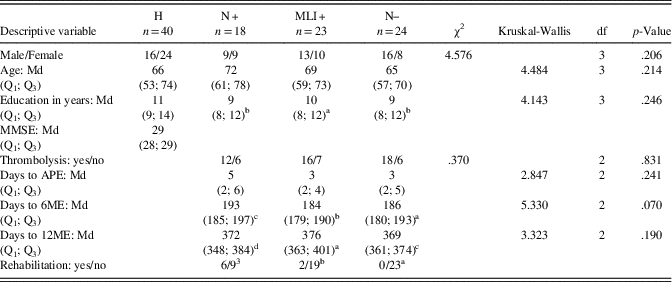
Eighteen patients (28%) had visual neglect (N+; failure in at least two BITC subtests), and 23 patients (35%) met the criteria for ipsilateral orienting bias (MLI+; atypical SP in at least two cancellation tasks). Twenty-four patients (37%) did not show neglect symptoms (N−). Characteristics for the patient groups and the healthy group are presented in Table 1. The groups did not differ significantly on any subject characteristics at any point of measurement. Forty percent of N+, 10% of MLI+ and 0% of N− patients received rehabilitation during the 1-year follow-up.
Subject characteristics and comparisons of H, N+, MLI+, and N− groups

Note. H=healthy control group; N-=non-neglect group; MLI+=mild left inattention group; N+=neglect group; Md=median; Q1=lower quartile; Q3=upper quartile; MMSE=Mini Mental State Examination; APE=acute phase examination; ME=months’ examination; Rehabilitation=rehabilitation received during 1-year follow-up including neuropsychological rehabilitation and occupational therapy.
a Data for 1 patient missing.
b Data for 2 patients missing.
c Data for 3 patients missing.
d Data for 4 patients missing.
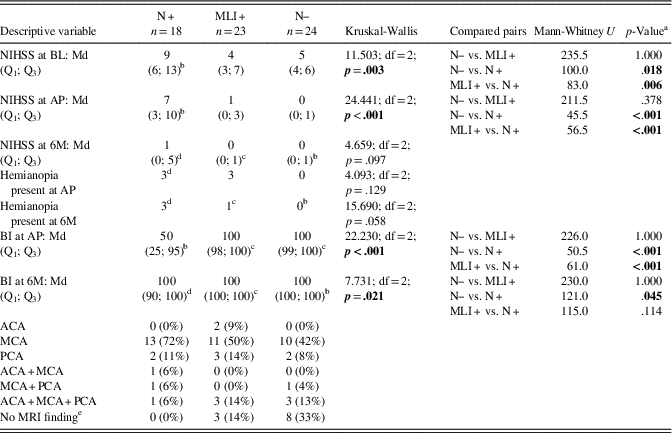
Neurological characteristics and the infarct locations for the patient groups are presented in Table 2. Stroke severity (NIHSS) differed significantly between the groups at baseline and at the acute phase. At both times the N+ group had more severe stroke than the other groups. There were significant differences between the patient groups in basic ADL (BI) at the acute phase and at 6 months. At the acute phase the N+ group had greater dependence in basic ADL than the other groups. At 6 months the N+ group was still more dependent in basic ADL than the N− group. In all groups, the most typical infarct location was in the region of MCA.
Neurological characteristics and comparisons of N+, MLI+, and N− groups

Note. N−=non-neglect group; MLI+=mild left inattention group; N+=neglect group; Md=median; Q1=lower quartile; Q3=upper quartile; BL=baseline; NIHSS=National Institution of Health Stroke Scale; AP=acute phase; M=months; BI=Barthel Index, ACA=infarct in the region of anterior cerebral artery; MCA=infarct in the region of medial cerebral artery; PCA=infarct in the region of posterior cerebral artery; MRI=magnetic resonance imaging.
a p-Values Bonferroni corrected multiplying by 3.
b Data for 1 patient missing.
c Data for 2 patients missing.
d Data for 3 patients missing.
e All the patients without a finding in the MRI have received thrombolytic treatment at the baseline prior to the MRI examination.
Visual Neglect and Laterality
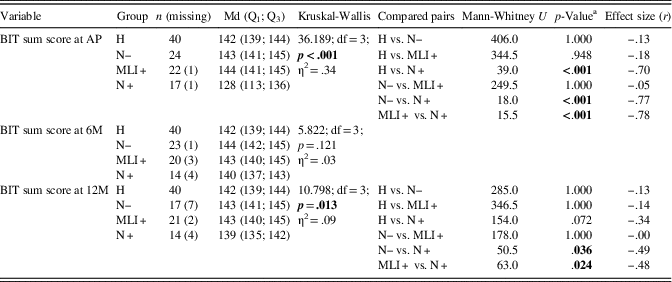
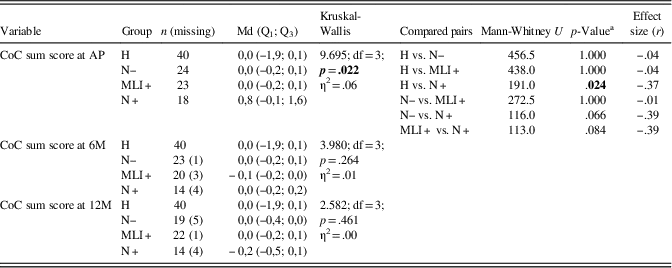
Median and quartiles of the BIT and CoC sum scores for the four groups and between-group comparisons at the three points of measurement are presented in Tables 3 and 4. Significant group differences were found in the BIT sum scores at the acute phase and at 12 months and in the CoC sum scores at the acute phase. At the acute phase, the N+ group had a significantly lower BIT sum score than the other groups (large effects) and a significantly more rightward CoC sum score than the healthy group (medium effects). At 12 months, the N+ group had a significantly lower BIT sum score than the N− and MLI+ groups (medium effects).
Md and Q1; Q3 of the BIT sum scores in H, N+, MLI+, and N− groups and between-group comparisons

Note. BIT=Behavioural Inattention Test; H=healthy control group; N−=non-neglect group; MLI+=mild left inattention group; N+=neglect group; Md=median; Q1=lower quartile; Q3=upper quartile; AP=acute phase; M=months.
a p-Values Bonferroni corrected multiplying by 6.
Md and Q1; Q3 of the CoC sum scores in H, N+, MLI+, and N− groups and between-group comparisons

Note. CoC=Center of Cancellation; H=healthy control group; N−=non-neglect group; MLI+=mild left inattention group; N+=neglect group; Md=median; Q1=lower quartile; Q3=upper quartile; AP=acute phase; M=months.
a p-Values Bonferroni corrected multiplying by 6.
Individual BIT and CoC values for each patient are presented in Appendix 3. Based on failure in at least two BITC subtests, visual neglect was still present in 21% of N+ patients at 6 months and in 36% of N+ patients at 12 months.
Ipsilateral Orienting Bias
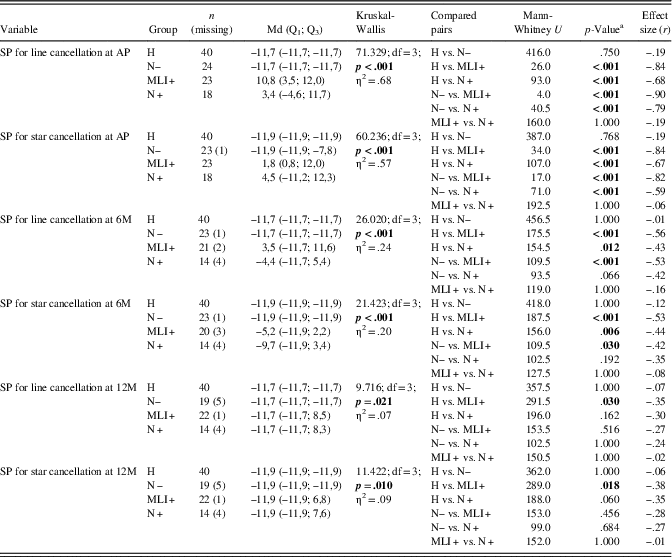
Median and quartiles of SPs for line and star cancellation tasks in the four groups and between-group comparisons at three points of measurement are presented in Table 5. There were statistically significant group differences in the SPs for both cancellation tasks at each point of measurement. At the acute phase, the SPs for line and star cancellation tasks were significantly more rightward located in the N+ and MLI+ groups than in the N− and healthy groups (large effects). At 6 months, the SPs for the same tasks were more rightward located in the N+ and MLI+ groups than in the healthy group, and in the MLI+ group than in the N− group (medium to large effects). At 12 months, the SPs for the line and star cancellation tasks were located significantly more to the right in the MLI+ group than in the healthy group (medium effect). The SPs of the N+ and MLI+ groups did not differ significantly from each other at any point of measurement.
Md and Q1; Q3 of SPs for line and star cancellation tasks in H, N+, MLI+, and N− groups and between-group comparisons

Note. SP=starting point; H=healthy control group; N−=non-neglect group; MLI+=mild left inattention group; N+=neglect group; Md=median; Q1=lower quartile; Q3=upper quartile; AP=acute phase; M=months.
a p-Values Bonferroni corrected multiplying by 6.
Individual SP values for each patient are presented in Appendix 3. Based on atypical SP in at least two cancellation tasks, ipsilateral orienting bias still occurred in 43% of N+ and 50% of MLI+ patients at 6 months, and in 29% of N+ and 32% of MLI+ patients at 12 months.
Processing Speed in Visual Search
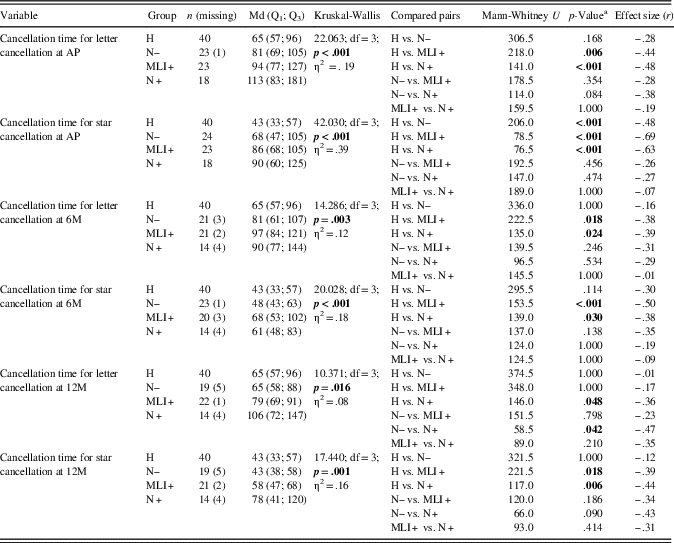
Median and quartiles of cancellation time for the letter and star cancellation tasks in the four groups and between-group comparisons at the three points of measurement are presented in Table 6. There were statistically significant cancellation time differences between the four groups in both cancellation tasks at each point of measurement. At the acute phase, cancellation time for the letter cancellation task was significantly slower in the MLI+ and N+ groups than in the healthy group (medium effects). Cancellation time for the star cancellation task was significantly slower in all three patient groups than in the healthy group (medium to large effects). At 6 months, cancellation time for both cancellation tasks was slower in the MLI+ and N+ groups than in the healthy group (medium to large effects). At 12 months, cancellation time for the letter cancellation task was slower in the N+ group than in the N− and healthy groups (medium effects). Cancellation time for the star cancellation task was slower in the MLI+ and N+ groups than in the healthy group (medium effects). The cancellation times of the N+ and MLI+ groups did not differ significantly from each other at any point of measurement.
Md and Q1; Q3 of cancellation time for letter and star cancellation tasks in H, N+, MLI+, and N− groups and between-group comparisons

Note. H=healthy control group; N−=non-neglect group; MLI+=mild left inattention group; N+=neglect group; Md=median; Q1=lower quartile; Q3=upper quartile; AP=acute phase; M=months.
a p-values Bonferroni corrected multiplying by 6.
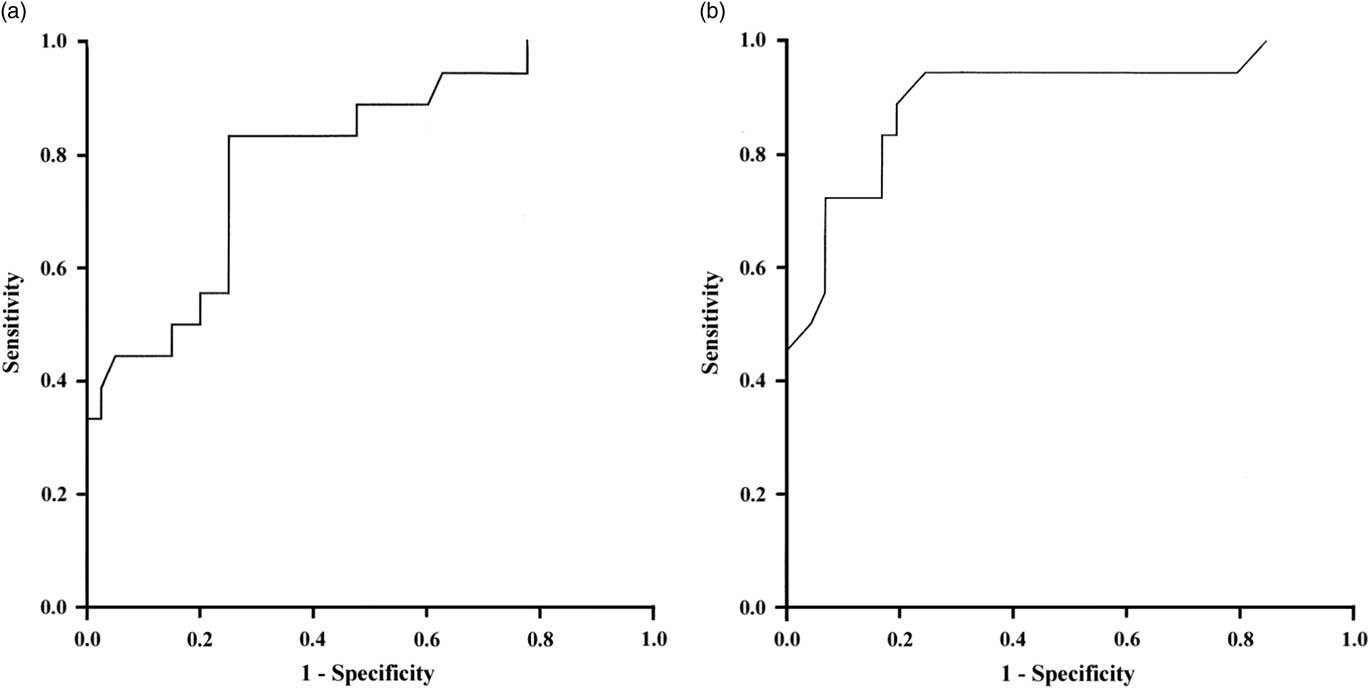
The ROC analyses of processing speed for healthy subjects versus N+ patients in the letter and star cancellation tasks are shown in Table 7. For the letter cancellation task, the ideal pairing of sensitivity (83%) and specificity (75%) was found with a cutoff of >82.5 s for slowed processing speed (Figure 1a). For the star cancellation task, the ideal pairing of sensitivity (83%) and specificity (83%) was found with a cutoff of >59.5 s for slowed processing speed (Figure 1b). Because of its higher specificity, we chose to use the star cancellation task for assessing slowed processing speed in individual patients. Thus, a cancellation time of 60 s or more in the star cancellation task was defined as an indicator of slowed processing speed in visual search.
a: Receiver operating characteristic curve: processing speed for healthy subjects versus visual neglect (N+) patients in letter cancellation task. b: Receiver operating characteristic curve: processing speed for healthy subjects versus visual neglect (N+) patients in star cancellation task.

ROC analyses of processing speed for H subjects vs. N+ patients in letter and star cancellation tasks

Note. ROC=receiver operating characteristic; H=healthy; N+=neglect; AUC=area under the curve; CI=confidence interval; Cutoff=guideline cutoff for slowed processing speed (cancellation time slower than cutoff indicates slowed processing speed).
Individual cancellation times for each patient are presented in Appendix 3. Based on the guideline cutoff, slowed processing speed was found in 83% of N+, 83% of MLI+, and 58% of N− patients at the acute phase; in 57% of N+, 55% of MLI+, and 35% of N− patients at 6 month; and in 71% of N+, 48% of MLI+, and 16% of N− patients at 12 months.
DISCUSSION
The aim of our study was to investigate the occurrence of and recovery from neglect-related symptoms, focusing on neglect laterality, ipsilateral orienting bias, and slowed processing speed in visual search during a 1-year follow-up. The RH patients were divided into N+, MLI+, and N− groups according to their acute phase symptoms and compared with healthy controls. Our particular interest was to examine the symptoms of patients with MLI+, who often remain undetected in clinical work and who have received less attention in neglect research. In addition, we aimed to further enhance the BIT by defining a guideline for assessing slowed processing speed using the cancellation tasks.
At the acute phase of RH infarct, 18 patients (28%) met the criterion for visual neglect (N+). During the 1-year follow-up overall neglect decreased according to both the BIT and CoC sum scores. However, we also saw some fluctuation in recovery based on the group comparisons with BIT sum scores and the proportions of individual N+ patients showing neglect, which is in line with the previous findings of Jehkonen et al. (Reference Jehkonen, Laihosalo, Koivisto, Dastidar and Ahonen2007). On the other hand, the CoC sum scores indicated that at follow-ups, omissions in the N+ group were no longer located more leftward than in the healthy group. As hypothesized, then, neglect manifested as left-sided only at the acute phase, after which the remaining omissions became more evenly distributed, indicating a shift toward milder non-lateralized deficit in attention. These results support Karnath’s (Reference Karnath1988) suggestion that the inability to orient attention toward the contralesional side recovers faster than the general attentional deficits of neglect.
At the acute phase, we found initial ipsilateral orienting bias not only in the N+ group, but also in 23 RH patients (35%) who did not show neglect with conventional BIT measures (MLI+). Indeed, the N+ and MLI+ groups started the line and star cancellation tasks from the right side at the acute phase, in contrast to the healthy and N− groups, which started the tasks from the left margin. This is in line with previous studies showing that ipsilateral orienting bias is a common neglect symptom (Butler et al., Reference Butler, Lawrence, Eskes and Klein2009; Corbetta & Shulmann, Reference Corbetta and Shulman2011; Gainotti et al., Reference Gainotti, D’Erme and Bartolomeo1991, Reference Gainotti, De Luca, Figliozzi and Doricchi2009; Karnath & Rorden, Reference Karnath and Rorden2012; Manly et al., Reference Manly, Dove, Blows, George, Noonan, Dodds and Warburton2009; Nurmi et al., Reference Nurmi, Kettunen, Laihosalo, Ruuskanen, Koivisto and Jehkonen2010) and may also be seen in RH patients without full-blown neglect, indicating less severe neglect symptoms (Erez et al., Reference Erez, Katz, Ring and Soroker2009; Gainotti et al., Reference Gainotti, D’Erme and Bartolomeo1991; Jalas et al., Reference Jalas, Lindell, Brunila, Tenovuo and Hämäläinen2002; Nurmi et al., Reference Nurmi, Kettunen, Laihosalo, Ruuskanen, Koivisto and Jehkonen2010).
During the first 6 months the N+ and MLI+ groups’ SPs shifted somewhat leftward, but still located more to the right than in the healthy group, as hypothesized. At 12 months, however, only the MLI+ group’s SPs were significantly more rightward than in the healthy group, while just a borderline difference occurred between the N+ and healthy groups in the star cancellation task. Nevertheless, almost one-third of both the N+ and MLI+ patients still showed ipsilateral orienting bias at 12 months. These results support Karnath’s (Reference Karnath1988) suggestion that persisting ipsilateral orienting bias is one component of residual deficits in neglect patients who have recovered abilities of contralesional orienting.
They also support previous findings that neglect patients may show ipsilateral orienting bias 6 to 12 months after stroke (Bonato, Reference Bonato2012; Kettunen et al., Reference Kettunen, Nurmi, Dastidar and Jehkonen2012; Mattingley et al., Reference Mattingley, Bradshaw, Bradshaw and Nettleton1994; Samuelsson et al., Reference Samuelsson, Hjelmquist, Naver and Blomstrand1996). However, only limited scientific attention has previously been devoted to the recovery of patients with initially milder inattention symptoms (i.e., MLI+), but no actual neglect after stroke. Our results highlight the clinical relevance of these patients as well, since ipsilateral orienting bias proved to be particularly persistent in the MLI+ group.
For purposes of assessing the occurrence of slow processing speed in visual search in individual patients, we created guideline cutoffs in the letter and star cancellation tasks. Because of its better combination of sensitivity and specificity, we chose to focus on the star cancellation alone, in which a cancellation time of 60 s or more indicated slowed processing speed. At the acute phase, just over half of the N− patients and a clear majority of the MLI+ and N+ patients showed slow processing speed in visual search.
In general, all patient groups were slower than the healthy group at the acute phase, but showed differing courses of recovery during the follow-up, as was hypothesized. The N− group’s performance was significantly slower than the healthy group’s only in the star cancellation task and only at the acute phase. Indeed, during the follow-up the proportion of slow N− patients fell markedly, and at 12 months reached the same level as in the healthy subjects. In contrast, the MLI+ and N+ groups were slower than the healthy group in both cancellation tasks up to 6 months, and in the star cancellation task still at 12 months. A little over half of the patients in both groups showed slow cancellation performance at 6 months, after which the proportion slightly decreased in the MLI+ patients but increased in the N+ patients toward the end of the year.
Altogether, these results are in line with previous studies that have associated slow processing speed with RH lesions in general (Farne et al., Reference Farne, Buxbaum, Ferraro, Frassinetti, Whyte, Veramonti and Làdavas2004; Heilman et al., Reference Heilman, Watson and Valenstein1993) and even more so with visual neglect (Erez et al., Reference Erez, Katz, Ring and Soroker2009; Bonato, Reference Bonato2012; Gerritsen et al., Reference Gerritsen, Berg, Deelman, Visser-Keizer and Meyboom-de Jong2003). In addition, our results support the previous findings that slow processing speed is a rather persistent residual symptom of neglect and may be seen in patients with clinically recovered neglect for several months (Harvey & Gilchrist, Reference Harvey and Gilchrist2002; Samuelsson et al., Reference Samuelsson, Hjelmquist, Jensen, Ekholm and Blomstrand1998; Viken, Reference Viken2013), or as in our study, even a year after stroke. There is hardly any previous research regarding processing speed and its recovery specifically in a subgroup of RH patients with initially milder inattention symptoms after stroke but no actual neglect (i.e., MLI+). Our results suggest that these patients may also show slowed processing speed in visual search as a persistent residual symptom even for a year after stroke, unlike the RH non-neglect patients (N−) who instead seem to recover quite soon after stroke.
We also obtained information about RH patients’ rehabilitation, including neuropsychological rehabilitation and occupational therapy during the follow-up. A clear majority of patients who received rehabilitation were N+ patients, of whom 40% were in rehabilitation during the year after stroke. Only 10% of the MLI+ patients and none of the N− patients received rehabilitation. This may have influenced the recovery of the N+ group. For example, recovery from ipsilateral orienting bias appeared to be slightly better in the N+ than the MLI+ group. Moreover, this finding suggests that RH patients with milder inattention symptoms, but without full-blown neglect, are under-treated in clinical work.
A major strength of our study is a broad perspective on recovery from visual neglect after RH infarct by examining various neglect-related symptoms during a lengthy follow-up period of 12 months. We focused on a homogeneous group of consecutive patients with a first-ever RH infarct. As well as including neglect patients, we showed a particular interest in patients with initially milder inattention symptoms, who have received less attention both in clinical work and in neglect research. Overall, the results of our study were well in line with previous findings, which adds to their reliability.
In addition, we propose a novel, potential method for measuring processing speed in visual search by suggesting a guideline cutoff of 60 s for slowed processing speed in the BIT star cancellation task. When combined with our previously suggested analysis of SP in the BIT cancellation tasks (Nurmi et al., Reference Nurmi, Kettunen, Laihosalo, Ruuskanen, Koivisto and Jehkonen2010), this offers an effortless, tentative way of enhancing neglect assessment by adding an examination of processing speed and ipsilateral orienting bias alongside the standard administration of the well-known conventional neglect assessment.
However, it should be noted that our relatively small sample sizes together with the loss of participants during the follow-up might have had some influence on the results. This applies particularly to the N+ group, which initially was the smallest group and also lost the biggest number of participants. This might go some way toward explaining why some of our hypotheses concerning the N+ group did not receive as strong support as we expected. Furthermore, this is why we were only able to suggest a guideline cutoff rather than establish a firm cutoff point for slowed processing speed in visual search. This will require further research.
Paper-pencil measures of processing speed can be susceptible to factors other than processing speed (e.g., perseveration, distraction, lack of motivation), which may also contribute to prolonged test performance. Cancellation time is no exception, and as it has not been traditionally used as a measure of processing speed, the findings must be interpreted with caution. As stated, our results are altogether well in line with previous findings concerning neglect and slow processing speed, but more work is still needed to explore milder inattention symptoms and their association with processing speed and its recovery.
Furthermore, previous studies concerning neglect and processing speed have lent support to two contrasting hypotheses; one suggesting that slow processing speed emerges contralaterally (e.g., Behrmann & Meegan, Reference Behrmann and Meegan1998; Smania et al., Reference Smania, Martini, Gambina, Tomelleri, Palamara, Natale and Marzi1998) reflecting lateralized deficits, and the other that slowness is ipsi- or bilateral and reflects non-lateralized difficulties instead (Bartolomeo & Chokron, Reference Bartolomeo and Chokron2002; van Kessel et al., Reference van Kessel, van Nes, Brouwer, Alexander, Geurts and Fasotti2010; Robertson, Reference Robertson1993). The methods used in this study to measure processing speed do not allow us to determine which type of attentional deficit, lateralized or generalized, lies behind the slowed processing speed associated with neglect. This is another question that calls for further research. The considerable heterogeneity seen in N+ patients’ acute phase BIT scores underlines the need to explore the possible association of neglect severity with the occurrence and recovery of different neglect-related symptoms. Finally, rehabilitation was here assessed on a yes/no basis only, but as the content and intensity of rehabilitation may substantially influence the recovery of different neglect-related symptoms, it needs to be considered in more detail in future studies.
In conclusion, our results suggest that, during the first year after RH infarct, there is a shift from left-sided manifestation of neglect toward milder non-lateralized deficit of attention. In addition, both ipsilateral orienting bias and slowed processing speed appear to be rather persistent neglect-related symptoms that may occur for up to a year after RH infarct in patients with originally full-blown neglect, but also in patients with initially milder inattention symptoms. Both these symptoms should be assessed in the clinical examination of neglect, since they are known to cause difficulties in more complex ADL such as participating in traffic, and are important predictors of functional dependency after stroke.
We propose here some effortless, tentative ways of examining processing speed and ipsilateral orienting bias alongside the standard administration of the well-known conventional neglect assessment. The findings of our study highlight the importance of both a sensitive enough neglect assessment and a long enough follow-up for patients after RH infarct to better recognize and treat different neglect-related symptoms in neglect patients and in patients with initially milder inattention symptoms who both may suffer from significant residual symptoms long after stroke.
ACKNOWLEDGMENTS
This study was supported by grants from the Finnish Cultural Foundation (00130649) and the Competitive State Research Financing of the Expert Responsibility Area of Tampere University Hospital (9M023). The authors have no conflicts of interest.
SUPPLEMENTARY MATERIAL
To view supplementary material for this article, please visit https://doi.org/10.1017/S1355617718000176