Introduction
Seeking ways to make decision-making procedures more legitimate in the eyes of citizens is a main task for both political scientists and democratic reformers. In democratic theory, two frequently occurring ideas are that this can be realized through two different arrangements for decision-making: deliberation and direct voting in referendums. By presenting an experimental account of the relative effectiveness of these arrangements for decision-making in a small-group setting, this article contributes to an emerging literature that experimentally examines the effects of democratic procedures (see, e.g., Delli Carpini et al. (Reference Delli Carpini, Cook and Jacobs2004), Thompson (Reference Thompson2008), Karpowitz and Mendelberg (Reference Karpowitz and Mendelberg2011) for literature reviews; for specific studies see Morrell (Reference Morrell1999, Reference Morrell2005), Sulkin and Simon (Reference Sulkin and Simon2001), Simon and Sulkin (Reference Simon and Sulkin2002), Esaiasson (Reference Esaiasson2010), Grönlund et al. (Reference Grönlund, Setälä and Herne2010), Setälä et al. (Reference Setälä, Grönlund and Herne2010), and Esaiasson et al. Reference Esaiasson, Gilljam and Persson(2012)).
That a democratic procedure that includes voting is perceived as more legitimate than other procedures is conventional wisdom (cf. Dahl, Reference Dahl1989). Voting enables individuals to express their interests and treats everyone as equals. However, in democratic theory, some argue that democratic procedures should not be limited to the aggregation of preferences through voting. Influential deliberative democratic theorists claim that, in addition to voting, reasoned public deliberation is necessary for a procedure to be normatively legitimate (e.g. Knight and Johnson, Reference Knight and Johnson1994). In the present study, we evaluate whether this claim corresponds to how individuals perceive the legitimacy of decision-making procedures in small groups: Do citizens subjectively perceive the level of legitimacy of procedures that include voting and/or deliberation in the same way as deliberative theorists normatively understand it? More precisely, do decision-making procedures that include deliberation prior to voting produce higher levels of perceived legitimacy than a minimalistic procedure merely including voting?
While experimentally examining the effects of voting is quite simple since it is a straightforward decision-making arrangement, it is impossible to set up a strict empirical test of the entire deliberative theory (cf. Thompson, Reference Thompson2008). According to the deliberative ideal, citizens shall participate equally, act respectfully toward each other, put forward reasonable arguments, and carefully consider each other's arguments (see, e.g., Rosenberg, Reference Rosenberg2007 for a survey of the conditions that should ideally be fulfilled in a deliberative setting). The problem is of course that in an experimental setting you cannot guarantee that individuals behave this way. No matter how ambitious the opportunities for deliberation, skeptics can always object that the experimental situation does not resemble the theoretical ideal closely enough. Thus, we make no claims to offer a strict test of the deliberative theory per se. Our aim is more modest: We derive our hypotheses from deliberative theory and experimentally manipulate opportunities for deliberation.
We are well aware that our experimental treatments fall short of achieving the deliberative ideal. As Mutz (Reference Mutz2006: 4) points out: ‘many of the conditions necessary for approximating deliberative ideals such as Habermas's ideal speech situations are unlikely to be realized in naturally occurring social contexts’. Nevertheless, arguments about the beneficial effects of deliberation are frequent in the literature and we believe that is of great importance to experimentally test these claims. We also believe that it is of great value that empirical and theoretical political science is brought together. Refraining from empirical tests because the theoretical concepts are too complex will not move us forward. For that reason, our empirical investigation of deliberation is necessarily a simplification of the theoretical ideal.
In this context we draw on Mutz and a minimalist conception of deliberative democracy according to which the latter means that people are exposed to oppositional political perspectives through political talk and get the opportunity to take part in discussion (cf. Mutz, Reference Mutz2006). Following Fearon (Reference Fearon1998), Sulkin and Simon (Reference Sulkin and Simon2001), and Simon and Sulkin (Reference Simon and Sulkin2002), we use discussion as a proxy for deliberation. Thus, it is important to emphasize that we manipulate the opportunity for discussion, not the quality of the deliberations that actually take place (for the sake of simplicity, from here on we refer simply to deliberation).
However, our treatment approaches the deliberative ideal since all participants have the same opportunity to deliberate, the same information, and the same voting rights. In this respect, we test what Mutz (Reference Mutz2006: 5) and others have referred to as ‘theories of middle range’: ‘theories not too far removed from on-the-ground, operational research, yet not so narrow and specific as to be irrelevant to larger bodies of theory’. A consequence of this approach is that we derive our hypothesis from deliberative democratic theory but use political discussion as our operational indicator.
To our knowledge, this study is the first to provide a full factorial experimental design enabling individuals to assess the legitimacy of decision-making procedures including voting and/or deliberation. We ask two questions derived from democratic theory: First, what are the causal effects of voting and deliberation on the perceived legitimacy of the procedure? Second, what are the causal mechanisms that connect voting and deliberation with the perceived legitimacy of the procedure?
To address these questions, we designed a randomized field experiment in which 215 students from 12 high school classes participated. Each class was subject to a collectively binding decision on an identical issue – whether to give a substantial sum of money provided by us to charity, or to keep it for themselves for an activity of their own choice. The decision was made either by direct secret ballot voting or as a non-voting procedure (decision made by the teacher). We also manipulated the possibility to discuss the issue prior to the decision (deliberation vs. no deliberation). This 2 × 2 factorial design allows us to compare the impact of voting and deliberation (and the combination of them) with the impact of a form of decision-making that aims to resemble how decisions are typically made in large-scale democracies, that is, without any opportunities for citizens to vote directly or to influence the decision in a deliberative democratic process.
We also evaluate two alternative causal mechanisms that, according to the literature, link direct voting and deliberation to perceived legitimacy. Drawing on the literature on deliberative democracy, we test whether the perceived epistemic quality of a decision works as a mediator between the two components (voting and deliberation) and perceived legitimacy (cf. Chambers, Reference Chambers2003). Additionally, drawing on the literature on participatory democracy, we test whether the amount of perceived influence in the decision-making process mediates the effects of the two components on legitimacy (cf. Pateman, Reference Pateman1970).
In what follows, we first develop the arguments on why voting and deliberation are hypothesized to increase legitimacy. We thereafter present our experimental design and turn to empirical findings. We find that both direct voting and opportunity for deliberation significantly increase legitimacy compared with a non-voting and non-deliberative procedure, yet direct voting is clearly the most effective. As regards the causal mechanisms, we find that the mechanism put forward by participatory democrats – self-involvement in the decision-making procedure – mediates the effect of both voting and deliberation. Finally, we conclude the article by discussing the theoretical and practical implications of our findings.
Theory
We hypothesize that direct voting such as in referendums is perceived as more legitimate than other forms of decision-making due to the fact that voting gives individuals a sense of being able to influence the decision outcome. A vast amount of literature on participatory democracy supports this claim, that is, that decision-making processes that allow for more self-involvement are generally perceived as more legitimate. The basic idea, advocated by Rousseau, is that ‘being one's own master’ increases one's willingness to play along with collectively binding decisions (Pateman, Reference Pateman1970: 26–27; see also Warren, Reference Warren1992).
Deliberative democratic theorists emphasize that the aggregation of preferences is not enough; democratic procedures also need to include open and reasoned deliberation to be normatively legitimate (cf. Manin, Reference Manin1987; Cohen, Reference Cohen1997; Cooke, Reference Cooke2000; Chambers, Reference Chambers2003). Deliberation ought here to be understood as ‘communication that induces reflection on preferences, values and interests in a non-coercive fashion’ (Dryzek, Reference Dryzek2000: 76). In recent years, deliberation has evolved as a component of central interest in the democratic process. Indeed, Cohen argues that ‘outcomes are democratically legitimate if and only if they could be the object of a free and reasoned agreement among equals’ (Cohen, Reference Cohen1997: 77). It should be noted that not all deliberative theorists agree with this claim, and that they do not all share the same conception of legitimacy. Many deliberative theorists do not tackle the issue of legitimacy at all while others do not perhaps find these arguments to be major claims of the deliberative project. Indeed, few go as far as Cohen and claim that deliberation is a necessary condition for legitimate decision-making. However, according to our reading of the literature, we believe that most deliberative theorists would agree that deliberation increases the legitimacy of the democratic process.Footnote 1
We will use the two central mechanisms in the literature explaining the legitimizing effect of direct voting and deliberation: influence in the decision-making process and the epistemic quality of the decision. Both voting and deliberation can theoretically affect legitimacy via these two mechanisms. It should be noted that we focus mainly on factors related to what Scharpf and others have referred to as input legitimacy (i.e. the fairness of the procedures), and focus less on the output side of democracy (cf. Scharpf, Reference Scharpf2009).
The first mechanism, most often put forward by participatory democrats, suggests that personal influence in the procedure generates legitimacy beliefs (Fearon, Reference Fearon1998: 56). Direct voting in referendums is one such way to exercise influence in the process. However, influence in the decision-making process can also be obtained via deliberation. The work on procedural legitimacy by Lind and Tyler (Reference Lind and Tyler1988) and Tyler (Reference Tyler1990) shows that individuals attach more legitimacy to procedures in which they have a ‘voice’. Surprisingly, experimental studies show that voice might have a positive effect on legitimacy even if individuals themselves do not have the ability to decide on an issue. The positive effect of voice is supported by the extensive experimental fairness literature (Folger et al., Reference Folger, Rosenfield, Grove and Corkran1979; Lind et al., Reference Lind, Kanfer and Earley1990; van den Bos et al., Reference van den Bos, Lind, Vermunt and Wilke1997; Brockner et al., Reference Brockner, Siegel, Martin, Reed, Heuer, Wiesenfeld, Grover and Bjorgvinsson1998; van den Bos, Reference van den Bos1999). The basic fact that this research points at is that, in general, individuals are expected to appreciate the feelings of control, shared responsibility, and mutual respect that come with expressing one's voice.
The second causal mechanism focuses on the epistemic quality of the decision-making process. Some deliberative theorists point out that, among other positive consequences of deliberation, there is a certain epistemic value in the deliberative procedure (cf. Estlund, Reference Estlund2008; Bohman, Reference Bohman2009). By deliberating, individuals are more likely to arrive at a decision of higher epistemic value than would have been the case without deliberation. The epistemic value of the deliberative procedure generated by the fact that it offers the opportunity to express one's own views and consider those of others might be a reason why individuals perceive it as more legitimate. As Estlund (Reference Estlund2008: 89) points out: ‘Democratic legitimacy requires that the procedure can be held, in terms acceptable to all qualified points of view, to be epistemically the best (or close to it) among those that are better than random’. In other words, procedures that produce decisions of high epistemic value are considered as more legitimate. Moreover, the deliberative process has mutual justification as its central task (Mansbridge et al., Reference Mansbridge, Bohman, Chambers, Estlund, Føllesdal, Fung, Lafont, Manin and Marti2010), and supposedly produces decisions of better quality since it forces participants to consider other participants’ arguments and positions. Furthermore, the deliberative process might give citizens a better understanding of their own individual preferences (Chambers, Reference Chambers2003; Dryzek and List, Reference Dryzek and List2003). Most importantly, since the deliberative process ideally brings all arguments to the table, it provides the possibility for the participants to make a better-informed decision (Fearon, Reference Fearon1998; Dryzek and List, Reference Dryzek and List2003; Goodin, Reference Goodin2008).
Yet it is not only deliberation that has an epistemic value – direct voting has epistemic qualities as well. The Condorcet Jury Theorem shows that majority voting is likely to arrive at the correct outcomes under certain conditions (cf. List and Goodin, Reference List and Goodin2001). Drawing on this idea, theorists argue that certain forms of voting procedures can function as ‘truth-trackers’ (Bovens and Rabinowicz, Reference Bovens and Rabinowicz2004, Reference Bovens and Rabinowicz2006). Given that voters have a reasonable amount of competence, majority voting will arrive at decisions of high epistemic value. Compared with a completely random procedure – such as a coin flip – preference aggregation through voting clearly has epistemic advantages. Taking this into account, it is reasonable to hypothesize that the perceived epistemic quality of voting can function as a mechanism triggering legitimacy beliefs. However, it should be noted that the theorem is based on demanding conditions such as individual competence and independence of votes; it is an open question as to how far it is applicable to real world politics.
In sum, we propose two central mechanisms mediating the legitimizing effects of voting and deliberation. We hypothesize that the effects run through the arrows as presented in Figure 1. The effects of voting and deliberation are mediated via influence in the process and/or via the quality of the decision. Participatory democrats argue that the amount of perceived influence in the decision-making process works as the causal mechanism linking both direct voting and deliberation with increased perceived legitimacy. Deliberative democrats, on the other hand, argue that a central reason why deliberation increases legitimacy is that deliberative procedures produce decisions of better quality. We test the connection between voting and deliberation (separately and combined) through the two mechanisms and the perceived legitimacy of the procedure.
Theoretical model of the relationship between voting and deliberation, the causal mechanisms, and perceived legitimacy of the procedure.

Previous research
We aim to contribute to an emerging field of research that empirically examines the effects of forms of democratic decision-making (see Delli Carpini et al., Reference Delli Carpini, Cook and Jacobs2004; Thompson, Reference Thompson2008; Karpowitz and Mendelberg, Reference Karpowitz and Mendelberg2011 for literature reviews). Research focusing explicitly on the effects of forms of decision-making on legitimacy is still rather scarce. Pioneering work on the legitimacy of procedures by Lind and Tyler (Reference Lind and Tyler1988) and Tyler (Reference Tyler1990) shows that individuals attach more legitimacy to procedures in which they have a ‘voice’ (the ability to express one's arguments). However, the results from these studies do not concern collective democratic decision-making, but rather legal arrangements. More recently, an emerging field of research has focused more explicitly on democratic decision-making. Morrell (Reference Morrell1999) examines how perceived legitimacy differs among individuals who experience different forms of democratic decision-making with different levels of self-involvement. Rather surprisingly, Morrell's results show weak support for the idea that high levels of self-involvement increase legitimacy (see also Morrell, Reference Morrell2005). However, Morrell does not manipulate opportunities for deliberation but only forms of decision-making.
One major weakness in previous empirical research on deliberative democracy has been the lack of control group designs (Mutz, Reference Mutz2008: 365; Teorell, Reference Teorell2008). Researchers have often only studied groups employing deliberation, and have thus been unable to compare the effects of deliberation with non-deliberative settings. The advantage of the present article is that the full factorial design allows us to trace the causal effects of each condition.
Sulkin and Simon (Reference Sulkin and Simon2001) provide an explicit test of the effects of deliberation on legitimacy perceptions. They use a ‘divide-the-dollar’ game in which opportunities for deliberation are manipulated, and show that there is a positive effect of giving participants the opportunity to deliberate before the proposal stage under certain circumstances. Further support for these findings is reinforced by results presented in Simon and Sulkin (Reference Simon and Sulkin2002). However, Simon and Sulkin's experiments did not include face-to-face deliberation, and the deliberations lasted for a very short time; that is, participants deliberated with each other in online chat rooms for 200 seconds. Unlike Morrell's experiment, Simon and Sulkin did not manipulate forms of decision-making. We combine features of both these studies to trace the effects of both direct voting and deliberation: like Morrell we manipulate forms of decision-making, and like Simon and Sulkin we manipulate opportunities for deliberation.
In this context, it is also worth mentioning the deliberative polls conducted by Fishkin and Luskin (Luskin et al., Reference Luskin, Fishkin and Jowell2002; Fishkin and Luskin, Reference Fishkin and Luskin2005). These studies are of course central in the field of empirical research on deliberation. However, they do not provide evidence of the legitimizing effects of deliberative decision-making. The main reason for this is obvious: they are not studies of decision-making but polls. However, what could be studied are the general effects of the deliberative process. Unfortunately, even this is hard to do since the treatments include so many components (information, deliberation, discussion, etc.), which makes it hard to isolate the effects of deliberation. As Teorell (Reference Teorell2008: 73) points out, until deliberative polls are designed in such a way to allow one to separate the effects of each specific component, they will not provide empirical evidence for the hypotheses proposed by deliberative democratic theory.
In our own previous research, we compared democratic forms of decision-making in controlled field experiments and vignette experiments. When holding opportunities for deliberation constant at a high level, we found that direct democracy produces significantly higher levels of legitimacy than does representative democracy and expert decision-making (Esaiasson, Reference Esaiasson2010; Esaiasson et al., Reference Esaiasson, Gilljam and Persson2012). However, since the opportunities for deliberation were constant in all treatments, we could not at that stage examine whether the legitimizing effect of direct democracy was due to voting or to the combination of voting and deliberation prior to voting.
To conclude, the existing experimental studies on democratic decision-making provide contradictory results, and more research is needed in order to trace in what settings and under what circumstances opportunities for deliberation and voting affect perceived legitimacy.
Experimental design and measurements
The participants comprised 215 students in 12 high school classes in a West European metropolitan area (Gothenburg, Sweden). Each treatment was conducted in three classes and randomization was carried out at the class level.Footnote 2 Since this is a cluster-randomized design, the statistical power is a function of the number of clusters per treatment and the number of individuals within each cluster (Raudenbush, Reference Raudenbush1997). To increase the statistical precision, and to correct remaining imbalances in observed measures post-randomization, we include relevant covariates that could explain participants’ legitimacy perceptions (Duflo et al., Reference Duflo, Glennerster and Kremer2008; Gerber et al., Reference Gerber, Huber and Washington2010). Specifically, we include gender, political interest, policy winner/loser status (whether one gets one's preference fulfilled or not), generalized horizontal trust, vertical trust (in teachers and the principal), particular horizontal trust (in classmates) as individual level covariates, and grade level as a cluster level covariate.Footnote 3
Three main advantages of our experimental design need to be emphasized. First, to mimic real-life decision-making, we let participants deliberate face-to-face in their natural surroundings. Second, we used real money to construct an incentivized context (cf. Palfrey, Reference Palfrey2009). Third, in order to study decision-making under realistic conditions, we randomized among existing collectives of individuals who have to take shared responsibility for the outcome of their decision.
The reason why we selected high school students as participants is that we wanted to study natural collectives of individuals who have a shared history and future, and who are forced to take collective responsibility for the consequences of their decisions. By doing so, we believe that we mimic large-scale democratic decision-making more closely than in experiments in which individuals are put together in artificial groups for only a short period of time. In one-shot experiments, groups do not function as a collective that needs to take responsibility for the long-term consequences of its decisions. Consequently, we turned to the high school setting in order to find a sufficient number of natural collectives of individuals.Footnote 4 The relatively young age of the participants might be a concern for the generalizability of the results, especially since they naturally have less experience of participating in democratic decision-making procedures than adults. However, psychologists have shown that high school students in contexts as diverse as Canada and China show attitudes toward government that are similar both to each other and to the attitudes of adults (see Helwig et al., Reference Helwig, Arnold, Tan and Boyd2007).Footnote 5
Each group was randomly assigned to one of the following four treatments:
(1) Voting and deliberation – direct majoritarian secret ballot vote with the opportunity for deliberation among participants.
(2) Voting without deliberation – direct majoritarian secret ballot vote without the opportunity for deliberation among participants.
(3) Deliberation without voting – decision by the teacher with the opportunity for deliberation among participants.
(4) No voting and no deliberation – decision by the teacher without the opportunity for deliberation among participants.
We conducted the experiments by visiting the classes at the schools during regular lessons, and our two experimenters manipulated decision-making arrangements for the decision-making procedure. Before the decision-making process started, participants filled out a questionnaire about background characteristics used for randomization control. After the decision had been made, all individuals filled out a second questionnaire where they evaluated the decision-making procedure.
We followed experimental economics and used money to create an incentivized environment. However, while experimental economics rewards participants individually, the participants in our experiment were rewarded collectively following the outcome of the decision-making process. Each class was subject to a decision on how to collectively spend a sum equivalent to $15/€11 per individual. We proposed two alternatives: they could either donate the money to charity or keep it for themselves and spend it on whatever they wanted.
The choice between charity (altruism) and personal material well-being represents a decision over distributive policies. Issues regarding the allocation of resources are a common problem to deal with in real world democracies. The choice may seem simple, but it did allow for participants to provide reasonable arguments. The students put forward arguments such as unfulfilled rights to medical aid in foreign countries, the possibility that the money could provide students from economically strained homes, the possibility to participate in school trips, etc. Yet other students proposed arguments drawing on utilitarian calculations of what options would maximize happiness or utility. To draw a parallel with real world democracies, the choice resembles one over whether to provide money to foreign aid or spend it in a sector that would benefit the home population (such as providing support to the cultural sector). Hence, although it might seem to be a simple issue, it has severe moral implications that the students discussed. Moreover, the fact that they themselves were actually affected by the decision (since they could keep the money for themselves) and had stakes in it increased the seriousness of the discussion.
As it turned out, five of the six classes employing direct voting decided to give the money to charity. In classes subject to the non-voting procedure, four of the six decision-makers decided to give the money to charity.
We started the experiment by presenting the issue at hand to the participants. Thereafter, the participants were informed about the procedure that would be employed to decide on the issue. Although participants were not informed about the other treatments, we primed them to consider the importance of decision-making arrangements. After the introduction, participants in the treatments that included deliberation got the opportunity to discuss the issue. Experimenters initiated a discussion about the pros and cons of the two alternative outcomes. The experimenters were careful to make sure that all students had the opportunity to express their views. The experimenters also emphasized that the students should provide reasonable arguments and abstain from expressing rushed and thoughtless opinions. When the intensity of the discussion began to fade (usually after 20 minutes), participants were surveyed about their personal preference. The experimenters report that in all classrooms, participants did actually exchange their different viewpoints. Although every participant did not contribute equally, no one remained silent.
Participants in treatments (2) and (4) passed directly to the decision-making after the issue had been presented, without any opportunity for deliberation. When direct voting was employed in treatments (1) and (2), we used the secret ballot voting procedure and majority rule.
One might raise the objection that the deliberation treatment is not a purely deliberative democratic decision-making procedure since the decision is made by voting and not through deliberation per se. However, as Przeworski (Reference Przeworski1998: 141) points out, ‘deliberation must end with voting’. What else can be done if participants do not reach a consensus? Parallels in real-life decision-making are settings like school boards and town council meetings. In these contexts, elected officials deliberate together and conclude with a vote (and often a majority vote). However, it is important to note that we do not test the effects of deliberation as a decision-making procedure but rather as a component preceding voting in the decision-making process (for such a test, see Esaiasson et al., Reference Esaiasson, Gilljam and Persson2012). We are exploring majority-rule voting as the decision-making institution vs. a non-voting procedure in combinations with and without prior discussion.
The non-voting procedures used in treatments (3) and (4) serve as groups of comparison in relation to the treatments including direct democracy, that is, as a baseline to which we compare the impact of direct voting. When the non-voting procedure was employed in treatments (3) and (4), the class teacher made the decision. Participants were then informed that their teacher had received additional information concerning the two alternatives in order to make a more well-informed decision. It was emphasized to the participants that the teacher was free to choose any of the two alternatives regardless of the reasons expressed in the class.
Furthermore, in the analyses in this article we include a variable for trust in the teacher, which balances the effect of the attitude toward the out-group decision-maker. In treatment (3) the teacher listened to the participants’ deliberations but then made the decision of his/her own choice. However, some students might feel that they were able to exercise some influence over the decision via the deliberative process even though they did not have any possibility to directly vote. In treatment (4) participants were simply told about the alternatives for the money and that the teacher would make the decision. Then the teacher informed the students about the decision. As it turned out, five out of six teachers made a decision in accordance with the majority will of the group.Footnote 6
The dependent variable measures the individuals’ perceived legitimacy beliefs regarding the decision-making procedure. It should be acknowledged that legitimacy is an inherently abstract concept that is hard to measure directly. In other fields of research, the concept of legitimacy is used in essentially different ways than it is here, that is, such as a strict legal issue or a normative conceptualization (cf. Grimes, Reference Grimes2008). We draw on a psychological understanding of the concept of legitimacy (Tyler, Reference Tyler2006), according to which the assessments of the fairness of the procedures determine the perceived legitimacy of the institutions. For measurement of the dependent variable, we rely on an item that is used as a standard indicator in procedural fairness research (e.g. Skitka et al., Reference Skitka, Winquist and Hutchinson2003): ‘How fair do you think matters were when the decision was made?’ This item is measured on a 7-point scale ranging from 1 (not fair at all) to 7 (very fair).
The first causal mechanism is amount of perceived influence in the decision-making process and is measured through the question ‘How much did you feel that you could influence the decision?’ This item is also measured on a 7-point scale, from 1 (not at all) to 7 (very much). To measure the second causal mechanism, the perceived epistemic quality of the decision, we use the question: ‘What do you think about the decision that the class made?’ Again we used a 7-point scale, from 1 (not good at all) to 7 (very good).
Results
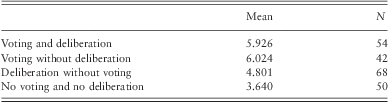
We begin by looking at the raw means of the dependent variable resulting from the different treatments in Table 1. A first glance at the results indicates clear treatment effects. Treatments including voting (1 and 2) result in the highest mean levels (around 5.5 on the 1–7 scale). Deliberation and no voting (3) results in a mean level of 4.4, while no voting and no deliberation (4) scores the lowest, 3.6.
Mean level of perceived legitimacy of the procedure
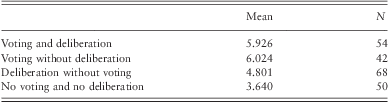
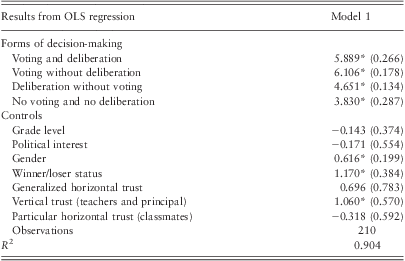
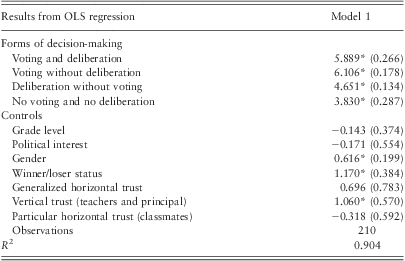
However, more careful statistical tests need to be performed in order to conclude which treatments result in significantly different levels of legitimacy. To compare the predicted levels of legitimacy associated with the four treatments, we estimated a non-intercept ordinary least squares (OLS) regression model including the dummies for the four treatments, a full set of controls to stabilize imbalances, and clustered standard errors at the class level. The predicted levels of legitimacy for the four treatments are illustrated in Figure 2, and the estimates from the full model are presented in Table 2. By comparing the predicted levels of legitimacy associated with the treatments and their respective confidence intervals, we can conclude which treatments significantly differ from each other.
Effects of forms of decision-making on legitimacy. Predicted levels and 95% confidence intervals.
Effects of forms of decision-making on the perceived legitimacy of the procedure
OLS = ordinary least squares.
Note: Unstandardized coefficients, standard errors in parentheses.
*P < 0.05.
As hypothesized, the non-voting procedure without any opportunity for deliberation yields the lowest level of perceived legitimacy. It is evident that in comparison with this procedure, there is a significant positive effect of both treatments (all significant differences reported are two-tailed). Adding deliberation to the non-voting procedure significantly increases the level of perceived legitimacy. This is interesting since it means that deliberation increases perceived legitimacy even though the participants know that they will not have any direct influence on the decision.Footnote 7
Voting also increases perceived legitimacy significantly compared with the non-voting procedure. As a matter of fact, voting stands out as more effective than deliberation. This holds both when voting is combined with deliberation and when it is not. However, the two forms of voting (with and without deliberation) do not differ significantly from each other; applying both deliberation and voting in the same procedure does not produce significantly more legitimacy than a procedure with only voting. It should be noted that the ordering of the mean values of the two forms including voting might seem puzzling (voting without deliberation has a slightly higher mean value than voting with deliberation). However, the difference between these two forms is statistically insignificant and has no substantial implication.
To answer the second question regarding the causal mechanisms that connect voting and deliberation with the perceived legitimacy of the procedure, we set up a structural equation model to illustrate the relationship between the treatments, the mediators, and the dependent variable. Figure 3 presents the direct and indirect effects of the treatments via the respective mediators on the perceived legitimacy of the procedure. We use treatment (4), no voting and no deliberation, as reference category and report the standardized coefficients of the other treatments.Footnote 8
Direct and indirect effects via mediators of forms of decision-making on perceived legitimacy of the procedure. Note: Standardized coefficients, standard errors in parentheses, *P < 0.05. The model includes the following technical controls not presented in the graph. For step 3 in which the perceived legitimacy of procedure is the dependent variable: grade level, political interest, gender, winner/loser status, generalized horizontal trust, vertical trust (teachers and the principal), and particular horizontal trust (classmates). For steps 1 and 2 in which quality of the decision and influence in the process are the dependent variables: winner/loser status.
When comparing the effects of the two mediators on the dependent variable, we find that the perceived influence in the process has a somewhat stronger effect on legitimacy than does the perceived quality of the decision, although the effects of both mediators are significant. Most importantly, however, all three treatments have significant positive effects on influence in the process. The effects of the treatments on the quality of the decision, on the other hand, do not run in the expected direction and are insignificant in two of the three cases.
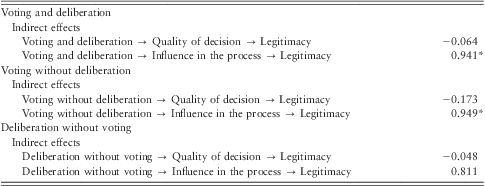
To provide a more conclusive test of the indirect effects of the treatments via the mediators, we perform significance tests for the indirect estimates using the bias-corrected percentile interval bootstrap test (set at the 95% confidence level with 5000 bootstrap sample replications). Table 3 presents the indirect effects via the mediators on the perceived legitimacy of the procedure. The results show that for all treatments we find a significant indirect effect mediated via influence in the process, whereas there is no significant indirect effect mediated via quality of the decision. Moreover, Figure 3 shows that for both of the treatments involving voting, there remains a significant direct effect on the legitimacy of the procedure that is not mediated via the mechanisms.
Indirect effects of treatments on the perceived legitimacy of the procedure
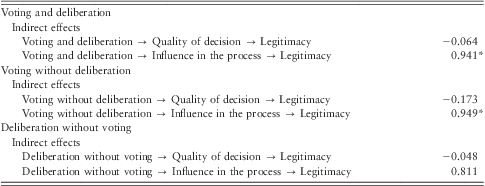
Note: Unstandardized coefficients, *P < 0.05. Significance tests for indirect effects using bootstrap (5000 replications), bias-corrected percentile confidence interval method.
In sum, perceived influence in the decision-making process mediates the effect of both voting and deliberation, regardless of whether they are applied independently or jointly. It is striking that this mechanism mediates not only the effect of direct democratic voting but also the effect of deliberation. In contrast, the causal mechanism focusing on the quality of the decision, which is heavily emphasized in deliberative democratic theory, gained no support in our analyses as a mediator of the effect of voting, and perhaps even more surprisingly nor did it as a mediator of deliberation.
Conclusions
Within our experimental framework, we find that both voting and deliberation generate legitimacy beliefs but that voting clearly is the stronger generator. Moreover, we find no evidence that voting and deliberation interact to generate even higher levels of legitimacy beliefs. Rather, the results indicate that procedures will be perceived as equally fair regardless of whether there is an opportunity to deliberate prior to voting. Overall, our results suggest that previous research claiming that deliberation is a necessary condition to increase legitimacy does not correspond to how citizens perceive decision-making procedures in small groups.
With regard to mediators, our results indicate that perceived influence in the decision-making process functions as the causal mechanism that links both voting and deliberation to legitimacy beliefs. This mechanism, often put forward by participatory democrats, seems to explain not only why direct secret ballot voting is perceived as legitimate, but also why deliberation prior to voting increases legitimacy. The results suggest that direct democratic voting has a special legitimizing appeal among citizens. This finding has also been confirmed in comparative survey research by Bowler et al. (Reference Bowler, Donovan and Karp2007), who show that individuals in a large number of countries are positive toward direct democracy and decision-making in referendums. On the other hand, the causal mechanism focusing on the quality of the decision does not work as a mediator in relation to legitimacy. While it could be seen as remarkable that deliberation does not increase the epistemic quality of the decision, we would like to emphasize that our results should be interpreted with caution and regarded as suggestive; further studies are needed to establish better knowledge on this issue.
Reflecting upon the external validity of the findings, it is clear that our experimental setup differs from real large-scale democracies in several important respects, primarily in that it is a one-shot decision in a small group. Our results therefore do not in any way imply that a political system where there is a lot of voting but where citizens are not allowed to discuss politics would be desirable or legitimate. While we have shown that direct voting has a strong legitimizing effect even without prior deliberation, more research is needed on the role that deliberation can play in different forms of democratic decision-making. Moreover, further studies are needed in order to confirm whether the same pattern applies when dealing with issues with higher stakes and other populations, and when decisions are repeated.
If indeed our results generalize to real world decision-making, what does this study tell us about how democratic decision-making functions? Most importantly, they indicate that the deliberative critique of a voting-centered aggregated model of democracy might be exaggerated, at least from the perspective of psychological legitimacy and citizens’ legitimacy beliefs. Few studies have tested experimentally the conditions under which deliberation actually generates legitimacy beliefs; theorists’ criticism of voting-centered democratic models has been based on scarce empirical evidence. Our contribution to this field suggests that the act of voting is central for citizens’ perceptions of the legitimacy of decision-making procedures. Hence, more focus should be turned to the underestimated importance of voting.
Acknowledgments
Previous versions of this paper were presented at Midwest Political Science Association in Chicago 2010, the conference Participatory and Deliberative Democracy in the United Kingdom in Glasgow 2010, the workshop Building Bridges – Political Science and Psychology in Lund 2009, and the method-network-meeting at the University of Gothenburg 2011. We would like to thank the participants for their valuable comments. We are grateful for helpful comments from Debbie Axlid, Jenny de Fine Licht, Kimmo Grönlund, Michael E. Morrell, Johan Martinsson, Maija Setälä and three anonymous reviewers and the editors of European Political Science Review. Jenny de Fine Licht provided excellent research assistance for this paper. Research for this article was supported by a grant from the Swedish Research Council (SRC-721-2004-3445).