1. Introduction
Albrecher and Hipp [Reference Albrecher and Hipp1] first introduced the so-called loss-carry-forward tax strategy in the classical compound Poisson risk model. In their model, taxation is imposed at a constant proportional rate
 $\gamma\in(0,1) $
whenever the surplus process is in its running supremum (and, hence, in a profitable situation). The authors established a remarkably simple relationship between the ruin probabilities of the surplus processes with and without tax; obtained the solution for the expected accumulated discounted tax payments; and characterized the optimal starting threshold
 $M\in(0,\infty) $
that maximizes the expected accumulated discounted tax payments. Here, we say that M is a starting threshold for taxation, if tax is collected by the tax authority only when the surplus has exceeded M and is in a profitable situation at the same time.
During the past decade, there has been much progress in the study of the loss-carry-forward taxation problem when the underlying surplus processes are spectrally negative Lévy processes, time-homogeneous diffusion processes, and Markov additive processes. In the following, we will summarize the literature on loss-carry-forward taxation, which consists of four components: (i) the Gerber–Shiu function; (ii) the distribution of the accumulated discounted tax payments; (iii) searching for the optimal starting threshold M to maximize the expected accumulated discounted tax payments; and (iv) characterizing the optimal tax strategy to maximize the expected accumulated discounted tax payments.
With respect to (i), the study concerning loss-carry-forward taxation has undergone an impressive metamorphosis. In the earliest work, Albrecher and Hipp [Reference Albrecher and Hipp1] presented a simple relationship (also called the tax identity) between the ruin probabilities under the classical compound Poisson risk models with and without constant tax rate. By linking queueing concepts with risk theory, another simple and insightful proof for the tax identity was provided in [Reference Albrecher, Borst, Boxma and Resing6]. The tax identity was then extended to classical compound Poisson risk processes with constant credit interest rate and surplus-dependent tax rate in [Reference Wei37]; to spectrally negative Lévy risk processes with constant tax rate in [Reference Albrecher, Renaud and Zhou4]; to time-homogeneous diffusion risk processes with surplus-dependent tax rate in [Reference Li, Tang and Zhou23]; and to Markov additive risk processes with surplus-dependent tax rate in [Reference Albrecher, Avram, Constantinescu and Ivanovs5]. The Gerber–Shiu functions were studied in [Reference Wang, Ming and Hu35] under the classical compound Poisson risk model with a constant tax rate; in [Reference Ming, Wang and Xiao27] under the classical compound Poisson risk model with constant tax, credit interest, and debit interest rates; in [Reference Cheung and Landriault15] under the classical compound Poisson risk model with surplus-dependent premium and tax rates; in [Reference Wei, Yang and Wang38] under the Markov-modulated risk model with constant tax rate; and in [Reference Kyprianou and Zhou20] under the Lévy risk model with surplus-dependent tax rate.
We can find the earliest work for (ii) and (iii) in [Reference Albrecher and Hipp1] under the classical compound Poisson risk model with constant tax rate. These results were then generalized in [Reference Wang, Zhang and Wang36] to classical compound Poisson risk processes with constant interest and tax rates; in [Reference Cheung and Landriault15] to the classical compound Poisson risk model with surplus-dependent premium and tax rates; and in [Reference Albrecher, Badescu and Landriault3] to spectrally negative Lévy risk processes with constant tax rate. Results for (ii) can also be found in [Reference Li, Tang and Zhou23] for time-homogeneous diffusion risk processes with surplus-dependent tax rate. In addition, for spectrally negative Lévy risk processes with surplus-dependent tax rate, Kyprianou and Zhou [Reference Kyprianou and Zhou20] obtained a solution to problem (ii), while Renaud [Reference Renaud30] obtained arbitrary moments of the accumulated discounted tax payments.
For the dual model of the classical compound Poisson risk process, Albrecher et al. [Reference Albrecher, Renaud and Zhou4] solved tax problems (i)–(iii) under the assumption of exponential jump sizes. Periodic tax has also been taken into consideration in the case of spectrally negative Lévy risk processes. In [Reference Hao and Tang18], asymptotic formulae for the ruin probability with periodic tax is discussed under suitable assumptions imposed on the Lévy measure. While in [Reference Zhang, Cheung and Yang39] periodic tax was investigated and solutions for (i)–(iii) were given. In addition, capital injection has been included in risk processes with loss-carry-forward tax in [Reference Albrecher and Ivanovs2], where some power identities were obtained. For works concerning the two-sided exit problem for risk models with loss-carry-forward tax, the reader is referred to [Reference Albrecher, Badescu and Landriault3], [Reference Albrecher, Avram, Constantinescu and Ivanovs5], [Reference Albrecher, Borst, Boxma, Resing, Glynn, Mikosch and Rolski7], [Reference Cheung and Landriault15], [Reference Kyprianou and Zhou20], [Reference Li, Tang and Zhou23], and [Reference Wang and Ming33].
It is known that in the seminal paper [Reference De Finetti16], a critical surplus threshold for starting dividend payments was determined to maximize the expected accumulated discounted dividends, and it aroused great research interests in optimizing the dividend payment strategy. Likewise, the studies on (iii) aroused research interests in optimizing the loss-carry-forward tax strategy, which lies in the scope of (iv). Recently, under spectrally negative Lévy risk processes, Wang and Hu [Reference Wang and Hu32] characterized the optimal tax strategy which maximizes the expected accumulated discounted tax payments until ruin, via the standard approach of stochastic control theory. The optimal tax return function was also obtained in [Reference Wang and Hu32].
Recently, Avram et al. [Reference Avram, Vu and Zhou12] considered the variants of (i)–(iii) through replacing the ruin time by the draw-down time with a linear draw-down function in spectrally negative Lévy risk processes with constant tax rate. The subsequent work of Li et al. [Reference Li, Vu and Zhou24] proved several results involving the general draw-down time from the running maximum for the spectrally negative Lévy process. Quite recently, Wang and Zhou [Reference Wang and Zhou34] considered a general version of de Finetti’s optimal dividend problem in which the ruin time is replaced by the general draw-down time for spectrally negative Lévy risk processes. The authors identified a condition under which the barrier dividend strategy turned out to be optimal among all admissible dividend strategies. For more results on the general draw-down time, we refer the reader to [Reference Pistorius and Donati-Martin29].
Motivated by [Reference Avram, Vu and Zhou12], [Reference Kyprianou and Zhou20], [Reference Li, Vu and Zhou24], [Reference Wang and Hu32], and [Reference Wang and Zhou34], the present paper is also concerned with the problem of optimizing the payment of loss-carry-forward tax in the Lévy setup, under the optimization criterion of maximizing the expected accumulated discounted tax payments until the general draw-down time from the running maximum. The main goal of this paper is to extend the classical ruin-based tax optimization solution to the general draw-down-based tax optimization solution, with the latter involving a trade-off between taxation optimization and solvency. Specifically, we shall search for the optimal tax return function and the optimal tax strategy which maximizes the expected accumulated discounted tax payments until the general draw-down time. We mention that this extension makes our optimization problem interesting and practical in the following senses.
(a) Roughly speaking, the general draw down (see (1) for its definition; see the paragraph immediately below (1) for its origin) refers to the first time when a drop in value (say, of a stock price or value of a portfolio) from a historical peak exceeds a certain surplus-related level. Hence, draw down is fundamentally useful from the perspective of risk management as it can be applied in measuring and managing extreme risks. In fact, applications of draw down can be found in many areas. Draw down is frequently used by mutual fund managers and commodity trading advisors as an alternative measurement for volatility, especially when the downward risks of asset returns are of primary interest (see [Reference Schuhmacher and Eling31]). There are also close ties between draw down and problems in mathematical finance, insurance, and statistics. To name a few, the draw down can be useful in pricing and managing of Russian options or insurance options against a drop in the value of a stock (see, e.g. [Reference Asmussen, Avram and Pistorius8], [Reference Avram, Kyprianou and Pistorius9], and [Reference Meilijson and Azéma26]); the equivalence between the joint distributions of ruin-related quantities under the barrier dividend strategy and draw-down-related quantities under a dividend-free risk model can be found in [Reference Avram, Palmowski and Pistorius10] and [Reference Loeffen25]; draw down turned out to be the optimal solution in the cumulative sum statistical procedure in [Reference Page28]. General draw-down times also find interesting applications of defining Azéma–Yor martingales to solve the Skorokhod embedding problem (see, e.g. [Reference Azéma and Yor13] and [Reference Pistorius and Donati-Martin29]). For a more detailed review of applications of draw down, the interested reader is referred to [Reference Landriault, Li and Zhang21] and [Reference Li22].
(b) By extending the classical ruin to the general draw down, we can easily adjust the draw-down function so that the surplus levels remain positive at the terminal draw-down time with positive probability. It thus provides an interesting alternative to the optimal taxation problem that achieves a balance between taxation optimization and solvency (see [Reference Wang and Zhou34]).
For more detail, let us look at definition (1) endowed with positive-valued
 $\xi$
; whenever the surplus process hits a new record high x, the surplus process is allowed to deviate down from x with deviation magnitude no more than
$x-\xi(x)\in(0,x) $
; otherwise, general draw down occurs. In contrast, classical ruin occurs when the surplus process deviates down with deviation magnitude no less than x, a deviation magnitude large enough to lead to general draw down. Intuitively speaking, if adopted by the insurance company as a risk assessment tool, general draw down only allows for a ‘moderate’ downward deviation magnitude of the surplus process, while the classical ruin allows for a ‘large’ downward deviation magnitude of the surplus process. Hence, compared with classical ruin, general draw down turns out to be the more favorable risk assessment tool from the practical view point of ‘protecting’ the insurance company.
More importantly, when
$\xi$
is chosen to be positive valued, there is a positive probability that the surplus remains positive at the general draw-down time. Take the Lévy risk processes with nontrivial Gaussian part for example; there should be positive probability that the surplus hits the general draw-down level
$\xi(y)\in(0,y) $
at the general draw-down time, where
$y\in(0,\infty) $
denotes the running maximum until the general draw-down time.If
$\xi$
is additionally assumed such that
$\xi$
and
$x-\xi(x) $
are both increasing, as its running supremum grows larger, the surplus process is allowed to deviate down further away from the running supremum, meanwhile the surplus remains at a higher level at the general draw-down time, leaving the insurance company more flexible disposal choices of risks. This seems to be very close to reality.If
$\xi$
is chosen to be negative valued, whenever the surplus process hits a new record high x, the company is allowed to continue running its businesses until its surplus process drops below 0 with a deficit bigger than
$|\xi(x)|$
. In the latter case, the company stops running its businesses and we say ‘absolute ruin’ occurs. We refer the reader to, for example, [Reference Avram, Pérez and Yamazaki11] for the definition of ‘absolute ruin’ for spectrally negative Lévy risk processes.In addition, it is interesting to see that draw down provides much more surplus-level-related information compared to classical ruin. It is also interesting to see that, when our model and tax structure are specified to those in the existing literature, our results coincide with those existing results (see Remark 2).
(c) This extension makes our optimization problem much more difficult and complicated. First, new solutions of the general draw-down-based two-sided exit problem and the expected discounted accumulated tax payments (in Section 3) should be obtained in advance so as to push forward the Hamilton–Jacobi–Bellman (HJB) equation and the verification proposition in Section 4. Second, because the general draw-down function introduces new complexity into the HJB equation, characterizing its solutions becomes more challenging, and, hence, greater endeavors are devoted to guessing and verifying its candidate solutions, which is very critical in addressing optimal control problems, since solutions to the HJB equation usually correspond to the optimal tax return function and the optimal tax strategy.


We also mention that the standard line of stochastic control theory was adopted when addressing our general draw-down-based loss-carry-forward tax optimization problem, just as in the dividend optimization literature (see, e.g. [Reference Avram, Palmowski and Pistorius10], [Reference Loeffen25], and [Reference Wang and Zhou34]). However, the present paper is different from those in the dividend optimization literature in implementing each step along the standard line of stochastic control theory. For example, we use an alternative martingale approach instead of the Itô’s formula in Proposition 4.
This paper is structured as follows. In Section 2, we give the mathematical presentation of the problem and a quick review of some preliminaries of the spectrally negative Lévy process. The solution of the two-sided exit problem and the return function for a given tax strategy are given in Section 3. It is then argued in Section 4 that, if the optimal tax return function is once continuously differentiable, then it satisfies an HJB equation. Conversely, it is proven that a solution to the HJB equation coincides with the optimal tax return function. In Section 5, the solution to the HJB equation is constructed and the optimal strategy is also found, provided that Assumption 1 (in Section 5) holds. In Section 6, for some spectrally negative Lévy processes, we construct some appropriate classes of draw-down functions which satisfy Assumption 1. Finally, some numerical results are given in Section 7.
2. Problem formulation
To give a mathematical formulation of the optimization problem, we start from a one-dimensional Lévy process
 $X=\{X(t);\ t\geq0\}$
defined on
 $ (\Omega, \mathcal{F}, \mathbb{F}=\{\mathcal{F}_t,\, t\geq 0\},
\mathbb{P}) $
, a filtered probability space satisfying the usual conditions. Throughout this paper, we assume that X is a spectrally negative Lévy process with the usual exclusion of pure increasing linear drift and the negative of a subordinator. We denote by
 $\mathbb{P}_x$
the law of X with
 $X_0=x\geq0$
, and let
 $\mathbb{E}_x$
denote the corresponding expectation operator. Let
 $\{\bar{X}(t);\ t\geq0\}$
be the running supremum process of X, where
 $\bar{X}(t) : =\sup_{0\leq s\leq t}X(s) $
for
 $t\geq0$
. We assume that in the case of no control, the surplus process for a company evolves as
 $\{X(t);\ t\geq0\}$
.
A loss-carry-forward tax strategy is described by a one-dimensional stochastic process
 $\{\gamma(\bar{X}(t)),\,t\geq0\}$
, where
 $\gamma\colon [0,\infty)\rightarrow[\gamma_{1},\gamma_{2}]$
is a measurable function with
 $0\leq\gamma_{1}\leq\gamma_{2}\lt 1$
. Since there is a one-to-one correspondence between the function
 $\gamma$
and the tax strategy
 $\{\gamma(\bar{X}(t)),\,t\geq0\}$
, we will also denote the corresponding loss-carry-forward tax strategy by
 $\gamma$
for short. For the case of an insurance company,
 $\gamma(\bar{X}(t)) $
denotes the fraction of the insurer’s income that is paid out as tax at time t if it is in a profitable situation. Here we say that the company is in a profitable situation at time t if we have
 $X(t)=\bar{X}(t) $
. Thus, when applying strategy
 $\gamma$
, the cumulative tax until time t is
 $$
\int_{0}^{t}\gamma(\bar{X}(s)){{\rm d}}\,\bar{X}(s),
$$
and the controlled surplus process is given by
 $$
U^{\gamma}(t)=X(t)-\int_{0}^{t}\gamma(\bar{X}(s))
{{\rm d}}\,\bar{X}(s).
$$
The strategy
 $\gamma$
is said to be admissible if the process
 $\{\gamma(\bar{X}(t));\ t\geq0\}$
is adapted to the filtration
 $\{\mathcal{F}_{t};\ t\geq0\}$
and
 $\gamma(\bar{X}(t))\in[\gamma_{1},\gamma_{2}]$
. By
 $\Gamma$
we denote the set of all measurable functions
 $\gamma\colon
[0,\infty)\rightarrow[\gamma_{1},\gamma_{2}]$
, i.e.
 $\Gamma$
consists of all admissible tax strategies in the sense of equating a tax strategy with its corresponding function
 $\gamma$
. For a given admissible strategy
 $\gamma\in\Gamma$
, we define the tax return function
 $f_{\gamma}$
by
 \begin{equation}
f_{\gamma}(x)
=\mathbb{E}_{x}\bigg(\int_{0}^{\tau_{\xi}^{\gamma}}\mathrm{e}^{-qt}
\gamma(\bar{X}(t)){{\rm d}}\ \bar{X}(t)\bigg), \qquad x\in[0,\infty),
\end{equation}
where
 $q>0$
is a discount factor, and
 \begin{equation}
\tau^{\gamma}_{\xi}=\mbox{inf}\{t\geq0;\ U^{\gamma}(t)\lt
\xi(\bar{U}^{\gamma}(t))\}
\label{eqn1}
\end{equation}
with
 $\bar{U}^{\gamma}(t)\,\, :\!=\sup_{0\leq s\leq t}U^{\gamma}(s) $
, is the general draw-down time associated with the general draw-down function
 $\xi$
for the process
 $U^{\gamma}$
. The function
 $\xi\colon
[0,\infty)\rightarrow(\!-\infty,+\infty) $
is called a general draw-down function if it is a continuously differentiable function satisfying
 $\bar{\xi}(y)=y-\xi(y)>0$
for all
 $y\in[0,\infty) $
.
It is interesting to see why the time defined by (Section 1) is called the general draw-down time. In the literature, the reflected process of a Markov process Y at its supremum, defined as
 $\smash{\sup_{s\in[0,t]}}Y(s)-Y(t) $
, is called the draw-down process of Y (see, for example, [Reference Landriault, Li and Zhang21]). Hence, it is natural to name the first time when the magnitude of the draw-down process exceeds a given threshold
 $a>0$
, i.e.
 $$\ell _\alpha ^ + : = \inf \left\{ {t \ge 0;\mathop {\sup }\limits_{s \in [0,t]} \,Y(s) - Y(t) \gt \alpha } \right\} = \inf \left\{ {t \ge 0;Y(t) \lt \mathop {\sup }\limits_{s \in [0,t]} Y(s) - \alpha } \right\},$$
as the draw-down time. By comparing the definitions of
 $\smash{\ell_{a}^{+}}$
and
 $\smash{\tau^{\gamma}_{\xi}}$
, we may observe that
 $\smash{\ell_{a}^{+}}$
is a special case of the general draw-down time for the process Y, in that its general draw-down function is specialized to
 $\xi_{a}(x)=x-a$
. This explains the origin of the name general draw-down time. In addition, we find that the classical ruin time is recovered if we choose
 $\xi\equiv0$
in (1), while draw down provides greater reserve-level-related information compared to ruin. In this sense, draw down shall be an efficient tool of characterizing extreme risks from the point of view of risk management.
The optimal tax return function is defined by
 \begin{equation}
f(x)=\sup_{\gamma\in\Gamma}f_{\gamma}(x)=
\sup\limits_{\gamma\in\Gamma}\mathbb{E}_{x}\bigg(
\int_{0}^{\tau^{\gamma}_{\xi}}\mathrm{e}^{-qt}\gamma (\bar{X}(t))
{{\rm d}}\ \bar{X}(t)\bigg), \qquad x\in[0,\infty).
\label{eqn2}
\end{equation}
The objectives of this paper are to find the optimal tax return function and the optimal tax strategy
 $\gamma^{\ast}$
that satisfies
 $f(x)=f_{\gamma^{\ast}}(x) $
for all
 $x\in[0,\infty) $
.
Now we present some useful concepts associated with X. The Laplace exponent of X is defined by
 \begin{equation}
\psi(\theta)=\mbox{log}\mathbb{E}_{x}(\mathrm{e}^{\theta (X(1)-x)}),
\end{equation}
which is known to be finite for at least
 $\theta\in[0,\infty) $
in which case it is strictly convex and infinitely differentiable. As in [Reference Bertoin14], the q-scale functions
 $\{\smash{W^{(q)}};\ q\geq0\}$
of X are defined as follows. For each
 $q\geq0$
,
 $\smash{W^{(q)}}\colon
[0,\infty)\rightarrow[0,\infty) $
is the unique strictly increasing and continuous function with Laplace transform
 \begin{equation}
\int_{0}^{\infty}\mathrm{e}^{-\theta x}W^{(q)}(x){{\rm d}}x
=\frac{1}{\psi(\theta)-q},\qquad\theta>\Phi(q),
\end{equation}
where
 $\Phi(q) $
is the right inverse of
 $\psi$
, i.e. the largest root of the equation (in
 $\theta$
)
 $\psi(\theta)=q$
. For simplicity, we write W(x) for
 $\smash{W^{(0)}(x)}$
. In addition, it follows from [Reference Zhou40] that
 \begin{equation}
\lim_{x\rightarrow\infty}\frac{W^{(q)\prime}(x)}{W^{(q)}(x)}= \Phi(q)\lt 0
\quad\mbox{for }q \gt 0.
\label{eqn3}
\end{equation}
For any
 $x\in\mathbb{R}$
and
 $\vartheta\geq0$
, there exists a well-known exponential change of measure that one may perform for spectrally negative Lévy processes:
 \begin{equation}
\frac{\mathbb{P}_{x}^{\vartheta}}{\mathbb{P}_{x}}\bigg|_{\mathcal{F}_{t}}
=\mathrm{e}^{\vartheta(X(t)-x)-\psi(\vartheta)t}.
\label{eqn4}
\end{equation}
Furthermore, under the probability measures
 $\smash{\mathbb{P}_{x}^{\vartheta}}$
, X remains within the class of spectrally negative Lévy processes. Here and after, we shall refer to the functions
 $\smash{W_{\vartheta}^{(q)}}$
and
 $W_{\vartheta}$
as the functions that play the role of the q-scale functions and 0-scale function considered under the measure
 $\smash{\mathbb{P}_{x}^{\vartheta}}$
.
We also briefly recall concepts in excursion theory for the reflected Lévy process
 $\{\bar{X}(t)-X(t);\ t\geq0\}$
, and we refer the reader to [Reference Bertoin14] for more details. For
 $x\in[0,\infty) $
, the process
 $\{L(t)\ :\!= \bar{X}(t)-x,\, t\geq0\}$
serves as a local time at 0 for the Markov process
 $\{\bar{X}(t)-X(t);\ t\geq0\}$
under
 $\mathbb{P}_{x}$
. Let the corresponding inverse local time be defined as
 $$L^{ - 1} (t): = \inf \{ s \ge 0|L(s) \gt t\} = \sup \{ s \ge 0|L(s) \le t\}.$$
Furthermore,
 $L^{-1}(t-)=\lim_{s\uparrow t}L^{-1}(s) $
. The Poisson point process of excursions indexed by this local time is denoted by
 $\{(t,
\varepsilon_{t});\ t\geq0\}$
,
 $$\varepsilon _t (s): = X(L^{ - 1} (t)) - X(L^{ - 1} (t - ) + s),s \in (0,L^{ - 1} (t) - L^{ - 1} (t - 1)],$$
whenever
 $L^{-1}(t)-L^{-1}(t-)>0$
. For the case when
 $L^{-1}(t)-L^{-1}(t-)=0 $
, define
 $\varepsilon_{t}=\Upsilon$
with
 $\Upsilon$
being an additional isolated point. Accordingly, we denote a generic excursion as
 $\varepsilon(\cdot) $
(or
 $\varepsilon$
for short) belonging to the space
 $\mathcal{E}$
of canonical excursions. The intensity measure of the process
 $\{(t, \varepsilon_{t});\ t\geq0\}$
is given by
 $\mathrm{d}t\times \mathrm{d}n,$
where n is a measure on the space of excursions. In particular,
 $\bar{\varepsilon}=\sup_{s\geq0}
\varepsilon(s) $
serves as an example of the n-measurable functional of the canonical excursion. Recalling the definition of
 $L^{-1}(t) $
, we can verify that
 \begin{equation}
L^{-1}(t-)=\lim_{u\uparrow t}L^{-1}(u)=\inf\{s\geq0\mid L(s)\geq t\}
=\sup\{s\geq0\mid L(s){\lt}t\}
\end{equation}
and
 \begin{equation}
s{\lt}L^{-1}(t-)\quad\Longleftrightarrow\quad L(s){\lt}t.
\label{eqn5}
\end{equation}
Throughout this paper, to avoid the trivial case that X drifts to
 $-\infty$
(draw down is certain), we assume that
 $\psi^{\prime}(0+)\geq0$
. It is also assumed that each scale function has continuous derivative of second order.
3. Two-sided exit problem and expected accumulated discounted tax
In this section, solutions of the two-sided exit problem and expected accumulated discounted tax payments are given, in preparation for motivating the HJB equation (see Proposition 3) and the verification proposition (see Proposition 4) in Section 4. The solutions are explicitly expressed by the scale functions associated with the driving spectrally negative Lévy process.
Define the first up-crossing time of level b as
 \begin{equation}
\tau^{+}_{b}=\inf\{t\geq0;\,U^{\gamma}(t)>b\},
\label{eqn6}
\end{equation}
with the convention that
 $\inf\emptyset=\infty$
. For
 $\gamma\in\Gamma$
, define
 \begin{equation}
\bar{\gamma}_{x}(z)\ :\!=x+\int_{x}^{z}(1-\gamma(y)){{\rm d}}y, \qquad
z\in[x,\infty).
\end{equation}
By Lemma 2.1 of [Reference Kyprianou and Zhou20], we know that the random times
 $\{t\geq0:\ U^{\gamma}(t) = \bar{U}^{\gamma}(t)\}$
agree precisely with
 $\{t\geq0\colon X(t) = \bar{X}(t)\}$
. Hence, we have
 $\smash{X(\tau^{+}_{x+h})=\bar{X}(\tau^{+}_{x+h})}$
, which together with the definitions of
 $\bar{\gamma}_{x}(z) $
and
 $U^{\gamma}$
yields, for
 $h\geq0$
,
 \begin{equation}
x+h=U^{\gamma}(\tau^{+}_{x+h})= \bar{X}(\tau^{+}_{x+h})-
\int_{0}^{\tau^{+}_{x+h}}\gamma(\bar{X}(s)) {{\rm d}}\ \bar{X}(s)
=\bar{\gamma}_{x}(\bar{X} (\tau^{+}_{x+h})), \qquad
x\in[0,\infty).
\label{eqn7}
\end{equation}
Furthermore, using the fact that
 $\bar{\gamma}_{x}$
is strictly increasing and continuous, we obtain
 \begin{equation}
\bar{X}(\tau^{+}_{x+h})=\bar{\gamma}_{x}^{-1}(x+h), \qquad
x\in[0,\infty),
\end{equation}
where
 $\smash{\bar{\gamma}_{x}^{-1}}$
denotes the well-defined inverse function of
 $\bar{\gamma}_{x}$
.
The following result gives the solution to the two-sided exit problem in terms of scale functions via an excursion argument. The excursion theory has also been used in some recent works; see [Reference Avram, Vu and Zhou12], [Reference Kyprianou and Zhou20], and [Reference Li, Vu and Zhou24].
Proposition 1. For
 $a\in(0,\infty) $
, tax strategy
 $\gamma,$
and draw-down function
 $\xi,$
we have
 \begin{equation}
\mathbb{E}_{x}(\mathrm{e}^{-q \tau_{a}^{+}}\mathbf{1}_{\{\tau_{a}^{+}
\lt \tau^{\gamma}_{\xi}\}})
=\exp\bigg(\!-\int_{x}^{a}\frac{W^{(q)\prime}(\bar{\xi}(y))}
{W^{(q)}(\bar{\xi}(y))}\frac{1}{1-\gamma
(\bar{\gamma}_{x}^{-1}(y))} {{\rm d}}y\bigg), \qquad x\in[0,a],
\label{eqn8}
\end{equation}
with
 $\bar{\xi}(y)\ :\!=y-\xi(y) $
.
Proof. On
 $\{\tau_{a}^{+}\lt \tau^{\gamma}_{\xi}\}$
, we have
 \begin{equation}
U^{\gamma}(t)\geq \xi(\bar{U}^{\gamma}(t))= \xi\Big(\sup_{0\leq
s\leq t}U^{\gamma}(s)\Big)\quad\text{for all } t\in[0,\tau_{a}^{+}].
\end{equation}
Hence, we can rewrite the set
 $\smash{\{\tau_{a}^{+}\lt \tau^{\gamma}_{\xi}\}}$
as
 \begin{equation}
\{\tau_{a}^{+}\lt \tau^{\gamma}_{\xi}\}=\{\bar{\varepsilon}_{t}\leq
\bar{\xi}(\bar{\gamma}_{x}(x+t)) \text{ for all }
t\in[0,\bar{\gamma}_{x}^{-1}(a)-x]\}.
\label{eqn9}
\end{equation}
Here we have used the fact that, for any
 $ s\in[0,L^{-1}(t)-L^{-1}(t-)]$
,
 \begin{align*}
U^{\gamma}(L^{-1}(t-)+s)&=
X(L^{-1}(t-)+s)-\int_{0}^{L^{-1}(t-)+s}\gamma(\bar{X}(u)
){{\rm d}}\ \bar{X}(u)
\\
& = X(L^{-1}(t-)+s)-\int_{0}^{L^{-1}(t-)}\gamma(\bar{X}(u)
){{\rm d}}\ \bar{X}(u) ,
\end{align*}
which implies that
 $U^{\gamma}(L^{-1}(t-)+s)\geq \xi(\sup_{u\leq
L^{-1}(t-)+s}U^{\gamma}(u))=\xi(U^{\gamma}(L^{-1}(t))) $
and is equivalent to
 \begin{align*}\\[-24pt]
\varepsilon_{t}(s)&= X(L^{-1}(t))-X(L^{-1}(t-)+s)
\\
&=U^{\gamma}(L^{-1}(t))-U^{\gamma}(L^{-1}(t-)+s)
\\
&\leq U^{\gamma}(L^{-1}(t))-\xi(U^{\gamma}(L^{-1}(t)))
\\
&=\bar{\xi}(\bar{\gamma}_{x}(x+t)), \qquad
s\in[0,L^{-1}(t)-L^{-1}(t-)].
\end{align*}
By (9) we have
 \begin{align}
\mathbb{P}_{x}(\{\tau_{a}^{+}\lt \tau^{\gamma}_{\xi}\}) &=
\mathbb{P}_{x}(\{\bar{\varepsilon}_{t}\leq
\bar{\xi}(\bar{\gamma}_{x}(x+t)), \text{ for all }
t\in[0,\bar{\gamma}_{x}^{-1}(a)-x]\})\nonumber
\\
&= \exp\bigg(\!-\int_{0}^{\bar{\gamma}_{x}^{-1}(a)-x}
n(\bar{\varepsilon}>\bar{\xi}(\bar{\gamma}_{x}(x+t)
)){{\rm d}}t\bigg) \nonumber
\\
&= \exp\bigg(\!-\int_{x}^{a}\frac{W^{\prime}(\bar{\xi}(y))}
{W(\bar{\xi}(y))} \frac{1}{1-\gamma(\bar{\gamma}_{x}^{-1}(y))}
{{\rm d}}y\bigg),
\label{eqn10}\end{align}
where in the last equality we have changed variables via
 $y=\bar{\gamma}_{x}(x+t) $
and used
 $n(\bar{\varepsilon}>x)={W^{\prime}(x)}/{W(x)},$
providing that x is not a point of discontinuity in the derivative of W (see [Reference Kyprianou19]).
By (4) we have
 \begin{align}
\mathbb{P}_{x}^{\Phi(q)}(\tau_{a}^{+}\lt \tau^{\gamma}_{\xi}) &=
\mathbb{E}_{x}(\mathrm{e}^{\Phi(q)(X(\tau_{a}^{+})-x)-q\tau_{a}^{+}}
\mathbf{1}_{\{\tau_{a}^{+}\lt \tau^{\gamma}_{\xi}\}}) \nonumber
\\
&= \mathrm{e}^{\Phi(q)(\bar{\gamma}_{x}^{-1}(a)-x)}
\mathbb{E}_{x}(\mathrm{e}^{-q\tau_{a}^{+}}\mathbf{1}_{\{\tau_{a}^{+}
\lt \tau^{\gamma}_{\xi}\}}),
\label{eqn11}\end{align}
while, on the other hand, we also have
 \begin{align}
\mathbb{P}_{x}^{\Phi(q)}(\tau_{a}^{+}\lt \tau^{\gamma}_{\xi}) & =
\exp\bigg(\!-\int_{x}^{a}\frac{W_{\Phi(q)}^{\prime}(\bar{\xi} (y))}
{W_{\Phi(q)}(\bar{\xi}(y))}
\frac{1}{1-\gamma(\bar{\gamma}_{x}^{-1}(y))} {{\rm d}}y\bigg) \nonumber
\\
&= \exp\bigg(\!-\int_{x}^{a}\frac{W^{(q)\prime}(\bar{\xi}(y))}
{W^{(q)}(\bar{\xi}(y))}
\frac{1}{1-\gamma(\bar{\gamma}_{x}^{-1}(y))}{{\rm d}}y
+\Phi(q)(\bar{\gamma}_{x}^{-1}(a)-x)\bigg),
\label{eqn12}\end{align}
where a similar argument leading to (10) and
 $W_{\Phi(q)}(x)=\smash{\mathrm{e}^{-\Phi(q)x}W^{(q)}(x)}$
are used. Combining (11) and (12), we arrive at the desired result (8).
The following result solves the expected accumulated discounted tax payments (tax return function) for a given tax strategy
 $\gamma$
.
Proposition 2. For
 $a\in(0,\infty) $
, tax strategy
 $\gamma,$
and draw-down function
 $\xi,$
we have
 \begin{align}
&\mathbb{E}_{x}\bigg(\int_{0}^{\tau_{a}^{+} \wedge
\tau^{\gamma}_{\xi}}\mathrm{e}^{-q t}\gamma(\bar{X}(t)){{\rm d}}
(\bar{X}(t)-x)\bigg) \nonumber
\\
&\qquad= \int_{x}^{\bar{\gamma}_{x}^{-1}(a)} \exp\bigg(\!-\int_{x}^{y}
\frac{W^{(q)\prime}(\bar{\xi}(\bar{\gamma}_{x}(s)
))}{W^{(q)}(\bar{\xi}(\bar{\gamma}_{x}(s) ))}{{\rm d}}s\bigg)
\gamma(y){{\rm d}}y, \qquad x\in[0,a].
\label{eqn13}\end{align}
Proof. See Appendix B.
Remark 1
Letting
 $a\rightarrow \infty$
in (13) we obtain the solution of the expected total discounted tax payments paid until the general draw-down time
 \begin{align}
&\mathbb{E}_{x}\bigg(\int_{0}^{\tau^{\gamma}_{\xi}}\mathrm{e}^{-q
t}\gamma(\bar{X}(t)){{\rm d}}(\bar{X}(t) -x)\bigg)\nonumber
\\
&\qquad= \int_{x}^{\infty} \exp\bigg(\!-\int_{x}^{y}
\frac{W^{(q)\prime}(\bar{\xi}(\bar{\gamma}_{x}(s)))}
{W^{(q)}(\bar{\xi} (\bar{\gamma}_{x}(s) ))}{{\rm d}}s\bigg)
\gamma(y){{\rm d}}y,\qquad x\geq0.
\end{align}
Note that, since
 ${W^{(q)\prime}(x)}/{W^{(q)}(x)}\geq \Phi(q)>0$
(see (29)), we can obtain an upper bound for
 $f_{\gamma}(x) $
as which yields
 \begin{equation}
f(x)=\sup_{\gamma\in\Gamma}f_{\gamma}(x)\leq\frac{\gamma_{2}}{\Phi(q)},
\qquad x\in[0,\infty).
\end{equation}
4. HJB equation and verification arguments
In this section, the HJB equation and the verification proposition are presented. It turns out that the optimal tax return function (i.e. the expected accumulated discounted tax payments corresponding to the optimal tax strategy) satisfies the HJB equation. Since a solution to the HJB equation is not necessarily the optimal tax return function, then a verification proposition is in need to guarantee that the solution to the HJB equation is indeed the optimal tax return function.
The following result gives the HJB equation satisfied by the optimal tax return function defined by (2).
Proposition 3. Assume that f(x) defined by (2) is once continuously differentiable over
 $[0,\infty) $
. Then f(x) satisfies the following HJB equation
 \begin{equation}
\sup_{\gamma\in[\gamma_{1},\gamma_{2}]}\bigg(\frac{\gamma}{1-\gamma}-
\frac{1}{1-\gamma} \frac{W^{(q)\prime}(\bar{\xi} (x))}{W^{(q)}
(\bar{\xi}(x))}\ f(x) +f^{\prime}(x)\bigg)=0, \qquad x\in[0,\infty).
\label{eqn14}
\end{equation}
Proof. See Appendix C.
In the following result, we argue that a solution to the HJB equation (14) serves as the optimal tax return function f(x) defined in (2).
Proposition 4. (Verification proposition.) Assume that f(x) is a once continuously differentiable solution to (14), and let
 $\gamma^{*}$
be the function that maximizes the left-hand side of (14), i.e.
 \begin{equation}
\gamma^{*}(z)=\mathop{\arg\max}_{\gamma\in[\gamma_{1},\gamma_{2}]}\bigg[
\frac{\gamma}{1-\gamma}-\frac{1}{1-\gamma} \frac{W^{(q)\prime}
(\bar{\xi}(\bar{\gamma}_{x}(z)))}
{W^{(q)}(\bar{\xi}(\bar{\gamma}_{x}(z)))}\ f(\bar{\gamma}_{x}(z))+f'(\bar{\gamma}_{x}(z))\bigg]
\label{eqn15}
\end{equation}
for
 $z\in [x,\infty) $
. Then
 $\gamma^{*}$
serves as an optimal tax strategy.
Proof. Since
 $\gamma(z)\in[\gamma_{1},\gamma_{2}]$
for all
 $z\in[x,\infty) $
and
 $\gamma\in\Gamma$
, it can be checked from (14) that, for any
 $\gamma\in\Gamma$
,
 \begin{equation}
\gamma(z)\leq -\bigg((1-\gamma(z))\ f'(\bar{\gamma}_{x}(z))
-\frac{W^{(q)\prime}(\bar{\xi}(\bar{\gamma}_{x}(z) ))}
{W^{(q)}(\bar{\xi} (\bar{\gamma}_{x}(z)))}\ f(\bar{\gamma}_{x}(z))\bigg),\qquad z\in [x,\infty),
\end{equation}
and the equality holds when
 $\gamma\equiv\gamma^{*}$
. Replacing z by
 $\bar{X}(t) $
in the above inequality we should have, for all
 $s\geq0,$
 \begin{equation}
\gamma(\bar{X}(s))\leq
\frac{W^{(q)\prime}(\bar{\xi}(\bar{\gamma}_{x}
(\bar{X}(s))))} {W^{(q)}(\bar{\xi}(\bar{\gamma}_{x}
(\bar{X}(s))))}\ f (\bar{\gamma}_{x}(\bar{X}(s)))
-(1-\gamma(\bar{X}(s)))\ f'(\bar{\gamma}_{x}(\bar{X}(s))) ,
\label{eqn16}
\end{equation}
and the equality holds when
 $\gamma\equiv\gamma^{*}$
.
Define
 $\{\eta(s);\ s\geq0\}$
as
 \begin{align}
\eta(s)&= \lim_{h\downarrow0}\frac{1}{h}\,\mathbb{E}_{x}\Big(\Big(
\mathrm{e}^{-q\tau_{\bar{\gamma}_{x}(\bar{X}(s))
+(1-\gamma(\bar{X}(s)))h}^{+}}\mathbf{1}_{\{
\tau_{\bar{\gamma}_{x}(\bar{X}(s))+(1-
\gamma(\bar{X}(s)))h}^{+}\lt \tau^{\gamma}_{\xi}\}}\ f(\bar{\gamma}_{x}(\bar{X}(s))\nonumber
\\
& +(1\!-\!\gamma(\bar{X}(s)))h)
-\!\mathrm{e}^{-q\tau_{_{\bar{\gamma}_{x} (\bar{X}(s))}}^{+}}
\mathbf{1}_{\{\tau_{_{\bar{\gamma}_{x}(\bar{X}(s) )}}^{+}
\lt \tau^{\gamma}_{\xi}\}}\ f(\bar{\gamma}_{x}(\bar{X}(s)))
\!\Big)\Bigm|\mathcal{F}_{\tau^{+}_{\bar{\gamma}_{x}
(\bar{X}(s))}}\Big).
\label{eqn17}\end{align}
Then, by mimicking the arguments in the proof of the martingale property of the process (4.3) in [Reference Gerber and Shiu17] or the process (3.5) in [Reference Wang and Hu32], we can verify that the compensated process
 \begin{equation}
Z(t)=\mathrm{e}^{-q\tau_{_{\bar{\gamma}_{x}(\bar{X}(t) )}}^{+}}
\mathbf{1}_{\{\tau_{_{\bar{\gamma}_{x}(\bar{X}(t) )}}^{+}
\lt \tau^{\gamma}_{\xi}\}} f(\bar{\gamma}_{x}(\bar{X}(t)))
-\int_{0}^{\tau_{_{\bar{\gamma}_{x}(\bar{X}(t)
)}}^{+}}\eta(s){{\rm d}}\ \bar{X}(s),\qquad t\geq0,
\end{equation}
is a martingale with respect to the filtration
 $\smash{\{\mathcal{F}_{\tau_{\bar{\gamma}_{x}(\bar{X}(t))}^{+}}};\ t\geq0\}$
. In addition, the right-hand side of (17) can be rewritten as
 \begin{align}
\eta(s) &=\lim_{h\downarrow0}\frac{1}{h}\Big(\mathbb{E}_{x}\Big(
\mathrm{e}^{-q\tau_{_{\bar{\gamma}_{x}(\bar{X}(s))
+(1-\gamma(\bar{X}(s)))h}}^{+}}\mathbf{1}_{\{
\tau_{_{\bar{\gamma}_{x}(\bar{X}(s))
+(1-\gamma(\bar{X}(s)))h}}^{+}\lt \tau^{\gamma}_{\xi}\}} \nonumber
\\
& \times f(\bar{\gamma}_{x}(\bar{X}(s))
+(1-\gamma(\bar{X}(s)))h)
\bigm|\mathcal{F}_{\tau_{\bar{\gamma}_{x}(\bar{X}(s)
)}^{+}}\Big) \nonumber
\\
&
-\mathrm{e}^{-q\tau_{\bar{\gamma}_{x}(\bar{X}(s)
)}^{+}}\mathbf{1}_{\{\tau_{\bar{\gamma}_{x}(\bar{X}(s))}^{+}
\lt \tau^{\gamma}_{\xi}\}} f(\bar{\gamma}_{x}(\bar{X}(s)))\Big)
\nonumber
\\
&=\lim_{h\downarrow0}\frac{1}{h}\Big(\mathbb{E}_{x}
\Big(\mathrm{e}^{-q\tau_{_{\bar{\gamma}_{x}
(\bar{X}(s))+(1-\gamma(\bar{X}(s) ))h}}^{+}}\mathbf{1}_{\{
\tau_{_{\bar{\gamma}_{x}(\bar{X}(s))+(1
-\gamma(\bar{X}(s)))h}}^{+}\lt \tau^{\gamma}_{\xi}\}}
\Bigm|\mathcal{F}_{\tau_{\bar{\gamma}_{x}(\bar{X}(s)
)}^{+}}\Big) \nonumber
\\
& \times (f(\bar{\gamma}_{x}(\bar{X}(s)))+
f'(\bar{\gamma}_{x} (\bar{X}(s)))(1-
\gamma(\bar{X}(s)))h+o(h)) \nonumber
\\
&
-\mathrm{e}^{-q\tau_{\bar{\gamma}_{x}(\bar{X}(s))}^{+}}
\mathbf{1}_{\{\tau_{\bar{\gamma}_{x}(\bar{X}(s))}^{+}
\lt \tau^{\gamma}_{\xi}\}} f(\bar{\gamma}_{x}(\bar{X}(s))) \Big)
\nonumber
\\
&=\lim_{h\downarrow0}
\frac{1}{h}\bigg(\bigg(1-\frac{(W^{(q)})'(\bar{\xi}
(\bar{\gamma}_{x}(\bar{X}(s))))}
{W^{(q)}(\bar{\xi}(\bar{\gamma}_{x}
(\bar{X}(s))))}h+o(h)\bigg)\nonumber
\\
& \times(f(\bar{\gamma}_{x}(\bar{X}(s)))+
f'(\bar{\gamma}_{x}(\bar{X}(s)))(1-\gamma(\bar{X}(s)
))h+o(h)) \nonumber
\\
& -f(\bar{\gamma}_{x}(\bar{X}(s)))\bigg)
\mathrm{e}^{-q\tau_{\bar{\gamma}_{x}
(\bar{X}(s))}^{+}}\mathbf{1}_{\{\tau_{\bar{\gamma}_{x}
(\bar{X}(s))}^{+} \lt \tau^{\gamma}_{\xi}\}} \nonumber
\\
&= \bigg( -\frac{W^{(q)'}(\bar{\xi}(\bar{\gamma}_{x}
(\bar{X}(s))))} {W^{(q)}(\bar{\xi}(\bar{\gamma}_{x}
(\bar{X}(s))))} f(\bar{\gamma}_{x}(\bar{X}(s))) \nonumber
\\
& +(1-\gamma(\bar{X}(s)))
f'(\bar{\gamma}_{x}(\bar{X}(s)))\bigg)
\mathrm{e}^{-q\tau_{\bar{\gamma}_{x}(\bar{X}(s)
)}^{+}}\mathbf{1}_{\{\tau_{\bar{\gamma}_{x}(\bar{X}(s) )}^{+}
\lt \tau^{\gamma}_{\xi}\}},
\label{eqn18}\end{align}
where in the third equality of (18) we have used Lemma 1 (see Appendix A) and the fact that
 $$z - \xi _1 (z) = \bar y _x (z) - \xi (\bar y _x (z)) = \bar \xi (\bar y _x (z)) $$
Combining (16) and (18) yields
 \begin{equation}
\gamma(\bar{X}(s))\mathrm{e}^{-q\tau_{\bar
{\gamma}_{x}(\bar{X}(s))}^{+}}
\mathbf{1}_{\{\tau_{\bar{\gamma}_{x}(\bar{X}(s))}^{+}
\lt \tau^{\gamma}_{\xi}\}}\leq-\eta(s),
\label{eqn19}
\end{equation}
where the equality holds when
 $\gamma=\gamma^{*}$
. It is also seen from (19) that
 $\{-\eta(s);\ s\geq0\}$
is a nonnegative-valued process. Noting that
 $\{Z(t);\ t\geq0\}$
is a martingale with respect to
 $\smash{\{\mathcal{F}_{\tau_{\bar{\gamma}_{x}(\bar{X}(t))}^{+}}}
;\ t\geq0\}$
, we have
 \begin{equation}
\mathbb{E}_{x}\bigg[\mathrm{e}^{-q\tau_{_{\bar{\gamma}_{x}
(\bar{X}(t))}}^{+}} \mathbf{1}_{\{\tau_{_{\bar{\gamma}_{x}
(\bar{X}(t) )}}^{+} \lt \tau^{\gamma}_{\xi}\}}
f(\bar{\gamma}_{x}(\bar{X}(t)))
-\int_{0}^{\tau_{\bar{\gamma}_{x}(\bar{X}(t)
)}^{+}}\eta(s){{\rm d}}\ \bar{X}(s)\bigg]=f(x).
\label{eqn20}
\end{equation}
Now note that
 $\limsup_{t\rightarrow\infty}X(t)=\infty$
almost surely (a.s.) implies that
 $\lim_{t\rightarrow\infty}\bar{X}(t)=\infty$
a.s., which further implies that
 $\lim_{t\rightarrow\infty}\tau_{\bar{\gamma}_{x}
(\bar{X}(t))}^{+}=\infty$
a.s. Combining the facts that f(x) is bounded over
 $[0,\infty) $
(see Remark 1) and
 $\smash{\lim_{t\rightarrow\infty}\tau_{\bar{\gamma}_{x}
(\bar{X}(t))}^{+}}=\infty$
a.s., we obtain
 \begin{equation}
\lim_{t\rightarrow\infty}\mathbb{E}_{x}\Big(\mathrm{e}^{-q
\tau_{_{\bar{\gamma}_{x}(\bar{X}(t))}}^{+}}
\mathbf{1}_{\{\tau_{_{\bar{\gamma}_{x}(\bar{X}(t) )}}^{+}
\lt \tau^{\gamma}_{\xi}\}} f(\bar{\gamma}_{x}
(\bar{X}(t)))\Big)=0,
\end{equation}
due to the bounded convergence theorem. Letting
 $t\rightarrow\infty$
in (20) and using the monotone convergence theorem, we arrive at
 \begin{equation}
\mathbb{E}_{x}\bigg[ -\int_{0}^{\infty}\eta(s){{\rm d}}\ \bar{X}(s)\bigg]
= f(x).
\label{eqn21}
\end{equation}
Since (19) becomes equality when
 $\gamma=\gamma^{*}$
, by (21) we obtain
 \begin{equation}
\mathbb{E}_{x}\bigg[
\int_{0}^{\infty}\mathrm{e}^{-q\tau_{\bar{\gamma^{*}}
(\bar{X}(s))}^{+}} \mathbf{1}_{\{\tau_{\bar{\gamma^{*}}
(\bar{X}(s))}^{+} \lt \tau^{\gamma^{*}}_{\xi}\}} \gamma^{*}
(\bar{X}(s)){{\rm d}}\ \bar{X}(s)\bigg]= f(x).
\end{equation}
Because tax would be paid when and only when
 $\bar{X}(s) $
genuinely increases (intuitively, when ‘
 $\mathrm{d}\bar{X}(s)>0$
’ or
 $\smash{s\in\{\tau_{\bar{\gamma^{*}}(\bar{X}(s))}^{+};\ s\geq0\}}$
), we have
 \begin{align}
&\mathbb{E}_{x}\bigg[ \int_{0}^{\infty}\mathrm{e}^{-qs} \mathbf{1}_{\{s
\lt \tau^{\gamma^{*}}_{\xi}\}} \gamma^{*}
(\bar{X}(s)){{\rm d}}\ \bar{X}(s)\bigg]
\\
&\qquad= \mathbb{E}_{x}\bigg[
\int_{0}^{\infty}\mathrm{e}^{-q\tau_{\bar{\gamma^{*}}
(\bar{X}(s))}^{+}}
\mathbf{1}_{\{\tau_{\bar{\gamma^{*}}(\bar{X}(s))}^{+}
\lt \tau^{\gamma^{*}}_{\xi}\}} \gamma^{*}
(\bar{X}(s)){{\rm d}}\ \bar{X}(s)\bigg]
\\
&\qquad=f(x),
\end{align}
that is,
 $ f_{\gamma^{*}}(x)= f(x) $
.
While, for arbitrary
 $\gamma\in\Gamma$
, by (19) and similar arguments, we can obtain
 \begin{equation}
\mathbb{E}_{x}\bigg[ \int_{0}^{\infty}\mathrm{e}^{-qs} \mathbf{1}_{\{s
\lt \tau^{\gamma}_{\xi}\}} \gamma
(\bar{X}(s)){{\rm d}}\ \bar{X}(s)\bigg]\leq f(x),\nonumber
\end{equation}
that is,
 $ f_{\gamma}(x)\leq f(x) $
for all
 $\gamma\in\Gamma$
.
5. Characterizing the optimal return function and strategy
As usual in stochastic control problems, we guess the qualitative nature of the optimal return function and make some assumptions. Based on those assumptions we find the solution to the HJB equation and later we need to verify that the obtained solution satisfies the assumptions. To be more specific, we proceed as follows.
Guess in advance that ‘
${W^{(q)\prime}(\bar{\xi}(x))}f(x)/{W^{(q)}
(\bar{\xi}(x))}\leq1$
for all x’, which is equivalent to (32), to arrive at a candidate solution (28) to (14). Then we should prove that (28) satisfies ‘
${W^{(q)\prime}(\bar{\xi}(x))}f(x)/{W^{(q)}(\bar{\xi}
(x))}\leq1$
for all x’, to guarantee that this candidate solution (28) is indeed a solution to (14). See Proposition 5 and its proof.Guess in advance that ‘
${W^{(q)\prime}(\bar{\xi}(x))}f(x)/{W^{(q)}
(\bar{\xi}(x))}\geq1$
for all x’, which is equivalent to (35), to arrive at a candidate solution (34) to (14). Then we should prove that (34) satisfies ‘
${W^{(q)\prime}(\bar{\xi}(x))}f(x)/{W^{(q)}
(\bar{\xi}(x))}\geq1$
for all x’, to guarantee that this candidate solution (34) is indeed a solution to (14). See Proposition 6 and its proof.Guess in advance that ‘
${W^{(q)\prime}(\bar{\xi}(x))}f(x)/{W^{(q)}
(\bar{\xi}(x))}\geq1$
for all
$x\in(0,x_{1}) $
and
${W^{(q)\prime}(\bar{\xi}(x))}f(x)/
{W^{(q)}(\bar{\xi}(x))}\leq1$
for all
$x\in[x_{1},\infty) $
’, to arrive at a candidate solution (38) to (14). Then we should prove that (38) satisfies ‘
${W^{(q)\prime}(\bar{\xi}(x))}f(x)/{W^{(q)}
(\bar{\xi}(x))}\geq1$
for all
$x\in(0,x_{1}) $
and
${W^{(q)\prime}(\bar{\xi}(x))}f(x)/{W^{(q)}
(\bar{\xi}(x))}\leq1$
for all
$x\in[x_{1},\infty) $
’, to guarantee that this candidate solution (38) is indeed a solution to (14). See case (v) of Proposition 7 and its proof. Or, vice versa for case (vi) of Proposition 7.


It is already argued in Proposition 4 that the solution to (14) serves as the optimal tax return function of the taxation optimization problem (2), and the optimal tax strategy is then obtained using such a solution through (15). In order to solve (14), one may eliminate the operator ‘
 $\sup_{\gamma\in[\gamma_{1},\gamma_{2}]}$
’ on the right-hand side of (14) beforehand. To this end, we first guess that the solution f(x) of (14) satisfies
 ${W^{(q)\prime}(\bar{\xi}(x))}f(x)/{W^{(q)}
(\bar{\xi}(x))}\leq1$
for all x, in which case
 $${y \over {1 - y}} - {1 \over {1 - y}}{{W^{(q)prime} (\bar \xi (x))} \over {W^{(q)} (\bar \xi (x))}}f(x) $$
is nondecreasing with respect to
 $\gamma$
for all given x. Then, using this fact, we may rewrite (14) as
 \begin{equation}
0=\gamma_{2}-\frac{W^{(q)\prime}(\bar{\xi}(x))}{W^{(q)}
(\bar{\xi}(x))}f(x)+(1-\gamma_{2})f^{\prime}(x) \quad\mbox{for all
}x\geq0.
\label{eqn22}
\end{equation}
Instead of solving (23), we first turn to the homogeneous differential equation of (23), which can be rewritten as
 \begin{equation}
\frac{\mathrm{d}}{\mathrm{d}x}\ln f(x)=\frac{f^{\prime}(x)}{f(x)}
=\frac{1}{1-\gamma_{2}}\frac{W^{(q)\prime}(\bar{\xi}(x))}
{W^{(q)}(\bar{\xi}(x))},\qquad x\geq0.
\end{equation}
The solution of the above homogeneous differential equation is given by
 \begin{equation}
f(x)=C\exp\bigg(\frac{1}{1-\gamma_{2}}\int_{0}^{x}\frac{W^{(q)\prime}
(\bar{\xi}(y))}{W^{(q)}(\bar{\xi}(y))} {{\rm d}}y\bigg),\qquad
x\geq0,
\end{equation}
with C being some constant. By the standard method of the variation of constants, we guess that the solution to (23) is
 \begin{equation}
f(x)=C(x)\exp\bigg(\frac{1}{1-\gamma_{2}}\int_{0}^{x}\frac{W^{(q)\prime}
(\bar{\xi}(y))}{W^{(q)}(\bar{\xi}(y))} {{\rm d}}y\bigg),\qquad
x\geq0,
\label{eqn23}
\end{equation}
with C(x) being some unknown function to be determined later. Substituting (24) into (23) we obtain
 \begin{align}
0&= \gamma_{2}-\frac{W^{(q)\prime}(\bar{\xi}(x))}
{W^{(q)}(\bar{\xi}(x))}\,C(x)\exp\bigg(\frac{1} {1-\gamma_{2}}
\int_{0}^{x}\frac{W^{(q)\prime}(\bar{\xi}(y))}{W^{(q)}
(\bar{\xi}(y))}{{\rm d}}y\bigg)
\\
& +(1-\gamma_{2})
\exp\bigg(\frac{1}{1-\gamma_{2}}\int_{0}^{x}\frac{W^{(q)\prime}
(\bar{\xi}(y))} {W^{(q)}(\bar{\xi}(y))}{{\rm d}}y\bigg)
\bigg(C^{\prime}(x)+\frac{C(x)}{1-\gamma_{2}}\frac{W^{(q)\prime}
(\bar{\xi}(x))}{W^{(q)}(\bar{\xi}(x))} \bigg),
\end{align}
which can be simplified as
 \begin{equation}
C^{\prime}(x)= -\frac{\gamma_{2}}{1-\gamma_{2}}
\exp\bigg(\!-\frac{1}{1-\gamma_{2}}\int_{0}^{x}\frac{W^{(q)\prime}
(\bar{\xi}(y))} {W^{(q)}(\bar{\xi}(y))} {{\rm d}}y\bigg).
\end{equation}
The solution of the above differential equation is given by
 \begin{equation}
C(x)= C_{0}-\frac{\gamma_{2}}{1-\gamma_{2}}\int_{0}^{x}
\exp\bigg(\!-\frac{1}{1-\gamma_{2}}\int_{0}^{y}\frac{W^{(q)\prime}
(\bar{\xi}(u))} {W^{(q)}(\bar{\xi}(u))}{{\rm d}}u\bigg){{\rm d}}y,
\label{eqn24}
\end{equation}
where
 $C_{0}$
is some constant. Combining (24) and (25) we know that the solution of (23) is
 \begin{align}
f(x)&=\bigg(C_{0}-\frac{\gamma_{2}}{1-\gamma_{2}}\int_{0}^{x}
\exp\bigg(\!-\frac{1}{1-\gamma_{2}}\int_{0}^{y}\frac{W^{(q)\prime}
(\bar{\xi}(u))}{W^{(q)}(\bar{\xi}(u))} {{\rm d}}u\bigg){{\rm d}}y\bigg)
\nonumber
\\
& \times\exp\bigg(\frac{1}{1-\gamma_{2}}\int_{0}^{x}
\frac{W^{(q)\prime} (\bar{\xi}(y))}{W^{(q)}
(\bar{\xi}(y))}{{\rm d}}y\bigg),\qquad x\geq0.
\label{eqn25}\end{align}
It remains to determine the unknown constant
 $C_{0}$
. For this purpose, we first deduce that
 \begin{equation}
\lim_{x\rightarrow\infty}\exp\bigg(\frac{1}{1-\gamma_{2}}\int_{0}^{x}
\frac{W^{(q)\prime}(\bar{\xi}(y))}{W^{(q)}
(\bar{\xi}(y))}{{\rm d}}y\bigg)=\infty,
\label{eqn26}
\end{equation}
which together with the fact that
 $f(\infty)\lt \infty$
implies that (26) can be rewritten as
 \begin{equation}
f(x)=\frac{\gamma_{2}}{1-\gamma_{2}}\int_{x}^{\infty}
\exp\bigg(\!-\frac{1}{1-\gamma_{2}}\int_{x}^{y}\frac{W^{(q)\prime}
(\bar{\xi}(u))} {W^{(q)}(\bar{\xi}(u))}{{\rm d}}u\bigg){{\rm d}}y,
\qquad x\geq0.
\label{eqn27}
\end{equation}
We prove (27) in the sequel. Note that the scale function
 $\smash{W^{(q)}(x)}$
is continuously differentiable, positive valued, and strictly increasing over
 $ (0,\infty) $
. By the equality
 $\smash{W^{(q)}(x)}=\smash{\mathrm{e}^{\Phi(q)x}W_{\Phi(q)}(x)}$
we can conclude that the function
 $W^{\prime}(x) $
must also be a continuous function over
 $ (0,\infty) $
. Furthermore, we have
 \begin{align}
\frac{W^{(q)\prime}(x)}{W^{(q)}(x)}&=
\frac{\Phi(q)\mathrm{e}^{\Phi(q)x}W_{\Phi(q)}(x)+\mathrm{e}^{\Phi(q)x}
W_{\Phi(q)}^{\prime}(x)}{\mathrm{e}^{\Phi(q)x}W_{\Phi(q)}(x)}\nonumber
\\
&=\Phi(q)+ \frac{W_{\Phi(q)}^{\prime}(x)}{W_{\Phi(q)}(x)}\nonumber
\\
&=\Phi(q)+n_{\Phi(q)} (\bar{\varepsilon}>x)\nonumber
\\
&\geq\Phi(q)>0 \quad\text{for all }x\in(0,\infty) \text{ and all } q>0.
\label{eqn28}\end{align}
Hence, recalling that
 $\bar{\xi}(y)>0$
for all
 $y\in[0,\infty) $
, we can find that
 \begin{equation}
\lim_{x\rightarrow\infty}
\exp\bigg(\frac{1}{1-\gamma_{2}}\int_{0}^{x}\frac{W^{(q)\prime}
(\bar{\xi}(y))}{W^{(q)}(\bar{\xi}(y))} {{\rm d}}y\bigg) \geq
\lim_{x\rightarrow\infty}\exp\bigg(\frac{1}{1-\gamma_{2}}\Phi(q)x\bigg)
=\infty,
\end{equation}
as is required in (27).
For the candidate optimal solution given by (28), we need to justify that (for all
 $x>0$
) to assure its optimality. Using integration by parts, we can rewrite (28) as,
 \begin{align}
f(x)&=
\int_{x}^{\infty}\mathrm{d}\left(\!-\frac{\exp\Big(\!-\frac{\gamma_{2}}
{1-\gamma_{2}}\int_{x}^{y}\frac{W^{(q)\prime} (\bar{\xi}
(u))}{W^{(q)}(\bar{\xi}(u))}{{\rm d}}u\Big)}
{\exp\Big(\int_{x}^{y}\frac{W^{(q)\prime}(\bar{\xi}(u))}
{W^{(q)}(\bar{\xi}(u))}{{\rm d}}u\Big)
\frac{W^{(q)\prime}(\bar{\xi}(y))}{W^{(q)}
(\bar{\xi}(y))}}\right)\nonumber
\\
& -\int_{x}^{\infty}\frac{\Big[\exp\Big(\int_{x}^{y}\frac{W^{(q)\prime}(\bar{\xi}
(u))}{W^{(q)}(\bar{\xi}(u))}{{\rm d}}u\Big)
\frac{W^{(q)\prime}(\bar{\xi}(y))}{W^{(q)}(\bar{\xi}
(y))}\Big]' \exp\Big(\!-\frac{\gamma_{2}}{1-\gamma_{2}}
\int_{x}^{y}\frac{W^{(q)\prime}(\bar{\xi}(u))}{W^{(q)}
(\bar{\xi}(u))}{{\rm d}}u\Big)}
{\Big[\exp\Big(\int_{x}^{y}\frac{W^{(q)\prime}(\bar{\xi}
(u))}{W^{(q)}(\bar{\xi}(u))}{{\rm d}}u\Big)
\frac{W^{(q)\prime}(\bar{\xi}(y))}{W^{(q)}
(\bar{\xi}(y))}\Big]^{2}}\,\,{{\rm d}}y
\nonumber
\\
&= -\frac{\exp\Big(\!-\frac{\gamma_{2}}{1-\gamma_{2}}\int_{x}^{y}
\frac{W^{(q)\prime}(\bar{\xi}(u))}{W^{(q)}(\bar{\xi}
(u))}{{\rm d}}u\Big)} {\exp\Big(\int_{x}^{y}
\frac{W^{(q)\prime}(\bar{\xi}(u))}{W^{(q)}
(\bar{\xi}(u))}{{\rm d}}u\Big)\frac{W^{(q)\prime}
(\bar{\xi}(y))}{W^{(q)}(\bar{\xi}(y))}}
\Bigg\vert_{x}^{_{\infty}} \nonumber
\\
& -\int_{x}^{\infty}\frac{\Big[\exp\Big(\int_{x}^{y}\frac{W^{(q)\prime}
(\bar{\xi}(u))}{W^{(q)}(\bar{\xi}(u))}
{{\rm d}}u\Big)\frac{W^{(q)\prime}(\bar{\xi}(y))}
{W^{(q)}(\bar{\xi}(y))}\Big]'
\exp\Big(\!-\frac{\gamma_{2}}{1-\gamma_{2}}\int_{x}^{y}\frac{W^{(q)\prime}
(\bar{\xi}(u))}{W^{(q)}(\bar{\xi}(u))} {{\rm d}}u\Big)}
{\Big[\exp\Big(\int_{x}^{y}\frac{W^{(q)\prime} (\bar{\xi}
(u))}{W^{(q)}(\bar{\xi}(u))}
{{\rm d}}u\Big)\frac{W^{(q)\prime}(\bar{\xi}(y))}
{W^{(q)}(\bar{\xi}(y))}\Big]^{2}}{{\rm d}}y \nonumber
\\
&= \frac{W^{(q)}(\bar{\xi}(x))}{W^{(q)\prime} (\bar{\xi}(x))}
-G_2(x), \qquad x\geq0,
\label{eqn29}\end{align}
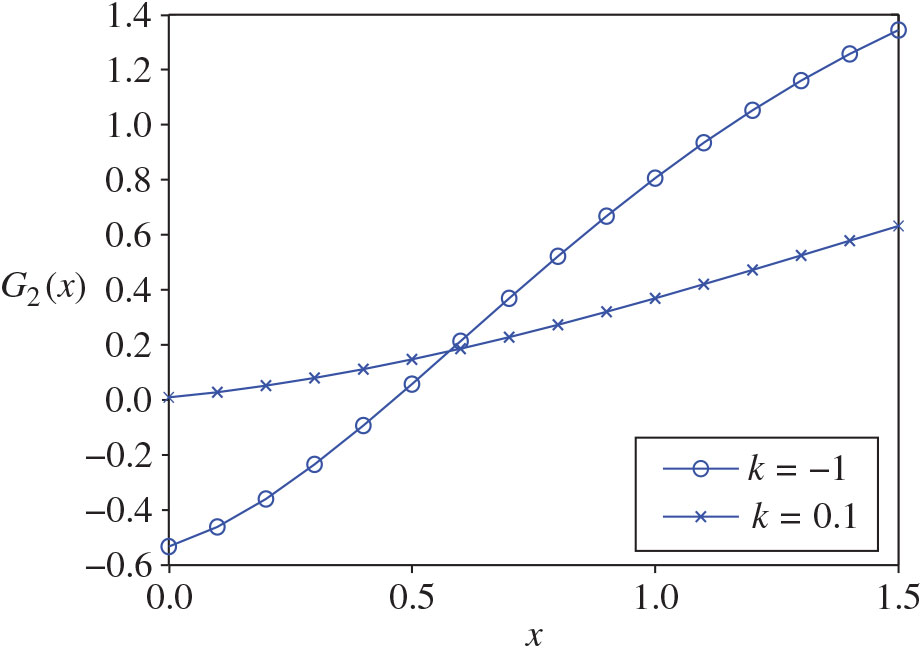
where
 \begin{equation}
G_{2}(x)=\int_{x}^{\infty}
\exp\bigg(\!-\frac{1}{1-\gamma_{2}}\int_{x}^{y}\frac{W^{(q)\prime}
(\bar{\xi}(u))}{W^{(q)}(\bar{\xi}(u))}
{{\rm d}}u\bigg)g(y){{\rm d}}y,\qquad x\geq 0.
\end{equation}
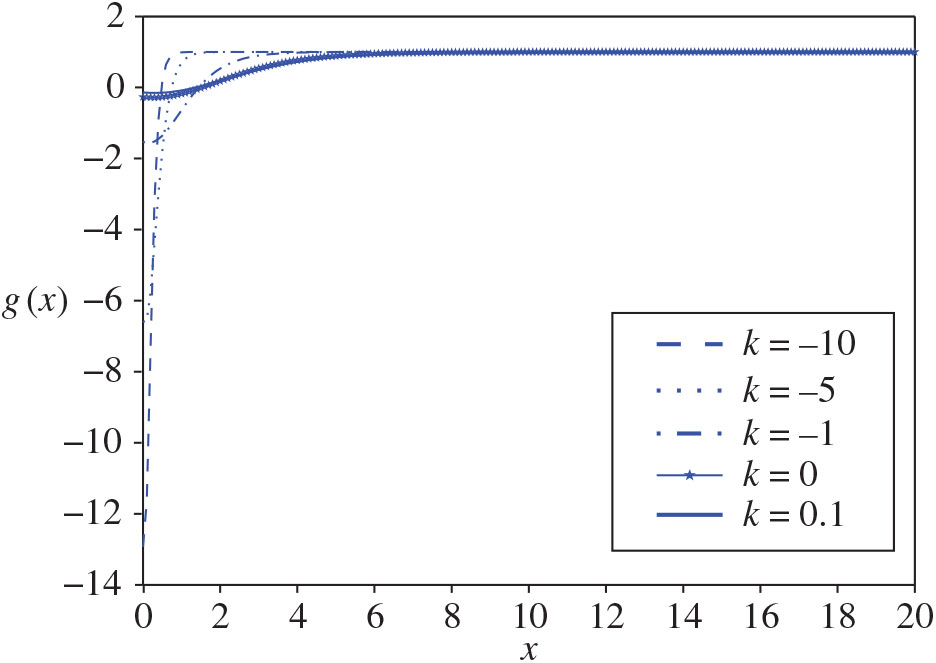
Here the function g is defined as
 \begin{equation}
g(x)=\xi^{\prime}(x)+(1-\xi^{\prime}(x))\frac{W^{(q)\prime
\prime}(\bar{\xi}(x))W^{(q)}(\bar{\xi}(x))}
{(W^{(q)\prime}(\bar{\xi}(x)))^{2}},\qquad x\geq 0.
\label{eqn30}
\end{equation}
With the above alternative representation of f(x), we conclude that (for all
 $x>0$
) + is equivalent to the inequality
 \begin{equation}
G_2(x)\geq0 \quad\text{for all }x\lt0.
\label{eqn31}
\end{equation}
In order to characterize the optimal tax strategy and the optimal tax return function explicitly, we need the following assumption, under which the optimal tax return function and the optimal tax strategy can be obtained. As can be seen, the extension from the ruin-based tax optimization problem to our general draw-down-based tax optimization problem incurs in greater difficulties and complexity, especially in finding the optimal tax return function and the optimal tax strategy, while characterizing them is very critical in addressing optimal control problems. When our model and tax structure reduce to those in the existing literature, our results coincide with the corresponding results.
Assumption 1. Let g be defined by (31). Assume that there exists an
 $x_{0}\in[0,\infty) $
such that the function g changes its sign at the point
 $x_{0}$
. Here, we say that the function g(x) changes its sign at the point
 $x_{0}$
if and only if
 $g(x_{1})g(x_{2})\leq0$
for all
 $x_{1}\leq x_{0},\,x_{2}\geq x_{0}$
.
Proposition 5. Suppose that Assumption 1 and condition (32) hold, which is equivalent to a combination of the two cases
(i)
$x_{0}=0$
,
$g(x)\geq0$
for
$x\in [0,\infty) $
;(ii)
$x_{0}\in(0,\infty) $
,
$g(x)\leq0$
for
$x\in[0, x_{0}]$
,
$g(x)\geq0$
for
$x\in (x_{0},\infty) $
,
$G_{2}(0)\geq0$
.


Let f(x) be defined by (28). Then f(x) is indeed a once continuously differentiable solution to (14). In addition, the optimal tax strategy is
 $\gamma(x)\equiv\gamma_{2},\,x\in[0,\infty) $
.
Proof. See the arguments before Assumption 1.
We proceed to characterize the optimal solution for (14). This time we guess that the solution f(x) of (14) satisfies
 ${W^{(q)\prime}(\bar{\xi}(x))}f(x)/{W^{(q)}(\bar{\xi}(x))}
\geq1$
for all x. Then, for all
 $x\geq0$
, the function f satisfies
 \begin{equation}
0 =\gamma_{1}-\frac{W^{(q)\prime}(\bar{\xi}(x))}
{W^{(q)}(\bar{\xi}(x))}f(x)+(1-\gamma_{1})f^{\prime}(x).
\label{eqn32}
\end{equation}
Solving (33) by similar arguments as in solving (23), we obtain
 \begin{align}
f(x)&= \frac{\gamma_{1}}{1-\gamma_{1}}\int_{x}^{\infty}
\exp\bigg(\!-\frac{1}{1-\gamma_{1}}\int_{x}^{y}\frac{W^{(q)\prime}
(\bar{\xi}(u))}{W^{(q)}(\bar{\xi}(u))} {{\rm d}}u\bigg){{\rm d}}y
\nonumber
\\
&= \frac{W^{(q)}(\bar{\xi}(x))}{W^{(q)\prime}
(\bar{\xi}(x))}-G_1(x), \qquad x\geq0,
\label{eqn33}\end{align}
where
 \begin{equation}
G_{1}(x)=\int_{x}^{\infty}\exp\bigg(\!-\frac{1}{1-\gamma_{1}}\int_{x}^{y}
\frac{W^{(q)\prime}(\bar{\xi}(u))}{W^{(q)}(\bar{\xi}
(u))}{{\rm d}}u\bigg)g(y){{\rm d}}y.
\end{equation}
By (34), it is obvious that is equivalent to
 \begin{equation}
G_1(x)\leq0 \quad\text{for all } x\lt0.
\label{eqn34}
\end{equation}
Proposition 6. Suppose that Assumption 1 and condition (35) hold, which is equivalent to a combination of the two cases
(iii)
$x_{0}=0$
,
$g(x)\leq0$
for
$x\in [0,\infty) $
;(iv)
$x_{0}\in(0,\infty) $
,
$g(x)\geq0$
for
$x\in[0, x_{0}]$
,
$g(x)\leq0$
for
$x\in(x_{0},\infty) $
,
$G_1(0)\leq0$
.


Let f(x) be defined by ( 34). Then f(x) is indeed a once continuously differentiable solution to ( 14). In addition, the optimal tax strategy is
 $\gamma(x)\equiv\gamma_{1},\,x\in[0,\infty) $
.
Aside from cases (i)–(iv), we also consider the following two cases.
(v)
$x_{0}\in(0,\infty) $
,
$g(x)\leq0$
for
$x\in[0,x_{0}]$
,
$g(x)\geq0$
for
$x\in(x_{0},\infty) $
, and there is an
$\bar{x}>0$
such that
$G_{2}(\bar{x})\lt0$
.(vi)
$x_{0}\in(0,\infty) $
,
$g(x)\geq0$
for
$x\in[0, x_{0}]$
,
$g(x)\leq0$
for
$x\in(x_{0},\infty) $
, and there is an
$\bar{\bar{x}}>0$
such that
$G_{1}(\bar{\bar{x}})>0$
.


In case (v), we must have
 $\bar{x}{\lt}x_{0}$
. By the definition of
 $x_{0}$
we know that
 $G_{2}(x_{0})\geq0$
. Then from the intermediate value theorem for the continuous function
 $G_{2}(x) $
we claim that there must exist some
 $x\in(\bar{x},x_{0}]$
such that
 $G_{2}(x)=0$
. Let
 \begin{equation}
x_{1}=\inf\{x\in(\bar{x},x_{0}]\mid G_{2}(x)=0\}.
\label{eqn35}
\end{equation}
Then
 $G_{2}(x_{1})=0$
,
 $G_{2}(x)\lt0$
for all
 $0{\lt}x{\lt}x_{1}$
, and
 $G_{2}(x)\geq0$
for all
 $x\in[x_{1},\infty) $
. Hence, this time we guess that the solution f(x) of (14) satisfies
 $${{{W^{(q)t}}(\bar \xi (x))} \over {{W^{(q)t}}(\bar \xi (x))}}f(x) \ge 1\,{\rm{for}}\,{\rm{all}}\,x\, \in (0,{x_1}),\,{\rm{and}}\,{{{W^{(q)t}}(\bar \xi (x))} \over {{W^{(q)t}}(\bar \xi (x))}}f(x) \le 1\,{\rm{for}}\,{\rm{all}}\,x \in [{x_1},\infty ).
$$
That is, f(x) satisfies the system of differential equations
 \begin{equation}
\begin{gathered}
0=\gamma_{1}-\frac{W^{(q)\prime}(\bar{\xi}(x))}
{W^{(q)}(\bar{\xi}(x))}f(x)+(1-\gamma_{1})f^{\prime}(x)
\quad\text{for all } x\in(0,x_{1}),
\\
0=\gamma_{2}-\frac{W^{(q)\prime}
(\bar{\xi}(x))}{W^{(q)}(\bar{\xi}(x))}
f(x)+(1-\gamma_{2})f^{\prime}(x) \quad\text{for all } x\in[x_{1},\infty).
\end{gathered}
\label{eqn36}
\end{equation}
Solving the above system of equations yields
 \begin{align}
f(x)&= \bigg(C-\frac{\gamma_{1}}{1-\gamma_{1}}\int_{0}^{x}
\exp\bigg(\!-\frac{1}{1-\gamma_{1}}\int_{0}^{y}\frac{W^{(q)\prime}
(\bar{\xi}(u))}{W^{(q)}(\bar{\xi}(u))}
\mathrm{d}u\bigg){{\rm d}}y\bigg) \nonumber
\\
& \times
\exp\bigg(\frac{1}{1-\gamma_{1}}\int_{0}^{x}\frac{W^{(q)\prime}
(\bar{\xi}(y))}{W^{(q)}(\bar{\xi}(y))} {{\rm d}}y\bigg)
\quad\text{for all }x\in(0,x_{1}), \nonumber
\\
f(x)&=\frac{\gamma_{2}}{1-\gamma_{2}}
\int_{x}^{\infty}\exp\bigg(\!-\frac{1}{1-\gamma_{2}}\int_{x}^{y}
\frac{W^{(q)\prime}(\bar{\xi}(u))}{W^{(q)}
(\bar{\xi}(u))}{{\rm d}}u\bigg){{\rm d}}y \quad\text{for all }
x\in[x_{1},\infty).\nonumber
\end{align}
Using the continuity condition
 $f(x_{1}-)=\ f(x_{1}+)=\ f(x_{1}),$
we can determine the constant C as
 \begin{align}
C&=\frac{\gamma_{1}}{1-\gamma_{1}} \int_{0}^{x_{1}}
\exp\bigg(\!-\frac{1}{1-\gamma_{1}} \int_{0}^{y}\frac{W^{(q)\prime}
(\bar{\xi}(u))} {W^{(q)}(\bar{\xi}(u))} {{\rm d}}u\bigg){{\rm d}}y
\nonumber
\\
& +\frac{\gamma_{2}}{1-\gamma_{2}} \exp\bigg(\frac{-1}{1-
\gamma_{1}}\int_{0}^{x_{1}}\!\frac{W^{(q)\prime}(\bar{\xi}
(y))}{W^{(q)}(\bar{\xi}(y))}{{\rm d}}y\bigg) \int_{x_{1}}^{\infty}\!\!
\exp\bigg(\frac{-1}{1-\gamma_{2}}\int_{x_{1}}^{y}\!
\frac{W^{(q)\prime}(\bar{\xi}(u))}{W^{(q)}(\bar{\xi}
(u))}{{\rm d}}u\bigg){{\rm d}}y.\nonumber
\end{align}
Therefore, we can write down the solution to the equations in (37) as
 \begin{align}
f(x)&= \frac{\gamma_{1}}{1-\gamma_{1}}\int_{x}^{x_{1}}
\exp\bigg(\frac{-1}{1-\gamma_{1}}\int_{x}^{y}\frac{W^{(q)\prime}
(\bar{\xi}\left(u\right))}{W^{(q)}(\bar{\xi}\left(u\right))}
{{\rm d}}u\bigg) {{\rm d}}y \nonumber
\\
& +\frac{\gamma_{2}}{1-\gamma_{2}} \exp\bigg(\frac{-1}{1-\gamma_{1}}
\int_{x}^{x_{1}}\frac{W^{(q)\prime}(\bar{\xi}(y))}
{W^{(q)}(\bar{\xi}(y))}{{\rm d}}y\bigg) \nonumber
\\
& \times \int_{x_{1}}^{\infty} \exp\bigg(\frac{-1}
{1-\gamma_{2}}\int_{x_{1}}^{y}\frac{W^{(q)\prime}(\bar{\xi}
(u))}{W^{(q)}(\bar{\xi}(u))}{{\rm d}}u\bigg) {{\rm d}}y \quad\text{for all
}x\in(0,x_{1}), \nonumber
\\
f(x)&=\frac{\gamma_{2}}{1-\gamma_{2}}
\int_{x}^{\infty}\exp\bigg(\!-\frac{1}{1-\gamma_{2}}\int_{x}^{y}
\frac{W^{(q)\prime}(\bar{\xi}(u))}{W^{(q)}
(\bar{\xi}(u))}{{\rm d}}u\bigg){{\rm d}}y \quad\text{for all
}x\in[x_{1},\infty).
\label{eqn37}\end{align}
We need to only further prove that the function given by (38) satisfies
 $$\frac{{W^{(q)'} (\bar \xi (x))}} {{W^{(q)} (\bar \xi (x))}}f(x) \ge 1\quad {\text{for}}\,{\text{all}}\,x \in (0,x_1 ) $$
to guarantee itself a solution to the HJB equation (14). By some algebraic manipulations we obtain, for
 $x\in(0,x_{1}) $
,
 \begin{align}
f(x)&=\int_{x}^{x_{1}}\mathrm{d} \left(\!-\frac{\exp\Big(
-\frac{\gamma_{1}}{1-\gamma_{1}}
\int_{x}^{y}\frac{W^{(q)\prime}(\bar{\xi}(u))}
{W^{(q)}(\bar{\xi}(u))}{{\rm d}}u\Big)}
{\exp\Big(\int_{x}^{y}\frac{W^{(q)\prime}(\bar{\xi}(u))}
{W^{(q)}(\bar{\xi}(u))}{{\rm d}}u\Big)
\frac{W^{(q)\prime}(\bar{\xi}(y))}{W^{(q)}
(\bar{\xi}(y))}}\right)\nonumber
\\
& - \int_{x}^{x_{1}} \frac{\Big[\exp\Big(\int_{x}^{y}\frac{W^{(q)\prime}
(\bar{\xi}(u))}{W^{(q)}(\bar{\xi}(u))}
{{\rm d}}u\Big)\frac{W^{(q)\prime}(\bar{\xi}(y))}
{W^{(q)}(\bar{\xi}(y))}\Big]' \exp\Big(\!-\frac{\gamma_{1}}
{1-\gamma_{1}}\int_{x}^{y} \frac{W^{(q)\prime} (\bar{\xi}(u))}
{W^{(q)}(\bar{\xi}(u))}{{\rm d}}u\Big)}
{\Big[\exp\Big(\int_{x}^{y}\frac{W^{(q)\prime}(\bar{\xi}
(u))}{W^{(q)}(\bar{\xi}(u))}{{\rm d}}u\Big)
\frac{W^{(q)\prime}(\bar{\xi}(y))}{W^{(q)}
(\bar{\xi}(y))}\Big]^{2}}{{{\rm d}}y} \nonumber
\\
& +\exp\bigg(\frac{-1}{1-\gamma_{1}}\int_{x}^{x_{1}}
\frac{W^{(q)\prime}(\bar{\xi}(y))}{W^{(q)}
(\bar{\xi}(y))}{{\rm d}}y\bigg) \nonumber
\\
& \times \left( \int_{x_{1}}^{\infty}\mathrm{d}\left(\!-\frac{\exp\Big(
-\frac{\gamma_{2}}{1-\gamma_{2}}\int_{x}^{y}\frac{W^{(q)\prime}
(\bar{\xi}(u))}{W^{(q)}(\bar{\xi}(u))} {{\rm d}}u\Big)}
{\exp\Big(\int_{x}^{y}\frac{W^{(q)\prime}
(\bar{\xi}(u))}{W^{(q)}(\bar{\xi}(u))}
{{\rm d}}u\Big)\frac{W^{(q)\prime}(\bar{\xi}(y))}
{W^{(q)}(\bar{\xi}(y))}}\right)\right.\nonumber
\\
&\left.-\int_{x_{1}}^{\infty}\frac{\Big[\exp\Big(\int_{x}^{y}\frac{W^{(q)\prime}
(\bar{\xi} (u))}{W^{(q)}(\bar{\xi}(u))}
{{\rm d}}u\Big)\frac{W^{(q)\prime}(\bar{\xi}(y))}
{W^{(q)}(\bar{\xi}(y))}\Big]'
\exp\Big(\!-\frac{\gamma_{2}}{1-\gamma_{2}}\int_{x}^{y}\frac{W^{(q)\prime}
(\bar{\xi}(u))}{W^{(q)}(\bar{\xi}(u))} {{\rm d}}u\Big)}
{\Big[\exp\Big(\int_{x}^{y}\frac{W^{(q)\prime}
(\bar{\xi}(u))}{W^{(q)}(\bar{\xi}(u))}
{{\rm d}}u\Big)\frac{W^{(q)\prime}(\bar{\xi}(y))}
{W^{(q)}(\bar{\xi}(y))}\Big]^{2}}{{\rm d}}y \right)\nonumber
\\
&= \frac{W^{(q)}(\bar{\xi}(x))}{W^{(q)\prime} (\bar{\xi}(x))}
-\int_{x}^{x_{1}} \exp\bigg(\!-\frac{1}{1-\gamma_{1}}
\int_{x}^{y}\frac{W^{(q)\prime} (\bar{\xi}(u))}{W^{(q)}
(\bar{\xi}(u))} {{\rm d}}u\bigg)g(y){{\rm d}}y \nonumber
\\
& -\exp\bigg(\frac{-1}{1-\gamma_{1}}\int_{x}^{x_{1}}
\frac{W^{(q)\prime}(\bar{\xi}(y))}{W^{(q)}
(\bar{\xi}(y))}{{\rm d}}y\bigg) G_{2}(x_{1}) \nonumber
\\
&\geq\frac{W^{(q)}(\bar{\xi}(x))}{W^{(q)\prime}
(\bar{\xi}(x))},
\label{eqn38}\end{align}
since
 $g(y)\leq0$
for
 $y\in[x,x_{1}]\subseteq[0,x_{0}]$
and
 $G_{2}(x_{1})=0$
. Inequality (39) reveals that
 ${W^{(q)\prime}(\bar{\xi}(x))}f(x)/{W^{(q)}(\bar{\xi}
(x))}\geq1$
for all
 $x\in(0,x_{1}) $
.
Proposition 7. In case (v), the once continuously differentiable solution to (14) (optimal tax function) is defined by (38) with
 $x_{1}$
determined by (36) and
 $x_{0}$
given in Assumption 1. In addition, the optimal tax strategy is given by
 $\gamma(x)= \smash{\gamma_{1}\mathbf{1}_{[0,x_{1}]}(x)+
\gamma_{2}\mathbf{1}_{(x_{1},\infty)}(x)}$
.
In case (vi), the once continuously differentiable solution to (14) (optimal tax function) is defined by,
 \begin{align}
f(x)&= \frac{\gamma_{2}}{1-\gamma_{2}}\int_{x}^{x_{2}}
\exp\bigg(\frac{-1}{1-\gamma_{2}}\int_{x}^{y}\frac{W^{(q)\prime}
(\bar{\xi}(u))}{W^{(q)}(\bar{\xi}(u))} {{\rm d}}u\bigg) {{\rm d}}y
\nonumber
\\
& +\frac{\gamma_{1}}{1-\gamma_{1}} \exp\bigg(\frac{-1}
{1-\gamma_{2}}\int_{x}^{x_{2}}\frac{W^{(q)\prime}(\bar{\xi}
(y))}{W^{(q)}(\bar{\xi}(y))}{{\rm d}}y\bigg) \nonumber
\\
& \times\int_{x_{2}}^{\infty} \exp(\frac{-1}{1-\gamma_{2}}
\int_{x_{2}}^{y}\frac{W^{(q)\prime}(\bar{\xi}(u))}
{W^{(q)}(\bar{\xi}(u))}{{\rm d}}u\bigg){{\rm d}}y \quad\text{for all
}x\in(0,x_{2}), \nonumber
\\
f(x)&=\frac{\gamma_{1}}{1-\gamma_{1}}\int_{x}^{\infty}\exp
\bigg(\!-\frac{1}{1-\gamma_{1}}\int_{x}^{y}\frac{W^{(q)\prime}
(\bar{\xi}(u))}{W^{(q)}(\bar{\xi}(u))} {{\rm d}}u\bigg){{\rm d}}y
\quad\text{for all } x\in[x_{2},\infty),
\end{align}
with
 $x_{2}$
determined by,
 \begin{equation}{x2}
x_{2}=\inf\{x\in(\bar{\bar{x}},x_{0}]\mid G_{1}(x)=0\},
\end{equation}
and
 $x_{0}$
given by Assumption 1. In addition, the optimal tax strategy is given by
 $\gamma(x)=\smash{\gamma_{2}\mathbf{1}_{[0,x_{2}]}(x)}+
\smash{\gamma_{1}\mathbf{1}_{(x_{2},\infty)}(x)}$
.
Proof. The arguments of the proof of case (v) are given immediately above this proposition. The proof of case (vi) is much similar.
Remark 2. Let
 $\xi(x)\equiv0$
. Then the HJB equation (14) coincides well with Equation (2.6) of [Reference Wang and Hu32]. Furthermore, if it is assumed that each scale function is three times differentiable and its first derivative is a strictly convex function (as was assumed in [Reference Wang and Hu32] and [Reference Albrecher, Renaud and Zhou4]), then
 $$
g(x) = \frac{{W^{(q)''} (x)W^{(q)} (x)}}
{{(W^{(q)'} (x))^2 }},\quad x \ge (0,x_1 ),
$$
will change its sign at most once. In addition, if g(x) changes its sign once at
 $x_{0}\in[0,\infty) $
, we must have
 $g(x)\leq0$
for
 $x\in[0,x_{0}]$
, and
 $g(x)\geq0$
for
 $x\geq x_{0}$
.
That is, only cases (i), (ii), and (v) are possible scenarios. Combined with the last equality in (39), it is obvious that (38) in case (v) coincides with Equation (5.7) of [Reference Wang and Hu32]. Meanwhile, (28) in cases (i) and (ii) coincides with Equation (4.2) of [Reference Wang and Hu32]. Indeed, when
 $\xi\equiv0,$
we have
 \begin{equation}
G_{2}(x) = (W^{(q)}(x))^{{1}/{(1-\gamma_{2})}}
\int_{x}^{\infty}\frac{W^{(q)\prime\prime}(y)(W^{(q)}(y)
)^{1-{1}/{(1-\gamma_{2})}}} {(W^{(q)\prime}(y))^{2}}{{\rm d}}y, \qquad x\geq
0.\nonumber
\end{equation}
Hence,
 $x_{1}$
as defined by (36) in case (v) coincides with
 $u_{0}$
defined in Equation (5.15) of [Reference Wang and Hu32], which implies that Equation (5.22) of [Reference Wang and Hu32] holds with
 $\beta=\gamma_{2}$
and
 $c=q$
, that is,
 \begin{equation}
\frac{W^{(q)}(x_{1})}{W^{(q)\prime}(x_{1})}=\frac{\gamma_{2}}{1-\gamma_{2}}
\int_{x_{1}}^{\infty}\bigg(\frac{W^{(q)}(x_{1})}{W^{(q)}(y)}
\bigg)^{{1}/{(1-\gamma_{2})}}\mathrm{d}y.
\label{eqn39}
\end{equation}
By (40), (38) can be rewritten as
 \begin{align}
f(x)&= \frac{\gamma_{1}}{1-\gamma_{1}}\int_{x}^{x_{1}}
\exp\bigg(\frac{-1}{1-\gamma_{1}}\int_{x}^{y}\frac{W^{(q)\prime}(u)}
{W^{(q)}(u)}{{\rm d}}u\bigg){{\rm d}}y
\\
& +\exp\bigg(\frac{-1}{1-\gamma_{1}}\int_{x}^{x_{1}}
\frac{W^{(q)\prime}(y)} {W^{(q)}(y)}{{\rm d}}y\bigg)
\frac{\gamma_{2}}{1-\gamma_{2}}\int_{x_{1}}^{\infty}\exp
\bigg(\frac{-1}{1-\gamma_{2}}\int_{x_{1}}^{y}\frac{W^{(q)\prime}(u)}
{W^{(q)}(u)}{{\rm d}}u\bigg){{\rm d}}y
\\
&= (W^{(q)}(x))^{{1}/{(1-\gamma_{1})}}
\bigg(\frac{\gamma_{1}}{1-\gamma_{1}}\int_{x}^{x_{1}}
(W^{(q)}(y))^{-{1}/{(1-\gamma_{1})}}\mathrm{d}y
+\frac{(W^{(q)}(x_{1}))^{1-{1}/{(1-\gamma_{1})}}}
{W^{(q)\prime}(x_{1})}\bigg)
\end{align}
for
 $x\in(0,x_{1}) $
, and
 \begin{align}
f(x) &=\frac{\gamma_{2}}{1-\gamma_{2}}
(W^{(q)}(x))^{{1}/{(1-\gamma_{2})}} \int_{x}^{\infty}
(W^{(q)}(y))^{-{1}/{(1-\gamma_{2})}}{{\rm d}}y
\\
&= (W^{(q)}(x))^{{1}/{(1-\gamma_{2})}} \bigg(
\frac{(W^{(q)}(x_{1}))^{1-{1}/{(1-\gamma_{2})}}} {W^{(q)\prime}(x_{1})} -
\frac{\gamma_{2}}{1-\gamma_{2}}\int_{x_{1}}^{x}
(W^{(q)}(y))^{-{1}/{(1-\gamma_{2})}}{{\rm d}}y \bigg)
\end{align}
for
 $ x\in[x_{1},\infty) $
, coinciding well with Equation (5.7) of [Reference Wang and Hu32].
6. Examples
In this section, we consider several examples of spectrally negative Lévy processes X and show that Assumption 1 holds for certain choices of the draw-down function
 $\xi$
. For simplicity of notation, write
 $\bar{\xi}(x)\ :\!=x-\xi(x) $
,
 $W_\xi(z)\ :\!={W^{(q)}(\bar{\xi}(z))}/
{W^{(q)\prime}(\bar{\xi}(z))},$
and, hence,
 $W_0(z)\ :\!={W^{(q)}(z)}/
{W^{(q)\prime}(z)}$
.
Example 1. In this example, let
 $X(t)=\mu t+B(t) $
for a constant
 $\mu$
and a Brownian motion B. The q-scale function of X is given by
 \begin{equation}
W^{(q)}(x)=\frac{1}{\sqrt{\mu^2+2q}\,}(\mathrm{e}^{\theta_1x}-
\mathrm{e}^{\theta_2x}),\qquad x\geq0,
\end{equation}
with
 $\theta_1=-\mu+\smash{\sqrt{\mu^2+2q}}$
and
 $\theta_2=-(\mu+\smash{\sqrt{\mu^2+2q}}) $
. It can be checked that
 \begin{gather}
W^{(q)\prime}(x)=\frac{1}{\sqrt{\mu^2+2q}\,}(\theta_1
\mathrm{e}^{\theta_1x}-\theta_2\mathrm{e}^{\theta_2x})\gt0, \qquad x\geq0,
\\
W^{(q)\prime\prime}(x)=2(qW^{(q)}(x) -\mu W^{(q)\prime}(x)),\qquad
x\geq0.
\end{gather}
The function g can be rewritten as
 \begin{align}
g(x) &=\xi^{\prime}(x)+(1-\xi^{\prime}(x))(2qW_{\xi}(x)^2-2\mu
W_{\xi}(x)),
\end{align}
from which we can deduce that
 \begin{align}
g^{\prime}(x)=\xi^{\prime\prime}(x)f_1(W_{\xi}(x))+(\xi^{\prime}(x)-1)
W_{\xi}^{\prime}(x)f_2(W_{\xi}(x)),
\end{align}
with
 $f_1(x)=1-2qx^2+2\mu x$
and
 $f_2(x)=-4qx+2\mu$
. We can find that
 $f_1(x)\gt(\lt)\,0$
on
 $[0,{(\mu+\sqrt{\mu^2+2q})}/{2q}) $
 $ (({(\mu+\sqrt{\mu^2+2q})}/{2q},\infty)) $
, and
 $f_1(x)=0$
for
 $x={(\mu+\sqrt{\mu^2+2q})}/{2q}$
; while
 $f_2(x)\gt(\lt)\,0$
on
 $[0,{\mu}/{2q}) $
 $ (({\mu}/{2q},\infty)) $
, and
 $f_2(x)=0$
for
 $x={\mu}/{2q}$
. There are two cases to be considered.
Case 1:
 $\mu>0$
, and hence
 $0\lt {\mu}/{2q}\lt {(\mu+\sqrt{\mu^2+2q})}/{2q}$
. First, choose
 $\xi$
in such a way that
-
$\xi(0)=0, \lim _{x\rightarrow\infty}\bar{\xi}(x) =\infty,
\xi^{\prime}(0)\leq0$
;
-
$\xi^{\prime}(x)\lt 1$
for all
$x\in[0,\infty) $
;
-
$\xi^{\prime\prime}(x)\leq0$
for all
$x\in[0,W_{\xi}^{-1}({\mu}/{2q})]$
and
$ \xi^{\prime\prime}(x)\geq0$
for all
$x\in(W_{\xi}^{-1}({\mu}/{2q}),\infty) $
.


We can observe the following facts:
-
$\bar{\xi}(x) $
is strictly increasing over
$[0,\infty) $
(because
$\bar{\xi}^{\prime}(x)=1-\xi^{\prime}(x)>0$
for all
$x\in[0,\infty) $
);
-
$W_\xi(z) $
is strictly increasing (since
${W^{(q)}(z)}/
{W^{(q)\prime}(z)}$
and
$\bar{\xi}(z) $
are both strictly increasing) with supremum
$W_\xi(\infty)={(\mu+\sqrt{\mu^2+2q})}/{2q}$
;
-
$\lim_{x\rightarrow\infty}g(x)=\lim_{x\rightarrow\infty}
(\xi^{\prime}(x)+1-\xi^{\prime}(x))=1>0,
\lim_{x\rightarrow0}g(x)=\xi^{\prime}(0)\leq0$
;
-
$g^{\prime}(x)\!=\xi^{\prime\prime}(x)f_1(W_{\xi}(x))+(\xi^{\prime}(x)-1)
W_{\xi}^{\prime}(x)f_2(W_{\xi}(x))\lt 0$
for all
$x\in[0,W_{\xi}^{-1}({\mu}/{2q})) $
;
-
$\xi^{\prime}(W_{\xi}^{-1}({\mu}/{2q}))\lt 0, g(W_{\xi}^{-1} ({\mu}/{2q}))
=\xi^{\prime}(W_{\xi}^{-1}({\mu}/{2q}))
+(1-\xi^{\prime}(W_{\xi}^{-1}({\mu}/{2q})))\times(\!-~{\mu^2}/{2q})\lt 0$
;
-
$g^{\prime}(x)=\xi^{\prime\prime}(x)f_1(W_{\xi}(x))+(\xi^{\prime}(x)-1)
W_{\xi}^{\prime}(x)f_2(W_{\xi}(x))>0,\,
x\in(W_{\xi}^{-1}({\mu}/{2q}),\infty) $
.





Based on these observations, we can deduce that there should exist an
 $x_0\in(W_{\xi}^{-1}({\mu}/{2q}),\infty) $
such that
 $g(x)\leq0$
for
 $x\leq x_0$
, and
 $g(x)>0$
for
 $x>x_0$
. Thus, Assumption 1 holds.
The above class of the general draw-down function however may seem to be restrictive because conditions are imposed on the second derivative of
 $\xi$
. Now we construct a more general class of the general draw-down functions. It is seen that
 \begin{align}
g(x)\geq0 &\quad\Longleftrightarrow\quad
\frac{1}{1-\xi^{\prime}((\bar{\xi})^{-1}(z))}-1\geq-\frac{W^{(q)
\prime\prime}(z)W^{(q)}(z)}{(W^{(q)\prime}(z))^{2}}, \qquad
z=\bar{\xi}(x) \nonumber
\\
&\quad\Longleftrightarrow\quad ((\bar{\xi})^{-1})^{\prime}(z)-1\geq
2\mu W_{0}(z)-2qW_{0}(z)^2, \qquad z=\bar{\xi}(x),
\label{eqn40}\end{align}
provided that
 $\xi^{\prime}(x)\lt 1$
for all
 $x\geq0$
(hence,
 ${(\bar{\xi})^{-1}}$
is well defined). Recalling that
 $W^{(q)\prime\prime}(z) $
takes positive values for large z (In fact,
 $W_{\xi}^{-1}({\mu}/{q}) $
is the unique zero of
 $W^{(q)\prime\prime}(z) $
with
 $W^{(q)\prime\prime}(z)\lt (\gt)\,0$
over
 $[0, W_{\xi}^{-1}({\mu}/{q}))
\,((W_{\xi}^{-1}({\mu}/{q}),\infty)) $
, we can also choose
 $\xi$
satisfying
-
$0\leq\xi^{\prime}(x)\lt 1$
for all
$x\in[0,\infty) $
;
-
$\bar{\xi}(0)=\underline{d}\in(0,\infty),
\bar{\xi}(\infty)=\bar{d}\in(0,\infty],
a\in[\underline{d},\bar{d}]$
;
-
$ ((\bar{\xi})^{-1})^{\prime}(z)-1\lt 2\mu W_{0}(z)-2qW_{0}(z)^2$
for all
$z\in [\underline{d},a) $
;
-
$ ((\bar{\xi})^{-1})^{\prime}(z)-1\geq2\mu W_{0}(z)-2qW_{0}(z)^2$
for all
$z\in[a,\bar{d} ) $
,


so that Assumption 1 holds with
 $x_{0}=(\bar{\xi})^{-1}(a) $
. In particular, if
 $a=\bar{d}$
then
 $g(x)\lt 0$
for all
 $x\in[0,\infty) $
; if
 $a=\underline{d}$
then
 $g(x)\geq0$
for all
 $x\in[0,\infty) $
. To see that such a construction is feasible, it would be quite useful to note that
 $\xi^{\prime}(x)\in[0,1) $
(or, equivalently,
 $\bar{\xi}^{\prime}(x)\in(0,1]$
) over
 $x\in[0,\infty) $
can result in
 $ ((\bar{\xi})^{-1})^{\prime}(z)\in[1,\infty) $
over
 $z\in[0,\infty) $
. Note that the function on the right-hand side of the final inequality of (41) does not depend on
 $\xi$
.
In particular, we can fix
 $d_{1}\in[0,\infty) $
,
 $a\in[d_{1},\infty),$
and
 $M_{1}\in[1,\infty) $
, and then choose
 $\xi$
satisfying
-
$ (\bar{\xi})^{-1}(d_{1})=0$
;
-
$ ((\bar{\xi})^{-1})^{\prime}(z)\in[1,M_{1}), \,z\in[d_{1},\infty) $
;
-
$ ((\bar{\xi})^{-1})^{\prime}(z)-1\lt 2\mu W_{0}(z)-2qW_{0}(z)^2$
for all
$z\in[d_{1},a) $
;
-
$ ((\bar{\xi})^{-1})^{\prime}(z)-1\geq2\mu W_{0}(z)-2qW_{0}(z)^2$
for all
$z\in[a,\infty),$


to fulfill Assumption 1 with
 $x_{0}=(\bar{\xi})^{-1}(a) $
. Here, we should note that the function on the right-hand side of the final inequality of (41) is bounded, and
 $\bar{\xi}(\infty)=\infty$
by construction.
Case 2:
 $\mu\leq0$
. First, consider the case
 $\xi$
satisfying
-
$\xi^{\prime}(x)\lt 1$
for all
$x\in[0,\infty) $
;
-
$\xi(0)=0,\lim_{x\rightarrow\infty}\bar{\xi}(x)=\infty,\xi^{\prime}
(0)=0$
;
-
$\xi^{\prime\prime}(x)\geq0$
for all
$x\in[0,\infty),$


so that
 $\bar\xi(x) $
is strictly increasing on
 $[0,\infty) $
;
 $g(0)=0$
; and
 $g^{\prime}(x)=\xi^{\prime\prime}(x)f_1(W_{\xi}(x))+(\xi^{\prime}
(x)-1)W_{\xi}^{\prime}(x)f_2(W_{\xi}(x))>0$
(and, hence,
 $g(x)>0$
) for all
 $x\in(0,\infty) $
. Hence, Assumption 1 should hold with
 $x_0=0$
.
Due to the fact that
 \begin{align}
g(x)\geq0 \quad\Longleftrightarrow\quad \xi^{\prime}(x)+(1-
\xi^{\prime}(x)) (2qW_{\xi}(x)^2-2\mu W_{\xi}(x))\geq0,
\end{align}
we can also just choose
 $\xi$
such that
 $\xi^{\prime}(x)\in[0,1) $
for
 $x\in[0,\infty) $
, so that Assumption 1 holds with
 $x_0=0$
.
Example 2. Let
 $X(t)=x+pt-\smash{\sum_{i=1}^{N(t)}e_{i}}$
, where
 $p>0$
,
 $\{e_{i};\ i\geq1\}$
are independent and identically distributed exponential random variables with mean
 ${1}/{\mu},$
and
 $\{N(t),
t\geq0\}$
is an independent Poisson process with intensity
 $\lambda$
. The q-scale function of X is given by
 \begin{equation}
W^{(q)}(x)=p^{-1}(A_{+}{\rm e}^{\theta_{+}x} -A_{-}{\rm e}^{\theta_{-}x}),\qquad
x\geq0,
\end{equation}
where
 $$A_ \pm = \frac{{\mu + \theta _ \pm }}
{{\theta _ + - \theta _ - }} > 0,\quad \theta _ \pm = \frac{{q + \lambda - \mu p \pm \sqrt {(q + \lambda - \mu p)^2 + 4pq\mu } }}
{{2p}}.$$
Some algebraic manipulations yield
 $$
W^{(q)''} (x) = p^{ - 1} (A_ + (\theta _ + )^2 e^{\theta _ + x} - A_ - (\theta _ - )^2 e^{\theta _ - x} ) = - \theta _ - \theta _ + W^{(q)} (x) + (\theta _ + + \theta _ - )W^{(q)'} (x).
$$
Hence, g(x) can be rewritten as
 \begin{align}
g(x) =\xi^{\prime}(x)+(1-\xi^{\prime}(x))(\!-\theta_{+}\theta_{-}
W_{\xi}(x)^2+(\theta_{+}+\theta_{-}) W_{\xi}(x)).
\end{align}
Let
 $f_{3}(x)=-\theta_{+}\theta_{-}x^2+(\theta_{+}+\theta_{-})x$
, which is nonpositive and decreasing over
 $[0,0\vee
{(\theta_{+}+\theta_{-})}/{2\theta_{+}\theta_{-}}) $
, and increasing over
 $[0\vee {(\theta_{+}+\theta_{-})}/{2\theta_{+}\theta_{-}},\infty) $
. Because
 $W_\xi(z) $
is strictly increasing with upper bound
 ${1}/{\theta_{+}}$
(cannot be attained) and lower bound 0,
 $1-f_{3}(W_{\xi}(x))>0$
, leading to
 $1-{1}/{(1-f_{3}(W_{\xi}(x)))}\lt 1,\,x\in[0,\infty) $
. Hence, we can verify that
 \begin{equation}
g(x)\geq0 \quad\Longleftrightarrow\quad \xi^{\prime}(x)\geq
\frac{-f_{3}(W_{\xi}(x))}{1-f_{3}(W_{\xi}(x))}=1-
\frac{1}{1-f_{3}(W_{\xi}(x))}.
\label{eqn41}
\end{equation}
Then we can choose
 $\xi$
satisfying
 $$
{\text{o}}\,\xi '(x) \ge 1 - \frac{1}
{{1 - f_3 (0 \vee (\theta _ + + \theta _ - )/2\theta _ + \theta _ - )}}\quad {\text{for}}\,{\text{all}}\,x \in [0,\infty ),
$$
in order to guarantee that
 $g(x)\geq0$
for all
 $x\in[0,\infty) $
, in which case Assumption 1 holds with
 $x_0=0$
.
By imposing conditions on the first and second derivatives of
 $\xi,$
and using a very similar argument as in the first construction method for the case
 $\mu>0$
in Example 1, we can construct an appropriate class of the general draw-down functions fulfilling Assumption 1.
Note that (42) is equivalent to
 \begin{align}
g(x)\geq0 &\quad\Longleftrightarrow\quad
\xi'((\bar{\xi})^{-1}(z))\geq\frac{-f_{3}(W_{0}(z))}
{1-f_{3}(W_{0}(z))},\qquad z=\bar{\xi}(x) \nonumber
\\
&\quad\Longleftrightarrow\quad
1-(((\bar{\xi})^{-1})^{\prime}(z))^{-1}
\geq\frac{-f_{3}(W_{0}(z))}{1-f_{3}(W_{0}(z))}, \qquad z=\bar{\xi}(x),
\label{eqn42}\end{align}
provided that
 $ (\bar{\xi})^{-1}$
is well defined. Thus, we can also choose
 $\xi$
satisfying
-
$\xi^{\prime}(x)\lt 1$
for all
$x\in[0,\infty) $
;
-
$\bar{\xi}(0)=\underline{d}\in(0,\infty),\bar{\xi}(\infty)
=\bar{d}\in(0,\infty], a\in[\underline{d},\bar{d}]$
;
-
$1-(((\bar{\xi})^{-1})^{\prime}(z))^{-1}\lt
\displaystyle\frac{-f_{3}(W_{0}(z))}{1-f_{3}(W_{0}(z))}$
for all
$z\in[\underline{d},a) $
;
-
$1-(((\bar{\xi})^{-1})^{\prime}(z))^{-1}
\geq\displaystyle\frac{-f_{3}(W_{0}(z))}{1-f_{3}(W_{0}(z))}$
for all
$z\in[a,\bar{d}),$


so that Assumption 1 holds with
 $x_{0}=(\bar{\xi})^{-1}(a) $
. To understand the feasibility of such a construction, it would be quite useful to note that
 $\xi^{\prime}(x)\in(\!-\infty,1) $
(or, equivalently,
 $\bar{\xi}^{\prime}(x)\in(0,\infty) $
) over
 $x\in[0,\infty) $
can lead to
 $ ((\bar{\xi})^{-1})^{\prime}(z)\in(0,\infty) $
over
 $z\in[0,\infty) $
. Note that the function on the right-hand side of the final inequality of (43) does not depend on
 $\xi$
.
In particular, we can fix
 $d_{2}\in[0,\infty) $
,
 $a\in[d_{2},\infty),$
and
 $M_{2}\in(0,\infty) $
, and then choose
 $\xi$
satisfying
-
$ (\bar{\xi})^{-1}(d_{2})=0$
;
-
$ ((\bar{\xi})^{-1})^{\prime}(z)\in(0,M_{2}), \,z\in[d_{2},\infty) $
;
-
$1-(((\bar{\xi})^{-1})^{\prime}(z))^{-1}\lt \displaystyle\frac{-f_{3}(W_{0}(z))}
{1-f_{3}(W_{0}(z))}$
for all
$z\in[d_{2},a) $
;
-
$1-(((\bar{\xi})^{-1})^{\prime}(z))^{-1}\geq
\displaystyle\frac{-f_{3}(W_{0}(z))}{1-f_{3}(W_{0}(z))}$
for all
$z\in[a,\infty) $
,


to fulfill Assumption 1 with
 $x_{0}=(\bar{\xi})^{-1}(a) $
. Here, we should note that the function on the right-hand side of the final inequality of (43) is bounded from above, and
 $\bar{\xi}(\infty)=\infty$
by construction.
Example 3. In this example we consider a general spectrally negative Lévy process X. It still holds that
 \begin{equation}
g(x)\geq0 \quad\Longleftrightarrow\quad
((\bar{\xi})^{-1})^{\prime}(z)-1\geq-\frac{W^{(q)
\prime\prime}(z)W^{(q)}(z)}{(W^{(q)\prime}(z))^{2}},\qquad z=
\bar{\xi}(x),
\end{equation}
provided that
 $\xi^{\prime}(x)\lt 1$
for all
 $x\geq0$
. We can choose
 $\xi$
satisfying
-
$\xi^{\prime}(x)\in(\!-\infty,1) $
for all
$x\in[0,\infty) $
;
-
$\bar{\xi}(0)=\underline{d}\in(0,\infty),\bar{\xi}(\infty)=
\bar{d}\in(0,\infty], \,a\in[\underline{d},\bar{d}]$
;
-
$ ((\bar{\xi})^{-1})^{\prime}(z)-1\lt(\gt)-\displaystyle\frac{W^{(q)\prime\prime}
(z)W^{(q)}(z)}{(W^{(q)\prime}(z))^{2}}$
for all
$z\in[\underline{d},a) $
;
-
$ ((\bar{\xi})^{-1})^{\prime}(z)-1\geq(\leq)-\displaystyle\frac{W^{(q)
\prime\prime}(z)W^{(q)}(z)}{(W^{(q)\prime}(z))^{2}}$
for all
$z\in[a,\bar{d}),$


to guarantee that Assumption 1 holds with
 $x_{0}=(\bar{\xi})^{-1}(a) $
. It would also be useful to note that
 $\xi^{\prime}(x)\in(\!-\infty,1) $
(or, equivalently,
 $\bar{\xi}^{\prime}(x)\in(0,\infty) $
) over
 $x\in[0,\infty) $
can result in
 $ ((\bar{\xi})^{-1})^{\prime}(z)\in(0,\infty) $
over
 $z\in[0,\infty) $
. In essence, an appropriate class of general draw-down functions satisfying Assumption 1 are constructed via imposing conditions on the inverse function
 $ (\bar{\xi})^{-1} $
instead of on
 $\xi$
or
 $\bar{\xi}$
.
For the spectrally negative Lévy process whose Lévy measure has a completely monotone density, we can also follow the method in [Reference Wang and Zhou34] to construct the class of the general draw-down functions fulfilling Assumption 1 with
 $x_{0}=(\bar{\xi})^{-1}(a) $
and
 $a\ :\!=\inf\{z\geq 0\colon
\smash{W^{(q)\prime\prime}(z)> 0 \}}$
.
7. Numerical analysis
In this section we provide some numerical examples to illustrate the theoretical results obtained in the previous sections. We consider a linear draw-down function
 $$\xi (x) = kx - d,\quad k \lt 1,d \ge 0.
$$
Under this assumption, we have, for
 $x{\lt}y$
,
 $$
\int_x^y {\frac{{W^{(q)'} (\bar \xi (u))}}
{{W^{(q)} (\bar \xi (u))}}du = \frac{1}
{{1 - K}}\ln \left( {\frac{{W^{(q)} ((1 - k)y + d)}}
{{W^{(q)} ((1 - k)x + d)}}} \right)} ,
$$
which has frequently appeared in the formulae in Section 4.
For the risk process, it is assumed to be a linear Brownian motion, i.e.
 \begin{equation}
X(t)=\mu t+\sigma B(t),\qquad t\geq 0,
\label{eqn43}
\end{equation}
where
 $\mu\in \mathbb{R}$
,
 $\sigma>0$
, and
 $\{B(t)\}$
is a standard Brownian motion. Note that our main results are all expressed in terms of the q-scale function
 $W^{(q)}$
. By [Reference Kyprianou19] we know that the q-scale function for the linear Brownian motion (44) is given by
 \begin{equation}
W^{(q)}(x)=\frac{2}{\sigma^2\Xi} \mathrm{e}^{-{\mu}x/{\sigma^2} }
\sinh(\Xi x),\qquad x\geq 0,
\end{equation}
where
 $ \Xi={\sqrt{ \mu^2+2q\sigma^2 } }/{ \sigma^2}.$
Throughout this section, we set
 $\mu=0.03, \sigma=0.4,$
and
 $q=0.01$
.
It follows from Propositions 5 and 6 that Assumption 1 plays an important role in characterizing the optimal return function. It is seen that
 $$
\mathop {\lim }\limits_{x \to \infty } \frac{{W^{(1)''} (\bar \xi (x))W^{(q)} (\bar \xi (x))}}
{{(W^{(q)'} (\bar \xi (x)))^2 }} = 1,
$$
which yields
 $\lim_{x\rightarrow \infty}g(x)=1$
. In Figure 1, we plot the behavior of g(x) for
 $d=1$
and
 $k=-10, -5, -1, 0, 0.1$
. It follows that the function g indeed converges to 1 as
 $x\rightarrow
\infty$
, and we also find that the function g indeed changes its sign at some point
 $x_0$
.
Behavior of the function g for
 $d=1$
and
 $k=-10, -5, -1, 0,
0.1$
.

Now for the draw-down parameters (k, d), we shall consider two cases:
 $ (0.1, 1) $
and
 $ (\!-1, 1) $
. Furthermore, we set
 $ (\gamma_1, \gamma_2)=(0.2,
0.6) $
. First, we consider the conditions in Proposition 5. Besides Assumption 1, we also need to check inequality (32). It follows from Figure 1 that
 $g(y)>0$
for
 $y>x_0$
. Hence, to check inequality (32), we need to only check the condition
 \begin{equation}
G_2(x)\geq 0 \quad\text{for all } 0{\lt}x\leq x_0.
\end{equation}
The function
 $G_2$
for
 $d=1$
and
 $k=-1, 0.1$
.

For
 $ (k, d)=(0.1, 1) $
, we can obtain
 $x_0=1.360$
; for
 $ (k,d)=(\!-1,1) $
, we can obtain
 $x_0=1.443$
. In Figure 2, we plot
 $G_2$
as a function of x for
 $0\leq x \leq 1.5$
. When
 $k=0.1$
, we find that
 $G_2(x) $
is strictly positive for
 $0\leq x\leq x_0$
. It follows from Proposition 5 that the optimal strategy function is
 $\gamma(x)\equiv\gamma_{2}$
for all
 $x\geq0$
, and the optimal return function is given by (28). In Figure 3, we plot the optimal return value as a function of the initial surplus level x. We observe that f(x) is an increasing function and converges to a constant value
 $2.8209$
. The limit can be checked mathematically as follows. Using (30), we have
 $$f(x) = \frac{{W^{(q)} (\bar \xi (x))}}
{{W^{(q)'} (\bar \xi (x))}} - \int_x^\infty {\exp \left( { - \frac{1}
{{1 - \gamma _2 }}\int_x^y {\frac{{W^{(q)'} (\bar \xi (u))}}
{{W^{(q)} (\bar \xi (u))}}} } \right)g(y)dy.}
$$
The optimal return function when
 $d=1$
,
 $k=0.1$
,
 $\gamma_1=0.2,$
and
 $\gamma_2=0.6$
.

which, together with
 $g(y)\rightarrow 1$
as
 $y\rightarrow \infty$
, yields, for large x,
 \begin{equation}
f(x) \approx \frac{W^{(q)}(\bar{\xi}(x))}{W^{(q)\prime}
(\bar{\xi}(x))}-\frac{1-\gamma_2}{\gamma_2}f(x),
\end{equation}
where we have used (3), (27), (28), and l’Hôpital’s rule to deduce that
 \begin{align}
& \lim_{x\rightarrow\infty}\frac{\int_{x}^{\infty}\exp
\Big(\!-\frac{1}{1-\gamma_{2}}\int_{x}^{y}\frac{W^{(q)\prime}
(\bar{\xi}(u))}{W^{(q)}(\bar{\xi}(u))} {{\rm d}}u\Big)
g(y){{\rm d}}y}{f(x)}
\\
&\qquad = \lim_{x\rightarrow\infty}
\frac{-g(x)+\frac{1}{1-\gamma_{2}}\frac{W^{(q)\prime}
(\bar{\xi}(x))}{W^{(q)}(\bar{\xi}(x))}
\int_{x}^{\infty}\exp\Big(\!-\frac{1}{1-\gamma_{2}}\int_{x}^{y}
\frac{W^{(q)\prime}(\bar{\xi}(u))}{W^{(q)}
(\bar{\xi}(u))}{{\rm d}}u\Big) g(y){{\rm d}}y}
{-\frac{\gamma_{2}}{1-\gamma_{2}}+\frac{\gamma_{2}}{1-\gamma_{2}}
\frac{1}{1-\gamma_{2}}\frac{W^{(q)\prime}(\bar{\xi}(x))}
{W^{(q)}(\bar{\xi}(x))}
\int_{x}^{\infty}\exp\Big(\!-\frac{1}{1-\gamma_{2}}\int_{x}^{y}
\frac{W^{(q)\prime}(\bar{\xi}(u))}{W^{(q)}
(\bar{\xi}(u))}{{\rm d}}u\Big) {{\rm d}}y}
\\
&\qquad =\frac{1-\gamma_{2}}{\gamma_{2}}.
\end{align}
Hence, for large x, we have
 $$f(x) \approx \gamma _2 \frac{{W^{(q)} (\bar \xi (x))}}
{{W^{(q)'} (\bar \xi (x))}} = 0.6\frac{{W^{(q)} (0.9x + 1)}}
{{W^{(q)'} (0.9x + 1)}} \to \frac{{0.6}}
{{\Phi (0.01)}} = 2.8209\quad {\text{as}}\,x \to \infty ,
$$
where the last step follows from (3).
As for
 $k=-1$
, after observing Figure 2 we find that
 $G_2(x) $
is not always positive for
 $0\leq x\leq x_0$
. Hence, the optimal return function is not characterized by Proposition 5. However, it is seen that the conditions in case (v) are satisfied; then the optimal return function is given by formulae in (38). In Figure 4 we plot the optimal return function for
 $0\leq x\leq 20$
. In this case, we find that f(x) converges to the same limit as the case when
 $k=0.1$
, which is due to the fact that the optimal return function has the same form when x is large, and the corresponding limit
 $2.8209$
is independent of the parameter k.
The optimal return function when
 $d=1$
,
 $k=-1$
,
 $\gamma_1=0.2,$
and
 $\gamma_2=0.6$
.

The patterns of the optimal return functions shown in Figure 3 and Figure 4 reveal that the smaller the parameter k, the larger the optimal return function. This is because, for each admissible tax strategy
 $\gamma\in\Gamma$
, the draw-down time
 $\tau^{\gamma}_{\xi}$
decreases a.s. as k increases, bearing in mind (1) and
 $\xi(x)=kx-d$
with
 $d=1$
set in Figure 3 and Figure 4. These reasonings together with the definition of the optimal return function given by (2) explain why smaller k gives a larger optimal return function value, i.e.
 $f(x)|_{k=k_{1}}\leq f(x)|_{k=k_{2}}$
for
 $x\in[0,\infty) $
and
 $k_{2}\leq
k_{1}\lt 1$
.
Appendix A. Proof of a technical lemma
Leema 1. For
 $z\in[x,\infty) $
, set
 $$\xi _1 (y): = \int_x^z {\gamma (w){\text{d}}w + \xi \left( {y - \int_x^z {\gamma (w){\text{d}}w} } \right),\quad y \in [z,\infty ).} $$
Then we have, for
 $z\in[x,\infty) $
and
 $a\in[0,\infty) $
,
 \begin{align}
& \mathbb{E}_{x}\Big(\mathrm{e}^{-q
(\tau_{\bar{\gamma}_{x}(z)+a}^{+}
-\tau_{\bar{\gamma}_{x}(z)}^{+})}
\mathbf{1}_{\{\tau_{\bar{\gamma}_{x}(z)+a}^{+}\lt
\tau^{\gamma}_{\xi}\}}|\mathcal{F}_{\tau_{\bar
{\gamma}_{x}(z)}^{+}}\Big) \nonumber
\\
&\qquad=
\mathbf{1}_{\{\tau_{\bar{\gamma}_{x}(z)}^{+}\lt \tau^{\gamma}_{\xi}\}}
\exp\bigg(\!-\int_{z}^{z+a}\frac{W^{(q)'}(\bar{\xi_{1}}(y))}
{W^{(q)}(\bar{\xi_{1}}(y))}\frac{1}{1-\gamma
(\bar{\gamma}_{z}^{-1}(y))} {{\rm d}}y\bigg).
\label{eqn44}\end{align}
Proof. We find that
 \begin{align}
U_{\gamma}(t) &= X(t)-\bar{X}(t) +z+\int_{z}^{\bar{X}(t)}
(1-\gamma(w)){{\rm d}}w -\int_{x}^{z}\gamma(w){{\rm d}}w
\\
&= X(t)-\bar{X}(t) +\bar{\gamma}_{z}(\bar{X}(t))
-\int_{x}^{z}\gamma(w){{\rm d}}w, \qquad
t\in[\tau_{\bar{\gamma}_{x}(z)}^{+},\infty),\,z\in[x,\infty),
\end{align}
where
 $\bar{\gamma}_{z}(y)=y
-\smash{\int_{z}^{y}\gamma(w)}{{\rm d}}w,\,y\in[z,\infty) $
. Hence, we have
 \begin{align}
\tau_{\bar{\gamma}_{x}(z)+a}^{+} &=
\inf\{t\geq\tau_{\bar{\gamma}_{x}(z)}^{+};\ U_{\gamma}(t)
> \bar{\gamma}_{x}(z)+a\}\nonumber
\\
&= \inf\{t\geq\tau_{\bar{\gamma}_{x}(z)}^{+};\ X(t)-\bar{X}(t)
+\bar{\gamma}_{z}(\bar{X}(t)) >z+a\},
\label{eqn45}\end{align}
and, on
 $\smash{\{\tau_{\bar{\gamma}_{x}(z)}^{+}\lt \tau^{\gamma}_{\xi}\}}$
,
 \begin{align}
\tau^{\gamma}_{\xi}&=
\inf\bigg\{t\geq\tau_{\bar{\gamma}_{x}(z)}^{+};\ X(t)-\bar{X}(t)
+\bar{\gamma}_{z}(\bar{X}(t)) \nonumber
\\
& \lt \int_{x}^{z}\gamma(w){{\rm d}}w
+\xi\bigg(\bar{\gamma}_{z}(\bar{X}(t))-\int_{x}^{z}\gamma(w)
{{\rm d}}w\bigg)\bigg\}.
\label{eqn46}\end{align}
Recalling that
 $$\tau _{\bar \gamma _x (z)}^ + = \inf \{ t \ge 0;X(t) > z\} \quad {\text{and}}\quad U_\gamma (t) = X(t) - \bar X(t) + \bar \gamma _x (\bar X(t)),
$$
we can find, from (46) and (47),
 \begin{equation}
\tau_{\bar{\gamma}_{x}(z)+a}^{+}-\tau_{\bar{\gamma}_{x}(z)}^{+}
=\tau_{z+a}^{+}\small{\circ}\theta_{\tau_{\bar{\gamma}_{x}(z)}^{+}},
\quad \mathbb{P}_{x}\text{-a.s.}
\end{equation}
and
 \begin{equation}
\tau^{\gamma}_{\xi}-\tau_{\bar{\gamma}_{x}(z)}^{+}
=\tau_{\xi_{1}}^{\gamma}\small{\circ}\theta_{\tau_{\bar
{\gamma}_{x}(z)}^{+}}, \quad \mathbb{P}_{x}\text{-a.s.\ on
}\{\tau_{\bar{\gamma}_{x}(z)}^{+}\lt \tau^{\gamma}_{\xi}\},
\end{equation}
which combined with the strong Markov property yield
 \begin{equation}
\mathbb{E}_{x}\Big(\mathrm{e}^{-q (\tau_{\bar{\gamma}_{x}(z)+a}^{+}
-\tau_{\bar{\gamma}_{x}(z)}^{+})}
\mathbf{1}_{\{\tau_{\bar{\gamma}_{x}(z)+a}^{+}\lt
\tau^{\gamma}_{\xi}\}}\Bigm|\mathcal{F}_{\tau_{\bar{\gamma}_{x}
(z)}^{+}}\Big)=\mathbf{1}_{\{\tau_{\bar{\gamma}_{x}(z)}^{+}\lt
\tau^{\gamma}_{\xi}\}} \mathbb{E}_{z}\Big(\mathrm{e}^{-q \tau_{z+a}^{+}}
\mathbf{1}_{\{\tau_{z+a}^{+}\lt \tau_{\xi_{1}}^{\gamma}\}}\Big),
\end{equation}
Appendix B. Proof of Proposition 2
Using (5), it can be verified that
 \begin{align}
&\mathbb{E}_{x}\bigg(\int_{0}^{\tau_{a}^{+} \wedge
\tau^{\gamma}_{\xi}}\mathrm{e}^{-q t}\gamma(\bar{X}(t))
{{\rm d}}(\bar{X}(t)- x)\bigg) \nonumber
\\
&\qquad=\mathbb{E}_{x}\bigg(\int_{0}^{\infty}\mathbf{1}_{\{t{\lt}L^{-1}
(L(\tau_{a}^{+}\wedge \tau^{\gamma}_{\xi})-) \}}\mathrm{e}^{-q
t}\gamma(\bar{X}(t)) {{\rm d}}(\bar{X}(t)- x)\bigg) \nonumber
\\
&\qquad=\mathbb{E}_{x}\bigg(\int_{0}^{\infty}\mathbf{1}_{\{y{\lt}L
(\tau_{a}^{+}\wedge \tau^{\gamma}_{\xi})\}} \mathrm{e}^{-q
L^{-1}(y)}\gamma(y+x){{\rm d}}y \bigg) \nonumber
\\
&\qquad=\int_{0}^{\infty}\mathbb{E}_{x}\Big(\mathrm{e}^{-q
L^{-1}(y)}\mathbf{1}_{\{y{\lt}L(\tau_{a}^{+})\wedge
L(\tau^{\gamma}_{\xi})\}}\Big)\gamma(y+x) {{\rm d}}y \nonumber
\\
&\qquad=\int_{0}^{\bar{\gamma}_{x}^{-1}(a)-x}\mathbb{E}_{x}
\Big(\mathrm{e}^{-q L^{-1}(y)}\mathbf{1}_{\{y{\lt}L
(\tau^{\gamma}_{\xi})\}}\Big)\gamma(y+x) {{\rm d}}y.
\label{eqn47}\end{align}
In addition, the set
 $\{y{\lt}L(\tau^{\gamma}_{\xi})\}$
can be re-expressed as
 $$\{ y \lt L(\tau _\xi ^\gamma )\} = \{ \bar \varepsilon _t \le \bar \xi (\bar \gamma _x (x + t))\} ,\quad {\text{for}}\,{\text{all}}\,t \in [0,\gamma ]\} ,
$$
which together with (48) implies that
 \begin{align}
&\mathbb{E}_{x}\bigg[\int_{0}^{\tau_{a}^{+}\wedge
\tau^{\gamma}_{\xi}}\mathrm{e}^{-q t}\gamma(\bar{X}(t)){{\rm d}}
(\bar{X}(t)-x)\bigg]
\\
&\qquad=\int_{0}^{\bar{\gamma}_{x}^{-1}(a)-x}\mathbb{E}_{x}
\Big(\mathrm{e}^{-q L^{-1}(y)}\mathbf{1}_{\{\bar {\varepsilon}_{t}
\leq \bar{\xi}(\bar{\gamma}_{x}(x+t) )\text{ for all }
t\in[0,y]\}}\Big)\gamma(y+x) {{\rm d}}y
\\
&\qquad=\int_{0}^{\bar{\gamma}_{x}^{-1}(a)-x}\mathrm{e}^{-\Phi(q)y}
\mathbb{E}_{x}^{\Phi(q)}\Big(\mathbf{1}_{\{\bar
{\varepsilon}_{t}\leq \bar{\xi}(\bar{\gamma}_{x}(x+t) ) \text{
for all } t\in[0,y]\}}\Big)\gamma(y+x) {{\rm d}}y
\\
&\qquad=\int_{0}^{\bar{\gamma}_{x}^{-1}(a)-x}\mathrm{e}^{-\Phi(q)y}
\exp\bigg(\!-\int_{0}^{y}\frac{W_{\Phi(q)}'
(\bar{\xi}(\bar{\gamma}_{x}(x+t))
)}{W_{\Phi(q)}(\bar{\xi}(\bar{\gamma}_{x} (x+t)))}{{\rm d}}t\bigg)
\gamma(y+x){{\rm d}}y
\\
&\qquad=\int_{0}^{\bar{\gamma}_{x}^{-1}(a)-x}
\exp\bigg(\!-\int_{0}^{y}\frac{W^{(q)\prime}
(\bar{\xi}(\bar{\gamma}_{x}(x+t)))}
{W^{(q)}(\bar{\xi}(\bar{\gamma}_{x}(x+t)))}{{\rm d}}t\bigg)
\gamma(y+x){{\rm d}}y,
\end{align}
where
 $\smash{n_{\Phi(q)}}$
is the excursion measure under the probability measure
 $\smash{\mathbb{P}_{x}^{\Phi(q)}}$
.
Appendix C. Proof of Proposition 3
For any
 $\epsilon>0$
and
 $h>0$
, by the definition of supremum we can always find a strategy
 $\gamma_{_{\epsilon}}\in \Gamma$
yielding the first inequality in (49) below, where the stopping time
 $\smash{\hat{\tau}_{x+h}^{+}}$
is defined via (6) with
 $\gamma$
replaced by
 $\gamma_{_{\epsilon}}$
. Then we have
 \begin{align}
f(x)-\epsilon &=\sup_{\gamma\in\Gamma}\mathbb{E}_{x} \int_{0}^{\tau^{\gamma}_{\xi}}
\mathrm{e}^{-qt}\gamma (\bar{X}(t)){{\rm d}} \bar{X}(t)-\epsilon\notag\\
&\leq \mathbb{E}_{x}\int_{0}^{\tau^{\gamma_{_{\epsilon}}}_{\xi}}
\mathrm{e}^{-qt}\gamma_{_{\epsilon}} (\bar{X}(t) ){{\rm d}}
\bar{X}(t) \nonumber
\\
&=\mathbb{E}_{x}\bigg(\int_{0}^{\tau^{\gamma_{_{\epsilon}}}_{\xi}
\wedge\hat{\tau}_{x+h}^{+}}\mathrm{e}^{-qt}\gamma_{_{\epsilon}}
(\bar{X}(t)){{\rm d}}\ \bar{X}(t)\bigg)
+\mathbb{E}_{x}\bigg(\int_{\hat{\tau}_{x+h}^{+}}^{\tau^{
\gamma_{_{\epsilon}}}_{\xi}}\mathrm{e}^{-qt}\gamma_{_{\epsilon}}
(\bar{X}(t)){{\rm d}}\ \bar{X}(t) \mathbf{1}_{\{\hat{\tau}_{x+h}^{+}
\lt \tau^{\gamma_{_{\epsilon}}}_{\xi}\}} \bigg) \nonumber
\\
&\qquad\leq\mathbb{E}_{x}\bigg(\int_{0}^{\tau^{\gamma_{_{\epsilon}}}_{\xi}
\wedge\hat{\tau}_{x+h}^{+}}\mathrm{e}^{-qt}\gamma_{_{\epsilon}}
(\bar{X}(t)){{\rm d}}\ \bar{X}(t)\bigg)
+\mathbb{E}_{x}\Big(\mathrm{e}^{-q\hat{\tau}_{x+h}^{+}}
\mathbf{1}_{\{\hat{\tau}_{x+h}^{+} \lt \tau^{\gamma_{_{\epsilon}}}_{\xi}\}}
\Big)f(x+h) \nonumber
\\
&\qquad\leq\sup_{\gamma\in\Gamma}\mathbb{E}_{x}\bigg(\int_{0}^{\tau^{
\gamma}_{\xi}\wedge\tau_{x+h}^{+}}\mathrm{e}^{-qt}\gamma
(\bar{X}(t)){{\rm d}}\ \bar{X}(t)
+\mathrm{e}^{-q\tau_{x+h}^{+}}\mathbf{1}_{\{\tau_{x+h}^{+} \lt
\tau^{\gamma}_{\xi}\}}f(x+h)\bigg).
\label{eqn48}\end{align}
On the other hand, given any
 $\gamma\in \Gamma$
, define a new strategy
 $\widetilde{\gamma}\in \Gamma$
as follows: during the time interval
 $\smash{[0,\tau_{x+\epsilon}^{+}]}$
the strategy
 $\gamma$
is adopted, which is then switched to an
 $\epsilon$
-optimal strategy associated with initial reserve
 $x+h$
. Because any given strategy must be suboptimal, we obtain
 \begin{align}
f(x)&\geq\mathbb{E}_{x}\int_{0}^{\tau^{\widetilde{\gamma}}_{\xi}}
\mathrm{e}^{-qt}\widetilde{\gamma}(\bar{X}(t)) {{\rm d}}\ \bar{X}(t)
\nonumber
\\
&=\mathbb{E}_{x}\bigg(\mathbb{E}_{x}\bigg(\int_{\tau_{x+h}^{+}}^{\tau^{
\widetilde{\gamma}}_{\xi}}\mathrm{e}^{-qt}\widetilde{\gamma}
(\bar{X}(t)){{\rm d}}\ \bar{X}(t)
\biggm|\mathcal{F}_{\tau_{x+h}^{+}}\bigg)\mathbf{1}_{\{\tau_{x+h}^{+}
\lt \tau^{\gamma}_{\xi}\}}\bigg) \nonumber
\\
& +\mathbb{E}_{x}\bigg(\int_{0}^{\tau^{\gamma}_{\xi}\wedge
\tau_{x+h}^{+}}\mathrm{e}^{-qt}\gamma(\bar{X}(t))
{{\rm d}}\ \bar{X}(t)\bigg) \nonumber
\\
&\geq\mathbb{E}_{x}\bigg(\int_{0}^{\tau^{\gamma}_{\xi}\wedge
\tau_{x+h}^{+}}\mathrm{e}^{-qt}\gamma(\bar{X}(t))
{{\rm d}}\ \bar{X}(t) +\mathrm{e}^{-q\tau_{x+h}^{+}}
\mathbf{1}_{\{\tau_{x+h}^{+} \lt \tau^{\gamma}_{\xi}\}}f(x+h)\bigg)-\epsilon,
\label{eqn49}\end{align}
where we have used the fact that
 $\smash{\tau^{\widetilde{\gamma}}_{\xi}\wedge\tau_{x+h}^{+}}=
\smash{\tau^{\gamma}_{\xi}\wedge\tau_{x+h}^{+}}$
due to the definition of the strategy
 $\widetilde{\gamma}$
. Taking the supremum over
 $\gamma\in\Gamma$
in (50), we should have
 \begin{equation}
f(x)\geq\sup\limits_{\gamma\in\Gamma}\mathbb{E}_{x}\bigg(\int_{0}^{
\tau^{\gamma}_{\xi}\wedge\tau_{x+h}^{+}}\mathrm{e}^{-qt}\gamma
(\bar{X}(t)){{\rm d}}\ \bar{X}(t)
+\mathrm{e}^{-q\tau_{x+h}^{+}}\mathbf{1}_{\{\tau_{x+h}^{+} \lt
\tau^{\gamma}_{\xi}\}}f(x+h)\bigg)-\epsilon.
\label{eqn50}
\end{equation}
Putting together (49) and (51), by the arbitrariness of
 $\epsilon\in(0,\infty) $
we obtain the dynamic programming principle
 \begin{equation}
f(x)=\sup_{\gamma\in\Gamma}\mathbb{E}_{x}\bigg(\int_{0}^{\tau^{
\gamma}_{\xi}\wedge\tau_{x+h}^{+}}\mathrm{e}^{-qt}\gamma
(\bar{X}(t)){{\rm d}}\ \bar{X}(t)
+\mathrm{e}^{-q\tau_{x+h}^{+}}\mathbf{1}_{\{\tau_{x+h}^{+}
\lt \tau^{\gamma}_{\xi}\}}f(x+h)\bigg).
\end{equation}
Fix an arbitrary constant
 $\gamma_{0}\in[\gamma_{1},\gamma_{2}]$
, and choose
 $\gamma\in\Gamma$
such that tax is paid at the fixed rate
 $\gamma_{0}$
during the time interval
 $[0,\tau_{x+h}^{+}]$
. In this case
 \begin{align}
f(x)&\geq\mathbb{E}_{x}\bigg(\int_{0}^{\tau_{x+h}^{+}}\mathrm{e}^{-qt}
\gamma_{0}{{\rm d}}\ \bar{X}(t)\mathbf{1}_{\{\tau_{x+h}^{+}
\lt \tau^{\gamma}_{\xi}\}} +\mathrm{e}^{-q\tau_{x+h}^{+}}
\mathbf{1}_{\{\tau_{x+h}^{+} \lt \tau^{\gamma}_{\xi}\}}f(x+h)\bigg)
\\
&\geq\mathbb{E}_{x}\Big(\gamma_{0} \mathrm{e}^{-q\tau_{x+h}^{+}}
(\bar{X}(\tau_{x+h}^{+})-x)
\mathbf{1}_{\{\tau_{x+h}^{+} \lt \tau^{\gamma}_{\xi}\}}\Big)
+\mathbb{E}_{x}\Big(\mathrm{e}^{-q\tau_{x+h}^{+}}
\mathbf{1}_{\{\tau_{x+h}^{+} \lt \tau^{\gamma}_{\xi}\}}\Big)f(x+h).
\end{align}
It can be verified from (7) that
 $\smash{\bar{X}(\tau_{x+h}^{+})}=x+{h}/{(1-\gamma_{0})}$
, which together with the above inequality yields
 \begin{align}
f(x) &\geq \exp\bigg(\!-\int_{x}^{x+h}\frac{W^{(q)\prime}
(\bar{\xi}(y))} {W^{(q)}(\bar{\xi}(y))}
\frac{1}{1-\gamma_{0}}{{\rm d}}y\bigg)\bigg(f(x+h)+
\frac{\gamma_{0}h}{1-\gamma_{0}}\bigg) \nonumber
\\
&=\bigg(1-\frac{1}{1-\gamma_{0}}\frac{W^{(q)\prime}(\bar{\xi}
(x))}{W^{(q)}(\bar{\xi}(x))}h+o(h)\bigg)
\bigg(\frac{\gamma_{0}h}{1-\gamma_{0}} +f(x)+f^{\prime}(x)h+o(h)\bigg),
\label{eqn51}\end{align}
where we used (8) in Proposition 1 with
 $\gamma\equiv \gamma_{0}$
. Subtracting both sides of (52) with f(x) and collecting the terms of order h we obtain
 \begin{equation}
0\geq\frac{\gamma_{0}}{1-\gamma_{0}}-\frac{1}{1-\gamma_{0}}
\frac{W^{(q)\prime}(\bar{\xi}(x))}{W^{(q)}
(\bar{\xi}(x))}f(x)+f^{\prime}(x).
\end{equation}
The arbitrariness of
 $\gamma_{0}$
leads to
 \begin{equation}
0\geq\sup_{\gamma\in[\gamma_{1},\gamma_{2}]}\bigg(\frac{\gamma}{1-\gamma}
-\frac{1}{1-\gamma} \frac{W^{(q)\prime}(\bar{\xi}(x))}
{W^{(q)}(\bar{\xi}(x))}f(x)+f^{\prime}(x)\bigg).
\label{eqn52}
\end{equation}
For
 $h^{2}>0$
, by the definition of supremum, there should exist a strategy
 $\widetilde{\gamma}$
such that
 \begin{align}
f(x) &\leq\mathbb{E}_{x}\bigg(\int_{0}^{\widetilde{\tau}_{x+h}^{+}}
\mathrm{e}^{-qt}\widetilde{\gamma} (\bar{X}(t)) {{\rm d}}\ \bar{X}(t)
\mathbf{1}_{\{\widetilde{\tau}_{x+h}^{+} \lt
\tau^{\widetilde{\gamma}}_{\xi}\}} +
\int_{0}^{\tau^{\widetilde{\gamma}}_{\xi}}
\mathrm{e}^{-qt}\widetilde{\gamma}(\bar{X}(t))
{{\rm d}}\ \bar{X}(t)\mathbf{1}_{\{\widetilde{\tau}_{x+h}^{+}
\gt \tau^{\widetilde{\gamma}}_{\xi}\}}\bigg)\nonumber
\\
& +\mathbb{E}_{x}\Big(\mathrm{e}^{-q\widetilde{\tau}_{x+h}^{+}}
\mathbf{1}_{\{\widetilde{\tau}_{x+h}^{+} \lt
\tau^{\widetilde{\gamma}}_{\xi}\}}\Big)f(x+h) +h^{2}.
\label{eqn53}\end{align}
Here,
 $\smash{\widetilde{\tau}_{x+h}^{+}}$
is defined by (6) with
 $\gamma$
replaced by
 $\widetilde{\gamma}$
.
The first term on the right-hand side of (54) can be rewritten as
 \begin{align}
&\mathbb{E}_{x}\bigg(\int_{0}^{\widetilde{\tau}_{x+h}^{+}}\mathrm{e}^{-qt}
\widetilde{\gamma}(\bar{X}(t)){{\rm d}}\ \bar{X}(t)
\mathbf{1}_{\{\widetilde{\tau}_{x+h}^{+} \lt
\tau^{\widetilde{\gamma}}_{\xi}\}}\bigg) \nonumber
\\
&\qquad=\mathbb{E}_{x}\bigg(\mathrm{e}^{-q\widetilde{\tau}_{x+h}^{+}}
\int_{0}^{\widetilde{\tau}_{x+h}^{+}}\widetilde{\gamma}
(\bar{X}(t)){{\rm d}}\ \bar{X}(t)
\mathbf{1}_{\{\widetilde{\tau}_{x+h}^{+} \lt
\tau^{\widetilde{\gamma}}_{\xi}\}}\bigg) \nonumber
\\
&\qquad +\mathbb{E}_{x}\bigg(q\int_{0}^{\widetilde{\tau}_{x+h}^{+}}
\mathrm{e}^{-qt}\bigg(\int_{0}^{t}\widetilde{\gamma}(\bar{X}(r)
){{\rm d}}\ \bar{X}(r)\bigg)\mathrm{d}t
\mathbf{1}_{\{\widetilde{\tau}_{x+h}^{+} \lt
\tau^{\widetilde{\gamma}}_{\xi}\}}\bigg).
\label{eqn54}\end{align}
The cumulative (nondiscounted) tax until the stopping time
 $\widetilde{\tau}_{x+h}^{+}\,(h>0) $
can be re-expressed as
 \begin{align}\nonumber\\[-24pt]
\int_{0}^{\widetilde{\tau}_{x+h}^{+}}\widetilde{\gamma}
(\bar{X}(s)){{\rm d}}\ \bar{X}(s)
&=\bar{X}\bigg(\widetilde{\tau}_{x+h}^{+})-
(x+\int_{0}^{\widetilde{\tau}_{x+h}^{+}}(1-\widetilde{\gamma}
(\bar{X}(s))){{\rm d}}\ \bar{X}(s)\bigg) \nonumber
\\
&=(\bar{\widetilde{\gamma}}_{x})^{-1}(x+h)
-U^{\widetilde{\gamma}}(\widetilde{\tau}_{x+h}^{+})\nonumber
\\
&= \frac{\widetilde{\gamma}(x)}{1-\widetilde{\gamma}(x)}h+o(h),
\label{eqn55}\end{align}
where we have used the fact that
 \begin{equation}
\lim_{h\downarrow0}\frac{(\bar{\widetilde{\gamma}}_{x}
)^{-1}(x+h)-x-h}{h} =[(\bar {\widetilde{\gamma}}_{x})^{-1}(x)]'-1
=\frac{\widetilde{\gamma}[(\bar{\widetilde{\gamma}}_{x}
)^{-1}(x)]}{1-\widetilde{\gamma}
[(\bar{\widetilde{\gamma}}_{x})^{-1}(x)]}
=\frac{\widetilde{\gamma}(x)}{1-\widetilde{\gamma}(x)},
\end{equation}
since
 $\smash{\bar{\widetilde{\gamma}}_{x}(z)}$
is a strictly increasing and continuous function of z. By (56), the first quantity on the right-hand side of (55) can be rewritten as
 \begin{align}
&\mathbb{E}_{x}\bigg(\mathrm{e}^{-q\widetilde{\tau}_{x+h}^{+}}
\int_{0}^{\widetilde{\tau}_{x+h}^{+}}\widetilde{\gamma}
(\bar{X}(t)){{\rm d}}\ \bar{X}(t)
\mathbf{1}_{\{\widetilde{\tau}_{x+h}^{+} \lt
\tau^{\widetilde{\gamma}}_{\xi}\}}\bigg)\nonumber
\\
&\qquad=\bigg(\frac{\widetilde{\gamma}(x)}{1-\widetilde{\gamma}(x)}h
+o(h)\bigg) \exp\bigg( -\int_{x}^{x+h}\frac{W^{(q)\prime}
(\bar{\xi}(y))}{W^{(q)}(\bar{\xi}(y))
(1-\widetilde{\gamma}((\bar{\widetilde{\gamma}}_{x})^{-1}(y)))}
{{\rm d}}y\bigg) \nonumber
\\
&\qquad=\frac{\widetilde{\gamma}(x)}{1-\widetilde{\gamma}(x)}h +o(h)
\label{eqn56}\end{align}
and
 \begin{align}
&\mathbb{E}_{x}\bigg(q\int_{0}^{\widetilde{\tau}_{x+h}^{+}}
\mathrm{e}^{-qt}\bigg(\int_{0}^{t}\widetilde{\gamma}
(\bar{X}(r)){{\rm d}}\ \bar{X}(r)\bigg){{\rm d}}t
\mathbf{1}_{\{\widetilde{\tau}_{x+h}^{+} \lt \tau^{\widetilde{\gamma}}_{\xi}\}}
\bigg)\nonumber
\\
&\qquad\leq((\bar{\widetilde{\gamma}}_{x})^{-1}(x+h)-x- h)
\mathbb{E}_{x}\Big((1- \mathrm{e}^{-q\widetilde{\tau}_{x+h}^{+}})
\mathbf{1}_{\{\widetilde{\tau}_{x+h}^{+}
\lt \tau^{\widetilde{\gamma}}_{\xi}\}}\Big) \nonumber
\\
&\qquad=\bigg(\frac{\widetilde{\gamma}(x)}{1-\widetilde{\gamma}(x)}h
+o(h)\bigg) \bigg(\exp\bigg(\!-\int_{x}^{x+h}\frac{W^{(0)'}(\bar{\xi}
(y))}{W(\bar{\xi}(y))(1-\widetilde{\gamma}
((\bar{\widetilde{\gamma}}_{x})^{-1}(y)))}{{\rm d}}y\bigg) \nonumber
\\
&-\exp\bigg(\!-\int_{x}^{x+h}\frac{W^{(q)\prime}
(\bar{\xi}(y))}{W^{(q)}(\bar{\xi} (y))(1-\widetilde{\gamma}
((\bar{\widetilde{\gamma}}_{x})^{-1}(y)))}{{\rm d}}y\bigg)\bigg)
\nonumber
\\
&\qquad= o(h).
\label{eqn57}\end{align}
The second term on the right-hand side of (54) can be calculated as follows,
 \begin{align}
&\mathbb{E}_{x}\bigg(\int_{0}^{\tau^{\widetilde{\gamma}}_{\xi}}
\mathrm{e}^{-qt}\widetilde{\gamma} (\bar{X}(t)) {{\rm d}}\ \bar{X}(t)
\mathbf{1}_{\{\widetilde{\tau}_{x+h}^{+}>
\tau^{\widetilde{\gamma}}_{\xi}\}}\bigg) \nonumber
\\
&\qquad\leq \mathbb{E}_{x}\bigg(\mathrm{e}^{-q\widetilde{\tau}_{x+h}^{+}}
\int_{0}^{\widetilde{\tau}_{x+h}^{+}}\widetilde{\gamma}
(\bar{X}(t)){{\rm d}}\ \bar{X}(t)
\mathbf{1}_{\{\widetilde{\tau}_{x+h}^{+}>
\tau^{\widetilde{\gamma}}_{\xi}\}} \nonumber
\\
& +q\int_{0}^{\widetilde{\tau}_{x+h}^{+}}
\mathrm{e}^{-qt}\bigg(\int_{0}^{t}\widetilde{\gamma}
(\bar{X}(r)){{\rm d}}\ \bar{X}(t)\bigg){{\rm d}}t
\mathbf{1}_{\{\widetilde{\tau}_{x+h}^{+}>
\tau^{\widetilde{\gamma}}_{\xi}\}}\bigg) \nonumber
\\
&\qquad\leq [(\bar{\widetilde{\gamma}}_{x})^{-1} (x+h)-x-h]
\mathbb{E}_{x}\bigg[\mathrm{e}^{-q \widetilde{\tau}_{x+h}^{+}}
\mathbf{1}_{\{\widetilde{\tau}_{x+h}^{+}
>\tau^{\widetilde{\gamma}}_{\xi}\}}+q\int_{0}^{\widetilde{\tau}_{x+h}^{+}}
\mathrm{e}^{-qt}{{\rm d}}t \mathbf{1}_{\{\widetilde{\tau}_{x+h}^{+}
>\tau^{\widetilde{\gamma}}_{\xi}\}}\bigg] \nonumber
\\
&\qquad= [(\bar{\widetilde{\gamma}}_{x})^{-1}(x+h) -x-h]
\bigg[1-\exp\bigg(\!-\int_{x}^{x+h} \frac{W^{(0)'}(\bar{\xi}(y))}
{W(\bar{\xi}(y))(1-\widetilde{\gamma}
((\bar{\widetilde{\gamma}}_{x})^{-1}(y)))} {{\rm d}}y\bigg)\bigg]
\nonumber
\\
&\qquad= o(h).
\label{eqn58}\end{align}
Hence, (54), (55), (57), and (58) together with (59) give rise to
 \begin{equation}
f(x) \leq\frac{\widetilde{\gamma}(x)}{1-\widetilde{\gamma}(x)}h
+f(x)+f^{\prime}(x)h-\frac{W^{(q)\prime}(\bar{\xi}(x))}
{W^{(q)}(\bar{\xi}(x))(1-\widetilde{\gamma}(x))}f(x)h +o(h).
\label{eqn59}
\end{equation}
Subtracting f(x) from both sides of (60) and then collecting the terms of order h we have
 \begin{align}
0 &\leq\frac{\widetilde{\gamma}(x)}{1-\widetilde{\gamma}(x)}
+f^{\prime}(x)-\frac{W^{(q)\prime}(\bar{\xi}(x))}
{W^{(q)}(\bar{\xi}(x))(1-\widetilde{\gamma}(x))}f(x) \nonumber
\\
&\leq\sup_{\gamma\in[\gamma_{1},\gamma_{2}]}\bigg(\frac
{\gamma}{1-\gamma}-\frac{1}{1-\gamma} \frac{W^{(q)\prime}
(\bar{\xi}(x))}{W^{(q)}(\bar{\xi}(x))}
f(x)+f^{\prime}(x)\bigg).
\label{eqn60}\end{align}
Acknowledgements
The authors are grateful to the anonymous referees for their very helpful suggestions and comments. The research of Wenyuan Wang was supported by the National Natural Science Foundation of China (grant number 11601197), the Program for New Century Excellent Talents in Fujian Province University (grant number Z0210103), and Fundamental Research Funds for the Central Universities (grant number 20720170096). The research of Zhimin Zhang was supported by the National Natural Science Foundation of China (grant numbers 11871121 and 11471058), MOE (Ministry of Education in China) Project of Humanities and Social Sciences (grant number 16YJC910005), and Fundamental Research Funds for the Central Universities (grant number 2018CDQYST0016).