INTRODUCTION
Coffea arabica came originally from Ethiopia, where it grows naturally in shade (Marin et al., Reference Marin, Angelochi, Righi and Sentelhas2005). In Brazil, C. arabica is cultivated mainly in open areas to increase grain production (DaMatta, Reference DaMatta2004), but full sun irradiance in open field areas has been related to high leaf temperature, stomatal pore narrowing and decrease in net photosynthesis (Barros et al., Reference Barros, Mota, DaMatta and Maestri1997; Camargo-Bortolin et al., Reference Camargo-Bortolin, Prado, Souza and Novaes2008; Ronquim et al., Reference Ronquim, Prado, Novaes, Fahl and Ronquim2006). On the other hand, sun leaves of C. arabica have shown high tolerance to excessive irradiance (Chaves et al., Reference Chaves, Ten-Caten, Pinheiro, Ribeiro and DaMatta2007) and the ability to prevent photoinhibition of photosynthesis (Araujo et al., Reference Araujo, Dias, Moraes, Celin, Cunha, Barros, DaMatta and Barros2008). Low water availability in the rhizosphere during seasonal drought could aggravate the drop of net assimilation during the diurnal course by extending the midday depression of leaf gas exchange in C. arabica. Grafting is a simple and low cost practice that could improve development of coffee plants in the field. Fahl et al. (Reference Fahl, Carelli, Menezes, Gallo and Trevelin2001) pointed out that using C. canephora as rootstock to graft C. arabica could alleviate water stress because of the greater ability of C. canephora to acquire water and nutrients. Coffea canephora progeny were less susceptible than C. arabica to attack by soil nematoids (Silvarolla et al., Reference Silvarolla, Gonçalves and Lima1998) and to the fungus Hemileia vastatrix (Fazuoli et al., Reference Fazuoli, Carvalho and Costa1983). Indeed, grafted plants of C. arabica under field conditions were taller, had more numerous plagiotropic branches and higher grain production than non-grafted plants (Fahl et al., Reference Fahl, Carelli, Menezes, Gallo and Trevelin2001). Therefore, grafting could be an appropriate practice to maintain the carbon balance of C. arabica as positive as possible during drought.
The maximum net photosynthetic rate of Coffea usually occurs in early morning in the wet season (Fahl et al., Reference Fahl, Carelli, Menezes, Gallo and Trevelin2001). This maximum CO2 net assimilation could be used to estimate the potential diurnal net photosynthesis unaffected by midday depression. The difference between potential and actual diurnal net photosynthesis is an estimate of CO2 that was not assimilated as a result of environmental and plant impediments to the photosynthetic process (Kikuzawa et al., Reference Kikuzawa, Shirskawa, Suzuki and Umeki2004; Ronquim et al., Reference Ronquim, Prado, Novaes, Fahl and Ronquim2006). Therefore, the difference between actual and potential diurnal net photosynthesis strongly depends on the intensity and the extension of midday depression (Camargo-Bortolin et al., Reference Camargo-Bortolin, Prado, Souza and Novaes2008).
In the present study, the responses of leaf gas exchange and leaf water potential (Ψleaf) of grafted and non-grafted C. arabica were compared seasonally in plants under field conditions. We expected that grafted plants would be able to maintain greater intensity of leaf-to-atmosphere gas exchange than non-grafted plants, especially under water stress at midday due to the ability of C. canephora to acquire water. Grafted individuals could tolerate lower values of Ψleaf under water stress because of their capacity to restore leaf water status more rapidly than non-grafted plants. The difference between actual and potential net carbon assimilation around midday was used to check if grafting is suitable to minimize the effects of high seasonal drought under future climate change when evaporative demand and air temperature will increase simultaneously.
MATERIAL AND METHODS
Study area, plant material, meteorological determinations and periods of study
The experiment was carried out in southeast Brazil (22°02′15″S; 47°46′57″W). The natural vegetation of the area is a mosaic of Cerrado vegetation (Brazilian neotropical savanna) and semi-deciduous forests. The area has a podzol soil with slightly undulating topography at 845 m asl. The climate is Cwa according to Köppen's classification with dry winters (April to September) and wet summers (October to March). Historical annual average ± s.d. values of rainfall, relative humidity, temperature and vapour pressure deficit (VPD) are 1506 ± 26 mm, 71 ± 5%, 21.0 ± 0.5 and 0.72 ± 0.13 kPa respectively (Damascos et al., Reference Damascos, Prado and Ronquim2005).
The non-grafted genotype Obatã IAC 1669–20 (C. arabica) and the same genotype grafted on Apoatã IAC 2258 (C. canephora) were used. The plantations of non-grafted and grafted individuals were established in 1997 by the Brazilian Agronomic Institute (IAC). The experimental design of the Coffea plots was completely randomized. An experimental Coffea plot consisted of six rows of plants, with 1.0 m between plants and 3.0 m between rows. There were three sets of 10 individuals of non-grafted Obatã intercalated with three sets of 10 individuals of grafted Obatã in each line. Phytosanitary and nutritional care was the same for non-grafted and grafted plants, following the commercial practices determined by the IAC for Coffea plantations in the Cerrado area.
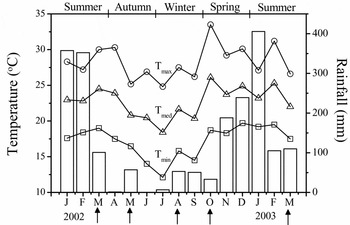
The non-grafted and grafted Obatã individuals were four years old when the diurnal course of leaf gas exchange and Ψleaf was measured. The experiment was carried out from March 2002 to March 2003. Monthly meteorological data such as rainfall, maximum, medium and minimum air temperature, and the total diurnal hours of sunshine during the experimental period were obtained from national meteorological station number 83726, 12 km from the experimental area. High rainfall occurred in summer (January to March) when the sunny (2002) and cloudy (2003) diurnal course of leaf gas exchange and Ψleaf was measured (Figure 1). Coffee plants were growing under minimum soil water stress in summer because monthly rainfall was between 100 and 300 mm. Measurements were made in autumn and winter when the monthly rainfall was 50 mm, and in spring, at the peak of dry season, when monthly rainfall was below 33 mm.
Monthly average values of maximum (Tmax), medium (Tmed) and minimum (Tmin) air temperature (symbols), and monthly total rainfall (columns) from January 2002 to March 2003. Sunny diurnal courses of leaf gas exchange and leaf water potential were measured in summer (March), autumn (May), winter (August) and spring (October). The cloudy diurnal course was measured in summer 2003 (March). Arrows indicate the diurnal course dates.

The diurnal course in summer was measured on sunny (8 March 2002) and cloudy (18 March 2003) days. The autumn sunny diurnal course was measured on 3 May 2002, at the transition from rainy to dry period. During dry periods, the sunny diurnal course was measured in winter on 27 August 2002 and in spring on 18 October 2002. The predawn (Ψpd) leaf water potential was determined at 05:00 hours in the wet period (8 March 2002) and at the peak of the dry period (18 October 2002).
Micrometeorological, leaf gas exchange, and water potential determinations
A portable infra red gas analyser (IRGA) model LCA-4 (ADC, Hoddesdon, UK) connected to a Parkinson narrow leaf chamber PLCN-4 (ADC) was used to obtain leaf-to-atmosphere gas exchange. Microclimate data during diurnal courses such as air temperature and relative humidity at the site of the experiment were obtained using the PLCN-4 opened in shade and free of leaves. The PLCN-4 had a quanta sensor on the top to determine the photosynthetic photon flux density (PPFD). Ambient air temperature during the diurnal courses was monitored with a regular thermometer placed in shade. Leaf temperature was determined by a copper-constantan thermocouple connected to PLCN-4. The leaf chamber temperature was maintained equal to the air temperature during the day by a Peltier system (ADC) attached to PLCN-4.
The gas exchange parameters obtained during the diurnal courses were net photosynthesis (PN), transpiration (E) and stomatal conductance of water vapour (gs). The LCA-4 worked as an open system during gas exchange measurements comparing CO2 and H2O molar fractions before and after passing through PLCN-4. The instantaneous water use efficiency (WUE) was determined as PN/E (Nogueira et al., Reference Nogueira, Martinez, Ferreira and Prado2004). The values of Ψleaf and Ψpd during diurnal courses were obtained by pressure chamber model 3005 (Santa Barbara Soil Moisture, Santa Barbara, USA). Ψleaf was measured immediately after leaf gas exchange determinations during the day. The values of VPD during diurnal courses were calculated using the equation described by Jones (Reference Jones1992).
The leaf gas exchange, Ψleaf, PPFD and VPD measurements were carried out at two-hourly intervals from 06:00 to 18:00 hours. Two non-grafted and two grafted individuals growing in different lines under field conditions were used in every determination of leaf gas exchange and Ψleaf. On each plant two branches totally exposed to solar irradiance were chosen and two completely expanded and healthy illuminated leaves were selected. These leaves were usually the third leaf pair from the apex on a plagiotropic branch in the upper third of plant canopy.
Net photosynthesis as a function of PPFD
The PN-PPFD curves were obtained using IRGA LCA-4 and PLCN-4 described previously. The net maximum photosynthetic rates (PNmax) obtained from the PN-PPFD curves for wet and dry periods were used to estimate the integrated potential diurnal net CO2 assimilation (IPPN) around midday as described below. The PLCN-4 was connected to a PLU-002 light source with a halogen 12 V 20 W dichroic lamp (ADC, Hoddesdon, UK). The leaf temperature (Tleaf) was maintained with a Peltier system at 25±0.5 °C during PN measurements. The PPFD intensity was attenuated by reducing the voltage on PLU-002 and by fitting neutral glass filters (Comar Instruments, Cambridge, UK) in the PLCN-4 chamber between leaf and light source. Measurements from two grafted and two non-grafted plants were used to produce the PN-PPFD curves. For each plant two completely expanded and healthy sun-leaves were chosen on plagiotropic branches in the upper third of the plant canopy. The PN-PPFD curves were carried out at a favourable time for plant CO2 assimilation (07:00–09:00 hours) in the wet period on 1 and 26 March 2002, and in the dry period on 8 August 2002. Two PN-PPFD curves were obtained for each treatment (non-grafted and grafted plants) in wet and dry periods. The two PN-PPFD curves for each treatment were merged. The values of merged PN-PPFD curves were adjusted using the equation described by Prado and Moraes (Reference Prado and Moraes1997):

where PN = net photosynthesis (μmol m−2 s−1); PNmax = net maximum photosynthesis (μmol m−2 s−1); e = natural logarithmic base; k = constant of proportionality; PPFD = photosynthetic photon flux density (μmol m−2 s−1); and Lc = light compensation point (μmol m−2 s−1).
The PPFD value when PN achieved 90% of PNmax (equation 1) was termed the light saturation point (Ls, μmol m−2 s−1) as described by Prado and Moraes (Reference Prado and Moraes1997).
Midday depression of diurnal photosynthesis
The integrated values of PN during diurnal courses (IPN) were calculated on sunny days in summer and in spring, because the average values of PN around midday (10:00 to 16:00 hours) were significantly different (p < 0.05) between grafted and non-grafted treatments. IPN was determined from 10:00 to 16:00 hours on sunny days of summer and spring using equation 2 (Kikuzawa et al., Reference Kikuzawa, Shirskawa, Suzuki and Umeki2004; Prado et al., Reference Prado, Passos and Moraes2001; Ronquim et al., Reference Ronquim, Prado, Novaes, Fahl and Ronquim2006):
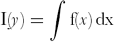
where x = independent variable, time interval in seconds from 10:00 to 16:00 hours during diurnal courses; I(y) = integrated y value; and f(x) = the dependent variable (PN).
IPN expresses the net CO2 assimilation in leaves limited by ambient and internal plant impediments such as high VPD and Ψleaf, respectively (Prado et al., Reference Prado, Passos and Moraes2001). Integrated potential CO2 assimilation (IPPN) represents the diurnal assimilation in leaves limited occasionally only by PPFD (Kikuzawa et al., Reference Kikuzawa, Shirskawa, Suzuki and Umeki2004). IPPN around midday (10:00 to 16:00 hours) was calculated in two steps. First, the PNmax obtained from the PN-PPFD curve and the values of PPFD determined during the diurnal courses were applied in equation 1 to determine the expected net CO2 assimilation at every measurement between 10:00 and 16:00 hours. These predictable PN values around midday were subsequently integrated using equation 2 resulting in IPPN. From the contrast between IPN and IPPN it was possible to estimate how much non-grafted and grafted plants reduced the net CO2 assimilation as a function of environmental and internal impediments around midday (10:00 to 16:00 hours).
Statistical analysis
Differences in average values of PPFD, E, gs, Ψpd, Ψleaf, WUE and PN at each time of the diurnal courses, and PNmax, and Ls from the PN-PPFD curves between grafted and non-grafted treatments were tested considering significant those differences with decision level (α) at p < 0.05. Significant differences were tested by Student's t-test when the data showed normal distributions or by non-parametric analysis (Mann-Whitney) when they showed abnormal distributions.
RESULTS
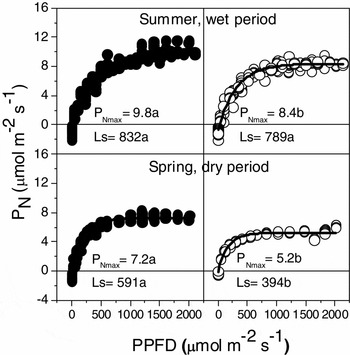
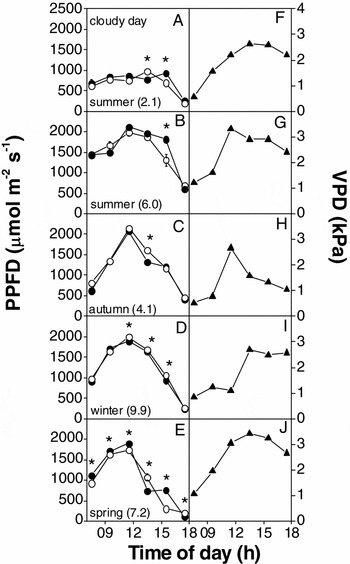
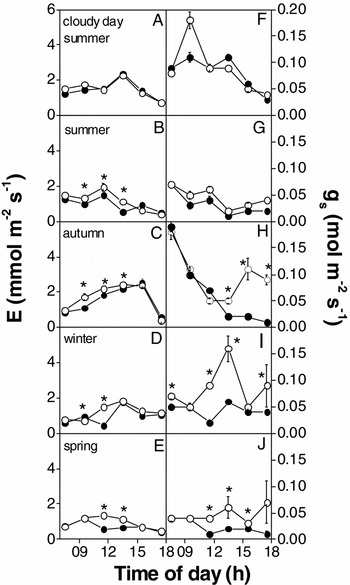
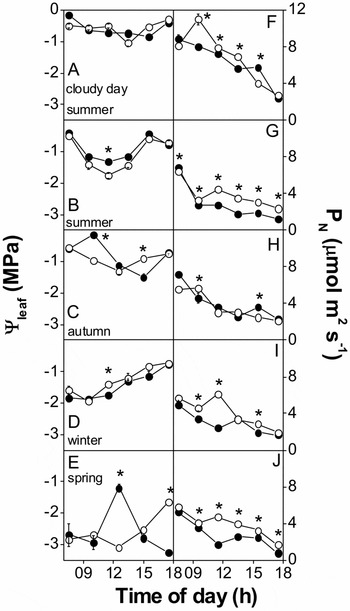
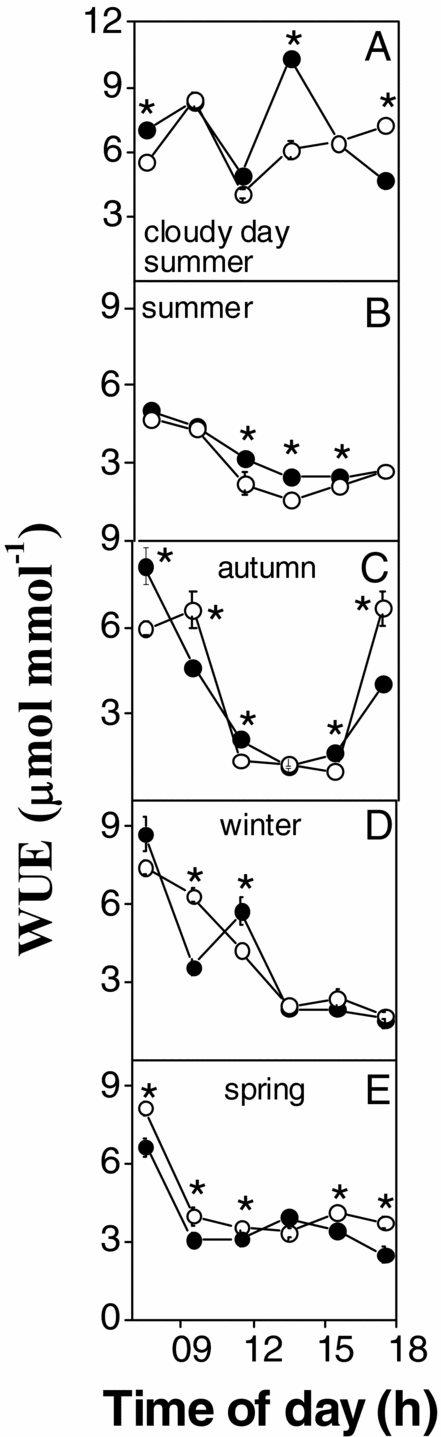
Values of PNmax and Ls were higher in wet than dry periods in both treatments (Figure 2). The values of PNmax in non-grafted and grafted treatments were, respectively, 9.8 and 8.4 μmol m−2 s−1 in the wet period and 7.2 and 5.2 μmol m−2 s−1 in the dry period. These values were significantly higher in non-grafted than grafted plants in both periods. The values of Ls in non-grafted and grafted treatments were, respectively, 832 and 789 μmol m−2 s−1 in the wet period, and 591 and 394 μmol m−2 s−1 in the dry period (Figure 2). Ls was significantly higher in non-grafted than in grafted plants only in the dry period. Some values of PPFD were not similar (p < 0.05) between non-grafted and grafted plants during the diurnal courses (Figure 3A–E), although they were higher than Ls (Figure 2) in the majority of daytimes in both treatments. The most favourable condition for leaf gas exchange occurred on summer cloudy days (wet period) because PPFD was not excessive (500–1000 μmol m−2 s−1, Figure 3A), VPD was lower than 3 kPa around midday (Figure 3F), and there was more water available in soil from rainfall (Figure 1). Despite low PPFD on cloudy days, irradiance intensity was enough to maintain gs and PN at high rates (Figures 4F and 5F) but under leaf transpiration lower than 2.1 mmol m−2 s−1 (Figure 4A) and Ψleaf higher than −1.0 MPa (Figure 5A) during the cloudy diurnal course in both treatments. Grafted plants showed significantly higher values of PN than non-grafted ones around midday on cloudy days (Figure 5F). Despite the greater values of PN around midday, grafted plants showed significant lower values of WUE in almost the entire cloudy diurnal course (Figure 6A).
Net photosynthesis (PN) as a function of photosynthetic photon flux density (PPFD) on leaves of non-grafted (●) and grafted (○) C. arabica over C. canephora during early morning in summer (March 2002, wet period) and spring (October 2002, dry period). The values of maximum net photosynthesis (PNmax, μmol m−2 s−1) and light saturation point (Ls, μmol m−2 s−1) are shown at the bottom in each panel. Two curves were merged in each panel before adjustment. Significant differences (p < 0.05) in PN and Ls values between treatments in the same period are indicated by different letters.

Diurnal courses of photosynthetic photon flux density (PPFD) and vapour pressure deficit (VPD) on leaves of non-grafted (●) and grafted (○) individuals of C. arabica on cloudy (March 2003, A and F) and sunny (March 2002, B and G) summer days, and during sunny days in autumn (May 2002, C and H), winter (August 2002, D and I), and in spring (October 2002, E and J). The numbers in brackets represent the total hours of sunshine in each day. Circles represent average values, bars denote s.e. and asterisks indicate significant differences (p < 0.05) between non-grafted and grafted treatments at each time of the diurnal courses.

Diurnal courses of leaf transpiration (E) and stomatal conductance (gs) in leaves of non-grafted (●) and grafted (○) individuals of Coffea arabica on cloudy (March 2003, A and F) and sunny (March 2002, B and G) summer days, and during sunny days in autumn (May 2002, C and H), winter (August 2002, D and I), and in spring (October 2002, E and J). Circles represent average values, bars denote s.e. and asterisks indicate significant differences (p < 0.05) between non-grafted and grafted treatments at each time of the diurnal courses.

Diurnal courses of leaf water potential (Ψleaf) and net photosynthesis (PN) in leaves of non-grafted (●) and grafted (○) individuals of C. arabica on cloudy (March 2003, A and F) and sunny (March 2002, B and G) summer days, and during sunny days of autumn (May 2002, C and H), winter (August 2002, D and I) and spring (October 2002, E and J). Symbols represent average values, bars denote s.e. and asterisks indicate significant differences (p < 0.05) between non-grafted and grafted treatments at each time of the diurnal courses.

Diurnal courses water use efficiency (WUE) in leaves of non-grafted (●) and grafted (○) individuals of Coffea arabica on cloudy (March 2003, A) and sunny (March 2002, B) summer days, and during sunny days of autumn (May 2002, C), winter (August 2002, D) and spring (October 2002, E). Symbols represent average values, bars denote standard error and asterisks indicate significant differences (p < 0.05) between non-grafted and grafted treatments at each time of the diurnal courses.
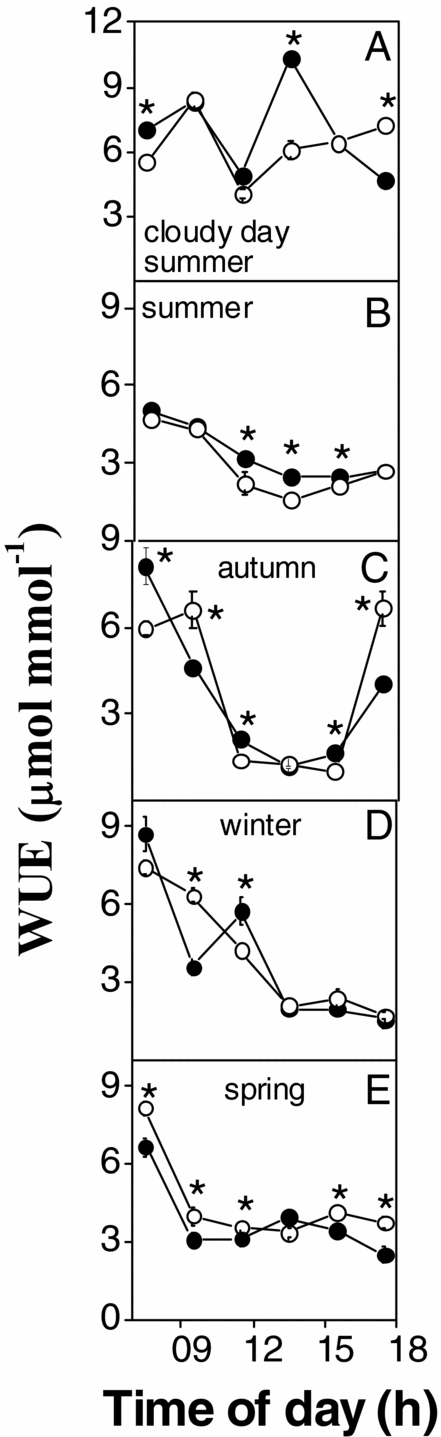
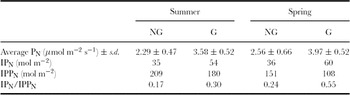
Excessive values of PPFD around midday occurred in sunny diurnal courses (around 1500 μmol m−2 s−1, Figure 3B–E). Besides, VPD values were higher than 3 kPa around midday in sunny days of summer and spring (Figure 3G and 3J). Under these stressful environmental conditions grafted plants showed significantly (p < 0.05) higher values of gs around midday in autumn, winter and spring (Figure 4H–J), higher values of E around midday in sunny daily courses in all seasons (Figure 4B–E), and greater values of PN around midday during summer, winter and spring (Figure 5). When VPD was greater than 3 kPa around midday in summer and spring (Figure 3J and 3J, respectively), there were lower values of Ψleaf (Figure 5B and 5E) in grafted than non-grafted plants. Grafted plants showed significantly lower values of WUE around midday in summer (Figure 6B), but the differences between treatments during the daily courses was reduced towards spring. Significantly higher values of WUE in grafted than in non-grafted plants during the entire diurnal course occurred only at the peak of the dry season in spring (Figure 6J). Average (±s.e.) values of Ψpd of non-grafted and grafted plants were, respectively, −0.60 ± 0.90 and −0.52±0.17 MPa in the wet and −1.41 ± 0.32 and −0.53 ± 0.28 MPa in the dry period. There was a significant difference (p < 0.05) between treatments about Ψpd only in the dry period. The mean values of PN were significantly different between grafted and non-grafted plants during the stressful daytimes from 10:00 to 16:00 hours in summer and spring sunny daily courses (Figures 5G and 5J), when IPN, IPPN and the ratio IPN/IPPN around midday were higher in grafted than in non-grafted plants (Table 1).
Integrated net photosynthesis (IPN) and integrated potential net photosynthesis (IPPN) from 10:00 to 16:00 hours during sunny days of summer and spring, when average values of net photosynthesis (PN) were significantly different (p < 0.05) between non-grafted (NG) and grafted (G) individuals of Coffea arabica.

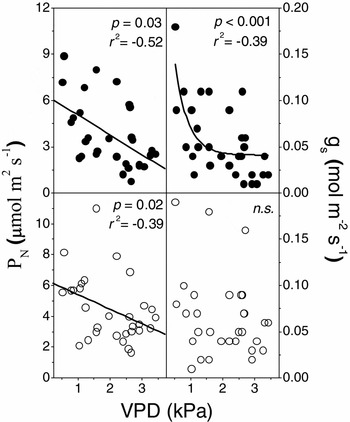
PN showed linear decrease with VPD in both treatments, although the value of r 2 was significant higher (p < 0.05) in non-grafted than in grafted treatment (Figure 7). In contrast, gs decreased exponentially with VPD in non-grafted plants and there was no significant relationship between gs and VPD in grafted individuals (Figure 7). Therefore, VPD did not affect significantly the values of gs in grafted plants considering the pool of data obtained during the year.
Average values of net photosynthesis (PN) and stomatal conductance (gs) as a function of vapour pressure deficit (VPD) on leaves of non-grafted (●) and grafted (○) individuals of Coffea arabica. Data were obtained during cloudy and sunny days in summer and during sunny days in autumn, winter, and spring under field conditions. n.s = not significant.

DISCUSSION
The favourable conditions observed on cloudy days in summer attenuated the midday depression of coffee plant photosynthesis. Indeed, Ronquim et al. (Reference Ronquim, Prado, Novaes, Fahl and Ronquim2006) observed that irradiance attenuation during cloudy days increased the diurnal carbon assimilation of C. arabica in relation to sunny days in wet periods. The values of E, gs, Ψleaf and PN agree with those found by Ronquim et al. (Reference Ronquim, Prado, Novaes, Fahl and Ronquim2006) in non-grafted plants of C. arabica (cv. Catuaí) in similar cloudy conditions. The behaviour of leaf gas exchange and Ψleaf in grafted and non-grafted C. arabica plants on cloudy days could be associated with their origin in the understory of high altitude tropical forests in Ethiopia. Reduced PPFD, VPD and the number of hours of sunshine are common during the whole year in Ethiopian forest (Marin et al., Reference Marin, Angelochi, Righi and Sentelhas2005), where the average annual air temperature and rainfall are 20 °C and 2000 mm, respectively (Carr, Reference Carr2001). On the other hand, grafted plants showed higher PN than non-grafted ones around midday during cloudy diurnal courses. Therefore, grafting is important to carbon uptake even in the wet season when water availability to roots and atmospheric conditions are favourable to PN as happened in cloudy days in summer.
High PPFD and VPD around midday resulted in great differences between grafted and non-grafted plants in sunny diurnal courses. Grafted plants had lower midday depression than non-grafted ones under more severe water stress in atmosphere or in soil. Less susceptibility of grafted than non-grafted treatment to midday depression was revealed by lower values of Ψleaf associated with higher values of PN and E in sunny days of summer and spring and by higher values of gs around midday in autumn, winter and spring. The differences in E, gs, PN and Ψleaf between treatments were even higher in dry periods (winter and spring). Indeed, grafted plants showed WUE values significantly higher than non-grafted treatments at the peak of the dry season in spring. The better performance of grafted plants, principally in the dry period, could be linked to the bigger and deeper root system of C. canephora, which could acquire water at a rate that C. arabica could not (Fahl et al., Reference Fahl, Carelli, Menezes, Gallo and Trevelin2001). In fact, grafted plants showed great capacity to restore leaf water status during the night in dry periods, when predawn leaf water potential in non-grafted and grafted plants was −1.25 and −0.52 MPa, respectively. Therefore, these physiological performances in grafted plants resulted in a better tolerance to soil and atmospheric water stresses, making them able to support higher rates of leaf gas exchange and greater tension in the xylem water column than non-grafted individuals.
The diurnal carbon assimilation in trees is usually influenced by midday depression of leaf gas exchange (Kikuzawa et al., Reference Kikuzawa, Shirskawa, Suzuki and Umeki2004). Coffea plants were able to hold IPN/IPPN near 1.0 in the absence of midday depression on a cloudy day (Ronquim et al., Reference Ronquim, Prado, Novaes, Fahl and Ronquim2006). Therefore, midday depression of leaf gas exchange was responsible for values of IPN/IPPN ratio lower than 0.55 in non-grafted and grafted plants. Midday depression in C. arabica growing in an open field in southeast of Brazil was also observed by Barros et al. (Reference Barros, Mota, DaMatta and Maestri1997), who showed that gs was high during the morning but decreased as air temperature and VPD increased after midday in summer. Minor susceptibility to midday depression of leaf gas exchange was confirmed by IPN/IPPN ratio two times higher in grafted than in non-grafted plants around midday in summer and spring. The values of E, gs, Ψleaf and PN of sunny diurnal courses agree with those found by Fahl et al. (Reference Fahl, Carelli, Menezes, Gallo and Trevelin2001) in grafted C. arabica over C. canephora and non-grafted plants (cv. Catuaí) between 08:00 and 12:00 hours during a sunny day in open fields. These authors also observed higher PN, gs and E values in the grafted plants.
The behaviour of water relations and PN during diurnal courses demonstrated that grafting on C. canephora is appropriate to increase the carbon balance of C. arabica and may result in higher vegetative and reproductive growth. Indeed, adult grafted C. arabica plants showed greater height, number of plagiotropic branches and grain production than non-grafted plants under field conditions (Fahl et al., Reference Fahl, Carelli, Menezes, Gallo and Trevelin2001). Lower susceptibility of grafted plants to midday depression as a result of better tolerance to soil and atmospheric water stress could contribute to better development and higher productivity of Coffea arabica during the year. The weaker connection between PN and VPD and the independence of gs in relation to VPD in grafted plants confirm the successes of grafting against water stress.
Conditions occurring on cloudy days are the opposite of the expected trend of climate in the future, i.e. projected simultaneous increase of air temperature and VPD in Brazil. The projected mean warming for Latin America for 2100 ranges from 1 to 6 °C according to different climate models (Bates et al., Reference Bates, Kundzewicz, Wu and Palutikof2008). In fact, low water availability in the rhizosphere and unfavourable temperatures during global climate change will be the major limitations to coffee production (DaMatta and Ramalho, Reference DaMatta and Ramalho2006) in Brazil even under irrigation (Assad et al., Reference Assad, Pinto, Zullo Junior and Ávila2004). The increase of air temperature from 1.0 to 5.8 °C will induce an increase of 40–100% of unsuitable areas for Coffea plantations in the Brazilian states of Goiás, Minas Gerais and São Paulo, limiting appropriate areas to the south of Paraná state (Assad et al., Reference Assad, Pinto, Zullo Junior and Ávila2004). Grafted plants were less affected by drought since they showed greater tolerance to water stress in atmospheric and in soil and lower dependence of PN and gs to VPD during the year. Therefore, grafting C. arabica over C. canephora is highly recommended in a future climate change, when air temperature and evaporative demand in atmosphere will increase simultaneously.
CONCLUSIONS
Higher values of PN in grafted compared to non-grafted plants around midday showed that grafting was important even when environmental conditions were favourable in field conditions. Moreover, lower midday depression in grafted plants on sunny days confirmed that grafting is suitable to maintain the carbon uptake against environmental stresses. The differences in leaf gas exchange and leaf water potential in favour of grafted plants were higher in dry periods (winter and spring). Indeed, the IPN/IPPN ratio in grafted was double that in non-grafted individuals around midday in sunny periods in summer and spring. Low susceptibility of grafted plants to midday depression should contribute to better development and higher productivity during the year. In addition, low dependence of PN and gs on VPD in grafted C. arabica over C. canephora showed that grafting is strongly recommended under future climate scenarios in Latin America.
Acknowledgments
This work was supported by Brazilian agencies FAPESP and CNPq with scholarships to authors PN and CHBA, respectively. The federal agency FNMA furnished us with equipment and the state research institute IAC provided plant materials and plant husbandry. We are grateful to Julio Cesar Ronquim, Carlos Cesar Ronquim and Carlos A. Casali for assistance in field and to Joel I. Fahl for showing us the area of study.