In 1881 two women who were to become part of the history of Victorian feminism met: Constance Maynard (1849–1935), graduate of one of the first cohorts of women to enter Girton College and founder in 1882 of Westfield College for Women, and Bessie Rayner Parkes Belloc (1829–1925), friend of Barbara Leigh Smith Bodichon and the “Langham Place” group of feminists, and former editor of the feminist English Women's Journal.Footnote 1 In 1873 Maynard became the first woman in England to receive a degree in “moral sciences,” from Girton, and subsequently worked for six years as a headmistress and schoolmistress at two groundbreaking girls' schools, Cheltenham Ladies' College and the new St. Leonard's School in Scotland. When she met Belloc, she was living in London with her brother, taking art classes at the Slade School, and beginning discussions that would lead to the foundation of Westfield College, formed as an explicitly Evangelical-identified parallel to ecumenical Girton and also as the first college to prepare women for the examinations and degrees offered by the University of London.Footnote 2
The two women were thus at different stages of their lives: the one-time feminist, Unitarian activist Bessie Parkes had become the widow Madame Belloc, a Roman Catholic convert returned from France with two children (who would become the popular writers Hillaire Belloc and Marie Belloc Lowndes). The devoutly Evangelical Anglican, unmarried Maynard was on the threshold of a long career as the first “mistress” of Westfield. Already a veteran diary-keeper, she was also discovering the pleasures of writing for an audience: “I have been writing a paper on the Culture of the Intellect to be read on October 5th before the C[hristian] W[omen's] Union,” she records. “It is not yet finished, but the plan lies mentally before me, & affords the truest interest and pleasure in working it out.”Footnote 3
While we might like to imagine Maynard and Belloc exchanging stories about their experiences of activism on behalf of women, according to Maynard's diary entry at the time and her inclusion in the autobiography, some forty years later, of their “long & … solemn conversation” they bonded as spiritual seekers rather than social reformers.Footnote 4 They shared this orientation with their hostess, Elizabeth Rundle Charles, a successful Anglican novelist and writer of hymns. Approaching the Catholic Belloc with some caution, Maynard recalls being won over: “I was entirely convinced of her faith, strange & wayward being that she was, & I felt I might speak openly, & we talked of Moody & Sankey's work, & of the Salvation Army, & various other unlikely topics.” At the conversation's climax, Maynard, who had seized every opportunity to proselytize at Girton, described her conversion of a fellow student, prompting from Parkes the sad confession that “Not one case [of conversion] have I ever seen right through.”Footnote 5 Like many of Maynard's autobiographical anecdotes, this one concludes on a surprisingly melancholy as well as a religious note: “I felt sad at [Belloc's] sense of complete failure” (AB [January–July 1881] 68).
This brief anecdote highlights key features of Maynard's autobiography: the omnipresence of religion as a conduit of personal connection, particularly with other women; a strong sense of failure and inadequacy, both others' and her own; and the close dependence of the autobiography on the detailed diaries, large parts of which she often transcribed.Footnote 6 Recording her life in forms both private and published remained one of Maynard's preoccupations throughout her life. From adolescence on, she kept both diaries that recorded exterior events and what she called her “Green-book” diaries (after the green leather bindings of the original volumes) exploring her spiritual and emotional, or what she called the “inner,” life. In legible cursive in a series of lined notebooks, the Green-books provide a copious account of her intellectual challenges as a student, her managerial challenges as a principal, and—with surprising frankness—her often tortured homoerotic involvements with colleagues and students. Upon her retirement, she drew on these extensive materials—now in nineteen boxes in the archives of Queen Mary College, University of London—to produce an unfinished autobiography of over six hundred haunted and halting pages, in search of a conclusion that ends only with her death.Footnote 7
Since the 1985 publication of Martha Vicinus's Independent Women: Work and Community for Single Women, 1850–1902, which draws on these materials for two chapters on Maynard and the homosocial world of girls' and women's education, this archive has been returned to repeatedly by feminist and queer scholars, particularly historians. Most recently, she has been the subject of a special issue of the Women's History Review, “Love, Desire, and Melancholy: Inspired by Constance Maynard” (2015), and a full-length biography by Pauline Phipps, Constance Maynard's Passions: Religion, Sexuality, and an English Educational Pioneer, 1849–1935 (2015). As a subject, however, Maynard produces as much ambivalence as enlightenment. The editors of the Women's History Review issue approach her cautiously, warning that “the need to critically interrogate the more questionable dimensions of women's actions without ‘glossing’ over or excusing them is brought into stark relief by the extant historiography on Maynard.”Footnote 8 As the privileged daughter of a wealthy businessman who made his fortune through the extractive industries of English imperialism in Africa; a devout Evangelical who held to the most stringent dogma of her denomination long after its mainstream had embraced moderation; and a powerful personality prone to harsh judgments and impossible demands, Maynard embodies ideologies of class- and race-supremacy in Anglo-American feminist history that belie its gender egalitarianism. Thus for every recovery of Maynard as a first-wave pioneer who “opened opportunities for the future, seized by so many women,”Footnote 9 there is a skeptical analysis of her implication in the “evangelical, racial and eugenic ideas about character”Footnote 10 that framed her relationship with the Italian girl whom she adopted from the care of the Salvation Army, or of the emotionally intense relationships with her Westfield students that Phipps summarizes gently as Maynard's “adopt-[ing] what we today may call an inappropriate role as an educator.”Footnote 11
Maynard's extensive self-representation, in other words, offers scholars an archive that is not internally unified, reliably amenable to narratives of progress, or easily assimilable to models of individual agency. As Elsa Richardson writes,
Instead of making legible a recognisably “lesbian” life wrested from history and made newly visible, the diaries present the modern reader with vexing opacity. … Because Maynard understood her intense relationships with other women through the prism of devout Christian faith, her reflections place us in close proximity to an increasingly unfamiliar theological framework. … Maynard is herself a tricky subject, one who refused any attempt to marry the richness and variety of her personal experience to a straightforward taxonomy. She is a beguiling prospect for the historian, one that presses us to consider whether it is possible to understand the emotional experiences of someone so remote from our present understanding of sexual identity.Footnote 12
Maynard's tendency to tell stories about religious conversion rather than cultural conversion, in other words, makes her a “tricky” subject for contemporary feminism. Nevertheless, the issue's introduction reaffirms Maynard's continued “significance for women's and gender history, the history of religion and the history of the emotions, particularly our understanding of love, sexuality and desire.”Footnote 13 Its six articles, originating in a symposium, range in topic from Maynard's relation to the tradition of spiritual autobiography; to reflections on the challenges and utility of digitizing archives; to the complex connections among her Evangelical beliefs, her pursuit of a career, her implication in imperialist discourses, and her homoerotic relationships.
What this gathering of areas illuminated by Maynard's archive excludes, however, is also notable: the relevance of her large archive to analysis of women's life-writing as a genre. Maynard has been largely absent from the feminist Victorianist scholarship that has transformed our understanding of women's life-writing as literary representation as well as historical resource. “Constance Maynard” as the name of an archive has been an object of historical and biographical inquiry; Constance Maynard as an autograph, the sign of a subject writing her own experience, has been less visible.
Yet Maynard understood herself to a significant degree as a writer; not just a witness to, but more actively a recorder of, history. She circulated her published writings assiduously and preserved her neatly written unpublished writings, both diaries and manuscript autobiography, with care. To take Maynard seriously as a practitioner of autobiography grappling with the limitations and opportunities of the genre, I suggest, can significantly enrich our understanding of the life-writing of Victorian women and begin to reconnect their self-representation to the modernist life-writing practices from which it is often understood to be disjunctive. In this essay, therefore, I offer a reading of Maynard's autobiography as a text that challenges the expectations that we still bring to, and the boundaries we sometimes draw around, the canon of Victorian women's autobiography, and to an extent around autobiography itself. Maynard's autobiography belies expectations of Victorian autobiographical representation in general with its continual emphasis on inadequacy, its investment in unresolved doctrinal conflicts, and its resistance to the transitional vocabularies of selfhood (such as turn-of-the-century sexology and psychology and secular alternatives to Christian ethics) then becoming available. At the same time, Maynard displays little of the modest or reluctant stance that, as Mary Jean Corbett describes, nineteenth-century women religious writers often adopted in bringing themselves before a public audience.Footnote 14 Finally, the visible struggle, shared across the autobiography and diaries, to produce a unified, coherent, and forward-moving self-narrative evinces by its very resistance a sense of fractured and discursively dependent subjectivity that critics have associated more strongly with modernist life-writing.
As an autobiographer, then, Maynard challenges us to think about how our practices of periodization and our ideological investments in narrating change may obscure rather than illuminate the inadequacy of autobiographical narrative to construct coherence, singularity, and forward movement as the foundations of subjectivity. In this way, she can be placed among the group of turn-of-the-century writers whom Max Saunders discusses as exemplifying a “crisis” in autobiographical form:
Autobiography experienced a crisis in the later nineteenth century, partly because its project came to seem impossible. Developments in the form that constantly push towards the limits of self-understanding keep discovering that the self has a perplexing capacity to elude such attempts at description. … It is as if the attempt to establish autobiographical sincerity culminates in an anxiety that sincerity is all the autobiographer can hope for, when knowledge of the self and its world are felt to be dissolving. At the same time, autobiography as a form comes to seem conventional, and its conventionality to preclude the rendering of individuality.Footnote 15
Like Saunders, I suggest that the relationship between Victorian and modernist life-writing is one of development and not of rupture; unlike Saunders, I locate these generic struggles in the practice of a writer who stands at the outskirts of literary recognition then or canonicity now. I argue that Maynard's autobiography, despite its outdated religiosity and its relative obscurity, demonstrates that (1) affective stances, complexities of identity, and self-conscious engagements with genre that we still tend to attribute largely to modern subjectivities have a longer and more complex literary history, and (2) embracing such challenges to our periodizing assumptions—even when they hail us in the form of thousands of unpublished, handwritten pages—will enrich our understanding of Victorian autobiography and selfhood.
The canon of Victorian women's autobiography that has emerged over the last several decades is to a large extent the product of a critical focus on women who successfully left a public mark as activists, writers, or both: for example, the autobiographical narratives of Harriet Martineau (1877), Frances Power Cobbe (1894), and Margaret Oliphant (1899). These narratives often trace a trajectory in which an initial loss or deficit (of orthodox faith, financial security, familial or erotic connection) is transformed into the gain of a public and professional self, as a woman of letters, or in social activism; such women then become, in Laura Marcus's words, “autobiographical models and mentors” for subsequent generations of feminist readers and critics.Footnote 16 In the process, negative affects (loneliness, shame, doubt) and negative effects (loss, failure, disappointment) can remain underacknowledged as features of self-fashioning and self-expression in feminist analysis of Victorian women's life-writing; expressions of what Maynard calls “inadequacy” are displaced from the subject who expresses them to the insufficiency of available cultural scripts. As Marilyn Booth and Antoinette Burton observe, writing (in 2009) of the “number of volumes of collected female lives that the [Journal of Women's History] book reviews editor receives with regularity,” “the recuperative and role-modeling ‘moment’ of feminism seems never to be over.”Footnote 17
In the last several decades, however, queer theorists such as Heather Love and Jack Halberstam have directed attention to negative affects associated with the history of gender and sexual marginalization and to subject positions not amenable to recuperation as role models. Representation of such affects in relation to norms of gender and sexuality is not, of course, confined to queer narratives; Oliphant's Autobiography, for example, records self-lacerating feelings of maternal failure. But Love argues that because “the experience of queer historical subjects is not at a safe distance from contemporary experience; rather, their social marginality and abjection mirror our own,” contemporary (twentieth- and twenty-first-century) queer theorists and readers have been particularly resistant to recognizing the feelings of backwardness, inadequacy, shame, or isolation in our forebears: “In attempting to construct a positive genealogy of gay identity, queer critics and historians have often found themselves at a loss about what to do with the sad old queens and long-suffering dykes who haunt the historical record. If critics do admit the difficulties of the queer past, it is most often in order to redeem them.”Footnote 18 In response to this absence, Love sketches an “aesthetics of failure” (56) through the writing of fin-de-siècle and modernist authors, including two contemporaries of Maynard, Walter Pater (1839–1894) and Radclyffe Hall (1880–1943). “Rather than denying or trying to ‘get over’ this past,” she suggests, “queer subjects might begin to forge a politics that keeps faith with those who drew back and those whose names were forgotten. … The example of [Walter] Pater's shrinking resistance suggests that we need to rethink the heroics of rebellion and to begin to imagine a politics that incorporates a history of forced exile” (71).Footnote 19
Maynard's autobiography, which falls within this transitional period, likewise shows a queer subject facing the future with “shrinking resistance.” Where Pater laments the loss of a classical ethos and its aestheticized male homosociality, Maynard mourns the erosion of nineteenth-century Evangelical certainty and the concomitant spiritualization of intimacy through which she was accustomed to interpret her passionate connections with women. Despite those connections, her own “forced exile,” to which the autobiography frequently returns, was the loneliness of a Victorian woman who eschewed, or could not make the compromises necessary to create, a conventional domestic life. As the leader of a community of women at Westfield, she conceptualized the companionship she missed in a mixture of erotic and spiritual vocabularies. Recollecting her heartbreak at the failure of her colleagues Anne Richardson and Frances “Ralph” Grey to requite the passionate intensity of her feelings for each of them, she writes:
Love is an awfully serious thing to deal with, & I had it to give in full measure, and was simply starving to receive it. It is all very well to call this loneliness “sex-feeling,” but I can honestly say my thoughts never strayed to a man. I wanted to live thus with my flock in a happy community, but I wanted one life to stand beside me, one heart to pour its fulness into mine, and then I should be amply content. … And still my first thought on waking was “Has He come? No. Do you want him? Yes.” And sometimes there were tears. (AB [1887] 172)
The distinctions she strives to maintain in this passage, between a “sex-feeling” that she conceives as necessarily heterosexual, the homosocial “happy community” of her all-female “flock,” and the primacy of spiritual connection threaten to collapse under the pressure of desire. Yet, as the dismissive reference to “sex-feeling” indicates, she did not find in the twentieth century's outspoken but pathologizing new vocabulary—“what psychoanalysts call by highly disagreeable names, such as ‘the thwarted sex-instinct’” (AB [1882] 3)—an invitation to identification or self-knowledge. To be the subject of a “thwarted sex-instinct,” after all, is no more heroic or successful than to be a failed spiritual seeker, and the vocabularies of sexology and psychology offered a considerably less elevated, familiar, and richly historical standpoint for self-conception than the Evangelical framework in which she had spent her life.Footnote 20
There was, however, another aspect of identity crucial to Maynard's self-concept and her oscillating feelings of shame and triumph, success and failure: the identity of the writer. Maynard began the autobiography after her retirement from Westfield in 1913, working on it in fits and starts during two broad intervals, 1915–19 and 1924–33, alongside other writing—diaries; tracts and religious poetry; articles in religiously inflected journals such as The Contemporary Review and The Hibbert Review; a book-length poem, A True Mother (1916); and a religious biography.Footnote 21 The autobiography records her conviction, entered in her Green-book at the age of twelve, that she was “singled out for something of the lonely post of a prophet.” Looking back she adds, “when I am dead I believe I shall ‘yet speak’ & stretch out a helping hand to many souls in trouble” (AB [1860–62] 29). In her forties she finds that “The severest crisis is allayed and turned aside if I can but write; the sharpest grief has its edge a little blunted, prayer is turned into reflection, aspiration is stopped half way and returned, and love flutters down and sinks to rest.” This comfort is immediately qualified, however, by doubt about the sincerity of self-representation: “Energy of all kinds expended in attempting to make an accurate portraiture of itself,—oh, miserable aim, oh hollow failure, why has the snare bound me so long?” (GB, 7 October 1886). Ambition and a sense of abject failure continue to alternate in Maynard's reflections on her own writing process. “Perhaps,” she reflects in a late Green-book, “after all this life-time of hope, I am not called to be a prophet? Perhaps I am to do no public work, but live in dumb obedience?” (GB, 18 January 1924). Only a few pages later, she imagines herself as “the real herald of a clearer dispensation, I want to be in religion what John Locke was in philosophy” (GB, 23 March 1924).
Though Maynard came to feel that the autobiography could not be published during her lifetime (GB, 3 September 1916), she continued to “have the increasingly strong feeling that the experiences of my life are not mine alone but are to be held in trust for other people” (GB, 10 November 1929) and to plan for its posthumous appearance (GB, 8 January 1934). She regretted having burnt most of her correspondence on leaving Westfield (AB [1912–20] 669). She left her manuscripts to no fewer than five literary executors who were former students or colleagues, one of whom, Catherine B. Firth (herself a historian), dutifully drew on them to publish the first biography of Maynard, fulfilling at least part of her hope that “when I have died someone would re-edit my works as I am doing for Dora Greenwell” (GB, 25 May 1927).
In her wish to preserve and narrate the story of a woman's life lived in a time of cultural change, Maynard was not unusual. The last third of the Victorian and first third of the Edwardian periods saw a surge in published autobiographies by women—such as Harriet Martineau (1877), Frances Power Cobbe (1894), and Margaret Oliphant (1899)—and biographies and memoirs by and about women writers, educators, and activists, from relatively obscure reminiscences such as Annie Ridley's Frances Mary Buss and Her Work for Education (1896), to John Cross's mythifying George Eliot's Life, as Related in Her Letters and Journals (1885), to Ray Strachey's still-consulted account of the suffrage movement, The Cause (1928). Maynard herself wrote and self-published a biography of the Anglo-Catholic poet and religious writer Dora Greenwell (1926). However, Maynard is unusual in the emotional frankness and self-scrutiny of the recollections that she contemplated making public and deliberately preserved. By contrast, two of the subjects of her passionate attachments who were also educators, Louisa Lumsden, a fellow student at Girton who brought Maynard to teach at St. Leonard's, and Frances “Ralph” Gray, Maynard's Westfield colleague, published reminiscences in the 1930s that avoid personal revelation and particularly elide the intimacies she details. The title of Gray's memoir, And Gladly Wolde He Learne and Gladly Teache: A Book about Teaching and Learning (1931), effectively telegraphs its impersonal contents. Likewise, Lumsden's Yellow Leaves (1933) focuses largely on the public-facing side of her career as a suffragist.
Though many of these works draw on a variety of materials, including diaries and letters, and combine a first-person self-representation with third-person memoirs of other notable figures, Maynard's composition and archiving practices are also more extreme in this regard. The totality of her archives challenges the conventional generic distinctions that Martin Hewitt identifies as “the contrast between the simple compositional structure of the diary, rooted in its dailiness, and the complex strategies of self-representation available to the autobiography; between the diary as ‘natural’ and the autobiography as ‘artful’; between the diary as open and plotless and the autobiography as predicated on emplotment and a search for closure; between the diary as introspection and the autobiography as projection; between the diary as a private mode and the autobiography as a public mode.”Footnote 22 Indeed, Maynard's composition of multiple, simultaneous diaries, separating spiritual from mundane records, and her reworking of the material of those diaries in the autobiography, illustrate the limitations of such contrasts. The two genres of life-narrative, for Maynard, are closely connected: she often copies large portions of the diaries into the autobiography; at the same time, the work of writing the autobiography becomes part of the narrative of her concurrent diaries. Her careful preservation, and the unifying status of autobiography and Green-books as archival materials now available for scholarly consultation, all mean they do not map neatly onto a distinction between public and private modes or between retrospection and projection.
One of the few critics to address Maynard specifically as a writer is Elisabeth Jay, in an analysis of her relationship to the tradition of spiritual autobiography. From this perspective, Jay regards a number of the idiosyncratic features of Maynard's archive as aesthetic and even as partly ethical failures. The autobiography, in her view, is a “sprawling, inchoate manuscript” that is “rambling, repetitive, but intense.”Footnote 23 Because of its reliance on the diaries, “there is very little evidence of a detachment sufficient to allow for recognition and evaluation of her earlier selves” (10). She also finds the autobiography inconsistent in its literary merit (the “vivid vignettes” do not provide “continuous fine writing”), historical salience (Maynard's “objective contribution to women's higher education” does not “attain [in the autobiography] the prominence it deserves”), and individual exceptionality (“her [religious] struggle, though more intensely felt, was not dissimilar from that encountered by many contemporary Christians”) (11). Maynard's text is, in this account, a generic failure.
However, rather than find the autobiography wanting according to these familiar and still to some degree normative criteria, I am suggesting that we might recognize its potential to expand our expectations of life-writing by dislodging or complicating them. Dispersed across multiple texts and genres, Maynard's life-narrative in its totality can be approached as what Roland Barthes calls, in another context, a “readerly” text, one that can be assembled differently and anew by each new reader.Footnote 24 It can also be read as a rejoinder to a frequent plot of Victorian life-narratives, in the form of fiction or autobiography, in which religious doctrine becomes, implicitly or explicitly, an atavistic force from which the protagonist must escape into modernity by discovering or creating a more or less secular, individualized ethical paradigm. The Mill on the Floss and Father and Son, for example, both exhibit this trajectory. As Saunders writes, such plots often represent “a radical transformation of the conversion narrative: the narrative of ‘de-conversion’. … It isn't just that autobiography of this period is drawn towards the story of deconversion; but that in the wake of deconversion, hope is offered by the religion of autobiography.”Footnote 25 For Maynard, however, the purpose of writing was always to lead back toward, never to replace, conversion and religious belief.
Maynard's literary education, heavy on the reading of biographies of religious figures (most novels, in this as in many other pious households, were forbidden), collected sermons, and histories of the church, gave her a background in traditions of hagiography and homiletics and prepared her well, if idiosyncratically, for such a project. As an adult, she read secular biographies and autobiographies, such as G. H. Lewes's Life of Goethe (1855) and the autobiographies of John Stuart Mill and Edmund Gosse, as well as exemplars of the Victorian period's other influential form of life-narrative, the bildungsroman, including George Eliot's The Mill on the Floss (1861). All these life histories she found painful in their absence or abandonment of Christian doctrine. She recalls that Lewes's biography of Goethe “by no means increased my liking for him”; and along with The Mill on the Floss it “gave me a good lesson on the worth of Christianity, by exhibiting in clear colors the desolation caused by its absence” (AB [1873] 452). Perhaps surprisingly, she admired John Stuart Mill, whose System of Logic she had studied at Girton, but his Autobiography “saddened [her] by his long fruitless endeavours; why,” she asks, “was there no Christian soul at hand to help such a fine thoughtful lad?” (AB [1875] 476). As late as 1920, when she had begun her own autobiographical project, she was haunted by these narratives of lost faith: “I heard Edmund Gosse speak, & could think of nothing but that heart-rending book, ‘Father & Son,’ & here is the child of those many prayers, ‘our little lamb,’ a complete & satisfied Agnostic” (AB [1920] 88). Her own autobiography continually circles back to the question of how to maintain a strongly doctrinal belief in an age in which, as she observed with distaste, “in many minds Religion is dissolved into Ethics” (AB [1916] 41).
Indeed, it was her failure to fully inhabit religious experience, in the particular form of conversion—what she referred to as an “Interview”—that in her view was the primary failure of both the life and the writing, condemning her to a posture of repeated lamentation. In the last volume of her autobiography, written in 1932–33, she reflects on the summer of 1927: “Was there anything lacking? Outwardly, nothing; inwardly, yes, there was. I was like a child far from home who every day receives by the post some little token of remembrance and affection.” As she continues she slips into the present tense: “By the writing on the parcels [i.e., the “tokens” of the previous sentence] I know from whose hand they come,—but oh! I want an interview! ‘In Thy presence is fulness of joy’—there and no where else is the kind of happiness I long for to be found” (AB [1921] 37). The passage illustrates the peculiar temporality of the autobiography, as she slips between a past “I” of quoted diary material (usually, but not reliably, indicated by quotation marks) and a present-tense “I” of the autobiographer that, as in this case, seems to take on the point of view initially associated with the past self. As represented here, the lack Maynard felt in 1927—of spiritual “fulness of joy”—is felt apparently without abatement in 1933. Maynard does, by contrast, find something closer to satisfaction at those moments, present or past, when her writing itself moves to the foreground and projects her voice to a public audience. That satisfaction is reflected in the last lines of the autobiography, written in 1933 and dated (because reflecting on) “31 Dec. 1927”: “A good year on the whole, & as for writing a remarkably full one. ‘Progressive Creation,’ ‘Then shall we know,’ & the ‘Threefold Revelation,’ are all published books, beside ‘Life in Three Volumes' in the Contemporary & 3 other smaller articles[.] ‘Who art thou, Lord?’ I had reprinted from The Christian, & sent away 200 as a New Year greeting to my friends” (AB [1921–27] 39).
This summary demonstrates Maynard's diverse publishing and circulation practices, which incorporated self-funded publication and gift distribution as well as publications in religious periodicals. It also illustrates a compositional feature of the autobiography, drawn directly from the diary source material, which is an apparently straightforward chronological structure and posture of historical witness. As the manuscript unfolds, however, through several attempts to restart or redirect the narrative after gaps of years, its forward movement is thwarted by the tendency of Maynard's sources to draw her back into the past, and by her difficulty in navigating between a public and a more personal subject position. The autobiography's first beginning appears to posit a confidently retrospective narrative self:
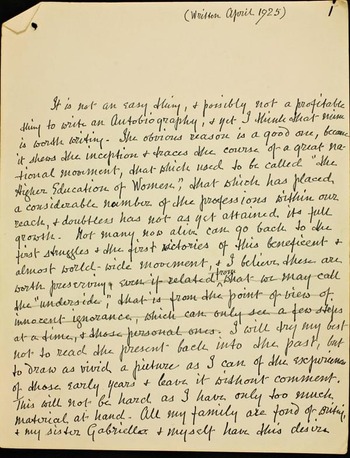
It is not an easy thing, & possibly not a profitable thing to write an Autobiography, & yet I think that mine is worth writing … because it shews the inception and traces the course of a great national movement, that which used to be called ‘the Higher Education of Women.’ … Not many now alive can go back to the first struggles & the first Victories of this beneficent & almost worldwide movement, and I believe these are worth preserving. I will try my best not to read the present back into the past, but to draw as vivid a picture as I can of the experiences of those early years & leave it without comment. … All my family are fond of writing, & my sister Gabrielle & myself have this desire in an almost exaggerated form, as is testified by rows and rows of diaries. … The fact of having these exact records leads me to the second & far more compelling reason why I should attempt an autobiography—my life covers the whole period of the onslaughts of Criticism on Religion. (AB [1849–60] 1–2)
This opening positions the autobiography as a contribution to a positive historical narrative, invoking the promise of an eyewitness and accurate representation (“vivid” and drawing on “exact records”) of important public movements. However, division of purpose creeps in almost immediately. Maynard begins by citing a familiar narrative—“the great national movement … the ‘Higher Education of Women’”—as her impetus for writing, only to add, a page later, a “second & far more compelling”—and also more ominous—focus on “the onslaughts of Criticism on Religion.” The promise to “try not to read the present back into the past” suggests the difficulty for the autobiographer of maintaining the position of distanced retrospection.
Maynard's doubt about striking a distanced stance is further emphasized in a deleted phrase (fig. 1). In the manuscript, the word “preserving” is originally followed by a comma (overwritten in pencil with a period) and a phrase crossed out in pencil: “even if related \from/ what we may call the ‘underside,’ that is from the point of view of innocent ignorance, which can only see a few steps at a time, and those personal ones.” “Even if” suggests a doubt that her own observations, made in ignorance of the historical trajectory of events, can be valuable—they represent merely the “underside” of history, like the knotted side of a carpet whose threads are legible as a pattern only from above. Yet despite recurring concerns that “the purely personal point of view may appear to many inadequate & even trifling,” Maynard remains convinced that “there is no other way in which I personally can offer a contribution to the great & far-reaching history of the whole movement” (AB [1881] 52) than by reliving her experiences through rereading the diaries. The possibility of constructing an independent self-narrative, de novo, does not seriously seem to occur to her. Maynard reflects in the autobiography on her parents' effort to rewrite the entire Anglican Book of Common Prayer to eliminate doctrinally suspect (Roman Catholic) elements, for which she served as “humble scribe”: “Think of the temerity of it; we read no books, we consulted no one, but began at the very beginning of the Morning Service and went straight through the Confession & the Absolution & all” (AB [1870–71] 212–13). Though she recognizes the quixotic nature of this project, her model of composition remains much the same: all writing is rewriting, an effort (prophetic) on behalf of the future that is always beholden to the past.
Manuscript page from Maynard, Autobiography (1881), 52, written April 1925. Reproduced with permission from Queen Mary, University of London Archives.

Intended to provide a unifying framework, then, this opening instead points toward the structural tensions with which the autobiography continues to grapple: between historical and personal narrative; between the “beneficen[ce]” of a public, historical movement and the “underside” of affective investment; between the experiencing and the retrospective selves. That last conflict is redoubled by the evidence of ambivalence introduced by Maynard's editing. Not only is there a division between the “innocent ignorance” of the diary self, who can see only what lies immediately before her, and the retrospectively enlightened, “preserving” self of the present; but there is also a division about how this history should be represented within the autobiographer self—the one who, in 1925, writes these words in a clear black ink, and the one who later (be it minutes or years) thinks the better of them in thick-leaded pencil. Here and elsewhere, we might see this blurring of Maynard's narrative between past and present, memory and event, diary and autobiography less as a failure of detachment in regard to earlier “selves” than as suggesting a different model of the self's plurality: rather than replace one another in a progression toward the present, to arrive at last at a moment of authoritative retrospect, Maynard's selves continue to coexist across time (her long life) and space (her various texts), each jostling for, but never fully achieving, mastery.
Maynard returns to the problems of self-division when she begins the project anew in 1926:
My [original] object was to record as exactly as I could the spirit that animated the very first few years of what in those days was called ‘The Higher Education of Women.’ Well enough do I know that the personal point of view may appear to many inadequate & even trifling, but this is generally the only way in which to secure life and colour in the narrative. … Evidently my own share in this great work was unintelligible unless there was some description of the restrained & yet highly cultured atmosphere of the home from which I came, so the previous twenty years had to be looked up & summarised, before I could enter on the work of my life. This was my thirty-one years of principalship of Westfield College, University of London, & so threaded through and through with characteristic weakness is the whole that I am not sure I shall record it. (AB [1881] 52).
Maynard expresses continued concern that a narrative of personal experience is “inadequate & even trifling” and hesitation over the degree of her self-revelation: “Shall I burn the records of those nights of hot, helpless, hopeless tears?” she wonders, looking back on the Green-book entries recounting her triangulated Westfield relationships with her colleagues (GB, 18 September 1930). Nevertheless, she produces some eight hundred pages covering the Westfield years and keeps her diary records largely intact.Footnote 26 What emerges from this opening, as from the autobiography in toto, is Maynard's understanding of the inextricability of “personal point of view” and historical event. The public, professional, and successful self that founded an institution and led it for thirty-one years, and the inner, affective self, which “often sank back in despair from the sense of utter loneliness that seemed to follow me wherever I went” (AB [1881] 53), are inseparable, and the emphasis on subjective and emotional experience is part of, not distinct from, a narrative that Maynard (ever the evangelist) hopes “may be of [some] use to those who come after me” (AB [1882] 3). The public, adult narrative is also “unintelligible” without information about the “restrained” childhood, and so a narrative perhaps intended to rehearse for Maynard (who had not been keen to retire) the bustle and achievement of her career instead draws her back to the less effective—younger, despairing—selves.
If Maynard continued to feel, as she writes in 1926, that “much of my life is stamped with the single word, ‘Inadequacy’” (AB [1881] 52), the reason is partly that she longed for, even as she recognized the impossibility of, precisely the kind of singular life-narrative, the achievement of “emplotment and … closure” that, as Hewitt suggests, is conventionally attributed to autobiography as against the “open and plotless” form of the diary.Footnote 27 The standard that Maynard felt unable to attain is captured in her diary account of her father's death, which concludes, “There was never anything put on in his life, & so there was nothing to take off at his death. All was in absolutely one straight line. No delusions to rend asunder, no props to fail him, no new things to find out, no old things to disappoint him, but he simply had to lean his whole weight on the things he had known & trusted, & to find that they were strong enough.”Footnote 28 There may be a note of irony in Maynard's admiration for her father's happy ignorance of “new things,” but the belief that the ideal life was lived in “absolutely one straight line” haunts her repeated attempts to generate a narrative that will frame her apparently incompatible desires—for surrender to faith and independence of inquiry, for erotic and spiritual satisfaction, for autonomy and community—as a single and coherent portrait.
The Evangelical tradition contributes to her sense of failure by imbuing self-division with the weight of spiritual error. A divided self must also be an inauthentic one: her early training emphasized the importance of “a genuine correspondence between the mind within & the world without” (AB [1870–71] 193–94). She early experiences the paradoxical effect of this imperative, which produces “private chafing against the endless demand for a sort of cheerful humility in the home life, a demand that always created in me a sense of unreality & even at times of hypocrisy” (AB [1868] 103). As she begins to reread the Green-books from that period of her late adolescence for the purposes of writing the autobiography, she discovers that the inauthenticity she felt penetrates even these volumes that were intended to capture “everything that touched the inner life of the heart and soul” and “kept strictly private” (AB [1849] 2). “I turn over the pages [of the Green-book],” she records, “with a kind of irritation, because [in these pages] I am always trying to like what I ought to like, with a sort of timid conventional feeling” (AB [1867] 97). Maynard's dubiousness about the authenticity of the diaries challenges the conventional assignment of greater sincerity, or at least immediacy, to diaries over the retrospect of memoir. Hewitt, for example, suggests that “diaries challenged autobiographers with an authenticity which magnified the treacheries of hindsight.”Footnote 29 For Maynard, however, no representation can evade an internalized sense of inevitable error. Though “the object of life, I was told [as a child], was to secure Truth,” the effect of this “object” was the illustration of its human impossibility: “ ‘My people are destroyed for lack of knowledge’ [Hosea 4:6]—that I think was dear Father's favorite text. … Explanations of error were endless” (AB [1860–62] 29). The ideal of Truth, the inevitability of error, and the resulting necessity for “endless” explanation underlines the logorrheic intensity of her textual self-representation.
Though the Green-books become less “timid” as Maynard grows older, they also become ever less able to capture the fullness of experience: “In sorrows & empty miseries I come quickly enough to these pages, & every spark of light is caught and recorded, but when life is full & the path is bright, even the best things tend to pass unheeded” (GB, 18 December 1902). The Green-books of the last decade or so of Maynard's life record a litany of complaints about their own inauthenticity: “This record cannot be a true one, because so much is missed out” (21 May 1924); “I have a strange disinclination to write in this book, for I feel as though it would not be true” (23 March 1928). Yet the hindsight of the present-tense autobiographer can no more be relied upon to correct distortions than the prior diary-keeping self was able to prevent them: “I find it a little difficult,” Maynard observes, “to distinguish between what [home life] actually was & my record of it” (AB [1869] 159); later she wonders whether “the really most important events of life, are those most often and vividly brought to one's memory” (AB [1874] 564). No matter how finely Maynard dices her experience, in secular diaries and spiritual ones, in private and in published writings, she remains unable to compose a singular, authentic self.
Because of their interpenetrating and inconclusive form, the Green-books and autobiography together form a set of self-representations that vacillate between ambition and inadequacy without ever settling on either narrative. For every Green-book meditation that concludes with self-castigation, there is an anecdote that indicates Maynard's continued commitment to a narrative of selfhood reachable through text. In the new year of 1927, for example, she laments, “Looking back, I see golden opportunities wasted in inadequacy” (GB, 19 February 1927). The very next day, however, finds her taking two pages to ponder the horoscope cast for her in writing a few days previously by “a learned and delapidated [sic] old Lady who believes in Astrology.” According to Maynard, “The message conveyed was: ‘I hate to be a disagreeable prophet, but the answer is unmistakable,—you should stop writing, & you won't like it. Your faculties are very acute just now, but Saturn, the Reaper, the thinker, is to rule now by meditation and to leave the active Mars'” (GB, 20 February 1927).
However “delapidated,” the astrologer shrewdly read her subject's anxieties about the efficacy of her efforts in writing and in prayer as she aged—but may have underestimated her resolve. “In all this,” Maynard reflects, “there seemed to me a great deal of mistake & folly, but in replying I touched only on two points, (1) that the Sun was not in Scorpio in Feb. but in Sagittarius or Capricornus; & (2) that I could not and would not leave off writing; & I enclosed [to] her two letters from strangers received that very week thanking me most heartily for my printed words.” Though she concludes that “Surely Astrology is supposed to tell you what you are by birth, by nature, not by training? If so, she is altogether wrong,” the detailed recapitulation reveals both Maynard's continued insistence on the meaning of her “printed words” and her attraction to narrative frameworks—even those, such as astrological readings, manifestly contrary to Christianity—that might provide a basis for a coherent narrative of self (“what you are by birth”). The inadequacy of each narrative framework both dooms her to and enables continued textual production. Rather than give up entirely on the project of producing a narrated self, she continues to find new words to narrate that project's inadequacy.
Maynard's last Green-book entry, written four days before her death, reveals her as spiritually unsatisfied and authorially ambitious to the end: “I hope my real dying will be more conscious and happier. I gave Dr. Bateman ‘The Kingdom of Heaven Is Like’” (GB, 24 March 1935).Footnote 30 Maynard's essay The Kingdom of Heaven Is Like (1924), about the use of metaphor in religious apologetics, was published by the Religious Tract Society; on her deathbed, she still hopes that her writing will influence others and still has the energy to record that effort. The particular cultural conflicts that fostered her religious crisis are long superseded, and with them the likelihood that she “shall ‘yet speak,’ & stretch out a helping hand to many souls in trouble” (AB [1860] 29). As Jay observes, “[M]odern readers, more accustomed to the ironic tropes and poses favoured by postmodern self-representation, are likely to perceive the earnest confessional religious writing of even a century ago, as a largely alien discourse.”Footnote 31 Yet the textual selves generated by her reflection on that “single word, Inadequacy” do continue to speak, both by offering feminist scholars many strands of experience to unravel and by highlighting, in their struggles to construct a singular life-narrative, the difficulty, if not impossibility, of doing so. Despite her admiration of the “one straight line” of her father's life, and her own sense of “inadequacy” at not being able to hew to such a line, it is Maynard's copious record of self-division that has proven more than “adequate” to support a variety of inquiries into Victorian women's subjectivity.