Introduction
‘It is good to look back to the olden days and gratefully to recall the men whose labours in the past have made the present possible’ (William Osler, 1849–1919).Reference Osler1
More than any other surgical specialty, otolaryngology is concerned with the body's hidden structures. Alongside anaesthesia and antisepsis, which undoubtedly propelled surgery forward across all specialties, advancements in light technology made a significant contribution to the progress of the otolaryngologist.
Mirrors to focus and utilise sun and candlelight lit up the tympanic membrane, and arguably gave birth to laryngology as a specialty.Reference Weir2 By the late nineteenth century, the humble mirror was supplemented by lime, and eventually electric light. By the mid-twentieth century, fibre-optics and endoscopic techniques had changed the otolaryngologist's repertoire significantly.
In reality, it was not until the early twentieth century, when surgeons in the field of otology joined laryngology physicians, that the surgical specialty of otolaryngology was formed.Reference Mudry, Pirsig and Weir3 A driving force behind this marriage was the way in which both groups had not only harnessed the latest developments in medicine, but also mastered light-assisted techniques to visualise and alter the living anatomy of the ear, nose and throat. Interestingly, it is the extraordinary technological development of recent decades, with improving endoscopic and microscopic technologies at its heart, that has contributed to the rise of the subspecialist.Reference Yalamanchili4
Otology
‘It is difficult… to look further than you can see’ (Winston Churchill, 1874–1965).5
Examination of the tympanic membrane requires both an instrument to straighten and stent the tortuous canal, and a light source to illuminate it within. The origins of an ear speculum can be traced to the fourteenth century. In his Grand Book of Surgery, first published in 1363, Guy de Chauliac describes removal of a foreign body with the aid of a speculum, and refers to an even earlier use of an ear speculum in ancient Egypt.Reference de Chauliac, Rosenman and Nicaise6 More recognisably, in A Text-book of Diseases of the Ear and Adjacent Organs, published in 1883, Adam Politzer, an eminent otologist of the time, describes his vulcanite speculum: light, warm, with a darkened interior for maximum illumination.7 Indeed, the modern plastic speculum fulfils these same qualities.
Initially, direct rays from the sun or candles were used to illuminate the ear canal. This was predictably cumbersome and inadequate. William Wilde (1815–1876), an eminent Irish otologist and the father of Oscar Wilde, wrote that examination of the ear should be undertaken between the hours of 11 am and 3 pm, and was in fact not reliable in many of the winter months.8 Later, lime, oil and electric light supplemented sunlight. However, this was inefficient compared with reflected and focused light, which gained popularity following the introduction of Hofmann's ear mirror in 1841 – a handheld circular, concave mirror with a central perforation.Reference Heermann9
While the use of a mirror to reflect light into a dark cavity may seem obvious, it is worth noting that it was not until the 1830s that mirrors were mass manufactured, following the invention of silvered glass by the German alchemist, Justus Von Liebig. He did this by chemically reducing silver nitrate (a consistently useful chemical in otolaryngology) onto glass.Reference Liebig10 Hofmann's peer and fellow German, Anton Von Troeltsch, is widely accredited with the invention of the head mirror, which he presented to the Union of German Physicians in 1855.Reference Hofmann11 Easy to use with sufficient practice, and leaving both hands free, this popular instrument was widely used and gained widespread acclaim. The head mirror has remained essentially unchanged through the decades to the present day. Akin to the stethoscope in ubiquity, it remains well referenced whenever doctors are illustrated in popular culture.
Upon embarking on his career as an otologist in 1839, Toynbee commented on the ‘degraded state of aural surgery’,Reference Mudry12 referencing the lack of rigorous scientific endeavour in otology in Britain in the early nineteenth century. Better illumination of the tympanic membrane, and the ability to visualise it outside of daylight hours, led to significant advancements by the latter half of the nineteenth century. Adam Politzer took advantage of the improved illumination and published the first atlas of tympanic membrane pathology in 1865.Reference Mudry13 He followed this a year later with an atlas of coloured illustrations.Reference Mudry13 Together with Joseph Toynbee's meticulous dissections of ear anatomy,Reference Toynbee14 significant contributions were made in this time to our understanding of aural pathology. From the 1870s, there followed developments in aural procedures with arguably what were the beginnings of endaural surgery, as Johannes Kessel, and contemporaries such as Von Troeltsch, refined the indications and methodology for paracentesis of the middle ear – a procedure which, since its inception by Cooper in 1800, has split opinion and caused controversy.Reference Rimmer, Giddings and Weir15
The emergence of operative microscopy further advanced otology. The ability to use glass lenses to enlarge an image is many hundreds of years old, with some dating the technique to Galilei and the seventeenth century.Reference van Helden16 However, illuminating the microscopic image is much more recent, and can be traced to the German scientist August Köhler, who, in 1893, invented a microscopic configuration to evenly distribute light.Reference Köhler17 Prior to this, the source of light (e.g. a light bulb) would disfigure the microscopic image. Köhler went on to work for the Zeiss optical company, which in the 1950s introduced the operating microscope.18 This permitted binocular vision and high quality images, and represented the true beginning of modern otology. Soon after, Fritz Zöllner in 1951 and Horst Wüllstein in 1952 described the steps of tympanoplasty as we would recognise it today.19 At this same time, an American, Samuel Rosen, successfully mobilised the stapes – using an instrument we now refer to as a Rosen needle – to treat otosclerosis.Reference Rosen20
Laryngology
Francis Bacon stated ‘Were it not better for a man in a fair room to set up one great light, than to go about with a rushlight into every dark corner’, as cited by Sir Morell Mackenzie in his seminal brochure, published in 1865, entitled The Use of the Laryngoscope in Diseases of the Throat.21
With the invention of indirect (mirror) laryngoscopy, the practice of laryngology began in earnest. The late nineteenth century saw the emergence of the ‘master laryngologist’, which included physicians such as Sir Morell Mackenzie and Felix Semon. As with all firsts, the invention of laryngoscopy is hotly contested, but one could argue it can be traced back to a day in Paris, 1854, when Manuel Garcia succeeded in visualising his own larynx. Having purchased a thin mirror with a long shaft from a surgical instrument maker called Charrière (later to become famous for the French (‘Fr’) or Charrière (‘Ch’) gauging system currently used for catheters and cannulas), he harnessed sunlight reflected onto a dressing mirror and into his mouth to successfully visualise his vocal folds.Reference Thomson22 Garcia was a Spanish singer and vocal pedagogue. Born in Madrid, he abandoned his career as a baritone to teach singing in Paris, then London, where he died at the age of 101 years. Within a year of visualising his own larynx, he had written up his findings – including the way in which he postulated the vocal folds moved to make certain sounds and notes – and presented this to the Royal Society in London in 1855. Here, he described a mode of examination which has changed little in the past 160 years and which is still used today in many ENT clinics:
‘The method which I have adopted is very simple. It consists of placing a little mirror, fixed on a long handle, suitably bent, in the throat of the person experimented on against the soft palate and uvula. The party ought to turn himself towards the sun, so that the luminous rays falling on the little mirror may be reflected to the larynx’.Reference Garcia23
Following this discovery, in another European capital, Vienna, a fierce battle of primacy was ongoing between Ludwig Turck and Johann Czermak, who both claimed the first clinical use of the laryngoscope. Fortuitously, this rivalry led to both physicians becoming more prolific, and enhanced the dissemination of laryngological practice across Europe, culminating in the first university clinics of both otology and laryngology in Vienna in the 1870s.Reference Weir2
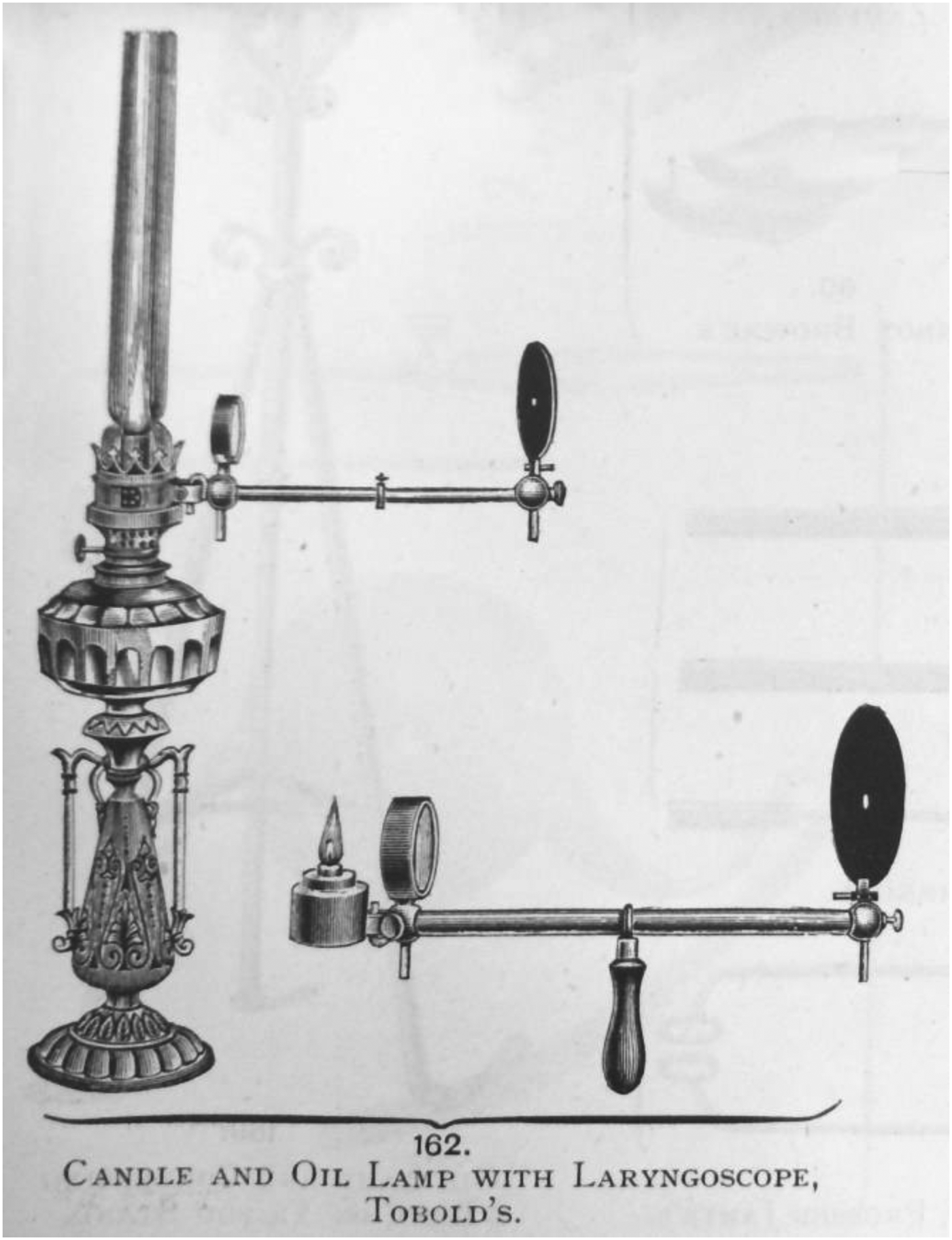
As with otoscopy, reliance on the sun's rays was troublesome for the European laryngologist. As such, in the late nineteenth century, large laryngoscopic lanterns fitted with shutters and convex ‘bull's eye’ lenses, which were powered by candles, mineral oil or even limelight (where cylinders of lime are burnt to incandesce, producing a bright, daylight glow), were invented and used as a light source (Figure 1).24 Of course, these posed the disadvantage of being immobile and a fire hazard. Indeed, limelight, which had first gained popularity in lighting up a theatre stage, was the cause of numerous Victorian theatre fires. This was improved upon with the advent of electricity, invented in 1879 by Thomas Edison. Its use in laryngoscopy slowly increased, and by the late nineteenth century, the Mackenzie bull lamp and the Semon electric laryngoscope (a dental mirror mounted onto a miniature bulb, on display at the Hunterian Museum, London) were in established use.
Laryngoscopic lanterns, as shown in Muller's Illustrated Catalogue of Surgical Instruments.24 (Reproduced with the permission of the Royal College of Surgeons of England.)

Perfection of the miniature electric bulb also improved direct laryngoscopic techniques. Laryngoscopy, oesophagoscopy and bronchoscopy had been attempted, but with little therapeutic success until the introduction of cocaine anaesthesia in 1884 and the illumination of an electric lamp. It was this combination that allowed Gustav Killian (better known for his description of inferior constrictor muscle dehiscence) to undertake the first successful bronchoscopy in 1897, removing an aspirated pork bone.Reference Prowse and Makura25 Addressing the Royal Society of Medicine in 1931, St Clair Thomson stated ‘…two events have marked the history of the last seventy three years of this specialty. One was the discovery of cocaine – more used in rhino-laryngology than in any other department – and the other was the perfection of per-oral endoscopy’.Reference Thomson22
Rhinology
‘The true mystery of the world is the visible, not the invisible’ (Oscar Wilde, 1854–1900).Reference Wilde, Jackson, Small, Fong, Beckson and Bristow26
Rhinology provides an apt opportunity to discuss arguably the most important advancement in light technology in the twentieth century: the Hopkins rod. Drawings by Leonardo Da Vinci, uncovered in 1901, illustrate remarkable insight into the anatomy of the nasal conchae and the paranasal sinuses as early as the fifteenth century. Despite further gains in knowledge through dissection, the sinuses remained for many centuries the object of mystical speculation. Even with the rationalisation and scientific discipline of the nineteenth century, aesthetic procedures for septal deviation, nasal polypectomy and maxillary washout via a Caldwell–Luc approach (described independently by each in the 1890s) remained the mainstay of rhinological surgery into the twentieth century. Indeed, with the advent of antibiotics and anti-histamines (1939 and 1942 respectively), which reduced the need for sinus intervention, rhinology stalled in the beginning of the twentieth century.Reference Weir2
Modern endoscopic sinus surgery owes its inception to the Hopkins rod and computed tomography radiography (itself preceded by plain and stereoscopic radiography, and polytomography). Prior to this, sinus disease was investigated by standing the patient in a dark room holding a light torch inside the mouth, to demonstrate sinus opacity.27 In 1954, Harold Hopkins, a physicist whose talents had initially been harnessed in the Second World War, published his invention of coherent fibre-optics in the journal Nature.Reference Hopkins and Kapany28 Even in Roman times, drawn-out glass fibres had been used to transmit light. However, it was not until the invention of the Hopkins rod-lens in 1960 (developed and manufactured by Karl Storz) that images were conveyed faithfully and safely.
Visualisation of the inside of the living body had been attempted previously, often in the face of cynicism and suspicion. In 1806, Phillip Bozzini introduced his Lichtleiter (a handheld metal tube with an eyepiece and inlet for daylight) but it was not until the twentieth century that endoscopy began to flourish.Reference Natalin and Landman29 The first breakthrough was Hopkins's ‘fibroscope’, which consisted of a bundle of flexible glass fibres capable of coherently transmitting an image. However, there were physical limits to the quality of the image produced and progressive loss of pixels as fibres broke. Hopkins's solution, which Storz realised and developed, was to fit the spaces between the little lenses with rods of glass. There are regions of the body that will always require flexible endoscopes, but the rigid Hopkins rod still offers unparalleled image quality and is used wherever possible.
The fibre-optic endoscope has revolutionised surgery and expanded the otolaryngologist's operative repertoire considerably. In the field of rhinology, together with breakthroughs in the pathophysiology of sinus disease, the Hopkins rod has built around itself the relatively new discipline of functional endoscopic sinus surgery. Endoscopy remains an important topic in ongoing research, such as that involving stereoscopic cameras which offer true depth perception.Reference Fishman, Ellis, Hasser and Stern30
Conclusion
Historical records as early as Egyptian papyri have shown physicians tackling ENT diseases. However, it was not until the beginning of the nineteenth century that the emergence of otolaryngology approximating to the specialty that we know today was witnessed. Development in light technology has played an important role in the progression of otolaryngology. It defined what could be seen, and therefore studied, sampled and operated upon. By virtue of the hidden anatomy they face, otolaryngologists have been on the forefront of applying new technologies to clinical practice, a characteristic which in many ways shapes the specialty's identity.
In 1931, St Clair Thomson ended his speech tracing the history of laryngology with the following:
‘Since 1858 those that sat in darkness, peering into the problems of laryngology, have seen a great light. We, the heirs of all the ages, should feel the great joy of living in this golden age of medicine. Let us continue to be filled with wonder – and with thankfulness’.Reference Thomson22
Advances continue to be made even to this day – for example, in the fields of transoral robotic surgery and endoscopically-assisted minimally invasive surgery – that further expand the surgical repertoire available to existing otolaryngologists.Reference Tolley, Garas and Palazzo31
Acknowledgement
The authors would like to thank Ms Stefanie Sams at the Royal College of Surgeons of England for her help in locating the surgical instrument catalogues.