


1 Introduction
One of the most relevant research lines in group theory is the study of groups whose proper subgroups satisfy some property. This is particularly relevant in finite group theory, where arguments by minimal counterexample are common. In such arguments, one is naturally led to consider situations in which all proper subgroups (indeed, all strictly smaller groups) satisfy a given property (and its consequences); and so if the group does not satisfy that property (or its consequences), then it must be subject to several restrictions. Among the most notable instances of this line of research are the classifications of groups whose proper subgroups are abelian, nilpotent, supersoluble, normal and so on (see [Reference Robinson19]). For the reader’s convenience, we recall in more detail three of these examples that concern three of the most relevant embedding properties for groups.
Groups whose (proper) subgroups are normal are called Dedekind, in general, and Hamiltonian if they are nonabelian: the latter are direct products of a periodic abelian group with only odd order elements, a copy of the quaternion group
$Q_8$
 of order
$8$
 and an elementary abelian
$2$
 -group. The normality requirement can be weakened by asking that all subgroups of the group are permutable. Recall that a subgroup
$H$
 of a group
$G$
 is permutable if
$HK=KH$
 for every
$K\leq G$
 . Groups whose (proper) subgroups are permutable are said to be quasi-Hamiltonian and are completely characterized (see [Reference Schmidt20]). Another way to weaken the normality hypothesis is by asking that all subgroups are pronormal. Recall that a subgroup
$H$
 of a group
$G$
 is pronormal if, for every
$g\in G$
 ,
$H$
 is conjugate to
$H^g$
 in
$\langle H,H^g\rangle $
 (in this case, we say that the element
$g$
 pronormalizes
$H$
 ). This concept was introduced by Philip Hall and abstracts the common features of Sylow subgroups of finite groups, normal subgroups and maximal subgroups. Groups whose subgroups are pronormal are described in [Reference Kuzennyi and Subbotin15].
Over time, classification results have become increasingly refined, addressing, for instance, groups in which not all proper subgroups satisfy a given property, but only a suitably large class of them; for example (but there are plenty of papers on the argument), in [Reference Kurdachenko, Atlıhan and Semko14], groups whose nonabelian subgroups are normal are described.
In reviewing this line of research, we were led to consider seemingly natural dual conditions that appear to have been overlooked. For example, what can be said about a (finite) group in which every subgroup is normal or contained in the norm (that is, the set of elements normalizing every subgroup)? A brief analysis shows that such a condition forces any two subgroups to permute and, hence, the group is quasi-Hamiltonian. By the known characterization of quasi-Hamiltonian groups, it follows that these groups are direct products of
$p$
 -groups of finite exponent of the type described in our Theorem 3.1. Thus, the problem admits a straightforward answer.
Turning to permutability, if one attempts to formulate an analogous dual condition, then one is led to consider groups in which every subgroup is permutable or contained in the quasinorm, that is, the set of elements whose cyclic subgroups permute with every subgroup. A moment’s reflection shows that these are precisely the quasi-Hamiltonian groups. In other words, permutability is sort of a ‘fixed point’ for this class of problems. (Another easier ‘fixed point’ is centrality.)
Thus, the only reasonable property that remains to be considered is pronormality. What about groups whose subgroups are pronormal or are contained in the pronorm, that is, the set of all elements pronormalizing every subgroup of the group? Here, the situation is much more difficult and it is the subject of this paper to deal with it, showing that such groups have some very nice and unexpected properties.
Our main results with respect to the class of groups whose subgroups are pronormal or contained in the pronorm are the following ones. Note that although most of these results apply to infinite groups, we state them below in the finite case, with references to their most general formulations.
-
• A complete classification of finite insoluble groups (see Theorem 5.23 and the subsequent results). This is certainly our main result and its proof is based on the structure theory we obtain in the case of soluble groups.
-
• A characterization of finite $p$
 -groups with our property (see Theorems 3.1 and 4.1).
-
• Every finite soluble group of our type has a Sylow tower (see Corollary 3.4) and has derived length at most $3$
(see Corollary 4.9)—even
$2$
if the group is supersoluble (see Theorem 3.6). -
• A rough structural result for finite soluble groups of our type is given in Theorem 3.12 (see also Theorem 3.13).
-
• Soluble groups with our property satisfy the subnormal intersection property (see Theorem 4.5). In turn, this fact has many consequences for the infinite soluble groups of our type (see the corollaries after Theorem 4.5).


2 Preliminaries
In this section, we introduce some of the basic tools we exploit in our work. Most of the facts we introduce are used in the subsequent proofs without further notice. We also include a number of examples, with the aim of clarifying the setting and illustrating some of the underlying ideas.
Let us start by recalling that a group is locally graded if every nontrivial finitely generated subgroup has a nontrivial finite homomorphic image. Locally graded groups are usually introduced to deal with infinite groups in very large settings and allow us to get rid of Tarski monsters (that is, infinite simple groups whose proper nontrivial subgroups have prime order) and similar pathologies. For example, all subgroups of a Tarski monster are pronormal, so the classification of groups with only pronormal subgroups could be an extremely difficult task in general, but in the universe of locally graded groups, this can be accomplished quite well (see [Reference Giovanni and Trombetti9, Lemma 2.8] and [Reference Kuzennyi and Subbotin15]). It turns out that a locally graded group
$G$
 with only pronormal subgroups is either Dedekind or can be written as follows:
$G=H\ltimes \gamma _3(G)$
 , where
$H$
 is Dedekind,
$\gamma _3(G)$
 is abelian with all subgroups normal in
$G$
 and
$\pi (H)\cap \pi (\gamma _3(G))=\emptyset $
 . (Actually, to get the sufficiency, we should also require that the Sylow
$\pi (H)$
 -subgroups of
$G$
 are complements to
$\gamma _3(G)$
 , which is something that, in finite groups, always happens.)
Remark 2.1. If
$\pi $
 is a set of primes and
$G$
 is a group, then a Sylow
$\pi $
 -subgroup of
$G$
 is just a maximal
$\pi $
 -subgroup of
$G$
 .
Since our aim is to deal with groups in which all subgroups are pronormal or contained in the pronorm, we should spend some words on these concepts (most of the facts we cite can be found in [Reference Brescia, Ingrosso and Trombetti1]). Let us first fix some notation: the norm of a group
$G$
 is denoted with
$N(G)$
 , while the pronorm is denoted by
$N_{\mathrm{pro}}(G)$
 . It turns out that the pronorm of a finite soluble group is a (characteristic) subgroup and such is also true in polycyclic groups. This is something very useful in proving that certain types of groups are of our type. The set of all elements pronormalizing a given subgroup
$H$
 of a group
$G$
 is denoted by
$P_G(H)$
 and we also set
$P_K(H):=P_G(H)\cap K$
 for every subgroup
$K$
 of
$G$
 . (We say that subgroup
$U$
 pronormalizes
$H$
 if
$U\subseteq P_G(H)$
 .) Even in finite soluble groups,
$P_G(H)$
 may not be a subgroup and, to overcome this difficulty, one usually considers maximal subgroups of
$P_G(H)$
 containing
$H$
 as a pronormal subgroup—these are called the pronormalizers of
$H$
 in
$G$
 (note that these may be more than one). The pronorm, the pronormalizers and the sets of pronormalizing elements are controlled by the finite homomorphic images in a polycyclic group.
Another class of groups that we need is that of critical-Sylow-tower groups
$G$
 , that is, of groups with no Sylow tower, but in which every subgroup and homomorphic image has a Sylow tower. These are described in [Reference Fattahi5, page 365] and the finite soluble ones are of two types.
-
Type 1 $|G|=p^\alpha q^\beta $
(here,
$p$
and
$q$
are distinct primes),
$G$
has a unique minimal normal subgroup
$F(G)$
and
$G/F(G)$
is minimal nonnilpotent. (Here,
$F(G)$
is the Fitting subgroup of
$G$
, that is, the largest nilpotent normal subgroup of
$G$
.) -
Type 2 $G=(\langle x_1\rangle \ltimes A_1)\times \cdots \times (\langle x_n\rangle \ltimes A_n)$
, where
$|x_i|=p_i$
,
$|A_i|=p_{i+1}^{r_{i+1}}$
,
$[x_i,A_i]\neq \{1\}$
and the
$A_i$
are minimal normal subgroups of
$G$
(here,
$p_1,\ldots ,p_n$
are distinct primes and
$p_{n+1}=p_1$
).


We end this section with the promised collection of examples (and nonexamples) of groups whose subgroups are pronormal or contained in the pronorm. Since these examples can be easily dealt with using GAP [21], we do not provide many details in every single case. Most of our notation for well-known groups is standard, but note that
$\mathcal C_n$
 denotes the cyclic group of order
$n$
 , while
$\mathbb Z$
 is the infinite cyclic group.
Example 2.2. The following groups have subgroups that are neither pronormal nor contained in the pronorm.
-
(1) $\mathrm{Dih}(8)$
. Here,
$N(\mathrm{Dih}(8))=Z(\mathrm{Dih}(8))$
. As a consequence,
$\mathrm{Sym}(4)$
and
$\mathrm{Dih}(\infty )$
are groups of the same type. Here,
$N_{\mathrm{pro}}(\mathrm{Sym}(4))=N_{\mathrm{pro}}(\mathrm{Dih}(\infty ))=\{1\}$
. -
(2) Every minimal nonabelian group of order $p^3$
and exponent
$p$
for some odd prime
$p$
. Here, the norm coincides with the centre. -
(3) $\mathrm{Alt}(4)\times \mathrm{Alt}(4)$
. Here, the pronorm coincides with the Sylow
$2$
-subgroup. -
(4) $\mathrm{SL}(2,3)\times \mathrm{Sym}(3)$
. Here, the pronorm is
$Q_8\times \mathcal C_3$
. -
(5) $Q_8\times \mathcal C_4$
. Here, the pronorm equals the centre.







Proof. (1)
$\mathrm{Dih}(8)$
 is not quasi-Hamiltonian. The pronorm
$N$
 of
$G=\mathrm{Sym}(4)$
 is obviously contained in the Wielandt subgroup of
$G$
 , which coincides with the Klein
$4$
 -subgroup
$V$
 of
$G$
 . However, the only element of
$V$
 pronormalizing
$H$
 is
$(1,2)(3,4)$
 , so
$N=\{1\}$
 because it is a proper
$G$
 -invariant subgroup of
$V$
 .
(2) It is not quasi-Hamiltonian, while the computation of the norm is easy.
(3) The pronorm is easily seen to coincide with the Sylow
$2$
 -subgroup. However, every cyclic subgroup of order
$6$
 is not pronormal.
(4) Every diagonal subgroup of order
$3$
 is neither pronormal nor even contained in the pronorm, which is easily seen to coincide with
$Q_8\times \mathcal C_3$
 .
(5) Write our group as
$G=\langle a,b\rangle \times \langle c\rangle $
 , where
$\langle a,b\rangle \simeq Q_8$
 and
$o(c)=4$
 . Clearly,
$Z(G)\leq N_{\mathrm{pro}}(G)$
 . Let
$x=ac$
 . Then,
$\langle x\rangle $
 is not pronormal in
$G$
 (conjugate by
$b$
 ). However,
$x$
 is not contained in the pronorm of
$G$
 because it does not pronormalize
$\langle bc\rangle $
 . Now, we easily see that the pronorm must coincide with the centre.
Example 2.3. The subgroups of the following groups are pronormal or contained in the pronorm.
-
(1) $\mathrm{Sym}(3)\times \mathrm{Sym}(3)$
. Here,
$|N_{\mathrm{pro}}(\mathrm{ Sym}(3)\times \mathrm{Sym}(3))|=18$
. -
(2) $\mathrm{Alt}(5)$
. Here,
$|N_{\mathrm{pro}}(\mathrm{Alt}(5))|=40$
. -
(3) Every minimal nonabelian group of order $p^3$
and exponent
$p^2$
for some odd prime
$p$
. Here, the norm coincides with the set of all elements of order
$p$
. -
(4) $\mathrm{Alt}(4)$
. Here, the pronorm coincides with the Sylow
$2$
-subgroup. -
(5) $(E\times Q_8)\ltimes \mathcal C_3$
, where the action of
$E\times Q_8$
on
$\mathcal C_3$
is by inversion and
$E$
is an elementary abelian
$2$
-group. -
(6) $\mathrm{Sym}(3)\times \mathbb Z$
. Here, the pronorm is
$\mathcal C_3\times \mathbb Z$
. -
(7) $\mathrm{Alt}(4)\times \mathbb Z$
. Here, the pronorm is
$\mathcal C_2\times \mathcal C_2\times \mathbb Z$
. -
(8) $Q_8\ltimes (\mathcal C_3\times \mathcal C_3)$
, where the action is irreducible. Here, the pronorm is
${\mathcal C_2\ltimes (\mathcal C_3\times \mathcal C_3)}$
(this also coincides with the derived subgroup).





Proof. (1) Write our group as follows:
$G=(\langle a_1\rangle \ltimes \langle b_1\rangle )\times (\langle a_2\rangle \ltimes \langle b_2\rangle )$
 , where
$a_i$
 has order
$2$
 and
$b_i$
 has order
$3$
 for every
$i\in \{1,2\}$
 . Clearly,
$a_i$
 does not pronormalize
$\langle b_1b_2\rangle $
 , while
$b_1,b_2$
 and
$a_1a_2$
 are contained in the pronorm. Thus, a subgroup
$H$
 that is not contained in the pronorm must contain a conjugate of
$a_1$
 or
$a_2$
 . Suppose
$H$
 contains
$a_1$
 . If it contains
$b_1$
 , then we can factor
$\langle a_1,b_1\rangle $
 out and note that all subgroups of
$\mathrm{Sym}(3)$
 are pronormal. If it does not contain
$b_1$
 , but contains
$b_2$
 , then we factor by
$\langle b_2\rangle $
 and note that, again, all subgroups of the quotient are pronormal. If
$H$
 contains neither
$b_1$
 nor
$b_2$
 , then we may assume
$H\leq \langle a_1\rangle \times \langle a_2\rangle $
 and that actually either
$H=\langle a_i\rangle $
 for some
$i$
 or
$H=\langle a_1,a_2\rangle $
 . In both cases,
$H$
 is trivially pronormal in
$G$
 .
(2) Use GAP (or see Theorem 5.4).
(3)–(4) Easy.
(5) All subgroups are pronormal in this case (see the main theorem of [Reference Kuzennyi and Subbotin15]).
(6) Our group
$G$
 is polycyclic, so the pronorm is a subgroup of
$G$
 . Write
${G=(\langle a\rangle \ltimes \langle b\rangle )\times \langle c\rangle }$
 , where
$o(a)=2$
 ,
$o(b)=3$
 and
$o(c)=\infty $
 . To prove that
${N_{\mathrm{pro}}(G)=\langle b,c\rangle }$
 , we only need to show that
$b$
 is contained in the pronorm (
$c$
 being central and
$G$
 not having only pronormal subgroups). Clearly,
$b$
 centralizes
$\langle b,c\rangle $
 . Let
$H$
 be any subgroup of
$G$
 that is not contained in
$\langle b,c\rangle $
 and let
$g$
 be an element of
$H$
 that is not contained in
$\langle b,c\rangle $
 . Then,
$g^2\in \langle c\rangle $
 , and to show that
$b$
 pronormalizes
$H$
 , we may assume that
$c^2=g^2=1$
 and so, in particular, that
$G$
 is finite and
$|H|\leq 4$
 . However, now it is very easy to realize that
$b$
 pronormalizes
$H$
 .
Finally, if
$H$
 is any subgroup of
$G$
 which is not contained in
$N_{\mathrm{pro}}(G)$
 , then
$H$
 is easily seen to be pronormal in
$G$
 (essentially because one can assume that
$o(c)=2$
 , which in turn implies that all subgroups of
$G$
 are pronormal).
(7) Again, our group
$G$
 is polycyclic, so the pronorm is a subgroup of
$G$
 . Write

where
$o(a)=3$
 ,
$o(b)=o(c)=2$
 and
$o(d)=\infty $
 . As in item (6), to prove that
$N_{\mathrm{pro}}(G)=\langle b,c,d\rangle $
 , we may assume
$o(d)=3$
 , which immediately implies the claim (see also Lemma 3.8).
Finally, let
$H$
 be any subgroup of
$G$
 that is not contained in
$N_{\mathrm{pro}}(G)$
 . To show that
$H$
 is pronormal, we may assume
$o(d)=3$
 . Clearly, if
$H$
 contains a
$3$
 -element, then
$H\trianglelefteq G$
 . If not, then
$H$
 is a
$2$
 -subgroup, so either
$|H|=2$
 or
$|H|=4$
 . In both cases,
$H$
 is clearly pronormal in
$G$
 .
(8) This is an easy exercise (see also Lemma 3.8).
3 The finite soluble case
This section is devoted to proving general structural results in the soluble setting for finite groups whose subgroups are pronormal or contained in the pronorm. The first result provides a complete description of the locally finite
$p$
 -groups of this type for any prime
$p$
 . This, together with Corollary 4.7, yields for example that any (locally) nilpotent group of our type has nilpotency class at most
$2$
 .
Theorem 3.1. Let
$p$
 be a prime and
$G$
 a nonabelian locally finite
$p$
 -group. Then, all subgroups of
$G$
 are normal or contained in the norm if and only if
$G$
 is one of the following groups:
-
(1) $Q_8\times E$
, where
$E$
is an elementary abelian
$2$
-group; -
(2) $G=\langle x\rangle \ltimes (\langle a_1\rangle \times B)$
, where
$G'\leq \langle a_1\rangle $
,
$B\leq Z(G)$
and $$ \begin{align*}o(a_1)\geq |G'|^2/p\cdot \max \{o(x), \mathrm{exp}(B)\}.\end{align*} $$In particular, $G'\leq Z(G)$
.





Proof. Suppose first that all subgroups of
$G$
 are normal or contained in the norm. Every finite subgroup of
$G$
 is quasi-Hamiltonian, so
$G$
 is quasi-Hamiltonian too. Thus, if
$Q_8$
 is involved in
$G$
 , then
$G$
 is of type (1). Assume
$Q_8$
 is not involved in
$G$
 . Then, there is a finite-exponent abelian subgroup
$A$
 of
$G$
 and an element
$x\in G$
 such that
$G=\langle x\rangle A$
 with
$x$
 acting on
$A$
 as a power automorphism which is
$\equiv _41$
 in the case where
$p=2$
 (see [Reference Schmidt20, Theorem 2.3.1]).
From now on, since the proof is exactly the same and for reader’s convenience, we prove the statement assuming that
$G$
 is finite.
Write
$A=\langle a_1\rangle \times \langle a_2\rangle \times \cdots \times \langle a_n\rangle $
 , where
$o(a_1)\geq o(a_2)\geq \cdots \geq o(a_n)$
 . We claim that
$\langle a_2,\ldots ,a_n\rangle \leq Z(G)$
 . Suppose not. Clearly, we may assume
$n=2$
 . If
${o(a_1)>o(a_2)}$
 , then by induction on the order,
$\langle a_2\rangle (\langle a_1a_2\rangle [p])/(\langle a_1a_2\rangle [p])$
 and
$\langle a_2\rangle /(\langle a_2\rangle [p])$
 are centralized by
$x$
 , so
$a_2$
 is centralized by
$x$
 . Thus,
$o(a_1)=o(a_2)$
 . Assume that
${o(x)> o(a_1)}$
 . Since
$\langle x \rangle \cap A$
 is a cyclic subgroup of
$A$
 , we may assume without loss of generality that
$\langle x \rangle \cap A \leq \langle a_1 \rangle $
 . It follows that
$\langle xa_2 \rangle $
 is not normalized by
$a_1$
 . However,
$xa_2$
 does not belong to the norm because it fails to normalize
$\langle x \rangle $
 , which yields a contradiction. Thus,
$o(x)\leq o(a_1)$
 and we may even assume that
$\langle x\rangle \cap A=\{1\}$
 . Now,
$\langle a_1x\rangle $
 is not normal in
$G$
 because it is not normalized by
$a_2$
 , so it must be contained in the norm of
$G$
 . However,
$a_1x$
 does not normalize
$\langle x\rangle $
 , so we obtain a contradiction. The claim is proved. In particular,
$o(a_1)\geq o(a_2)|G'|$
 .
We claim that
$x$
 and
$a_1$
 can be chosen in such a way that
$o(x)<o(a_1)$
 . Let
${L=\langle x,a_1\rangle }$
 . If
$|L'|=p$
 , then
$L$
 is minimal nonabelian and metacyclic, so we may write
$L=\langle x'\rangle \ltimes \langle a_1'\rangle $
 for suitable elements
$x',a_1'$
 . In this case,
$o(x')<o(a_1')$
 ; otherwise,
$\langle x'a_1'\rangle $
 is not normal and does not even normalize
$\langle x'\rangle $
 . Similarly, if
$M=\langle x\rangle \cap \langle a_1\rangle =\{1\}$
 , then
$o(x)<o(a_1)$
 since otherwise,
$\langle xa_1\rangle $
 is not normal and does not even normalize
$\langle x\rangle $
 (put
$x'=x$
 and
$a_1'=a_1$
 in this case). Thus, we may assume
$|L'|\geq p^2$
 and
$M\neq \{1\}$
 . Let
$S$
 be the socle of
$M$
 . By induction, we may find
$x'$
 and
$a_1'$
 such that
$L/S=\langle x'S\rangle \ltimes \langle a_1'S\rangle $
 and
$o(x'S)<o(a_1'S)$
 . If
$S\not \leq \langle a_1'\rangle $
 , then
$G'$
 is not cyclic, which is a contradiction. Thus,
$S\leq \langle a_1'\rangle $
 , so
$\langle a_1'\rangle $
 is normalized by
$x'$
 and
$o(a_1')>o(x')$
 . In any case,
$o(a_1')\geq o(a_1)$
 .
Now,
$A_1=\langle a_1',a_2,\ldots ,a_n\rangle $
 is abelian and
$x'$
 acts on
$A_1$
 as a power automorphism because
$o(a_1')\geq o(a_1)\geq o(a_2)|G'|$
 . Finally, by suitably replacing
$x'$
 , we may further require that
$\langle x'\rangle \cap A_1=\{1\}$
 (it is in fact enough choosing
$x'$
 of smallest possible order).
It remains to prove the bound in point (2). Set
$o(x) = p^t$
 ,
$o(a_1) = p^n$
 and
${a_1^x = a_1^{1+p^s}}$
 for some
$s\ge 1$
 . In particular,
$\langle a_1^{p^{n-s}}\rangle = Z(G)$
 and
$|\langle a_1 \rangle : Z(G)| = |G'|$
 . Assume
${o(x)> |Z(G)|}$
 . If
$y$
 is an element of
$\langle a_1\rangle $
 with
$o(y)=o(x)$
 , then
$\langle xy\rangle $
 is not normalized by
$a_1$
 and does not normalize
$\langle x\rangle $
 , which is a contradiction. Therefore,
$o(x)\le |Z(G)|=o(a_1)/|G'|$
 . Now, assume that
$o(x)> o(a_1)p/|G'|^2$
 . Let
$y=a_1^{p^{(n-t)-(n-s)}}$
 . Note that
$o(a^{p^{n-t}})=p^t$
 and that
$\langle y\rangle>Z(G)$
 . It follows that
$\langle xy \rangle $
 does not normalize
$\langle x \rangle $
 and is not normalized by
$a_1$
 because the assumption yields that
$\langle xy\rangle \not \geq G'$
 . If we replace
$x$
 by
$xa_i$
 ,
$i>1$
 , in this argument, then we see that all the required conditions are satisfied.
Conversely, suppose
$G$
 is a group of type (2). Then, the conditions imply that every cyclic subgroup of
$G$
 that is not centralized by
$x$
 must contain
$G'$
 . Thus,
$x\in N(G)$
 . However, every cyclic subgroup that lies outside
${\langle x\rangle (\langle a_1,\ldots ,a_n\rangle \cap Z(G))\leq N(G)}$
 contains
$G'$
 , so
$G$
 satisfies the required condition.
The relevance of the previous characterization in the general theory of the class of groups we are studying can immediately be seen from the following result.
Theorem 3.2. Let
$G$
 be a finite group whose subgroups are pronormal or contained in the pronorm. If
$G=H\ltimes P$
 , where
$P$
 is a non-Dedekind
$p$
 -group for some prime
$p$
 and
$(|H|,p)=1$
 , then
$G=H\times P$
 .
Proof. Since
$P$
 is not Dedekind, it must satisfy Condition (2) in the statement of Theorem 3.1. Write
$P=\langle x\rangle \ltimes (\langle a_1\rangle \times \cdots \times \langle a_n\rangle )$
 , where
$o(a_2)\geq \cdots \geq o(a_n)$
 ,
${P'\leq \langle a_1\rangle }$
 ,
$\langle a_2,\ldots ,a_n\rangle \leq Z(P)$
 and
$o(a_1)\geq |P'|^2/p\cdot \max \{o(x),o(a_2)\}$
 . Clearly,
$a_1$
 does not normalize
$\langle x\rangle $
 , so
$\langle a_1\rangle $
 is pronormal in
$G$
 and, hence, (being subnormal) also normal. Similarly,
$\langle xa_1\rangle $
 and
$\langle a_1a_i\rangle $
 ,
$i>1$
 , are normal in
$G$
 . Moreover, if
$H$
 centralizes
$\langle a_1\rangle $
 , it must also centralize
$\langle xa_1\rangle $
 and
$\langle a_1a_i\rangle $
 ,
$i>1$
 , because the socles are the same, and
$(|H|,p)=1$
 , and hence,
$H$
 centralizes
$P$
 . Thus, we may assume that
$C_H(a_1)=\{1\}<H$
 and that
$p$
 is odd (because the automorphism group of a cyclic
$2$
 -group is a
$2$
 -group).
If
$|P'|>p$
 , then induction yields that
$[H,P]\leq \Omega (P')$
 , so
$H$
 centralizes
$\langle a_1\rangle $
 , which is a contradiction. Thus,
$|P'|=p$
 .
Now,
$U=\Omega (\langle x,a_1\rangle )$
 is elementary abelian of order
$p^2$
 , so
$U=U_1\ltimes \langle a_1\rangle $
 , where
$U_1$
 is
$H$
 -invariant. If
$|U_1|\neq |\langle x\rangle |$
 , then
$U_1\trianglelefteq P$
 , so
$U_1\trianglelefteq G$
 and, hence,
$[H,P]\leq U_1$
 by induction; but this yields again the contradiction that
$H$
 centralizes
$a_1$
 . Thus, we may assume
$U_1=\langle x\rangle $
 . Similarly, we can get rid of the
$a_i$
 with
$i\geq 2$
 and so assume
$n=1$
 .
Next, observe that every subgroup of
$\langle x,a_1\rangle /\langle a_1^p\rangle $
 is
$H$
 -invariant, so
$H$
 acts as a group of power automorphisms on it. However,
$\langle a_1\rangle =C_G(a_1)$
 , so
$G/\langle a_1\rangle $
 is abelian and, hence,
$[H,U_1]=\{1\}$
 . Thus,
$H$
 must centralize
$a_1$
 , which is the final contradiction.
Using the previous result, we can now prove three main general structure results (see Corollaries 3.4 and 3.5, and Theorem 3.6).
Theorem 3.3. Let
$G$
 be a finite soluble group whose subgroups are pronormal or contained in the pronorm. Then,
$G$
 has a Sylow tower.
Proof. It is enough to show that the critical-Sylow-tower groups
$G$
 do not satisfy the hypotheses. Suppose first that
$G$
 is critical-Sylow-tower of type
$2$
 . Then, there are primes
$p_1,\ldots ,p_n,p_{n+1}=p_1$
 such that

$|x_i|=p_i$
 ,
$|A_i|=p_{i+1}^{r_{i+1}}$
 ,
$[x_i,A_i]\neq \{1\}$
 and the
$A_i$
 are minimal normal subgroups of
$G$
 . Clearly, not every
$A_i$
 can be cyclic; otherwise, we would have
$p_1<p_2<\cdots <p_n<p_1$
 . Let
$j$
 be such that
$A_j$
 is not cyclic. Let
$a\in A_n\setminus \{1\}$
 and define
$g$
 as
$x_1x_ja$
 if
$j\neq 1$
 , or as
$x_1a$
 if
$j=1$
 .
Put
$H=\langle g\rangle $
 . Clearly,
$H$
 is not pronormal in
$G$
 since it is subnormal and nonnormal in
$\langle x_2,x_1,a\rangle $
 . However,
$H$
 is not even contained in the pronorm because otherwise,
$A_j$
 would have been cyclic.
Assume
$G$
 is critical-Sylow-tower of type
$1$
 . Thus,
$|G|=p^\alpha q^\beta $
 (here,
$p$
 and
$q$
 are distinct primes),
$G$
 has a unique minimal normal subgroup
$F(G)$
 and
$G/F(G)$
 is minimal nonnilpotent. Suppose
$F(G)$
 is a (necessarily elementary abelian)
$p$
 -group, and let
$P$
 and
$Q$
 be respectively a Sylow
$p$
 -subgroup and a Sylow
$q$
 -subgroup of
$G$
 ; in particular,
$G/F(G)=P/F(G)\ltimes QF(G)/F(G)$
 and
$P/F(G)$
 is cyclic.
If
$P$
 is Dedekind, then
$F(G)\leq Z(P)$
 , so
$C_G(F(G))=G$
 and, hence,
$Q$
 is characteristic in
$QF(G)$
 , which is a contradiction. Thus,
$P$
 is not Dedekind and so
$P$
 satisfies the structure of Theorem 3.2.
Since
$F(G)$
 is a minimal normal subgroup of
$G$
 and
$Z(P)\neq F(G)$
 , we have that
$Z(P)\cap F(G)$
 cannot be normalized by
$Q$
 . Now, let
$a\in Z(P)\cap F(G)$
 and
$x\in Q$
 . Then,
$a^x=a'$
 for some
$a'\in F(G)$
 . Set
$P/F(G)=\langle yF(G)\rangle $
 . If we now apply conjugation by
$y$
 , we find that
$a^{x^y}=(a')^y$
 , where
$x^yF(G)=x^\ell F(G)$
 for some positive integer
${1<\ell <q}$
 . Thus,
$a^{x^{y}}=a^x(\mathrm{mod}\ P')$
 and so
$a^{x^{y-1}}\in P'$
 for every
$a\in Z(P)$
 . However,
$P'\leq Z(P)$
 and
$[Q,\langle y\rangle ]F(G)=QF(G)$
 , so
$Z(P)$
 is normal in
$G$
 . Therefore,
$Z(P)=P$
 , which is the final contradiction.
Corollary 3.4. Let
$G$
 be a locally finite soluble group whose subgroups are pronormal or contained in the pronorm. Then,
$G$
 has a finite normal series with nilpotent coprime factors. In particular,
$G$
 has an ascending Sylow tower.
Proof. A standard inverse limit argument (using Theorem 3.3) shows that
$G$
 has a normal series with coprime factors. If
$H/K$
 is a factor of this series such that
$H$
 is not contained in the pronorm of
$G$
 , then
$G/H$
 has only pronormal subgroups; in particular,

Let
$W$
 be the intersection of all the factors of the previous type. Clearly,
$\pi (W)\cap \pi (G/W)=\emptyset $
 and
$W\leq N_{\mathrm{pro}}(G)$
 . However, also
$\pi (\gamma _3(G)W/W)\cap \pi (G/\gamma _3(G)W)=\emptyset $
 and so we are done.
Corollary 3.5. Let
$G$
 be a finite soluble group whose subgroups are pronormal or contained in the pronorm. Then,
$G$
 has derived length at most
$3$
 .
Proof. By Theorem 3.3,
$G$
 has a Sylow tower. Let
$P$
 be a normal Sylow
$p$
 -subgroup of
$G$
 for some prime
$p$
 . Clearly, we may assume by induction that
$G$
 has only one minimal normal subgroup
$M$
 , which is necessarily a
$p$
 -group.
Let
$Q$
 be a Sylow
$p'$
 -subgroup of
$G$
 , so
$G=Q\ltimes P$
 . Let
$X$
 be any subgroup of
$Q$
 that is not pronormal in
$Q$
 (and so in
$G$
 ). Then,
$X$
 is contained in the pronorm
$N$
 of
$G$
 . However,
$Z(N)N'\leq P$
 , so
$N/(P\cap N)$
 is cyclic and
$X(P\cap N)/(P\cap N)$
 is normal in
$G/(P\cap N)$
 . Then,
$XP/P\trianglelefteq G/P$
 and so
$X\trianglelefteq Q$
 , which is a contradiction. Thus,
$Q$
 is metabelian.
Now, suppose that
$P$
 is nonabelian. Then, Theorem 3.2 shows that
$P$
 is a Dedekind
$2$
 -group. By Maschke’s theorem, the socle of
$P$
 is cyclic, so
$P$
 is a quaternion group of order
$8$
 . Then,
$C_G(P)=Z(P)$
 because of the uniqueness of
$M$
 and, hence,
$G/P$
 is a proper subgroup of
$\mathrm{Sym}(4)$
 (which does not satisfy our hypotheses), so
$G/P$
 is metabelian and
$G^{(3)}=\{1\}$
 .
Theorem 3.6. Let
$G$
 be a finite group whose subgroups are pronormal or contained in the pronorm. If
$G$
 is supersoluble, then
$G$
 is metabelian.
Proof. Let
$G$
 be a minimal counterexample. Then,
$G$
 has only one minimal normal subgroup
$N$
 , which has prime order
$p$
 . Clearly,
$p>2$
 and
$G$
 is not a
$p$
 -group. Let
$P=O_p(G)$
 and let
$C$
 be the intersection of all the centralizers of the chief factors of
$G$
 contained in
$P$
 . Then,
$P\leq C$
 and
$G/C$
 is abelian of order prime with
$p$
 . If
$C\neq P$
 , then there is a minimal normal subgroup
$M/P$
 of
$G/P$
 contained in
$C/P$
 which is a
$q$
 -group for some prime
$q\neq p$
 , so
$M=P\times L$
 , where
$L$
 is a nontrivial normal
$q$
 -subgroup of
$G$
 , which is a contradiction. Thus,
$C=P$
 and so
$P$
 is nonabelian. However, then Theorem 3.2 shows that
$G=Q\times P$
 , so
$G$
 is metabelian, which is the final contradiction.
Giving a very precise description of finite soluble groups whose subgroups are pronormal or contained in the pronorm is not an easy task, due to the large range of possibilities that may arise. In the remainder of this section, we try at least to give a very approximate description of such groups. We start with some useful lemmas that already shed some light on the structure.
Lemma 3.7. Let
$G$
 be a group and
$H$
 ,
$K$
 subgroups of
$G$
 with
$N_G(K) \ge H$
 . If
${g \in P_G(H) \cap N_G(K)}$
 , then
$g \in P_G(HK)$
 .
Proof. Since
$g \in P_G(H)\cap N_G(K)$
 , there exists
$u \in \langle H, H^g \rangle \leq N_G(K)$
 such that
${H^u = H^g}$
 . Thus,
$gu^{-1} \in N_G(K)$
 , so
$(HK)^{gu^{-1}} = HK$
 and, hence,
$(HK)^g = (HK)^u$
 . Therefore,
$g\in P_G(HK)$
 and the statement is proved.
Lemma 3.8. Let
$\pi $
 be a set of primes and
$G$
 a finite soluble group. If the Sylow
$\pi $
 -subgroups of
$G$
 are Dedekind, then
$O_\pi (G)\leq \mathrm{ N}_{\mathrm {pro}}(G)$
 .
Proof. Let
$H$
 be a subgroup of
$G$
 . Then,
$H = H_{\pi '}H_\pi $
 , where
$H_\pi '$
 is a Sylow
$\pi '$
 -subgroup of
$H$
 and
$H_\pi $
 is a Sylow
$\pi $
 -subgroup of
$H$
 . Now,
$G$
 is soluble, so
$O_\pi (G)$
 pronormalizes
$H_{\pi '}$
 . Consequently, if
$x\in O_\pi (G)$
 , then there exists
${u \in \langle H, H^x\rangle \le HO_\pi (G)}$
 such that
$H_{\pi '}^x = H_{\pi '}^u$
 ; clearly, we may assume
$u\in O_\pi (G)$
 . Then,
${H^x = H_{\pi '}^xH_\pi ^x =H_{\pi '}^xH_\pi =H_{\pi '}^uH_\pi ^u = H^u}$
 because
$O_\pi (G)$
 normalizes
$H_\pi $
 . The statement is proved.
Lemma 3.9. Let
$G=H\ltimes K$
 be a finite group, where
$K$
 is a nonabelian Dedekind
$2$
 -group,
$H$
 is abelian and
$\pi (H)\cap \pi (K)=\emptyset $
 . If
$G$
 is metabelian, then
$H$
 centralizes a copy of
$Q_8$
 contained in
$K$
 .
Proof. Suppose first that
$H=\langle h\rangle $
 is cyclic. Write
$K=Q\times W$
 , where
$Q=\langle a,b\rangle $
 is a copy of the quaternion group of order
$8$
 and
$W$
 is elementary abelian. Set
${Z=Z(Q)\times W}$
 . Since
$K/Z$
 is a Klein
$4$
 -group and
$G'$
 is abelian, we have that
$[H,K]\leq Z$
 . Write
$Z=C_K(H)\times [H,Z]$
 , and put
$a^h=aa_1a_2$
 and
$b^h=bb_1b_2$
 , where
$a_1,b_1\in C_K(H)$
 and
$a_2,b_2\in [H,Z]$
 . Replacing
$h$
 by
$h^2$
 , we have that
$a_1=b_1=1$
 . Thus,
$a^h=aa_2$
 and
$b^h=bb_2$
 .
Now, note that
$[H,Z]=\{[h,z]\,:\, z\in Z\}$
 , so there exist
$z_1,z_2\in Z$
 such that
${[h,z_1]=a_2}$
 and
$[h,z_2]=b_2$
 . Let
$Q_h=\langle az_1,bz_2\rangle $
 be centralized by
$H$
 ; in fact, for example,

This proves the statement when
$H$
 is cyclic.
Finally, we turn to the general case. Write
$H=H_1\times \langle h\rangle $
 . Then,
$h$
 centralizes not only
$Q_1$
 , but also
$Q_1^H$
 . Let
$G_1=H_1\ltimes Q_1^H$
 . By induction, we see that
$Q_1^H$
 contains a copy
$Q_2$
 of
$Q_8$
 that is centralized by
$H_1$
 . Consequently,
$Q_2$
 is centralized by
$H$
 and the statement is proved.
In the following, if
$G$
 is a group, and
$N$
 and
$H$
 a normal subgroup and a subgroup of
$G$
 , respectively, then
$\mathrm{PAut}_H(N)$
 denotes the subgroup of all elements of
$H$
 that act as power automorphisms on
$N$
 .
Lemma 3.10. Let
$G = Q\ltimes V$
 be a finite soluble group, where
$V$
 is abelian and
${\pi (V) \cap \pi (Q) = \emptyset }$
 . If every subgroup of
$G$
 is pronormal or contained in the pronorm, then the following conditions hold:
-
(1) every nonpronormal subgroup $K$
of
$Q$
is contained in the pronorm of
$G$
; -
(2) if $K$
is a pronormal subgroup of
$Q$
that is not contained in
$\mathrm{N}_{\mathrm{pro}}(G)$
, then every subgroup
$U$
of
$V$
normalized by
$K$
is normalized by
$N_G(K)$
; -
(3) $Q/\mathrm{PAut}_Q(V)$
has only pronormal subgroups, so
$Q"\leq \mathrm{PAut}_Q(V)$
; -
(4) $[\mathrm{PAut}_Q(V),Q]\leq C_Q(V)$
; -
(5) the Sylow subgroups of $Q/\mathrm{PAut}_Q(V)$
are abelian; -
(6) if $V$
is an irreducible
$Q$
-module and
$Q$
is a
$q$
-group for some prime
$q$
, then either
$Q/C_Q(V)$
is cyclic or
$Q$
is Dedekind and
$Q/C_Q(V)\simeq Q_8$
.


Conversely, if
$G$
 satisfies Conditions (1) and (2), then all its subgroups are pronormal or contained in the pronorm.
Proof. Assume first that every subgroup of
$G$
 is pronormal in
$G$
 or contained in the pronorm of
$G$
 . Obviously, if
$K$
 is nonpronormal in
$Q$
 , then
$K$
 is nonpronormal in
$G$
 . Consequently,
$K \le \mathrm{N}_{\mathrm{pro}}(G)$
 . Now, assume that
$K \not \le \mathrm{N}_{\mathrm{pro}}(G)$
 . Let
$U$
 be a subgroup of
$V$
 that is
$K$
 -invariant. Therefore,
$K \ltimes U$
 is pronormal in
$G$
 (because
$K$
 is not contained in the pronorm of
$G$
 ). If
$g\in N_G(K)$
 , then there exists
${u \in \langle KU, KU^g \rangle = K \ltimes \langle U, U^g \rangle }$
 such that
$(KU)^u = KU^g$
 . Write
$u=xy$
 , where
$x\in K$
 and
$y\in \langle U,U^g\rangle $
 . Then,
$KU^g=(KU)^u=(KU)^y=K^yU$
 and, hence,
$U^g=U$
 , as desired. Thus, Conditions (1) and (2) are proved.
Set
$P=\mathrm{PAut}_Q(V)$
 . The fact that
$Q/P$
 has only pronormal subgroups follows from the observation that any nonpronormal subgroup of
$Q$
 must be contained in the pronorm of
$G$
 and so it must act as power automorphisms on
$\gamma _3(V)$
 . This proves Condition (3). Moreover,
$P/C_Q(V)$
 is clearly central in
$Q/C_Q(V)$
 , so
$[P,Q]\leq C_Q(V)$
 . This proves Condition (4).
To prove Condition (5), suppose that
$Q/P$
 contains a copy of the quaternion group of order
$8$
 . Since the Sylow subgroups of
$Q$
 are either Dedekind or of type described in Theorem 3.1, there exists a subgroup
$W$
 of
$Q$
 such that
$W\simeq Q_8$
 and
$W\cap P=\{1\}$
 . The latter condition implies that
$Z(W)$
 is not contained in the pronorm of
$G$
 , so
$W$
 normalizes every subgroup of
$V$
 which is normalized by
$Z(W)$
 . In turn, this shows that every cyclic subgroup of
$V$
 normalized by
$W$
 must be centralized by
$Z(W)$
 and so that
$Z(W)$
 centralizes
$V$
 , which is a contradiction. Therefore, the Sylow subgroups of
$Q/P$
 are abelian. This proves Condition (5).
Finally, Condition (6) follows at once from Theorem 3.1 and the fact that the centre of an irreducible subgroup of
$\mathrm{GL}(n,p)$
 is cyclic.
Conversely, assume that
$G$
 satisfies Conditions (1) and (2). Since
$\pi (V) \cap \pi (Q) = \emptyset $
 and
$V$
 is abelian, so
$V \le N_{\mathrm{pro}}(G)$
 by Lemma 3.8. Let
$M$
 be the subgroup generated by the nonpronormal subgroups of
$Q$
 . By Condition (1),
$M\leq N_{\mathrm{pro}}(G)$
 .
Now, let
$H$
 be a subgroup of
$G$
 that is not contained in
${N}_{\mathrm{pro}}(G)$
 . Write
${H = H_Q \ltimes U}$
 , where
$U \le V$
 and
$H_Q$
 is the Sylow
$\pi (Q)$
 -subgroup of
$H$
 . We claim that
$H$
 is pronormal in
$G$
 . Replacing
$H$
 with a conjugate (if necessary), we may assume that
$H_Q \le Q$
 . If
$H_Q$
 is not pronormal in
$Q$
 , then
$H_Q \le M$
 , so
$H \le {N}_{\mathrm{pro}}(G)$
 , which is a contradiction. Thus,
$H_Q$
 is pronormal in
$Q$
 . However,
$H_Q $
 is pronormal in
${H_Q \ltimes V}$
 , since
$V$
 is contained in the pronorm of
$G$
 . Therefore,
$H_Q$
 is pronormal in
$G=Q(H_QV)$
 (see [Reference Brescia, Ingrosso and Trombetti1, Theorem 3.45]). Finally, if
$g \in G$
 , then there exists
${u \in \langle H_Q, H_Q^g \rangle \le \langle H, H^g \rangle }$
 such that
$H_Q^u = H_Q^g$
 ; but
$gu^{-1} \in N_G(H_Q)$
 and so
${H^g = H^u}$
 by Condition (2). This shows that
$H$
 is pronormal in
$G$
 and we are done.
Remark 3.11. In the context of Condition (2) of Lemma 3.10, we note that if
$Q$
 is nilpotent, then every subgroup of
$Q$
 is normal in
$Q$
 or contained in the pronorm of
$G$
 . Thus, if
$K$
 is a subgroup of
$Q$
 that does not normalize a cyclic subgroup of
$V$
 , then
$K$
 and
$Q$
 normalize the same subgroups of
$V$
 , and in particular,
$V$
 is
$Q$
 -irreducible if and only if it is
$K$
 -irreducible.
Theorem 3.12. Let
$G$
 be a finite soluble group whose subgroups are pronormal or contained in the pronorm. Assume that not every subgroup of
$G$
 is pronormal. Then,
$G = (T \ltimes S)\ltimes X$
 , where
$S$
 is a Sylow
$p$
 -subgroup of
$G$
 (here,
$p$
 is a prime) that is not contained in the pronorm of
$G$
 , all subgroups of
$T$
 are pronormal in
$G$
 ,
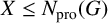
$X\leq N_{\mathrm{pro}}(G)$
 ,
$\pi (X)\cap \pi (T)=\emptyset $
 and
$p\not \in \pi (X)\cup \pi (T)$
 . Clearly,
$S$
 is either Dedekind, or of the type described in Theorem 3.1. Write
$X=M\ltimes \gamma _3(X)$
 , and replace
$S$
 and
$T$
 in such a way that
$G=W\ltimes \gamma _3(X)$
 , where
$W=(T\ltimes S)\ltimes M$
 . Then,
$[M,W]\leq C_M(\gamma _3(X))$
 and
${W"\leq \mathrm{PAut}_W(\gamma _3(X))}$
 .
-
• In particular, if $\pi ([M,W])\cap \pi (C_M(W))=\emptyset $
, then we may assume
$X$
to be Dedekind.


Assume
$G$
 is metabelian. Then,
$T$
 can be chosen to be Dedekind,
$G'\leq N_{\mathrm{pro}}(G)$
 and
$[T,S]=\{1\}$
 .
-
(⋆) Assume $[S,M]=\{1\}$
. Then:-
– $G=S\ltimes (TX)$
; -
– all subgroups of $TX$
are pronormal and, in fact,
$TX=R\ltimes \gamma _3(TX)$
, where
${R=T\times C_M(T)}$
and
$\gamma _3(TX)=[M,T]\times \gamma _3(X)$
(in particular,
$[S,R]=\{1\}$
, while
$\pi (T)$
,
$\pi (C_M(T))$
,
$\pi ([M,T])$
and
$\pi (\gamma _3(X))$
have pairwise empty intersection); -
– if $S_1$
is a subgroup of
$S$
that is not contained in
$\mathrm{N}_{\mathrm{pro}}(G)$
, then
$N_S(S_1)$
normalizes every subgroup of
$\gamma _3(X)$
that is normalized by
$S_1$
; -
– the nonpronormal subgroups of $S$
act as power automorphisms on
$\gamma _3(X)$
.
-


Conversely, if
$G$
 has the structure described in (
$\star $
 ), then every subgroup of
$G$
 is pronormal or contained in the pronorm.
Proof. By Theorem 3.3,
$G$
 has a Sylow tower
$\{1\} =P_0 \trianglelefteq P_1 \trianglelefteq \cdots \trianglelefteq P_t = G,$
 where
$P_{i+1}/P_{i}$
 is a Sylow
$p_i$
 -subgroup of
$G/P_i$
 (here,
$p_i$
 is a prime) for
$i\in \{0, \ldots , t-1\}$
 . Let
$X$
 be the largest term of this series that is contained in
$N_{\mathrm{pro}}(G)$
 . Then, we can write
$G=T\ltimes (S\ltimes X)$
 for some subgroup
$T$
 of
$G$
 and for some Sylow
$p$
 -subgroup
$S$
 of
$G$
 (here,
$p$
 is a prime) that is not contained in
$N_{\mathrm{pro}}(G)$
 . Since
$S\ltimes X$
 is not contained in the pronorm of
$G$
 , all subgroups of
$T\simeq G/(S\ltimes X)$
 are pronormal. Since
$\pi (\gamma _3(X))\cap \pi (G/\gamma _3(X))=\pi (X)\cap \pi (G/X)=\emptyset $
 , we may actually choose
$S$
 and
$T$
 such that
$G= W\ltimes \gamma _3(X)$
 , where
$W=(T\ltimes S)\ltimes M$
 and
$X=M\ltimes \gamma _3(X)$
 .
The fact that
$[M,W]\leq C_M(\gamma _3(X))$
 and
$W"\leq \mathrm{PAut}_W(\gamma _3(X))$
 follows at once from Lemma 3.10. In particular, if
$\pi ([M,W])\cap \pi (C_M(W))=\emptyset $
 , then we may re-arrange the Sylow subgroups of
$G$
 as follows:
$G=((T\times C_M(W))\ltimes S)\ltimes ([M,W]\times \gamma _3(X))$
 , where
$[M,W]\times \gamma _3(X)$
 is Dedekind. This proves the first part of the statement.
Assume
$G$
 is metabelian. Then,
$S\ltimes X$
 has an ascending
$G$
 -invariant series with elementary abelian factors. By [Reference Gorenstein10, Lemma 2.3], each of these factors is centralized by
$T'$
 because
$\pi (T)\cap \pi (SX)=\emptyset $
 and
$G'$
 is abelian. Consequently,
$T'$
 is subnormal in
$G$
 , so it centralizes
$SX$
 . In particular,
$T'$
 is normal in
$G$
 . Since
$T'$
 is contained in
$T$
 , so
$T'\leq N_{\mathrm{pro}}(G)$
 by Lemma 3.8. Now,
$T=U\ltimes \gamma _3(T)$
 , where
$\pi (U)\cap \pi (\gamma _3(T))=\emptyset $
 and
$U$
 is Dedekind, so replacing
$T$
 by
$U$
 and
$X$
 by
$X\gamma _3(T)$
 , we may assume that
$T$
 is Dedekind. Finally, the Sylow
$q$
 -subgroups of
$G$
 are Dedekind for every prime
$q$
 and, hence,
${G'\leq N_{\mathrm{pro}}(G)}$
 by Lemma 3.8.
Now, we prove that
$[T,S]=\{1\}$
 . If
$S$
 is not Dedekind, then
$[S,T]=\{1\}$
 by Theorem 3.2. If
$S$
 is Dedekind nonabelian, then
$T$
 centralizes a copy of
$Q_8$
 contained in
$S$
 by Lemma 3.9. This implies that we can always write
$S=C_S(T)\times [S,T]$
 . If
$x\in C_S(T)$
 and
$1\neq y\in [S,T]$
 , then
$\langle xy\rangle $
 is not pronormal in
$G$
 , so
$xy\in N_{\mathrm{pro}}(G)$
 . Since we already know that
$[S,T]\leq G'\leq N_{\mathrm{pro}}(G)$
 , the arbitrariness of
$x$
 and
$y$
 yields that
$S\leq N_{\mathrm{pro}}(G)$
 , which is a contradiction. Thus,
$[T,S]=\{1\}$
 .
Case (
$\star $
 ):
$[S,M]=\{1\}$
 . Then,
$S\gamma _3(X)\trianglelefteq G$
 and
$G/S\gamma _3(X)\simeq T\ltimes M$
 has only pronormal subgroups. Re-arranging the Sylow subgroups of
$T\ltimes X$
 (using also Lemma 3.9), we can write

which is a group with only pronormal subgroups. Note that
$[S,MT]=\{1\}$
 and we are done.
Finally, if
$S_1$
 is a pronormal subgroup of
$S$
 that is not contained in the pronorm of
$S$
 , then it is not contained in the pronorm of
$S\ltimes \gamma _3(X)$
 and Lemma 3.10 yields that every
$S_1$
 -invariant subgroup of
$\gamma _3(X)$
 is also
$N_S(S_1)$
 -invariant.
Assume conversely that
$G$
 has the structure described in (
$\star $
 ). Let
$H$
 be a nonpronormal subgroup of
$S\times R$
 . Then,
$H$
 acts as power automorphisms on
$\gamma _3(X)$
 . We claim that
$H$
 is contained in the pronorm of
$G$
 . Let
$K$
 be any other subgroup of
$G$
 . To show that
$H$
 pronormalizes
$K$
 , we may assume
$K\cap [M,T]=\{1\}$
 and so even
$[M,T]=\{1\}$
 by [Reference Brescia, Ingrosso and Trombetti1, Corollary 3.10]. Write
$K=K_1\ltimes K_2$
 , where
$K_2=\gamma _3(X)\cap X$
 . Also, we may reduce to
$\langle H,K\rangle R\gamma _3(G)$
 , so now
$K_2$
 is normal and
$K_1=K$
 is pronormalized by
$H$
 because it is pronormalized modulo
$\gamma _3(G)$
 (see [Reference Brescia, Ingrosso and Trombetti1, Corollary 3.10]). Therefore, the conditions of Lemma 3.10 are satisfied and we are done.
In our final result,
$\overline Z(G)$
 denotes the hypercentre of the group
$G$
 .
Theorem 3.13. Let
$G$
 be a finite soluble group whose subgroups are pronormal or contained in the pronorm, and
$H$
 a subgroup of
$G$
 that is isomorphic to
$Q_8$
 . If
$H\leq \overline {Z}(G)$
 , then
$G=O_2(\overline {Z}(G))\times D$
 for some
$D\leq G$
 .
Proof. By Theorem 3.1, we may assume that
$G$
 is not a
$2$
 -group. Since
$G$
 is soluble, there are a Sylow
$2'$
 -subgroup
$Q$
 of
$G$
 and a Sylow
$2$
 -subgroup
$P$
 of
$G$
 (containing
$H$
 ) such that
$G=PQ$
 . Now,
$P$
 is a quasi-Hamiltonian
$2$
 -group involving
$Q_8$
 , so
$P=H\times R$
 , where
$R$
 is an elementary abelian
$2$
 -subgroup. Moreover, since
$H\leq \overline {Z}(G)$
 , we have that
$[H,Q]=\{1\}$
 . Thus,
$H$
 is normalized by both
$P$
 and
$Q$
 , and so by
$G=PQ$
 .
Now, let
$K$
 be any subgroup of
$O_2(\overline {Z}(G))$
 containing
$H$
 . We claim that
$K$
 is a direct factor of
$G$
 . First, note that
$K$
 is normal in
$G$
 by the previous paragraph because it is generated by copies of
$Q_8$
 . Let
$N$
 be a minimal normal subgroup of
$G$
 , so
$N$
 is an elementary abelian
$p$
 -group for some prime
$p$
 . If
$p>2$
 , then there is
$X/N$
 such that
$G/N=KN/N\times X/N$
 . Thus,
$G=K\times X$
 because
$K$
 is normal in
$G$
 . Suppose that every minimal normal subgroup of
$G$
 is a
$2$
 -group, put
$L=O_2(G)$
 and let
$S$
 be the socle of
$L$
 . Moreover, let
$M/L$
 be a minimal normal subgroup of
$G/L$
 , which necessarily is a
$2'$
 -subgroup. If every subgroup of
$S$
 is normal in
$G$
 , then
$S\leq Z(G)$
 , so
$L\leq \overline Z(G)$
 and, hence,
$M=L\times U$
 for some normal
$2'$
 -subgroup of
$G$
 , which is a contradiction. Thus, not every subgroup of
$S$
 is normal in
$G$
 and so not every subgroup of
$S$
 is normalized by
$Q$
 . Thus, there is a minimal normal
$2$
 -subgroup
$W$
 of order at least
$4$
 such that
$W\cap K=\{1\}$
 (by Maschke’s theorem). Finally, by induction,
$G/W=KW/W\times D/W$
 for some subgroup
$D/W$
 of
$G/W$
 , so
$G=K\times D$
 and we are done.
4 The infinite soluble case
The aim of this section is to deal with infinite (generalized) soluble groups whose subgroups are pronormal or contained in the pronorm. Most of the results here are essential to prove our main theorem about the general insoluble case (see Theorem 5.23). We start by showing that some of the results in the previous section in the finite case can be extended to periodic, locally graded groups.
Theorem 4.1. Let
$G$
 be a locally graded group whose subgroups are pronormal or contained in the pronorm. If
$G$
 is periodic, then
$G$
 is locally finite.
Proof. Clearly, we may assume that
$G$
 is finitely generated, so we need to prove that
$G$
 is finite. Let
$R$
 be the finite residual of
$G$
 . If every finite quotient of
$G$
 is soluble, then every finite quotient of
$G$
 is soluble of derived length at most
$3$
 by Corollary 3.5, so
$G/R$
 is soluble (of derived length at most
$3$
 ) and, hence, even finite. However, then
$R=\{1\}$
 and we are done.
It is therefore safe to assume that
$G$
 contains an insoluble finite quotient
$G/N$
 . Now,
$N$
 is finitely generated as well and no finite quotient of
$N$
 can be insoluble, otherwise, every subgroup of
$G/N$
 would be pronormal and
$G/N$
 would be soluble, which is a contradiction. By the previous paragraph,
$N$
 is finite and so also
$G$
 is finite. The statement is proved.
We now show that soluble groups whose subgroups are pronormal or contained in the pronorm satisfy the subnormal intersection property (see Theorem 4.5), that is, the intersection of any family of subnormal subgroups is subnormal. In turn, this provides many structural consequences (see Corollary 4.7).
Theorem 4.3. Let
$G$
 be a group whose subgroups are serial and pronormal or contained in the pronorm. Then, every subgroup of
$G$
 is normal or contained in the norm of
$G$
 . In particular,
$G$
 is quasi-Hamiltonian.
Proof. It follows from [Reference Brescia, Ingrosso and Trombetti1, Theorem 3.1] that for every subgroup
$H$
 of
$G$
 , the set
$P_G(H)$
 of all elements of
$G$
 pronormalizing
$H$
 coincides with the normalizer
$N_G(H)$
 . Thus, if
$H$
 is a pronormal subgroup of
$G$
 , then
$H$
 is normal in
$G$
 . However, if
$H$
 is contained in the pronorm, then
$H$
 normalizes every subgroup of
$G$
 , so
$H$
 is actually contained in the norm of
$G$
 . Thus,
$HK=KH$
 for all subgroups
$H,K$
 of
$G$
 .
Corollary 4.4. Let
$G$
 be a locally nilpotent group whose subgroups are pronormal or contained in the pronorm. Then, every subgroup of
$G$
 is normal or contained in the norm of
$G$
 . In particular,
$G$
 is quasi-Hamiltonian.
Proof. This follows from Theorem 4.3 and the well-known fact that every subgroup of a locally nilpotent group is serial.
Theorem 4.5. Let
$G$
 be a locally graded group whose subgroups are pronormal or contained in the pronorm. If
$H$
 is a subnormal subgroup of
$G$
 , then
$H$
 has defect at most
$7$
 .
Proof. Clearly, if
$H$
 is pronormal in
$G$
 , then
$H$
 is normal in
$G$
 . Assume
$H$
 is contained in the pronorm of
$G$
 . Then, all subgroups of
$H$
 are pronormal in
$G$
 (and so in
$H$
 ), so
$H$
 is metabelian, being locally graded.
Now,
$H'$
 is an abelian subnormal subgroup of
$G$
 and so
$L=(H')^G$
 is locally nilpotent. By Theorem 4.3, every subgroup of
$L$
 is normal or contained in the norm of
$L$
 ; in particular, every subgroup of
$L$
 is subnormal of defect at most
$2$
 .
Let
$S$
 be a normal subgroup of
$L$
 such that
$H'$
 is normal in
$S$
 . Since
$L$
 and
$H'$
 are
$H$
 -invariant, we may further require that
$S$
 is
$H$
 -invariant. We claim that
$H$
 is subnormal in
$HS$
 of defect at most
$2$
 . To prove this, we may assume
$H'=\{1\}$
 , so
$H$
 is abelian and subnormal in
$HS$
 , and by the above,
$H$
 is subnormal of defect at most
$2$
 in
$HS$
 . In a similar fashion, we show that
$HS$
 is subnormal of defect at most
$2$
 in
$HL$
 , so
$H$
 is subnormal of defect at most
$4$
 in
$HL$
 . Finally, a further application of the same argument shows that
$HL$
 is subnormal in
$(HL)^G$
 of defect at most
$2$
 , so
$H$
 is subnormal in
$G$
 of defect at most
$7$
 .
Question 4.6. What is the smallest possible defect of subnormality in the statement of Theorem 4.5?
Corollary 4.7. Let
$G$
 be a soluble group whose subgroups are pronormal or contained in the pronorm. Then, we have the following conditions.
-
(1) If $G$
is finitely generated, then
$G$
is finite-by-abelian. Moreover, in this case,
$G$
splits over the torsion subgroup. -
(2) If $G$
is nilpotent and nonperiodic, then
$G$
is abelian. -
(3) If $G$
is torsion-free, then
$G$
is abelian. -
(4) If $G$
is nonperiodic, then
$G$
is metabelian. More precisely, the torsion-subgroup
$T$
of
$G$
has an abelian normal subgroup
$H$
such that
$\pi (T)\cap \pi (H)=\emptyset $
and
$G/H$
is abelian. -
(5) Every nonperiodic element $x$
of
$G$
has a power
$x^n$
centralizing the torsion-subgroup
$T$
of
$G$
, provided that
$T$
is abelian.


Proof. Clearly, we may always assume that
$G$
 is finitely generated. Then, a combination of Theorem 4.5 and [Reference Robinson18, Theorem 10.54] yields that
$G$
 is finite-by-nilpotent, and so even finite-by-(torsion-free nilpotent), being
$G$
 finitely generated.
Assume
$G$
 is nilpotent and nonperiodic. Then,
$G$
 is quasi-Hamiltonian by Corollary 4.4, so it satisfies the conditions in [Reference Schmidt20, Theorem 2.4.11]. If
$G$
 is nonabelian, then
$G$
 has a nonabelian section of the form
$\mathcal C_{p^n}\ltimes \mathcal C_{p^m}$
 , where
$m$
 is fixed and
$n$
 can be chosen arbitrarily large. This contradicts Theorem 3.1, and proves Statement (2).
Going back to the general case, we see that
$G$
 is finite-by-abelian, which proves the first half of Statement (1), and consequently even abelian in case
$G$
 is torsion-free, thus proving Statement (3).
To prove the second half of Statement (1), we may assume that the torsion subgroup
$T$
 of
$G$
 is a
$p$
 -group for some prime
$p$
 (see Theorem 3.3). Since
$G$
 is (central torsion-free)-by-finite, every finite quotient of
$G$
 is a quotient of a finite quotient of
$G$
 in which the centre has
$p$
 -elements of arbitrarily large orders. Thus, Theorem 3.1 yields that the
$p$
 -subgroups of every quotient of
$G$
 are abelian. This implies that there exists a torsion-free central subgroup
$Z$
 of
$G$
 such that
$G/Z=U/Z\ltimes TZ/Z$
 for some
$p'$
 -subgroup
$U/Z$
 . Clearly,
$U$
 is torsion-free and
$G=U\ltimes T$
 , as desired.
(4) To prove the statement, we may assume
$G$
 is finitely generated, so
$G$
 is finite-by-(abelian torsion free) by Statement (1). Since
$G$
 has a torsion-free abelian central subgroup of finite index, we have that
$G$
 is residually finite-by-(infinite cyclic), so we may actually assume that
$G$
 is finite-by-(infinite cyclic). Write
$G=\langle w\rangle \ltimes H$
 , where
$H$
 is finite and
$o(w)=\infty $
 , and set
$C=C_{\langle w\rangle }(H)$
 . It easily follows from Theorem 3.1 (and Example 2.2(5)) that the Sylow
$p$
 -subgroups of every quotient of
$G$
 are abelian (essentially because we can find a larger quotient containing a central
$p$
 -element of large order).
Suppose first that all subgroups of
$H$
 are pronormal. If
$H$
 is abelian, then
$G$
 is metabelian and we are done. Assume
$H$
 is not abelian and write
$H=K\ltimes \gamma _3(H)$
 , where as usual we have
$\pi (K)\cap \pi (\gamma _3(H))=\emptyset $
 , and both
$K$
 and
$\gamma _3(H)$
 are abelian. Since the Sylow subgroups of the quotients are abelian, we can write
$K=C_{\langle w\rangle }(K)\times [\langle w\rangle ,K]$
 modulo
$\gamma _3(H)$
 . Again, modulo
$\gamma _3(H)$
 , we have that the nontrivial Sylow subgroups of
$[\langle w\rangle ,K]\times C$
 are not pronormalized by
$w$
 , so
$K$
 is contained in the pronorm of
$G$
 . However,
$K$
 does not pronormalize a cyclic subgroup of
$\gamma _3(H)\times \langle w\rangle $
 , which hence is a contradiction. This implies that
$[\langle w\rangle ,K]=\{1\}$
 , so
$G$
 is metabelian.
Now, assume that
$H$
 does not have only pronormal subgroups. Then,
$H$
 has the structure outlined in Theorem 3.12, so we may write
$H=(T\ltimes S)\ltimes X$
 , where
$T$
 ,
$S$
 and
$X$
 satisfy the conditions in that statement.
We start by deriving some additional information on
$H$
 . Set
$L=H\times C$
 . First, we claim that
$T$
 ,
$S$
 and
$X$
 are abelian. By Statement (2), all Sylow subgroups of
$G$
 are abelian, so
$S$
 is abelian. Moreover,
$T\times \langle a\rangle $
 has only pronormal subgroups, so again
$T$
 is abelian. Let
$n$
 be the product of all primes in
$\pi (H)$
 and replace
$G$
 by
$G/C^n$
 , so
$C$
 is now finite of order
$n$
 . If
$\gamma _3(X)\neq \{1\}$
 , then
$U=\gamma _3(X)\times O_{\pi (\gamma _3(X))}(\langle a\rangle )$
 is not contained in the pronorm, so all subgroups of
$G/U$
 are pronormal; but
$G/U$
 has central
$p$
 -subgroups for every prime
$p$
 in
$\pi (G/U)$
 , so
$G/U$
 is abelian. If
$w$
 does not centralize a cyclic subgroup of
$H/U$
 , then
$w$
 does not normalize a cyclic subgroup of
$H/U\times CU/U$
 , so
$S\leq N_{\mathrm{pro}}(G)$
 , which is a contradiction.
Now, if
$[T,S]\neq \{1\}$
 , then
$T$
 does not pronormalize a cyclic subgroup of
$S\times C$
 , so
$S$
 is contained in the pronorm of
$G$
 , which is a contradiction. Thus,
$[T,S]=\{1\}$
 . If
$w$
 does not centralize a cyclic subgroup of
$T\times S$
 , then
$w$
 does not normalize a cyclic subgroup of
$T\times S\times C$
 , so
$T\times S\leq N_{\mathrm{pro}}(G)$
 , which is a contradiction. Consequently,
$w$
 centralizes
$T\times S$
 and
$G$
 is metabelian.
(5) Let
$u$
 be an element of
$T$
 that is not centralized by
$x$
 . By Statement (1), there is a power of
$x$
 , say
$y=x^n$
 , centralizing
$u$
 . However, then
$\langle uy\rangle $
 is not pronormal in
$\langle uy,x\rangle $
 , so
$uy$
 is contained in the pronorm of
$G$
 and must consequently act as power automorphisms on
$T\times \langle y\rangle $
 , and so it must centralize
$T\times \langle y\rangle $
 . Thus,
$[y,T]=\{1\}$
 , as desired.
Remark 4.8. Example 2.3(6) shows that we cannot extend Corollary 4.7(3) to nonperiodic groups, while Example 2.3(7) shows that nonperiodic groups whose subgroups are pronormal or contained in the pronorm may not even be supersoluble.
Corollary 4.9. Let
$G$
 be a soluble group whose subgroups are pronormal or contained in the pronorm. Then,
$G$
 is soluble of length at most
$3$
 .
Proof. Clearly, we may assume
$G$
 is finitely generated. By Corollary 4.7,
$G$
 is polycyclic and every finite quotient of
$G$
 is soluble of derived length at most
$3$
 (see Corollary 3.5). Since
$G$
 is residually finite,
$G$
 has derived length at most
$3$
 .
Recall that a T-group is a group in which normality is a transitive relation and that a
$\overline T$
 -group is a group in which every subgroup is a
$T$
 -group. Soluble
$T$
 -groups have been studied by Gaschütz [Reference Gaschütz7] (in the finite case) and Robinson [Reference Robinson17] (in the infinite case). It is a well-known open problem to decide whether a torsion-free locally graded
$\overline T$
 -group is abelian or not. The following result relates the class of torsion-free soluble
$\overline T$
 -groups with the class we are studying.
Corollary 4.10. Let
$G$
 be a torsion-free, locally graded group in which every subgroup is pronormal or contained in the pronorm. Then,
$G$
 is a
$\overline T$
 -group.
Proof. Since the property is inherited by subgroups, we only need to show that
$G$
 is a
$T$
 -group. Let
$H$
 be a subnormal subgroup of
$G$
 . If
$H$
 is pronormal, then
$H$
 is normal in
$G$
 . Assume
$H$
 is contained in the pronorm of
$G$
 , so
$H$
 is abelian (being locally graded). Then,
$H^G$
 is locally nilpotent and so abelian by Corollary 4.7(2). Consequently,
$H^G\langle x\rangle $
 is abelian for every
$x\in G$
 (by Corollary 4.7(3)), so
$H^G\leq Z(G)$
 and
$H$
 is again normal in
$G$
 .
Our final result shows that Corollary 4.7(5) cannot be much improved.
Example 4.11. There exists a metabelian nonperiodic group with trivial centre whose subgroups are pronormal or contained in the pronorm.
Proof. Let
$\{p_i\}_{i\in \mathbb N}$
 and
$\{q_i\}_{i\in \mathbb N}$
 be families of prime numbers such that
$q_i$
 divides
${p_i-1}$
 and
$|\{p_i,q_i,p_j,q_j\}|=4$
 for
$i\neq j$
 . For each
$i\in \mathbb N$
 , let
$\langle a_i\rangle $
 and
$\langle b_i\rangle $
 be groups of order
$p_i$
 and
$q_i$
 , respectively. For each
$i\in \mathbb N$
 , let
$H_i=\langle b_i\rangle \ltimes \langle a_i\rangle $
 be the natural semidirect product. Let
$\langle x\rangle $
 be an infinite cyclic group and define
$G=\langle x\rangle \ltimes \mathrm{Dr}_{i\in I} H_i$
 by setting
$b_i^x=b_ia_i$
 . Put
$H=\mathrm{Dr}_{i\in I} H_i$
 . Let
$X$
 be any subgroup of
$G$
 .
Assume
$X\not \leq \langle x\rangle H'$
 . We claim that
$X$
 is pronormal in
$G$
 . Without loss of generality, we may assume
$X\cap H'=\{1\}$
 and then even
$X\cap H=\{1\}$
 , so actually,
$X$
 is infinite cyclic. This obviously allows us to assume that
$X \le G = \langle x \rangle N$
 , where
$N = \mathrm{ Dr}_{i=1}^nH_i$
 for
$n$
 sufficiently large and
$\pi (\langle x\rangle )=\pi (N)$
 . Now,
$Z(G) \le \langle x \rangle $
 and
$G/Z(G)$
 is finite, so we may assume that
$Z(G) = \{1\}$
 and, hence, that
$G$
 is finite. Setting
$z= xa_1^{-1} \cdots a_n^{-1}$
 , we have that
$G = \langle z \rangle \times N$
 . By Lemma 3.10, every subgroup of
$G$
 is pronormal or contained in the pronorm. Moreover, by Lemma 3.8,
$N_{\mathrm{pro}}(G) = \langle z \rangle \times N'=\langle x\rangle N'$
 (note that the pronorm is maximal in
$G$
 and
$G$
 has not only pronormal subgroups), so
$X$
 is pronormal in
$G$
 .
Now, suppose
$X\leq \langle x\rangle H'$
 . Let
$W$
 be a subgroup of
$G$
 . We need to show that
$X$
 pronormalizes
$W$
 . By the previous paragraph, we may assume that
$W\leq \langle x\rangle H'$
 . However,
$\langle x\rangle H'$
 is abelian and so we are done.
5 The insoluble case
The aim of this section is to give a complete description of finite insoluble groups whose subgroups are pronormal or contained in the pronorm. This is the content of Theorem 5.23, which is actually proved in a large class of insoluble (arbitrary) groups, although the main bulk of the proof is certainly the finite case. The layout of the proof is as follows: first, we characterize the finite simple groups (see Theorem 5.6), then the direct products of finite simple groups with arbitrary finite groups and, finally, we exploit this information to prove the main result.
We start by proving that certain finite simple groups satisfy our property. Most of the information about the structure of the finite simple groups involved here comes from [Reference Conway, Curtis, Norton, Parker and Wilson4, Reference King13].
Theorem 5.1. All subgroups of the first Janko group
$J_1$
 are pronormal or contained in the pronorm.
Proof. Let
$H$
 be a nonpronormal subgroup of
$G$
 . We need to show that
$H$
 is contained in the pronorm of
$G$
 . The main result of [Reference Nogata16] shows that the only nonpronormal subgroups of
$J_1$
 are isomorphic with
$\mathcal C_2$
 and
$\mathcal C_2\times \mathcal C_2$
 , and so without loss of generality, we may assume that
$H=\langle g\rangle $
 is cyclic of order
$2$
 .
Now, let
$K$
 be any subgroup of
$G$
 and put
$L=\langle K,K^g\rangle $
 . The proof is complete if we can prove that
$K$
 is conjugate to
$K^g$
 in
$L$
 . To this aim, we may obviously assume that
$L$
 is a proper subgroup of
$G$
 . Furthermore,
$x$
 normalizes
$L$
 because
$o(x)=2$
 , so
$\langle g\rangle L$
 is in fact a proper subgroup of
$G$
 and, hence, it is contained in a maximal subgroup
$M$
 of
$G$
 . Then,
$M$
 is isomorphic to one of the following groups:
-
(1) $\mathrm{PSL}(2,11)$
; (2)
$(\mathcal C_3\ltimes \mathcal C_7)\ltimes \mathcal C_2^3$
; (3)
$\mathcal C_2\times \mathrm{Alt}(5)$
; (4)
$\mathcal C_{6}\ltimes \mathcal C_{19}$
; -
(5) $\mathcal C_{10}\ltimes \mathcal C_{11}$
; (6)
$\mathrm{Sym}(3)\times \mathrm{Dih}(10)$
; (7)
$\mathcal C_6\ltimes \mathcal C_7$
.


It is easy to see that groups of types (3)–(7) have all their subgroups that are pronormal or contained in the pronorm. Similarly, groups of type (1) and (2) satisfy the same property (use GAP [21], for example).
If
$M$
 is of type (4), (5) or (7), then all its subgroups are pronormal and there is nothing more to add. If
$M$
 is of type (2) or (6), then all its cyclic subgroups of order
$2$
 are not pronormal, so they must be contained in the pronorm of
$M$
 . If
$M$
 is of type (3), then the subgroups of order
$2$
 are either central or nonpronormal, so again we are done. If
$M$
 is of type (1), then all its involutions are conjugate so the involutions are nonpronormal (see for example [Reference Brescia, Ingrosso and Trombetti1, Corollary 3.52]) and, hence, they pronormalize
$K$
 . The statement is proved.
Theorem 5.2. Let
$p$
 be a prime and set
$G=\mathrm{PSL}(2,2^p)$
 . Then, every subgroup of
$G$
 is pronormal or contained in the pronorm.
Proof. It follows from [Reference Nogata16] that the only nonpronormal subgroups are elementary abelian
$2$
 -groups. Let
$H=\langle x\rangle $
 be any cyclic subgroup of order
$2$
 and let
$K$
 be any subgroup of
$G$
 . As in the proof of Theorem 5.1, we may assume that
$H$
 normalizes
$\langle K,K^x\rangle $
 , so
$\langle H,K\rangle $
 is a proper subgroup of
$G$
 . Now, note that the subgroups of every maximal subgroup
$M$
 of
$G$
 are pronormal or contained in the pronorm of
$M$
 , which in turn implies that the subgroups of order
$2$
 of
$M$
 are contained in the pronorm of
$M$
 . This shows that
$x$
 pronormalizes
$K$
 and proves the result.
Lemma 5.3. Let
$q$
 be an odd prime power with
$q \equiv _8 5$
 ,

and
$t\in \mathrm{PSL}(2,q)$
 an involution. Then,
$\langle t,\,t^{y_x}\rangle $
 is nonabelian.
Proof. Since
$t$
 is an involution in
$\mathrm{PSL}(2,q)$
 and
$q\equiv 5\ (\mathrm{mod}\ 8) $
 , every lift
$A\in \mathrm{SL}(2,q)$
 of
$t$
 has trace
$\mathrm{Tr}(A)=0$
 ; hence, we may write

where the last identity comes from
$\det (A)=1$
 . Clearly,

Denote
$P=AA^{y_x}$
 and
$Q=A^{y_x}A$
 . A direct matrix multiplication gives

We now analyse when the classes of
$A$
 and
$A^{y_x}$
 commute in
$\mathrm{PSL}(2,q)$
 . Since the centre of
$\mathrm{SL}(2,q)$
 is
$\{\pm I_2\}$
 , commuting in
$\mathrm{PSL}(2,q)$
 means that

Case
$\varepsilon =+1.$
 The equation
$P=Q$
 implies, by comparing the
$(2,1)$
 -entries, that

hence,
$2c^2x=0$
 . Since
$q$
 is odd and
$x\neq 0$
 , we obtain
$c=0$
 . Substituting
$c=0$
 into the
$(1,2)$
 -entries, we get

and, therefore,
$4a^2x=0$
 . Again, since
$q$
 is odd and
$x\neq 0$
 , this yields
$a=0$
 . However, then
$a^2+bc=0$
 , which contradicts the identity
$a^2+bc=-1$
 . Thus, no such
$A$
 exists, and
$A$
 and
$A^{y_x}$
 do not commute in
$\mathrm{SL}(2,q)$
 .
Case
$\varepsilon =-1.$
 The equation
$P=-Q$
 is equivalent to
$P+Q=0$
 and we compute

Hence,
$P+Q=0$
 if and only if

Using
$a^2+bc=-1$
 , we substitute
$a^2=-1-bc$
 and obtain

Thus,
$t$
 and
$t^{y_x}$
 commute in
$\mathrm{PSL}(2,q)$
 if and only if
$c^2=-2/x^2$
 . Since
$x^2$
 is a square, this holds if and only if
$-2$
 is a square in
$\mathbb F_q$
 , which is false for
$q\equiv _8 5$
 . Therefore,
$\langle t,t^{y_x}\rangle $
 is nonabelian.
Theorem 5.4. Let
$G = \mathrm{PSL}(2,q)$
 , where
$q=5^m$
 , and either
$m=1$
 or
$m$
 is an odd prime. Let
$H$
 be a subgroup of
$G$
 . Then,
$H$
 is pronormal in
$G$
 provided that one of the following conditions holds:
-
(1) $H$
is cyclic with
$|H|$
dividing
$({q\pm 1})/{2}$
and
$|H|\neq 2$
; -
(2) $H$
is dihedral with
$|H|$
dividing
$q\pm 1$
; -
(3) $H\simeq \mathrm{Alt}(4)$
or
$H\simeq \mathrm{Alt}(5)$
; -
(4) $H$
is a Hall subgroup of
$G$
; -
(5) $S\leq H\leq N_G(S)$
, where
$S$
is a Sylow
$5$
-subgroup of
$G$
and
$|H/S|\neq 2$
.


Moreover,
$H$
 is contained in the pronorm of
$G$
 provided that:
-
(6) $H$
is cyclic of order
$2$
or of order
$5$
.


In particular, every subgroup of
$G$
 is pronormal or contained in the pronorm.
Proof. (1) Since
$q$
 is odd,
$(q+1)/2$
 and
$(q-1)/2$
 are coprime, and hence the Sylow
$\pi $
 -subgroups of
$G$
 are cyclic whenever
$\pi $
 is a set of odd primes dividing
$q+1$
 or
$q-1$
 . Then, a well-known result of John Rose (see for example [Reference Ferrara and Trombetti6, Corollary 2.4]) shows that
$H$
 is pronormal in
$G$
 whenever
$|H|$
 is odd.
Now, assume that
$|H| = 2m$
 , where
$m$
 is odd, and let
$L$
 be the subgroup of
$H$
 of order
$m$
 . By the previous paragraph,
$L$
 is pronormal in
$G$
 . Moreover,
$C_G(L)$
 is cyclic (see for example [Reference Nogata16, Fact 3.10]). Let
$g\in G$
 . Then, there exists
$x \in \langle L,L^g \rangle \leq \langle H,H^g \rangle $
 such that
$L^g = L^x$
 and, consequently,
$H^x,H^g \leq C_G(L^x) = C_G(L^g)$
 . However,
$C_G(L^g)$
 is cyclic and
$|H^x|=|H^g|$
 , so
$H^g=H^x$
 . Thus,
$H$
 is pronormal in
$G$
 .
(2) Write
$H=C\ltimes L$
 , where
$|C|=2$
 and
$L$
 is cyclic. Of course, we may assume that
$4\neq |L|>2$
 . Set
$R=O_{2'}(L)$
 and let
$g\in G$
 . We need to show that
$H$
 and
$H^g$
 are conjugate in
$\langle H,H^g\rangle $
 . If
$\langle H,H^g\rangle =G$
 , then we are good. Assume not and let
$x\in \langle H,H^g\rangle $
 be such that
$R^x=R^g$
 . Clearly, it is enough to show that
$H^x$
 and
$H^g$
 are conjugate in
$\langle H^x,H^g\rangle \leq \langle H,H^g\rangle $
 , and so that
$H$
 and
$H^{gx^{-1}}$
 are conjugate in
$\langle H,H^{gx^{-1}}\rangle $
 . We may therefore replace
$g$
 by
$gx^{-1}$
 obtaining that
$R=R^g$
 . Then,
$\langle H,g\rangle \leq N_G(R)<G$
 , so
$\langle H,g\rangle $
 is dihedral. Now, [Reference King13, Theorem 2.1] shows that there are at most two conjugacy classes of
$H$
 in
$G$
 ; but we can find representatives for these classes in any maximal dihedral subgroup
$M$
 containing
$\langle H,H^g\rangle \geq H$
 and so the representatives of the conjugacy classes of dihedral subgroups of
$M$
 are exactly those of
$G$
 . However,
$H$
 and
$H^g$
 are conjugate in
$G$
 , so they must be conjugate also in
$M$
 and so in
$\langle H,H^g\rangle $
 .
(3) If
$H\simeq \mathrm{Alt}(5)$
 , then
$H$
 is maximal. Suppose
$H\simeq \mathrm{Alt}(4)$
 and let
$g\in G$
 . If
$\langle H,H^g\rangle =G$
 , then we are done. Thus,
$\langle H,H^g\rangle $
 is either isomorphic to
$\mathrm{Alt}(4)$
 or
$\mathrm{Alt}(5)$
 . However, in both cases,
$H$
 is conjugate to
$H^g$
 inside the generated subgroup.
(4) For Sylow subgroups, this is obvious, while for Hall subgroups, this in general follows from [Reference Vdovin and Revin22].
(5) This is because
$S$
 is the product of two pronormal subgroups, one of which normalizes the other; see Part (1).
(6) Let
$K$
 be any subgroup of
$G$
 and write
$H=\langle x\rangle $
 . If
$o(x)=2$
 , then
$H$
 normalizes
$\langle K,K^x\rangle $
 , so we may assume that
$\langle H,K\rangle $
 is a proper subgroup of
$G$
 . However, every maximal subgroup of
$G$
 is easily seen to have the involutions contained in the pronorm.
Assume
$o(x)=5$
 . By Parts (1)–(5) and Lemma 5.3, we may assume that
$K\leq N_G(S)$
 for some Sylow
$5$
 -subgroup
$S$
 of
$G$
 and
$|K|=5^\ell \cdot 2^\varepsilon $
 , where
$\varepsilon \in \{0,1\}$
 . Let
$R=O_5(K)$
 . If
$[R,R^x]=\{1\}$
 , then
$R^x\leq Z(\langle R,R^x\rangle )\cap Z(\langle R^x,R^{x^2}\rangle )$
 and so
$R^x\leq S$
 . Repeating this argument yields that
$K^H$
 is contained in
$S$
 and so
$R$
 is normalized by
$H$
 . Then,
$H\leq N_G(S)$
 . However,
$H$
 is contained in the pronorm of
$N_G(S)$
 and so we are done.
Suppose
$[R,R^x]\neq \{1\}$
 and
$\langle K,K^x\rangle <G$
 . Then,
$\langle K,K^x\rangle \simeq \mathrm{Alt}(5)$
 and either
$|K|=5$
 or
$|K|=10$
 . In both cases, there is only one conjugacy class of subgroups of that order, so we are done again.
Theorem 5.5. Let
$G=\mathrm{PSL}(2,q)$
 , where
$q>5$
 is a prime with
$q\equiv _83,5$
 . Then, every subgroup of
$G$
 is pronormal or contained in the pronorm.
Proof. The proof is essentially the same as that of Theorem 5.4 but easier, so it is omitted.
Theorem 5.6. Let
$G$
 be a nonabelian finite simple group. Then, every subgroup of
$G$
 is pronormal or contained in the pronorm if and only if
$G$
 is isomorphic to one of the following types of groups:
-
(1) $\mathrm{PSL}(2,5^m)$
, where either
$m=1$
or
$m$
is an odd prime; -
(2) $\mathrm{PSL}(2,q)$
, where
$q$
is a prime with
$q>5$
and
$q\equiv _8 3,5$
; -
(3) $\mathrm{PSL}(2,2^m)$
, where
$m$
is a prime; -
(4) the first Janko group $J_1$
.


Proof. The sufficiency of the conditions is obtained by combining Theorems 5.1, 5.2, 5.4 and 5.5. Let us turn to the necessity. Let
$S$
 be a Sylow
$2$
 -subgroup of
$G$
 . Then,
$S$
 has nilpotency class at most
$2$
 by Theorem 3.1. Assume
$S$
 has class
$2$
 . Then,
$G$
 is isomorphic to one of the following groups (see [Reference Gilman and Gorenstein8]):
$\mathrm{PSL}(2,q)$
 , with
$q\equiv _{16} 7,9$
 ;
$\mathrm{Alt}(7)$
 ;
$\mathrm{Sz}(2^n)$
 ;
$\mathrm{PSL}(3,2^n)$
 ;
$\mathrm{PSp}(4,2^n)$
 ,
$U(3,2^n)$
 , where
$n\geq 2$
 . However, in any of the first three cases, the Sylow
$2$
 -subgroups have a section that is isomorphic with
$\mathrm{Dih}(8)$
 , which contradicts Theorem 3.1.
Suppose
$G =\mathrm{PSp}(4,2^{\mathrm{n}}) = \mathrm{Sp}(4,2^{\mathrm{n}})$
 (see [Reference Huppert11, page 231]). Now,
$G$
 contains a
$2$
 -subgroup
$Q$
 such that
$Q' = Z(Q) = \mathrm{Fratt}(Q)$
 is elementary abelian of order at least
$2^n$
 (see [Reference Wilson23, page 63]), which contradicts Theorem 3.1.
Suppose
$G=U(3,2^n)$
 . Then,
$G$
 has a subgroup
$\mathrm{SU}(3,2^n)$
 of index
$2^n+1$
 (see [Reference Wilson23, page 66]). However, the centre of
$ \mathrm{SU}(3,2^n)$
 has order
$d = (2^n+1,3)$
 (see [Reference Wilson23, page 66]), so it is odd. Thus, the
$2$
 -subgroups of
$\mathrm{U}(3,2^n)$
 are the same of
$G=\mathrm{SU}(3,2^n)$
 . It follows that
$G$
 contains a
$2$
 -subgroup
$Q$
 of order
$q^{3}$
 such that
$Z(Q) = Q' = \mathrm{Fratt}(Q)$
 (see [Reference Wilson23, page 67]), which contradicts Theorem 3.1.
Thus,
$S$
 is abelian and
$G$
 is isomorphic to one of the following groups (see for example [Reference Gorenstein10, page 485]):
$\mathrm{ PSL}(2,q)$
 , where
$q>3$
 ,
$q \equiv _8 3,5$
 or
$q = 2^n$
 ,
$J_1$
 ,
$^2G_2(3^{2n+1})$
 . However, the Sylow
$3$
 -subgroups of
$^2G_2(3^{2n+1})$
 are of nilpotency class
$3$
 (see for example [Reference Busch, Pengitore, Schillewaert and van Maldeghem2, page 5]), so they can be ruled out.
Write
$q=q_0^m$
 and let
$Q$
 be a Sylow
$q_0$
 -subgroup of
$G$
 (this is an elementary abelian
$q$
 -subgroup). Then,
$N_G(Q)=C\ltimes Q$
 for some cyclic subgroup
$C$
 irreducibly acting on
$Q$
 . If
$m$
 is divisible by at least
$2$
 primes, then there are proper subgroups
$D_1\leq D_2$
 of
$C$
 and proper subgroups
$R_1\leq R_2$
 of
$Q$
 such that
$R_2^{D_2}=R_2$
 ,
$R_1^{D_1}=R_1$
 and
$R_1^{D_2}\neq R_1$
 . Then,
$D_2R_2$
 is not pronormalized by any generator of
$C$
 and, at the same time, it is not even contained in the pronorm of
$G$
 because
$D_1$
 is not. Thus, either
$m=1$
 or
$m$
 is a prime.
Suppose
$m$
 is prime and
$q$
 is odd. Since
$q\equiv _83,5$
 and
$q$
 is odd, so
$m>2$
 . If
$q_0=3$
 , then
$G$
 contains a cyclic subgroup of order
$3$
 as a nonpronormal subgroup. However, these subgroups are conjugate and
$G$
 also contains a copy of
$\mathrm{Alt}(4)$
 , so it contains a subgroup of order
$3$
 that is not pronormal nor contained in the pronorm of
$G$
 . Thus,
$q_0\neq 3$
 .
Assume
$q\equiv _83$
 and
$m>1$
 . Since
$m$
 is odd, we necessarily have
$q_0\equiv _83$
 (just check all the possibilities for
$q_0$
 ). This implies that
$-2=a^2$
 for some
$a\in \mathrm{GF}(q_0)$
 . Let
$y$
 and
$x$
 be respectively the images of the matrices

in
$G$
 . It is easy to see that
$\langle x,x^y\rangle $
 has order
$4$
 , so
$y$
 does not pronormalize
$\langle x\rangle $
 . However,
$\langle y\rangle $
 is certainly not pronormal because
$m>1$
 . This rules out the case
$q\equiv _83$
 and
$m>1$
 .
Finally, assume
$p>5$
 ,
$q\equiv _85$
 and
$m>1$
 . Let
$x$
 be an involution of
$G$
 and choose a lift

of
$x$
 in
$\mathrm{SL}(2,q)$
 ; in particular,
$a^2+bc=-1$
 . Let
$y$
 be a nontrivial element of
$G\setminus C_G(x)$
 whose order divides
$p-1$
 and is not
$2$
 . Without loss of generality, we may assume that
$y$
 has a lift of the form

in
$\mathrm{SL}(2,q)$
 . We wish to find a necessary and sufficient condition for
$\langle x,x^y\rangle $
 to be of order
$4$
 . First, we compute

and then

Requiring that
$XX^Y=X^YX$
 is equivalent to requiring that

However,
$t^4\neq 1$
 , so the previous system is equivalent to
$ab=ac=bc=0$
 , which gives
$b=c=0$
 by virtue of
$a^2+bc=-1$
 and so that
$y\in C_G(x)$
 , which is a contradiction. Requiring that
$XX^Y=-X^YX$
 is equivalent to requiring that
$2a^2+bc(t^2+t^{-2})=0$
 . Replacing
$bc=-1-a^2$
 in the previous equation gives
$a^2(2-(t^2+t^{-2}))=t^2+t^{-2}$
 . Clearly,
${2-t^2-t^{-2}=0}$
 if and only if
$(t^2-1)=0$
 , so

The previous equation can be solved for
$a$
 if and only if
$-(t^4+1)$
 is a square in
$\mathbb F_q$
 . Since
$m$
 is odd, this is equivalent to requiring that
$-(t^4+1)$
 is a square in
$\mathbb F_p$
 .
Let
$\chi $
 denote the quadratic character of
$\mathbb {F}_p$
 , extended by
$\chi (0)=0$
 . Thus,
$\chi (a)=1$
 if
$a$
 is a nonzero square,
$\chi (a)=-1$
 if
$a$
 is a nonsquare. Consider the character sum

Using multiplicativity of
$\chi $
 ,

The polynomial
$f(t)=t^4+1$
 has degree
$4$
 and distinct roots. Therefore, the Weil bound for multiplicative character sums applies (see for example [Reference Wu, Lee and Wang24]):

Hence,

We argue by contradiction. Assume that for every
$t\in \mathbb F_p$
 , the element
$-(t^4+1)$
 is not a square. Since
$t^4+1=0$
 never has a root in
$\mathbb F_p$
 because
$-1$
 is not a square, then
$|S|=p$
 and consequently
$p<3\sqrt {p}$
 , which gives
$p\leq 5$
 , which is a contradiction. Thus, there is
$t\in \mathbb F_p$
 such that
$-(t^4+1)$
 is a square in
$\mathbb F_p$
 . Clearly,
$t\neq 0$
 and
$t^2\neq 1$
 because
$-2$
 is not a square in
$\mathbb F_p$
 because
$p\equiv _85$
 .
Now, let
$\ell $
 be the order of
$y$
 . By our assumption on
$t$
 ,
$y$
 is not contained in the pronorm of
$G$
 . However, since
$m>1$
 , there is a subgroup of order
$p\ell $
 containing
$y$
 and which is not pronormal in the normalizer of a Sylow
$p$
 -subgroup of
$G$
 . This contradicts the hypotheses and completes the proof of the statement.
Corollary 5.7. There is no infinite locally graded periodic simple group whose subgroups are pronormal or contained in the pronorm.
Proof. Let
$G$
 be an infinite locally-graded periodic simple group whose subgroups are pronormal or contained in the pronorm. By Theorem 4.1,
$G$
 is locally finite. By Theorem 5.6, we may find a Kegel cover
$\mathcal K$
 of
$G$
 in such a way that every Kegel factor is linear of bounded degree (see [Reference Kegel and Wehrfritz12]). Since the finite subgroups of
$G$
 are isomorphic with subgroups of some Kegel factor of
$\mathcal K$
 ,
$G$
 is linear by a well-known theorem of Mal’cev. However, then
$G$
 is the union of its finite simple subgroups (see [Reference Kegel and Wehrfritz12, Proposition 4.6]), a fact that is clearly impossible because of the classification provided in Theorem 5.6.
Corollary 5.8. Let
$G=\mathrm{PGL}(n,p^m)$
 , where
$p$
 is a prime,
$n\geq 2$
 ,
$m\geq 1$
 . Every subgroup of
$G$
 is pronormal or contained in the pronorm if and only if
$p=2$
 , and either
$m$
 is a prime, or
$m=1$
 and
$n=2$
 .
Proof. This is immediate from Theorem 5.6 and [Reference King13, Corollary 2.3].
The following easy result allows us to extend Theorem 5.6 to the corresponding special linear groups.
Lemma 5.9. Let
$G$
 be a periodic group,
$Z$
 a central subgroup of
$G$
 ,
$U$
 a subgroup of
$G$
 and
$x\in P_{G/Z}(UZ/Z)$
 . Then,
$x\in P_G(U)$
 provided that
$\pi (U)\cap \pi (Z)=\emptyset $
 or
$Z\leq U$
 .
Proof. The statement is clear if
$Z\leq U$
 . Assume
$\pi (U)\cap \pi (Z)=\emptyset $
 . Then, there exists an element
$y\in \langle U, U^x \rangle Z$
 such that
$U^y\times Z=U^yZ = U^xZ=U^x\times Z$
 . Thus,
$U^y=U^x$
 . However,
$y=hz^m$
 for some
$h\in \langle U,U^x\rangle $
 and
$z\in Z$
 , so
$U^h=U^x$
 .
Corollary 5.10. Let
$G$
 be a periodic group and
$Z$
 a central subgroup of
$G$
 of order
$2$
 such that every subgroup of
$G/Z$
 is pronormal or contained in the pronorm of
$G/Z$
 . If the Sylow
$2$
 -subgroups of
$G$
 are generalized quaternion, then every subgroup of
$G$
 is pronormal or contained in the pronorm of
$G$
 . (In particular, the Sylow
$2$
 -subgroups must be quaternion groups of order
$8$
 .)
Theorem 5.11. Let
$G=\mathrm{Aut}(\mathrm{PSL}(2,2^p))$
 , where
$p$
 is a prime. Every subgroup of
$G$
 is pronormal or contained in the pronorm if and only if
$p>3$
 . In this case, the subgroups of order
$2$
 are contained in the pronorm.
Proof. If
$p=2$
 , then
$G\simeq \mathrm{Sym}(5)$
 , which contains a cyclic subgroup of order
$2$
 that is neither pronormal nor contained in the pronorm. If
$p=3$
 , then we can easily find a subgroup of the form
$\mathcal C_2\ltimes (\mathcal C_3\times \mathcal C_3)$
 where the action of
$\mathcal C_2$
 is not the same on the two
$\mathcal C_3$
 factors (this is the centralizer of the Frobenius automorphism). Since every subgroup of order
$2$
 of
$\mathrm{PSL}(2,2^p)$
 is not pronormal, we have again found a cyclic subgroup of order
$2$
 that is neither pronormal nor contained in the pronorm.
Assume
$p>3$
 . Write
$G=K\ltimes \mathrm{PSL}(2,2^p)$
 , where
$|K|=p$
 and note that
$(p,|\mathrm{PSL}(2,2^p)|)=1$
 . All pronormal subgroups of
$\mathrm{PSL}(2,2^p)$
 are again pronormal in
$G$
 because their isomorphism classes in
$\mathrm{PSL}(2,2^p)$
 coincide with their conjugacy classes in
$\mathrm{PSL}(2,2^p)$
 . If
$H$
 is a subgroup of
$G$
 whose order is divisible by
$p$
 , then we can assume
$H=K\ltimes R$
 for some subgroup
$R$
 of
$\mathrm{PSL}(2,2^p)$
 . If
$R$
 is pronormal in
$\mathrm{PSL}(2,2^p)$
 , then
$H$
 is pronormal in
$G$
 , being the product of two pronormal subgroups, one of which normalizes the other. Thus, we may assume that
$R$
 is an elementary abelian
$2$
 -group of order
$2^m$
 , where
$0<m<p$
 .
Let
$g\in G$
 . To show that
$H$
 is pronormal in
$G$
 , we may assume that
$H<L= \langle H,H^g\rangle <G$
 . Write
$L=K\ltimes S$
 for some
$R<S<\mathrm{ PSL}(2,2^p)$
 . Of course, we may also assume that
$H$
 is not a Hall subgroup of
$L$
 , so
$L$
 is contained in the normalizer of a Sylow
$2$
 -subgroup
$S$
 of
$G$
 . Clearly, we may further assume
$g\in \mathrm{PSL}(2,2^p)$
 .
Now,
$\langle R,R^g\rangle \cap \langle R^g,R^{g^2}\rangle \neq \{1\}$
 , so
$R$
 ,
$R^g$
 and
$R^{g^2}$
 all lie in
$S$
 (see for example [Reference Huppert11, Theorem 8.2, page 200]). Repeating this argument, we see that
$g$
 normalizes
$S$
 . However, there exists
$u\in \langle K, K^g \rangle \le L$
 such that
$K^u = K^g$
 and so
$gu^{-1} \in N_G(K)=K\times \mathrm{SL}(2,2)\simeq \mathcal C_p\times \mathrm{Sym}(3)$
 . Since
$g,u$
 are elements of
$\mathrm{PSL}(2,2^p)$
 normalizing
$S$
 , then
$gu^{-1}$
 has order
$2$
 or
$3$
 , but it cannot be
$3$
 because
$p$
 is odd and
$3$
 does not divide
$2^p-1$
 . Thus,
$gu^{-1}$
 has order
$2$
 and it must necessarily be contained in
$S$
 , which implies that

Therefore,
$H$
 is pronormal in
$G$
 .
Finally, let
$x$
 be any element of order
$2$
 and
$H$
 any subgroup of
$G$
 . To show that
$x$
 is contained in the pronorm of
$G$
 , we may assume
$H$
 is not pronormal, so
$H$
 is an elementary abelian
$2$
 -group. However,
$x$
 normalizes
$\langle H,H^x\rangle $
 , so
$\langle x,H\rangle $
 is an abelian
$2$
 -subgroup and consequently
$H^x=H$
 .
Theorem 5.12. Let
$G$
 be the subgroup of index
$2$
 of
$\mathrm{Aut}(\mathrm{PSL}(2,5^p))$
 , where
$p$
 is an odd prime. Then,
$G$
 has a subgroup that is neither pronormal nor contained in the pronorm.
Proof. Write
$G = K \ltimes U$
 , where
$U=\mathrm{PSL}(2,5^p)$
 and
$|K| = p$
 . Note that

Let
$A$
 be a subgroup of
$\mathrm{PSL}(2,5)$
 that is isomorphic to
$\mathrm{Alt}(4)$
 and
$C$
 a subgroup of order
$2$
 of
$A$
 . The subgroup
$H = K \times C$
 is not pronormal in
$K \times A$
 , so it is not pronormal in
$G$
 . However,
$K$
 is not contained in the pronorm of
$G$
 , because it is not contained in the pronorm of
$K\ltimes V$
 , where
$V$
 is the image in
$U$
 of the group of all unitriangular matrices of
$\mathrm{SL}(2,5^p)$
 .
Theorem 5.13. Let
$G=H\times K$
 be a locally graded group, where
$K\simeq J_1$
 . Then, all subgroups of
$G$
 are pronormal or contained in the pronorm if and only if the following conditions are satisfied:
-
(1) $H$
is periodic and all its subgroups are pronormal; -
(2) $\pi (H)\cap \pi (K)\subseteq \{2\}$
.


Proof. First, we deal with the necessity. Clearly,
$K$
 has subgroups that are not contained in the pronorm, so every subgroup of
$H\simeq G/K$
 must be pronormal. Suppose that there is an odd prime
$p$
 in
$\pi (H)\cap \pi (K)$
 . Then,
$G$
 has a subgroup of the form
$C\ltimes (\mathcal C_p\times \mathcal C_p)$
 , where
$C$
 is a subgroup of order
$2$
 of
$K$
 acting in distinct ways on the factors (see the maximal subgroups of
$J_1$
 in the proof of Theorem 5.1). It follows that
$C$
 is not contained in the pronorm of
$G$
 . However,
$C$
 is not even pronormal in
$K$
 and so we have a contradiction. This proves Condition (2). Finally, Condition (2) yields that
$H$
 does not contain any infinite cyclic subgroup and so
$H$
 is periodic, proving Condition (1).
Now, we deal with the sufficiency. Write
$H=R\ltimes S$
 , where
$S$
 is abelian with all subgroups normal in
$H$
 ,
$R$
 is Dedekind,
$\pi (R)\cap \pi (S)=\emptyset $
 ,
$2\not \in \pi (S)$
 . Let
$U$
 be a subgroup of
$G$
 . We need to show that
$U$
 is pronormal in
$G$
 or is contained in the pronorm of
$G$
 .
Step (a). If
$U=U_H\times U_K$
 , where
$U_H\leq H$
 and
$U_K\leq K$
 with
$|U_K|\neq 2,4$
 , then
$U$
 is pronormal in
$G$
 . (The proof of this is obvious because
$U_H$
 and
$U_K$
 are pronormal in
$H$
 and
$K$
 , respectively.)
Step (b). Suppose that
$|UH/H|\neq 2,4$
 (so
$UH/H$
 is pronormal in
$G/H$
 ) and that
$U$
 cannot be written as
$U_H\times U_K$
 , where
$U_H\leq H$
 and
$U_K\leq K$
 . We claim that
$U$
 is pronormal in
$G$
 .
Let
$g\in G$
 . Since
$\pi (S)\cap \pi (K)=\emptyset $
 , [Reference Brescia, Ingrosso and Trombetti1, Corollary 3.16] shows that we may assume that
$S=\{1\}$
 and
$H$
 is a Dedekind
$2$
 -group. Consequently, we may further assume that
$U\cap H=\{1\}$
 ,
$H$
 is an elementary abelian
$2$
 -group and
$g\in K$
 . In particular,
$U$
 is finite so, replacing
$G$
 by
$\langle U,K,g\rangle $
 , we may as well assume that
$G$
 is finite. We need to divide the proof according to the possibilities for
$U$
 . Suppose first that
$19$
 divides
$|U|$
 , so
$U\cap K$
 contains a normal subgroup
$W$
 of order
$19$
 , and we may assume
$U$
 is contained in a subgroup of the form
$(\langle a\rangle \times B)\ltimes W$
 , where
$|B|=3$
 and
$a=xy$
 , where
$x\in H$
 and
$y\in K$
 are involutions. If
$W^g\neq W$
 , then
$\langle U,U^g\rangle \geq \langle W,W^g\rangle =K\ni g$
 . Thus, we may assume
$W^g=W$
 , so
$g\in \langle W,B,y\rangle $
 and, hence, we easily see that
$U$
 and
$U^g$
 are both contained in
$U_1=\langle W,B,a\rangle $
 . However,
$U$
 and
$U^g$
 are Hall subgroups of
$U_1$
 and so they are conjugate in the subgroup they generate. Thus, we may assume that
$19$
 does not divide
$|U|$
 .
Suppose that
$U$
 is insoluble. Then,
$U\cap K=K$
 ,
$U\cap K\simeq \mathrm{PSL}(2,11)$
 ,
$U\cap K\simeq \mathrm{Alt}(5)$
 or
$U\cap K\simeq \mathcal C_2\times \mathrm{Alt}(5)$
 . In both the first and second cases, we obtain the contradiction that
$U=(U\cap H)\times (U\cap K)$
 (because the elements of
$G$
 act on
$U\cap K$
 as elements of
$K$
 ). In the fourth case, we may assume that
$g\in N_K(U\cap K)=U\cap K$
 and so we are done. Assume that
$U\cap K\simeq \mathrm{Alt}(5)$
 , so
$U\simeq \langle xy\rangle \times \mathrm{Alt}(5)$
 , where
$x\in H$
 and
$y\in K$
 are involutions. If
$g$
 normalizes
$U\cap K$
 , then
$g\in \langle y,U\cap K\rangle $
 , so
$g$
 centralizes
$xy$
 and we are done. Thus,
$g$
 does not normalize
$U\cap K$
 . If
$\langle U\cap K,(U\cap K)^g\rangle \simeq \mathrm{PSL}(2,11)$
 , then
$g\in K\leq \langle xy, U\cap K,(U\cap K)^g\rangle $
 , so we are done. Finally, if
$\langle U\cap K,(U\cap K)^g\rangle =\langle y,U\cap K\rangle $
 , then obviously
$U\cap K=(U\cap K)^g$
 , which is a contradiction. Thus, we may assume
$U$
 is soluble.
Now, the case in which
$11$
 divides
$|U|$
 can be dealt with in the same way as that in which
$19$
 divides
$|U|$
 . Note only that
$U$
 (containing a dihedral subgroup of order
$22$
 ) is not isomorphic to any subgroup of
$\mathrm{PSL}(2,11)$
 , so (using the notation of the previous case) if
$\langle W,W^g\rangle \simeq \mathrm{PSL}(2,11)$
 , then
$K\leq \langle xy, W,W^g\rangle \leq \langle U,U^g\rangle $
 . It is therefore possible to assume that
$11$
 does not divide the order of
$|U|$
 .
Next, suppose
$5$
 divides the order of
$|U|$
 . The previous assumptions imply that
$U$
 has a normal subgroup
$W$
 of order
$5$
 . First, note that there exists
$z\in \langle U,U^g\rangle \cap K$
 such that
$W^z=W^g$
 . To prove that
$U$
 is conjugate to
$U^g$
 in
$\langle U,U^g\rangle $
 , we only need to prove that
$U^z$
 and
$U^g$
 are conjugate in
$\langle U^z,U^g\rangle \leq \langle U,U^g\rangle $
 , and so that
$U$
 and
$U^{gz^{-1}}$
 are conjugate in
$\langle U,U^{gz^{-1}}\rangle $
 . Replacing
$g$
 with
$gz^{-1}$
 , we may assume
$W=W^g$
 . Now,
$N_K(W)=(\langle k_1\rangle \ltimes \langle v\rangle )\times (\langle k_2\rangle \ltimes W),$
 where
$o(k_1)=o(k_2)=2$
 ,
$o(v)=3$
 ,
$v^{k_1}=v^{-1}$
 and
$w^{k_2}=w^{-1}$
 for
$w\in W$
 . Consequently,

where
$h_1,h_2\in H$
 . Since
$g\in N_K(W)$
 , so
$\langle U,U^g\rangle \leq \langle h_1,h_2\rangle \times N_K(W)$
 . However, all subgroups of
$\langle h_1,h_2\rangle \times N_K(W)$
 are pronormal and so we are done. Thus, we may assume that
$5$
 does not divide the order of
$U$
 .
A similar argument applies when
$U$
 has a normal subgroup of order
$7$
 or
$3$
 , so we may assume
$U$
 has no such subgroups. (Note that this argument could have also been employed in dealing with the cases in which
$19$
 (or
$11$
 ) divides the order of
$|U|$
 , but we chose to exhibit a different argument.)
Now, assume that
$7$
 divides
$|U|$
 . By the previous assumptions, we have that
$U$
 contains a normal Sylow
$2$
 -subgroup
$P$
 of order
$8$
 (which is elementary abelian) and an element
$x$
 of order
$7$
 acting irreducibly on
$P$
 . However, then
$P$
 must lie inside
$K$
 , which in turn implies that
$U\leq K$
 , which is a contradiction. Therefore,
$7$
 does not divide the order of
$|U|$
 .
Finally, assume that
$3$
 divides
$|U|$
 . Then, either
$U\simeq \mathrm{Alt}(4)$
 , in which case we obtain the contradiction
$U\leq K$
 , or
$U=LM$
 , where
$M\simeq \mathrm{Alt}(4)$
 ,
$L$
 is cyclic of order
$6$
 and
$L$
 normalizes
$M$
 . However, we already know that
$L$
 and
$M$
 are pronormal subgroups of
$G$
 , so
$U$
 is pronormal as well.
Step (c). If
$g$
 is any involution of
$K$
 , then
$H\times \langle g\rangle $
 is contained in the pronorm of
$G$
 .
Let
$U$
 be a subgroup of
$G$
 and let
$x\in H\times \langle g\rangle $
 . We need to show that
$U$
 and
$U^x$
 are conjugate in
$\langle U,U^x\rangle $
 . To this end, we may assume
$U$
 is not pronormal, so by Steps (a) and (b),
$UH/H$
 is a (finite)
$2$
 -subgroup of
$G/H$
 . Again, [Reference Brescia, Ingrosso and Trombetti1, Corollary 3.16] shows that we may assume
$H$
 to be a (Dedekind)
$2$
 -group, so
$x$
 is a
$2$
 -element. Consequently, we may further assume
$U\cap H=\{1\}$
 , so
$U$
 is a finite elementary abelian
$2$
 -group. Now, replacing
$G$
 by
$\langle U,x,K\rangle $
 , we may further assume that
$G$
 is finite. Write
$x=yz$
 , where
$y\in H$
 and
$z\in \langle g\rangle \leq K$
 . Then, the action of
$x$
 on
$U$
 coincides with that of
$z$
 , so we may assume that
$x\in K$
 , that
$H$
 is an elementary abelian
$2$
 -group and that
$U$
 is not contained in
$K$
 .
Clearly, we may further assume that
$\langle U,U^x\rangle H/H<G/H$
 , so also
$\langle U,x\rangle H/H<G/H$
 because
$xH$
 has order
$2$
 (and so normalizes
$\langle U,U^x\rangle $
 ). It follows that
${\langle U,x\rangle \leq H\times M}$
 , where
$M$
 is a maximal subgroup of
$K$
 with no normal Sylow
$2$
 -subgroup (otherwise,
$\langle U,x\rangle $
 is abelian). However, in all these cases, we easily see that the involutions are contained in the pronorm. The claim is proved.
By combining Steps (a), (b) and (c), the statement is proved.
Theorem 5.14. Let
$G=H\times K$
 be a locally graded group, where
$K\simeq \mathrm{PSL}(2,q)$
 for some prime
$q\geq 5$
 with
$q \equiv _{8} 5$
 . Then, all subgroups of
$G$
 are pronormal or contained in the pronorm if and only if the following conditions are satisfied:
-
(1) $H$
is periodic and all its subgroups are pronormal; -
(2) $\pi (H)\cap \pi (K)\subseteq \{2\}$
.


Proof. The necessity is proved as in Theorem 5.13 using the list in [Reference King13, Theorem 2.1].
Now, we deal with the sufficiency. Write
$H=R\ltimes S$
 , where
$S$
 is abelian with all subgroups normal in
$H$
 ,
$R$
 is Dedekind,
$\pi (R)\cap \pi (S)=\emptyset $
 ,
$2\not \in \pi (S)$
 . Let
$U$
 be a subgroup of
$G$
 . We need to show that
$U$
 is pronormal in
$G$
 or is contained in the pronorm of
$G$
 .
Step (a). If
$U=U_H\times U_K$
 , where
$U_H\leq H$
 and
$U_K\leq K$
 with
$|U_K|\neq 2,$
 then
$U$
 is pronormal in
$G$
 . (The proof of this is obvious because
$U_H$
 and
$U_K$
 are pronormal in
$H$
 and
$K$
 , respectively.)
Step (b). Suppose that
$|UH/H|$
 is not a power of
$2$
 (so
$UH/H$
 is pronormal in
$G/H$
 ) and that
$U$
 cannot be written as
$U_H\times U_K$
 , where
$U_H\leq H$
 and
$U_K\leq K$
 . We claim that
$U$
 is pronormal in
$G$
 .
Let
$g\in G$
 . Since
$\pi (S)\cap \pi (K)=\emptyset $
 , [Reference Brescia, Ingrosso and Trombetti1, Corollary 3.16] shows that we may assume that
$S=\{1\}$
 and
$H$
 is a Dedekind
$2$
 -group. Consequently, we may further assume that
$U\cap H=\{1\}$
 ,
$H$
 is an elementary abelian
$2$
 -group and
$g\in K$
 . In particular,
$U$
 is finite, so, replacing
$G$
 by
$\langle U,K,g\rangle $
 , we may as well assume that
$G$
 is finite. We need to divide the proof according to the possibilities for
$U$
 .
If
$U$
 is insoluble, then
$U\simeq \mathrm{Alt}(5)$
 must be contained in
$K$
 , which contradicts our assumptions. Thus,
$U$
 is solvable. Let
$N$
 be a minimal normal subgroup of
$U$
 . If
$|N|=4$
 , then
$U\simeq \mathrm{Alt}(4)$
 and so
$N\leq K$
 as well as
$U\leq K$
 , which is a contradiction.
Thus, we may assume that
$|N|\neq 2$
 , so
$N$
 is contained in a cyclic Sylow subgroup of
$K$
 . Consequently, there is
$z\in \langle U,U^g\rangle \cap K$
 such that
$N^z=N^g$
 . To prove that
$U$
 is conjugate to
$U^g$
 in
$\langle U,U^g\rangle $
 , we only need to prove that
$U^z$
 and
$U^g$
 are conjugate in
$\langle U^z,U^g\rangle \leq \langle U,U^g\rangle $
 , and so that
$U$
 and
$U^{gz^{-1}}$
 are conjugate in
$\langle U,U^{gz^{-1}}\rangle $
 . Replacing
$g$
 with
$gz^{-1}$
 , we may assume
$N=N^g$
 .
Now, we can write
$U=\langle x_1y_1\rangle \ltimes (\langle x_2y_2\rangle \times R)$
 , where
$x_1,x_2\in H$
 and
$y_1,y_2\in K$
 have order at most
$2$
 , and
$R$
 is cyclic of odd order. Then,
$\langle U,g\rangle \leq \langle x_1\rangle \times \langle x_2\rangle \times N_K(N)$
 , where
$N_K(N)=\langle y_1,y_2,S\rangle $
 with
$S$
 cyclic of odd order containing
$R$
 . Clearly, all subgroups of
$L$
 are pronormal, so
$U$
 is conjugate to
$U^g$
 in
$\langle U,U^g\rangle $
 and the claim is proved.
Step (c). If
$g$
 is any involution of
$K$
 , then
$H\times \langle g\rangle $
 is contained in the pronorm of
$G$
 . (This is proved exactly as the corresponding step in the proof of Theorem 5.13.)
By combining Steps (a), (b) and (c), the result follows.
Corollary 5.15. Let
$G=H\times K$
 be a locally graded group, where
$K\simeq \mathrm{SL}(2,q)$
 for some prime
$q\geq 5$
 with
$q \equiv _{8} 5$
 . Then, all subgroups of
$G$
 are pronormal or contained in the pronorm if and only if the following conditions are satisfied:
-
(1) $H$
is periodic and all its subgroups are pronormal; -
(2) $\pi (H)\cap \pi (K)\subseteq \{2\}$
; -
(3) the Sylow $2$
-subgroups of
$H$
are elementary abelian.


Proof. For the sufficiency, it is enough to apply Theorem 5.14 and Example 2.2(5), having noted that
$G/Z(K)$
 is obviously locally graded. Let us deal with the necessity. By Theorem 5.14, we know that all subgroups of
$G/Z(K)$
 are pronormal or contained in the pronorm. Let
$x\in G$
 and
$U\leq G$
 with
$x$
 pronormalizing
$UZ(K)/Z(K)$
 . We claim that
$x$
 pronormalizes
$U$
 : this is enough to complete the proof. If
$2\not \in \pi (U)$
 or
$U\geq Z(K)$
 , then we may apply Lemma 5.9. Assume
$2\in \pi (U)$
 and
$U\cap Z(K)=\{1\}$
 , so the Sylow
$2$
 -subgroups of
$U$
 are elementary abelian and are consequently centralized by
$K$
 . By [Reference Brescia, Ingrosso and Trombetti1, Corollary 3.16], we may assume that
$H$
 is abelian, so the Sylow
$2$
 -subgroups of
$U$
 are normal in
$G$
 . By factoring them out, we see that
$x$
 pronormalizes
$U$
 .
Theorem 5.16. Let
$G=H\times K$
 be a locally graded group, where
$K\simeq \mathrm{PSL}(2,5^p)$
 for some odd prime
$p$
 . Then, all subgroups of
$G$
 are pronormal or contained in the pronorm if and only if the following conditions are satisfied:
-
(1) $H$
is periodic and all its subgroups are pronormal; -
(2) $\pi (H)\cap \pi (K)\subseteq \{2\}$
.


Proof. The necessity follows at once from Theorem 5.14. Now, to the sufficiency. Write
$H=R\ltimes S$
 , where
$S$
 is abelian with all subgroups normal in
$H$
 ,
$R$
 is Dedekind,
$\pi (R)\cap \pi (S)=\emptyset $
 ,
$2\not \in \pi (S)$
 . Let
$U$
 be a subgroup of
$G$
 . We need to show that
$U$
 is pronormal in
$G$
 or is contained in the pronorm of
$G$
 .
Step (a). If
$U=U_H\times U_K$
 , where
$U_H\leq H$
 and
$U_K\leq K$
 with
$\pi (U_K)\not \subseteq \{2,5\}$
 , then
$U$
 is pronormal in
$G$
 . (The proof of this is obvious because by Theorem 5.4,
$U_H$
 and
$U_K$
 are pronormal in
$H$
 and
$K$
 , respectively.)
Step (b). Suppose that
$\pi (UH/H)\not \subseteq \{2,5\}$
 (so
$UH/H$
 is pronormal in
$G/H$
 by Theorem 5.4) and that
$U$
 cannot be written as
$U_H\times U_K$
 , where
$U_H\leq H$
 and
$U_K\leq K$
 . We claim that
$U$
 is pronormal in
$G$
 .
Let
$g\in G$
 . Since
$\pi (S)\cap \pi (K)=\emptyset $
 , [Reference Brescia, Ingrosso and Trombetti1, Corollary 3.16] shows that we may assume that
$S=\{1\}$
 and
$H$
 is a Dedekind
$2$
 -group. Consequently, we may further assume that
$U\cap H=\{1\}$
 ,
$H$
 is an elementary abelian
$2$
 -group and
$g\in K$
 . In particular,
$U$
 is finite so, replacing
$G$
 by
$\langle U,K,g\rangle $
 , we may as well assume that
$G$
 is finite. We need to divide the proof according to the possibilities for
$U$
 .
If
$U$
 is insoluble, then
$U$
 is simple and so it must be contained in
$K$
 , which contradicts our assumptions. Thus,
$U$
 is solvable. Let
$N$
 be a minimal normal subgroup of
$U$
 . If
$|N|=4$
 , then
$U\simeq \mathrm{Alt}(4)$
 and so
$N\leq K$
 as well as
$U\leq K$
 , which is a contradiction.
Thus, we may assume that
$|N|\neq 2$
 , so
$N$
 is either a Sylow
$5$
 -subgroup of
$G$
 or it is contained in a cyclic Sylow subgroup of
$K$
 . Consequently, there is
$z\in \langle U,U^g\rangle \cap K$
 such that
$N^z=N^g$
 . To prove that
$U$
 is conjugate to
$U^g$
 in
$\langle U,U^g\rangle $
 , we only need to prove that
$U^z$
 and
$U^g$
 are conjugate in
$\langle U^z,U^g\rangle \leq \langle U,U^g\rangle $
 , and so that
$U$
 and
$U^{gz^{-1}}$
 are conjugate in
$\langle U,U^{gz^{-1}}\rangle $
 . Replacing
$g$
 with
$gz^{-1}$
 , we may assume
$N=N^g$
 .
Suppose
$5$
 does not divide
$|N|$
 . In this case, we can write
$U=\langle x_1y_1\rangle \ltimes (\langle x_2y_2\rangle \times R)$
 , where
$x_1,x_2\in H$
 and
$y_1,y_2\in K$
 have order at most
$2$
 , and
$R$
 is cyclic of odd order. Then,
$\langle U,g\rangle \leq L =\langle x_1\rangle \times \langle x_2\rangle \times N_K(N)$
 , where
$N_K(N)=\langle y_1,y_2,S\rangle $
 with
$S$
 cyclic of odd order containing
$R$
 . Clearly, all subgroups of
$L$
 are pronormal, so
$U$
 is conjugate to
$U^g$
 in
$\langle U,U^g\rangle $
 and we are done.
If
$5$
 divides
$|N|$
 , then
$N$
 is a Sylow
$5$
 -subgroup of
$G$
 and
$U=C\ltimes N$
 , where
$C$
 is a cyclic subgroup such that
$2\mid |C|\mid (5^p-1)$
 . Now,
$N$
 is obviously pronormal and
$C$
 is pronormal by the previous cases, so
$U=CN$
 is pronormal as well. This completes Step (b).
Step (c). If
$g$
 is any element of
$K$
 of order
$2$
 or
$5$
 , then
$H\times \langle g\rangle $
 is contained in the pronorm of
$G$
 .
Let
$U$
 be a subgroup of
$G$
 and let
$x\in H\times \langle g\rangle $
 . We need to show that
$U$
 and
$U^x$
 are conjugate in
$\langle U,U^x\rangle $
 . To this end, we may assume
$U$
 is not pronormal, so by Steps (a) and (b),
$\pi (UH/H)\subseteq \{2,5\}$
 . Again, [Reference Brescia, Ingrosso and Trombetti1, Corollary 3.16] shows that we may assume
$H$
 to be a (Dedekind)
$2$
 -group. Consequently, we may further assume
$U\cap H=\{1\}$
 , so
$UK/K$
 is an elementary abelian
$2$
 -group and, hence,
$o(x)\in \{2,5,10\}$
 . Now,
$U$
 is finite so, replacing
$G$
 by
$\langle U,K,g\rangle $
 , we may as well assume that
$G$
 is finite. Write
$x=yz$
 , where
$y\in H$
 and
$z\in K$
 . Then, the action of
$x$
 on
$U$
 coincides with that of
$z$
 , and so we may assume that
$x\in K$
 (in particular,
$o(x)\in \{2,5\}$
 ), that
$H$
 is an elementary abelian
$2$
 -group and that
$U$
 is not contained in
$K$
 .
Clearly, we may further assume that
$\langle U,U^x\rangle H/H<G/H$
 . If
$\langle U,U^x\rangle H/H$
 is insoluble, then it is simple, so
$\langle U,U^x\rangle \leq K$
 and, hence, applying Theorem 5.4, we are done. Thus,
$\langle U,U^x\rangle H/H$
 is solvable.
If
$\langle U,x\rangle H/H$
 is a proper subgroup of
$G/H$
 , then
$\langle U,x\rangle \leq H\times M$
 , where
$M$
 is a maximal subgroup of
$K$
 with no normal Sylow
$2$
 -subgroup (otherwise,
$\langle U,x\rangle $
 is abelian). In all these cases, we see that the elements of order
$2$
 and
$5$
 are contained in the pronorm. However, if we assume
$\langle U,x\rangle H=G$
 , then the argument employed in point (6) of the proof of Theorem 5.4 yields that
$\langle U,x\rangle H/H$
 is contained in the normalizer of a Sylow
$5$
 -subgroup of
$G/H$
 , which gives a contradiction. Step (c) is proved.
By combining Steps (a), (b) and (c), the result follows.
Corollary 5.17. Let
$G=H\times K$
 be a locally graded group, where
$K\simeq \mathrm{SL}(2,5^p)$
 for some odd prime
$p$
 . Then, all subgroups of
$G$
 are pronormal or contained in the pronorm if and only if the following conditions are satisfied:
-
(1) $H$
is periodic and all its subgroups are pronormal; -
(2) $\pi (H)\cap \pi (K)\subseteq \{2\}$
; -
(3) the Sylow $2$
-subgroups of
$H$
are elementary abelian.


Proof. The proof is essentially the same as that of Corollary 5.15.
Lemma 5.18. Let
$q$
 be an odd prime power with
$q \equiv _8 3$
 ,

Then, there exists an involution
$t\in \mathrm{PSL}(2,q)$
 such that
$\langle t,\,t^{y_x}\rangle $
 is abelian.
Proof. Since
$q\equiv 3\ (\mathrm{mod}\ 8) $
 , every involution
$t\in \mathrm{PSL}(2,q)$
 lifts to a matrix

with
$\mathrm{Tr}(A)=0$
 . Set
$A^{y_x}=y_x^{-1}Ay_x$
 . As shown in the proof of Lemma 5.3, the classes of
$A$
 and
$A^{y_x}$
 commute in
$\mathrm{PSL}(2,q)$
 if and only if

which is equivalent to

Since
$q\equiv 3\ (\mathrm{mod}\ 8) $
 , the element
$-2$
 is a square in
$\mathbb F_q$
 . Fix
$\lambda \in \mathbb F_q$
 such that
$\lambda ^2=-2$
 and define

Then,
$c^2x^2=-2$
 .
Now, choose

With this choice,

so
$A\in \mathrm{SL}(2,q)$
 . Hence,
$A$
 lifts an involution
$t\in \mathrm{PSL}(2,q)$
 such that
$t$
 and
$t^{y_x}$
 commute in
$\mathrm{PSL}(2,q)$
 . Therefore,
$\langle t,t^{y_x}\rangle $
 is abelian.
Theorem 5.19. Let
$G=H\times K$
 be a locally graded group, where
$K\simeq \mathrm{PSL}(2,q)$
 for some odd prime
$q$
 with
$q \equiv _{8} 3$
 . Then, all subgroups of
$G$
 are pronormal or contained in the pronorm if and only if the following conditions are satisfied:
-
(1) $H$
is periodic and all its subgroups are pronormal; -
(2) $\pi (H)\cap \pi (K)\subseteq \{2\}$
.


Proof. First, we deal with the necessity. Clearly,
$K$
 has subgroups that are not contained in the pronorm, so every subgroup of
$H\simeq G/K$
 must be pronormal. Suppose that there is a prime
$p \notin \{2,q\}$
 in
$\pi (H)\cap \pi (K)$
 . Then,
$G$
 has a subgroup of the form
$C\ltimes (\mathcal C_p\times \mathcal C_p)$
 , where
$C$
 is a subgroup of order
$2$
 of
$K$
 inverting one
$\mathcal C_p$
 factor and centralizing the other (see [Reference King13, Theorem 2.1]). It follows that
$C$
 is not contained in the pronorm of
$G$
 . However,
$C$
 is not even pronormal in
$K$
 and so we have a contradiction.
Now, we deal with the prime
$q$
 . Let
$x\in H$
 and
$y\in K$
 be elements of order
$q$
 and let
$C=\langle xy\rangle $
 . Then,
$C$
 is not pronormal because there exist elements of
$K$
 normalizing but not centralizing
$\langle y\rangle $
 . However, Lemma 5.18 shows that
$y$
 does not belong to the pronorm of
$K$
 , so
$xy$
 does not belong to the pronorm of
$G$
 . Thus,
$C$
 is neither pronormal nor contained in the pronorm, which is a contradiction. This proves Condition (2). Finally, Condition (2) yields that
$H$
 does not contain any infinite cyclic subgroup and so that
$H$
 is periodic, proving Condition (1).
Now, we deal with the sufficiency. Write
$H=R\ltimes S$
 , where
$S$
 is abelian with all subgroups normal in
$H$
 ,
$R$
 is Dedekind,
$\pi (R)\cap \pi (S)=\emptyset $
 ,
$2\not \in \pi (S)$
 . Let
$U$
 be a subgroup of
$G$
 . We need to show that
$U$
 is pronormal in
$G$
 or is contained in the pronorm of
$G$
 .
Step (a). If
$U=U_H\times U_K$
 , where
$U_H\leq H$
 and
$U_K\leq K$
 with
$|U_K|\neq 2,$
 then
$U$
 is pronormal in
$G$
 . (The proof of this is obvious because by Theorem 5.4,
$U_H$
 and
$U_K$
 are pronormal in
$H$
 and
$K$
 , respectively.)
Step (b). Suppose that
$\pi (UH/H)\not \subseteq \{2\}$
 (so
$UH/H$
 is pronormal in
$G/H$
 ) and that
$U$
 cannot be written as
$U_H\times U_K$
 , where
$U_H\leq H$
 and
$U_K\leq K$
 . We claim that
$U$
 is pronormal in
$G$
 .
This can be proved in the same way as the corresponding point in the proof of Theorem 5.14.
Step (c). If
$g$
 is any element of
$K$
 of order
$2$
 , then
$H\times \langle g\rangle $
 is contained in the pronorm of
$G$
 .
This can be proved as the corresponding point in the proof of Theorem 5.13.
By combining Steps (a), (b) and (c), the result follows.
Corollary 5.20. Let
$G=H\times K$
 be a locally graded group, where
$K\simeq \mathrm{SL}(2,q)$
 for some odd prime
$q$
 with
$q \equiv _{8} 3$
 . Then, all subgroups of
$G$
 are pronormal or contained in the pronorm if and only if the following conditions are satisfied:
-
(1) $H$
is periodic and all its subgroups are pronormal; -
(2) $\pi (H)\cap \pi (K)\subseteq \{2\}$
; -
(3) the Sylow $2$
-subgroups of
$H$
are elementary abelian.


Proof. The proof is the same as that of Corollary 5.15.
Theorem 5.21. Let
$G=H\times K$
 be a locally graded group, where
$K\simeq \mathrm{PSL}(2,2^p)$
 for some prime
$p\geq 3$
 . Then, all subgroups of
$G$
 are pronormal or contained in the pronorm if and only if the following conditions are satisfied:
-
(1) $H$
is periodic and all its subgroups are pronormal; -
(2) $\pi (H) \cap \pi (K) \subseteq \{2\}$
.


Proof. First, we deal with the necessity. Clearly,
$K$
 has subgroups that are not contained in the pronorm, so every subgroup of
$H\simeq G/K$
 must be pronormal. Suppose that there is an odd prime
$p$
 in
$\pi (H)\cap \pi (K)$
 . Then,
$G$
 has a subgroup of the form
$C\ltimes (\mathcal C_p\times \mathcal C_p)$
 , where
$C$
 is a subgroup of order
$2$
 of
$K$
 inverting one
$\mathcal C_p$
 factor and centralizing the other (see [Reference King13, Theorem 2.1]). It follows that
$C$
 is not contained in the pronorm of
$G$
 . However,
$C$
 is not even pronormal in
$K$
 (otherwise being central in the normalizer of a Sylow
$2$
 -subgroup of
$K$
 ), and so we have a contradiction. This proves Condition (2). Finally, Condition (2) yields that
$H$
 does not contain any infinite cyclic subgroup and so that
$H$
 is periodic, which proves Condition (1).
Now, we deal with the sufficiency. Write
$H=R\ltimes S$
 , where
$S$
 is abelian with all subgroups normal in
$H$
 ,
$R$
 is Dedekind,
$\pi (R)\cap \pi (S)=\emptyset $
 ,
$2\not \in \pi (S)$
 . Let
$U$
 be a subgroup of
$G$
 . We need to show that
$U$
 is pronormal in
$G$
 or is contained in the pronorm of
$G$
 .
Step (a). If
$U=U_H\times U_K$
 , where
$U_H\leq H$
 ,
$U_K\leq K$
 and
$|U_K|$
 is not a power of
$2$
 , then
$U$
 is pronormal in
$G$
 . (The proof of this is obvious because
$U_H$
 and
$U_K$
 are pronormal in
$H$
 and
$K$
 , respectively.)
Step (b). Suppose that
$|UH/H|$
 is not a power of
$2$
 (so
$UH/H$
 is pronormal in
$G/H$
 ) and that
$U$
 cannot be written as
$U_H\times U_K$
 , where
$U_H\leq H$
 and
$U_K\leq K$
 . We claim that
$U$
 is pronormal in
$G$
 .
Let
$g\in G$
 . Since
$\pi (S)\cap \pi (K)=\emptyset $
 , [Reference Brescia, Ingrosso and Trombetti1, Corollary 3.16] shows that we may assume that
$S=\{1\}$
 and
$H$
 is a Dedekind
$2$
 -group. Consequently, we may further assume that
$U\cap H=\{1\}$
 ,
$H$
 is an elementary abelian
$2$
 -group and
$g\in K$
 . In particular,
$U$
 is finite so, replacing
$G$
 by
$\langle U,K,g\rangle $
 , we may as well assume that
$G$
 is finite. We need to divide the proof according to the possibilities for
$U$
 .
Since
$K$
 is a minimal simple group,
$U$
 is solvable. Let
$N$
 be a minimal normal subgroup of
$U$
 . If
$|N|$
 is a power of
$2$
 , then
$|N|=2^p$
 and
$N$
 is irreducibly acted upon by an odd-order element, so
$N\leq K$
 as well as
$U\leq K$
 , which is a contradiction.
Thus, we may assume that
$|N|$
 is not a power of
$2$
 , so
$N$
 is contained in a cyclic Sylow subgroup of
$K$
 . Consequently, there is
$z\in \langle U,U^g\rangle \cap K$
 such that
$N^z=N^g$
 . To prove that
$U$
 is conjugate to
$U^g$
 in
$\langle U,U^g\rangle $
 , we only need to prove that
$U^z$
 and
$U^g$
 are conjugate in
$\langle U^z,U^g\rangle \leq \langle U,U^g\rangle $
 , and so that
$U$
 and
$U^{gz^{-1}}$
 are conjugate in
$\langle U,U^{gz^{-1}}\rangle $
 . Replacing
$g$
 with
$gz^{-1}$
 , we may assume
$N=N^g$
 .
Now, we can write
$U=\langle xy\rangle \ltimes R$
 , where
$x\in H$
 and
$y\in K$
 have order at most
$2$
 , and
$R$
 is cyclic of odd order. Then,
$\langle U,g\rangle \leq L=\langle x\rangle \times N_K(N)$
 , where
$N_K(N)=\langle y,S\rangle $
 with
$S$
 cyclic of odd order containing
$R$
 . Clearly, all subgroups of
$L$
 are pronormal, so
$U$
 is conjugate to
$U^g$
 in
$\langle U,U^g\rangle $
 , and the claim is proved.
Step (c). If
$g$
 is any involution of
$K$
 , then
$H\times \langle g\rangle $
 is contained in the pronorm of
$G$
 .
This can be proved in the same way as the corresponding point in the proof of Theorem 5.13.
By combining Steps (a), (b) and (c), the statement is proved.
Theorem 5.22. Let
$p>3$
 be a prime and let
$G = C \ltimes (H \times K)$
 , where
$C=\langle c\rangle $
 is cyclic of
$p$
 -power order,
$K=\mathrm{PSL}(2,2^p)$
 ,
$H\neq \{1\}$
 is locally graded and
$[C,K]\neq \{1\}$
 (in particular,
$C/C^{p}\!\ltimes \! K\!\simeq \! \mathrm{Aut}(\mathrm{ PSL}(2,2^p))$
 ). Then, all subgroups of
$G$
 are pronormal or contained in the pronorm if and only if the following conditions are satisfied:
-
(1) $H$
is periodic and all subgroups of
$C \ltimes H$
are pronormal; -
(2) $H\trianglelefteq G$
,
$K\trianglelefteq G$
; -
(3) $\pi (H) \cap \pi (K) \subseteq \{2\}$
.


Proof. Note that
$p$
 does not divide the order of
$K$
 . We start dealing with the necessity. It follows from Theorem 5.21 that
$\pi (H)\cap \pi (K)\subseteq \{2\}$
 and that
$H$
 is a periodic group with only pronormal subgroups. In particular,
$H$
 is soluble, and so both
$H$
 and
$K$
 are characteristic in
$H\times K$
 . Consequently,
$H$
 and
$K$
 are normal subgroups of
$G$
 . Since
$K$
 has subgroups of order
$2$
 that are not contained in the pronorm,
$G/K\simeq C\ltimes H$
 has only pronormal subgroups. The necessity is proved.
Now, we deal with the sufficiency. Set
$L:=C\ltimes H$
 and write
$L=R\ltimes S$
 , where
$S$
 is abelian with all subgroups normal in
$L$
 ,
$R$
 is Dedekind,
$\pi (R)\cap \pi (S)=\emptyset $
 ,
$2\not \in \pi (S)$
 ,
$S\leq L'$
 and
$C\leq R$
 . Let
$U$
 be a subgroup of
$G$
 . We need to show that
$U$
 is pronormal in
$G$
 or is contained in the pronorm of
$G$
 .
Step (a). If
$U=U_H\times U_K$
 , where
$U_H\leq C^p\ltimes H$
 ,
$U_K\leq K$
 and
$|U_K|$
 is not a power of
$2$
 , then
$U$
 is pronormal in
$G$
 .
Let
$g = c^nhk\in G$
 , where
$n\in \mathbb N_0$
 ,
$h \in H$
 and
$k \in K$
 . Then,

because
$C^p\ltimes H$
 and
$K$
 are characteristic subgroups of
$(C^p\ltimes H)\times K$
 . Since all subgroups of
$C\ltimes H$
 are pronormal, there exists
$u_1 \in \langle U_H, U_H^g \rangle \leq C^p\ltimes H$
 such that
$U_H^{u_1}=U_H^g$
 . However, by Theorem 5.11,
$U_K$
 is a pronormal subgroup of
$C\ltimes K$
 , so there exists
$u_2 \in \langle U_K, U_K^g \rangle \leq K$
 such that
$U_K^{u_2}=U_K^g$
 . Since
$u_1u_2\in \langle U,U^g\rangle $
 and
$U^{u_1u_2}=U_H^{u_1}\times U_{K}^{u_2}=U_H^g\times U_K^g=U^g$
 , the claim is proved.
Step (b). Suppose that
$|UC^pH/C^pH|$
 is not a power of
$2$
 (so
$UC^pH/C^pH$
 is pronormal in
$G/C^pH$
 ) and that
$U$
 cannot be written as
$U_{H}\times U_K$
 , where
$U_H\leq C^p\ltimes H$
 and
${U_K\leq K}$
 . We claim that
$U$
 is pronormal in
$G$
 .
Let
$g\in G$
 . Since
$\pi (S)\cap \pi (K)=\emptyset $
 , [Reference Brescia, Ingrosso and Trombetti1, Corollary 3.16] shows that we may first assume that
$S=\{1\}$
 and then that
$L=C\times H$
 , where
$H$
 is a Dedekind
$2$
 -group and
$|C|=p$
 . Consequently, we may further assume that
$U\cap H=\{1\}$
 ,
$H$
 is an elementary abelian
$2$
 -group and
$g\in C\ltimes K$
 ; write
$g=ck$
 , where
$c\in C$
 and
$k\in K$
 . In particular,
$U$
 is finite so, replacing
$G$
 by
$\langle U,K,g,C\rangle $
 , we may as well assume that
$G$
 is finite. We need to divide the proof according to the possibilities for
$U$
 .
Suppose first that
$p$
 does not divide
$|U|$
 , so
$U\leq H\times K$
 . Since
$U\cap H=\{1\}$
 , the hypotheses of Step (b) yield that
$U$
 is dihedral (the only other possibility being that
$U$
 properly contains a Sylow
$2$
 -subgroup of
$K$
 ). Thus,
$U=Y\ltimes N$
 , where
$Y$
 has order
$2$
 and
$N$
 is of odd order. As we have seen several times now (for example in the proof of Step (b) of Theorem 5.21), it is possible to assume that
$N=N^g$
 . Write
$Y=\langle xy\rangle $
 , where
$x\in H$
 and
$y\in K$
 are elements of order
$2$
 . Then,
$U^g=\langle xy^g\rangle \ltimes N$
 . Clearly,
${Y^g\leq N_{H\times K}(N)=H\times N_K(N)}$
 , so
$\langle U,U^g\rangle \leq Y\ltimes N_K(N)$
 , and hence,
$U$
 and
$U^g$
 are (obviously) conjugate in
$\langle U,U^g\rangle $
 .
Now, suppose that
$p$
 divides
$|U|$
 , so we may assume
$C\leq U$
 . Write
$U=C\ltimes N$
 , where
$N\leq H\times K$
 . If
$N$
 is a pronormal subgroup of
$G$
 , then
$U$
 is pronormal as well, being the product of two pronormal subgroups, one of which normalizes the other. Thus, we may assume
$N$
 is not pronormal in
$G$
 and, hence (by what we have already proved), that
$N$
 is an elementary abelian
$2$
 -group. For a similar reason, we may further assume that
$N$
 is not normalized by
$g$
 .
By hypothesis,
$UH/H$
 is pronormal in
$G/H$
 , so there is
$x\in \langle U,U^g\rangle $
 with
$U^xH=U^gH$
 . Thus,
$\langle U^x,U^g\rangle \leq \langle U,U^g\rangle $
 and to prove that
$U$
 is conjugate to
$U^g$
 in
$\langle U,U^g\rangle $
 , we may prove that
$U^x$
 is conjugate to
$U^g$
 in
$\langle U^x,U^g\rangle $
 , so without loss of generality, we may assume
$U^gH=UH$
 . Thus,
$N^gH=NH$
 and also
$N^kH=NH$
 because
$c\in C\leq U$
 .
Assume
$k$
 has odd order, so
$NH/H$
 is a Sylow
$2$
 -subgroup of
$G/H$
 . As we remarked above,
$N^k=N^g\neq N$
 , so
$\langle N,N^g\rangle \geq K$
 and, hence,
$\langle U,U^g\rangle \geq CK\ni g$
 . Thus,
$k$
 is an involution. However, then
$\langle k\rangle NH$
 is a
$2$
 -subgroup of
$H\times K$
 and so it is abelian. Consequently,
$g$
 normalizes
$N$
 and we have a contradiction. Step (b) is proved.
Step (c). If
$g$
 is any involution of
$K$
 , then
$(C^p\ltimes H)\times \langle g\rangle $
 is contained in the pronorm of
$G$
 .
Let
$U$
 be a subgroup of
$G$
 and let
$x\in (C^p\ltimes H)\times \langle g\rangle $
 . We need to show that
$U$
 and
$U^x$
 are conjugate in
$\langle U,U^x\rangle $
 . To this end, we may assume
$U$
 is not pronormal, so by Steps (a) and (b),
$UC^pH/C^pH$
 is a
$2$
 -subgroup of
$G/C^pH$
 . Thus,
${\langle g,U\rangle \leq (C^p\ltimes H)\times K}$
 and the statement follows from Step (c) of the proof of Theorem 5.21.
By combining Steps (a), (b) and (c), the statement is proved.
To establish a general structure theorem that also encompasses infinite groups, we cannot rely exclusively on locally graded groups, as we did in the previous results. This difficulty arises, for instance, from the fact that although we know that infinite locally finite simple groups with our property do not exist (see Corollary 5.7), we are unable to prove an analogous result for infinite locally graded simple groups. To overcome this and related issues, we introduce the following definition: a group
$G$
 is said to be locally c-graded if, in every finitely generated subgroup of
$G$
 , the insoluble chief factors are locally finite. Clearly, every locally c-graded group is locally graded and every locally (soluble-by-finite) group is locally c-graded. Moreover, the class of locally c-graded groups is obviously closed under the formation of subgroups and homomorphic images.
Theorem 5.23. Let
$G$
 be a locally c-graded insoluble group. Then, the subgroups of
$G$
 are pronormal or contained in the pronorm of
$G$
 if and only if one of the following possibilities holds.
-
(1) $G=H\times K$
, where:-
– $H$
is periodic and all its subgroups are pronormal; -
– $\pi (H)\cap \pi (K)\subseteq \{2\}$
; -
– if $Z(K)\neq \{1\}$
, then the Sylow
$2$
-subgroups of
$H$
are elementary abelian; and -
– $K$
is isomorphic to one of the following groups:
$J_1$
,
$\mathrm{PSL}(2,2^p)$
, with
$p$
a prime, or
$\mathrm{ PSL}(2,q)$
,
$\mathrm{SL}(2,q)$
, where:-
* $q=5^{m}$
with
$m=1$
or
$m$
an odd prime; or -
* $q>5$
and
$q\equiv _83,5$
; or -
* $q=2^{m}$
, where
$m$
is a prime.
-
-
-
(2) $G=C\ltimes (H\times K)$
, where:-
– $K=\mathrm{PSL}(2,2^p)$
for a prime
$p>3$
; -
– $[C,K]\neq \{1\}$
and
$C$
has order
$p^n$
for some integer
$n\geq 1$
; -
– $\pi (H)\cap \pi (K)\subseteq \{2\}$
; -
– $H,K\trianglelefteq G$
; and -
– $H$
is periodic and all subgroups of
$C\ltimes H$
are pronormal.
-


Proof. The sufficiency of the conditions follows by combining all the results we have obtained so far. Let us now consider the necessity. First, we assume
$G$
 is finite. Let
$M$
 be a minimal normal subgroup of
$G$
 . Suppose first that
$M$
 is an elementary abelian
$p$
 -group for some prime
$p$
 . By induction,
$G/M$
 has the required structure. In particular, there exists a finite normal nonabelian simple subgroup
$K/M$
 of
$G/M$
 . Let
$X$
 be a cyclic
$2$
 -subgroup of
$K$
 such that
$XM/M$
 is an involution. We know that
$XM/M$
 is not pronormal in
$K/M$
 , so
$X$
 is not pronormal in
$G$
 and, hence,
$X$
 is contained in the pronorm of
$G$
 . Consequently,
$X$
 normalizes every subgroup of
$M$
 . The arbitrariness of
$X$
 yields that every subgroup of
$M$
 is normal in
$K$
 , so
$M\leq Z(K)$
 because
$K/M$
 is simple. By Theorem 5.6, the Schur multiplier of
$K/M$
 has order at most
$2$
 . Consequently,
$K=S\times R$
 , where
$R$
 is an elementary abelian
$p$
 -group, and either
$S\simeq K/M$
 or
$S$
 is a nonsplitting central extension of the simple group
$K/M$
 ; in particular,
$M=Z(S)\times R$
 . However, now
$S=K'$
 , so
$Z(S)$
 is a characteristic subgroup of
$K$
 . Thus, either
$Z(S)\neq \{1\}$
 and so
$M=Z(S)$
 , or
$S$
 is a simple normal subgroup of
$G$
 and
$R=M$
 . Note that
$Z(S)$
 has order at most
$2$
 , so
$Z(S)\leq Z(G)$
 .
In both cases, let
$C=C_G(S)$
 . By Theorem 5.6, Corollary 5.8, Theorem 5.11 and Theorem 5.12, either
$SC=G$
 , or
$S=\mathrm{PSL}(2,2^p)$
 and
$|G:SC|=p>3$
 . Suppose the former. Then,
$S\cap C=Z(S)$
 . Since
$S$
 contains subgroups that are not contained in the pronorm of
$S$
 (and so in that of
$G$
 ),
$C/Z(S)$
 has only pronormal subgroups. Thus,
$C/Z(S)=U/Z(S)\ltimes V/Z(S)$
 , where
$\pi (U/Z(S))\cap \pi (V/Z(S))=\emptyset $
 ,
$2\not \in \pi (V/Z(S))$
 and
$U/Z(S)$
 is a Dedekind group acting as power automorphisms on
$V/Z(S)$
 . We claim that
$C$
 splits over
$Z(S)$
 . To this aim, we may certainly assume that
$|Z(S)|=2$
 and that
$C/Z(S)$
 is a Dedekind
$2$
 -group. Let
$a$
 be any element of
$C$
 such that
$1\neq a^2\in Z(S)$
 and let
$Q$
 be a Sylow
$2$
 -subgroup of
$S$
 ; in particular,
$Q=\langle x,y\rangle $
 is a quaternion group of order
$8$
 . Now,
$\langle ax\rangle $
 is a subgroup of order
$2$
 that is not pronormal (as conjugation by
$y$
 shows) and is not even contained in the pronorm (because
$\langle ay\rangle $
 is not pronormalized by
$ax$
 ). Thus, if
$C/Z(S)$
 has an element of order
$4$
 , then
$G$
 has a subgroup of the form
$\mathcal C_4\times S$
 , which is not possible by Corollaries 5.15, 5.17 and 5.20. Thus,
$C/Z(S)$
 is an elementary abelian
$2$
 -group and such is also
$C$
 . Consequently,
$G=R\times S$
 for some subgroup
$R$
 and the statement follows from a combination of our previous results.
Suppose now that
$S=\mathrm{PSL}(2,2^p)$
 and
$|G:SC|=p>3$
 . By the previous paragraph, we can write
$SC=S\times R$
 for some subgroup
$R$
 . Clearly,
$p$
 does not divide the order of
$S$
 and we may write
$G=L\ltimes (S\times R)$
 , where
$L$
 is cyclic of
$p$
 -power order. Then, the result follows from Theorem 5.22.
Finally, the case in which
$M$
 is a nonabelian simple group can be handled exactly as above, by letting
$M$
 play the role of
$S$
 . This proves the statement when
$G$
 is finite.
Now, assume
$G$
 is locally finite. Since
$G$
 is not soluble, it has an insoluble finite subgroup
$E$
 (see Corollary 4.9). By using the result in the finite case, we have that the soluble residual
$R_E$
 of
$E$
 is such that
$R_E/Z(R_E)$
 is simple nonabelian and
$Z(R_E)$
 has order at most
$2$
 . If
$F$
 is any finite subgroup of
$G$
 containing
$E$
 , then
$F$
 is insoluble and
$R_F\geq R_E$
 . Thus, by assuming that the order of
$E$
 is large enough, we may actually assume that
$R_E=R_F$
 for every finite subgroup
$F$
 of
$G$
 containing
$E$
 . It follows in particular that
$R_E$
 is normal in
$G$
 . Finally, precisely as we did in the second and third paragraphs of the proof, we can finish the proof in this case.
Assume
$G$
 is arbitrary. We claim that
$G$
 is locally finite, which completely proves the statement. Suppose not and let
$F$
 be an infinite finitely generated subgroup of
$G$
 . Since
$G$
 is insoluble, it follows from Corollary 4.9 that
$G$
 must contain a finitely generated insoluble subgroup, so without loss of generality, we may assume that
$F$
 is insoluble. Let
$R$
 be the soluble residual of
$F$
 . It follows again from Corollary 4.9 that
$F/R$
 is soluble and so even finitely presented by Corollary 4.7. This implies that
$R$
 is finitely generated as an
$F$
 -invariant subgroup and so that
$R$
 contains a maximal
$F$
 -invariant subgroup
$E$
 . Since
$G$
 is locally c-graded,
$R/E$
 is either soluble, or insoluble and locally finite. The former is not possible (otherwise,
$R=E$
 ), so
$R/E$
 is locally finite and not soluble. However, for locally finite groups, we know the statement holds, so
$R/E$
 is actually a finite simple nonabelian group. Clearly,
$R/E\times C_{F/E}(R/E)$
 has finite index in
$F/E$
 . By combining all the results we have so far proved for direct products of simple groups with arbitrary subgroups, we have that
$C_{F/E}(R/E)$
 is periodic, so
$F/E$
 is locally finite and, hence, even finite (being finitely generated). Let
$E_1$
 be any proper
$F$
 -invariant subgroup of
$E$
 of finite index. Then,
$E/E_1$
 is soluble because
$F/E$
 is insoluble. Moreover, the finite case yields that the soluble residual of
$F/E_1$
 is
$R/E_1$
 and this implies that
$|E:E_1|\leq 2$
 . However,
$E_1$
 is finitely generated and
$G$
 is locally graded, so
$E_1=\{1\}$
 and
$F$
 is finite, which is a contradiction.
Remark 5.24. We can actually extend Theorem 5.23 to the smallest class of groups
$\mathfrak D$
 containing the class of locally c-graded groups that is local, and it is closed under formation of ascending, descending series and arbitrary subdirect products. Since the argument is very technical, based on the very abstract theory of classes described in the first chapter of [Reference Robinson18], and does not really extend the previous result in a very significant way, we only sketch the proof of this fact.
Let
$G$
 be a finitely generated group whose subgroups are pronormal or contained in the pronorm. We need to show that if
$G\in \mathfrak D$
 , then
$G$
 is either soluble or (finite simple nonabelian)-by-abelian. This can be done by transfinite induction by assuming that
$G$
 satisfies one of the following properties:
-
• $G$
has an ascendant/descendant series whose factors are either soluble or (finite simple non-abelian)-by-abelian; -
• $G$
has a family of normal subgroups whose quotient is either soluble or (finite simple nonabelian)-by-abelian, and whose intersection is trivial.


In each of these cases, recalling Corollary 4.9, we easily prove that
$G$
 has a finite normal series whose factors are either soluble or finite simple nonabelian, which implies that
$G$
 is a locally
$c$
 -group, and so either soluble or (finite simple non-abelian)-by-abelian by our Theorem 5.23.
By Lemma 4.1, the class of locally graded
$c$
 -groups contains the class of periodic locally graded groups, so the class
$\mathfrak D$
 contains the class of groups introduced by Černikov in [Reference Černikov3].
Corollary 5.25. Let
$G$
 be a locally graded group. If every subgroup of
$G$
 is pronormal or contained in the pronorm, then the set of periodic elements forms a (locally finite) subgroup.
Proof. Let
$x,y \in G$
 be periodic elements. Clearly, we may assume
$G=\langle x,y\rangle $
 . Let
$R$
 be the finite residual of
$G$
 . If
$G/R$
 is soluble, then it is periodic by Corollary 4.7 and so finite. If
$G/R$
 is not soluble, then, being residually finite, it is (locally) finite by Theorem 5.23 and Remark 5.24. In both cases,
$R=\{1\}$
 and
$G$
 is finite.
Corollary 5.26. Let
$G$
 be an infinite locally graded group whose subgroups are pronormal or contained in the pronorm. If
$G$
 is simple, then
$G$
 is torsion-free.



