


Favipiravir (Avigan) is a new antiviral medication developed by Fuji Film Company and Toyama Chemical with effectiveness against viral infectious diseases such as Ebola virus,Reference Smither, Eastaugh and Steward1, Reference Oestereich, Lüdtke and Wurr2 2009 pandemic influenza H1N1 virus,Reference Park, Kim and Lee3 Lassa fever, and Argentine hemorrhagic fever.Reference Mendenhall, Russell and Smee4 Favipiravir, which is also known as T-705, is an experimental antiviral drug with activity against many RNA viruses. Similar to other experimental antiviral drugs (eg, T-1105 and T-1106), it is a pyrazinecarboxamide derivative. Favipiravir is active against influenza viruses, West Nile virus, yellow fever virus, foot-and-mouth disease virus, and other flaviviruses, including arenaviruses, bunyaviruses, and alphaviruses.Reference Smither, Eastaugh and Steward1, Reference Oestereich, Lüdtke and Wurr2 Favipiravir does not inhibit the RNA involved in DNA synthesis in mammalian cells and is therefore not toxic to the host.Reference Smither, Eastaugh and Steward1
Several laboratory studies have shown the effectiveness of favipiravir against Ebola virus. Oestereich et al showed that favipiravir administration to mice infected with Zaire ebolavirus on day 6 after infection induced rapid viral clearance, reduced biochemical parameters of disease severity, and prevented a lethal outcome in 100% of the animals.Reference Oestereich, Lüdtke and Wurr2 The United Kingdom Ministry of Defense showed that favipiravir gave 100% protection against aerosolized Ebola virus infection, and protection was shown in immune-deficient mice after 14 days of twice-daily administration.Reference Smither, Eastaugh and Steward1 These studies suggested that favipiravir might be useful for the treatment of Ebola virus disease, including pandemic outbreaks, although no clinical trial has yet been performed.
Current Status of Ebola Virus Infection
Ebola virus disease (EVD or simply Ebola) is a severe, often fatal disease in humans. Several outbreaks of EDV have been identified as occurring before 2014.Reference Maganga, Kapetshi and Berthet5 The first known outbreak of EVD was identified between June and November 1976 in South Sudan, and the second major outbreak occurred in 1995 in the Democratic Republic of Congo.
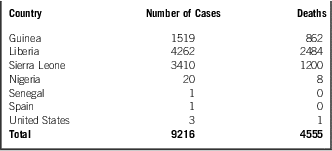
The World Health Organization recently updated the global situation of EVD to include 4555 fatalities among 9216 patients as of October 17, 2014. The details are listed in Table 1, by country.6 The center of the outbreak is in West Africa, and the first case was suspected to have occurred in Guinea in December 2013.
Global Status of Ebola Virus Disease as of October 17, 2014, According to the World Health Organization
EVD, formerly known as Ebola hemorrhagic fever, is introduced into the human population through close contact with the blood, secretions, organs, or other bodily fluids of infected animals. Ebola then spreads in the community through human-to-human transmission, with infection resulting from direct contact (through broken skin or mucous membranes) with the blood, secretions, organs, or other bodily fluids of infected people and indirect contact with environments contaminated with such fluids. Burial ceremonies in which mourners have direct contact with the body of the deceased person can also play a role in the transmission of Ebola. Although local and international health agencies have made maximum efforts to control the outbreak, EVD continues to spread globally. On August 8, 2014, the World Health Organization Secretariat, Margaret Chan, declared the Ebola outbreak an international public health emergency.
One of the major issues surrounding EVD is the fact that many health workers are at risk of infection and potentially death. On July 29, Sierra Leone’s top Ebola doctor, Sheik Umar Khan, died of complications of EVD. Two US citizens, Dr Kent Brantly, who was working with an aid organization in Liberia, and Nancy Writebol, a Christian missionary in Liberia, were transferred to Emory University Hospital in Atlanta, Georgia, for the treatment of complications from Ebola virus infection. Before their evacuation from Africa, ZMapp, an experimental biopharmaceutical comprising three humanized monoclonal antibodies under development as a treatment for Ebola virus disease, was administered. The condition of both patients improved, and both Brantly and Writebol were released from the hospital later. Miguel Pajares, a Roman Catholic priest, was transferred from Monrovia, Liberia, to Spain on August 7 after being infected with Ebola. He was also given ZMapp. Two days after receiving the drug, he died on August 12. Since August 14, ZMapp has been used to treat patients in Liberia, although supplies of ZMapp may be inadequate.
Official Approval of Favipiravir In Japan
In March 2011, an application was made to the Ministry of Health, Welfare and Labor, Pharmaceutical and Food Safety Bureau, Evaluation and Licensing Division (the agency that regulates and approves new drugs and medical devices in Japan), to approve favipiravir as a new antiviral medication for influenza type A and B.6 A Phase I/II clinical trial was conducted in the United States, which showed that compared with placebo, patients treated on protocol with a dose of 1800 mg twice a day during the first day and 800 mg twice a day for the second through fifth days showed significant reduction of the 6 main influenza symptoms including cough, sore throat, headache, nasal symptoms, muscle pain, and general fatigue (Gehan-Wilcoxon test: p=0.01). However, patients treated using a protocol including 2400 mg for the first dose and 600 mg for the second and third doses on the first day, followed by 600 mg 3 times a day for the second through fifth days, did not have significant improvement (Gehan-Wilcoxon test: p=0.414). While favipiravir showed clinical effectiveness against influenza type A and B infections, the results were not consistent and depended on the treatment protocol.
The combination of peramivir and favipiravir was proposed to be effective for the treatment of the 2009 pandemic of oseltamivir-resistant influenza A (H1N1) infection and was tested in mice.7 However, favipiravir has teratogenicity and embryotoxicity.8 Fetal death during early embryogenesis was observed in rats. Use of typical doses of favipiravir in mice, rats, rabbits, and monkeys demonstrated teratogenicity including external anomalies, internal anomalies, and skeletal anomalies.7 Favipiravir is excreted in human breast milk and semen. It is therefore contraindicated during pregnancy, and contraception is required at the conclusion of treatment in women of childbearing age.
On March 26, 2014, the Ministry of Health, Welfare and Labor, Pharmaceutical and Food Safety Bureau, Evaluation and Licensing Division, approved favipiravir in consideration of the situation that antiviral medication-resistant influenza will emerge.7 However, strict requirements accompanied this approval. First, the findings for clinical effectiveness in humans are limited and include only trials in influenza infections. Second, because of teratogenicity and embryotoxicity, favipiravir will be administered to patients only when the Japanese government makes the decision to use the medication during an outbreak of antiviral medication-resistant influenza. Without the permission of the Minister of Health, Welfare and Labor, favipiravir cannot be manufactured or stocked in Japan.
Strict requirements are not practical for Fuji Film Company and Toyama Chemical for drug production. In addition, several international agencies have shown strong interest in the possibility of developing favipiravir. Both Fuji Film Company and Toyama Chemical would like to contribute to patient welfare in Japan.
Preparing For An Outbreak of Ebola
On August 15, 2014, the Minister of Health, Welfare and Labor of Japan, Mr Tamura, stated during a media conference that using favipiravir in Japanese patients during emergencies such as an outbreak of EVD or pandemic Influenza is not against the Pharmaceutical Affairs Law and administration of this medication is permitted on the basis of a physician’s judgment. This can be interpreted as allowing favipiravir to be one of the candidates for use during an outbreak of new viral infectious diseases in Japan.8
On August 25, 2014, the Chief Cabinet Secretary, Yoshihide Suga, mentioned in a media conference that the Japanese government is willing to provide support in collaboration with pharmaceutical companies, especially when there is a formal request from the World Health Organization.9
On September 19, a Frenchwoman who became infected with EVD in Liberia began taking favipiravir with other medications, because the French National Agency for Medicines and Health Safety asked Fuji Film Company and Toyama Chemical for assistance. This woman fully recovered and was discharged from the hospital on October 4. The French and Guinea governments are planning to conduct a clinical trial of favipiravir in November 2014.10
In October 2015, the World Medical Association (WMA), declared the WMA Resolution on Unproven Therapy and the Ebola Virus 11 and strongly supported the intention of paragraph 37 of the 2013 revision of the Declaration of Helsinki, which reads: “In the treatment of an individual patient, where proven interventions do not exist or other known interventions have been ineffective, the physician, after seeking expert advice, with informed consent from the patient or a legally authorised representative, may use an unproven intervention if in the physician’s judgment it offers hope of saving life, re-establishing health or alleviating suffering. This intervention should subsequently be made the object of research, designed to evaluate its safety and efficacy. In all cases, new information must be recorded and, where appropriate, made publicly available.”
Discussion
There are several concerns about the use of favipiravir during an EVD outbreak. Phase I/II trials to establish clinical efficacy against influenza have been completed in Japan and the United States. However, data showing efficacy against Ebola in humans are not yet available. Second, as shown in experimental trials, favipiravir has a risk for teratogenicity and embryotoxicity in humans. Therefore, if favipiravir is used against EVD, we must be careful to protect the patients being treated with a medication with only limited data regarding efficacy and side effects.
As of October 21, 2014, there are no effective medications for the treatment of EVD. Since this represents an international crisis, using a new medication such as favipiravir for EVD is acceptable if the intention of paragraph 37 of the 2013 revision of the Declaration of Helsinki is respected along with other emergency WMA resolutions for EVD. The importance of a speedy approval process and less stringent regulations for the use of experimental drugs such as favipiravir in emergencies is important.
The authors sincerely hope that the international community will overcome the difficulties of EVD in the world.



