Cardiomyopathies are a heterogeneous group of diseases of the myocardium that are associated with significant morbidity, mortality, and cost. While medical advances over time have led to improved heart failure outcomes, the ability to predict serious adverse events remains limited. Historically, outpatient management of children with cardiomyopathy has focused on restriction of activity due to concern for risk of sudden cardiac events.Reference Maron, Chaitman and Ackerman1 However, regular physical activity has important benefits to overall health, well-being, and development. Heart failure clinicians often struggle to determine the level of physical activity that is both healthy and safe for paediatric cardiomyopathy patients, and there is current debate over whether or not activity restrictions actually cause more harm than good.Reference Baggish, Ackerman and Lampert2 Standardised exercise stress testing can be useful for risk stratification, but its use in the paediatric population is hindered by developmental limitations. Furthermore, clinical testing does not necessarily reflect the “real world” activity. Clinicians often rely on parent and patient self-reported measures of activity level and tolerance, which may be vague, imprecise, and limited by cognitive development in the paediatric population.Reference Schuna, Johnson and Tudor-Locke3 As such, there is a need to close the knowledge gap between daily physical activity levels in the paediatric cardiomyopathy population and patient-related outcomes to determine optimal outpatient management strategies.
With the increasing popularity and convenience of consumer-based activity monitor technology, it is important to consider if and how these devices could be incorporated into outpatient care to mitigate the aforementioned gap in knowledge.Reference Kaiser, Harrington and Turakhia4 These devices have been validated in children with heart disease and can provide good estimates of physical activity.Reference Voss, Gardner, Dean and Harris5 Therefore, we examined both the safety and feasibility of consumer-based activity to monitor use in outpatient management of paediatric cardiomyopathy patients as well as to assess patient acceptance of technology integration into care.
This single-centre pilot study included 20 adolescent cardiomyopathy patients (55% hypertrophic, 30% dilated, and 15% left ventricular non-compaction cardiomyopathy), chosen via convenience sample, who were seen in a paediatric cardiomyopathy clinic between October 2016 and June 2017. Subjects received a Fitbit Blaze device to be worn as continuously as possible for 3 months. Data on heart rate, activity, and sleep were transmitted via Bluetooth into a database. Upon study completion, subjects completed questionnaires to evaluate their acceptance of the device and interest in use of technology to augment their outpatient medical care.
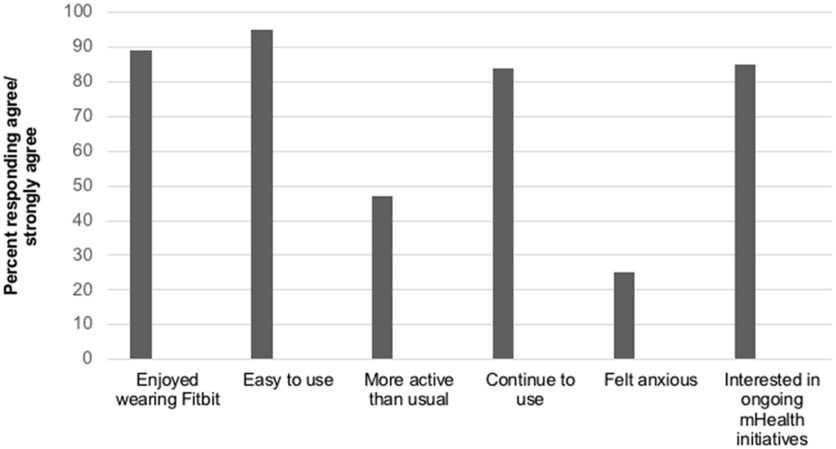
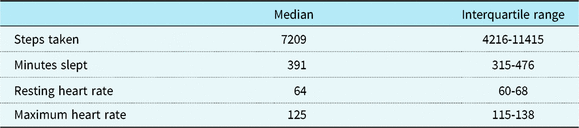
Nineteen subjects (7 (37%) females, median age 14.9 (interquartile range 13–18)) completed the study. One subject was unable to meet the follow-up requirements of the study due to distance and electively withdrew from the study. Over the 3-month study period, devices were worn an average of 70 days, representing >75% of the study period, meeting our a priori definition for consistent use. There were no device-related adverse events. The median resting heart rate was 64 beats per minute (bpm) (interquartile range 60–68) (Table 1). The median peak daily heart rate was 125 bpm (interquartile range 116–137). Subjects took a median of 7209 steps per day (interquartile range 4216–11,415), were at least moderately active for a median of 12 minute (interquartile range 1–12), defined as a energy expenditures that are greater than or equal to three metabolic equivalents,Reference Brewer, Swanson and Ortiz6 slept a median of 391 minute (interquartile range 315–476), and 47% stated they were more active than usual when wearing the device (Fig 1). Subjects completed a brief survey and (25%) stated that wearing the device made them feel anxious, though the majority of subjects expressed a favourable view of the device (89%) and planned to continue using it after study completion (95%). Importantly, the majority were interested in using mobile technology to transmit data to (85%) and communicate with their cardiology team (74%).
Study questionnaire results.

Daily activity monitor data

These findings suggest that the use of a consumer-based activity monitor is both safe and feasible in the adolescent outpatient cardiomyopathy population, and the vast majority of study participants were interested in integrating this technology into routine management. The popularity, availability, and quality of consumer-based activity monitor technology will likely continue to grow over time, and the use of these devices in the healthcare industry has the potential to improve outpatient management of patients with chronic diseases in several ways. Pairing an activity monitor with smart phone applications that allow communication with the care team may improve continuity of care and lead to improved patient/family satisfaction. Additionally, review of data obtained from continuous physiologic monitoring may allow providers to detect clinical changes prior to development of symptoms, ultimately leading to improved patient outcomes.
In conclusion, the use of consumer-based activity monitor technology in the healthcare industry has the potential to improve the management of chronic disease management with a patient-centric approach. Further study is needed to define optimal patient-centric disease management for this complex patient population in the era of wearable healthcare devices. We aim to use the data obtained in this feasibility study to support a large randomised trial that will incorporate use of consumer-based activity monitors and smart-phone technology into the outpatient management of cardiomyopathy patients. This qualitative pilot study is the first step in working to define optimal disease management for this complex patient population in the age of consumer-driven healthcare.
Acknowledgements
We thank Matthew O′Connor, Michael McBride, Kelly Miller, Rachel Ryan, Robert Shaddy, and Heather Griffis for their input and review and review of this study.
Financial Support
This study was funded by a philanthropic support and a grant from the Department of Nursing at Children’s Hospital of Philadelphia.
Conflict of Interest
J.W.R. was the consultant for Novartis, Amgen, Bayer and received travel support from Abbott.
Ethical Standards
This study was approved by the Institutional Review Board at the Children’s Hospital of Philadelphia.