Introduction
Popcorn is grown on nearly 90,000 ha in the United States every year (USDA NASS 2018). States that produce more than 500 ha of popcorn annually include Illinois, Indiana, Iowa, Kansas, Kentucky, Michigan, Nebraska, and Ohio (USDA NASS 2018). Global popcorn sales have increased by an average of 4 million kg each year from 1970 to 2017, with sales of more than 540 million kg in 2017 (Popcorn Board 2019). Nebraska produces the most popcorn of any state in the United States; popcorn is grown on approximately 26,000 ha in Nebraska, producing 167 million kg, which represents 34% of U.S. popcorn production in 2017 (USDA NASS 2018). Popcorn production is normally contracted by the popcorn processor and the farmer (D’Croz-Mason and Waldren Reference D’Croz-Mason and Waldren1978; Ziegler Reference Ziegler and Hallauer2001). Popcorn growth and development varies from field corn in several ways: Popcorn has shorter and thinner stalks, narrower and more upright leaves, and slower emergence than field corn (Ziegler Reference Ziegler and Hallauer2001). Because of these characteristics, popcorn is less competitive with weeds than is field corn (Ziegler Reference Ziegler and Hallauer2001).
The majority of popcorn production in the United States is under conservation tillage systems and herbicides are the primary method of weed control (Pike et al. Reference Pike, Pritchett, Reynolds, Cook, Mueller, Green, Linn, Koinzan, Eisley, Obermeyer, Hoffman, Robbins, Sleaford, Schleisman, Sieg, Weaver, Ziegler, Duty, Iverson, Miyazaki, Jess and Burr2002). Weed control is a challenge for popcorn producers because there are fewer herbicide options compared with field corn. For example, herbicide premixes such as isoxaflutole/thiencarbazone (Anonymous 2016a), tembotrione/thiencarbazone (Anonymous 2012), rimsulfuron/mesotrione (Anonymous 2016b), and acetochlor/flumetsulam/clopyralid (Anonymous 2014b, 2014c) are labeled in field corn but not in popcorn. Commercially available popcorn hybrids are not genetically modified, so commonly used POST herbicides in herbicide-resistant field corn, such as glyphosate and/or glufosinate, cannot be used for weed control in popcorn (Fernandez-Cornejo et al. Reference Fernandez-Cornejo, Wechsler, Livingston and Mitchell2014; Ziegler Reference Ziegler and Hallauer2001).
Velvetleaf is a large-seeded annual broadleaf weed (Bazzaz et al. Reference Bazzaz, Garbult, Reekie and Williams1989) native to China, where it was cultivated as a fiber crop (Sattin et al. Reference Sattin, Zanin and Berti1992). It was introduced to North America in the 17th century for fiber production (DeFelice et al. Reference Defelice, Witt and Barrett1988, Spencer Reference Spencer1984). Velvetleaf is now a major agricultural weed in corn, cotton (Gossypium hirsutum L.), soybean [Glycine max (L.) Merr.], and sorghum [Sorghum bicolor (L.) Moench] production fields in North America (Spencer Reference Spencer1984). A statewide survey conducted in 2015 reported velvetleaf as the fourth most difficult to control weed in Nebraska (Sarangi and Jhala Reference Sarangi and Jhala2018a). Widespread occurrence and seed-bank persistence of velvetleaf contributes to its longevity and long-term success (Warwick and Black Reference Warwick and Black1988). For example, Toole and Brown (Reference Toole and Brown1946) reported that velvetleaf buried for 39 yr in Virginian soil had 43% seed viability. A similar study in Nebraska reported 25% and 35% viability in eastern and western Nebraska, respectively, after 17 yr of velvetleaf seed burial (Burnside et al. Reference Burnside, Wilson, Weisberg and Hubbard1996). Its growth potential and canopy architecture enable velvetleaf to compete for light with most agronomic crops (Bazzaz et al. Reference Bazzaz, Garbult, Reekie and Williams1989).
Velvetleaf interference in field corn has been attributed primarily to light competition (Lindquist et al. Reference Lindquist, Mortensen and Johnson1998). Velvetleaf competition in field corn has been reported to result in substantial yield losses. Campbell and Hartwig (Reference Campbell and Hartwig1982) reported 70% yield reduction in field corn after 6 weeks of competition. Lindquist et al. (Reference Lindquist, Mortensen, Clay, Schmenk, Kells, Howatt and Westra1996) reported yield loss from velvetleaf ranged from 0% to 80%, depending on the year, in Nebraska. Terra et al. (Reference Terra, Martin and Lindquist2007) reported variable field corn yield loss due to velvetleaf competition, ranging from 0% to 72% at 20 velvetleaf plants m–1 row. Liphadzi and Dille (Reference Liphadzi and Dille2006) reported maximum field corn yield losses from velvetleaf competition ranged from 41% to 100%. Werner et al. (Reference Werner, Curran, Harper, Roth and Knievel2004) reported 37% field corn yield loss from 21 velvetleaf plants m–2 in Pennsylvania. Similarly, Scholes et al. (Reference Scholes, Clay and Brix-Davis1995) reported 37% yield loss from 24 velvetleaf plants m–2 in South Dakota. Soil water level affects competition between velvetleaf with field corn (Vaughn et al. Reference Vaughn, Lindquist and Bernards2007, Reference Vaughn, Bernards, Arkebauer and Lindquist2016). Increased field corn populations and velvetleaf that emerge after field corn emergence have resulted in less velvetleaf seed production (Teasdale et al. Reference Teasdale1998). Field corn yield loss due to velvetleaf interference has been reported to be greater with higher levels of nitrogen fertilizer (Barker et al. Reference Barker, Knezevic, Martin, Walters and Lindquist2006; Bonifas et al. Reference Bonifas, Walters, Cassman and Lindquist2005).
Herbicides applied PRE, such as atrazine/fluthiacet-methyl/pyroxasulfone (1,260 g ai ha–1) and acetochlor/clopyralid/flumetsulam (1,190 g ai ha–1), controlled velvetleaf 78% to 90% and 74% to 79%, respectively at 28 d after treatment (DAT) in field corn in Nebraska (Sarangi and Jhala Reference Sarangi and Jhala2018b). Liphadzi and Dille (Reference Liphadzi and Dille2006) showed that the competitiveness of surviving velvetleaf in field corn was reduced after isoxaflutole and flumetsulam was applied PRE. Similarly, velvetleaf that survived dicamba, halosulfuron-methyl, or flumiclorac applied POST was less competitive with field corn than velvetleaf in plots not treated with a POST herbicide (Terra et al. Reference Terra, Martin and Lindquist2007). Although velvetleaf plants that survive PRE or POST herbicide applications are likely to be less competitive, seed production from survivors is a concern because they contribute to soil seed bank (Liphadzi and Dille Reference Liphadzi and Dille2006; Murphy and Lindquist Reference Murphy and Lindquist2002; Terra et al. Reference Terra, Martin and Lindquist2007).
Weed height at the time of herbicide application can influence herbicide efficacy (Wiles et al. Reference Wiles, Wilkerson, Gold and Coble1992; Wilkerson et al. Reference Wilkerson, Modena and Coble1991). King and Oliver (Reference King and Oliver1992) reported reduced herbicide efficacy as time after weed emergence increased for a number of weed species. Herbicide application to weeds at the proper weed height is a tactic used to delay the evolution of herbicide resistance (Norsworthy et al. Reference Norsworthy, Ward, Shaw, Llewellyn, Nichols, Webster, Bradley, Frisvold, Powles, Burgos, Witt and Barrett2012). Fluthiacet-methyl (4.8 to 7.2 g ai ha–1) can be applied to velvetleaf until the plants are up to 91 cm tall (Anonymous 2011). The recommended height for broadleaf summer annual weeds is 3 to 8 cm when applying dicamba at rates ranging from 210 to 1,120 g ai ha–1 (Anonymous 2018a). There is no information in the scientific literature, to our knowledge, on effect of velvetleaf height on labeled POST herbicide efficacy in popcorn.
Atrazine and S-metolachlor are commonly applied in mixture because of their crop safety in yellow and white popcorn (Barnes et al. Reference Barnes, Lawrence, Knezevic, Rodriguez, Irmak and Jhala2019b). For instance, it was estimated that 99% and 11% of popcorn fields were treated PRE and/or POST with atrazine and S-metolachlor, respectively, in 1999 in the United States (Bertalmio et al. Reference Bertalmio, Cook, Duty, Eisley, Green, Hacker, Hoffman, Iverson, Jess, Koinzan, Linn, Miyazaki, Mueller, Mueller, Obermeyer, Pike, Pritchett, Reynolds, Robbins, Schleisman, Sieg, Sleaford, Weaver and Ziegler2003). Sarangi and Jhala (Reference Sarangi and Jhala2018a) reported in a statewide survey that S-metolachlor/atrazine was the third most commonly used PRE herbicide in field corn in eastern Nebraska. S-metolachlor/atrazine, applied PRE, is a commonly used herbicide in popcorn production; one concern with its use is that it provides only partial control of velvetleaf (Anonymous 2014a; Taylor-Lovell and Wax Reference Taylor-Lovell and Wax2001). Barnes et al. (Reference Barnes, Knezevic, Lawrence, Irmak, Rodriguez and Jhala2019a) reported that S-metolachlor/atrazine (2,470 g ai ha–1) applied PRE reduced velvetleaf density 24% to 0% in 2017 and 2018, respectively. Because of rain and other unexpected events, it can be difficult for growers to apply PRE herbicides. For example, in the 2019 growing season in Nebraska and several other popcorn-producing states, spring was extremely wet. Several growers were able to plant popcorn but were not able to apply PRE herbicide; therefore, they had to rely on POST herbicides for weed control. Herbicide-resistant popcorn has not been developed, so nonselective herbicides that can be used in glyphosate/glufosinate-resistant field corn cannot be used in popcorn. In addition, relatively new premixture herbicides such as atrazine/bicyclopyrone/S-metolachlor/ (Anonymous 2017a) and acetochlor/clopyralid/mesotrione (Anonymous 2017b) are labeled to apply PRE in popcorn, but not POST. Often, popcorn growers have to rely on POST herbicides for weed control.
To our knowledge, scientific literature is not available for velvetleaf control in popcorn with POST herbicides. The objectives of our research were (1) to evaluate the efficacy and crop safety of labeled POST herbicides for controlling velvetleaf that survived S-metolachlor/atrazine applied PRE in Nebraska popcorn and (2) to determine the effect of velvetleaf height on POST herbicide efficacy, popcorn injury, and yield. We hypothesized the efficacy of POST herbicides available for control of velvetleaf may be reduced when applied to velvetleaf up to 30-cm tall compared with plants up to 15-cm tall.
Materials and Methods
Site Description
Field experiments were conducted at the University of Nebraska-Lincoln, South Central Agricultural Laboratory near Clay Center, NE (40.5752°N, 98.1428°W; 552 m above mean sea level) in 2018 and 2019. The soil type was Hastings silt loam (montmorillonitic, mesic, Pachic Argiustolls; 17% sand, 58% silt, and 25% clay) with a pH of 6.5 and 3.0% organic matter. In early spring, the site was disked with a tandem disk at a depth of 10 cm and fertilized with 202 kg ha−1 nitrogen in the form of anhydrous ammonia (82-0-0) applied with an anhydrous ammonia coulter on 96-cm spacing. Starter fertilizer ammonium polyphosphate (APP; 10-34-0) was applied in-furrow at 6 kg ha−1 during planting.
Treatments and Experimental Design
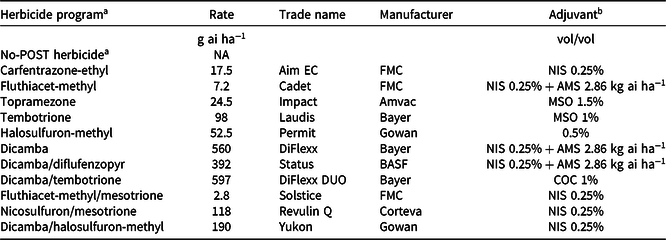
The treatments were arranged in a split-plot design with four replications. The main plot treatments consisted of two velvetleaf heights (≤15 cm and ≤30 cm tall) and 11 subplot POST herbicide programs (Table 1). A no-POST herbicide control was included for comparison. Plot dimensions were 9-m long by 3-m wide. A yellow popcorn hybrid (VYP 321; Conagra Brands, Chicago, IL 60654) was planted on April 30, 2018, and May 1, 2019, with a row spacing of 76 cm at a depth of 4 cm and a planting density of 89,000 seeds ha−1. S-metolachlor/atrazine (Bicep II Magnum; Syngenta Crop Protection, Greensboro, NC 27419) was applied at 2,470 g ai ha–1 on May 2, 2018, and May 2, 2019, using a tractor sprayer to treat the entire research site to achieve early-season control of small-seeded weeds (Geier et al. Reference Geier, Stahlman, Regehr and Olson2009; Grichar et al. Reference Grichar, Besler, Brewer and Palrang2003; Steele et al. Reference Steele, Porpiglia and Chandler2005). This PRE herbicide resulted in high survival rate of velvetleaf and low survival rate of other weed species (Anonymous 2014a; Taylor-Lovell and Wax Reference Taylor-Lovell and Wax2001). Except for S-metolachlor/atrazine applied PRE, POST herbicides were applied with a CO2-pressurized backpack sprayer and a boom equipped with five TTI 110015 flat-fan nozzles for treatments included dicamba (TeeJet, Spraying Systems, Wheaton, IL 60189) or five AIXR 110015 flat-fan nozzles spaced 51-cm apart for other herbicide treatments. POST herbicides were applied to velvetleaf plants up to 15 cm tall on June 8 and June 10 in 2018 and 2019, respectively, and to velvetleaf plants up to 30 cm tall on June 22 and June 17 in 2018 and 2019, respectively. Popcorn growth stages when velvetleaf reached up to 15 and up to 30 cm were V6 and V9, respectively, in 2018, and V5 and V8, respectively, in 2019.
Herbicide programs for POST control of velvetleaf in popcorn in field experiments conducted at the University of Nebraska, South Central Agricultural Laboratory near Clay Center, NE, in 2018 and 2019.

a The experimental site was treated with S-metolachlor/atrazine at 2,470 g ai ha−1 applied PRE, including the no-POST herbicide control plots.
b Abbreviations: AMS, ammonium sulfate; COC, crop oil concentrate; MSO, methylated seed oil; NA, not applicable; NIS, nonionic surfactant.
Data Collection
Velvetleaf control was assessed visually on a scale of 0% to 100%, with 0% representing no control and 100% representing complete control at 14 and 28 DAT. Popcorn injury was assessed on a scale of 0% to 100%, with 0% representing no injury and 100% representing plant death at 14 and 28 DAT. Velvetleaf densities were assessed from two randomly placed 0.5-m2 quadrats in each plot at 14 and 28 DAT. Velvetleaf aboveground biomass was assessed from two randomly placed 0.5-m2 quadrats in each plot at 45 d after POST herbicides were applied. Surviving velvetleaf plants were cut near the soil surface, dried in paper bags at 65 C for 10 d, and dry weight was recorded. Percent biomass reduction compared with that of the no-POST herbicide control was calculated using Equation 1 (Wortman Reference Wortman2014):
 $$\% \,\,{\rm{ Biomass\ reduction}} = \left[ {\left( {C - B} \right)/C} \right] \times \!100$$
where C represents the velvetleaf biomass from the no-POST herbicide control plot in the corresponding replication block and B represents the biomass of the treatment plots. At popcorn harvest, five velvetleaf plants (if present) from each plot were collected and the number of seed capsules per plant were counted. Popcorn was harvested from the middle two rows with a plot combine and the yields were adjusted to 14% grain moisture content.
Statistical Analysis
Data were subjected to ANOVA in R, version 3.5.1 (R Core Team, 2019), using the base packages and the Agricolae: Statistical Procedures for Agricultural Research Package (Mendiburu Reference Mendiburu2017). ANOVA was performed using the sp.plot (split plot) function where velvetleaf height (≤15 cm or ≤30 cm) was treated as the main plot and POST herbicides were considered the subplot effect. Replications nested within years were considered random effects in the model. ANOVA assumptions of normality and homogeneity of variance were tested (Kniss and Streibig Reference Kniss and Streibig2018). Improvements in normality were gained for density and biomass data with a logit transformation. Back-transformed data are presented in tables for interpretation. If the random effect of year was significant, data were analyzed with years separated. Treatment means were separated at P ≤ 0.05 using Fisher protected LSD test. Orthogonal contrast analysis was conducted to compare velvetleaf control between herbicide programs that included fluthiacet-methyl or dicamba, and programs that did not include fluthiacet-methyl or dicamba.
Results and Discussion
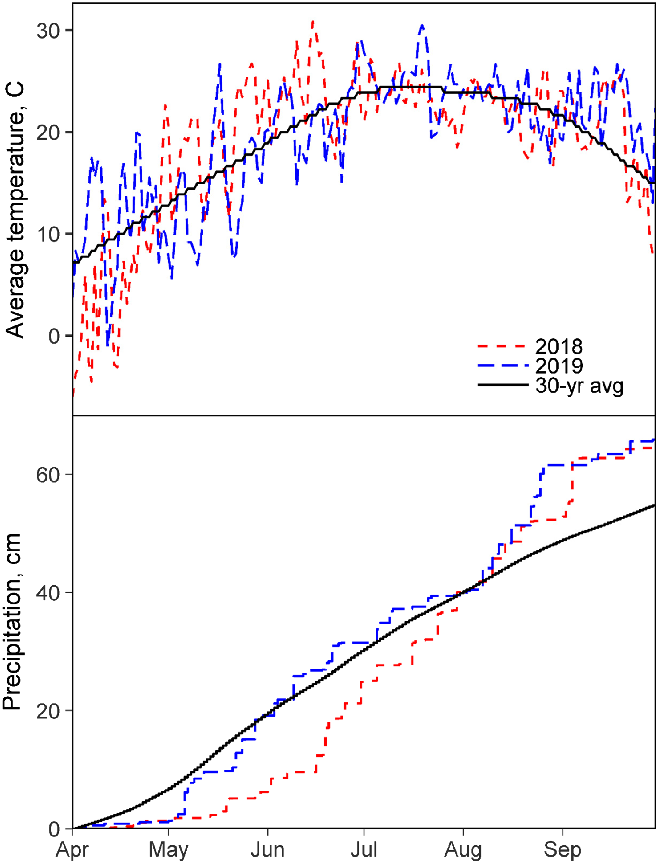
Average daily temperatures and precipitation for the 2018 and 2019 growing seasons were similar to the 30-yr average for the experimental site (Figure 1). Year was significant for all measured variables except velvetleaf seed capsules; therefore, data were analyzed separately.
Average daily air temperature and total precipitation during 2018 and 2019 growing seasons compared with the 30-yr average (avg) at the University of Nebraska–Lincoln, South Central Agricultural Laboratory near Clay Center, NE.

Velvetleaf Control
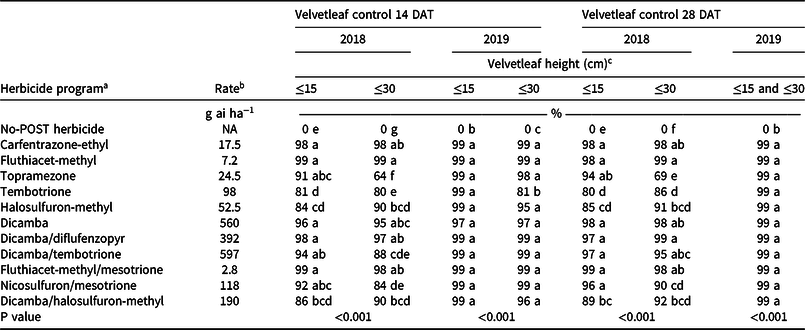
Velvetleaf control 14 DAT varied across years and an interaction between velvetleaf height and herbicide program occurred in both years of the study; however, at 28 DAT in 2019, velvetleaf height did not affect herbicide efficacy (Table 2). Most POST herbicide programs controlled velvetleaf 95% or greater at 14 and 28 DAT regardless of velvetleaf height at application. Cafentrazone, fluthiacet-methyl, dicamba, dicamba/diflufenzophr, and fluthiacet-methyl/mesotrione resulted in 95% or greater control 14 DAT regardless of velvetleaf height at the time of application in 2018 and 2019. Similarly, Barnes et al. (Reference Barnes, Lawrence, Knezevic, Rodriguez, Irmak and Jhala2019b) reported velvetleaf that survived a PRE herbicide was controlled 99% with dicamba/diflufenzopyr, 98% with dicamba/tembotrione, and 95% with fluthiacet-methyl/mesotrione 21 DAT in popcorn. Sarangi and Jhala (Reference Sarangi and Jhala2018c) reported velvetleaf that survived flumioxazin/pyroxasulfone applied PRE was controlled 98% 14 DAT with 5 g ai ha–1 fluthiacet-methyl applied when velvetleaf was 12-cm tall. Bussan et al. (Reference Bussan, Boerboom and Stoltenberg2001) reported 0% to 7% survival of 5-cm velvetleaf treated with dicamba at 560 g ai ha–1 plus 28% nitrogen at 1.25% vol/vol.
Comparison of POST herbicide programs for control of velvetleaf up to 15- and up to 30-cm tall in popcorn at 14 and 28 DAT in field experiments conducted at the University of Nebraska, South Central Agricultural Laboratory near Clay Center, NE, in 2018 and 2019.

a The experimental site was treated with S-metolachlor/atrazine 2,470 g ai ha−1 applied PRE, including the no-POST control plots.
b Abbreviations: DAT, days after treatment; NA, not applicable.
c Means presented within the same column with no common letter(s) are significantly different according to Fisher protected LSD (α = 0.05).
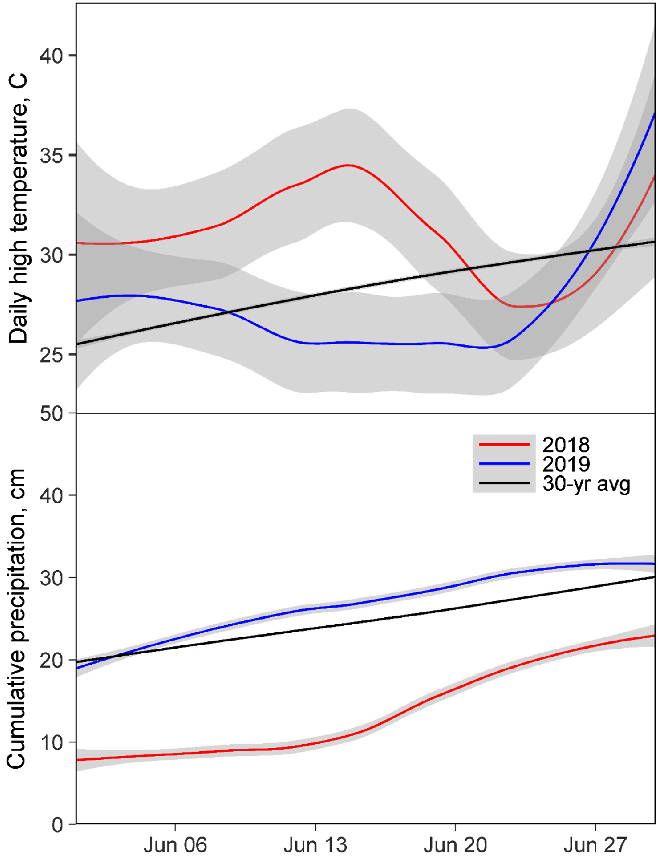
Topramezone provided 91% control of up to 15-cm–tall velvetleaf but only 64% control of velvetleaf up to 30-cm tall at 14 DAT in 2018. Topramezone is labeled for control of velvetleaf less than 20-cm tall (Anonymous 2019); therefore, relatively less control of up to 30-cm velvetleaf was expected. In contrast, topramezone resulted in 98% or greater control in 2019 regardless of velvetleaf height. The lower level of velvetleaf control with topramezone in 2018 might have been due to lower-than-average precipitation and higher-than-average maximum daily temperatures in June 2018 compared with June 2019 (Figure 2). When weeds are under stress, herbicide efficacy is reduced. For example, Godar et al. (Reference Godar, Varanasi, Nakka, Prasad, Thompson and Mithila2015) reported greater control, shorter plants, and higher mortality rate in Palmer amaranth [Amaranthus palmeri (S.) Watson] treated with mesotrione at low temperatures (25/15 C day/night) compared with high temperatures (40/30 C day/night) with 85% control obtained with concentrations of 14.9 and 80.8 g ai ha–1 at low and high temperatures, respectively. Tembotrione resulted in 80% to 81% control of 12- to 30-cm–tall velvetleaf 14 DAT in 2018.
Maximum daily air temperature and total cumulative precipitation during June 2018 and 2019 compared with the 30-yr average (avg) at the University of Nebraska–Lincoln, South Central Agricultural Laboratory near Clay Center, NE.

In 2019, control of velvetleaf up to 15-cm tall was 99% with tembotrione compared with 81% control of velvetleaf up to 30-cm tall. In 2018, application of halosulfuron-methyl resulted in 84% and 90% control of velvetleaf up to 15- and up to 30-cm tall, respectively, 14 DAT. In 2019, halosulfuron provided 99% and 95% control of velvetleaf up to 15- and up to 30-cm tall, respectively, 14 DAT.
In 2018, 88% to 94% control of velvetleaf was achieved with dicamba/tembotrione and 99% in 2019. Similarly, control of velvetleaf at 14 DAT with nicosulfuron/mesotrione (99%) and dicamba/halosulfuron-methyl (96% to 99%) in 2019 was greater than control with nicosulfuron/mesotrione (84% to 92%) and dicamba/halosulfuron-methyl (86% to 90%) in 2018. Orthogonal contrasts indicated that POST herbicide programs with fluthiacet-methyl or dicamba resulted in greater control of velvetleaf than herbicide programs without fluthiacet-methyl or dicamba in 2018 (data not shown). In 2019, herbicide programs with or without fluthiacet-methyl or dicamba resulted in similar control of velvetleaf at 28 DAT.
New dicamba products labeled for use in dicamba-resistant soybean do not allow for ammonium sulfate because it increases dicamba volatility (Zollinger et al. Reference Zollinger, Howatt, Bernards, Young and Goss2016). However, ammonium sulfate is commonly used as a water conditioner and the ammonium increases herbicide absorption and translocation (Zollinger et al. Reference Zollinger, Howatt, Bernards, Young and Goss2016). Mixing ammonium sulfate with dicamba increases dicamba efficacy in redroot pigweed (Amaranthus retroflexus L.) and common lambsquarters (Chenopodium album L.) (Roskamp et al. Reference Roskamp, Chahal and Johnson2013). Nebraska Extension recommends that ammonium sulfate not be added to dicamba, to reduce dicamba volatility and subsequent off-target injury (Klein et al. Reference Klein, Jhala, Pryor, Knezevic, Rees and Whitney2018). Ammonium sulfate was added in this study to dicamba and dicamba/diflufenzopyr as recommended on the product labels; therefore, if recommendations to exclude ammonium sulfate from dicamba applications are followed, relatively less control of velvetleaf is expected or warrants investigation.
Velvetleaf control at 28 DAT varied across years. Velvetleaf (≤15 cm tall) control ranging from 80% to 89% was achieved with dicamba/halosulfuron-methyl, halosulfuron-methyl, and tembotrione 28 DAT in 2018. More than 94% control of velvetleaf up to 15-cm tall was achieved with the rest of the herbicide treatments 28 DAT in 2018. Carfentrazone-ethyl applied at 35 g ai ha–1 has been reported to provide 98% control of velvetleaf 30 DAT, but it was applied when velvetleaf was not more than 10-cm tall (Durgan et al. Reference Durgan, Yenish, Daml and Miller1997). Sarangi and Jhala (Reference Sarangi and Jhala2018c) reported 95% control of velvetleaf 28 DAT with 5 g ai ha–1 fluthiacet-methyl applied to 12-cm velvetleaf that survived flumioxazin/pyroxasulfone applied PRE.
Dicamba/halosulfuron-methyl, halosulfuron-methyl alone, and nicosulfuron/mesotrione provided 90% to 92% control of velvetleaf up to 30-cm tall 28 DAT in 2018. Schuster et al. (Reference Schuster, Al-Khatib and Dille2008) reported 91% to 93% control of 5- to 8-cm–tall velvetleaf with 105 to 140 g ai ha–1 nicosulfuron/mesotrione 21 DAT. Tembotrione and topramezone controlled velvetleaf up to 30-cm tall 85% and 69%, respectively, at 28 DAT in 2018. Bollman et al. (Reference Bollman, Boerboom, Becker and Fritz2008) reported 95% to 98% control of 5- to 10-cm velvetleaf 35 DAT with 12 g ai ha–1 topramezone and 96% to 100% control with tembotrione at 92 g ai ha–1 in plots treated with S-metolachlor applied PRE. All other herbicide programs achieved greater than 95% control of velvetleaf up to 30 cm 28 DAT in 2018. Velvetleaf control was not affected by plant height in 2019 (Table 2). All herbicide programs controlled velvetleaf up to 15- and up to 30-cm tall 99% 28 DAT in 2019.
Results of herbicide programs with fluthiacet-methyl or dicamba did not differ from other herbicide programs 28 DAT in 2019. These herbicides are not necessarily labeled for control of velvetleaf at this height. For example, dicamba is labeled to provide effective control of 3- to 8-cm–tall velvetleaf, fluthiacet-methyl/mesotrione for velvetleaf less than 13-cm tall, and tembotrione for velvetleaf less than 15-cm tall. In contrast, few herbicides evaluated in this research are labeled for velvetleaf height within the tested height range, including topramezone (≤20 cm), dicamba/halosulfuron-methyl (≤23 cm), nicosulfuron/mesotrione (≤25 cm), halosulfuron-methyl (≤30 cm), carfentrazone-ethyl (≤61 cm), and fluthiacet-methyl (≤91 cm). Fluthiacet-methyl/mesotrione and nicosulfuron/mesotrione are labeled only in yellow popcorn and should not be applied in white popcorn. Velvetleaf control with herbicide programs including fluthiacet-methyl or dicamba provided greater control than herbicide programs without them 28 DAT in 2018 but not in 2019.
Velvetleaf Density
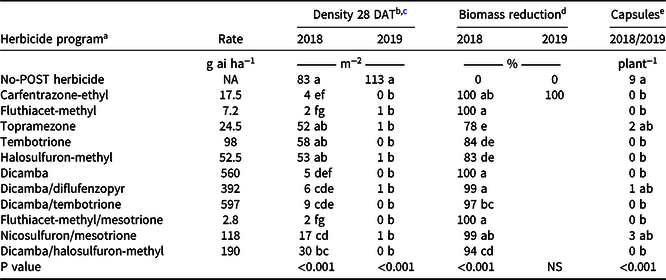
Velvetleaf density at 28 DAT varied by year. Herbicide application by velvetleaf height did not influence velvetleaf density in either year of the study (Table 3). Velvetleaf density in no-POST herbicide plots was 83 plants m–2 in 2018 compared with 113 plants m–2 in 2019. Velvetleaf density in herbicide programs ranged from 2 to 58 plants m–2 in 2018. Velvetleaf density after application of carfentrazone-ethyl, fluthiacet-methyl, dicamba, dicamba/diflufenzopyr, dicamba/tembotrione, and fluthiacet-methyl/mesotrione was not more than 9 plants m–2 in 2018. Topramezone, halosulfuron-methyl, and tembotrione, applied POST, resulted in velvetleaf densities that were similar to the no-POST control in 2018. As expected, based on control ratings 28 DAT, velvetleaf density ranged from 0 to 1 plants m–2 for all herbicide programs in 2019. Orthogonal contrasts indicated that herbicide programs with fluthiacet-methyl or dicamba reduced velvetleaf density more than herbicide programs without fluthiacet-methyl or dicamba in 2018 (data not shown). Treatments with fluthiacet-methyl resulted in less velvetleaf than treatments with dicamba in 2018. Sarangi and Jhala (Reference Sarangi and Jhala2018c) reported velvetleaf density of 3 m–2 at 28 DAT with 5 g ai ha–1 fluthiacet-methyl applied to 12-cm velvetleaf that survived flumioxazin/pyroxasulfone applied PRE compared with 16 plants m–2 when only the PRE herbicide was applied.
Comparison of velvetleaf density and biomass 28 and 45 DAT, respectively, of plants ≤30-cm tall, and 2019 velvetleaf capsule yield in herbicide programs for control of velvetleaf ≤15- and ≤30-cm tall in popcorn in field experiments conducted at the University of Nebraska, South Central Agricultural Laboratory near Clay Center, NE in 2018 and 2019.

a The experimental site was treated with S-metolachlor/atrazine 2,470 g ai ha−1 applied PRE, including the no-POST control plots.
b Abbreviations: DAT, days after treatment; NA, not applicable; NS, not significant.
c Means presented within the same column with no common letter(s) are significantly different according to Fisher protected LSD (α = 0.05).
d No-POST herbicide control was excluded from biomass reduction analysis to meet assumptions of ANOVA.
e There was no significant difference between the number of velvetleaf seed capsules; therefore, data of both years were combined.
Biomass Reduction
Velvetleaf biomass reduction varied by year. Velvetleaf plant height at the time of POST herbicide application did not affect velvetleaf biomass reduction. In 2018, 78% to 100% biomass reduction was observed across POST herbicide programs (Table 3). Carfentrazone-ethyl, fluthiacet-methyl, dicamba, dicamba/diflufenzopyr, dicamba/tembotrione, and fluthiacet-methyl/mesotrione reduced velvetleaf biomass 99% to 100%. Topramezone, halosulfuron-methyl, and tembotrione reduced velvetleaf biomass the least at 78%, 83%, and 84%, respectively. In 2019, there was no difference in velvetleaf biomass reduction among the herbicide programs evaluated. Zhang et al. (Reference Zhang, Jaeck, Menegat, Zhang, Gerhards and Hanwen2013) reported 90% velvetleaf biomass reduction with topramezone at 15.84 g ai ha–1 plus 0.3% methylated seed oil. Hart (Reference Hart1997) reported halosulfuron-methyl at 9 g ai ha–1 plus dicamba at 140 g ai ha–1 plus crop oil concentrate or methylated seed oil 1% vol/vol resulted in 87% velvetleaf biomass reduction.
Velvetleaf Seed Capsules
The no-POST herbicide plots resulted in an average of 9 velvetleaf seed capsules plant–1 (Table 3). Lindquist et al. (Reference Lindquist, Maxwell, Buhler and Gunsolus1995) report that each velvetleaf capsule contains approximately 40 seeds. Dicamba/diflufenzopyr, topramezone, and nicosulfuron/mesotrione treatments resulted in 1, 2, and 3 capsules plant–1, respectively, which was similar to the no-POST control. Velvetleaf seed production was reduced with all other herbicide programs. Schmenk and Kells (Reference Schmenk and Kells1998) reported 50% less seed production in velvetleaf that escaped atrazine compared with nontreated plants. Murphy and Lindquist (Reference Murphy and Lindquist2002) reported that velvetleaf that survived halosulfuron, dicamba, or flumiclorac applied POST produced the same number of capsules plant–1 as the no-POST herbicide; however, velvetleaf density was reduced, resulting in significantly less seed production. Terra et al. (Reference Terra, Martin and Lindquist2007) reported velvetleaf treated with dicamba, halosulfuron, or flumiclorac produced fewer capsules and seeds than did nontreated velvetleaf. Bussan et al. (Reference Bussan, Boerboom and Stoltenberg2001) reported velvetleaf seed production is correlated with velvetleaf biomass in corn and soybean production systems.
Popcorn Injury and Yield
Popcorn injury was not observed in any of herbicide programs tested in this study during both years. Yield varied by year; however, there was no effect of herbicide program or velvetleaf height on yield. Popcorn yield averaged 5,060 kg ha–1 across all treatments in 2018. Popcorn yield in 2019 was poor due to rain events in May that resulted in poor crop stand and hail and wind damage in August that resulted in lodging averaging 1,052 kg ha–1 across all treatments. It has to be noted that the no-POST herbicide plots in this study also received atrazine/S-metolachlor applied PRE that provided partial control of velvetleaf. In addition, the majority of velvetleaf in no-POST herbicide plots emerged after popcorn emerged; therefore, the velvetleaf was not very competitive.
Practical Implications
Weed management in no-till popcorn depends primarily on herbicides. Selecting a POST herbicide in popcorn is more challenging than in field corn because there a fewer registered herbicides. There are fewer control options for weeds that escape PRE herbicides and reach height above most label recommendations. Velvetleaf was effectively controlled by a number of POST herbicides tested in this study at heights ranging from 12 to 30 cm. Fluthiacet-methyl and carfentrazone-ethyl provided 98% to 99% control and are labeled for velvetleaf up to 91- and up to 62-cm tall, respectively. With the addition of ammonium sulfate, dicamba and dicamba/diflufenzopyr provided 95% or greater velvetleaf control.
From the results of this study, we conclude that effective POST herbicides are available for control of 12- to 30-cm velvetleaf in popcorn production. Velvetleaf interference did not reduce popcorn yield relative to the no-POST herbicide control. This is not unexpected, based on information known about the reduced competitiveness of weeds that survive a soil-applied herbicide. The reduction in velvetleaf seed production is an important weed management principle, especially considering the longevity of velvetleaf in the seedbank. As of 2019, only atrazine-resistant velvetleaf has been reported (Heap Reference Heap2019); however, herbicide with multiple sites of action should be used to delay the evolution of herbicide-resistant velvetleaf.
Acknowledgements
The authors acknowledge the help of Irvin Schleufer, Amy Hauver, Shawn McDonald, Jasmine Mausbach, Will Neels, Adam Leise, and Jared Stander in this project. This project was partially supported by the Nebraska Agricultural Experiment Station with funding from the Hatch Act through the U.S. Department of Agriculture (USDA) National Institute of Food and Agriculture Project No. NEB-22-396. This project was also supported by the USDA National Institute of Food and Agriculture’s Nebraska Extension Implementation Program. No conflicts of interest have been declared.