Syncopation is one of the essential features of 20th-century popular music – American popular music, certainly, but also the many musical genres around the world that have felt American influence. Across a wide variety of popular styles spanning the entire century (and extending into the 21st – ragtime, jazz, Tin Pan Alley, rock, country, disco, rap – syncopation is a pervasive and unifying characteristic. It is also a characteristic that distinguishes modern popular music from music of the past. While many basic features of 20th-century popular music are shared with that of the previous century and before – duple and triple metrical structures, a norm of four-measure phrases, melody-and-accompaniment texture, diatonic scale frameworks and triadic harmony – the much higher degree of syncopation in the later century creates a strong contrast between the two eras.
Given the importance of syncopated rhythms in 20th-century popular music, it is natural to wonder about their historical roots: Where and when did these rhythms originate? There is little consensus on this issue. Some have suggested that they arose primarily out of earlier African-American, or even African, music. Mark Gridley and Wallace Rave, while acknowledging the presence of syncopation in European music, assert that ‘it is more likely that the model for jazz syncopation … came from Africa’ (Reference Gridley and Rave1984, p. 48). Edward Berlin offers a very different view, suggesting that ‘the rhythmic configurations constituting ragtime syncopation … had long been part of the language of Western music’; only their ‘consistency’ was new to ragtime (Berlin Reference Berlin1980, p. 106). Other authors take a middle ground, viewing the rhythm of ragtime and later genres as a fusion of European and African-American traditions. Several of these accounts centre on the rhythmic pattern  , known as the ‘Scotch snap,’ or the related pattern
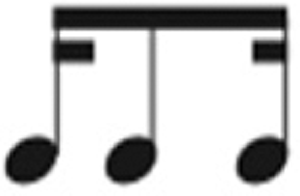 . The Scotch snap is traditionally associated with British music, as the name implies, although opinions differ as to whether its use in ragtime originated from that source or from African-American music.Footnote 1 In either case, it has been argued that the syncopations of ragtime arose, at least in part, out of extensions and elaborations of this pattern: in ragtime rhythm, ‘the simple syncopated rhythmic germ [
 ] … is expanded and made more complex’ (Hamm Reference Hamm1983, p. 393; see also Krehbiel Reference Krehbiel1914, p. 94; van der Merwe Reference van der Merwe1989, pp. 163–4).
In this article I offer a novel, alternative view of the evolution of 20th-century syncopation. Of crucial importance is the distinction between what I will call second-position syncopations, accents on the second quarter of a metrical unit (the second eighth of a half-note span, or the second sixteenth of a quarter), and fourth-position syncopations, or accents on the fourth quarter of a metrical unit. In itself, this distinction is not new. Second-position syncopation could be viewed as a generalised version of the Scotch snap (I will discuss the connection between these two concepts further below). The distinction between second- and fourth-position syncopations was recognised by Berlin, who labels them as ‘untied’ and ‘tied’ syncopations, respectively (1980, pp. 81–3). Berlin notes that untied syncopations were common in ragtime's early years, while tied ones became popular after 1900.Footnote 2
I will suggest that the distinction between second- and fourth-position syncopations is more fundamental and important than has been generally acknowledged. The two types have quite different musical features: in vocal music, second-position syncopations generally carry unstressed syllables while fourth-position ones carry stressed syllables. (‘Stress’ here, and throughout the study, refers to lexical stresses inherent in words, not to any kind of musical accentuation.) In addition, unlike second-position syncopations, fourth-position syncopations usually have a strongly anticipatory character: one feels that the syncopated note ‘belongs’ on the following strong beat. The two rhythmic devices also appear to have very different historical origins. In a recent article (Temperley Reference Temperley2019), which I will briefly summarise here, I present evidence confirming the view that the roots of second-position syncopation are largely in British (English and Scottish) music; its uses in modern popular music often resemble earlier British uses. In contrast, fourth-position syncopation – the focus of the current article – has no clear precedent in European music of any kind. It first appears in ragtime piano in the 1890s, and probably grew out of earlier forms of African-American music; evidence from recordings shows that fourth-position syncopations were used in performance before they were notated. I will also consider another important aspect of 20th-century syncopation: cross-rhythm, the suggestion of a dotted-quarter or dotted-eighth pulse over an underlying duple pulse. In this case, too, African-American origins seem most likely, although Caribbean music may have been an important influence as well.
Syncopation
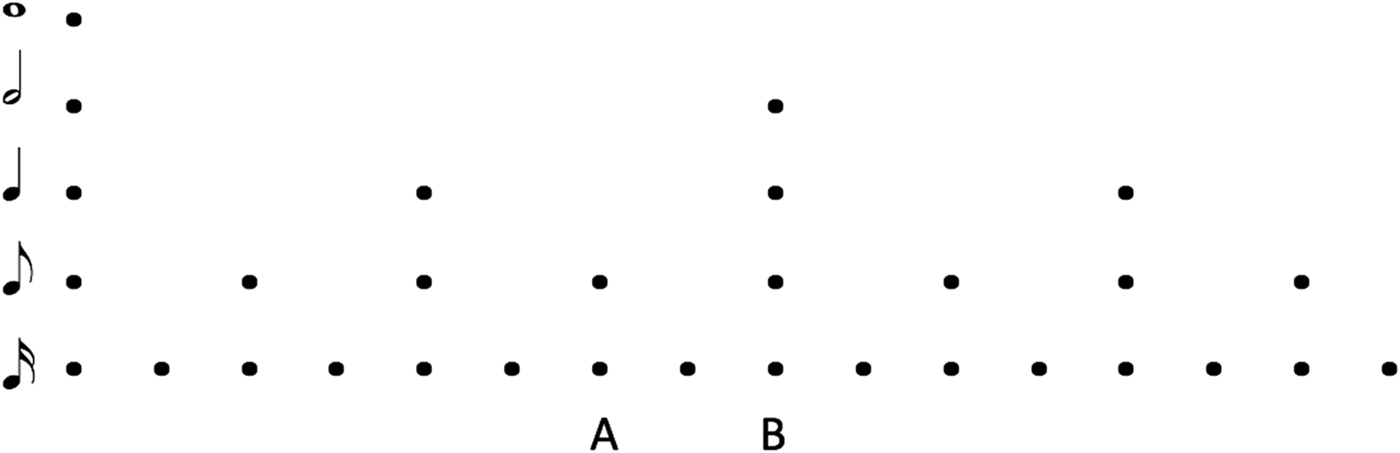
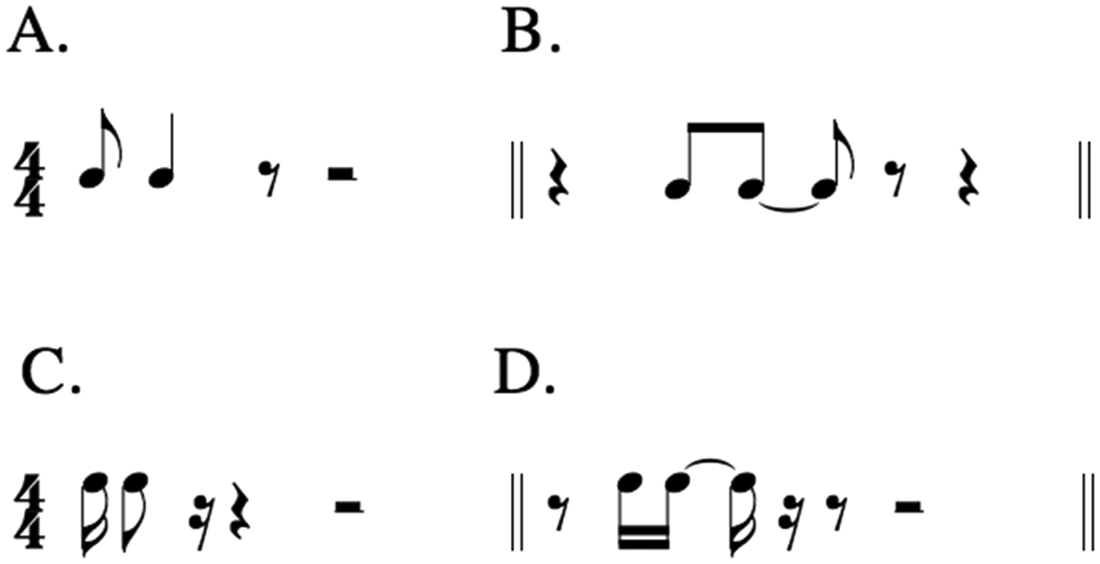
The New Harvard Dictionary of Music defines syncopation as ‘a momentary contradiction of the prevailing meter or pulse’ (Randel Reference Randel1986, p. 827). This roughly captures the usual meaning of the term, and the meaning that I assume here, but it will be useful to adopt a more precise definition. Following Lerdahl and Jackendoff (Reference Lerdahl and Jackendoff1983), we can think of a metre as a hierarchical framework of levels of beats, with each level corresponding to a rhythmic value – a ‘metrical grid’, as shown in Figure 1. Each beat can be identified by the highest level at which it is present; beat A in the figure is an eighth-note-level (or simply eighth-level) beat, while beat B is a half-note-level beat. Beats have varying levels of strength depending on how far up they extend in the hierarchy; an eighth-level beat is weaker than a quarter-level beat but stronger than a sixteenth-level beat. An intermediate level in the hierarchy is generally regarded as the main beat or ‘tactus’ – the quarter-note level in 4/4 or the dotted-quarter in 6/8. Also useful is Lerdahl and Jackendoff's concept of phenomenal accent (Reference Lerdahl and Jackendoff1983, p. 17), which is anything in the music that gives accentuation or emphasis to a beat. Sources of phenomenal accent include note onsets, long notes, loud notes, stressed syllables and changes of harmony. Defined in this way, phenomenal accentuation is clearly a gradient matter: a beat may be accented to a greater or lesser degree. Generally, phenomenal accents fall on relatively strong beats (this is what conveys the metre to the listener), but they need not always do so. Lerdahl and Jackendoff define syncopation as a conflict between phenomenal accents and metre: a situation where a weak beat carries a stronger phenomenal accent than a neighbouring strong beat (1983, pp. 17–18). For example, in Example 1A, the second note is a syncopation, since it falls on an eighth-level beat but is phenomenally accented (owing to its length), more so than the following quarter-level beat (which carries no note) and the previous whole-note-level beat (which only carries a short note). Syncopations can be labelled according to the metrical level of the accented weak beat: thus Examples 1A and 1B are eighth-level syncopations and Examples 1C and 1D are sixteenth-level syncopations. Examples 1A and 1C are what I call second-position syncopations, where the syncopation falls on the second quarter of a half-note or quarter-note unit; Examples 1B and 1D are fourth-position syncopations. Example 1C is essentially the Scotch snap, although some have defined the Scotch snap to include Example 1A as well (Hamm Reference Hamm1983, p. 389; van der Merwe Reference van der Merwe1989, p. 163). Both second- and fourth-position syncopation are common in modern popular music; examples of both will be given later in the article.
A metrical grid for 4/4 time.

Second- and fourth-position syncopations.

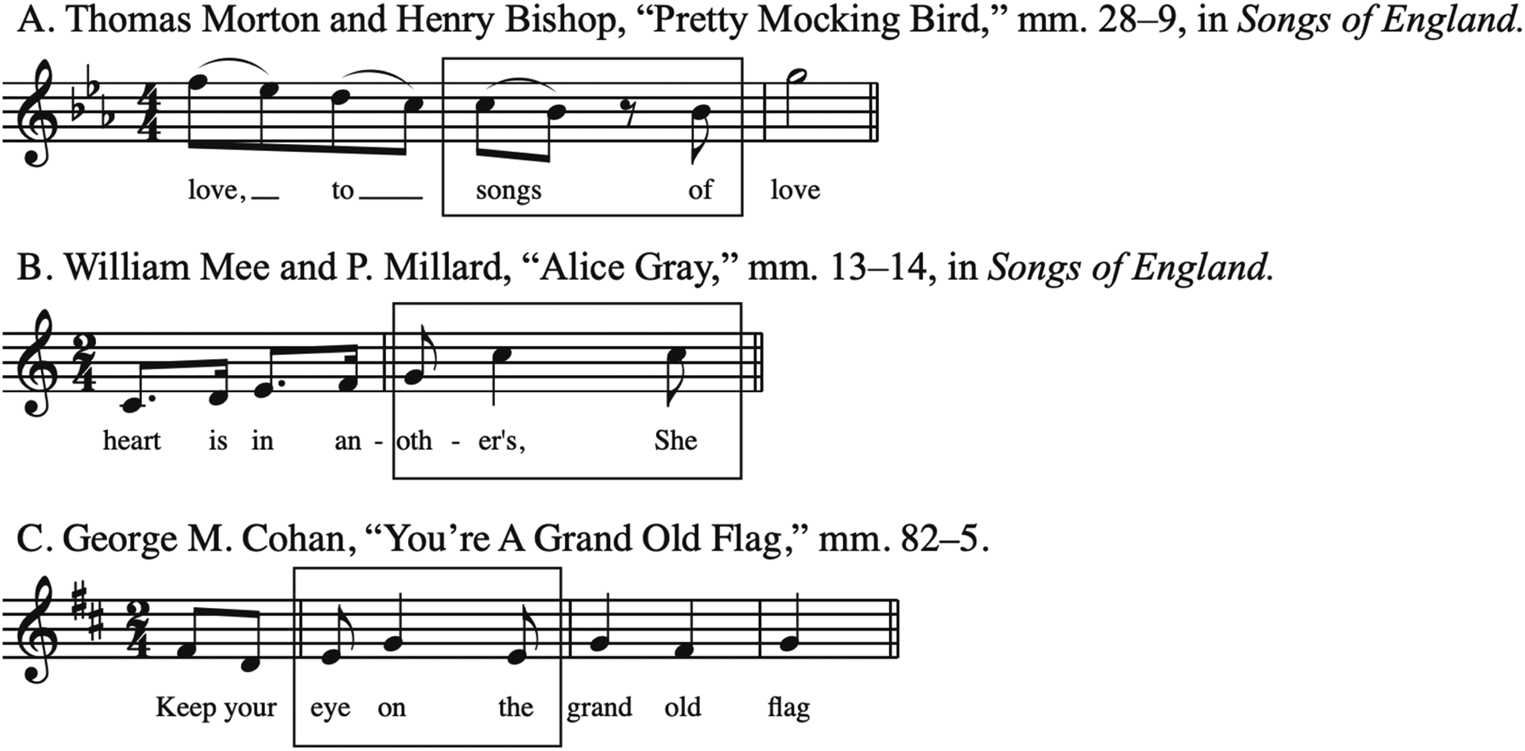
Some efforts have been made to define syncopation in quantitative terms, allowing measurement of its statistical frequency in musical corpora. Most such definitions consider only the pattern of note onsets in the melody and its alignment with the metre, disregarding other possible sources of phenomenal accent. For example, Longuet-Higgins and Lee (Reference Longuet-Higgins and Lee1984) define a syncopation simply as a note on a weak beat with no note on the following strong beat; other definitions are similar (Huron and Ommen Reference Huron and Ommen2006; Gomez et al. Reference Gomez, Thul and Toussaint2007). I have argued elsewhere (Temperley Reference Temperley2019) that such ‘positional’ definitions of syncopation neglect important stylistic differences in the use of syncopation. Consider Examples 2A and 2B, both from 19th-century English songs. The boxed segments in these two phrases are essentially identical in terms of their onset patterns (in relation to the metre): both feature note onsets on the first, second and fourth eighth-note beats of a half-note segment (a 2/4 measure, or half of a 4/4 measure). In positional terms, the second note within the box in each of these cases could be considered a syncopation (a second-position syncopation, by the taxonomy introduced earlier). Yet the effect of syncopation seems much stronger in Example 2B than in Example 2A. Several factors contribute to this: in Example 2B, the second note is continued over the following beat (rather than followed by a rest), it has a change of syllable from the preceding note (rather than a melisma) and it is approached by an ascending leap in pitch; Example 2A has none of these features. Example 2C, from an early-20th-century popular song, has all of the syncopating features mentioned above, and is similar in effect to Example 2B.
Second-position syncopations.

As noted earlier, several scholars have considered the idea (although sometimes with scepticism) that the use of second-position syncopation in modern popular music may have roots in the Scotch snap of earlier British music. In an earlier study (Temperley Reference Temperley2019), I explored this possibility from a statistical perspective, presenting a corpus analysis of second-position syncopation in 19th-century vocal music.Footnote 3 My corpus consisted of seven smaller corpora, representing vocal music of different nations and cultures. Five European corpora – English, French, German, Italian and Scottish – were represented by songbooks from each nation. I also included a book of African-American songs, Slave Songs of the United States (Allen et al. Reference Allen, Ware and Garrison1867), and a book of Euro-American songs, A Treasury of American Song (Downes and Siegmeister Reference Downes and Siegmeister1940; I excluded a section of African-American songs, as well as sections focusing on songs after 1900). I refer to these as the African-American and Euro-American corpora, respectively. I analysed each of the seven corpora with regard to the frequency of second-position syncopation. When syncopation was defined purely in positional terms (so that both Examples 2A and 2B are syncopations), eighth-level second-position syncopation was common in the English, Scottish and Italian corpora, as well as the two American ones. However, when the features of note duration, syllabic onset and pitch contour were considered (thus including Example 2B but excluding Example 2A), second-position syncopation was non-existent in the Italian corpus, occurring only in the two British corpora and the two American ones. As for sixteenth-level second-position syncopations, these were very rare in the three continental corpora (French, German, and Italian), even when defined only in terms of onset pattern; they were fairly common in the British and American corpora.
My conclusions in this earlier study were that second-position syncopation was much more common in 19th-century British music than in that of other Western European nations, and that its prevalence and usage in Euro-American and African-American music strongly resembled those of British music. It is certainly possible that the use of second-position syncopation in American music was influenced by other factors – by musical developments internal to the United States, or even by African musical traditions. We should bear in mind also that the evidence presented so far is entirely based on notated music; actual performances of these songs may have diverged quite markedly from their notated rhythms, an issue that I will address later in the article. Still, based on the evidence considered here, it seems likely that this important element of 20th-century popular music had roots in British music. Other essential elements of this rhythmic idiom, however, appear to have quite different origins.
Fourth-position syncopation
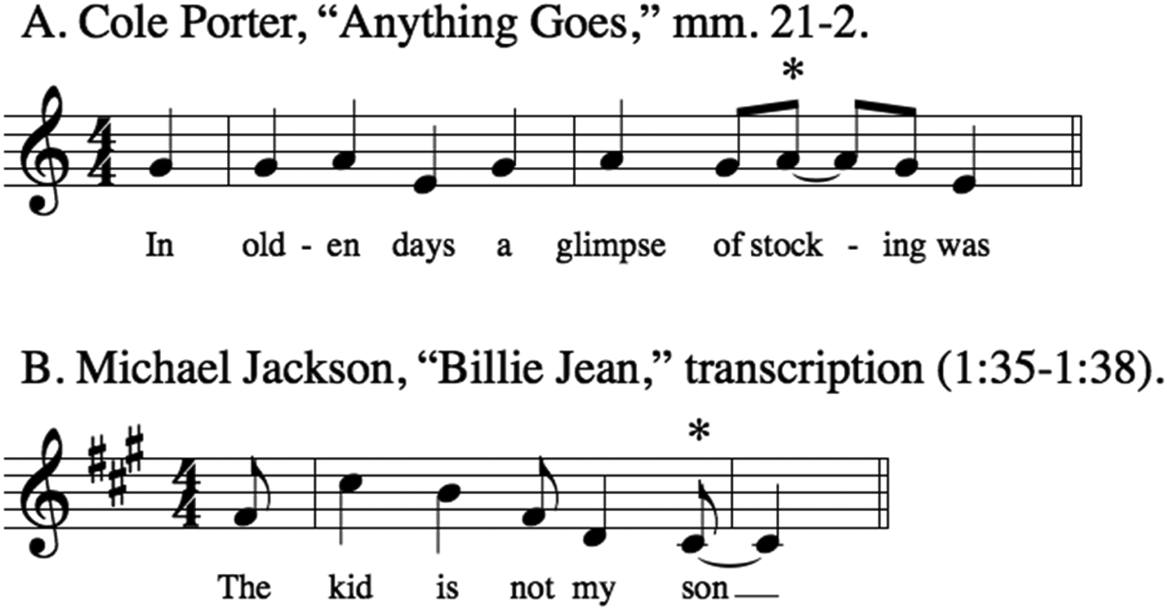
Before proceeding, a few words are needed about the character of fourth-position syncopation in 20th-century popular music. Unlike second-position syncopations, fourth-position syncopations (in vocal music) usually carry a stressed syllable; two typical instances are shown in Example 3. (In this and subsequent examples, fourth-position syncopations are marked with asterisks.) If the syncopated note is preceded by an unstressed syllable on the previous strong beat (as is often the case), this creates a conflict between metre and stress. In Example 3A, for example, the syllable ‘stock-’ is more stressed than the syllable ‘of’, although it falls on a weaker beat. However, the fourth-position note is understood as really ‘belonging’ on the following strong beat, thus resolving the stress-metre conflict.Footnote 4 This anticipatory effect is typical of fourth-position syncopations. Second-position syncopations typically carry unstressed syllables (this is the case in both Examples 2B and 2C), so there is little reason to regard them as anticipatory. The stress-metre conflict created by fourth-position syncopations usually makes them easily recognisable; other factors that affect second-position syncopation – such as pitch contour and duration – tend to seem less important.
Fourth-position syncopations.

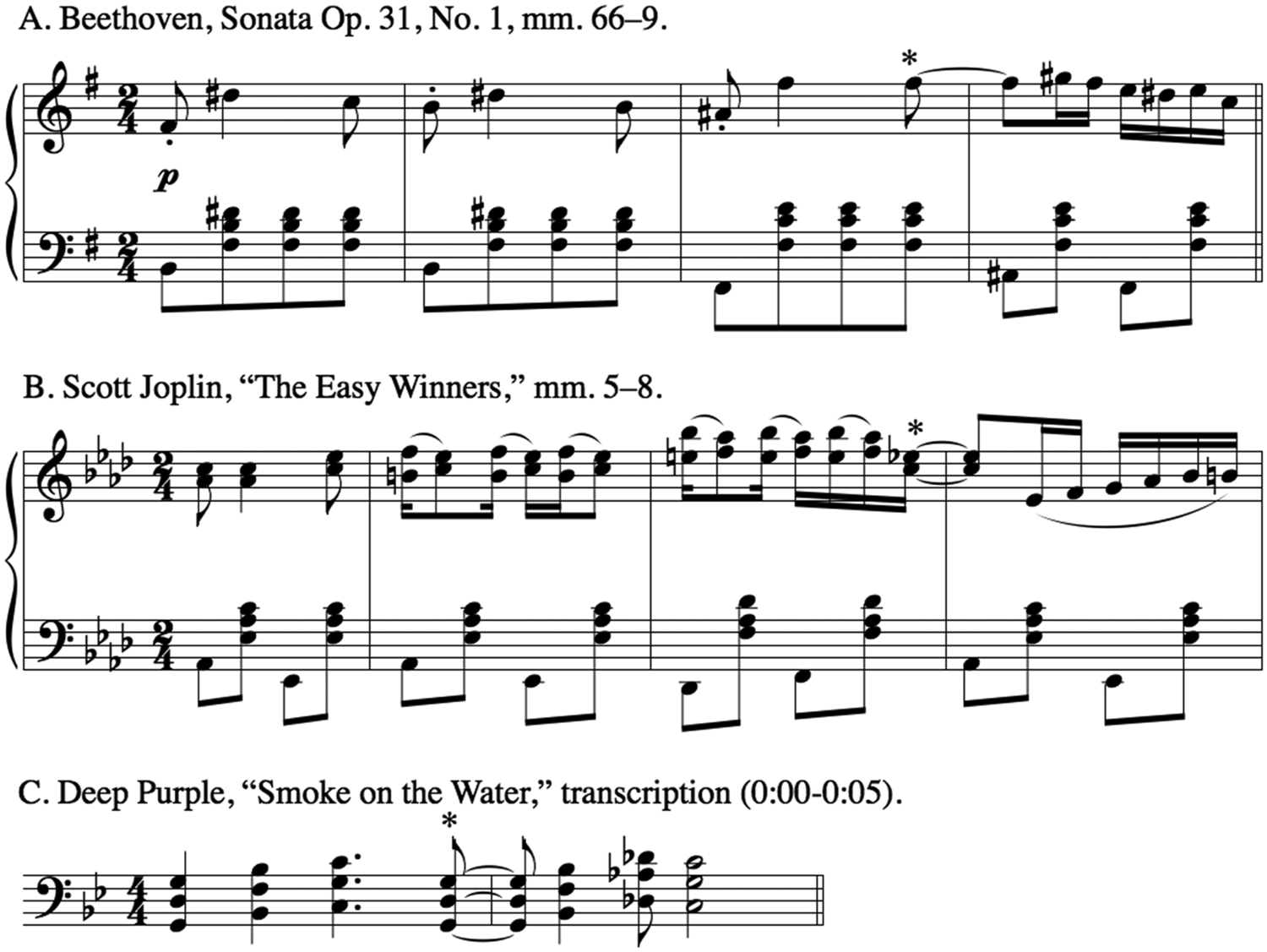
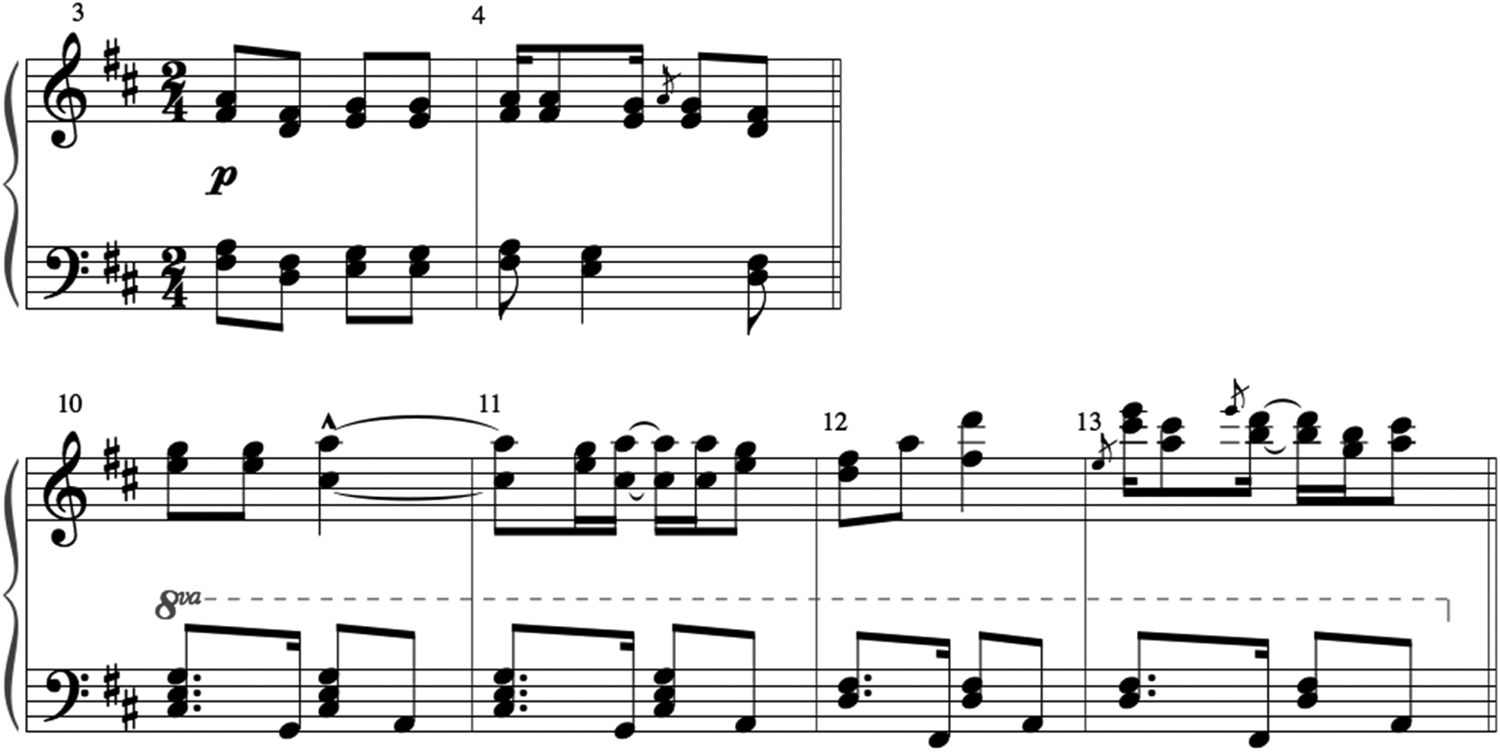
In instrumental music, the absence of syllabic stress can make the identification of anticipatory fourth-position syncopations more difficult. Some fourth-position syncopations create little sense of anticipation, such as the note at the end of the third measure in Example 4A. However, other factors can still create an anticipatory effect. Harmonic structure is one factor. In Example 4B, the right-hand dyad at the end of the third measure clashes with the D♭ major harmony of the measure; if we regard it as belonging on the following downbeat, it makes more harmonic sense. (The same point could be made about Example 3B; the C♯ at the end of the phrase fits the F♯ minor harmony of the next measure better than the B minor harmony of the current one.) A chord carries a stronger sense of anticipation than a single note, since chords normally fall on metrically strong positions; Berlin (Reference Berlin1980, pp. 128–9) observes that fourth-position syncopations in ragtime piano music are much more likely to be chords than second-position ones. Motivic parallelism can play a role too: in a case like Example 4C, when a motive is presented first without syncopations and then with them, this suggests that the notes are being shifted from strong beats to earlier weak ones. (In some cases, such parallelisms are better explained as cross-rhythms than anticipations, as I discuss in a later section.)
Fourth-position syncopations in instrumental music.

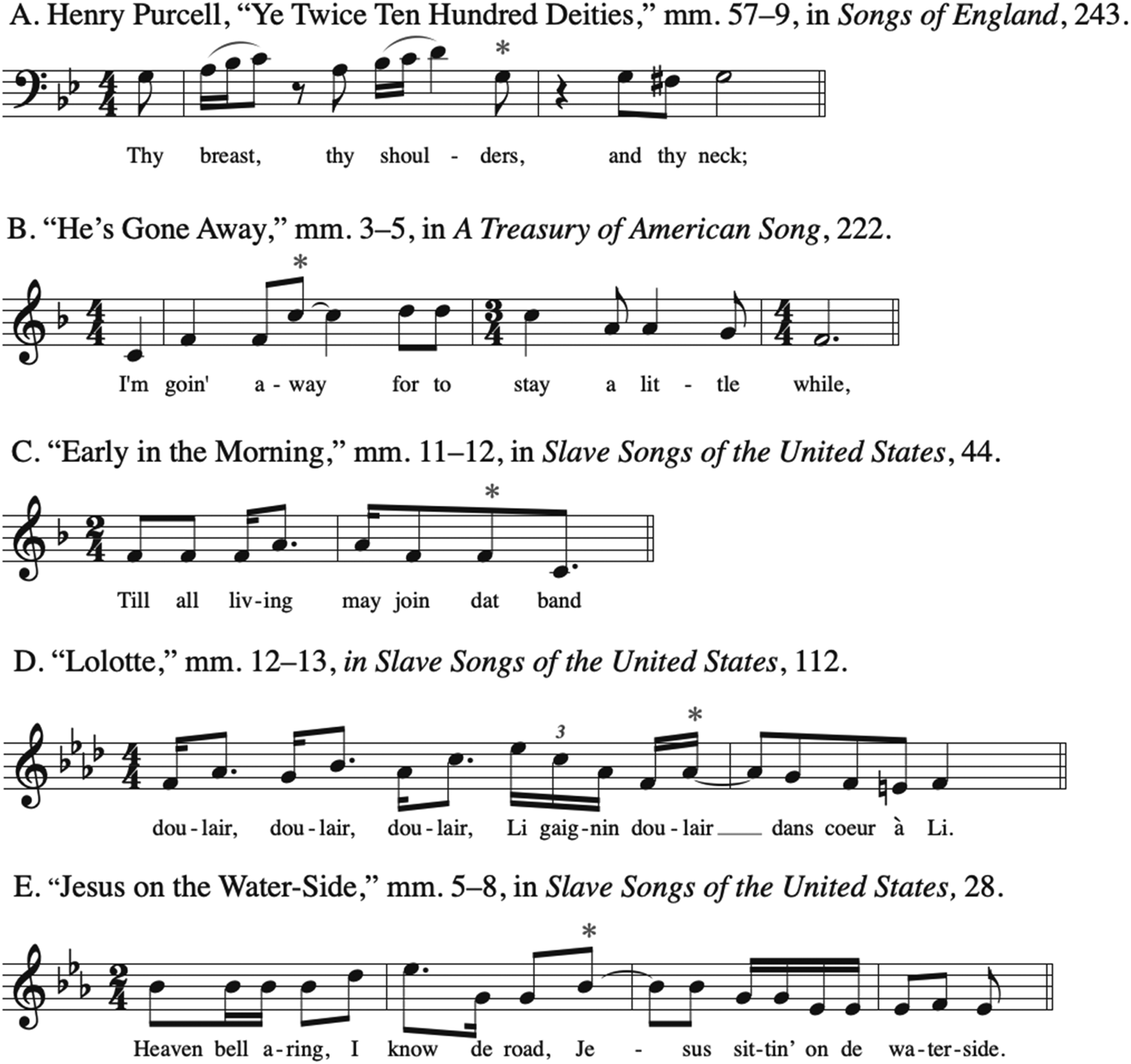
We begin by considering the incidence of fourth-position syncopations in the songbooks used in the corpus analysis described above. In the European corpora (English, French, German, Italian, and Scottish), anticipatory fourth-position syncopations are simply non-existent: not a single clear example is found in any of the five national corpora. A small number of positional fourth-position syncopations occur – that is, cases where a note on the fourth quarter of a quarter-note or half-note unit is followed by a strong beat with no note; but in all of these cases, the syncopated note carries an unstressed syllable or a melisma. One instance is shown in Example 5A: while the second syllable of ‘shoul-ders’ could perhaps be described as a syncopation, the fact that the syllable is unstressed makes it quite different in effect from the syncopations shown in Example 3.
Fourth-position syncopations in pre-20th-century vocal music.

While the rarity of fourth-position syncopations in the European corpora is perhaps unsurprising, they are also extremely rare in the Euro-American and African-American corpora. The Euro-American corpus (A Treasury of American Song) contains just one dubious example, shown in Example 5B (‘a-way’); the irregular metre of the song makes one uncertain about the rhythmic and metric interpretation. The African-American corpus (Slave Songs of the United States) contains three possible instances of fourth-position syncopation, none of which reflect its typical uses in later popular music. In one case (Example 5C), the fourth-position syllable is unstressed (‘dat’); in another (Example 5D), from a song in a French-derived Creole dialect, the fourth-position syncopation seems to arise from an unusual shifting of a second-position syncopation earlier in the measure.Footnote 5 The third instance shown (Example 5E) is the most convincing, featuring a stressed syllable (‘Je-sus’) on the fourth eighth of a half-note segment; however, the syncopation occurs at the beginning of a phrase, which is atypical of later uses of fourth-position syncopation. By way of comparison, the same songbook contains 225 second-position syncopations (Temperley Reference Temperley2019); 77 of the 130 songs (59%) contain at least one. Two other late-19th-century books of African-American songs were also examined, Jubilee Songs (Anonymous 1872) and Cabin and Plantation Songs (Fenner Reference Fenner1886); like Slave Songs of the United States, they contain many second-position syncopations but practically no fourth-position syncopations.Footnote 6
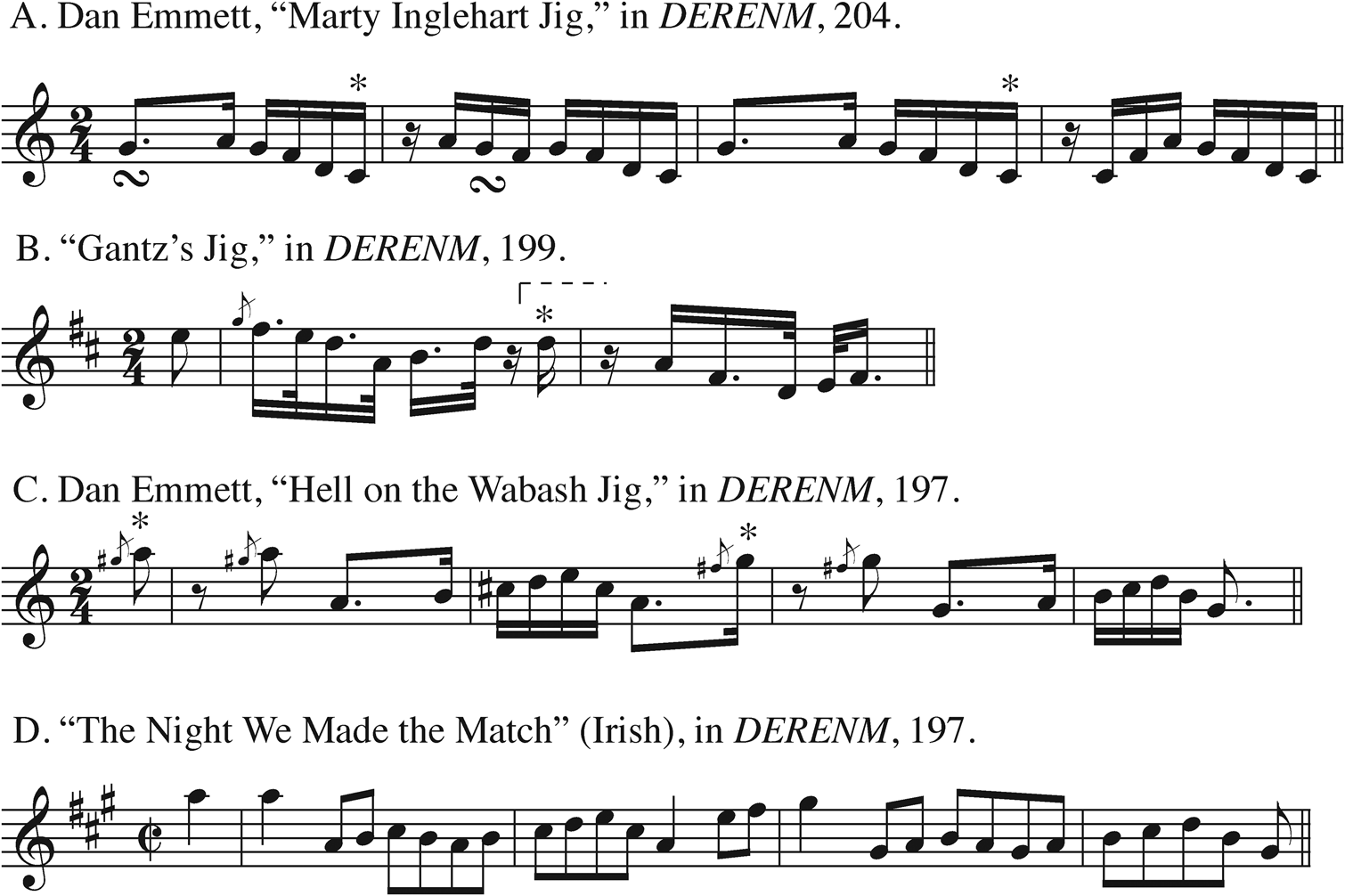
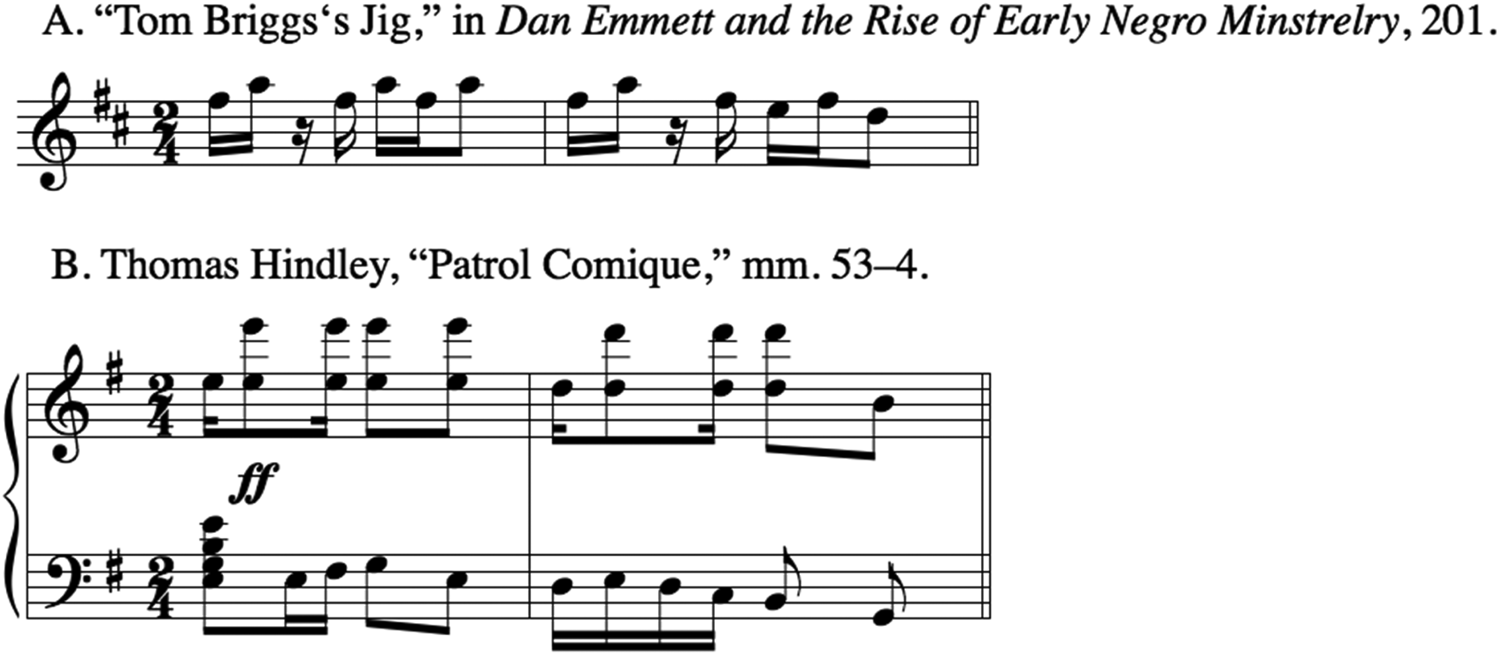
The sources considered here suggest that anticipatory fourth-position syncopation was exceedingly rare in 19th-century American vocal music – or at least, that it was hardly ever represented in notation. What about instrumental music? One interesting, although inconclusive, body of evidence is the mid-19th-century banjo music of Dan Emmett, published and analysed by Hans Nathan (Reference Nathan1962). Nathan rightly observes that Emmett's transcriptions and compositions show a level of rhythmic complexity that seems to have little precedent in European music (1962, pp. 205–7); Examples 6A–6C show three of Nathan's examples. In positional terms, there are numerous cases of both second-position and fourth-position syncopations. However, it is unclear that any of the fourth-position syncopations are truly anticipatory in character. Many clearly are not. In Example 6A, the C at the end of the first measure is motivically parallel to the one at the end of the second measure. The second C cannot be anticipatory, since it is followed by a note on the following downbeat; this discourages an anticipatory hearing of the first C. Nathan presents two cases, shown in Examples 6B and 6C, in which, he says, ‘the phrase … begins prematurely, that is, before the previous measure ends’ (1962, p. 195); I take this to mean that the first note of the phrase anticipates its underlying position. However, this analysis seems debatable in both cases. Nathan describes Example 6C as a variant of an Irish melody, shown in Example 6D; the downbeat rest at the beginning of Emmett's melody seems to arise from a delay in the second note, rather than an anticipation in the first note. It seems unlikely that anticipatory thinking was involved in this music, although we cannot be certain.
Fourth-position syncopations in Dan Emmett and the Rise of Early Negro Minstrelry (DERENM).

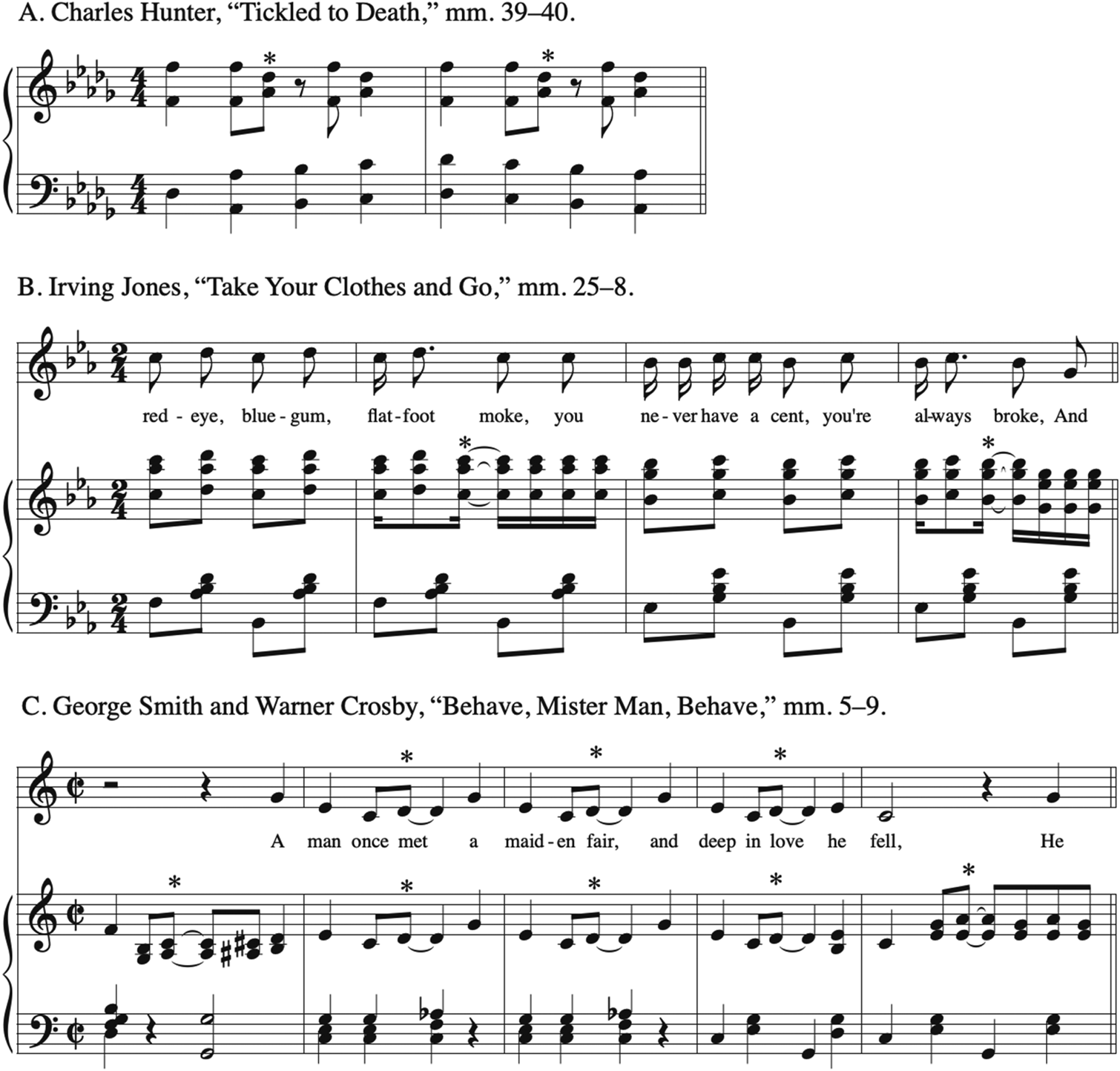
Clear evidence of anticipatory fourth-position syncopation only emerges much later in the century – in ragtime music of the 1890s. Berlin (Reference Berlin1980, pp. 84–8) shows that second-position (‘untied’) syncopations were common from the very beginning of ragtime; fourth-position (‘tied’) syncopations occur only occasionally before 1900, becoming much more common in later years (see also Volk & de Haas Reference Volk and de Haas2013). Example 7 shows three examples not cited by Berlin, the first from a solo piano piece, the second and third from songs. I apologise for the offensive and racist character of the second example, and several others below, but they are important pieces of evidence. In solo piano music, like Example 7A, it is sometimes debatable whether the fourth-position syncopations are truly anticipations. A stronger case can be made in piano accompaniments to songs. In Example 7B, the right hand of the piano part has two fourth-position syncopations. Essentially it plays a rhythmic variation on the vocal melody; each of the syncopations occurs just before a stressed syllable (‘moke,’ ‘broke’), creating a strongly anticipatory effect. Several other songs from the late 1890s show exactly the same pattern, with fourth-position syncopations in the piano part but not in the vocal line, and with the piano syncopations anticipating notes of the melody.Footnote 7 After 1900, fourth-position syncopations begin to appear in vocal parts as well; Example 7C is from 1902. The fact that second-position syncopation was common even in very early ragtime, while fourth-position syncopation was introduced only gradually (first in piano parts, later in vocal parts), is not surprising, in light of the evidence presented earlier. Second-position syncopation was already part of the musical language of 19th-century Americans, inherited from British songs and the overall stylistic character of British vocal music. Anticipatory fourth-position syncopation, in contrast, was something really new.
Fourth-position syncopations in ragtime.

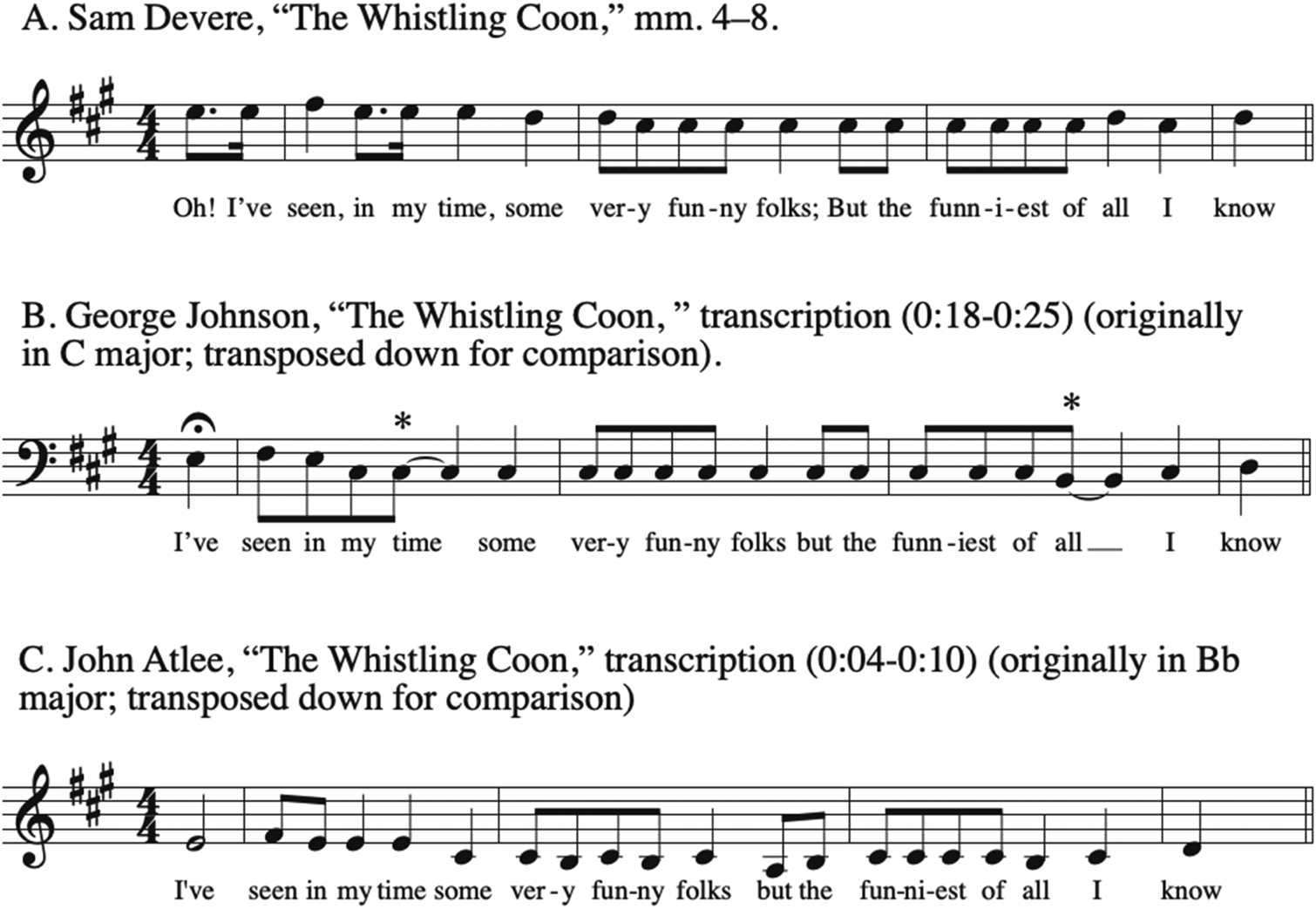
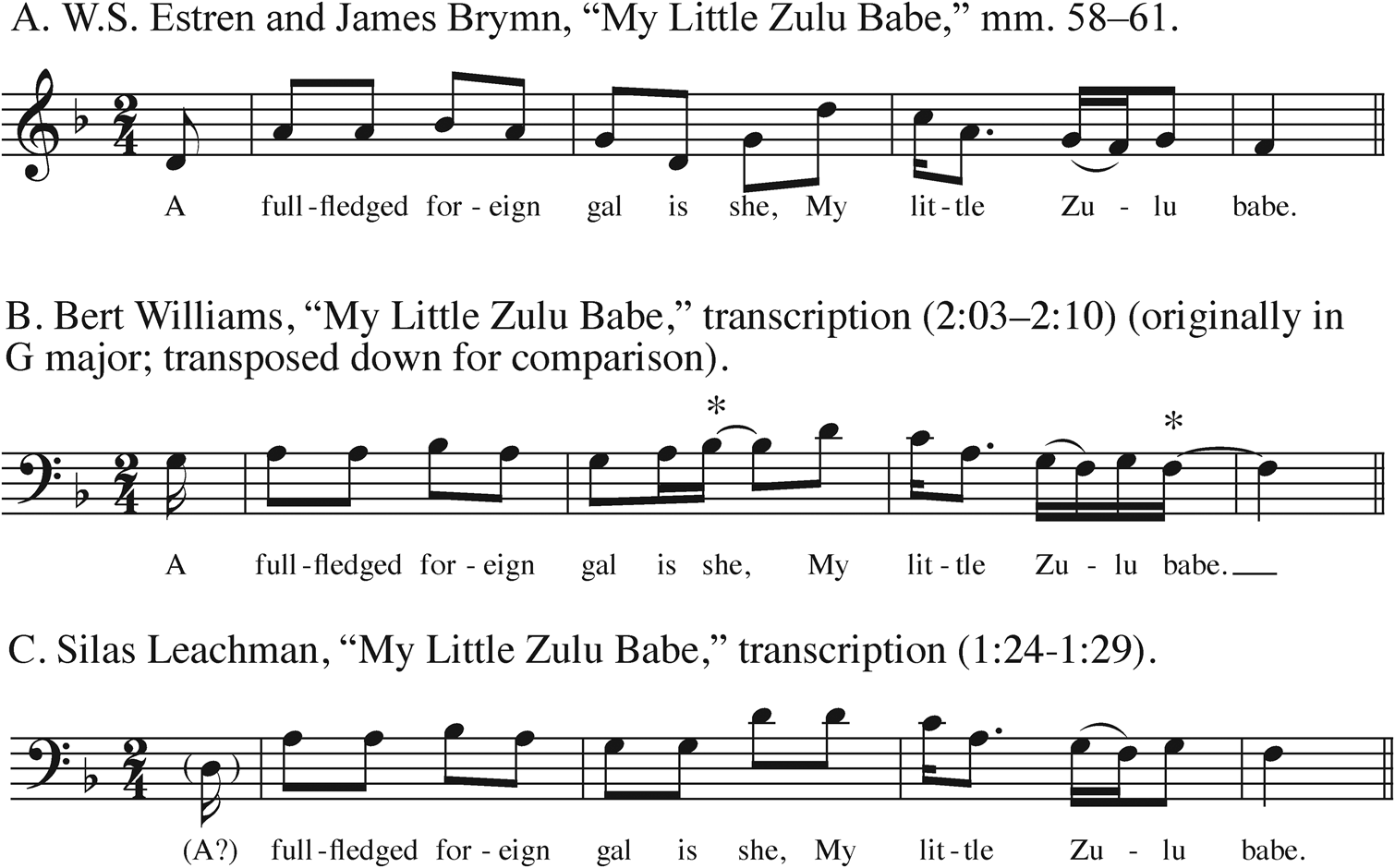
Complicating this account is the fact that the use of fourth-position syncopation in vocal performance seems to predate its appearance in notation. Evidence for this comes from very early recordings of popular songs by African-American singers. Example 8A shows a phrase from the sheet music to ‘The Whistling Coon’, from 1888; Example 8B shows my own transcription of a recorded performance of the phrase by George Johnson from 1891 (Brooks Reference Brooks2005). The performance contains clear examples of fourth-position syncopation (‘in my time’, ‘funniest of all’); these are highly idiomatic uses of the device, similar to those in Example 3, with fourth-position stressed syllables anticipating the following strong beats. These syncopations are absent in the sheet music; the rhythm of the performance is, roughly speaking, a syncopated version of the notated rhythm. It seems most likely that the syncopations originated with Johnson himself, but we cannot be certain.Footnote 8 In this case, a performer added syncopations to a notated song; in other cases, transcribers removed syncopations from a vocal performance. Example 9 shows notated and performed versions of a phrase from ‘My Little Zulu Babe’, recorded in 1901 by the successful African-American duo Bert Williams and George Walker (Brooks Reference Brooks2005). The sheet music (from 1900) states that the song was ‘originally introduced and featured’ by Williams and Walker, and is surely based on their earlier performances of the song. Williams's vocal performance contains numerous syncopations, both second and fourth position, but only the second-position syncopations are captured in the notation. Example 9 (the final phrase of the song) illustrates this: The second-position syncopation on ‘little’ in Williams's performance (Example 9B) is accurately reflected in the notation (Example 9A), but the fourth-position syncopations on ‘she’ and ‘babe’ are not.Footnote 9
Notated (A) and performed (B,C) versions of the first phrase of “The Whistling Coon.”

Notated (A) and performed (B,C) versions of the last phrase of “My Little Zulu Babe.”

Vocal uses of fourth-position syncopation in the 1890s and the first few years of the 1900s are found mainly in recordings by African-American singers; among white singers they are much less common. An interesting case in point is ‘The Whistling Coon’, which was recorded by at least three white singers in the years after Johnson introduced it (Brooks and Spottswood Reference Brooks and Spottswood2004, pp. 33, 60–1).Footnote 10 The earliest of the three, by John Atlee (1898), diverges somewhat from the music notation, but uses no fourth-position syncopations; Atlee's performance of the first phrase is shown in Example 8C. The later two recordings, by S.H. Dudley (1902?) and Billy Murray (1910), follow the unsyncopated rhythm of the sheet music almost exactly; the first phrase of both performances is as shown in Example 8A. Similarly, Silas Leachman's recording of ‘My Little Zulu Babe’ omits the fourth-position syncopations of Bert Williams's original (compare Examples 9B and 9C). Other recordings by white singers of songs originally recorded by African-Americans are similar in this regard.Footnote 11 By 1910, fourth-position syncopations were common both in notated vocal parts and in white singers’ performances. ‘Casey Jones’, from 1909, is illustrative (Example 10); the syncopation on ‘hear’ is present in Billy Murray's 1910 recording as well.
T. Lawrence Seibert and Eddie Newton, “Casey Jones,” mm. 7–8.

The examples above show quite clearly that fourth-position syncopation was in use by African-American singers as early as 1891, and that, in some cases, it was used in performance but not notated; either it was added by performers of notated music or it was omitted in transcriptions of vocal performances. These practices may have been quite widespread. The roots of ragtime are thought to lie partly in the improvisations of itinerant pianists (Gushee Reference Gushee1994, pp. 13–14; Southern Reference Southern1997, pp. 314–17); it is quite possible that fourth-position syncopations were common in this music well before they began to appear in notation. One might wonder if the same was true of other kinds of African-American instrumental and vocal music; for example, the performances transcribed in Slave Songs in the United States may have contained fourth-position syncopations that were not notated.Footnote 12 This might have occurred (if it did occur) because the transcribers of the songs viewed the syncopations as imprecisions or as nuances of timing that did not require transcription, or because they felt that such syncopations would not be appealing to the book's intended audience.
There is reason to doubt, however, that fourth-position syncopations were prevalent in African-American music long before 1890. If they had been, surely white audiences and performers would have heard such rhythms and become accustomed to them. The gradual incorporation of fourth-position syncopations into ragtime – first in notated piano parts, then in vocal parts; first by African-American singers, later by white singers – suggests that this was not the case. Rather, it points to the novelty and strangeness of fourth-position syncopation at the time: some exposure to it was needed before white listeners (and even white performers) would become fully comfortable with it.Footnote 13 I suspect, then, that anticipatory fourth-position syncopation was a late-19th century phenomenon, even in African-American music, perhaps emerging only shortly before Johnson's first recordings.
Cross-rhythm
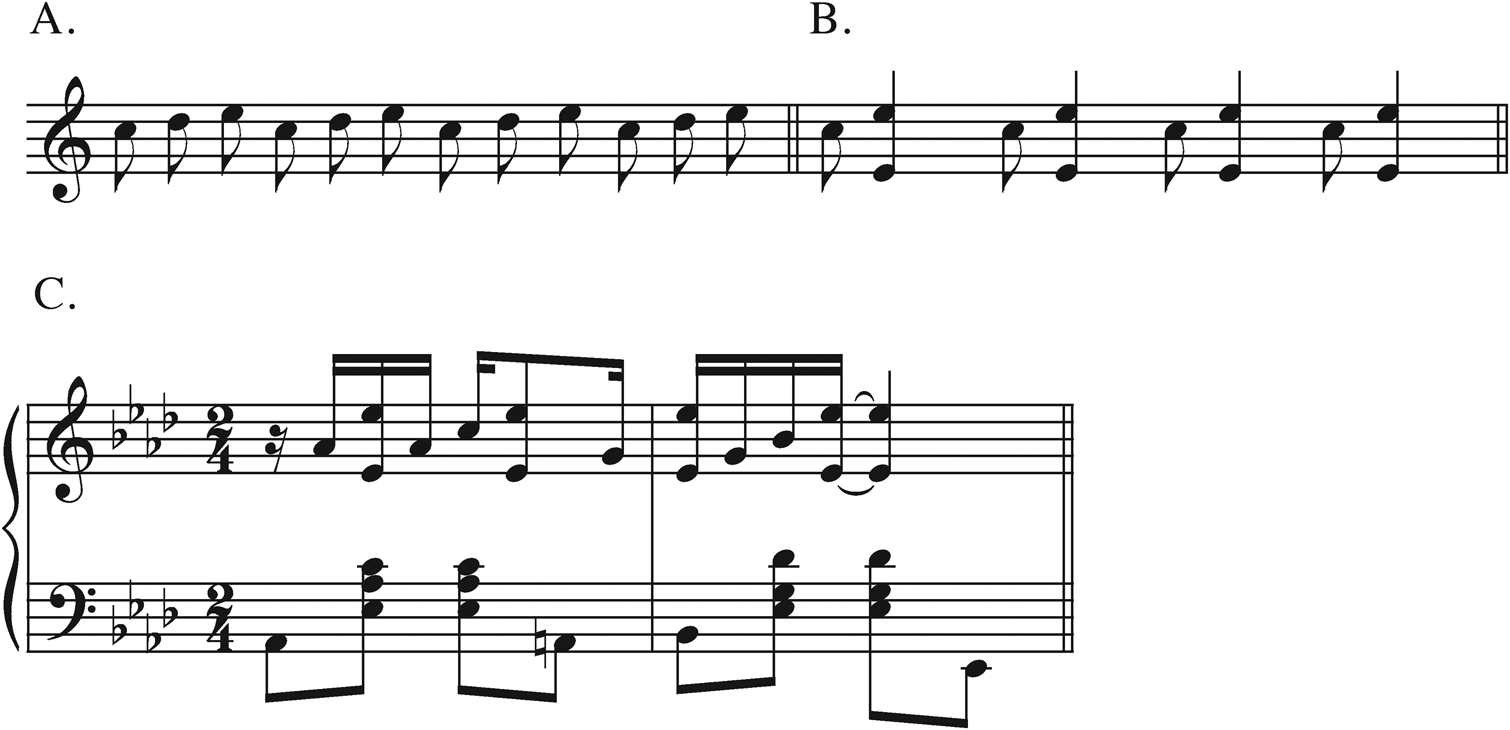
Example 4B contains a feature that is very characteristic of ragtime: cross-rhythm. Cross-rhythm relates to a factor in the perception of metre that Lerdahl and Jackendoff call parallelism (Reference Lerdahl and Jackendoff1983, pp. 74–5). When a musical pattern is immediately repeated, there is a tendency to perceive a metrical level whose period (the time interval between beats) is the same as the length of the pattern. This can arise even with an isochronous pattern such as Example 11A: it seems clear in this case that there is a dotted-quarter metrical level, although its phase, the placement of the beats in relation to the pattern, is uncertain. (Is the first note of the pattern metrically strong, or the third?) If one position in the pattern is phenomenally accented, by length or other means, as in Example 11B, the implied metre becomes clear. Cross-rhythm occurs when a parallelism arises that undermines the prevailing metre.Footnote 14 It seems reasonable to consider this a form of syncopation, under the usual construal of the term as a ‘contradiction’ of the metre, although not all authors do so (Berlin Reference Berlin1980, p. 131). A rhythmic pattern in itself can have an effect of cross-rhythm, by creating a repeated motive in conflict with the metre, but this effect is likely to be weak unless it is supported by a repeated pattern of pitches (or perhaps intervals). Example 2C, shown earlier, is a case in point; the repeated rhythmic pattern (eighth–quarter–eighth–quarter) is reinforced by the repeated E–G pitch pattern. Example 11C is another famous instance: although the melodic pattern is not literally repeated, the E♭ octaves clearly imply a dotted-eighth pulse.
Parallelism and cross-rhythm.

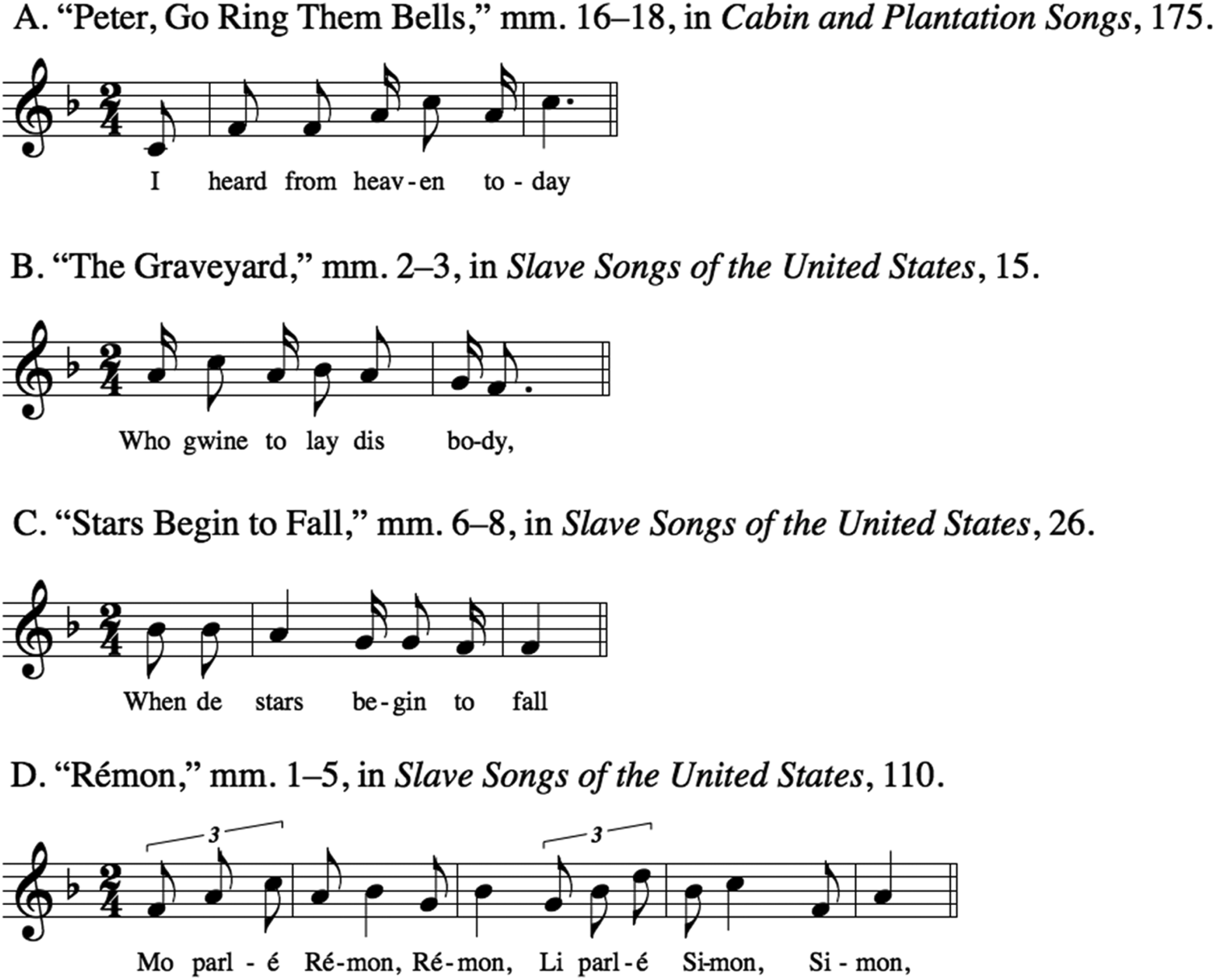
With regard to cross-rhythm, the 19th-century songbooks used in the above-mentioned corpus analyses reveal a definite difference in style between the African-American songs and the European and Euro-American songs. The European and Euro-American corpora do not contain a single convincing example of cross-rhythm; while purely durational cross-rhythmic patterns occasionally occur (e.g. eighth–quarter–eighth–quarter), they are never clearly reinforced by a repeated pitch pattern. In the African-American songbooks, in contrast, there are several very clear instances of cross-rhythm and a number of suggestive ones; four are shown in Example 12. In Example 12A, the repeated two-note pitch pattern (A–C–A–C) makes the cross-rhythm unmistakable. (Compare with Example 2C.) In Examples 12B and 12C there is no literal repetition of a pitch pattern, but there are hints: in 12B, the first note of a two-note pair is repeated, A–C–A–B♭; in Example 12C, a repeated-note figure is shifted a step down, G–G–F–F. Subtle though these suggestions of cross-rhythm may be, they have no parallel in any of the other corpora. In Example 12D (transcribed from a slave community in Louisiana), the cross-rhythm is established partly by the text – the repetition of the words ‘Rémon’ and ‘Simon’; again, nothing like this occurs in any of the other corpora.
Cross-rhythms in 19th-century African-American songs.

Cross-rhythm is present – indeed, prevalent – in the very earliest ragtime music, and there is some evidence of it in earlier American instrumental music. Nathan (Reference Nathan1962) observes several cases of cross-rhythm in Emmett's banjo compositions and transcriptions; one is shown in Example 13A. Example 13B, from an 1886 piano piece, is debatable (like Examples 12B and 12C above): the Es in the first measure (and the Ds in the second) form a repeated two-note pitch pattern, but not one that specifically favours the dotted-eighth pulse. Still, I doubt that one would find this pattern in any European music of the period. In ‘Tickled to Death’ (Example 7A) and ‘Maple Leaf Rag’ (Example 11C), the cross-rhythmic intent seems beyond dispute. Some of these pieces were written by white composers,Footnote 15 but were intended as imitations of African-American instrumental practices; this is clear from the pieces’ titles and cover pictures (in the case of Examples 7A and 13B) and from our general knowledge of their stylistic influences (in the case of Example 13A) (Nathan Reference Nathan1962, pp. 107–58). Such examples, combined with the examples of cross-rhythm in slave songs mentioned above, leave little doubt that this rhythmic feature originated in 19th-century (or even earlier) African-American music, and passed on from there into ragtime and later popular music.
Cross-rhythms in 19th-century instrumental music.

The relationship between cross-rhythm and other forms of syncopation requires comment. Cross-rhythms may contain either second-position (Example 2C) or fourth-position syncopations (Example 7A). Example 11C contains both: the second E♭ octave is a second-position syncopation and the fourth is a fourth-position one. Cross-rhythm could be viewed as an alternative way of generating a fourth-position syncopation, distinct from the anticipatory logic discussed earlier; some fourth-position syncopations in cross-rhythms do not seem especially anticipatory, such as those in Example 7A. In other cases, both anticipatory and cross-rhythmic logic seem to be at work: the last octave in Example 11C clearly arises from the cross-rhythm, but its strong agogic accent makes it feel anticipatory as well. In contrast, the fourth-position syncopations in Examples 4A and 5A involve neither anticipation nor cross-rhythm. In vocal music, cross-rhythms early in the 20th century generally involve only second-position syncopation (Example 2C is typical); cross-rhythmic uses of fourth-position syncopation only appear later, in songs like Gershwin's ‘I Got Rhythm’ (Example 14).
George Gershwin and Ira Gershwin, ‘I Got Rhythm’.

Conclusions and further issues
The marked increase in syncopation in popular music around 1900 was widely observed at the time. As noted by Berlin, early descriptions of ragtime often highlight syncopation as a prominent or even defining feature; probably the name itself is due to this (‘ragged-time’; Berlin Reference Berlin1980, pp. 11–13, 26–9). What was it about ragtime rhythm that seemed so novel and striking to contemporary listeners? It was not second-position syncopation: this had long been present in American music, with roots in earlier British music. It is true that the sheer frequency of second-position syncopations in many ragtime pieces exceeds anything found in earlier British or American music, but this alone seems unlikely to have accounted for ragtime rhythm's striking effect. The rhythmic novelty of ragtime lay, rather, in two other devices: fourth-position syncopation and cross-rhythm. Even cross-rhythm had some presence in earlier African-American music and should not have been completely unfamiliar to white listeners. But fourth-position syncopation, in its characteristic anticipatory form, seems to have been non-existent in European and Euro-American music before the ragtime era, and I suspect that it had only recently emerged in African-American music. Indeed, one might argue that we need this assumption to explain the evident novelty of ragtime rhythm to white listeners: something was creating this effect, and it seems likely that it was largely fourth-position syncopation, although cross-rhythm may also have played a role.
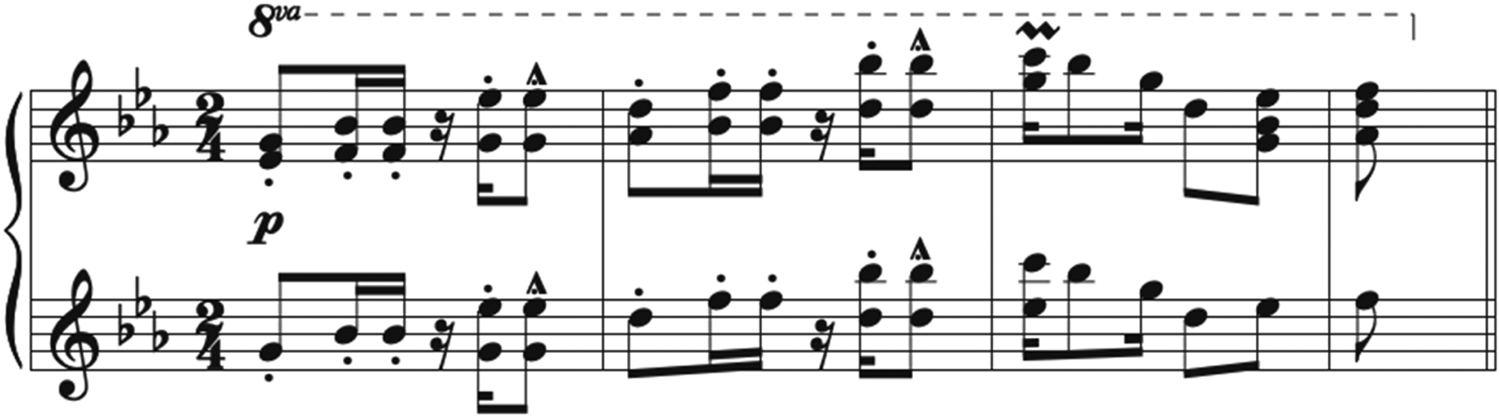
One possible source for the devices of 20th-century syncopation has not yet been considered, namely, Caribbean music. Example 15 shows two excerpts from a Cuban piano piece published in about 1857 (Manuel Reference Manuel2009, p. 73), containing syncopations in both second and fourth positions. The sense of syncopation is unmistakable, conveyed largely by motivic parallelisms: the G–A motive in m. 10 (considering just the top line), with the A on a strong beat, makes us hear the fourth-position A as accented when the motive is repeated in the following measure, and also gives the latter A an anticipatory character. That anticipatory fourth-position syncopation was entirely due to Caribbean influence seems unlikely; it is unclear, for example, that George Johnson – who lived in Virginia and New York City, and was using fourth-position syncopations in 1891 – would have heard much Caribbean music.Footnote 16 However, Caribbean influence might have reinforced tendencies that were already developing in American popular music in the late 19th century.Footnote 17
Two excerpts from José Fernandez de Coca, ‘Cambujá’, in Creolizing Contradance in the Caribbean, 74. Beaming of notes has been changed to clarify rhythm.

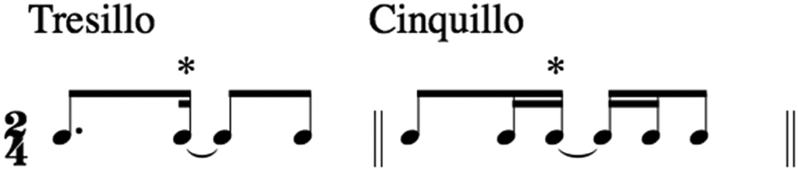
The case for Caribbean influence is especially strong in the case of cross-rhythm. As Peter Manuel has shown, 19th-century Caribbean rhythms are largely built on a few specific rhythmic patterns, especially the tresillo and cinquillo (Example 16; Manuel Reference Manuel2009, pp. 19–22; see also Washburne Reference Washburne1997). Both of these patterns can be described under the current framework as containing a fourth-position syncopation (at the points marked with asterisks). However, they can also be understood as reflecting an implied dotted-eighth pulse superimposed on the underlying duple metre. Very often, this cross-rhythm is brought out by motivic parallelisms. Measure 4 of Example 15 is a case in point: the rhythm of the melody could well be described as a modified cinquillo, and the repeating motive (A–A–G–G) reinforces it. Further evidence of the presence of such rhythms in 19th-century Caribbean music comes from the works of the American composer Louis Gottschalk, whose incorporation of Caribbean elements is well known; pieces such as ‘Ojos criollos – danse cubaine’ (Example 17) and ‘Souvenir de Porto Rico’ contain both fourth-position syncopations and cross-rhythms. The extent of Caribbean influence in the development of ragtime and later American popular genres is an interesting issue, raising questions about cultural contact and interaction that are beyond my scope and expertise.
Tresillo and cinquillo.

Louis Gottschalk, ‘Ojos creoles – danse cubaine’, mm. 41-2 (for piano four hands; example shows primo part only).

Gottschalk's compositions are of interest here in another respect as well. In addition to his Caribbean-influenced works, he also wrote pieces inspired by the African-American music he heard in his native Louisiana, such as his ‘Bamboula – danse des negres’, ‘Le bananier – chanson negre’ and ‘Le banjo’. These pieces, all from the 1840s and 1850s, contain occasional second-position syncopations (e.g. ‘Le banjo’, mm. 3–4), but no fourth-position ones. Here we have a composer who was clearly capable of notating fourth-position syncopations (as he did in his Caribbean-influenced pieces) and apparently interested in highlighting distinctive rhythmic aspects of non-European music; if he had heard anticipatory fourth-position syncopations in Louisiana, surely he would have written them. This is further evidence that this device emerged in African-American music only in the late 19th century.
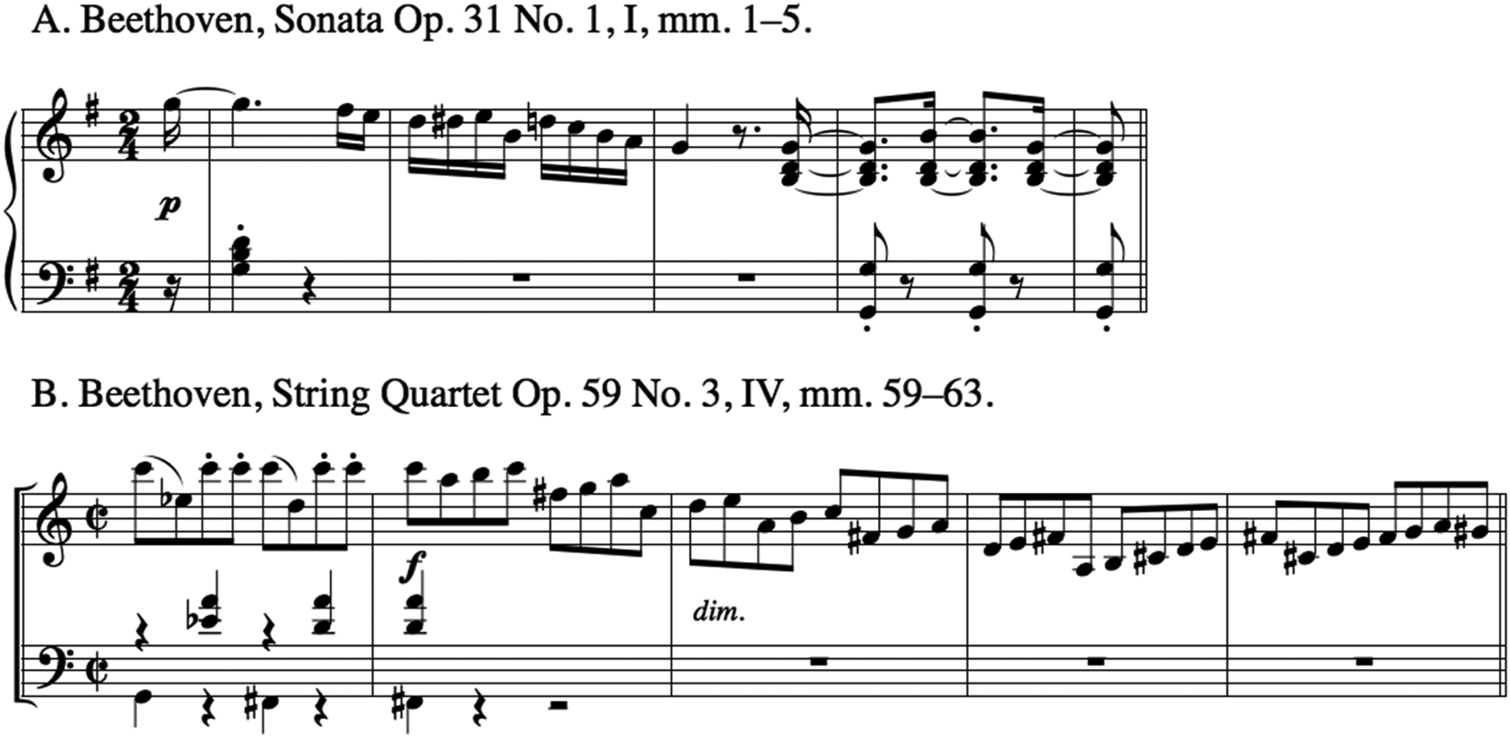
I have said little about European instrumental music (British or continental), and one might wonder if there is any precedent in that music for the devices of 20th-century syncopation. Fairly clear cases of second-position syncopation can be found; the first three measures of Example 4A are illustrative. Fourth-position syncopations appear to be much rarer, and most (like the third measure of Example 4A, discussed earlier) carry little sense of anticipation. One possible exception is the opening theme of the movement quoted in Example 4A, shown in Example 18A; each tied melody note is arguably an anticipation of the following strong beat. However, this theme feels quite incongruous in the context of the classical style. Cross-rhythms – momentary suggestions of a dotted-quarter or dotted-eighth pulse in a duple-metre context – present a similar situation: they occasionally appear, but seem like anomalous oddities rather than characteristic stylistic features. The cross-rhythm in Example 18B is quite unlike those discussed earlier; the unaccompanied three-note pattern encourages us to shift our metrical hearing to the dotted-quarter pulse, rather than retaining the underlying quarter-note pulse as we do in Example 11C. Cross-rhythms in triple or compound metre contexts – such as hemiolas – are more common, used frequently by composers such as Schumann and Brahms (Krebs Reference Krebs1999), but these would seem to have little connection to modern popular music.
Fourth-position syncopation and cross-rhythm in Beethoven.

One remaining issue, a controversial one, is the possible roots of 20th-century syncopation in African music.Footnote 18 It seems unlikely that this issue will ever be resolved with certainty, given our very limited knowledge about African music at the time of the slave trade. It is certainly possible that all of the devices of 20th-century syncopation – second-position, fourth-position and cross-rhythm – were strengthened by, or even grew out of, rhythmic practices brought over from Africa. Caribbean influences on these elements may, of course, have African roots as well. Modern accounts of traditional West African music attest to the prevalence of syncopation and cross-rhythm, but not specifically to anticipatory syncopation (Nketia Reference Nketia1974; Locke Reference Locke1982; Agawu Reference Agawu1995). Still, the possibility of African roots for anticipatory syncopation is intriguing, given its absence in earlier European music. The plausibility of this connection depends partly on when fourth-position syncopation (in its characteristic anticipatory form) emerged in American music. Certainly it was present before its appearance in notation (as proven by Johnson's recordings); however, other considerations – its absence in Emmett's transcriptions and Gottschalk's Louisianian compositions, its likely role in the novel effect of ragtime rhythm, and its gradual, incremental incorporation into ragtime – suggest that it came into use only in the late 19th century. If that is true, it seems unlikely that anticipatory fourth-position syncopation had direct origins in African music: why would a rhythmic device brought over from Africa only have surfaced in musical practice many decades later?
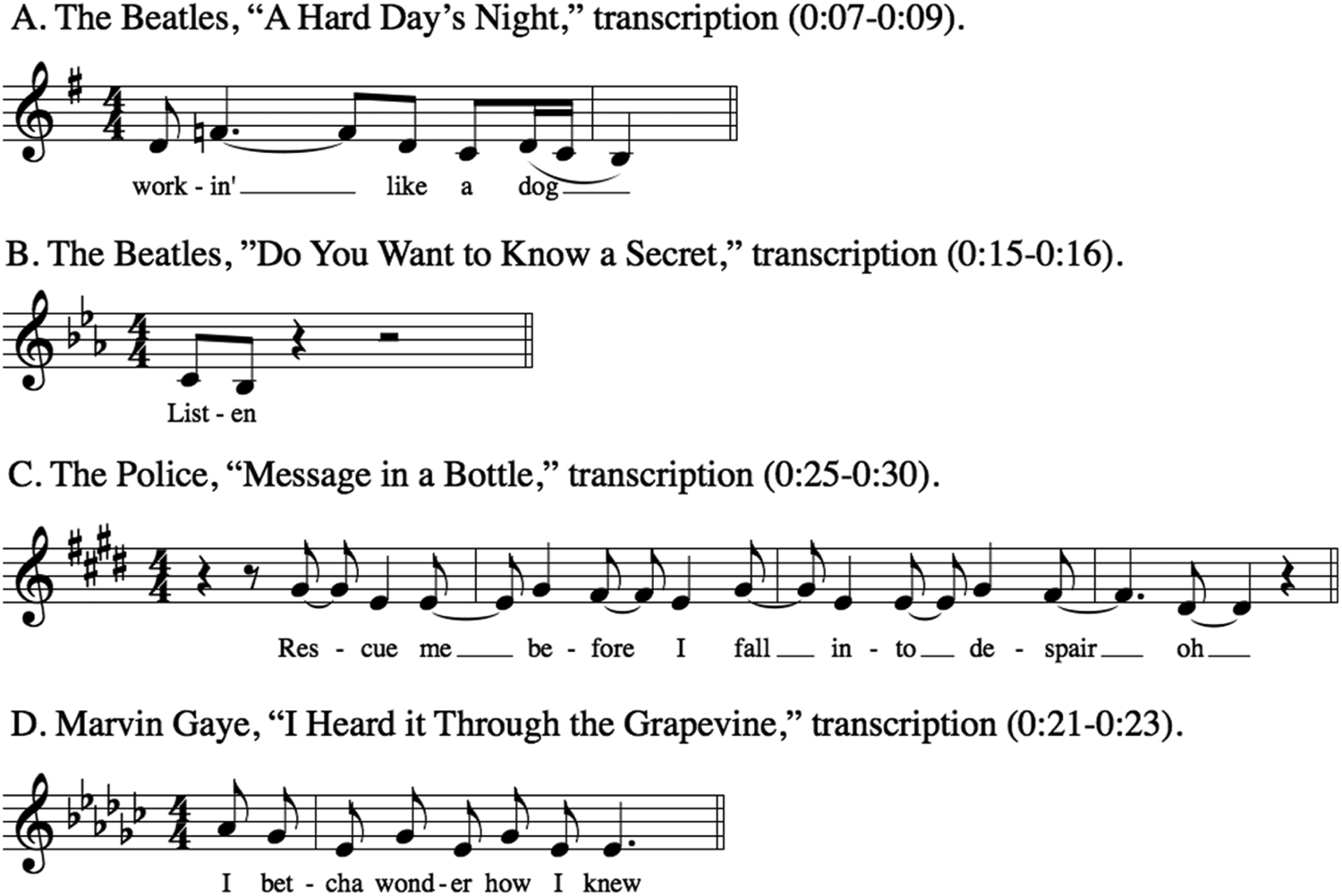
There is, of course, much more to be said about syncopation in the 20th century itself. It is simply a premise of my study that the devices discussed here – second-position syncopation, anticipatory fourth-position syncopation and cross-rhythm – can account for most of the syncopation in 20th-century popular music; this could certainly use further confirmation. Regarding the prevalence of second and fourth-position syncopation in rock, Tan et al. (Reference Tan, Lustig and Temperley2019) provides some evidence; Traut (Reference Traut2005) cites many examples of cross-rhythm in 1980s popular music. As noted earlier, the stress-metre conflict in fourth-position syncopations tends to make them easily identifiable, while second-position syncopations are more gradient in character; the second note in Example 19A seems more syncopated than that in Example 19B. No doubt, also, there are differences in the use of syncopation among 20th-century popular genres. Some studies of specific periods and genres within the century suggest that the frequency and intensity of syncopation increase over time (Berlin Reference Berlin1980; Huron and Ommen Reference Huron and Ommen2006; Waller Reference Waller2016), but this has yet to be systematically studied across the entire century. Later in the century, one sees patterns like Example 19C, where every note in a vocal phrase is on a weak eighth-note beat, or Example 19D, where even the unstressed syllables are anticipatory, shifted from weak beats to strong ones.Footnote 19
Syncopations in late-20th-century popular music.

In this essay I have proposed a view of the origins of 20th-century syncopation that I hope has cast some new light on this issue. My account centres on two types of syncopation that are quite different in their musical features and historical origins. Comparison of English, Scottish, Euro-American and African-American vocal music in the 19th century shows that the use and prevalence of second-position syncopation were broadly similar across these cultures. Anticipatory fourth-position syncopation, however, is virtually non-existent in notated vocal music until the late 1890s, and is almost certainly of African-American origin; its use in performance seems to have preceded its appearance in notation, although perhaps not by much. Given the distinctive musical character of fourth-position syncopation, it seems unlikely that it grew out of second-position syncopation, at least in any straightforward way; at the very least, its anticipatory character required a very different kind of musical thinking – a kind of cognitive ‘leap’. Cross-rhythm, too, appears to be an African-American innovation, perhaps amplified by the influence of Caribbean music. All of these conclusions are somewhat conjectural and may be reinforced or overturned by future research, but I hope this study has helped us better understand the origins of this vital aspect of 20th-century popular music.
Competing interests
The author declares none.