Introduction
Arsenopalladinite was discovered in the residual concentrates from gold washing at Itabira, Minas Gerais, Brazil. It was reported firstly with the Pd3As stoichiometry and with a hexagonal unit cell of a = 6.80, c = 3.48 Å (Claringbull and Hey, Reference Claringbull and Hey1957). Later, Clark et al. (Reference Clark, Criddle and Fejer1974) determined that concentrates contained three palladium arsenide–antimonide minerals: arsenopalladinite; atheneite, (Pd,Hg)3As; and isomertieite, (Pd,Cu)5(Sb,As)2. The grains defined originally as hexagonal arsenopalladinite actually turned out to be atheneite. Clark et al. (Reference Clark, Criddle and Fejer1974) redefined the arsenopalladinite formula as Pd5(As,Sb)2. The unit-cell was found to be triclinic: a = 7.399, b = 14.063, c = 7.352 (Å), α = 92°03′, β = 118°57′ and γ = 95°54′ (Clark et al., Reference Clark, Criddle and Fejer1974).
A few years later, Cabri et al. (Reference Cabri, Clark and Chen1977) studied arsenopalladinite from Itabira, Minas Gerais, Brazil and from the Stillwater Complex, Montana, and revised the chemical formula to Pd8(As,Sb)3. Furthermore, the As:Sb ratio in arsenopalladinite was found to be equal to 5:1 and the triclinic symmetry was confirmed.
Relations between mertieite-I, mertieite-II, isomertieite, stillwaterite and arsenopalladinite remained uncertain for a long time. The crystal structures of atheneite, isomertieite and mertieite-II have been recently elucidated. Atheneite was studied by Bindi (Reference Bindi2010), who found that Hg atoms enter one of the As sites and redefined the mineral formula as Pd2(As0.75Hg0.25) with Z = 3. The mineral was found to be hexagonal, with space group P  $\bar{6}$2m, a = 6.813(1), c = 3.4892(5) Å and V= 140.26(4) Å3.
The isomertieite formula was earlier revised as Pd11Sb2As2 (Cabri and Laflamme, Reference Cabri and Laflamme1979, Cabri, Reference Cabri and Cabri1981). Its crystal structure was refined recently in the space group Fd  $\bar{3}$m, with a = 12.297(5) Å, V = 1859.3(2) Å3 and Z = 8 (Karimova et al., Reference Karimova, Grokhovskaya, Zolotarev and Gurzhiy2016). The structure of mertieite-II, Pd8Sb2.5As0.5, was also studied recently (Karimova et al., Reference Karimova, Zolotarev, Evstigneeva and Johanson2018). Mertieite-II is trigonal, R
 $\bar{3}$c, with a = 7.5172(3), c = 43.037(2) Å, V = 2106.1(2) Å3, and Z = 12. Here we report the first determination of the crystal structure of arsenopalladinite.
Materials and methods
Arsenopalladinite crystals for the structural study were provided by Dr. Kari Kojonen, Geological Survey of Finland (GSF). Grains were collected from the black sands of gold placers from the Kaarreoja River, Inari commune, Finnish Lapland, Finland (68.65°N, 25.63°E).
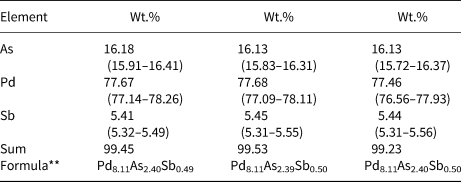
The chemical composition was determined using a Cameca SX 100 electron microprobe (Table 1). The wavelength-dispersive spectroscopy analyses were performed with an operating voltage of 15 kV, a beam current of 20 nA, and a beam diameter of 1 μm. Pure Pd, Rh, Pt, cobaltite (for As), Sb2Te3 (for Sb), chalcopyrite (for Cu and S) and hematite (for Fe) were used as standards. AsLα (LIF diffracting crystal), PdLα (LIF), SbLα (PET), SKα (PET), FeKα (LIF), RhLα (PET), PtLα (LIF) and CuKα (LIF) spectral lines were used.
Representative* analysis of arsenopalladinite (microprobe).

* Average analysis along the profiles.
** Calculated with 11 atoms per formula unit.
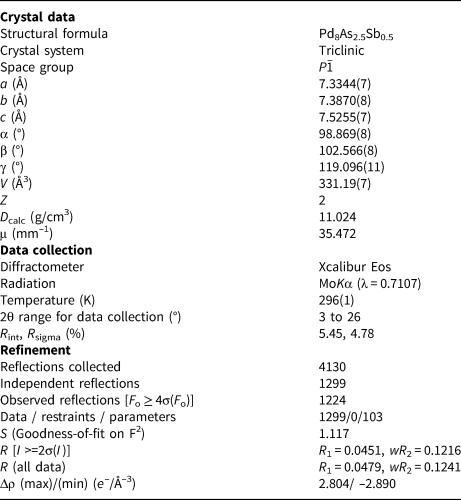
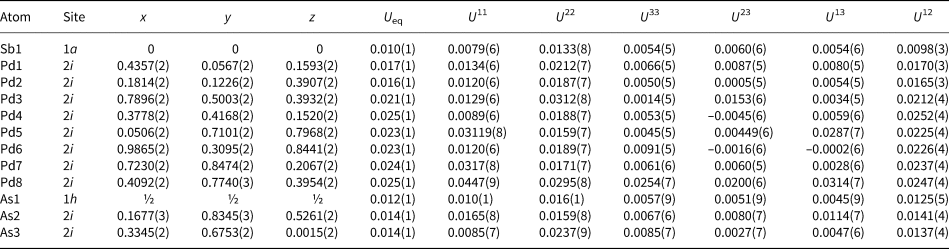
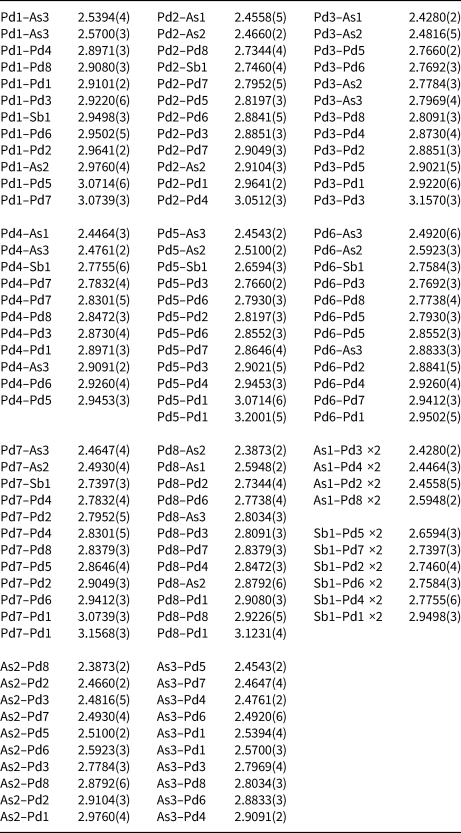
The same crystal used for the chemical study was analysed by single-crystal X-ray diffraction at the XRD Centre of Research Park of St. Petersburg State University. A hemisphere of three-dimensional data was collected at room temperature using an Xcalibur Eos diffractometer, which was operated at 50 kV and 40 mA (monochromatic MoKα X-radiation). The data were integrated and corrected by means of the CrysAlisPro (Agilent Technologies, 2012) program package, which was also used to apply empirical absorption correction using spherical harmonics, implemented in the SCALE3 ABSPACK scaling algorithm. The structure was solved by direct methods using SHELXT program (Sheldrick, Reference Sheldrick2015a) in the frame of a WinGX programs package (Farrugia, Reference Farrugia2012). Eight Pd, one Sb and three As sites were located in the structure. Refinement gave the full occupancies for As and Sb sites. The structure was refined to R 1 = 0.0451 for 1224 unique observed reflections with |F o| ≥ 4σF o in an anisotropic approximation using SHELXL (Sheldrick, Reference Sheldrick2015b). The crystallographic data and selected refinement parameters are shown in Table 2. The final atomic coordinates and displacement parameters are listed in Table 3 and the selected interatomic distances are in Table 4. Table 5 shows the coordination numbers and the average values of the bond lengths. The crystallographic information files have been deposited with the Principal Editor of Mineralogical Magazine and are available as Supplementary material (see below).
Crystal data and structure refinement for arsenopalladinite.

Atomic coordinates and equivalent isotropic and anisotropic displacement parameters (Å2) for arsenopalladinite.

Selected bond lengths (Å) for arsenopalladinite.

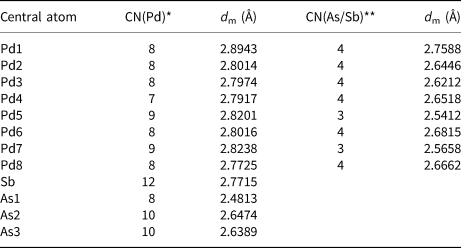
The coordination number (CN) together with the average values of Pd–Pd and Pd–As/Sb distances (d m) around the different atoms in arsenopallanite.

* CN(Pd) is the number of nearest Pd neighbours;
** CN(As/Sb) is the number of nearest As/Sb neighbours.
Composition
The composition was obtained on the basis of 15 points along three lines across the crystal (Fig. 1). The mean analyses of each line are shown in Table 1. The element concentrations vary within very narrow limits (~1.5 wt.%). The average element contents (in wt.%) are: Pd 77.60, As 16.15, Sb 5.43. Minor amounts of S (0.01–0.09 wt.), Se (0.01–0.15 wt.%), Pt (0.02–0.49 wt.%) and Cu (0.01–0.09 wt.%) were detected in some analyses. The empirical formula for arsenopalladinite is Pd8.11As2.39Sb0.50, calculated on the basis of 11 atoms per formula unit. The empirical formula calculated on the bases of 8 palladium atoms per formula unit is Pd8.00As2.37Sb0.49.
SEM-BSE image of arsenopalladinite, Pd8As2.5Sb0.5.

Crystal structure description
All palladium atoms occupy general positions in the structure (Wyckoff symbol 2i) (Table 3). One As atom is located on an inversion centre, at the Wyckoff position –1h, and the other two are in general positions 2i. The antimony atoms site is located on another inversion centre – at the Wyckoff position1a.
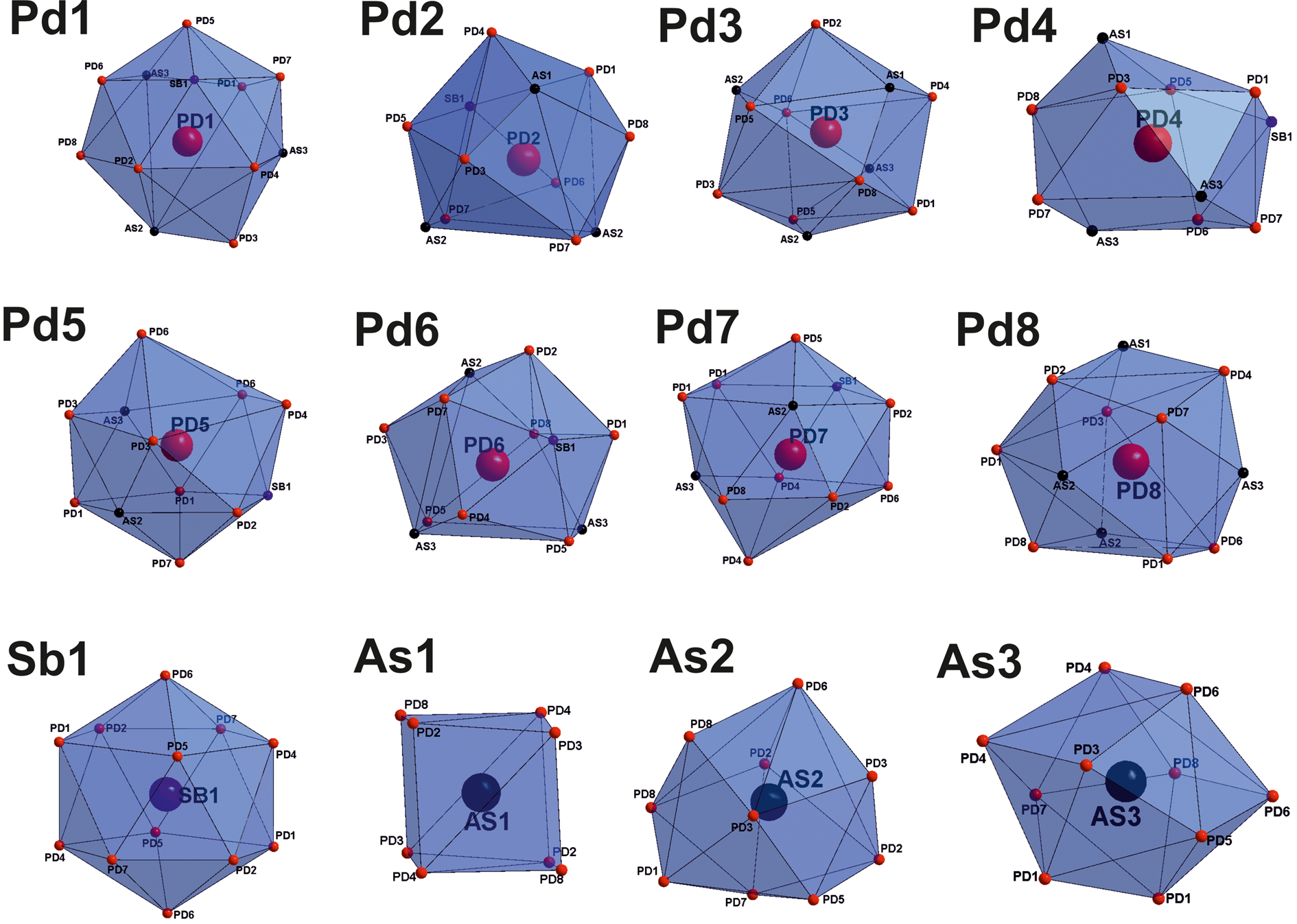
The coordination polyhedra around all atoms are irregular (Fig. 2). The Pd and Sb sites have 12 neighbours (Tables 4, 5); the As1 site has 8 neighbours; As2 and As3 sites have 10 neighbours (Tables 4, 5). Interatomic distances in the structure vary significantly. The overall minimum Pd–As bond is 2.3873(2) Å. It is slightly less than the minimum palladium to arsenic distance in other Pd–As–Sb ternary minerals – mertieite-II and isomertieite are 2.488 and 2.465 Å, respectively (Karimova et al., Reference Karimova, Grokhovskaya, Zolotarev and Gurzhiy2016; Reference Karimova, Zolotarev, Evstigneeva and Johanson2018). The characteristic feature of arsenopalladinite is elongated Pd–As bonds to a maximum of 2.9760(4) Å. It is significantly longer than those bonds in mertieite-II and isomertieite are: 2.537 and 2.662 Å, respectively (Karimova et al., Reference Karimova, Grokhovskaya, Zolotarev and Gurzhiy2016; Reference Karimova, Zolotarev, Evstigneeva and Johanson2018). The very long palladium to arsenic bonds (up to 3.380 Å) are also formed in the synthetic phase Pd5As (Matkovic and Schubert, Reference Matkovic and Schubert1978). The Pd–Sb bonds lengths vary from 2.6594(3) Å to 2.9498(3) in arsenopalladinite. This is in good agreement with those distances in isomertieite (2.708–2.894 Å, Karimova et al., Reference Karimova, Grokhovskaya, Zolotarev and Gurzhiy2016). The palladium to antimony distances vary in wider limits in mertieite-II (2.602–3.340 Å, Karimova et al., Reference Karimova, Zolotarev, Evstigneeva and Johanson2018), synthetic Pd8Sb3 (2.594–3.303 Å, Marsh, Reference Marsh1994) and Pd20Sb7 (2.600–3.303 Å, Wopersnow and Schubert, Reference Wopersnow and Schubert1977)
Coordination polyhedra in the arsenopalladinite structure.

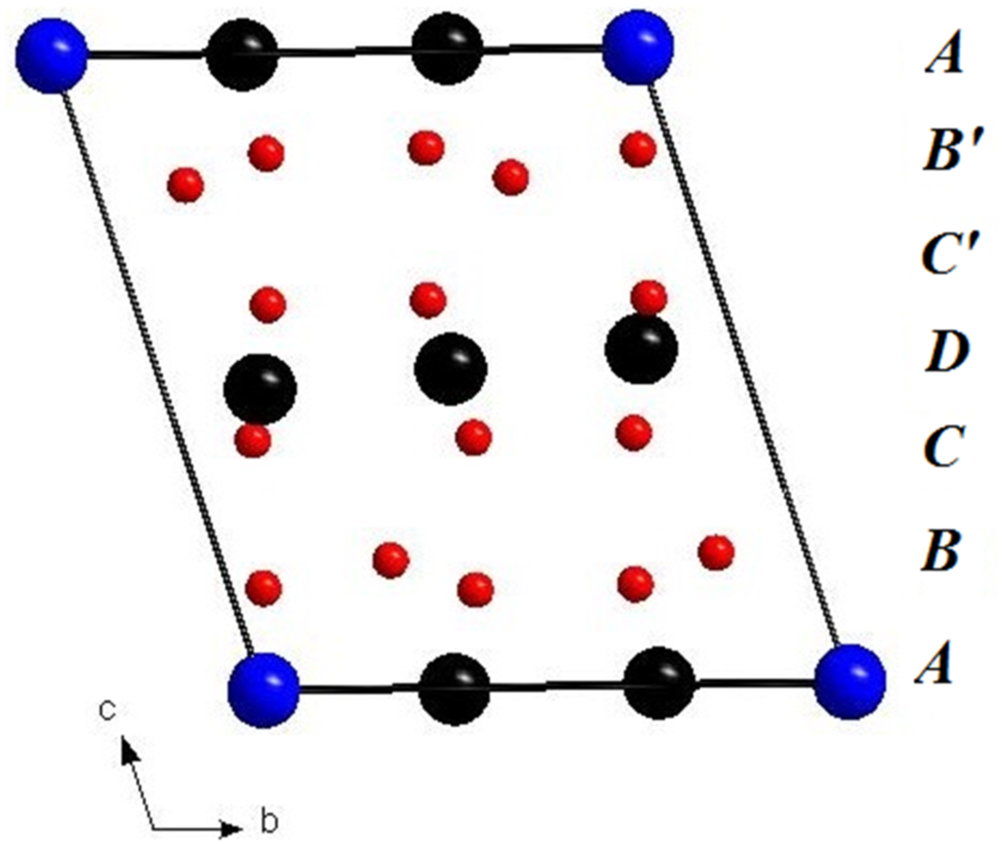
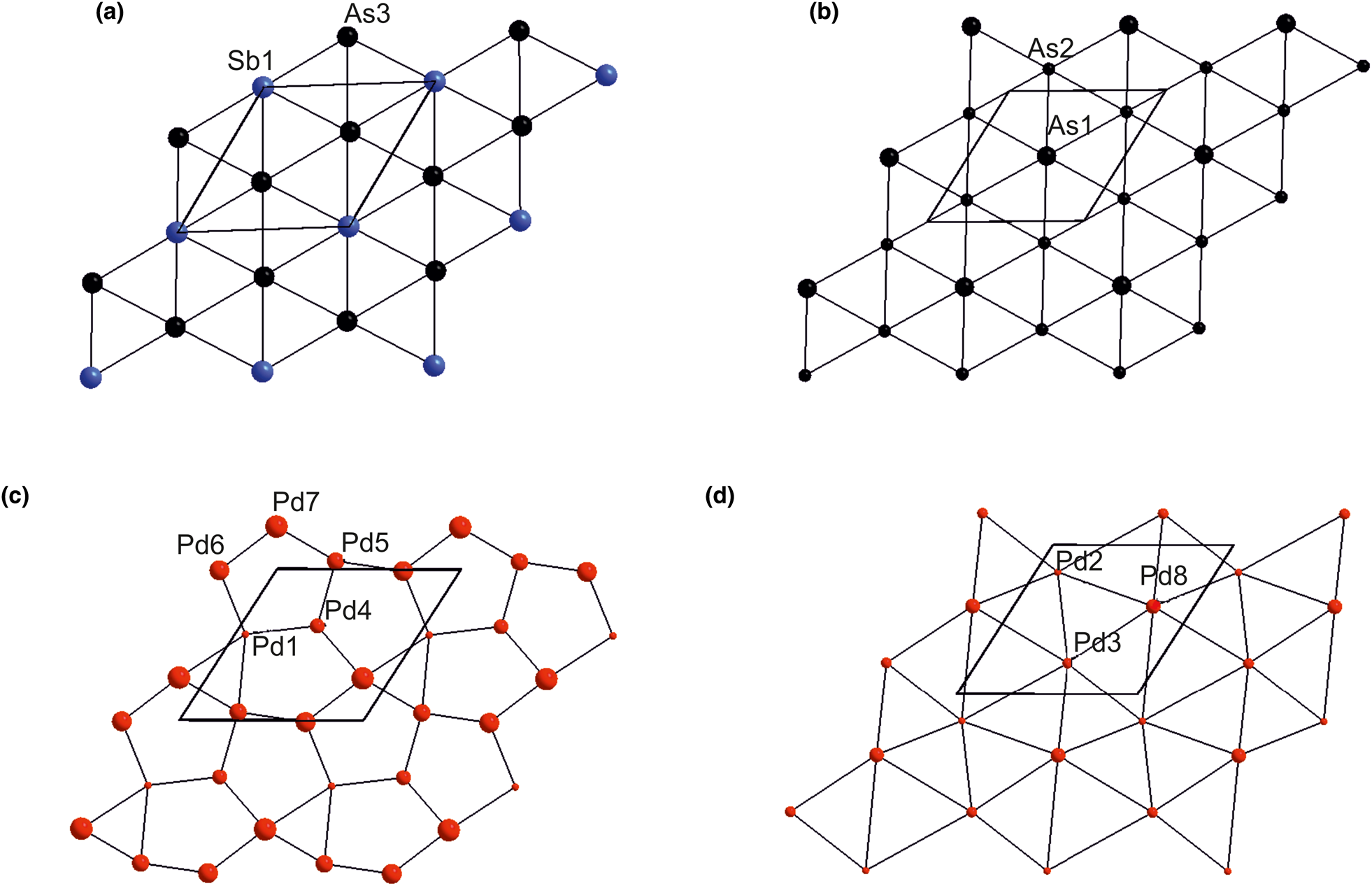
The crystal structure of arsenopalladinite is shown in Fig. 3. Atoms are located in layers stacked along the c axis, with palladium and pnictogen atoms (As and Sb) occupying different layers, respectively. The topology of the layers is described in Fig. 4. Antimony atoms site (Sb1) and one of the arsenic atom sites (As3) form a 36 triangular net (named the ‘A’ layer, Fig. 4). The next layer, ‘B’, is a distorted triangular net. It is formed by Pd2, Pd3 and Pd8 atomic sites. The next one, the ‘C’ layer, is pentagon–triangular net. It is formed by Pd1, Pd4, Pd5, Pd6 and Pd7 atomic sites. Finally, two arsenic atoms sites – As1 and As2 build a 36 triangular net (the ‘D’ layer). The A, B, C and D layers stack along the z direction of the unit cell (Fig. 3). The stacking sequence is: ABCDBCA. The unit cell contains 6 layers.
The crystal structure of arsenopalladinite projected along the a axis. Blue circles are Sb atoms, black circles – As atoms and red circles – Pd atoms.

Atomic nets in the crystal structure of arsenopalladinite. Colour codes as in Fig. 3.

The crystal structure formula of arsenopalladinite is Pd16As5Sb1 (Z = 1). It can be expressed in the form Pd8As2.5Sb0.5 (Z = 2), which is more suitable in order to compare it with other members of the mertieite mineral group.
Discussion
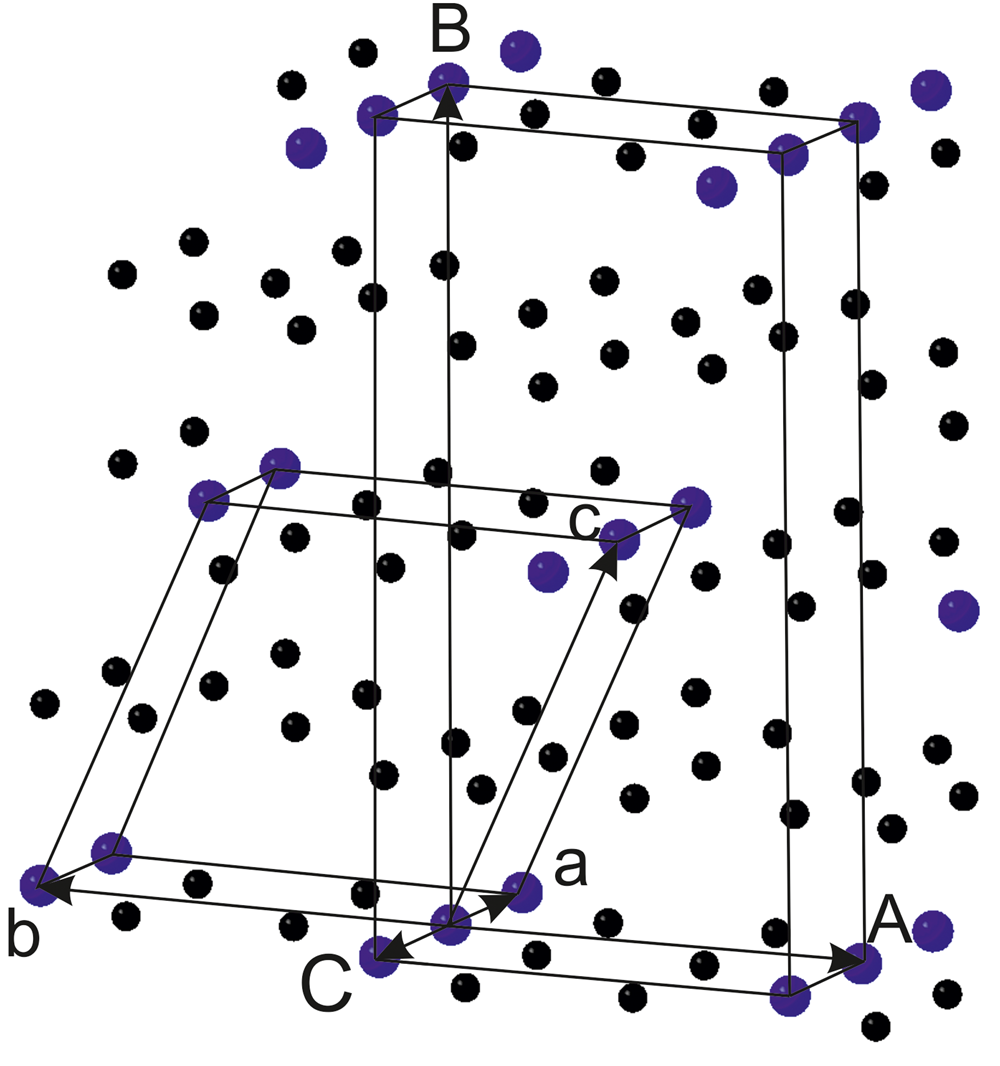
The arsenopalladinite unit cell reported here is the smallest, so-called reduced triclinic cell (Wolff, Reference Wolff and Hahn2005). A larger unit cell was reported earlier in literature: a = 7.399, b = 14.063, c = 7.352 (Å), α = 92°03′, β = 118°57′, γ = 95°54′ (Clark et al., Reference Clark, Criddle and Fejer1974, Cabri et al., Reference Cabri, Clark and Chen1977, Cabri, Reference Cabri and Cabri2002). These two cells are actually two possible choices describing the same crystal structure. The relation between them is shown in Fig. 5. The larger cell transforms into smaller one by transformation matrix (0 0  $\bar{1}$ /
 $\bar{1}$ 0 0 / ½ ½ ½).
Relation between two possible choices of the unit cell. Colour codes as in Fig. 3. Palladium atoms are omitted.

Pearson (Reference Pearson1972) proposed describing the structures of metallic phases and intermetallic compounds in terms of atomic nets. The crystal structures of the minerals arsenopalladinite, Pd8As2.5Sb0.5, and mertieite-II, Pd8Sb2.5As0.5, have a close relation. The base of the structure is the same in both cases. The structures are built up by layers of Pd and As/Sb atoms. The structural building unit is the same in both minerals. It is a package of 3 atomic layers: triangular pnictogen net + triangular Pd net + pentagon–triangular Pd net.
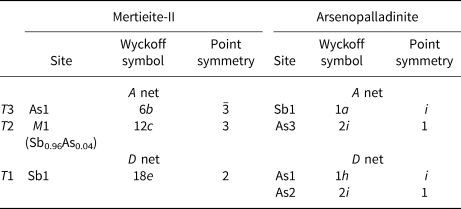
A key role in the structure stabilisation is played by the triangular nets of pnictogen atoms. The nets have identical –36 topology in both minerals, but different plane symmetry. They are compared in Fig. 6.The plane symmetry of A and D nets in arsenopalladinite is p2. The plane symmetry of the pnictogen nets in mertieite-II is higher: p3m for the A net and p3 for the D net. The nets contain several sites possibly hosting As and Sb atoms: T1, T2 and T3. The arsenic and antimony distribution on positions at the nets are shown in Table 6. In the case of arsenopalladinite the T1 site is divided in two symmetry independent sites: T1 and T1’. A common formula for both minerals can be expressed in a form: Pd8T11.5T21T30.5. Then, for mertieite-II it is Pd8Sb1.5Sb1As0.5 =Pd8T11.5T21T30.5 and for arsenopalladinite it is Pd8As1As0.5As1Sb0.5 = Pd8T11T1’0.5T21T30.5.
The comparison of the pnictogen nets in mertieite-II and arsenopalladinite.

Occupation of the sites in pnictogen (As/Sb) triangular nets in arsenopalladinite and mertieite-II.

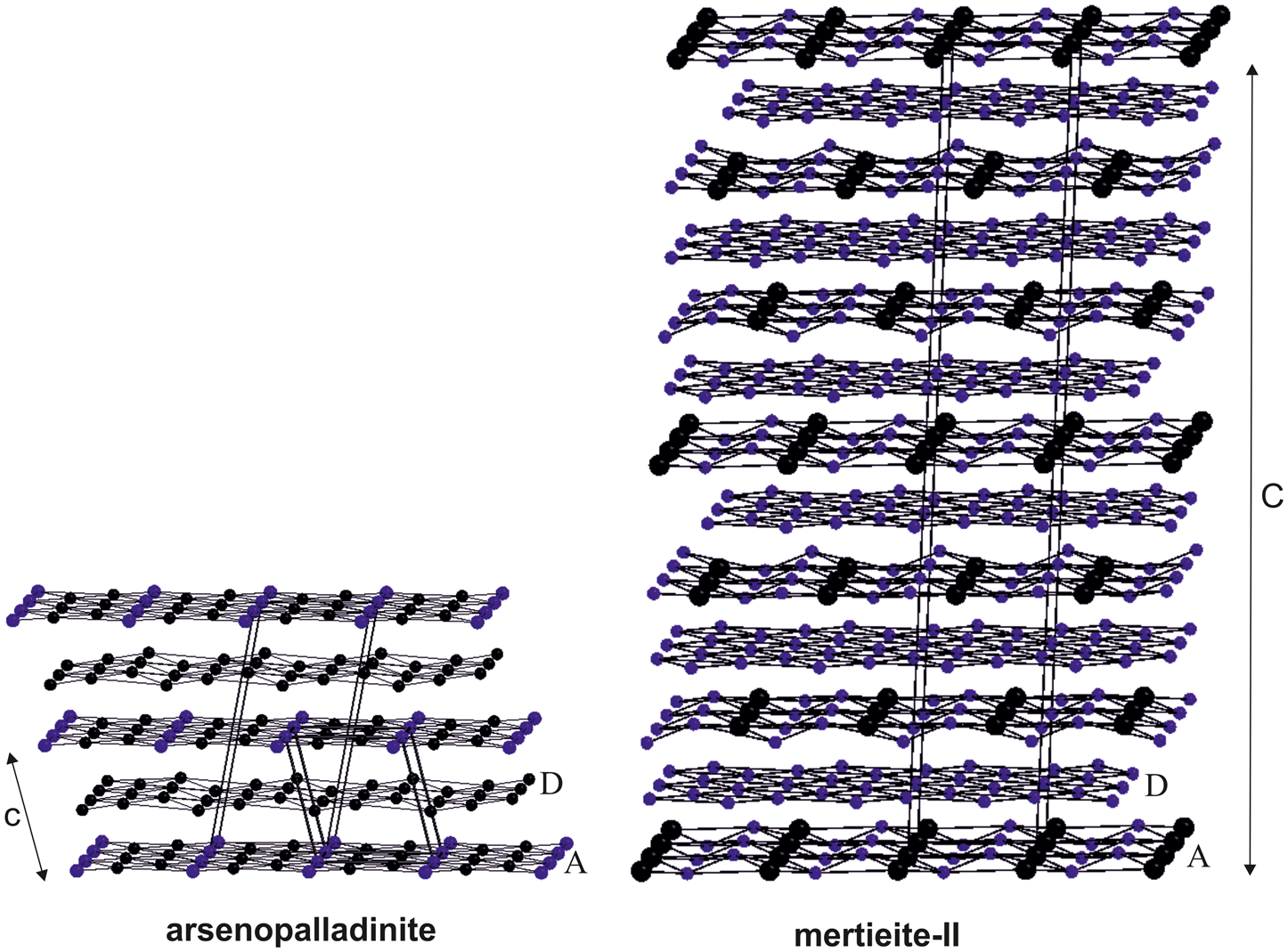
The pnictogen layers of two types alternate along the c axis in the structures of mertieite-II and arsenopalladinite (Fig. 7). Arsenopalladinite contains two pnictogen layers per unit cell, mertieite-II has 12.
Ordering of As and Sb atoms in the pnictogen layers in arsenopalladinite and mertieite-II structures. Palladium layers are omitted. Colour codes as in Fig. 3.

Two adjacent layers stack on onto another likewise in classic close package structures. Two types of cavities are formed: hexagonal and tetragonal. Palladium atoms occupy all hexagonal and ⅚ of the tetragonal cavities (Fig. 8). Palladium atoms at the hexagonal cavities shift from the cavity centre. Thus, their coordination by As and Sb atoms reduces from six to three. So, the structure contains As and (As,Sb) tetrahedra, and triangles around Pd atoms.
Palladium atoms distribution on sites between two adjacent pnictogen layers in arsenopalladinite structure. Five tetragonal cavities are highlighted.

The size of atoms is one of the factors that has an influence on the stability of a structure type (Pearson, Reference Pearson1972). The radius of arsenic, which has formed structure layers in arsenopalladinite, is smaller than those of antimony in mertieite-II: 1.39 and 1.59 Å, respectively (metallic radii, Pearson, Reference Pearson1972). When the smaller arsenic substitutes antimony in the structure layers, an adaptation of interatomic distances leads to atom shifts from the symmetry sites and so a change of structure symmetry.
In the range [Pd8Sb3, synthetic compound]–[mertieite-II, Pd8Sb2.5As0.5]–[arsenopalladinite, Pd8As2.5Sb0.5], the compositional changes favour the occurrence of different structural arrangements. Mertieite-II is isostructural with synthetic Pd8Sb3 (Karimova et al., Reference Karimova, Zolotarev, Evstigneeva and Johanson2018, Marsh Reference Marsh1994, Wopersnow and Schubert, Reference Wopersnow and Schubert1976). In that composition range only limited solid solution can exist for Pd8Sb3–Pd8Sb2.5As0.5. The crystal structures of Pd8Sb3 and Pd8Sb2.5As0.5 compounds are trigonal with an elongated rhombohedral unit-cell. If arsenic content increases up to Pd8As2.5Sb0.5 composition, then deformation of the structure up to triclinic symmetry is realised.
Arsenopalladinite, Pd8As2.5Sb0.5, and mertieite-II, Pd8Sb2.5As0.5, are structurally closely related minerals. They can be joined in one mineral group. The crystal structures of mertieite-I, Pd8(Sb,As)3, and stillwaterite, Pd8As3, are not known yet, and their relation to the named minerals is not still clear.
Acknowledgements
The authors are grateful to Luca Bindi, an anonymous reviewer, Structural Editor Daniel Atencio and Associate Editor František Laufek for useful comments and editing the manuscript. We thank Kari Kojonen for providing samples. We acknowledge the Resource Centre of X-ray diffraction studies of St. Petersburg State University for collection of the experimental data. This study was supported by the Russian Academy of Sciences, Program of Fundamental Research.
Supplementary material
To view supplementary material for this article, please visit https://doi.org/10.1180/mgm.2020.65.