Introduction
A zoological expedition was organized in early 1995 by the Project Itatuba supported by the Károly Kögl family, who founded a Private Nature Conservation Reserve near São Paulo, Brazil. During fieldwork the Hungarian botanist Professor Attila Borhidi collected leaves covered with epiphyllous bryophytes and lichens. Among these collections we discovered a species of Calopadia Vězda (Pilocarpaceae) with a unique combination of characters (especially those of the red-pigmented campylidia) which we describe as new to science. Although the foliicolous lichen flora of Brazil is relatively well known (e.g. Lücking et al. Reference Lücking, Sérusiaux, Maia and Pereira1998; Cáceres et al. Reference Cáceres, Maia and Lücking2000; Lücking & Kalb Reference Lücking and Kalb2000; Lücking Reference Lücking2008) it is not surprising that such a conspicuous new species should be found given the biodiversity and size of the country.
Material and Methods
The lichen material was collected by Professor Attila Borhidi (Hungary) and deposited in VBI, with duplicates in CANB, F, PRA-V and hb. Flakus. The morphology and the anatomy were examined using standard stereo microscopes (Olympus SZX9, Nikon SMZ 800) and compound microscopes (Olympus BX50, Nikon Eclipse 80i). Hand-cut sections and squash mounts were examined in water, 10% solution of potassium hydroxide, and Lugol's solution. All measurements were made on material mounted in tap water. Chemical analyses were carried out using HPLC following the methods described in Elix & Wardlaw (Reference Elix and Wardlaw2002).
The Species
Calopadia erythrocephala Farkas, Elix & Flakus sp. nov.
Mycobank: MB 563146
Calopadia puiggarii affinis sed campylidiis rubropruinosis differt.
Typus: Brazil, Estado São Paulo, São Roque, Cascada sobre la Laguna Sapucaia, in Atlantic submontane rainforest, c. 800 m, on leaves of a vascular plant, 2 January 1995, A. Borhidi s. n. (VBI-L 06001—holotypus; CANB, F, PRA-V, herb. Flakus—isotypi).
(Fig. 1)
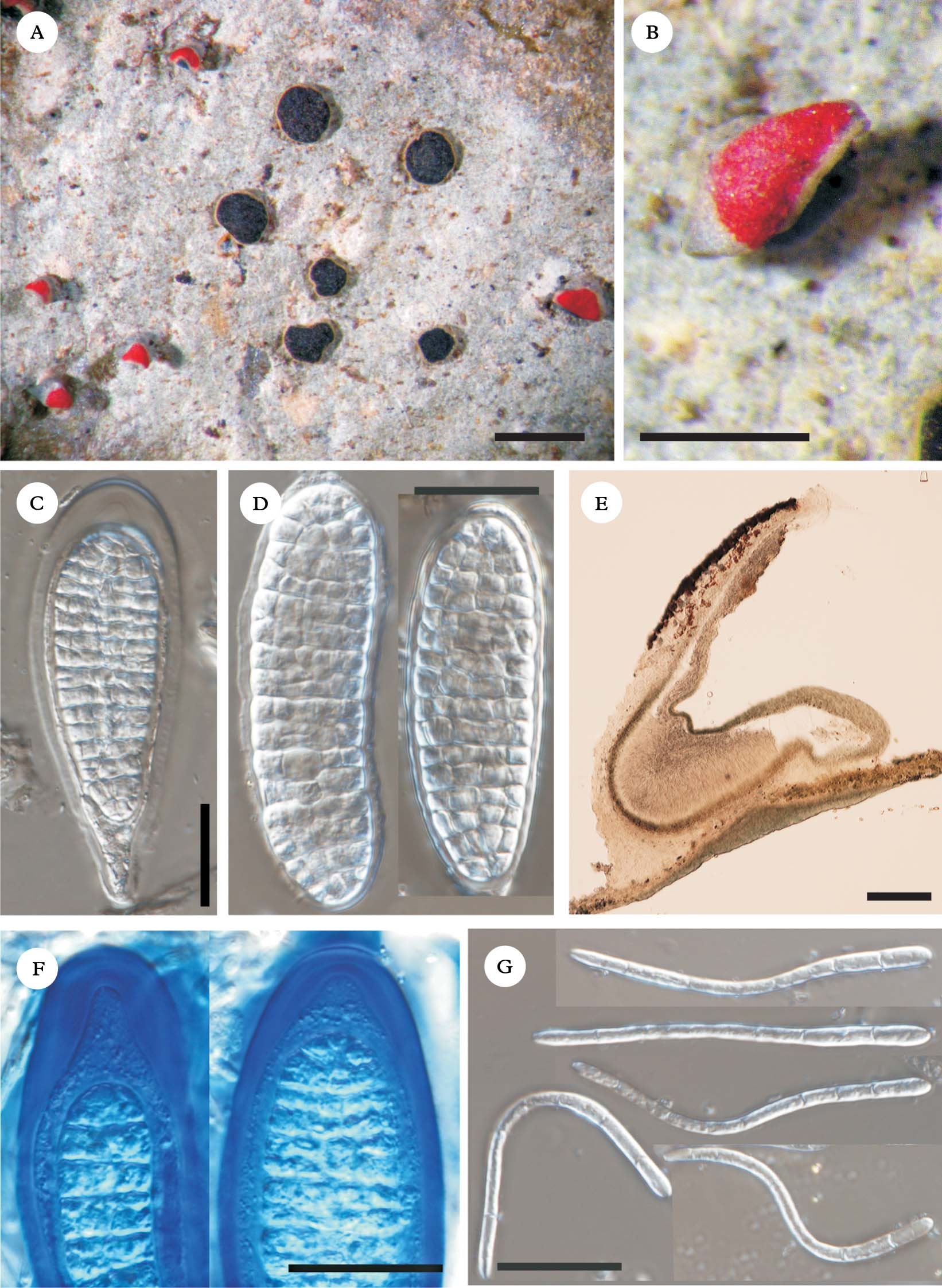
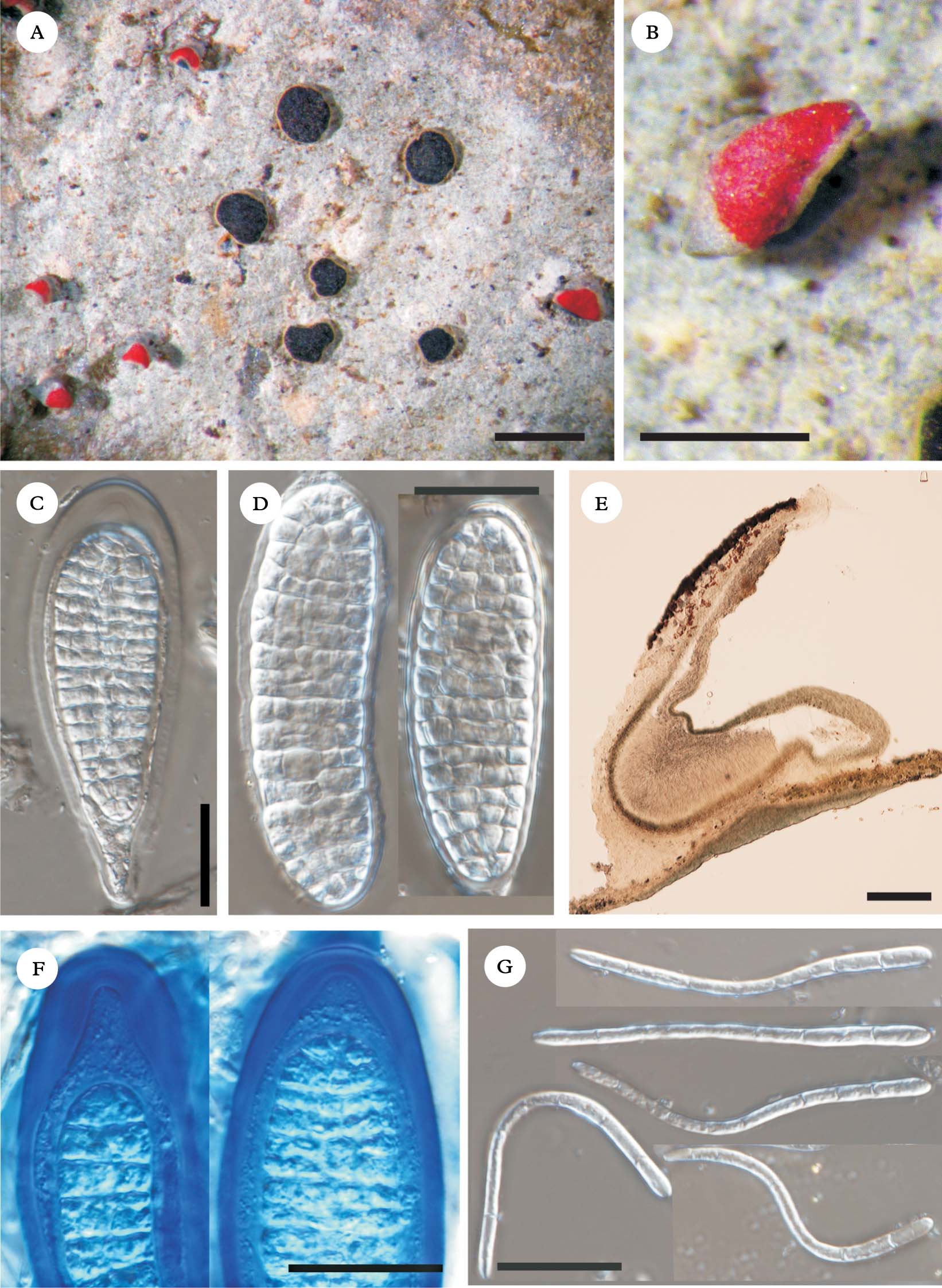
Calopadia erythrocephala (holotype). A, thallus with apothecia and campylidia; B, a campylidium; C, ascus with a single ascospore; D, ascospores; E, section of a campylidium; F, Sporopodium-type ascus apex (in K/KI); G, conidia. Scales: A=1 mm, B=0·5 mm, C, D, F & G=20 µm, E=100 µm.
Thallus foliicolous, continuous or dispersed into patches along the margins, up to 15 mm wide, 20–30 µm thick, ecorticate, smooth, pale grey. Photobiont chlorococcoid, cells up to 12 µm diam.
Apothecia rounded to undulate, 0·3–0·6 mm diam., 220–240 µm high; disc flat to slightly convex in old apothecia, dark brown to almost black, epruinose; margin distinct, greyish white. Excipulum 30–50 µm wide, 50–60 µm high (below hymenium), hyaline to pale greyish brown, paraplectenchymatous, composed of cells 3–10(–15) µm diam. Hymenium 100–120 µm high, colourless. Hypothecium 20–40 µm high, dark olive-brown, K−, a thin hypothecioid tissue developed inside the marginal part of the excipulum. Apothecial base aeruginous. Asci Sporopodium-type, 80–100×20–30 µm. Ascospores single in ascus, oblong-ellipsoid to broadly-ellipsoid, muriform, colourless, 45–80×15–30 µm.
Campylidia sessile, 0·4–0·6(–1·0) mm broad; lobe well-developed, hood-shaped, pale grey to aeruginose grey, distinctly red pruinose in upper part. Conidia filiform with clavate apex, slightly to strongly sigmoid or curved, 3–7 septate, 45–65×1·5–2·0 µm (2·0–3·5 µm broad at the wider apex), without associated algal cells.
Chemistry. Campylidia contain fusarubin; no additional substances detected in the thallus by HPLC.
Etymology. The new species is named after the characteristic red pigment covering the upper hood-shaped part of the campylidia, thus resembling the fairy tale figure of Little Red Riding Hood.
Notes. Calopadia erythrocephala is most similar to C. puiggarii (Müll. Arg.) Vězda (for detailed description see Lücking, 2008), but differs in having red-pigmented campylidia, darker apothecial discs and longer but somewhat similar conidia [45–65×1·5–2·0 µm (2·0–3·5 µm broad at the wider apex) for C. erythrocephala versus 30–50×1·0–1·5 µm (1·5–3·0 µm at apex) for C. puiggarii]. The new species is distinguished from other related members of C. fusca-group in the key below.
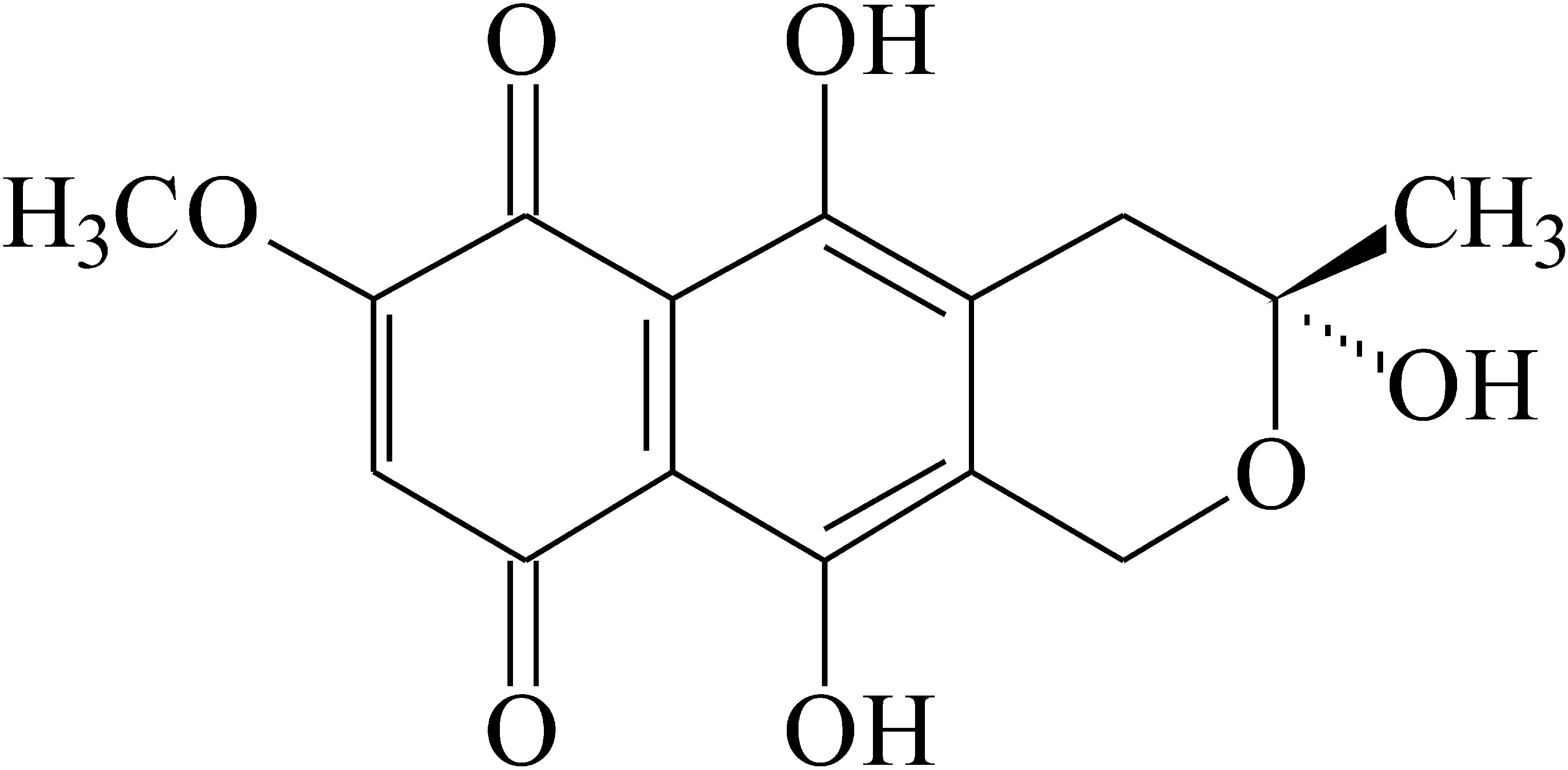
The most remarkable character of the new species, the red colour of the upper part of campylidia, is due to the naphthaquinone fusarubin (Fig. 2), not previously recorded in Calopadia (e.g. Lücking Reference Lücking2008; Elix & Øvstedal Reference Elix and Øvstedal2009). This pigment was previously known from two species of pathogenic fungi, Fusarium javanicum Koor. and F. solani (Mart.) Sacc., and from the lichen, Xanthoparmelia endomiltodes (Nyl.) Hale (e.g. Elix & Wardlaw Reference Elix and Wardlaw2002; Lugauskas Reference Lugauskas2005). Calopadia erythrocephala is the first foliicolous lichen known to produce fusarubin.
Fusarubin.

Loflammia epiphylla (Fée) Lücking & Vězda is another species with pale orange to red-pigmented campylidia, but is distinguished by the typically bright red apothecia, small, non-septate conidia and by the presence of atranorin, stictic and hypostictic acids (Vězda Reference Vězda1986; Lücking Reference Lücking2008).
Distribution and ecology. The new species has been found on the leaves of vascular plants (3–4 different species, among them an Ilex species, most probably Ilex paraguariensis) in the Atlantic, submontane rainforests of Brazil. So far it is known only from three neighbouring localities visited on different days during the collecting trip. The following components of the vegetation were noted by the collector: Allophylus edulis, Bauhinia forficata, Carpotroche brasiliensis, Cecropia glaziovii, Cedrela fissilis, Chrorisia speciosa, Cupania vernalis, Myrciaria tenella, M. trunciflora, Nectandra lanceolata, Piptadenia gonoacantha, Psidium cattleianum, Schinus terebinthifolius, Securinega guaraiuva, Trichilia claussenii, T. hirta, Urera baccifera and Zanthoxylum rhoifolium.
The number of endemic species and biodiversity of the Atlantic rainforest of Brazil is considered to be especially high (Brown Reference Brown, Whitmore and Prance1987; Groombridge Reference Groombridge1992; Heywood Reference Heywood1995). Consequently the occurrence of a rare foliicolous lichen, possibly with specific microclimatic requirements, in such a habitat is not surprising. Unfortunately, such microhabitats in the Atlantic rainforests are critically endangered posing a threat to species such as C. erythrocephala (cf. Tabarelli et al. Reference Tabarelli, Mantovani and Peres1999, Reference Tabarelli, Pinto, Silva, Hirota and Bedê2005; Myers et al. Reference Myers, Mittermeier, Mittermeier, da Fonseca and Kent2000; Galindo-Leal & Câmara Reference Galindo-Leal and Câmara2003; Cáceres et al. Reference Cáceres, Lücking and Rambold2008).
Additional specimens examined. Brazil: Estado São Paulo: São Roque, entre la Laguna Sapucaia y la Lagunita, Atlantic submontane rainforest, alt. ca 800 m, 3 i 1995, A. Borhidi s. n. (VBI); ibid., São Roque, al Oeste de la Cascada, sobre la Laguna de Sapucaia, Atlantic submontane rainforest, 7 i 1995, A. Borhidi s. n. (VBI).
Specimens of Calopadia puiggarii examined. Brazil: Estado São Paulo: São Roque, Cascada sobre la Laguna Sapucaia, Atlantic submontane rainforest, alt. c. 800 m, 2 i 1995, A. Borhidi s. n. (VBI).—Costa Rica: Las Cruces: 5 km südlich von San Vito, 1000 m, viii 1988, R. Lücking s. n. (PRA-V 12911). Limon province: Cahuita, c. 140 km ESE of San José and 45 km SE of Limon at the Atlantic coast, 9°44′N 82°50′W, sea level, lowland rainforest zone, anthropogenic vegetation (fruit trees) around Cahuita village, on leaves of Citrus sp., 1992, R. Lücking 92-4066, (R. Lücking Lichenes Foliicoli Exsiccati 86; VBI).—Tanzania: West Usambara Mts.: NW of Mazumbai village, montane rainforest along the north headwaters of Kambi stream, with many tree ferns, 1780 m, epiphyllous, 1984, T. Pócs 8405/BA (VBI).
A word-wide key to the foliicolous species of Calopadia with single, muriform ascospores
1 Ascospores 80–110 µm long ... 2
Ascospores 45–85 µm long ... 4
2(1) Apothecial disc pale brown; strongly yellow to pale brownish pruinose ... C. perpallida (Nyl.) Vězda
Apothecial disc (reddish) brown to dark brown; epruinose ... 3
3(2) Thallus with vermicular cephalodia (chamois coloured); New Guinea, Philippines ... C. vermiculifera (Vain.) Sér.
Thallus without cephalodia; mostly corticolous, muscicolous, occasionally foliicolous; Brazil, Puerto Rico, Seychelles ... C. subfusca Kalb & Vězda
4(1) Campylidia red-pigmented (fusarubin) in the upper part ... C. erythrocephala Farkas et al.
Campylidia lacking red pigment ... 5
5(4) Thallus pale orange-yellow (K+ pale wine-red) with bright orange-red fluorescence (UV 366 nm); apothecia dark greyish-brown, epruinose, margin orange-grey ... C. aurantiaca Lücking
Thallus grey, pale grey to whitish grey ... 6
6(5) Thallus with yellow to orange fluorescence (UV 366 nm) ... 7
Thallus without UV fluorescence ... 8
7(6) Apothecia brownish grey to dark grey, white pruinose (with a purplish tinge in part); ascospores 50–70×12–18 µm; conidia 3–5-septate, 40–50×1·8–2 µm (up to 3·0–3·5 µm wide at apex); thallus dispersed but single patches partly confluent; ... foliicolous; Africa ... C. lucida Lücking & R. Sant.
Apothecia orange-brown to brown, white pruinose when young; ascospores 55–75×20–22 µm; conidia multiseptate, 25–31×3 µm, often strongly curved; thallus continuous, often with a discontinuous white prothallus; corticolous, rarely ... foliicolous; Florida ... C. schomerae F. Seavey & J. Seavey
8(6) Apothecia (at least when young) greyish black to black; hypothecium ... aeruginose ... 9
Apothecia pale to dark brown; hypothecium pale to dark brown ... 10
9(8) Apothecia epruinose ... C. subcoerulescens (Zahlbr.) Vězda
Apothecia densely and persistently white pruinose ... C. cinereopruinosa Bungartz & Lücking
10(8) Apothecia pale brown; pruina intense yellow to cream ... C. editae Vězda ex Chaves & Lücking
Apothecia pale to dark brown; epruinose ... 11
11(10) Apothecia pale to reddish brown; hypothecium pale yellowish-brown ... C. fusca (Müll. Arg.) Vězda (incl. C. schaeferi Vězda, see Lücking 2008: 741)
Apothecia greyish brown to dark brown; hypothecium dark brown ... C. puiggarii (Müll. Arg.) Vězda
Our research was supported by the Hungarian Scientific Research Fund (OTKA K81232), and the National Centre for Research and Development (NCBiR) in Poland under the LIDER Programme for the years 2010–2013 (no. 92/L–1/09).