Introduction
The Southern Hemisphere floras provide striking examples of geographical disjunctions, consisting of a heterogeneous assemblage of taxa with diverse evolutionary histories (Raven Reference Raven1972). They contain a number of monotypic taxa that have long remained isolated within classical phylogenies. The lack of morphological intermediates between these taxa and their better known continental progenitors has hampered historical reconstructions. The fossil record is incomplete, so can only partly illuminate historical biogeography. Therefore, the need for reliable phylogenies for meaningful studies in historical biogeography is especially relevant in the Southern Hemisphere (Bargelloni et al. Reference Bargelloni, Zane, Derome, Lecointre and Patarnello2000).
Molecular phylogeny nowadays provides independent tests for colonization hypotheses inferred from comparative morphology and contemporary distribution patterns (Winkworth et al. Reference Winkworth, Wagstaff, Glenny and Lockhart2002). Furthermore, observations on the level of genetic divergence between taxa can allow for dating of evolution or dispersal events (Winkworth et al. Reference Winkworth, Wagstaff, Glenny and Lockhart2002). Thus, we need new phylogenetic data, particularly of these intriguing systematic enigmas, combined with all available information on palaeogeology, palaeoclimatology, and present-day ecology of species in order to understand the complexities of Southern Hemisphere biogeography.
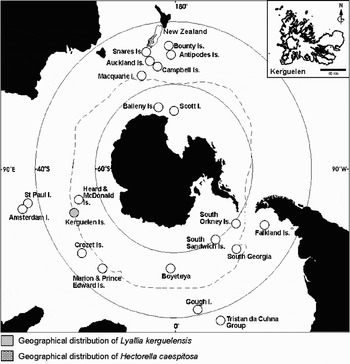
The sub-Antarctic islands have always been believed to hold important parts of the floristic history of the Southern Hemisphere. It is believed that they provided refuge during the last ice age and that they host morphologically isolated taxa, which were often thought by early scientists to have once flourished in continental Antarctica (e.g. Hooker Reference Hooker1847). Kerguelen, in the Southern Indian Ocean (49°21′S, 70°13′E) (Fig. 1), is the largest sub-Antarctic archipelago, consisting of a main island (6500 km2) and about 60 small islands. It is also, by far, the oldest sub-Antarctic archipelago, with exposed basalts dating back 29 to 24 m.y. bp (Nicolaysen et al. Reference Nicolaysen, Frey, Hodges, Weis and Giret2000). The flood basalts that account for 85% of the archipelago issued from the most recent volcanism from the Kerguelen hotspot, which has erupted basalt over the last 115 million years, forming the Kerguelen Plateau (Nicolaysen et al. Reference Nicolaysen, Frey, Hodges, Weis and Giret2000). The first eruptions took place near to the junction of the Australian, Indian and Antarctic plates (McLoughlin Reference McLoughlin2001). The central plateau was raised above sea level in the Cretaceous and supported a diverse high-latitude flora, composed of a dense conifer forest, ferns and early angiosperms, for most of the Tertiary (Philippe et al. Reference Philippe, Giret and Jordan1998, McLoughlin Reference McLoughlin2001, Mohr et al. Reference Mohr, Wähnert and Lazarus2002). Part of the arboraceous flora appears to have survived the climatic deterioration of the latest Pliocene to earliest Pleistocene, to become extinct by the middle or late Pleistocene - a similar pattern as in Tasmania (Philippe et al. Reference Philippe, Giret and Jordan1998). Kerguelen, being emplaced above sea level at the time of the earliest angiosperm radiations, and with a palaeoposition off north-eastern India, was suggested to have been a crucial corridor for early angiosperm dispersal to southern high latitudes (McLoughlin Reference McLoughlin2001).
Geographical distributions of Lyallia kerguelensis and Hectorella caespitosa. Insert: Iles Kerguelen.

The present flora of Kerguelen is depauperate with only 29 autochthonous species (Frenot et al. Reference Frenot, Gloaguen, Massé and Lebouvier2001). Nonetheless the island stands out as having the highest number of endemic plant species (six species, Lourteig & Cour Reference Lourteig and Cour1963). These are diversely shared by four islands in the region defined as the Southern Ocean province (Marion and Prince Edward islands, Crozet, Kerguelen, and Heard and MacDonald islands; Hennion & Walton Reference Hennion and Walton1997a, Chown et al. Reference Chown, Gremmen and Gaston1998). The landscape of Kerguelen is desolate (Gray Reference Gray and Kidder1876). It is a region of almost constant precipitation, and violent gales are common. The topography is hilly and gently slopes up to abruptly projecting crowns of basalt. The ranges, especially those fronting the south-east, present steep cliffs with Mount Ross reaching 1852 m and Mount Crozier about 1000 m. Streams are numerous, and the water is cold and clear. Ponds are also frequent on both high and low ground.
Lyallia kerguelensis (Portulacaceae) is the only phanerogam strictly endemic to the Iles Kerguelen. Hooker (Reference Hooker1847) first described this taxon, naming it in honour of his close friend, Dr Lyall. Hooker thought that its affinities were “most obscure”, with a putative resemblance to Pycnophyllum molle Remy from the Bolivian Andes, and placed Lyallia provisionally in the Portulacaceae. However, Bentham (Reference Bentham1862), due to the two bracts and four floral structures that he interpreted as sepals, placed Lyallia within the Caryophyllaceae, along with Pycnophyllum. Hooker (Reference Hooker1864), when describing an unusual new alpine plant collected by Dr Hector from the Otago alps, wrote that Hectorella was “a remarkable genus, allied to no other, but approaching in habit Lyallia of Kerguelen's land”. Pax (Reference Pax, Engler and Prantl1889a, Reference Pax, Engler and Prantl1989b) initially placed Hectorella in the Portulacaceae and Lyallia in the Caryophyllaceae, but was followed by Diels (Reference Diels1897), who allied both Lyallia and Hectorella to the Caryophyllaceae. Later, Pax & Hoffman (Reference Pax, Hoffmann, Engler and Prantl1934) shared Diels' interpretation. Skipworth's (Reference Skipworth1961) detailed study showed that floral characters in both Hectorella and Lyallia, with two sepals, four or five petals, and stamens alternating with petals, excluded the two from Caryophyllaceae, unlike Pycnophyllum. Special characters were a free central, not a basal placentation and spirally arranged leaves. Moreover, Philipson & Skipworth (Reference Philipson and Skipworth1961) suggested that Hectorella and Lyallia were not closely allied to either the Caryophyllaceae or the Portulacaceae and that these genera were sufficiently distinct as to merit being segregated into their own family, the Hectorellaceae (see also Philipson Reference Philipson, Kubitzki, Rohwer and Bittrich1993). Further studies of pollen (Cranwell Reference Cranwell1963), sieve elements (Behnke Reference Behnke1975), phytochemistry (Mabry et al. Reference Mabry, Neuman and Philipson1978), and wood anatomy (Carlquist Reference Carlquist1997) demonstrated a possible affinity between Hectorellaceae and the Portulacaceae, but also appeared to justify the maintenance of a different family for these two endemic genera.
Previous work on the affinities of Lyallia has been fragmentary and primarily aimed at assessing the familial relationships of this enigmatic genus. The genera with which Lyallia have been associated, Pycnophyllum and Hectorella, have a widely disjunct distribution in Kerguelen, New Zealand, and South America. A recent analysis of DNA sequences places Hectorella in Portulacaceae (Applequist et al. Reference Applequist, Warren, Zimmer and Nepokroeff2006). Portulacaceae are a small family of around 15 genera with centres of distribution in western North America, southern South America, and South Africa, but extending throughout Europe to eastern Siberia, Australia, New Zealand and the sub-Antarctic islands (Pax & Hoffman Reference Pax, Hoffmann, Engler and Prantl1934). In the analysis of Applequist et al. (Reference Applequist, Warren, Zimmer and Nepokroeff2006) Hectorella emerged as sister to a clade that includes Lewisia, Montia and Claytonia. Based upon this result they merged Lyallia and Hectorella within the Portulacaceae and defined a new tribe, Hectorelleae, based upon Hectorellaceae.
We expand upon these earlier studies by assessing the phylogenetic relationships of Lyallia and Hectorella. We aim to address the following specific questions: Are Hectorella and Lyallia sisters? How much sequence variation distinguishes them? When did Hectorella and Lyallia diverge from their most recent common ancestor? Finally, we discuss the biogeographical and ecological implications of the inferred relationships.
Morphological and ecological descriptions
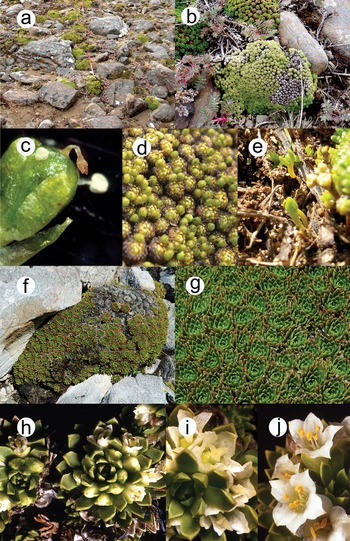
Lyallia kerguelensis Hook f. is a long-lived perennial herb, persisting at least 16 years (1990–2006). It forms roughly round-shaped cushions, 20–40 cm across, exceptionally up to 1 m, always in small populations (Fig. 2a & b). It shows a very limited distribution on the archipelago, inhabiting moraines or fellfields, from the shore to about 300 m (Hennion & Walton Reference Hennion and Walton1997a).
a. Fellfield vegetation on windswept stony soil on basalts in Ile Australia, Iles Kerguelen, 132 m altitude; sparse Lyallia kerguelensis cushions (light green, label) among more widespread Azorella selago (Apiaceae) cushions (dark green), forb Acaena magellanica (Rosaceae) and short grasses (mainly Festuca contracta and Agrostis magellanica) (Photo by F. Hennion), b. Lyallia kerguelensis cushion showing partial erosion on the right side. Above is a cushion of Azorella selago, and around are several shoots of Acaena magellanica and Festuca contracta (Photo by M. Lebouvier), c. flower showing one sepal, two petals, two stamens, the globular ovary, and the reddish two-lobed stigma (Photo by F. Hennion), d. maturing capsules at the cushion surface (late May), some breaking up and dispersing the shiny black seed (Photo by P. Lambret), e. seedlings of Lyallia kerguelensis within peat close to a cushion (3 mm height) (Photo by F. Hennion), f. Hectorella caespitosa cushion (Photo by Steve Wagstaff), g. close-up of Hectorella cushion showing the tightly compressed shoots (Photo by Steve Wagstaff), h. flowering shoot of Hectorella. The flowers emerge in the axils of the leaves at the ramet apices, generally in clusters of 2–4 (Photo by Bill Malcolm), i. pistillate flowers of Hectorella (Photo by Bill Malcolm), j. staminate flowers of Hectorella (Photo by Bill Malcolm).

The flowers are axillary at the ramet apices, often in clusters of 2–4. The flowers have two opposite, green, membraneous sepals, fused in a short sheath at their base, and covering half the length of the ovary. There are four petals, similar in texture to the sepals, and covering four-fifths of the ovary (Fig. 2c). The stamens, generally have 3(–4), flattened and frail filaments inserted between the petals. The pale yellow, versatile anthers are biloculate and introrse. There are always three anthers in the bud, but mature flowers often have only two dehiscent anthers (36% of 25 flowers) and sometimes the remains of a third filament. The gynoecium is formed of a globular ovary bearing a short style and stigma. The mature stigma is raised at anthesis and formed of two short and thick lobes with tiny papillas. The mature capsules become translucent and red-brown (Fig. 2d). They usually contain one, but approximately one-third of the fruits have two seeds that are reniform, black and shining (Hennion & Walton Reference Hennion and Walton1997a). The capsules are indehiscent, and the seeds are set free by breaking or disintegration of the tegument, either within the cushion (Fig. 2d), or after rolling down to the ground close to the parent plant (Hennion & Walton Reference Hennion and Walton1997a). Germination of seeds in the lab has proven difficult, and seedlings are infrequently found in the field (Hennion & Walton Reference Hennion and Walton1997b) (Fig. 2e).
Lyallia and Hectorella share a similar dense cushion growth habit with small coriaceous leaves that lack stipules. (Fig. 2f & g). While the flowers of Lyallia kerguelensis are hermaphroditic with four petals and three stamens, the flowers are female, male or hermaphroditic in Hectorella caespitosa, with five petals and five stamens (Fig. 2 h–j).
Lyallia kerguelensis has a very patchy distribution in the Kerguelen archipelago. It is found in small populations in very exposed but humid places from the shore to about 300 m altitude, such as wind corridors with frequent frosts. The plant grows on gravel, moraine deposits or syenites, in open vegetation with fellfield communities of small cushions of the Apiaceae Azorella selago Hook f., short-length shooted plants from the Rosaceae, Acaena magellanica (Lam.) Vahl, and several grasses such as Festuca contracta T. Kirk and Agrostis magellanica Lam. (Fig. 2a). Flowering starts in November and is protogynous. Within a few days, stamen development raises anthers, then is dehiscent, at the level of stigmas. Flowering is synchronous both within and between sites. Fruit ripeness is attained in February.
There are signs of a high sensitivity of Lyallia kerguelensis to dry conditions, such as encountered under present climate change (Chapuis et al. Reference Chapuis, Frenot and Lebouvier2004). In the eastern, drier part of the archipelago, cushions often show partial necrosis (Fig. 2b, Hennion Reference Hennion1992). The drying off then death of whole small cushions was observed after long dry periods in summer (Hennion Reference Hennion1992). In the western, much more humid part of the archipelago (Péninsule Rallier-du-Baty), cushions are more obviously alive and not affected by necrosis, but even there, few young plants were found (Hennion Reference Hennion1992).
The very rare plants observed in closed vegetation were in poor condition, suggesting inability to sustain competition (Hennion Reference Hennion1992). Seedlings are infrequent, often found growing within the dead parts of cushions, and some were found drying off after a few weeks (Hennion & Walton Reference Hennion and Walton1997b).
Hectorella caespitosa Hook f. is confined to the South Island of New Zealand where it ranges along the summit of the Southern Alps from Arthur's Pass to Fiordland, but extends eastward into central Otago. It is a characteristic plant of fellfield and cushion plant communities in the alpine zone from 1300 to 2000 m, where it forms hemispherical cushions up to 2 m across. It inhabits both soil and rock crevices. According to Billings & Mark (Reference Billings and Mark1961) it is often found on the windward side of solifluction terraces.
Both Hectorella and Lyallia have open-access flowers that are adapted for most pollinating insects, although the open shallow flowers may not be best suited for long-tongued insects. However, in the Iles Kerguelen, very few flying insects have been observed (Schermann-Legionnet et al. Reference Schermann-Legionnet, Hennion, Vernon and Atlan2007), and none of them were ever observed on Lyallia during the various field surveys. Oribatid mites and, rarely, alien aphids were observed over the cushions but their putative role in the pollination of Lyallia is not known. Pollination systems in the alpine areas of New Zealand involve abundant flowers and large numbers of potential pollinators. Pollinator access to the flowers is limited more by the frequently inclement weather than by competition for flower resources (Primack Reference Primack1978, Newstrom & Robertson Reference Newstrom and Robertson2005).
Materials and methods
Study group
Our study group includes Lyallia kerguelensis and Hectorella caespitosa along with a representative sample of members of the Portulacaceae whose sequences were obtained from GenBank. Voucher information, along with GenBank (http://www.ncbi.nlm.nih.gov) accession numbers, is detailed in Appendix A. The complete datasets are available on request from the first author.
Morphological methods
The morphological descriptions were based upon field observation and microscopic examination of live plants along with pressed herbarium specimens. Observations on Lyallia kerguelensis in Kerguelen were regularly undertaken from the summer of 1989/90 to 2005/06.
DNA extraction, amplification and sequencing
Total DNA was extracted from leaves following a modification of the CTAB method of Doyle & Doyle (Reference Doyle and Doyle1987). The amplification and sequencing procedures have been described previously (Wardle et al. Reference Wardle, Ezcurra, Ramirez and Wagstaff2001, Wagstaff & Wege Reference Wagstaff and Wege2002, Wagstaff et al. Reference Wagstaff, Breitwieser and Swenson2006). We sequenced the chloroplast encoded gene rbcL and an intergenic spacer region between trnK and matK. The gene rbcL is evolving at a slow rate, hence it is possible to make broad comparisons across angiosperm families, whereas the trnK/matK intergenic spacer is more variable, and so it is more appropriate for studies within families. Both regions have been previously sequenced for the Portulacaceae, including Hectorella, and nucleotide substitution rates have been estimated for each. The DNA samples were labelled with fluorescent dyes (Big Dye Chemistry) and then sequenced by the Allan Wilson Centre (Massey University) DNA sequencing facility. In all instances both the forward and reverse DNA strands were sequenced.
Data analysis
The sequences were initially aligned using ClustalX (Thompson et al. Reference Thompson, Gibson, Plewniak, Jeanmougin and Higgins1997) and gaps were inserted in the data matrix. The resulting alignments were then visually inspected and minor changes made manually to ensure positional homology prior to the phylogenetic analyses. The phylogenetic analyses were accomplished using PAUP* version 4.0b10 (Swofford Reference Swofford2002) with both parsimony and maximum likelihood selected as optimality criteria. The parsimony analysis was conducted with the PAUP* settings TBR branch-swapping, MULPARS, and RANDOM ADDITION with 1000 replicates. Duplicate trees were eliminated using the condense-trees option collapsing branches with a maximum length of zero. The characters were unordered and equally weighted; gaps were treated as missing data. The most appropriate maximum likelihood model and parameter estimates were determined by the Akaike Information Criterion test (AIC) implemented in Modeltest vers. 3.06 (Posada & Crandall Reference Posada and Crandall1998). Support for clades was estimated by bootstrap analyses (Felsenstein Reference Felsenstein1985) with 1000 replications, excluding uninformative sites; starting trees were obtained by RANDOM ADDITION with one replication for each bootstrap replication, TBR branch-swapping, MULPARS in effect and a MAXTREE limit of 1000. We used a likelihood ratio test to determine whether the data satisfied the assumptions of a molecular clock (Felsenstein Reference Felsenstein1988). In the absence of a molecular clock assumption, the nonparametric rate smoothing (NPRS) method of Sanderson (Reference Sanderson1997) was used to accommodate rate heterogeneity across lineages. This procedure is implemented in the software TREEEDIT (version 1.0, August 2000, written by Andrew Rambault and Mike Charleston and available at http://evolve.zoo.ox.ac.uk/software/TreeEdit/main.html). Confidence intervals were calculated by reapplying the NPRS procedure to 100 bootstrap trees.
Because there is virtually no fossil record for the Portulacaceae, we applied mean substitution rates to estimate divergence times. The mean substitution rate for trnK/matK (0.000944 substitutions per site per million years) was calculated for Abrotanella (Wagstaff et al. Reference Wagstaff, Breitwieser and Swenson2006), and the rate for rbcL (0.000462 substitutions per site per million years) was calculated for legumes (Lavin et al. Reference Lavin, Herendeen and Wojciechowski2005).
Results
Phylogenetic relationships and divergence estimates
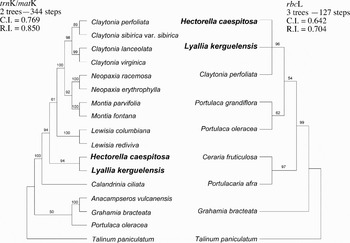
Our phylogenetic analysis of trnK/matK sequences provides additional evidence supporting a close relationship between Lyallia and Hectorella. The two species form a well-supported clade that is nested within the Portulacaceae (Figs 3 & 4). Parsimony analysis of the trnK/matK data recovered a single island of two trees (length = 344 steps, consistency index = 0.769, retention index = 0.850), whereas analysis of the rbcL sequences recovered a single island of three trees (length = 127 steps, consistency index = 0.642, retention index = 0.704). Strict consensus trees are compared in Fig. 3. The trnK/matK and rbcL trees differ in taxon sampling and the rbcL tree is not as well resolved; Lyallia and Hectorella form a well-supported clade in both analyses (bootstrap 94% and 96% respectively). However, their relationship to Claytonia perfoliata is not resolved by the rbcL analysis. The relatively high consistency and retention scores would suggest little homoplasy in the data.
Comparison of strict consensus trees resulting from parsimony analysis of the trnK/matK and rbcL sequence data. Bootstrap values > 50% are provided above the nodes. C.I. = Consistency Index, R.I. = Retention Index.

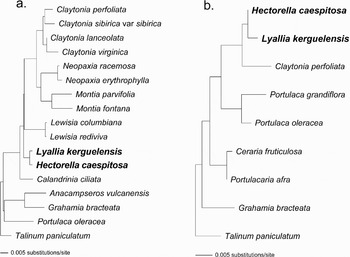
a. Phylogram (ln = 3901.352) resulting from maximum likelihood analysis of the trnK/matK sequence data. Lyallia and Hectorella form a well-supported clade (bootstrap = 95%) nested within the Portulacaceae, b. Phylogram (ln = 2811.184) resulting from maximum likelihood analysis of the rbcL data.

The Akaike Information Criterion test (AIC) selected GTR + G model for the trnK/matK maximum likelihood analysis with assumed nucleotide frequencies of A= 0.35100, C = 0.15020, G = 0.15140, T = 0.34740, proportion of variable sites = none; distribution of rates at variable site = gamma with a shape parameter 0.4986; the phylogram ln = 3901.352 (shown in Fig. 4a). The K81 model was selected for the rbcL analysis with equal bases, the distribution of rates at variable site = equal, and the proportion of invariable site = 0, and a single phylogram ln = 2811.184 (shown in Fig. 4b).
Both the trnK/matK (likelihood ratio test = 2 (3948.841–3901.352) = 94.978, d.f. = 14, P > 0.01) and the rbcL (likelihood ratio test = 2 (2821.354–2811.184) = 20.428, d.f. = 7, P > 0.01) datasets violated an assumption of a constant molecular clock exhibiting significant rate variation across lineages. This is illustrated in Fig. 4 where the branch length (number of substitutions per site) of Talinum was shorter than that of Claytonia. Hence we used the NPRS procedure to transform the maximum likelihood tree to an ultrametric tree in order to estimate divergence times.
Applying a mean nucleotide substitution rate for the trnK/matK of 0.000944 substitutions per site per million years to the split between Hectorella and Lyallia in the maximum likelihood tree transformed by NPRS, gives a divergence estimate of 18.6 ± 7.2 m.y. Several substitution rates have been calculated for the gene rbcL and these vary greatly partly depending upon whether the rates were based upon synonymous or total substitutions. We applied a mean rate of 0.000462 total substitutions per site per million years and estimated an older divergence time of 25.6 ± 4.3 m.y.
Discussion
The sub-Antarctic islands host a distinctive and perhaps relictual flora (McLoughlin Reference McLoughlin2001). Plants such as Lyallia kerguelensis or the crucifer Pringlea antiscorbutica R. Br. are morphologically isolated endemics (Hennion & Walton Reference Hennion and Walton1997a). Because of their geographic isolation and the difficulty of obtaining suitable plant specimens, many of them have not yet been included in phylogenetic studies and their relationships still remain a mystery.
The close relationship between Lyallia and Hectorella, which was first proposed by Hooker (Reference Hooker1864), is confirmed by molecular data. Our molecular study is the first assessment of the phylogenetic relationships between Lyallia and Hectorella. It provides further support for the inclusion of Lyallia in tribe Hectorelleae as was suggested by Applequist et al. (Reference Applequist, Warren, Zimmer and Nepokroeff2006). We also agree that the genetic distance between Lyallia kerguelensis and Hectorella caespitosa justifies the maintenance of two genera, as do their different reproductive characters (Applequist et al. Reference Applequist, Warren, Zimmer and Nepokroeff2006). Both Lyallia and Hectorella form dense cushions consisting of tightly packed stems with closely imbricated leaves. The flowers of Lyallia kerguelensis have two sepals, four petals, three stamens and a bicarpellate gynoecium, and usually produce one to two seeds. In contrast female, male and hermaphroditic flowers have been observed in Hectorella caespitosa, and they have two sepals, five petals, five stamens and a bicarpellate gynoecium, and produce from one to five seeds. The chromosome number of Hectorella is 2n = c. 96 (Beuzenberg & Hair Reference Beuzenberg and Hair1983), whereas that of Lyallia is unknown.
The sub-Antarctic islands are geographically isolated by the Southern Ocean, which necessitates either an ancient Antarctic origin or oceanic long-distance dispersal to explain the sister relationships of disjuncts such as Lyallia and Hectorella. However, for most of the Tertiary, Australia, New Zealand, South America and Africa faced an almost continuous Antarctic coastline that was clothed in diverse forest vegetation (McLoughlin Reference McLoughlin2001). Following the general decline in global temperatures, a major cooling occurred in Antarctica around the Eocene–Oligocene boundary, 35 million years ago, initiating the formation of Antarctic ice with subsequent rapid expansion (Ashworth & Cantrill Reference Ashworth and Cantrill2004). From the Oligocene through the early Miocene, the vegetation of Antarctica progressively declined in density and diversity, and became tundra-like with feldmark, cushion plants, heath, and prostrate shrubs (Ashworth & Cantrill Reference Ashworth and Cantrill2004). Ultimately, this Neogene cool temperate flora became extinct in continental Antarctica, possibly following the mid-Miocene warm interval at c. 17 m.y., or that in the mid-Pliocene at c. 3 m.y. The onset of glaciation during the Pleistocene resulted in mass extinction in continental Antarctica; many of the morphological intermediates were eliminated (Ashworth & Cantrill Reference Ashworth and Cantrill2004). At least some of these morphologically isolated species found refuge in the sub-Antarctic islands where they have persisted to the present day.
Our estimates date the divergence between Hectorella and Lyallia back to the Miocene long after the end of the Gondwanan break-up. This coincides with major climate cooling and vegetation change in Antarctica. The common ancestor of these two species may have been widely distributed in Antarctica during the mid-Tertiary. A possible pattern is that these two species, following the onset of glaciation during the Pleistocene, survived colder climates in Kerguelen and New Zealand.
Sources of error in divergence estimates have recently received critical attention (Sanderson et al. Reference Sanderson, Thorne, Wikstöm and Bremer2004, Heads Reference Heads2005). One of the most difficult problems to overcome is the appropriate integration of the fossil record to calibrate a molecular clock. The first appearance in the fossil record provides only a minimum age estimate and, because the fossil record is scanty and incomplete, basing divergence estimates on a single calibration point is problematic. Furthermore nucleotide substitution rates often vary across lineages. The divergence times provided here should therefore be viewed only as baseline estimates that will undoubtedly be fine-tuned as more information becomes available.
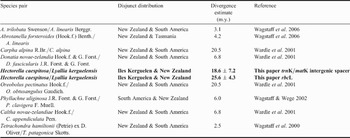
Lyallia and Hectorella share a similar cushion habit with many unrelated members of the sub-Antarctic flora, such as Phyllachne (Stylidiaceae), Abrotanella (Asteraceae) and Dracophyllum (Ericaceae), with similar disjunct distributions in the Southern Hemisphere (Table I). The cushion habit is not homologous. Rather, this compact growth form is known to provide morphological protection from low temperature and vapour loss under harsh environmental conditions such as those at high altitudes or high latitudes, like in the sub-Antarctic region. For all species pairs (Table I), the divergence estimates predate the onset of Pleistocene glaciation, 2 million years ago (Table I). At this time, it is likely that many unrelated species employed similar morphological and physiological responses to these dramatic environmental changes. The cushion habit in these plant species may have evolved in response to the stressful climatic conditions that accompanied glaciation.
Divergence estimates for inhabitants of cushion bog communities. The splits are between disjunct species pairs. Most are members of small, morphologically isolated plant genera (e.g. Hectorella and Lyallia are monotypic, Donatia 2 species, Tetrachondra 2 species).

m.y. = million years
Lyallia kerguelensis is restricted to fellfield habitats particularly exposed to frost. This plant was already described as “very local” by Hooker in 1840 (Hooker Reference Hooker1847), hence much earlier than the introduction of rabbits in 1874 (Hennion Reference Hennion1992). Nowhere does Lyallia kerguelensis appear to colonize new areas. Some of its biological traits suggest that this species may be threatened with extinction. Little morphological variation is shown as a response to local soil and climate, and poor and synchronized germination and little seed dispersal (Hennion Reference Hennion1992, Hennion & Walton Reference Hennion and Walton1997b) suggest low genetic variability and therefore limit its ability to adapt to changing climatic conditions. Furthermore, in the short term, the traits of Lyallia kerguelensis suggest that this species may be unlikely to compete successfully with autochthonous or introduced species linked with climate change (Bergstrom & Chown Reference Bergstrom and Chown1999). The sub-Antarctic cushion plant Azorella selago (Apiaceae) is another slow colonizer (Frenot et al. Reference Frenot, Gloaguen, Cannavacciuolo and Bellido1998), though it is much more widespread than Lyallia. The plant was recently demonstrated as drastically affected by one-year experimental climate drying and shading (Le Roux et al. Reference Le Roux, McGeoch, Nyakatya and Chown2005).
In summary, Lyallia and Hectorella are two closely related members of the Portulacaceae. The common ancestor of these two species may have been widely distributed in continental Antarctica prior to the onset of glaciation. Most recent studies of the biogeographical history of the Southern Hemisphere emphasize the major role of dispersal and extinction in the evolution and distribution patterns of many groups (Hill & Wang Reference Hill and Wang1996, Hill et al. Reference Hill, Macphail and Jordan2001, Swenson et al. Reference Swenson, Backlund, McLoughlin and Hill2001). The evaluation, based on a large set of plant phylogenies, of the relative roles played by vicariance, after the Gondwanan break-up, and dispersal in shaping Southern Hemisphere biotas, designate dispersal as the dominant factor for biogeographic patterns in plants (Sanmartin & Ronquist Reference Sanmartin and Ronquist2004). As a whole, the phylogenetic pattern shown by the two isolated endemic genera Lyallia and Hectorella emphasizes the importance of Antarctica as a corridor for dispersal during the mid to late Tertiary with shorter hops to Kerguelen and New Zealand where these two disjunct species persist to the present day. Their morphological intermediates were very likely eliminated by extinction.
Acknowledgements
The fieldwork in Kerguelen was performed under the French Polar Institute programme no. 136 (Head M. Lebouvier). We thank Marc Lebouvier, Philippe Lambret and Phil Novis for help in plant sampling and observations. We thank Dana Bergstrom (Australian Antarctic Division), Marc Lebouvier and Yann Rantier (CNRS-University of Rennes) for help in designing the map. This work is part of SCAR programme EBA “Evolution and Biodiversity in Antarctica”. Funding for this research was also provided by the New Zealand Foundation for Research, Science and Technology. Earlier versions of this manuscript benefited greatly from the suggestions of Phil Novis, Ulf Swenson and an anonymous reviewer.
Appendix A
Collection localities for Lyallia and Hectorella, references for published sequences and GenBank accession numbers firstly for trnK/matK then rbcL for the species included in the phylogenetic analyses.
Anacampseros vulcanensis D.Añon Suarez de Cullen, Mueller & Borsch 2005, AY514851, —; Calandrinia ciliata (Ruiz & Pavón) de Candolle, O'Quinn & Hufford Reference O'Quinn and Hufford2005, AY764087, —; Ceraria fruticulosa Pearson & E.L. Stephens, Edwards et al. Reference Edwards, Nyffeler and Donoghue2005, —, AY875218; Claytonia lanceolata Pursh, O'Quinn & Hufford Reference O'Quinn and Hufford2005, AY764102, —; Claytonia perfoliata Donn ex Willd., O'Quinn & Hufford Reference O'Quinn and Hufford2005, AY764091, —; Claytonia perfoliata Donn ex Willd., Clement & Mabry Reference Clement and Mabry1996 —, AF132093; Claytonia sibirica L. var sibirica, O'Quinn & Hufford Reference O'Quinn and Hufford2005, AY764109, —; Claytonia virginica L., O'Quinn & Hufford Reference O'Quinn and Hufford2005, AY764113, —; Grahamia bracteata Gill. ex Hook., Nyffeler Reference Nyffeler2002, AY015273, —; Grahamia bracteata Gill. ex Hook., Edwards et al. Reference Edwards, Nyffeler and Donoghue2005, —, AY875217; Hectorella caespitosa Hook.f., NEW ZEALAND, Canyon Creek, Ahuriri, scree on south-facing spur, 1600 m, P. Novis, 6 April 2005, CHR571419 BHO, EF551350, EF551347; Lewisia columbiana (Howell ex A. Gray) B.L. Robinson var. columbiana, O'Quinn & Hufford Reference O'Quinn and Hufford2005, AY764126, —; Lewisia rediviva Pursh, O'Quinn & Hufford Reference O'Quinn and Hufford2005, AY764125, —; Lyallia kerguelensis Hook.f., KERGUELEN ISLANDS, 132 m, Marc Lebouvier, 5 Feb 2005, CHR581896 BHO; EF551349, EF551348; Montia fontana L., O'Quinn & Hufford Reference O'Quinn and Hufford2005, AY764118, —; Montia parvifolia (de Candolle) Greene, O'Quinn & Hufford Reference O'Quinn and Hufford2005, AY764122, —; Neopaxia erythrophylla Heenan, O'Quinn & Hufford Reference O'Quinn and Hufford2005, AY764123, —; Neopaxia racemosa (Buchanan) Heenan, O'Quinn & Hufford Reference O'Quinn and Hufford2005, AY764124, —; Portulaca grandiflora Hook., Rettig et al. Reference Rettig, Wilson and Manhart1991, —, M62568; Portulaca oleracea L., AY875249, —; Portulaca oleracea L., Meimberg et al. Reference Meimberg, Dittrich, Bringman, Schlauer and Heubl2000, AF204867, —; Portulacaria afra Jacq., Edwards et al. Reference Edwards, Nyffeler and Donoghue2005, —, AY875219; Talinum paniculatum Adans., Edwards et al. Reference Edwards, Nyffeler and Donoghue2005, —, AY875214.