BACKGROUND
The incidence of carbapenem-resistant Enterobacteriaceae (CRE) has markedly increased worldwide over the last decade. While almost unheard of at the beginning of the 21st century, in 2014, 7% of Klebsiella pneumoniae bloodstream isolates reported to the European Antimicrobial Resistance Surveillance Network (EARS-Net) were carbapenem resistant. 1 Infections caused by CRE are associated with crude mortality rates of 44%–70%, due in part to limited therapeutic options.Reference Munoz-Price and Quinn 2 – Reference Patel, Huprikar, Factor, Jenkins and Calfee 6 Risk factors identified for carbapenem-resistant K. pneumoniae acquisition and infection include underlying medical conditions, critical illness, intensive care unit stay, poor functional status, and receipt of antibiotics.Reference Schwaber, Klarfeld-Lidji, Navon-Venezia, Schwartz, Leavitt and Carmeli 3 , Reference Swaminathan, Sharma and Blash 7 – Reference Chitnis, Caruthers and Rao 9
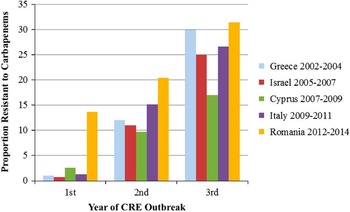
In developed countries, the epidemiology of CRE followed a pattern typical for hospital-acquired pathogens.Reference Grundmann, Livermore and Giske 10 Initial sporadic occurrences were followed by single-hospital outbreaks, then spread along hospital patient referral routes (Figure 1). Hospitals that share the same patients are at a high risk of admitting colonized or infected individuals, providing sources for future outbreaks.Reference Grundmann, Livermore and Giske 10 This natural history of CRE spread was well demonstrated in Europe, where between 2010 and 2013, 17 of 31 countries reported increased spread or endemicity of CRE.Reference Glasner, Albiger and Buist 11 The cardinal role of long-term care facilities (LTCFs) in the epidemiology of CRE, especially long-term acute-care hospitals (LTACHs) caring for mechanically ventilated patients, has also been demonstrated. Such facilities often serve as reservoirs and amplifiers of resistance.Reference Prabaker, Lin and McNally 12
Natural history of carbapenem-resistant K. pneumoniae spread in 5 different countries during the first 3 years of the outbreak. This graph depicts the spread of carbapenem-resistant K. pneumoniae in Europe based on precise data by country and year available from European Antimicrobial Resistance Surveillance Network (EARS-Net).

Proactive and adequate preventive measures are needed locally, regionally, and nationally to contain the spread of CRE, particularly in countries where CRE are not yet endemic.Reference Bilavsky, Schwaber and Carmeli 13 This guideline, based on the best available evidence and expert opinion, updates the global epidemiology of CRE, summarizes experience with implementation of measures for the control of outbreaks caused by CRE, and creates a roadmap for infection control measures.
We performed an informal systematic review of the literature by searching PubMed between January 2006 and December 2015 for the terms “carbapenemase,” “Klebsiella pneumoniae carbapenemase,” or commonly used acronyms (eg, KPC, CRE, CPE, NDM, VIM, IMP, OXA) in combination with the names of individual countries and “detection” or “prevention” or “contact isolation” or “infection control.”
THE GLOBAL EPIDEMIOLOGY OF CRE
The epidemiologically relevant carbapenemases can be grouped into 3 classes. In class A, K. pneumoniae carbapenemase (KPC) is clinically and epidemiologically the most important.Reference Grundmann, Livermore and Giske 10 KPC-producing K. pneumoniae was first isolated in the United States in 1996.Reference Munoz-Price, Poirel and Bonomo 14 KPC is spread primarily by clonal outbreaks in healthcare facilities, with a single K. pneumoniae clonal complex, CC258, having played a major role in the dissemination of 2 KPC isoenzymes: KPC-2 and KPC-3.Reference Munoz-Price, Poirel and Bonomo 14
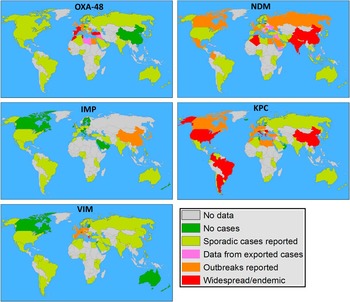
As of January 2015, at least 1 KPC-producing CRE isolate had been reported from 48 US states, and KPC has gained a foothold globally,Reference Grundmann, Livermore and Giske 10 , Reference Glasner, Albiger and Buist 11 , Reference Munoz-Price, Poirel and Bonomo 14 , Reference Hrabák, Papagiannitsis, Študentová, Jakubu, Fridrichová and Zemlickova 20 – Reference Zujić Atalić, Bedenić and Kocsis 38 with established endemicity in the northeastern United States, Puerto Rico, China, Israel, England, Italy, Romania, Greece, Brazil, Argentina, and Colombia (Figure 2).Reference Munoz-Price, Poirel and Bonomo 14 – 19
Occurrence and geographic distribution of carbapenemase-producing Enterobacteriaceae (CPE) worldwide by resistance mechanism, based on literature review, 2015. These maps are based on literature review. In some countries, the scale used may underestimate the true extent of the spread of CPE because of an absence of detailed data, making it difficult to distinguish between sporadic cases and outbreaks. Results presented here reflect reporting at the time of preparation of this review.

Class B carbapenemases include the metallo-β-lactamases (MBLs), imipenemase IMP), verona integrin-encoded MBL (VIM), and New Delhi MBL (NDM-1). IMP producers were initially identified predominantly in Asia with more recent spread elsewhere (Figure 2).Reference Pitout, Nordmann and Poirel 16 , Reference Bonelli, Meurer Moreira and Cristina Picão 17 , Reference Miró, Agüero and Larrosa 21 , Reference Sheng, Badal and Hseuh 36 – Reference Mushi, Mshana, Imirzalioglu and Bwanga 43
VIM enzymes were discovered in P. aeruginosa in Verona, Italy, in 1997, and were first reported in Enterobacteriaceae in 2002, in Athens. K. pneumoniae–producing VIM is endemic in Greece,Reference Pitout, Nordmann and Poirel 16 , Reference Peirano, Lascols, Hackel, Hoban and Pitout 44 and VIM-producing Enterobacteriaceae are now spreading elsewhere, especially in Italy and Spain.Reference Grundmann, Livermore and Giske 10 , Reference Glasner, Albiger and Buist 11 , Reference Pitout, Nordmann and Poirel 16 , Reference Bonelli, Meurer Moreira and Cristina Picão 17 , Reference Hrabák, Papagiannitsis, Študentová, Jakubu, Fridrichová and Zemlickova 20 , Reference Miró, Agüero and Larrosa 21 , Reference Ageevets, Partina and Lisitsyna 32 , Reference Lixandru, Cotar and Straut 37 – Reference Manenzhe, Zar, Nicol and Kaba 40 , Reference Mushi, Mshana, Imirzalioglu and Bwanga 43 – Reference Nastro, Monge and Zintgraff 48
NDM-1 spreads within and between species on a transposon. The main reservoir of NDM-producing Enterobacteriaceae is the Indian subcontinent (Pakistan, India, Sri Lanka, and Bangladesh),Reference Lascols, Hackel and Marshall 49 where NDM is widespread both in healthcare settings and the community, spread in the latter is likely due to limitations in sanitation and hygiene.Reference Tängdén and Giske 25 Elsewhere, NDM was initially introduced via patients with recent hospitalization in the Indian subcontinent.Reference Grundmann, Livermore and Giske 10 , Reference Sheng, Badal and Hseuh 36 , Reference Lascols, Hackel and Marshall 49 , Reference Nordmann, Poirel, Walsh and Livermore 50 NDM is now emerging worldwide (Figure 2).Reference Glasner, Albiger and Buist 11 , Reference Pitout, Nordmann and Poirel 16 , Reference Bonelli, Meurer Moreira and Cristina Picão 17 , Reference Jans, Daniel Huang and Bauraing 22 , Reference Lixandru, Cotar and Straut 37 – Reference Rimrang, Chanawong and Lulitanond 42 , Reference Jamal, Rotimi, Albert, Khodakhast, Nordmann and Poirel 47 , Reference Barantsevich, Churkina, Barantsevich, Pelkonen, Schlyakhto and Woodford 51 – Reference Hrabák, Študentová and Adámková 58
Class D β-lactamases include the oxacillinases (eg, OXA-48–like enzymes).Reference Grundmann, Livermore and Giske 10 The OXA-48 gene is primarily plasmid-based and is associated with clonal and nonclonal multispecies spread. OXA-48–producing K. pneumoniae, first described from a patient in Istanbul,Reference Glasner, Albiger and Buist 11 , Reference Poirel, Héritier, Tolün and Nordmann 59 arose in the Mediterranean basin, likely in the community. Elsewhere, OXA-48 has led to healthcare-associated outbreaks.Reference Pitout, Nordmann and Poirel 16 , Reference Jones, Flonta, Gurler, Cepparulo, Mendes and Castanheira 39 , Reference Poirel, Potron and Nordmann 60 OXA-48 is endemic in Malta,Reference Glasner, Albiger and Buist 11 and it is the most frequently detected carbapenemase in The Netherlands, France, and Belgium.Reference Glasner, Albiger and Buist 11 , Reference Munoz-Price, Poirel and Bonomo 14 , Reference Pitout, Nordmann and Poirel 16 , Reference Jans, Daniel Huang and Bauraing 22 Outside Europe, it is spreading across all other continents (Figure 2).Reference Glasner, Albiger and Buist 11 , Reference Pitout, Nordmann and Poirel 16 – 19 , Reference Ageevets, Partina and Lisitsyna 32 , Reference Lixandru, Cotar and Straut 37 , Reference Manenzhe, Zar, Nicol and Kaba 40 , Reference Huang, Frye and Chahine 46 , Reference Zowawi, Sartor and Balkhy 55 , Reference Izdebski, Bojarska and Baraniak 61 – Reference Djahmi, Dunyach-Remy, Pantel, Dekhil, Sotto and Lavigne 73
OXA-181 is a variant of OXA-48, which shares similar carbapenemase activity, and it has been identified in isolates from India or of Indian origin, often coexisting with NDM in single strains of K. pneumoniae. OXA-181 is present in much of Asia and has been sporadically detected in the United Kingdom, The Netherlands, Norway, France, South Africa, New Zealand, Oman, and Nigeria.Reference Jans, Daniel Huang and Bauraing 22 , Reference Brink, Coetzee and Corcoran 67 , Reference Samuelsen, Naseer and Karah 74 , Reference Walkty, Gilmour and Simner 75 As the description above suggests, CRE are identified wherever antimicrobial resistance data exist.
STEPS IN THE CRE ROADMAP
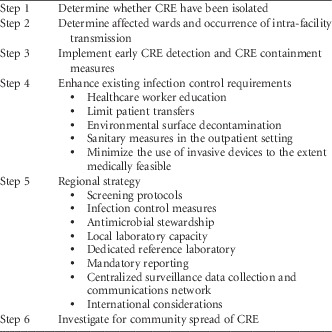
This review provides a stepwise roadmap of infection control measures that are required to contain CRE in acute-care hospitals, LTCFs, and the community. Table 1 outlines the steps in the roadmap.
Steps in the Carbapenem-Resistant Enterobacteriaceae (CRE) Preparedness Roadmap

Step 1: Determine Whether CRE Have Been Isolated
The first step is to determine periodically whether CRE have been isolated from patients at the institution and the timing of cultures relative to admission dates (within 48 hours of admission or more than 48 hours after admission). On a regional or statewide level, CRE prevalence surveys should be completed under the guidance of public health authorities. 76 Facilities without this information should review archived laboratory results from the prior 6–12 months. 77
CRE Have Not Been Isolated
If CRE have never been reported, highly sensitive detection criteria plus an early warning system and a preparedness plan should be put in place according to the steps in this roadmap.Reference Grundmann, Livermore and Giske 10 The primary requirement is the microbiological laboratory capability to identify CRE phenotypically and genetically using uniform selective media and confirmatory tests (according to guidelines for detection) and a reference laboratory capable of timely molecular characterization of isolates.Reference Grundmann, Livermore and Giske 10 , 76 , Reference Carmeli, Akova and Cornaglia 78 – Reference Nordmann, Cuzon and Naas 82
Step 2: Determine Affected Wards and Occurrence of Intrafacility Transmission
If CRE have been isolated, determine which wards are affected and whether evidence exists for intrafacility transmission. If data are not available, an audit is required to determine the proportion of all Enterobacteriaceae in the facility that are CRE. In known CRE-positive patients, the following factors should be determined: demographics, diagnoses, and wards, as well as risk factors such as surgery and antibiotics.
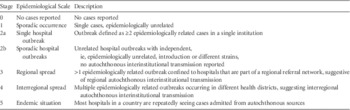
A simple, 5-level numerical staging system, proposed by Grundmann et al,Reference Grundmann, Livermore and Giske 10 should be used to grade the epidemiology of carbapenem resistance in institutions, regions, states, and/or countries (Table 2). While recommended infection control measures adopted to confront CRE in different settings vary greatly,Reference Bilavsky, Schwaber and Carmeli 13 the interventions chosen should be guided by the epidemiological stage.Reference Grundmann, Livermore and Giske 10
Epidemiological Scale and Stages of Healthcare-Associated Carbapenem- Non-Susceptible Enterobacteriaceae Footnote a

a Adapted from Grundmann et al, Euro Surveillance 2010.Reference Grundmann, Livermore and Giske 10
Sporadic CRE
If CRE have been identified sporadically, the goal should be to completely eradicate that CRE according to the ‘search and destroy strategy’ described by Wertheim et alReference Wertheim, Vos and Boelens 83 in reference to methicillin-resistant Staphylococcus aureus (MRSA) in 2004. This Dutch strategy, when utilized against CRE, is more accurately termed a “search and isolate” strategy, that incorporates active surveillance, contact tracing, and strict contact isolation in single rooms.Reference Kluytmans–VandenBergh, Kluytmans and Voss 84 A suggested action plan for rapid implementation of infection control measures in settings with sporadic occurrence of CRE includes the following elementsReference Carmeli, Akova and Cornaglia 78 :
-
∙ Screening of all contacts of index cases
-
∙ Epidemiological investigation of nosocomial cross-transmission events with >2 secondary cases
-
∙ Communication with staff and hospital administration
-
∙ Stringent infection control measures aimed at containment and eradication of nosocomial clusters
-
∙ Coordination and supervision by public health authorities
Single-Hospital Outbreak of CRE
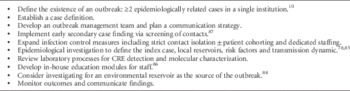
In suspected hospital CRE outbreaks in nonendemic settings, infection control teams must commence their investigations by ensuring that situations fulfill outbreak criteria by having 2 or more cases that are epidemiologically related. Reference Grundmann, Livermore and Giske 10 Development of outbreak management teams is recommended to coordinate investigation of possible sources and mechanisms of transmission and to coordinate communication, education, contact screening, and expansion of infection control measures (Table 3). Consideration should also be given to closure or reduction in activity of high-risk units and to investigation for possible environmental reservoirs.Reference Akova, Daikos, Tzouvelekis and Carmeli 85 – Reference Kotsanas, Wijesooriya and Korman 88
Managing a Hospital Outbreak of Carbapenem-Resistant Enterobacteriaceae (CRE)

Step 3: Implement Early CRE Detection and CRE Containment Measures
For sporadic hospital outbreaks or regional spread of CRE, infection control teams should be trained to implement measures to contain spread based on premises of early CRE detection and containment. Interventions must be adapted to local conditions, and institutions must decide which to implement first. While a staggered approach toward implementation may be undertaken, 1 a combination of early identification of asymptomatic CRE carriers followed by strict carrier and staff cohorting have been demonstrated to be particularly effective in controlling the horizontal transmission of CRE.Reference Munoz-Price and Quinn 2
Organizational characteristics, such as nursing staff levels and the presence of a safety culture, must also be considered in preparedness plans because these factors may influence the adherence of staff to required infection control practices. Strong and consistent inverse relationships have been reported between staffing levels and nosocomial infections.Reference Needleman, Buerhaus, Mattke, Stewart and Zelevinsky 89 More specifically, high levels of staff engagement have been shown to reduce CRE acquisition rates.Reference Fedorowsky, Peles-Bortz, Masarwa, Liberman, Rubinovitch and Lipkin 90 Active involvement of the hospital administration is therefore necessary in the development and support of programs to contain CRE.Reference Siegel, Rhinehart, Jackson and Chiarello 91
CRE DETECTION STRATEGIES
Screening
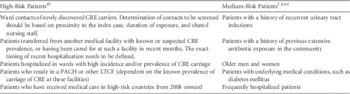
A proactive approach to screening is recommended. Screening includes both verification of continued carriage in those previously identified with CRE and detection of new asymptomatic carriage. Unidentified carriers with prior exposure to the healthcare system are a source for spread of CRE to other patients.Reference Schwaber and Carmeli 87 Clinical cultures obtained on suspicion of infection identify only approximately one-third of patients colonized with CRE.Reference Wiener-Well, Rudensky and Yinnon 92 It is therefore recommended that institutions develop the capacity both to verify continued carriage and to identify previously unrecognized colonized and infected patients on admission. Sweden, for example, boasts high levels of screening of patients for resistant Enterobacteriaceae. Patients screened on admission to Swedish hospitals include those who have received healthcare outside of Sweden during the past 6 months or within Sweden in areas with ongoing outbreaks.Reference Löfmark, Sjöström, Mäkitalo, Edquist, Tegmark Wisell and Giske 93 National protocols regarding the detection of new, often asymptomatic carriers who require screening on admission or while in hospital are recommended. Such protocols should define which epidemiologically linked contacts of new CRE cases should be screened based on proximity to index cases, duration of exposure, and shared nursing staff,Reference Schwaber and Carmeli 87 and they should risk-stratify new patients to define those at risk for CRE (Table 4).Reference Schwaber, Klarfeld-Lidji, Navon-Venezia, Schwartz, Leavitt and Carmeli 3 , Reference Swaminathan, Sharma and Blash 7 , Reference Glasner, Albiger and Buist 11 , Reference Wiener-Well, Rudensky and Yinnon 92 , Reference Matthaiou, Michalopoulos and Rafailidis 94
Examples of High-Risk and Medium-Risk Patients for Carbapenem-Resistant Enterobacteriaceae (CRE) Screening Purposes

NOTE. PACH, post–acute-care hospital; LTCF, long-term care facility.
The primary body site for screening is the rectum, sampled via swab or stool culture; these are the single most sensitive specimens for surveillance of CRE.Reference Wiener-Well, Rudensky and Yinnon 92 , Reference Lerner, Romano, Chmelnitsky, Navon-Venezia, Edgar and Carmeli 95 While routine sampling of additional sites has limited value,Reference Carmeli, Akova and Cornaglia 78 the addition of inguinal or axillary skin swabs may improve yield.Reference Wiener-Well, Rudensky and Yinnon 92 , Reference Thurlow, Prabaker, Lin, Lolans, Weinstein and Hayden 96
Notification
Rapid, real-time notification of culture results from the laboratory, enabling contact isolation to commence, is critical and requires close collaboration between microbiological laboratories and local and regional infection control teams.Reference Carmeli, Akova and Cornaglia 78 , Reference Schwaber, Lev and Israeli 97 Notification systems are recommended that function both to notify relevant infection control practitioners of new positive clinical or screening cultures and to alert staff when new admissions have a history of CRE infection or colonization. Such systems require that alerts be placed within the medical record (written and electronic) to enable repeat screening and contact isolation with future admissions, as appropriate.
CRE CONTAINMENT
Hand Hygiene
Patient-to-patient transmission in healthcare settings, usually via the hands of healthcare workers (HCWs), has been a major factor accounting for the increased incidence and prevalence of multidrug-resistant organisms (MDROs).Reference Siegel, Rhinehart, Jackson and Chiarello 91 Hand hygiene within facilities must be promoted with an emphasis on HCW education. Hand-hygiene facilities must be accessible and conveniently located in all healthcare facilities.Reference Siegel, Rhinehart, Jackson and Chiarello 91 Hand-hygiene guidelines (materials and methodology) are fully applicable in the setting of CRE, with no recommended alterations. In the Israeli intervention, alcohol-based handrub has been used as the predominant hand-hygiene agent, consistent with international guidelines. 98 Importantly, hand hygiene should be performed according to the WHO’s 5 Moments model, including the measurement of performance and feedback to improve compliance.Reference Sax, Allegranzi, Uckay, Larson, Boyce and Pittet 99
Contact Precautions
There is a direct relationship between colonization pressure and nosocomial CRE acquisition.Reference Schwaber, Lev and Israeli 97 Effective national guidelines used in Israel incorporate physical separation of all hospitalized patients colonized or infected with CRE (in either isolation rooms or by creating carrier cohorts) and the use of dedicated nursing staff not assigned to care simultaneously for noncarriers. A significant inverse relationship between compliance with dedicated staffing guidelines and risk of CRE transmission was demonstrated. Reference Schwaber, Lev and Israeli 97
It is recommended that wherever possible, hospitals should dedicate rooms, equipment and staff for patients with CRE. Isolation on admission is recommended for patients known to be CRE carriers and for high-risk patients whose carriage status is not known.Reference Akova, Daikos, Tzouvelekis and Carmeli 85 , Reference Schwaber and Carmeli 87 , Reference Siegel, Rhinehart, Jackson and Chiarello 91 , Reference Wiener-Well, Rudensky and Yinnon 92 , Reference Lledo, Hernandez and Lopez 100 The use of contact isolation in single rooms is dependent on single-room availability within institutions. Hospitals must determine, based on local epidemiology and risk factors among local populations, whether to isolate certain patients of unknown CRE carriage status preemptively pending culture results.
Discontinuation of Contact Precautions
There is no consensus guideline on discontinuation of contact isolation precautions among patients who were previously colonized or infected with CRE. MDR Enterobacteriaceae can persist for many months, especially in the presence of severe underlying disease, invasive devices, and recurrent courses of antimicrobial agents. In Israel, 35% of known carriers remained colonized when screened within 3 months of their initial identification as carriers,Reference Schechner, Kotlovsky and Tarabeia 101 and 30% of prior CRE carriers in LTCFs were CRE positive when cultured at least 90 days following their last positive culture.Reference Ben-David, Masarwa and Navon-Venezia 102 Among patients with an initial positive rectal culture for CRE, even after 2 or more negative screening cultures, recurrence of CRE detection occurs in 15%–25% of patients.Reference Lewis, Enfield, Mathers, Giannetta and Sifri 103 – Reference Oren, Sprecher and Finkelstein 105
Careful risk assessment should be undertaken before removing previously culture-positive patients from isolation. More than 1 negative culture, from relevant body sites, is required to rule out continued CRE colonization. One approach is to require 2 negative surveillance rectal swabs and a negative carbapenemase gene polymerase chain reaction result on enrichment broth.Reference Schwaber and Carmeli 87 , 106 , 107 Uniform, evidence-based guidelines for revoking prior carrier status should be implemented at a regional or national level.
CRE Detection and Containment in LTCFs
Patients admitted from LTCFs can reintroduce CRE to acute-care hospitals, undermining containment efforts. Among LTCF patients, CRE risk factors include prolonged length of stay in acute care, sharing rooms with known carriers, and carrier prevalence on wards.Reference Schwaber and Carmeli 87
Because the LTCF environment is different from that of acute-care hospitals, guidelines for the control of CRE must account for unhindered delivery of rehabilitation and socialization of residents. Point prevalence surveys in post-acute care hospitals (PACHs) and other epidemiologically relevant LTCFs are recommended in regions with CRE, both to measure CRE prevalence and to guide formulation of evidence-based recommendations for CRE surveillance and containment.Reference Schwaber and Carmeli 87 , Reference Ben-David, Masarwa, Adler, Mishali, Carmeli and Schwaber 108
Hand hygiene should be promoted in LTCFs, with guidelines adapted to these settings from the WHO hand-hygiene strategy. 109 Facilities should ensure access to adequate hand-hygiene stations that are well stocked with supplies.
The use of contact precautions for LTCF patients infected or colonized with CRE should not be routine, although targeted short-term interventions or even periodic ward closures may be required during outbreaks. In determining containment measures, CRE transmission risk should be considered, with contact precautions reserved for patients at highest risk of transmission based on such factors as incontinence of stool, ventilator dependence, and wounds with difficult-to-control drainage. 76 A successful approach employed in Israeli PACHs, codified in national guidelines, adapts recommendations to ward type and patient acuity. Recommendations for the highest-risk patients (eg, ventilated or skilled nursing patients) include CRE screening on admission, barrier precautions and cohorting for carriers, while for low-risk rehabilitation patients, modified contact precautions without cohorting or confinement of carriers to their rooms are sufficient.Reference Schwaber and Carmeli 87 , Reference Ben-David, Masarwa and Navon-Venezia 102 , Reference Ben-David, Masarwa, Adler, Mishali, Carmeli and Schwaber 108
Step 4: Enhance Existing Infection Control Requirements Education of HCWs
Education and training of HCWs regarding prevention of transmission, highlighting hand-hygiene and contact precautions, are prerequisites for ensuring that policies and procedures for standard and transmission-based precautions are understood and practiced correctly.Reference McGrath, Chopra and Abdel-Haq 86 The CDC/HICPAC guidelines recommend targeting the following HCWs for education and training: medical and nursing staff, clinical technicians and laboratory staff, housekeeping staff, laundry, maintenance and dietary workers, students, contract staff, and volunteers. Training completion and competency assessment should be documented initially and repeatedly as appropriate for specific staff positions. It is important to ensure that HCWs employed by outside agencies also meet education and training requirements.Reference Siegel, Rhinehart, Jackson and Chiarello 91
Limitation of Patient Transfer
Patient transfer between healthcare facilities is a risk factor for the dissemination of resistant microorganisms. Cross-border transmission in European countries and inter-country transfer of multiresistant K. pneumoniae is well described and has led to the dissemination of CRE within hospitals.Reference Saito, Takahashi and Sawabe 27 , Reference Chang, Buising and Jeremiah 35 , Reference Teo, Kurup, Lin and Hsien 71 , Reference Rogers, Aminzadeh, Hayashi and Paterson 110 , Reference Lerner, Solter and Rachi 111
Facilities and regions should develop guidelines regarding patient transfers between facilities and countries, addressing issues such as the availability of screening results prior to patient transfer. In the context of rapid globalization, it is prudent to consider every patient transferred from foreign hospitals as at risk for CRE carriage.Reference Kostyanev, Tafaj and Skenduli 24 Limiting patient transfers when feasible also can reduce the spread of CRE.Reference Akova, Daikos, Tzouvelekis and Carmeli 85 If transfer is unavoidable, communication with receiving facilities regarding CRE status is essential. Interfacility infection control transfer forms have been used successfully to communicate such information. 76 , 107
Environmental Surface Decontamination
CRE can be eliminated from the environment by stringent application of normal standards of cleaning and decontamination, and no increased frequency of cleaning or special type of disinfectant is required. 107 Surface disinfectant cleaners have been found to be effective against gram-negative bacteria with multidrug resistance in the patient environment.Reference Reichel, Schlicht, Ostermeyer and Kampf 112
Unlike Pseudomonas aeruginosa and Acinetobacter baumannii, which survive for long periods on environmental surfaces and may be transmitted to patients therefrom,Reference Jawad, Seifert and Snelling 113 – Reference Nseir, Blazejewski, Lubret, Wallet, Courcol and Durocher 116 Enterobacteriaceae have not been associated with the same degree of risk for environmental transmission, likely due to their shorter environmental survival time.Reference Nseir, Blazejewski, Lubret, Wallet, Courcol and Durocher 116 CRE have been found infrequently in the environment of infected or colonized patients. In a recent study, only 8.4% of frequently touched surfaces in the rooms of patients colonized or infected with CRE were contaminated, with an average of only 5.1 colony-forming units per contaminated surface (120 cm2). The surfaces that were most commonly culture positive were the toilet and the floor around the toilet. Poor organism survival (<15% at 24 hours, <5% at 48 hours, and no survival at 72 hours) was found when surfaces were inoculated with CRE, especially E. coli.Reference Weber, Rutala, Kanamori, Gergen and Sickbert-Bennett 117 In another study, only 0.8% of 1160 environmental surfaces in French nursing homes that housed patients infected or colonized with extended spectrum β-lactamase (ESBL)–producing Enterobacteriaceae were culture positive.Reference Cochard, Aubier, Quentin and van der Mee-Marquet 118
We recommend that rooms occupied by CRE-positive patients be cleaned and disinfected at least once per day and that dedicated, single-patient or single-use equipment be used when possible. Following discharge or transfer of CRE-positive patients, terminal cleaning and disinfection of the room, its contents, and the bathroom should be performed, including laundering of privacy curtains and cleaning and disinfection of mattresses. Standard precautions apply for management of linen and waste from CRE-positive patients. 107 , 119 Hospitals must define responsibility for and frequency of cleaning and disinfection of equipment and surfaces and monitor compliance. 76
Sanitary Measures in the Outpatient Setting
Few data exist on the risk of hospital-acquired infections in ambulatory care settings outside of hemodialysis centers.Reference Akova, Daikos, Tzouvelekis and Carmeli 85 Patient-to-patient transmission of ESBL-producing K. pneumoniae occurs in patients with hospital time overlap, and the incidence of transmission is higher for K. pneumoniae than for E. coli.Reference Harris, Perencevich and Johnson 120 , Reference Hilty, Betsch and Bögli-Stuber 121 In addition, a Spanish study of ESBL-producing E. coli among non-hospitalized patients found no evidence of either horizontal transmission or clonal spread.Reference Rodríguez-Baño, Navarro and Romero 122 The rate of spread of Enterobacteriaceae is low and likely requires more than brief exposure.Reference Tschudin-Sutter, Frei, Dangel, Stranden and Widmer 123 Although further data specific to CRE are needed, existing data and data extrapolated from other MDROsReference Weinstein 124 suggest that outpatients with CRE, especially those with draining wounds, incontinence, or other transmission risk factors should be seen after other patients, with full terminal cleaning of examination areas following visits.
Minimizing the Use of Devices
Indwelling devices, such as urinary catheters (IDC), central venous (CVC) and arterial catheters, endotracheal tubes, and synthetic implants facilitate the development of infection by providing surfaces for adherence of pathogens and the development of biofilms.Reference Donlan 125 CRE have been implicated as a cause of device-associated infections, particularly catheter-associated urinary tract infections. In a recent outbreak of NDM-1–producing Enterobacteriaceae in South Africa, each additional day of exposure to an IDC or CVC was associated with 7% or 8% increased odds, respectively, of acquiring NDM-1 infection.Reference de Jager, Chirwa, Naidoo, Perovic and Thomas 126 Therefore, limiting the use of invasive devices is another important intervention for CRE prevention. It is imperative that both vascular and urinary catheters be inserted only for appropriate indications, that aseptic technique be used for insertion, and that catheters be removed as soon as possible.Reference Gould, Umscheid, Agarwal, Kuntz and Pegues 127
Decolonization of Patients
Bathing with chlorhexidine has a role in bioburden containment and has been demonstrated to reduce the transmission of resistant organisms and the acquisition of hospital-acquired and line-associated bloodstream infections among patients in ICUs and LTACHs.Reference Vernon, Hayden, Trick, Hayes, Blom and Weinstein 128 – Reference Munoz-Price, Hota, Stemer and Weinstein 130 While some studies showed no effect on the incidence of colonization or hospital-acquired bloodstream infections with highly resistant Enterobacteriaceae,Reference Climo, Yokoe and Warren 129 , Reference Derde, Cooper and Goossens 131 bundled together with other measures, chlorhexidine has been shown to prevent KPC colonization and infection in LTACHs.Reference Hayden, Lin and Lolans 132
Selective gut decontamination has been shown to reduce the incidence of ventilator-associated pneumonia,Reference de Smet, Kluytmans and Cooper 133 but this strategy is known to increase ceftazidime resistance. In settings with high levels of endemic MDROs, it is associated with increased selection of such pathogens.Reference Brink, Coetzee and Corcoran 67 , Reference Shibli, Milbrandt and Baldisseri 134 Although Zuckerman et alReference Zuckerman, Benyamini and Sprecher 135 achieved a 66% eradication of CRE using gentamicin, gut decontamination is not recommended for CRE control due to limited data on long-term eradication rates and the risk for emergence of pan-resistant strains.
Fecal microbiota transplantation (FMT), highly effective against Clostridium difficile infection, has emerged as a promising therapy for intestinal MDR bacterial decolonization. Several case reports have shown that FMT resulted in intestinal decolonization of ESBL-producers and CRE. Data from large trials currently underway will help determine whether FMT can be recommended for CRE decolonization.Reference Manges, Steiner and Wright 136
Step 5: Regional Strategy
We define the “regional” body as the public health authority with regulatory oversight over all healthcare institutions within a region, state, or country. Public health authorities are uniquely positioned to act because their activities span the full spectrum of health care, from community education to prevention efforts in all healthcare institutions. A regional strategy governing the following infection control measures is advised: screening protocols, surveillance data collection, measurements of laboratory capacity, a dedicated reference laboratory, recommendations regarding infection control measures, antimicrobial stewardship requirements, mandatory reporting, communication, and international considerations (Table 1).Reference Grundmann, Livermore and Giske 10 , Reference Glasner, Albiger and Buist 11 Such strategies are reliant on political and financial commitment at the national level, ideally with international collaboration to respond to the global threat of CRE.
Local outbreaks of CRE have been shown to continue with accelerating incidence rates at multiple hospitals despite local infection control efforts.Reference Bilavsky, Schwaber and Carmeli 13 , Reference Schwaber and Carmeli 87 National centers and strategies incorporating mandatory reporting of CRE cases with strict adherence to screening and contact isolation guidelines have been successfully employed in both Israel and France.Reference Munoz-Price, Poirel and Bonomo 14 , Reference Schwaber, Lev and Israeli 97 , Reference Fournier, Monteil and Lepainteur 137 In many European countries, CRE are now included in mandatory reporting systems, and isolates are transported from clinical laboratories to national reference laboratories for characterization.Reference Löfmark, Sjöström, Mäkitalo, Edquist, Tegmark Wisell and Giske 93 , Reference Österblad, Kirveskari, Hakanen, Tissari, Vaara and Jalava 138 A national strategy including the addition of CRE infection/colonization to existing lists of reportable conditions is recommended.Reference Glasner, Albiger and Buist 11 , Reference Gupta, Limbago, Patel and Kallen 139
Central surveillance data collection at local and national levels is also necessary to detect temporal and geographical trends.Reference Grundmann, Livermore and Giske 10 Without a national detection system for CRE, the nationwide character of a CRE outbreak may go unnoticed, delaying appropriate intervention. Reference Schwaber, Lev and Israeli 97 The establishment of centralized surveillance for both antimicrobial resistance and antimicrobial use, as exists in many countries, is also recommended.Reference Munoz-Price, Poirel and Bonomo 14 , Reference Jans, Daniel Huang and Bauraing 22 , 140 , 141 Apart from centralized data collection, a nationwide real-time network of communications is required to manage a large-scale countrywide CRE outbreak.Reference Schwaber and Carmeli 87 Unfortunately, in resource-limited settings, the capacity to perform surveillance and respond to the threat of MDROs is largely absent.
Local and National Antimicrobial Stewardship (AMS) programs
AMS is an important part of efforts to control MDROs,Reference Siegel, Rhinehart, Jackson and Chiarello 91 and establishment of national AMS standards or guidelines is a core recommendation of the WHO Antimicrobial Resistance strategy. 142 , 143
Guidelines for treatment of infections should be reviewed to ensure that alternatives to broad-spectrum agents are provided and that de-escalation of antibiotics and reductions in use of specific antimicrobial classes and total antibiotic burden are emphasized.Reference Gupta, Limbago, Patel and Kallen 139 , Reference Dumartin, Rogues and Amadeo 144 Antimicrobials such as carbapenems, fluoroquinolones, and metronidazole have been identified as possible risk factors for acquisition of CRE.Reference Schwaber, Klarfeld-Lidji, Navon-Venezia, Schwartz, Leavitt and Carmeli 3 , Reference Patel, Huprikar, Factor, Jenkins and Calfee 6 , Reference Wiener-Well, Rudensky and Yinnon 92 , Reference Schechner, Kotlovsky and Tarabeia 101 In the setting of CRE transmission, whether sporadic or epidemic, it is important to ensure minimization of unnecessary and unnecessarily broad-spectrum antibiotic use. Existing AMS interventions may need to be enhanced by stricter preprescription approval systems and timely postprescription review.Reference Chang, Buising and Jeremiah 35 Antibiotic use should also be quantified by periodic audits. Ideally, detailed antimicrobial consumption trends should be available, as is the case in Europe and Canada. 1 , 140 Delivery of institution- or unit-specific antimicrobial consumption data can engage prescribers and improve compliance with guidelines.Reference Colligan, Sneddon, Bayne, Malcolm, Walker and Nathwani 145 , Reference Howard, Pulcini and Levy Hara 146 Verbal and written feedback, ideally including explicit targets and action plans, are valuable.Reference Jamtvedt, Young, Kristoffersen, O’Brien and Oxman 147
Local antibiotic treatment guidelines should include recommendations for treatment of proven and suspected infections caused by CRE.Reference Akova, Daikos, Tzouvelekis and Carmeli 85 Local guidelines should reflect the antibiotic susceptibility profiles of previous local CRE isolates. Selective reporting of susceptibilities of only the most appropriate agents is sensible, with extended susceptibilities available on request. Finally, clinical teams must be educated to ensure that they have good understanding of the implications of CRE colonization and infection for antimicrobial prescribing.
Local Laboratory Capacity
The contribution of diagnostic laboratories to both infection control and public health is often underappreciated and underfunded.Reference Grundmann, Livermore and Giske 10 National strategies should ensure the capacity of local laboratories to perform susceptibility testing utilizing internationally recognized uniform break points and recognized methodologies. There must be agreement on the minimum test requirements for detection and data reporting of CRE with regular quality assurance.Reference Carmeli, Akova and Cornaglia 78 , Reference Schwaber, Lev and Israeli 97
Uniform laboratory guidelines should be issued for screening of Enterobacteriaceae for carbapenem resistance and the phenotypic and molecular workups of CRE isolates for carbapenemase production, including carbapenem hydrolysis testing and carbapenemase gene detection. 76 , Reference Carmeli, Akova and Cornaglia 78 – Reference Nordmann, Cuzon and Naas 82 , Reference Schwaber and Carmeli 87 Microbiology laboratories must be able to distinguish carbapenemase-producing isolates from CRE with other mechanisms of carbapenem resistance because of the differing epidemic potential of these organisms. Available data suggest that, in general, carbapenemase-producing (CP) Enterobacteriaceae (CPE) have a greater potential for nosocomial spread than non-CP CRE, as evidenced by the small number of reported outbreaks of non-CP CRE and by the reduced virulence of porin-mutant strains.Reference Chen, Siu and Fung 148 For example, among NDM-1–producing strains, some specific sequence types and successful clones are important for dissemination.Reference Giske, Fröding and Hasan 149 In addition, bla OXA-48 can successfully spread horizontally and has strong epidemic potential.Reference Lafeuille, Decré, Mahjoub-Messai, Bidet, Arlet and Bingen 66 Finally, carriage of a single CRE type does not confer immunity against infection with others; therefore, isolation measures to separate carriers of a single type from carriers of another are warranted.Reference Schwaber and Carmeli 87
Reference Laboratories
Creation of reference laboratories to handle molecular diagnostics should be part of a coordinated regional control effort. Such reference laboratories are already in place in many European countries to identify the resistance mechanisms and to confirm carbapenemase production.Reference Hrabák, Papagiannitsis, Študentová, Jakubu, Fridrichová and Zemlickova 20 , Reference Jans, Daniel Huang and Bauraing 22 , Reference Löfmark, Sjöström, Mäkitalo, Edquist, Tegmark Wisell and Giske 93 , Reference Österblad, Kirveskari, Hakanen, Tissari, Vaara and Jalava 138
International Considerations
In combating CRE, important international considerations include mechanisms to determine the scope of antimicrobial resistance in all countries, including those that are resource limited, and to inform neighboring countries about the prevailing epidemiology of resistant bacteria, so that safe policies for cross-border patient transfer can be established.Reference Grundmann, Livermore and Giske 10 Importation of CRE may occur due to returned travelers, medical repatriation of patients, and medical tourism.Reference Jans, Daniel Huang and Bauraing 22
The spread of KPC- and NDM-producing Enterobacteriaceae during the 2000s due to cross-border transfer of patients between healthcare facilities highlights the urgent need for both formalized CRE screening procedures by international and national health and travel insurance providers and global antimicrobial resistance surveillance systems.Reference Jans, Daniel Huang and Bauraing 22 , Reference Saito, Takahashi and Sawabe 27 , Reference Lascols, Peirano, Hackel, Laupland and Pitout 68 Global surveillance systems incorporating molecular characterization can ensure early recognition of novel resistance mechanisms and the emergence of successful international CRE clones or sequence types.Reference Lascols, Peirano, Hackel, Laupland and Pitout 68
Global or regional networks for tracking antimicrobial resistance already exist. Examples include the SENTRY program developed in 1997, which incorporates North America, Latin America and Europe, and the National Healthcare Safety Network at the US Centers for Disease Control and Prevention.Reference Deshpande, Jones, Fritsche and Sader 150 , Reference Sievert, Ricks and Edwards 151 Other networks include the Central Asian and Eastern European Surveillance of Antimicrobial Resistance (CAESAR), and EARS-Net, funded by the European Centers for Disease Control. 1 , 152 In addition, the Study for Monitoring Antimicrobial Resistance Trends (SMART) has been ongoing since 2002 in most regions of the world, with 192 hospitals currently participating.Reference Sheng, Badal and Hseuh 36 , Reference Lascols, Hackel and Marshall 49 , Reference Biedenbach, Bouchillon and Hackel 70 , 153
Step 6: Investigate for Community Spread of Carbapenemases
In developed countries, carbapenemase-producing bacteria are usually acquired in the healthcare setting. In developing countries, however, the spread of carbapenemases (primarily NDM-1 and OXA-48) occurs largely in the community via the fecal–oral route, by waterborne and foodborne transmission.Reference Walsh, Weeks, Livermore and Toleman 154 CRE have been identified in hospital sewage in China, Spain, and Brazil, in regular sewage on the island of Barbados, and in river water in Portugal.Reference Munoz-Price, Poirel and Bonomo 14 , Reference Scotta, Juan and Cabot 155 – Reference Knaizeh and Workman 157 CRE has recently been found in retail chicken meat in Egypt and in fresh vegetables and spices imported from Asia.Reference Abdallah, Reuland and Wintermans 158 , Reference Zurfluh, Poirel, Nordmann, Klumpp and Stephan 159 As with other enteric bacteria, waterborne outbreaks occur on a larger scale than foodborne outbreaks.Reference Akova, Daikos, Tzouvelekis and Carmeli 85
In countries with a high burden of community CRE, strategies for CRE containment may differ. The remedy to community spread is complex and multifactorial and depends on improved sewage systems and their separation from potable water, adequate chlorination of drinking water and improved sanitation in food preparation. Countries in which CRE are not currently endemic need to be aware of the risks of importing CRE from countries where community spread occurs secondary to travel, medical tourism, immigration, and trade.
In conclusion, to prevent CRE from becoming widespread in nonendemic locations, collaboration is needed among healthcare providers, facilities, and public health authorities. Inadequate, delayed responses to the spread of resistant bacteria have been common and are associated with increased morbidity and mortality. The experience of countries with widespread CRE should serve to caution countries where CRE are still rare or absent to be alert and prepared for its emergence and preemptively to form centralized plans for detection and control of CRE. Countries currently without endemic CRE need to be in the preparation phase of multifaceted responses that should ideally be implemented before CRE have entered a region, or at the very least, immediately after its recognition.Reference Schwaber and Carmeli 160 Coordinated responses should come from policy makers and public health authorities, following a roadmap based on international experience.
ACKNOWLEDGMENTS
We thank Yoni Almagor for his assistance with world map preparation.
Financial support: No financial support was provided relevant to this article.
Potential conflicts of interest. Y.C. is a consultant for Merck, Sharpe, and Dohme (MSD), Cubist, Valneva, Astra Zeneca, Rempex, Durata, Achoagen, PPD, Allecra and DaVoltera; he has received payment for lectures from and is a member of the speaker’s bureau of MSD. All other authors report no conflicts of interest related to this article.