I. Introduction
The politics of Handel's oratorios and operas provoke heated debate, not least about how we define ‘politics’ in the eighteenth century and how, if at all, we separate ‘Handel’ from the collaborative endeavours and multiple sites of composition, patronage, business, performance and reception that make up Handel's oratorios and operas.Footnote 1 Librettos feature prominently in these debates.Footnote 2 Even if they reveal little (at least directly) about Handel's sensibilities, they seem to reveal something; when musical settings seem impossibly opaque, texts can appear welcomingly decipherable and explicit. Understandably so: among other things, political theorizing is generally conducted in words; words are the primary medium of scholarship; and modern musicological tools of interpretation have their origins in hermeneutic techniques developed over millennia to deal with words.
Yet interpretations of Handel's librettos and librettists are themselves fraught, whether they support claims about Handel's music, its receptions or its contexts. A decade ago, Suzanne Aspden called for Handel scholars to recognize the malleability and contingency of interpretation itself, among eighteenth-century listeners as well as musicologists. She suggested that operatic exegetes should welcome the discovery that even ‘ostensibly straightforward’ material ‘becomes not more but less easy to read, the more deeply we delve into the labyrinths of history and allegory’.Footnote 3 Such suggestions have received mixed responses. Thomas McGeary has recently dismissed a broad swathe of allegorizing approaches to Handel's operas, arguing that topical and party-political meanings inhered primarily in extramusical sources, which appropriated the operas and turned them to political ends (especially in squibs and journalism), rather than in the actions of partisan producers and performers, or in allegories constructed within librettos and reconstructed centuries later.Footnote 4 But some may hesitate over McGeary's distinctions between partisanship and broader political ideologies, or between ‘extrinsic’ politicizations of music and apparently intrinsic or intended meanings.Footnote 5 In more heated debate surrounding the ‘anti-Judaic message’ of Handel's Messiah, Michael Marissen has been accused of allowing slippage between the possible intentions of Handel, his non-juring librettist Charles Jennens and anti-Jewish sources Jennens used in compiling Messiah.Footnote 6 Yet even casting Handel as relatively indifferent to his librettists’ possible theological-political investments leaves open the question of how individual texts and writers contribute to the composite compositions that go by the name of Handel's works.
This article grapples with this question in the course of exploring the early writings of one of Handel's lesser-known librettists, Newburgh Hamilton. It describes what seems to be the first publication attributable to Hamilton, The Changes (1711), sets it in the context of other early publications and biographical details, and conducts a thought experiment by reading two Handel librettos alongside The Changes. The early writings are approached less as contexts for the oratorios than as texts with their own interest, and intertexts to be set in dialogue with later productions. This approach follows current literary understandings of interpretation as a process of exploration, unfolding, playing-out or performance, and related cultural-historical understandings of political meanings as on the one hand implicit in cultural objects – whether or not these meanings were intended and perceived – and on the other hand as unpredictable, performed and contingent as they relate to individual agents.Footnote 7
Hamilton's collaborations with Handel were shaped by his position in a particular Tory-orientated network, and traces of the writer's early connections with High Church, pre-Revolution and sometimes Jacobitical tastes, patrons and causes can plausibly be seen in his later texts for Handel. This argument supports the growing understanding of Handel's music as embedded in contemporary political-religious cultures. Recognizing the complexity of these cultures and Handel's mobility within them does not entail that politics and music occupied separate domains; the fruits of Handel's collaborations with librettists like Hamilton were not determined by ‘party affiliations’, as James Winn rightly observes, yet neither did they ‘transcend’ politics.Footnote 8
II. Hamilton, Sacheverell and The Changes
We know comparatively little about Hamilton, an admirer and friend of Handel who arranged the text for Alexander's Feast (1736), Samson (1743), the Occasional Oratorio (1746) and possibly Semele (1744). At least between 1725 and 1754, Hamilton served as steward to the Earl of Strafford and his family, whose papers contain much of the scarce information we possess about his working life and enthusiasm for Handel.Footnote 9 Musicologists generally describe him as flourishing from 1712, when his first piece opened at Drury Lane. Hamilton's entry in the New Grove Dictionary identifies his dedicatees and patrons as ‘markedly oppositionist’, although Ruth Smith noted that Hamilton's own politics are not directly known.Footnote 10
Significant additional light is cast on Hamilton's background by a nineteenth-century genealogical study by Everard Hamilton,Footnote 11 who traced his family's 1616 settlement in Ireland under James I, and its relationship to other branches of the Hamilton clan in Ireland and Scotland.Footnote 12 According to his study, Newburgh was born in 1691/2, the third son of Patrick Hamilton of Killeter, County Tyrone, a trained attorney. In 1708 he matriculated at Trinity College Dublin, aged 16.Footnote 13 He left without a degree, unlike two older brothers who became clergymen (like many in the extended family). His younger brother Charles had a successful military career, and after his retirement to Twickenham he had friendly contact with Newburgh and the Strafford circle. Charles was Newburgh's inheritor after his death in 1761.Footnote 14
Little can be said definitively about the family's politics, let alone whether Newburgh shared them. Trinity and the clergy it trained generally professed allegiance to William III.Footnote 15 Trinity students, however, were sometimes associated with Jacobite-leaning dissent.Footnote 16 Perhaps the strongest impression of Newburgh's origins created by Everard is of a loyal plantation family, bastions of the Anglo-Scottish establishment in Ireland, and especially the Church, with Stuart loyalties that were tested by the turmoil of the seventeenth century. Newburgh's maternal grandfather, Arthur Newburgh, was an MP during the Protectorate, but also held office after the Restoration.Footnote 17 Newburgh's paternal ancestor William Hamilton of Ballyfatten died imprisoned by Catholic ‘rebels’ during the confederate wars.Footnote 18 One branch of his descendants produced distinguished Royalist soldiers who were granted at the Restoration lands comprising the Caledon estate.Footnote 19 In 1698, John Hamilton of Caledon was (rightly or wrongly) attainted for disloyalty to James II; but his heir, Margaret, married the Fifth Earl of Orrery and Cork, son of a notorious Jacobite plotter and himself a prominent Jacobite and Tory figure.Footnote 20 Newburgh's cousin William of Ballyfatten, too, was attainted by James II, although later he may have been suspected of Jacobitism.Footnote 21
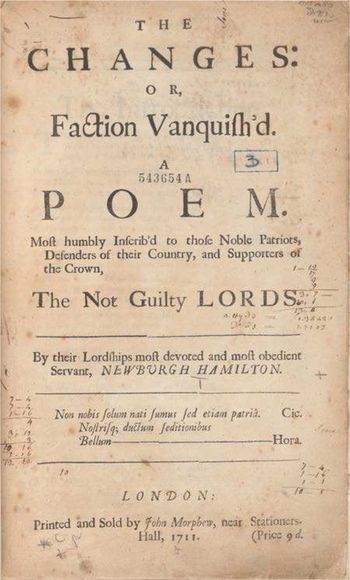
A richer source for Newburgh's own politico-religious life is the little-studied document at the centre of this article, The Changes: Or, Faction Vanquish'd. A Poem. Most humbly Inscrib'd to those Noble Patriots, Defenders of their Country, and Supporters of the Crown, the Not Guilty Lords (London, 1711). Most extant copies of the poem are anonymous, but a variant title page, preserved at the New York Public Library, names the author as ‘their Lordships most devoted and most obedient Servant, Newburgh Hamilton’ (see Figure 1). The attribution appears in some literary reference works, and has been noted briefly by John Andrews and Ilias Chrissochoidis; other scholars, perhaps wary of doubtful identifications, have passed over it.Footnote 22
Newburgh Hamilton, The Changes: Or, Faction Vanquish'd (London, 1711), title page. General Research Division, The New York Public Library, Astor, Lenox and Tilden Foundations.

Written in the aftermath of the notorious Sacheverell trial and the subsequent fall of the Whig's ‘curs'd Cabal’ from government, The Changes is a Tory panegyric and a warning against letting Whigs regain sway.Footnote 23 This satirical-panegyrical poem aligns itself with Henry Sacheverell's supporters – Tories, High Churchmen, Non-jurors and real or suspected Jacobites – without, however, making explicit pronouncements on the constitutional controversy at the trial's heart. Sacheverell was a High Church cleric impeached by Parliament in 1710 following a sermon in which he painted the ruling Whigs as secret enemies of the Church and dissented from the sanctioned understanding of the Glorious Revolution as an instance of lawful resistance to threatened tyranny under the Catholic James II.Footnote 24 The Changes praises the ‘Not Guilty Lords’: the minority who voted to acquit Sacheverell and also, the poem implies, the only Lords themselves not guilty of treasonous faction-mongering. Although Sacheverell was convicted, Queen Anne supported an extremely lenient sentence. Soon afterwards, in October 1710, the Whigs fell from power in a landslide election and Anne restocked her ministry with Tories – the ‘Change’ celebrated ‘with joyful loud Applause’ in the poem (line 322). Yet this change by no means settled matters. The trial had shown just how difficult it was for Whigs to define the proper limits of resistance (why should the nation not resist Anne if the mood suited?) or, conversely, for Tories safely to oppose Whig interpretations of lawful resistance in 1688. For, as the Earl of Wharton reportedly put it, ‘If the revolution was not lawful, many in that house […] were guilty of blood, murder, rapine, and injustice; and […] the queen herself was no lawful sovereign.’Footnote 25
The Sacheverell affair touched on a core unresolved problem for the British polity after 1688, generating a deluge of polemical poetry and prose, and acting as reference point in the coming years. Some satires in this period contained ambitious political analysis, were investigative or exploratory and presented detailed arguments to persuade the undecided or reform the erring; writers could stake a claim to develop political ideas or influence an emergent public sphere.Footnote 26 This cannot be said of The Changes. Rather, it might be said to follow rhetorical conventions already established in early Stuart England, whereby ‘under a monarchy the orator, the master of persuasive, “deliberative” rhetoric’ ‘become[s] a courtier and use[s] the “demonstrative” rhetoric of praise and blame’.Footnote 27 In keeping with this non-democratic ethos, the change celebrated in the poem is portrayed as relying not on votes in the recent election but on the divinely ordained monarch's choice of a new ‘Senate’ (ministry), filled with heroically virtuous and noble patriots (line 73).
Printed six months after Sacheverell's trial, The Changes works partly by making a bid for and praising values claimed by Tories and Whigs alike: patriotism, enmity to faction, loyalty to the crown, disinterest, bravery, love of harmony. Even its charges against Whiggery remain relatively commonplace. Whigs usurp royal power (they ‘sat upon / The Regal Throne’; lines 54–5). They subvert monarchic constitution (the ‘Fury’ ‘Faction’ gloatingly predicts the return of ‘Commonwealth’ and ‘Confusion’ with Whig domination; lines 91, 112, 139–40). They preach ‘Cant’ about the sanctity of laws protecting ‘Church and State’, while in fact using their ‘boast[ed]’ focus on legislation to rewrite the rule books (‘Those Laws that were not for them, they did break, / […] The old were burnt, that they might better make’; lines 175, 190–1, 194–6). The poem's depiction of Sacheverell avoids the pointy end of political analysis and mirrors popular Tory portrayals of Sacheverell as an apolitical martyr, a simple ‘holy Priest’ who diagnosed the nation's ‘Wounds’ and ‘rous[ed]’ it ‘t'avoid th'approaching Storm’ (lines 223–4, 234, 236). A nuanced or closely reasoned interpretation of ‘Party’ is not at issue here, let alone a testing out of concepts of resistance.
Rather than offering self-consciously theoretical analysis, The Changes has a narrative and epideictic logic that connects praise for Sacheverell and his supporters (stanzas 1–23) with the new Tory-dominated government led by Robert Harley (stanzas 24–9) and (implicitly) with a key issue before this government – ending the war with Spain and France; as well as with a spectacular recent event – Harley's triumphant return to Parliament in late April 1711 after being stabbed by a French spy, Antoine de Guiscard (stanzas 30–7). The poem frames these phenomena within ongoing cosmic strife between (Tory) virtue and (Whig) faction, the latter recalling Milton's council of devils, and like them finally leaving ‘Rending Hell's gloomy Shades with screams and howls’ (line 494). This framework allows Harley's stabbing to act as a reminder not of papist perfidy and the need to hold out against France in peace negotiations (as many Whigs wanted), but of the need to ‘Keep’ the Whigs ‘in Awe’: ‘Let them not rise again, but press them down, / Lest they attempt once more t’ insult the Crown’ (lines 511–13).
Ironically, Harley himself tried to create a more moderate bipartisan government and maintain personal links with Whigs.Footnote 28 By his lights, the extreme anti-Whiggery of The Changes might seem to promote faction. Indeed, superficially, the poem's demonization of Whiggery resembles the position of an anti-Harleyite group of Tories, the October Club, associated in the popular imagination with Sacheverell and intent on purging Whigs from Parliament.Footnote 29 Ignoring the Club, The Changes presents an alternative narrative connecting High Church causes, anti-Whiggery and Harley, in effect showing that patriotic Britons can abominate Whigs while supporting the current ministry.
This position intersects strongly with that of the Tory paper The Examiner, penned by Jonathan Swift and Delarivier Manley. On 17 May 1711, The Examiner reminded its readers that the paper was ‘first undertaken’ to ‘shew the Necessity […] of changing the Ministry, that our Constitution in Church and State might be preserv'd; to expose some dangerous Principles and Practices under the former Administration, and prove […] that those who are now at the Helm, are entirely in the true Interest of Prince and People’.Footnote 30 The same issue inveighed against Whiggish misrepresentations of Harley – and it advertised the publication of The Changes alongside a tract authored by Manley with Swift, A True Narrative of What Pass'd at the Examination of the Marquis de Guiscard, recounting Guiscard's attack (London, 1711). Connecting The Changes, The Examiner and A True Narrative was their printer, John Morphew, who had been arrested by the Whigs in 1709, helped to produce the first Tory account of Sacheverell's trial and became a chief printer for the Tory ministry.Footnote 31
While The Examiner criticized others’ accounts of Harley, Swift himself had made an initial ‘Blunder’ in representing the attack in his paper, and was accused of diminishing Harley's heroism and giving a windfall to his rivals. From a Harleyite perspective, Manley's A True Narrative was a more accurate account, with a politic emphasis on moderation and toleration, and a careful avoidance of Whig-bashing that chimed with Harley's modus operandi.Footnote 32 These emphases are, of course, antipathetic to The Changes. Its linking of current events with Sacheverell also deviated from the wary distance Swift and Manley's texts generally maintained from the firebrand cleric. We might imagine the printer and bookseller Morphew strategically catering to a range of political supporters and customers by presenting this range of pro-ministry perspectives on Harley's stabbing, much as Daniel Defoe in the same period produced multiple publications on a single issue, pointing the same moral, but apparently speaking from different perspectives.Footnote 33
But the title page bearing Hamilton's name encourages us to think further about the work undertaken by the poem, beyond any usefulness for other Tory figures. The variant title page could indicate a printer's mistake or the writer's last-minute change of heart about anonymity – a practice which, broadly construed, ‘was at least as much a norm as signed authorship’ in the period, especially with potentially controversial or embarrassing efforts like a youthful author's political satire.Footnote 34
Alternatively, Hamilton may have intended a small group of prints to circulate under his name, perhaps as gifts to potential patrons or reliable political connections.Footnote 35 Certainly, the poem seems designed to impress. Its substantial length (522 lines), literary allusions and self-referential moments and its ambitious formal scheme (an ‘Introduction’ and ‘Conclusion’ in heroic triplets flanking 40 verses in an original, intricate and exacting stanzaic pattern) set it apart from the vast majority of contemporary topical poems.
Some formal comparisons are instructive. A close relation of The Changes in the field of praise, Britannia: A Poem. With all Humility Inscrib'd to the Fifty Two (Not Guilty) Lords (London, 1710), is shorter, and uses what we might call the unmarked form for long poems in the period: rhyming couplets in iambic pentameter. The same unambitious form appears in a close relation to The Changes in the field of blame, the popular satire Faction Display'd (1704; London, 1709). It shares The Changes’ targets of Whiggery, cabals, moderation and republicanism (though Faction is more analytical, more open in its support for Stuarts and Laudians, and more specific about the crimes of particular Whigs). Like The Changes, it personifies Faction as a female fiend, borrows its structure from Milton's council of demons and makes a bid for a noble, high style of ruthless satire through (among other things) its appeals to the muses, its high-literary references and its imposing length (526 lines).Footnote 36 There is nothing formally comparable to The Changes in the Tory Collection of Poems, for and against Dr. Sacheverell (London, 1710) or A Tory Pill, to Purge Whig Melancholy (London, 1715). Of the 76 poems from 1704–14 reproduced in Poems on Affairs of State, only two are longer than The Changes.Footnote 37 Those poems that are not in rhyming couplets in this collection almost all use (and parody) recognizable song forms – hymns, ballads, tail-rhyme stanzas. One notable exception, Defoe's The Vision (1706), again uses form parodically, in order to suggest an antiquated, superstitious, ‘foreign’ (Scottish) speaker who pays more attention to sound than to sense.Footnote 38
The mode of The Changes is not ironic. Its intricate lyric form arguably contributes to its claim to cultural capital of a particular kind, helping to write the poem into a literary heritage of courtly praise and ingenuity reminiscent of Cavalier poetry and some Pindaric odes. Its formal distinctiveness and complexity certainly suggest the author's aesthetic, professional or ideological investment in the piece. It reads like a poem with something to prove for its poet, a poem its author might be sorry to see completely unacknowledged. This investment suggests the poem's role in its author's political and literary self-fashioning.
The Changes aligns its author unequivocally with the High Church Tory cause and commits him to one vision of ‘Toryism’ at a moment when its fortunes seemed to have turned. This sociocultural vision encompassed more than high political theory. As Mark Knights observes, Sacheverell ‘questioned the whole culture ushered in by the revolution, a shift, as he saw it, towards atheism, irreligion, republicanism, hypocrisy and self-advancement veiled by a dangerous veneer of worldly “moderation” that his own zeal and passion was intended to challenge’.Footnote 39 The poetic mode of The Changes participates in such a challenge to post-Revolution culture, meting out praise to ‘The Godlike Acts of British Heroes’ and violent retribution to ‘vile Traitors’ (the poet's pen should ‘force’ the ‘sharpest Sting’ through traitors until they ‘wish for Death’; lines 20–1, 36).
What might strike modern readers as crude hyperbole belongs at least in part to an emulation of elite pre-Revolution literary culture, where aristocratic virtues like heroism are significant political desiderata and savage satires are presented, as in The Changes, as serving ‘sacred truth’ and ‘publick Zeal’ (lines 55, 321). The preface to Faction Display'd explained the political charge attaching to this high and vituperative style: ‘Sincerity’, ‘Truth’ and ‘Nakedness’ belong to Juvenalian satire and the Tory poet; moderate ‘delight’, flattery, ‘Fiction’ and ‘Embellishment’ to ‘the Whig-Writters’.Footnote 40 It seems fitting or at least suggestive that the Hamilton family motto, sola nobilitas virtus (virtue alone ennobles), was adapted from a Juvenal satire.Footnote 41
The author of The Changes has no taste for highly prized ‘modern’ literary values like indirection and moderate debate – at that time associated with dissent and Whiggery – or for separating politics, divine inspiration and poetry. These domains merge in an aesthetic that recalls aspects of the late seventeenth-century interest in the sublime, with its emphasis on autocratic powers and desires, and the sublime orator's ‘pleasing rape upon the very Soul of the Reader’.Footnote 42 Poetic persuasion in The Changes takes pleasing liberties with its readers; it is forceful, even violent, yet metaphysically and rhetorically lofty:
Nor should The Changes be subjected too quickly to modern assumptions about political hack writing, although such ideas were formed and debated in Hamilton's lifetime.Footnote 43 The Changes does read like a poem suing for patronage. Yet while it decries self-interest in ‘hired Scriblers’ (line 37), it nonetheless suggests that its author is a willing and morally upright pen for party. The poem envisions its reception in a world where the powerful legitimately patronize ‘humble servant[s]’, including poets who share their political views.
This world was rapidly changing, as print markets made poets less dependent on individual patrons, as ideas about the ethics of patronage and professionalism shifted, and as newspapers outstripped topical poetry as a dominant mode of news- and opinion-making. Most importantly for The Changes, the political landscape and rules of engagement with poetry were changing. Early in the century, writing verse was ‘a means of achieving recognition and appointment or a party position’.Footnote 44 Young hopefuls might make their mark in poetry and then become ‘gentlemen amateurs’, occasionally writing poetry while they began careers in public service opened up by authorship.Footnote 45 The author of The Changes may have desired a similar trajectory, and have taken steps in this direction. But for Tories, the role of public poet in public service was largely closed after 1714, when George I's accession ushered in four decades of Tory exclusion from power.
Identifying the author of The Changes with Handel's Hamilton seems uncontroversial, especially in the context of changing writerly careers and changing political culture over the eighteenth century. The High Church Tory position occupied by The Changes is not incongruent with Hamilton's background as an educated young man who for some reason did not complete his studies; whose family was enmeshed with the established Church and had reason to support centralist visions of hereditary monarchy (Stuart or otherwise); and who arrived in London sometime in the 1710s without independent means. The Changes also chimes, as we shall see, with Hamilton's known patrons, employers and dedicatees. His other early writings seemingly have an anti-Whig colouring, and his Handel librettos can be read as sharing a number of their literary-political sensibilities and values.
III. Hamilton's ‘friends’ and other early writings
When Hamilton called Handel ‘my Friend’ in the dedicatory poem which prefaces Alexander's Feast, he suggested an affective tie and even a degree of equality which sits well with images of Handel's life as one shaped by sociability and friendship in the modern sense.Footnote 46 But ‘friends’ in Hamilton's lifetime covered wider territory, ‘spann[ing] kinship ties, sentimental relationships, economic ties, occupational connections, intellectual and spiritual attachments, sociable networks, and political alliances’.Footnote 47 Considering Hamilton's known writings before his collaborations with Handel helps us to understand not only his literary self-fashioning but also his friendships in this extended sense, involving political affiliation, family and money.
The cultural-political associations of Hamilton's employers and patrons could be extreme. Hamilton's St Cecilia's Day ode, The Power of Musick (London, 1720), was dedicated to ‘Peregrine, Marquis of Carmarthen, Baron of Kiveton’ (Peregrine Hyde Osborne, 1691–1731), a Yorkshire nobleman and heir to the Second Duke of Leeds (c.1659–1729), one of Sacheverell's prominent not-guilty lords.Footnote 48 In 1712, Osborne had married the youngest daughter of Harley, the politician eulogized in The Changes; around 1711–12 the Harleys were also close to Hamilton's long-term employer, Thomas Wentworth, Earl of Strafford (1672–1739).Footnote 49 The dedication's reference to Hamilton as Osborne's ‘obliged’ servant may indicate a patronage relationship through this sprawling and intricate network. Handel himself forms another conceivable link between Hamilton and his dedicatee: Osborne and his brother Danby had travelled through northern Germany in 1709–11, learning from music masters, buying scores and attending concerts under the watchful eye of a governor who also kept their father abreast of developments in the War of the Spanish Succession. Danby died overseas, and Osborne returned to England with one of his music manuscripts, now regarded as ‘an important source of music from Handel's Hamburg period’.Footnote 50 Hamilton's own interest in Handel dates from at least as early as 1725, when he subscribed to the score of Rodelinda.Footnote 51
Osborne's musical interests, however, do not seem to have been particularly strong, and Hamilton's competent Pindaric ode perhaps nods as much to the family's general associations with music – and libertinage – as to its particular dedicatee.Footnote 52 Osborne's notorious father was a talented violinist at a time when the instrument still carried associations with French-style Restoration court music, dancing and volatile passions. He seems to have cut the figure of a latter-day Cavalier or Restoration ‘rake’,‘permanently impecunious’; martial, ‘bold, volatile and somewhat eccentric’; and accused by his wife of ‘cruel’, ‘inhuman usage’.Footnote 53 The duke's political allegiances were febrile. As a young man he served as an MP for the court party. Like some other party members, he worked to bring William of Orange to England, yet initially voted against declaring the throne vacant before swiftly recanting. The accession of George I changed things again. He announced during the 1715 Jacobite rising that he ‘had not a thought’ in 1688 ‘that the Prince of Orange's landing would end in deposing the King’, and subsequently entered into plots with Jacobites in France.Footnote 54 In 1720, he was a member of the Jacobite peerage in exile on the Continent.
Hamilton's music ode has appropriately rakish accents. After unexceptionable verses recounting Orpheus's lament for Eurydice, the poem unexpectedly turns against marriage and, rather unusually, begins to address directly a character other than Cecilia. This passage mixes the provocative, sceptical tone of the Restoration stage hero with the Anacreontic language of Dryden's Cecilian ode, Alexander's Feast (1697):
Later stanzas enjoin the abandoned husband to use music in seducing a ‘coy Fair One’ (line 73). The libertine colouring of this seduction is suggested by its level of sexual innuendo: ‘First touch the softly-breathing Flute, / Then gently press her, gentle Boy; / […] / She yields, she feels the pleasing Smart, / And dying hugs the tickling Dart’ (lines 76–7, 80–1). When these lines were printed, the marquis had recently remarried; presumably the tropes of womanizing and wife-hating were calculated to have a literary-cultural appeal and significance outweighing any indecorum in their possible application to their dedicatee.
The ode's literary-cultural cues suggest a comparison with The Changes, whose ‘Introduction’ cited a set of Restoration poets associated with satire and wit, and sometimes with libertinage, Jacobitism and Catholicism:
The non-standard stanzaic scheme of The Changes – a5b3a5b3c5c5c5d4e2e2d5/6 – also recalled Pindaric odes and other late seventeenth-century formal experimentations. (The pattern is not dissimilar to the first stanzas of that most widely imitated English Pindaric, Alexander's Feast.) Hamilton's interest in irregular forms is clear from the varied stanzas of his Pindaric music ode, which plays with odd combinations of line length and rhyme, uses rhyming triplets and quadruplets, and, like The Changes, includes a set of quatrains composed of two-foot rhyming couplets enclosed by longer lines. The formal play evident in Hamilton's poetry, and the engagement with Pindarics in his work for Handel, is thus congruent with the (more limited) formal experimentation of the younger author of The Changes.
The cultural-political charge of The Changes also resonates with Hamilton's later employers, the Straffords, another Yorkshire aristocratic family. In 1710, Thomas Wentworth, the future earl of Strafford (then Lord Raby) was engaged in diplomacy on the Continent, and did not vote in the Sacheverell trial.Footnote 57 Nonetheless, he was undertaking negotiations to end the War of the Spanish Succession (1701–14), a drawn-out and increasingly unpopular conflict promoted by the Whig government. Whig opposition to peace fuelled the electoral defeat of 1710. The war's end is perhaps glanced at in The Changes’ claim that Whigs destroy peace of all kinds; in its epigraphs from Cicero and Horace, which juxtapose disinterested patriotism with self-interested insurrections and war; and in its praise for Harley, then working to conclude peace treaties (and establishing the South Sea Company to benefit from the privileges treaties would secure).Footnote 58
It is uncertain how and when Hamilton entered the Straffords’ service. Firm evidence of his stewardship comes in 1725, though Smith suggests that a 1714 poem to Anne, Lady Strafford, in Hamilton's hand ‘has very much the tone of affectionate respect appropriate to’ a family servant.Footnote 59 The poem at the very least suggests an existing ‘friendship’ between Hamilton and Lady Strafford, referring to the speaker's ‘Gratitude’, and intriguingly placing him with her in The Hague, where she spent the winter of 1714 while her husband visited England.Footnote 60
Party, poetry and personal networks probably worked hand in hand in establishing Hamilton's link to the Straffords. The family was strongly Tory and cultivated relationships with more prominent Tories in the beau monde into which they ascended in the early 1710s, as Baron Raby was created First Earl of Strafford by the increasingly pro-Tory Queen.Footnote 61 It was not a foregone conclusion that Strafford would employ Tories: in 1711, Swift helped a young Whig poet, William Harrison, to a post as Strafford's secretary.Footnote 62 Nonetheless, a fellow partyman with a taste for high culture may well have been attractive to the family as they entered London society, with the new Lady Strafford (a shipwright and politician's daughter) establishing a house in fashionable St James's Square and ingratiating herself with court and government figures.Footnote 63 Hamilton's later role in the family clearly included catering to cultural needs, not only taking the children to the opera and offering news from and about Handel, but also negotiating the services of a musician, and keeping the earl up to date on Alexander Pope's new satires against Lord Hervey, the Straffords’ arch-Whig neighbour.Footnote 64
During peace negotiations, Strafford was viewed as straightforwardly un-Whiggish and potentially Jacobitical. In February 1712, Swift reported a ‘foolish Story got about th[e] town’ that the earl was ‘in t[h]e Interests of France’.Footnote 65 The historical impeachment of his forebear Thomas Wentworth, chief councillor to Charles I, also politicized the family, as it was cited as an important precursor to proceedings against Sacheverell.Footnote 66 The link evidently made an impression on the Straffords. The family in London kept Strafford abreast of news of Sacheverell's trial, bought contemporary pamphlets and sent him copies of The Examiner, weaving together news of the trial with hints about peace negotiations, changes in government and possible chances for new positions and ennoblement.Footnote 67 His brother sought out ‘things that related to Tho: late Earle of Strafford […] that Great man’; his mother, once lady of the bedchamber in James II's court, worried at the similarities between the unrest surrounding Sacheverell and ‘the begining of the lait troubles’.Footnote 68
The Stuart ties in the family were strengthened with George I's exclusion of Tories like Strafford from favour and office. In late 1714, months after Hamilton had envisaged a reunited Earl and Countess enjoying ‘The just rewards of love & Constancy’ in view of ‘th'admiring world’, Strafford was recalled from The Hague and criticized for his negotiations by the reascendant Whigs.Footnote 69 He faced impeachment in 1715, and by the early 1720s he had ‘turned to the Jacobites and corresponded with the Pretender, who appointed him commander-in-chief of the Jacobite forces north of the Humber’.Footnote 70 Strafford was permanently excluded from office under the Hanoverians, though his family still took part in London life and he still occasionally appeared in Parliament.Footnote 71
Whatever Hamilton's connection with the Wentworths in this period, he had some friends among the Tory-leaning beau monde. The dedication of his play The Doating Lovers: or, The Libertine Tam'd (London, 1715) to ‘the Dutchess of Hamilton and Brandon’ indeed gives the piece political colourings similar to those of his early poetry. In 1715, the duchess was the recent widow of James Hamilton (1658–1712), a Scottish Jacobite sympathizer who had been close to Charles II, Louis XIV and James II. James Hamilton was twice imprisoned in the tower after William III's accession and engaged in a number of abortive political and military moves against William III and his successors. Later, he supported Sacheverell's acquittal and was rewarded under the incoming Tory government. Newburgh's connection with the duchess is unclear, although the dedication claims her close encouragement and favour.Footnote 72 Later, David Erskine Baker reported that Hamilton ‘lived in the family of Duke Hamilton, and was probably related to his grace’.Footnote 73 Baker was born long after Hamilton entered the Wentworths’ service, and his suggestion may derive simply from the dedication, or from gossip about the duke's indecorous household.Footnote 74 It certainly contributes to Baker's waspish portrait of Hamilton as a lacklustre dramatist whose plays were moderately successful only because his ‘interest was so strong, and his acquaintance so extensive’.Footnote 75
It is possible that Hamilton looked to the duke and duchess as his ‘friends’ in the sense of kin: they had shared ancestry, whose details he may or may not have known, but which was witnessed by a shared crest, motto and arms.Footnote 76 It also seems plausible that he perceived connections between the duchess and his other Tory-Jacobitical affiliations. This is supported by the specification on the play's title page: ‘As it is Acted at the Theatre in Lincoln's-Inn-Fields […] under Letters Patent Granted by King Charles the Second’. Some plays at Lincoln's Inn Fields printed between 1700 and 1730 refer to the Theatre Royal or His Majesty's servants, but to my knowledge this is a unique reminder of the theatre's founding under Charles II, and by extension the reopening of theatres at the Restoration.
This association between the Stuarts and theatre chimes with The Doating Lovers’ much less unusual adoption of Restoration comedy conventions. This play's prologue cites the dramatist George Etherege, creator of the archetypal Restoration rake Dorimant, as the inimitable model of ‘so young a Bard’ as the play's author. (Etherege was similarly admired as an unreachable model for a ‘tender unskill'd Pen’ in The Changes (line 4).) Like many comedies in its vein, the play ends with the apparent taming of at least one libertine by conjugal love – albeit, in this case, an equivocal taming. The reformation of Hamilton's libertine is last-minute and sportive, reached through his future wife's wit and admirability rather than any moral or sentimental remorse.Footnote 77 Following the bent of William Wycherley's The Country Wife or Aphra Behn's The Rover, Hamilton even leaves lingering doubts about the strength of marriage bonds. The ‘Rover fix'd by’ the ‘bright Star’ of a beautiful wife in his play only ‘hopes to prove as Constant as she's Fair’.Footnote 78 And given the inevitable waning of the star of beauty in all young women, even this hope may, like summer's lease, have all too short a date.
This closing uncertainty combines with the play's self-consciously ‘lewd’ beginnings – a conversation between two gentlemen and a pimp that brands ‘The whole Town’ as a pack of hypocritical, fornicating ‘Libertine[s]’ – to make The Doating Lovers closer to rawer Restoration-era pieces than to the rising genre of Whiggish ‘sentimental’ comedies advocated by Richard Steele and others.Footnote 79 Steele had criticized Etherege's The Man of Mode in The Spectator, arguing that this ‘pattern of genteel Comedy’ was in fact not only ungenteel but also morally reprehensible.Footnote 80 In 1722, Steele's play The Conscious Lovers offered a counter-example of morally improving comedy. For Steele and like-minded reformers, comedy was not to invite ridicule of rakes like Dorimant, nor surreptitious identifications with his ‘Ribaldry’, but instead ‘Polite’, ‘Lib'ral Mirth’, provoked by characters worthy of emulation.Footnote 81
Hamilton's earlier farce The Petticoat-Plotter (1712) still more clearly belongs to the rearguard of impolite un-Whiggish comedy, although the play's revivals in 1715, 1718 and 1728 indicate the continuing appetite for such supposedly ‘archaic’ plays during the period.Footnote 82 Here, the dashing but impecunious True-Love, aided by crafty Plotwell, defies old Mr Thrifty's refusal to grant him the hand of Isabella Thrifty, and thwarts Thrifty's plans to marry Isabella to the desiccated but wealthy Sir Simon Scrape-All. The polite indirection of emerging sentimental heroes is lost on True-Love. He begins the play, after a moment's entreaty to his prospective father-in-law, by informing Thrifty that he is ‘a doating old Fool’ who in Scrape-All courts an ‘accursed Usurer’ and ‘wither'd Crabtree, an useless Drone, that's a Nuisance to his Neighbours, and an Eye-sore to the World […] foh, foh! he stinks so of Mortality, that I can't look at him but I think of my Grave’.Footnote 83 True-Love's characteristic modes of address are invective and plain-speaking. A high-minded pursuit of ‘Love, sincere Love’ and condemnation of others’ venial self-interest do not keep him from frank, rather materialist arguments: ‘Sir,’ he tells Thrifty to excuse his poverty, ‘I have Love, and you can give Riches, both are best.’Footnote 84 The sceptical-libertine colourings of the play are reinforced by a satire of a Puritan stock character borrowed from Ben Jonson (the schoolman/scribe Ananias) and by swaggering breaches of discretion like True-Love's public boast, shouted from the window of Thrifty's own barricaded house, that Isabella is ‘Wedded and Bedded’ by the end of the play.Footnote 85
Just as it shares the crude loftiness of The Changes, this play resonates with its anti-Whig cultural politics. Written at the conclusion of the War of the Spanish Succession, when Whigs had held out for competitive advantages in foreign trade against Tory preferences for a speedy peace (and rights to exploit colonial territories), the play significantly shows Thrifty being cozened by a Spanish beauty, Theodosia.Footnote 86 This supposed Spaniard (Plotwell in petticoats) reports that Thrifty's brother, a merchant in Spain, has died and left him fabulous profits, the first fruits of which Theodosia has brought in a pair of chests. In reality, Spain's riches are True-Love and a chaplain, smuggled in to solemnize a marriage with Isabella. Thrifty himself is another trader (he hopes Theodosia will teach him Spanish to use on the Exchange), and thus arguably a natural Whig if not a professed one in the play. Spectators with an allegorical turn of mind might have seen in True-Love's triumph not only a satire of ‘Whiggish’ speculation and financial interest, but also the story of a failed paternal protector of the happiness of the feminized nation (Isabella), perhaps even a failed Whiggish Parliament, ousted by the nation's dashing ‘Tory’ True-Love.
Yet the narrative of one ruling man ousting another is slightly complicated by the play's allegiance to patriarchal authority. Some ‘Whiggish’ contemporary playwrights used intergenerational domestic dramas to imply the nation's progress from autocratic rule towards liberal governments administered by younger bands of brothers.Footnote 87 By contrast, Hamilton's Plotters stage a forthright, proud, lustful and violent opposition to existing authority – but less to authoritarians per se than to wrong-headed, money-grubbing ones. Once the needful plotting is over, True-Love dedicates himself to earning Thrifty's ‘Love’; the Plotters then abase themselves before the father and plead for a ‘general Indemnity’.Footnote 88 The play ends with a restoration of the old order, inaugurated, like Charles II's Restoration, by a general pardon. Isabella's attitude to resistance, meanwhile, might be read as a twisted version of Tory theories of passive obedience: allowing True-Love time to mount his active resistance, Isabella ‘seemingly compl[ies] with th[e] unnatural Match’ to Scrape-All.Footnote 89 In rehearsing this stereotypical image of femininity as passive yet dissimulative, Hamilton's farce also offers one way of imagining the appropriate position of the body politic in the face of unjust rule. Although inconclusive, these threads in the farce create Tory-leaning parallels between political and petticoat plots.
Hamilton's known publications before his collaboration with Handel – his music ode and two plays – therefore harmonize with the party-political stance of The Changes. They suggest a strongly anti-Whig author, aligned with a version of British culture predating 1688 and sympathetic to Tory and some Jacobitical patrons and values. Hamilton's collaborations with Handel, by contrast, have been read as politically neutral or neutralizing; as aligned with Whig Opposition (in Samson); or as fairly clearly anti-Jacobite (the Occasional Oratorio).Footnote 90 Hamilton's arrangement of texts for the Occasional Oratorio, supporting military action against a Jacobite uprising, is in itself unsurprising, given that people of many political stripes feared and deplored the 1745 rising, but also given that his brother Charles fought against the Jacobites at Culloden.Footnote 91 Changing political circumstances, cultural changes like the rise of politeness and sensibility, and differences in generic expectations go a long way towards understanding further differences between Hamilton's early and later writings. We might nonetheless explore continuities in politico-religious sensibility between Hamilton's earlier and later texts, and productively situate his collaborations with Handel within the political world of his network of friends.
IV. Texts for Handel: Alexander's Feast and Samson
Hamilton's first arrangement for Handel, premièred in London in February 1736, was a reverent adaptation of Dryden's Alexander's Feast. This was a text by a notorious Stuart loyalist and Catholic convert, capable of being read as a Jacobite satire of William III.Footnote 92 Yet it was also one of the most popular poems of the eighteenth century, and hardly regarded as politically sensitive. As Hamilton himself noted, the ode was ‘universally allow'd to be the most excellent of its Kind’ and had ‘long done Honour to the Nation’.Footnote 93 To have this national treasure set by the nation's most popular composer was a safe bet, since ‘it [was] next to an Improbability, to offer the World any thing in those Arts more perfect, than the united Labours and utmost Efforts of a Dryden and a Handel’.Footnote 94 If there is cultural politicking afoot, it is super-subtle: Hamilton's promotion of the poem fits with his earlier affiliations and tastes without obviously furthering a Tory or anti-Whig agenda.
If it is right to attribute to Hamilton the dedicatory poem found in the 1739 edition of the wordbook, then Hamilton's tone here, too, differs from his early writings. The brash and provocative stance of earlier arguments and the formal ingenuity of earlier poetry are replaced by moderate sentiments in standard heroic couplets. Whereas Hamilton's music ode followed Orpheus's narrative in order to depict dramatic passions and licentious desires (like those experienced by Alexander), the dedicatory poem distances Handel from Orpheus's quasi-magical powers over animals and animal passions:
It instead extols Handel's moderation, ‘controul’ and refinement: he ‘calm[s] the Passions, and improve[s] the Heart’; subdues ‘Rage’ and ‘Pride’; brings ‘Peace’ and ‘Harmony’; and directs ‘new-kindling Love to chaste Desire’.Footnote 96 Does this difference simply mark the distance between a dedicatory eulogy and other genres, or might we see here some capitulation or accommodation to the polite ‘Whiggish’ culture opposed by Sacheverell, but increasingly entrenched in 1730s London?Footnote 97
One echo we might hear of Hamilton's earlier political stance lies in his most significant intervention in Dryden's text. Hamilton wrote that in laying out the ode he had ‘confin'd [himself] to a plain Division of it into Airs, Recitative, or Chorus's; looking upon the Words in general so sacred, as scarcely to violate one in the Order of its first Place’.Footnote 98 This is mostly, but not quite, true: the final stanza from Hamilton's music ode (which, as mentioned, itself borrowed from Alexander's Feast) is appended to Dryden's text, and Dryden's design of having the chorus repeat four or more lines from the end of each stanza is modified to omit or abbreviate many refrains, and to assign some text solely to the chorus. New repetitions are also made to accommodate da capo arias in movements 17, 19 and 21. But a longer and slightly more substantial intervention comes in stanza 4, where the musician Timotheus laments the fall of the Persian king Darius – an allusion, according to readings of Dryden's poem as a Jacobite-leaning satire, to James Stuart. In his arrangement of this stanza, Hamilton evidently suggested a repetition in a ternary aria of the first four lines of the following passage taken from Dryden:
The first wordbook repeats the first quatrain, reflecting the earliest extant drafts of Handel's setting.Footnote 101 By the time of the first performance, however, Handel had radically revised and shortened this movement several times, including an omission of the entire dal segno section.Footnote 102 Following lines describing Alexander's sorrowful response to Timotheus, Hamilton again departs from Dryden's text by condensing, altering and repeating the passage a second time, for the chorus:
No longer framed as Timotheus's indirect speech, the text now appeals directly to Alexander, and perhaps to Handel's audience, underscoring the pathos of fallenness and defeat, and the sheer physical humiliation (or lowering) of the former ruler's body, a sight implicitly shameful for his conquerors as well as his friends. In other repetitions, Hamilton highlights the passionate responses of Alexander or his courtiers to Timotheus's song. This repetition, by contrast, draws us into the backstory to Alexander's feast, the forgotten passion-inducing defeat of a ‘Great and Good’ ruler.
These same lines and sentiments resonated with the author of The Changes, who described the Whigs taking advantage of an ‘easie Queen’, ‘lull'd asleep’ and ‘led astray’ ‘by Fav'rites’ (as Alexander was by Timotheus and Thais), and the subsequent ‘fall’ of Britain and ‘British Patriots’ (lines 150, 153, 157, 160). Harley's fall from favour before the 1710 election particularly echoes Darius's fall:
Hamilton's interest in Handelian fallen rulers may be evident as early as his subscription to Rodelinda (1725), the story of a usurped king who, following defeat in battle, goes into hiding until he can regain his throne, and whose pathetic complaint, ‘Dove sei, amato bene?’, is the opera's best-known aria.
Hamilton's apparent concern for defeated heroes – among whom we might count the Earl of Strafford – would be given full rein in his next collaboration with Handel, his arrangement of Milton's Samson Agonistes for Samson (first version 1741, revised version performed 1743). Hamilton's preface to Samson's wordbook remarked on Handel's recent setting of Milton's L'Allegro and Il Penseroso, but also linked the composer's new oratorio with Alexander's Feast, reminding audiences that Handel had ‘already added new Life and Spirit to some of the finest Things in the English Language, particularly that inimitable Ode of Dryden's, which no Age nor Nation ever excell'd’.Footnote 104 This comment quietly promotes Hamilton's previous collaboration with Handel, and simultaneously positions Milton, the unwavering republican and enemy of the High Church, and Dryden, the Catholic convert and Stuart loyalist, as equivalent sources of a national pride grounded in the ‘English Language’ rather than ideology.
Like this positioning, Hamilton's adaptation of Milton can seem politically muted, at most appealing to a middle ground of national feeling. Deborah Rooke, for example, sees in Hamilton's libretto ‘characteristically British ideals’ like ‘resistance to tyranny and defeat of idolatrous (Catholic) religion’.Footnote 105 Yet, as Smith has argued, the cultural politics of Samson are delicate and (perhaps intentionally) polyvalent.Footnote 106 Despite contemporary attempts to depoliticize Milton, the author's name still carried difficult political freight. Milton's republicanism was unpalatable for many, but his ideology nonetheless recognizably belonged to the party-political ancestry of eighteenth-century Whigs. Milton's adherence to his principles after the Restoration also made him a broader touchstone of fervent opposition (recall his use in the Tory satires The Changes and Faction Display'd). Smith observes that Milton was particularly looked to as a ‘figurehead’ of Patriot Whig opposition to the King and to Prime Minister Walpole in the late 1730s.Footnote 107 This chimes with the oratorio's probable genesis in November 1739, recounted in a well-known letter from the Opposition Whig Anthony Ashley Cooper, Fourth Earl of Shaftesbury, to his cousin James Harris, himself later a Whig MP: ‘Jemmy Noel read through the whole’ of Milton's Samson Agonistes, ‘and whenever he rested to take breath Mr Handel (who was highly pleas'd with the piece) played […] & his harmony was perfectly adapted to the sublimity of the poem’.Footnote 108 By early January, Harris, a keen Handelian, was sending to Jennens via Shaftesbury another Milton text to stimulate Handel's powers, L'Allegro and Il Penseroso.Footnote 109
On these and other grounds, Smith suggests that Handel's Samson, with its ‘basic plot of the renewal and exertion of national strength against the heathen oppressor’, alongside its dedication to the Prince of Wales, a centre of Opposition energies, may nod to the Whig Patriots’ support for war with Spain.Footnote 110 Still, Smith also notes that the topical resonances were in many ways ‘unspecific: the audience can associate the Israelite–Philistine confrontation with any hostilities, […] [or] any phase of them’.Footnote 111 In light of Hamilton's earlier writings, can we explore other implications in the libretto, heard by audiences or not? First, we might not be surprised to find an emphasis on conquering false religion (and not only Catholicism) from an apparent former champion of the High Churchman Sacheverell and the ‘Noble Patriots’ who defended him.Footnote 112
Secondly, Hamilton's participation in an apparently Patriot Opposition-orientated project is similarly comprehensible without assuming he straightforwardly abandoned earlier political sympathies. Unsurprisingly, the concerns of Tories and Patriot Whigs not infrequently converged in opposition to Walpole's ruling Whig faction from the 1720s to the 1740s. The Earl of Strafford, as a Tory peer, cooperated with Opposition Whigs in electioneering in 1734.Footnote 113 And the Jemmy Noel who recited Milton before his brother-in-law, Shaftesbury, came from a once strongly Royalist and now active Tory family; as a Tory MP, he voted against the Whig administration in almost all recorded divisions.Footnote 114
Adding to the areas of convergence between Tory and Opposition Whig interests is the turn among Hamilton's ‘friends’ towards a more conciliatory political stance in the period of Samson's composition. After the Earl of Strafford's death in 1739, his son evidently increased efforts to distance the family name from Jacobitism or virulent Toryism. In 1741 he married the daughter of the Duke of Argyll, a Whig bigwig who had led troops against the Jacobite rising in 1715. In early 1742, immediately following Walpole's resignation as prime minister, we find the Second Earl of Strafford inviting his son, the art lover and Whig politician Horace Walpole, to dinner; the two became friends, partly through shared pursuit of the arts.Footnote 115 Hamilton is unlikely to have been untouched by the Second Earl's efforts, although he remained in Anne Wentworth's household. We might speculate that the death of the elder Strafford not only gave Hamilton more time to develop his poetico-Handelian interests, but also helped make collaboration between the steward and the feted Hanoverian composer appealing to both Handel and Hamilton's employers.
In this double context of overlapping Tory-Opposition interests and of political conciliation, we can imagine Hamilton's dedication of Samson to the Prince of Wales as an appropriate political gesture. We might nonetheless remain alert to continuities in cultural-political sensibility between Hamilton's early and later writings. Christine Gerrard some years ago outlined what is perhaps a parallel case: the way Pope experimented with genres of praise and narratives of national renewal beloved of the Patriots in whose circles he moved, but remained unwilling or hesitant to dramatize the straightforward recoveries such narratives offered for Whigs.Footnote 116 This hesitation makes good sense: to imagine a national recovery dependent on deposing Walpole or waiting for one Hanoverian to succeed another is simpler than imagining a recovery dependent on an entire party returning from the wilderness, a reform of the national Church or the resolution of problematic successions stretching over multiple generations.
Perhaps Hamilton had reasons similar to those of Pope for hesitating to depict a glorious national revival at the end of his narrative. For whereas Milton closed his Samson with Manoah and the chorus affirming God's steadfast if ‘unsearchable’ ‘favour’ for his chosen people and dismissing the need for ‘lamentation’, Hamilton's libretto originally closed with much stronger mourning.Footnote 117 Here, Hamilton skilfully interwove some of the most elegiac and lyrical lines from the conclusion of Samson Agonistes with phrases from Milton's early Epitaph on the Marchioness of Winchester, uncharacteristically (for the mature Milton) a pathos-filled elegy for a prominent Catholic noblewoman, Jane Paulet (d. 1631). Her husband, John Paulet (1598?–1675), likewise a Catholic and a committed Royalist during the Civil War and Commonwealth, would be commemorated by Dryden as an ‘Ark’ of the ‘faith’ and a paragon of suffering loyalty.Footnote 118 The publication of Dryden's epitaph for Paulet in 1712 (two years after another Paulet voted for Sacheverell's acquittal) implicitly politicized the family's memory, suggesting that Charles I's execution belonged to a ‘rebellion’ for whose ill effects even the Restoration government ‘could not [make] recompense’ to Paulet, and playing on a heroic and martyrological ethos (familiar to the author of The Changes) in its depiction of a man who ‘By sufferings rose, and gave the law to fate’.Footnote 119
Hamilton's turn to the Epitaph on the Marchioness of Winchester might, then, have seemed inappropriate to anyone who associated Samson with stoical-republican resistance. For a writer with another mindset, an epitaph displaying what William Parker calls ‘the careless elegance and polished irregularity of a Cavalier poem’ might have a number of uses.Footnote 120 Formally, the Epitaph's rhyming tetrameters better lend themselves to musical setting, according to mid-eighteenth-century preferences, than the blank verse that predominates in Samson Agonistes.Footnote 121 Hamilton's choice also responds to Manoah's evocation of a funeral procession, laurels and floral tributes in Milton's text – resonating with the Epitaph's offering of ‘som Flowers, and som Bays, / For thy Hears to strew the ways’ – alongside less immediately evident parallels.Footnote 122 Milton's semichorus, for instance, described Samson as a phoenix whose ‘fame’ rises ‘In the Arabian woods’ from ‘her ashy womb’ (lines 1700, 1703, 1706), thereby activating long-standing associations between the phoenix and the resurrected Christ, between Christ and Samson, and (more distantly) between Christ and motherhood.Footnote 123 Sylvan imagery, the tomb and the ‘Mothers Womb’ are also closely linked in the Epitaph, as the marchioness's death in childbirth allows her to become a self-sacrificing, Christ-like figure who, ‘to give the world encrease, / Shortned hast [her] own lives lease’ (lines 51–2). As the marchioness ‘fled’ ‘Through pangs […] to felicity’ (line 68), so Hamilton's Samson becomes a model ‘hero’ by ‘fall[ing] […] Through sorrow to felicity’.Footnote 124
Hamilton's chosen intertext thus hints at Samson's association with Christ-like martyrdom, a Christian heroism which triumphs through passive pathos rather than Miltonic agonism. Milton had smoothed the way to such associations by referring in the introduction of Samson Agonistes to ‘a Tragedy’ called ‘Christ suffering’.Footnote 125 Hamilton's emphasis on passion in his libretto could be seen as no more than typical of mid-century preferences for sentiment, especially in Handel's oratorios.Footnote 126 But it is intriguing that Hamilton transformed Milton's last lines, with their stoic-republican flavour (God ‘dismissed’ his servant ‘With peace’ and ‘calm of mind all passion spent’; lines 1757–8), into final lines that, while they similarly hymned ‘Rest’ and ‘Peace’, did so through an intensely pathetic intertext which resembled the Royalist poetry admired by the author of The Changes much more than the sentimental writings we now largely associate with eighteenth-century Whiggish culture.
Handel ‘astonishing[ly]’ (for the editor of the Halle edition) originally ‘went along with [Hamilton's] design, and wrote his Fine under a pianissimo finale; for his usual custom […] was to have [oratorios] end festively with trumpets and drums’.Footnote 127 This ending was revised before the oratorio's first performance a few years later: the new version ends with an unequivocally celebratory chorus from Milton's At a Solemn Musick. Yet Samson's final aria, ‘Thus when the sun from's wat'ry bed’, remains unchanged in the new version, and lends a slight taint to the oratorio's sense of a happy ending. In this aria – an interpolation from On the Morning of Christ's Nativity – Samson uses the epic simile of a sunrise to describe his plans to ‘make Jehovah's Glory known’ in his final deed (Act 3, scene i). This sunrise image neatly reverses the image of eclipse in Samson's first aria. But the reversal is somewhat incomplete. Samson's Sun is ominous, withdrawn and haunted: ‘pillow[ing] his chin’ on a wave rather than coming out ‘as a bridegroom from his chamber, and rejoicing as a strong man to run his course’ (Psalm 19); covered with the ‘cloudy red’ of slaughter; and watching as ‘wand'ring shadows ghastly pale’ ‘troop to their infernal jail’ in the ‘grave’ – Samson's last word in Hamilton's text (Act 3, scene i).Footnote 128 The ghosts, of course, will be Samson's Philistines, and the red sun foreshadows not only their deaths but also Samson's. Hamilton's adaptation is especially apt since Samson's death was a common type for Christ's crucifixion, alluded to by Milton in his celebration of the infant Christ's first day.Footnote 129 Nonetheless, a ‘red and lowering’ sky in the morning tells of ‘bad weather’ to come (Matthew xvi. 2–3), and who could say how long the storm would last? Perhaps only until Samson's death, as the jubilant final version of the oratorio suggests. But perhaps longer. Hamilton's choices at least make the oratorio comparatively open to a Tory- or even Jacobite-leaning understanding of England's long and uncertain road to recovery.
Finally, there are what we might call connotative connections between the intense passivity sometimes diagnosed in Handel's Samson (‘by the mid-point of the action, if such it can be called, the hero has done nothing’) and older Tory theories of passive resistance to the powers that be.Footnote 130 Non-resistance was no longer a prominent issue dividing Tory and Whig in late 1730s politics; yet as a cultural ideal it had a much longer life. Toni Bowers has argued that in a strand of seduction stories, a widespread plot in eighteenth-century narratives, heroines mount what she terms ‘collusive resistance’, an attenuated version of passive resistance. This stance, she shows, created a ‘paradoxical model’ of ‘resistance through submission’ to power. It ‘was especially valuable’, she argues, ‘to writers with ideological leanings toward tory principles, writers for whom resistance to legitimate authority was difficult to justify even when it was unequivocally necessary’.Footnote 131
This model is suggestive for Hamilton's Samson. His narrative begins after a moral seduction that – more explicitly than in most eighteenth-century narratives – blends the personal-sexual and the national-political, devastating Samson's personal identity and his nation's fate. Samson's passivity is intensified because Milton's story begins in gaol, after Samson's capitulation to Delilah. When Samson Agonistes was published in 1671, Samson's fall probably looked analogous to the fall of the Commonwealth; for later writers and Handel's first listeners, it might conceivably have spurred reflections on the quite different fall of the Stuarts. It is by confronting his agonizing situation – life after the fall – that Hamilton's passive hero comes to regain his honour or sense of purpose, through what could be seen as a spectacular, if extremely twisted, act of collusive resistance. The turning point comes when the Philistines demand that Samson ‘come’ and ‘show / Some public proof’ of his enormous strength as an entertainment at their feast to Dagon (Act 3, scene i). Samson first refuses to ‘be their fool, / And play before their God’, but is warned that he will face death or be physically forced to attend the games. Samson then begins to comply, sensing that godly purposes can align his will with that of his oppressors. He avoids the maximum affront to his dignity by going voluntarily rather than being taken ‘like a wild beast trail'd’ through the streets, and finally capitulates to the demands to show his strength – by destroying the pagan temple and its worshippers, and by submitting himself to death under the temple's roof.
Undoubtedly, this dramatic irony could be attractive to individuals with different purposes and ideologies – witness its appeal to Milton and later Whig monarchists. Interestingly, though, Samson Agonistes is more scrupulous than Samson in distinguishing between independence and coercion, autonomy and heteronomy. This is as we might expect, given republican views of freedom as independence from even potential coercion or influence, and so as absolutely incompatible with collusion.Footnote 132 Milton has Samson expatiate on the difference between being physically forced to do something against one's will and basely submitting one's will because it seems unavoidable (lines 1363–79). To retain his dignity, Milton's Samson must independently choose to attend the Philistine festival or be compelled to do so, not just to comply. There would be no grey zone between what Bowers, quoting Pope, calls ‘force or fraud’, rape or seduction, absolute resistance or submission: it is just this grey zone that continued to fascinate writers with ‘tory-oriented sensibilities’.Footnote 133
Hamilton omits Milton's deliberations about free will, and a reordering of Milton's material makes his Samson seem slightly less independent, formulating his will in compromised dialogue with his enemies. This is a matter of subtle emphasis. Hamilton's Samson, like Milton's, ‘begin[s] to feel / Some inward motions’ to attend the Philistines before their messenger appears to renew his demand (Act 3, scene i). Differences emerge with the Philistines’ threat to find ‘engines’ to ‘move’ Samson, ‘though’ he were ‘solid rock’ (Act 3, scene i; Milton, lines 1396–8). Milton's Samson reflects, to himself, that he could kill some Philistines if he tried to resist, but is nonetheless ‘content to go’ voluntarily to avoid degrading force (line 1403). His focus remains on the limits and nature of his concession: a recognition of the Philistines’ physical superiority, he insists, does not affect his moral integrity (lines 1408–9). Hamilton's hero more rashly (and illogically) declares to his interlocutor: ‘Vain were their art if tried, I yield to go / Not through your streets be like a wild beast trail'd’ (Act 3, scene i).
It serves Milton's purposes to underscore the futility of Samson's physical resistance. Hamilton, by adding Samson's claim that any efforts to control him would themselves be futile (‘vain’), should he choose to resist, instead emphasizes Samson's supernatural strength and chosen submissiveness. Similarly, in Milton's poem, even the Philistine messenger recognizes Samson's change of heart as a positive ‘resolution’ of will – although he then assumes, like any subject inured to tyranny, that the only path to greater freedom is currying favour: ‘By this compliance thou wilt win the Lords / To favour, and perhaps to set thee free’ (lines 1410–12). Milton's Samson ignores him and addresses his final speech to his ‘Brethren’, closing with the reassurance that he will undertake ‘Nothing dishonourable, impure, unworthy’ (lines 1413, 1424). Hamilton, meanwhile, omits reference to Samson's resolution. His Philistine still points to the benefits of compromise (‘You thus may win the lords to set you free’), and Samson's reply might seem to recognize that, within reason, he could seek favour through his accommodation (‘In nothing I'll comply that's scandalous / Or sinful by our law’; Act 3, scene i). Hamilton's drastic reduction of Milton's argumentation was clearly necessitated by the constraints of a libretto.Footnote 134 Nonetheless, such tiny, potentially unreflecting, alterations in what is textually present point towards Hamilton's indifference to key Miltonic concepts like independence of will and resistance – and his receptiveness to images of Samson as a type of Christ, yielding to be ‘led as a lamb to the slaughter’.Footnote 135
For some scholars, Samson's passivity means that the Israelite chorus (as proxy for the British nation) is the true hero of Handel's oratorio, and Samson a fallible man, no better than he should be.Footnote 136 Yet the oratorio seems also to carry traces of a different construction of heroism – one appropriate to High Church ‘martyrs’ like Charles I and Sacheverell, though also crucial to broader Christian constructions of heroism – whose ultimate model is Christ, obedient unto death. This reading is strengthened by Hamilton's interpolation at crucial moments (for example, Samson's last aria, the original close of the oratorio) of intertexts suggesting parallels between Samson and Christ. This is not to say that all Hamilton's adaptations point in one direction; as Aspden observes, ‘Interpretations need not be univocal to have validity.’ Indeed, the absence of smoking guns pushes us to recognize interpretation ‘not as an open-and-shut case, but […] a matter of potentiality’.Footnote 137
V. Conclusion
Integrating early works, including The Changes, into Hamilton's oeuvre provides varied possibilities for thinking about his collaborations with Handel. We might see Hamilton setting forth his credentials as a party writer in a topical polemic in The Changes, then moving through politically coloured plays and a music ode, and into a genre that did whatever cultural-political work it did discretely, stewarding others’ words and creating vehicles for others’ tunes.
The Changes’ support for Sacheverell and Hamilton's family ties to the Church of Ireland strengthen what might already have been supposed: that Hamilton shared with the overwhelming majority of Handel's English librettists an affiliation with the High Church cause.Footnote 138 Hamilton's early religio-political credentials, like Jennens's, probably closed outlets for writerly industry and skill that remained open to Whigs in pursuit of cultural capital; plausibly, his employers’ changing position and the lessening of the rage of party helped ensure that the oratorios were not one of those blocked outlets. My explorations of Alexander's Feast and Samson further suggest a continuing sensitivity towards suffering and fallen heroes. This literary-affective sensibility included political resonances in eighteenth-century culture, although, as contemporaries recognized, the politics of suffering and resisting could become fiendishly strange. ‘We are now come to fresh paradoxical circumstances,’ as one Tory writer commented during riots surrounding Sacheverell's trial: ‘while the rabble are pulling down houses out of zeal for passive obedience, the vile [Whig] ministry’ was oppressing the ‘nation’ and its rioters ‘in defense of forcible resistance’.Footnote 139
Different threads might emerge from readings of Hamilton's possible libretto for Semele, a ‘baudy’ tale adapted from another late seventeenth-century master, William Congreve, or the Occasional Oratorio.Footnote 140 With the former, we might stress Hamilton's taste for Restoration wits and licentious dramatists (Dryden, Wycherley, Etherege). With the latter, The Changes’ (factious) opposition to faction and tumult could come to the fore, and suggest Hamilton's contribution to what Gillen D'Arcy Wood calls the ‘rituals of Handelian consensus’ in Romantic Britain.Footnote 141 For Wood, the oratorios’ function as a site of national consensus involved the paradox that, ‘though full of politics themselves’, ‘the oratorios as a social phenomenon’ came to stand ‘for the neutralization of political division’ – a neutralization that was in turn deployed in politically charged debates.Footnote 142
This article's examination of Hamilton's early writings does not conclusively reveal authorial purposes, ideological or aesthetic, for his Handel texts. But consideration of Hamilton's intertextual and rhetorical predilections, his affiliations and his ‘friends’ encourages us to think of Handel's vocal works as shot through with multiple, potentially contradictory, cultural-political meanings and resonances. It is itself no new thing in Handel studies to deprioritize a search for single authorial purposes, whether aesthetic or ideological: many more words about Hamilton, then, but in some senses plus ça change.
There are, however, two points worth raising in conclusion. A prominent strategy in Handel scholarship for deprioritizing the search for single authorial visions has been to remove discussions from the sphere of (authorial) intentionality by emphasizing reception studies and listener theory, alongside broadly deconstructive methods that stress inherent indeterminacy or multiplicity.Footnote 143 One objection to this strategy might be that, no matter what audiences thought, and no matter how indeterminate all texts may be, Handel and his collaborators had intentions, and these concerned the creation and production of music, something above the fray of partisan or topical politics. Yet in discussing Hamilton I have hoped to re-emphasize the fact that not only listeners but also creators and their creations are changeable, multiple and not self-transparent. The arguments advanced here suggest that Hamilton's Tory and Jacobitical connections and authorial activities are evidence of an intimate relationship in Handel's world between music and politics (in the sense of ideological sensibility and of current political affairs). Hamilton cannot persuasively contribute to a counter-argument that Handel or his works transcended politics simply because Handel had Tory as well as Whig supporters.Footnote 144
Secondly (and relatedly), scholarship on Handel's vocal works has played out larger debates about facts and interpretation. A number of scholars cite approvingly the literary historian Robert Hume's methodology, set out most fully in Reconstructing Contexts.Footnote 145 It advocates ‘finding, analysing, and honouring fact’.Footnote 146 Facts can be preferred to ‘interpretation’, because new facts help to reconstruct ‘contexts’.Footnote 147 Contexts in turn provide ‘extrinsic evidence with which to validate’ understandings of individual texts (as, for example, intentionally political).Footnote 148 Some literary scholars have questioned Hume's articulation of his method, not least because it implies that some texts or traces of the past have a fact-like meaning, and can become background for explaining others.Footnote 149 Although this article has looked for new empirical data about Hamilton, it has tried to proceed on the understanding that facts are faits (made), and what makes them is part of the process of interpretation.Footnote 150 For this reason texts like The Changes and The Doating Lovers should be approached less as contexts for Alexander's Feast (for example) than as intertexts with their own sociocultural interests and puzzles.
The narratives we construct about Hamilton's authorial and social identities (the extent to which he changed his politics, became apolitical or fitted his writings and social self to his ‘friends’ without experiencing deep political affiliations), not to mention our understanding of the significance of The Changes for the librettos, will never become matter of fact. They will be a matter of unfolding interpretations in close contact with historical materials. In this respect, a dilemma familiar to scholars and critics is evoked by the double narrative in The Changes of absolute victory and absolute peril. New matters come to light, a revolution occurs, faction is vanquished, dissension is silenced and multiplicity gives way to unity. Yet somehow ‘Fiends’ rise up again; spies and assassins threaten the new rulers; our materials prove ‘harden'd in rebellious Ill’ and must be ‘press[ed]’ ‘down’ at the close of each argument (lines 520, 512). Future interpretative possibilities may change if The Changes is brought into closer dialogue with Handel's music. But – plus ça change – these changes will not stabilize or silence new interpretations.