Introduction
The cerrado is the second largest vegetation type in Brazil, occupying about 2 million km2, and is exceeded only by the Amazonian forest with 3.5 million km2 (Furley & Ratter, Reference Furley and Ratter1988; Ratter et al., Reference Ratter, Ribeiro and Bridgewater1997). It occupies the central part of the country and is usually located on crystalline or sedimentary plateaus (Brasil & Alvarenga, Reference Brasil, Alvarenga and Duarte1989; Silva & Bates, Reference Silva and Bates2002). This extensive biome is a biodiversity ‘hotspot’ and is a conservation priority area because 70% of it has already been altered by intensive human activity and only 6.2% is protected in reservations or conservation units (Myers et al., Reference Myers, Mittermeier, Mittermeier, Fonseca and Kent2000). The natural vegetation of cerrado varies from open, dry grassland (termed campo limpo) to savanna parkland containing scattered low contorted trees of 4–8 m in a grassland matrix (termed cerrado sensu stricto, s.s.) to forest physiognomies of characteristic species called cerradão (the augmentative of cerrado in Portuguese) (Eiten, Reference Eiten1972; Coutinho, Reference Coutinho1978; Ratter et al., Reference Ratter, Ribeiro and Bridgewater1997).
The cerradão is essentially a sclerophyllous forest (Rizzini, Reference Rizzini1979), that occupies around 1% of the cerrado biome (Borlaug, Reference Borlaug and Baley2002) and is associated with well-drained deep soils (Ribeiro & Walter, Reference Ribeiro, Walter, Sano, Almeida and Ribeiro2008). Its flora consists of typical cerrado species mixed with those of forest; however, there is a group that has cerradão as their most characteristic habitat. Cerradões (plural of cerradão) show great variation in vegetation structure, ranging from those with 6–7 m tall emergent trees and partially closed canopies to true forests with up to 15 m tall trees and more than 90% canopy cover (Ratter et al., Reference Ratter, Askew, Montgomery, Gifford and Ferri1977).
Although cerradão now covers perhaps only c.1% of the cerrado biome, there is evidence that in the past, before massive human influence, it formed a major – or possibly the dominant – component of cerrado vegetation (see Ratter et al., Reference Ratter, Bridgewater, Ribeiro, Pennington, Lewis and Ratter2006). Many of the 19th-century botanical explorers comment on its prevalence across central Brazil and it was even abundant at the time of the cutting of the Belo Horizonte–Brasília highway in the 1960s and of the roads in eastern Mato Grosso at the same time (Rizzini, Reference Rizzini1979; Ratter et al., Reference Ratter, Bridgewater, Ribeiro, Pennington, Lewis and Ratter2006). Rizzini (Reference Rizzini and Ferri1963) and Rizzini & Heringer (Reference Rizzini and Heringer1962) used the term floresta xeromorfa for cerradão and Warming (Reference Warming1892) equated it to the Indian name Catanduva. The latter author had not seen great landscapes of this vegetation but had heard of them from travellers and deduced from the frequent use of the term Catanduva as a place name that it was once widespread. Durigan has demonstrated the regeneration of cerradão on reserves in São Paulo State that have been protected, particularly against fire, for a considerable period (Durigan et al., Reference Durigan, Ratter, Bridgewater, Siqueira and Franco2003; Durigan, Reference Durigan, Pennington, Lewis and Ratter2006). There seems little doubt that it would represent the climax vegetation of a very great area of the cerrado biome in the absence of human disturbance.
Studies on vegetation (Ratter, Reference Ratter and Ferri1971; Ratter et al., Reference Ratter, Richards, Argent and Gifford1973) and soil properties (Askew et al., Reference Askew, Moffatt, Montgomery, Searl and Ferri1971) were published as a result of the 1967–69 British expedition in the Xavantina-Cachimbo area of Mato Grosso State in the central Brazilian plateau (Ratter et al., Reference Ratter, Richards, Argent and Gifford1973). These and subsequent studies in several areas have shown the existence of two types of cerradão, one type, called mesotrophic, occurring in soils with pH greater than 5.1 and availability of Ca greater than 2 cmol dm–3, and the other, called dystrophic, occurring in soils with pH from 4.0 to 4.8 and Ca contents lower than 0.5 cmol dm–3 (Ratter, Reference Ratter and Ferri1971; Ratter et al., Reference Ratter, Richards, Argent and Gifford1973, Reference Ratter, Askew, Montgomery, Gifford and Ferri1977; Araújo & Haridasan, Reference Araújo and Haridasan1988; Furley & Ratter, Reference Furley and Ratter1988). The number of species found in these cerradão types varied from 25 to 125, with a Shannon diversity index from 2.92 to 3.56 (Felfili et al., Reference Felfili, Silva Junior, Rezende, Machado, Nogueira and Walter1994; Guilherme & Nakajima, Reference Guilherme and Nakajima2007). Another important aspect is that, unsurprisingly, cerradões often occur on soils of intermediate character in transition zones between more open cerrado formations and deciduous and semideciduous forests (Ratter, Reference Ratter and Ferri1971; Ratter et al., Reference Ratter, Askew, Montgomery, Gifford and Ferri1977; Marimon-Júnior & Haridasan, Reference Marimon-Júnior and Haridasan2005). The most common characteristic species are Callisthene fasciculata Mart. and Magonia pubescens in mesotrophic cerradão, and Emmotum nitens and Hirtella glandulosa in dystrophic cerradão (Ratter, Reference Ratter and Ferri1971; Ratter et al., Reference Ratter, Richards, Argent and Gifford1973, Reference Ratter, Askew, Montgomery, Gifford and Ferri1977; Araújo & Haridasan, Reference Araújo and Haridasan1988). (See Table 2 for authors for species recorded in the present study.)
There are few reports in the literature on cerradão due to its small area compared with the other cerrado physiognomies and also because of its widespread destruction for agricultural and other uses. Thus, there is an urgent need to generate information for the conservation and management of the remaining areas of this interesting and important vegetation.
The objective of the present study was to characterise the vegetation and the soil of a fragment of cerradão located in the Serra de Caldas Novas State Park and compare it with other cerradão areas in central Brazil.
Material and Methods
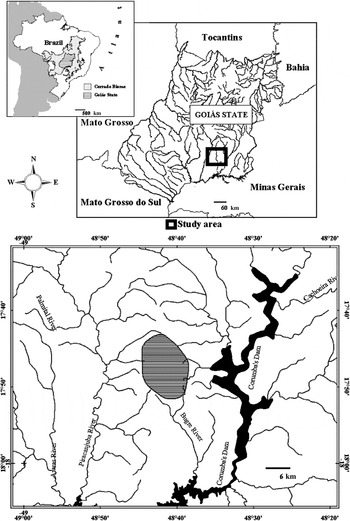
The study was carried out in a cerradão located along the eastern boundary of the Serra de Caldas Novas State Park (Parque Estadual de Caldas Novas, PESCAN) (see Fig. 1) at 17°46′S, 48°39′W and an altitude of 780 m in an area with outcrops of metasiltite rocks (Embrapa, 1983). The region has well-defined dry and rainy seasons and the climate is Aw (savanna subtype of the tropical rain climate) according to Köppen’s classification (1948). The mean annual temperature is 22°C and the annual precipitation is 1550 mm (Reatto & Martins, Reference Reatto, Martins, Scariot, Souza-Silva and Felfili2005). Red and yellow latosols occur along the top of the PESCAN plateau and lithosols along the borders (Embrapa, 1983). The park is a conservation unit with an area of 12,315 ha, created in 1970 to protect the recharging of the hydrothermal aquifer in the area and maintain the regional flora and fauna. The cerradão area sampled is of about 45 ha, surrounded by areas of lower and more open cerrado and riverine and semideciduous forests.
Location of the Serra de Caldas Novas State Park, Goiás, Brazil (with transversal lines). Drawing by Borges Filho, H.C.

In order to characterise the soil of cerradão, six plots were randomly selected among the 25 plots where vegetation was sampled. Soil samples of 0–20 cm depth were collected from three random points in each plot and made into a composite sample. These were air-dried and passed through a 2 mm mesh sieve. Soil pH was measured in 1:2.5 soil–water suspensions. Exchangeable Ca2+, Mg2+ and Al3+ were determined in 1N KCl. Mellich extract (0.0125N H2SO4 + 0.05N HCl) was used for the determination of P, K+ and base saturation. Diethylenetriaminepentaacetic acid (DTPA) (pH 7.3) was used for the extraction of Fe3+ and Mn2+. Aluminium was obtained by titration with 0.025N NaOH (Allen, Reference Allen1974). The P content was determined by colorimetry and K by flame photometry. The organic matter was estimated by titration with 0.5N Fe2SO4 (Walkley & Black, Reference Walkley and Black1934) and levels of other elements were obtained by atomic absorption spectrophotometry. The analyses were carried out at the Soils Laboratory of the Federal University of Uberlândia.
Twenty-five contiguous 20 m × 20 m plots were surveyed to register all trees of 4.77 cm or more diameter at breast height (dbh), giving a total sample area of 1 ha. Phytosociological parameters (density, dominance, frequency, and importance value) were calculated using FITOPAC software (Shepherd, Reference Shepherd2006). The classification system adopted for the plant families was APG II (Angiosperm Phylogeny Group, 2003).
Sturge’s formula (k = log2n + 1, where n is the number of samples and k is the number of bins) was used to calculate the optimal number of bins for a histogram of the diameter distribution of the tree species in the community with dbh ≥ 4.77 cm. The frequency distribution of diameters was well fitted by a gamma distribution.
The allometric relationship (H/D) between tree height and dbh was evaluated using simple regression analysis. According to Thornley (Reference Thornley1999), the H/D ratio provides an adequate description of this allometric relationship in plants.
Ordination of tree species was performed using Detrended Correspondence Analysis (DCA – Hill, Reference Hill1979; Hill & Gauch, Reference Hill and Gauch1980). This method is based on Reciprocal Averaging (RA) and is geared towards ecological analyses as it has the potential to uncover modal as well as linear gradients. Reciprocal Averaging is also referred to as correspondence analysis. Detrended Correspondence Analysis is an extension of correspondence analysis, whereby as an extra step the axes are detrended and rescaled in order to overcome the tendency of the correspondence analysis to distort one-dimensional gradients into an arch along the second axis and to unevenly space samples along the first axis (Holland, Reference Holland2008).
Floristic similarity between our site and 10 other areas of Brazilian cerradão was compared by the Sørensen similarity index and the UPGMA (Unweighted Pair-Group Method Using Arithmetic Average) clustering method, based on species lists for each area (Kent & Coker, Reference Kent and Coker1992; Afifi & Clark, Reference Afifi and Clark1997). For this analysis two worksheets were constructed: one with a quantitative data analysis for tree community ordination (DECORANA), and the other qualitative (with data of presence and absence) for analysis of the similarity (cluster) among the 11 areas of cerradão. Only areas sampled by the plot method were used in comparisons.
A classification of the 11 areas of cerradão was carried out using the Two-Way Indicator Species Analysis (TWINSPAN) method. The method is divisive and polythetic and builds a dichotomous table for the identification of preferential species and plots. The samples are first sorted by successive divisions. Then, the species are also classified in the same way, using the divisions of the samples as a base. The two classifications are made simultaneously and the dichotomies are obtained by dividing the ordinations in half (Kent & Coker, Reference Kent and Coker1992).
Software PC-ORD for Windows, version 5.10 (McCune & Mefford, Reference McCune and Mefford2006) was used for multivariate analysis of ordination (DECORANA), clustering (UPGMA) and the TWINSPAN classification method.
Results
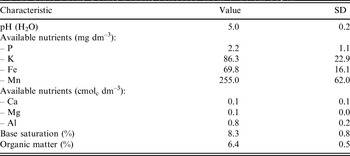
The soil in the PESCAN cerradão area has low availability of P, Ca and Mg, with a base saturation of 8.3 and soil pH of 5 (Table 1).
Characteristics of the soil in the cerradão in the Serra de Caldas Novas State Park, Goiás, Brazil, collected from 0–20 cm depth

n = 6, SD = standard deviation.
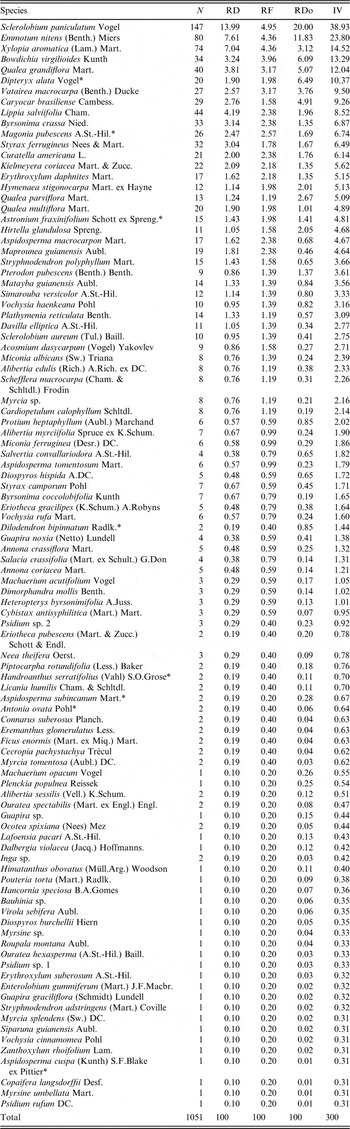
A total of 1051 individuals belonging to 99 species were sampled in the 1 ha area of cerradão (Table 2). The families with the greatest number of species were Leguminosae (19), followed by Vochysiaceae (7), Apocynaceae (6) and Myrtaceae (6), while the genera with the greatest number of species were Aspidosperma (4), Alibertia (3), Myrcia (3), Qualea (3) and Vochysia (3).
Phytosociological parameters of the arboreal species of the dystrophic cerradão in the Serra de Caldas Novas State Park, Goiás, Brazil

N = number of individuals; RD = relative density; RF = relative frequency; RDo = relative dominance; IV = importance value; * = indicator species of mesotrophic cerradão.
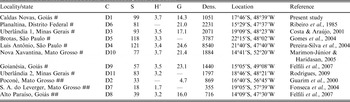
Sclerolobium paniculatum, Emmotum nitens, Xylopia aromatica, Bowdichia virgilioides and Qualea grandiflora were the most important species, giving 34.2% of the importance value and 35.6% of the total number of individuals. Forty-four species (44.4% of the total) had only one or two individuals and were classified as rare species in the community (Table 2). The basal area was calculated as 14.34 m2 ha–1 and the Shannon diversity index (H′) as 3.7 (Table 3).
Comparison of the structural characteristics of cerradão of the Serra de Caldas Novas State Park, Goiás, Brazil with 10 other cerradões in different parts of Brazil

C = site code; S = species richness; H′ = Shannon diversity index; G = basal area per hectare; Dens. = density per hectare; # = dystrophic cerradão; ## = mesotrophic cerradão. Note the characteristic lower species diversity on the three mesotrophic sites (Poconé, S. A. do Leverger and Alto Paraíso). This is usually caused by the dominance of mesotrophic species.
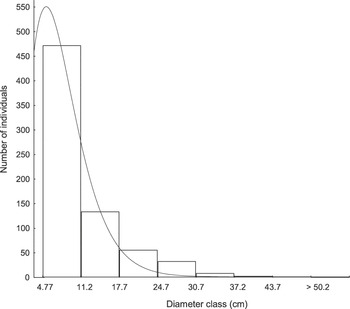
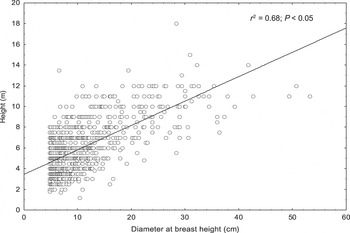
Diameter distribution (Fig. 2) and the relationship between height and diameter (Fig. 3) show that most of the trees had diameters from 5 to 20 cm and heights between 2 and 10 m. The H/D ratio is greater for small diameters (Fig. 3). Very few individuals showed heights greater than 14 m and diameters above 40 cm. An increase in diameter usually leads to a greater variation in observed plant heights (Fig. 3), which reflects a larger H/D ratio and reduces its accuracy.
Tree diameter distribution in the cerradão in the Serra de Caldas Novas State Park. The grey line represents gamma distribution (r 2 = 0.95; P < 0.0001).

Relationship between the diameter at breast height and total height in the cerradão in the Serra de Caldas Novas State Park.

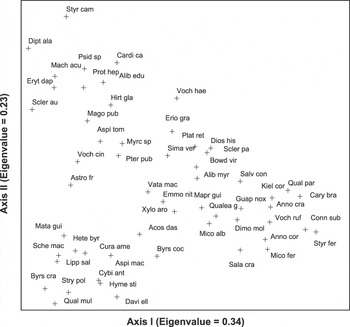
Ordination of species (Fig. 4) resulted in a dispersed cloud of points along the two axes, with a greater variation for axis II. Typical cerradão species such as Sclerolobium paniculatum and Emmotum nitens were positioned in the central part, with average values for the two axes. On the other hand, species that also occur in seasonal semideciduous forests, such as Styrax camporum, Alibertia edulis, Cardiopetalum calophyllum and Dipteryx alata, presented greater values for axis II and were positioned away from the rest of the species. For the first axis, the eigenvalue was large (0.34) and species of the cerrado (s.s.) such as Connarus suberosus, Caryocar brasiliense, Annona crassiflora and Styrax ferrugineus were grouped towards one end of this axis.
Ordination of arboreal plant species of the fragment of cerradão in the Serra de Caldas Novas State Park using the DECORANA method.

The results of the TWINSPAN analysis are reported in the next section as it is easier to consider them in conjunction with the discussion.
Discussion
The cerradão is a forest physiognomy intermediate between cerrado and seasonal semideciduous forests, and includes species from both vegetation types (Marimon-Júnior & Haridasan, Reference Marimon-Júnior and Haridasan2005; Ribeiro & Walter, Reference Ribeiro, Walter, Sano, Almeida and Ribeiro2008). The cerrado woody flora is commonly composed of a small number of dominant families, such as Leguminosae, Malpighiaceae, Melastomataceae, Myrtaceae, Rubiaceae and Vochysiaceae (Ratter et al., Reference Ratter, Bridgewater, Ribeiro, Pennington, Lewis and Ratter2006; Mendonça et al., Reference Mendonça, Felfili, Walter, Silva-Júnior, Rezende, Filgueiras, Sano, Almeida and Ribeiro2008). In general, the families with a greater number of species in dystrophic cerradão are Leguminosae and Vochysiaceae (Costa & Araújo, Reference Costa and Araújo2001; Marimon-Júnior & Haridasan, Reference Marimon-Júnior and Haridasan2005). Leguminous species are generally nitrogen fixers and, therefore, should have competitive advantage in cerradão areas with dystrophic soils (Araújo & Haridasan, Reference Araújo and Haridasan1988). In the PESCAN cerradão the leguminous Sclerolobium paniculatum, Bowdichia virgilioides, Dipteryx alata and Vatairea macrocarpa had importance values higher than 10. Dipteryx alata is usually a dominant species of mesotrophic cerradão as it prefers mesotrophic soils (Ratter et al., Reference Ratter, Bridgewater, Ribeiro, Pennington, Lewis and Ratter2006). The presence of this species in the cerradão of PESCAN is probably due to the occurrence of an isolated area of higher nutrient availability. Such areas are not uncommon in the cerrado landscape; for example, one was encountered on Fazenda Palestina in the Brazilian Federal District where there was a mosaic of small patches of dystrophic and mesotrophic cerradão (fide J. Ratter). On the other hand, Bowdichia virgilioides and Vatairea macrocarpa are found with greater importance values in cerradões on dystrophic soils and in more open cerrado (Costa & Araújo, Reference Costa and Araújo2001).
An important aspect of the plant community investigated was the prevalence of small trees, indicating much recent regeneration and causing the low value of basal area per hectare (see Table 3). This type of distribution is generally reported in semideciduous (Oliveira-Filho et al., Reference Oliveira-Filho, Nilton, Vilela and Carvalho2001) and mixed tropical forests (Alder, Reference Alder1995). The H/D ratios and the asymmetry to the left of the diameter distribution, with a good fit to the gamma distribution (r 2 = 0.95; P < 0.0001), was another consequence of most individuals being small.
A very small basal area value, as found by Guarim et al. (2000) in Mato Grosso State (Table 3), indicates selective logging of trees. The small basal area value found in the present study (14.3 m2 ha–1) can be explained by the fact that the sampled community was dominated by a large number of small to medium-sized individuals forming a large number of stems per unit area and high rates of canopy cover. This pattern, together with the density of Sclerolobium paniculatum and Xylopia aromatica, points to recent disturbance in the study site (see Costa & Araújo, Reference Costa and Araújo2001; Pereira-Silva et al., Reference Pereira-Silva, Santos, Kageyama and Hardt2004). Sclerolobium paniculatum, a species with a short lifespan but with great potential for colonising on dystrophic soils, is common as large colonies in cerrado (Costa & Araújo, Reference Costa and Araújo2001) and as isolated individuals in semideciduous and evergreen forests (Araújo et al., Reference Araújo, Guimarães and Nakajima1997). It is notable for its abundant fruit production – so great that it often results in the death of the individuals, causing populations to have great numbers of dead trees. This in a more extreme form is characteristic of the monocarpic genus Tachigali Aubl. to which Sclerolobium paniculatum has recently been transferred by A. T. Oliveira-Filho.
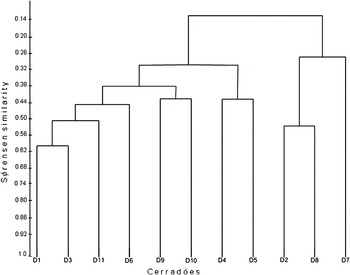
The floristic similarity between our study area and the other 10 communities of cerradões elsewhere in Brazil with which it was compared was low, and there was a clear separation between the areas of dystrophic and mesotrophic cerradão (Fig. 5). Areas of dystrophic cerradão in the Triângulo Mineiro formed a distinct group, with high floristic similarity indicated by cluster analysis. The species assembly observed in the present study was floristically more similar to D3 (Uberlândia 1) than to D11 (Uberlândia 2). Based on floristic similarity, the analysis clustered the mesotrophic cerradões (D2, D7 and D8) of more fertile soils and separated them from the other eight sites. Even with the limited comparison of only 11 areas in different floristic regions, the results corroborated the observations of Ratter et al. (Reference Ratter, Bridgewater and Ribeiro2003) for cerradões.
Cluster analysis, using the Sørensen similarity index, between the cerradão of the Serra de Caldas Novas State Park and 10 other cerradões in different parts of Brazil. D1 = present study; D2 = Poconé; D3 = Uberlândia 1; D4 = Luis Antônio; D5 = Brotas; D6 = Planaltina; D7 = S. A. do Leverger; D8 = Alto Paraíso; D9 = Goianésia; D10 = Nova Xavantina; D11 = Uberlândia 2. See Table 3 for further details of the sites.

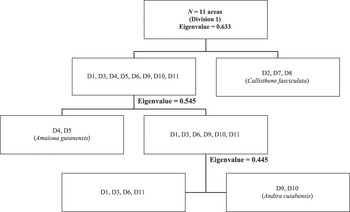
Classification of the 11 areas of cerradão using the TWINSPAN method separated them into three distinct groups. The first division separated off a group of mesotrophic cerradão areas: Poconé (D2) and Santo Antonio do Leverger (D7), both in Mato Grosso State, and Alto Paraíso (D8) in Goiás State showed a significant eigenvalue (0.633, Fig. 6) and were dominated by Callisthene fasciculata, a strong indicator species of mesotrophic areas (Ratter et al., Reference Ratter, Askew, Montgomery, Gifford and Ferri1977). The second division separated off the areas of cerradão in the dystrophic soils of São Paulo State (Luis Antonio) (D4) and Brotas (D5) (eigenvalue = 0.545), with Amaioua guianensis Aubl. as the indicator species in those areas. The remaining areas (Fig. 6), which formed a third group, were divided on the basis of Andira cuiabensis Benth., the indicator species observed in Goianésia (D9) and Nova Xavantina (D10). Our experience suggests that the indicator species of the present analysis are of rather different significance. The first division is based on Callisthene fasciculata, the indicator par excellence of mesotrophic cerradão. However, the second is Amaioua guianensis, a common species of cerradão and forest of dystrophic soil, which is widespread from the Guianas to the south of Brazil. The third is Andira cuiabensis, with probably more differential significance than the previous indicator. It is a species of dystrophic soils of cerrado and cerradão with a distinctly western distribution, occurring in the most westerly sites of the analysed areas.
Classification by the TWINSPAN method of 11 cerradão areas at different sites in central Brazil. The first division separates the dystrophic and mesotrophic sites. In parentheses are the indicator species of each of the divisions with its respective eigenvalue. D1 = present study; D2 = Poconé; D3 = Uberlândia 1; D4 = Luis Antônio; D5 = Brotas; D6 = Planaltina; D7 = S. A. do Leverger; D8 = Alto Paraíso; D9 = Goianésia; D10 = Nova Xavantina; D11 = Uberlândia 2.

Strategies for conservation and management of cerradão fragments should take into account the dichotomy between mesotrophic and dystrophic cerradões and that it is important to conserve both. Callisthene fasciculata, Myracrodruon urundeuva M.Allemão, Anadenanthera colubrina (Vell.) Brenan, Dilodendron bipinnatum and many other species listed in the publications of Ratter et al. are indicators of mesotrophic soils and thus are found in mesotrophic cerradões and the related deciduous forests on mesotrophic soils (Siqueira et al., Reference Siqueira, Araújo and Schiavini2009). Although Magonia pubescens is characteristic of mesotrophic cerradão (Ratter et al., Reference Ratter, Askew, Montgomery, Gifford and Ferri1977, Reference Ratter, Bridgewater, Ribeiro, Pennington, Lewis and Ratter2006), it has a higher environmental plasticity and can also occur on poor soils (Marimon-Júnior & Haridasan, Reference Marimon-Júnior and Haridasan2005) in central Brazil. Sclerolobium paniculatum is a very cosmopolitan species on dystrophic soil, occurring in all areas compared in this study, and usually with large populations (Marimon-Júnior & Haridasan, Reference Marimon-Júnior and Haridasan2005; Rodrigues, Reference Rodrigues2009). Bowdichia virgilioides, Qualea grandiflora and Xylopia aromatica were among the five most important species at PESCAN, and were also more frequent on dystrophic soils. These species are common in cerradão, and Xylopia aromatica is one of the most common colonising species of disturbed areas of this habitat. Qualea grandiflora is the most commonly recorded woody species in the core area of the cerrado biome (Ratter et al., Reference Ratter, Bridgewater and Ribeiro2003, Reference Ratter, Bridgewater, Ribeiro, Pennington, Lewis and Ratter2006, Reference Ratter, Bridgewater, Ribeiro, Fonsêca-Filho, Rodrigues and Silva2011) and although it is an obligate aluminium accumulator occurs as frequently on mesotrophic as on dystrophic soil (Araújo & Haridasan, Reference Araújo and Haridasan1988). This demonstrates the remarkable ability of Vochysiaceae to accumulate aluminium even if it occurs only as a trace in the soil.
Acknowledgements
We wish to thank Dr Antje Ahrends, Plant Diversity and Spatial Analysis Scientist of the Royal Botanic Garden Edinburgh, for her careful checking and editing of analytical techniques used in the paper.