1. Introduction
The theme of the 2017 Asia-Pacific LSP (language for specific purposes) and Professional Communication Conference is ‘Collaborating and Sharing Knowledge’. In this plenary, I report on two studies that are concerned with EAP and ESP teachers and teaching and also related to the conference theme. Both the first and second study involved teacher participants who were willing to share with the researchers information about their work that would help us develop our understanding of teacher education needs. I would like to acknowledge all the teachers who participated in the studies as they were generous in giving their time and sharing their experiences. The second study was a collaboration with a colleague in Spain, and again I wish to acknowledge the major contribution made by my co-researcher in all stages of this project.
In this talk, I will use the term ESP as an umbrella word to refer to the teaching of English for all specific purposes (academic, occupational or professional purposes). I will use the terms ‘English for specific academic purposes’, or ‘ESAP’, and ‘English for general academic purposes’, or ‘EGAP’. ESAP, such as English for engineering students or English for nursing studies, involves teaching learners from the same discipline and thus a focus on language use and communication in that discipline. EGAP, on the other hand, generally involves teaching learners from a mix of disciplines and thus usually a focus on the general academic register or a set of linguistic skills that we believe can be applied across disciplines.
Specificity has been described as the cornerstone of ESP (Hyland Reference Hyland, Hyland and Shaw2016). The teaching of English for occupational or professional purposes has by nature always been highly specific. However, historically, EAP teaching has presented a somewhat different tableau. Here most often we have seen the provision of EGAP-type courses which focus on a generic version of academic English. However, there has been a growing realisation that the provision of EGAP-type instruction may be insufficient. There is often now recognition, at least in principle, of the potential value of providing ESAP-type instruction to support students with the English language needs for disciplinary study. For example, a university may provide EGAP instruction to students in the first year of academic study at a time when students’ majors are yet to be determined (Belcher Reference Belcher2006), and may then supplement this with ESAP-type instruction in later years of study, typically by the provision of instruction focusing on disciplinary writing. An example of this can be seen in Hyland's (Reference Hyland, Hyland and Shaw2016) description of developments in the curriculum at the University of Hong Kong.
Today's talk focuses on ESP teachers and teaching. It focuses on issues in ESP teaching and tasks central to the work of the ESP teacher. These are often additional tasks that teachers of general English may not be required to carry out at all or which do not feature as centrally in the work of the teacher of general English compared to the teacher of ESP. Thus, the talk includes discussion of the extent of subject content knowledge required by an ESP teacher, for example, the extent of knowledge of computer science required by a teacher of an English for computing studies course. The talk includes discussion of how ESP teachers develop their knowledge of specialist discourse, that is, language used in particular disciplines, professions or occupations, such as language used in law studies or in the medical profession, and how ESP teachers devise instruction and materials to focus on such discourse. The talk does not include topics that would be possibly more relevant for teachers of general English, such as the teaching of grammar as a formal system (without reference to its uses in an academic, occupational or professional context).
I will argue that the literature on the topic of teachers and teaching in the ESP literature is limited. The vast majority of published studies in the ESP literature concern linguistic description. To an extent, the topic of teachers and teaching in EAP has begun to receive interest in the literature (Blaj-Ward Reference Blaj-Ward2014; Ding & Bruce Reference Ding and Bruce2017). However, very few published empirical studies directly concern teachers or teaching with the result that little is known about topics such as how ESP teachers develop their knowledge of specialist discourse or how ESP teachers might draw on research-based linguistic descriptions in devising pedagogical descriptions. It is recognised that ESP teachers are specialists who are ‘often needs analysts first and foremost, then designers and implementers of specialised curricula’ (Belcher Reference Belcher2006: 135). This is an extensive and challenging role which involves additional tasks. However, it is my argument that the literature has not fully considered the implications of this role.
In the remainder of today's talk, I describe two studies concerning ESP teachers and teaching. I will present Study One followed by Study Two. In each case, I will review the background literature and then I will provide details of the study in terms of its methods and findings. I will provide more details about Study Two as this study is the more recent.
2. Study One
2.1 Background
The literature on ESP teachers and teaching is, as I mentioned above, very limited. There are reports on products for or products of teaching. For example, Cowling (Reference Cowling2007) describes the syllabus he devised for workplace courses in a Japanese manufacturing company and Bosher & Stocker (Reference Bosher and Stocker2015) present findings from a narrative enquiry into the needs of nurses for workplace English in Taiwan. Both studies were published in the leading journal English for Specific Purposes. Studies such as these are, I believe, of great importance to the field. They are practitioner-led. They report research by those directly involved in teaching in the contexts in question and thus the studies resonate with other ESP teaching practitioners. They report quality practices that others in the field can learn from and they provide innovative or creative solutions to practical problems in the field. An emerging topic is processes of teaching. This literature is even more limited. By ‘processes’, I mean that the main focus of the research is on understanding how courses and/or materials were developed rather than delineating what course designs or materials were developed. Examples of research on the topic of processes include that by Kuzborska (Reference Kuzborska2011) into how EAP teachers developed a reading programme in a university context in Lithuania, research by Basturkmen (Reference Basturkmen2010) into how ESP teachers developed courses in New Zealand contexts, and research by Basturkmen & Bocanegra-Valle into how ESP teachers in university contexts in Spain developed materials and lessons.
Few links have been made in the ESP literature between ESP teacher learning and the wider literature on language teacher education (LTE). Certain themes from the LTE literature are particularly relevant to Study One, which I report on below. These themes include the importance of understanding teachers’ ‘experiences, processes and outcomes of professional learning’ (Borg Reference Borg, Paltridge and Phakiti2015: 552), the learning of practising teachers (Avalos Reference Avalos2011) and the importance of teacher language awareness. Svalberg (Reference Svalberg and Hall2016: 405) notes that ‘well-developed language awareness has the potential to make teachers autonomous and able to supplement/replace textbooks and published materials’. ESP teachers often need to work autonomously on course and materials development, and can rarely depend on a published course book. They need to develop materials. Part of this involves devising pedagogic descriptions of specialist discourse (language use in a specific work or study area). To do this, they need to develop awareness of language use in that area.
2.2 Report
The first study enquired into how highly experienced ESP teachers developed a particular ESP course. I was interested in finding out about the processes involved in course development, the teachers’ considerations in developing the courses and the kinds of difficulties, or constraints, course development involved. It is important, I believe, to consider constraints. In real life teaching situations, teachers/course developers are not completely free. They need to devise instruction within contextual parameters, such as time constraints or school requirements for assessment. The study, which is fully reported in Basturkmen (Reference Basturkmen2010), focused on the development of four ESP courses in New Zealand. In one case, two teachers worked together in developing the course. The courses were ones that the teachers/course developers had recently worked on. Two courses were work-related. One was a course for medical doctors and one a course for police recruits. Two of the courses were study-related. One was an ESAP course for students of art history and one course focused on thesis writing for students from a range of disciplinary areas. The study was an enquiry into how the teachers, who were all highly experienced in ESP teaching and course development, had set about developing that particular course and the materials for it. It was not a study of what the teachers would ideally do or what they might do in the abstract in regard to developing a course. Rather the questions focused on the course they had recently developed and the tasks this particular course development had involved. Thus, this was a study of expertise (highly experienced ESP teachers) and of the procedures used in real-world situations (a concrete course the teachers had recently developed).
The main methods were in-depth interviews with the course developers, and document analysis, for example analysis of teaching materials, course descriptions, materials for assessment and needs analysis. It was a cross-case study in the sense that it involved the attempt to identify similar findings across the cases.
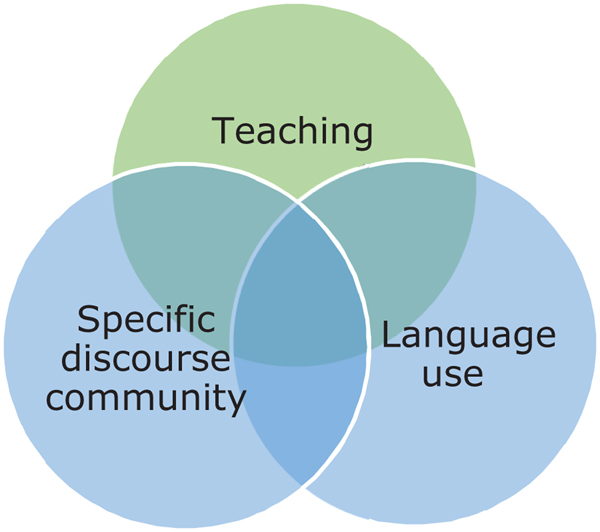
The interview protocol involved many questions which led to multiple findings. Time is too short to summarise all of these in this talk. By way of illustration, one question was ‘In developing your course, how did you investigate and/or describe specialist language use?’ This question enquired into the processes the teachers used to examine and come to understand language use in the specific domain the course they targeted. As shown in Figure 1, this process involved the interfaces between three areas of knowledge, namely, knowledge of teaching (course planning and devising the language component of a course syllabus), knowledge of language analysis (how to analyse samples of language use), and knowledge of the specific domain of interest (the values and expectations held for forms of communication practices and events in a specific discourse community).
Areas of teacher knowledge related to the interview prompt ‘In developing your course, how did you investigate/describe specialist language use?’

The teachers in all four cases reported that this process had involved them in collecting and analysing authentic language samples from target situations, such as police car patrols or doctor–patient interaction in clinics. Even though, for example, there is a literature on doctor–patient interaction, the developer of the course for medical doctors had not relied on findings and examples from this literature, or from published language teaching materials on doctor–patient interaction since the course she was tasked with preparing aimed to focus on the norms and practices of doctor–patient interaction in the New Zealand context and using the New Zealand variety of English. Findings and descriptions from research in other contexts would simply not have been relevant to the course aims.
Findings from Study One revealed the very high levels of knowledge and skills needed by the ESP teachers. The range of tasks that the teachers reported included classroom instruction in and assessment of specialist English, course development, identification of learners’ needs, devising pedagogic descriptions of specialist discourse/language use, investigating specialist discourse/language use or locating existing descriptions in the literature. It further included analysing language samples using discourse analytic techniques (such as corpus analysis, genre analysis and pragmatics), and developing subject-specific instructional materials as commercially published materials were invariably found to be of limited relevance to the class in question.
3. Study Two
3.1 Background
The second study sought to understand how ESP teachers (in a different context) might acquire the kinds of skills and knowledge described above. It seemed that the teachers in the first study acquired these over time and through experience/practice. However, the first study had not directly focused on ESP teacher learning. The second study did focus on this, and also whether teachers in this second context identified residual teacher education needs, skills or knowledge they needed but which did not develop simply through experience, and which might be targeted in potential in-service teacher education.
Literature on ESP teacher development is scarce, a gap recently highlighted by Ding & Campion (Reference Ding, Campion, Hyland and Shaw2016). Belcher (Reference Belcher, Paltridge and Starfield2013: 544) has remarked that the ‘community that ESP professionals know least about is their own.’
There has been sporadic discussion of the kinds of knowledge ESP/EAP teachers require (Ewer Reference Ewer1983; Taylor Reference Taylor1994; Dudley-Evans Reference Dudley-Evans, Howard and Brown1997; Ferguson Reference Ferguson, Howard and Brown1997; Master Reference Master and Hinkel2005; Bruce Reference Bruce2011; Hall Reference Hall and Chapelle2013; Basturkmen Reference Basturkmen2014; Campion Reference Campion2016). There have been surveys of the extent of provision of ESP teacher education in particular geographical contexts, including the US (Master Reference Master, Howard and Brown1997) and UK (Richards Reference Richards, Howard and Brown1997). The surveys have highlighted that provision is very limited. Ding & Campion (Reference Ding, Campion, Hyland and Shaw2016) provide a recent description and critique of EAP teacher education in the UK. Writers have suggested topics for ESP teacher education (Master Reference Master and Hinkel2005; Hűttner, Smit & Mehlmauer-Larcher Reference Hűttner, Smit and Mehlmauer-Larcher2009; Basturkmen Reference Basturkmen2014), although these were generally not derived from empirical research.
Empirical studies on ESP teachers and teaching are few. They include a study of EAP teacher beliefs (Alexander Reference Alexander2012), of how teachers transitioned from ELT to EAP teaching and the challenges they faced in so doing (Campion Reference Campion2016), and a study of the strategies ESP teachers used in their classroom teaching to compensate for gaps in their subject content knowledge (Wu & Badger Reference Wu and Badger2009).
A key document in recent years is the Competency Framework for Teachers of EAP of the British Association of Lectures in English for Academic Purposes. This provides a very useful taxonomy of EAP teacher competencies. For an overview of this, see Bruce (Reference Bruce2011). The Framework identifies competency goals for EAP teachers. That is, it specifies what EAP teachers should know or be able to do. To illustrate, in regard to one competency, academic practice, teachers should have good knowledge of academic discourse, discourse analysis, disciplinary differences and how to explore such differences.
There has been discussion of who can teach ESP. Starfield (Reference Starfield and Hall2016: 157) points out that ‘Given the breath of areas covered by ESP instruction, it is reasonable to ask who can teach ESP and how much content knowledge ESP professionals needs.’ Belcher (Reference Belcher and Belcher2009) asks whether it is better for English to be taught by content-area informed language instructors or by subject specialists. Flowerdew (Reference Flowerdew, Paltridge and Starfield2013) reports that English for occupational purposes courses in the professional sector tend to be taught by discipline-based rather than ESP practitioners. In ESAP and content and language integrated learning there are reports of cooperation between language and subject specialists (Northcott Reference Northcott and Belcher2009), linked subject-language courses (Airey Reference Airey, Hyland and Shaw2016) and team teaching by subject and language specialists (Dudley-Evans & St John Reference Dudley-Evans and St John1998). In English for air traffic control and other highly specialised fields where lives are at stake, the subject specialist is most likely to teach the language (Master Reference Master and Hinkel2005). Who can teach may be changing due to corpus studies and the increasing number of language teachers who are now able to access corpora of academic and professional texts and make observations on language use in them (Starfield Reference Starfield and Hall2016).
It is often the case that language teachers prefer to take on ESAP and ESP courses in fields in which they have some background knowledge. However, there are many examples where language teachers have taken on course development and/or teaching for a field in which they have very limited knowledge. In the two work-related courses in Study One, none of the three teachers involved considered that they had much subject content knowledge prior to embarking on course development. It is also possible that extensive subject content knowledge could be problematic for the teacher of ESP. For example, the teacher is tasked to teach language but cannot resist teaching content. This problem was reported by the teacher/course developer of the English for medical doctors programme in the first study. She was not the first teacher/course developer employed for this programme. Previously, a subject specialist (a practitioner in an allied medical field) had devised and taught the course on doctor–patient interaction, but had focused a lot on medical content rather than on language, the area of need. A subject specialist may take features and forms of language for granted and not be aware of the challenges that learning specialist language use can pose for the second language learner.
Although various viewpoints on the question of the kind of subject content knowledge needed by the ESP teacher have appeared in the literature from time to time, to date there has been almost no work entirely devoted to this topic, with the exception of Ferguson's (Reference Ferguson, Howard and Brown1997) discussion of the role of specialised knowledge in teacher education in ESP. The limited attention to discussion of the subject is a notable lacuna in the literature and one that I think the field could usefully consider over the coming years. Ferguson (Reference Ferguson, Howard and Brown1997: 84) argued that the LSP teacher needs ‘specialised knowledge’ rather than ‘specialist knowledge.’ The latter was defined as knowledge of the content of the students’ discipline or subject. Ferguson argued that the specialised knowledge LSP teachers need comprised knowledge of disciplinary cultures and values, knowledge of the epistemological basis of disciplines and knowledge of genres and discourse. These ideas deserve further consideration in the ESP literature.
3.2 Report
The second study reported on here is my recent collaboration with Ana Bocanegra-Valle from the University of Cádiz, Spain. In the Spanish university context, there is increasing adoption of English Medium Instruction (EMI). Spanish is generally the first language of the majority of faculty and students. There are, however, an increasing number of international students in Spanish universities. EMI is increasingly being adopted at policy level and embraced in principle, although the practice is reported to vary widely in relation to particular institutions, departments and individual faculty members. For a review of EMI in the European context, see Airey (Reference Airey, Hyland and Shaw2016).
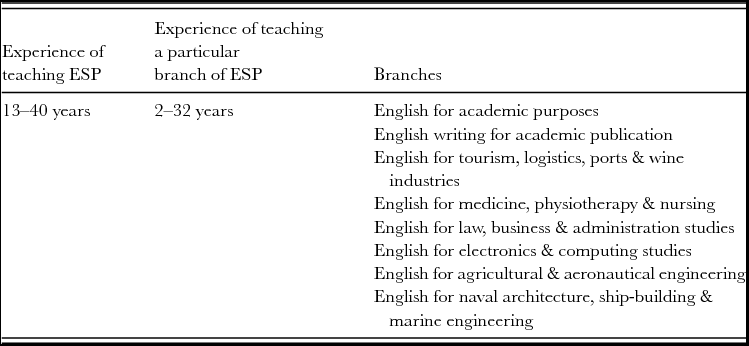
The study investigated the experiences and views of experienced ESP teachers working in two universities in different geographical regions of Spain. It aimed to explore how the teachers developed materials, teacher education needs and interests, and the teachers’ views on the importance of subject content knowledge in ESP teaching. I will now describe the study and highlight some of the most interesting, qualitative findings and observations derived from it. (For an account of quantitative findings, see Bocanegra-Valle & Basturkmen, manuscript under preparation.) Nineteen teachers participated in the study (fifteen female and four male). As shown in Table 1, the teachers taught a wide range of branches of ESP. In this context, EAP courses are offered to support students with English language needs for academic study and the ESP courses are offered to support students in their final year(s) of university with English language needs for the relevant industry sectors– such as tourism, ports, logistics, and the wine industry – in which students will work after graduation. In some cases, students are doing internships with local companies concurrently with university ESP courses. The teachers had between 13 and 40 years’ experience of teaching ESP and between two and 32 years’ experience of teaching a particular branch of ESP, such as English for naval architecture. The branches they taught included English for study purposes, English for research publication purposes, English for industry sectors and English for medicine, business or engineering.
Contexts of teaching in Study Two

We conducted an in-depth interview with each of the teacher participants. We sent the interview prompts to the teachers in advance so they could reflect on their experiences and views and asked the teachers to bring to the interview two samples of materials they had recently developed and used in class. One sample was to be material they felt pleased with in that it had led to a successful class and one sample they were not pleased with. We used these samples as a springboard for recall and discussion of teaching practices and teacher education needs or wants.
The first part of the interview focused on materials development. The teachers were asked about the extent to which they designed materials from scratch or adapted existing materials, how they had started to develop materials and about any training they had received. They were asked also to talk about the sample materials they had brought to the interview. The second part of the interview focused on ESP teacher education needs. In this part, the teachers were asked for their perspectives on the skills and knowledge needed by ESP/EAP teachers and were also asked to identify their strengths and difficulties in teaching ESP in terms of areas in which they felt particularly competent or less competent. We asked them how they had developed the strengths or competencies they identified and, finally, for their perspectives on topics that could usefully be targeted in any future in-service teacher development initiatives in their context.
The interviews were recorded and the recording transcribed. Three interview excerpts are given below to illustrate our discussions with the teachers. Excerpt 1 shows part of a teacher's response to the question about developing or adapting materials. As can be seen in the response, the teacher mainly adapts materials rather than designs these from scratch and tries to use authentic, subject-specific texts as materials, although she finds it necessary to simplify these for her students. Excerpt 2 shows part of a teacher's response to the question about learning to develop materials. Like many responses to this question, the teacher reports not having had training in materials development. The teacher learnt through studying the materials developed by colleagues or those available in published ESP course books.
Excerpt 1
A: How did you learn to develop/adapt materials?
B: I don't really design that much material. I usually adapt, especially like check on the internet and in course books. I find many activities that I like. What I do is to make things easier for the students because everything especially the texts is too high a level for them, at least for my students.
A: Texts? Authentic texts?
B: Yes, that's right. They're too difficult so I usually read the text and make it shorter and change difficult words.
Excerpt 2
A: How did you learn to develop materials?
B: Well, from just observing colleagues doing the teaching materials or from books as well, books like English for Tourism. We have lots of materials in the library, good books for tourism. So trying just to do the same. I mean I haven't had any training course or any training at all in materials development.
Excerpt 3 shows part of a teacher's response to the question about difficulties. He describes a tension between his wish to create exciting and enjoyable instruction on the one hand and to ensure good language learning outcomes on the other. The same tension between teaching methodology/delivery and language content was found in Campion's (Reference Campion2016) study, which investigated the challenges teachers reported when they transitioned from teaching general English to teaching EAP. The teacher in the present study, however, was highly experienced. It is possible that this tension is one the teacher finds hard to resolve despite these years of experience.
Excerpt 3
A: Is there an area that you are not so good at really? Is there anything?
B: I think it's assessment in a way . . . and the outcome. Sometimes, I mean most of the time I am quite unsure. I mean was this activity measuring the progress of the students? Sometimes you have the feeling that I don't know whether they have learned anything at all with this activity Sometimes I have the feeling that I have been wasting some time with this activity. . . . I don't know whether it's our duty as teachers to judge how much we have taught the students or how much they've learned. I know it should be, I mean to say to assess it properly . . . I mean if they are happy when they are doing this I think they've learned. . . . . We are all having fun and have a nice time but what is the outcome of this . . . . But is the point making students happy, I mean motivating the class? Yes, that's ok, but it's not only motivation. They have to improve content and they have to improve the language and knowledge of vocabulary.
3.3 Findings from Study Two
I will now report on a selection of findings from the study.
3.3.1 Materials development
We found that the teachers reported materials development was a major part of their work but that they had received almost no direct training in ESP materials development. They had largely learnt to develop such materials through observing the practices of more experienced colleagues, examining existing ESP materials and gleaning occasional new ideas for teaching/materials from conference presentations. The teachers appeared to have a high level of confidence in their abilities to develop materials and ESP instruction more generally and this was based on extensive practice; they had devised materials and experienced success in this over the years. They appeared particularly confident in developing materials and instruction for speaking, interaction and production-type lessons and, with the exception of one teacher, they reported being confident about developing technology-based instruction. Unlike the teachers in New Zealand, who had generally devised many of their materials from scratch, the teachers in the Spanish context generally reported adapting many of their materials. As one teacher reported, ‘I am good at preparing (rather than) designing material. I don't design a lot.’
A number of difficulties and dilemmas about developing materials/instruction emerged. One difficulty concerned devising instruction for students with a range of linguistic proficiency levels. Students in general English classes are often closely matched in terms of proficiency with the more advanced students in one class, less advanced in another, and intermediate students in a third class. However, only one ESP class for a particular subject area might be offered with the result that classes more often include students with a range of proficiency levels. This presented a challenge for the teachers. Another difficulty concerned students’ motivation. Some students, the teachers reported, had limited interest in their specialist subject area. ESP is based on the idea that learners will be motivated by their subject area. Lack of interest posed a dilemma. Should the teacher select only topics from the specialist subject area when designing instruction/materials, thus tailoring instruction to the interests of only some of the class, or include general topics which would make instruction less ESP-focused? The use of authentic texts presented a further dilemma. The teachers wanted to draw on authentic texts from the specialist subject area but often found these texts were above the linguistic level of the students. The teachers also reported that they struggled to find ways of using such texts; if they simplified the texts, these were no longer authentic.
3.3.2 Teacher needs and interests
As described above, the teachers selected samples of materials they had developed and which they felt had been successful. Most teachers selected speaking, interaction and language production-type materials to show us. They clearly recognised their strengths in developing instruction for these areas. Possibly the teachers were less confident in their abilities to devise materials for the receptive skills of reading and listening. Their selections included almost no mainly form-focused materials, that is, materials to help learners notice discourse or grammar features in specialist language use. Yet the teachers all recognised the importance of helping learners acquire work or study-related language. That the teacher did not include such materials may be indicative of a residual need in this context. One teacher, who was teaching an English for law studies course, commented that he knew conditionals were used in very specific ways in legal discourse but that he felt he ‘did not know how to explain the grammar if it's not in the traditional way’.
And lastly, the teachers highlighted a social need. This was unexpected as no interview prompt had addressed this topic. They needed to share experiences with colleagues and talk about their work in teaching ESP yet all too often as an ESP teacher they worked alone. The teachers were frequently the only teacher for a particular subject and they worked alone. They missed working in a group. One teacher commented ‘That is something I miss. I used to talk to colleagues every day. You know “what are you doing right now? I have found this on the internet.” And sharing everyday problems.’
The teachers suggested topics for teacher education. They expressed interest in extending their expertise in assessment, especially assessing learners’ competencies and measuring learning outcomes in ESP and in materials development. As discussed above, form-focused rather than skills-focused materials would appear to be a priority in this regard. The teachers also expressed interest in exploring ways to extend their understanding of the subject area. They also wished to find ways to help students become autonomous in ESP learning and to gear instruction to learners’ needs after a course has begun. Generally, literature on needs analysis concerns pre-course needs analysis for the purposes of determining objectives (Bocanegra-Valle Reference Bocanegra-Valle, Hyland and Shaw2016).
3.3.3 Views on subject content knowledge
The teachers had a clear understanding about the need for subject content knowledge in ESP teaching. They invariably viewed this kind of knowledge as essential. As one teacher stated, ‘You have to have knowledge of the subject.’ In their experience, such knowledge was easier to acquire in some subjects than others. One teacher felt it was ‘quite easy’ to acquire this knowledge in teaching English for tourism as ‘everyone has been to a travel agent and been on a flight’. Another teacher described the various kinds of knowledge he had needed to acquire for teaching English for law. He reported that, ‘You need to know the language of the law, the situations that language is used in, the way a court works and the different types of crimes.’ These areas are typically fairly unfamiliar to English language teachers, few of whom have usually had direct personal experience of the criminal justice system. The teachers thought they were responsible for acquiring this knowledge. As one explained, ‘I had to learn how the tourism or engineering industry is.’ They reported ways they had acquired such knowledge, which included use of internet sources and TV shows about specific workplace settings, such as medical clinics or law offices. They consulted friends who worked in the academic discipline or profession in question and read books about the particular industry in question, such as books about tourism. A suggestion made by one teacher for new teachers of English for civil engineering was to recommend watching ‘videos about civil engineers because in that way you can see how civil engineers work, how they think.’ We noted that the teachers did not mention acquiring knowledge from the materials their students were using in their work or study area, such as the law textbooks used in law studies. From the researchers’ perspective, this seemed to be missed opportunity.
4. Concluding comments
I have reported on two studies that focused on teaching and teachers in EAP and ESP. Teaching and teachers are areas I feel have been relatively neglected in literature in this field, the literature tending to focus on linguistic descriptions and learner needs but relatively peripherally on teaching and teachers’ needs. What is available conventionally focuses on products for or products of teaching, such as descriptions of syllabuses and materials designed for learners in a particular setting. I have argued that this focus continues to be important in our field. There has been scant research or literature on the processes involved in ESP teaching and on teacher learning and teacher education needs. These are emerging topics that I suggest can usefully extend the scope of the literature in ESP. With so many English language teachers world-wide now working in EAP and ESP, and increasing numbers of new teachers coming into the field and requiring some form of ESP teacher education, it is important that more information becomes available about the ESP teaching profession.
Acknowledgements
I would like to acknowledge the support of the teachers who participated in the two studies reported above. They were generous in giving their time and sharing their experiences with the researchers. I would also like to acknowledge my co-researcher in the second study, Professor Ana Bocanegra-Valle from the University of Cádiz, for her valuable expertise and warm support.
Helen Basturkmen is Associate Professor in Applied Language Studies and Linguistics at the University of Auckland where she convenes postgraduate courses in ESP and Discourse Analysis for Language Teachers. Her main research area is ESP. She has written two books on ESP (Routledge, 2006; Palgrave Macmillan, 2010) and edited the multi-volume work English for academic purposes in the Routledge Critical Concepts in Linguistics Series (2015). In addition to her work on ESP, she has published on a range of topics, including genre analysis, teaching pragmatics, teachers’ beliefs and language awareness.