In Southeast Asia, the high prevalence of extended-spectrum β-lactamase (ESBL)–producing Enterobacteriaceae is concerning. Reference Kiratisin, Apisarnthanarak, Laesripa and Saifon1 – Reference Teerawattanapong, Panich and Kulpokin3 The estimated range of enteric ESBL-producing Enterobacteriaceae colonization is 30%–86% in healthy adults. Reference Teerawattanapong, Panich and Kulpokin3 – Reference Boo, Ng and Lim5 These estimates have potential impact on recommendations for antimicrobial surgical prophylaxis and surgical site infections (SSI) in this region. Guidelines for SSI prevention include screening recommendations for methicillin-resistant Staphylococcus aureus followed by decolonization, 6 , Reference Anderson, Podgorny and Berrios-Torres7 yet screening and decolonization protocols for ESBL-producing Enterobacteriaceae have not been defined. This study was conducted to evaluate the outcomes of enteric ESBL-producing Enterobacteriaceae colonization among patients who underwent abdominal surgery in an ESBL prevalent region.
Methods
A prospective cohort study was performed at Thammasat University Hospital, Thailand from February 1, 2017, to April 1, 2019. All patients who underwent clean-contaminated, contaminated, or dirty abdominal surgical procedures were enrolled. All patients were screened for evidence of ESBL-producing Enterobacteriaceae colonization by rectal swab culture within 1 day before and 5 days after abdominal surgery. Routine preoperative baths with soap and water were recommended for patients the night prior to surgery. Data collection included baseline demographic and clinical characteristics, underlying comorbidities, risk for SSIs, previous hospitalization(s), type of surgical procedure, type of antibiotic prophylaxis and duration (at the surgical team’s discretion), as well as American Society of Anesthesiology (ASA) risk class. Outcomes collected included evidence of superficial and deep SSIs as well as microbiological data (pathogens and susceptibility data) through the 28-day postoperative period (ie, the study end point). Patients were excluded if they had a documented infection(s) at the time of surgery or could not be followed for 28 days after surgery. Superficial and deep SSI was diagnosed according to Centers for Diseases Control and Prevention (CDC) definition. 8 The institutional review board approved this study.
Enteric surveillance swabs (Becton Dickinson Diagnostics, Sparks, MD) were obtained from each patient upon admission and within the 5-day post-operative interval. Each swab was processed in real time and was inoculated into tryptic soy broth containing a 30-μg ceftriaxone disk (bioMérieux) and incubated at 37°C. Within 48 hours of inoculation, 100-μL broth samples with visible turbidity were plated on sheep blood agar and MacConkey agar with a 30-μg ceftriaxone disk and incubated at 37°C overnight. All recovered isolates within the zone of inhibition underwent routine identification using the Vitek 2 automated system (bioMérieux). Antimicrobial susceptibility testing was performed using the Clinical and Laboratory Standards Institute Interpretive Guidelines (disk diffusion test, bioMérieux), and confirmed by ESBL double-disk synergy testing for Enterobacteriaceae. 9
All analyses were performed using SPSS version 19 software (IBM, Armonk, NY). The χ2 or Fisher exact test was used to compare categorical variables. Mann-Whitney U tests were used for continuous data. All P values were 2-tailed; a P value < .05 was considered statistically significant. To determine factors associated with SSIs, variables that had a significant level of P < .20 or variable with priori significant in univariate analyses were entered into multivariate logistic regression models. Adjusted odd ratios (aORs) and 95% confidence intervals (CIs) were calculated.
Results
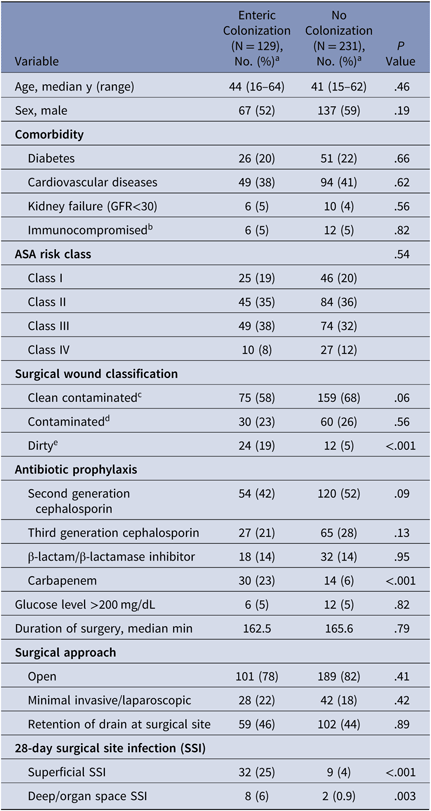
Among 360 patients who underwent abdominal surgery and were prospectively followed through postoperative day 28, and most (N = 204, 56%) were male (Table 1); 234 patients (65%) underwent clean contaminated surgical procedures, 90 (25%) underwent contaminated surgical procedures, and 36 (10%) underwent dirty surgical procedures. At baseline, 129 patients (36%) had preoperative enteric colonization with ESBL-producing Enterobacteriaceae. Preoperative antibiotic prophylaxis included second-generation cephalosporins in 174 patients (48%), third-generation cephalosporins in 92 patients (25%), β-lactam/β-lactamases inhibitor therapy in 50 patients (14%), and carbapenems in 44 patients (12%). The median duration of SSI antibiotic prophylaxis was 2.6 days (range, 1–4 days).
Demographic, Clinical Characteristics and 28-Day Postoperative Surgical Site Infections Among 360 Patients Screened for Preoperative Enteric Colonization With Extended-Spectrum β-Lactamase (ESBL)-Producing Enterobacteriaceae

Note: GFR, glomerular filtration rate; ASA, American Society of Anesthesiology.
a Unless indicated otherwise.
b History of steroid or immunosuppressive agents >2 weeks before surgery, underlying human immunodeficiency virus.
c Clean-contaminated included abdominal procedures that include hepatobiliary tract with contamination.
d Contaminated surgery included abdominal procedures that include colorectal and hepatobiliary tract surgery with evidence of contamination.
e Dirty surgery included any abdominal surgery with evidence of massive contamination (eg, perforated colonic obstruction).
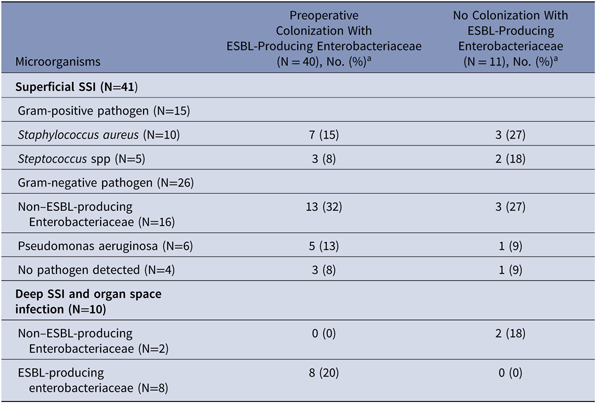
Overall, 51 patients (14.1%) developed an SSI, 41 of whom (80%) had a superficial SSI and 10 of whom (20%) had a deep or organ-space SSI. Among the 41 patients with superficial SSI, wound cultures were positive for S. aureus (10 of 41, 34%), Streptococcus spp (5 of 41, 12%), non–ESBL-producing Enterobacteriaceae (16 of 41, 39%), Pseudomonas aeruginosa (6 of 41, 15%), and no pathogen (4 of 41, 10%) (Table 2). Among 231 patients with negative preoperative enteric screening tests for ESBL-producing Enterobacteriaceae, 12 (5%) screened positive at postoperative day 5. The 8 patients with a deep or organ-space SSI had culture confirmed ESBL-producing Enterobacteriaceae infection, and all 8 had positive preoperative enteric screening tests for ESBL-producing Enterobacteriaceae.
Microbial Characterization of Surgical Site Infections (SSIs) Among 360 Patients Who Underwent Preoperative Enteric Screening for Extended-Spectrum β-Lactamase (ESBL)-Producing Enterobacteriaceae

Note. 4 patients who developed superficial SSIs had negative culture results.
a Unless indicated otherwise.
There was no association between carbapenem surgical prophylaxis and reduction in SSIs (aOR, 0.89; 95% CI, 0.55–14.24; P = .39). By multivariate analysis, independent risk factors for SSI were enteric colonization with ESBL-producing Enterobacteriaceae (aOR, 2.4; 95% CI, 1.19–19.91; P = .04) and dirty abdominal wound classification (aOR, 3.6; 95% CI, 1.94–16.99; P = .02).
Discussion
In this prospective study, enteric colonization with ESBL-producing Enterobacteriaceae was a predictor of abdominal SSI. Most SSIs (80%) were superficial SSIs, and none were attributed to ESBL-producing Enterobacteriaceae. In contrast, the 8 patients who developed deep or organ-space SSIs all had culture-confirmed ESBL-producing Enterobacteriaceae and preoperative enteric screening tests positive for ESBL-producing Enterobacteriaceae. These findings suggest that enteric ESBL colonization is a predictor for deep SSI due to ESBL-producing Enterobacteriaceae and may serve as a proxy for excess skin contamination that deserves further study for effective infection prevention and control interventions. Additionally, although 12% of the study population received surgical prophylaxis with a carbapenem, no association was identified between carbapenem use and SSI reduction. Lastly, without guideline recommendations for preoperative prophylaxis in abdominal surgeries performed in ESBL prevalent region, surgeons observed in this study had a tendency to use a wide variety of broad-spectrum antibiotic regimens and to extend (>2 days) the postoperative antibiotic duration.
Geographic variation in the proportions of ESBL enteric colonization, together with the lack of evidence for effective preventive interventions, makes it difficult to provide general guidance for abdominal surgical care. Studies from Europe suggest that ESBL enteric colonization ranges between 18% and 29% among patients who undergo colorectal surgery, with a 2-fold increase in deep SSI among patients with enteric ESBL-producing Enterobacteriaceae colonization.Reference Pfeffer, Zemel and Kariv10,Reference Dubinsky-Pertzov, Temkin and Harbarth11 Similar to a previous study, Reference Dubinsky-Pertzov, Temkin and Harbarth11 the risk of SSI, particularly deep SSI, remains high in ESBL-prevalent regions. On the contrary, our population included all patients who underwent clean-contaminated, contaminated, or dirty abdominal surgical procedures. A recent study suggested that personalized ertapenem prophylaxis for enteric ESBL-producing Enterobacteriaceae carrier can reduce SSI among patients who underwent colorectal surgery. Reference Nutman, Temkin and Harbarth12 In this study, given that majority of patients had superficial SSIs, we found no association between carbapenem use as surgical prophylaxis and reduction in SSIs.
Our study has a few notable limitations. First, the enteric colonization of ESBL-producing Enterobacteriaceae was performed using rectal swab culture, which has <80% sensitivity Reference Jazmati, Jazmati and Hamprecht13 ; hence, misclassification bias may have occurred, with underestimation of prevalence and the association of colonization to SSI. Second, because the study was performed at a single center, generalization to other populations may not be plausible. Third, the small sample size in this study may have prevented identification of factors associated with SSIs among surgical patients with preoperative enteric colonization of ESBL-producing Enterobacteriaceae.
Despite these limitations, our study increases clinical awareness for the potential association of enteric ESBL-producing Enterobacteriaceae colonization with deep or organ-space SSIs of the same pathogen and provides further evidence in support of the existing guidelines for the use of noncarbapenem antibiotics in surgical prophylaxis. Additional studies to evaluate preoperative bathing interventions seem justified to inform on SSI infection prevention and control among patients colonized with ESBL-producing Enterobacteriaceae in prevalent regions.
Acknowledgments
None.
Financial support
This study was supported in part by a research grant from Investigator-Initiated Studies Program of Merck, Sharp, & Dohme. The opinions expressed in this article are those of the authors and do not necessarily represent those of Merck, Sharp, & Dohme. The funders had no role in the study design, data collection and analysis, decision to publish, or preparation of the article.
Conflicts of interest
All authors report no conflict of interest relevant to this article.