Southern California’s Landscape from 11,000 Feet
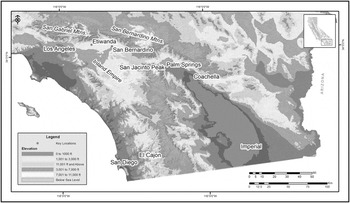
Sometime around 1890, the naturalist John Muir stood on top of San Jacinto Peak, one hundred miles east of Los Angeles, and, according to local lore, described what he saw from 11,000 feet up as “the most sublime spectacle to be found anywhere on this earth.” Although the quotation may well be apocryphal, it is not hard to picture the landscape that would have revealed itself to Muir. Southern California, seen from this altitude, presents a dramatic geography, uneven with peaks and valleys, heat and cold, water and dearth (see Figure 1). The eastern slope of the San Jacinto range, where Muir stood, spreads out into the enormous Mojave Desert. In contrast, the western slope, falling toward the Pacific, is pocked with valleys and lightly watered: Clouds roll off the ocean to be penned up here by the mountains, dumping onto the slopes the moisture they have carried inland. When Muir stood on San Jacinto, the first major Anglo commercial farms were sprouting up in these valleys, around San Bernardino and Etiwanda, feeding on mountain runoff.Footnote 1
Southern California’s topography.

Sixty years after Muir, journalist and social critic Carey McWilliams surveyed the same terrain. To his eye, the mountains themselves formed the true border of southern California. The region as a coherent unit ended at San Jacinto, excluding the desert to the east. The most striking feature of Southern California proper, to McWilliams’s apparent surprise—lying exclusively west of the mountains—was its “amazing fertility. Given water and proper scientific cultivation, the land will raise more things, faster, and in greater quantities than any other section of America.”Footnote 2
As anyone entering a supermarket in postwar America could surmise, the prophecy proved true. Southern California did indeed yield “more things, faster”—an agricultural bounty of astonishing scope. However, McWilliams got the geography partly wrong. It was not only the Mediterranean climate of greater Los Angeles, west of San Jacinto Peak, that gave up the abundance of postwar produce markets—southern California proper, in his reckoning. Coastal southern California was joined in this agrarian bounty by the desert on the eastern slope of the mountains. In 1910, as the California specialty crop boom was accelerating, the farms of Los Angeles County covered 757,985 acres; those of Imperial County, the baked desert valley along the Mexican border, 223,602 acres. In the 1954 agricultural census, by contrast, Los Angeles County farms covered 855,563 acres; Imperial County, 550,075 acres. Agriculture in the desert county had more than doubled its territory, whereas the coastal farms had grown only slightly.Footnote 3
By what logic would agribusinesses scale down the relative weight of production in the land where the rain actually reaches, and fashion an industrial garden beyond the mountain barrier? Why build up the land in the valley and farm the desert? What prosperity might such economic decisions bring—and what consequences? From the outset of this process, social critics have grasped that ecological adventurism of this kind could raise consumer standards in agricultural markets, but would bring serious consequences for both workers and the environment. Woody Guthrie—alongside McWilliams, a leading member of the Popular Front cohort of agribusiness critics—described this tension neatly in his song “Pastures of Plenty”:
California, Arizona, I make all your crops,
Well it’s north up to Oregon to gather your hops,
Dig the beets from your ground, cut the grapes from your vine,
To set on your table your light sparkling wine.
Guthrie sang in the voice of a migrant worker. But even without an explicit ecological consciousness, he grasped that there was a relationship between ecological transformation and economic exploitation in the production of consumer plenty. To make and sell “light sparkling wine,” rivers had to be dammed, deserts had to be transformed into pastures, and workers made disposable:
Green pastures of plenty from dry desert ground,
From that Grand Coulee Dam where the water runs down,
Every state in this union us migrants have been,
We’ll work in this fight and we’ll fight till we win.Footnote 4
This article examines the process by which a California agribusiness, the George F. Johnston Company, made “green pastures of plenty from dry desert ground.” It follows the movement of agricultural capital across space, from the mild foothills of greater Los Angeles into the desert of the Imperial and Coachella Valleys. It argues that environmental forces specific to agricultural production shaped the grape market and drove this movement of capital, with contradictory and often dire results—for workers, consumers, markets, and nature. It was a contorted process by which an agricultural system took shape that led consumers to expect that they could buy any kind of produce at any time, at a price unburdened by the human and ecological costs of year-round production.
Much of the historical literature on agricultural commodity chains attributes their growth to consumer demand. “Environmental history begins in the belly,” goes an aphorism cited by Nicolaas Mink, passed to him from William Cronon, who had, in turn, learned it from Donald Worster. In the case study presented here, however, the expansion of produce markets was driven by dynamics within the supply chain rather than a priori consumer demand. The ever-more abstracted and constant supply of goods out of the land emerged from a wrenching process of competition, expansion, and reorganization within and between firms, from which the Johnston Company emerged as a crucial coordinator in the market for early grapes, rather than an initial unmet need on the consumer end. It was through this process and the commodity chain it constructed that a final good—a springtime grape, in this case—became available without carrying the price of the externalities of its production.Footnote 5
Farming is characterized by an idiosyncratic, largely fixed temporal rhythm. The moment of production happens on its own inflexible, natural schedule. Land and weather, the critical factors of production, defy the direction of management with relative ease. In agriculture, the “factories” are not, as McWilliams once put it, “in the field”; the factories are the fields. Labor performed on a tree or vine is labor on a natural machine, the speed and output of which cannot be set unilaterally by management. This refusal of fields to behave as reliably as their machine equivalents do contributes to the price fluctuation to which agricultural markets are acutely prone, and around which much of the diverse organizational infrastructure of agriculture (e.g., family farming, slavery, farm tenancy, labor contracting, cooperatives, and futures markets) has grown.Footnote 6
The connection observed by Guthrie is inherent to large-scale capitalist agriculture: The imperative of managing an ultimately uncontrollable nature drives a tendency toward extreme exploitation of workers. The narrow window of production necessitates that labor be powerless and disposable if the harvest is to come off profitably. Class relations characterized by intense power imbalance and social domination have thus been especially common in agricultural capitalism. What is more, agricultural production has often been a crucial site of racial formation. The frequency with which racialized labor regimes develop in the fields follows from the agrarian capitalist’s challenge: How does one mobilize the labor necessary for the period of the harvest, without assuming responsibility for the subsistence of the workers year-round? How does one ensure that the bounded period of the harvest, which theoretically might lend leverage to the workers, instead reproduces their disposability and the capitalist’s control? To navigate this situation, agricultural capitalists have often depended on the marking of their employees as racially or legally subordinate in some respect. When McWilliams and Guthrie labeled 1930s agribusinessmen as fascists, it was this tendency that they were observing and expressing in Popular Front rhetoric.Footnote 7
As the Johnston Company developed, it struggled with the ecological imperatives of grape growing. Nature constrained the opportunities for production and marketing in ways that eventually came to impose a severe penalty on the firm’s profits. The company sought to remake its economic environment by escaping its ecological constraints, and to reconstitute its workforce to suit its new geography of production. This process foreshadowed the globalized produce system of the present day, which brings melons and mangoes onto the supermarket shelves of the global North in midwinter. The result of Johnston’s exertions was the expansion of grape production across space and grape markets across time; the hardening of racial hierarchy in social relations; and the worsening of the ecological catastrophe that has long shadowed economic plenty in rural California capitalism.
The George F. Johnston Company
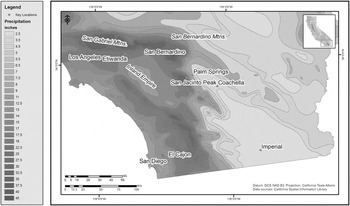
George Johnston arrived in southern California in the late 1880s, apparently a refugee from the long downturn at the end of the nineteenth century. He seems to have spent some time working as a field hand himself, but by 1901 he had scraped up enough money to buy some land in a town called Etiwanda, in what is now the Inland Empire, near where the San Bernardino and San Gabriel mountains meet. Thanks to its position downhill from the highest ranges in the region, Etiwanda was, by the standards of southern California, a wet place (see Figure 2).Footnote 8
Average annual precipitation in southern California, 1900–1960.

The mountains had created this wet patch in a dry land, and so were all important to its early start in specialty crop agriculture. Booster literature described “broad and fertile acres of orange and lemon groves and vineyards along the foot of the picturesque Sierra Madre, whose snowcapped peaks look down from an altitude of some 10,000 feet upon a veritable Garden of Eden.” In 1881, the original developer of the Etiwanda “colony,” an engineer and land speculator named George Chaffey, had realized this natural advantage by laying the first cement irrigation pipes found anywhere in southern California. The Santa Fe Railroad followed soon after, running through the pass between the San Gabriel and San Bernardino ranges.Footnote 9
As Johnston accumulated acreage, he hired labor following a racial schematic. Chinese workers drilled wells and laid pipelines around the feet of the San Gabriel Mountains. Japanese and Italian immigrants, many of whom had skilled winery experience, handled the direct work on the vines and grapes. With this heterogeneous force, Johnston turned himself into a successful (though small, relative to the firms beginning to consolidate in the San Joaquin Valley) specialty grower and shipper of Muscat grapes, selling first to local markets, and soon to farther-flung ones.Footnote 10
The Muscat is the oldest variety of cultivated grape, and can be eaten off the table, dried into raisins, or pressed into wine or juice. Johnston, like most grape growers, produced grapes for all these purposes, but his specialty was shipping fresh produce east in refrigerated train cars. The Etiwanda Muscat harvest began in late summer and ran through October. Typically, the same workers who picked the grapes also got them ready for shipment to a central packinghouse. This was a process of several stages. In Johnston’s early years, grapes would be piled into wagons in bulk and taken to a third-party packinghouse, located at the nearby railroad spur.
The value of table grapes relies on their freshness and attractiveness when they reach the end consumer. With this goal in mind, Johnston adjusted the organization of the vineyard labor process. The new system bucked the industry norm in two ways. First, he had workers cut grapes off the vine in smaller clusters. Second, the pickers became packers as well. Johnston ordered wood (“shook”), from which workers assembled small crates (“lugs”) in which the fruit could be packed more safely. As they harvested, the pickers placed the grapes directly in the lugs, which were then loaded onto trucks and taken directly to the refrigerated train cars.Footnote 11
This “field pack” method bypassed the packinghouse, but getting the grapes off the vine and into the box required more care and skill than at other vineyards. “They used to tell the men how to pick the grapes and how to pack them, how to do it right,” remembered one observer. At the outset of each season, Johnston constantly admonished his labor contractors, “Be sure to get good packers.” This early innovation—incorporating the packing function directly into the organization of the field labor process, rather than ceding it to a third-party packinghouse—reflected a concern for the table grape’s quality at market. It foreshadowed what would become a pattern of unstable attempts at vertical integration in the development of the company, with the organizational hierarchy pegged to fluctuating racial divisions of labor.Footnote 12
When Johnston spoke of “good pickers” and “good packers,” it seems mainly to have denoted a classification of skill, overlapping with a racial classification. Johnston demanded that his labor contractors find good packers; the contractors, Italian and Japanese, turned around and hired from their immigrant enclaves. When gangs of seasonal workers showed up in the vineyards, if the racial composition was a match (Japanese or Italian, but not Mexican or Chinese), Johnston had his “good packers.” As long as they qualified as such, they received the skilled job and higher wage regardless of whether they were Japanese or Italian. If Mexican and Chinese laborers came looking for work, Johnston automatically classified them as unskilled, and shunted them down into ditch digging and weed clearing. Such water-management work, though low in prestige and pay, was vital to the financial health of the company. Grapes would actually grow in parts of Etiwanda without irrigation. They would not, however, grow in sufficient quantity to form a basis for a profitable business. Johnston reported, “We irrigate all of our vineyards as we usually get double the quantity and a superior quality.”Footnote 13
Picking and packing grapes were major, tiring tasks and required a large gang of workers, yet the vines required some work year-round. Picking and shipment in the fall were followed by pruning through the winter to redirect plant energy away from vegetation, and into fruit. Pruning took a somewhat smaller team of workers; typically, Johnston had about one-third as many pruners in winter as pickers in fall. In the spring, the berries received their first coating of sulfur (to fight mildew), with application continuing throughout the warm months, along with pesticide.Footnote 14 Water-management required year-round work as well. Water-sucking Bermuda grass had to be cleared and vines watered. Water a vine too soon, and it will over-vegetate instead of producing sweet fruit. Wait too long, and it will wither under the summer sun. Here, too, a hierarchy of skill and control characterized the relationship between the top and bottom of the company: Johnston decided when to water, and found Mexican and Chinese workers to do it on a casual basis, year round.Footnote 15
Other than the occasional bout of “unreasonable” foot-dragging over wages, there was little formal protest by Johnston’s workers, although it seems certain that surreptitious resistance happened out of his view. The nearest examples require some guesswork. In 1916, a neighbor complained that Italian workers hired by Johnston “carried off some of my things I judge to the amount of $15.00 would be glad you would have them straighten up this difference.” On another occasion, a different neighbor asked to rent a building owned by Johnston, to house short-term workers. The reply from Johnston’s secretary reveals the automatic wariness about the behavior of agricultural workers—theft, tool-breaking, and the like—that one would expect years of muted class conflict to generate: “As Mr. Johnston has several car loads of shook stored in the immediate vicinity of the house, I doubt if it would be safe to harbor transient help there as the material is not insured.” Although anxiety about seasonal laborers’ reliability hints at the conflict intrinsic to the situation, there is no record of overt, organized labor conflicts on Johnston’s farms.Footnote 16
The basic organizational form described thus far captures the shape of the George F. Johnston Company for the first decade of its existence. Johnston had built up a domain of several hundred acres in and around Etiwanda, which he mainly supervised directly. He had secured reliable and affordable access to labor, water, and markets. Although a certain amount of debt is inevitable in agriculture, the ink on the account books was likely to be at its reddest at the outset of the harvest, before an agribusiness can begin making sales and taking in revenue. On August 15, 1912—at the opening of the Muscat harvest—Johnston had no cash on hand, and had borrowed $7,000 from the San Bernardino National Bank to finance operations. However, even a bad harvest or low prices on the coming crop would not have exposed the company to serious risk. He held several thousand dollars’ worth of raisins waiting for sale. More to the point, the total assets of the company at the time amounted to nearly $70,000. And, in fact, within a month, Johnston had netted more than $7,000 on grape sales. In California at large in 1910, total farm debt equaled 24 percent of total farm value, and stood at 23 percent in Johnston’s home county, San Bernardino. In the major grape-growing counties—Kern, Tulare, Fresno, and Kings—it ranged between 20 and 27 percent. For Johnston, the debt ratio hovered at around 10 to 12 percent. This relative financial stability was built atop the initial rent that made the company’s growth possible: the early, easy availability of water at Etiwanda, antedating the acceleration of California’s irrigation boom, and the manageability and control that this concentration of land, water, and labor lent to Johnston.Footnote 17
From 1900 to 1910, the coverage of California’s irrigation networks nearly doubled, from 1.4 million acres to just under 2.7 million acres. Johnston’s competition was growing; the territory seeing the most dramatic expansion was the San Joaquin Valley, the southern half of California’s great Central Valley. In 1880, the San Joaquin and Kings River Canal and Irrigation Company had served 29,000 acres, of which 17,000 were planted with grain and alfalfa. By 1910, the same water system had grown to cover 340,000 acres—and this was no longer grain and alfalfa country, but the new grape heartland.Footnote 18
In that first decade of the twentieth century, California’s annual grape output more than doubled, from 721 million pounds to 1.67 billion pounds. This astonishing growth, although not exclusive to the San Joaquin Valley, was certainly led by development there. Such a powerful stream of investment, when precipitated into the valley’s irrigation canals, turned a sandy backwater into the world capital of viticulture—a position it maintains today. As Steven Stoll writes: “Local promoters had reason to boast when they referred to the perfection of Fresno for grape growing. There are only a handful of places on earth where the right climate, water, and soil for successful viticulture exist together, and the southern San Joaquin is one of them.” Its grapes flooded the market, and prices declined. Survival would require an adaptive fix.Footnote 19
By 1910, the San Joaquin growers dwarfed Johnston in size, but lacked his ease of access to the valleys of California’s far south. When George Johnston went searching for a way to ride out the wave of San Joaquin grapes saturating the market, he looked southward: the farther south the vineyard, the earlier the harvest. If he could manage to establish himself somewhere significantly nearer to Mexico, Johnston might extract himself from the now-glutted market in late-summer, early-fall Muscat grapes. By producing in multiple natural environments, Johnston could sell table grapes at different moments in the year, reaping a premium by syncopating the ordinary rhythm of the grape market.
Johnston first began to push south in 1911. As he did so, he encountered people who were already cultivating their own Muscat grapes. Johnston had no way to proceed except to become a middleman—to melt down his capital and reconstitute it in a new shape. He could not simply set up his own farms; grapevines take several years to yield a mature crop. Therefore, he had to slip into a role as a merchant, and deal with the farmers already on the land. At first, he bought up the crops of a handful of small ranchers in the El Cajon Valley, in the foothills east of San Diego. The deal he worked out with these local farmers required that Johnston buy the grapes while still on the vine, at the price of fifteen dollars per ton once picked. He supplied the labor and transportation and made the shipping and marketing decisions. In some cases, he even hired on the local landlord to superintend the harvest. In July 1911, he shipped his first carload of grapes from outside Etiwanda. The move had bought him almost a month free of the competition of his San Joaquin rivals.Footnote 20
To realize the full promise of moving farther south, however, Johnston realized that he would have to escape the Muscat market entirely. Grapes grown in a significantly hotter environment could get to market sooner; Muscats, however, fare poorly in the scorching heat. Fortunately for him, capital had been pouring into the California countryside, and the San Joaquin Valley was not the only new space opened up for investment. In the first decade of the century, George Chaffey, along with several land speculators and engineers, had begun experimenting with the possibility of diverting the Colorado River into the deserts of the Imperial and Coachella valleys in California’s far south. George Henderson writes, “The aim of the project … was to sell land and water to a ‘white’ settler class of small farmers who would also be sold hundreds of thousands of acre-feet of water imported from the Colorado River. … [There was] a general expression working its way through the California economy: the economic use of space to absorb capital and relieve pressures derived from the boom and bust nature of capitalism.”Footnote 21
Despite an initial series of mishaps, both financial and environmental, the speculators who irrigated the southern desert did manage to parcel the land out to smallholding settlers. One brochure produced by the Imperial County Board of Supervisors advertised the possibility of “An ideal home farm: 40 acres and comfort.” A diagram of a 40-acre homestead illustrated the yeoman idyll, complete with livestock enclosure, orchard, vegetable garden, alfalfa field, vineyard, family home, and yard. “An ideal home farm in Imperial Valley is a 40-acre tract. Rich soil, abundance of water and the possibilities of whole-year culture and a wide variety of products combine to make the small farm the best for practical results.” Another promotional pamphlet, edited by J. Paul Mossau, titled “The Imperial Valley—What it is, and what it is not,” made this producerist idyll the explicit core of its appeal:
Literature, dealing with any of the communities of Southern California, usually refers to them as a paradise, and faithful to usage, a booklet which has received wide distribution refers to the Imperial Valley as a corner of Paradise. Imperial County can scarcely lay serious claim to this. Paradise is reputed to be a place of relaxation, while the Imperial Valley is certainly a land of industry and busy employment. It is a land glowing with milk and honey, where returns reward labor; but not Paradise.
Small farmers came to the valley in response to this appeal. The desert environment was hostile, however, and the social structure stratified; the homesteaders were vulnerable, in short, to would-be middlemen like George Johnston.Footnote 22
In 1914, Johnston expanded again, this time acquiring new interests to the southeast in the newly irrigated desert of the Imperial Valley. The immediate advantages that the region offered were clear, even if Johnston was, at first, uncertain about how to exploit them most effectively. Still, things looked promising. The small farmers who had settled in the decade since irrigation began grew highly profitable, early-fruiting varieties of grapes: in particular, Thompson seedless and Red Malaga, which ripened much earlier than Johnston’s Muscats. Johnston needed their grapes, and they needed his access to credit, markets, and labor.
In his first season there, Johnston wrote a Los Angeles grocer and business partner, “Grapes still ripening slowly, have shipped 6 cars. … Having no former experience down here, am not in a position to say how they will come out.” His apparent pessimism belies the situation: Johnston wrote this letter on July 8, 1914, by which point he had already shipped six carloads of grapes. This meant one crucial thing: Johnston had grapes on the market nearly a month earlier in 1914 than he had in 1913. By the end of the 1915 harvest, Johnston seemed drunk with the possibilities of the Imperial Valley. He was actually willing to rent out his own vineyard land in Etiwanda to tenants who wanted to raise corn, even as he was himself renting land in the Imperial Valley. Never having grown anything but grapes, he suddenly entertained the idea of growing cantaloupes in the valley. In Johnston’s emergent—and uncharacteristic—boldness, in July 1914, he turned down an offer of “financial assistance” from his friend and frequent partner Peter Cuccia. “At present am getting along nicely,” he let Cuccia know.Footnote 23
Again, a spatial fix was also a temporal solution, and it did not take long for Johnston to make the southern deserts the mainstay of his business. Initially, the combination of the desert environment and the lower-quality infrastructure caused too much damage to the grapes in transit, but Johnston developed a technical solution. In this process, called “girdling,” his skilled workers stripped the bark off the vines in belts, near the base of the stem. This prevented plant energy from going into vegetation or back into the earth, instead pushing it into the budding berries. It also sped up the ripening process, and caused vines to make better use of the scarce water in the sandy soil. In New York, Thompson seedless grapes—Johnston’s desert specialty—looked so different from their competition that they came to be known for a time as “Johnston seedless.”Footnote 24
With his technical innovations in place and his supply chain up and running, Johnston successfully expanded his coverage of cultivated acreage, typically contracting at a price of about twenty-five dollars per ton of picked grapes. By 1916, Johnston was shipping the earliest grapes in the entire country, the Thompson seedless variety, grown in the Imperial Valley. On June 20, the Holtville Tribune reported,
The first car of grapes to be shipped from any point in the United States went forward today to New York from the Phil Brooks ranch at Meloland near here. The car was loaded by George F. Johnston and contained a fine lot of Thompson seedless, a high grade table grape of superior quality. A second car is being loaded today and will be shipped to Boston, while other cars will follow rapidly until it is estimated ten or a dozen full loads will go out from the Brooks ranch. In about ten days the Malaga grapes from this point will be ready for the market. Mr. Brooks says that he has made a special effort this year and was liberal in the use of fertilizer and careful in cultivation. He is enthusiastic over the production and optimistic over the future of this section.Footnote 25
Even as his interests in Imperial grew, Johnston found yet another new sub-region, similarly fresh, unexploited ground—the Coachella Valley, next-door to the Imperial. In 1922, these two desert valleys accounted for 294 cars of grapes that Johnston shipped; by 1931, 55 percent came from the two valleys, and a much greater portion of his profit. Indeed, for much of the 1920s and early 1930s, Johnston actually lost money each season on his Etiwanda operation, making up the gap in the southern desert valleys. In 1923, he found himself in the position of having to explain to the government why he had given bonuses to his higher-paid employees in a bad year for his company. He wrote, “In 1923 my net income from the first unit of our operations, which is in the Imperial Valley, was $50,504.73. Expecting that our other two units of operation, El Cajon and Etiwanda, would do proportionately well, I felt justified in declaring bonuses to the four department heads to the amount of $4,440.00 each and paid these amounts on August 1st, and August 16th (before the El Cajon and Etiwanda business opened) to assist them in meeting obligations due at that time incident to their buying property in Imperial Valley.” From August to September, though, the market took a turn. “Later business was disastrous, showing continual losses to the end that all profits were wiped out and a loss sustained as shown.” This pattern, a surprise to Johnston in 1923, would continue for another decade. In 1932, for example, the company took in $84,204.90, which was $2,432.36 less than expenditures—a small net loss. However, the net loss at Etiwanda was nearly $13,000, compensated by profits from Coachella and, to some extent, Imperial. The ground had shifted under the southern California grape business.Footnote 26
Here too, Johnston found himself in an intermediary position as merchant and financier. Local farmers whose grapes he bought on the vine relied on him to supply labor, for which Johnston initially continued to rely on his connections with contractors in the Japanese and Italian communities of southern California. He became a labor contractor, and his immigrant padrones—such as Mateo Masi, Sam Caldarella, and Ori Takeda—became subcontractors. The landlords also needed Johnston’s connections to local produce jobbers across the country, with whom he maintained years-long relationships. It was out of the realm of possibility for someone like Phil Brooks, sitting on a few acres in the Imperial Valley desert, to keep up ties with distributors in Philadelphia or New Orleans. Local smallholders could not market the grapes they grew—indeed, they could not even grow them—without Johnston. For them, Johnston’s arrival did more than solve problems of access to labor and to markets; he also offered a source of credit. As his business had grown and prospered, Johnston had developed the habit of ending each harvest season by depositing a large sum—typically, about $20,000—into his savings account. Over the next year, he would draw down this amount bit by bit. He was free from the intense dependency on debt that crippled so many farmers when prices swung wildly—as they did frequently in agricultural markets. Moreover, Johnston’s contract terms allowed him to refuse to pay for fruit on the vine if he did not believe he could sell it at a profit.Footnote 27
As early as 1917, Johnston began using the money he had banked to keep the local desert landlords afloat between the end of one harvest, in mid-autumn, and the beginning of the next, in late spring. Over the course of January 1917, Johnston spent the remaining balance in the company’s account down to only $18.85: On January 20, he withdrew $13,000 from the San Bernardino County Savings Bank. On January 24, he lent $2,000 to P. L. Cuccia, a produce jobber in Los Angeles, and $1,750 to Phil Brooks in the Imperial Valley. A week later, he paid $4,300 in advances to four more Imperial landlords. The week after that, he lent one of them another $6,000 on his property. The first repayments for these January and February loans appeared in June; the rest trickled in over the course of the year, while Johnston gradually withdrew the remainder of the $20,000 to keep himself above water. And on November 2, he deposited another $20,000 in his savings account, to repeat the cycle the next year. Indeed, he started again in doling out new loans to the landlords before the year was even up. Seeking the differential rents offered by a spatial fix had made Johnston not just a merchant and a labor contractor, but a tinpot banker as well.Footnote 28
Johnston had been forced into these intermediary positions by the circumstances of his arrival in the far south. Still, he spent years working through them, and reaping enormous profits. In 1914—his first year of shipping from the Imperial Valley—the company took in $49,425.18, but netted only $3,004.26. In 1921, as table grape prices climbed to a national level of $80 per ton (and higher still for those with a monopoly on the early season), Johnston’s receipts soared to $246,523.30, and his net profit to $25,703.29. It was at this point that he seems to have decided that he could do without the inconveniences of being a middleman. Collecting the rents that accrued from his reach across the economic spaces of southern California clearly worked well enough. But Johnston seems to have grasped that some of those among whom he coordinated—landlords, labor contractors—needed him more than he needed them. Why continue to pay the transaction costs of his new position if he did not have to?Footnote 29
Johnston depended on workers to be available where and when he wanted them. He could typically manage this through his contractors, but this did not always come off flawlessly. In the summer of 1914, for example, the pickers were collected and en route for Johnston’s first Imperial harvest. Then, in response to a price fluctuation, his agent Peter Cuccia decided to call a halt to picking on one of the ranches. (Cuccia intended to invoke the contract stipulation that allowed Johnston to reject an otherwise good crop that he did not deem profitable.) However, if the pickers arrived and found no work, they would leave, ending the whole harvest prematurely. “The pickers will be ready to go at his fruit Friday, and if they are not allowed to work in a few days they will not stay and Vahan will have a hard time getting more, in fact it will be well nigh impossible,” warned the ranch superintendent. Likewise, at the end of 1921 and the beginning of 1922, rain forced Johnston to idle a group of pruners he had already engaged, and then ruined roads kept them sitting longer still. Having hired them on December 19, he realized, “Many of them went to Los Angeles over Christmas so it will probably be Jany. 4th., or 5th., before I can get them all back and started for the Valley.” The difficulties of hiring for skill across distance remained as well. As Johnston often warned labor contractors, “Its no use for anyone to come who is not a good pruner as he will just have to pay his own fare home.” These were not insurmountable problems, but they were real. Johnston had tried to ramp up the scale of production dramatically without changing the organization of production. Necessarily, this entailed difficulties, as the long distances and multiple seasonal work cycles that the enlarged company now spanned tested his control.Footnote 30
The more serious problem was not with labor, however, but with landlords. Johnston had to trust the landowners in the desert valleys and at El Cajon to keep their capital stock in working order. Living off of productive property that they did not work themselves, but only leased out, some landowners were essentially unprofessional, in contrast to the fastidious Johnston. One, C. Ballance, asked Johnston to come keep an eye on his grapes—that is, to do his job—so he could take a trip to Los Angeles. “I would be glad if you will keep your eye at the remaining Malagas and pick them as soon as they will suit you as it is pretty hard to keep people out of the vineyard. It may be you could make arrangements with Jim to pick them. We want to go to Los A. early next week. I cant go until grapes are picked.” Elsewhere, even as he was trying to convince one landowner to sign a contract, Johnston wrote to business partner Charles Myers, fretting about the mistreated vines on some land:
I was in the vineyard at El Centro last Friday, and find much damage by cut-worms. De Campos said the vines were late this year, so I told him many of them would now be one year late, as what he took for late starting, was caused by the buds being destroyed by cut-worms … over half of the crop is destroyed on the piece just east of the colored grapes I explained to Campos the best way to save part of the crop, and trust he will take the necessary steps to do so.
In May 1915, as Johnston was considering a contract with a farmer in Heber, near Calexico, his agent George Kennedy wrote to him: “Went to Heber this morning and find the grapes are the little patch just south of Whitings corner. Vines have had very poor care and place is covered with weeds.” Johnston often had to instruct the Imperial landowners, whose grapes he bought on the vine, how to maintain their ranches properly. He wrote to one, V. H. Azhderian: “It will be necessary for you to spray your Malagas again this year, especially the south end, along the irrigating ditch. I showed [landowner] Phil Brooks a lot of grapes which we could not pick last year on account of their being ruined by the vine leaf hopper.”Footnote 31
At the very least, such landlord trouble was a headache. What was worse, the local landlords had gotten into the habit of borrowing from Johnston. Moreover, of course, he had to pay them to rent their vines, yet sometimes collected as little as 10 percent of the final selling price, plus expenses. At the height of the price spike, when Imperial grapes were going for about $83 per ton, Johnston had to spend up to $75 per ton on rent. Meanwhile, the landlords appeared to contribute nothing to the process except their permission—and the threat to collude to drive up the rent even further. Thomas Ballantyne, an El Cajon landowner, had threatened Johnston with this in 1913. “I have talked with all the growers you bought grapes from last year and find that the growers on the east side of the valley do not care to sell their grapes for the same as you paid last year. Mr Miller, Hawley and Kemp will sell if you come down and I have about twenty-five acres that have been irrigated that you could pick from.” This all must have seemed, to Johnston, rather overweening behavior for men whom he encountered socially as the managerial staff of his operation.Footnote 32
Thus, it is unsurprising that over the first few years of the 1920s, Johnston decided to terminate his relationships with nearly all the landlords in the far south. He had found a simple enough solution: Rather than buy unimproved land and wait for vineyards to mature, he bought up plots already under cultivation—in some cases, the very ranches he had previously contracted. In 1925, he responded to an enquiry from an Imperial landlord, “We have not bought any grapes for some years and are only handling grapes grown by ourselves.” In 1924, Johnston owned a total of 387 vineyard acres across southern California; by 1927, it was 832, and by 1929, 872.Footnote 33 Without Johnston to connect them to credit, labor, and markets, many of the smallholders folded as he bought up land and broke off relationships.Footnote 34 By the early 1930s, Johnston had a swath of vineyards across wide territory. In addition to the ranches in the far south, he was operating the original vineyards in Etiwanda, retrofitted to grow Ribier and Persian grapes—earlier-fruiting varieties than the abandoned Muscats. Thanks to the sheer volume of grapes he was picking, Johnston needed more labor power than ever. Around this time, he upended his previous system for hiring.Footnote 35
Johnston had for years employed two tiers of short-term laborers, racially delineated. As discussed earlier, the upper tier was made up of Italian and Japanese workers, hired through the padrones. Mikami, Takeda, Masi, and Caldarella provided the pruners, the pickers, and the packers; indeed, thanks to Johnston’s innovations, these latter two jobs were usually combined into a picker-packer position. The lower tier of workers, first Chinese, then Mexican, dug ditches and performed other menial labor. As the volume of grapes picked increased, however, the organization of the labor process changed, which corresponded to a rearrangement of the racial division of labor. Johnston terminated the labor contractors he had relied on for years, and more to the point, their skilled contract gangs. Mateo Masi, Johnston’s longest-serving and most reliable procurer of Italian gang labor, did his last work for Johnston in 1928. Ori Takeda got his last contracting job with Johnston in 1924; an attempt to renew the relationship in 1928 was rebuffed.Footnote 36 With the old labor contractors gone, Japanese and Italian labor all but disappeared as well. Although some Italians still worked at various points in the hierarchy of the old Etiwanda ranches, their responsibilities, and their numbers, dwindled in the lucrative ranches in Coachella and Imperial desert areas. Those who remained were mainly permanent staff, hired directly to supervise the desert ranches, and to perform high-skilled vineyard labor. They kept up the land and took care of tasks, such as packing and pruning, that were thought to be more suited to skilled Europeans.
Mexican workers, once confined to purely menial labor, overtook the bottom half of a vineyard labor process; the new racial configuration was accompanied by changes in the organization of that process. Johnston dispensed with the field-packing innovation that had been at the core of his early business. The field-pack had been a crucial element of his early rent—access to water in the San Bernardino Valley, and consequent consolidated and direct control over the production of a high-quality product. Once his business had become reoriented around early production, the importance of volume increased relative to quality. Johnston had a window in time to realize the new differential rent to which he had access in his early market. However much he produced in this moment, he could probably sell. He thus set about increasing the spread of his territory across the desert and reorganizing the labor process to accommodate this increased volume. Picking work became increasingly exploitative, deskilled, and racially demarcated. “Good packers” remained a part of Johnston’s labor market lexicon, as that was work that he still deemed more delicate; however, “good pickers” disappeared. By the early 1930s, Mexican workers did all the picking in Coachella and Imperial. They worked in gangs larger than any Johnston had ever hired before, often numbering more than 50 people per crew. “As many of the italians will not work for 25¢ per hour, and as we cannot pay more,” Johnston explained, “we pick loose in the vineyards with mexicans and pack under the trees with some italians.”Footnote 37
Johnston’s turn to Mexican workers for agricultural labor coincided with that of the region at large, following the migration produced by the Mexican Revolution. Simply noting the sudden availability of Mexican labor power, however, is inadequate to explain the racial reordering of the vineyard division of labor, which had its origins in geography. More precisely, the spatial dynamics by which rural California capitalism developed, from the 1880s up through the 1930s, underlay the immediate push and pull of supply and demand in the labor market. First the land had been refashioned into a factor of production (by irrigation), keyed to a market (early grapes), and largely cleared of intermediate classes (the small landlords and skilled Italian and Japanese workers). With that done, a relatively variegated hierarchy of race and skill hardened into a sharply racially demarcated class system. Now composing the social structure were a white class of owners, managers, and skilled workers, and a deskilled, racially marginalized rural proletariat.
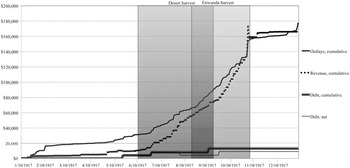
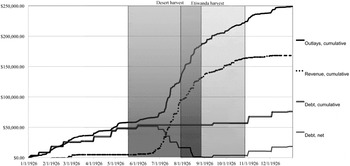
In sum, over the course of the 1920s, Johnston conquered the desert valleys of the far south. He achieved the monopoly rent he had sought over early grapes, and he eliminated the transaction costs associated with his expansion across the space of California and the time of the seasonal produce calendar. He reworked the organization of his business, allowing new connections of credit, labor, water, and markets. The triumph, however, was short-lived. In 1917, a profitable year (see Figure 3), the company took on a relatively small amount of debt at the opening of each of its regional harvests, which left it largely unburdened by the end of the annual production cycle. Roughly 40 percent of the company’s revenues that year came from desert production, another 40 percent from the Etiwanda farms, and a final 20 percent from repayment and interest on loans to desert farmers. In contrast, in 1926, 80 percent of Johnston’s revenues came from the desert farms (see Table 2), and the company finished the year at a loss, with an unpaid debt load of $18,389, equal to nearly 11 percent of its revenue for the year. As profit margins vanished, the transition toward a racially stratified workforce accelerated.Footnote 38
George F. Johnston Company, finances, 1917.Footnote 39

George F. Johnston Company finances, 1926.Footnote 40

In essence, the inland deserts and watered valleys could not be brought into sync: The debt required to operate the farms in Coachella and Imperial had paid itself off in sales, but the accumulating outlays required to operate the Etiwanda vineyards had buried the Johnston Company deep in the red.
With rapid expansion and a growing ownership stake in the land he farmed, Johnson had come to rely more and more on debt to get through the seasonal cycle. In 1918, he had taken only $32,300 in debt. However, the war-driven bounce in grape prices, which had delivered the huge profits of the late 1910s and early 1920s, had beguiled Johnston. By 1927, Johnston had borrowed $94,700 for the annual production cycle. The logic seems clear enough: Prices had risen at the end of World War I, and his bankers held his interest rate steady as he went ever deeper into the red. Having once been a source of credit for the producers whose grapes he marketed, Johnston himself began borrowing from his own marketers. In 1923, he wrote to a New York produce jobber, “In accordance with our previous arrangement with your Mr. Pope, which allowed us to draw on you for $6000.00, we are now drawing on you for $3000.00 of the above amount and may possibly require another $3000.00 about July 1st.” He soon followed up, “Owing to grapes ripening earlier than we had anticipated this year, we find we will require $3000.00, referred to in ours of May 1st., prior to July 1st., and have drawn on you for this amount to-day.” Over the course of the rest of the 1920s and into the Depression, prices steadily sank. The modest debt that had once fueled Johnston’s growth now began to roll over, accumulating year-to-year. The business transitioned, as Hyman Minsky would put it, from “hedge” to “speculative” borrowing—the debt no longer yielding revenue sufficient to zero itself out by the end of the sales cycle.Footnote 41
Peaking at a statewide average of $80 per ton in 1921, prices dropped to $40 per ton by 1923—the year in which Johnston posted his first loss: He brought in $258,000 and spent $262,000, for a total loss of $4,000. By mid-decade, the average price was down to $25 per ton, and Johnston posted an annual loss of $30,000. Worse, now that he owned the land himself, he had little of the flexibility that, while he was working on rented vines, had allowed him to choose, week by week, whether to keep spending on a particular crop or not. By 1931, his marketers were showing signs of anxiety: “We have had an awful time trying to dispose of the last car of grapes you shipped us out of the Imperial Valley,” wrote a San Antonio produce jobber. Kimball Fruit Company, his New York-based marketer and creditor, also began showing signs of anxiety. On April 28, along with a loan of $5,000, a Kimball employee requested a copy of Johnston’s bank statement. “It is a little embarrassing to suggest this, because of our close relationship, our friendship, and our knowledge of your valued business. It, however, is not for ourselves, but for our Bankers.” There was cause for concern. As Carl Kimball, of the same distribution company, wrote a few months later, “The eastern situation is dizzy right now – upset by so many grapes coming from so many different sections at this early date.”Footnote 42
As the specific agricultural price depression of the 1920s concatenated into the general economic crisis of 1929 and beyond, Johnston’s boom-time expansion began to look like overextension. The steady price decline cut unrelentingly into margins; in 1929, however, the desert ranches were still generating significant profits, whereas Etiwanda operated at a loss. As Depression beset consumer markets, demand collapsed for Johnston’s early grapes, which, as out-of-season quasi-luxury products, had once commanded such high prices. By 1935, the situation had reversed: Only low-cost, low-price Etiwanda operated at a profit, and then just barely.Footnote 43 This process forced Johnston to pivot again. He sold 250 of his 900 acres. He dumped his new desert properties and retreated back into contract relationships with Imperial Valley landlords. In 1932, Johnston’s primary bank, San Bernardino National, went under. Locals were so unprepared for the bust that a prosecutor actually convened a grand jury to investigate the rumor, hawked by the Los Angeles Times, that a secret phone bank of communists had deliberately sowed panic and provoked a bank run.Footnote 44
Institutions such as San Bernardino National Bank had served to intermediate between a countryside and a city that, though only several hundred miles apart geographically, remained separated by a wide social gulf. The debits and credits on the account sheets concealed California’s vast inequalities: The very source of Johnston’s success, his move into the desert, nearly ruined him in this moment. To city dwellers, the countryside seemed to yield miracles: fresh grapes at times of year previously unheard-of; huge profits flowing back into metropolitan banks—the returns on credit doled out to farms. Out in the fields, things looked different. The physically differentiated landscape of California, in short, both made possible the highly uneven spatial patterning of economic development seeking various potential rents, and hid the volatility of an economy so arranged.
Although the documentary record becomes much sparser after the Great Depression, existing reports suggest that the national economic recovery enabled Johnston to enter into a second round of expansion in the southern deserts. Having sold off hundreds of acres at the nadir of the Depression, he apparently purchased and contracted his way back up to a quantity of acreage exceeding his prior peak in the early 1930s. Through the war and the postwar boom, Johnston maintained his prosperous position. As a year-round market in fresh produce at all times became an expectation of affluent customers, Johnston’s supply could fill in the period in the calendar between South American imports and the flood of San Joaquin grapes.Footnote 45
After Johnston died in the early 1950s, his son-in-law, William Pearson, continued to operate the company until the 1970s. Ultimately, overcapacity again set in, this time on an even larger scale, as ease of transportation linked cheaper global supply to American consumers. The desert viticulturalist lost his monopoly rent, and it seems that, as the 1970s slowdown took hold, Pearson shut down the southern desert operation. As for the Etiwanda land, Pearson joined the local trend of selling out to real estate developers. Johnston’s granddaughter and her husband, still farming 20 remaining acres in 1991, described the scene: “There’s more money to be made in selling the land than trying to farm it. … The twenty acres that Mr. Johnston had bought in the 1800s we’re still farming. We’ve had real estate people tell us we’re crazy not to accept offers that were being made. … It was all being bought by people from Taiwan, and they were all paying cash.”Footnote 46
Conclusion
Today, the agricultural boom whose beginnings Muir must have seen in the valleys west of the peak, and which McWilliams described in full flower, has come and gone. Where citrus and grapes once prospered there are now housing developments, strip malls, and gargantuan retail warehouse complexes. Standing on San Jacinto and looking west, one might not even be able to see Muir’s “sublime spectacle.” Instead, the valley that lies between San Jacinto Peak and Los Angeles is now, as Mike Davis puts it, “the capital of the smog belt.”Footnote 47 The same winds and topography that channel in precipitation, which once enticed early Anglo farmers like Johnston, now shroud the Inland Empire with the pollution of greater Los Angeles. Agriculture never made much natural sense here, as McWilliams pointed out. The region’s fertility was a modern undertaking. Now farming is diminished, replaced by an enormous exurban bowl.
As land speculators have put this valley’s available rents to other purposes, the larger region has gone through a drastic and strange transformation—as if the crops had leapfrogged San Jacinto Peak, looking for dryer climes. This is a phenomenon that previous generations of inhabitants—and, likely, future ones—would find odd, even disturbing: that farming has mainly fled the semi-arid valley, and instead prospers east of the mountains, in the outright desert. If the scale of the intervention required to fashion a green garden on the western slope of the San Jacinto range struck McWilliams as improbable, it nevertheless shrinks next to the bizarre scene of industrial agribusiness in the scorched lands on the far side of the mountains. However, this move, pioneered by Johnston among others, has set the agenda for agricultural production and produce consumption; from its causes and consequences we can read the economic dynamics, and the likely ecological fate, of the desert prosperity of the American Southwest.Footnote 48
The project of assembling labor, financing, nature, and markets into a profitable whole—and then reassembling again in a new shape when the competition catches up—has turned supermarket produce departments into consumer theme parks, but left much of the rural world in a precarious position. Today, the Colorado River, diverted into the Imperial and Coachella valleys, no longer reliably reaches the ocean. Instead, it drains through the irrigation canals cut into the desert, into the toxic and ultra-saline Salton Sea. Agribusinesses like Johnston’s, by making the desert into their hothouses, have devastated the ecosystem and pushed the entire region to the brink of a catastrophic drought—now widely seen by environmental scientists as inevitable, and perhaps already under way.Footnote 49
What the Johnston case illustrates is how the ecological consequences of agricultural bounty are at one with its profound social and economic ills. Johnston’s growth, driven by environmental forces, caused him to implement a stark expansion of inequality within the agricultural proletariat, along lines of race and citizenship. The struggle between agribusiness and nature for control of the timing of the harvest became manifest in the company’s geography and in the social structure of its workforce.
The exact process of the growth, change, and eventual decline of the George F. Johnston Company was, in its own terms, unusual. It involved one entrepreneur carving out relatively small niches in the agricultural economy and exploiting them as long as he could, in precise ways that differed from the strategies of somewhat similar firms with slightly different niches. What is exceptional at one scale of analysis, however, is general one level up: California has contained many such niches, in which geography determines market structure, firm organization, and social order in different formations. Viewed at a distance, the geographical, social, and environmental outcomes of different sectors of agriculture—and possibly other sorts of primary production—seem similar enough to raise a general concern. Regardless of the local specialty of production, one finds an enormous gulf between rich and poor, overlapping with a racial and legal distinction separating white from Chicano, and a regional one separating urban from rural. And across the region, the water is running out.
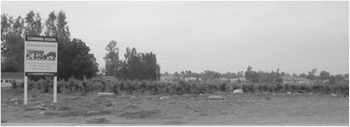
The significance of the Johnston case lies in how it offers one of many idiosyncratic instances that together form an overall pattern: a capitalism defined by the pursuit of differential land rents and the creation of firm structures and social structures that enable the capture of those rents and the externalization of their social and ecological costs. It is this process, whether in pursuit of grapes, hops, oranges, lemons, or cotton that has driven an unmistakable dynamic of environmental destruction and social stratification. One might even make such a case about other nonagricultural California commodity markets organized around land-rent: oil and real estate come to mind. Prices in these sometimes-speculative markets also link a specific spot on earth with a specific window of time in the market; hence the financial scaffolding of futures and derivatives erected around such commodities to smooth their markets across time—a scaffolding that resembles that surrounding agricultural commodities. Their production also has entailed a sometimes-wanton scramble for the big score, with high social and environmental costs left to be accounted for later. Indeed, it is probably no coincidence, though beyond the scope of this article, that the old agricultural zones on the fringes of California’s metropolitan regions were the very heart of the recent real estate mania and meltdown. Etiwanda is just such a place—one of many sites in California where vines and orchards were torn up for exurban subdivisions (see Figure 5).Footnote 50
On what was once Johnston’s land, a common Inland Empire scene, where promises of residential development remain stalled after the collapse of the local economy. The sign reads: “Coming Soon: Etiwanda Estates; 14 new single family estate homes; 3,400–5,000 Sq. Ft.; Half-acre lots.” Photo taken May 2012.

Today, one finds some of America’s worst poverty rates in the exact zones of California that Johnston once farmed. The causal chain here did not run directly from Johnston to today’s crises, of course. However, it is impossible to mistake the way that Johnston’s earlier efforts prefigured the eventual fate of people in this region. Rural California contains many such scenes of profound racialized poverty and environmental crisis; these sites are the backstage of gaudy supermarket displays of year-round produce. They form an inseparable whole.Footnote 51
Attention to the ways agribusinesses like Johnston’s have structured themselves and shifted production and consumption over time and space allows us to see how they have overcome their specific environmental problems and worked nature to their advantage; how, in return for the agricultural plenty of “light sparkling wine,” they make green pastures of plenty from dry desert ground. Historians must account more fully for the costs of this bounty, as the very process of production and marketing conceals a full accounting. Such a reckoning has become urgent, for it is a window onto a food system that is not broken, but rather one that is killing us with its success.