Introduction: frontier cosmopolitanism
‘Cosmopolitanism’ is associated with notions of travel, connections and acquaintance with other regions, peoples and customs. It also presupposes a certain attitude of tolerance towards diversity and a rejection of essentialisms—a “willingness to engage with the Other” (Hannerz Reference Hannerz1990: 239). Unsurprisingly, cosmopolitanism is linked with state societies and urban centres as foci of cultural refinement and experimentation. Yet cosmopolitanism can also be found in unexpected places, far inland and in remote borderlands. This is cosmopolitanism of a different kind: it involves acquaintance with other cultural traditions, religious systems and material worlds, and it is also defined by multilingualism, tolerance and hybridisation, but it is neither elitist nor used to promote personal status, wealth or power over others. Here, we can speak of ‘vernacular cosmopolitanism’ (Bhabha Reference Bhabha, García-Moreno and Pfeiffer1996; Diouf Reference Diouf2000; Werbner Reference Werbner2006). According to Bhabha (Reference Bhabha, García-Moreno and Pfeiffer1996: 195–96), vernacular cosmopolitanism refers to a “cosmopolitan community envisaged in marginality”. Thus, borderlands are good places to find such communities, as they are often marginal in geographic, political and sociocultural terms, frequently acting as sanctuaries for nomads, tribal communities and refugees (Jȩdrej Reference Jȩdrej2004).
In this article, I examine the area between the Sudan and Ethiopia, one of the oldest state borders in sub-Saharan Africa. Elsewhere, I have examined how local communities, predominantly over the past 200 years, developed tactics of resistance against external domination (González-Ruibal Reference González-Ruibal2014), including via isolation, violence and the rejection of foreign artefacts and technologies. Here, I emphasise the other side of the coin, by taking a long-term perspective in order to understand how and why these communities engaged with the wider world.
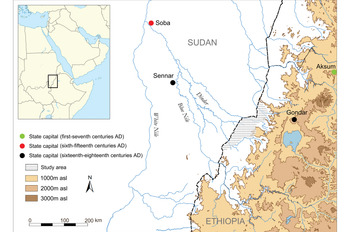
Polities existed in both the Nile Valley and the northern Ethiopian Highlands from at least the early first millennium BC (Connah Reference Connah2015: 69–148), with the area between both polities remaining stubbornly stateless almost until the twenty-first century (González-Ruibal Reference González-Ruibal2014). This article focuses on a specific but representative part of this wide borderland: the region between the Blue Nile and the Atbara Rivers (Figure 1). Here, five seasons of archaeological and ethnographic fieldwork (2013–2019) have revealed a history of migrations, ethnic interactions, cultural creativity, conflict and resistance (González-Ruibal & Falquina Reference González-Ruibal and Falquina2017; Hernando et al. Reference Hernando, González-Ruibal and Derara-Megenassa2019). This vernacular cosmopolitanism is rooted as much in the cultural traditions and moral values of the borderland peoples, who have an extraordinary capacity for assimilating others (James Reference James1979), as in the environment of the region. Although the borderland's rugged geography and harsh ecosystems have prevented its effective colonisation by the state until very recently, its precious resources (including gold, ivory and incense), and its location between old states and along routes of pilgrimage, transhumance and commerce, have long facilitated trans-regional interactions. From this perspective, the borderland represents a strategic space that generates economic, political and cultural resources (Feyissa & Hoehne Reference Feyissa and Hoehne2010; MacEachern Reference MacEachern2018).
Map of the study area, showing centres of power between the mid first millennium and the nineteenth century (image by A. González-Ruibal).

In fact, borderlands are, by definition, cosmopolitan. They are a “Third Space” (Bhabha Reference Bhabha1994: 53–56) that challenges state dichotomies, and where hybridisation, creativity and local agency thrive (Lightfoot & Martínez Reference Lightfoot and Martinez1995; Naum Reference Naum2010; Ylimaunu et al. Reference Ylimaunu, Lakomäki, Kallio-Seppä, Mullins, Nurmi and Kuorilehto2014). This understanding of borderlands allows us to perceive them as worlds in their own right (i.e. borderworlds, rather than borderlands), autonomous from (though related to) neighbouring states. This concept of borderworlds applies particularly to pre-colonial African contexts, where these zones are often much wider—and always more complex—than state territories. Borderworlds are not purely social constructs, as they are often regarded in the social sciences (e.g. St John & Ferris Reference St John and Ferris2019), but rather a combination of ecologies, geographies and the materialisation of human action.
To describe border peoples as essentially cosmopolitan—that is, characterised by a “stance of openness toward divergent cultural experiences” (Hannerz Reference Hannerz1990: 239)—in order to counteract colonial stereotypes, would be both misleading and ahistorical. Reality is more complex: we find neither the primitive isolation imagined by colonial ethnologists, nor the ever-changing, globalised indigene of postmodern anthropology. Rather, we perceive moments of integration and openness, along with others of closure and isolation. I take inspiration here from Morris's (Reference Morris2003) critique of the grand historical narratives on the Mediterranean. For Morris (Reference Morris2003) these narratives have tended to either emphasise stagnation and fragmentation or connectivity and fluidity, the latter becoming mainstream since the 1990s. Morris warns against an exclusive focus on either of these two narratives. Instead, he suggests that the norm is characterised by shifts between moments of integration and moments of stasis. He also argues that connectedness and fluidity are not inherently positive: they create both winners and losers. Morris encourages researchers to explore the reasons behind increased connection or disconnection in the Mediterranean, precisely what I aim to do here in the context of the Horn of Africa.
Two clarifications are required. First, it is important to note that the area under study was situated, until the late nineteenth century, within the margins of Ethiopia. It was, however, culturally and politically much closer to the Sudan than to Ethiopia, while remaining stubbornly autonomous from both polities. Second, the period addressed here corresponds with what is usually termed ‘medieval’. This is a contentious concept in the sub-Saharan African context, although perhaps less so in the case of the Horn, as it is impossible to understand this region's history without reference to Islam, Christianity, long-distance trade networks and phenomena such as feudalism or pilgrimage. Although the prevailing concept of ‘medieval’ has been labelled Eurocentric (with good reasons; see critique in Frankopan (Reference Frankopan2019)), it can be used in a post-colonial way to emphasise the relevance of areas that have been considered marginal or simply forgotten in general accounts of the period between AD 500 and 1500 (Fauvelle Reference Fauvelle2018; Frankopan Reference Frankopan2019). Accepting the concept of ‘medieval’, however, does not mean abiding by its Eurocentric chronology. As in many other parts of Africa, social, political and cultural processes in the Sudan and Ethiopia during the eighteenth century differed little from those of the thirteenth century (Oliver & Atmore Reference Oliver and Atmore2001). Thus, it makes sense to appraise the period between the late first millennium and the early nineteenth century as a single entity.
Entering the network (c. AD 600–900)
By the end of the sixth century AD, there were two powerful Christian polities in the Horn of Africa: in the Sudan, the Kingdom of Alodia, whose capital was in Soba on the Blue Nile, near modern Khartoum (Welsby & Daniels Reference Welsby and Daniels1991; Zarroug Reference Zarroug1991; Welsby Reference Welsby1998); and in Ethiopia, the Kingdom of Aksum, in the northern Highlands, with its centre in the city of the same name (Phillipson Reference Phillipson2012). The existence of the latter kingdom had little impact on the Blue Nile Basin, but Alodia had a lasting influence on the remote borderland.
Much of the Sudanese/Ethiopian borderland was occupied by hunter-gatherers until the mid first millennium AD. To the north of the Blue Nile, evidence for food-producing communities is attested archaeologically only from that date onwards (González-Ruibal & Falquina Reference González-Ruibal and Falquina2017: 176–83). At this time, small groups of pastoralists began moving back and forth between eastern Sudan and the Ethiopian foothills. They established small camps, usually of around 1000–1500m2 in extent. These were located on the floodplains of large rivers—the Dinder, Dubaba and Gelegu—that form part of the Blue Nile watershed and provide natural routes connecting the Sudan and Ethiopia. During the dry season (around November), pastoralists, who were probably semi-sedentary, moved their herds along the rivers into the greener Ethiopian foothills, returning to the Sudan with the first rains, starting in May, to avoid tsetse flies and other parasites that prey on cattle. As my team and I have observed, this model of transhumance continues in the region today. Although the archaeological situation in eastern Sudan is poorly understood, similar camp sites have been found between the Blue Nile and the Dinder (Ahmed & Ahmed Reference Ahmed and Ahmed2004).
The archaeological material assemblage on the Ethiopian side of the modern border is limited: our surveys documented a few grinding stones, abundant pottery and many spindle whorls (unpublished data). Grinding stones are small and portable, as befits a mobile population. Pottery, all handmade, shows very little typological variation: most of the vessels are small- or medium-sized open bowls (González-Ruibal & Falquina Reference González-Ruibal and Falquina2017: 179–82). This, again, is consistent with semi-sedentary groups. The pottery shows striking resemblance to that used in the early Christian period in the Sudanese Blue Nile (c. AD 600–900). Similarities can be found in shape, fabric (thin walls and mineral temper), modelling, colour (dark tones), surface treatment (burnishing) and decoration. The latter includes rims exhibiting finger impressions, and crosses and lozenges filled with incised lines or stylus impressions. Exact parallels are seen in early Christian Sudan during the late first millennium AD (Welsby Reference Welsby1998: 69).
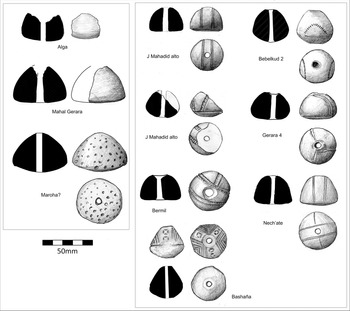
The spindle whorls provide the clearest evidence of a shared cultural world. These became popular during the Late Meroitic period (third to fourth centuries AD) in the Sudan with the rise of cotton cultivation, and are exceedingly common finds from late post-Meroitic and early Christian sites along the Blue Nile (Crawford & Addison Reference Crawford and Addison1951; Yvanez Reference Yvanez2016). Our surveys in western Ethiopia documented 19 whorls from 13 different sites (unpublished data). Of these, ten can be dated to the second half of the first millennium AD (Figure 2).
Spindle whorls of the Dinder Tradition (c. AD 600–900) (image by A. González-Ruibal).

Despite slight differences in size and decoration, there are striking resemblances between the Ethiopian whorls and examples from Sudan (Yvanez Reference Yvanez2016: 166). These objects attest to a world of common symbols spread over a very wide area. Their abundance suggests that communities in the Ethiopian foothills could have been producing surplus yarn to trade with the Kingdom of Alodia and beyond, and therefore that the Sudanese-Ethiopian borderland was integrated in the late first-millennium trans-regional economy. The artefacts also speak of the custom of wearing clothing, with important implications. When Muslim geographer Ibn Hawqal visited Alodia during the mid tenth century, he considered the groups living north of the Blue Nile to be “Nubians” (Zarroug Reference Zarroug1991: 17–18), who could be distinguished from communities living upstream farther south—known to the author as “Tubli”. The Alodians did not trade with the Tubli, “because they go naked and nobody knows what they eat or how they are” (Zarroug Reference Zarroug1991: 18). The denomination ‘Nubian’, which stands in opposition to ‘Tubli’, doubtless refers to a form of civilisation—that of the middle Nile Valley—with which the geographer was familiar and that was shared by people beyond Nubia proper. In contrast to the ‘savage’ Tubli, the Nubians of the borderland traded and wore clothing.
Ibn Hawqal confirms what we see in the archaeological record: that there were groups who maintained connections with the Alodian kingdom, trading and sharing customs, material traditions and cultural codes; and that there were others, such as the Tubli, who remained separate and resisted incorporation into this network of economic and symbolic exchanges. Indeed, unpublished surveys by Victor M. Fernández of the area inhabited by the Tubli—today, Benishangul—have failed to find archaeological evidence of connections with Alodia for the period considered here.
During the second half of the first millennium AD, the ‘Nubians’ of the borderland navigated between two worlds—the state and the stateless—their transhumant movements helping them to connect with both. The importance of gender roles in interregional connectivity is also notable, as ethnographic analogies suggest that both pottery-making and weaving were female chores (e.g. Crowfoot & Crowfoot Reference Crowfoot and Crowfoot1921; González-Ruibal Reference González-Ruibal2014; Salazar-Bonet et al. Reference Salazar-Bonet, Clack and Brittain2019). Historically, matrifocality was strong in the Sudanese/Ethiopian region, and today it manifests in rituals of community renewal and healing practices carried out by women, and in elements of matrilineality (James Reference James1979). Material actions, such as spindle-whorl-making and yarn-weaving, formed part of these practices of relationality that stitched different worlds together.
Stasis (c. AD 900–1600)
During the transition between the first and second millennia AD, some of the transhumant communities living north of the Blue Nile began to settle along the Ethiopian foothills. Camps became villages, which grew in number and size (up to 15 times larger than earlier sites). Population size also increased. Stone architecture appeared for the first time, indicative of the permanent nature of the sites. This consists of the foundations of raised roundhouses, granaries and terracing walls. Sites are no longer located along riverbanks, but rather on the slopes of the hills flanking the rivers. Contacts with Alodia diminished as a vernacular culture appeared, c. AD 900–1300, which we have named the Gelegu Tradition (González-Ruibal & Falquina Reference González-Ruibal and Falquina2017).
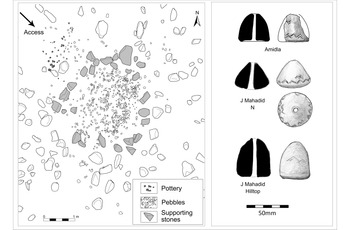
The Gelegu Tradition is characterised by a particular settlement pattern, architecture, pottery and types of spindle whorl (Figure 3). The ceramic assemblage now featured larger vessels with thicker walls, more adapted to a sedentary way of life, while decoration became uncommon, except on rims, which were still frequently decorated with finger impressions—identical to a those recorded in Alodia. Notably, this type of decoration seems to have survived in the borderland after it had been largely abandoned in the heart of the kingdom; in Soba, it is predominantly encountered in levels dating to AD 600–900 (Welsby Reference Welsby1998: 92–93), perhaps due to the growing isolation of these newly sedentarised communities. Regardless, some people kept moving back and forth along the rivers with their animals: we have documented two contemporaneous campsites, one of which is radiocarbon-dated to the mid thirteenth century and has yielded cattle bones (González-Ruibal & Falquina Reference González-Ruibal and Falquina2017: 178). Spindle whorls, which are common across Gelegu Tradition sites, have beehive shapes unknown in the Sudan, and they are fewer in number. Although the aggregate area of settlement sites increased fourfold, the number of spindle whorls diminished by half. This might indicate that communities were producing cotton cloth or yarn for self-consumption only. Thus, sedentarisation led to isolation and fragmentation, and probably also to a process of ethnogenesis, as the people of the Ethiopian foothills increasingly diverged from their Sudanese neighbours.
Remains of a hut (Bebelkud, Dinder River) and spindle whorls from sites associated with the Gelegu Tradition (c. AD 900–1300) (image by A. González-Ruibal).

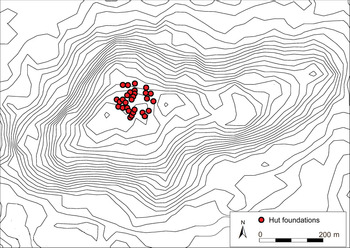
The situation changed again around the mid thirteenth century—and for the worse. The archaeological record clearly shows that all the sites on the alluvial plains were abandoned, as were some of the first permanent settlements. Instead, people began to occupy hilltops that rise 100m above the surrounding plains (Figure 4). These are steep hills and climbing them is demanding, particularly if one is carrying water (which was unavailable at the tops) or wood. Historically, hilltop settlements in the region are associated with turmoil (e.g. war, slave-raiding, internal conflict), and locals identify the elevated archaeological sites as dating to the time of the Mahdiyya (AD 1882–1899), when the followers of the Sudanese Mahdi—a Muslim messianic leader—ravaged the Ethiopian foothills, killing or enslaving people. Radiocarbon-dating on charcoal samples from hilltop sites, however, proves that they were occupied at least between the early fifteenth and early seventeenth centuries. Thus, the site of Jebel Omedla was dated to AD 422±21 (D-AMS 027664), whereas the hilltop part of Jebel Mahadid delivered two dates: 417±25 BP (D-AMS 027666) and 304±21 BP (D-AMS 027665), which cover a range between 1434 and 1649 AD (see Table S1 in the online supplementary material (OSM)). Material differences with the previous period are sufficiently marked to define a new cultural assemblage, which we have termed the Jebel Mahadid Tradition (named after its largest site) and dated to c. 1300–1600 AD.
The hilltop site of Jebel Gerara, c. thirteenth to fourteenth centuries AD (image by P. Rodríguez Simón & A. González-Ruibal).

This tradition exhibits a clear technological decline. Pottery becomes exceedingly crude, with thick walls, very rough modelling and irregular firing, and is almost always undecorated. Spindle whorls are much less abundant and are smaller and also undecorated. Those dated typologically to this period are three times less numerous than for the AD 600–900 period, despite the aggregate area of archaeological sites for the former period being nine times larger. It is likely that cotton cultivation, if not abandoned, became less common. At the same time, two artefacts reveal renewed and direct contact between the Ethiopian foothills and the Sudan: incense burners and dokas (Figure 5). Both artefact types originated in the neighbouring Sudan and evince new shared practices across the border. In the case of incense burners, identical artefacts have been documented at sites in the Sennar region, along the Sudanese Blue Nile, such as Abu Geili and Dar el Mek (Crawford & Addison Reference Crawford and Addison1951: 49, pls XXIX & XV.8– 9), whose later phases are roughly contemporaneous with the early Jebel Mahadid Tradition. They are commonly encountered in Ethiopia, and, as in the Sudan, they appear in domestic contexts. Dokas are open, large-diameter pots used for baking kisra (unleavened bread) or dry porridge. Originating in Nubia and becoming widespread throughout the Sudan during the early second millennium AD, dokas are associated with particular culinary practices (Dirar Reference Dirar1993: 171–84), although dry porridge was probably already consumed locally, as suggested by the open bowls of the Gelegu Tradition.
Sudanese-style pottery of the Jebel Mahadid Tradition (AD 1300–1600): A) incense burners; B) doka (image by the A. González-Ruibal & Á. Falquina).

The question of why these two clearly foreign elements—the incense burners and dokas—made their appearance at a time of isolation and conflict has a simple answer: they were brought into Ethiopia by refugees escaping from turmoil in the Kingdom of Alodia. The arrival of refugees matches the sudden population growth that is clear in the archaeological record. The aggregate settlement surface area increases from 57 to 106ha during the thirteenth to fifteenth centuries. The large-scale arrival of people is particularly clear at the eponymous site of Jebel Mahadid, the main occupation phase of which has been radiocarbon-dated to AD 1300–1600 (González-Ruibal & Falquina Reference González-Ruibal and Falquina2017: 185). The site, which was first settled during the previous period, expanded in size from 2.5 to 8ha during this phase. Here, we recorded over 200 stone structures during the 2018 field season, with the total number at the site probably closer to 300. Such a concentration of people had never previously existed in this region, and was never again reached prior to the late twentieth century. Some differences in pottery and architecture within the site and with neighbouring settlements hint at different communities living together. The lack of material continuity with the Gelegu Tradition, in turn, is suggestive of immigration. The settlement had a troubled life, being destroyed twice—first during the fifteenth century and again around a century later (González-Ruibal & Falquina Reference González-Ruibal and Falquina2017: 185).
To understand the situation in the borderland, we must examine the heartland of the Alodian Kingdom. Archaeological and documentary evidence attest to the splendour of its capital, Soba, from the late sixth to the twelfth centuries (Welsby & Daniels Reference Welsby and Daniels1991; Welsby Reference Welsby1998). During the thirteenth century, however, Soba seems to have entered a period of decline, with the abandonment and looting of its churches and squatters living amid the ruins, as well as a foreign population burying their dead in the middle of the city using mortuary practices incompatible with Christianity (Welsby Reference Welsby1998: 44–49). At around the same time, Abu Geili—the other Alodian town to have been excavated on a large scale—was also abandoned, and a cemetery constructed nearby, which again contravenes Christian norms (Crawford & Addison Reference Crawford and Addison1951). In Jebel Moya, a rocky massif in the same area, people relocated to the hilltops (Crawford and Addison Reference Crawford and Addison1951: 148–60). These changes can be associated with an invasion from the south, recorded in Arabic sources, most likely by Nilotic peoples (Trimingham Reference Trimingham1952: 60–61). In 1220, the kingdom collapsed under pressure from the so-called ‘Damdam’ (a blanket term referring to ‘savage’ African populations), but did not disappear altogether. It probably fragmented into several smaller polities, some of which are mentioned by Muslim travellers (O'Fahey & Spaulding Reference O'Fahey and Spaulding1974: 19). Although Alodia survived nominally, between the 1220 Damdam invasion and 1504—the official date of the kingdom's demise—the Blue Nile lacked centralised authority, and conflict plagued the region, spurred by a growing demand from Egypt for slaves after Nubia had become Islamised and therefore off limits for slave traders (Perry Reference Perry2014: 9). The situation was exacerbated by plague in the fourteenth century. These events would have convinced many to migrate, especially those living in the periphery of the kingdom, who were more exposed to raiding.
The period between AD 900 and 1600 was one of stasis in both etymological meanings of the term: first as a state of equilibrium, and then as a state of all-out conflict. Between 900 and 1250, a new vernacular culture arose in relative independence from both the Sudan and Ethiopia as a result of the peaceful and spontaneous sedentarisation of semi-nomadic groups. The forced reconnection with the outside world from the thirteenth century onwards came in the guise of mass migration, violence and decline in the general standard of living.
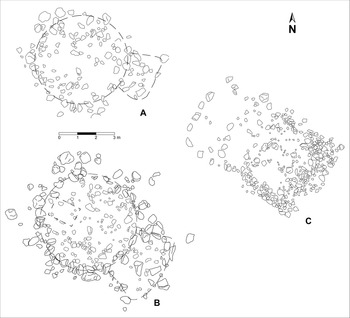
It was not only violence that came to the Ethiopian foothills from the Sudan, however. Migrants brought with them fragments of another world. They carried with them objects, ideas and symbols that were originally Christian, and which became thoroughly reshaped in the borderland. Such elements include the aforementioned incense burners, as well as cross symbols and the orientation of houses and granaries towards the east. Incense had been widely used since antiquity, and played a prominent role in Church rites. Today, incense is used by the borderland peoples in healing and divination practices, and homesteads contain braziers that are very similar to medieval examples (González-Ruibal Reference González-Ruibal2014). The afterlife of the Christian cross is particularly striking. Crosses, often inscribed in circles, commonly featured on Alodian pottery (Welsby Reference Welsby1998: 133–44). Today, they can be seen in facial and bodily scarification and in the decoration of granaries (Figure 6). The orientation of structures is also intriguing. Today, women pray in front of granaries during harvest rituals while facing the sunrise. It is well known that the sunrise plays an important role in Christian symbolism through its association with the idea of resurrection. Thus, churches are oriented to the east. In Ethiopia, many of the medieval houses and granaries that we documented were oriented to the south-east (Figure 7) because the sun rises from the south-east in November, which is the month of the harvest. The borderland communities, therefore, adopted a symbol of resurrection from a foreign, monotheistic religion, and adapted it to what was most important to them: the annual resurrection of the crops. Vernacular cultures incorporated and reworked exotic elements and ideas, some of them with a trans-regional dimension. One of the borderland peoples, the Hamaj, were still very aware of their Christian heritage during the eighteenth century, when they requested Christian missionaries to recover their old faith (Spaulding Reference Spaulding1974: 32), and colonial administrators collected Hamaj oral traditions referring to Soba, the capital of Alodia (Chataway Reference Chataway1930).
Christian symbols from 1) medieval pottery from Soba; 2) modern Gumuz scarifications; 3) modern Hamaj granaries (image by A. González-Ruibal, part 1 after Welsby & Daniels (Reference Welsby and Daniels1991)).

Hut foundations, oriented to the south-east (fifteenth to sixteenth centuries AD) at: A) Jebel Mahadid; B–C) Jebel Omedla (image by A. González-Ruibal).

Back into the network (AD 1685–1821)
By AD 1600 the Ethiopian foothills had been largely depopulated. The situation changed again in 1685, a dramatic year in the Sudanese/Ethiopian borderland, when the Funj Kingdom conquered its eastern margin, causing large-scale migrations into Ethiopia (Spaulding Reference Spaulding1974: 32). Meanwhile, famine and an outbreak of smallpox ravaged the Sudan, triggering more displacements (Holt & Daly Reference Holt and Daly2000: 29). The situation evokes that of the mid thirteenth century, with refugees once again seeking shelter in the Ethiopian foothills. Their presence is visible in the archaeological record in two ways. First, our surveys have documented a steep increase in settlement numbers during the eighteenth century: in the course of just 100 years, there was an increase from no settlement sites to dozens of them, with an aggregate surface area greater than that of AD 1250–1600 (from 106 to 115ha). Second, in terms of material culture, there is an important break with the previous tradition with a radical change in pottery styles, incense burners and settlement patterns (scattered, open sites in the alluvial plains instead of concentrated hilltop villages).
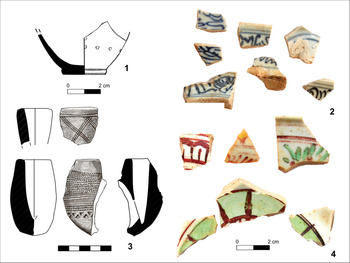
Despite its traumatic beginning, the eighteenth century was a period of relative peace and prosperity. The Funj Kingdom was lenient towards its eastern periphery, which was only nominally subjected to the sultanate. The sultans bestowed titles to local chiefs and allowed indirect rule (Jeȩdrej Reference Jȩdrej2004: 713). The borderlands were not ravaged as they had been between the thirteenth and sixteenth centuries, and trade and exchange increased. A cultural koiné developed that encompassed the Sudanese Blue Nile and the Ethiopian foothills. The objects that we have recovered during fieldwork attest to an expanding exchange network: glass beads from Europe, India and the Middle East, the custom of smoking (imported from the Americas), Islamic ablution jars and Chinese pottery (González-Ruibal & Falquina Reference González-Ruibal and Falquina2017: fig. 24) (Figure 8). It was also during this period that American cultigens—corn, tomato and tobacco—became popular. People were experimenting with objects and ideas that came from lands well beyond their geographic imagination.
Becoming global in the Sudanese/Ethiopian borderland: 1–2 & 4) Chinese wares (late eighteenth to early nineteenth centuries); 3) smoking pipes (late seventeenth to early nineteenth centuries) (image by A. González-Ruibal).

There are two reasons behind the greater connectivity of this period. There is, of course, the larger context of increased globalisation due to European expansion from the late fifteenth century onwards. Yet there is also a more local explanation for increased incorporation of the Sudanese/Ethiopian borderland into the world system. The readiness of people to adopt and adapt certain innovations was fostered because the Funj Kingdom was not a predatory polity reliant on brute force, but rather one that resorted to hegemony and shared cultural practices in relation to its periphery, with which it interacted mostly through peaceful exchanges (James Reference James and Jain1977). Indeed, the Funj Kingdom can be described as a cosmopolitan state: it was multicultural and open to the world. Its territory was crossed by pilgrims heading to Mecca, and products from the Indian Ocean trade and the Mediterranean were transported via the Nile and the Red Sea port of Suakin (Kapteijns & Spaulding Reference Kapteijns and Spaulding1982). During the same period, Ethiopia instead closed itself off to the outside world. This had much to do with the impact of the Jesuit Mission (AD 1557–1632), which resulted in deep internal conflict and eventually a rejection of foreign values and innovation for over two centuries. Thus, despite extensive archaeological work on royal residences at the core of the Ethiopian Kingdom (Fernández et al. Reference Fernández, de Torres, d'Alòs-Moner and Cañete2017), only one sherd of Chinese pottery has been found, whereas we have located at least four different Chinese vessels at Funj-period sites in our study area. Furthermore, we have collected 12 tobacco pipes from our sites, as opposed to only two from the royal residences—a scarcity relating to a strong religious opposition to smoking.
The missionary episode, however, does not entirely explain the isolation of Ethiopia during the seventeenth and eighteenth centuries. Although connected with the wider Christian world, the kingdom does not seem to have engaged deeply in the long-distance trading networks that were active in the Indian Ocean before the arrival of the Portuguese in the early sixteenth century. The few excavations of thirteenth- to sixteenth-century contexts in the Christian Highlands have yielded no imported objects (González-Ruibal Reference González-Ruibal and Orser2020: 663)—a situation that contrasts strikingly with contemporaneous Muslim polities, both to the east and west of Ethiopia (Insoll Reference Insoll2017). This is probably due to the strong cultural tradition of the Highlands based on a beleaguered Christianity, a long state tradition and literacy, which helped create a stable cultural canon. In comparison, the tribal societies of the borderland were bricoleurs by definition, and their readiness to experiment with cultural novelties was only limited by the violence they met from neighbouring states. One such violent episode put an end to the cosmopolitan Funj Kingdom, which was destroyed by the Turco-Egyptian invasion of 1821.
As in the mid thirteenth century, the area was connected to the wider world through violence. The lenient Funj rule gave way to the ravages of Egyptian imperialism, characterised by extensive slavery, looting and heavy tribute. By the mid nineteenth century, the region was virtually empty of people—a demographic collapse that is clear in the widespread abandonment of settlements, resulting in a new hiatus in the archaeological record until the region began to be resettled in the mid twentieth century, based on the oral history that we collected. The image of timeless, isolated tribes conveyed by early colonial anthropologists failed to understand the periods of connection and disconnection that local communities had experienced over the prior 1500 years. Indeed, the borderland peoples had retained ancestral political principles, cultural practices and vernacular materialities against the influence of neighbouring states. But they had also been interacting with the wider world for many centuries, adopting or rejecting innovations depending on the circumstances.
Conclusions
Despite its remote, inland location, the Sudanese/Ethiopian borderland has long been a cosmopolitan region, where different peoples experimented with foreign cultural traditions, religious ideas, techniques and objects—but not always. Contrary to common approaches that strongly emphasise networks and mobility, I have presented a case study in which connectivity and disconnection alternated through time depending on the political circumstances. The tribal societies of the borderland were usually keen to integrate aspects of the external world when they interacted with states, such as Alodia and the Funj Sultanate, that were multicultural and tolerant—what I have termed cosmopolitan states. When predatory polities prevailed, like the Ethiopian Kingdom through most of its history, or the Turco-Egyptian Empire, borderland communities cut ties with the external world and became more self-centred. The same is true not only for tribal societies, but also for states: the closing off of the Ethiopian Kingdom to the external world during the seventeenth and eighteenth centuries was partially influenced by the crisis provoked by foreign missionary intervention. Thus, compared to the Ethiopian royalty, the remote borderland tribes of the eighteenth century had greater access to foreign goods and ideas, and were more willing to incorporate them, than the Ethiopian royalty. This challenges assumptions of connected elites in state centres vs isolated stateless groups.
The material elements that the borderland communities incorporated at different times evince their anxieties and aspirations. Thus, between AD 600 and 1250, clothing and weaving put them in contact with the wider world: clothing made them ‘civilised’ (i.e. ‘Nubians’) and weaving allowed them to participate in a trans-regional economy. During the turbulent period of AD 1300–1600 borderland communities incorporated Christian objects, which were associated with the bygone days of the Alodian Kingdom and which embodied ideas of regeneration, purification and protection—elements much needed at a time of insecurity. Hannerz (Reference Hannerz1990: 240) has argued that ‘cultural competence’ (“the ability to make one's way into other cultures”), which is typical of cosmopolitanism, provides a sense that the world is somehow under control. The appropriation of alien objects and symbols in the borderland was very much connected to this: conscious of their fragile situation in relation to powerful states, local communities embraced those artefacts that could empower them, physically or spiritually.
Connectedness was also helped or hindered by local, regional and trans-regional processes. Transhumance promoted relations during the early medieval period, whereas the first sedentarisation resulted in isolation and cultural fragmentation. Rising regional demand for slaves in the thirteenth and nineteenth centuries put the borderland in contact with the wider world in the worst possible way and compelled its inhabitants to reinforce their identities against external threats. In turn, the world economy of the eighteenth century facilitated access to goods and practices from distant places. The history of the borderland is therefore not one of continuous or increased cosmopolitanism, but of connection and disconnection. The case of the Sudanese/Ethiopian borderland also demonstrates that isolation and disconnection cannot be described as inherently good or bad. Connection often meant dispossession, and isolation could provide the opportunity to thrive.
Acknowledgements
My heartfelt thanks to Worku Derara, Chalachew Simeneh, Álvaro Falquina Aparicio and Pedro Rodríguez Simón for sharing the fieldwork on which this article is based. I am grateful to the Authority for the Research and Conservation of Cultural Heritage (ARCCH) for institutional support in Ethiopia. Gabriel Gerhard offered important insights into the Damdam and the collapse of Alodia. Two anonymous referees provided valuable comments that helped improve the article.
Funding statement
Funding was provided by the Spanish Ministry of Culture/Institute of the Spanish Cultural Heritage-IPCE (Archaeology Abroad Programme) and the PIAR Programme of the Spanish National Research Council (CSIC).
Supplementary material
To view supplementary material for this article, please visit https://doi.org/10.15184/aqy.2021.23