Introduction
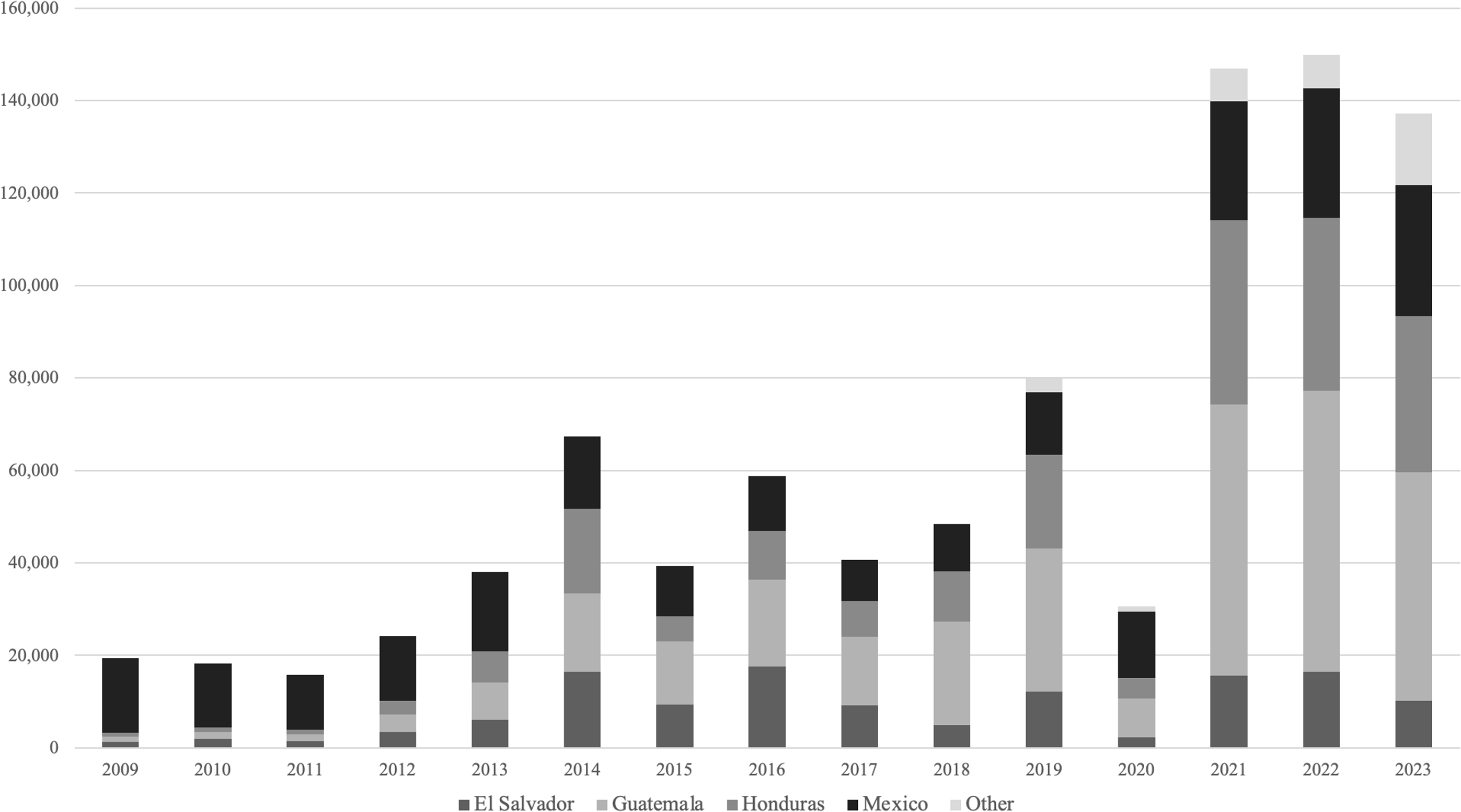
Access to counsel is a privilege and not a right for undocumented immigrants, including children, in the United States.Footnote 1 This study examines the “justice gap”—the difference between the number of people experiencing legal problems who could benefit from legal assistance and those who receive it (Sandefur Reference Rebecca2015a)—for unaccompanied minorsFootnote 2 facing removal proceedings in US immigration court. Since 2009, over one million unaccompanied children have been apprehended at the US-Mexico border, migrating mostly from Guatemala, Honduras, El Salvador, and Mexico (Figure 1). Like adults, these children must petition for immigration relief to avoid deportation back to danger and deprivation in their home countries (United Nations High Commissioner on Refugees 2014). While many qualify for asylum and other humanitarian deportation relief, preparing these applications requires knowledge of complex immigration laws that laypeople seldom possess (Lakhani Reference Lakhani2013, Reference Lakhani2014). The impact of legal representation on case outcomes in the legalistic and procedurally arduous immigration process has been well established by past scholarship (Ramji-Nogales, Schoenholtz, and Schrag Reference Ramji-Nogales, Schoenholtz and Schrag2009; Markowitz and Nash Reference Markowitz and Nash2011; Miller, Keith, and Holmes Reference Miller, Keith and Holmes2013, Reference Miller, Keith and Holmes2014; Srikantiah, Hausman, and Weissman-Ward Reference Srikantiah, Hausman and Weissman-Ward2015), increasing the likelihood of being allowed to remain in the United States for adults in removal proceedings (Eagly and Shafer Reference Eagly and Shafer2015), with even higher gains for unaccompanied minors (TRAC 2014; Galli and Padilla Reference Galli and Padilla2025a). Indeed, immigrant children face added developmental barriers in understanding the law and navigating immigration bureaucracies as compared to adults (Galli Reference Galli2018b, Reference Galli2020a, Reference Galli2020b, Reference Galli2023b; Given-Wilson, Hodes, and Herlihy Reference Given-Wilson, Hodes and Herlihy2018).
Apprehensions of unaccompanied minors at the US-Mexico border
Source: US Customs and Border Protection, “US Border Patrol Southwest Border Apprehension Statistics, Unaccompanied Children,” https://www.cbp.gov.

Recognizing their unique vulnerabilities, the 2008 William Wilberforce Trafficking Victims Protection Reauthorization Act (TVPRA) established due process protections for unaccompanied minors and emphasized the importance of providing them legal representation: “[T]o the greatest extent practicable … all unaccompanied alien children who are or have been in the custody of the Secretary of Homeland Security … [should] have counsel to represent them in legal proceedings or matters and protect them from mistreatment, exploitation, and trafficking.”Footnote 3 Following the introduction of the TVPRA, more federal funding for immigration legal aid has become available for these children. The last available estimates show that, between 2007 and 2012, 29 percent of represented children obtained free representation from a nonprofit or law school clinic compared to 6 percent of represented adults (Eagly and Shafer Reference Eagly and Shafer2015). Yet advocates’ attempts to establish government-funded universal legal representation for immigrant children have failed,Footnote 4 and the supply of free legal services remains insufficient to meet the growing demand of unaccompanied minors who can rarely afford expensive private counsel (Williams and Gosch Reference Williams and Brooke Gosch2025). This article asks: what are the determinants of access to counsel for unaccompanied minors facing removal proceedings in US immigration court?
To answer this question, we use an originally compiled administrative dataset that includes information on nearly four hundred thousand cases of unaccompanied minors in removal proceedings in US immigration court between 2009 and 2023 (through March). We identified these cases using a novel strategy that has been described in a separate article (see Galli and Padilla Reference Galli and Padilla2025b), which enables us to overcome limitations in the data from the Executive Office for Immigration Review (EOIR) that have hindered quantitative research on unaccompanied minors to date (for more on this, see TRAC n.d.c., 2021a).
To inform our analysis of these data and interpret our findings, we bridge two bodies of prior scholarship. First, we draw from a large body of access-to-justice research documenting supply- and demand-related determinants of access to counsel in the civil legal realm, including factors tied to geography and resource availability (see, for example, Albiston and Sandefur Reference Albiston and Sandefur2013; Eagly and Shafer Reference Eagly and Shafer2015; Statz, Friday, and Bredeson Reference Statz, Friday and Bredeson2021; Roubenoff, Slootjes, and Bloemraad Reference Roubenoff, Slootjes and Bloemraad2023; Ryo and Humphrey Reference Ryo and Humphrey2023). Second, we draw on qualitative research demonstrating that immigrant characteristics shape access to counsel because, in the context of limited resources and high demand from potential clients, immigration attorneys have incentives to select clients with “strong” cases likely to succeed in court (see, for example, Villalon Reference Villalon2010; Galli Reference Galli2020b, Reference Galli2023b; Yu Reference Yu2023a, Reference Yu2023b). In particular, research with unaccompanied children’s lawyers has shown that, facing adjudicators who treat humanitarian relief as a scarce resource to be granted as a matter of exception, lawyers exhibit preferences for client characteristics that both satisfy eligibility criteria and position children to be perceived as exceptionally worthy of compassion (Galli Reference Galli2020b, Reference Galli2023b). This article extends both bodies of past research. We test, for the first time, how determinants of access to counsel traditionally considered by access-to-justice scholarship work for immigrant children. We also bolster qualitative scholarship on immigration lawyering by showing the generalizability of findings on client selection practices through quantitative analysis.
Our analysis reveals that there is a wide gap between the protective intentions in the law in books under the TVPRA and the law in action: about half of unaccompanied minors were forced to navigate removal proceedings without counsel during the study period. While unaccompanied minors are considered one population in legal terms, we examine within-group variation and document inequalities that shape who among this protected group obtains the legal representation that is crucial to ensure that they will have a fair chance to fight for the right to remain in the United States. Similar to past work, we find that geographic and resource-related barriers shape access to counsel. Unaccompanied minors who reside or attend court in rural areas and those who face greater competition from other immigrants in need of removal defense are less likely to obtain counsel compared to children in cities and those who face less competition.
While the EOIR data do not include detailed information on the facts pertaining to each case, we explore whether attorneys have preferences for client characteristics that we can identify using the available information on immigrant demographics. We find that age, gender, national origin, and Indigeneity are key determinants of access to counsel among unaccompanied minors. Concretely, after controlling for the geographic and resource-related determinants of access to counsel identified in past work, we find that males, the youngest children and older teens, and Guatemalans are the groups of unaccompanied minors with the lowest chances of obtaining legal representation. Conversely, Chinese and Indian unaccompanied minors, those in middle childhood, as well as Indigenous language-speaking children from Latin America all have better chances of obtaining counsel.
Examining access to counsel in the immigration realm is paramount to understanding the access-to-justice crisis in the civil legal system, which is a major social problem in the United States. Nearly three-and-a-half million individuals, many of whom are vulnerable children, are entangled in removal proceedings in US immigration court at the time of this writing (TRAC, n.d.b.). Removal proceedings are formally considered civil cases, akin to custody or eviction cases and, hence, do not benefit from a public defender system like criminal cases. Yet the stakes of their outcomes are more similar to those of criminal cases as they involve the deprivation of personal liberty (for example, denied bond hearings keep immigrants in detention) and deportation that often results in family separation and forced return to hardship and/or danger in the home country (Heidbrink Reference Heidbrink2020; Andrews Reference Andrews2023).
Considering these stakes and the heightened power differential between unrepresented immigrants, who rarely speak English or have knowledge of US immigration law, and the US government, whose interests are represented by an expert trial attorney tasked with persuading the judge to rule in favor of the immigrant’s deportation, Mirian Martinez-Aranda (Reference Martinez-Aranda2023) conceptualizes the lack of counsel for immigrants in removal proceedings as a form of “legal violence.” Coined by Cecilia Menjívar and Leisy Abrego (Reference Menjívar and Abrego2012), the concept of legal violence problematizes the notion that law is impartial, instead shining light on how legal practices, formal procedures, and institutional actors inflict and legitimate harm and suffering on immigrants. Despite its formally non-punitive legal setting, US immigration court “criminalizes non-citizens, cements forms of social control, and dispenses punishment” by processing immigrants through narratives of criminality, assimilability, and deservingness (Levesque et al. Reference Levesque, DeWaard, Chan, McKenzie, Tsuchiya, Toles, Lange, Horner, Ryu and Heger Boyle2023, 407).
This article demonstrates that even ostensibly protected unaccompanied minors are subject to legal violence in US immigration court, a reality that challenges the broadly shared belief that all children should be protected. We argue that, in the context of limited resources and high demand from potential clients, the immigration attorneys who work within these systems inadvertently reinforce inequality through their client selection practices. Our findings call into question whether there is indeed due process and justice for immigrant children by highlighting the structural biases in US immigration court and shining light on inequalities shaping their access to counsel. At the same time, by examining access to counsel in a relative best-case scenario—since more funding means that more legal resources are available for unaccompanied minors than adults—our work has broader implications for US immigration reform, demonstrating that inequality and injustice are likely to persist in any funding landscape short of universal representation.
Background: laws and policies affecting unaccompanied minors in the United States
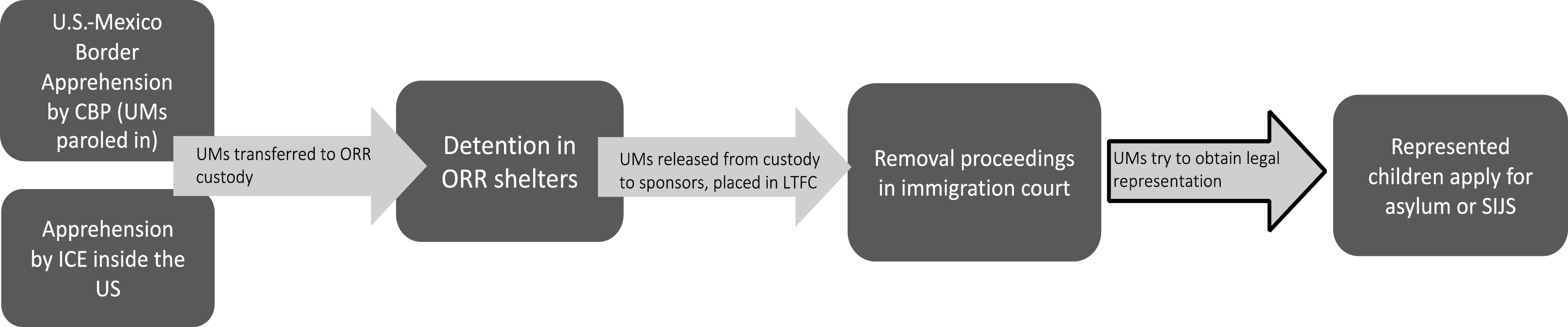
Unaccompanied minors benefit from due process protections unavailable to adults under the TVPRA. At the border, unaccompanied minors from non-contiguous countries are exempted from expedited removal and the credible fear screenings that adult asylum seekers must undergo to gain admission.Footnote 5 These children can be detained in border holding facilities for no more than seventy-two hours, after which they must be transferred to the custody of the Office of Refugee Resettlement (ORR). ORR holds unaccompanied minors in so-called “shelters,” which are detention facilities usually managed by subcontracted non-profit organizations and located in proximity to the border. ORR staff next identify and release children to “sponsors,” who in the vast majority of cases are parents or other family members (ORR, n.d.). Between 1 percent and 4 percent of children are placed in long-term foster care (LTFC) because they have no relatives able to care for them in the United States (Ryo and Humphrey Reference Ryo and Humphrey2021; Alcaraz et al. Reference Alcaraz, Pierce, López and Augustine-Adams2024). While children in LTFC are guaranteed government-funded access to counsel through non-profit organizations, the vast majority of unaccompanied minors must proactively look for legal representation. For this reason, and because of the limitations in the EOIR data,Footnote 6 we exclude detained children from our analysis and do not examine the impact of detention on access to counsel. Qualitative studies suggest that most children obtain counsel after they are released from ORR custody (Galli Reference Galli2023b).
Like adults, unaccompanied minors are served a notice to appear (NTA) that summons them to immigration court, initiating their removal proceedings. During these proceedings, an immigration judge must first establish that they are removable either because they plead to the charges—being in the United States without legal authorization—or because Immigration and Customs Enforcement (ICE) can prove the same by clear and convincing evidence. To avoid being ordered deported, unaccompanied minors most commonly apply for asylum—for individuals unable or unwilling to return to their home country due to a well-founded fear of persecution on account of their race, religion, nationality, political opinion, or membership in a particular social group—and/or special immigrant juvenile status (SIJS)—for children under the age of eighteen (or twenty-one) who have been abandoned, abused, or neglected by their parent(s) and for whom returning to the country of origin is not in the child’s best interest. Children who are not represented are rarely able to apply for relief on their own.
Starting in 2007, the EOIR (2007) established “juvenile dockets”—“child-friendly” courtrooms where immigration judges hear only the cases of unaccompanied minors—in an increasing number of immigration courts nationwide, offering some accommodations. For example, judges are encouraged to speak to children in a friendly, informal tone and to abstain from wearing robes. Non-profit organizations give federally funded legal orientation presentations in juvenile dockets, during which they educate unaccompanied minors about their rights, obligations, and the forms of deportation relief for which they may qualify, as well as distributing lists of local non-profit organizations offering free or low-cost legal services and reputable private attorneys (Huynh Reference Huynh2021; Galli Reference Galli2023b). Yet, despite these due process protections, many unaccompanied children are unable to access counsel (see Figure 2).
Unaccompanied minors’ trajectories in the US immigration system
Source: Authors elaboration.

Theorizing access to justice
The justice gap in civil proceedings is a major social problem in the United States, which lags behind other developed nations in its funding for civil legal aid (Houseman Reference Houseman2001; Rhode Reference Rhode2013). Most of the legal needs of middle-income individuals and an estimated 86 percent of those of low-income individuals in the United States are unmet (Engler Reference Engler2006; Rhode Reference Rhode2009; Legal Services Corporation 2017; Sandefur Reference Rebecca2019). Scholars have sought to understand this crisis by examining a host of interrelated topics, including whether individuals understand their problems as civil legal problems and are likely to engage with the courts to seek legal resolutions; respondents’ subjective experiences of legal proceedings; the differences between advocates’ and laypeople’s understandings of what “justice” entails; and civil case outcomes and their impacts on people’s lives (Sandefur Reference Rebecca2009, Reference Rebecca2010, Reference Rebecca2015a, Reference Rebecca2015b, Reference Rebecca2019; Poppe and Rachlinski Reference Poppe and Rachlinski2016; Longazel Reference Longazel2018; Pruitt et al. Reference Pruitt, Kool, Sudeall, Statz, Conway and Haksgaard2018; Statz, Friday, and Bredeson Reference Statz, Friday and Bredeson2021). Research has shown that legal representation improves outcomes across different types of civil casesFootnote 7 and is most important in shaping case outcomes for individuals facing procedurally complex areas of civil law (Sandefur Reference Rebecca2010; Quintanilla, Allen, and Hirt Reference Quintanilla, Allen and Hirt2017). Immigration law is a prime example of this as it has been likened in its complexity to tax law (Barnes Reference Barnes2003). This is broadly true, regardless of the form of immigration relief that immigrants might pursue.
Scholars have become increasingly interested in understanding access to justice in the immigration realm, with a burgeoning literature examining case outcomes—whether or not immigrants are granted legal status—in removal proceedings in immigration court; at the asylum office or other branches of US Citizenship and Immigration Services (USCIS); in large scale legalization programs; and at the stage of naturalization (Hagan Reference Hagan1998; Gilbertson and Singer Reference Gilbertson and Singer2003; Ramji-Nogales, Schoenholtz, and Schrag Reference Ramji-Nogales, Schoenholtz and Schrag2009; Miller, Keith, and Holmes Reference Miller, Keith and Holmes2013, Reference Miller, Keith and Holmes2014; Braaten and Braaten Reference Braaten and Nolasco Braaten2021; Ryo and Peacock Reference Ryo and Peacock2021; Ryo and Humphrey Reference Ryo and Humphrey2022; Hlass, Davidson, and Kocher Reference Hlass, Davidson and Kocher2023; Galli and Padilla Reference Galli and Padilla2025a). We know that legal representation improves multiple outcomes throughout the immigration process, making it more likely that immigrants will be released from detention on bond (Ryo Reference Ryo2018) and that they will show up to court (Eagly and Shafer Reference Eagly and Shafer2020) as well as improving courtroom advocacy for claimants (Ryo Reference Ryo2018) and increasing immigrants’ chances of being granted asylum or otherwise allowed to remain in the United States (Ramji-Nogales, Schoenholtz, and Schrag Reference Ramji-Nogales, Schoenholtz and Schrag2009; Markowitz and Nash Reference Markowitz and Nash2011; Miller, Keith, and Holmes Reference Miller, Keith and Holmes2013, Reference Miller, Keith and Holmes2014; TRAC 2014; Eagly and Shafer Reference Eagly and Shafer2015; Srikantiah, Hausman, and Weissman-Ward Reference Srikantiah, Hausman and Weissman-Ward2015; Braaten and Braaten Reference Braaten and Braaten2023; Galli and Padilla Reference Galli and Padilla2025a).
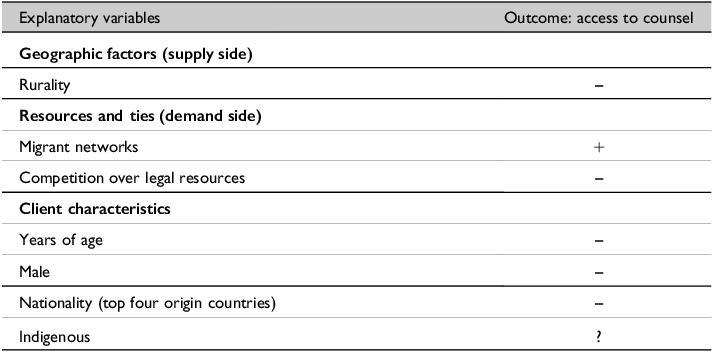
We know less, however, about what determines immigrants’ access to counsel in the first place (Eagly and Shafer Reference Eagly and Shafer2015; Eagly, Shafer, and Moulton Reference Eagly, Shafer and Moulton2025). To our knowledge, this is the first study to examine determinants of access to counsel among unaccompanied immigrant children. To explore this question, we draw on two bodies of prior scholarship—access-to-justice research documenting supply- and demand-related determinants of access to counsel in the civil legal realm and qualitative research on how immigration attorneys select their immigrant clients—to formulate a series of expectations (summarized in Table 1) that guide our subsequent analysis using multivariate models.
Supply-side explanations: geographic and resource-related barriers in access to counsel
Supply- and demand-side factors drive the justice gap (Albiston and Sandefur Reference Albiston and Sandefur2013). On the supply side, problems include insufficient funding, restrictions on the types of cases (including immigration cases) that can be represented using federal funds,Footnote 8 overbroad restrictions on nonlawyers’ ability to provide legal services, and insufficient pro-bono involvement (Rhode Reference Rhode2009; Carpenter, Mark, and Shanahan Reference Carpenter, Mark and Shanahan2017; Longazel Reference Longazel2018). Existing funding sources are volatile and subject to revocation under political pressure depending on the party in office (Albiston and Sandefur Reference Albiston and Sandefur2013). Funding for the legal representation of unaccompanied minors is no exception, and federal dollars allocated for their legal aid were first increased under President Barack Obama, then decreased under the first Trump administration, only to increase again under President Joe Biden (Galli Reference Galli2018a; Barrera Reference Barrera2022). The second Trump administration attempted in March 2025 to defund this program entirely, a move that prompted litigation, which, at the time of writing, has blocked funding cuts (Acacia Center for Justice 2025).
As of 2022, subcontracted nonprofit organizations in only twenty-one states benefited from federal funding to represent unaccompanied minors, administered through the Vera Institute of Justice (n.d.). Local government at the state, county, and city levels may elect to fund additional resources for immigration legal aid, which further exacerbates geographic disparities that make legal aid better funded in some parts of the country than in others, resulting in discrepancies in representation rates for unaccompanied minors based on their state of residence (Galli and Padilla Reference Galli and Padilla2025b). State-level funding variation and changes in the political and legal context over time have key implications for our research question, and we control for these factors by using state and year fixed effects in our models.
The supply of legal services varies widely by place, and scholars consider rurality to be one of the most important axes of inequality in access to counsel. Residents of rural areas—often referred to as “legal deserts”—fare worse than residents of cities in their access to counsel (Pruitt et al. Reference Pruitt, Kool, Sudeall, Statz, Conway and Haksgaard2018). These problems are persistent in spite of interventions aiming to increase legal services in rural legal deserts (Statz, Friday, and Bredeson Reference Statz, Friday and Bredeson2021). In their analysis of EOIR data on removal proceedings between 2007 and 2012, Ingrid Eagly and Steven Shafer (Reference Eagly and Shafer2015) found that, similar to other areas of civil law, geographic location was a key determinant of access to counsel for immigrants: those attending immigration court in rural areas were less likely to be represented compared to those attending court in medium and large cities. Rural areas and new destinations tend to lack the infrastructure of nonprofit legal services catering to immigrants’ needs that typically exists in large cities (Roubenoff, Slootjes, and Bloemraad Reference Roubenoff, Slootjes and Bloemraad2023).
In more recent work, Emily Ryo and Reed Humphrey (Reference Ryo and Humphrey2023) found that an immigrant’s place of residence in rural versus urban locations is predictive of their access to counsel, even after accounting for the availability of practicing immigration attorneys in their proximity. Ethan Roubenoff, Jasmijn Slootjes, and Irene Bloemraad (Reference Roubenoff, Slootjes and Bloemraad2023) similarly found that geographic space itself is an inhibitor of immigrants’ access to legal services because individuals in rural areas have to travel longer distances to reach service providers, which is especially difficult for undocumented immigrants and those living in poverty. In her ethnographic research with unaccompanied minors, Michele Statz (Reference Statz2018) found that unaccompanied minors in rural destinations are more reliant on their immigration attorneys to act as bridges with receiving-society institutions, such as the police and schools. Immigration attorneys that practice in underserved and rural areas may hence experience “role strain” as they are required to “wear multiple hats” and play professional roles that extend beyond their legal expertise as they serve their unaccompanied minor clients (Ruehs-Navarro Reference Ruehs-Navarro2022). Providing these additional services may potentially diminish how many unaccompanied minor clients rural attorneys can represent overall, making it more difficult for them to meet local demand.
In sum, immigrant residents of rural areas face added barriers to obtaining representation due both to resource scarcity—fewer and more overburdened nonprofit organizations and immigration attorneys practice in these areas—and the large distances involved in reaching courts and firm offices. Based on this scholarship, we expect that unaccompanied minors who reside or attend court in rural areas will have less access to counsel than those in urban areas.
Demand-side explanations: migrant networks and competition for attorneys
Ryo and Humphrey (Reference Ryo and Humphrey2023) argue that, in studying the immigration system, too much emphasis has been placed on the supply-side dimension of the access-to-justice crisis, obscuring other complex problems pertaining to demand. Their research identifies barriers in access to counsel that exist even when attorneys are present. In particular, they found that migrant networks matter for access to counsel: as the size of the local co-national population increases, the odds of obtaining legal representation also increase. These findings bolster scholarship that has shown that migrant networks are crucial to help immigrants incorporate in the host country and navigate the immigration process by providing information about eligibility criteria and the benefits of applying for legalization and naturalization as well as connections to attorneys and nonprofit organizations (Yang Reference Yang1994; Hagan Reference Hagan1998; Abascal Reference Abascal2017).
Demand for immigration legal services has increased consistently over time as more immigrants are entangled in the immigration court system, where the backlog of pending cases reached a record 3.7 million in 2025 (TRAC, n.d.a.). Under President Donald Trump, case resolution times were drawn out as cases became more procedurally complex to prepare and the interpretation of eligibility categories for deportation relief narrowed, which, in turn, increased the legal hours necessary to complete each case, further straining already overworked immigration attorneys (Galli Reference Galli2023a, Reference Galli2023b; Yu Reference Yu2023b). As more immigrants spend longer in the system, the growing demand for legal aid is exacerbating competition over scarce resources. Recent estimates suggest that the ratio of unaccompanied children to free and low-cost immigration attorneys exceeds reasonable caseloads, and nonprofit attorneys would need to increase between four- and eight-fold to meet representation needs (Williams and Gosch Reference Williams and Brooke Gosch2025). Even for immigrants who can afford private legal services, there are simply not enough immigration practitioners to meet existing needs. The immigration bar has been increasing in membership but not enough to match the pace of the growing backlog (Ryo and Humphrey Reference Ryo and Humphrey2023).
Based on this research, we expect access to legal representation among unaccompanied minors to increase as the size of the local co-national population increases, reflecting more robust migrant networks. We also expect that access to counsel will be negatively associated with local competition over legal resources, and unaccompanied minors facing removal proceedings in high-volume courts will fare worse than in those in immigration courts hearing fewer cases.
Client selection practices and sociodemographic determinants of access to counsel
Findings from socio-legal qualitative research on immigration lawyering may help shed light on additional determinants of access to counsel that past access-to-justice scholarship has yet to consider. Numerous qualitative studies have shown that, with limited resources and high demand from potential clients, legal service providers must find ways to allocate the finite resources at their disposal by selecting to represent some immigrants and not others. Roberta Villalon (Reference Villalon2010) identifies two ways in which immigration attorneys inadvertently introduce bias in access to justice through their client selection practices. First, attorneys pragmatically use “client management” strategies to manage their caseload more efficiently by selecting clients who do not strain organizational resources (see also Yu Reference Yu2023a). Second, nonprofit legal service providers depend on funding to finance their operations, and obtaining higher grant rates for their clients’ cases can make it easier to get funded in the future, which incentivizes them to select “strong” cases perceived as having the best chance of winning.
With many potential clients to choose from, nonprofit lawyers working with unaccompanied minors often use a “triage” approach to client selection based on the belief that it is preferable to invest scarce resources on the “strongest” cases than to “waste them” on cases likely to be denied (Galli Reference Galli2023b). Large law firms that do pro bono work with unaccompanied minors select cases that are both “strong” and meet specific humanitarian criteria based on a certain client profile (for example, young girls) or “a cause” that is deemed especially “deserving of aid” (for example, trafficking victims) (Statz Reference Statz2018). Immigration attorneys in private practice also choose cases that they consider the “best fit” based on considerations of where representation would most increase chances of success (Yu Reference Yu2023a, Reference Yu2024). To determine the “strength” of a case for humanitarian forms of deportation relief like asylum and SIJS, attorneys attempt to predict whether adjudicators—immigration judges, asylum officers, USCIS bureaucrats—will grant the case based on whether it satisfies: (1) formal eligibility criteria and (2) discretionary criteria (Lakhani Reference Lakhani2013, Reference Lakhani2014; Galli Reference Galli2020b).
In the restrictive US immigration system, eligibility for asylum and SIJS is designed to be narrow, and legal definitions exclude many vulnerable immigrants, including children fleeing violence (Galli Reference Galli2023b). By selecting cases that match existing eligibility criteria, attorneys inevitably act as “agents of the law” who reproduce narrow legal categories and an immigration system characterized by legal violence (Coutin Reference Coutin2000; Bhuyan Reference Bhuyan2008; Lakhani Reference Lakhani2014; Longazel Reference Longazel2018; Hsin and Aptekar Reference Hsin and Aptekar2022; Crooke Reference Crooke2023, Reference Crooke2024). In addition to determining eligibility under the letter of the law, attorneys select clients by anticipating the discretionary element of adjudicators’ decisions, which is shaped by preconceptions about the immigrant’s “deservingness” and assimilability or criminality and culpability (Bhuyan Reference Bhuyan2008; Lakhani Reference Lakhani2013, Reference Lakhani2014; Heidbrink Reference Heidbrink2014; Galli Reference Galli2018b, Reference Galli2020b, Reference Galli2023b; Shiff Reference Shiff2020; Bhuyan and Bragg Reference Bhuyan and Bragg2021; Farrell-Bryan Reference Farrell-Bryan2022; Peacock and Ryo Reference Peacock and Ryo2022; Levesque et al. Reference Levesque, DeWaard, Chan, McKenzie, Tsuchiya, Toles, Lange, Horner, Ryu and Heger Boyle2023; Yu Reference Yu2024). These cultural evaluations of “deservingness” reify ethno-racial, gendered, and age-based stereotypes and social stigma associated with immigrants and minority groups (Flores and Schachter Reference Flores and Schachter2018; Statz Reference Statz2018; Ruehs-Navarro Reference Ruehs-Navarro2022). Not to mention, attorneys may also be influenced by these same preconceptions (Tenorio Reference Tenorio2025).
In sum, qualitative scholarship shows that immigration attorneys face significant structural, legal, organizational, and cultural constraints that may lead them to demonstrate preferences for certain client and case characteristics. While the EOIR data do not include detailed information regarding the facts pertaining to a case, we explore whether attorneys have preferences for certain client characteristics that we can identify using available information on the following immigrant demographics: (1) age; (2) gender; (3) nationality; and (4) language spoken/Indigeneity.
Qualitative research suggests that lawyers who work with unaccompanied minors apply “client management criteria” by often opting not to represent older teenagers who are on the verge of “aging out” of eligibility for relief—which usually occurs at the age of eighteenFootnote 9 —because filing their time-sensitive applications requires putting other cases on hold (Villalon Reference Villalon2010; Galli Reference Galli2023b). For this reason, some nonprofit organizations do not represent any teenagers over the age of sixteen, according to organizational policy. Moreover, some funding sources constrain the types of cases that organizations can represent, and, until recently, children over the age of 16.5 could not receive ORR-funded legal representation. Conversely, cultural conceptions of deservingness may lead lawyers to favor younger children as clients. Younger immigrant children are seen as more vulnerable and deserving of protection than teenagers who, instead, tend to be adultified and criminalized (Heidbrink Reference Heidbrink2014; Terrio Reference Terrio2015; Galli Reference Galli2018b, Reference Galli2023b; Hlass Reference Hlass2019).
Because of these legal and organizational constraints and social norms, we expect that older teenagers will have lower access to counsel than younger children.
In addition to age, a robust scholarship has highlighted gender biases in the US immigration system. Among adults, immigrant males are more likely than females to be criminalized and targeted for internal enforcement and deportation (Golash-Boza and Hondagneu-Sotelo Reference Golash-Boza and Hondagneu-Sotelo2013; Menjívar, Abrego, and Schmalzbauer Reference Menjívar, Abrego and Schmalzbauer2016; Ramírez Reference Ramírez2023) as well as of being denied relief in immigration court and at the asylum office (Schoenholtz, Schrag, and Ramji-Nogales Reference Schoenholtz, Schrag and Ramji-Nogales2014; Farrell-Bryan Reference Farrell-Bryan2022). Unaccompanied minors also face gendered stereotypes: boys are more at risk of being criminalized, adultified, and denied the protections usually afforded to children, while girls are more readily seen as innocent, child-like, and “deserving” of protection (Heidbrink Reference Heidbrink2014; Terrio Reference Terrio2015; Galli Reference Galli2023b; Clark-Kazak Reference Clark-Kazak, Feghali and Toner2024). In their quantitative analysis of SIJS case decisions at USCIS between 2017 and 2020, Laila Hlass, Rachel Davidson, and Austin Kocher (Reference Hlass, Davidson and Kocher2023) found that approval rates were higher for female unaccompanied minors than for males.
Since attorneys anticipate case outcomes and adjudicators’ assumptions about deservingness when selecting clients, we expect that female unaccompanied minors will have higher odds of being represented than males.
Based on their analysis of EOIR data, Eagly and Shafer (Reference Eagly and Shafer2015) found that Guatemalans, Salvadorans, Honduras, and Mexicans are the nationalities with the lowest representation rates in immigration court. One possible explanation for this pattern may have to do with attorneys’ preference for “strong” cases that would lead them to prefer clients from “winning” nationalities, while nationals of Mexico, El Salvador, Guatemala, and Honduras have the lowest overall asylum grant rates in immigration court—between 15 percent and 20 percent (TRAC 2021b). Indeed, US asylum case law is particularly unfavorable to the cases that Central Americans (including unaccompanied minors) usually present, which are based on persecution by so-called “private actors” like gangs and are almost always denied (Coutin Reference Coutin2011; Shiff Reference Shiff2019; Galli Reference Galli2020b, Reference Galli2023b; Muñiz Reference Muñiz2022). In regard to unaccompanied minors applying for SIJS, children from El Salvador, Guatemala, and Honduras face far longer backlogs (over four years) than do applicants from Mexico (two years) or other countries (who face little to no backlog) to obtain permanent residency through this form of relief (Hlass, Davidson, and Kocher Reference Hlass, Davidson and Kocher2023).Footnote 10 Since taking on these SIJS cases is a long-term commitment, this may dissuade attorneys from representing Salvadorans, Guatemalans, and Hondurans while incentivizing them to select SIJS applicants from other nationalities.
Based on this research, we expect that all other nationalities will have higher access to counsel than Mexicans, Salvadorans, Guatemalans, and Hondurans. We will also explore variation in access to counsel between these four groups.
While most unaccompanied minors migrating to the United States are Spanish-speaking mestizos, others are members of Indigenous groups who speak only Indigenous languages. The latter children face special challenges navigating the immigration system (Canizales and O’Connor Reference Canizales, O’Connor and Doris2021; Canizales Reference Canizales, Deeb-Sossa and Mendez2022). While immigrations courts nationwide provide Spanish interpretation services, and many immigration attorneys speak Spanish (Ryo and Humphrey Reference Ryo and Humphrey2023), it is challenging to find interpreters for Indigenous languages (Wallace and Hernandez Reference Wallace and Iván Hernández2017; Obinna Reference Obinna2023). Because of these linguistic barriers, on the one hand, attorneys report special challenges in working with Indigenous language speakers (Galli Reference Galli2023a), which may dissuade them from selecting these children as clients. On the other hand, attorneys may conversely show preferences for Indigenous unaccompanied minors as potential clients because they often present narratives that are both eligible for asylum and SIJS and considered “strong” (Galli Reference Galli2023b). Experiences of racial persecution in the home position asylum cases as “strong” compared to cases based on gang violence that the vast majority of Central Americans present and that are likely to be denied (Coutin Reference Coutin2011; Muñiz Reference Muñiz2022). Indigenous Central American children are also especially likely to work from very young ages in dangerous and exploitative conditions to contribute to family economies (Heidbrink Reference Heidbrink2020), and these experiences often make them eligible for SIJS on the grounds of parental neglect (Galli Reference Galli2023b).
We expect that Indigeneity will play a role in explaining disparities in access to counsel among unaccompanied minors. Given mixed findings and potential explanations based on past research, we maintain open expectations about whether Indigenous language speakers or Spanish speakers will have higher odds of being represented.
Expectations guiding the analysis

Data and methods
This article examines the determinants of access to counsel among unaccompanied minors using an administrative dataset from the EOIR with information on 2.5 million cases of immigrants in removal proceedings in US immigration courtFootnote 11 between 2009 and 2023 (through March),Footnote 12 including demographics (age, gender, birth date, language, nationality), date of entrance, number and location of hearings, place of residence, detention status, representation, and case outcomes. We obtained these data from the Transactional Records Access Clearinghouse (TRAC) in our capacity as TRAC Fellows. Within this larger dataset, using a strategy described in separate writing (see Galli and Padilla Reference Galli and Padilla2025b), we identified 482,803 cases of unaccompanied minors in removal proceedings in US immigration court that were initiated between January 1, 2009, and March 31, 2023, for children who reside in one of the fifty US states.
Similar to Ryo and Humphrey (Reference Ryo and Humphrey2023), we limited our analysis for this article to cases of unaccompanied minors who were not detained during their most recent immigration proceeding because, for detained respondents, we cannot meaningfully measure the nearby presence of co-ethnics, which is an explanatory variable in our model. We dropped 14,567 detained cases (n = 14,567), leaving us with a sample of 468,236 cases. After dropping cases missing data on our variables of interest, our analytic sample consisted of 384,525 cases (n = 384,525). As others have noted, administrative datasets have not been designed for use in social science research, and, hence, they have limitations, which include the inclusion of fewer variables than typically appear in survey data and the potential presence of systematic or random errors (Johnson, Massey, and O’Hara Reference Johnson, Massey and O’Hara2015). As previously reported by researchers at TRAC (2023), missing data are common in the EOIR administrative dataset. We conducted several robustness checks to ensure that dropping cases with missing data did not bias our results; we discuss missing data and report the results of these checks in detail in Appendix A.
As our dependent variable, we used attorney_flag, which indicates whether there was any record of representation for the case: coded as 1 when counsel was present at any proceeding for the case or as 0 when no counsel was present. Our explanatory variables capture the expectations summarized in Table 1. First, we constructed a series of variables to measure geographic characteristics and resource availability. Adapting Eagly and Shafer’s (Reference Eagly and Shafer2015) approach based on the 2010 census,Footnote 13 we created a dichotomous variable (rural court) that measures the rurality of the place where the immigrant attended immigration court, coded as 1 to denote rural areas (where fewer than fifty thousand people live) and as 0 to denote cities (population of fifty thousand or more).
Next, we leveraged information on the immigrant’s zip code of residence to create rural residence, which measures the rurality of the respondent’s place of residence. Our approach is similar to Ryo and Humprey (Reference Ryo and Humphrey2023), who used the National Center for Health Statistics’ Urban-Rural Classification Scheme for Counties, which contains several measures of rurality/urbanicity overlapping our study period. For cases opened between 2009 and 2017, we assigned the classification dating 2013, while for cases opened between 2018 and 2023, we assigned the classification dating 2023. We then collapsed the original coding of urbanicity into a dichotomous variable,Footnote 14 coded as 1 to denote rural areas where fewer than fifty thousand people live and as 0 for all other urban and suburban areas.
To capture demand for legal services, we created case volume, a categorical variable measuring the number of cases active in the immigration court during the year the child’s case was opened, with four categories corresponding to quartiles ordered from lower to higher volume courts: less than 5,605 cases (lowest volume); between 5,605 and 9,599 cases (medium volume); between 9,599 and 16,340 cases (high volume), and over 16,340 cases (highest volume).
To measure migrant networks, we created a percentage co-ethnics variable. To create this variable, we drew from the American Community Survey’s five-year population estimates to measure the number of co-nationals within the county of the immigrants’ zip code of residence.Footnote 15 The variable is reported as a percentage and standardized by the county’s population.
We also included various sociodemographic variables to measure a host of client characteristics. Birth dates were available in the EOIR data, allowing us to construct age at entrance: the estimated difference between birth date and date of entrance into the United States (or when the latter was missing, the date of the notice to appear [NTA]) as well as its squared term. Male is a dichotomous indicator where 0 indicates females in the sample.Footnote 16 We constructed the Indigenous variable to capture sixty-six Indigenous languages spoken in Latin America that show up in the EOIR data.Footnote 17 We reconstructed nationality as seven mutually exclusive dichotomous variables, including the top countries of origin of unaccompanied minors in our sample: Guatemala, Honduras, El Salvador, Mexico, India, China, while Other includes all other nationalities.
Our models also include controls for number of hearings and duration (the time that passed from the date of the NTA to the case completion date), both of which are procedural factors that we know are associated with access to counsel based on past research.Footnote 18 We also included state and year fixed effectsFootnote 19 to account for unobserved factors that could be tied to issues such as variation in funding for immigration legal aid across states or over time and changes in the political and legal context, all of which have key implications for our research question.
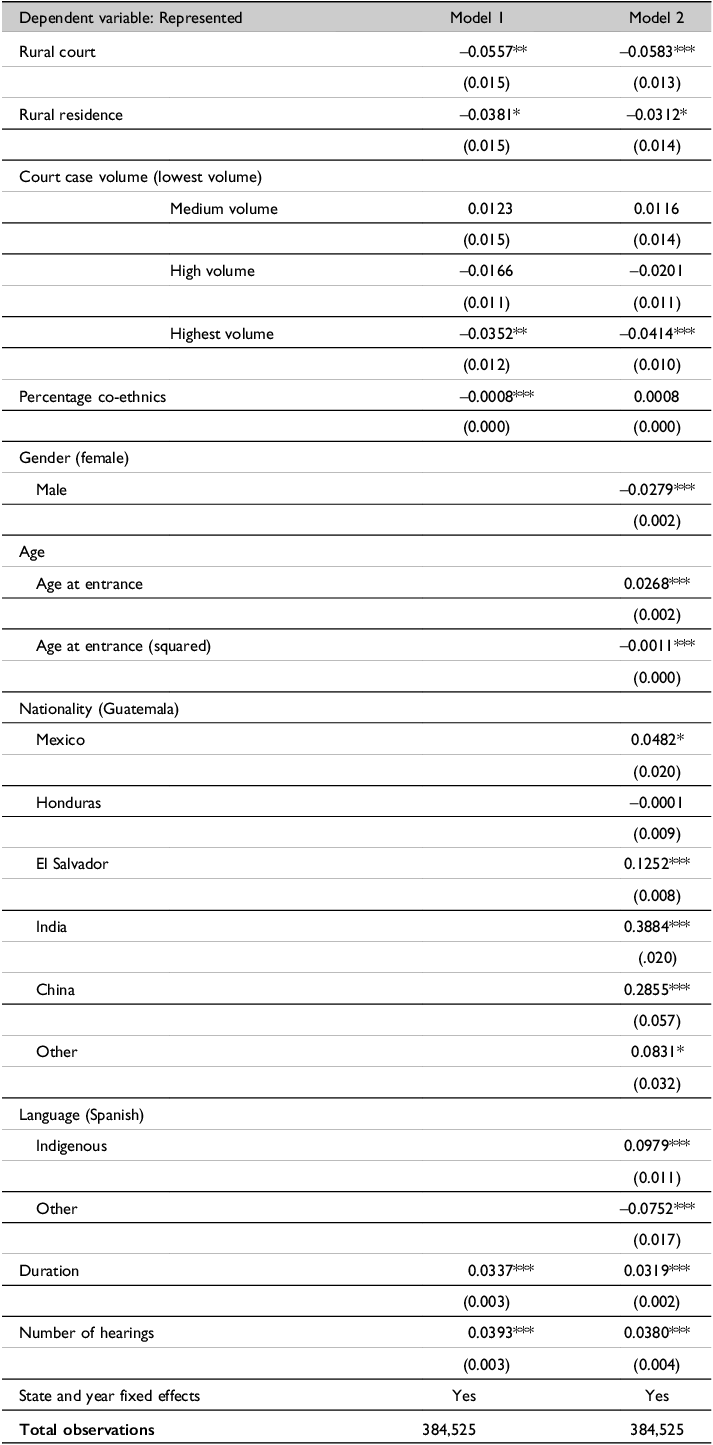
The analytical approach fits two linear probability models with robust standard errors to estimate the probability of being represented by an attorney among cases of unaccompanied minors in our analytical sample. Model 1 examines geographic characteristics and resource availability as determinants of access to counsel and includes explanatory variables pertaining to city size, volume of cases per court, and percentage of co-ethnics, as well as procedural controls, and state and year fixed effects. Building on Model 1, Model 2 also examines individual sociodemographic characteristics—gender, age, nationality, language—as determinants of access to counsel for unaccompanied minors. We conducted a Wald test post-estimation to analyze whether Model 2 fits significantly better than Model 1, and we were able to reject the null hypothesis, indicating that the coefficients are not simultaneously equal to zero. We can conclude that including immigrants’ sociodemographic characteristics in Model 2 results in a statistically significant improvement in the fit of the model. We also ran several robustness checks (reported in Appendix B).Footnote 20 We estimated our models using three additional specifications: regression, probit, and logit. The findings of these alternative model specifications confirm our results and indicate that our reported models offer conservative estimates. Finally, we conducted an additional robustness check to examine only cases whose removal proceedings began prior to 2021 to make sure that the results are not being driven by the amount of time it takes to obtain counsel. That is, some of the cases that show up later in the data would eventually get an attorney if observed longer. We found that our modeling strategy was robust to potential censoring of the sample’s outcome of interest. There is no evidence to suggest that recent arrivals, who have not had as much time to obtain a lawyer, are driving the results. In the next section, we report the findings from Model 2, our preferred model, on the full analytical sample spanning from 2009 to 2023 (through March).
Descriptive statistics
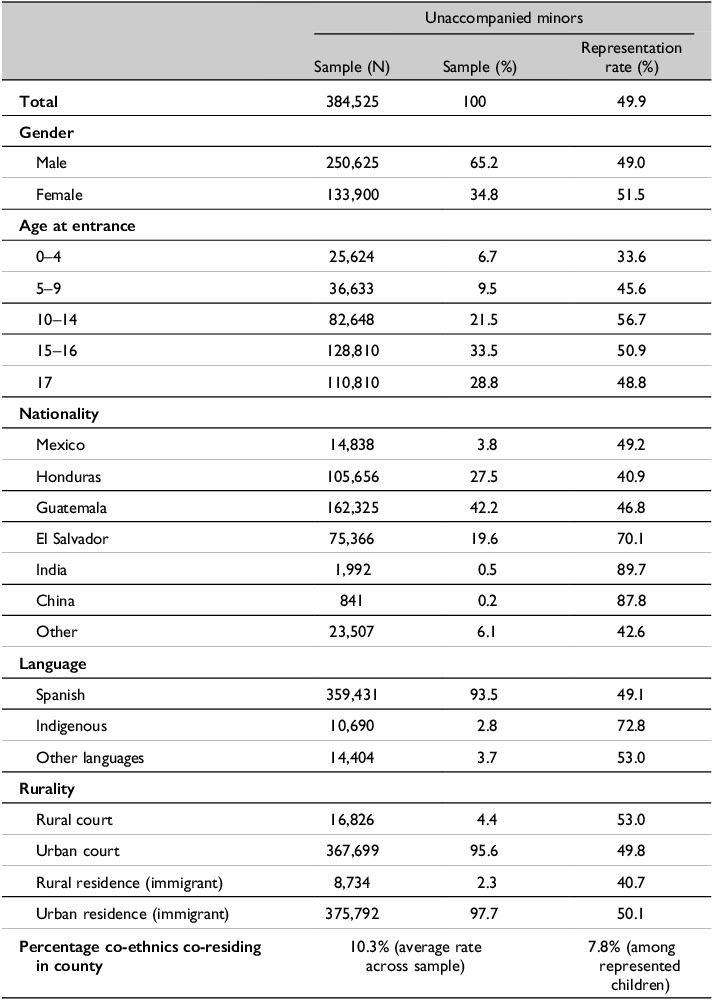
As shown in Table 2, the majority of unaccompanied minors in our sample are male, between the ages of fifteen and seventeen, and from Central America. Specifically, Guatemala (42.2 percent), Honduras (27.5 percent), and El Salvador (19.6 percent) are the origin countries of the vast majority of our sample, while Mexicans comprise 3.8 percent, Indians are 0.5 percent, and Chinese are 0.2 percent. The remaining 6.1 percent come from other countries, mostly in Latin America. Given these countries of origin, it is unsurprising that 93.5 percent are Spanish speakers, while 2.8 percent speak Latin American Indigenous languages, and 3.7 percent speak other languages. Our sample is composed of 65.2 percent males and 34.8 percent females. Children who were seventeen years old upon entrance to the United States make up 28.8 percent of our sample, those who were fifteen to sixteen make up 33.5 percent, those who were ten to fourteen make up 21.5 percent, and the rest were under the age of ten. About half (49.9 percent) of unaccompanied minors in our sample obtained legal representation at some point during their removal proceedings.
Analytical sample descriptives (non-detained unaccompanied minors) and representation rates

The sample descriptives in Table 2 also begin to explore the relationship between immigrant characteristics and legal representation. Importantly, legal representation is not equally represented across our key variables of interest. Representation rates among unaccompanied minors vary by geographic area and were lower for those residing in rural areas (40.7 percent) than those in cities (50.1 percent). Contrary to expectations, represented children lived in counties with fewer co-ethnics (7.8 percent) compared to unrepresented children (12.7 percent). Representation rates among unaccompanied minors also vary by sociodemographic characteristics. For example, 51.5 percent of females had legal representation compared to 49.0 percent of males. Regarding nationality, unaccompanied children from India and China have some of the highest representation rates: 89.7 percent and 87.8 percent, respectively. Representation rates were also considerably higher for Indigenous-language speakers (72.8 percent) than for Spanish speakers (49.1 percent). Representation rates by age are represented in Figure 3, which suggest a non-linear pattern. While teenagers’ representation rates decrease with age as expected, we see the opposite pattern among children under the age of eleven. The youngest children have the lowest representation rates (just 33.6 percent for ages zero to four). These descriptive statistics are helpful, but they do not reveal how children’s access to counsel is jointly shaped by geographic, resource-related, and sociodemographic variables. For that, we turn to our statistical models.
Unaccompanied minor representation-n rates by age
Source: Authors elaboration (analytic sample).

Results and discussion
We report findings from our preferred model (Model 2), which examines the geographic and resource-related factors considered by past access-to-justice scholarship, as well as the role of individual sociodemographic characteristics as determinants of access to counsel (Table 3). The model is specified with fixed effects for year and state; the coefficients, then, reflect the differences between unaccompanied minors’ cases in a state during each year.
Results

Notes: *p < 0.05; **p < 0.01; ***p < 0.001.
Supply and demand-related determinants of access to counsel
In line with past work, we found that geographic location and resources matter for access to counsel. Confirming our first expectation, rurality is negatively associated with access to counsel (Table 1). Compared to unaccompanied minors whose cases are heard in immigration courts located in urban areas, those whose cases are heard in courts located in rural areas are 5.8 percentage points less likely to access counsel, after accounting for co-variates, procedural and sociodemographic case characteristics, and state and year fixed effects. Residing in a rural area is also negatively correlated with access to counsel, resulting in a 3.1 percentage point decrease in access counsel, all else equal. Our findings confirm past work on rural deserts (see, for example, Eagly and Shafer Reference Eagly and Shafer2015), showing that both attending court and residing in rural areas are associated with lower levels of access to counsel among unaccompanied minors.
Further, as expected, we found that competition over resources is a determinant of access to counsel for unaccompanied minors, resulting in lower access to legal representation where competition is more intense. Concretely, compared to children whose cases are heard in the lowest-volume courts, children whose cases are heard in the highest-volume courts are 4.1 percentage points less likely to obtain counsel, all else held constant. Interestingly, contrary to our expectations and unlike work by Ryo and Humphrey (Reference Ryo and Humphrey2023), we did not find that more robust migrant networks increase access to counsel. Instead, percentage co-ethnics has no effect on access to counsel in our preferred model. In Model 1, which does not account for sociodemographic characteristics, such as nationality and gender, we found that the relationship has the opposite sign than we expected: a 1 percent increase in co-nationals cohabitating in the same county as the unaccompanied minor decreases the chance of obtaining counsel by 0.08 percentage points.
This result suggests that co-ethnics might be competing with unaccompanied minors for legal resources rather than helping them find attorneys. Indeed, there is some qualitative research that has shown that some migrant networks—in particular, those of the Central American immigrants who compose the vast majority of our sample—are resource poor due to the vulnerable status of illegality, labor precarity, and limited access to public benefits of their members (Menjívar Reference Menjívar2000). When this is true, migrant networks can have no benefit or can even be harmful to co-ethnics (Del Real Reference Del Real2019; Rosales Reference Rosales2020). However, given the small effect size (only present in Model 1), this result should be interpreted with caution.
The role of client selection: sociodemographic case characteristics
After accounting for geographic and resource-related variables (and procedural controls and state and year fixed effects), all our sociodemographic explanatory variables are statistically significant, demonstrating that age, gender, nationality, and Indigeneity are all important determinants of access to counsel for unaccompanied minors.
Our results on age are statistically significant, but they confirm our expectations only in part. We found that, all else equal, each additional year of age is positively associated with the probability of having an attorney (an increase of 2.7 percentage points per year of age) but that the association diminishes over time, as reflected by the negative sign of our age squared variable. The results of our multivariate analysis mirror our descriptive results, reflecting a non-linear relationship between age and access to counsel. Recall that, in Figure 3 (showing representation rates by age), we saw representation rates increase until the age of eleven, at which point representation starts to trend downward. Our results confirm our original expectation that attorneys may avoid selecting older teenagers as clients because of eligibility categories (for example, the problem of clients “aging out” at eighteen) and other constraints tied to organizational policies and funding sources. However, the findings do not confirm the idea that the youngest children—who we assumed would potentially be seen as most innocent, compassionate, and “deserving” of legal aid—have the highest access to counsel. Surprisingly, our findings instead also show that, all else equal, the youngest children are the ones with the lowest access to counsel.
Variations in cognitive development by age may help explain the pattern that we observe among young children in our data. As compared to adults, children often lack information relevant to their cases because they have been shielded by caretakers from frightening details about threats and harm directed at them or their families, a dynamic that is exacerbated among younger children (Pobjoy Reference Pobjoy2017; Galli Reference Galli2018b). Research in cognitive psychology shows that children only develop the ability to tell temporally coherent narratives starting at the age of eight and causal narratives starting at the age of twelve; both skills are indispensable for successful asylum cases, which must show escalating threats and explain not just how but also why the persecution took place (Given-Wilson, Hodes, and Herlihy Reference Given-Wilson, Hodes and Herlihy2018). Given the challenges involved with working with very young children, which requires a specific skill set in addition to legal knowledge, attorneys may not select them as clients. An alternative explanation is that younger children are more reliant on adults to help them interact with legal systems and find an attorney. The adult caretakers of unaccompanied minors are usually undocumented immigrants who are fearful of the state and hence are more reticent to engage with the immigration courts, which, in turn, may hinder children’s access to counsel (Abrego Reference Abrego2011; Galli Reference Galli2020a, Reference Galli2023b). Whichever explanation is accurate, this finding is concerning from a children’s rights standpoint because children of tender age are precisely those most in need of legal support due to their vulnerability and lack of capacity to engage with legal systems alone.
Next, as expected, gender shapes access to counsel. Males have a 2.8 percentage point lower likelihood of being represented than females, after accounting for controls and co-variates. This finding suggests that, like immigrant adults (see, for example, Golash-Boza and Hondagneu-Sotelo Reference Golash-Boza and Hondagneu-Sotelo2013; Menjívar, Abrego, and Schmalzbauer Reference Menjívar, Abrego and Schmalzbauer2016; Ramírez Reference Ramírez2023), male unaccompanied minors are also penalized in the immigration system, where they are more likely to be criminalized, adultified, and denied the protections afforded to children as compared to more “deserving” females. As they select clients with “strong” (that is, eligible and “deserving”) cases, lawyers may inadvertently reproduce these biases.
In line with past work, we also find that nationality is a key determinant of access to counsel (Eagly and Shafer Reference Eagly and Shafer2015). All other nationalities fare better than our top four origin countries of Guatemala, Honduras, El Salvador, and Mexico. We use Guatemala as the omitted category in our models because this is the most numerous nationality group both in our sample and among all unaccompanied minors in the United States (see Table 2; Figure 1). We found that the largest gains are experienced by unaccompanied minors from India who, compared to Guatemalans, have a 38.8 percentage points higher chance of having legal representation, followed by unaccompanied minors from China who, on average, are 28.6 percentage points more likely to have legal representation compared to Guatemalans, after accounting for controls and co-variates.
We also found variation among our top four sending countries. Unaccompanied minors from Mexico, on average, are 4.8 percentage points more likely to be represented compared to unaccompanied minors from Guatemala, all else equal. Salvadoran unaccompanied minors, on average, are 12.5 percentage points more likely to be represented compared to Guatemalans, all else equal. We found no significant effects for our Honduras variable, which suggests that the difference between Honduran and Guatemalan children’s access to counsel is negligible and, hence, equally poor.
These findings may suggest that immigration attorneys select client nationalities that are more likely to present “strong” cases, with higher grant rates. For example, Indian and Chinese immigrants have much higher grant rates in immigration court (for example, 72 percent and 80 percent, respectively, for asylum cases in 2021) than applicants from Central America and Mexico. Homicide rates were higher on average in El Salvador than in Guatemala during the study period (Gagne Reference Gagne2017), and these sending country conditions are pertinent for asylum case outcomes and hence may shape client selection. Since our model accounts for the proportion of co-nationals residing near the immigrant, we do not believe that the existence of more or less consolidated migrant networks explains the differences in access to counsel among children of different nationalities. Indeed, Ryo and Humphrey (Reference Ryo and Humphrey2023) similarly found that nationality mediated access to counsel, even when accounting for the effects of migrant networks. An alternative explanation to attorneys’ preferences for “strong” cases could be that there are more attorneys who, perhaps due to linguistic skills and cultural competency, specialize in serving certain communities from specific sending countries.
Finally, we found that unaccompanied minors who speak all languages other than Spanish (or Latin American Indigenous languages) have a 7.5 percentage points lower chance of having access to counsel than Spanish speakers. Conversely, we found that Indigenous language speakers are 9.8 percentage points more likely to have legal representation compared to Spanish speakers, all else being equal. The latter finding suggests that Indigeneity is a determinant of access to counsel for unaccompanied minors. These results support the idea that, in the context of limited resources and a large pool of potential clients to choose from, attorneys may prefer to represent Indigenous unaccompanied minors because their cases are considered “strong.” As mentioned above, Indigenous unaccompanied minors often qualify for SIJS, especially due to experiences of underage labor, which is considered a form of parental neglect in US law (Heidbrink Reference Heidbrink2014, Reference Heidbrink2020; Heidbrink and Statz Reference Heidbrink and Statz2017). They also present narratives of persecution on account of their race, which attorneys consider to be “strong” asylum cases (Galli Reference Galli2023b).
Importantly, our Indigenous language variable captures only those who speak Indigenous languages in immigration court. Hence, we are certainly undercounting Indigenous children by excluding those who also speak Spanish, whose Indigeneity is erased by the courts’ data-keeping practices. This is a study limitation. At the same time, however, it is especially interesting that Indigenous children have better access to counsel in spite of linguistic barriers and added difficulties involved in finding interpreters for Indigenous languages, which certainly makes representing their cases more challenging for attorneys (Wallace and Hernandez Reference Wallace and Iván Hernández2017; Obinna Reference Obinna2023).
Taken together, these findings suggest that, in the context of high demand from potential clients and limited resources and in light of significant structural, legal, organizational, and cultural constraints, immigration attorneys’ client selection practices may reproduce the biases inherent in the immigration system and exacerbate inequalities in access to justice for unaccompanied minors.
Conclusion
By examining access to counsel for a formally protected group of immigrants—unaccompanied minors—this article builds on scholarship on the “justice gap” (Sandefur Reference Rebecca2015a). We also add to the knowledge on immigrant children’s experiences navigating immigration bureaucracies, which, to date, with a few notable exceptions (Coulter et al. Reference Coulter2020; Ryo and Humphrey Reference Ryo and Humphrey2021; Braaten and Braaten Reference Braaten and Nolasco Braaten2021, Reference Braaten and Braaten2023; Alcaraz et al. Reference Alcaraz, Pierce, López and Augustine-Adams2024; Galli and Padilla Reference Galli and Padilla2025a, Reference Galli and Padilla2025b), has mainly been based on qualitative studies that are rich and theoretically generative but lack generalizability (see, for example, Heidbrink Reference Heidbrink2014, Reference Heidbrink2020; Terrio Reference Terrio2015; Gozdziak Reference Gozdziak2016; Galli Reference Galli2018b, Reference Galli2020a, Reference Galli2020b, Reference Galli2023a, Reference Galli2023b; Statz Reference Statz2018; Huyhn Reference Huynh2021; Ruehs-Navarro Reference Ruehs-Navarro2022; Canizales Reference Canizales2024; Tenorio Reference Tenorio2025).
In our analysis of a large administrative dataset, we found that the geographic patterns of inequality and competition over resources identified by past literature on access to justice in the broader civil legal system (Engler Reference Engler2006; Rhode Reference Rhode2009; Albiston and Sandefur Reference Albiston and Sandefur2013; Legal Services Corporation 2017; Pruitt et al. Reference Pruitt, Kool, Sudeall, Statz, Conway and Haksgaard2018), and with immigrant adults (Eagly and Shafer Reference Eagly and Shafer2015; Levesque Reference Levesque2022; Levesque, Horner, and Chan Reference Levesque, Horner and Chan2023; Levesque et al. Reference Levesque, DeWaard, Chan, McKenzie, Tsuchiya, Toles, Lange, Horner, Ryu and Heger Boyle2023; Roubenoff, Slootjes, and Bloemraad Reference Roubenoff, Slootjes and Bloemraad2023; Ryo and Humphrey Reference Ryo and Humphrey2023), are also key determinants of access to counsel among unaccompanied children in US immigration court. Children who reside or attend court in rural areas and those who face more competition from other immigrants in need of removal defense all fare worse in their access to counsel.
In addition, bolstering findings in qualitative scholarship on immigration lawyering, we found evidence that immigrants’ sociodemographic characteristics that may shape the viability of cases in immigration court—age, gender, Indigeneity, and nationality—are also determinants of access to counsel, after accounting for factors examined by past work. Concretely, both the youngest children and older teenagers (on the verge of aging out of eligibility for relief) fare poorly in their access to legal representation. Male unaccompanied minors have lower chances of obtaining counsel than females. Conversely, Indigenous children from Latin America who may present especially “strong” case characteristics have better access to counsel than Spanish-speaking Latinos. After accounting for how well developed the migrant networks of co-nationals were in the places where children reside, every nationality fared better in their access to counsel than Guatemalan children, with the highest gains for unaccompanied minors from India and China, followed by children from El Salvador.
While unaccompanied minors are considered one population in legal terms, our findings document considerable within-group variation. We have demonstrated that unaccompanied minors face unequal outcomes in the US immigration system in regard to their access to counsel, which problematizes the notion that there is due process for these vulnerable children in US immigration court. These findings highlight both the structural biases in the US immigration bureaucracy and how these same biases may be reinforced by the immigration attorneys working within these systems through their client selection practices. Drawing on socio-legal qualitative studies of immigration lawyering with unaccompanied minors and other humanitarian claimants (see, for example, Coutin Reference Coutin2000; Villalon Reference Villalon2010; Lakhani Reference Lakhani2013, Reference Lakhani2014; Galli Reference Galli2018b, Reference Galli2020b, Reference Galli2023a, Reference Galli2023b; Statz Reference Statz2018; Bhuyan and Bragg Reference Bhuyan and Bragg2021; Ruehs-Navarro Reference Ruehs-Navarro2022; Yu Reference Yu2024; Tenorio Reference Tenorio2025), we have argued that, in the context of limited resources and high demand from potential clients, attorneys may inadvertently reproduce the legal violence of the immigration system as they favor clients with “strong” cases that are both eligible for and likely to be deemed “deserving” of relief by adjudicators (Lakhani Reference Lakhani2013, Reference Lakhani2014; Muñiz Reference Muñiz2022). As others have noted, immigration attorneys act as both “agents and critics” of the law, simultaneously reinforcing and challenging restrictive immigration laws through their legal strategies (Coutin Reference Coutin2000; Lakhani Reference Lakhani2013, Reference Lakhani2014; Crooke Reference Crooke2023, Reference Crooke2024).
Future research can build on this work in several ways. Scholars could examine whether the inequalities in access to counsel that we identified hold across firm and organization type (for example, non-profit organizations, law school clinics, or private firms) and whether the type and quality of legal service, in turn, has an impact on immigrants’ chances of being allowed to remain in the United States. Researchers could also continue to explore the impact of age, gender, and Indigeneity on other case outcomes. Finally, scholars could compare the outcomes (for example, access to counsel, access to legal status) of unaccompanied minors to those of other immigrant populations like accompanied children and adults who benefit from less robust networks of non-profit legal service providers and fewer due process protections in US immigration law.
This research can inform policy change and advocacy on behalf of unaccompanied minors. To begin, our findings documenting patterns of inequality in access to counsel can inform decisions about where to best allocate future funding for legal aid. For instance, we found that children who live or attend court in rural areas are penalized in their access to counsel. We join others in advocating for increased funding for attorneys and non-profit organizations that operate in rural areas (Pruitt et al. Reference Pruitt, Kool, Sudeall, Statz, Conway and Haksgaard2018).
Perhaps our most striking finding is that the youngest children—precisely those who are most vulnerable and have the greatest difficulty understanding complex US immigration laws—are those most at risk of having to navigate immigration proceedings without legal representation. This suggests that special outreach programs and funding streams are needed to identify and assist the youngest unaccompanied children, especially those ages ten and under. Such a program might be implemented by following up with adult family members who have obtained custody of young children from ORR to educate them about the immigration process and connect them with specialized attorneys. The adult caretakers of unaccompanied minors are most often undocumented immigrants who are fearful of interacting with the US immigration system (Galli Reference Galli2023b). Ensuring that immigration courts are not sites of ICE activity might temper adult caretakers’ fears of engaging with the courts so that they may be better able to help their young children find legal representation and pursue applications for deportation relief.
However, by examining access to counsel in a relatively best-case scenario—more funding is currently available for legal aid benefiting unaccompanied minors than other categories of immigrants—our work clearly demonstrates that inequality is likely to persist in any funding landscape short of universal representation. Creating a universal legal representation program for all individuals facing removal proceedings in immigration court is crucial to ensure due process in a system that is formally non-punitive and part of the realm of civil law but that has stakes more closely resembling those of criminal cases, involving family separation and deportation back to deprivation and danger. Denying counsel to individuals of any age in immigration court is a form of legal violence considering language barriers and the complexity of immigration law (Martinez-Aranda Reference Martinez-Aranda2023). Unaccompanied children face added challenges due to their unique developmental vulnerabilities, past experiences of trauma, and limited formal schooling (Galli Reference Galli2018b, Reference Galli2023b). Access to counsel is indispensable to give children a fair chance to apply for deportation relief for which they often qualify, such as asylum and SIJS, so that they may find safe and stable futures in their new homes. From a children’s rights standpoint, we call for providing universal legal representation to immigrants of all ages, with added protections and resources to cater to children’s unique developmental needs.
This research has shown that a wide gap persists between the protective intent of the TVPRA, which recognizes the need to provide free counsel to all unaccompanied children, and a reality in which nearly half of unaccompanied minors in removal proceedings—tens of thousands of children over the past decade—have been forced to represent themselves in court. These findings are all the more crucial in today’s increasingly draconian climate. In March 2025, the Trump administration attempted to cut all federal funding for programs providing legal orientation and representation for unaccompanied children. These changes would have left over twenty-six thousand children without access to their attorneys (Acacia Center for Justice 2025). Legal service providers whose funding was terminated filed a federal lawsuit arguing that funding cuts constitute a failure to meet the TVPRA’s obligations and pose “irreparable harm to legal service provider organizations who, in many cases, must furlough or lay off highly skilled legal services staff with deep subject-matter expertise” (as cited in Williams and Gosch Reference Williams and Brooke Gosch2025). In April 2025, a judge granted a temporary restraining order mandating the government to reinstate funding, but the future of the program providing legal aid to unaccompanied minors remains uncertain. With access to counsel inadequately funded and vulnerable to revocation, justice remains out of reach for this ostensibly protected group of immigrant children in the United States.
Supplementary material
To view supplementary material for this article, please visit https://doi.org/10.1017/lsi.2026.10145
Acknowledgments
We thank Steven Shafer, Ingrid Eagly, Shannon Gleeson, Rebecca Hamlin, Chris Levesque, and Erin Hamilton for their feedback on previous versions of this article. This article was workshopped at the American Bar Foundation’s Access to Justice Fellows meeting, and we thank Rebecca Sandefur, Matthew Burnett, and the 2023–2024 Access to Justice Fellows for their constructive comments and critiques that have helped to greatly improve this work. We also thank Sue Long at TRAC for her crucial assistance and advice on working with the EOIR data. Finally, we thank Jennifer Podkul, Nirupa Narayan, and Jennifer Hojaiban at Kids in Need of Defense for lending their expertise and helping us verify key legal, procedural, and data-related questions to make this work possible. We obtained access to the EOIR data and conducted this research in our capacity as TRAC Fellows.