Implications
A positive human–animal relationship is an important aspect of animal welfare, and valid, reliable and feasible tools for assessing this relationship on-farm are needed. Human–animal relationship on flock level can be assessed by using the touch test as described in the Welfare Quality® protocol for broilers. However, this test depends on the ability of the birds to walk away from the human if they are fearful. Our study found that the outcome from the touch test may be confounded by lameness, and the results from the touch test must therefore be interpreted with care when used on broilers close to slaughter age.
Introduction
There has been an increased concern for the welfare of chickens in modern broiler production in the last decades, especially with focus on leg disorders due to fast growth (EFSA, 2012). Animal welfare may be viewed as the combination of biological function of the animal, the natural life of the animal and the animals’ emotional state (Fraser, Reference Fraser2008). In the broiler industry, the focus has mainly been on the biological functioning of the animals, and production data (e.g. growth rate and slaughter weight), and prevalence and severity of impaired health (e.g. lameness, contact dermatitis and mortality) are frequently used as welfare indicators (EFSA, 2012). In addition, there is an increased focus on including indicators of the animals’ subjective experiences when welfare is assessed. Affective states cannot be measured directly in animals, but behavioural indicators of negative emotional states such as fear (Forkman et al., Reference Forkman, Boissy, Meunier-Salaün, Canali and Jones2007) are used as indirect measures of subjective experiences in broiler welfare studies (Bassler et al., Reference Bassler, Arnould, Butterworth, Colin, de Jong, Ferrante, Ferrari, Haslam, Wemelsfelder and Blokhuis2013) and measures of, for example, fear and lameness are included in welfare assessment protocols including the Welfare Quality® protocol for poultry (Welfare Quality, 2009).
Fear is an adaptive emotional response to potentially harmful stimuli and serves to protect animals from injury. However, a very frequent or prolonged state of fear may negatively influence animal welfare (e.g. Broom, Reference Broom1991). Both acute and sustained fear can be powerful and potentially damaging stressors, resulting in suffering, reduced production and sickness (Broom, Reference Broom1991; Sanotra et al., Reference Sanotra, Lund and Vestergaard2002). Animals may perceive humans as a fear evoking stimulus (Jones, Reference Jones and Boissy1986; Boissy et al., Reference Boissy, Manteuffel, Jensen, Moe, Spruijt, Keeling, Winckler, Forkman, Dimitrov, Langbein, Bakken, Vessier and Aubert2007), whereas positive experiences with the farmer, through positive daily management routines, may promote a positive human–animal relationship and reduce the level of fear (e.g. Jones and Waddington, Reference Jones1992; Cransberg et al., Reference Cransberg, Hemsworth and Coleman2000; Graml et al., Reference Graml, Niebuhr and Waiblinger2008a; Jones and Boissy, Reference Jones and Waddington2011).
Fear tests such as tonic immobility, the avoidance distance test (ADT), human approach test, touch test, novel arena test and the novel object test are all considered well validated for laying hens and are frequently used as indicators of fearfulness in poultry (Jones Reference Jones1996; Forkman et al., Reference Forkman, Boissy, Meunier-Salaün, Canali and Jones2007; Graml et al., Reference Graml, Waiblinger and Niebuhr2008b). However, the vast majority of these studies have been conducted in laying hens. Only a few studies have investigated fear in broilers, and those studies have either been controlled studies focusing on small groups of broilers (Marin et al., Reference Marin, Freytes, Guzman and Jones2001) or used tonic immobility (Jones Reference Jones1992; Zulkifli et al., Reference Zulkifli, Gilbert, Liew and Ginsos2002; Bayram et al., Reference Bayram and Özkan2010; Pichova et al., Reference Pichova, Nordgreen, Leterrier, Kostal and Moe2016). Although few studies have assessed fear in commercial broiler flocks, it is known that fearfulness (as assessed by ADT) in commercial broiler flocks is related to stockperson behaviour (Cransberg et al., Reference Cransberg, Hemsworth and Coleman2000), whereas Bassler et al. (Reference Bassler, Arnould, Butterworth, Colin, de Jong, Ferrante, Ferrari, Haslam, Wemelsfelder and Blokhuis2013) used the touch test in 89 flocks and found reduced fear of humans with an increased dark period. In the Welfare Quality® assessment protocol for broilers (Welfare Quality, 2009), the touch test is included to assess the human–animal relationship in the flock. The touch test is designed to test the animals’ fear of humans, where it is expected that chickens will withdraw from the observer if they are fearful (Welfare Quality, 2009). Thus, this test relies on the birds’ motivation to walk away from a human. However, many broilers close to slaughter age show clinical signs of various leg health problems associated with lameness and impaired walking ability (Weeks et al., Reference Weeks, Danbury, Davies, Hunt and Kestin2000). During practical welfare assessments, lameness is often measured by examining the individual birds’ gait. The Bristol gait scoring system for broilers, which is applied in the Welfare Quality® protocol for broilers, scores the birds’ gait from 0 – normal to 5 – unable to walk (Kestin et al., Reference Kestin, Knowles, Tinch and Gregory1992), where a gait score of 3 or more is associated with increased likelihood of pain (Knowles et al., Reference Knowles, Kestin, Haslam, Brown, Green, Butterworth, Pope, Pfeiffer and Nicol2008; EFSA, 2012). Several studies using the Bristol score have found that 14% to 30% of broilers worldwide have an impaired gait (i.e. gait score 3, 4 or 5) (e.g. Bassler et al., Reference Bassler, Arnould, Butterworth, Colin, de Jong, Ferrante, Ferrari, Haslam, Wemelsfelder and Blokhuis2013; Kittelsen et al., Reference Kittelsen, David, Moe, Poulsen, Young and Granquist2016). Thus, the ability of the birds to walk away from a human may be hindered by lameness. However, little is known about the relationship between lameness and outcomes in the touch test in broiler chickens.
Therefore, the aim of this study was to investigate the relationship between measures of fear of humans and lameness assessed according to the Welfare Quality® protocol for broiler chickens in commercial Norwegian broiler flocks. We hypothesized that high gait scores (i.e. reduced walking ability) was associated with high scores in the touch test (i.e. less withdrawal from humans).
Material and methods
Study design
A total of 50 randomly selected broiler farms were visited between January to March 2015, and the touch test and gait scoring was assessed at each farm according to the Welfare Quality® protocol for broilers (Welfare Quality, 2009). All flocks consisted of the Ross 308 hybrid and were slaughtered at the same abattoir. Each flock was examined by the same observer between days 28 and 30 (average age of slaughter in Norway is 31 days). The majority of farms in Norway have only one broiler house, thus one flock was assessed from each farm.
Farm visits
The participating farms were randomly selected from a list of scheduled slaughter days and were contacted a few weeks before the visit. Participation in the study was voluntary, however only one of the contacted farmers declined. The farms belonged to three different hatcheries out of which one served 88% of the flocks.
Each farm was assessed using the complete Welfare Quality® protocol for broilers, however only results from the touch test and leg health (assessed by gait score) are reported here. Detailed description of the protocol is available in the Welfare Quality® broiler assessment protocol (Welfare Quality, 2009).
The observer received training by experienced persons in the theory and practice of the Welfare Quality® protocol before the farm visits. Each farm visit was completed within 3 to 4 h, allowing up to two farm visits per day. During every farm visit, the observer used a dark-blue overall with a hood and plastic boots. Data from the farm visits were recorded on site, using specialized software on a personal digital assistant.
Sampling procedures: touch test and gait scoring
The touch test was performed in accordance with the following description in the Welfare Quality® protocol for broilers. The assessor approached a group of at least three birds in the litter area, squatted for 10 s and then counted the number of birds at arm’s length (i.e. within 1 m of the observer), and then counted the number of birds actually touched. Every attempt to approach a group of birds was considered a trial, even if all birds from the group withdrew from the approaching or squatting assessor. The trials were repeated 21 times. The trials were carried out at several different locations around the house thereby seeking to avoid repeated scoring of the birds. The number of birds within arm’s length and number of birds touched were recorded at each trial. If no animals were within arm’s length within the first 12 trials, the touch test was ended. After the touch test, 150 birds from at least five different and randomized locations in the house were gait scored in accordance with the description in the Welfare Quality® protocol for broilers. At each random location, around 30 birds were carefully fenced in, using a mobile catching pen that could be put up around a group of animals without much disturbance. Each bird was then individually encouraged to walk out of the pen and was then scored. Gait scores were classified according to these criteria: 0 – normal, dexterous and agile, 1 – slight abnormality, but difficult to define, 2 – definite and identifiable abnormality, 3 – obvious abnormality, affects ability to move, 4 – severe abnormality, only takes a few steps, 5 – incapable of walking.
Calculation of scores
The Welfare Quality® broiler protocol includes detailed descriptions of how to calculate scores based on each measure. For the touch test, calculations were performed in accordance with the following description:
The theoretical number of bird that should be within arm’s reach of the observer if the birds were evenly spread in the barn is calculated from stocking density. This theoretical number is equal to the stocking density (expressed in birds/m2) multiplied with π/2 (we divide by two the exact surface of a circle which radius in 1 m, to cover for the space taken by the observer). The number of birds that are within arm’s reach of the observer (i.e. within 1 m) was compared to that theoretical number of birds. An index representing the % birds within 1 m is calculated:
I=100×(number of birds within arm’s reach/theoretical number of birds)
The index is turned into a score according to spline functions:
 $$\eqalignno{ {\rm When}\,{\rm I}\, \les \,20\,{\rm then}\,{\rm Score}{\, \equals\, }&24.631{\plus}\left( {8.9944{\times}{\rm I}} \right) \cr & {\hskip-10pt {-\left( {0.32423{\times}{\rm I}^{2} } \right){\plus}\left( {0.0031378{\times}{\rm I}^{3} } \right)}} \cr {\rm When}\,{\rm I}\, \ges \, 20\,{\rm then}\,{\rm Score}{\, \equals\, }&95.660{\plus}\left( {0.46453{\times}{\rm I}} \right)\cr &{\hskip -0.5pt -\left( {0.014127{\times}{\rm I}^{2} } \right){\plus}\left( {8.7479{\times}{\rm I}^{3} } \right)} $$
These calculations resulted in a touch test score for each of the 50 flocks. The touch test score can theoretically range from 24.6 (no animals touched) to 100 (all animals that theoretically can be touched, are touched). Thus, an increased touch test score indicates a reduced fear of humans and an improved human–animal relationship.
Gait score for each flock was calculated by multiplying all animals with score 0 with 0, all animals with score 1 with one and so on for 150 scored animals in each flock: ∑=((n0×0)+(n1×1)+(n2×2)+(n3×3)+(n4×4)+(n5×5)). The total flock gait score could theoretically range between 0 (all 150 animals receive score 0) and 750 (all 150 animals receive score 5). Thus, an increased gait score indicates increased lameness.
Statistical methods
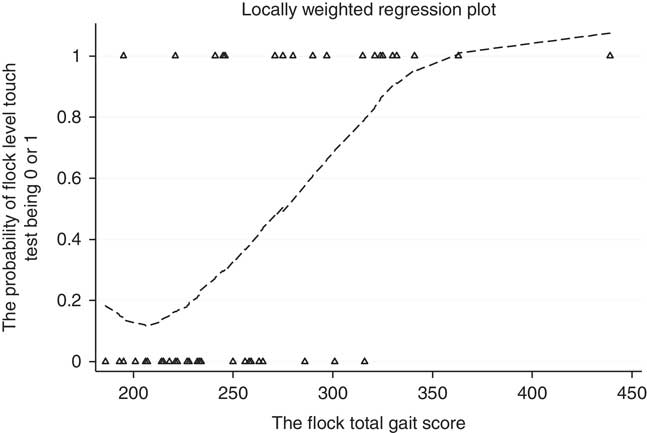
The data were collected on a handheld computer and data were transferred to an excel (version 2013) spreadsheet and further to Stata SE 14 (StataCorp LP, TX, USA). Descriptive statistics were performed in Stata using tabulations, correlations, calculations of means, standard deviation and 95% confidence intervals. The discussed variables were inspected for missing values, normality, linearity and co-linearity. The touch test score was not normally distributed, thus linear regression was not appropriate. The median (24.6) was placed to the left of the mean (45.30). The median was not a good parameter as it reflected the score 0, thus median regression was ruled out. Quantiles were made to establish classes of fear. However, only three levels were possible, resulting in an uneven distribution of observations, concentrating at the zero level. It was decided to classify fear as either present or absent for optimal presentation of results. The touch test score was dichotomized to flocks which expressed fear (n=20, score=24.6) and those that did not (n=30, score >24.6). The dichotomized touch test score was tested in one logistic regression model with the farm gait score as independent variable and for the possible univariable association with stocking density (kg/m2), age of parent flock, weight at visit, feed conversion rate and total mortality by logistic regression. Statistical significance was defined as P<0.05. Each gait score category (0 to 5) was expanded to individual birds and then appended to give an ordinal scale for describing population variations. The ordinal gait score variable was also used to identify the relationship between touch test and levels of gait. A Spearman correlation test was used to assess the relationship between the continuous touch test score and flock gait score as indicators of welfare (ρ=0.55). The relationship between the touch test score and the farm level gait score was visualized by a locally weighted scatterplot smoothing.
Results
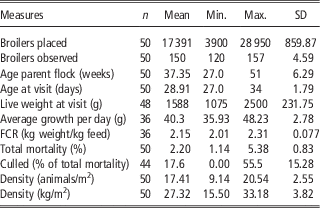
The overall descriptive flock data are given in Table 1. Mean flock age at visit was 28.9 days (range 27 to 34), mean flock size was 17 391 birds (range 3900 to 28 950) and average live weight at the visit was 1588 g (range 1075 to 2500 g) (Table 1). Mean growth rate was 40.3 g/day (range 35.9 to 48.2) and the mean total mortality was 2.1% (range 1.1 to 5.38) (Table 1).
Descriptive production data from the 50 visited broiler flocks

FCR=feed conversion rate.
Touch test
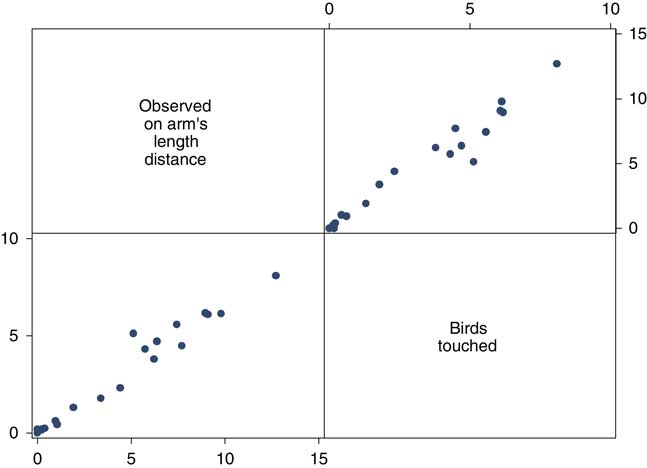
The correlation coefficient between those birds observed at arm’s length distance and touched birds was 0.99, suggesting that they measure exactly the same (Figure 1). The correlations between touch test score and number of animals touched or those observed at arm’s length distance were 0.92.
Correlation between number of broilers observed at arm’s length and number of broilers touched.

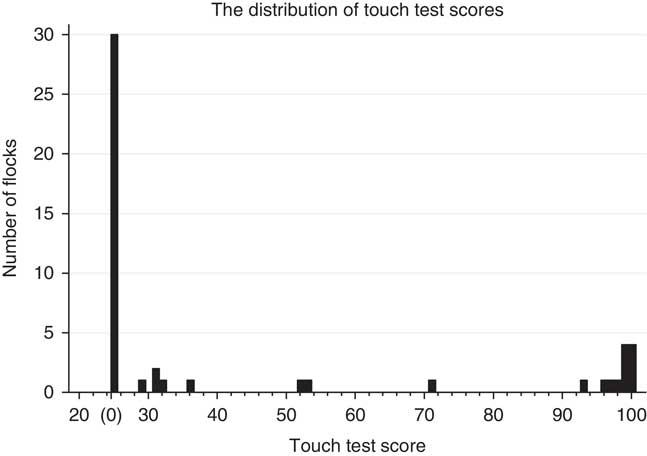
The level of fear of humans, as measured by the touch test, revealed differences between flocks with regards to numbers of animals touched, with flock scores ranging from 24.6 (no animals touched) to 99.88 (186 animals touched), averaging 45.13 (Figure 2). In 30 of the 50 flocks, the observer was not able to touch any birds (Figure 2). There was no effect of animal density (kg/m2) (P=0.74), age of parent stock (P=0.42), weight at visit (P=0.54), feed conversion qrate (P=0.89) or total mortality (P=0.79) on the number of animals touched.
Distribution of touch test scores in the 50 broiler flocks, illustrating number of flocks within the different touch test scores.

Gait score
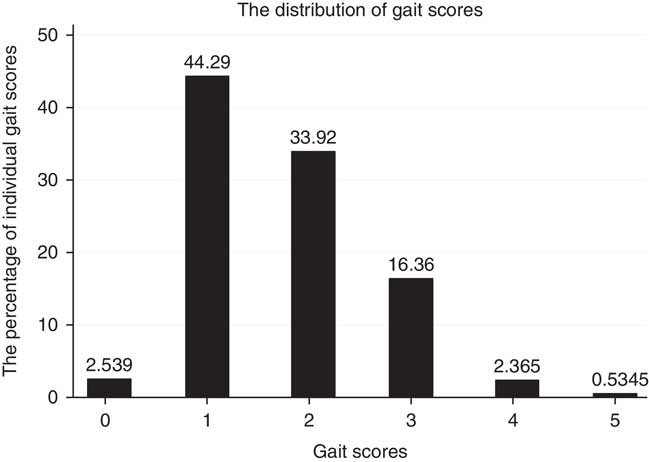
The gait score ranged from 186 to 439 in the observed flocks, with an average score of 259. In this study, 2.5% of the birds had gait score 0, 44.3% had score 1, 33.9% had gait score 2, 16.3% had score 3, 2.4% had score 4 and 0.5% had score 5. Of the 7500 observed birds in this study, 19.2% had gait score ⩾3 (Figure 3).
Distribution of gait scores in the 50 broiler flocks, illustrating the percentage of birds (n=7500) within each gait score category.

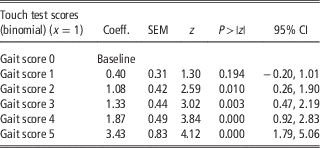
The regression coefficient for the relationship between touch test score and the total flock level gait score was 0.034 (P<0.001), indicating that the animals may express less fear when the gait scores increase (Figure 4). This is further presented in Table 2, which shows the increasing chance of a positive touch test with increasing gait scores.
Relationship between gait score and touch test score in the 50 broiler flocks, illustrating how increasing gait scores relates to the increased likelihood of obtaining a positive touch test score (x=1) (i.e. low fear of humans).

The associations between the binary touch test score (at flock level) and the gait scores (at the individual bird level) in the 50 visited broiler flocks, displaying how increasing gait scores relate to the increased likelihood of obtaining a positive touch test score (x=1) (i.e. low fear of humans) on flock level

CI=confidence intervals.
Each gait score category is relative to gait score 0 (base level). The robust standard errors are adjusted for clusters of flock identity.
Discussion
In support of the hypothesis, high gait scores (i.e. reduced walking ability) were associated with high scores in the touch test (i.e. less withdrawal from humans). As the human touch test relies on the birds’ ability to walk away to avoid the humans, this result may indicate that walking ability may have influenced the outcomes in the touch test, and hence confound interpretation of fear in broiler chicken flocks as assessed according to the Welfare Quality® protocol for broiler chickens.
We found that 19% of the birds showed moderate to severe lameness (gait score 3 or more) which is comparable to other studies examining lameness in broilers close to slaughter age (Kestin, et al., Reference Kestin, Knowles, Tinch and Gregory1992; Sanotra et al., Reference Sanotra, Lund and Vestergaard2002; Knowles et al., Reference Knowles, Kestin, Haslam, Brown, Green, Butterworth, Pope, Pfeiffer and Nicol2008; Bassler, et al., Reference Bassler, Arnould, Butterworth, Colin, de Jong, Ferrante, Ferrari, Haslam, Wemelsfelder and Blokhuis2013; Kittelsen et al., Reference Kittelsen, David, Moe, Poulsen, Young and Granquist2016). The applied scoring system scores the birds’ gait from 0 – normal to 5 – unable to walk (Kestin et al., Reference Kestin, Knowles, Tinch and Gregory1992), where a gait score of 3 or more is associated with increased likelihood of pain (Knowles et al., Reference Knowles, Kestin, Haslam, Brown, Green, Butterworth, Pope, Pfeiffer and Nicol2008; EFSA, 2012). Studies have shown that lame birds (gait score ⩾3), prefer food with analgesic, and increase their activity when given analgesics, which indicates that the observed lameness may reflect a painful condition (McGeown et al., Reference McGeown, Danbury, Waterman-Pearson and Kestin1999; Danbury et al., Reference Danbury, Weeks, Chambers, Waterman-Pearson and Kestin2000; Weeks et al., Reference Weeks, Danbury, Davies, Hunt and Kestin2000). Lameness has also been found to modify broiler behaviour; for example, Weeks et al. (Reference Weeks, Danbury, Davies, Hunt and Kestin2000) showed how lame broilers made fewer visits to the feeders, but ate for a longer duration compared with sound birds, whereas Vestergaard and Sanotra (Reference Vestergaard and Sanotra1999) found that lame birds dustbathe less than sound birds.
The touch test is designed to assess the human–animal relationship of the flock, which is an integral part of the overall animal welfare (Welfare Quality, 2009). The touch test is based on the premise that an improved human–animal relationship will result in less fearful animals, and that more animals can be touched by an assessor (e.g. Forkman et al., Reference Forkman, Boissy, Meunier-Salaün, Canali and Jones2007). The touch test has been validated for assessing human–animal relationship in laying hens, and it has been found that positive human contact increased number of touched birds in the touch test (Graml et al., Reference Graml, Niebuhr and Waiblinger2008a and Reference Graml, Waiblinger and Niebuhr2008b). Furthermore, the touch test was moderately to highly correlated with the ADT and novel object test in layers (Graml et al., Reference Graml, Niebuhr and Waiblinger2008a), indicating good specificity for measuring the hen’s relationship with humans. The number of birds touched in our study varied substantially between farms, and this difference could not be explained by factors that may have prevented the birds from moving away, such as animal density or the weight of the birds. In 30 of the 50 assessed flocks in our study, the assessor could not touch any birds, which in the protocol translates into a poor human–animal relationship. However, in some of these flocks, the escaping birds would return to the squatting assessor after a few moments, suggesting that these birds were motivated to approach the assessor after they initially fled. Our results emphasize the need for further studies to understand how broilers close to slaughter age express fear.
Our results suggest that increased lameness resulted in less fearful animals. We cannot rule out that the results in the present study may indicate that lame broilers, for some reason, were less fearful. We do not know whether farmers with more lameness in the flocks spent more time in the flocks and that the birds therefore were less fearful due to the amount of, for example, positive contact and time spent with the farmer. On the other hand, one could argue that lame birds would in fact feel more vulnerable as they are unable to withdraw from aversive encounters (Vestergaard and Sanotra, Reference Vestergaard and Sanotra1999), and thus be more fearful, but to our knowledge, this relationship has not been investigated.
Knowing that lameness is a common problem in broiler flocks (e.g. Bassler et al., Reference Bassler, Arnould, Butterworth, Colin, de Jong, Ferrante, Ferrari, Haslam, Wemelsfelder and Blokhuis2013; Kittelsen et al., Reference Kittelsen, David, Moe, Poulsen, Young and Granquist2016), the results in the present study suggest that the touch test could be affected and confounded by poor leg health and may represent a suboptimal method of assessing fear of humans and human–animal relationship of broilers close to slaughter age. However, due to the limited number of farms included, further epidemiological studies are needed to investigate prevalence and risk factors associated with reduced walking ability to gain more detailed knowledge about lameness in broiler chickens.
In addition to the pain associated with lameness, lame birds may have more difficulty reaching valued resources in the house, such as food and water (Sanotra et al., Reference Sanotra, Lund and Vestergaard2002) and performing motivated behaviour such as dust bathing (Vestergaard and Sanotra, Reference Vestergaard and Sanotra1999) and walking and preening (Weeks et al., Reference Weeks, Danbury, Davies, Hunt and Kestin2000). Recognizing that positive subjective states associated with display of positively motivated behaviour are important for good animal welfare (Boissy et al., Reference Boissy, Manteuffel, Jensen, Moe, Spruijt, Keeling, Winckler, Forkman, Dimitrov, Langbein, Bakken, Vessier and Aubert2007), the further validation of the touch test should, therefore, include studies of the relationship between outcomes in the touch test with other locomotor activities that indicate a positive motivational state of the birds.
In conclusion, the present study suggests that broiler leg health needs to be considered in the interpretation of outcomes in fear tests in broiler chickens. Furthermore, the touch test (and potentially other fear tests involving walking ability) needs to be further validated, taking pain associated with poor leg health as well as the expression of positive subjective states into account.
Acknowledgements
The authors would like to thank Henk Gunnink for valuable training of our observer in the use of the Welfare Quality® protocol. Professor Eystein Skjerve (NMBU) has provided valuable help with the statistics. The authors would also like to thank all participating farmers. This work was supported by the Norwegian Research Council, project no. 234191.