The impact of adversity on child development and well-being commands increasing concern, particularly with regard to the causes of heterogeneity in outcomes and identification of factors promoting resilience or vulnerability (Cicchetti & Walker, Reference Cicchetti and Walker2001; Gunnar, Reference Gunnar and Nelson2000; Repetti, Taylor, & Seeman, Reference Repetti, Taylor and Seeman2002). Biological markers have been increasingly used to “get under the skin” of trauma or disadvantage and assess the proximal impact of acute and chronic stressors (Granger & Kivlinghan, Reference Granger and Kivlinghan2003; Gunnar & Donzella, Reference Gunnar and Donzella2002; Heim & Nemeroff, Reference Heim and Nemeroff2002; Lupien, King, Meaney, & McEwen, Reference Lupien, King, Meaney and McEwen2001; Seeman & McEwen, Reference Seeman and McEwen1996). Rapidly accumulating work in this area contrasts with a paucity of data on non-Western settings where the majority of children live and the exposure to adversity is most prevalent and severe (UNICEF, 2002). These settings present other complexities (malnutrition, illness, diverse social conditions) against which existing models of stress and development should be tested and refined (Fernald & Grantham-McGregor, Reference Fernald and Grantham-McGregor2002; Flinn & England, Reference Flinn and England1997; McDade, Reference McDade2002; Raine et al., Reference Raine, Venables, Dalais, Mellingen, Reynolds and Mednick2001; Worthman, Reference Worthman, Panter-Brick and Worthman1999).
However, the present literature on childhood stress focuses on markers of psychosocial stress and impairment and neglects the concomitant physical burdens commonly encountered by children at risk. The potential for addressing both mental and physical burden in children at risk has expanded dramatically as researchers begin to apply a wide range of biomarkers for assessment of stress, vulnerability to stress, and functional burden. The present study deploys a multidimensional approach to appraise the distribution of burden with assessment of salient physical and psychosocial markers of stress in adverse environments. It was provoked by a surprising observation: homeless street children in Kathmandu, whose presence is regarded by international organizations and welfare agencies as deeply problematic, were found to achieve strikingly better growth outcomes relative to villagers in rural Nepal (Panter-Brick, Todd, & Baker, Reference Panter-Brick, Todd and Baker1996). A subsequent literature review (Panter-Brick, Reference Panter-Brick2002) concluded that homeless street children were not necessarily at risk for the worst health outcomes, contrary to existing literature that characterizes them as “most at risk of negative physical, mental and developmental outcomes” (de la Barra, Reference De la Barra1998, p. 46). It is arguable that a more critical appraisal of the impact of poverty, homelessness, and social exclusion is required, including a rigorous evaluation of health outcomes in different environments. Very few studies integrate both the physical and psychosocial dimensions of health outcomes to conceptualize the multifaceted responses to stressors and adversity in comparative perspective. This study takes a step in that direction, aiming to redress the paucity of comparative research on adverse environments and developmental risk in non-Western settings.
Developmental Psychobiology of Stress: Current Approaches
Advances in conceptualization of psychosocial stress emphasize its dynamic nature, as arising from cumulative interactions of the person and a specific environment (Cacioppo, Berntson, Sheridan, & McClintock, Reference Cacioppo, Berntson, Sheridan and McClintock2000; McEwen, Reference McEwen2000a, Reference McEwen2000b). A rapidly burgeoning literature on the developmental psychobiology of psychosocial stress has underscored the moderating role of temperamental and social factors on responses to stressful experience (Boyce & Jemerin, Reference Boyce and Jemerin1990; Gunnar & Donzella, Reference Gunnar and Donzella2002; Kagan, Reznick, & Snidman, Reference Kagan, Reznick and Snidman1987; Lewis & Ramsay, Reference Lewis and Ramsay1995) and their consequences for sociobehavioral and psychiatric outcomes (Boyce et al., Reference Boyce, Frank, Jensen, Kessler, Nelson and Steinberg1998; Hart, Gunnar, & Cicchetti, Reference Hart, Gunnar and Cicchetti1996; Hirshfeld et al., Reference Hirshfeld, Rosenbaum, Biederman, Bolduc, Faraone and Snidman1992). Research on the developmental effects of stressful experiences has been stimulated by important experimental and long-term work with rodent and primate models (Coplan et al., Reference Coplan, Smith, Altemus, Scharf, Owens and Nemeroff2001; Higley et al., Reference Higley, Thompson, Champoux, Goldman, Hasert and Kraemer1993; Meaney, Reference Meaney2001; Schneider & Moore, Reference Schneider, Moore and Nelson2000; Suomi, Reference Suomi, Bock and Whelan1991). In humans, the organizational impact of traumatic experiences on later mental health, even across generations, is receiving increasing attention (Heim & Nemeroff, Reference Heim and Nemeroff2001; Yehuda, Reference Yehuda1999; Yehuda, Teicher, Trestman, Levengood, & Siever, Reference Yehuda, Teicher, Trestman, Levengood and Siever1996). Social ecological challenges (poverty, maternal depression, quality of day care) also exert concurrent effects on hypothalamic–pituitary–adrenal (HPA) activity (Lupien, King, Meaney, & McEwen, Reference Lupien, King, Meaney and McEwen2001; Tout, de Haan, Campbell, & Gunnar, Reference Tout, de Haan, Campbell and Gunnar1998).
Such literature links the features of adverse experiences to cognitive and behavioral outcomes, via the psychophysiological mediators of experiential processing. However, research on children and youth in everyday settings precludes experimental and invasive approaches to tracing such mediating pathways in detail. Rather, the study of affective state regulation and processing in humans has relied on noninvasive means to track the physiological markers of stress regulation, such as cardiovascular autonomic and endocrine changes. Everyday negatively perceived experiences are acutely associated with cardiovascular changes and, over a somewhat longer time course, increased cortisol (Seeman & McEwen, Reference Seeman and McEwen1996; van Eck, Berkhof, Nicolson, & Sulon, Reference van Eck, Berkhof, Nicolson and Sulon1996). With respect to cardiovascular changes, “reactivity” (response latency, magnitude, and trajectory) is thought to modulate these associations (Cacioppo et al., Reference Cacioppo, Malarkey, Kiecolt-Glaser, Uchino, Sgoutas-Emch and Sheridan1995, Reference Cacioppo, Berntson, Malarkey, Kiecolt-Glaser, Sheridan and Poehlmann1998; Gunnar, Porter, Wolf, Rigatuso, & Larson, Reference Gunnar, Porter, Wolf, Rigatuso and Larson1995) and in field studies, pressor response (accommodation of postural change, indexed by heart rate [HR]) is a useful indicator of vagal tone and autonomic reactivity (Cacioppo, Reference Cacioppo1994; Cacioppo et al., Reference Cacioppo, Berntson, Malarkey, Kiecolt-Glaser, Sheridan and Poehlmann1998; Porges, Doussard-Roosevelt, & Maita, Reference Porges, Doussard-Roosevelt and Maita1994). With respect to endocrine responses, central neuroendocrine pathways of emotion processing influence cortisol levels, most conveniently appraised from repeated saliva sampling. Individual differences in responses to stressful experiences have been probed by tracking cortisol changes in experimental or natural conditions (Granger, Weisz, McCracken, Ikeda, & Douglas, Reference Granger, Weisz, McCracken, Ikeda and Douglas1996; Kirschbaum & Hellhammer, Reference Kirschbaum and Hellhammer1994; Schwartz, Granger, Susman, Gunnar, & Laird, Reference Schwartz, Granger, Susman, Gunnar and Laird1998). Both perceived chronic stress and constitutional factors have been associated with elevated cortisol in the hour after wakening (Wüst, Federenko, Hellhammer, & Kirschbaum, Reference Wüst, Federenko, Hellhammer and Kirschbaum2000); quality of child care has been related to emotional development, regulation, and cortisol responses in infants and children (Dettling, Parker, Lane, Sebanc, & Gunnar, Reference Dettling, Parker, Lane, Sebanc and Gunnar2000; Gunnar & Donzella, Reference Gunnar and Donzella2002; Hruschka, Kohrt, & Worthman, Reference Hruschka, Kohrt and Worthman2005); and traumatic stress has been linked to low as well as to high cortisol values and to blunted or exacerbated cortisol responsiveness in children and adults (De Bellis, Reference De Bellis2002; Heim & Nemeroff, Reference Heim and Nemeroff2001).
Levels of ecological stress, in conjunction with individual responses to stress, have also been linked to immune function (Boyce, Adams, et al., Reference Boyce, Adams, Tschann, Cohen, Wara and Gunnar1995; Boyce, Chesney, et al., Reference Boyce, Chesney, Alkon, Tschann, Adams and Chesterman1995; Uchino, Cacioppo, & Kiecolt-Glaser, Reference Uchino, Cacioppo and Kiecolt-Glaser1996) and consequent vulnerability to infections (Cohen, Frank, Doyle, Skoner, & Rabin, Reference Cohen, Frank, Doyle, Skoner and Rabin1998; Glaser, Kiecolt-Glaser, Malarkey, & Sheridan, Reference Glaser, Kiecolt-Glaser, Malarkey and Sheridan1998; Glaser, Rabin, Chesney, Cohen, & Natelson, Reference Glaser, Rabin, Chesney, Cohen and Natelson1999). Meta-analysis has identified that antibodies to resident viruses (Epstein–Barr and herpes simplex) pandemic in humans are sensitive indicators of chronic psychosocial stress, with increased levels of antibodies to a resident virus reflecting impaired cell-mediated immune function associated with long-term stress (Cacioppo et al., Reference Cacioppo, Kiecolt-Glaser, Malarkey, Laskowski, Rozlog and Poehlmann2002; Glaser, Kutz, MacCallum, & Malarkey, Reference Glaser, Kutz, MacCallum and Malarkey1995; Herbert & Cohen, Reference Herbert and Cohen1993). A pandemic herpes virus, Epstein–Barr virus (EBV) infects and chronically inhabits 80% to 90% of American adults by the age of 40 (Henle & Henle, Reference Henle, Henle, Glaser and Gottlieb-Stematsky1982; Jones & Straus, Reference Jones and Straus1987), but attains 100% prevalence by age 5 years in non-Western populations with greater exposure and vulnerability. A fingerprick blood spot method for assessing EBV antibody titers (EBV-Ab), developed for field studies, has been used to demonstrate the impact of acculturation stress on Samoan adolescents as well as of family stress on American youth (McDade, Reference McDade2002; McDade et al., Reference McDade, Stallings, Angold, Costello, Burleson and Cacioppo2000). Yet so far, the psychoneuroimmunological literature on psychosocial stress has failed to consider the impact of high pathogen load interacting with marginal nutrition, a condition uncommon in European and North American populations but prevalent in much of the rest of the world. This is the first report in the literature to consider such immunological correlates of stress for a population with high pathogen exposure and marginal nutrition.
Allostatic Load and Cumulative Burden
A lifespan perspective and emphasis on cumulative burden increasingly inform views of stress and health among adults (Darnton-Hill, Nishida, & James, Reference Darnton-Hill, Nishida and James2004). McEwen (Reference McEwen2000a) has advanced the concept of allostatic load to maintain a necessary distinction between stressors and stress: the former is a property of circumstances to which individuals are exposed, the latter is the extent to which the individual is challenged to maintain function. The above-reviewed literature on developmental psychobiology of stress, for instance, emphasizes the interaction of individual and context (Ellis, Essex, & Boyce, Reference Ellis, Essex and Boyce2005). Whatever the origins, activation of systems to meet psychosocial or physical challenges promotes adaptation in the short run, but exacts physical costs over time. Allostatic load represents the cumulative impact or functional burden of adjusting to perceived or actual challenge and as such, offers an integrated developmental, multisystem approach to understanding the sources of differential well-being (McEwen & Wingfield, Reference McEwen and Wingfield2003). Recent reports have used a multisystem assessment of allostatic load to predict differences in functioning and mortality risk in aging (Seeman, McEwen, Rowe, & Singer, Reference Seeman, McEwen, Rowe and Singer2001; Seeman, Singer, Rowe, Horwitz, & McEwen, Reference Seeman, Singer, Rowe, Horwitz and McEwen1997). Other work on response to challenge, particularly psychosocial threat, allies adaptationist with empirical approaches to suggest nonlinear interactions of adversity with responsivity to challenge (Boyce & Ellis, Reference Boyce and Ellis2005). Together the developmental, adaptationist, multisystem approach of allostatic load and the context-dependent perspective on emergence of response to challenge provide a framework for comparative empirical research on the impact of early adversity on mental and physical well-being.
Studies Among Non-Western Children and Youth
Against this substantial background of conceptual, methodological, and empirical progress, the dearth of comparative research in non-Western settings stands out. The generalizability of existing models for understanding the developmental psychobiology of psychosocial stress remains untested in the contexts relevant to the majority of the world's children. The few available reports are suggestive. For instance, in research in Dominica, Flinn, and colleagues (Flinn & England, Reference Flinn, England and Wilce2003; Flinn, Quinlan, Decker, Turner, & England, Reference Flinn, Quinlan, Decker, Turner and England1996) found that elevated cortisol profiles associated with family dynamics also related to subsequent discrete illness episodes. In Jamaica, 8- to 10-year-old children with continuous growth stunting from infancy (defined as ≤2 SD below US reference height for age) showed greater cortisol output, HRs, and pressor responses throughout a protocol of interview and frustrating tasks. Stunted children showed a relationship of pretest cortisol to increased behavioral inhibition and reduced vocalization during frustrating tasks, diametrically opposite to the cortisol profiles associated with increased vocalization and reduced inhibition in nonstunted children (Fernald & Grantham-McGregor, Reference Fernald and Grantham-McGregor1998). In a later study, similarly aged stunted Jamaican children exhibited elevated HRs and catecholamine production, but not salivary cortisol, during test session. Furthermore in Nepal, stunted 8- to 10-year-old school children showed similar baseline values and a blunted physiologic response (cortisol and HR) to challenging tasks, compared to nonstunted peers (Fernald, Grantham-McGregor, Manandhar, & Costello, Reference Fernald, Grantham-McGregor, Manandhar and Costello2003).
In contrast to the relative inattention to psychosocial stress, extensive comparative worldwide data are available relating child adversity to physical development and health. Indeed, child and maternal malnourishment indexed by underweight is estimated to represent the single largest source of global health burden (Ezzati et al., Reference Ezzati, Lopez, Rodgers, Vander Hoorn and Murray2002). Morphometric measures of child growth and nutritional status provide sensitive indices of environmental quality and developmental risk, representing the cumulative impacts of physical adversity such as impaired nutrition and burdens of infection and parasites, from gestation onward (Pelletier & Frongillo, Reference Pelletier and Frongillo2003; World Health Organisation [WHO], 1995). Structural factors affecting conditions such as rates of immunization, female literacy, and safe water also drive international differences in child growth (Milman, Frongillo, de Onis, & Hwang, Reference Milman, Frongillo, de Onis and Hwang2005). But political and social factors related to ethnicity, class, or region contribute to variation within countries (Eveleth & Tanner, Reference Eveleth and Tanner1990) and raise public health concern to detect and ameliorate the sources of such health disparities (Ezzati et al., Reference Ezzati, Lopez, Rodgers, Vander Hoorn and Murray2002). Furthermore, the insults reflected in poor child growth and nutrition are linked to deficits in cognitive–behavioral development (Chang, Walker, Grantham-McGregor, & Powell, Reference Chang, Walker, Grantham-McGregor and Powell2002; Li, Barnhart, Stein, & Martorell, Reference Li, Barnhart, Stein and Martorell2003), yet the import of these observations for long-term psychobehavioral risk remains understudied (but see Raine, Reference Raine2003). Advances in use of models and measures of child physical well-being for international public health have not been paralleled by similarly strong advances in assessment of child psychosocial well-being and mental health (Pollitt, Reference Pollitt2000). Further, assessment of child psychosocial stress has not been incorporated into measures of child well-being, leaving our global comparative view of child developmental risk incomplete.
Selection of Study Groups
Concern for the physical and mental health of displaced persons and unaccompanied children currently leads in many international agendas (Desjarlais, Eisenberg, Good, & Kleinman, Reference Desjarlais, Eisenberg, Good and Kleinman1995; Fazel & Stein, Reference Fazel and Stein2002; Saraceno, Reference Saraceno2003): there is a rapidly growing number of homeless street children subsisting in urban centers, of displaced children affected by warfare or ecological disasters, and orphans from the HIV/AIDS epidemic. High rates of adult mortality increase the risk that children experience parent loss, family disruption, stepparenting, and adoption. Such conditions confront Nepali children, given high maternal mortality (740 per 100,000 births in the period of this study (1993), compared to 540 in neighboring India (UNICEF, 2004, pp. 25–26) and overall adult mortality (ages 15–56: 312 males, 243 females/1,000 in 1990 (World Bank, 1993). Worldwide, such emerging issues intersect with other established and novel challenges to family and child well-being, including increasing rural poverty and ecological degradation as well as urbanization and economic stratification. At the time of the study, Nepal ranked as the seventh poorest nation in the world; rural population pressure with environmental decay contributed to rates of urban migration and rapid expansion of landless urban poor living in marginal conditions (United Nations Fund for Population Activities, 1996, 2000). Since then, as armed conflict between Maoist and government forces has flared across the country, increasing numbers of Nepali children are growing up under challenge from psychosocial stress and material hardship.
Studies in both the developed and developing world have emphasized that “homelessness” is a risk for child health, but so is “poverty” (Costello, Compton, Keeler, & Angold, Reference Costello, Compton, Keeler and Angold2002; Davey Smith, Reference Davey Smith1998; Luthar, Reference Luthar1999). Yet, rarely has research explicitly compared street children living outside a residential family setting with their peers growing up under other prevailing conditions that also may present distinctive challenges (Panter-Brick, Reference Panter-Brick and Schwartzman2001, Reference Panter-Brick2002). Therefore, we elected to contrast Nepali street children with children of urban squatter, urban middle-class, and rural village families. We thereby compare children who live with or without the care and protection of adults, children who are socioeconomically disadvantaged or secure, and children in urban or rural environments. Specifically, we sampled four groups with contrasting family residence, location, and wealth, as follows: two urban poor populations in Kathmandu: homeless children, and squatter children residing at home; the rural poor in a remote village of central Nepal; and urban middle class attending a fee-paying school in Kathmandu. Homeless street children come from both village and squatter populations, namely from families who have and have not migrated to Kathmandu. The middle-class group represents relatively advantaged rearing conditions available for Nepali children.
This is the first study of homeless street children that uses appropriate local controls, draws multiple indices of physical and psychosocial well-being, and assesses aggregated psychosocial and physical burden. To date we have reported marked group differences in the physical markers of well-being indicating that the homeless street boys did not have the worst outcomes in terms of growth status and pathogen load, and documenting a marked contrast between urban and rural conditions. Height status was worst in villagers (Panter-Brick, Todd, & Baker, Reference Panter-Brick, Todd and Baker1996) and acute-phase protein indices of pathogen load were greatest even though villagers reported the least morbidity (Panter-Brick, Lunn, Baker, & Todd, Reference Panter-Brick, Lunn, Baker and Todd2001; Panter-Brick, Todd, Baker, & Worthman, Reference Panter-Brick, Todd, Baker and Worthman1996). Indeed, the observed discordance between self-reported symptoms and infection status raised our interest in biomarkers to assess health status. Physiologic measures can indicate the acute and cumulative burden of insult of which individuals may or may not be aware, and are not dependent on the social, cultural, and personal factors that influence self-report.
Study Aims and Hypotheses
The present report aims to integrate measures of biological developmental adversity (growth status, pathogen load indexed by acute-phase protein, cardiovascular fitness) with measures of psychosocial stress (average cortisol, EBV antibody values) and indicators thought to mediate individual vulnerability to stress (cardiovascular reactivity, day-to-day cortisol variance). Hence, the suite of biomarkers was chosen to represent the confluence of both psychosocial and material deprivation comprising social (socioeconomic marginalization, perceived disadvantage, family dysfunction), material (marginal nutrition, workload, poor sanitation, inadequate housing), and psychological (insecurity, perceived disadvantage, lack of social support) dimensions. From these measures we derive an index of allostatic load to obtain a locally informed index of relative well-being and evaluate the contributions of material and social deprivation to differential well-being on two levels. From the epidemiologic focus on social address and exposure to risk (Krieger, Reference Krieger2004), we take a social ecological approach and contrast four groups from across the range of expectable rearing environments for children in Nepal. From the developmental focus on the individual, we applied biomarkers as sensitive and universal indices of developmental risk (e.g., growth impairment, nutritional, and infective status) and well-being (e.g., HPA, infection).
Here, we address the question of whether children living on the streets of Kathmandu indeed fare worse than their peers living in urban squatter, urban middle-class, or village families. First, we use biomarkers of mental and physical stress and vulnerability to stress to contrast burden among homeless street boys relative to peers. Second, we combine the biomarkers in a measure of allostatic load to compare overall well-being among groups. By contrast with a prevalent concern for homeless children evoked by their visibility and perceived vulnerability, previous field work indicates that the gradient of deprivation represented in growth and infective status across our four populations runs, high to low, as follows: villager, homeless, squatter, and school children. We test the competing hypothesis that allostatic load follows this gradient rather than one that places homeless street children as worst off.
Methods
Study populations
Four groups of Nepali boys (n = 107, ages 10–14 years)—homeless street children, urban squatters, urban middle class, and villagers—were drawn from three urban groups representing contrasting lifestyles and socioeconomic statuses in Kathmandu, a migrant-receiving city of ~450,000 inhabitants at the time of study (August–December 1993), and from a fourth contrasting village population in the rural hill areas supplying some urban migrants. These samples were selected to represent social ecologies, or prevailing conditions related to social address, that characterize the spectrum of conditions experienced by Nepali children. Our four contrastive conditions represent intersections of three axes that situate child social address in Nepal: urban–rural, disadvantaged–secure, and street–home. The present data concern a subsample of participants from a larger survey (n = 307, ages 6–14 years) that recruited a representative sample of homeless children—23% of the known homeless population of Kathmandu enumerated by a nongovernmental organization (NGO), Child Workers in Nepal (CWIN)—and total samples of poor squatter, middle-class urban and village boys drawn from a nearby squatter settlement, a private school, and the remote rural area, respectively (Panter-Brick, Baker & Todd, Reference Baker, Panter-Brick and Todd1996). After this survey, participants were recruited for the intensive hormonal, immunological, and cardiovascular measurements, for which data were collected both in secure locations (the NGO common room, a rented flat, the school, the village home) and in habitual settings (e.g., homes, streets) as appropriate. Because 97% of homeless children in Kathmandu were male, this study focused on boys. The purposes of the research were explained by local assistants well known to the children (NGO staff serving both homeless and squatter children, schoolteachers, and village leaders), whereas recruitment was facilitated through previous fieldwork by Baker et al. (Reference Baker, Panter-Brick and Todd1996) in the street and school settings and by Panter-Brick in the village setting since 1982. The research protocol was approved by the Ethics Committee of Durham University and conducted under research permit from the Research Office, Tribhuvan University, Kathmandu. All aspects of participation were explained to, and informed consent obtained from, participants and, where available, their parents. At the end of their participation, boys were paid a small amount of food or money for the time taken by the study.
Urban homeless
Homeless children represent conditions for children not residing in families and without stable abodes who endure the social and material uncertainty of life on the streets. Homeless street children in Kathmandu may come from rural areas throughout Nepal or be drawn from the rapidly growing squatter population in the urban area. They leave home mostly to seek independent livelihood and escape absolute poverty or family dysfunction (Panter-Brick, Todd, & Baker, Reference Panter-Brick, Todd and Baker1996). They support themselves both by begging from locals or tourists and by selling metal and plastic products scavenged from trash bins and city dumps, and taken to junkyards for recycling. The status of homelessness is rather fluid, as some children from rural areas visited the parental home (usually once a year), whereas others retained links with the squatter settlements. At the time of the study, however, these children reported themselves as homeless and slept nights alone or in small groups of friends, on pavements, at bus stops, by restaurants or shops, or in a secure common room run by the NGO. Duration of homelessness among participants in the initial survey ranged from 1 week to 9 years, averaging 2.7 years. For the subsample in the present study (n = 27), the range was 0.5–6 years, on average 2.85 (SD = 1.92). The sample of homeless is drawn from both rural immigrant and urban squatter sources.
Urban squatter
This group (n = 20) was chosen as representative of children of the urban migrant underclass who experience material deprivation, social marginalization, poor housing and sanitation, but who reside with their families. The squatter boys are also “street children” commonly engaged in similar street-based activities by day, but who spend the night with their families in illegally established, indigent, makeshift and crowded settlements. The squatter population of Kathmandu has been estimated as growing at 8% per annum to approximately 10,000 people in the early 1990s (Central Bureau of Statistics, 1987). Many squatter families have migrated from rural areas during the last 15 years, and subsist as low-caste street sweepers, street vendors, and jewelry makers. The boys, recruited from the squatter settlement closest to the NGO, contributed to their family's earnings and/or attended school.
Urban middle class
This group (n = 30) was chosen as representative of relatively favorable material conditions for child welfare, benefiting from relative material and social security, more adequate nutrition, urban housing, improved schooling, and sanitation. Pupils were drawn from four classes of a private school in Kathmandu, mostly day students living at home, with some boarders sent from rural areas. They represent a local control group drawn from relatively affluent middle-class families, able to afford private school fees. Middle-class families, locally characterized as having at least one adult with employment providing a stable income, comprise roughly 40% of the population in Nepal's Central region that includes Kathmandu.
Rural village
This group (n = 30) represents rural village conditions in which the majority of Nepali children grow up, subject to poor sanitation, subsistence nutrition, and relatively heavy physical workloads, but residing in families within a stable community. The village sample comprised all the available 10- to 14-year-old boys residing in the two main hamlets of Salme village (central Nepal), comprising 1,540 inhabitants. The area lacks roads, electricity, or public sanitation, and it is the site of long-term ongoing research by Panter-Brick. The villagers are self-sufficient agropastoralists with high workloads involving assistance from children, whose labor is counted as equivalent to that of an adult by 12 years of age (Panter-Brick, 1998). Subsistence relies on multiple cropping with circannual harvesting, use of animal resources, and occasional wage labor and outside remittances. Children attend school but routinely perform subsistence and domestic tasks as well.
Biomarkers and demographic data
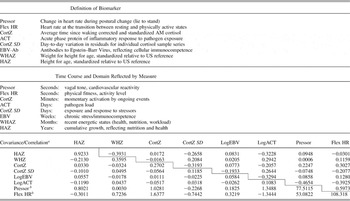
Biomarkers used in this study are listed in Table 1, along with the time course and domain represented by the measure.
Biomarkers: Characteristics and covariance

aCovariance and correlation are displayed below and above the step diagonal, respectively.
bData are from homeless, school, and village groups only.
Anthropometry
Growth status was assessed using standard anthropometric techniques and portable equipment (Harpenden anthropometer, Salter electronic scale, steel tape, and caliper) as detailed elsewhere (Panter-Brick, Baker & Todd, Reference Baker, Panter-Brick and Todd1996). Measures were taken by the same investigator at all four sites. Height for age (HAZ) represents cumulative growth reflective of lifetime nutrition and health; weight for age (WAZ) denotes past growth and present nutritional and infective status; and weight for height (WHZ) reflects recent health and nutritional status.
Salivary cortisol
Participants contributed morning samples over 7–10 consecutive days to derive a representative estimate of morning HPA activity (Hruschka et al., Reference Hruschka, Kohrt and Worthman2005), having been habituated to saliva collection by a previous week-long round of daily collection not considered in the present analysis. They were met at prespecified locations, and asked to rinse their mouth with water, wait 15 min for equilibration, and collect unstimulated 2.5 ml saliva into calibrated Sterilin vials pretreated with sodium azide (one drop 2% aqueous solution [wt/vol], dried). Time of collection, time of waking, and whether and when anything had been eaten or drunk were recorded. Samples were kept at room temperature in the field, shipped to the laboratory, and then stored at −26°C until assay. Cortisol determinations were made using a minimally modified version of a solid phase Coat-A-Count Cortisol radioimmunoassay (RIA) kit from Diagnostic Products Corporation (Los Angeles, CA). Validation analysis of matched treated and untreated saliva supported the expectation that the antioxidant sodium azide does not interfere with this RIA as it may with enzyme-linked assays. Antiserum is highly specific for cortisol, and it cross-reacts 1.4% with corticosterone, 1.5% with 11-deoxycorticosterone, and <1.0% with most other related compounds. Assay sensitivity is 0.06 mg/dl. Intraassay coefficients of variation (CVs) for low, medium, and high commercial controls are 10.7, 6.2, and 7.7%, respectively. Interassay CVs for low, medium, and high controls are 11.3, 8.2, and 8.0%. The intra- and interassay coefficients of variation for the saliva pool are 6.0 and 6.8%, respectively. Accuracy of the assay is reported as excellent (Raff, Homar, & Burns, Reference Raff, Homar and Burns2002).
Blood spot EBV-Ab and acute-phase protein
Finger-prick blood spots (one sample per child) were collected onto a standardized filter paper (Schleicher and Schull #903, Keene, NH), air dried at room temperature, placed in a ziplock bag, and refrigerated for up to a week until shipment to the laboratory, where they were stored at −26°C until assay. Details of blood spot sampling, handling, stability, and assay of EBV-Ab in the paper matrix are provided elsewhere (McDade et al., Reference McDade, Stallings, Angold, Costello, Burleson and Cacioppo2000; Worthman & Stallings, Reference Worthman and Stallings1997). Levels of EBV-Ab are elevated when cell-mediated immunity is impaired by psychosocial stress, and thus have been promoted as a direct biomarker of psychosocial stress. An acute-phase protein sensitive to a wide range of infections, alpha1-antichymotrypsin (ACT), was also assayed from the blood spots using an automated immunoturbidimetric technique (Dako, Ely, UK; Cobas Fara centrifugal spectrophotometer, Hoffman La Roche, Nutley, NJ). Assay detection limit is 0.02 g/l; within- and between-assay CVs for low and high controls (0.24 and 0.59 g/l) run 3 and 4%, and 5 and 8%, respectively. Procedure, performance, and quality control for the results reported here are detailed elsewhere (Adelekan et al., Reference Adelekan, Northrop-Clewes, Owa, Oyedeji, Owoeye and Thurnham2003; Panter-Brick et al., Reference Panter-Brick, Lunn, Baker and Todd2001). ACT rises rapidly and remains elevated in response to pathogen exposure, and thus acts as an indicator of pathogen challenge in subclinical and chronic infection (Adelekan et al., Reference Adelekan, Northrop-Clewes, Owa, Oyedeji, Owoeye and Thurnham2003; Thompson, Milford-Ward, & Whicher, Reference Thompson, Milford-Ward and Whicher1992). Acute immune activation stimulates HPA activity (Battaglia et al., Reference Battaglia, Brown, Krasa, Thrun, Viguié and Karsch1998) but in the present data set, cortisol was not correlated with ACT.
HR measures
Physical fitness and physical activity were assessed by HR monitoring during a standard protocol and where possible for 24 hr (Panter-Brick, Todd, Baker, & Worthman, 1996). A chest strap monitor and wrist recording devices (Polar Vantage XL, Polar CIC, Washington, NY) were worn by participants during a progressive timed protocol of lying, sitting, standing, stepping, and jogging. HR for each state was calculated as mean beats per minute (bpm) in the last minute of the 4-min recording period at each state. Flex HR (flexHR), a measure of cardiovascular fitness, was calculated from the mean of maximum rest (lying, sitting, standing) and minimum active (stepping, jogging) HR. Pressor response, a marker of vagal tone and cardiovascular reactivity, was derived as the difference between the maximum sitting HR (entire trace) and the mean lying HR (last minute). Cardiovascular capacity to accommodate load shifts during postural change from lying to sitting or standing reflects vagal tone and other dimensions of cardiovascular fitness (greater tone results in lower HR change). Results for the monitoring of 24-hr and daytime physical activity are reported elsewhere (Panter-Brick, Todd, Baker, & Worthman, Reference Baker, Panter-Brick and Todd1996). Logistic constraints prevented collection of HR measures in squatter boys.
Demographic data
Exact ages of village participants were known from household demographic records maintained since 1982. Exact ages were also known from school records for middle-class pupils. The ages of homeless and squatter boys were based on child reports, with repeated corroboration from trusted fieldworkers and parents when available. Family composition (nuclear, stepparent, orphan), size, and birth order were obtained from household records for the village and from extensively cross-checked self-reports for urban children (Baker, Panter-Brick, & Todd, Reference Baker, Panter-Brick and Todd1996).
Allostatic load
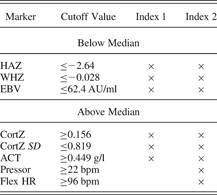
Following previous reports (Seeman et al., Reference Seeman, Singer, Rowe, Horwitz and McEwen1997, Reference Seeman, McEwen, Rowe and Singer2001), we constructed a measure of allostatic load that summarizes status on biomarkers that index multiple systems related to child developmental risk and well-being. Biomarkers included in the index were height for age and weight for height for age Z scores (HAZ and WHAZ, respectively, reflecting growth and nutritional status as influenced diet, physical activity, and burden of infection), cortisol and cortisol variability (exposure and responsivity to psychosocial challenge), ACT (subacute and chronic inflammation), antibodies to EBV (chronic psychosocial challenge), pressor response (cardiovascular reactivity, vagal tone), and flexHR (physical fitness). Individual scores for allostatic load were calculated by adding the number of indicators on which criterion for relative risk was met, as listed in Table 2. Because of the absence of cardiovascular measures for squatter children, two indices of allostatic load were created. Index 1 excludes cardiovascular measures, which are included in Index 2. All comparisons including the squatter group used Index 1. The choice of median cutoffs was dictated by the aim to represent data distribution across study groups. Measures included in the calculation of allostatic load were determined a priori. Note that in this population, a combination of heavy pathogen load and marginal nutrition reverses the significance of EBV as a marker of well-being. Under these conditions, elevated EBV apparently indicates relative immunocompetence rather than chronic psychosocial challenge as observed in well-nourished, low pathogen conditions.
Indices of allostatic load: Inclusion criteria for individual biomarkers
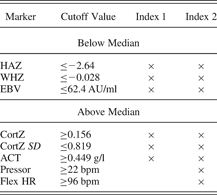
Note: HAZ, height for age, and WHZ, weight for height, z scores relative to NCHS references; EBV, Epstein–Barr virus (arbitrary units [AU]; CortZ, residuals corrected for time since waking; CortZ SD, variation of residuals within individual series of consecutive daily samples; ACT, alpha 1-antichymotripsin, acute-phase protein, reflecting exposure to a range of infections; pressor, pressor response defined as accommodation to postural change (lying to standing) during heart rate measuring protocol; flex HR, the point at which heart rate changes from resting to active state.
Alternate algorithms for computation of allostatic load were evaluated; none had substantial impact on our overall results. One alternative was to use the upper quartiles of observed risk as criteria in the summed index, but this both removed most of the data from consideration, and contravened the aim to assess relative well-being within a normative framework. The goal was to assess sources of normal variation rather than of clinical outcomes. Another option was adjustment of the valence for the individual biomarkers. The entire sample showed a negative relationship between HAZ and WHZ, congruent with the literature documenting strong conservation of weight for height among stunted, chronically undernourished populations (Ulijaszek, Reference Ulijaszek and Ulijaszek1996). Additionally, chronic psychosocial stress has been linked to low variance in cortisol, arguing against attention to high variance related to variable momentary activation.
Statistical analyses
Data reduction
Participants contributed a total of 784 morning cortisol samples. Group and individual differences in number of samples (homeless M = 9.3, SD = 1.4; squatter M = 9.3, SD = 1.1; middle class M = 6.5, SD = 2.1; village M = 10.1, SD = 3.7), F (3, 820) = 183.35, p < .0001, were taken into account by weighting where appropriate in tests involving all cortisol values. Hypotheses regarding group differences were tested by one-way analysis of variance (ANOVA) with post hoc analyses; analyses across groups employed unweighted linear regression. Statistical analyses were performed with Intercooled Stata 7 except where noted.
The major potential confounders for cortisol data in this study were time of day, time since waking, and food consumption, given that cortisol values peak shortly after waking and decline across the day to a 4–6 p.m. nadir, and are affected by napping, food consumption, and smoking, among other factors. Although samples were obtained around 8 a.m., the boys' diverse lifestyles resulted in group differences in time of waking: homeless, M = 6 h and 20 min (06:20), SD = 0:57; squatter, M = 05:54, SD = 0:52; middle class, M = 06:08, SD = 0:42, village 05:52 ± 0:28; F (3, 800) = 17.62, p < .0001; time of sampling: homeless, M = 07:46, SD = 0:47; squatter, M = 08:16, SD = 1:09; middle class M = 08:33 ± 1:30, village 8:24, SD = 1:04; F (3, 800) = 17.25, p < .0001; meal consumption: homeless, 0%; squatter, 81.1%; school, 83.2%; village, 59.8%, had eaten prior to sampling (homeless routinely breakfasted after early morning income-earning activities, scavenging for resalable goods; many villagers skipped early breakfast in anticipation of the family's main meal, customarily consumed ~10 a.m.); and for those who had breakfasted, time since meal: homeless, ns; squatter M = 75, SD = 45 min; middle class, M = 69, SD = 41; village, M = 36, SD = 30; F (2, 402) = 4.54, p = .011.
These differences had either insignificant or correctable relationships to cortisol (log taken to normalize distribution). “Time since waking” explained 12% of the variance in log cortisol—a better predictor than “time of day” in stepwise regression. Neither meal type (solids, drinks) nor time since meal influenced log cortisol once data were corrected for time since waking (p = .44). The best fit for cortisol data was obtained by applying two regressions, one for the sharp decline in the first 90 min postwaking (log cortisol = −0.68 – .30 [time awake]), the other for a shallower decline thereafter (log cortisol = −0.75 – .22 [time awake]). Cortisol variance did not differ in the samples collected before or after 90 min postwaking, F (234, 515) = 0.89, p = .21. Standardized residuals (Z scores) derived from these curves were based on all samples combined and used for all subsequent tests involving cortisol. Mean and variance of residualized cortisol for individual sample series (cortZ and residual SD, respectively) were used as status variables for each case. Thus, cortZ score indicates whether on average a participant has above- or below-average cortisol compared to his peers, controlling for time since waking. Residual SD indicates intraindividual day-to-day variation in cortZ or the variation in residualized cortisol.
Neither EBV-Ab nor ACT values were normally distributed, and were log transformed for statistical analyses. HR measures did not require transformation. The anthropometric variables were expressed with reference to the US NCHS 1978 reference population, as standard deviations from median HAZ, weight for age (WAZ), and WHZ using the Centers for Disease Control Anthropometric Software Package (CASP 3.1). NCHS standards for WHZ cover through age 11 years. Calculation of WHZ for older boys is detailed elsewhere (Panter-Brick, Todd, & Baker, Reference Panter-Brick, Todd and Baker1996). For calculation of allostatic load, HAZ, WAZ, and WHZ provide partially redundant information, so the less uniquely informative WAZ was excluded.
Analytic strategy
The plan of analysis addressed our hypotheses as follows:
1 Do homeless boys differ from other boys in biomarkers of allostatic load? We used ANOVA to test the following contrasts, and report adjusted R 2 (aR 2) to indicate the relative importance of group membership in determining the distribution of biomarkers. Urban versus rural: this contrast examines how urban environment shapes homeless boys' biomarker distributions, relative to village boys. (Univariate ANOVA rather than multivariate ANOVA [MANOVA] was used to accommodate missing data.) Homeless versus squatter and village: because homeless boys come from urban squatter or village settings, comparison of homeless with squatter or village boys is especially informative. Univariate ANOVA was again used for these comparisons. Homeless versus middle class: this contrast probes for differences of homeless from other urban boys who experience relative material and social advantage. Exposure and survival effects (new vs. veteran homeless): this comparison explores how long-term exposure to or survival on the street might affect the distribution of biomarker values among homeless children. The nonparametric Mann–Whitney exact test was used because of low subgroup size. Selection effects (new vs. squatter, new vs. village): the contrast probes how newcomers on the street may differ from their source populations. Again, we used nonparametric Mann–Whitney exact texts.
2 Is overall allostatic load in homeless boys greater than in their urban or rural peers? We first assessed whether our composite indices of allostatic load permit meaningful cross-group comparisons. To test for cross-group homogeneity in patterns of association among biomarkers, we used the Box test conducted in SPSS MANOVA. Similarly, we examined whether group membership modifies the association of biomarkers with our indices of allostatic load. Then, we tested for group differences in allostatic load, again using univariate ANOVA.
Results
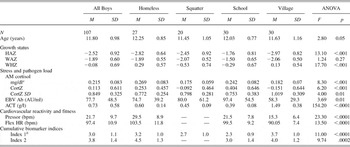
Population and group characteristics and biomarker status are displayed in Table 3. As a whole, high physical developmental risk among study participants was indicated by severe linear growth loss: HAZ fell well beyond 2 SD below expected. However, the less severe WAZ scores and normative WHZ scores suggest acceptable current nutritional status. Elevated levels of ACT overall denote high infectious risk and pathogen exposure, but levels in villagers stand out as particularly high. The negative relationship between the two immune parameters (see lower section of Table 1) suggests that such heavy pathogen loads may interfere with response to EBV antigen. For this reason, we treated EBV as a marker of physical rather than psychosocial burden, where increased values represent lower burden.
Group characteristics and biomarker status

Note: HAZ, height for age, WAZ, weight for age, WHAZ, weight for height for age z scores relative to NCHS references; CortZ, residuals corrected for time since waking; CortZ SD, variation of residuals within individual series of consecutive daily samples; EBV-Ab, Epstein–Barr virus antibody titer, a marker for immunocompetence (arbitrary units [AU]); ACT, alpha 1-antichymotripsin, acute-phase protein, reflecting exposure to a range of infections; pressor, pressor response defined as accommodation to postural change (lying to standing) during heart rate measuring protocol; flex HR, the point at which heart rate changes from resting to active state (bpm).
aCortisol profiles expressed as arithmetic mean of untransformed salivary levels.
bSummed indices of participant status for six biomarkers of allostatic load (anthropometric, endocrine, immunologic).
Biomarkers and contrasting lifestyles
First, we undertook a series of group comparisons to address the question of whether biomarkers of allostatic load differ in homeless boys compared to their peers. Overall, groups sampled from contrasting living conditions differed sharply in study indices, as summarized in Table 3. The strength of the differences suggests that the chronic and concurrent conditions experienced by children in these groups distinctively affect dimensions of developmental risk as reflected in biomarkers, with the sole exception of WAZ.
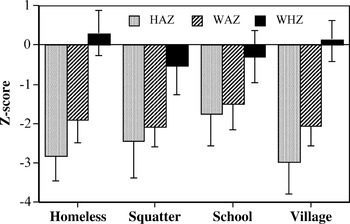
Average age was 11.80 ± 0.98 years, with homeless and middle-class groups each slightly older than squatter and village groups (p < .05, all post hoc contrasts). Age did not confound any of the variables under consideration nor feature as an interaction term in multivariable analyses. In terms of growth status, the respective group profiles established for boys surveyed in the larger sample (N = 307; Panter-Brick, Todd, & Baker, Reference Panter-Brick, Todd and Baker1996) were replicated in the subsample drawn for the present study (N = 107), with one exception. In both main and subsamples, middle-class boys achieved better HAZ, homeless and squatter boys were intermediate, and villagers were the shortest of all groups, whereas in the main sample the homeless averaged better HAZ than squatters; in the subsample, differences between them were insignificant (see Figures 1 and 2). Thus, our subsample was reasonably representative of the larger survey (n = 307, ages 6–14 years) that recruited a representative sample of homeless children, comprising 23% of the known homeless population of Kathmandu enumerated by an NGO, CWIN.
Indices of growth and nutritional status for each study group, including height for age (HAZ), weight for age (WAZ), and weight for height for age (WHAZ), standardized to NCHS reference values. Bars denote mean ± standard deviations; n = 107 boys.

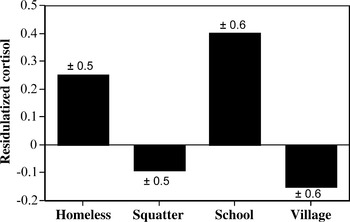
Cortisol residualized by time of day and study group. Bars denote means ± standard deviations.

Urban–rural contrast
Urban boys differed from village boys on all biomarkers included in this study. Most notably, urban boys had substantially lower ACT values, F (1, 101) = 327.43, p < .001, aR 2 = .76, and somewhat higher EBV-Ab titers, F (1, 101) = 7.25, p < .01, aR 2 = .06. Urban boys had higher cardiovascular indices: pressor response, F (1, 77) = 26.27, p < .001, aR 2 = .28; flexHR, F (1, 77) = 24.46, p < .001, aR 2 = .26, indicating less cardiovascular fitness and vagal tone than among village boys. They also had higher mean cortisol, F (1, 106) = 5.68, p < .01, aR 2 = .06, and less day-to-day variability in cortisol values, F (1, 106) = 10.74, p < .01, aR 2 = .10, than did villagers. Finally, urban boys showed better growth and nutrition outcomes, with greater HAZ, F (1, 95) = 10.94, p < .001, aR 2 = .09, and weight for height, F (1, 95) = 4.01, p < .05, aR 2 = .03) than village boys.
Homeless versus squatter and village boys
The contrast between the homeless and squatter or village boys is particularly informative, given that the homeless population derives largely from these two groups. Compared to squatters, homeless boys showed both higher pathogen exposure: logACT, F (1, 41) = 15.91, p < .001, aR 2 = .28; and better current nutritional status: WHZ, F (1, 40) = 16.68, p < .001, aR 2 = .28. They also had higher mean cortisol levels, F (1, 46) = 7.53, p < .01, aR 2 = .15, while showing no evidence of greater day-to-day variability in cortisol, F (1, 39) = 1.79, p < .19. Homeless and squatter boys also showed no differences in EBV-Ab titers or growth status (HAZ).
Compared to villagers, homeless boys showed on average substantially less pathogen exposure: logACT, F (1, 51) = 172.33, p < .001, aR 2 = .77, less vagal tone and cardiovascular fitness: pressor response, F (1, 53) = 42.47, p < .001, aR 2 = .49; flexHR, F (1, 53) = 33.22, p < .001, aR 2 = .43, and higher mean cortisol levels with less day-to-day variability in cortisol: cortZ, F (1, 54) = 6.70, p < .05, aR 2 = .11; cortSD, F = 7.24, p < .05, aR 2 = .14). However, they showed no significant differences in either EBV-Ab titers or growth and nutritional indices.
Thus, homeless boys fared worse than squatters, but much better than villagers in terms of pathogen exposure. They also maintained better nutritional status than squatter boys. However, they showed lower vagal tone than village boys, and higher mean cortisol levels than both squatter and village boys.
Homeless versus middle-class boys
The contrast between homeless and middle-class boys assesses the common assumption that by all measures, homeless children should manifest more allostatic load than their relatively advantaged counterparts. In line with this assumption, homeless boys had higher pathogen exposure: logACT, F (1, 51) = 43.49, p < .001, aR 2 = .46; poorer growth status: HAZ, F (1, 45) = 23.61, p < .001, aR 2 = .34; lower cardiovascular fitness: flexHR, F (1, 47) = 6.03, p < .05, aR 2 = .13; and reduced vagal tone: pressor response, F (1, 47) = 9.29, p < .01, aR 2 = .19. Unexpectedly, they also showed better current nutritional status (WHZ, F = 9.98, p < .01, aR 2 = .17), and showed no significant differences in HPA activity or EBV titers.
Survival and exposure effects (newcomers vs. established)
Homeless boys had spent a variable amount of time living on the streets (range = 0.5–6 years). To evaluate the impact of short- and long-term exposure to street existence, and to probe whether characteristics of the street population reflect effects of survivorship, we compared newcomers to the street with established street dwellers (homeless for ≤2 years, n = 8 vs. >2 years, n = 12; 0.88 ± 0.23 vs. 4.17 ± 1.27 years, mean ± SD). Compared to established street children, the newly homeless had better nutritional status (WHZ 0.60 ± 0.50 vs. veteran 0.52 ± 0.51, Mann–Whitney exact test p = .05), lower cardiovascular fitness (flexHR newcomer 111.6 ± 11.4 vs. established 100.6 ± 8.6 bpm, Mann–Whitney exact test p = .04), and marginally higher cortisol levels (CortZ newcomer 0.441 ± 0.209 vs. established 0.129 ± 0.436, Mann–Whitney exact test p = .07). They did not differ in HAZ, cortisol variance, EBV-Ab, pressor response, or ACT.
Selection effects (newcomers vs. village and squatters)
To examine the effects of self-selection, we compared the newcomers to the two populations from which they originated, namely villagers and squatters. Like all homeless boys, newcomers had less exposure to pathogens, lower cardiovascular fitness, and higher mean cortisol levels than village boys. Moreover, newcomers showed the same results as all homeless boys in having higher exposure to pathogens, higher cortisol, and better nutritional status than squatter boys. Newcomers to the street, unlike all homeless boys, had better nutritional status (WHZ) than did village boys (all Mann–Whitney exact tests p < .05).
Biomarkers and contrasting lifestyles
Next, we proceeded to test the hypothesis that homeless boys fare worse than their peers, after first assessing the applicability of our measure of allostatic load for cross-group comparisons.
Cross-group comparability of composite indices of allostatic load
Relationships among biomarkers (Table 1, lower section) reflect the expected array of strong and weak covariation, given the deliberate diversity of time courses, systems, and stressors reflected by the biomarkers. As such, the complex pattern of covariation seen in Table 1 supports the use of multiple measures to obtain global, rather than system-specific and hence less broadly representative, indices of status.
Indices 1 and 2 integrate biomarkers to provide a global estimate of allostatic burden across several separate though interacting systems. For these global estimates to be comparable across groups, the associations of individual biomarkers among themselves and with the global indices may not differ between groups. Box's M test of homogeneity of variances/covariances across the four groups indicates that the associations between biomarkers do not vary noticeably between groups (p > .30). Moreover, there are no significant effects of group on the association of individual components with the indices (p > .10). Although the power to detect differences in associations among biomarkers is limited by the small sample, these findings tentatively suggest that it is meaningful to compare indices of allostatic load across groups. These analyses were also conducted between two groups of individuals defined by a median split on ACT level, to assess the possibility of systemic changes as a result of exposure to pathogens. As with the between-ecology comparisons, there was no evidence that the patterns of association between biomarkers were affected by pathogen exposure.
Group differences in scores for allostatic load
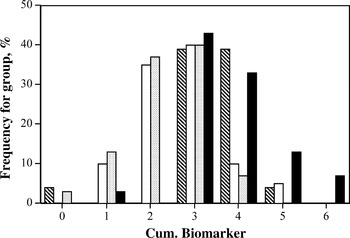
Scores for each index of allostatic load differed substantially among study groups: Index 1, F (3, 99) = 11.00, aR 2 = .25, p < .001; Index 2, F (2, 82) = 9.74, aR 2 = .18, p < .001), as shown in Table 3. Distributions of scores for Index 1 across groups are shown in Figure 3. With respect to the expectation that measures of allostatic load would follow a hypothesized gradient of ecologic burden with homeless having greatest load (homeless, village, squatter, school), post hoc analysis identified the gradient as village, homeless, squatter, school for Index 1. Although adjacent pairs in this gradient were not significantly different in mean score for Index 1, village/squatter, and homeless/school showed significant differences (F = 9–13, p < .05). By this metric, and contrary to expectation, village boys had greatest allostatic load, closely followed by homeless youth (Figure 3).
Frequency distributions of cumulative biomarker Index 1 for allostatic load, accumulated from scores for six biomarkers (see Table 2), by study group: (hatched bars) homeless, (open bars) squatter, (dotted bars) school, (filled bars) village.

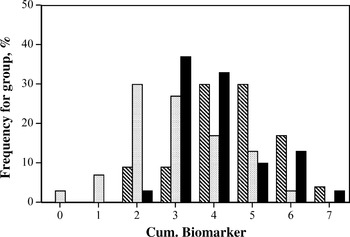
Group contrasts using Index 2 with cardiovascular markers (Figure 4) yield a slightly different picture, identifying street boys as having significantly higher mean scores than both village and school boys (p < .05), and village boys having marginally higher mean scores than school boys (p < .1). Thus, both indices of allostatic load showed that school boys (and to some degree squatters) fared better than homeless and villagers. In addition, homeless and village boys alternatively had the highest average allostatic load score depending on whether cardiovascular fitness was included in the index.
Frequency distributions of Index 2 for allostatic load, accumulated from scores for eight biomarkers (see Table 2), by study group: (hatched bars) homeless, (dotted bars) school, (filled bars) village.

Family composition
Families of homeless boys were more likely to feature a step-parent relative to other groups (42 vs. 3%) and less likely to feature both birth parents residing in a nuclear household (25 vs. 70%). Similarly, as a group, orphans and step-children (n = 17) are more likely to be street children than boys from families with both birth parents (n = 80; Pearson c 2 = 30.0, p < .001), to have elevated cortisol (Pearson c 2 = 4.04, p = .04), and show greater cardiovascular reactivity (pressor 27.8 ± 8.9 vs. 20.5 ± 8.1 bpm, t (1, 63) 2.83, p = .003) as well as lower fitness (flexHR 102 ± 10 vs. 95 ± 11 bpm, t (1, 63) 2.29, p = .01). They did not have greater cortisol variance or levels of ACT and EBV. Nonetheless, family composition per se did not contribute substantially to group differences in the variables under consideration, nor did it interact with lifestyle (represented by group) in models of allostatic load.
Discussion
This report addresses the question of whether, at the time, homeless street children represented the worst possible condition for children growing up in Nepal. On a broader level, this question concerns the impact of cumulative exposure to challenge, and the costs of meeting that challenge, on children growing up under greater social and material disadvantage. Answering this question involves formulating metrics for comparative assessment of burden or developmental risk and asking to what extent child burden differs by living conditions. Accordingly, we sampled groups representing prevalent conditions under which Nepali children grow up, in terms of living with or without a family, in rural or urban settings, and in poverty or relative affluence. We drew multiple biomarkers of developmental risk and biological adversity as well as of psychosocial stress and vulnerability, and used them to construct an index of allostatic load. Together, contrasts of biomarkers and allostatic load across settings in which children live permit comparison of the sources and extent of developmental risk and burden associated with each living condition. This approach provides novel insights into differential child well-being that challenge some preconceived notions about categories of children at risk.
Our findings suggest that homeless street boys were not the most at-risk group compared to others representing prevalent conditions for Nepali children. Rather, for many measures, burden was greatest among village boys. Indeed, the strong urban–rural contrast in biomarkers of risk and adversity contradicts a view that village life is inherently advantageous. Markers of physical well-being, infection, and nutrition (ACT, anthropometrics), were distinctly unfavorable compared to all urban groups, although psychosocial stress or activation indexed by cortisol was indeed lowest and cardiovascular fitness highest in the rural group. Even the most disenfranchised urban boys (squatters and street dwellers) fared better physically and had lower developmental risk (growth and nutrition status) than did village boys, which suggests urban conditions provide concrete advantages despite psychosocial challenges. In particular, pathogen load sharply distinguished village from urban groups. Hence, our index of allostatic load without cardiovascular measures (Index 1) identified village children as having the greatest burden of cumulative developmental, psychosocial, and health burden. The index that included cardiovascular measures (Index 2) blunted the urban–rural contrast because all urban groups are relatively sedentized and less physically fit. These findings align with multiple lines of evidence identifying lower physical fitness and poorer cardiovascular health, from childhood onward, as a common correlate of urbanization and changing lifestyles (WHO, 2002).
The fluidity of homelessness as a status heightens the potential for self-selection in our study groups, because village or squatter boys might leave or return home depending on current welfare. Our findings suggest that homeless boys share profiles of psychosocial and developmental risk that are distinctive from village and squatter boys: allostatic load placed homeless in a position intermediate between a significant village–squatter difference in load. Overall, cortisol levels were higher in street than village or squatter boys, as was nutritional status. Comparisons of recently homeless with village and squatter boys to assess potential selection effects, revealed substantially the same differences in biomarkers as found for all homeless boys. Furthermore, a test of survival and exposure effects that contrasted recent with long-term homeless showed that characteristic features of homeless boys (increased cortisol, lower cardiovascular fitness, better nutritional status) were more pronounced in the recently homeless. Thus, boys who become and remain homeless may self-select by states indexed by greater HPA activity, better nutritional status, and poor physical fitness, or else street life very rapidly shapes these dimensions. Our data do not permit discrimination between these possibilities.
Regarding other findings, our observations that boys from squatter families fared better than either their village or homeless counterparts informs widespread concern for developmental and health risks to children living in indigent squatter families that have migrated from rural to urban settings. Indeed, both homeless and urban squatter children are commonly included by welfare agencies in the catch-all categories of “street children” and children “at risk” (Panter-Brick, Reference Panter-Brick and Schwartzman2001). Biomarkers of risk and indices of allostatic load consistently identified squatter boys in our sample as distinct from villagers as well as their homeless urban peers. Boys in squatter families already have daytime experience of the streets, and readily may convert to homelessness when it appears necessary or beneficial. Accordingly, those living with their families exhibited lower allostatic load than homeless. Findings also confirmed the anticipated advantage for school boys compared not only to homeless, but also to all groups regarding overall burden, and most markers of developmental risk and well-being. That this group showed elevated HPA activity equivalent to homeless possibly reflects the pressure of schoolwork (Panter-Brick & Pollard, Reference Panter-Brick, Pollard, Panter-Brick and Worthman1999). Equivalent profiles between school and homeless boys underscores both the challenge of interpreting cortisol profiles without close individual-level contextualization, and supports the multidimensional nature of well-being that demands a multimodal approach.
Our results largely concur with the scant existing literature on the effects of living conditions or physical deprivation (stunting) on HPA activity in non-Western settings. Prospective study of Dominican children has examined associations of adrenal and immune activity with daily family dynamics and household composition, demonstrating that cortisol increases, altered immune function, and subsequent risk for infectious illness paralleled family conflict (Flinn & England, Reference Flinn and England1997, Reference Flinn, England and Wilce2003). Reports in Jamaican children have identified elevated cortisol and resting HRs as correlates of early growth stunting, implicating stress/arousal regulating systems as mediators of long-term effects of early deprivation (Fernald & Grantham-McGregor, Reference Fernald and Grantham-McGregor1998, Reference Fernald and Grantham-McGregor2002; Grantham-McGregor & Fernald, Reference Grantham-McGregor and Fernald1999). From a further study among Kathmandu school children (Fernald et al., Reference Fernald, Grantham-McGregor, Manandhar and Costello2003), these investigators reported that a compound measure of stress responsivity was lower among stunted than nonstunted controls, although associations of stunting with either HR or cortisol baselines and responses were slim. We also found no associations of morning cortisol values or variability with stunting (HAZ –2.0); further, the only significant relationship of stunting to cardiovascular response was diminished sitting HR among stunted urban boys (86 ± 9 vs. 81 ± 9 bpm, p = .03).
The differences between findings from Nepal and Jamaica likely are because of the cause, extent, and timing of growth retardation: Nepali children exhibit much greater and pervasive growth impairment, associated with pathogen burden and nutritional challenges from gestation onward. Our findings suggest that not all forms of stress (psychosocial, energetic, pathogenic) evoke the same impact on stress-responsive functions such as attention/arousal regulation (Granger, Hood, Dreschel, Sergeant, & Likos, Reference Granger, Hood, Dreschel, Sergeant and Likos2001; Granger & Kivlinghan, Reference Granger and Kivlinghan2003). Nor may the consequent adjustments in metabolic, immunologic, and other endocrine functions be the same for all sources of stress. Thus, as we expand the range of human variability addressed by research on the causes and consequences of child stress and adversity, we stand to expand and refine our existing models concerning these issues (Heim & Nemeroff, Reference Heim and Nemeroff2001; Rutter, Reference Rutter1999). Biomarkers help to evaluate the social and economic landscapes of stress and reveal that contexts that might be presumed as “safe” (rural village, family home) can be deeply challenging to child welfare and conversely, those presumed inherently pathogenic (homelessness) can represent individual short-term “solutions” symptomatic of root socioeconomic problems elsewhere. In the present case, to focus attention on homeless street children in Kathmandu would be to quit early for redressing the most pressing challenges to child welfare located in rural poverty and social ecology in Nepal.
To our knowledge, this report represents the first application of an allostatic load approach to the multimodal assessment of comparative child stress and developmental risk. We argue that a composite measure is needed to integrate aspects of mental and physical health risk that frequently co-occur, particularly under the conditions of adversity that many children face worldwide. Strong evidence links each of the markers to health risk and our indices met statistical criteria for cross-group comparison. But small differences in our findings using two slightly different indices illustrate the impact of the choice of markers included in allostatic load upon study results. Moreover, our cross-sectional data preclude prediction of specific health outcomes from our index of allostatic load, as has been done to hone and validate the measure as an index of burden in studies of aging (Seeman et al., Reference Seeman, McEwen, Rowe and Singer2001). Nevertheless, as the use of biomarkers and multimodal research designs expands, development of global indices such as allostatic load becomes increasingly necessary and merits exploration.
Several limitations of this study should be considered. First, the broader framework for the work reported here comprised an ethnographic evaluation of coping, social competence, and life history among homeless boys (Baker, Reference Baker, Hutchby and Moran-Ellis1998; Baker & Panter-Brick, Reference Baker, Panter-Brick, Panter-Brick and Smith2000; Baker, Panter-Brick, & Todd, Reference Baker, Panter-Brick and Todd1997). The present quantitative study was informed by this work, but the design relied on contrasting social–material conditions represented by study group and included limited individual measures of daily life circumstances or psychological states. Therefore, we could not address the role of psychosocial factors that would drive individual variation and may contribute to the observed group differences in individual biomarkers or overall allostatic load. Such measures should be incorporated in future work that builds on the value of a biomarker approach as demonstrated here, to examine pathways to individual and group differences in health or allostatic load. Second, our study included only boys and cannot address gender differences in performance of our biomarkers. For instance, the genders differ in adrenal regulation from birth (Davis & Emory, Reference Davis and Emory1995), and in effects of challenging or adverse experiences on HPA activity during childhood (Flinn et al., Reference Flinn, Quinlan, Decker, Turner and England1996; Tout et al., Reference Tout, de Haan, Campbell and Gunnar1998). Nonetheless, much work overlooks or does not explicitly probe gender in relation to the developmental psychobiology of stress; hence, gender differences in stress–responsive systems remain an important area for further investigation. Third, our cross-sectional study does not permit consideration of effects of early conditions on observed group differences in biomarker status. Thus, effects of locale-specific antigen exposures during development of immune function (McDade, Reference McDade2005) may explain the profiles of immune markers we observed. Differences in HPA activity among our study groups also may reflect conditions of gestation and subsequent development that could contribute to variation in HPA activity. For instance, chronically stressed Dominican children exhibited low unstressed levels of cortisol (Flinn & England, Reference Flinn and England1995), orphanage-reared Romanian children exhibit altered HPA activity (Gunnar, Morison, Chisholm, & Schuder, Reference Gunnar, Morison, Chisholm and Schuder2001), and gestational stress has been associated with increased HPA reactivity in children (Clark et al., Reference Clark, Hindmarsh, Shiell, Law, Honour and Barker1996).
Conclusion
In conclusion, this study suggests the value of increasing the range of human cultural and physical conditions for understanding the sources and consequences of childhood stress, of both the acute, traumatic and chronic, everyday varieties. The use of biomarkers, well-selected comparison groups, and close in situ study illuminate the complex developmental pathways mediating both vulnerability and resilience to difficult life circumstances. We underscore the importance of such work for enhancing the applicability of developmental research to the substantial worldwide challenges to mental and physical health imposed by childhood adversity.