Introduction
In Australia, at the present time, there is much discussion about TRC. In 2010, the Australian Federal Community and Disability Services Ministerial Advisory Committee (CDSMAC) endorsed a definition proposed by the National Therapeutic Residential Care Working Group (NTRCWG) which states;
Therapeutic residential care is intensive and time limited care for a child or young person in statutory care that responds to the complex impacts of abuse, neglect and separation from family. This is achieved through the creation of positive, safe, healing relationships and experiences informed by a sound understanding of trauma, damaged attachment and developmental needs.
This definition is unfortunately limited both by its reference to statutory care and by its focus on the time-limited nature of TRC. Neither of these should be core elements in any service definition. The definition also fails to specify the role of parents in the treatment endeavour.
As a consequence, the authors preferred definition of TRC is that recently provided by Whittaker, del Valle and Holmes and is as follows:
Therapeutic residential care involves the planful use of a purposefully constructed, multi-dimensional living environments designed to enhance or provide treatment, education, socialization, support and protection to children and youth with identified mental health or behavioural needs in partnership with their families and in collaboration with the full spectrum of community based and informal helping resources.
(Whittaker, del Valle & Holmes, 2014, p. 24)
Australian agencies that indicate that they are providing TRC are the Lighthouse Foundation (Barton, Gonzales, & Tomlinson, Reference Barton, Gonzales and Tomlinson2012; Hussein & Cameron, Reference Hussein and Cameron2014) and Hurstbridge and its satellites (VAG, 2014; Verso, 2011) in Victoria. In Queensland, the Churches of Christ Care Pathways are using the Sanctuary model (Clarke, Reference Clarke2013; Leigh-Smith & Toth, Reference Leigh-Smith and Toth2014). In Victoria, McKillop Family Services has also embraced the Sanctuary model (McNamara, Reference McNamara, Whittaker, del Valle and Holmes2015) which to a significant extent is a model of wide organisational cultural change rather than a model of TRC per se. In a recent survey of RC programmes in New South Wales (NSW) (Urquhart & Foote, Reference Urquhart and Foote2015), seven unnamed agencies also claimed to be using Sanctuary as the model for their residential programmes. These finding were, however, somewhat compromised as the survey allowed multiple responses from agencies to the question about which model they were using for their residential programmes. Information about developments in Western and South Australia, Tasmania and the Northern and Australian Capital territories is not publically available.
At the same time, as this discussion is taking place in Australia, elsewhere the argument about the cost and effectiveness of RC placements in comparison to foster family care is being re-heard. In the US, for example, a recent Anne E. Casey Foundation report stated that
When used unnecessarily, group placements are not cost effective. They cost the state three to five times as much as foster family placements, but often do not provide young people with the social and emotional supports they need to develop the knowledge, daily living skills and relationships that prepare them for adulthood.
(Holten, Horne, & Gerald, Reference Holten, Horne and Gerald2015).
This report follows on from an earlier Casey document “Rightsizing Congregate Care” (Noonan & Menashi, Reference Noonan and Menashi2011) that essentially conveyed the same message.
The Casey position does presuppose that the less costly foster family placement does “provide young people with the social and emotional supports they need to develop the knowledge, daily living skills and relationships that prepare them for adulthood” which is hardly in line with the outcome evidence for foster family care (Ainsworth & Hansen, Reference Ainsworth and Hansen2014).
Dozier et al. (Reference Dozier, Kobak, Sagi-Schwartz, Schauffer, IJzendoorm, Kaufman and Zeanah2014) has also published an article titled “Consensus statement on group care for adolescents”. This is a policy statement that claims that,
Group care should be used only when it is the least detrimental alternative, when necessary therapeutic mental health services cannot be delivered in a less restrictive setting.
(Dozier et al., Reference Dozier, Kobak, Sagi-Schwartz, Schauffer, IJzendoorm, Kaufman and Zeanah2014, p. 2).
In other words, it should be used only as a last resort.
Unnecessary group placements are of course to be avoided, not just because of costs, but because it would be professionally irresponsible to place a young person in a group placement when their needs can be met in foster family care. But acknowledging that a group placement may sometimes be unnecessary also conversely confirms that a group placement may be appropriate and necessary, even if the cost is higher, if such a placement can be shown to best meet a young person's needs. A further problem with this statement is that it treats foster family care and group placements as a single consistent entity. In both family foster care and group placements, the quality of service and the outcomes may range from the very good to the very poor. These factors mean that a bald statement about group placements costing three to five times more than foster family care has little relevance.
From England, we have a recent Department of Education report with the title “The place of RC in the English child welfare system”. This report indicates that there has been a growth in “therapeutic residential” placements even though there is no formal definition of what this means (Department of Education, 2015). The report raises many questions about the outcomes of RC and provides a research agenda to address this issue. There also appears to be confirmation that, unlike in the US, there will be no immediate pressure to eliminate residential placements from the child welfare continuum of care.
Also from the UK, there is a comparison where the unit costs of local authority foster care, agency foster care and agency RC show that RC is more costly than local authority or agency foster care (Holmes, Reference Holmes, Whittaker, del Valle and Holmes2015) (see Table 17.2).
What is not clear is the extent to which these costs take account of the complex mental health and behavioural difficulties of the young people placed in TRC by comparison with those in foster family care including treatment foster care (Holmes, Westlake & Ward, Reference Holmes, Westlake and Ward2008).
The Therapeutic Residential Care Population
The provision of TRC placements in Victoria and Queensland is clearly linked to the all too frequent failure of foster family care and the distressing outcomes for many of the children who have been in family foster care (Ainsworth & Hansen, Reference Ainsworth and Hansen2014). These foster family care facts are borne out by evidence from three states. In South Australia, in evidence to the current Royal Commission into the department responsible for child protection, the Chief Executive of that department stated that once a child is removed from their biological parents, they would on average cycle through 10 different foster homes (Puddy, Reference Puddy2015). Similar evidence from Victoria indicates that one third of the children in TRC placements in that state had experienced over 10 placements prior to entering RC (residential care) (VAG, 2014). Adding to this evidence is the fact that in Queensland the median number of placements for children and young people before being placed in RC is four per child (QCPCI, 2013). The situation is likely to be the same in other states and territories.
It should also be noted that an increasing number of these young people referred to TRC have a psychiatric diagnosis such as Oppositional Defiance Disorder (ODD) and may be receiving psychotropic medication (Huefner & Griffith, Reference Huefner and Griffith2014).
In fact every Australian therapeutic residential programme is full of young people who have endured many family foster care placement breakdowns. These are young people whose life trajectory is one that potentially includes poor educational achievements, incarceration, mental hospital admission and homelessness either as a juvenile or an adult. This is unless their mental health and behavioural difficulties are urgently addressed by the state in whose care they have been placed.
This highlights the key issue in the debate about comparisons between foster family care and TRC which is whether the two services are both attending to the treatment needs of same group of young people. That is, those who display mental health and behavioural difficulties of the same level of intensity and complexity.
The Purpose of Therapeutic Residential Care
The purpose of a TRC intervention is twofold. First, the intervention aims to stabilise a young person's living arrangements following multiple placement breakdowns. The task then is to help the young person recover from trauma and rebuild over time healthy attachment relationships. To this end, the average length of stay in the Lighthouse programme is 18 months (Hussein & Cameron, Reference Hussein and Cameron2014) with a 30 month time scale being reported for the Hurstbridge programme in Victoria (VAG, 2014). These stay times underline the inappropriateness of including in the NTRCWG (Reference McLean, Price-Robertson and Robinson2010) definition of TRC the notion of “time limited” for a placement. Such a notion will only encourage the specification of time limitation on the duration of a placement by administrators who have to be concerned about cost, rather than against clinical guidelines about treatment needs.
Placement Decisions
An examination of how different states manage placement decisions throws some light on the issue of population differences between family foster care and TRC.
New South Wales
In the NSW Department of Family and Community Services a Child Assessment Tool (CAT, 2014) is used to guide placement decisions. This tool was originally developed in the US by a consortium of not-for-profit public policy organisations including the Anne E. Casey Foundation referred to earlier. This assessment tool in, part A, step 1, considers the following 14 areas, education, peer relations, adult supervision, emotional adjustment, anger management, harm to people or property, fire-setting, cruelty to animals, offending behaviours, gang association, depression and self-harm, cognitive functioning, substance use/misuse and sexual behaviours. These are rated on a one to five scale.
Part B, step 1, focuses on behavioural issues and consists of 16 questions the referring caseworker must answer.
Part B, step 2 considers health and developmental issues and how a child's heath and developmental needs may impact on the placement and may therefore require particular care skills.
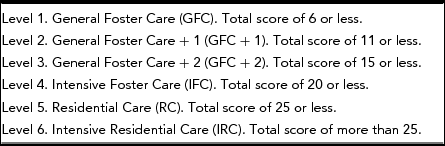
Table 1 below sets out the six levels of care and the entry scores for each level of care that the CAT tool calculates at step 3 which is the final step in the CAT assessment process.
CAT levels of care and entry scores for children and young people.
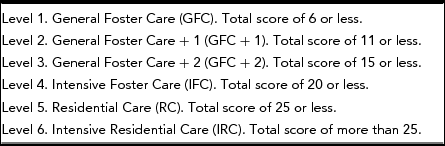
Source: NSW FaCS, Child assessment tool. User manual, 2014.
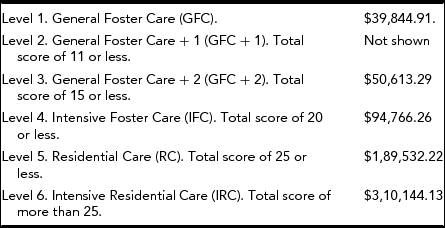
This tool if adhered to ensures that a young person who does not present with complex mental health and behavioural difficulties will not be placed in a TRC programme that in the CAT assessment tool scheme is referred to as Intensive Residential Care (IRC). What this assessment instrument does is demonstrate that foster family care at its most intensive (IFS score of 20 or less) is providing a service for young people with less complex needs than is recommended for either RC or IRC. In fact RC requires an entry score of 25 or less while IRC requires an entry score of more than 25. This clearly shows that the population of young people in Intensive Foster Care is markedly different from the young people who are placed in IRC (or presumably the alternatively named TRC). It is also worth noting that children under 9 years of age will not receive a recommended level of care higher than Level 5, RC using this tool. Given the above, it is obvious that both level 5 and level 6 placements will inevitably cost more than level 1 through 4 placements. For the financial year 2014–15, the Department of Family and Community Services have set the unit price that they will pay the non-government sector for the various level of service as shown in Table 2. This confirms that the cost of IRC/TRC is almost eight times the cost of foster family care.
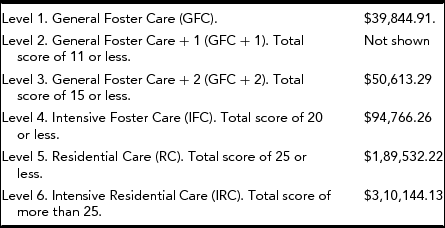
As to whether child protection authorities will be prepared to fund a non-government organisation (NGO), TRC services at this level i.e. $310, 144.15 or more, remains to be seen. What is also unknown is which programme model these unit costs reflect. Given these uncertainties, an NGO would be ill advised to venture into providing TRC services without sufficient resources. And by its very nature, TRC cannot be provided at a cut price. In NSW, there is also a joint Department of Family and Community Services/Association of Children's Welfare Agencies (ACWA) working group that is currently developing a framework for TRC (Urquhart & Foote, Reference Urquhart and Foote2015).
Victoria
In Victoria, a 2014 audit of RC services for children and young people (Victorian Auditor-General's (VAG, 2014) refers to two types of care, standard RC – accommodation and care only and TRC. This reflects the 191 residential service units identified by the audit. The first Victorian TRC was piloted in 2007 by the Department of Human Services and is known as the “Hurstbridge” TRC model. This model was positively evaluated in 2011 (Verso, 2011) and is described as “a more intensive model that has similar elements as the standard model but with access to therapeutic specialists and additional staff” (VAG. p.2). Following the 2011 Verso evaluation, the Hurstbridge TRC programme was expanded and now operates in 11 locations.
Importantly, only 11 of the 191 residential service units are classified as TRC. This clearly indicates that these units service, as in NSW, a selected population of young people with complex mental health and behavioural difficulties resulting in them requiring access to therapeutic specialists and a unit with additional staff with the resulting higher placement costs.
Queensland
In Queensland, a recent Child Protection Commission of Inquiry (QCPCI) (2013), better known as the Carmody enquiry, identified 105 generic residential facilities and a further four that were categorised as TRC. Exactly why these four programmes are categorised in this way is unclear as no programme details are given (Ainsworth & Thoburn, Reference Ainsworth and Thoburn2013). Surprisingly, an evaluation of;
these “pilot” therapeutic residential care facilities that ‘was began in 2011 was not completed owing to there being no consensus among the various operators of the four therapeutic residential care facilities about how the model should be assessed and what data should be reported.
(QCPCI, 2013, p. 268).
Finally, the enquiry indicated, that regardless of the Sanctuary model of TRC that is in limited use “Queensland is yet to implement an evidence-based trauma informed, residential care services model in its generic residential care facilities” (QCPCI, 2013, p. 267). If it were to do so the placement costs would undoubtedly be higher than for foster family care.
New Staffing Demands
If the relatively new Australian interest in TRC is to be successfully promoted then there will need to be a much better educated and trained RC workforce. At entry level, staff positions in standard or generic RC programmes require minimal vocational qualification or, as in Queensland, no specific qualifications at all. The Carmody enquiry stated that “the vast majority of children and young people in residential care are considered to have complex or extreme needs” (QCPCI, 2013, p.189), so it is difficult to imagine how an untrained staff will be effective.
As indicated elsewhere, a TRC workforce will require;
knowledge of the aetiology and treatment of mental health (McNally, Reference McNally2011) and behavioural issues (Granic & Patterson, Reference Granic and Patterson2006) and empirically tested treatment interventions are prerequisites for those who seek to be therapeutic care workers. Also required is knowledge of child and adolescent development with a particular focus on insecure or disorganised attachment (Shemmings & Shemmings, Reference Shemmings and Shemmings2011) and the impact of trauma (Barton et al., Reference Barton, Gonzales and Tomlinson2012). There is also a need for knowledge about group and family dynamics together with the skill to translate all of this theoretical knowledge into positive interactions with young people.
(Ainsworth, Reference Ainsworth2015).
This level of knowledge and practical skills are most likely to be acquired through tertiary level study yet no tertiary institution in Australia as yet provides a curriculum appropriate for a TRC workforce. In partnership with a university, the Child Welfare Training Centre (CCWT), the training arm of ACWA, will in 2016 offer for the first time a Graduate Diploma in Out-of-Home Care in NSW. The curriculum for this diploma is currently under construction and as a result it is too early to judge whether this diploma will meet the needs of staff in TRC programmes. The Lighthouse Institute in Victoria offers some short courses that focus on the use of attachment and trauma theories to informed residential practice. Apart from these offerings, the training and education of practitioners represents a major challenge to any child welfare organisation that seeks to provide TRC.
With a requirement for a more knowledgeable and skilled workforce comes a demand for increased workforce remuneration. This is a cost that has yet to be given serious consideration. What this points to is the fact that TRC programmes will be high cost programmes. They will never be able to compete with foster family care or be less costly nor should they try to as they are serving a different population. The alternative to meeting this cost is to leave the children and young people with mental health and behavioural difficulties without the services they need and deserve. This is not humane.
An Alternative View of Cost Comparisons
The focus on the comparative costs of foster family care and TRC may have been valid in an earlier era when children's homes and family group homes were used as placements for children and young people whose primary need was for a safe upbringing (Rowe, Hundleby, & Garnett, Reference Rowe, Hundleby and Garnett1989). That era is now past, and children and young people with such straightforward needs are rightly placed in foster family care. But as has been shown there are young people with complex mental health and behavioural difficulties for whom a foster family care placement does not work and who require more intensive services. These are services that involve,
the planful use of a purposefully constructed, multi-dimensional living environments designed to enhance or provide treatment, education, socialization, support and protection to children and youth with identified mental health or behavioural needs.
As stated in the definition of TRC offered by Whittaker, del Valle and Holmes in 2014. These are more complex services than foster family care and are inevitably more costly. A more accurate cost comparison given the population TRC is being asked to serve might be with a juvenile justice programme or a psychiatric in-patient unit for adolescents rather than with foster family care.
This is more complex task as it would involve comparing costs across child welfare, juvenile justice and mental health systems but the outcome would be more accurate and less misleading than the present comparison between foster family care and TRC.