Introduction
Information on the kinds of seed dormancy (and non-dormancy) within each plant family would greatly facilitate investigations on the evolutionary origins and relationships of the five classes of dormancy (and non-dormancy) (Baskin and Baskin, Reference Baskin and Baskin2014). For some plant families such as the Cannaceae, Cistaceae and Nelumbonaceae, there seems to be no variation, and all species have physical dormancy. In contrast, the Fabaceae and Malvaceae have three classes of dormancy (physical, physiological and combinational) as well as some species having non-dormant seeds (Baskin and Baskin, Reference Baskin and Baskin2014). For many other families, such as the Rubiaceae, we do not have a comprehensive overview of the diversity of dormancy classes within the family. Many species of Rubiaceae are reported to have seeds with physiological dormancy, but Baskin and Baskin (Reference Baskin and Baskin2014) caution that further research on members of the Rubiaceae may reveal greater diversity than has been ascribed previously to the family.
There are two reasons for thinking that some members of the Rubiaceae may have a class(es) of dormancy in addition to physiological dormancy. (1) The embryo in Coffea arabica seeds is differentiated and consists of a radicle, axis and two small cotyledons (Da Silva et al., Reference Da Silva, Toorop, Van Lammeren and Hilhorst2008). Furthermore, De Farias et al. (Reference De Farias, da Silva, Toorop, Bewley and Hilhorst2014) reported that the embryo in C. arabica seeds grows prior to radicle emergence, and that it does so within 9 d following imbibition. (2) Drawings of seeds of a few species of Rubiaceae, e.g. Mitchella repens, Psychotria tenuifolia (Martin, Reference Martin1946) and P. griffithii (Ng, Reference Ng1992), have been published, showing small, presumably underdeveloped embryos. If these small embryos must grow prior to radicle emergence and if growth and germination occur within less than about 1 month, seeds would have morphological dormancy. However, if embryos must grow prior to radicle emergence and if germination takes longer than about 1 month and dormancy-breaking treatments are required, seeds would have morphophysiological dormancy (Baskin and Baskin, Reference Baskin and Baskin2014). On the other hand, the small embryos may not grow prior to radicle emergence, e.g. some Nymphaeaceae (Baskin and Baskin, Reference Baskin and Baskin2007).
Psychotria (Rubiaceae) is the third largest genus of angiosperms, consisting of more than 1800 species (Sohmer, Reference Sohmer1988; Davis et al., Reference Davis, Bridson, Jarvis and Govaerts2001a; Mabberley, Reference Mabberley2008). It is a pantropical genus contributing significantly to the floristic diversity of the tropics (Nepokroeff et al., Reference Nepokroeff, Bremer and Sytsma1999), and a significant portion of the understorey of wet tropical forests consists of Psychotria spp. (Sohmer, Reference Sohmer1988). Thus, Psychotria has been used widely as a model genus for studying patterns of speciation, ecological mechanisms and reproductive systems among tropical plants (Hamilton, Reference Hamilton1989). Furthermore, since Psychotria is one of the important genera of the understorey tree layer of tropical wet and tropical montane forests in Sri Lanka (Dissanayake, Reference Dissanayake1987), as well as in other tropical areas, it is one of the significant genera that can be used to restore degraded forests (Olson and Dinerstein, Reference Olson and Dinerstein1998). Information on seed germination, seed dormancy and storage behaviour are important for production of seedlings for restoration activities. Studies on about 25 species of Psychotria indicate that seeds are slow to germinate (Baskin and Baskin, Reference Baskin and Baskin2014). For example, P. leiocarpa seeds took approximately 3 months to germinate (Henriques et al., Reference Henriques, Lopes, Paranhos, Gregianini, Fett-Neto, Schripsema and Von Pose2004), and those of P. hoffmansegiana remained in the soil >3 months after dispersal before germinating (Araújo and Cardoso, Reference Araújo and Cardoso2007). Thus, it is clear that seeds of various species of Psychotria are dormant, but no attention has been given to embryo morphology and to the possibility that seeds could have morphological or morphophysiological dormancy (MPD). Based on (1) what appear to be underdeveloped embryos in seeds of Psychotria tenuifolia (Martin, Reference Martin1946) and P. griffithii (Ng, Reference Ng1992) and (2) dormancy (slowness to germinate) in seeds of various species of Psychotria, we hypothesized that seeds of the Psychotria species in Sri Lanka would have MPD.
Fourteen Psychotria species have been recorded in Sri Lanka, and the majority of them are found in the wet zone of the country. Eleven of the Sri Lankan Psychotria spp. are endemics (Dissanayake, Reference Dissanayake1987; MOE, 2012), and eight of them are categorized as nearly threatened, vulnerable or endangered species on the red data list of threatened species (MOE, 2012). On the other hand, the genus Psychotria is characterized by the presence of many economically important chemicals, including some with high pharmacological activities (Adjibade et al., Reference Adjibade, Weniger, Quirion, Kuballa, Cabalion and Anton1992; Judd, Reference Judd1999; Davis et al., Reference Davis, Pritchard, Boyd and Prior2001b; Henriques et al., Reference Henriques, Lopes, Paranhos, Gregianini, Fett-Neto, Schripsema and Von Pose2004; Lops et al., Reference Lopes, Von Poser, Kerber, Farias, Konrath, Moreno, Sobral, Zuanazzi and Henriques2004; Corrêa et al., Reference Corrêa, Soares and Fett-Neto2008). However, the habitats of most Psychotria spp. are limited in Sri Lanka and are threatened by various anthropogenic and natural causes (Gunatilleke and Gunatilleke, Reference Gunatilleke and Gunatilleke1990). Thus, there is a threat of extinction for Sri Lankan Psychotria spp., which have high ecological and economic potential. Clearly, there is an immediate need to undertake the necessary conservation measures to protect the species of this valuable genus. Since seeds play an important role in the persistence of plant populations (Vazquez-Yanes and Orozco-Segovia, Reference Vazquez-Yanes and Orozco-Segovia1993) and in the production of saplings for restoration and regeneration activities (Engel and Parrotta, Reference Engel and Parrotta2001; Baskin and Baskin, Reference Baskin and Baskin2005), knowledge of seed sensitivity to drying, dormancy, dormancy-breaking treatments and germination requirements is crucial in planning conservation activities.
Rubiaceae is a family showing high diversity when considering seed desiccation tolerance. Intermediate sensitivity to desiccation was first observed in seeds of Coffea spp. (Ellis et al., Reference Ellis, Hong and Roberts1990). Furthermore, desiccation-sensitive and desiccation-tolerant seed-producing species have been observed among the Rubiaceae (Ellis et al., Reference Ellis, Hong and Roberts1990; Dussert et al., Reference Dussert, Chabrillange, Engelmann and Hamon1999; Orwa et al., Reference Orwa, Mutua, Kindt, Jamnadass and Simons2009). Knowledge on sensitivity of seeds to desiccation is very important as it assists in determining the proper storage conditions for long-term seed storage (Hong and Ellis, Reference Hong and Ellis1996).
Within the context of expanding our knowledge of the diversity of dormancy classes in plant families, and in Rubiaceae in particular, seed dormancy was studied in three species of Psychotria (P. gardneri, P. nigra and P. zeylanica) from the montane zone of Sri Lanka. The broad objective of our research on these three species was to determine the seed desiccation sensitivity and dormancy-breaking and germination requirements. All three species are rare and ecologically important in their montane habitats; thus, knowing how to germinate and store seeds of these species would benefit conservation efforts.
Materials and methods
Seed collection sites and the study species
Fruits for the experiments were collected from Knuckles, Horton Plains and Hanthana Mountains in Sri Lanka. Knuckles Forest Reserve is in the Knuckles Mountains which lie between latitudes 7°18′–7°34′N and longitudes 80°41′–80°55′E. The altitudes of these mountains range from 900 to 2000 m, with approximately 21,000 ha of forest cover. The montane forest zone where seeds were collected is extremely wet during most months with a mean annual rainfall of about ~5000 mm (Bambaradeniya and Ekanayake, Reference Bambaradeniya and Ekanayake2003), and the mean monthly temperature varies between 15 and 25°C (Weerawardhena and Russell, Reference Weerawardhena and Russell2012). Horton Plains is the highest peneplain in Sri Lanka. It is located at latitude 6°48′N and longitude 80°48′E and covers 3160 ha of the central highlands, with elevations ranging from 2100 to 2300 m. Mean annual rainfall of the area is about 2150 mm, and the mean annual temperature in the montane zone is about 15°C, with temperatures varying between 5 and 27°C (Green, Reference Green2008). The Hanthana Mountains, with elevations ranging from 800 to 1200 m, are located at latitude 7°16′N and longitude 80°37′E and cover 432 ha in the Kandy District in Sri Lanka. The mean annual temperature in the mountain area is about 24.1°C, and the mean annual precipitation is about 2000 mm.
Psychotria nigra (Gaertn.) Alston is a shrub growing up to 4 m tall and is native to South Asia, including India and Sri Lanka. Usually, plants can be found in the understorey of wet forests at elevations >800 m in Sri Lanka. P. nigra fruits are globose drupes that are ~9 mm long (Dassanayake, Reference Dissanayake1987). They were collected from Knuckles Forest Reserve and from the Hanthana Mountains. Those collected from Knuckles Forest Reserve were used for the seed desiccation experiment, and those collected from the Hanthana Mountains were used for seed dormancy experiments.
Psychotria zeylanica (Sohmer) is an endemic shrubby tree growing up to 3 m tall, found in the understorey of the wet forests in the central highlands of Sri Lanka, usually above 1500 m elevation. Mature fruits (drupes) are obovoid–ellipsoid, black and 9–11 mm long (Dassanayake, Reference Dissanayake1987). They were collected from Horton Plains.
Psychotria gardneri (Thw.) Hook. f. (var. gardneri) is a slender, much branched and glabrous tree, growing up to 5 m tall. This species is endemic to Sri Lanka and can be found in the subcanopy of the middle-elevation forests to about 1600 m (Dassanayake, Reference Dissanayake1987). Fruits (drupes) of this species are globose and ~6 mm in diameter, and they were collected from the Hanthana Mountains.
Dispersal units, ripe fruits (dark blue to black coloured and fleshy) were collected from five or more individuals of each species from each site. Fruits were collected at fruiting peak at each site for each species. Fruits of P. gardneri were collected on 13 January 2012 and 31 July 2013, P. nigra on 31 July 2013 and P. zeylanica on 8 February and 7 December 2012. Fruits were collected directly from the trees, placed in polythene bags, tagged and transported to the Department of Botany, University of Peradeniya, where the laboratory experiments were conducted. Seeds (enclosed by the endocarp, hereafter seeds) were removed from the fruits, washed, air dried and stored in plastic bottles at room temperatures until used. Laboratory experiments were initiated within 3 d after seed collection.
Seed desiccation sensitivity
The purpose of these experiments was to determine the level of desiccation sensitivity of seeds of the study species.
Seed moisture content (MC)
The mass of 15 fresh seeds (just after extraction of seeds from the mesocarp) for each species was measured individually using a digital balance to the nearest 0.0001 g. Then, seeds were dried at 120°C for 3 h (ISTA, 2008). After drying, the mass of each seed was re-measured. Initial MC was calculated on a fresh mass basis using initial mass and dry mass.
Effect of drying on seed viability
Three replicates of 15 seeds each for P. nigra and P. gardneri were dried to 14 and 12% MC, respectively, by keeping the seeds in a silica-gel desiccator for about 1 week. Dried seeds of P. nigra and P. gardneri were incubated in 9-mm-diameter Petri dishes (hereafter ‘Petri dishes') on eight layers of tissue paper [Flora paper serviette product code A1101, Pee Bee Management Services (Pvt.) Ltd. Homagama, Sri Lanka] moistened with distilled water at 25°C in light/dark (14 h/10 h, hereafter ‘light’) for 3 and 5 months (completed germination), respectively. At the end of the experiment, all non-germinated seeds were dissected (cut-test) to check the viability of the embryo (white and firm, a viable embryo vs. dark and soft, a non-viable embryo). Germination of dried seeds was compared to that of non-dried seeds, using a standard germination test (described under the heading ‘Standard germination (control)’), to determine the effect of drying on seed viability.
Seed dormancy
The purpose of these experiments was to determine if seeds are dormant and, if so, to identify the class and level of dormancy. Results from the germination and imbibition tests, changes in embryo:seed length (E:S) ratio, responses to gibberellic acid (GA3), and temperature and time required for radicle and shoot emergence were used to determine the class and level of dormancy.
Imbibition test
The initial mass of 15 fresh intact and 15 manually scarified seeds of P. gardneri and of P. zeylanica were measured individually using a digital chemical balance to the nearest 0.0001 g. Seeds were placed separately on eight layers of moistened tissue paper in Petri dishes and incubated at ambient laboratory conditions. Seeds were retrieved after 2, 5, 7 and 24 h and then after 4, 11, 19 and 26 d, weighed and returned to the Petri dishes. The average percentage mass increase during imbibition was plotted against time. The final mass increase of seeds was defined as the mass increase at the time the imbibition curve reached a plateau.
Standard germination (control)
Three replicates of 15 fresh intact seeds of each species at initial MC were incubated in Petri dishes on moistened tissue paper in light at 25°C. Seeds were checked for germination at 3-d intervals for 3 months for P. zeylanica and P. nigra (none of seeds germinated after 75 d) and 5 months for P. gardneri (after 5 months all non-germinated seeds were rotten). Radicle emergence (>1 mm) was the criterion for germination. At the end of the experiment, all non-germinated seeds were dissected (cut-test) to check the viability of the embryo. GT50 (time taken for 50% germination) was calculated for each species, as explained under ‘Data analysis' below.
Embryo length:seed length ratio (E:S ratio)
The embryo length:seed length ratio was determined for ten freshly collected seeds of each species and for ten seeds of each species at the time the endocarp split (but before the length of the emerging radicle exceeded 0.5 mm), indicating that the seed was germinating. Freshly collected seeds were allowed to imbibe for 24 h, and then the length of the seed (S) and embryo (E) of each was measured using a Vernier caliper. When the E:S ratio was determined in endocarp-split seeds, the embryo was measured excluding the portion outside the seed (i.e. the excluding radicle). The E:S ratio was calculated to determine the development of the embryo prior to radicle emergence, and the percentage embryo development prior to radicle emergence was calculated using the following formula:
 $$\eqalign{&\hbox{Percentage embryo development}= \cr & {{\hbox{Average E:S ratio of seeds soon after endocarp rupture} \over \hbox{Average E:S ratio of fresh seeds}}}{\times 100}.}$$
Furthermore, embryo and seed length of P. gardneri were monitored continually at 7-d intervals until plumule emergence occurred, after 106 d.
Gibberellic acid treatment
Three replicates of 15 seeds each of the three species were incubated in Petri dishes on eight layers of tissue paper moistened with 100 ppm and 500 ppm gibberellic acid (GA3) solutions in light at 25°C. Germination was checked at 3-d intervals for 90 d, and radicle emergence was the criterion for germination. The standard germination test, as explained above, was used as the control; these tests were initiated at the same time. GT50 was calculated for each treatment for each species.
Effect of temperature on seed germination
Three replicates of 15 fresh P. nigra seeds were incubated in Petri dishes on eight layers of tissue paper moistened with distilled water in light at 8, 15, 25 and 35°C, and three replicates of 15 fresh P. zeylanica seeds were incubated in light at 15, 25 and 35°C. Seeds were checked for germination at 3-d intervals for 90 d, and radicle emergence was the criterion for germination. Furthermore, three replicates of 15 fresh P. nigra seeds were incubated at 8, 15, 35°C for 2 weeks and then transferred to 25°C. Similarly, three replicates of 15 fresh P. zeylanica seeds were incubated at 35, 35, 25, 15 and 8°C for 2 weeks, after which seeds were transferred to 15, 25, 15, 25 and 25°C, respectively. Seeds were observed for germination at 3-d intervals for 90 d after the transfer to the second set of temperatures. These temperatures were chosen considering the mean temperatures in the habitats of these species at different times of the year (Green, Reference Green2008; Weerawardhena and Russell, Reference Weerawardhena and Russell2012). GT50 was calculated for each treatment for each species.
Epicotyl dormancy
Fifteen radicle-emerged (in light at 25°C) seeds each of P. zeylanica and P. nigra were incubated on 24 layers of tissue paper moistened with distilled water in a 1000-ml beaker in light at 25°C. Seeds were marked individually. The time taken for the shoot (plumule) to emerge from each seed was recorded. In addition, 15 radicle-emerged (in light at 15°C) seeds of P. zeylanica were incubated on tissue papers moistened with distilled water in light at 15°C in a 1000-ml beaker. Furthermore, 15 radicle-emerged seeds of P. nigra were incubated on tissue papers moistened with 100 ppm GA3 solution in a 1000-ml beaker in light at 25°C. Seeds were observed at 3-d intervals for plumule emergence, and the time taken for plumule emergence of each seed was recorded.
Morphological development of the plumule
Sixty seeds of P. gardneri were incubated on tissue papers moistened with water in light at 25°C. Ten seeds each were retrieved after 1, 2, 4, 6, 12 and 15 weeks, and the E:S ratio was determined as described above. Furthermore, seed and embryo lengths of P. zeylanica and P. nigra seeds were measured just after the endocarp ruptured and just before cotyledon emergence.
Data analysis
As binary logistic regression analysis is more appropriate to analyse experiments with two possible outcomes, germination data (two outcomes: germinated or not germinated) were statistically analysed with this procedure using Minitab 16.0 statistical software (Minitab® 16.2.3, Minitab Inc., State College, Pennsylvania, USA). Weibull 4 parameter sigmoidal curves were fitted to the germination time courses (as suggested by Brown, Reference Brown1987) using Sigmaplot 10.0 software (Sigmaplot for Windows version 10.0, Dundas software Ltd, ©wpcubed GmbH, Erkrath, Germany), to identify the germination patterns. GT50 of each treatment was determined, using the fitted curve, as the time until half-maximal germination. As normality and the homoscedasticity of the water imbibition, E:S ratio and time taken for plumule emergence data were confirmed by an Anderson–Darling test and by Bartlett's and Levene's tests, respectively, pooled t-tests were used to check the similarity or dissimilarity of water imbibition patterns of non-scarified and scarified seeds and the E:S ratios of non-germinated and germinated seeds. One-way analysis of variance (ANOVA) was used to analyse the time taken for plumule emergence and E:S ratios of seeds in different treatments (e.g. temperature conditions, different GA treatments) as there were more than two treatments for these experiments.
Results
Seed desiccation sensitivity
Seed moisture content
The fresh mass of P. zeylanica, P. nigra and P. gardneri seeds was 0.030 ± 0.005, 0.079 ± 0.013 and 0.017 ± 0.002 g, respectively, while the dry mass was 0.025 ± 0.004, 0.049 ± 0.008 and 0.013 ± 0.001 g, respectively. Thus, the initial MC of P. zeylanica, P. nigra and P. gardneri seeds was 15.9, 38.2 and 24.5%, respectively.
Effect of drying on seed viability
Under the initial MC, all the viable seeds of P. nigra and P. gardneri germinated during 90 and 144 d, respectively. When seeds of P. nigra and P. gardneri were dried to 14 and 12% MC, respectively, their germination percentage was not significantly different from that of the control (Table 1).
Initial moisture content (MC) of P. zeylanica, P. nigra and P. gardneri seeds (mean seed MC ± 1 SD) and MC after seeds were dried in a silica-gel desiccator (Low MC), and germination percentage of seeds at each MC. The P values were calculated from binary logistic regression and compared the germination of each species at their initial MC with germination after drying. P < 0.05 indicates significant differences between germination at the initial MC vs. that at the MC after drying

Seed dormancy
Imbibition test
After 26 d, the mass increase of non-scarified P. zeylanica and P. gardneri seeds on tissue papers moistened with distilled water was 55.9 ± 6.5 and 52.8 ± 11.2%, respectively, while the mass increase of scarified seeds of P. zeylanica and P. gardneri was 56.0 ± 12.2 and 53.1 ± 11.6%, respectively. However, no significant differences were observed between increase in mass of non-scarified and manually scarified seeds of P. zeylanica (t = −0.87, P = 0.40) and of P. gardneri (t = −0.08, P = 0.93) after imbibition for 26 d.
Standard germination (control)
Seeds of P. zeylanica first showed radical emergence after about 15 d of incubation, while those of P. nigra and P. gardneri took 33 and 59 d, respectively (Fig. 1). After 90 d, seeds of P. zeylanica, P. nigra and P. gardneri had germinated to 77.3, 53.3 and 13.3%, respectively; after 144 d only 55.6% of the P. gardneri seeds had germinated. Non-germinated P. nigra and P. zeylanica seeds were non-viable by 90 d, while all non-germinated P. gardneri seeds were non-viable by 150 d. The time for P. zeylanica, P. nigra and P. gardneri seeds to reach 50% germination (GT50) was 33, 53 and 110 d, respectively.
Radicle emergence of intact freshly collected seeds of P. gardneri, P. nigra and P. zeylanica incubated at 25°C in light/dark (14/10 h). Weibull 4 parameter sigmoidal curves were used to predict germination.

Embryo length:seed length ratio (E:S ratio)
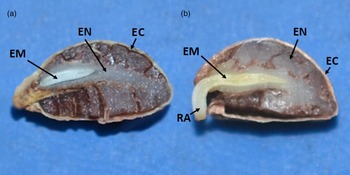
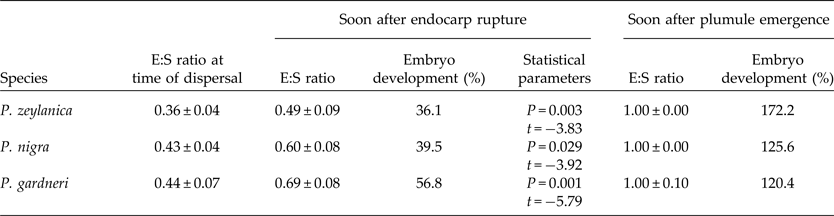
The E:S ratio of P. gardneri seeds at maturity and soon after the endocarp ruptured (after about 72 d of incubation) was 0.44 ± 0.07 and 0.69 ± 0.08, respectively. Embryo development (E:S ratio increment) reached 56.8% during this period. Similarly, the E:S ratio of the other two species increased during incubation prior to radicle emergence (Table 2, Fig. 2). Further, since embryo growth of P. gardneri continued until plumule emergence, the E:S ratio increased significantly between the time of endocarp rupture and plumule emergence (at 106 d of incubation) (F = 52.67, P < 0.001).
Longitudinal cross-section of P. nigra seed: (a) freshly matured seed and (b) just after radicle emergence. EC, endocarp; EM, embryo; EN, endosperm; RA, emerged radicle.

Development of embryo, i.e. embryo length:seed length ratio (E:S), from time of dispersal until radicle and plumule emergence of P. gardneri. P. zeylanica and P. nigra seeds (mean seed E:S ± 1 SD). P value < 0.05 indicates significant differences between E:S ratio at dispersal maturity and at the time of germination (radicle emergence)

Gibberellic acid treatment
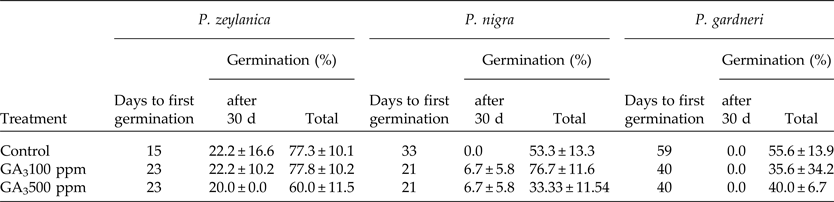
The percentage germination of P. nigra seeds was increased by 100 ppm GA3, but treatment with GA3 had no effect on germination of the other two species (Table 3). However, first germination of P. nigra and P. gardneri seeds was observed earlier than that of the control when they were treated with either concentration of GA3.
Germination (mean % ± SD) and days to first germination of P. zeylanica, P. nigra and P. gardneri seeds on filter papers moistened with 100 ppm or 500 ppm gibberellic acid (GA3) solutions or with distilled water (as the control)

Germination of all species after 30 d under GA3 treatments was not significantly different from that of the control (P P. nigra = 0.100, P P. zeylanica = 0.946). Similarly, total germination of P. zeylanica and P. gardneri seeds in the GA3 treatment was not significantly different from that of the control (P P. zeylanica = 0.111 and P P. gardneri = 0.133). However, total germination of P. nigra in the GA3 treatment was significantly different from the control (P P. nigra = 0.003).
Effect of temperature on seed germination
The highest germination of P. nigra seeds (53.3%) was observed at 25°C, and none of the seeds germinated at 8, 15 or 35°C. All the temperature changes caused a delay in the time to first germination of P. nigra seeds compared to that of the control. In P. zeylanica, 60.0% of the seeds germinated at 25°C, 16.7% germinated at 15°C and none germinated at 35°C. Temperature alterations did not significantly increase the final germination percentage of P. zeylanica seeds compared to that of the control at constant 25°C. Except for 15 → 25°C and 8 → 25°C, temperature changes decreased the germination percentage compared to that of the control (Fig. 3).
Germination percentages of P. zeylanica seeds under different temperature treatments after 30 and 90 d. Germination was grouped by one-way ANOVA using the Tukey method, at 95% CI under Tukey's family error rate of 15. Error bars are + SD.

Epicotyl dormancy
At 25°C, an average of 54.1 ± 8.6 and 134.4 ± 10.5 d were required for the beginning of radicle and plumule emergence, respectively, for P. zeylanica seeds. Furthermore, 53.1 ± 8.6 and 135.7 ± 12.0 d were required for the beginning of radicle and plumule emergence, respectively, when seeds were incubated at 15°C. No significant effect of temperature was observed on either time or percentage of plumule or radicle emergence from P. zeylanica seeds. At 25°C on tissue papers moistened with distilled water, the radicle and plumule emerged from P. nigra seeds after 42.6 ± 14.8 and 92.2 ± 28.5 d, respectively; plumule emergence was first observed after 54 d. However, radicles emerged from P. nigra seeds within 30.5 ± 5.4 d when seeds were incubated on tissue papers moistened with GA3 solutions. Seeds incubated on GA3 solutions did not show first plumule emergence until 61 d from the date of incubation. Unfortunately, no observations were made after 61 d, since all the emerged radicles died due to dehydration of the medium.
Morphological development of the plumule
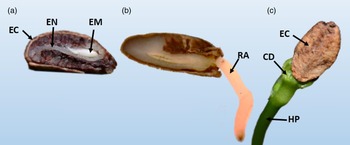
Seeds of the three species contained a linear embryo, and they showed epigeal germination. The E:S ratio of P. gardneri seeds, which was 0.44 ± 0.07 initially, increased to 0.69 ± 0.08 by the time of endocarp rupture and continued to increase to 0.95 ± 0.12 by the time of plumule emergence (Fig. 4). The E:S length ratio of the other two species also increased with a similar trend prior to radicle and plumule emergence (Table 2). Cotyledons developed within the seed, using all the space inside the seed that previously was occupied by the endosperm (Fig. 5).
Change in embryo length:seed length (E:S) ratio of P. gardneri during the incubation period. The short-dashed line indicates the time (~67 d) of radicle emergence, while the long-dashed line indicates the time (~106 d) of plumule emergence. Stirling's exponential growth curve was fitted to identify the embryo development trend. Error bars are ± SD.

Embryo development in P. zeylanica seeds from incubation to complete cotyledon development, i.e. plumule emergence. (a) The small embryo of a fresh intact seed after imbibition in distilled water for 24 h; (b) the embryo after radicle emergence, 34 d after the beginning of incubation; and (c) the fully developed embryo (cotyledons) just before plumule emergence after 125 d. CD, cotyledons; EC, endocarp; EN, endosperm; EM, embryo; HP, hypocotyl; RA, radicle.

Discussion
Germination tests conducted in the light at 25°C revealed that P. zeylanica seeds first showed germination within 1 month, while those of P. nigra took a little over 1 month and those of P. gardneri took about 2 months to show first germination. Furthermore, all the viable seeds of P. zeylanica and P. nigra completed germination within 3 months. However, seeds of the three studied Psychotria spp. took >30 d to reach 50% germination (GT50 based on the viable seeds), indicating that they had some kind of dormancy. Since the final increase in mass of non-scarified and manually scarified seeds of P. gardneri and of P. zeylanica did not differ significantly, we concluded that seeds of these species are not physically dormant. Seeds of the three Psychotria species have a small embryo with a prominent endosperm, and the embryo grew within the seed prior to radicle emergence. The embryo length:seed length ratio of P. zeylanica, P. nigra and P. gardneri increased 36, 40 and 57%, respectively, by the time of radicle emergence. Thus, seeds of the three species have a morphological component to their dormancy. Generally, seeds with morphological dormancy (MD) tend to germinate within 1 month. Since the GT50 of seeds of the three Psychotria spp. was >30 d, these seeds also have physiological dormancy (PD). Therefore, seeds of these three species have a combination of MD and PD, i.e. morphophysiological dormancy (MPD; Baskin and Baskin, Reference Baskin and Baskin2004). Further, since embryo growth within the seeds of the studied species occurred under warm conditions, seeds have one of the simple levels of MPD. In seeds with one of the complex levels of MPD, embryos required low (0–10°C) temperatures for growth (Baskin and Baskin, Reference Baskin and Baskin2014).
PD has been classified into three levels: non-deep, intermediate and deep (Baskin and Baskin, Reference Baskin and Baskin2004, Reference Baskin and Baskin2014). Non-deep PD can be alleviated by GA3, while intermediate PD may or may not be broken by GA3 and deep PD is not broken by GA3 (Nikolaeva, Reference Nikolaeva and Khan1977). Our experiments revealed that 100 ppm GA3 had no effect on radicle emergence of the three study species (Table 3). All the viable P. zeylanica and P. nigra seeds had an emerged radicle after incubation for 3 months at 25°C, i.e. ~3 months of warm stratification at 25°C were required to break the physiological component of radicle dormancy in seeds of these two species. This warm stratification requirement is confirmed by the results of the temperature transfer experiments. Seeds transferred from different temperatures took 3 months at 25°C to germinate. Furthermore, in the standard germination test, warm stratification at 25°C for 3 months promoted radicle emergence in seeds of P. gardneri. Thus, it can be concluded that the PD in radicles of the study species is non-deep. In the standard germination test, 22.2% of P. zeylanica seeds had an emerged radicle within 1 month, indicating that the radicle in this portion of the seeds was non-dormant, while that in the remaining seeds had non-deep PD.
Furthermore, it took more than 30 d for the shoots to emerge from radicle-emerged seeds of P. zeylanica, P. nigra and P. gardneri, revealing that they have epicotyl MPD (eMPD; Baskin and Baskin, Reference Baskin and Baskin2014). Remarkably, germinated seeds of P. zeylanica remained more than 125 d with a dormant epicotyl in light at 25 and 15°C. Shoot emergence of P. nigra seeds with an emerged radicle was first seen within 54 d under standard conditions, while none of the plumules emerged in the GA3 treatment until 61 d. Thus, plumule emergence of P. nigra seeds was not enhanced by the GA3 treatment. However, epicotyls emerged from seeds of all three species when they were incubated at 25°C for long periods of time (~4 months). Thus, we can conclude that seeds of these Psychotria spp. have non-deep simple epicotyl MPD (Baskin and Baskin Reference Baskin and Baskin2014). The dormancy of the seeds of these species can be described as C1bBb (radicle)–C1bBb (epicotyl). C1b means that the root and epicotyl have non-deep PD that is broken by warm stratification, and Bb means that the embryo grows prior to radicle emergence and also prior to epicotyl emergence under warm conditions. This is the first report of epicotyl MPD in the Rubiaceae.
Epicotyl MPD not only occurs in seeds of various temperate species (Baskin and Baskin, Reference Baskin and Baskin2014), but it has also been reported in a few tropical species, e.g. Virola koschnyi (Myristicaceae) and Minquartia guianensis (Olacaceae) (Flores et al., Reference Flores, Poulsen and Stubsgaard1996). Seeds of some temperate [Quercus alba, Quercus prinus (Farmer, Reference Farmer1977)] and some tropical/subtropical species [Calophyllum brasiliensis, Lecythis ampla (Flores et al., Reference Flores, Poulsen and Stubsgaard1996), Garcinia kola (Agyili et al., Reference Agyili, Sacande, Koffi and Peprah2007), Humboldtia laurifolia, Brownea coccinea and Cynometra cauliflora (Jayasuriya et al., Reference Jayasuriya, Wijetunga, Baskin and Baskin2012)] with fully developed embryos have been reported to have epicotyl PD (ePD) (Jayasuriya et al., Reference Jayasuriya, Wijetunga, Baskin and Baskin2012).
Seeds of P. nigra dried from 38 to 14% MC germinated to 87%, and those of P. gardneri dried from 25 to 12% germinated to 60%. Thus, P. nigra and P. gardneri seeds have the ability to tolerate desiccation and have either intermediate or orthodox storage behaviour. Since P. zeylanica seeds with an initial MC of 15.9% are dispersed during the dry season, it is assumed they have either intermediate or orthodox storage behaviour, which would help to explain how they remain viable during the dormancy period when exposed to dry habitat conditions.
We recommend incubating montane Psychotria seeds at temperatures greater than 15°C and less than 35°C to obtain a maximum number of seedlings from a seed lot. However, even under these optimum conditions, P. nigra and P. zeylanica seeds took 2 months and 3 months, respectively, for the radicles, and another 2 months for the shoots, to emerge. Further, P. gardneri seeds take more than 4 months to produce seedlings. Thus, if seedlings of these three species are needed, it is important to plan the nursery activities properly. These species should be sown about 4–5 months before the time seedlings are required.
Several hypotheses have been proposed to help explain the ecological significance of epicotyl dormancy. Baskin and Baskin (Reference Baskin and Baskin1985) have suggested that epicotyl dormancy may be an adaptation that allows seedlings of species in temperate deciduous forests to have a well-developed root system at the time of cotyledon expansion in early spring. Thus, the shoot has the maximum period of time for growth before canopy closure occurs due to expansion of leaves of the deciduous trees. Furthermore, Jayasuriya et al. (Reference Jayasuriya, Wijetunga, Baskin and Baskin2012) have suggested that the presence of epicotyl PD in tropical recalcitrant seeds may be a good adaptation for plants to remain in the understorey until they are exposed to suitable light conditions. Radicle emergence soon after dispersal serves to help maintain viability of the seed via uptake of water. However, seedlings may require a higher light intensity for growth than that occurring under a tropical forest canopy. If plants persist as seedlings with an emerged shoot until a canopy gap is formed, the more palatable parts of the seedling (shoot) could be attacked by pathogens or predators. However, if plants persist as seedlings with the epicotyl dormant, the more palatable shoot parts are protected by the protective layers (seed coats or endocarp) until shoots emerge when they receive suitable light conditions.
Although much more needs to be known to fully understand the significance of epicotyl dormancy in the life history of these species, the available information on two of the Psychotria species suggests a possible adaptive mechanism. The peak season of seed dispersal of P. zeylanica, which is common in the Horton Plains forests, is from December to February, during which time these montane forests experience dry, low temperature (<15°C) conditions. Temperatures start to increase in mid-February and reach a peak (about 25°C) by March–April; the rainy season begins in April and peaks in July. According to our results, seeds of P. zeylanica require about 2 months of warm stratification (at 25 or 15°C) before the radicle emerges. Thus, most of the P. zeylanica seeds could germinate (radicle emergence) at the end of March to mid-April, and we have seen seedlings in the field at this time (Athugala, pers. obs.). By the time the rainy season peaks in July, the root system of P. zeylanica is well developed, and epicotyl dormancy has been alleviated after 3–4 months of warm stratification. Thus, plumules emerge by July–August when environmental conditions are favourable for rapid seedling establishment and growth. The same adaptive advantage of eMPD can be observed in P. nigra seeds in the Knuckles submontane forests. Peak seed dispersal occurs during mid-June to July when the environment is dry, and temperatures are high. A period of about 2 months of warm stratification is required to promote radicle emergence. Thus, the radicles emerge by the end of August to mid-September, at which time the rainy season has started and conditions are favourable for development of a deep root system. The epicotyl in P. nigra is dormant and requires about 3 months of warm stratification for dormancy break to occur, resulting in plumule emergence by mid-October to November at the peak of the rainy season. Thus, dormancy of these two Psychotria species seems to be synchronizing radicle emergence to occur at the beginning of the rainy season and plumule emergence to occur at the peak of the rainy season when conditions are most favourable for rapid seedling development.
Acknowledgements
We wish to acknowledge Dr A.M. Karunaratne, Senior Lecture, Department of Botany, University of Peradeniya, Sri Lanka, for critically reading the manuscript, and to the Forest Department and the Wild Life Department of Sri Lanka for permission to collect seeds from the forest reserves.
Financial support
This work was supported by the National Research Council, Sri Lanka (grant number 11/091).
Conflicts of interest
None.